ENDOMETRIAL PREPARATION IN FROZEN EMBRYO TRANSFER CYCLES Muammer  DOGAN, Assoc. Prof.  MD
ENDOMETRIAL PREPARATION  IN FROZEN EMBRYO TRANSFER CYCLES Natural cycle Hormon Controlled cycle ->   GnRH-a programmed with E2 and P administration -> Non GnRH-a programmed with E2 and P administration
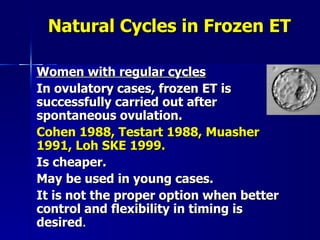
Natural Cycles in Frozen ET Women with regular cycles In ovulatory cases, frozen ET is successfully carried out after spontaneous ovulation. Cohen 1988, Testart 1988, Muasher 1991, Loh SKE 1999. Is cheaper. May be used in young cases.  It is not the proper option when better control and flexibility in timing is desired .
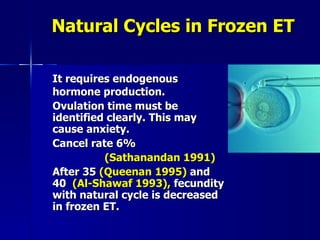
Natural Cycles in Frozen ET It requires endogenous hormone production. Ovulation time must be identified clearly. This may cause anxiety.  Cancel rate 6%  (Sathanandan 1991) After 35  (Queenan 1995)  and 40  (Al-Shawaf 1993),  fecundity with natural cycle is decreased in frozen ET.
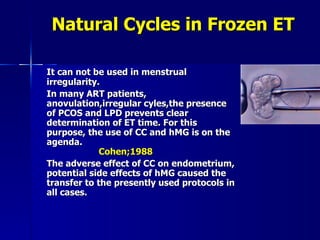
Natural Cycles in Frozen ET It can not be used in menstrual irregularity.  In many ART patients, anovulation,irregular cyles,the presence of PCOS and LPD prevents clear determination of ET time. For this purpose, the use of CC and hMG is on the agenda.  Cohen;1988 The adverse effect of CC on endometrium, potential side effects of hMG caused the transfer to the presently used protocols in all cases.
Natural Cycles in Frozen ET 4 days before ovulation monitorization in  ~ D8- D10   (USG, E2, LH, P) DF › 14 mm LH measurement 2 days after ovulation ( DF loss in USG, 2SD increase from the basal in P ) and 3 days after LH peak -> ET  Progesteron support is not usually required. Sometimes P   may be given for luteal support.
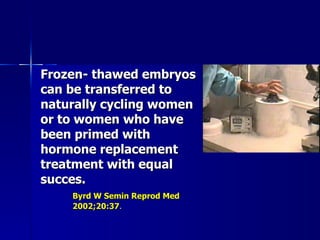
Frozen- thawed embryos can be transferred to naturally cycling women or to women who have been primed with hormone replacement treatment with equal succes. Byrd W Semin Reprod Med  2002;20:37 .
Hormonally Manipulated Cycles in Frozen ET In cases whose ovary is functional but who have  anovulatory and irregular cycles , frozen ET should be carried out only after adequate endometrial preparation. In these cases, ovulation may be induced by CC or hMG or ET may be performed after ovulation. Van der Auwera;1994.
Hormonally Manipulated Cycles in Frozen ET The fact that adequate endometrial preparation can be carried out with exogenous hormone administration was originially demonstrated by Navot et al. Navot;1989
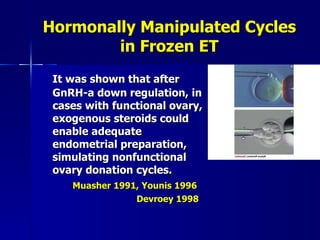
Hormonally Manipulated Cycles in Frozen ET It was shown that after GnRH-a down regulation, in cases with functional ovary, exogenous steroids could enable adequate endometrial preparation, simulating nonfunctional ovary donation cycles. Muasher 1991, Younis 1996   Devroey 1998
Hormonally Manipulated Cycles in Frozen ET GnRH-a Employment Advantages It simplifies the synchronization between embryo and endometrial development.  (E.g;anovulation and irregular cycle) It decreases the need for USG and endocrine monitorization The rate of cancellation decreases. Transfer time is more readily controlled. Smitz 1992, Keltz 1995.
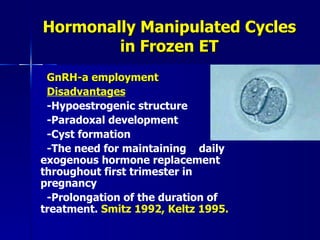
Hormonally Manipulated Cycles in Frozen ET GnRH-a employment Disadvantages -Hypoestrogenic structure -Paradoxal development -Cyst formation -The need for maintaining  daily exogenous hormone replacement throughout first trimester in pregnancy -Prolongation of the duration of treatment.  Smitz 1992, Keltz 1995.
Hormonally Manipulated Cycles in Frozen ET GnR-a, is  necessary  for sufficient endometrial hormonal manipulation in anovulatory frozen ET cases with functional ovary. Meldrum DR 1989, Remohij 1995,  Younis JS 1996, El-Toukhy T;2004. The employment of GnRH-a for controlled endometrial preparation in recipients with functional ovaries in frozen ET programs is  not necessary . de Ziegler D 1991, Pattison HA  1992, Yen B 1995, Queenan JT 1997, Simon A 1998, Oborna I 2004.
Hormonally Manipulated Cycles in Frozen ET E can be given, Orally, transdermally, vaginally, s.c P can be given Orally, IM, vaginally, nasally, rectally, sublingually The best route of administration of E and P in preparation for ET is unclear .
In endometrial preparation in Frozen ET cases, there is no difference between  sublingual P  (3x400mg) and  parenteral P (P in oil 50mg/g) with regard to IR. Dale WS; 1996.
Vaginal P (%8 Crinone)   V   İ.M  P (100 mg) Endometrial preparation was determined to be enough in all cases.  Patient compliance is better with vaginal use.  (less feeling of pain and discomfort) There is no difference in the rate and maintainance of pregnancy. Gibbons W;1998.
In programmed frozen ET, combined oral E2 and vaginal P employment is an effective, simple and inexpensive approach. There is no stastistically significant difference between IM and vaginal route in terms of P yield. Lightman A;1999.
The Estraderm TTS 100/Crinone 8% protocol seems to be superior to stimulation protocols and even to other protocols reported so far for artificial cycles with exogenous oestradiol and progesterone treatment. Bals-Pratch; 1999.
Hormonally Manipulated Cycles in Frozen ET  (  GnRH-a Programmed) D2(Follicular) V D21(Luteal)  GnRH-a  10-14 days  (Buserelin 500mcg, Nafarelin 2x2/g, Triptorelin 3.75 mg or 0.1mg/g,LA 0.5mg/d.) If Down regulation  (P‹ 0.5ng, E2 ‹50pg, LH ‹ 5 mIU)  did not occur, treatment is maintained for one more week and values are repeated After down regulation, the duration of proliferative phase which will last until the commencement of  progesteron  is approximately 12-20 days.
Hormonally Manipulated Cycles in Frozen ET  (  GnRH-a Programmed) HRT is initiated after down regulation. D1-D8  E2 Valerat or micronized E2    2 mg D9-D11    4 mg D12  6 mg D14 USG End > 8mm  Luteal support  Micronised P 2x400mg vaginal cap. Crinone  8% (90 mg) vaginal gel Cylogest 400 mg vag.tab 2X1
Hormonally Manipulated Cycles in Frozen ET  (  GnRH-a Programmed) D16-17 ET  (48-72 hours after P  ) After ET 14 day  β -hCG If pregnancy is present E2 8 mg and P at the same or twofold dose is administered until placental autonomy . Porcu E;1997.
Hormonally Manipulated Cycles in Frozen ET  (  GnRH-a Programmed) Transdermal E2  (Estraderm TTS 100) (Patch should be changed every two  days) After Down regülasyon; (e.g.;LA  0.5mg/g sc) D1-D8 E TTS 0.1  mg D9-D10 E TTS 0.2 mg D11-D12 E TTS 0.3 mg D13-D14 E TTS 0.4 mg D15  -> E TTS 0.2 mg Luteal support P İn oil 50mg IM. LA is discontinued.
Hormonally Manipulated Cycles in Frozen ET  (  GnRH-a Programmed) D17  ET After ET,  14th day  β -hCG If pregnancy is present, E2 ve P  dose administered until placental autonomy. Muasher;1991
Hormonally Manipulated Cycles in Frozen ET  (  GnRH-a Programmed) D1 Mikronised 17 β E2(Estrafem)  4mg/g 2x1 D7 E2, P, USG measurement E2 < 800pmol/L or End  < 8mm  Dose 6-8 mg/d is maintained for 5-10 more days End≥8mm Luteal support Mikronised P 3x300mg Vag . S imon A;1998 (First controlled randomized study )
Hormonally Manipulated Cycles in Frozen ET  (  GnRH-a Programmed)   48-72 hours after P ET After ET  14th day  β -hCG If pregnancy is present, this dose is given until placental autonomy S imon A;1998 (First controlled randomized study)
Hormonally Manipulated Cycles in Frozen ET  ( Non  GnRH-a Programmed) D1 Mikronised E2 Estrafem(6mg/d 3x1 p.o) (In previous schemes 2mg/d  Pattison;1992, Queenan;1997.) (Today, E2 treatment is started on cyle day 25 of the previous  cycle) The aim of high dose E is supression of gonadotropic cells, follıculogenesis and the prevention of LH peak.) D7 E2, End. thickness (End ≥8mm)   Luteal support (Mic.P 3x300mg vaginal)  (D7 – Luteal sup. P ≥6nmol/L  V D20 End. thickness  < 8 mm cycle cancellation)     Simon A;1999.
Hormonally Manipulated Cycles in Frozen ET  ( Non  GnRH-a Programmed) 48-72 hours after P -> ET 14th day after ET->  β -hCG If pregnancy is present, this dose is given until placental autonomy. The rate of cancellation is low,  The probability of premature P secretion is small. Conclusion : 6mg/d Mic. E2, gonadotropin secretion is sufficient for prevention of spontaneous ovulation and  endometrial preparation.   Simon A;1999.
Hormonally Manipulated Cycles in Frozen ET  ( Non  GnRH-a Programmed) Serum E2 level is unimportant in decision for ET. Only one serum P level measured with USG when starting P is enough for decision.  If endometrial thickness is adequate and premature P secretion is absent, P support may continue after ET.  Simon A;1999.
Hormonally Manipulated Cycles in Frozen ET  ( Non  GnRH-a Programmed) D1 4mg/g E2 Valerate D14 P measurement (for spontaneous ovulation) (p›0.9 ng/ml cycle cancellation) D15 Mic.P  300mg/g vaginal D19  ET D29 β -hCG If pregnancy is present, E2 and P dose x2 is maintained until placental autonomy. Lelaider C; 1995.
Hormonally Manipulated Cycles  in Frozen ET    ( Non  GnRH-a Programmed) The high PR observed after transferring blastoctsts on the 5th day of endometrial exposure to P in controlled E2 and P replacement cycles. Lelaider C; 1995.
Hormonally Manipulated Cycles in Frozen ET  ( Non  GnRH-a Programmed) Endometrial preparation with exogenous E and P without GnRH-a is simple, easy and efficient in frozen ET cases with active ovary.   Jaroudi;1991, Pattison HA;1992,  Lelaider C; 1995,  Queenan JT;1997,  Simon A; 1999, Dal Prato L;2002,
It seems to be appropriate to start progesterone administration before transfer in oocyte donation programmes as well as transfer of cryopreserved / thawed cell as soon as the endometrium is developed sufficiently (8mm,trilaminar pattern), and to perform the embryo transfer not before day 3 - 4 of progesterone treatment, i.e. embryo development on day 2-3. Nawroth F;2005.
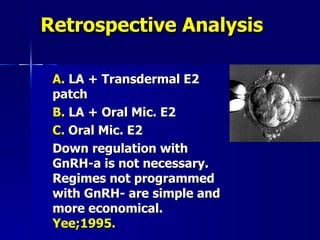
Retrospective Analysis A.  LA  +  Transdermal E2 patch B.  LA  +  Oral Mic. E2 C.  Oral Mic. E2 Down regulation with GnRH-a is not necessary. Regimes not programmed with GnRH- are simple and more economical.  Yee;1995.
A.  Naturel cycle  (Luteal P support) B.  Artificial preparation (GnRH-a  +  E2  +  P) C.  Ovarian Stimulation  (GnRH-a  +  hMG  +  hCG  +  P) Thre is no significant difference in terms of IR . Vasilios T;1996, Tanos V; 1996.
A-  400 mcg buserelin acetate + 6 mg E2 valerate +  (800 mg/d P) B-  6 mg E2 valerate  (800 mg/d P) Medicated frozen embryo replacement cycles timed by endometrial thickness measurement alone without monitoring or suppression of ovarian activity are associated with reduced outcome. El-Toukhy T;2004.
In  Frozen EmbryoTransfer; Significant effect - Patient  age , number of embryos  replaced No significant effect - Duration of storage of embryos Stimulation type Cause of infertility ( Avery and Brinsden;1997)
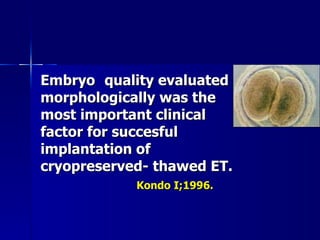
Embryo  quality evaluated morphologically was the most important clinical factor for succesful implantation of cryopreserved- thawed ET. Kondo I;1996.
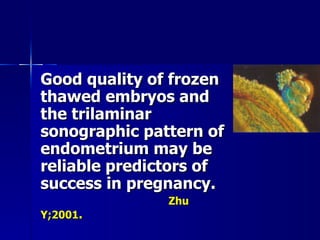
Good quality of frozen thawed embryos and the trilaminar sonographic pattern of endometrium may be reliable predictors of success in pregnancy.   Zhu Y;2001 .
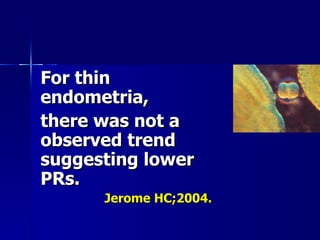
For thin endometria, there was not a observed trend suggesting lower PRs. Jerome HC;2004.
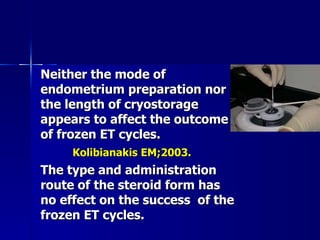
Neither the mode of endometrium preparation nor the length of cryostorage appears to affect the outcome of frozen ET cycles. Kolibianakis EM;2003. The type and administration route of the steroid form has no effect on the success  of the frozen ET cycles.
CONCLUSION- I Endometrial preparation is cheaper with natural cycles.  It can not be used in menstrual irregularity.  Therefore, it should be preferred in younger cases. It is not a suitable choice when better control and fleixbility in timing is desired.  The need for precise  determination of ovulation time may lead to anxiety.  Cancellation rate  % 6. In natural cycles, increased age decreases fecundity.
CONCLUSION- II Hormonal controlled cycle ;  In cases with functioning ovary but who have anovulatory or irregular cycles, it is necessary for adequate endometrial preparation. Therefore, as  programmed E2 and P replacement can be performed with GnRH-a , it can be carried out without this program.
CONCLUSION- III While previously  it was believed that with GnRH-a employment at the beginning, synchronization between embryo and endometrial development  was simplified, the need for USG and endocrin monitorization decreased,  cancellation rate was reduced and transfer time could be controlled more easily.
CONCLUSION- IV At present;  It has been established that endometrial preparation with exogenous E and P without using GnRH-a  is simple, easy , effective and economical in frozen ET cases with active ovaries. It is known that PR and IR in these cycles are the same with frozen ET cycles programmed with GnRH-a and naturel cycles.
CONCLUSION- V The type and administration route of the steroid form has no effect on the success  of the frozen ET cycles.
CONCLUSION- VI Good quality of frozen – thawed embryos and the trilaminar sonographic pattern of endometrium may be reliable predictors of success in pregnancy.
CONCLUSION- VII Embryo  quality evaluated morphologically was the most important clinical factor for succesful implantation of cryopreserved- thawed ET.
  CONCLUSION- VIII Neither the mode of endometrium preparation nor the length of cryostorage appears to affect the outcome of frozen ET cycles.

Fet endometrial preparation

  • 1.
    ENDOMETRIAL PREPARATION INFROZEN EMBRYO TRANSFER CYCLES Muammer DOGAN, Assoc. Prof. MD
  • 2.
    ENDOMETRIAL PREPARATION IN FROZEN EMBRYO TRANSFER CYCLES Natural cycle Hormon Controlled cycle -> GnRH-a programmed with E2 and P administration -> Non GnRH-a programmed with E2 and P administration
  • 3.
    Natural Cycles inFrozen ET Women with regular cycles In ovulatory cases, frozen ET is successfully carried out after spontaneous ovulation. Cohen 1988, Testart 1988, Muasher 1991, Loh SKE 1999. Is cheaper. May be used in young cases. It is not the proper option when better control and flexibility in timing is desired .
  • 4.
    Natural Cycles inFrozen ET It requires endogenous hormone production. Ovulation time must be identified clearly. This may cause anxiety. Cancel rate 6% (Sathanandan 1991) After 35 (Queenan 1995) and 40 (Al-Shawaf 1993), fecundity with natural cycle is decreased in frozen ET.
  • 5.
    Natural Cycles inFrozen ET It can not be used in menstrual irregularity. In many ART patients, anovulation,irregular cyles,the presence of PCOS and LPD prevents clear determination of ET time. For this purpose, the use of CC and hMG is on the agenda. Cohen;1988 The adverse effect of CC on endometrium, potential side effects of hMG caused the transfer to the presently used protocols in all cases.
  • 6.
    Natural Cycles inFrozen ET 4 days before ovulation monitorization in ~ D8- D10 (USG, E2, LH, P) DF › 14 mm LH measurement 2 days after ovulation ( DF loss in USG, 2SD increase from the basal in P ) and 3 days after LH peak -> ET Progesteron support is not usually required. Sometimes P may be given for luteal support.
  • 7.
    Frozen- thawed embryoscan be transferred to naturally cycling women or to women who have been primed with hormone replacement treatment with equal succes. Byrd W Semin Reprod Med 2002;20:37 .
  • 8.
    Hormonally Manipulated Cyclesin Frozen ET In cases whose ovary is functional but who have anovulatory and irregular cycles , frozen ET should be carried out only after adequate endometrial preparation. In these cases, ovulation may be induced by CC or hMG or ET may be performed after ovulation. Van der Auwera;1994.
  • 9.
    Hormonally Manipulated Cyclesin Frozen ET The fact that adequate endometrial preparation can be carried out with exogenous hormone administration was originially demonstrated by Navot et al. Navot;1989
  • 10.
    Hormonally Manipulated Cyclesin Frozen ET It was shown that after GnRH-a down regulation, in cases with functional ovary, exogenous steroids could enable adequate endometrial preparation, simulating nonfunctional ovary donation cycles. Muasher 1991, Younis 1996 Devroey 1998
  • 11.
    Hormonally Manipulated Cyclesin Frozen ET GnRH-a Employment Advantages It simplifies the synchronization between embryo and endometrial development. (E.g;anovulation and irregular cycle) It decreases the need for USG and endocrine monitorization The rate of cancellation decreases. Transfer time is more readily controlled. Smitz 1992, Keltz 1995.
  • 12.
    Hormonally Manipulated Cyclesin Frozen ET GnRH-a employment Disadvantages -Hypoestrogenic structure -Paradoxal development -Cyst formation -The need for maintaining daily exogenous hormone replacement throughout first trimester in pregnancy -Prolongation of the duration of treatment. Smitz 1992, Keltz 1995.
  • 13.
    Hormonally Manipulated Cyclesin Frozen ET GnR-a, is necessary for sufficient endometrial hormonal manipulation in anovulatory frozen ET cases with functional ovary. Meldrum DR 1989, Remohij 1995, Younis JS 1996, El-Toukhy T;2004. The employment of GnRH-a for controlled endometrial preparation in recipients with functional ovaries in frozen ET programs is not necessary . de Ziegler D 1991, Pattison HA 1992, Yen B 1995, Queenan JT 1997, Simon A 1998, Oborna I 2004.
  • 14.
    Hormonally Manipulated Cyclesin Frozen ET E can be given, Orally, transdermally, vaginally, s.c P can be given Orally, IM, vaginally, nasally, rectally, sublingually The best route of administration of E and P in preparation for ET is unclear .
  • 15.
    In endometrial preparationin Frozen ET cases, there is no difference between sublingual P (3x400mg) and parenteral P (P in oil 50mg/g) with regard to IR. Dale WS; 1996.
  • 16.
    Vaginal P (%8Crinone) V İ.M P (100 mg) Endometrial preparation was determined to be enough in all cases. Patient compliance is better with vaginal use. (less feeling of pain and discomfort) There is no difference in the rate and maintainance of pregnancy. Gibbons W;1998.
  • 17.
    In programmed frozenET, combined oral E2 and vaginal P employment is an effective, simple and inexpensive approach. There is no stastistically significant difference between IM and vaginal route in terms of P yield. Lightman A;1999.
  • 18.
    The Estraderm TTS100/Crinone 8% protocol seems to be superior to stimulation protocols and even to other protocols reported so far for artificial cycles with exogenous oestradiol and progesterone treatment. Bals-Pratch; 1999.
  • 19.
    Hormonally Manipulated Cyclesin Frozen ET ( GnRH-a Programmed) D2(Follicular) V D21(Luteal) GnRH-a 10-14 days (Buserelin 500mcg, Nafarelin 2x2/g, Triptorelin 3.75 mg or 0.1mg/g,LA 0.5mg/d.) If Down regulation (P‹ 0.5ng, E2 ‹50pg, LH ‹ 5 mIU) did not occur, treatment is maintained for one more week and values are repeated After down regulation, the duration of proliferative phase which will last until the commencement of progesteron is approximately 12-20 days.
  • 20.
    Hormonally Manipulated Cyclesin Frozen ET ( GnRH-a Programmed) HRT is initiated after down regulation. D1-D8 E2 Valerat or micronized E2 2 mg D9-D11 4 mg D12 6 mg D14 USG End > 8mm Luteal support Micronised P 2x400mg vaginal cap. Crinone 8% (90 mg) vaginal gel Cylogest 400 mg vag.tab 2X1
  • 21.
    Hormonally Manipulated Cyclesin Frozen ET ( GnRH-a Programmed) D16-17 ET (48-72 hours after P ) After ET 14 day β -hCG If pregnancy is present E2 8 mg and P at the same or twofold dose is administered until placental autonomy . Porcu E;1997.
  • 22.
    Hormonally Manipulated Cyclesin Frozen ET ( GnRH-a Programmed) Transdermal E2 (Estraderm TTS 100) (Patch should be changed every two days) After Down regülasyon; (e.g.;LA 0.5mg/g sc) D1-D8 E TTS 0.1 mg D9-D10 E TTS 0.2 mg D11-D12 E TTS 0.3 mg D13-D14 E TTS 0.4 mg D15 -> E TTS 0.2 mg Luteal support P İn oil 50mg IM. LA is discontinued.
  • 23.
    Hormonally Manipulated Cyclesin Frozen ET ( GnRH-a Programmed) D17 ET After ET, 14th day β -hCG If pregnancy is present, E2 ve P dose administered until placental autonomy. Muasher;1991
  • 24.
    Hormonally Manipulated Cyclesin Frozen ET ( GnRH-a Programmed) D1 Mikronised 17 β E2(Estrafem) 4mg/g 2x1 D7 E2, P, USG measurement E2 < 800pmol/L or End < 8mm Dose 6-8 mg/d is maintained for 5-10 more days End≥8mm Luteal support Mikronised P 3x300mg Vag . S imon A;1998 (First controlled randomized study )
  • 25.
    Hormonally Manipulated Cyclesin Frozen ET ( GnRH-a Programmed) 48-72 hours after P ET After ET 14th day β -hCG If pregnancy is present, this dose is given until placental autonomy S imon A;1998 (First controlled randomized study)
  • 26.
    Hormonally Manipulated Cyclesin Frozen ET ( Non GnRH-a Programmed) D1 Mikronised E2 Estrafem(6mg/d 3x1 p.o) (In previous schemes 2mg/d Pattison;1992, Queenan;1997.) (Today, E2 treatment is started on cyle day 25 of the previous cycle) The aim of high dose E is supression of gonadotropic cells, follıculogenesis and the prevention of LH peak.) D7 E2, End. thickness (End ≥8mm) Luteal support (Mic.P 3x300mg vaginal) (D7 – Luteal sup. P ≥6nmol/L V D20 End. thickness < 8 mm cycle cancellation) Simon A;1999.
  • 27.
    Hormonally Manipulated Cyclesin Frozen ET ( Non GnRH-a Programmed) 48-72 hours after P -> ET 14th day after ET-> β -hCG If pregnancy is present, this dose is given until placental autonomy. The rate of cancellation is low, The probability of premature P secretion is small. Conclusion : 6mg/d Mic. E2, gonadotropin secretion is sufficient for prevention of spontaneous ovulation and endometrial preparation. Simon A;1999.
  • 28.
    Hormonally Manipulated Cyclesin Frozen ET ( Non GnRH-a Programmed) Serum E2 level is unimportant in decision for ET. Only one serum P level measured with USG when starting P is enough for decision. If endometrial thickness is adequate and premature P secretion is absent, P support may continue after ET. Simon A;1999.
  • 29.
    Hormonally Manipulated Cyclesin Frozen ET ( Non GnRH-a Programmed) D1 4mg/g E2 Valerate D14 P measurement (for spontaneous ovulation) (p›0.9 ng/ml cycle cancellation) D15 Mic.P 300mg/g vaginal D19 ET D29 β -hCG If pregnancy is present, E2 and P dose x2 is maintained until placental autonomy. Lelaider C; 1995.
  • 30.
    Hormonally Manipulated Cycles in Frozen ET ( Non GnRH-a Programmed) The high PR observed after transferring blastoctsts on the 5th day of endometrial exposure to P in controlled E2 and P replacement cycles. Lelaider C; 1995.
  • 31.
    Hormonally Manipulated Cyclesin Frozen ET ( Non GnRH-a Programmed) Endometrial preparation with exogenous E and P without GnRH-a is simple, easy and efficient in frozen ET cases with active ovary. Jaroudi;1991, Pattison HA;1992, Lelaider C; 1995, Queenan JT;1997, Simon A; 1999, Dal Prato L;2002,
  • 32.
    It seems tobe appropriate to start progesterone administration before transfer in oocyte donation programmes as well as transfer of cryopreserved / thawed cell as soon as the endometrium is developed sufficiently (8mm,trilaminar pattern), and to perform the embryo transfer not before day 3 - 4 of progesterone treatment, i.e. embryo development on day 2-3. Nawroth F;2005.
  • 33.
    Retrospective Analysis A. LA + Transdermal E2 patch B. LA + Oral Mic. E2 C. Oral Mic. E2 Down regulation with GnRH-a is not necessary. Regimes not programmed with GnRH- are simple and more economical. Yee;1995.
  • 34.
    A. Naturelcycle (Luteal P support) B. Artificial preparation (GnRH-a + E2 + P) C. Ovarian Stimulation (GnRH-a + hMG + hCG + P) Thre is no significant difference in terms of IR . Vasilios T;1996, Tanos V; 1996.
  • 35.
    A- 400mcg buserelin acetate + 6 mg E2 valerate + (800 mg/d P) B- 6 mg E2 valerate (800 mg/d P) Medicated frozen embryo replacement cycles timed by endometrial thickness measurement alone without monitoring or suppression of ovarian activity are associated with reduced outcome. El-Toukhy T;2004.
  • 36.
    In FrozenEmbryoTransfer; Significant effect - Patient age , number of embryos replaced No significant effect - Duration of storage of embryos Stimulation type Cause of infertility ( Avery and Brinsden;1997)
  • 37.
    Embryo qualityevaluated morphologically was the most important clinical factor for succesful implantation of cryopreserved- thawed ET. Kondo I;1996.
  • 38.
    Good quality offrozen thawed embryos and the trilaminar sonographic pattern of endometrium may be reliable predictors of success in pregnancy. Zhu Y;2001 .
  • 39.
    For thin endometria,there was not a observed trend suggesting lower PRs. Jerome HC;2004.
  • 40.
    Neither the modeof endometrium preparation nor the length of cryostorage appears to affect the outcome of frozen ET cycles. Kolibianakis EM;2003. The type and administration route of the steroid form has no effect on the success of the frozen ET cycles.
  • 41.
    CONCLUSION- I Endometrialpreparation is cheaper with natural cycles. It can not be used in menstrual irregularity. Therefore, it should be preferred in younger cases. It is not a suitable choice when better control and fleixbility in timing is desired. The need for precise determination of ovulation time may lead to anxiety. Cancellation rate % 6. In natural cycles, increased age decreases fecundity.
  • 42.
    CONCLUSION- II Hormonalcontrolled cycle ; In cases with functioning ovary but who have anovulatory or irregular cycles, it is necessary for adequate endometrial preparation. Therefore, as programmed E2 and P replacement can be performed with GnRH-a , it can be carried out without this program.
  • 43.
    CONCLUSION- III Whilepreviously it was believed that with GnRH-a employment at the beginning, synchronization between embryo and endometrial development was simplified, the need for USG and endocrin monitorization decreased, cancellation rate was reduced and transfer time could be controlled more easily.
  • 44.
    CONCLUSION- IV Atpresent; It has been established that endometrial preparation with exogenous E and P without using GnRH-a is simple, easy , effective and economical in frozen ET cases with active ovaries. It is known that PR and IR in these cycles are the same with frozen ET cycles programmed with GnRH-a and naturel cycles.
  • 45.
    CONCLUSION- V Thetype and administration route of the steroid form has no effect on the success of the frozen ET cycles.
  • 46.
    CONCLUSION- VI Goodquality of frozen – thawed embryos and the trilaminar sonographic pattern of endometrium may be reliable predictors of success in pregnancy.
  • 47.
    CONCLUSION- VII Embryo quality evaluated morphologically was the most important clinical factor for succesful implantation of cryopreserved- thawed ET.
  • 48.
    CONCLUSION-VIII Neither the mode of endometrium preparation nor the length of cryostorage appears to affect the outcome of frozen ET cycles.

Editor's Notes