Pain and Pain pathways
S. Parasuraman, M.Pharm., Ph.D.,
Associate Professor,
Faculty of Pharmacy, AIMST University
Learning Outcomes
• Upon successful completion of this topic, students
should be able to:
– Upon successful completion of this topic, students
should be able to:
– classify pain. (CLO1)
– List the sources of pain. (CLO1)
– explain various pain pathways. (CLO1)
Pain
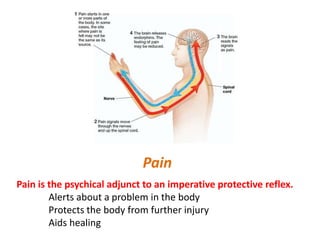
Pain is the psychical adjunct to an imperative protective reflex.
Alerts about a problem in the body
Protects the body from further injury
Aids healing
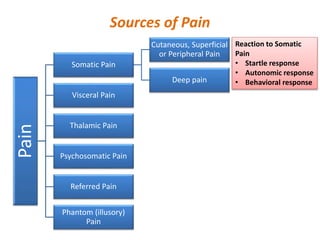
Sources of PainPain
Somatic Pain
Cutaneous, Superficial
or Peripheral Pain
Deep pain
Visceral Pain
Thalamic Pain
Psychosomatic Pain
Referred Pain
Phantom (illusory)
Pain
Reaction to Somatic
Pain
• Startle response
• Autonomic response
• Behavioral response
Sources of Pain
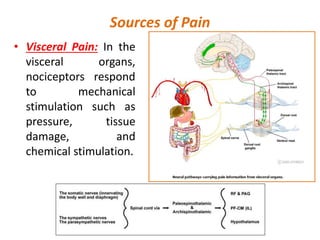
• Visceral Pain: In the
visceral organs,
nociceptors respond
to mechanical
stimulation such as
pressure, tissue
damage, and
chemical stimulation.
Sources of Pain
• Thalamic Pain: It also called as Dejerine–Roussy
syndrome. Stroke or occlusion in the
thalamogeniculate artery, which supplies the
lateroposterior half of the thalamus, can result in a
thalamic lesion, which is often accompanied by
neurologic conditions several months after the initial
event.
• Neuropathic Pain: It is a sharp, shooting and
devastating pain.
• Psychosomatic Pain: Psychic reaction to pain includes
all the well-known responses to pain such as anguish,
anxiety, crying, depression, nausea and excess
muscular excitability through the body.
Sources of Pain
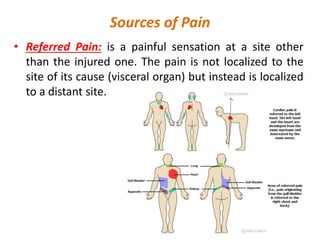
• Referred Pain: is a painful sensation at a site other
than the injured one. The pain is not localized to the
site of its cause (visceral organ) but instead is localized
to a distant site.
Sources of Pain
• Phantom (illusory) Pain: It is the experience of pain
without any signals from nociceptors.
Pathological classification of pain
• Nociceptive: represents the normal response to
noxious injury of tissues.
• Neuropathic: Pain initiated or caused by a primary
lesion in the somatosensory nervous system.
• Inflammatory: Activation and sensitization of the
nociceptive pain pathway by a variety of mediators
released at a site of tissue inflammation.
Time course: Pain duration
• Acute pain (less than 3 to 6 months duration): Pain
arises from activation of nociceptors for a limited time
and is not associated with significant tissue damage
(e.g., a pin prick).
• Chronic pain (more than 3-6 months): It is prolonged
pain lasting for months or longer that arises from
tissue injury, inflammation, nerve damage, tumor
growth, lesion or occlusion of blood vessels.
• Fibromyalgia: It is characterized by widespread
chronic pain throughout the body, including fatigue,
anxiety and depression.
Pain pathways
Pain pathways
• Pain has a biologically important protective function.
• Manifestations of pain related to tissue injury including
hyperalgesia, an exaggerated response to a noxious
stimulus, and allodynia, the perception of pain from
normally innocuous stimuli.
• Hyperalgesia and allodynia are the result of changes in
either the peripheral or central nervous systems and
causes peripheral or central sensitization, respectively.
Pain pathways
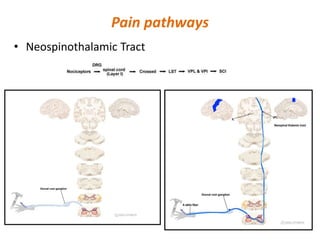
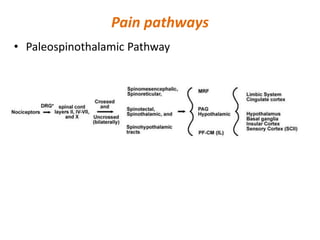
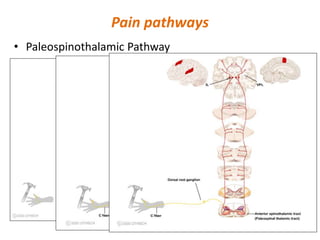
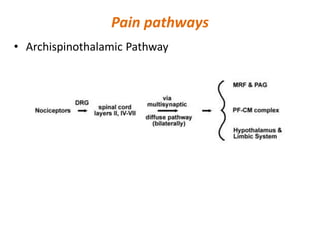
• The ascending pathways that mediate pain consist of
three different tracts:
– Neospinothalamic tract
– Paleospinothalamic tract
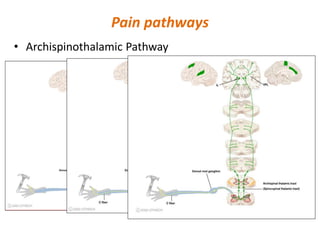
– Archispinothalamic tract
Pain pathways
• Neospinothalamic Tract
Pain pathways
• Paleospinothalamic Pathway
Pain pathways
• Paleospinothalamic Pathway
Pain pathways
• Archispinothalamic Pathway
Pain pathways
• Archispinothalamic Pathway
Pain Receptors
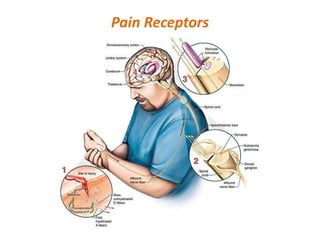
Pain Receptors
Nociceptors
• Neurotrophin receptors
– tyrosine kinase (trKA) receptor
– transient receptor potential (vanilloid) receptors
• TRPV I receptors
• TRPV3 receptors
• Tachykinin receptors
• Purinergic receptors
• Adenosine triphosphate receptors
• Opioid receptors
• Cannabinoid receptors
Pain Receptors
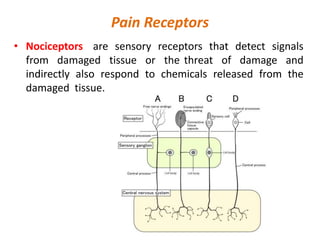
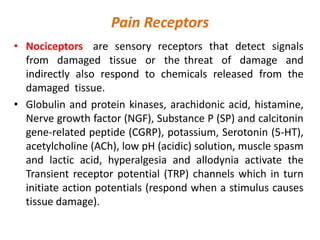
• Nociceptors are sensory receptors that detect signals
from damaged tissue or the threat of damage and
indirectly also respond to chemicals released from the
damaged tissue.
Pain Receptors
• Nociceptors are sensory receptors that detect signals
from damaged tissue or the threat of damage and
indirectly also respond to chemicals released from the
damaged tissue.
• Globulin and protein kinases, arachidonic acid, histamine,
Nerve growth factor (NGF), Substance P (SP) and calcitonin
gene-related peptide (CGRP), potassium, Serotonin (5-HT),
acetylcholine (ACh), low pH (acidic) solution, muscle spasm
and lactic acid, hyperalgesia and allodynia activate the
Transient receptor potential (TRP) channels which in turn
initiate action potentials (respond when a stimulus causes
tissue damage).
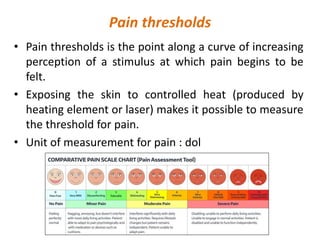
Pain thresholds
• Pain thresholds is the point along a curve of increasing
perception of a stimulus at which pain begins to be
felt.
• Exposing the skin to controlled heat (produced by
heating element or laser) makes it possible to measure
the threshold for pain.
• Unit of measurement for pain : dol
Thank you

Pathophysiology pain and pain pathways

  • 1.
    Pain and Painpathways S. Parasuraman, M.Pharm., Ph.D., Associate Professor, Faculty of Pharmacy, AIMST University
  • 2.
    Learning Outcomes • Uponsuccessful completion of this topic, students should be able to: – Upon successful completion of this topic, students should be able to: – classify pain. (CLO1) – List the sources of pain. (CLO1) – explain various pain pathways. (CLO1)
  • 3.
    Pain Pain is thepsychical adjunct to an imperative protective reflex. Alerts about a problem in the body Protects the body from further injury Aids healing
  • 4.
    Sources of PainPain SomaticPain Cutaneous, Superficial or Peripheral Pain Deep pain Visceral Pain Thalamic Pain Psychosomatic Pain Referred Pain Phantom (illusory) Pain Reaction to Somatic Pain • Startle response • Autonomic response • Behavioral response
  • 5.
    Sources of Pain •Visceral Pain: In the visceral organs, nociceptors respond to mechanical stimulation such as pressure, tissue damage, and chemical stimulation.
  • 6.
    Sources of Pain •Thalamic Pain: It also called as Dejerine–Roussy syndrome. Stroke or occlusion in the thalamogeniculate artery, which supplies the lateroposterior half of the thalamus, can result in a thalamic lesion, which is often accompanied by neurologic conditions several months after the initial event. • Neuropathic Pain: It is a sharp, shooting and devastating pain. • Psychosomatic Pain: Psychic reaction to pain includes all the well-known responses to pain such as anguish, anxiety, crying, depression, nausea and excess muscular excitability through the body.
  • 7.
    Sources of Pain •Referred Pain: is a painful sensation at a site other than the injured one. The pain is not localized to the site of its cause (visceral organ) but instead is localized to a distant site.
  • 8.
    Sources of Pain •Phantom (illusory) Pain: It is the experience of pain without any signals from nociceptors.
  • 9.
    Pathological classification ofpain • Nociceptive: represents the normal response to noxious injury of tissues. • Neuropathic: Pain initiated or caused by a primary lesion in the somatosensory nervous system. • Inflammatory: Activation and sensitization of the nociceptive pain pathway by a variety of mediators released at a site of tissue inflammation.
  • 10.
    Time course: Painduration • Acute pain (less than 3 to 6 months duration): Pain arises from activation of nociceptors for a limited time and is not associated with significant tissue damage (e.g., a pin prick). • Chronic pain (more than 3-6 months): It is prolonged pain lasting for months or longer that arises from tissue injury, inflammation, nerve damage, tumor growth, lesion or occlusion of blood vessels. • Fibromyalgia: It is characterized by widespread chronic pain throughout the body, including fatigue, anxiety and depression.
  • 11.
  • 12.
    Pain pathways • Painhas a biologically important protective function. • Manifestations of pain related to tissue injury including hyperalgesia, an exaggerated response to a noxious stimulus, and allodynia, the perception of pain from normally innocuous stimuli. • Hyperalgesia and allodynia are the result of changes in either the peripheral or central nervous systems and causes peripheral or central sensitization, respectively.
  • 13.
    Pain pathways • Theascending pathways that mediate pain consist of three different tracts: – Neospinothalamic tract – Paleospinothalamic tract – Archispinothalamic tract
  • 14.
  • 15.
  • 16.
  • 17.
  • 18.
  • 19.
  • 20.
    Pain Receptors Nociceptors • Neurotrophinreceptors – tyrosine kinase (trKA) receptor – transient receptor potential (vanilloid) receptors • TRPV I receptors • TRPV3 receptors • Tachykinin receptors • Purinergic receptors • Adenosine triphosphate receptors • Opioid receptors • Cannabinoid receptors
  • 21.
    Pain Receptors • Nociceptorsare sensory receptors that detect signals from damaged tissue or the threat of damage and indirectly also respond to chemicals released from the damaged tissue.
  • 22.
    Pain Receptors • Nociceptorsare sensory receptors that detect signals from damaged tissue or the threat of damage and indirectly also respond to chemicals released from the damaged tissue. • Globulin and protein kinases, arachidonic acid, histamine, Nerve growth factor (NGF), Substance P (SP) and calcitonin gene-related peptide (CGRP), potassium, Serotonin (5-HT), acetylcholine (ACh), low pH (acidic) solution, muscle spasm and lactic acid, hyperalgesia and allodynia activate the Transient receptor potential (TRP) channels which in turn initiate action potentials (respond when a stimulus causes tissue damage).
  • 23.
    Pain thresholds • Painthresholds is the point along a curve of increasing perception of a stimulus at which pain begins to be felt. • Exposing the skin to controlled heat (produced by heating element or laser) makes it possible to measure the threshold for pain. • Unit of measurement for pain : dol
  • 24.

Editor's Notes

  • #5 Deep Pain : The paleospinothalamic pathway and The archispinothalamic pathway.
  • #10 http://neuroscience.uth.tmc.edu/s2/chapter07.html#fig7_4
  • #11 http://neuroscience.uth.tmc.edu/s2/chapter07.html#fig7_4
  • #15 DRG: dorsal root ganglion