02/24/2025
2
ABJUNCTS IN TREATMENTOF ARDS
1. Ventilatory Strategies other than Lung Protective Strategy.
- Prone Ventilation
- Liquid Ventilation
- High Frequency Ventilation
- Tracheal Gas Insufflation
- Extracorporeal Gas Exchange
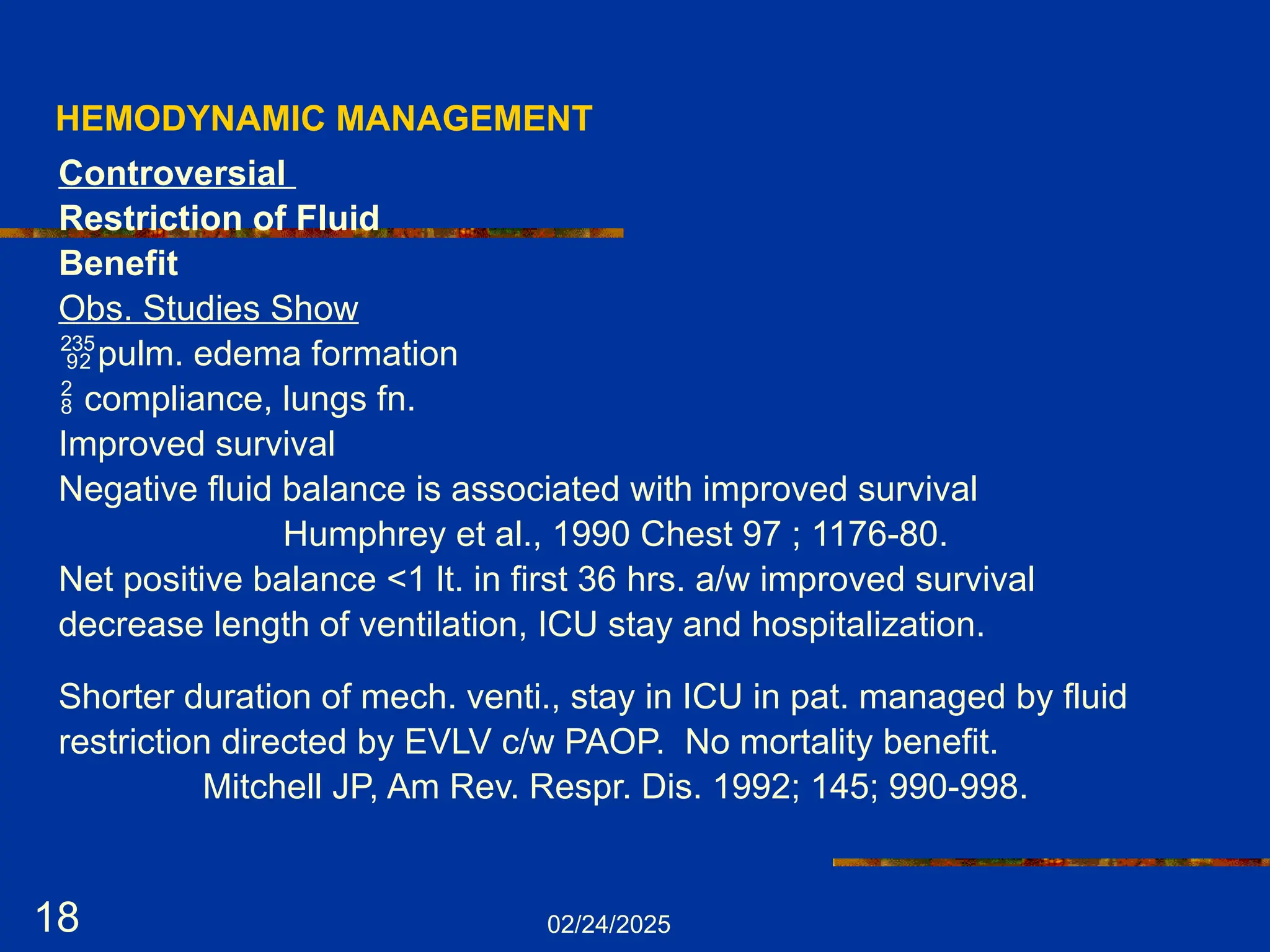
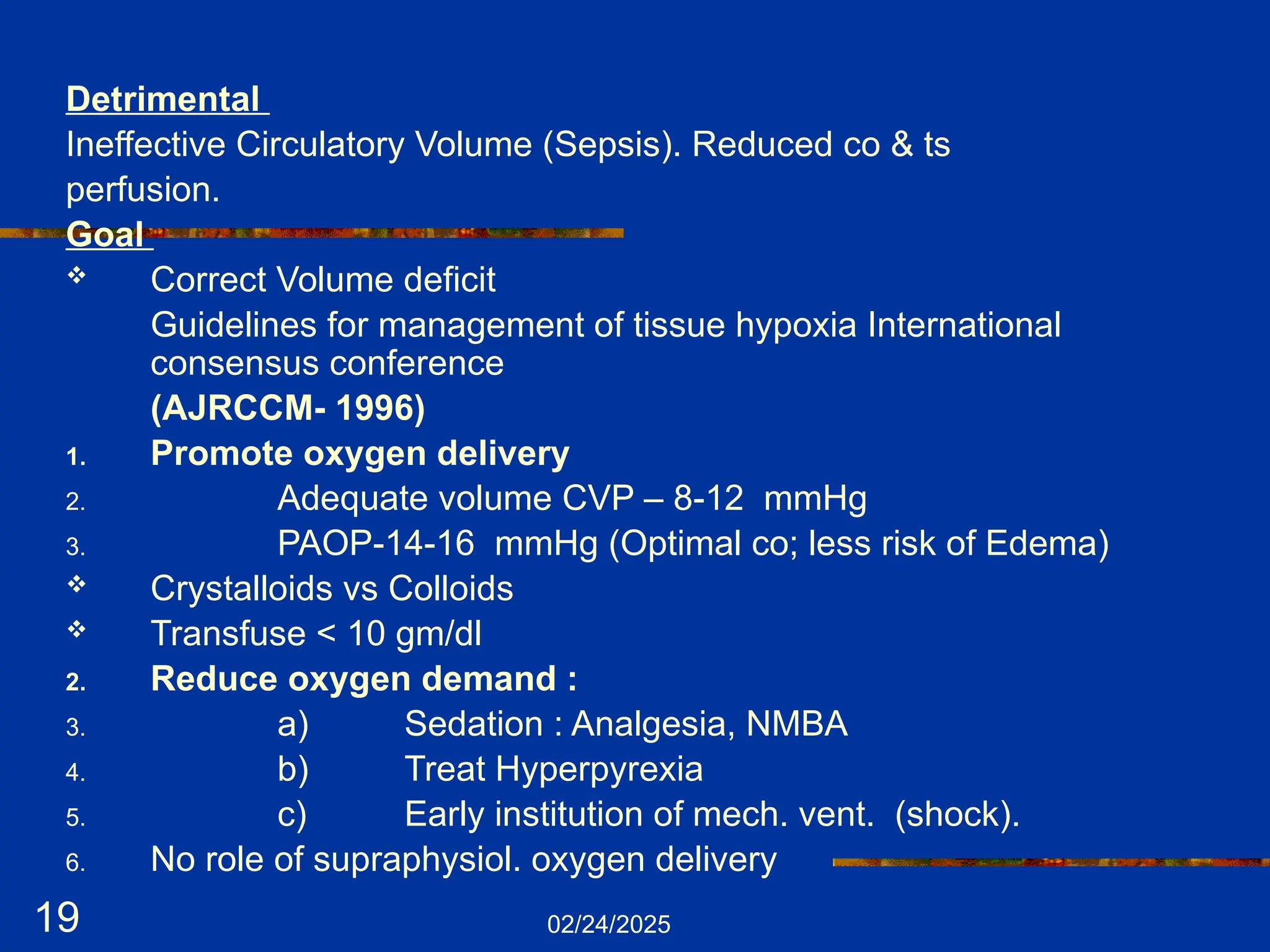
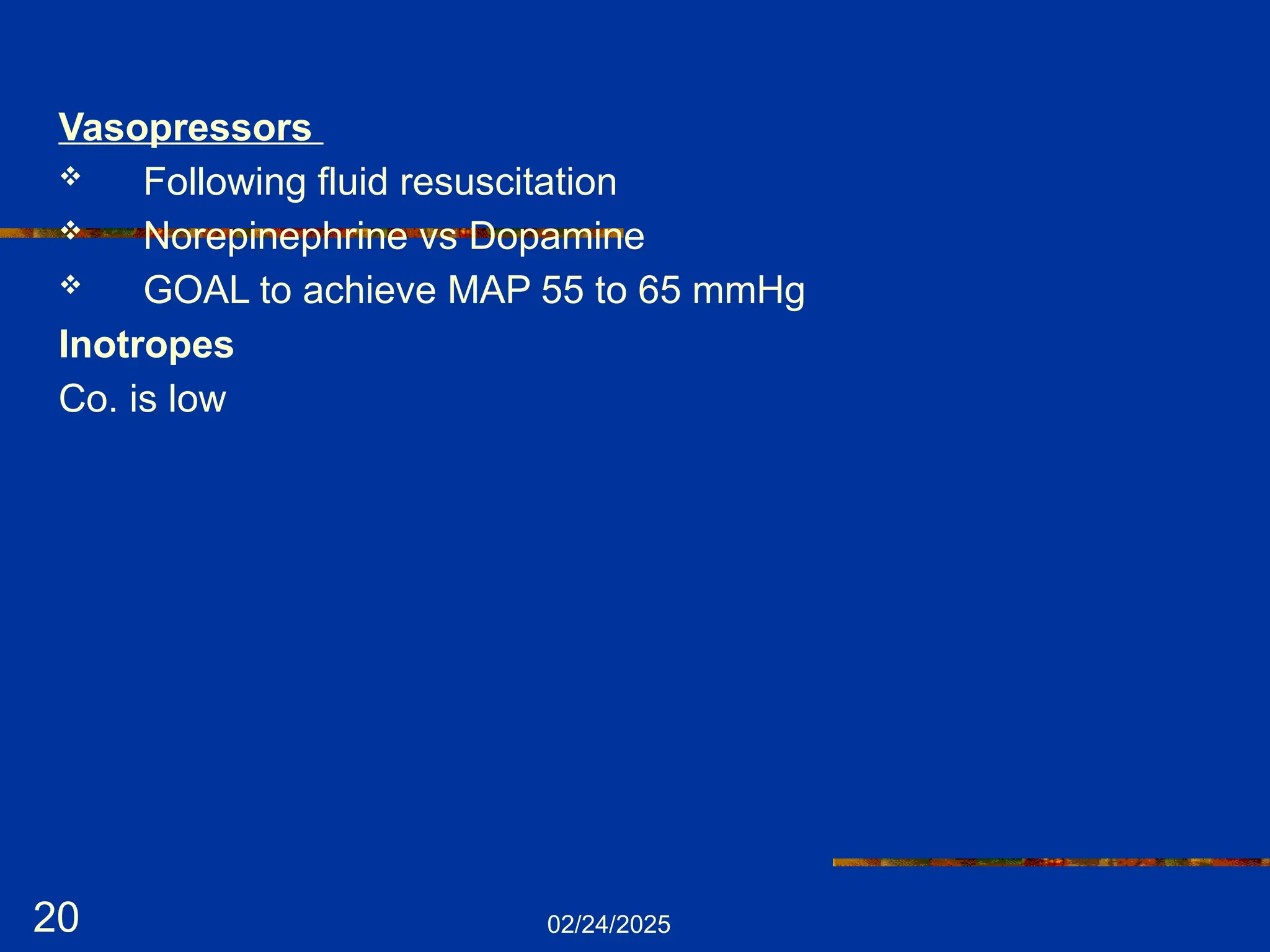
2. Hemodynamic Management – Fluids, Vasopressors.
3. Selective Pulmonary vasodilators.
4. Surfactant replacement therapy.
5. Anti-inflammatory Strategies.
6. a) Corticosteroids.
7. b) Cycloxygenase & lipoxygenase inhibitors.
8. c) Lisofylline and pentoxifylline.
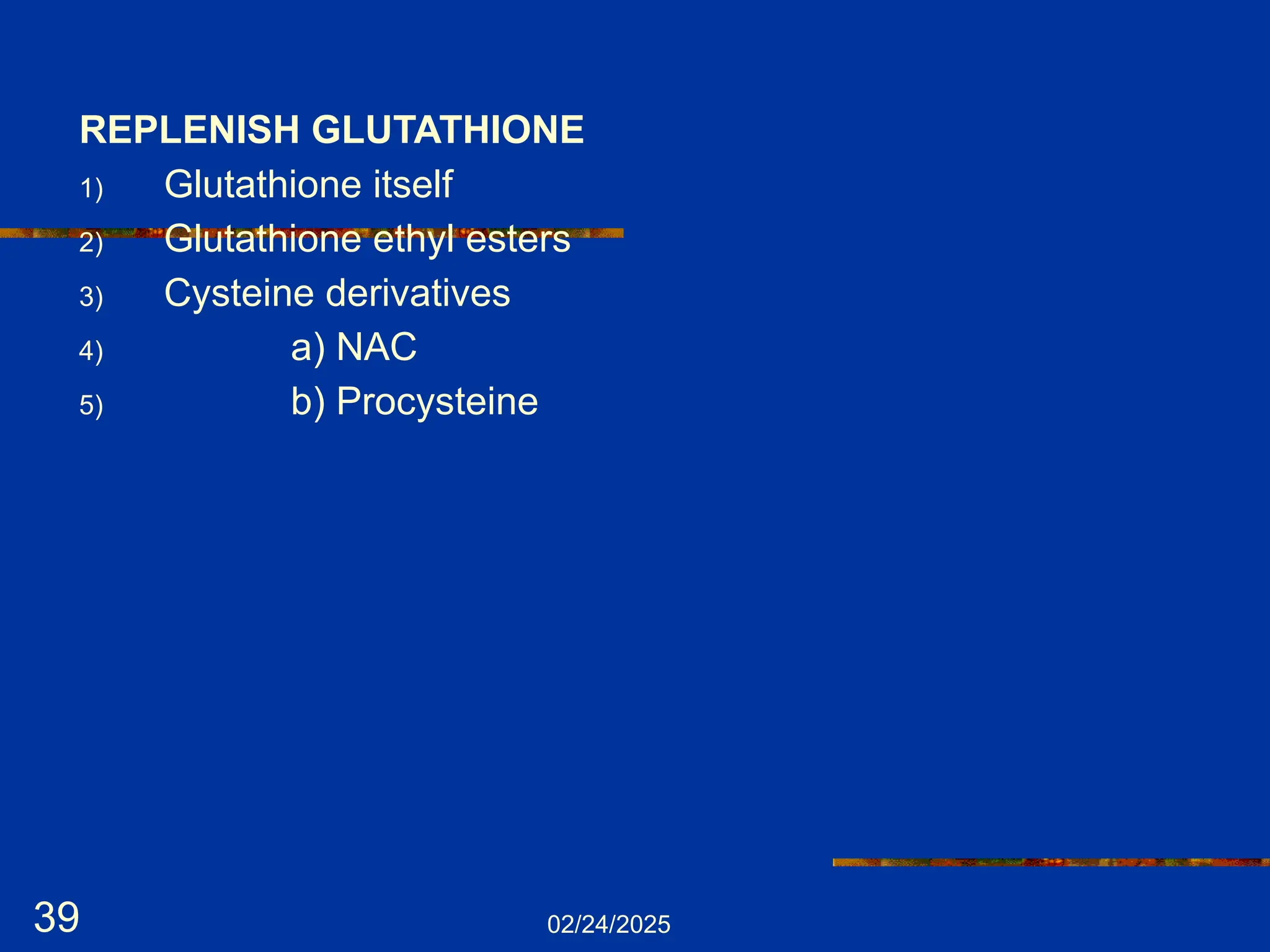
6. Antioxidants – NAC : Procysteine
7. Anticoagulants.
3.
02/24/2025
3
PRONE VENTILATION
Effect ongas exchange
Improves oxygenation – allows decrease Fio2; PEEP
- Variable
- not predictable
response rate – 50-70%
Proposed mechanism – how it improves oxygenation
1) Increase in FRC
2) Improved ventilation of previously dependent
regions.
(a) Difference in diaphragmatic movement
- supine : dorsal and ventral portion move
symmetrically
- prone : dorsal > ventral
4.
02/24/2025
4
PPL
-3.0
+2.8
PPL
-1.0
+1.0
Supine prone
PPL atdorsal Higher Less
TP pressure Lower More
Result Atelactasis opening
c) Decrease chest wall compliance in p.p
c) Redistribution of tidal volume to atelactatic dorsal
region.
d) Weight of heart may affect ventilation.
3. Improvement in Cardiac output
4. Better clearance of secretions
5. Improved lymphatic damage
5.
02/24/2025
5
CONTRAINDICATION
- Unresponsive cerebralhypertension
- Unstable bone fractures
- Left heart failure
- Hemodynamic instability
- Active intra abdominal pathology
TIMING ARDS > 24 hrs./ 2nd
day
FREQUENCY Usually one time per day
DURATION 2 to 20 hrs/day.
OUTCOME
Improvement in oxygenation
No improvement in survival
POSITIONING ACHIEVED BY
Circ Olectric, bed (Late 1970s).
Manual 2 step
Light weight portable support frame (Vollman prone
positioner)
6.
02/24/2025
6
NO. OF PERSONS3-5
POSITION OF ABDOMEN
allowed to protude ; partial/complete restriction
POSITION OF HEAD
Head down/ Head up position.
ADEQUATE SEDATION +/- NMBA
COMPLICATIONS
- pressure sore
- Accident removal of ET; Catheters
- Arrhythmia
- Reversible dependent odema (Face, anterior chest
wall)
Gattinoni et al, in a MRCT evaluated the effect of 7 hr / day
prone positioning x 10 day
improvement in oxygenation, no survival benefit
NEJM 2001, Vol 345 No 8 568-573
7.
02/24/2025
7
PARTIAL LIQUID VENTILATION
InARDs there is increased surface tension which can be
eliminated by filling the lungs with liquid (PFC).
Perflurocarbon:
Colourless, clear, odourless, inert, high vapour pressure
Insoluble in water or lipids
MC used – perflubron (Perfluoro octy bromide) (Liquivent)
Bromide radiopaque
ANIMAL EXPERIENCE
Improved
- Compliance - Gas exchange (dose dependent)
- lung function - Survival
Anti-inflam. properties
Decrease risk of nosocomial pneumonia.
Reduces pulm. vascular resistance.
Little effect on central hemodynamics.
8.
02/24/2025
8
Mechanism of action
i)Reduces surface tension
ii) Alveolar recruitment – liquid PEEP. Selective distribution to
dependent regions.
iii) Increases surfactant phospholipid synthesis and secretion.
iv) Anti Inflam. Properties
A. Indirect
Mitigation of VILI
B. Direct
a) decrease endotoxin stimulated release of TNF; IL-1;
IL-8.
b) decrease production of reactive oxygen species.
c) Inhibit neutrophil activation and chemostaxis.
d) Lavage of cellular debris.
9.
02/24/2025
9
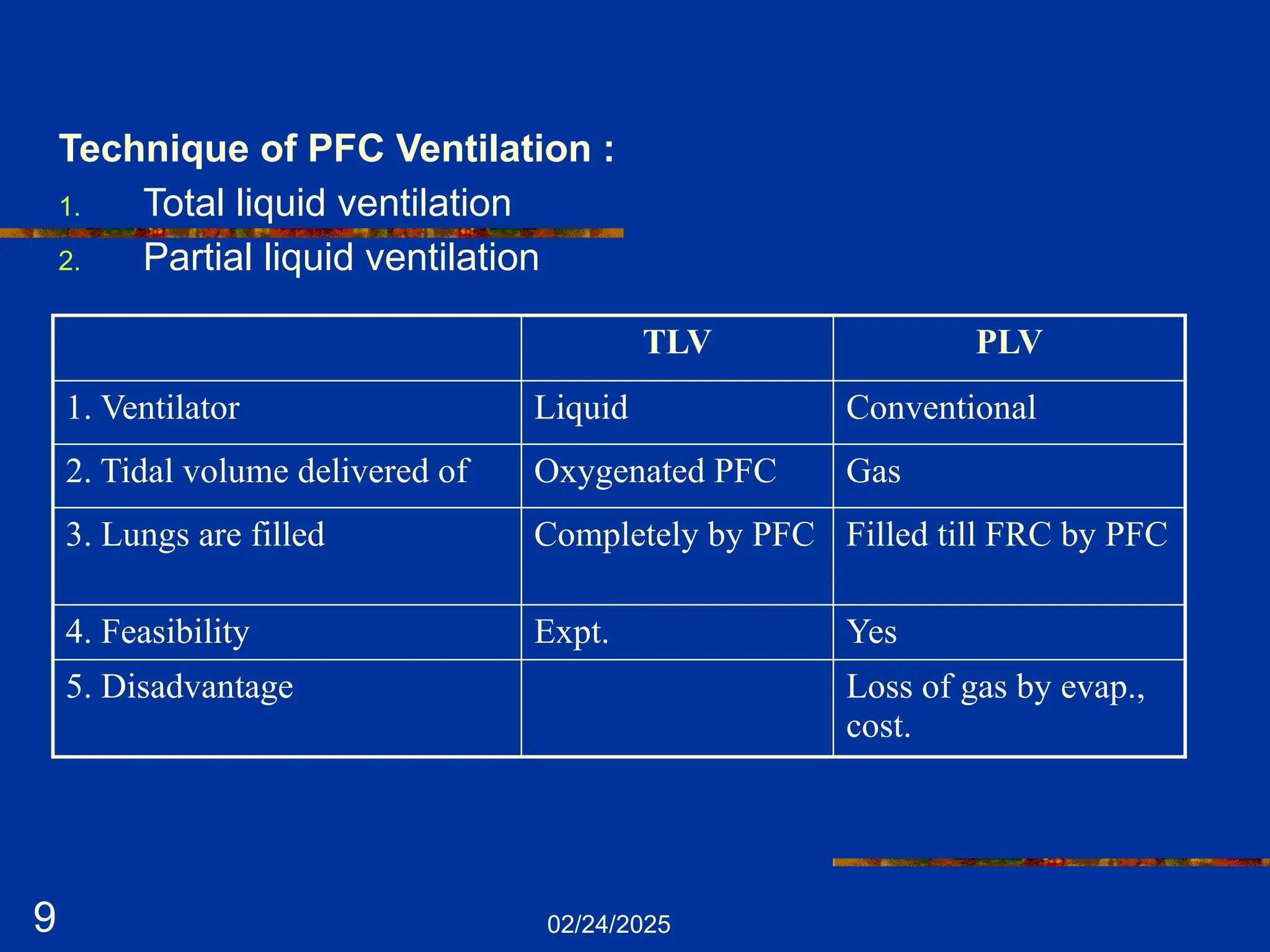
Technique of PFCVentilation :
1. Total liquid ventilation
2. Partial liquid ventilation
TLV PLV
1. Ventilator Liquid Conventional
2. Tidal volume delivered of Oxygenated PFC Gas
3. Lungs are filled Completely by PFC Filled till FRC by PFC
4. Feasibility Expt. Yes
5. Disadvantage Loss of gas by evap.,
cost.
10.
02/24/2025
10
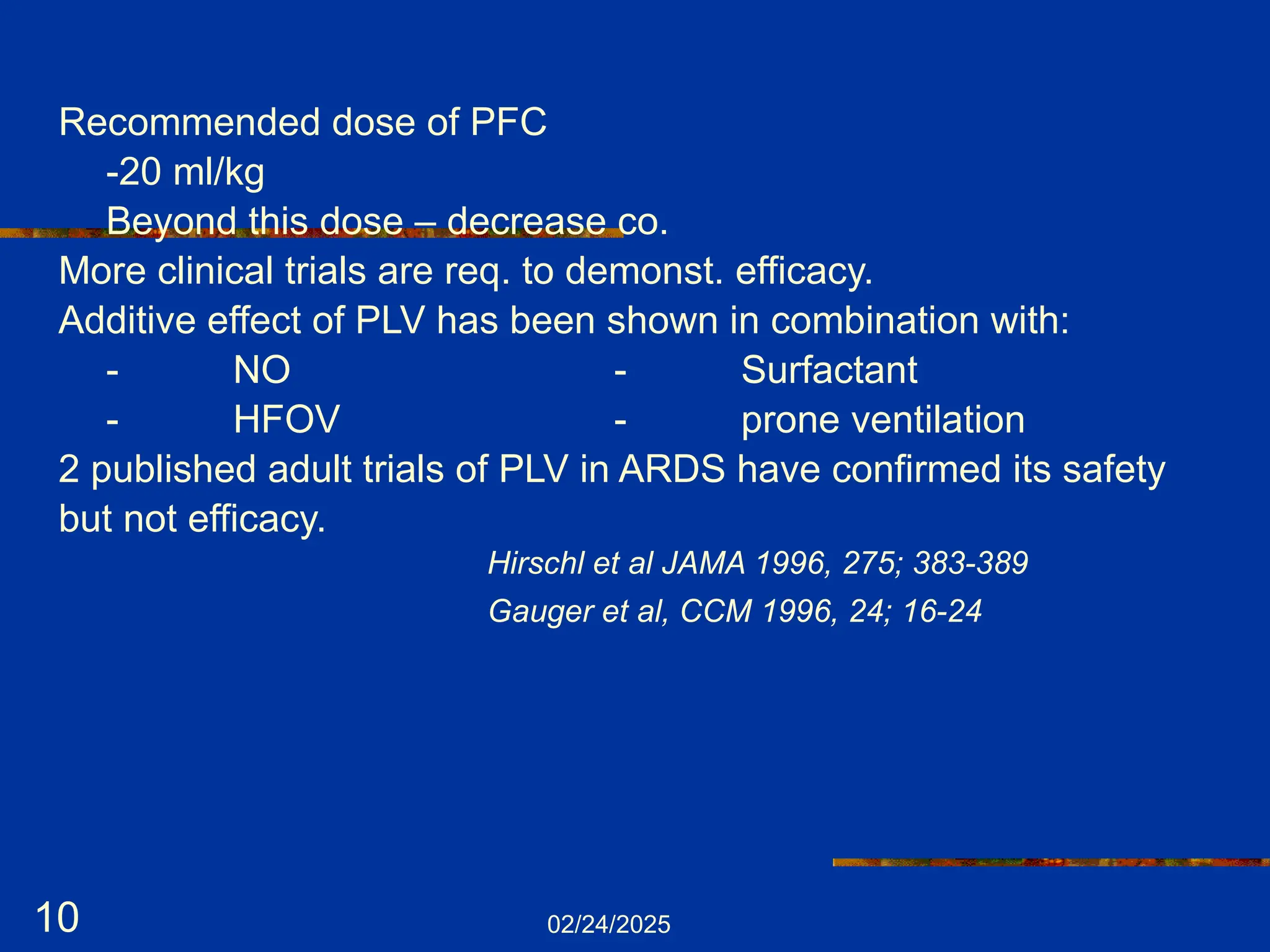
Recommended dose ofPFC
-20 ml/kg
Beyond this dose – decrease co.
More clinical trials are req. to demonst. efficacy.
Additive effect of PLV has been shown in combination with:
- NO - Surfactant
- HFOV - prone ventilation
2 published adult trials of PLV in ARDS have confirmed its safety
but not efficacy.
Hirschl et al JAMA 1996, 275; 383-389
Gauger et al, CCM 1996, 24; 16-24
11.
02/24/2025
11
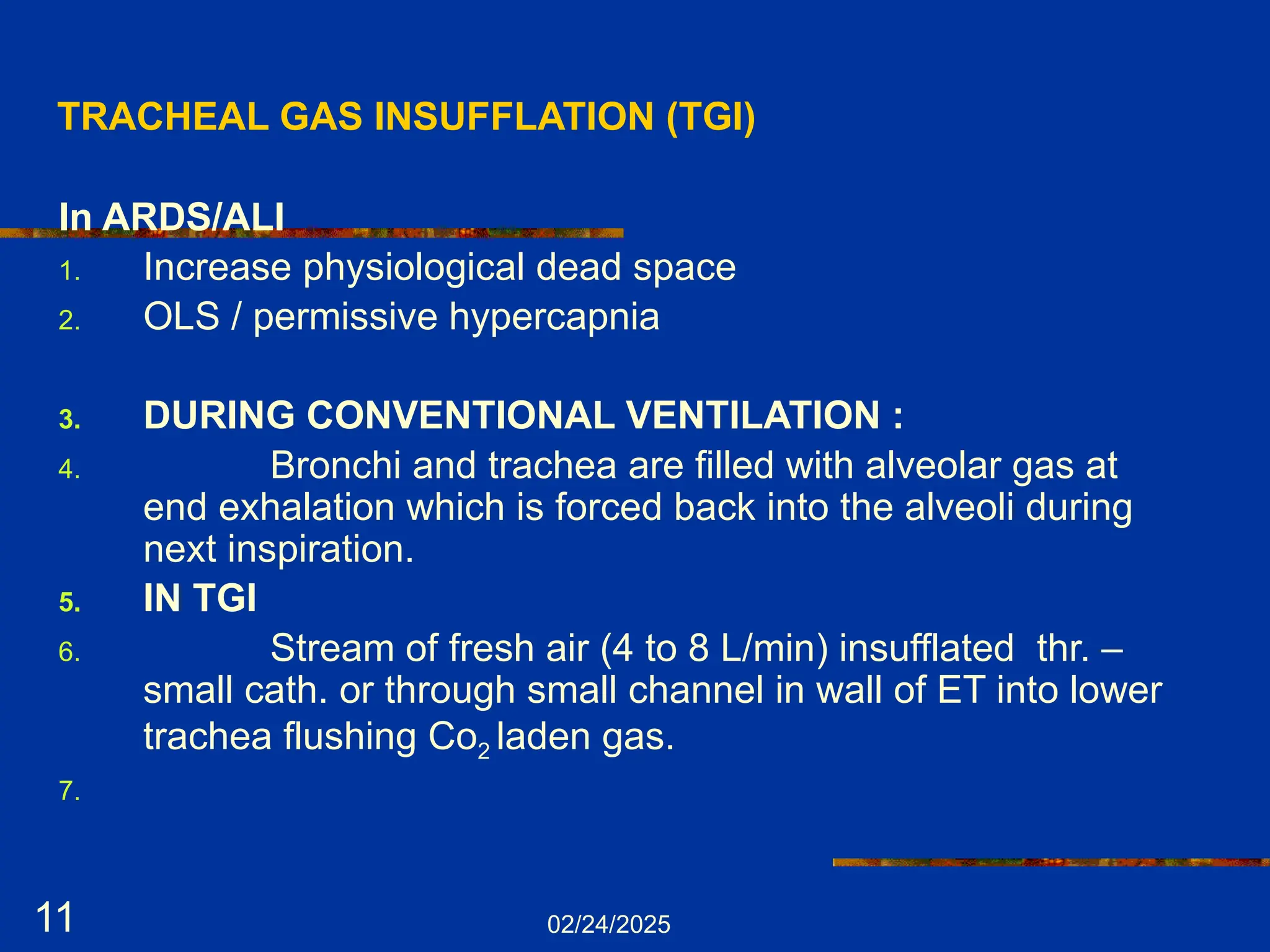
TRACHEAL GAS INSUFFLATION(TGI)
In ARDS/ALI
1. Increase physiological dead space
2. OLS / permissive hypercapnia
3. DURING CONVENTIONAL VENTILATION :
4. Bronchi and trachea are filled with alveolar gas at
end exhalation which is forced back into the alveoli during
next inspiration.
5. IN TGI
6. Stream of fresh air (4 to 8 L/min) insufflated thr. –
small cath. or through small channel in wall of ET into lower
trachea flushing Co2 laden gas.
7.
02/24/2025
13
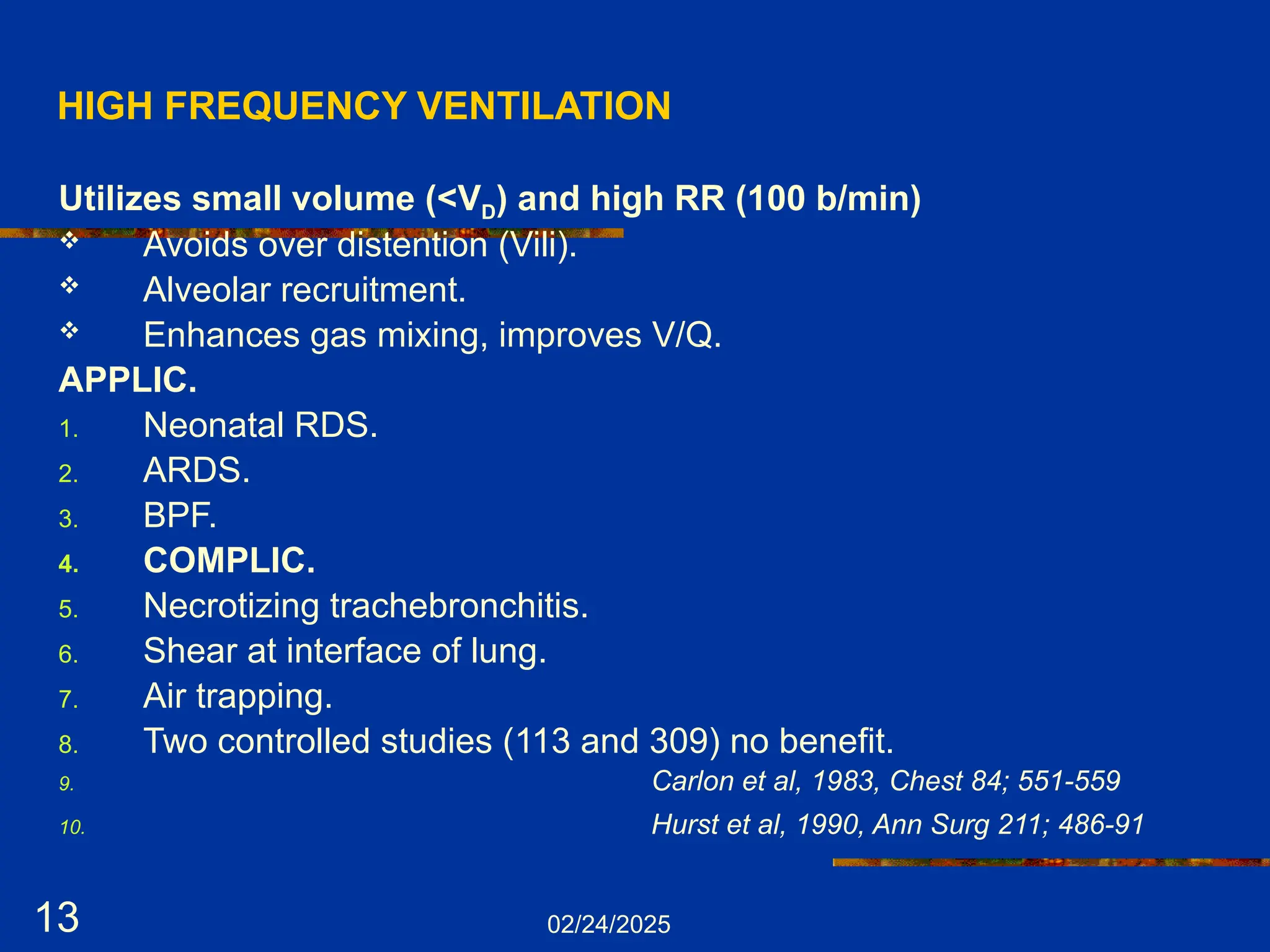
HIGH FREQUENCY VENTILATION
Utilizessmall volume (<VD) and high RR (100 b/min)
Avoids over distention (Vili).
Alveolar recruitment.
Enhances gas mixing, improves V/Q.
APPLIC.
1. Neonatal RDS.
2. ARDS.
3. BPF.
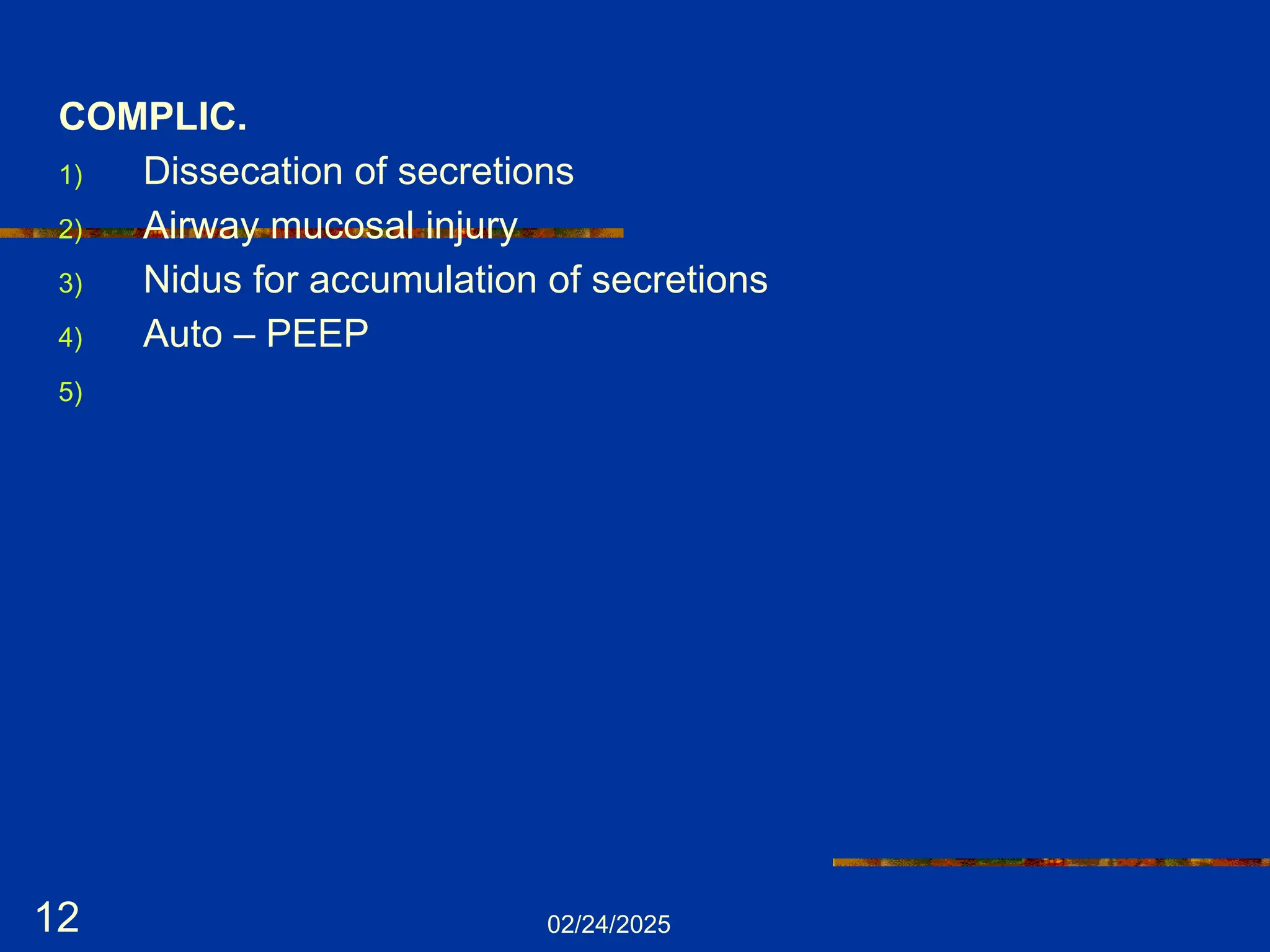
4. COMPLIC.
5. Necrotizing trachebronchitis.
6. Shear at interface of lung.
7. Air trapping.
8. Two controlled studies (113 and 309) no benefit.
9. Carlon et al, 1983, Chest 84; 551-559
10. Hurst et al, 1990, Ann Surg 211; 486-91
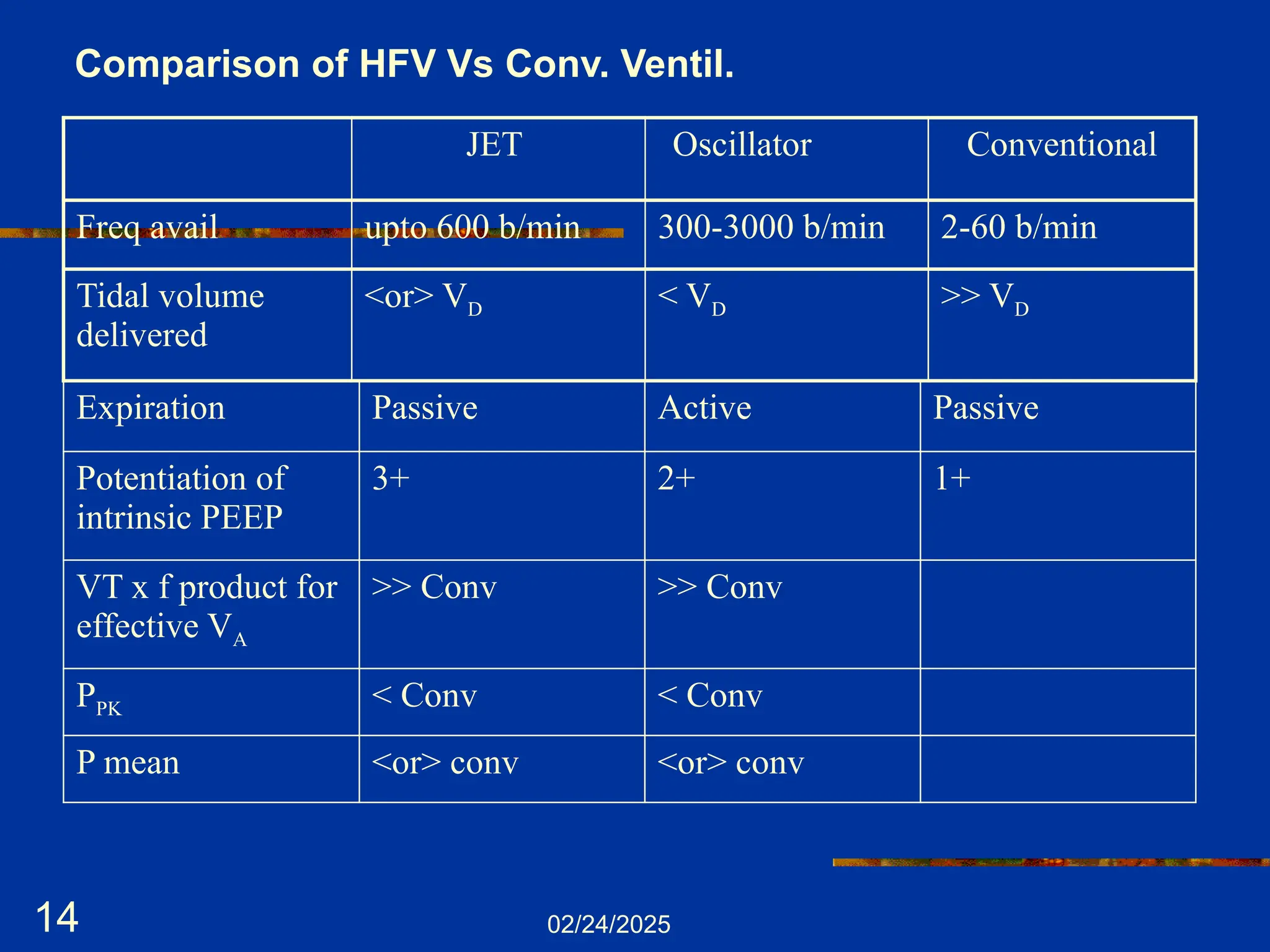
14.
02/24/2025
14
Expiration Passive ActivePassive
Potentiation of
intrinsic PEEP
3+ 2+ 1+
VT x f product for
effective VA
>> Conv >> Conv
PPK < Conv < Conv
P mean <or> conv <or> conv
JET Oscillator Conventional
Freq avail upto 600 b/min 300-3000 b/min 2-60 b/min
Tidal volume
delivered
<or> VD < VD >> VD
Comparison of HFV Vs Conv. Ventil.
15.
02/24/2025
15
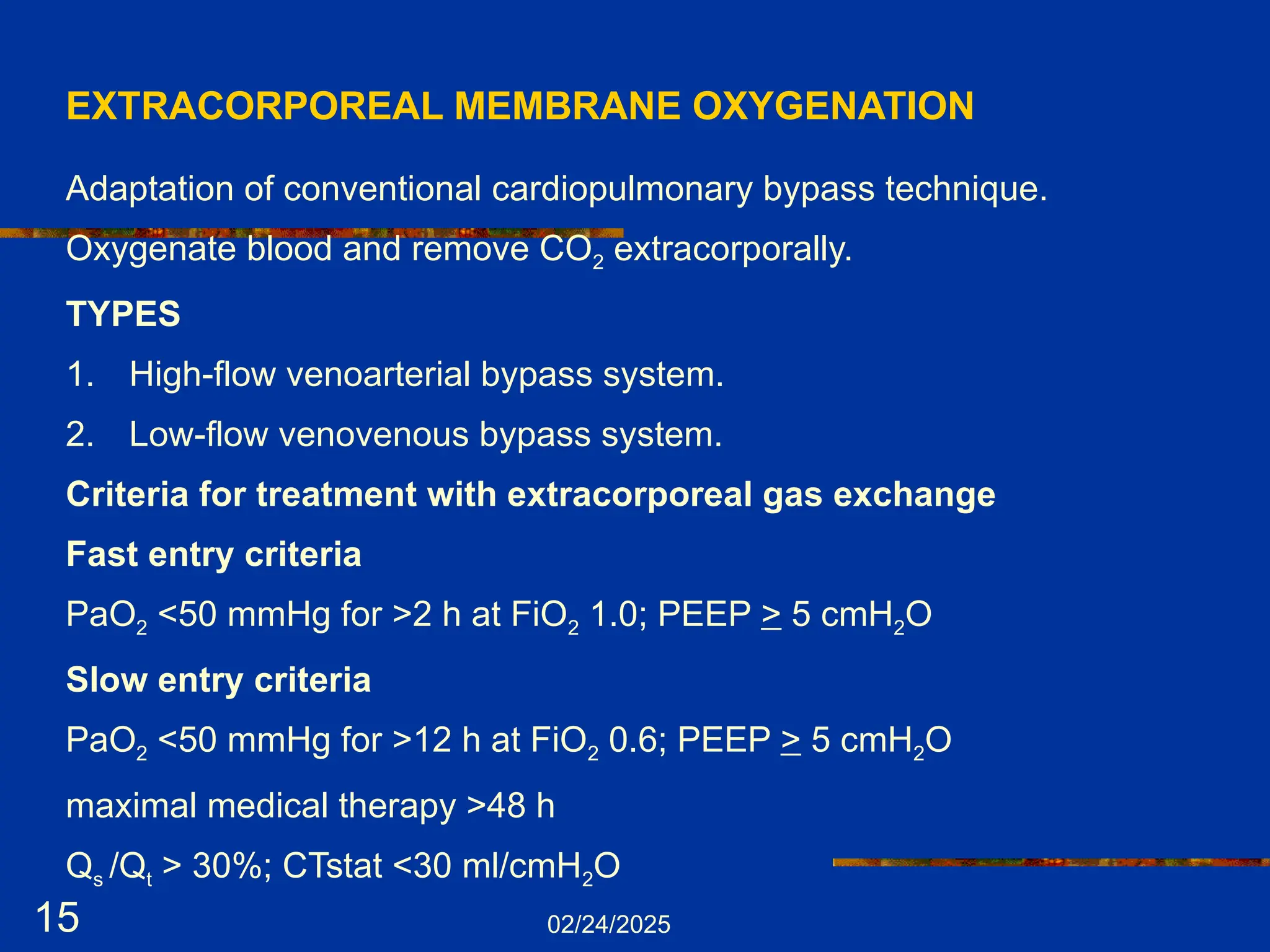
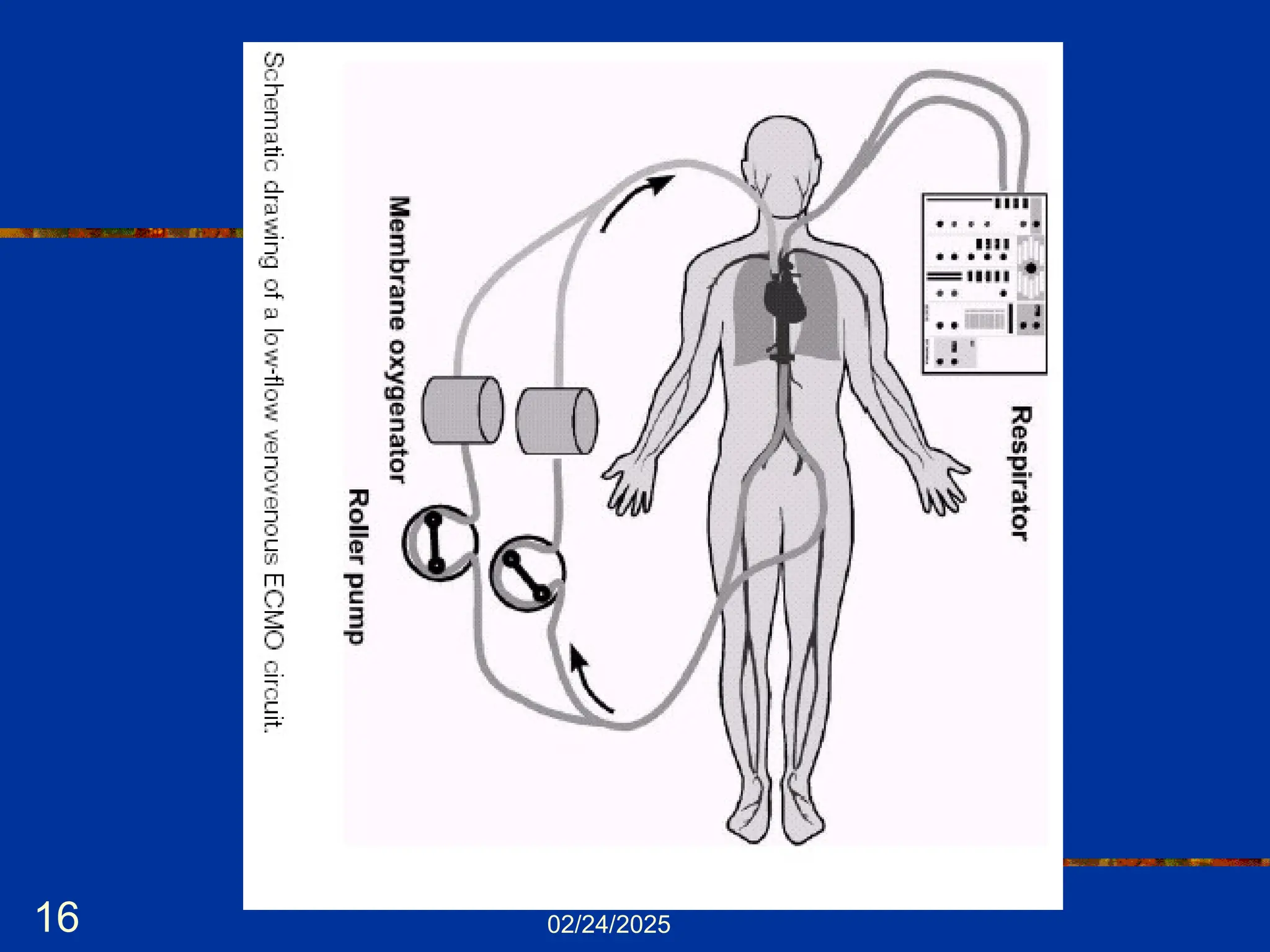
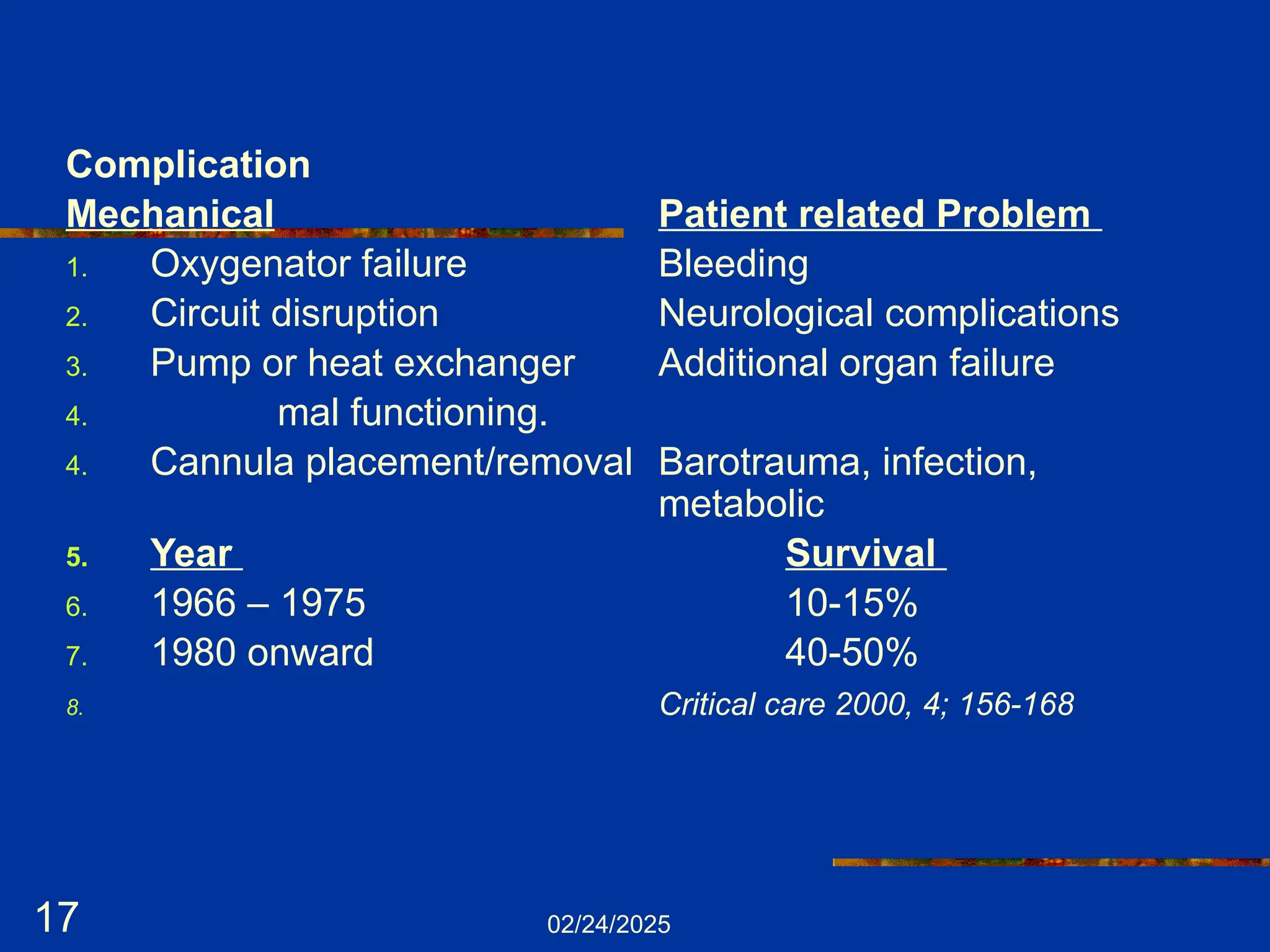
EXTRACORPOREAL MEMBRANE OXYGENATION
Adaptationof conventional cardiopulmonary bypass technique.
Oxygenate blood and remove CO2 extracorporally.
TYPES
1. High-flow venoarterial bypass system.
2. Low-flow venovenous bypass system.
Criteria for treatment with extracorporeal gas exchange
Fast entry criteria
PaO2 <50 mmHg for >2 h at FiO2 1.0; PEEP > 5 cmH2O
Slow entry criteria
PaO2 <50 mmHg for >12 h at FiO2 0.6; PEEP > 5 cmH2O
maximal medical therapy >48 h
Qs /Qt > 30%; CTstat <30 ml/cmH2O
02/24/2025
21
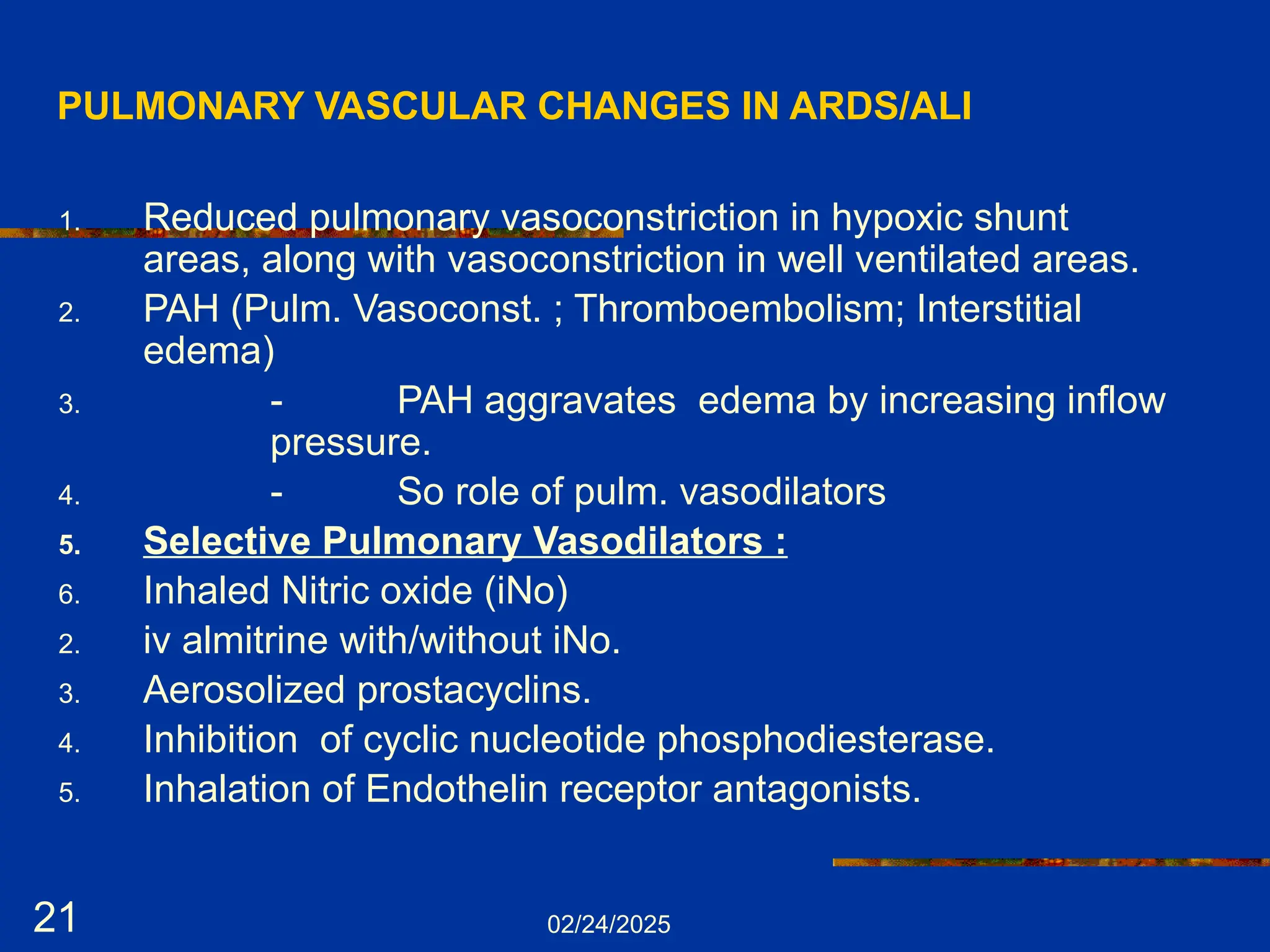
PULMONARY VASCULAR CHANGESIN ARDS/ALI
1. Reduced pulmonary vasoconstriction in hypoxic shunt
areas, along with vasoconstriction in well ventilated areas.
2. PAH (Pulm. Vasoconst. ; Thromboembolism; Interstitial
edema)
3. - PAH aggravates edema by increasing inflow
pressure.
4. - So role of pulm. vasodilators
5. Selective Pulmonary Vasodilators :
6. Inhaled Nitric oxide (iNo)
2. iv almitrine with/without iNo.
3. Aerosolized prostacyclins.
4. Inhibition of cyclic nucleotide phosphodiesterase.
5. Inhalation of Endothelin receptor antagonists.
22.
02/24/2025
22
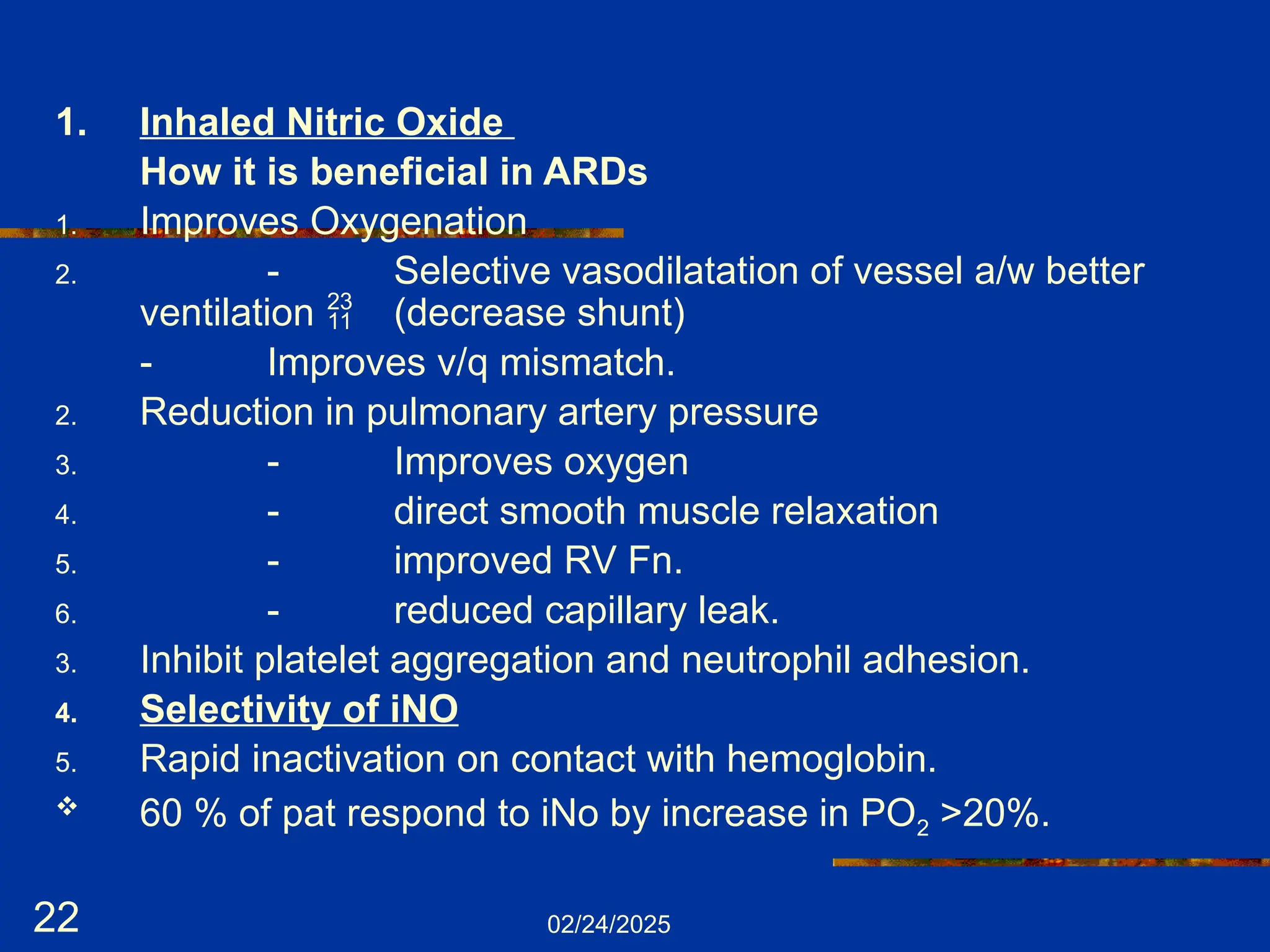
1. Inhaled NitricOxide
How it is beneficial in ARDs
1. Improves Oxygenation
2. - Selective vasodilatation of vessel a/w better
ventilation (decrease shunt)
- Improves v/q mismatch.
2. Reduction in pulmonary artery pressure
3. - Improves oxygen
4. - direct smooth muscle relaxation
5. - improved RV Fn.
6. - reduced capillary leak.
3. Inhibit platelet aggregation and neutrophil adhesion.
4. Selectivity of iNO
5. Rapid inactivation on contact with hemoglobin.
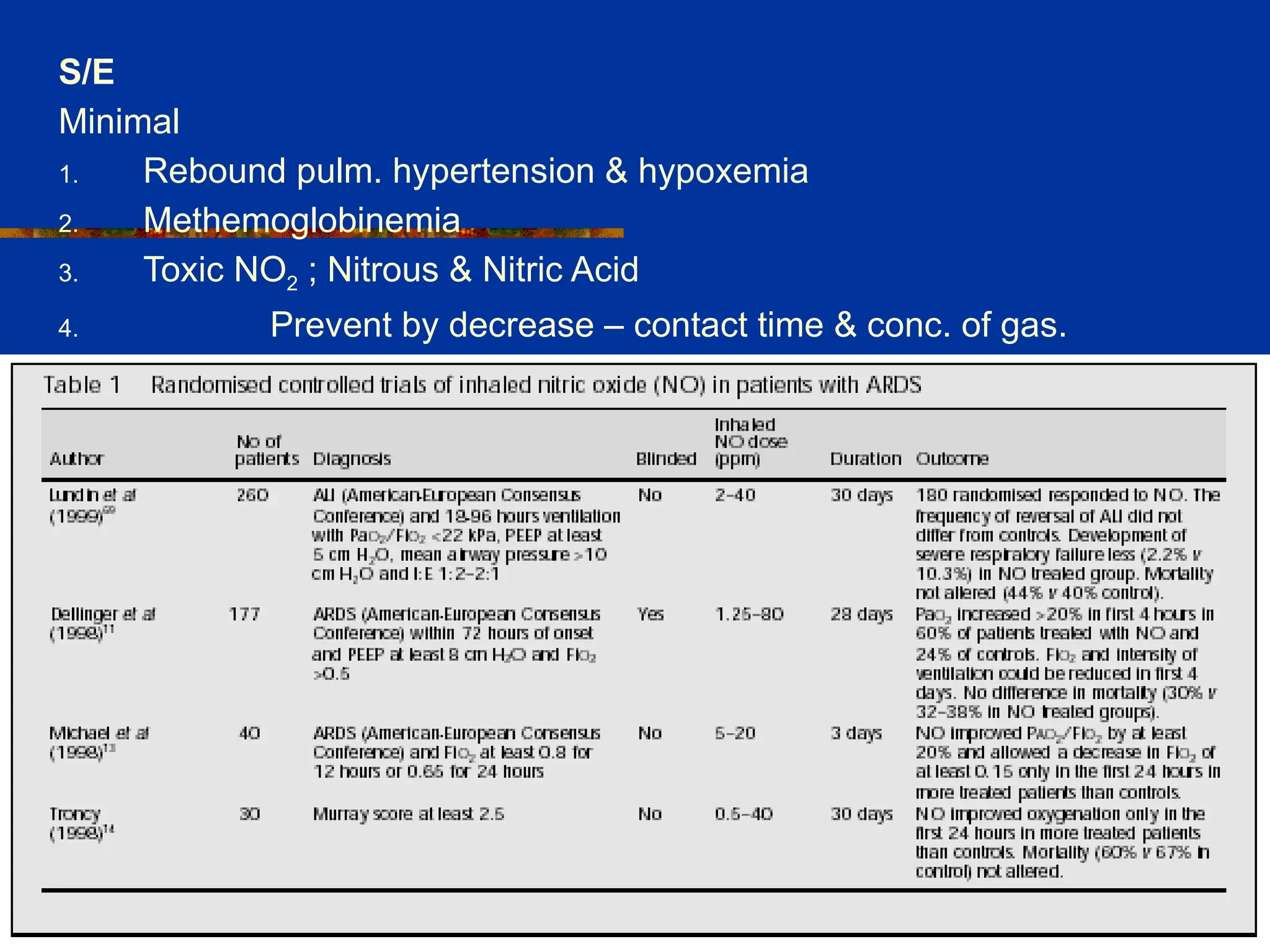
60 % of pat respond to iNo by increase in PO2 >20%.
23.
02/24/2025
23
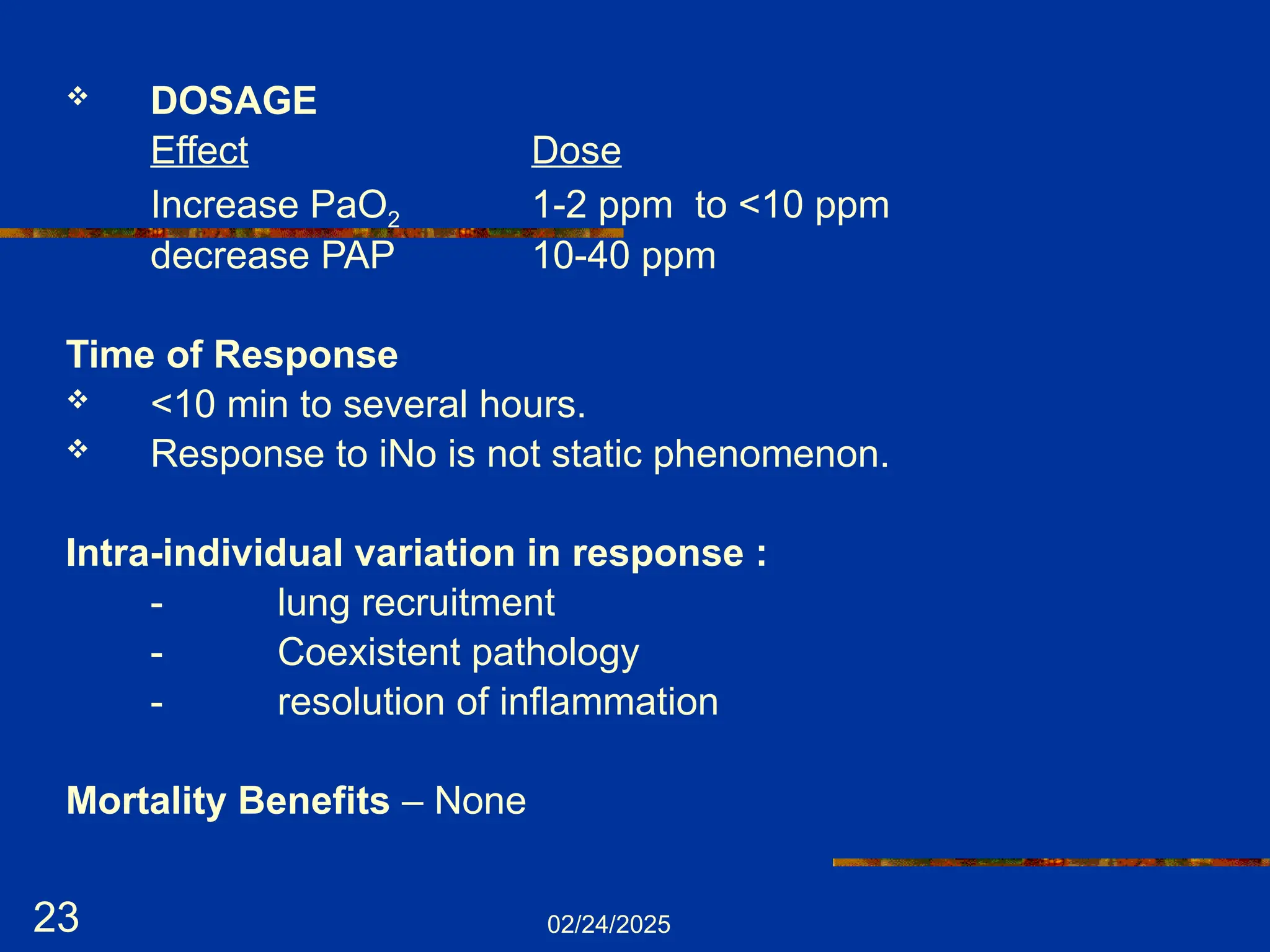
DOSAGE
Effect Dose
IncreasePaO2 1-2 ppm to <10 ppm
decrease PAP 10-40 ppm
Time of Response
<10 min to several hours.
Response to iNo is not static phenomenon.
Intra-individual variation in response :
- lung recruitment
- Coexistent pathology
- resolution of inflammation
Mortality Benefits – None
24.
02/24/2025
24
S/E
Minimal
1. Rebound pulm.hypertension & hypoxemia
2. Methemoglobinemia
3. Toxic NO2 ; Nitrous & Nitric Acid
4. Prevent by decrease – contact time & conc. of gas.
25.
02/24/2025
25
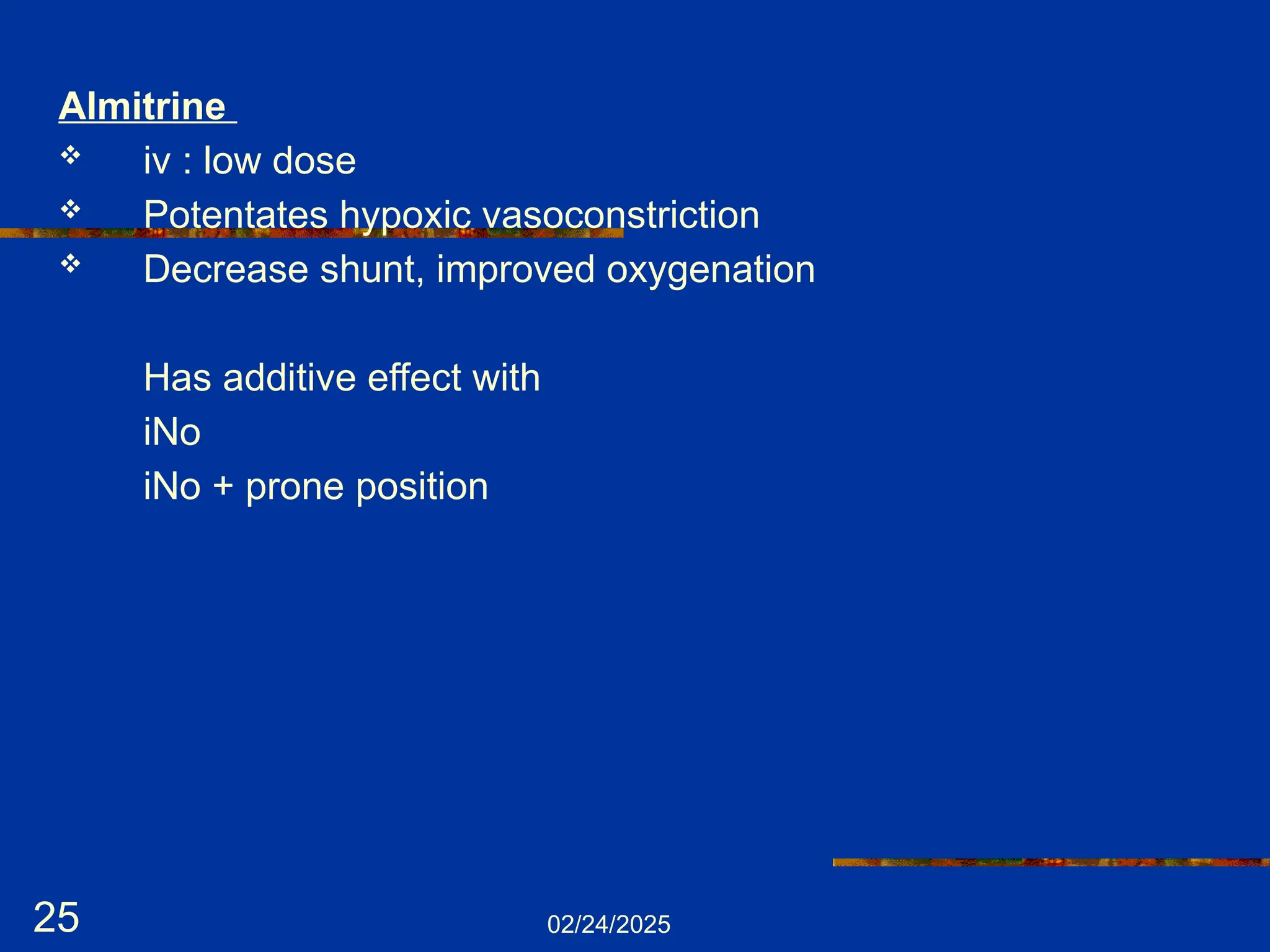
Almitrine
iv :low dose
Potentates hypoxic vasoconstriction
Decrease shunt, improved oxygenation
Has additive effect with
iNo
iNo + prone position
26.
02/24/2025
26
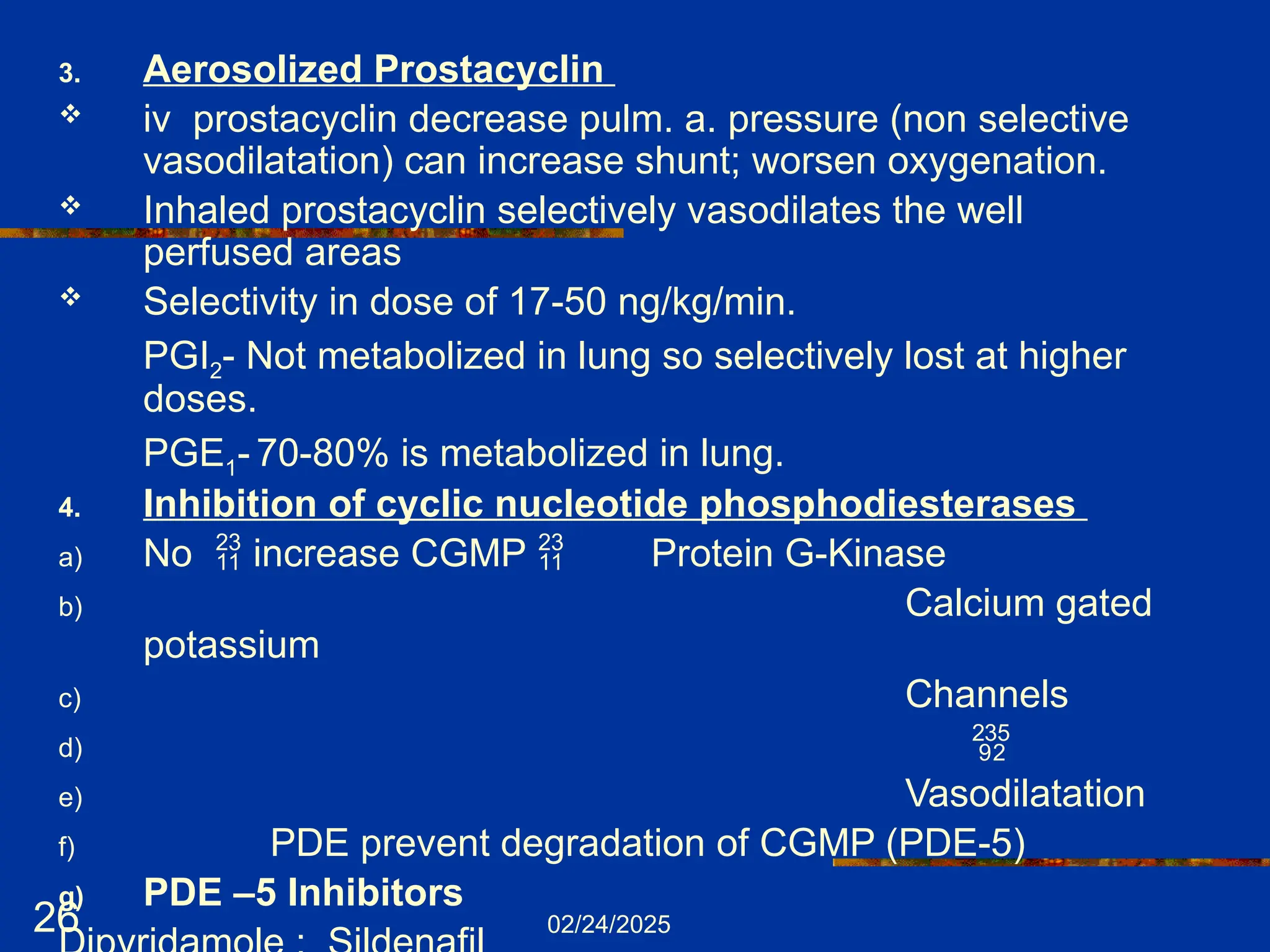
3. Aerosolized Prostacyclin
iv prostacyclin decrease pulm. a. pressure (non selective
vasodilatation) can increase shunt; worsen oxygenation.
Inhaled prostacyclin selectively vasodilates the well
perfused areas
Selectivity in dose of 17-50 ng/kg/min.
PGI2- Not metabolized in lung so selectively lost at higher
doses.
PGE1- 70-80% is metabolized in lung.
4. Inhibition of cyclic nucleotide phosphodiesterases
a) No increase CGMP Protein G-Kinase
b) Calcium gated
potassium
c) Channels
d)
e) Vasodilatation
f) PDE prevent degradation of CGMP (PDE-5)
g) PDE –5 Inhibitors
27.
02/24/2025
27
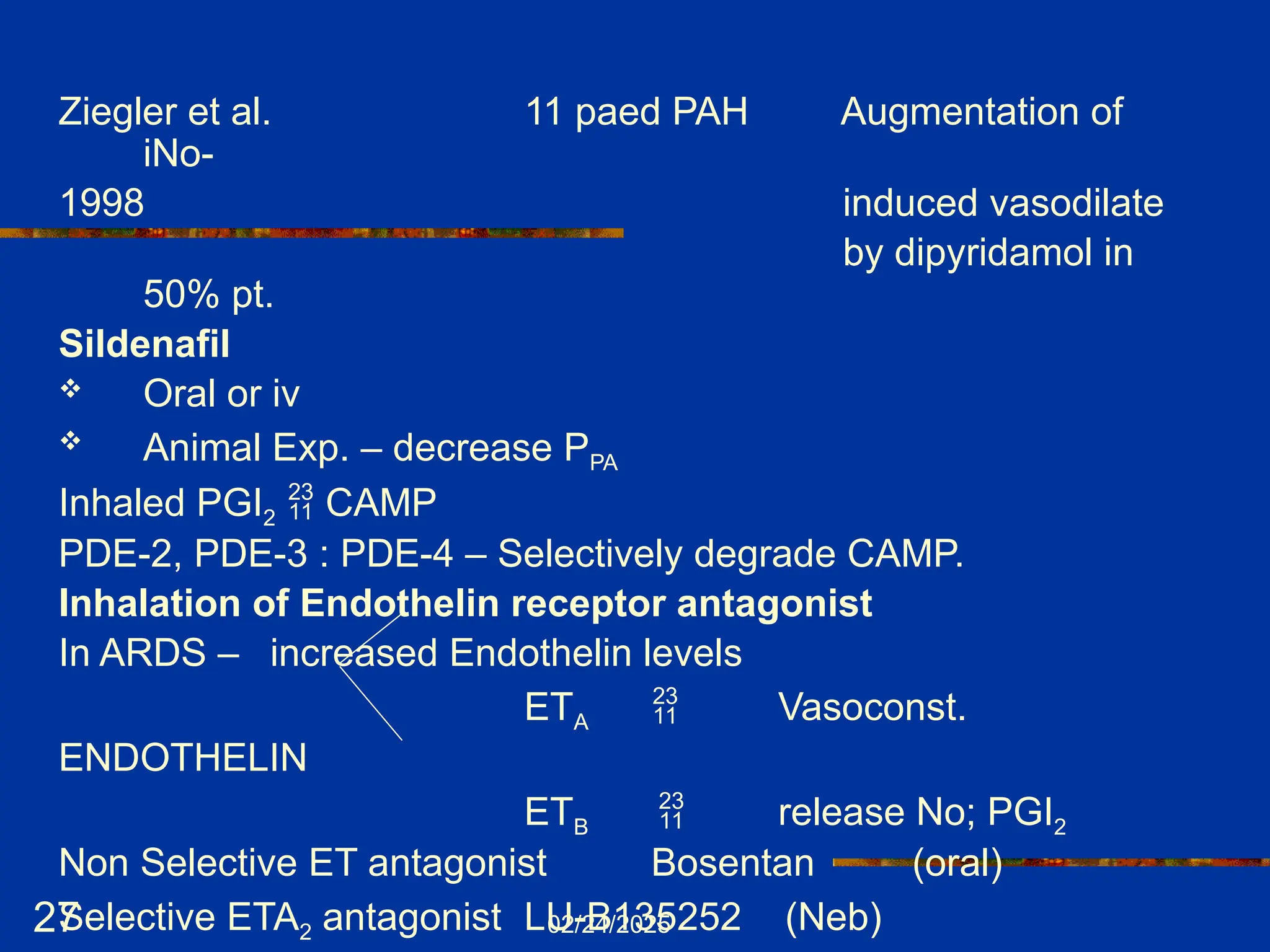
Ziegler et al.11 paed PAH Augmentation of
iNo-
1998 induced vasodilate
by dipyridamol in
50% pt.
Sildenafil
Oral or iv
Animal Exp. – decrease PPA
Inhaled PGI2 CAMP
PDE-2, PDE-3 : PDE-4 – Selectively degrade CAMP.
Inhalation of Endothelin receptor antagonist
In ARDS – increased Endothelin levels
ETA Vasoconst.
ENDOTHELIN
ETB release No; PGI2
Non Selective ET antagonist Bosentan (oral)
Selective ETA2 antagonist LU-B135252 (Neb)
28.
02/24/2025
28
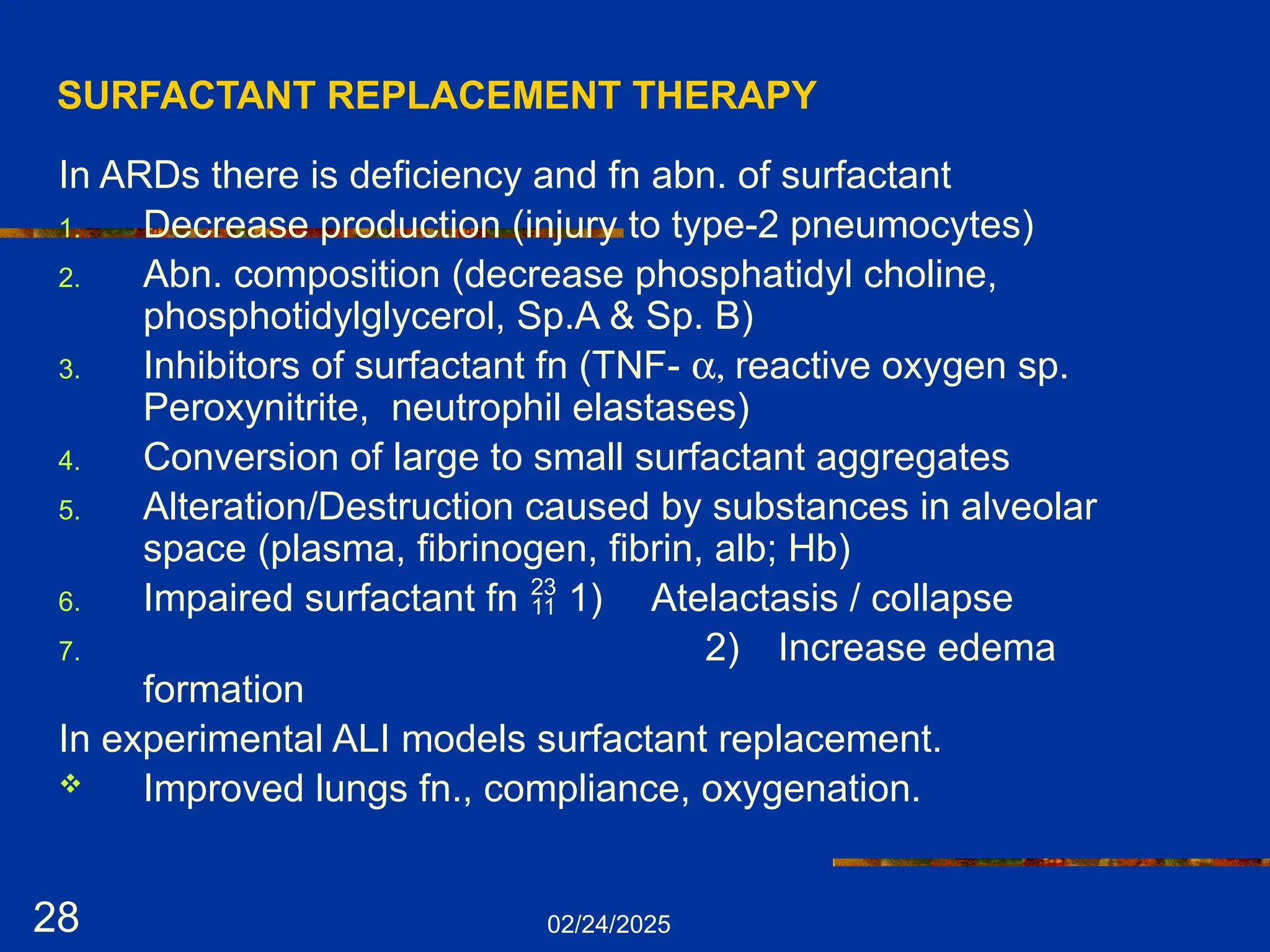
SURFACTANT REPLACEMENT THERAPY
InARDs there is deficiency and fn abn. of surfactant
1. Decrease production (injury to type-2 pneumocytes)
2. Abn. composition (decrease phosphatidyl choline,
phosphotidylglycerol, Sp.A & Sp. B)
3. Inhibitors of surfactant fn (TNF- a, reactive oxygen sp.
Peroxynitrite, neutrophil elastases)
4. Conversion of large to small surfactant aggregates
5. Alteration/Destruction caused by substances in alveolar
space (plasma, fibrinogen, fibrin, alb; Hb)
6. Impaired surfactant fn 1) Atelactasis / collapse
7. 2) Increase edema
formation
In experimental ALI models surfactant replacement.
Improved lungs fn., compliance, oxygenation.
29.
02/24/2025
29
Surfactant of possibletherapeutic use :
Class Origin Example
1. Natural Amniotic Human amniotic fluid
surfactant
2. Modified - Bovine Infasurf, alveofact
3. Natural BLESS,
Survanta
4. - Procine Curosurf
3. Synthetic Exosurf, ALEC, KL4
Surfactant, Venticute
DOSE
Sufficient dose should reach alveolar environment
TIMING
• As early as possible [<48 hr]
• Little benefit at 3 to 5 days [Fibrosis already set]
30.
02/24/2025
30
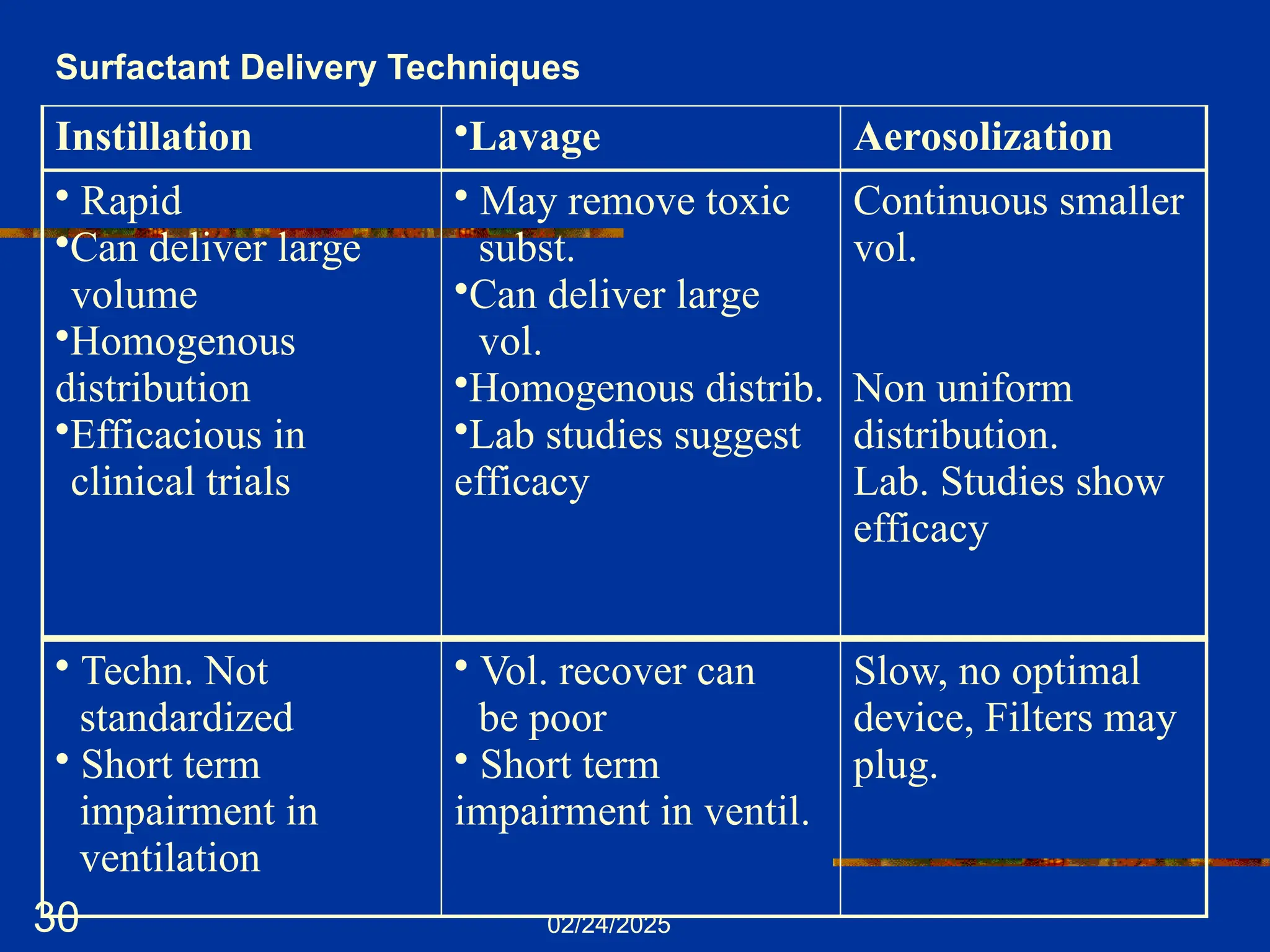
Surfactant Delivery Techniques
Instillation•Lavage Aerosolization
• Rapid
•Can deliver large
volume
•Homogenous
distribution
•Efficacious in
clinical trials
• May remove toxic
subst.
•Can deliver large
vol.
•Homogenous distrib.
•Lab studies suggest
efficacy
Continuous smaller
vol.
Non uniform
distribution.
Lab. Studies show
efficacy
• Techn. Not
standardized
• Short term
impairment in
ventilation
• Vol. recover can
be poor
• Short term
impairment in ventil.
Slow, no optimal
device, Filters may
plug.
31.
02/24/2025
31
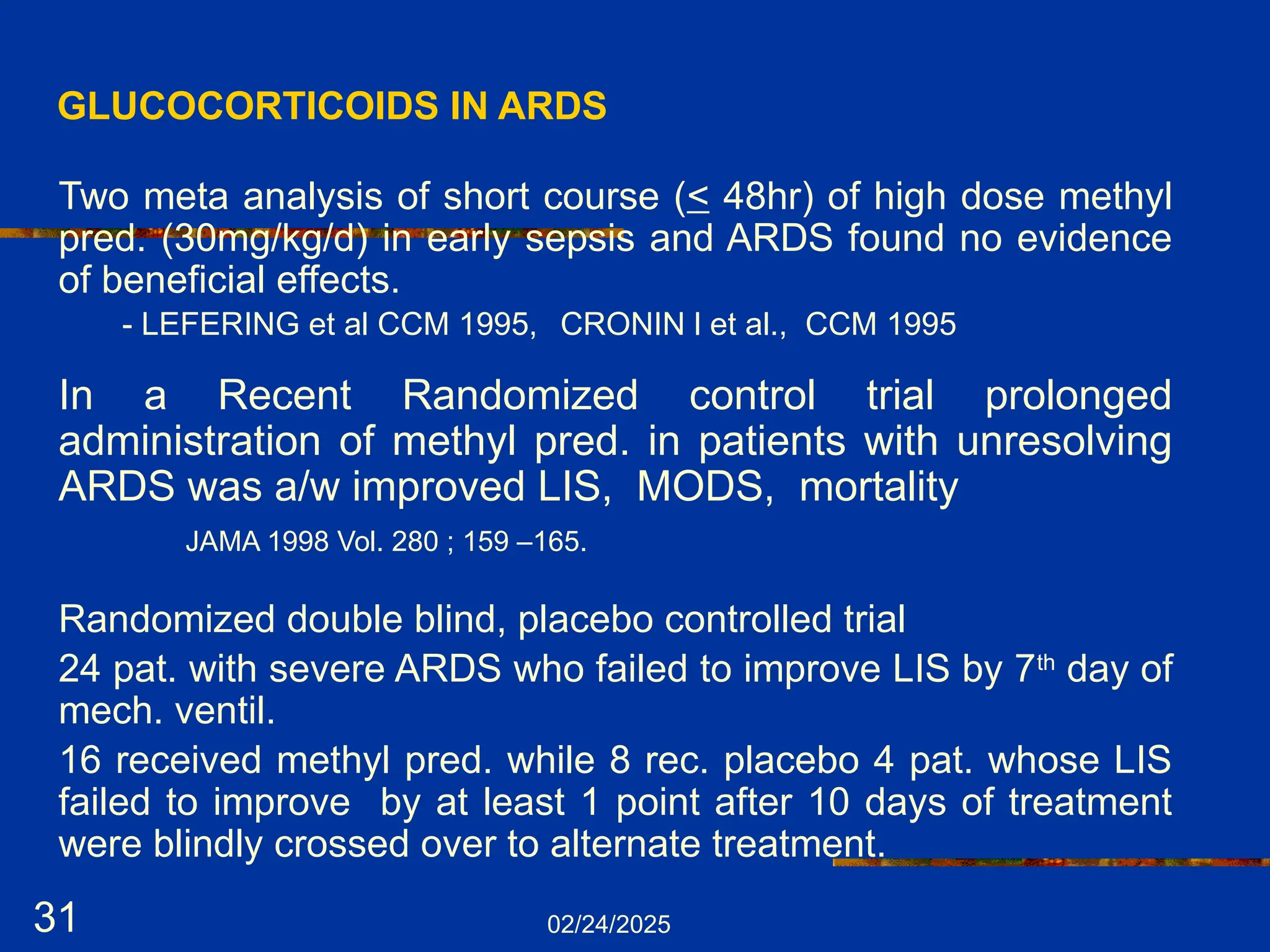
GLUCOCORTICOIDS IN ARDS
Twometa analysis of short course (< 48hr) of high dose methyl
pred. (30mg/kg/d) in early sepsis and ARDS found no evidence
of beneficial effects.
- LEFERING et al CCM 1995, CRONIN l et al., CCM 1995
In a Recent Randomized control trial prolonged
administration of methyl pred. in patients with unresolving
ARDS was a/w improved LIS, MODS, mortality
JAMA 1998 Vol. 280 ; 159 –165.
Randomized double blind, placebo controlled trial
24 pat. with severe ARDS who failed to improve LIS by 7th
day of
mech. ventil.
16 received methyl pred. while 8 rec. placebo 4 pat. whose LIS
failed to improve by at least 1 point after 10 days of treatment
were blindly crossed over to alternate treatment.
32.
02/24/2025
32
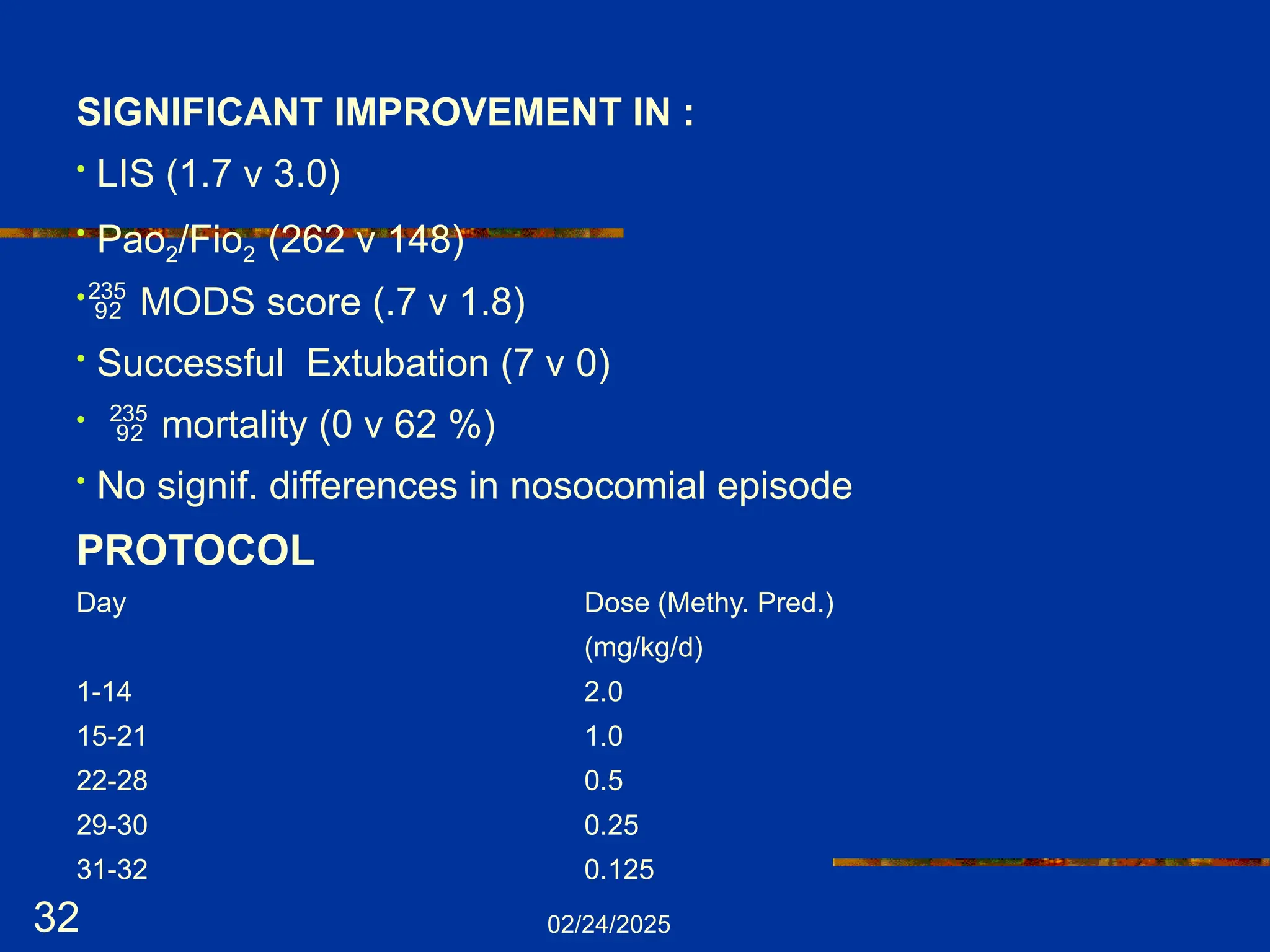
SIGNIFICANT IMPROVEMENT IN:
• LIS (1.7 v 3.0)
• Pao2/Fio2 (262 v 148)
• MODS score (.7 v 1.8)
• Successful Extubation (7 v 0)
• mortality (0 v 62 %)
• No signif. differences in nosocomial episode
PROTOCOL
Day Dose (Methy. Pred.)
(mg/kg/d)
1-14 2.0
15-21 1.0
22-28 0.5
29-30 0.25
31-32 0.125
33.
02/24/2025
33
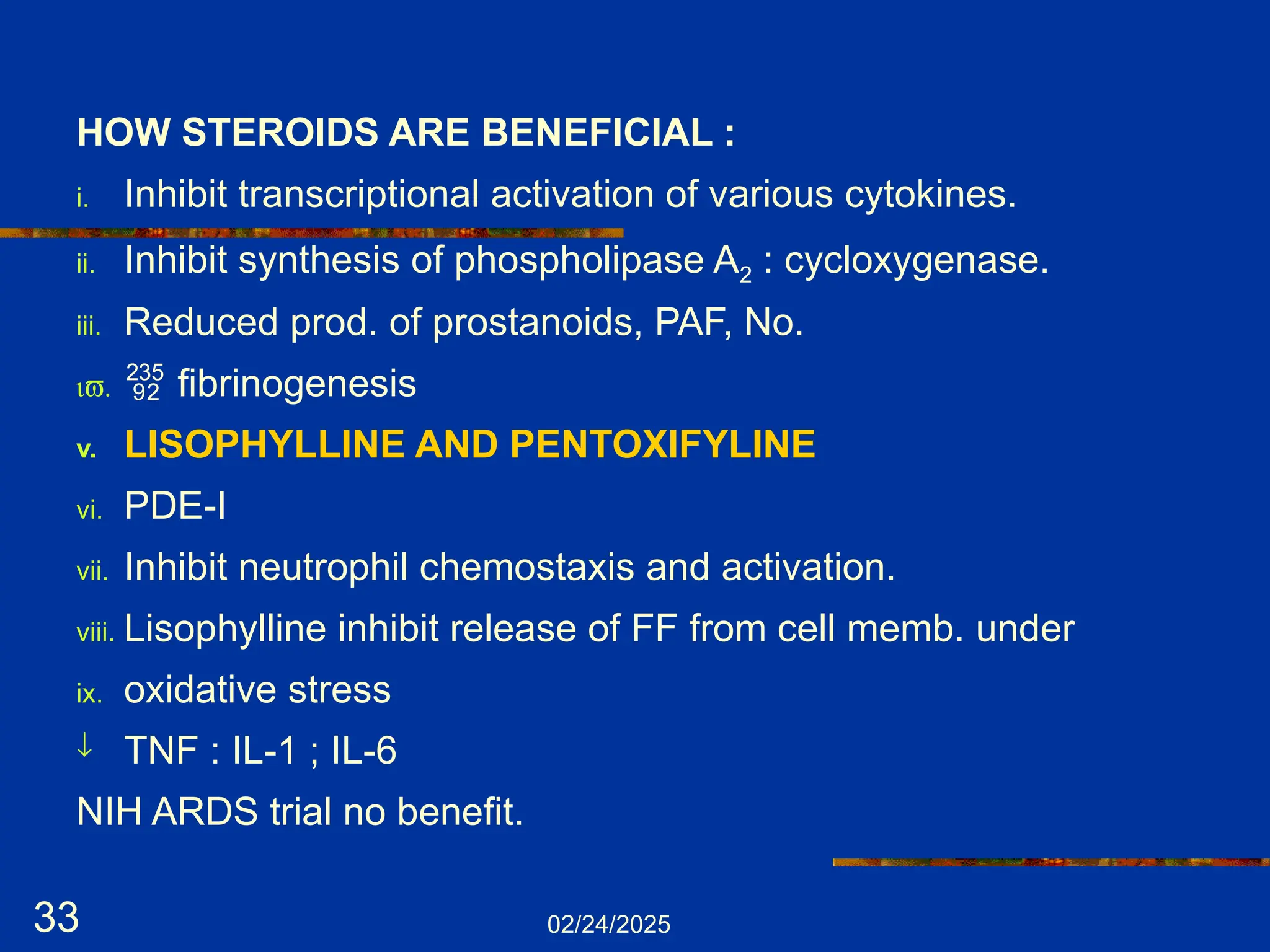
HOW STEROIDS AREBENEFICIAL :
i. Inhibit transcriptional activation of various cytokines.
ii. Inhibit synthesis of phospholipase A2 : cycloxygenase.
iii. Reduced prod. of prostanoids, PAF, No.
iv. fibrinogenesis
v. LISOPHYLLINE AND PENTOXIFYLINE
vi. PDE-I
vii. Inhibit neutrophil chemostaxis and activation.
viii. Lisophylline inhibit release of FF from cell memb. under
ix. oxidative stress
¯ TNF : IL-1 ; IL-6
NIH ARDS trial no benefit.
34.
02/24/2025
34
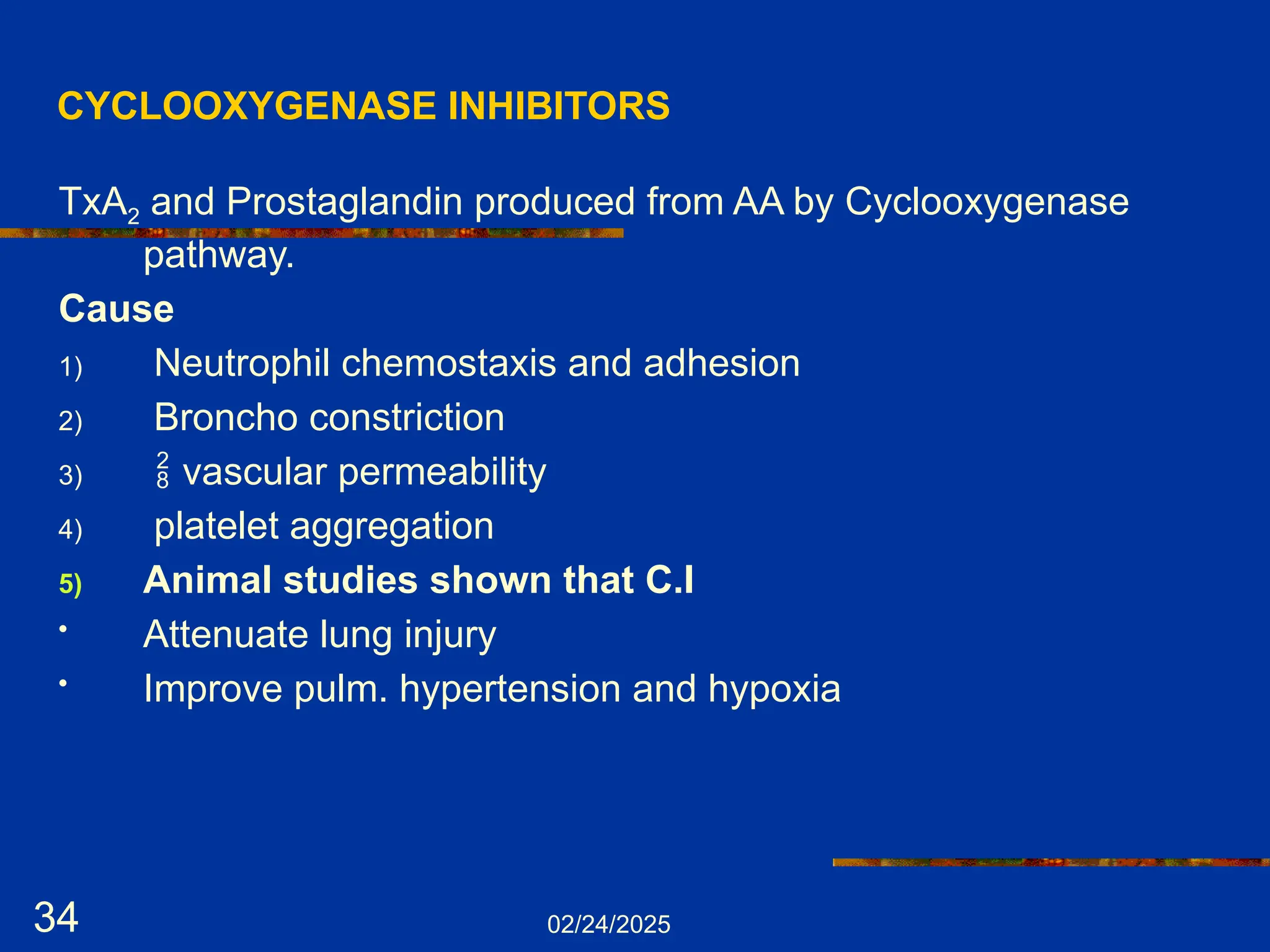
CYCLOOXYGENASE INHIBITORS
TxA2 andProstaglandin produced from AA by Cyclooxygenase
pathway.
Cause
1) Neutrophil chemostaxis and adhesion
2) Broncho constriction
3) vascular permeability
4) platelet aggregation
5) Animal studies shown that C.I
• Attenuate lung injury
• Improve pulm. hypertension and hypoxia
35.
02/24/2025
35
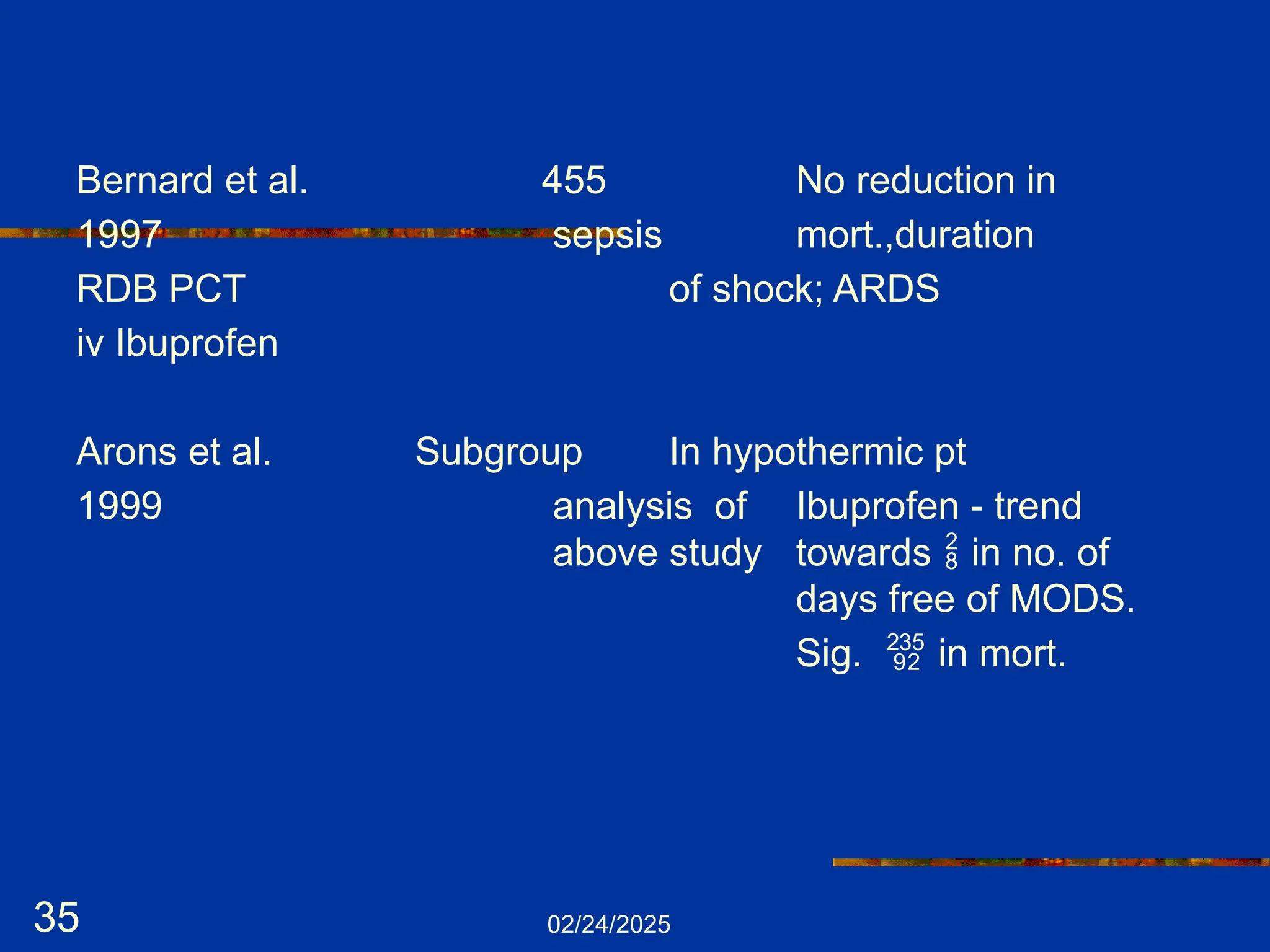
Bernard et al.455 No reduction in
1997 sepsis mort.,duration
RDB PCT of shock; ARDS
iv Ibuprofen
Arons et al. Subgroup In hypothermic pt
1999 analysis of Ibuprofen - trend
above study towards in no. of
days free of MODS.
Sig. in mort.
36.
02/24/2025
36
KETOCONAZOLE
TxA2
1) Pulmonary vasoconstriction
2)Platelet and neutrophil aggregation
3) Blockade of Tx synthesis or receptor antagonism ameliorates
experimental lung injury
4) Ketoconazole
5) Specific inhibitor of thromboxane synthetase
6) Inhibits 5 – Lipoxygenase [LTB4 & procoag activity]
7)
37.
02/24/2025
37
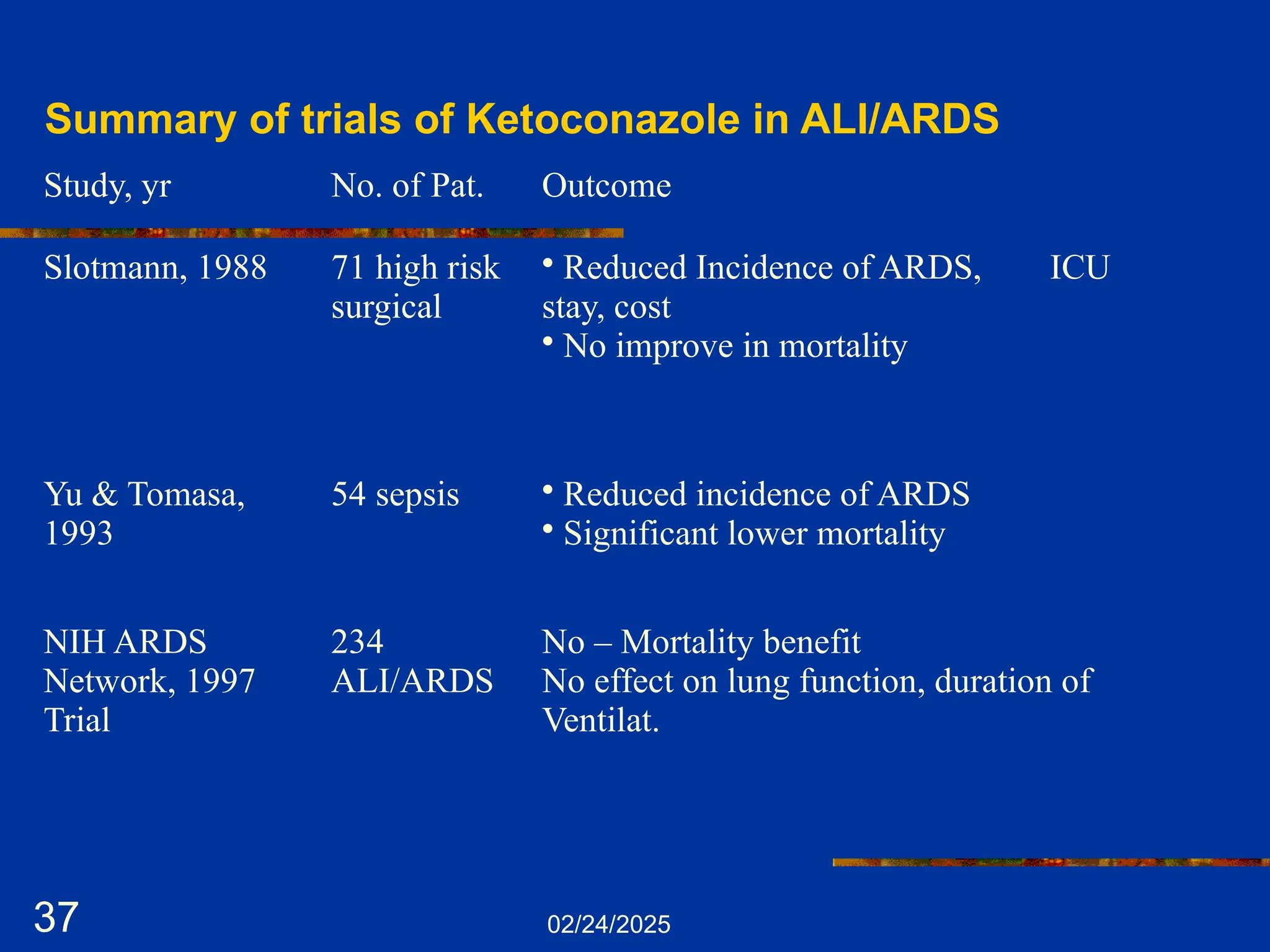
Summary of trialsof Ketoconazole in ALI/ARDS
Study, yr No. of Pat. Outcome
Slotmann, 1988 71 high risk
surgical
• Reduced Incidence of ARDS, ICU
stay, cost
• No improve in mortality
Yu & Tomasa,
1993
54 sepsis • Reduced incidence of ARDS
• Significant lower mortality
NIH ARDS
Network, 1997
Trial
234
ALI/ARDS
No – Mortality benefit
No effect on lung function, duration of
Ventilat.
38.
02/24/2025
38
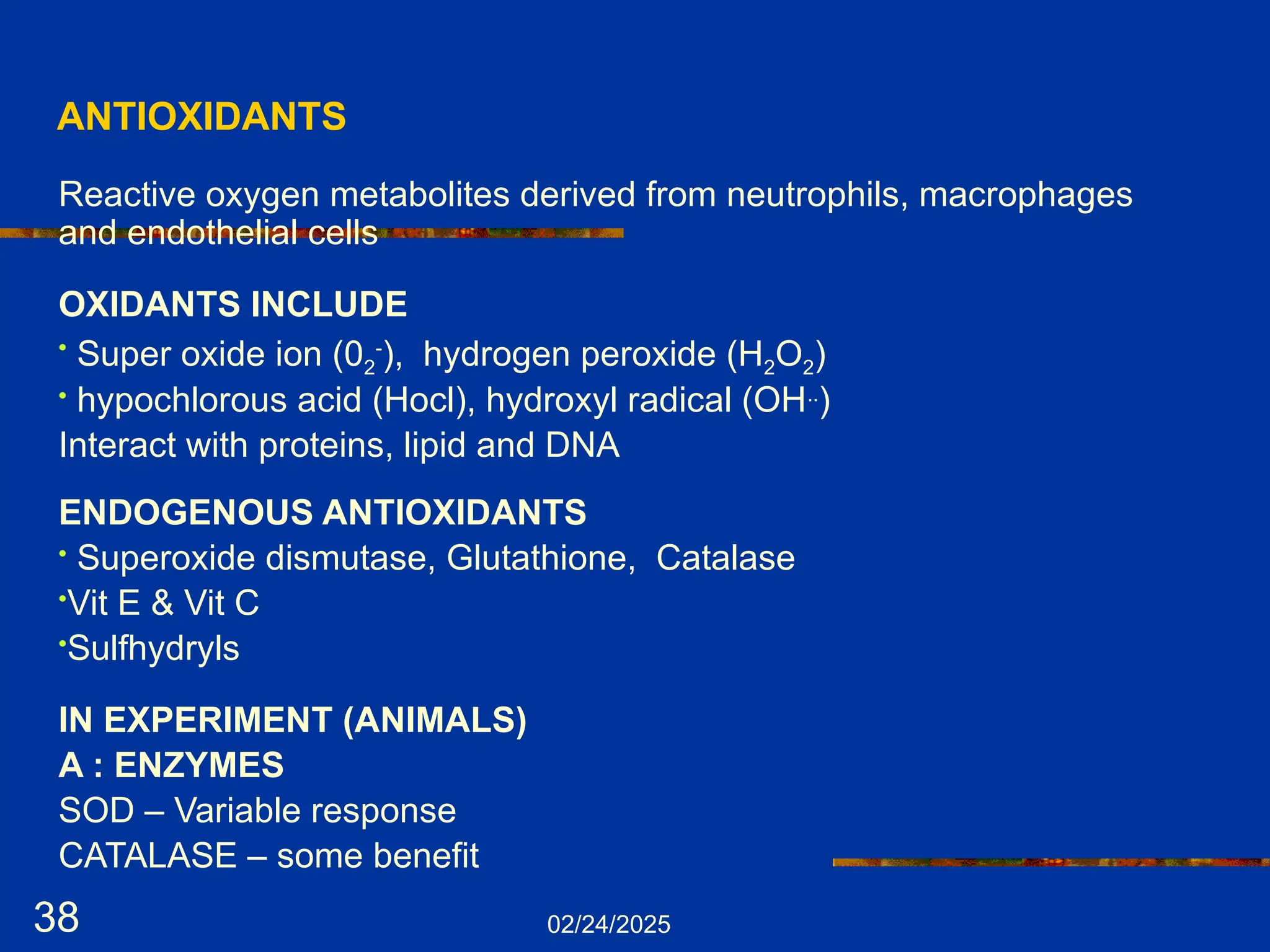
ANTIOXIDANTS
Reactive oxygen metabolitesderived from neutrophils, macrophages
and endothelial cells
OXIDANTS INCLUDE
• Super oxide ion (02
-
), hydrogen peroxide (H2O2)
• hypochlorous acid (Hocl), hydroxyl radical (OH..
)
Interact with proteins, lipid and DNA
ENDOGENOUS ANTIOXIDANTS
• Superoxide dismutase, Glutathione, Catalase
•Vit E & Vit C
•Sulfhydryls
IN EXPERIMENT (ANIMALS)
A : ENZYMES
SOD – Variable response
CATALASE – some benefit
02/24/2025
40
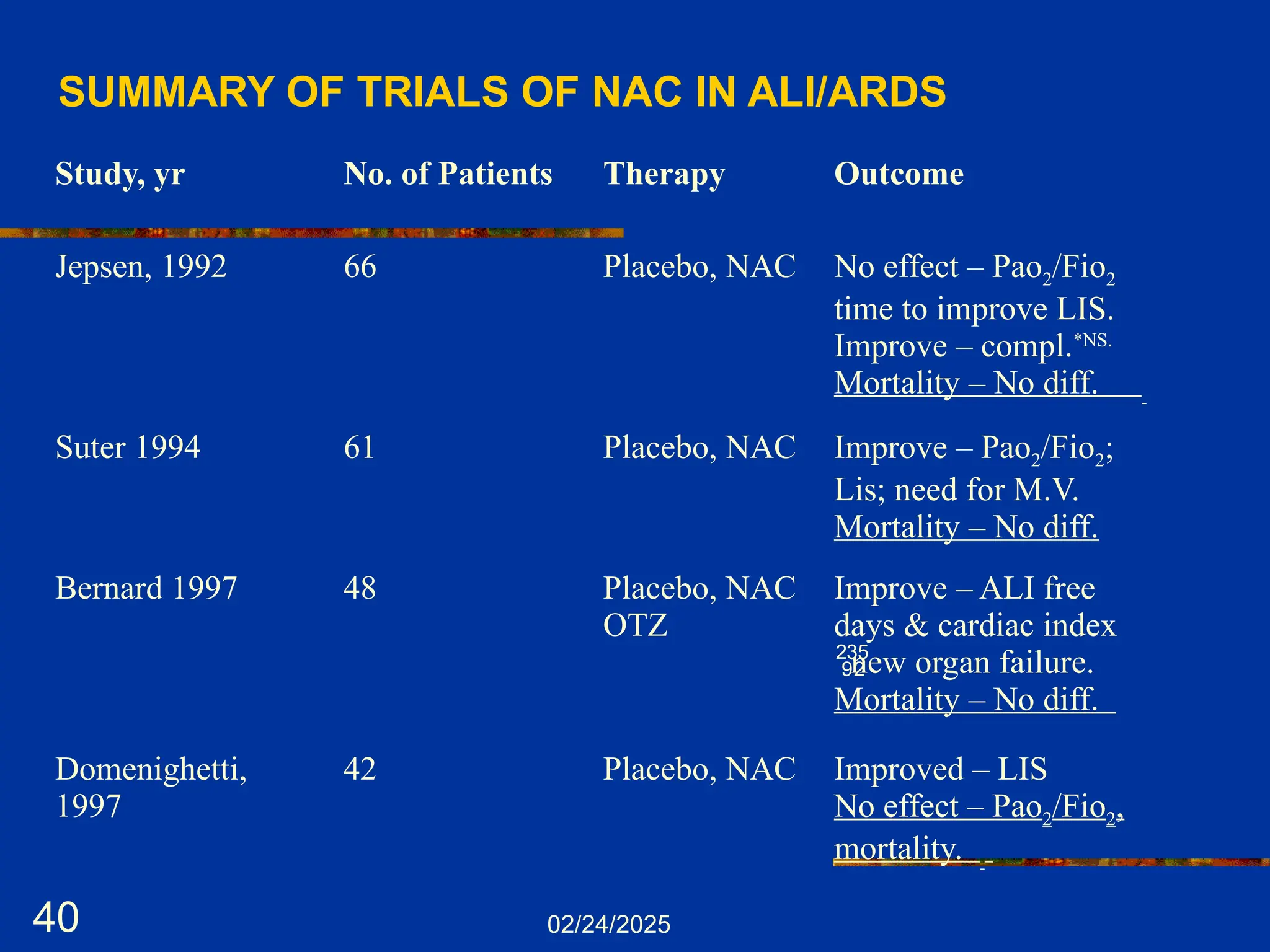
SUMMARY OF TRIALSOF NAC IN ALI/ARDS
Study, yr No. of Patients Therapy Outcome
Jepsen, 1992 66 Placebo, NAC No effect – Pao2/Fio2
time to improve LIS.
Improve – compl.*NS.
Mortality – No diff.
Suter 1994 61 Placebo, NAC Improve – Pao2/Fio2;
Lis; need for M.V.
Mortality – No diff.
Bernard 1997 48 Placebo, NAC
OTZ
Improve – ALI free
days & cardiac index
new organ failure.
Mortality – No diff.
Domenighetti,
1997
42 Placebo, NAC Improved – LIS
No effect – Pao2/Fio2,
mortality.
41.
02/24/2025
41
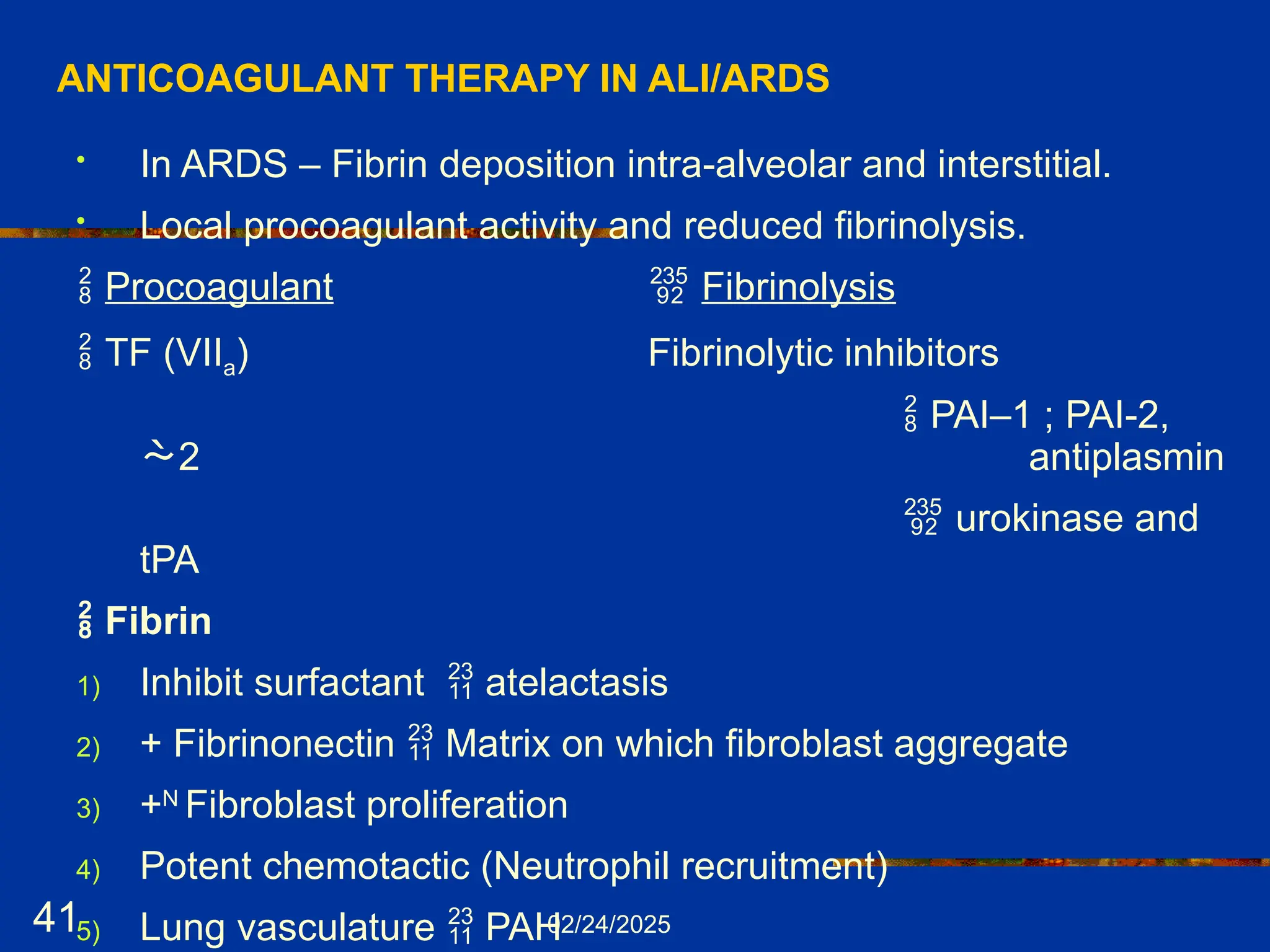
ANTICOAGULANT THERAPY INALI/ARDS
• In ARDS – Fibrin deposition intra-alveolar and interstitial.
• Local procoagulant activity and reduced fibrinolysis.
Procoagulant Fibrinolysis
TF (VIIa) Fibrinolytic inhibitors
PAI–1 ; PAI-2,
2 antiplasmin
urokinase and
tPA
Fibrin
1) Inhibit surfactant atelactasis
2) + Fibrinonectin Matrix on which fibroblast aggregate
3) +N
Fibroblast proliferation
4) Potent chemotactic (Neutrophil recruitment)
5) Lung vasculature PAH
42.
02/24/2025
42
TF PATHWAY INHIBITORSAND FACTOR Vll ai
In Expt studies
• Cytokine [IL-6, IL-10, IL-13]
• Fibrin clot
• Sepsis related organ damage
• LIS
•Improved survival
20 % RR reduction in 28 days all cause mortality and improvement in
organ dysfn. in patient with severe sepsis.
ABRAHAM E, ; CCM 2001 29 2081
HEPARIN
Effectiveness in blocking fibrin deposition debatable.
In Expt. animals large doses of UFH reduced fibrin deposition; prevent
EVLV; improved Pao2/Fio2
Human data lacking.
43.
02/24/2025
43
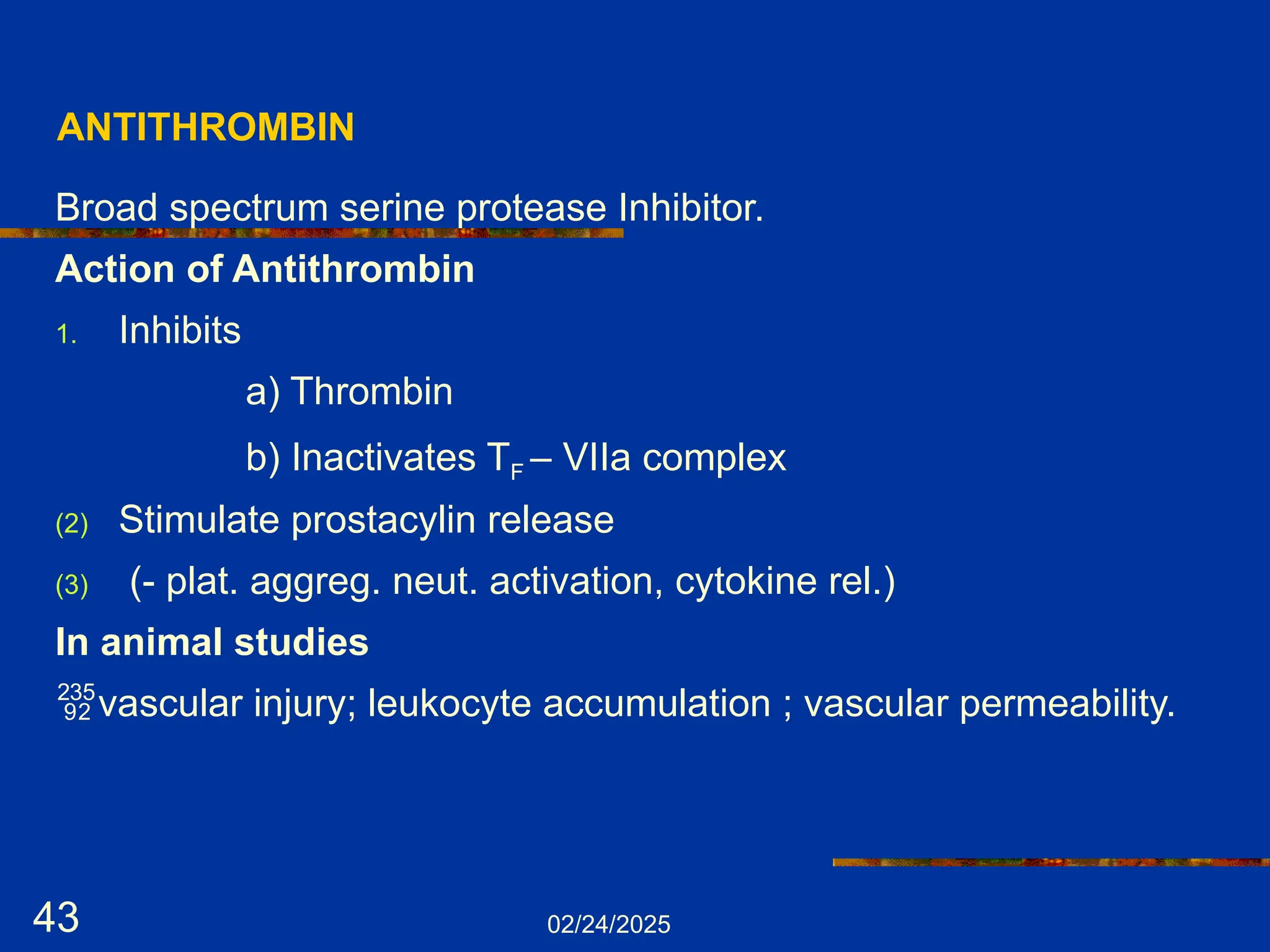
ANTITHROMBIN
Broad spectrum serineprotease Inhibitor.
Action of Antithrombin
1. Inhibits
a) Thrombin
b) Inactivates TF – VIIa complex
(2) Stimulate prostacylin release
(3) (- plat. aggreg. neut. activation, cytokine rel.)
In animal studies
vascular injury; leukocyte accumulation ; vascular permeability.
44.
02/24/2025
44
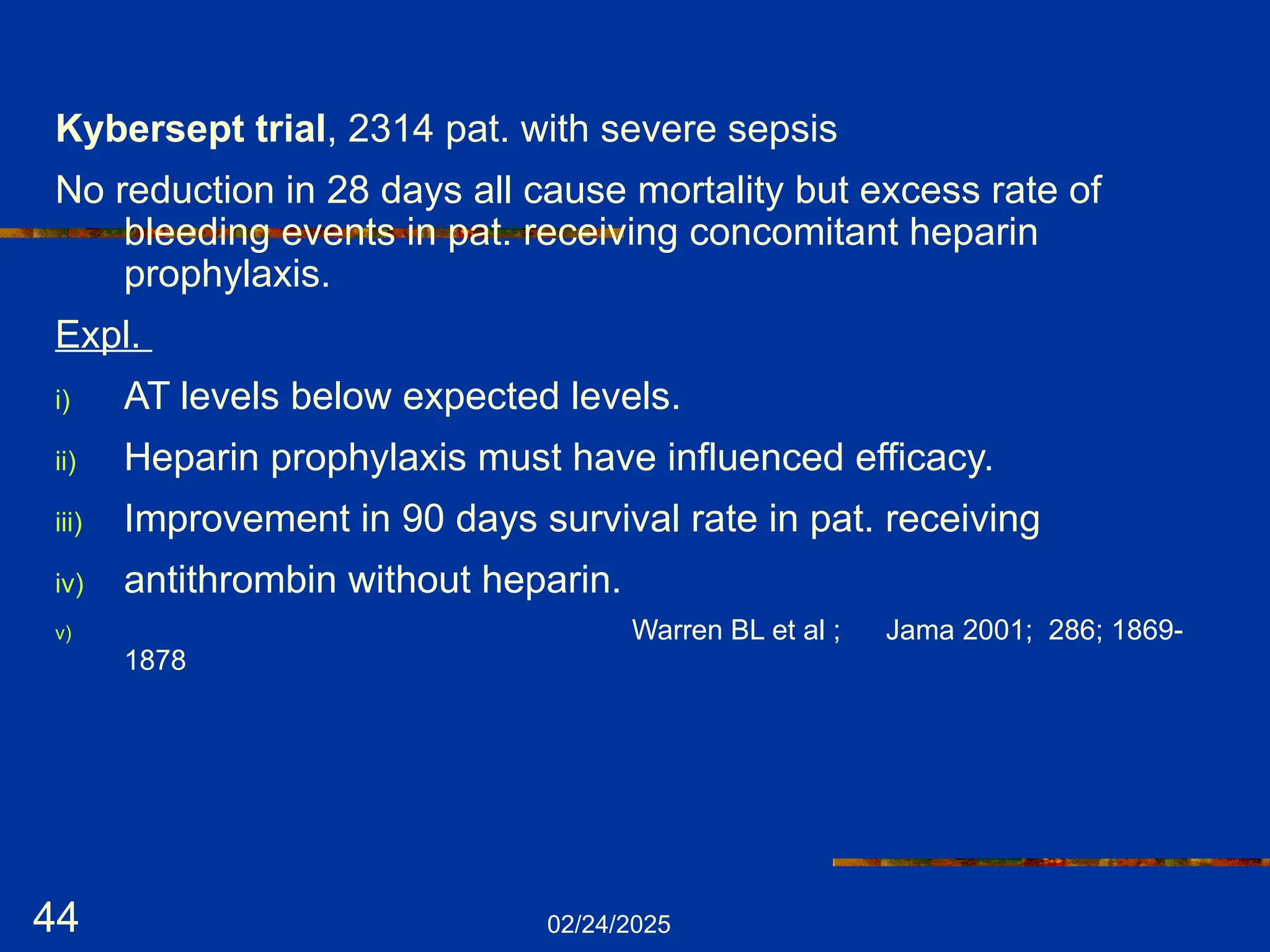
Kybersept trial, 2314pat. with severe sepsis
No reduction in 28 days all cause mortality but excess rate of
bleeding events in pat. receiving concomitant heparin
prophylaxis.
Expl.
i) AT levels below expected levels.
ii) Heparin prophylaxis must have influenced efficacy.
iii) Improvement in 90 days survival rate in pat. receiving
iv) antithrombin without heparin.
v) Warren BL et al ; Jama 2001; 286; 1869-
1878
45.
02/24/2025
45
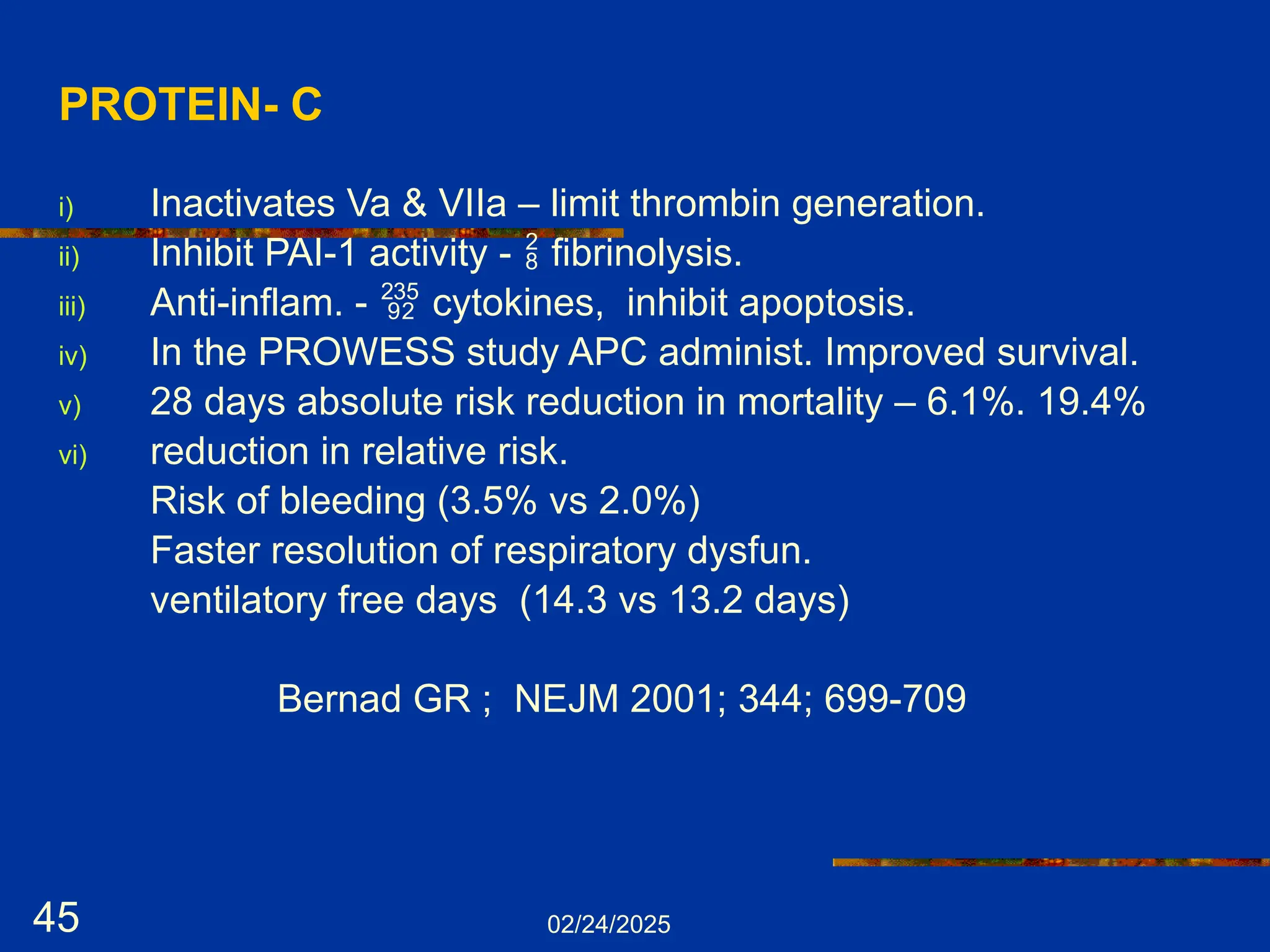
PROTEIN- C
i) InactivatesVa & VIIa – limit thrombin generation.
ii) Inhibit PAI-1 activity - fibrinolysis.
iii) Anti-inflam. - cytokines, inhibit apoptosis.
iv) In the PROWESS study APC administ. Improved survival.
v) 28 days absolute risk reduction in mortality – 6.1%. 19.4%
vi) reduction in relative risk.
Risk of bleeding (3.5% vs 2.0%)
Faster resolution of respiratory dysfun.
ventilatory free days (14.3 vs 13.2 days)
Bernad GR ; NEJM 2001; 344; 699-709
46.
02/24/2025
46
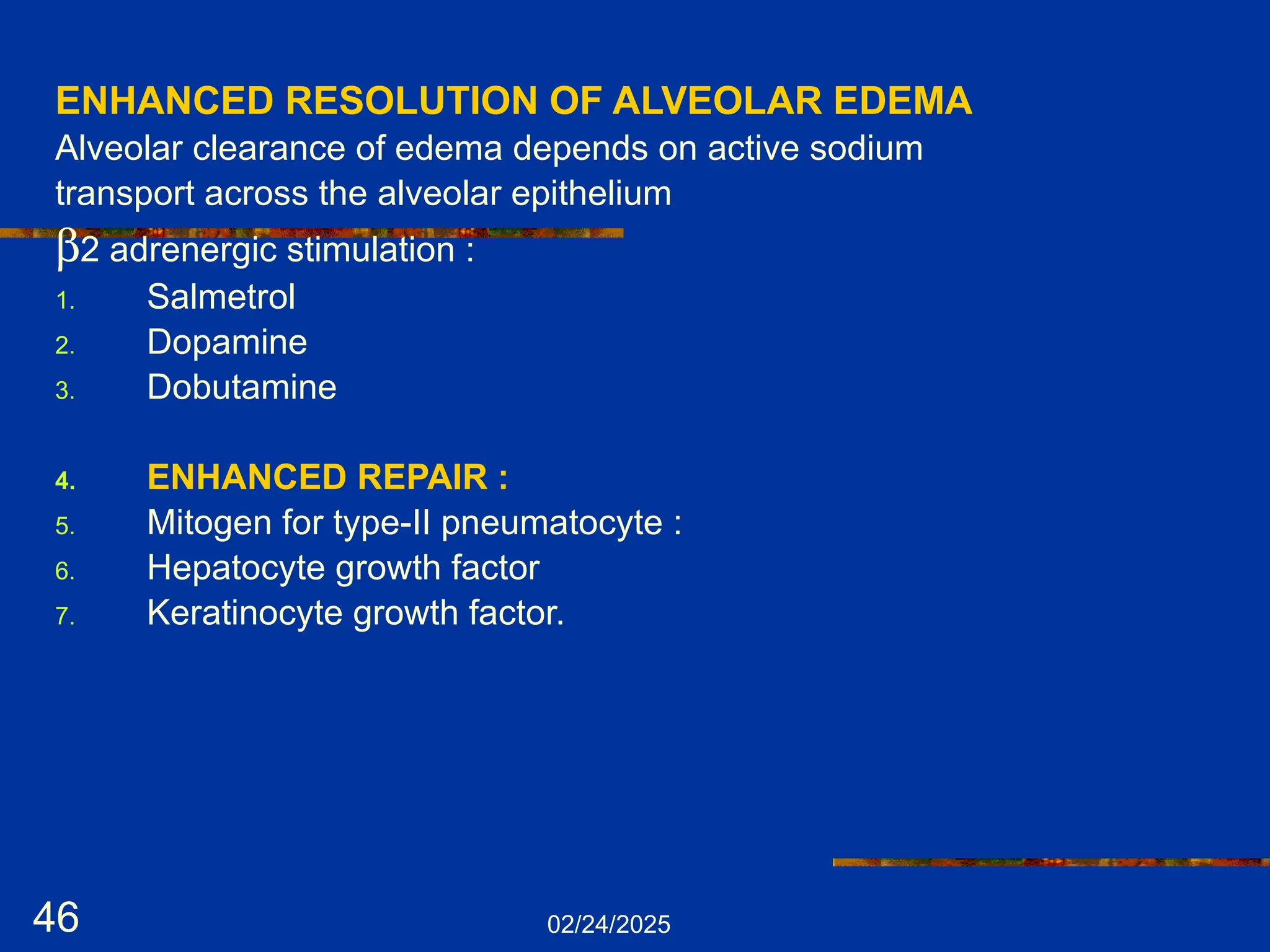
ENHANCED RESOLUTION OFALVEOLAR EDEMA
Alveolar clearance of edema depends on active sodium
transport across the alveolar epithelium
b2 adrenergic stimulation :
1. Salmetrol
2. Dopamine
3. Dobutamine
4. ENHANCED REPAIR :
5. Mitogen for type-II pneumatocyte :
6. Hepatocyte growth factor
7. Keratinocyte growth factor.
![02/24/2025
29
Surfactant of possible therapeutic use :
Class Origin Example
1. Natural Amniotic Human amniotic fluid
surfactant
2. Modified - Bovine Infasurf, alveofact
3. Natural BLESS,
Survanta
4. - Procine Curosurf
3. Synthetic Exosurf, ALEC, KL4
Surfactant, Venticute
DOSE
Sufficient dose should reach alveolar environment
TIMING
• As early as possible [<48 hr]
• Little benefit at 3 to 5 days [Fibrosis already set]](https://image.slidesharecdn.com/adjunctsintreatmentofards-singh-100415034924-phpapp01-250224091259-6df8b6f8/75/adjunctsintreatmentofards-singh-100415034924-phpapp01-ppt-29-2048.jpg)
![02/24/2025
36
KETOCONAZOLE
TxA2
1) Pulmonary vasoconstriction
2) Platelet and neutrophil aggregation
3) Blockade of Tx synthesis or receptor antagonism ameliorates
experimental lung injury
4) Ketoconazole
5) Specific inhibitor of thromboxane synthetase
6) Inhibits 5 – Lipoxygenase [LTB4 & procoag activity]
7)](https://image.slidesharecdn.com/adjunctsintreatmentofards-singh-100415034924-phpapp01-250224091259-6df8b6f8/75/adjunctsintreatmentofards-singh-100415034924-phpapp01-ppt-36-2048.jpg)
![02/24/2025
42
TF PATHWAY INHIBITORS AND FACTOR Vll ai
In Expt studies
• Cytokine [IL-6, IL-10, IL-13]
• Fibrin clot
• Sepsis related organ damage
• LIS
•Improved survival
20 % RR reduction in 28 days all cause mortality and improvement in
organ dysfn. in patient with severe sepsis.
ABRAHAM E, ; CCM 2001 29 2081
HEPARIN
Effectiveness in blocking fibrin deposition debatable.
In Expt. animals large doses of UFH reduced fibrin deposition; prevent
EVLV; improved Pao2/Fio2
Human data lacking.](https://image.slidesharecdn.com/adjunctsintreatmentofards-singh-100415034924-phpapp01-250224091259-6df8b6f8/75/adjunctsintreatmentofards-singh-100415034924-phpapp01-ppt-42-2048.jpg)