BIENGHEL H. OLIVER
Instructor 1
GOOD
AFTERNOON
LEARNING OBJECTIVES
BIENGHEL H. OLIVER
Instructor 1
BADMINTON
LEARNING OBJECTIVES
At the end of this module, the students are expected to:
 Identify the history/origin of the sports Badminton.
 Enumerate and explain the uses of the different facilities and
equipment used in the game.
 Analyze the basic rules or laws of the game.
 Perform the necessary basic skills and techniques in playing
Badminton.
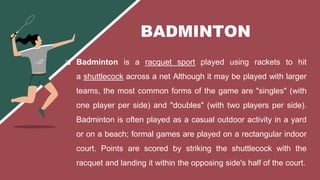
 Badminton is a racquet sport played using rackets to hit
a shuttlecock across a net Although it may be played with larger
teams, the most common forms of the game are "singles" (with
one player per side) and "doubles" (with two players per side).
Badminton is often played as a casual outdoor activity in a yard
or on a beach; formal games are played on a rectangular indoor
court. Points are scored by striking the shuttlecock with the
racquet and landing it within the opposing side's half of the court.
BADMINTON
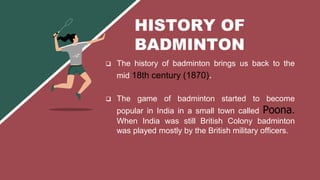
 The history of badminton brings us back to the
mid 18th century (1870).
 The game of badminton started to become
popular in India in a small town called Poona.
When India was still British Colony badminton
was played mostly by the British military officers.
HISTORY OF
BADMINTON
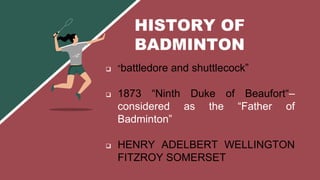
 “battledore and shuttlecock”
 1873 “Ninth Duke of Beaufort“–
considered as the “Father of
Badminton”
 HENRY ADELBERT WELLINGTON
FITZROY SOMERSET
HISTORY OF
BADMINTON
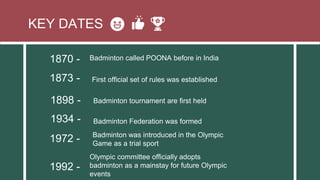
1870 - Badminton called POONA before in India
First official set of rules was established
KEY DATES
1873 -
1898 -
1934 -
1972 -
1992 -
Badminton tournament are first held
Badminton Federation was formed
Badminton was introduced in the Olympic
Game as a trial sport
Olympic committee officially adopts
badminton as a mainstay for future Olympic
events
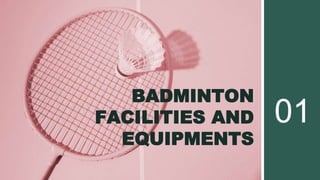
BADMINTON
FACILITIES AND
EQUIPMENTS
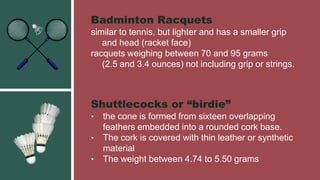
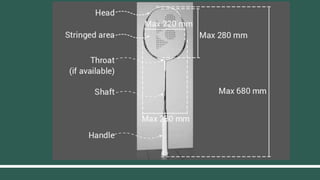
Badminton Racquets
similar to tennis, but lighter and has a smaller grip
and head (racket face)
racquets weighing between 70 and 95 grams
(2.5 and 3.4 ounces) not including grip or strings.
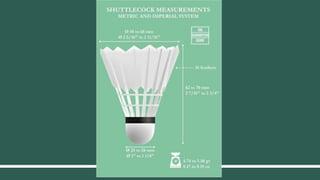
Shuttlecocks or “birdie”
• the cone is formed from sixteen overlapping
feathers embedded into a rounded cork base.
• The cork is covered with thin leather or synthetic
material
• The weight between 4.74 to 5.50 grams
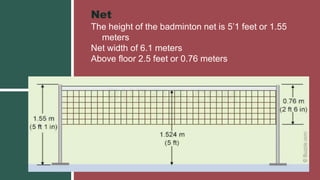
Net
The height of the badminton net is 5’1 feet or 1.55
meters
Net width of 6.1 meters
Above floor 2.5 feet or 0.76 meters
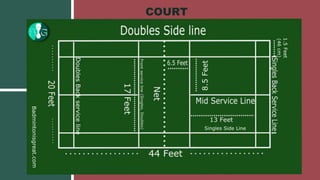
COURT
COURT
02
BASIC SKILLS
IN
BADMINTON
GRIP
You will want to learn how to hold your racket with the forehand to hit shuttles on
that side of your body and backhand to hit on the opposite side. You will use a
forehand grip to hit above your head as well. You can hit the shuttle using a
backhand grip with your elbow up or down. It is good to practice hitting with
these grips to improve your skills.
GRIP
FOOTWORK
Your footwork can bring more success to your game if you learn the basics of
moving on the court and practice them. Your ready position should include
standing in the center of the court if you are playing singles and bending your
knees with your body relaxed and waiting for play. Move your feet by shuffling
them or gliding from left to right and stepping or lunging forward. To move
backward, go fast enough that you get behind the shuttle to hit it hard enough.
GRIP
SERVING
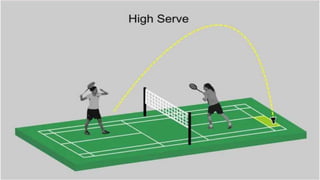
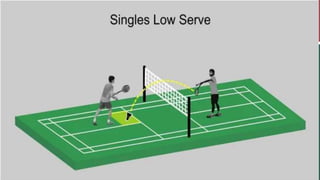
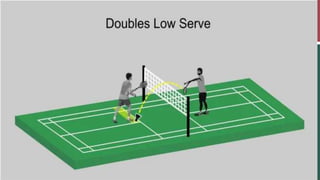
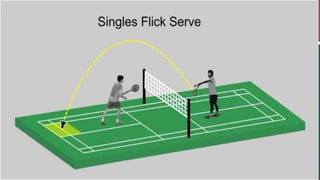
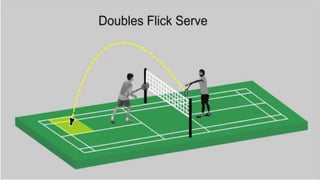
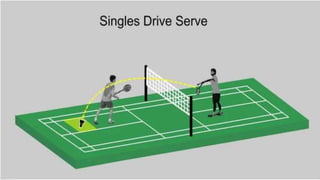
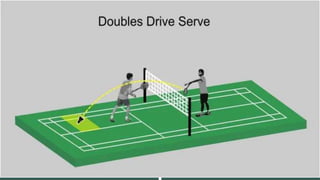
Four types of badminton serves include:
1. the high serve to move your opponent to the back of his or her side of the court;
2. the low serve to make your opponent have to get under the shuttle;
3. the flick serve that is used occasionally to confuse your opponent who thinks
you are going to hit a low serve;
4. the drive serve where you hit the shuttle low, fast and to the rear of the

receiver's court as a strategy move that will result in a missed hit.
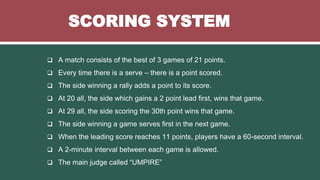
SCORING SYSTEM
 A match consists of the best of 3 games of 21 points.
 Every time there is a serve – there is a point scored.
 The side winning a rally adds a point to its score.
 At 20 all, the side which gains a 2 point lead first, wins that game.
 At 29 all, the side scoring the 30th point wins that game.
 The side winning a game serves first in the next game.
 When the leading score reaches 11 points, players have a 60-second interval.
 A 2-minute interval between each game is allowed.
 The main judge called “UMPIRE”
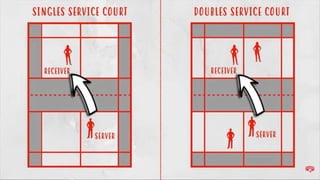
SINGLES
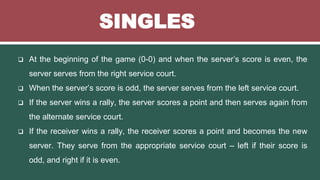
 At the beginning of the game (0-0) and when the server’s score is even, the
server serves from the right service court.
 When the server’s score is odd, the server serves from the left service court.
 If the server wins a rally, the server scores a point and then serves again from
the alternate service court.
 If the receiver wins a rally, the receiver scores a point and becomes the new
server. They serve from the appropriate service court – left if their score is
odd, and right if it is even.
DOUBLES
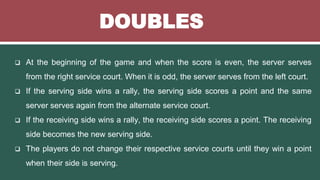
 At the beginning of the game and when the score is even, the server serves
from the right service court. When it is odd, the server serves from the left court.
 If the serving side wins a rally, the serving side scores a point and the same
server serves again from the alternate service court.
 If the receiving side wins a rally, the receiving side scores a point. The receiving
side becomes the new serving side.
 The players do not change their respective service courts until they win a point
when their side is serving.
GENERAL RULES
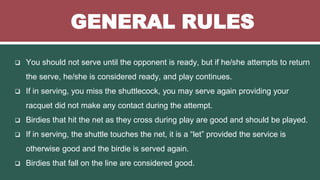
 You should not serve until the opponent is ready, but if he/she attempts to return
the serve, he/she is considered ready, and play continues.
 If in serving, you miss the shuttlecock, you may serve again providing your
racquet did not make any contact during the attempt.
 Birdies that hit the net as they cross during play are good and should be played.
 If in serving, the shuttle touches the net, it is a “let” provided the service is
otherwise good and the birdie is served again.
 Birdies that fall on the line are considered good.
TABLE OF CONTENTS
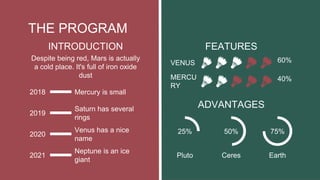
THE PROGRAM
75%
50%
25%
VENUS
FEATURES
2019
2018
2020
2021
Saturn has several
rings
Mercury is small
Venus has a nice
name
Neptune is an ice
giant
INTRODUCTION
Despite being red, Mars is actually
a cold place. It's full of iron oxide
dust MERCU
RY
60%
40%
ADVANTAGES
Pluto Ceres Earth
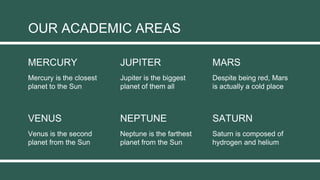
Jupiter is the biggest
planet of them all
MERCURY
Mercury is the closest
planet to the Sun
VENUS
Venus is the second
planet from the Sun
JUPITER
SATURN
Saturn is composed of
hydrogen and helium
MARS
Despite being red, Mars
is actually a cold place
NEPTUNE
Neptune is the farthest
planet from the Sun
OUR ACADEMIC AREAS
Mercury is the closest
planet to the Sun and the
smallest one of them all.
It’s only a bit larger than
the Moon
Venus has a beautiful
name and is the second
planet from the Sun. It’s
hot, even hotter than
Mercury
MISSION VISION
OUR MISSION AND VISION
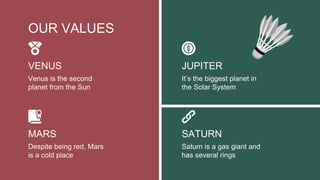
VENUS
Venus is the second
planet from the Sun
JUPITER
It’s the biggest planet in
the Solar System
MARS
Despite being red, Mars
is a cold place
SATURN
Saturn is a gas giant and
has several rings
OUR VALUES
AWESO
ME
WORDS
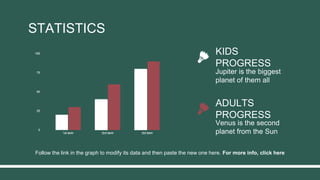
STATISTICS
Follow the link in the graph to modify its data and then paste the new one here. For more info, click here
ADULTS
PROGRESS
Venus is the second
planet from the Sun
KIDS
PROGRESS
Jupiter is the biggest
planet of them all
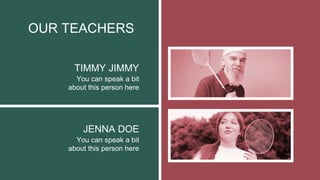
OUR TEACHERS
You can speak a bit
about this person here
JENNA DOE
TIMMY JIMMY
You can speak a bit
about this person here
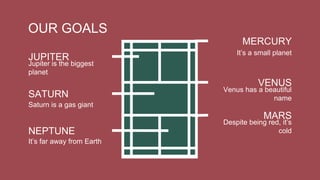
OUR GOALS
MERCURY
It’s a small planet
VENUS
Venus has a beautiful
name
MARS
Despite being red, it’s
cold
JUPITER
Jupiter is the biggest
planet
SATURN
Saturn is a gas giant
NEPTUNE
It’s far away from Earth
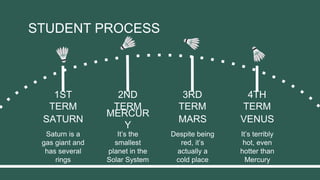
STUDENT PROCESS
SATURN
Saturn is a
gas giant and
has several
rings
1ST
TERM
2ND
TERM
MERCUR
Y
It’s the
smallest
planet in the
Solar System
3RD
TERM
MARS
Despite being
red, it’s
actually a
cold place
4TH
TERM
VENUS
It’s terribly
hot, even
hotter than
Mercury
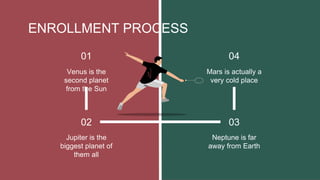
ENROLLMENT PROCESS
Venus is the
second planet
from the Sun
01
Mars is actually a
very cold place
04
Jupiter is the
biggest planet of
them all
02
Neptune is far
away from Earth
03
SPECIAL
REMINDERS
Do you know what helps you make your
point clear? Lists like this one:
● They’re simple
● You can organize your ideas clearly
● You’ll never forget to buy milk!
And the most important thing: the
audience won’t miss the point of your
presentation
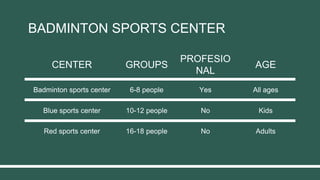
CENTER GROUPS
PROFESIO
NAL
AGE
Badminton sports center 6-8 people Yes All ages
Blue sports center 10-12 people No Kids
Red sports center 16-18 people No Adults
BADMINTON SPORTS CENTER
CENTER APP
You can replace the
image on the screen with
your own work. Just right-
click on it and select
“Replace image”
CREDITS: This presentation template was created
by Slidesgo, including icons by Flaticon and
infographics & images by Freepik
THANK
YOU!
DO YOU HAVE ANY
QUESTIONS?
youremail@freepik.com
+91 620 421 838
yourcompany.com
Please keep this slide for attribution
2022
SPORTS
CENTER

BADMINTON PE 3.pptx

  • 1.
  • 2.
  • 3.
  • 4.
    LEARNING OBJECTIVES At theend of this module, the students are expected to:  Identify the history/origin of the sports Badminton.  Enumerate and explain the uses of the different facilities and equipment used in the game.  Analyze the basic rules or laws of the game.  Perform the necessary basic skills and techniques in playing Badminton.
  • 5.
     Badminton isa racquet sport played using rackets to hit a shuttlecock across a net Although it may be played with larger teams, the most common forms of the game are "singles" (with one player per side) and "doubles" (with two players per side). Badminton is often played as a casual outdoor activity in a yard or on a beach; formal games are played on a rectangular indoor court. Points are scored by striking the shuttlecock with the racquet and landing it within the opposing side's half of the court. BADMINTON
  • 6.
     The historyof badminton brings us back to the mid 18th century (1870).  The game of badminton started to become popular in India in a small town called Poona. When India was still British Colony badminton was played mostly by the British military officers. HISTORY OF BADMINTON
  • 7.
     “battledore andshuttlecock”  1873 “Ninth Duke of Beaufort“– considered as the “Father of Badminton”  HENRY ADELBERT WELLINGTON FITZROY SOMERSET HISTORY OF BADMINTON
  • 8.
    1870 - Badmintoncalled POONA before in India First official set of rules was established KEY DATES 1873 - 1898 - 1934 - 1972 - 1992 - Badminton tournament are first held Badminton Federation was formed Badminton was introduced in the Olympic Game as a trial sport Olympic committee officially adopts badminton as a mainstay for future Olympic events
  • 9.
  • 10.
    Badminton Racquets similar totennis, but lighter and has a smaller grip and head (racket face) racquets weighing between 70 and 95 grams (2.5 and 3.4 ounces) not including grip or strings. Shuttlecocks or “birdie” • the cone is formed from sixteen overlapping feathers embedded into a rounded cork base. • The cork is covered with thin leather or synthetic material • The weight between 4.74 to 5.50 grams
  • 13.
    Net The height ofthe badminton net is 5’1 feet or 1.55 meters Net width of 6.1 meters Above floor 2.5 feet or 0.76 meters
  • 14.
  • 15.
  • 16.
  • 17.
    GRIP You will wantto learn how to hold your racket with the forehand to hit shuttles on that side of your body and backhand to hit on the opposite side. You will use a forehand grip to hit above your head as well. You can hit the shuttle using a backhand grip with your elbow up or down. It is good to practice hitting with these grips to improve your skills.
  • 18.
  • 19.
    FOOTWORK Your footwork canbring more success to your game if you learn the basics of moving on the court and practice them. Your ready position should include standing in the center of the court if you are playing singles and bending your knees with your body relaxed and waiting for play. Move your feet by shuffling them or gliding from left to right and stepping or lunging forward. To move backward, go fast enough that you get behind the shuttle to hit it hard enough.
  • 20.
  • 21.
    SERVING Four types ofbadminton serves include: 1. the high serve to move your opponent to the back of his or her side of the court; 2. the low serve to make your opponent have to get under the shuttle; 3. the flick serve that is used occasionally to confuse your opponent who thinks you are going to hit a low serve; 4. the drive serve where you hit the shuttle low, fast and to the rear of the receiver's court as a strategy move that will result in a missed hit.
  • 29.
    SCORING SYSTEM  Amatch consists of the best of 3 games of 21 points.  Every time there is a serve – there is a point scored.  The side winning a rally adds a point to its score.  At 20 all, the side which gains a 2 point lead first, wins that game.  At 29 all, the side scoring the 30th point wins that game.  The side winning a game serves first in the next game.  When the leading score reaches 11 points, players have a 60-second interval.  A 2-minute interval between each game is allowed.  The main judge called “UMPIRE”
  • 30.
    SINGLES  At thebeginning of the game (0-0) and when the server’s score is even, the server serves from the right service court.  When the server’s score is odd, the server serves from the left service court.  If the server wins a rally, the server scores a point and then serves again from the alternate service court.  If the receiver wins a rally, the receiver scores a point and becomes the new server. They serve from the appropriate service court – left if their score is odd, and right if it is even.
  • 31.
    DOUBLES  At thebeginning of the game and when the score is even, the server serves from the right service court. When it is odd, the server serves from the left court.  If the serving side wins a rally, the serving side scores a point and the same server serves again from the alternate service court.  If the receiving side wins a rally, the receiving side scores a point. The receiving side becomes the new serving side.  The players do not change their respective service courts until they win a point when their side is serving.
  • 32.
    GENERAL RULES  Youshould not serve until the opponent is ready, but if he/she attempts to return the serve, he/she is considered ready, and play continues.  If in serving, you miss the shuttlecock, you may serve again providing your racquet did not make any contact during the attempt.  Birdies that hit the net as they cross during play are good and should be played.  If in serving, the shuttle touches the net, it is a “let” provided the service is otherwise good and the birdie is served again.  Birdies that fall on the line are considered good.
  • 33.
  • 34.
    THE PROGRAM 75% 50% 25% VENUS FEATURES 2019 2018 2020 2021 Saturn hasseveral rings Mercury is small Venus has a nice name Neptune is an ice giant INTRODUCTION Despite being red, Mars is actually a cold place. It's full of iron oxide dust MERCU RY 60% 40% ADVANTAGES Pluto Ceres Earth
  • 35.
    Jupiter is thebiggest planet of them all MERCURY Mercury is the closest planet to the Sun VENUS Venus is the second planet from the Sun JUPITER SATURN Saturn is composed of hydrogen and helium MARS Despite being red, Mars is actually a cold place NEPTUNE Neptune is the farthest planet from the Sun OUR ACADEMIC AREAS
  • 36.
    Mercury is theclosest planet to the Sun and the smallest one of them all. It’s only a bit larger than the Moon Venus has a beautiful name and is the second planet from the Sun. It’s hot, even hotter than Mercury MISSION VISION OUR MISSION AND VISION
  • 37.
    VENUS Venus is thesecond planet from the Sun JUPITER It’s the biggest planet in the Solar System MARS Despite being red, Mars is a cold place SATURN Saturn is a gas giant and has several rings OUR VALUES
  • 38.
  • 39.
    STATISTICS Follow the linkin the graph to modify its data and then paste the new one here. For more info, click here ADULTS PROGRESS Venus is the second planet from the Sun KIDS PROGRESS Jupiter is the biggest planet of them all
  • 40.
    OUR TEACHERS You canspeak a bit about this person here JENNA DOE TIMMY JIMMY You can speak a bit about this person here
  • 41.
    OUR GOALS MERCURY It’s asmall planet VENUS Venus has a beautiful name MARS Despite being red, it’s cold JUPITER Jupiter is the biggest planet SATURN Saturn is a gas giant NEPTUNE It’s far away from Earth
  • 42.
    STUDENT PROCESS SATURN Saturn isa gas giant and has several rings 1ST TERM 2ND TERM MERCUR Y It’s the smallest planet in the Solar System 3RD TERM MARS Despite being red, it’s actually a cold place 4TH TERM VENUS It’s terribly hot, even hotter than Mercury
  • 43.
    ENROLLMENT PROCESS Venus isthe second planet from the Sun 01 Mars is actually a very cold place 04 Jupiter is the biggest planet of them all 02 Neptune is far away from Earth 03
  • 44.
    SPECIAL REMINDERS Do you knowwhat helps you make your point clear? Lists like this one: ● They’re simple ● You can organize your ideas clearly ● You’ll never forget to buy milk! And the most important thing: the audience won’t miss the point of your presentation
  • 45.
    CENTER GROUPS PROFESIO NAL AGE Badminton sportscenter 6-8 people Yes All ages Blue sports center 10-12 people No Kids Red sports center 16-18 people No Adults BADMINTON SPORTS CENTER
  • 46.
    CENTER APP You canreplace the image on the screen with your own work. Just right- click on it and select “Replace image”
  • 47.
    CREDITS: This presentationtemplate was created by Slidesgo, including icons by Flaticon and infographics & images by Freepik THANK YOU! DO YOU HAVE ANY QUESTIONS? youremail@freepik.com +91 620 421 838 yourcompany.com Please keep this slide for attribution 2022 SPORTS CENTER