CONTEMPORARY
PHILIPPINE ARTS
FROM THE REGIONS
Quarter 3
– Lesson 6
Gawad sa Manlilikhang Bayan
Prepared: Eric J. Manuevo
Gawad Sa
Manlilikha ng Bayan
(GAMABA)
 asenvisionedinrepublic act no.7355
 it wasestablished in1992
 shall meancitizen engagedinanytraditional
art uniquely Filipino,whosedistinct skills have
reached such a high level of technical and
artistic excellence, andhave passedit onto in
hisor her community with the samedegreeof
technical andartistic competence.
Manlilikha ng BayanAct
 Thehighest policy andcoordinatingbodyfor
culture andthe artsof the state.
 It has to search for the finest traditional artist of
the landwhoadoptsaprogramthat willensure the
transfer of their skillsto others,undertakes
measures to promote agenuine appreciationof and
crafts and give pride among our people about the
geniusof ManlilikhangBayan.
National Commission for Culture and
the Arts (NCCA)
 AsFilipinowhorecognize the uniqueidentitiesof
ourfellow Filipinos,it istheright to see their
contribution to the community.
 The country is rich with various elements of
tangibleandintangible cultural heritage whichhas
passedonthe newgeneration.
The Gawad Manlilikha ng Bayan
(GAMABA) Awardees
 Culture as part of our Philippine identity includes a
variety of arts that enhance by our National Living
Treasure artists who are recognized in their special
contribution to the nationalheritage.
 Theseare Filipinocitizenwhoisengagedinany
traditional art forms and has contributed to the
development of culturaldiversity andthe creativity
of humanity.
T
heG
aw
ad Manlilikha ng Bayan(GAMABA)
Awardees
TheGawad
Manlilikha ng Bayan
(GAMABA) Awardees
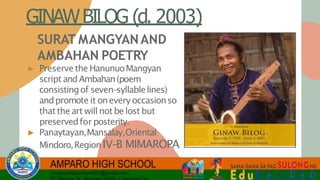
SURAT MANGYANAND
AMBAHAN POETRY
► Preserve the HanunuoMangyan
script andAmbahan(poem
consistingof seven-syllablelines)
andpromote it onevery occasionso
that the art will not belost but
preservedfor posterity.
► Panaytayan,Mansalay,Oriental
Mindoro,RegionIV-B MIMAROPA
GINAWBILOG (d. 2003)
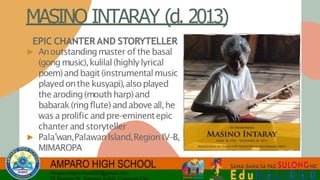
EPIC CHANTERAND STORYTELLER
► Anoutstandingmaster of the basal
(gongmusic),kulilal(highlylyrical
poem)andbagit(instrumentalmusic
playedonthe kusyapi),alsoplayed
the aroding(mouthharp)and
babarak(ringflute) andaboveall,he
wasaprolific andpre-eminentepic
chanterandstoryteller
► Pala’wan,PalawanIsland,RegionIV-B,
MIMAROPA
MASINO INTARAY (d. 2013)
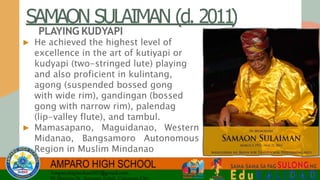
PLAYING KUDYAPI
► He achieved the highest level of
excellence in the art of kutiyapi or
kudyapi (two-stringed lute) playing
and also proficient in kulintang,
agong (suspended bossed gong
with wide rim), gandingan (bossed
gong with narrow rim), palendag
(lip-valley flute), and tambul.
► Mamasapano, Maguidanao, Western
Midanao, Bangsamoro Autonomous
Region in Muslim Mindanao
SAMAON SULAIMAN (d. 2011
)
T’NALAK WEAVING
► She iscredited with preservingher
people’straditional T’nalakusing abaca
fibers asfine ashair which traditionally
hasthree primary colors,red,black,and
the original colors of abacaleave
recreated by her nimblehands-the
crocodiles, butterflies,andflowers.
► Tagabawa Bagobo/Bansalan,Davao
del Sur,RegionXI, Davao Region
LANG DULAY (d. 2015)
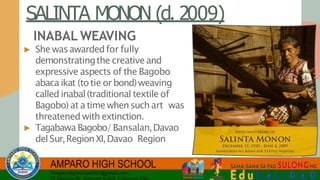
INABAL WEAVING
► She wasawardedfor fully
demonstratingthe creative and
expressive aspects of the Bagobo
abaca ikat (totie or bond)weaving
called inabal(traditional textile of
Bagobo) at a timewhensuchart was
threatened with extinction.
► Tagabawa Bagobo/Bansalan,Davao
del Sur,RegionXI,Davao Region
SALINTA MONON (d. 2009)
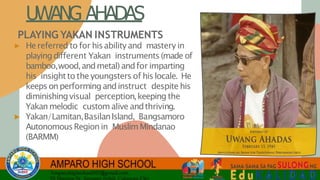
PLAYING YAKAN INSTRUMENTS
► Hereferred to for hisability and mastery in
playingdifferent Yakan instruments(made of
bamboo,wood,andmetal) andfor imparting
his insightto the youngsters of hislocale. He
keepsonperformingandinstruct despite his
diminishingvisual perception,keeping the
Yakanmelodic custom alive andthriving.
► Yakan/Lamitan,BasilanIsland, Bangsamoro
AutonomousRegionin MuslimMindanao
(BARMM)
UWANG AHADAS
CHANTING THE SUGIDANON
EPIC OFTHE PANAY BUKIDNON
► Hecontinuously worksfor the
documentationof the oral
literature,inparticular the
epics,of people.
► Yakan/Lamitan,Basilan Island,
Bangsamoro Autonomous
RegioninMuslimMindanao
(BARMM)
FEDERICO CABALLERO
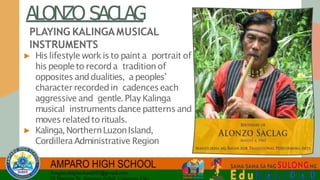
PLAYING KALINGAMUSICAL
INSTRUMENTS
► Hislifestyle workisto paint a portrait of
hispeopleto recorda traditionof
opposites anddualities, apeoples’
character recordedin cadenceseach
aggressiveand gentle.Play Kalinga
musical instruments dancepatternsand
movesrelatedtorituals.
► Kalinga,NorthernLuzonIsland,
CordilleraAdministrative Region
ALONZO SACLAG
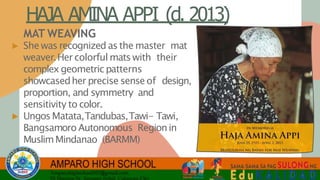
MAT WEAVING
► She was recognized as the master mat
weaver.Her colorfulmatswith their
complexgeometricpatterns
showcasedher precise senseof design,
proportion, and symmetry and
sensitivity to color.
► UngosMatata,Tandubas,Tawi- Tawi,
Bangsamoro Autonomous Regionin
MuslimMindanao (BARMM)
HAJA AMINA APPI (d. 2013)
METALPLATING
► Heisanartist whohasdevoted his
existence to developing religious
andsecular artwork insilver,
bronze,andwood.Hisintricately
detailedretablos,mirrors,altars,
andcarosas are inchurch buildings
andnon-public collections.
► Apalit,Pampanga,Region III,
Central Luzon
EDUARDO MUTUC
PIS SYABITWEAVING
► Sheremaineddevoted and
perseveredwith her missionto teach
the artwork of pissyabit weaving.
► Herstrokesfirm andsure,hercolor
sensitivity acute,andherdedication
to thebest of herproducts
unwavering.
► Tausug/Parang,Sulu,Bangsamoro
AutonomousRegioninMuslim
Mindanao(BARMM)
DARHATA SAWABI (d. 2005)
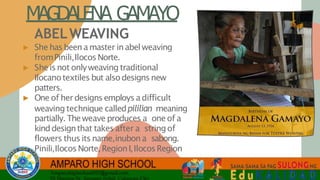
ABELWEAVING
► She hasbeenamaster inabel weaving
fromPinili,IlocosNorte.
► Sheisnot onlyweaving traditional
Ilocanotextiles but alsodesignsnew
patters.
► One of herdesignsemploys adifficult
weaving technique calledpililian meaning
partially.Theweave produces a one of a
kinddesignthat takes after a stringof
flowers thusits name,inubon a sabong.
► Pinili,IlocosNorte,RegionI,IlocosRegion
MAGDALENA GAMAYO
KATTUKONG OR
TABÚNGAW HAT MAKING
► Whenhefinishesfieldwork asa farmer,
hefocusesonthe cultivation and
developmentof tabúngaw (Ilokanoterm
for úpo).Atthe ageof fifteen(15)he
learnedthe art of Kattukongor
tabúngaw hatmaking andbasket
weavingfromhis grandfather.
► SanQuintin,Abra,Cordillera
Administrative Region(CAR)
TEOFILO GARCIA
YAKAN WEAVING
► ApuhAmbalang,is significantly respected inall of
Lamitan.Her ability is regardedunique:shecan bring
forthall designsandactualizeall textile categories
ordinary to the Yakancommunity,who are knowntobe
amongthefinest weaverswithin theSouthern
Philippines.
► Shecanperform thesuwahbekkat(cross-stitch-like
embellishment)andsuwahpendan(embroidery-like
embellishment)techniquesof thebungasama category.
► Shehasthe complexknowledgeof thewhole weaving
process,mindful at thesametimeasthe cultural
significanceof eachtextile designor category.
► Lamitan,Basilan Island,Bangsamoro Autonomous Region
inMuslimMindanao
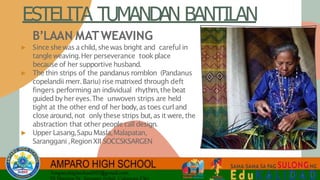
AMBALANG AUSALIN
B’LAAN MATWEAVING
► Since shewas achild,shewas bright and careful in
tangle weaving.Her perseverance tookplace
because of her supportive husband.
► The thin strips of the pandanus romblon (Pandanus
copelandii merr.Bariu) rise matrixed through deft
fingers performing an individual rhythm,thebeat
guided byher eyes.The unwoven strips are held
tight at the other end of her body,as toes curland
close around,not onlythese strips but,as it were, the
abstraction that other people call design.
► Upper Lasang,SapuMasla,Malapatan,
Saranggani ,RegionXII SOCCSKSARGEN
ESTELITA TUMANDAN BANTILAN
B’LAAN IKATOR TIE-DYE
FABRIC WEAVING
► YabingMasalon Dulo,called as “FuYabing”,was only
fourteen (14)years old when she started weaving.
All her younger years were spent in sharpening her
skills andimpartingthe knowledge to younger
generations of B’laan weavers.
► She follows her mother’smovements back and forth.
She colors the fibers, counts the thread, and
observes the rhythmic dance of a weaver’s dreams
woven into uniquesoulfulpieces.
► Amguo, Landan, Polomolok, South Cotabato,
Region XII SOCCSKSARGEN
YABING MASALON DULO
SUMMARY:
 Republic Act No. 7355 known as
Manlilikha ng Bayan Act was
established in 1992 to give
recognition to traditional art
uniquely Filipino who preserves and
promotes its traditional folk arts that
contribute to the national heritage.
 National Commission for Culture
and the Arts (NCCA) is the highest
policy and coordinating body for
culture and arts of the state.
 The Philippines through the
effort of NCCA introduced the
sixteen (16) Gawad sa
Manlilikha ng Bayan or
GAMABAAwardees namely:
QUIZ

CPAR Q3 LESSON 6.pptx

  • 2.
    CONTEMPORARY PHILIPPINE ARTS FROM THEREGIONS Quarter 3 – Lesson 6 Gawad sa Manlilikhang Bayan Prepared: Eric J. Manuevo
  • 3.
    Gawad Sa Manlilikha ngBayan (GAMABA)
  • 4.
     asenvisionedinrepublic actno.7355  it wasestablished in1992  shall meancitizen engagedinanytraditional art uniquely Filipino,whosedistinct skills have reached such a high level of technical and artistic excellence, andhave passedit onto in hisor her community with the samedegreeof technical andartistic competence. Manlilikha ng BayanAct
  • 5.
     Thehighest policyandcoordinatingbodyfor culture andthe artsof the state.  It has to search for the finest traditional artist of the landwhoadoptsaprogramthat willensure the transfer of their skillsto others,undertakes measures to promote agenuine appreciationof and crafts and give pride among our people about the geniusof ManlilikhangBayan. National Commission for Culture and the Arts (NCCA)
  • 6.
     AsFilipinowhorecognize theuniqueidentitiesof ourfellow Filipinos,it istheright to see their contribution to the community.  The country is rich with various elements of tangibleandintangible cultural heritage whichhas passedonthe newgeneration. The Gawad Manlilikha ng Bayan (GAMABA) Awardees
  • 7.
     Culture aspart of our Philippine identity includes a variety of arts that enhance by our National Living Treasure artists who are recognized in their special contribution to the nationalheritage.  Theseare Filipinocitizenwhoisengagedinany traditional art forms and has contributed to the development of culturaldiversity andthe creativity of humanity. T heG aw ad Manlilikha ng Bayan(GAMABA) Awardees
  • 8.
  • 10.
    SURAT MANGYANAND AMBAHAN POETRY ►Preserve the HanunuoMangyan script andAmbahan(poem consistingof seven-syllablelines) andpromote it onevery occasionso that the art will not belost but preservedfor posterity. ► Panaytayan,Mansalay,Oriental Mindoro,RegionIV-B MIMAROPA GINAWBILOG (d. 2003)
  • 11.
    EPIC CHANTERAND STORYTELLER ►Anoutstandingmaster of the basal (gongmusic),kulilal(highlylyrical poem)andbagit(instrumentalmusic playedonthe kusyapi),alsoplayed the aroding(mouthharp)and babarak(ringflute) andaboveall,he wasaprolific andpre-eminentepic chanterandstoryteller ► Pala’wan,PalawanIsland,RegionIV-B, MIMAROPA MASINO INTARAY (d. 2013)
  • 12.
    PLAYING KUDYAPI ► Heachieved the highest level of excellence in the art of kutiyapi or kudyapi (two-stringed lute) playing and also proficient in kulintang, agong (suspended bossed gong with wide rim), gandingan (bossed gong with narrow rim), palendag (lip-valley flute), and tambul. ► Mamasapano, Maguidanao, Western Midanao, Bangsamoro Autonomous Region in Muslim Mindanao SAMAON SULAIMAN (d. 2011 )
  • 14.
    T’NALAK WEAVING ► Sheiscredited with preservingher people’straditional T’nalakusing abaca fibers asfine ashair which traditionally hasthree primary colors,red,black,and the original colors of abacaleave recreated by her nimblehands-the crocodiles, butterflies,andflowers. ► Tagabawa Bagobo/Bansalan,Davao del Sur,RegionXI, Davao Region LANG DULAY (d. 2015)
  • 15.
    INABAL WEAVING ► Shewasawardedfor fully demonstratingthe creative and expressive aspects of the Bagobo abaca ikat (totie or bond)weaving called inabal(traditional textile of Bagobo) at a timewhensuchart was threatened with extinction. ► Tagabawa Bagobo/Bansalan,Davao del Sur,RegionXI,Davao Region SALINTA MONON (d. 2009)
  • 17.
    PLAYING YAKAN INSTRUMENTS ►Hereferred to for hisability and mastery in playingdifferent Yakan instruments(made of bamboo,wood,andmetal) andfor imparting his insightto the youngsters of hislocale. He keepsonperformingandinstruct despite his diminishingvisual perception,keeping the Yakanmelodic custom alive andthriving. ► Yakan/Lamitan,BasilanIsland, Bangsamoro AutonomousRegionin MuslimMindanao (BARMM) UWANG AHADAS
  • 18.
    CHANTING THE SUGIDANON EPICOFTHE PANAY BUKIDNON ► Hecontinuously worksfor the documentationof the oral literature,inparticular the epics,of people. ► Yakan/Lamitan,Basilan Island, Bangsamoro Autonomous RegioninMuslimMindanao (BARMM) FEDERICO CABALLERO
  • 19.
    PLAYING KALINGAMUSICAL INSTRUMENTS ► Hislifestyleworkisto paint a portrait of hispeopleto recorda traditionof opposites anddualities, apeoples’ character recordedin cadenceseach aggressiveand gentle.Play Kalinga musical instruments dancepatternsand movesrelatedtorituals. ► Kalinga,NorthernLuzonIsland, CordilleraAdministrative Region ALONZO SACLAG
  • 21.
    MAT WEAVING ► Shewas recognized as the master mat weaver.Her colorfulmatswith their complexgeometricpatterns showcasedher precise senseof design, proportion, and symmetry and sensitivity to color. ► UngosMatata,Tandubas,Tawi- Tawi, Bangsamoro Autonomous Regionin MuslimMindanao (BARMM) HAJA AMINA APPI (d. 2013)
  • 22.
    METALPLATING ► Heisanartist whohasdevotedhis existence to developing religious andsecular artwork insilver, bronze,andwood.Hisintricately detailedretablos,mirrors,altars, andcarosas are inchurch buildings andnon-public collections. ► Apalit,Pampanga,Region III, Central Luzon EDUARDO MUTUC
  • 23.
    PIS SYABITWEAVING ► Sheremaineddevotedand perseveredwith her missionto teach the artwork of pissyabit weaving. ► Herstrokesfirm andsure,hercolor sensitivity acute,andherdedication to thebest of herproducts unwavering. ► Tausug/Parang,Sulu,Bangsamoro AutonomousRegioninMuslim Mindanao(BARMM) DARHATA SAWABI (d. 2005)
  • 25.
    ABELWEAVING ► She hasbeenamasterinabel weaving fromPinili,IlocosNorte. ► Sheisnot onlyweaving traditional Ilocanotextiles but alsodesignsnew patters. ► One of herdesignsemploys adifficult weaving technique calledpililian meaning partially.Theweave produces a one of a kinddesignthat takes after a stringof flowers thusits name,inubon a sabong. ► Pinili,IlocosNorte,RegionI,IlocosRegion MAGDALENA GAMAYO
  • 26.
    KATTUKONG OR TABÚNGAW HATMAKING ► Whenhefinishesfieldwork asa farmer, hefocusesonthe cultivation and developmentof tabúngaw (Ilokanoterm for úpo).Atthe ageof fifteen(15)he learnedthe art of Kattukongor tabúngaw hatmaking andbasket weavingfromhis grandfather. ► SanQuintin,Abra,Cordillera Administrative Region(CAR) TEOFILO GARCIA
  • 28.
    YAKAN WEAVING ► ApuhAmbalang,issignificantly respected inall of Lamitan.Her ability is regardedunique:shecan bring forthall designsandactualizeall textile categories ordinary to the Yakancommunity,who are knowntobe amongthefinest weaverswithin theSouthern Philippines. ► Shecanperform thesuwahbekkat(cross-stitch-like embellishment)andsuwahpendan(embroidery-like embellishment)techniquesof thebungasama category. ► Shehasthe complexknowledgeof thewhole weaving process,mindful at thesametimeasthe cultural significanceof eachtextile designor category. ► Lamitan,Basilan Island,Bangsamoro Autonomous Region inMuslimMindanao AMBALANG AUSALIN
  • 29.
    B’LAAN MATWEAVING ► Sinceshewas achild,shewas bright and careful in tangle weaving.Her perseverance tookplace because of her supportive husband. ► The thin strips of the pandanus romblon (Pandanus copelandii merr.Bariu) rise matrixed through deft fingers performing an individual rhythm,thebeat guided byher eyes.The unwoven strips are held tight at the other end of her body,as toes curland close around,not onlythese strips but,as it were, the abstraction that other people call design. ► Upper Lasang,SapuMasla,Malapatan, Saranggani ,RegionXII SOCCSKSARGEN ESTELITA TUMANDAN BANTILAN
  • 30.
    B’LAAN IKATOR TIE-DYE FABRICWEAVING ► YabingMasalon Dulo,called as “FuYabing”,was only fourteen (14)years old when she started weaving. All her younger years were spent in sharpening her skills andimpartingthe knowledge to younger generations of B’laan weavers. ► She follows her mother’smovements back and forth. She colors the fibers, counts the thread, and observes the rhythmic dance of a weaver’s dreams woven into uniquesoulfulpieces. ► Amguo, Landan, Polomolok, South Cotabato, Region XII SOCCSKSARGEN YABING MASALON DULO
  • 31.
    SUMMARY:  Republic ActNo. 7355 known as Manlilikha ng Bayan Act was established in 1992 to give recognition to traditional art uniquely Filipino who preserves and promotes its traditional folk arts that contribute to the national heritage.  National Commission for Culture and the Arts (NCCA) is the highest policy and coordinating body for culture and arts of the state.  The Philippines through the effort of NCCA introduced the sixteen (16) Gawad sa Manlilikha ng Bayan or GAMABAAwardees namely:
  • 32.