PATENTAPPLICATION FORMS &
GUIDELINES
PRESENTED BY :-
PRATIK P KEDARE
[M-PHARM 1ST
YEAR]
Department of Pharmaceutical analysis
GUIDED BY :-
MRS.AVNI KHRISTI
[HOD Parul Institute of Pharmacy ]
Content’s
INTRODUCTION OF PATENT
PATENT FORMS APPLICATION
TYPES OF PATENT APPLICATION
Patent
Patent is a set of exclusive rights granted by government of India to an inventor for a limited
period of time, excluding others from making, using, selling, importing the patented product or
process producing that product for these purposes.
PATENTEE : A person to whom the patent is granted.
PATENT FORMS APPLICATION
The list of forms that have to be submitted are :-
Form 1: Application for grant of patent
Form 2 : Provisional /complete specification
Form 3 : Statement & undertaking under section 8 (From the date of filling of patent application we
have maximum of 6 months to file this patent )
Form 5 : Declaration as to inventorship
Form 9 : Request for publication ( Covered under section 11 A(2) )
Form 18 : Request for examination of application for patent ( Covered under section 11 B )
18A – Expedited examination – Referred under rule no 24 c of INDIAN PATENT ACT 1970
Form 26 : Power of authority
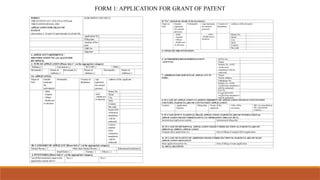
 FORM -1 : APPLICATION FOR GRANT OF PATENT IN INDIA
In this form, one has to furnish information such as name and address of the inventors, name and
address of the applicant, information corresponding to prior patent application which any authorized
entity has filled & some declarations among other information
 FORM -2 : PROVISIONAL /COMPLETE SPECIFICATION
The patent specification can be provisional or a complete patent specification depending on the type
of patent application one is filling.
The number of sheets and claims is to be counted and the appropriate fee is calculated. While
counting the sheets, even the drawing sheets will have to be taken into account.
 FORM -3 : STATEMENT & UNDERTAKING
It is used to furnish information and action relating to patent applications filed in other countries for
the current invention.
 FORM – 5 : DECLARATION AS TO INVENTORSHIP
Application used to declare the inventors of the subject matter sought to be protected using the
current patent application.
 FORM – 9 : REQUEST FOR PUBLICATION
By filling this form, one can generally have the patent specification published within 1 month from
filling this form.
 FORM – 18 : REQUEST FOR EXAMINATION OF APPLICATION FOR PATENT
This form can be filled within 48 months from priority date. The patent office will not consider a patent

application for examination unless this form is filled. Hence, if one wishes to expedite the patenting process filing
of form 9 & 18 at an early stage is advised.
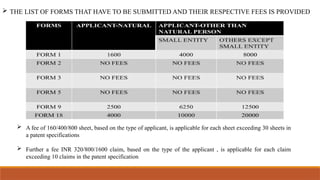
 THE LIST OF FORMS THAT HAVE TO BE SUBMITTED AND THEIR RESPECTIVE FEES IS PROVIDED
 A fee of 160/400/800 sheet, based on the type of applicant, is applicable for each sheet exceeding 30 sheets in
a patent specifications
 Further a fee INR 320/800/1600 claim, based on the type of the applicant , is applicable for each claim
exceeding 10 claims in the patent specification
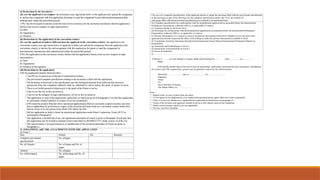
FORM 1: APPLICATION FOR GRANT OF PATENT
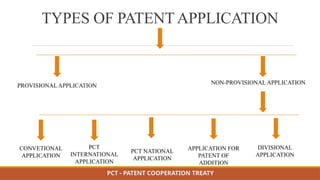
TYPES OF PATENT APPLICATION
PROVISIONAL APPLICATION
NON-PROVISIONAL APPLICATION
CONVETIONAL
APPLICATION
PCT
INTERNATIONAL
APPLICATION
PCT NATIONAL
APPLICATION
APPLICATION FOR
PATENT OF
ADDITION
DIVISIONAL
APPLICATION
PCT - PATENT COOPERATION TREATY
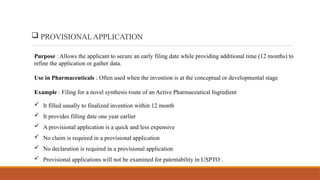
 PROVISIONALAPPLICATION
Purpose : Allows the applicant to secure an early filing date while providing additional time (12 months) to
refine the application or gather data.
Use in Pharmaceuticals : Often used when the invention is at the conceptual or developmental stage
Example : Filing for a novel synthesis route of an Active Pharmaceutical Ingredient
 It filled usually to finalized invention within 12 month
 It provides filling date one year earlier
 A provisional application is a quick and less expensive
 No claim is required in a provisional application
 No declaration is required in a provisional application
 Provisional applications will not be examined for patentability in USPTO .
 NON-PROVISIONALAPPLICATION
Purpose: A complete application with all required claims and specifications. It begins the examination process
Use in Pharmaceuticals: Covers new drugs, formulations, delivery systems, or manufacturing processes
Example: A detailed application for a new combination drug or sustained-release tablet.
 After 12 month provisional application convert to the non provisional application and within 14 month after the filling
date of the Provisional's application
 12 month pendency periods can not be extended
 Non- provisional application is examine by USPTO ( UNITED STATE PATENT AND TRADEMARK OFFICE )
 Non-provisional application invention disclose publically
 In Non-provisional application applicant confers the right to stop other form making, sealing, using and try to using
his/her invention.
 CONVETIONALAPPLICATION
 A conventional patent application, also known as a non-provisional patent application, is a legal document that
gives an inventor exclusive rights to their invention. It's a way to claim priority for a patent application based on a
similar application filed in a convention country
 An application for patent filed in the Patent Office, claiming a priority date based on the same or substantially
similar application filed in one or more of the convention countries, is called a convention application
 In order to get convention status, an applicant should file the application in the Indian Patent Office within 12
months from the date of first filing of a similar application in the convention country.
 PCT NATIONALAPPLICATION
 When an international application is made according to PCT designating India, an applicant can file the
national phase application in India within 31 months from the international filing date or the priority date
(whichever is earlier )
 The application can be filed at any of the four Patent Offices located at Delhi, Kolkata, Chennai
or Mumbai, depending on the domicile, business or place of the Applicant
 If the applicant for the patent has no business, place or domicile in India, the appropriate Patent
office will be the address of service in India. For example, patents can be filed at the Chennai
Patent Office where the address for service would be Intepat IP, Bangalore.
 PCT INTERNATIONALAPPLICATION
Purpose : The PCT provides a unified procedure for filing patent applications in its 157 member countries (as of
2024). While the PCT does not grant an "international patent," it simplifies the process of securing national or
regional patents by allowing inventors to file a single international application
Use in Pharmaceuticals: Ensures global protection of new drugs or formulations
Example: Filing a PCT application for a novel vaccine to protect its IP worldwide.
 A PCT Application is an international application governed by the Patent Cooperation Treaty, and can be validated in up to
142 countries
 The Patent Cooperation Treaty (PCT) is an international agreement established in 1970 to facilitate the process of obtaining
patent protection for inventions in multiple countries
 Administered by the World Intellectual Property Organization (WIPO), the PCT streamlines the patent application process,
making it more efficient and cost-effective for applicants seeking protection in multiple jurisdictions
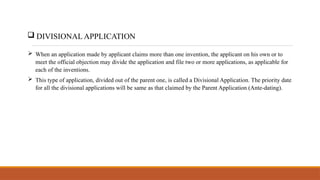
 DIVISIONAL APPLICATION
 When an application made by applicant claims more than one invention, the applicant on his own or to
meet the official objection may divide the application and file two or more applications, as applicable for
each of the inventions.
 This type of application, divided out of the parent one, is called a Divisional Application. The priority date
for all the divisional applications will be same as that claimed by the Parent Application (Ante-dating).
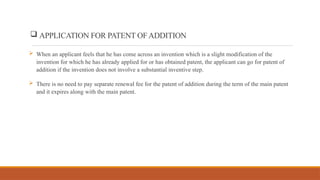
 APPLICATION FOR PATENT OFADDITION
 When an applicant feels that he has come across an invention which is a slight modification of the
invention for which he has already applied for or has obtained patent, the applicant can go for patent of
addition if the invention does not involve a substantial inventive step.
 There is no need to pay separate renewal fee for the patent of addition during the term of the main patent
and it expires along with the main patent.
 Indian Patent Office (IPO) Guidelines - https://www.ipindia.gov.in
 WIPO Official Website: https://www.wipo.int/pct/en
 Practical guidance on PCT filings can often be found in intellectual property law journals, such as Managing Intellectual
Property and resources provided by international IP law firms
 REFERENCE'S