Industry Analysis and porter’s five force analysis of
“Automobile Industry”
Presentedby:-
ShubhamChugh
AutomobileIndustry, definition…!
The automotive industry comprises a wide range of companies
and organizations which are involved in designing, Development,
Manufacturing, Marketing, and selling of motor vehicles.
It is one of the world's largest economic sectors by revenue.
 The automotive industry does not include industries dedicated
to the maintenance of automobiles following delivery to the
end user such as:-
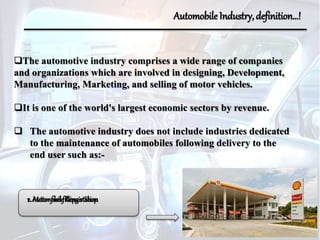
1. AutomobileRepairShop2. Motorfuelfillingstation
AutomobileIndustry, Products and Services…!
Servicesbeing offered:
 The auto servicing market is expected to grow by over 65 per cent over the next
few years. The auto servicing market, currently pegged at Rs. 20,000 crore, is
expected to be worth Rs. 33,000-34,000 crore by 2020.
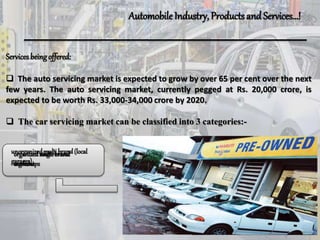
 The car servicing market can be classified into 3 categories:-
organizedsingle brand
segment
organizedmulti-brand
workshops
unorganizedmultibrand (local
garages)
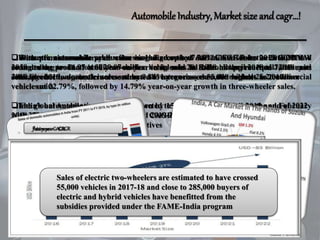
Domestic automobile sales witnessing a growth of 7.01% CAGR between 2013 and
2018 owing to 24.97 million vehicles being sold in 2018. Between April 2018 and
January 2019, domestic sales across all categories was the highest in commercial
vehicles at 22.79%, followed by 14.79% year-on-year growth in three-wheeler sales.
 Domestic automobile production was hiked up by 7.08% CAGR from 2013 to 2018
owing to the production of 29.07 million vehicles in 2018. From April 2018 to January
2019, production growth increased by 9.84% year-on-year and touched 26.26 million
vehicle units.
The global Automotive market is expected to reach USD 83 billion by the end of 2022
with 27% CAGR during forecast period 2019-2022
With premium motorcycle sales in India crossed one million units in 2018, BMW
recorded a growth of 11% year-on-year in its sales in India having reached 7,915 units
sold. Electric two-wheelers are estimated to have crossed 55,000 vehicles in 2017.
India’s automobile exports have grown by 15.54% between April 2018 and February
2019. This figure is likely to grow at a CAGR of 3.05% from 2016 to 2026. And with
several auto-focussed government initiatives
AutomobileIndustry, Market size and cagr…!
Pastyear- CAGRfutureyear– CAGR
Sales of electric two-wheelers are estimated to have crossed
55,000 vehicles in 2017-18 and close to 285,000 buyers of
electric and hybrid vehicles have benefitted from the
subsidies provided under the FAME-India program
AutomobileIndustry, Government initiatives…!
 The Government of India encourages foreign investment in the automobile sector
and allows 100 per cent FDI under the automatic route.
Some of the recent initiatives taken by the Government of India are -
1. Under Union Budget 2019-20, Govt. is providing additional income tax
deduction of Rs 1.5 lakh (US$ 2,146) on the interest paid on the loans taken to
purchase EVs.
2. The government aims to develop India as a global manufacturing centre and an
R&D hub.
3. Under NATRiP, the Government of India is planning to set up R&D centres at a
total cost of US$ 388.5 million to enable the industry to be on par with global
standards.
4. The Ministry of Heavy Industries, Government of India has shortlisted 11 cities
in the country for introduction of electric vehicles (EVs) in their public transport
systems under the FAME (Faster Adoption and Manufacturing of (Hybrid) and
Electric Vehicles in India) scheme. The government will also set up incubation
centre for start-ups working in electric vehicles space.
5. In February 2019, the Government of India approved the FAME-II scheme with a
fund requirement of Rs 10,000 crore (US$ 1.39 billion) for FY20-22.
Bharat Stage-IV emission standards-compliant vehicles purchased till March
2020 will remain operational for the entire period of its registration.
Bharat Stage-VI will be introduced with an immediate effect from April, 2020
Revision of one-time registration fee to be deferred till June 2020.
Ban on purchase of new vehicles by government departments lifted.
Increase in depreciation on vehicles to 30 percent from 15 percent
AutomobileIndustry, …!
Policies Announcement
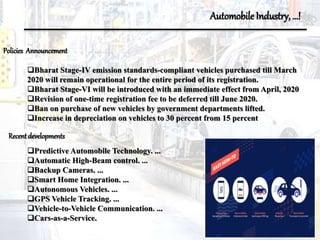
Predictive Automobile Technology. ...
Automatic High-Beam control. ...
Backup Cameras. ...
Smart Home Integration. ...
Autonomous Vehicles. ...
GPS Vehicle Tracking. ...
Vehicle-to-Vehicle Communication. ...
Cars-as-a-Service.
Recentdevelopments
AutomobileIndustry, major players…!
MARUTI SUZUKI
1. Maruti Suzuki which commands a majority of the market share in the Indian auto
industry is said to have lost out a certain percentage in the first quarter of FY2019-20
(April - June). In this period, market shares of Maruti Suzuki have declined by 1.40 per
cent from 52.54% to 51%. The company managed to sell 3.63 lakh units of vehicles in
the first quarter of FY2019; a drop of almost 95,000 units during the same period last
year. The sales of even some of their popular models such as the Baleno, Swift, Dzire,
Ignis, Ertiga and Wagon R seem to have slowed down considerably in the past few
months.
HYUNDAI MOTORS
1. Hyundai — the second-highest market share holder in the country. Although Hyundai
did witness a drop in sales during Q1 of FY2019, its cumulative sales have helped it gain
2 per cent market share in India from 15.75% to 17.70%. The increase in market share
for Hyundai is mainly due to its UV segment, consisting of the Creta and the newly-
launched Venue SUVs. The two models in the lineup together brought in over 43,687
units of sales in Q1 2019; a growth of a healthy 38.66 per cent. This helped Hyundai
overcome its slump from the hatchback and compact-sedan segments, which put
together recorded a decline of around 6 per cent during the same period
MAHINDRA AND MAHINDRA
1. Mahindra & Mahindra, is another brand in the country which has managed to improve
its market share in these tough times. The Indian brand has recorded a growth in
market share from 6.93% to 8.34% in Q1 2019; an improvement of 1.40 per cent. gain,
similar to Hyundai, most of Mahindra's growth has come from the compact-SUV
segment offerings. This is mainly due to the success of the recently-launched XUV300
which leads the way in bringing sales for the company.
HONDA
1. Honda Cars India Ltd is the Indian subsidiary of Japan’s automobile giant, Honda Motor
Co Ltd.
2. It entered the Indian automobile market in 1995. Honda Cars India’s most popular
models include Honda City, Honda Accord, Honda Jazz, Honda CR-V and Honda Brio,
among others.
3. This large Japanese car manufacturer’s Indian operations accounted for some 178,755
automobiles made in India during the financial year 2017-2018.
4. The company’s automobiles are also exported to nearby countries.
5. Market share of Honda ltd. Is about 5.4% of total market share.
Toyota Kirloskar Motor Pvt. Ltd
1. A joint venture between Japan’s Toyota Motors and India’s Kirloskar Group, this
company manufactures the world-renowned Toyota cars in this country.
2. The company was established in 1997 The maker of premium utility vehicles like Innova
and Fortuner recorded a market share of 4.86 per cent in the first half of the fiscal year
2019 (April to September period). It witnessed an increase of 23 basis points when
compared to 4.63 per cent market share in the same period last fiscal year.
3. Toyota Kirloskar made 139,566 automobiles in India during the financial year 2017-
2018. Their cars and other automobiles are popular in India and exported to foreign
markets too.
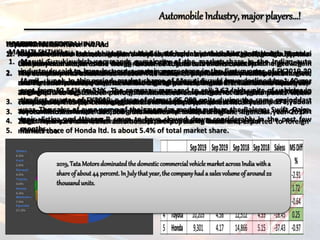
2019,TataMotorsdominatedthedomesticcommercial vehicle marketacrossIndia witha
share of about 44 percent.In Julythat year,the companyhad a salesvolume of around22
thousand units.
AutomobileIndustry, porter five forceanalysis…!
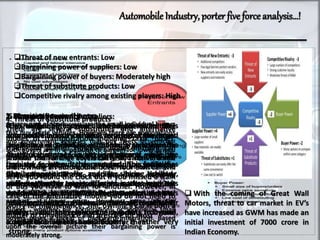
Threat of new entrants: Low
Bargaining power of suppliers: Low
Bargaining power of buyers: Moderately high
Threat of substitute products: Low
Competitive rivalry among existing players: High
1. Threats of new entrants:
It is difficult for new brands to enter the
automobile industry which is because of the large
investment required for establishing a car brand.
At the initial stage, a huge investment will be
required to set up the manufacturing facilities,
distribution network and for hiring skilled
staff. Another major barrier is the level of
competition from the existing brands. Unless a
new brand brings an innovative and differentiated
product to the market, chances to gain
a significant market share are low.
 With the coming of Great Wall
Motors, threat to car market in EV’s
have increased as GWM has made an
initial investment of 7000 crore in
Indian Economy.
2. Bargaining Power of suppliers:
The bargaining power of suppliers in the
automotive industry is weak for most of them are
small players. Only few of them are significant in
size. The threat of forward integration is minimum
from the suppliers for the reasons discussed in the
first category. These suppliers have to play
according to the rules set by the car brands. The
vehicle brands like BMW, Ford, Toyota and VW
hold immense clout because the raw material is
always available in plenty and switching from one
supplier to another is not difficult for them.
3. Bargaining powers of buyers
A large part of the buyers are the small individual buyers
that buy single vehicles. However, there are corporations
and government agencies that buy fleets of vehicles.
Such buyers are in a position to bargain for lower prices.
Whether small or large buyers can easily switch to a new
brand. There are no big costs involved in switching to
another brand or to an alternative mode of
transportation. The buyers are price sensitive mostly and
would switch to another brand that offers a better
product at lower price. However, none of the
buyers whether big corporations or individual small
buyers poses a threat of backward integration. Based
upon the overall picture their bargaining power is
moderately strong.
4. Threat of Substitute products
There are several substitutes and alternative
modes of transportation including taxis, buses,
trains and planes. However, none of them can
provide the kind of accessibility and convenience
that owning an automobile does. Your own car will
serve you round the clock but if you missed a train
or bus you have to wait for another. However, in
case of the alternative modes you do not need to
worry for maintenance. Still, owning a car is both a
matter of convenience and prestige for most
5. Competitive rivalry
The number of recognized and influential brands is
low and the exit barriers very high. Any brand
trying to exit would have to bear large losses. The
level of customer loyalty is high and while the
industry is large, it has matured. This intensifies
the competition for market share. However,
different brands target different market segments
but yet they overlap. Brands compete on the basis
of price, design, quality, technology, customer
safety and several other points. Overall,
competition in the auto industry is rather very
strong.
India is expected to emerge as the world’s third-largest passenger-vehicle market by
2021.It took India around seven years to increase annual production to four million vehicles
from three million. However, the next milestone—five million—is expected in less than five
years. Hitting that mark will depend on today’s rapid economic development continuing,
with a projected annual GDP growth rate of 7 percent through 2020, ongoing urbanization, a
burgeoning consuming class, and supportive regulations and policies.
Automotive industry is growing rapidly. Despite the uncertainties over Brexit and the
Trump – China trade war, the car industry is expanding at a fast rate. Global sales are
growing at around 2.8% worldwide per year. If predictions are correct, this his will result in
over a 100 million automobiles sold by 2020.
1. Continued government focus on supporting the industry
2. Favorable macroeconomic and demographic trends
3. The development of India as a manufacturing hub
The potential for global disruptions are:
1. Electrification
2. Shared mobility
3. Connected vehicles.
4. Autonomous vehicles.
AutomobileIndustry, porter five forceanalysis…!

Automobile Industry presentation

  • 1.
    Industry Analysis andporter’s five force analysis of “Automobile Industry” Presentedby:- ShubhamChugh
  • 2.
    AutomobileIndustry, definition…! The automotiveindustry comprises a wide range of companies and organizations which are involved in designing, Development, Manufacturing, Marketing, and selling of motor vehicles. It is one of the world's largest economic sectors by revenue.  The automotive industry does not include industries dedicated to the maintenance of automobiles following delivery to the end user such as:- 1. AutomobileRepairShop2. Motorfuelfillingstation
  • 3.
    AutomobileIndustry, Products andServices…! Servicesbeing offered:  The auto servicing market is expected to grow by over 65 per cent over the next few years. The auto servicing market, currently pegged at Rs. 20,000 crore, is expected to be worth Rs. 33,000-34,000 crore by 2020.  The car servicing market can be classified into 3 categories:- organizedsingle brand segment organizedmulti-brand workshops unorganizedmultibrand (local garages)
  • 4.
    Domestic automobile saleswitnessing a growth of 7.01% CAGR between 2013 and 2018 owing to 24.97 million vehicles being sold in 2018. Between April 2018 and January 2019, domestic sales across all categories was the highest in commercial vehicles at 22.79%, followed by 14.79% year-on-year growth in three-wheeler sales.  Domestic automobile production was hiked up by 7.08% CAGR from 2013 to 2018 owing to the production of 29.07 million vehicles in 2018. From April 2018 to January 2019, production growth increased by 9.84% year-on-year and touched 26.26 million vehicle units. The global Automotive market is expected to reach USD 83 billion by the end of 2022 with 27% CAGR during forecast period 2019-2022 With premium motorcycle sales in India crossed one million units in 2018, BMW recorded a growth of 11% year-on-year in its sales in India having reached 7,915 units sold. Electric two-wheelers are estimated to have crossed 55,000 vehicles in 2017. India’s automobile exports have grown by 15.54% between April 2018 and February 2019. This figure is likely to grow at a CAGR of 3.05% from 2016 to 2026. And with several auto-focussed government initiatives AutomobileIndustry, Market size and cagr…! Pastyear- CAGRfutureyear– CAGR Sales of electric two-wheelers are estimated to have crossed 55,000 vehicles in 2017-18 and close to 285,000 buyers of electric and hybrid vehicles have benefitted from the subsidies provided under the FAME-India program
  • 5.
    AutomobileIndustry, Government initiatives…! The Government of India encourages foreign investment in the automobile sector and allows 100 per cent FDI under the automatic route. Some of the recent initiatives taken by the Government of India are - 1. Under Union Budget 2019-20, Govt. is providing additional income tax deduction of Rs 1.5 lakh (US$ 2,146) on the interest paid on the loans taken to purchase EVs. 2. The government aims to develop India as a global manufacturing centre and an R&D hub. 3. Under NATRiP, the Government of India is planning to set up R&D centres at a total cost of US$ 388.5 million to enable the industry to be on par with global standards. 4. The Ministry of Heavy Industries, Government of India has shortlisted 11 cities in the country for introduction of electric vehicles (EVs) in their public transport systems under the FAME (Faster Adoption and Manufacturing of (Hybrid) and Electric Vehicles in India) scheme. The government will also set up incubation centre for start-ups working in electric vehicles space. 5. In February 2019, the Government of India approved the FAME-II scheme with a fund requirement of Rs 10,000 crore (US$ 1.39 billion) for FY20-22.
  • 6.
    Bharat Stage-IV emissionstandards-compliant vehicles purchased till March 2020 will remain operational for the entire period of its registration. Bharat Stage-VI will be introduced with an immediate effect from April, 2020 Revision of one-time registration fee to be deferred till June 2020. Ban on purchase of new vehicles by government departments lifted. Increase in depreciation on vehicles to 30 percent from 15 percent AutomobileIndustry, …! Policies Announcement Predictive Automobile Technology. ... Automatic High-Beam control. ... Backup Cameras. ... Smart Home Integration. ... Autonomous Vehicles. ... GPS Vehicle Tracking. ... Vehicle-to-Vehicle Communication. ... Cars-as-a-Service. Recentdevelopments
  • 7.
    AutomobileIndustry, major players…! MARUTISUZUKI 1. Maruti Suzuki which commands a majority of the market share in the Indian auto industry is said to have lost out a certain percentage in the first quarter of FY2019-20 (April - June). In this period, market shares of Maruti Suzuki have declined by 1.40 per cent from 52.54% to 51%. The company managed to sell 3.63 lakh units of vehicles in the first quarter of FY2019; a drop of almost 95,000 units during the same period last year. The sales of even some of their popular models such as the Baleno, Swift, Dzire, Ignis, Ertiga and Wagon R seem to have slowed down considerably in the past few months. HYUNDAI MOTORS 1. Hyundai — the second-highest market share holder in the country. Although Hyundai did witness a drop in sales during Q1 of FY2019, its cumulative sales have helped it gain 2 per cent market share in India from 15.75% to 17.70%. The increase in market share for Hyundai is mainly due to its UV segment, consisting of the Creta and the newly- launched Venue SUVs. The two models in the lineup together brought in over 43,687 units of sales in Q1 2019; a growth of a healthy 38.66 per cent. This helped Hyundai overcome its slump from the hatchback and compact-sedan segments, which put together recorded a decline of around 6 per cent during the same period MAHINDRA AND MAHINDRA 1. Mahindra & Mahindra, is another brand in the country which has managed to improve its market share in these tough times. The Indian brand has recorded a growth in market share from 6.93% to 8.34% in Q1 2019; an improvement of 1.40 per cent. gain, similar to Hyundai, most of Mahindra's growth has come from the compact-SUV segment offerings. This is mainly due to the success of the recently-launched XUV300 which leads the way in bringing sales for the company. HONDA 1. Honda Cars India Ltd is the Indian subsidiary of Japan’s automobile giant, Honda Motor Co Ltd. 2. It entered the Indian automobile market in 1995. Honda Cars India’s most popular models include Honda City, Honda Accord, Honda Jazz, Honda CR-V and Honda Brio, among others. 3. This large Japanese car manufacturer’s Indian operations accounted for some 178,755 automobiles made in India during the financial year 2017-2018. 4. The company’s automobiles are also exported to nearby countries. 5. Market share of Honda ltd. Is about 5.4% of total market share. Toyota Kirloskar Motor Pvt. Ltd 1. A joint venture between Japan’s Toyota Motors and India’s Kirloskar Group, this company manufactures the world-renowned Toyota cars in this country. 2. The company was established in 1997 The maker of premium utility vehicles like Innova and Fortuner recorded a market share of 4.86 per cent in the first half of the fiscal year 2019 (April to September period). It witnessed an increase of 23 basis points when compared to 4.63 per cent market share in the same period last fiscal year. 3. Toyota Kirloskar made 139,566 automobiles in India during the financial year 2017- 2018. Their cars and other automobiles are popular in India and exported to foreign markets too. 2019,TataMotorsdominatedthedomesticcommercial vehicle marketacrossIndia witha share of about 44 percent.In Julythat year,the companyhad a salesvolume of around22 thousand units.
  • 8.
    AutomobileIndustry, porter fiveforceanalysis…! Threat of new entrants: Low Bargaining power of suppliers: Low Bargaining power of buyers: Moderately high Threat of substitute products: Low Competitive rivalry among existing players: High 1. Threats of new entrants: It is difficult for new brands to enter the automobile industry which is because of the large investment required for establishing a car brand. At the initial stage, a huge investment will be required to set up the manufacturing facilities, distribution network and for hiring skilled staff. Another major barrier is the level of competition from the existing brands. Unless a new brand brings an innovative and differentiated product to the market, chances to gain a significant market share are low.  With the coming of Great Wall Motors, threat to car market in EV’s have increased as GWM has made an initial investment of 7000 crore in Indian Economy. 2. Bargaining Power of suppliers: The bargaining power of suppliers in the automotive industry is weak for most of them are small players. Only few of them are significant in size. The threat of forward integration is minimum from the suppliers for the reasons discussed in the first category. These suppliers have to play according to the rules set by the car brands. The vehicle brands like BMW, Ford, Toyota and VW hold immense clout because the raw material is always available in plenty and switching from one supplier to another is not difficult for them. 3. Bargaining powers of buyers A large part of the buyers are the small individual buyers that buy single vehicles. However, there are corporations and government agencies that buy fleets of vehicles. Such buyers are in a position to bargain for lower prices. Whether small or large buyers can easily switch to a new brand. There are no big costs involved in switching to another brand or to an alternative mode of transportation. The buyers are price sensitive mostly and would switch to another brand that offers a better product at lower price. However, none of the buyers whether big corporations or individual small buyers poses a threat of backward integration. Based upon the overall picture their bargaining power is moderately strong. 4. Threat of Substitute products There are several substitutes and alternative modes of transportation including taxis, buses, trains and planes. However, none of them can provide the kind of accessibility and convenience that owning an automobile does. Your own car will serve you round the clock but if you missed a train or bus you have to wait for another. However, in case of the alternative modes you do not need to worry for maintenance. Still, owning a car is both a matter of convenience and prestige for most 5. Competitive rivalry The number of recognized and influential brands is low and the exit barriers very high. Any brand trying to exit would have to bear large losses. The level of customer loyalty is high and while the industry is large, it has matured. This intensifies the competition for market share. However, different brands target different market segments but yet they overlap. Brands compete on the basis of price, design, quality, technology, customer safety and several other points. Overall, competition in the auto industry is rather very strong.
  • 9.
    India is expectedto emerge as the world’s third-largest passenger-vehicle market by 2021.It took India around seven years to increase annual production to four million vehicles from three million. However, the next milestone—five million—is expected in less than five years. Hitting that mark will depend on today’s rapid economic development continuing, with a projected annual GDP growth rate of 7 percent through 2020, ongoing urbanization, a burgeoning consuming class, and supportive regulations and policies. Automotive industry is growing rapidly. Despite the uncertainties over Brexit and the Trump – China trade war, the car industry is expanding at a fast rate. Global sales are growing at around 2.8% worldwide per year. If predictions are correct, this his will result in over a 100 million automobiles sold by 2020. 1. Continued government focus on supporting the industry 2. Favorable macroeconomic and demographic trends 3. The development of India as a manufacturing hub The potential for global disruptions are: 1. Electrification 2. Shared mobility 3. Connected vehicles. 4. Autonomous vehicles. AutomobileIndustry, porter five forceanalysis…!