AUTOMOBILE INDUSTRY IN
        INDIA


               Prabhjot Singh
               Raghu Monga
               Robin Kumar
               Sandeepika Sharma
EVOLUTION IN INDIA
AUTO INDUSTRY
 The year 1898 saw the first car rolling out, on the streets
  of Mumbai.

 A land of Premier Padminis, Ambassadors, scooters,
  temps, trucks and autos galore, India had not seen much
  of choice in vehicles.

 Since then Indian auto industry has witnessed a lot of
  change.
PROTECTIONISM – EARLY
               1980s
 The manufacturing of automobiles especially cars was
 subject to strict licensing, restrictive tariff structure and
 limited avenues for expansion.

 The foreign technology collaboration came with the
 inception of Maruti Udyog in collaboration with Suzuki of
 Japan in the passenger car segment.

 Indian roads saw the launch of Maruti 800.


 It was still not very easy to own a car, first was
 affordability and next was a long waiting period.
LIBERALISATION – 1990s
 With liberalization, some more Japanese manufacturers
  entered the two-wheeler and the commercial vehicle
  segment in a collaborative arrangement.

 This period characterized joint ventures in India and the
  market started opening up.

 Automobile Industry was delicensed in July 1991 with
  the announcement of the New Industrial Policy.

 The passenger car industry was, however, delicensed in
  1993.
 The era of controls and protection came to an
 end.

 Decrease in customs and excise duties meant
 that a vehicles started getting affordable.

 The entry of foreign banks with attractive auto
 finance schemes helped garner a huge base of
 middle class population.

 However the market was still ruled by the sellers.
GLOBALISATION – 2000s
 A Core Group on Automotive Research and Development
  (CAR) was established in 2003 for encouraging R&D
  activities.

 Indian economy also witnessed rapid industrialization.
  Factories needed transport both for goods and for their
  employees.

 Pushed the demand for efficient logistics and that in turn
  increased the number of commercial vehicles.
MARKET SIZE
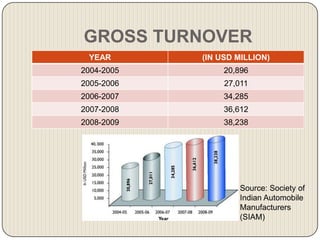
GROSS TURNOVER
 YEAR       (IN USD MILLION)
2004-2005        20,896
2005-2006        27,011
2006-2007        34,285
2007-2008        36,612
2008-2009        38,238


                    Source: Society of
                    Indian Automobile
                    Manufacturers
                    (SIAM)
RECENT FACTS & FIGURES
 In 2010-11, the overall domestic passenger car sales
 rose by 29.73 per cent to 19,82,702 units from
 15,28,337 units in the previous fiscal.

 Hyundai Motor India also saw its market share
 declining to 18.10 per cent in FY 2011 from 20.61 per
 cent in the previous year.

 Tata Motors too lost its market share during the said
 period, falling to 12.92 per cent with sales of 2,56,202
 units.

 General Motors India (GMI) and Honda Siel cars India
 (HSCI) also lost their market share last fiscal. While
 GMI's share fell to 4.40 per cent from 4.62 per cent,
MAJOR PLAYERS IN THE
     INDUSTRY

•Mahindra         • Hyundai Motor India
     &
 Mahindra
 Limited


• Maruti Suzuki      •Ashok Leyland
India Ltd
OTHER PLAYERS IN THE
  INDUSTRY

TATA Motors


                      • The Bajaj Group


• Hero Group   • Ford India
GLOBAL PLAYERS IN INDIA
 Audi
 Honda
 Mercedes
 Ferrari
 Nissan
 BMW
MARKET SHARE OF MAJOR
       PLAYERS
MARKET SHARE
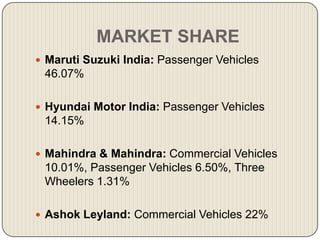
 Maruti Suzuki India: Passenger Vehicles
 46.07%

 Hyundai Motor India: Passenger Vehicles
 14.15%

 Mahindra & Mahindra: Commercial Vehicles
 10.01%, Passenger Vehicles 6.50%, Three
 Wheelers 1.31%

 Ashok Leyland: Commercial Vehicles 22%
MARKET SHARE OF DIFFERENT
VEHICLES IN THE INDIAN AUTOMOBILE
             INDUSTRY
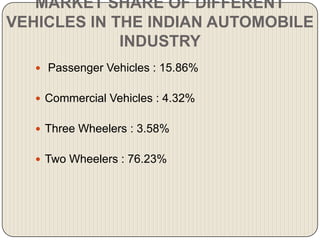
    Passenger Vehicles : 15.86%


    Commercial Vehicles : 4.32%


    Three Wheelers : 3.58%


    Two Wheelers : 76.23%
CHALLENGES
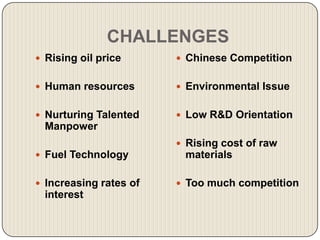
 Rising oil price       Chinese Competition


 Human resources        Environmental Issue


 Nurturing Talented     Low R&D Orientation
  Manpower
                         Rising cost of raw
 Fuel Technology        materials

 Increasing rates of    Too much competition
  interest
IMPACT OF GLOBAL CRISIS ON
        INDUSTRY
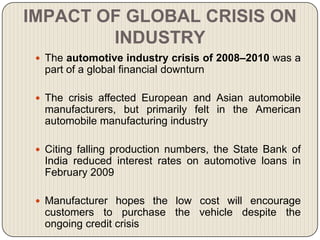
  The automotive industry crisis of 2008–2010 was a
  part of a global financial downturn

  The crisis affected European and Asian automobile
  manufacturers, but primarily felt in the American
  automobile manufacturing industry

  Citing falling production numbers, the State Bank of
  India reduced interest rates on automotive loans in
  February 2009

  Manufacturer hopes the low cost will encourage
  customers to purchase the vehicle despite the
  ongoing credit crisis
RECENT TRENDS
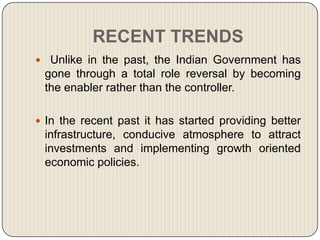
 Unlike in the past, the Indian Government has
 gone through a total role reversal by becoming
 the enabler rather than the controller.

 In the recent past it has started providing better
 infrastructure, conducive atmosphere to attract
 investments and implementing growth oriented
 economic policies.
 Competition: Immense pressure has grown on
 the Indian companies. A lot of joint ventures have
 taken place, some others have invested heavily
 on R&D.
 Customer: Armed with higher buying power and
 an ever increasing expectation from products and
 services, the customer is undoubtedly the king
 and has propelled a fierce competition among the
 major players in the market.
 Safety Norms: cars as well as two-wheelers
  have met the most stringent international norms
  of pollution.
 Euro II vehicles have become the norm of the
  day all over India. Unfortunately, in the Indian
  context, safety in motor vehicles is a relatively
  neglected area.
 Bad roads coupled with the absence of adequate
  safety features in the vehicles such as airbag and
  crumple zone needs immediate attention.
 But awareness is on the increase and the use of
  seat belts while driving has been made
  mandatory.
 Bikes: Keeping apace with the global trends the
 two-wheeler segment has witnessed tremendous
 growth both qualitatively and quantitatively. Bikes
 with higher engine capacities have done
 commendably well on the Indian roads. Bike
 styling and fuel efficiency has also seen major
 developments
THANK YOU

Auto indus

  • 1.
    AUTOMOBILE INDUSTRY IN INDIA Prabhjot Singh Raghu Monga Robin Kumar Sandeepika Sharma
  • 2.
  • 3.
    AUTO INDUSTRY  Theyear 1898 saw the first car rolling out, on the streets of Mumbai.  A land of Premier Padminis, Ambassadors, scooters, temps, trucks and autos galore, India had not seen much of choice in vehicles.  Since then Indian auto industry has witnessed a lot of change.
  • 4.
    PROTECTIONISM – EARLY 1980s  The manufacturing of automobiles especially cars was subject to strict licensing, restrictive tariff structure and limited avenues for expansion.  The foreign technology collaboration came with the inception of Maruti Udyog in collaboration with Suzuki of Japan in the passenger car segment.  Indian roads saw the launch of Maruti 800.  It was still not very easy to own a car, first was affordability and next was a long waiting period.
  • 5.
    LIBERALISATION – 1990s With liberalization, some more Japanese manufacturers entered the two-wheeler and the commercial vehicle segment in a collaborative arrangement.  This period characterized joint ventures in India and the market started opening up.  Automobile Industry was delicensed in July 1991 with the announcement of the New Industrial Policy.  The passenger car industry was, however, delicensed in 1993.
  • 6.
     The eraof controls and protection came to an end.  Decrease in customs and excise duties meant that a vehicles started getting affordable.  The entry of foreign banks with attractive auto finance schemes helped garner a huge base of middle class population.  However the market was still ruled by the sellers.
  • 7.
    GLOBALISATION – 2000s A Core Group on Automotive Research and Development (CAR) was established in 2003 for encouraging R&D activities.  Indian economy also witnessed rapid industrialization. Factories needed transport both for goods and for their employees.  Pushed the demand for efficient logistics and that in turn increased the number of commercial vehicles.
  • 8.
  • 9.
    GROSS TURNOVER YEAR (IN USD MILLION) 2004-2005 20,896 2005-2006 27,011 2006-2007 34,285 2007-2008 36,612 2008-2009 38,238 Source: Society of Indian Automobile Manufacturers (SIAM)
  • 10.
    RECENT FACTS &FIGURES  In 2010-11, the overall domestic passenger car sales rose by 29.73 per cent to 19,82,702 units from 15,28,337 units in the previous fiscal.  Hyundai Motor India also saw its market share declining to 18.10 per cent in FY 2011 from 20.61 per cent in the previous year.  Tata Motors too lost its market share during the said period, falling to 12.92 per cent with sales of 2,56,202 units.  General Motors India (GMI) and Honda Siel cars India (HSCI) also lost their market share last fiscal. While GMI's share fell to 4.40 per cent from 4.62 per cent,
  • 11.
    MAJOR PLAYERS INTHE INDUSTRY •Mahindra • Hyundai Motor India & Mahindra Limited • Maruti Suzuki •Ashok Leyland India Ltd
  • 12.
    OTHER PLAYERS INTHE INDUSTRY TATA Motors • The Bajaj Group • Hero Group • Ford India
  • 13.
    GLOBAL PLAYERS ININDIA  Audi  Honda  Mercedes  Ferrari  Nissan  BMW
  • 14.
    MARKET SHARE OFMAJOR PLAYERS
  • 15.
    MARKET SHARE  MarutiSuzuki India: Passenger Vehicles 46.07%  Hyundai Motor India: Passenger Vehicles 14.15%  Mahindra & Mahindra: Commercial Vehicles 10.01%, Passenger Vehicles 6.50%, Three Wheelers 1.31%  Ashok Leyland: Commercial Vehicles 22%
  • 16.
    MARKET SHARE OFDIFFERENT VEHICLES IN THE INDIAN AUTOMOBILE INDUSTRY  Passenger Vehicles : 15.86%  Commercial Vehicles : 4.32%  Three Wheelers : 3.58%  Two Wheelers : 76.23%
  • 17.
    CHALLENGES  Rising oilprice  Chinese Competition  Human resources  Environmental Issue  Nurturing Talented  Low R&D Orientation Manpower  Rising cost of raw  Fuel Technology materials  Increasing rates of  Too much competition interest
  • 18.
    IMPACT OF GLOBALCRISIS ON INDUSTRY  The automotive industry crisis of 2008–2010 was a part of a global financial downturn  The crisis affected European and Asian automobile manufacturers, but primarily felt in the American automobile manufacturing industry  Citing falling production numbers, the State Bank of India reduced interest rates on automotive loans in February 2009  Manufacturer hopes the low cost will encourage customers to purchase the vehicle despite the ongoing credit crisis
  • 19.
    RECENT TRENDS  Unlikein the past, the Indian Government has gone through a total role reversal by becoming the enabler rather than the controller.  In the recent past it has started providing better infrastructure, conducive atmosphere to attract investments and implementing growth oriented economic policies.
  • 20.
     Competition: Immensepressure has grown on the Indian companies. A lot of joint ventures have taken place, some others have invested heavily on R&D.
  • 21.
     Customer: Armedwith higher buying power and an ever increasing expectation from products and services, the customer is undoubtedly the king and has propelled a fierce competition among the major players in the market.
  • 22.
     Safety Norms:cars as well as two-wheelers have met the most stringent international norms of pollution.  Euro II vehicles have become the norm of the day all over India. Unfortunately, in the Indian context, safety in motor vehicles is a relatively neglected area.  Bad roads coupled with the absence of adequate safety features in the vehicles such as airbag and crumple zone needs immediate attention.  But awareness is on the increase and the use of seat belts while driving has been made mandatory.
  • 23.
     Bikes: Keepingapace with the global trends the two-wheeler segment has witnessed tremendous growth both qualitatively and quantitatively. Bikes with higher engine capacities have done commendably well on the Indian roads. Bike styling and fuel efficiency has also seen major developments
  • 24.