Presented By:

Ankur Kejriwal.


                  Group-8   1
• Introduction.
• Benefits of Two-Wheeler.
• Overview.
• Contribution to G.D.P.
• Segment Wise Market Share.
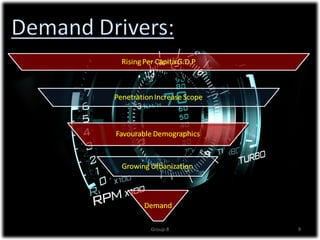
• Demand Drivers.
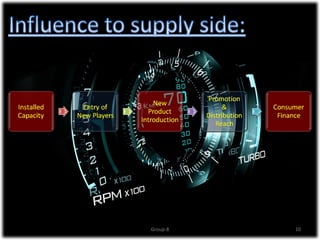
• Influence to Supply Side.
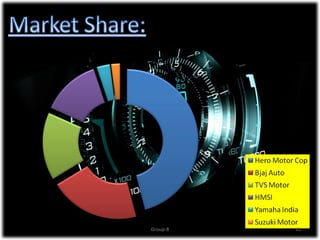
• Market Share.
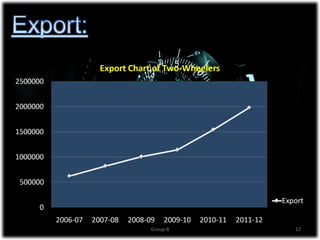
• Export.
• Effect of G.D.P on Two-Wheeler.
• Two-Wheeler Penetration in India.
• Installed Capacities of Two-Wheeler Companies.
• Effect of Inflation.
• Government Initiatives.
• Conclusion.
                                    Group-8        2
India, is the second largest producer of two-wheelers in the world. In the last few years,
the Indian two-wheeler industry has seen spectacular growth. The country stands next to
China and Japan in terms of production and sales respectively.
Majority of Indians, especially the youngsters prefer motorbikes rather than cars.
Capturing a large share in the two-wheeler industry, bikes and scooters cover a major
segment. Bikes are considered to be the favorite among the youth generation, as they
help in easy commutation.

Two-Wheelers Segment in India:

1.Motorcycles.
2.Scooters.
3.Mopeds.

    Large variety of two wheelers are available in the market, known for their latest
technology and enhanced mileage. Indian bikes, scooters and mopeds represent style
and class for both men and women in India.

                                           Group-8                                       3
Two-wheelers are the most popular and highly sought out medium of transport in India.
The trend of owning two-wheelers is due to its-

1.Economical price
2.Safety
3.Fuel-efficient
4.Comfort level

However, few Indian bike enthusiasts prefer high performance imported bikes. Some of
the most popular high-speed bikes are Suzuki Hayabusa, Kawasaki Ninja, Suzuki
Zeus, Hero Honda Karizma, Bajaj Pulsar and Honda Unicorn. These super bikes are
specially designed for those who have a zeal for speedy drive.


                                        Group-8                                    4
• The Indian two-wheeler (2W) industry recorded sales volumes of 13.4 million
units in 2011-12.

• A growth of 14.0% over the previous year.

• In a year where in growth in other automobile segments particularly,
passenger vehicle (PV) and medium & heavy commercial vehicle (M&HCV),
slowed down to single digits.

• 14% growth recorded by the 2W industry remained steady.

• The momentum in the 2W industry’s volume growth too has been losing
steam lately as evident from the relatively lower volume growth of 11.0%
recorded in H2, 2011-12 (YoY) against a growth of 17.1% recorded in H1, 2011-
12 (YoY).

                                     Group-8                                    5
• The deceleration in growth is largely attributable to the motorcycles segment
which grew at a much lower rate of 7.8% (YoY) in H2, 2011-12 vis-à-vis 16.4% in
H1, 2011-12.

• The scooters segment continued to post 20%+ (YoY) expansion during both
halves of the last fiscal.

• The share of the scooters segment in the domestic 2W industry volumes
increased to 19.1% in 2011-12 from 17.6%.

• Over the medium term, the 2W industry is expected to report a volume CAGR of
9-11% to reach a size of 24-26 million units (domestic + exports) by 2016-17.


                                      Group-8                                 6
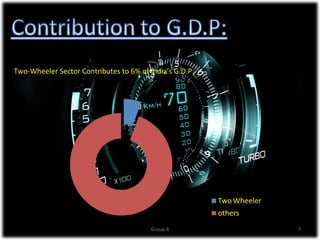
Two-Wheeler Sector Contributes to 6% of India’s G.D.P:


                                         Group-8         7
Group-8   8
Group-8   9
Group-8   10
Group-8   11
Group-8   12
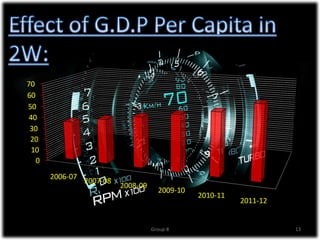
Group-8   13
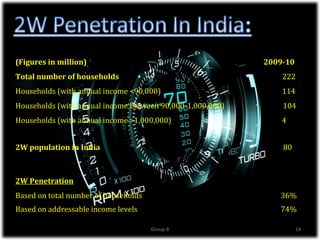
Table 1: 2W Penetration in India


(Figures in million)                                               2009-10
Total number of households                                             222
Households (with annual income <90,000)                                114
Households (with annual income between 90,000-1,000,000)               104
Households (with annual income >1,000,000)                             4


2W population in India                                                 80


2W Penetration
Based on total number of households                                   36%
Based on addressable income levels                                    74%

                                           Group-8                           14
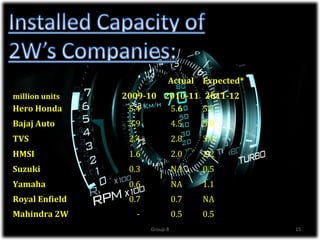
Actual Expected*
million units   2009-10 2010-11 2011-12
Hero Honda       5.4     5.6    5.7
Bajaj Auto       3.9             4.5   5.0
TVS              2.4             2.8   3.0
HMSI             1.6             2.0   2.2
Suzuki           0.3             NA    0.5
Yamaha           0.6             NA    1.1
Royal Enfield    0.7             0.7   NA
Mahindra 2W        -             0.5   0.5
                       Group-8                  15
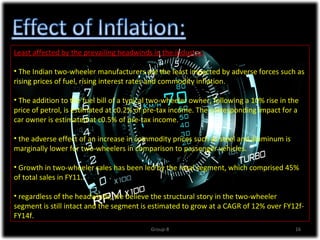
Least affected by the prevailing headwinds in the industry:

• The Indian two‐wheeler manufacturers are the least impacted by adverse forces such as
rising prices of fuel, rising interest rates and commodity inflation.

• The addition to the fuel bill of a typical two‐wheeler owner, following a 10% rise in the
price of petrol, is estimated at c0.2% of pre‐tax income. The corresponding impact for a
car owner is estimated at c0.5% of pre‐tax income.

• the adverse effect of an increase in commodity prices such as steel and aluminum is
marginally lower for two‐wheelers in comparison to passenger vehicles.

• Growth in two‐wheeler sales has been led by the rural segment, which comprised 45%
of total sales in FY11..

• regardless of the headwinds, we believe the structural story in the two‐wheeler
segment is still intact and the segment is estimated to grow at a CAGR of 12% over FY12f‐
FY14f.
                                           Group‐8                                       16
• The Indian government encourages foreign investment in the automobile sector and
allows 100% FDI under the automatic route. It is a fully delicensed industry, freely allowing
imports of automotive components.

• The government has made successive policy changes that allow for stronger growth in the
automotive sector. Major among these are:
             1. Automotive Mission Plan: The plan has been prepared to accelerate
                 and sustain growth in the automotive sector during the period 2006–
                 2016. It aims to make India a global automotive hub. This will involve
                 doubling the contribution of the automotive sector to the country’s GDP
                 by taking its turnover to USD 145 billion and providing additional
                 employment to 25 million people with special emphasis on the export of
                 small cars, MUVs, two‐ and three‐wheelers and auto components.
             2. National Automotive Testing and R&D Infrastructure Project: This is a
                 USD 400 million initiative of the Government of India and various state
                 governments; it is aimed at creating a state‐of‐art, dedicated testing,
                 validation and R&D infrastructure across the country.


                                            Group‐8                                      17
Group‐8   18

Presentation on two wheeler industry in india

  • 1.
  • 2.
    • Introduction. • Benefitsof Two-Wheeler. • Overview. • Contribution to G.D.P. • Segment Wise Market Share. • Demand Drivers. • Influence to Supply Side. • Market Share. • Export. • Effect of G.D.P on Two-Wheeler. • Two-Wheeler Penetration in India. • Installed Capacities of Two-Wheeler Companies. • Effect of Inflation. • Government Initiatives. • Conclusion. Group-8 2
  • 3.
    India, is thesecond largest producer of two-wheelers in the world. In the last few years, the Indian two-wheeler industry has seen spectacular growth. The country stands next to China and Japan in terms of production and sales respectively. Majority of Indians, especially the youngsters prefer motorbikes rather than cars. Capturing a large share in the two-wheeler industry, bikes and scooters cover a major segment. Bikes are considered to be the favorite among the youth generation, as they help in easy commutation. Two-Wheelers Segment in India: 1.Motorcycles. 2.Scooters. 3.Mopeds. Large variety of two wheelers are available in the market, known for their latest technology and enhanced mileage. Indian bikes, scooters and mopeds represent style and class for both men and women in India. Group-8 3
  • 4.
    Two-wheelers are themost popular and highly sought out medium of transport in India. The trend of owning two-wheelers is due to its- 1.Economical price 2.Safety 3.Fuel-efficient 4.Comfort level However, few Indian bike enthusiasts prefer high performance imported bikes. Some of the most popular high-speed bikes are Suzuki Hayabusa, Kawasaki Ninja, Suzuki Zeus, Hero Honda Karizma, Bajaj Pulsar and Honda Unicorn. These super bikes are specially designed for those who have a zeal for speedy drive. Group-8 4
  • 5.
    • The Indiantwo-wheeler (2W) industry recorded sales volumes of 13.4 million units in 2011-12. • A growth of 14.0% over the previous year. • In a year where in growth in other automobile segments particularly, passenger vehicle (PV) and medium & heavy commercial vehicle (M&HCV), slowed down to single digits. • 14% growth recorded by the 2W industry remained steady. • The momentum in the 2W industry’s volume growth too has been losing steam lately as evident from the relatively lower volume growth of 11.0% recorded in H2, 2011-12 (YoY) against a growth of 17.1% recorded in H1, 2011- 12 (YoY). Group-8 5
  • 6.
    • The decelerationin growth is largely attributable to the motorcycles segment which grew at a much lower rate of 7.8% (YoY) in H2, 2011-12 vis-à-vis 16.4% in H1, 2011-12. • The scooters segment continued to post 20%+ (YoY) expansion during both halves of the last fiscal. • The share of the scooters segment in the domestic 2W industry volumes increased to 19.1% in 2011-12 from 17.6%. • Over the medium term, the 2W industry is expected to report a volume CAGR of 9-11% to reach a size of 24-26 million units (domestic + exports) by 2016-17. Group-8 6
  • 7.
    Two-Wheeler Sector Contributesto 6% of India’s G.D.P: Group-8 7
  • 8.
  • 9.
  • 10.
  • 11.
  • 12.
  • 13.
  • 14.
    Table 1: 2WPenetration in India (Figures in million) 2009-10 Total number of households 222 Households (with annual income <90,000) 114 Households (with annual income between 90,000-1,000,000) 104 Households (with annual income >1,000,000) 4 2W population in India 80 2W Penetration Based on total number of households 36% Based on addressable income levels 74% Group-8 14
  • 15.
    Actual Expected* million units 2009-10 2010-11 2011-12 Hero Honda 5.4 5.6 5.7 Bajaj Auto 3.9 4.5 5.0 TVS 2.4 2.8 3.0 HMSI 1.6 2.0 2.2 Suzuki 0.3 NA 0.5 Yamaha 0.6 NA 1.1 Royal Enfield 0.7 0.7 NA Mahindra 2W - 0.5 0.5 Group-8 15
  • 16.
    Least affected bythe prevailing headwinds in the industry: • The Indian two‐wheeler manufacturers are the least impacted by adverse forces such as rising prices of fuel, rising interest rates and commodity inflation. • The addition to the fuel bill of a typical two‐wheeler owner, following a 10% rise in the price of petrol, is estimated at c0.2% of pre‐tax income. The corresponding impact for a car owner is estimated at c0.5% of pre‐tax income. • the adverse effect of an increase in commodity prices such as steel and aluminum is marginally lower for two‐wheelers in comparison to passenger vehicles. • Growth in two‐wheeler sales has been led by the rural segment, which comprised 45% of total sales in FY11.. • regardless of the headwinds, we believe the structural story in the two‐wheeler segment is still intact and the segment is estimated to grow at a CAGR of 12% over FY12f‐ FY14f. Group‐8 16
  • 17.
    • The Indiangovernment encourages foreign investment in the automobile sector and allows 100% FDI under the automatic route. It is a fully delicensed industry, freely allowing imports of automotive components. • The government has made successive policy changes that allow for stronger growth in the automotive sector. Major among these are: 1. Automotive Mission Plan: The plan has been prepared to accelerate and sustain growth in the automotive sector during the period 2006– 2016. It aims to make India a global automotive hub. This will involve doubling the contribution of the automotive sector to the country’s GDP by taking its turnover to USD 145 billion and providing additional employment to 25 million people with special emphasis on the export of small cars, MUVs, two‐ and three‐wheelers and auto components. 2. National Automotive Testing and R&D Infrastructure Project: This is a USD 400 million initiative of the Government of India and various state governments; it is aimed at creating a state‐of‐art, dedicated testing, validation and R&D infrastructure across the country. Group‐8 17
  • 18.