Particle-size analysis
• The dimensions of particulate solids are
important in achieving optimum production of
efficacious medicines.
• knowledge and control of particle size is of
importance both for the production of medicines
containing particulate solids and in the efficacy
of the medicine following administration.
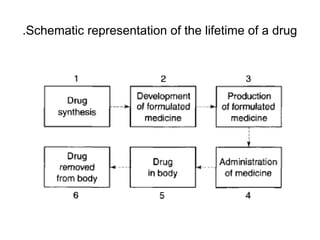
Schematic representation of the lifetime of a drug
.
• In the lifetime of a drug; during stages 1 and 2,
when a drug is synthesized and formulated, the
particle size of drug and other powders is
determined and influences the subsequent
physical performance of the medicine and the
pharmacological performance of the drug.
• Particle size influences the production of
formulated medicines (stage 3) as solid dosage
forms.
• Both tablets and capsules are produced using
equipment that controls the mass of drug and
other particles by volumetric filling. Therefore,
any interference with the uniformity of fill
volumes may alter the mass of drug
incorporated into the tablet or capsule and
hence reduce the content uniformity of the
medicine.
• Powders with different particle sizes have
different flow and packing properties, which alter
the volumes of powder during each
encapsulation or tablet compression event.
• In order to avoid such problems the particle
sizes of drug and other powder may be defined
during formulation so that problems during
production are avoided.
• Following administration of the medicine (stage
4), the dosage form should release the drug into
solution at the optimum rate.
• This depends on several factors, one of which
will be the particle size of drug.
• reduction in size generally increases the specific
surface area of particles. Thus particles having
small dimensions will tend to increase the rate of
solution.
• For example, the drug griseofulvin has a low
solubility by oral administration but is rapidly
distributed following absorption.
• the solubility of griseofulvin can be greatly
enhanced by particle size reduction, so that
blood levels equivalent to, or better than, those
obtained with crystalline griseofulvin can be
produced using a microcrystalline form of the
drug.
• A reduction of particle size to improve rate of
solution and hence bioavailability is not always
beneficial.
• For example, small particle-size nitrofurantoin
has an increased rate of solution which
produces toxic side-effects because of its more
rapid absorption.
Dimensions
• particles would be irregular with different
numbers of faces and it would be difficult or
impractical to determine more than a single
dimension.
• For this reason a solid particle is often
considered to approximate to a sphere which
can then be characterized by determining its
diameter.
• Because measurement is then based on a
hypothetical sphere, which represents only an
approximation to the true shape of the particle,
the dimension is referred to as the equivalent
diameter of the particle.
• It is possible to generate more than one sphere
which is equivalent to a given irregular particle
shape.
Equivalent diameters
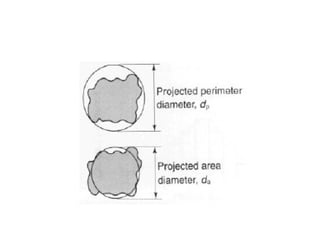
• The projected area diameter is based on a circle
of equivalent area to that of the projected image
of a solid particle.
• the projected perimeter diameter is based on a
circle having the same perimeter as the particle.
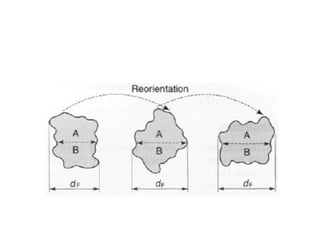
• Feret's and Martin's diameters are dependent on
both the orientation and the shape of the
particles.
• These are statistical diameters which are
averaged over many different orientations to
produce a mean value for each particle
diameter.
• Feret's diameter is determined from the mean
distance between two parallel tangents to the
projected particle perimeter.
• Martin's diameter is the mean chord length of
the projected particle perimeter, which can be
considered as the boundary separating equal
particle areas.
• It is also possible to determine particle size
based on spheres of equivalent volume,
sedimentation volume, mass or sieve mass of a
given particle.
• In general, the method used to determine
particle size dictates the type of equivalent
diameter that is measured
• Interconversion may be carried out automatically
as part of the size analysis

Particle size analysis for pharmacuticals.ppt

  • 1.
  • 2.
    • The dimensionsof particulate solids are important in achieving optimum production of efficacious medicines. • knowledge and control of particle size is of importance both for the production of medicines containing particulate solids and in the efficacy of the medicine following administration.
  • 3.
    Schematic representation ofthe lifetime of a drug .
  • 4.
    • In thelifetime of a drug; during stages 1 and 2, when a drug is synthesized and formulated, the particle size of drug and other powders is determined and influences the subsequent physical performance of the medicine and the pharmacological performance of the drug.
  • 5.
    • Particle sizeinfluences the production of formulated medicines (stage 3) as solid dosage forms. • Both tablets and capsules are produced using equipment that controls the mass of drug and other particles by volumetric filling. Therefore, any interference with the uniformity of fill volumes may alter the mass of drug incorporated into the tablet or capsule and hence reduce the content uniformity of the medicine.
  • 6.
    • Powders withdifferent particle sizes have different flow and packing properties, which alter the volumes of powder during each encapsulation or tablet compression event. • In order to avoid such problems the particle sizes of drug and other powder may be defined during formulation so that problems during production are avoided.
  • 7.
    • Following administrationof the medicine (stage 4), the dosage form should release the drug into solution at the optimum rate. • This depends on several factors, one of which will be the particle size of drug.
  • 8.
    • reduction insize generally increases the specific surface area of particles. Thus particles having small dimensions will tend to increase the rate of solution.
  • 9.
    • For example,the drug griseofulvin has a low solubility by oral administration but is rapidly distributed following absorption. • the solubility of griseofulvin can be greatly enhanced by particle size reduction, so that blood levels equivalent to, or better than, those obtained with crystalline griseofulvin can be produced using a microcrystalline form of the drug.
  • 10.
    • A reductionof particle size to improve rate of solution and hence bioavailability is not always beneficial. • For example, small particle-size nitrofurantoin has an increased rate of solution which produces toxic side-effects because of its more rapid absorption.
  • 11.
    Dimensions • particles wouldbe irregular with different numbers of faces and it would be difficult or impractical to determine more than a single dimension. • For this reason a solid particle is often considered to approximate to a sphere which can then be characterized by determining its diameter.
  • 12.
    • Because measurementis then based on a hypothetical sphere, which represents only an approximation to the true shape of the particle, the dimension is referred to as the equivalent diameter of the particle. • It is possible to generate more than one sphere which is equivalent to a given irregular particle shape.
  • 13.
    Equivalent diameters • Theprojected area diameter is based on a circle of equivalent area to that of the projected image of a solid particle. • the projected perimeter diameter is based on a circle having the same perimeter as the particle.
  • 15.
    • Feret's andMartin's diameters are dependent on both the orientation and the shape of the particles. • These are statistical diameters which are averaged over many different orientations to produce a mean value for each particle diameter.
  • 16.
    • Feret's diameteris determined from the mean distance between two parallel tangents to the projected particle perimeter. • Martin's diameter is the mean chord length of the projected particle perimeter, which can be considered as the boundary separating equal particle areas.
  • 18.
    • It isalso possible to determine particle size based on spheres of equivalent volume, sedimentation volume, mass or sieve mass of a given particle. • In general, the method used to determine particle size dictates the type of equivalent diameter that is measured • Interconversion may be carried out automatically as part of the size analysis