MILLING
Dr.Ibtihal O. Alkarim
headlines
Under this
topic we’ll
discuss:
1. What is milling?
2. Pharmaceutical application
3. Size distribution and measurement
4. Types of mills
5. Selection of mills
Dr.Ibtihal O. Alkarim
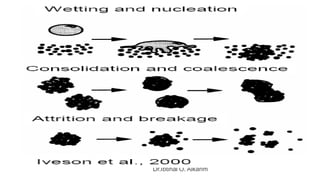
What is milling?
Milling is mechanical process of reducing the
particle size of solids.
Various terms has been used cursing,
disintegration, dispersion, grinding, and
pulverization.
Dr.Ibtihal O. Alkarim
why milling?
Dr.Ibtihal O. Alkarim
 Increase specific surface of the
substance.
 Increase the free surface energy of
milled substance.
 significantly increase the speed of
substance and diffusion processes.
 strengthen the pharmacological activity
of substances
Milling
advantages
 Mixing is more uniform if
ingredients are roughly the
same size
 Milling of wet granules can
promote uniform and efficient
drying
 Increased surface area can
improve dissolution rate and
bioavailability
 Improved content uniformity of
dosage units
disadvantages:
 Excessive heat generation
can lead to degradation,
change in polymorphic
form
 Increase in surface energy
can lead to agglomeration
 May result in excessive
production of fines or
overly broad particle size
distribution
Dr.Ibtihal O. Alkarim
Pharmaceutical application
 Specific surface (
surface area per unit
weight) increase by
size reduction which
affect the therapeutic
efficiency of medical
substance.
specially if the material
have low solubility.
Dr.Ibtihal O. Alkarim
Examples:
Dr.Ibtihal O. Alkarim
 Griseofulvin
 Penicillin G procaine
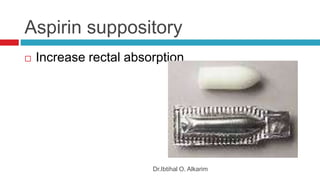
 Aspirin suppository
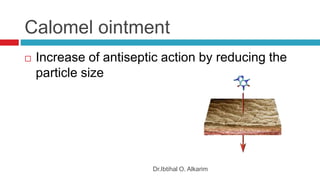
 Calomel ointment
 Areosol
 suspension
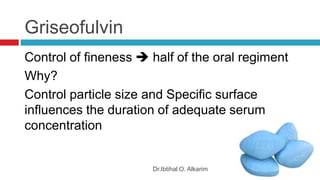
Griseofulvin
Dr.Ibtihal O. Alkarim
Control of fineness  half of the oral regiment
Why?
Control particle size and Specific surface
influences the duration of adequate serum
concentration
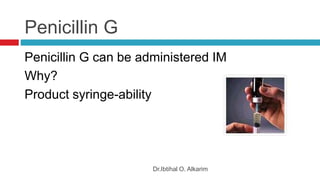
Penicillin G
Dr.Ibtihal O. Alkarim
Penicillin G can be administered IM
Why?
Product syringe-ability
Aspirin suppository
Dr.Ibtihal O. Alkarim
 Increase rectal absorption
Calomel ointment
Dr.Ibtihal O. Alkarim
 Increase of antiseptic action by reducing the
particle size
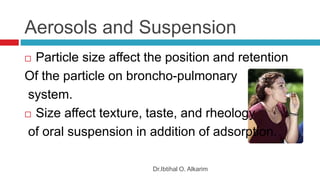
Aerosols and Suspension
Dr.Ibtihal O. Alkarim
 Particle size affect the position and retention
Of the particle on broncho-pulmonary
system.
 Size affect texture, taste, and rheology
of oral suspension in addition of adsorption.
Dr.Ibtihal O. Alkarim
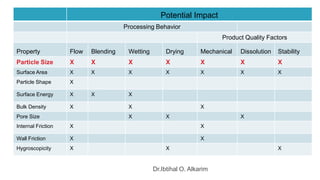
Potential Impact
Processing Behavior
Product Quality Factors
Property Flow Blending Wetting Drying Mechanical Dissolution Stability
Particle Size X X X X X X X
Surface Area X X X X X X X
Particle Shape X
Surface Energy X X X
Bulk Density X X X
Pore Size X X X
Internal Friction X X
Wall Friction X X
Hygroscopicity X X X
 Introduction
 Representation of data
 Measurement methods
Size distribution
Dr.Ibtihal O. Alkarim
Measurement methods
Dr.Ibtihal O. Alkarim
There are three method involved in size
distribution measurement:
a. Microscopy
b. Sieving
c. Sedimentation
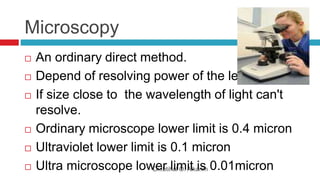
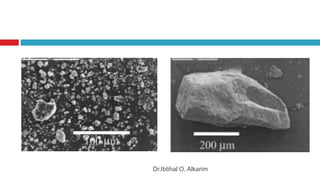
Microscopy
Dr.Ibtihal O. Alkarim
 An ordinary direct method.
 Depend of resolving power of the lens.
 If size close to the wavelength of light can't
resolve.
 Ordinary microscope lower limit is 0.4 micron
 Ultraviolet lower limit is 0.1 micron
 Ultra microscope lower limit is 0.01micron
Dr.Ibtihal O. Alkarim
Sieving
Dr.Ibtihal O. Alkarim
 Most widely used
 Inexpensive
 Rapid
 Little variation
 Lower limit is 50 micron (micromesh 10
micron)
What is sieve?
Dr.Ibtihal O. Alkarim
 A pan with a bottom of wired cloth with square
openings
 In U.S, two standard of sieves are used.
 The procedure involve shaking, weighing of
portion retained, and taping
sedimentation
Dr.Ibtihal O. Alkarim
 Used over size range from 1 to 200 microns.
 Based on the dependence of the rate of
sedimentation of the particle on their size
expressed by stoke equation.
 Pipet method is the simplest means of
incremental particle size analysis.
Types of mills
Dr.Ibtihal O. Alkarim
 A mill consist of three part:
1. Feed chute
2. Grinding mechanism
3. Discharge chute
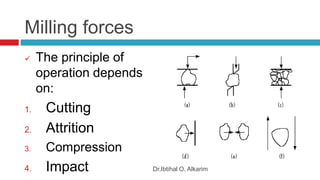
Milling forces
 The principle of
operation depends
on:
1. Cutting
2. Attrition
3. Compression
4. Impact Dr.Ibtihal O. Alkarim
Continuing…
Dr.Ibtihal O. Alkarim
 Open-circuit and closed-circuit mills
 Rate of discharge equal rate of feed.
 Discharge chute designed at the bottom of
mills so that the force of gravity is sufficient to
give free discharge.
Continuing
 Comminution is characterized by the symbol
index –”i” - the degree of comminution of
substances.
“I” equal ratio of the diameter of pieces of
material to the milling (D) to particles diameter
after ones (d).
i = D / d
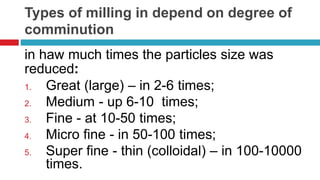
Types of milling in depend on degree of
comminution
in haw much times the particles size was
reduced:
1. Great (large) – in 2-6 times;
2. Medium - up 6-10 times;
3. Fine - at 10-50 times;
4. Micro fine - in 50-100 times;
5. Super fine - thin (colloidal) – in 100-10000
times.
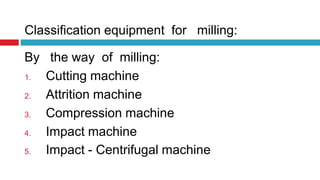
Classification equipment for milling:
By the way of milling:
1. Cutting machine
2. Attrition machine
3. Compression machine
4. Impact machine
5. Impact - Centrifugal machine
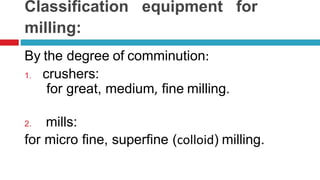
Classification equipment for
milling:
By the degree of comminution:
1. crushers:
for great, medium, fine milling.
2. mills:
for micro fine, superfine (colloid) milling.
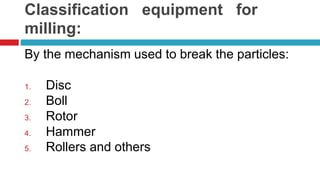
Classification equipment for
milling:
By the mechanism used to break the particles:
1. Disc
2. Boll
3. Rotor
4. Hammer
5. Rollers and others
Requirements for the milling
process:
1. Substances must has initial its composition and
pharmacological properties during the milling
process;
2. Periodically to remove enough milled particles
from the sphere of comminution;
3. Prevent formation of dust (sealed enclosures);
4. Appropriate moisture of material
5. The use of sequence connected crushing-milling
machines.
Mills selection:
1. Initial size of the material and
desirable size of final product
2. The total amount of material for
milling
3. Physical and chemical properties of
material for milling
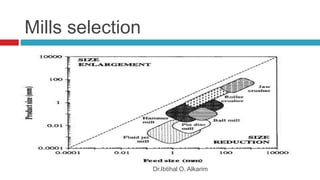
Mills selection
Dr.Ibtihal O. Alkarim
Cutting machine.
are used to comminution herbal drug that has a fibers
structure
 Grass cutting and straw cutting (grass, stalks).
 Root cutting with the guillotine knife - for grinding roots,
bark.
 Drum straw cutting - for grinding dry medicines.
 Knife mill - for milling volume materials, containing
cellulose
 Motorized soft meat grinder - for fresh herbal drugs,
animal raw materials
Crushes machines
which are used for milling solid materials:
 Cheek and jaw mill
 Rollers mill
 Cone mill
 Hammer mill
 Disk mill (Excelsior)
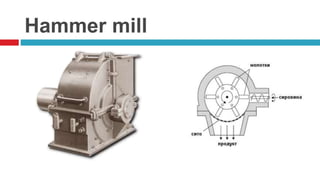
Hammer mills
Dr.Ibtihal O. Alkarim
 It’s an impact-centrifuge mill.
 Using high-speed rotor to which number of swining hammers
are fixed.
 The material is fed at the top or center
 Thrown out centrifugally
 Ground by impact of the hammers or against the plates
around the periphery of the casing.
 The material is retained inside the casing until it is small
enough to fall the the screen at lower portion of casing.
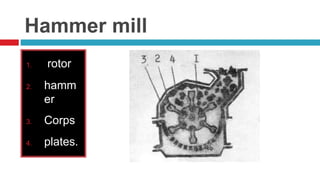
Hammer mill
1. rotor
2. hamm
er
3. Corps
4. plates.
Dr.Ibtihal O. Alkarim
 Most popular
 Used almost at any type of size reduction
 Can be used for dry, wet, cakes, ointment,
slurries.
 Comminution is affected by impact of
peripheral hammer speed ( up to
7600m/minute).
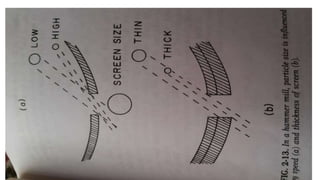
 The size of product is controlled by speed of
Dr.Ibtihal O. Alkarim
advantages
Dr.Ibtihal O. Alkarim
 Narrow size distribution
 Simple to install and operate
 Speed and screen can be rapidly changed
 Easy to clean
 May be operate as closed system.
Hammer mill
Ball mills
Dr.Ibtihal O. Alkarim
 It’s combined of attrition and impact mills.
 Consist of horizontally rotating hollow vessel of
cylindric shape.
 The mills filled with balls of steel or pebbles (
grinding medium).
 Pebbles, rods, and tube mills
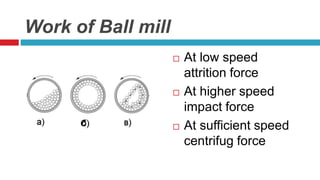
Work of Ball mill
 At low speed
attrition force
 At higher speed
impact force
 At sufficient speed
centrifug force
C
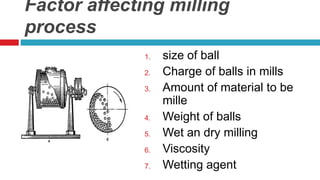
Factor affecting milling
process
1. size of ball
2. Charge of balls in mills
3. Amount of material to be
mille
4. Weight of balls
5. Wet an dry milling
6. Viscosity
7. Wetting agent
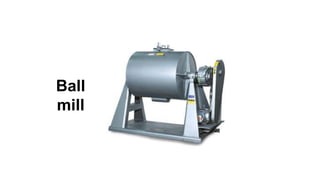
Ball
mill
Advantages of ball mill
Dr.Ibtihal O. Alkarim
 Used either for dry or wet
 Batch or continuous operations
 Sterile grounding possible
 Installation, operation, and labor costs are low
 Unsurpassed for fine grinding of abrasive and
hard material
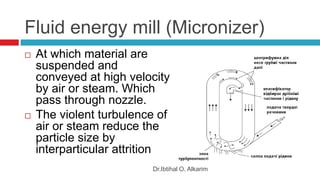
Fluid energy mill (Micronizer)
 At which material are
suspended and
conveyed at high velocity
by air or steam. Which
pass through nozzle.
 The violent turbulence of
air or steam reduce the
particle size by
interparticular attrition
Dr.Ibtihal O. Alkarim
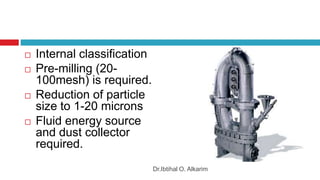
 Internal classification
 Pre-milling (20-
100mesh) is required.
 Reduction of particle
size to 1-20 microns
 Fluid energy source
and dust collector
required.
Dr.Ibtihal O. Alkarim
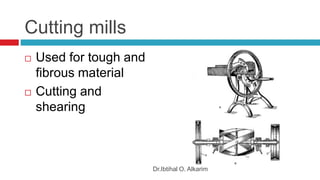
Cutting mills
 Used for tough and
fibrous material
 Cutting and
shearing
Dr.Ibtihal O. Alkarim
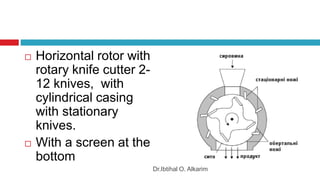
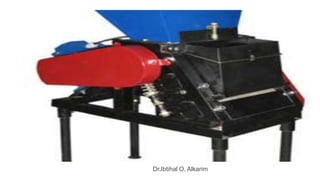
 Horizontal rotor with
rotary knife cutter 2-
12 knives, with
cylindrical casing
with stationary
knives.
 With a screen at the
bottom
Dr.Ibtihal O. Alkarim
 The feed should not exceed the length of knife
 Not more that 1 inch thick
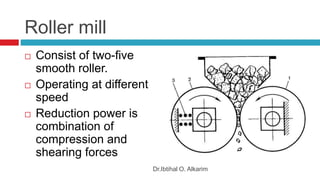
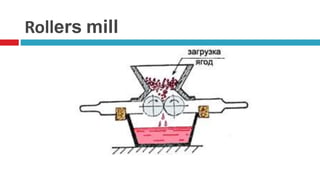
Roller mill
 Consist of two-five
smooth roller.
 Operating at different
speed
 Reduction power is
combination of
compression and
shearing forces
Dr.Ibtihal O. Alkarim
Rollers mill
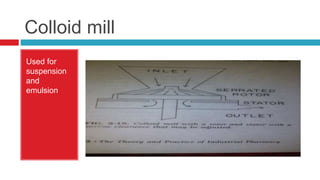
Colloid mill
 Consist of high speed
rotor and stator with
adjustable clearance
range.
 Rotor speed up to
20.000 rpm
 Premilling is required

Dr.Ibtihal O. Alkarim
Colloid mill
Dr.Ibtihal O. Alkarim
 Used to process suspension and emulsion
 Not for dry material
 Pre mixing with liquid
 May be smooth or rough surface regarding
rotor and stator
Colloid mill
Used for
suspension
and
emulsion
Factor influence milling
Dr.Ibtihal O. Alkarim
1. Properties of a solid (Hard (iodine), soft and
intermediate solid).
2. Specification of the product.
3. Physical nature of material (fibrous, friable)
4. Water content
5. Heat during milling (low melting point, heat
sensitive drug, pigment, unstable compound)
Dr.Ibtihal O. Alkarim
1. Shape of milled particle (flow specifications)
2. Milling may alter Crystalline structure and
causes chemical change in some material
Selection of a mill
Dr.Ibtihal O. Alkarim
 The choose of the mill depend on:
1. Product specification (size range, particle size
distribution, shape, moisture content, physical
and chemical properties of material)
2. Capacity of the mill and product rate requirement
3. Versatility of operation ( wet and dry milling,
rapid change of speed and screen, and safety
requirement)
Dr.Ibtihal O. Alkarim
1. Dust control (loss of costly drug, health
hazard, contamination)
2. Sanitation (ease of cleaning, sterilization)
3. Auxiliary equipment
4. Batch or continuous operation
5. Economical factor
Dr.Ibtihal O. Alkarim
Thanks….
Dr.Ibtihal O. Alkarim

Milling final

  • 1.
  • 2.
    headlines Under this topic we’ll discuss: 1.What is milling? 2. Pharmaceutical application 3. Size distribution and measurement 4. Types of mills 5. Selection of mills Dr.Ibtihal O. Alkarim
  • 3.
    What is milling? Millingis mechanical process of reducing the particle size of solids. Various terms has been used cursing, disintegration, dispersion, grinding, and pulverization. Dr.Ibtihal O. Alkarim
  • 4.
  • 5.
    why milling? Dr.Ibtihal O.Alkarim  Increase specific surface of the substance.  Increase the free surface energy of milled substance.  significantly increase the speed of substance and diffusion processes.  strengthen the pharmacological activity of substances
  • 6.
    Milling advantages  Mixing ismore uniform if ingredients are roughly the same size  Milling of wet granules can promote uniform and efficient drying  Increased surface area can improve dissolution rate and bioavailability  Improved content uniformity of dosage units disadvantages:  Excessive heat generation can lead to degradation, change in polymorphic form  Increase in surface energy can lead to agglomeration  May result in excessive production of fines or overly broad particle size distribution Dr.Ibtihal O. Alkarim
  • 7.
    Pharmaceutical application  Specificsurface ( surface area per unit weight) increase by size reduction which affect the therapeutic efficiency of medical substance. specially if the material have low solubility. Dr.Ibtihal O. Alkarim
  • 8.
    Examples: Dr.Ibtihal O. Alkarim Griseofulvin  Penicillin G procaine  Aspirin suppository  Calomel ointment  Areosol  suspension
  • 9.
    Griseofulvin Dr.Ibtihal O. Alkarim Controlof fineness  half of the oral regiment Why? Control particle size and Specific surface influences the duration of adequate serum concentration
  • 10.
    Penicillin G Dr.Ibtihal O.Alkarim Penicillin G can be administered IM Why? Product syringe-ability
  • 11.
    Aspirin suppository Dr.Ibtihal O.Alkarim  Increase rectal absorption
  • 12.
    Calomel ointment Dr.Ibtihal O.Alkarim  Increase of antiseptic action by reducing the particle size
  • 13.
    Aerosols and Suspension Dr.IbtihalO. Alkarim  Particle size affect the position and retention Of the particle on broncho-pulmonary system.  Size affect texture, taste, and rheology of oral suspension in addition of adsorption.
  • 14.
    Dr.Ibtihal O. Alkarim PotentialImpact Processing Behavior Product Quality Factors Property Flow Blending Wetting Drying Mechanical Dissolution Stability Particle Size X X X X X X X Surface Area X X X X X X X Particle Shape X Surface Energy X X X Bulk Density X X X Pore Size X X X Internal Friction X X Wall Friction X X Hygroscopicity X X X
  • 15.
     Introduction  Representationof data  Measurement methods Size distribution Dr.Ibtihal O. Alkarim
  • 16.
    Measurement methods Dr.Ibtihal O.Alkarim There are three method involved in size distribution measurement: a. Microscopy b. Sieving c. Sedimentation
  • 17.
    Microscopy Dr.Ibtihal O. Alkarim An ordinary direct method.  Depend of resolving power of the lens.  If size close to the wavelength of light can't resolve.  Ordinary microscope lower limit is 0.4 micron  Ultraviolet lower limit is 0.1 micron  Ultra microscope lower limit is 0.01micron
  • 18.
  • 19.
    Sieving Dr.Ibtihal O. Alkarim Most widely used  Inexpensive  Rapid  Little variation  Lower limit is 50 micron (micromesh 10 micron)
  • 20.
    What is sieve? Dr.IbtihalO. Alkarim  A pan with a bottom of wired cloth with square openings  In U.S, two standard of sieves are used.  The procedure involve shaking, weighing of portion retained, and taping
  • 21.
    sedimentation Dr.Ibtihal O. Alkarim Used over size range from 1 to 200 microns.  Based on the dependence of the rate of sedimentation of the particle on their size expressed by stoke equation.  Pipet method is the simplest means of incremental particle size analysis.
  • 22.
  • 23.
    Dr.Ibtihal O. Alkarim A mill consist of three part: 1. Feed chute 2. Grinding mechanism 3. Discharge chute
  • 24.
    Milling forces  Theprinciple of operation depends on: 1. Cutting 2. Attrition 3. Compression 4. Impact Dr.Ibtihal O. Alkarim
  • 25.
    Continuing… Dr.Ibtihal O. Alkarim Open-circuit and closed-circuit mills  Rate of discharge equal rate of feed.  Discharge chute designed at the bottom of mills so that the force of gravity is sufficient to give free discharge.
  • 26.
    Continuing  Comminution ischaracterized by the symbol index –”i” - the degree of comminution of substances. “I” equal ratio of the diameter of pieces of material to the milling (D) to particles diameter after ones (d). i = D / d
  • 27.
    Types of millingin depend on degree of comminution in haw much times the particles size was reduced: 1. Great (large) – in 2-6 times; 2. Medium - up 6-10 times; 3. Fine - at 10-50 times; 4. Micro fine - in 50-100 times; 5. Super fine - thin (colloidal) – in 100-10000 times.
  • 28.
    Classification equipment formilling: By the way of milling: 1. Cutting machine 2. Attrition machine 3. Compression machine 4. Impact machine 5. Impact - Centrifugal machine
  • 29.
    Classification equipment for milling: Bythe degree of comminution: 1. crushers: for great, medium, fine milling. 2. mills: for micro fine, superfine (colloid) milling.
  • 30.
    Classification equipment for milling: Bythe mechanism used to break the particles: 1. Disc 2. Boll 3. Rotor 4. Hammer 5. Rollers and others
  • 31.
    Requirements for themilling process: 1. Substances must has initial its composition and pharmacological properties during the milling process; 2. Periodically to remove enough milled particles from the sphere of comminution; 3. Prevent formation of dust (sealed enclosures); 4. Appropriate moisture of material 5. The use of sequence connected crushing-milling machines.
  • 32.
    Mills selection: 1. Initialsize of the material and desirable size of final product 2. The total amount of material for milling 3. Physical and chemical properties of material for milling
  • 33.
  • 34.
    Cutting machine. are usedto comminution herbal drug that has a fibers structure  Grass cutting and straw cutting (grass, stalks).  Root cutting with the guillotine knife - for grinding roots, bark.  Drum straw cutting - for grinding dry medicines.  Knife mill - for milling volume materials, containing cellulose  Motorized soft meat grinder - for fresh herbal drugs, animal raw materials
  • 35.
    Crushes machines which areused for milling solid materials:  Cheek and jaw mill  Rollers mill  Cone mill  Hammer mill  Disk mill (Excelsior)
  • 36.
    Hammer mills Dr.Ibtihal O.Alkarim  It’s an impact-centrifuge mill.  Using high-speed rotor to which number of swining hammers are fixed.  The material is fed at the top or center  Thrown out centrifugally  Ground by impact of the hammers or against the plates around the periphery of the casing.  The material is retained inside the casing until it is small enough to fall the the screen at lower portion of casing.
  • 37.
    Hammer mill 1. rotor 2.hamm er 3. Corps 4. plates.
  • 38.
    Dr.Ibtihal O. Alkarim Most popular  Used almost at any type of size reduction  Can be used for dry, wet, cakes, ointment, slurries.  Comminution is affected by impact of peripheral hammer speed ( up to 7600m/minute).  The size of product is controlled by speed of
  • 39.
  • 40.
    advantages Dr.Ibtihal O. Alkarim Narrow size distribution  Simple to install and operate  Speed and screen can be rapidly changed  Easy to clean  May be operate as closed system.
  • 41.
  • 42.
    Ball mills Dr.Ibtihal O.Alkarim  It’s combined of attrition and impact mills.  Consist of horizontally rotating hollow vessel of cylindric shape.  The mills filled with balls of steel or pebbles ( grinding medium).  Pebbles, rods, and tube mills
  • 43.
    Work of Ballmill  At low speed attrition force  At higher speed impact force  At sufficient speed centrifug force C
  • 44.
    Factor affecting milling process 1.size of ball 2. Charge of balls in mills 3. Amount of material to be mille 4. Weight of balls 5. Wet an dry milling 6. Viscosity 7. Wetting agent
  • 45.
  • 46.
    Advantages of ballmill Dr.Ibtihal O. Alkarim  Used either for dry or wet  Batch or continuous operations  Sterile grounding possible  Installation, operation, and labor costs are low  Unsurpassed for fine grinding of abrasive and hard material
  • 47.
    Fluid energy mill(Micronizer)  At which material are suspended and conveyed at high velocity by air or steam. Which pass through nozzle.  The violent turbulence of air or steam reduce the particle size by interparticular attrition Dr.Ibtihal O. Alkarim
  • 48.
     Internal classification Pre-milling (20- 100mesh) is required.  Reduction of particle size to 1-20 microns  Fluid energy source and dust collector required. Dr.Ibtihal O. Alkarim
  • 49.
    Cutting mills  Usedfor tough and fibrous material  Cutting and shearing Dr.Ibtihal O. Alkarim
  • 50.
     Horizontal rotorwith rotary knife cutter 2- 12 knives, with cylindrical casing with stationary knives.  With a screen at the bottom Dr.Ibtihal O. Alkarim
  • 51.
  • 52.
    Dr.Ibtihal O. Alkarim The feed should not exceed the length of knife  Not more that 1 inch thick
  • 53.
    Roller mill  Consistof two-five smooth roller.  Operating at different speed  Reduction power is combination of compression and shearing forces Dr.Ibtihal O. Alkarim
  • 54.
  • 55.
    Colloid mill  Consistof high speed rotor and stator with adjustable clearance range.  Rotor speed up to 20.000 rpm  Premilling is required  Dr.Ibtihal O. Alkarim
  • 56.
    Colloid mill Dr.Ibtihal O.Alkarim  Used to process suspension and emulsion  Not for dry material  Pre mixing with liquid  May be smooth or rough surface regarding rotor and stator
  • 57.
  • 58.
    Factor influence milling Dr.IbtihalO. Alkarim 1. Properties of a solid (Hard (iodine), soft and intermediate solid). 2. Specification of the product. 3. Physical nature of material (fibrous, friable) 4. Water content 5. Heat during milling (low melting point, heat sensitive drug, pigment, unstable compound)
  • 59.
    Dr.Ibtihal O. Alkarim 1.Shape of milled particle (flow specifications) 2. Milling may alter Crystalline structure and causes chemical change in some material
  • 60.
    Selection of amill Dr.Ibtihal O. Alkarim  The choose of the mill depend on: 1. Product specification (size range, particle size distribution, shape, moisture content, physical and chemical properties of material) 2. Capacity of the mill and product rate requirement 3. Versatility of operation ( wet and dry milling, rapid change of speed and screen, and safety requirement)
  • 61.
    Dr.Ibtihal O. Alkarim 1.Dust control (loss of costly drug, health hazard, contamination) 2. Sanitation (ease of cleaning, sterilization) 3. Auxiliary equipment 4. Batch or continuous operation 5. Economical factor
  • 62.
  • 63.
  • 64.