PARTICIPLE CLAUSES
GRAMMAR
Definition:
• A form of adverbial clause which enables to say
information in a more economical way.
• We can use participle clauses when the participle and the
verb in the main clause have the same subject.
For example:
Waiting for John, I made some tea.
Waiting for John, the kettle boiled. [This would suggest
that the kettle was waiting for John!]
NOTE: If the subject of the participle is different from the
subject of the verb, this goes at the beginning of the
sentence. E.g.
Weather permitting, we may drive to the beach.
FORM
Participle clauses can be formed with:
1. the present participle (-ing form of the verb)
• E.g. Shouting loudly, Peter walked home. [Peter was
shouting
2. past participle(-ed regular verbs /third form of the
irregular verbs)
• E.g. Shouted at loudly, Peter walked home. [Someone
was shouting at Peter]
3. to emphasise that one action was before another then
we can use a perfect participle(having + past participle):
• Having won the match, Susan jumped for joy.
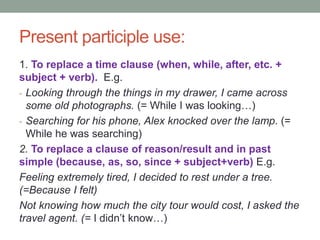
Present participle use:
1. To replace a time clause (when, while, after, etc. +
subject + verb). E.g.
- Looking through the things in my drawer, I came across
some old photographs. (= While I was looking…)
- Searching for his phone, Alex knocked over the lamp. (=
While he was searching)
2. To replace a clause of reason/result and in past
simple (because, as, so, since + subject+verb) E.g.
Feeling extremely tired, I decided to rest under a tree.
(=Because I felt)
Not knowing how much the city tour would cost, I asked the
travel agent. (= I didn’t know…)
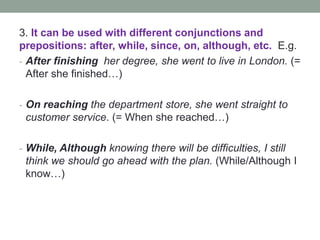
3. It can be used with different conjunctions and
prepositions: after, while, since, on, although, etc. E.g.
- After finishing her degree, she went to live in London. (=
After she finished…)
- On reaching the department store, she went straight to
customer service. (= When she reached…)
- While, Although knowing there will be difficulties, I still
think we should go ahead with the plan. (While/Although I
know…)
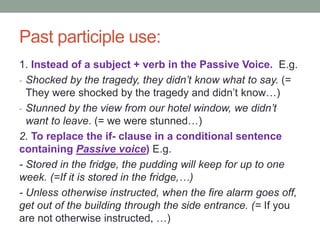
Past participle use:
1. Instead of a subject + verb in the Passive Voice. E.g.
- Shocked by the tragedy, they didn’t know what to say. (=
They were shocked by the tragedy and didn’t know…)
- Stunned by the view from our hotel window, we didn’t
want to leave. (= we were stunned…)
2. To replace the if- clause in a conditional sentence
containing Passive voice) E.g.
- Stored in the fridge, the pudding will keep for up to one
week. (=If it is stored in the fridge,…)
- Unless otherwise instructed, when the fire alarm goes off,
get out of the building through the side entrance. (= If you
are not otherwise instructed, …)
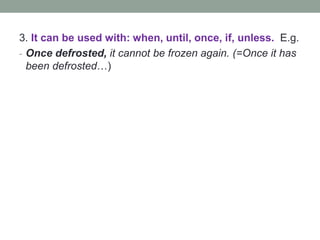
3. It can be used with: when, until, once, if, unless. E.g.
- Once defrosted, it cannot be frozen again. (=Once it has
been defrosted…)
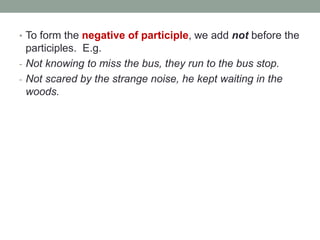
• To form the negative of participle, we add not before the
participles. E.g.
- Not knowing to miss the bus, they run to the bus stop.
- Not scared by the strange noise, he kept waiting in the
woods.

Participle clauses

  • 1.
  • 2.
    Definition: • A formof adverbial clause which enables to say information in a more economical way. • We can use participle clauses when the participle and the verb in the main clause have the same subject. For example: Waiting for John, I made some tea. Waiting for John, the kettle boiled. [This would suggest that the kettle was waiting for John!] NOTE: If the subject of the participle is different from the subject of the verb, this goes at the beginning of the sentence. E.g. Weather permitting, we may drive to the beach.
  • 3.
    FORM Participle clauses canbe formed with: 1. the present participle (-ing form of the verb) • E.g. Shouting loudly, Peter walked home. [Peter was shouting 2. past participle(-ed regular verbs /third form of the irregular verbs) • E.g. Shouted at loudly, Peter walked home. [Someone was shouting at Peter] 3. to emphasise that one action was before another then we can use a perfect participle(having + past participle): • Having won the match, Susan jumped for joy.
  • 4.
    Present participle use: 1.To replace a time clause (when, while, after, etc. + subject + verb). E.g. - Looking through the things in my drawer, I came across some old photographs. (= While I was looking…) - Searching for his phone, Alex knocked over the lamp. (= While he was searching) 2. To replace a clause of reason/result and in past simple (because, as, so, since + subject+verb) E.g. Feeling extremely tired, I decided to rest under a tree. (=Because I felt) Not knowing how much the city tour would cost, I asked the travel agent. (= I didn’t know…)
  • 5.
    3. It canbe used with different conjunctions and prepositions: after, while, since, on, although, etc. E.g. - After finishing her degree, she went to live in London. (= After she finished…) - On reaching the department store, she went straight to customer service. (= When she reached…) - While, Although knowing there will be difficulties, I still think we should go ahead with the plan. (While/Although I know…)
  • 6.
    Past participle use: 1.Instead of a subject + verb in the Passive Voice. E.g. - Shocked by the tragedy, they didn’t know what to say. (= They were shocked by the tragedy and didn’t know…) - Stunned by the view from our hotel window, we didn’t want to leave. (= we were stunned…) 2. To replace the if- clause in a conditional sentence containing Passive voice) E.g. - Stored in the fridge, the pudding will keep for up to one week. (=If it is stored in the fridge,…) - Unless otherwise instructed, when the fire alarm goes off, get out of the building through the side entrance. (= If you are not otherwise instructed, …)
  • 7.
    3. It canbe used with: when, until, once, if, unless. E.g. - Once defrosted, it cannot be frozen again. (=Once it has been defrosted…)
  • 8.
    • To formthe negative of participle, we add not before the participles. E.g. - Not knowing to miss the bus, they run to the bus stop. - Not scared by the strange noise, he kept waiting in the woods.