PARTICIPLE
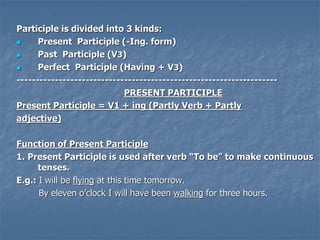
Participle is divided into 3 kinds:
 Present Participle (-Ing. form)
 Past Participle (V3)
 Perfect Participle (Having + V3)
--------------------------------------------------------------------
PRESENT PARTICIPLE
Present Participle = V1 + ing (Partly Verb + Partly
adjective)
Function of Present Participle
1. Present Participle is used after verb “To be” to make continuous
tenses.
E.g.: I will be flying at this time tomorrow.
By eleven o’clock I will have been walking for three hours.
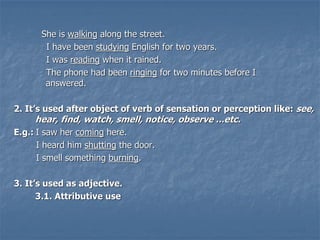
She is walking along the street.
I have been studying English for two years.
I was reading when it rained.
The phone had been ringing for two minutes before I
answered.
2. It’s used after object of verb of sensation or perception like: see,
hear, find, watch, smell, notice, observe ...etc.
E.g.: I saw her coming here.
I heard him shutting the door.
I smell something burning.
3. It’s used as adjective.
3.1. Attributive use
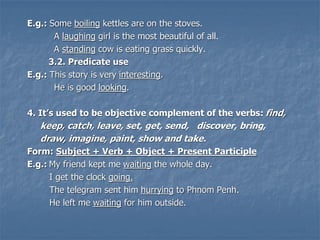
E.g.: Some boiling kettles are on the stoves.
A laughing girl is the most beautiful of all.
A standing cow is eating grass quickly.
3.2. Predicate use
E.g.: This story is very interesting.
He is good looking.
4. It’s used to be objective complement of the verbs: find,
keep, catch, leave, set, get, send, discover, bring,
draw, imagine, paint, show and take.
Form: Subject + Verb + Object + Present Participle
E.g.: My friend kept me waiting the whole day.
I get the clock going.
The telegram sent him hurrying to Phnom Penh.
He left me waiting for him outside.
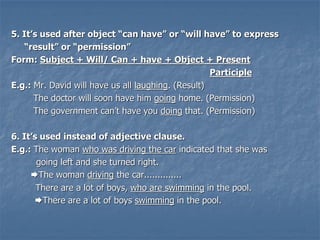
5. It’s used after object “can have” or “will have” to express
“result” or “permission”
Form: Subject + Will/ Can + have + Object + Present
Participle
E.g.: Mr. David will have us all laughing. (Result)
The doctor will soon have him going home. (Permission)
The government can’t have you doing that. (Permission)
6. It’s used instead of adjective clause.
E.g.: The woman who was driving the car indicated that she was
going left and she turned right.
The woman driving the car..............
There are a lot of boys, who are swimming in the pool.
There are a lot of boys swimming in the pool.
The man who is smoking a cigarette is my uncle.
The man smoking a cigarette is my uncle.
7. It’s used as adverb of sentence.
E.g.: Generally speaking, a runner is more tired than a walker.
Talking about football, have you ever seen our team play?
Strictly speaking, they have no right to be here.
8. It’s used after verb to express an action happening at the same
time.
E.g.: She sat waiting for you.
They entered carrying the poster.
The beggar sat asking for money.
I’ve stood watching the football match.
9. Mixing two sentences in one by making one as absolute phrase.
In this case there are three conditions.
- Making the first action as absolute phrase.
- If the subject of the two sentences is the same person, we have to
omit one in the first action.
- If the subject of the two sentences isn’t the same person, we can’t omit it,
we only make the first action as absolute phrase.
E.g.: He crossed the road. He was knocked down by a car.
 Crossing the road, he was knocked down by a car.
I walked to the garden. I smelled sweet roses.
 Walking to the garden, I smelled sweet roses.
He stood on the street. He saw a car accident.
 Standing on the street, he saw a car accident.
The teacher was absent. The student went home.
 The teacher being absent, the student went home.
The cinema was full. We went home.
 The cinema being full, we went home.
THIS IS THE END!

2. participle

  • 1.
  • 2.
    Participle is dividedinto 3 kinds:  Present Participle (-Ing. form)  Past Participle (V3)  Perfect Participle (Having + V3) -------------------------------------------------------------------- PRESENT PARTICIPLE Present Participle = V1 + ing (Partly Verb + Partly adjective) Function of Present Participle 1. Present Participle is used after verb “To be” to make continuous tenses. E.g.: I will be flying at this time tomorrow. By eleven o’clock I will have been walking for three hours.
  • 3.
    She is walkingalong the street. I have been studying English for two years. I was reading when it rained. The phone had been ringing for two minutes before I answered. 2. It’s used after object of verb of sensation or perception like: see, hear, find, watch, smell, notice, observe ...etc. E.g.: I saw her coming here. I heard him shutting the door. I smell something burning. 3. It’s used as adjective. 3.1. Attributive use
  • 4.
    E.g.: Some boilingkettles are on the stoves. A laughing girl is the most beautiful of all. A standing cow is eating grass quickly. 3.2. Predicate use E.g.: This story is very interesting. He is good looking. 4. It’s used to be objective complement of the verbs: find, keep, catch, leave, set, get, send, discover, bring, draw, imagine, paint, show and take. Form: Subject + Verb + Object + Present Participle E.g.: My friend kept me waiting the whole day. I get the clock going. The telegram sent him hurrying to Phnom Penh. He left me waiting for him outside.
  • 5.
    5. It’s usedafter object “can have” or “will have” to express “result” or “permission” Form: Subject + Will/ Can + have + Object + Present Participle E.g.: Mr. David will have us all laughing. (Result) The doctor will soon have him going home. (Permission) The government can’t have you doing that. (Permission) 6. It’s used instead of adjective clause. E.g.: The woman who was driving the car indicated that she was going left and she turned right. The woman driving the car.............. There are a lot of boys, who are swimming in the pool. There are a lot of boys swimming in the pool.
  • 6.
    The man whois smoking a cigarette is my uncle. The man smoking a cigarette is my uncle. 7. It’s used as adverb of sentence. E.g.: Generally speaking, a runner is more tired than a walker. Talking about football, have you ever seen our team play? Strictly speaking, they have no right to be here. 8. It’s used after verb to express an action happening at the same time. E.g.: She sat waiting for you. They entered carrying the poster. The beggar sat asking for money. I’ve stood watching the football match.
  • 7.
    9. Mixing twosentences in one by making one as absolute phrase. In this case there are three conditions. - Making the first action as absolute phrase. - If the subject of the two sentences is the same person, we have to omit one in the first action. - If the subject of the two sentences isn’t the same person, we can’t omit it, we only make the first action as absolute phrase. E.g.: He crossed the road. He was knocked down by a car.  Crossing the road, he was knocked down by a car. I walked to the garden. I smelled sweet roses.  Walking to the garden, I smelled sweet roses. He stood on the street. He saw a car accident.  Standing on the street, he saw a car accident.
  • 8.
    The teacher wasabsent. The student went home.  The teacher being absent, the student went home. The cinema was full. We went home.  The cinema being full, we went home. THIS IS THE END!