A Social-Economic Framework
   for Assessing Enduring Value
      From Mining for Remote
            Communities
     Dr Boyd D Blackwell* & Prof. Brian Dollery**
*Post-doctorial Research Fellow, UNE Business School and CRC REP
 ** UNE Business School and Director, Centre for Local Government

                       boydb@une.edu.au


                Presentation made to the 2012 ANZSEE
            Conference, Green growth or de-growth? 12 – 15
             November, 2012, Bond University, Gold Coast
Acknowledgements

 •   Traditional owners
 •   CRC REP and the Partners in this project
 •   Views are those of the authors
 •   Errors or omissions remain with the authors


                                                   2
Outline

 •   Introduction
 •   Remoteness problems
 •   Methods for impact assessment
 •   Evaluation of methods
 •   Conceptual approach
 •   Conclusion


                                     3
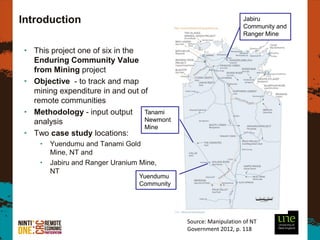
Introduction                                                      Jabiru
                                                                  Community and
                                                                  Ranger Mine

• This project one of six in the
  Enduring Community Value
  from Mining project
• Objective - to track and map
  mining expenditure in and out of
  remote communities
• Methodology - input output Tanami
  analysis                       Newmont
                                 Mine
• Two case study locations:
    •   Yuendumu and Tanami Gold
        Mine, NT and
    •   Jabiru and Ranger Uranium Mine,
        NT
                                 Yuendumu
                                 Community


                                             Source: Manipulation of NT
                                             Government 2012, p. 118
What do we do?
Who are we?

The CRC-REP is a collaborative
research platform that works with
communities, businesses and
people in remote regions of
Australia to systemically
investigate and provide practical
responses to the complex issues
that drive economic participation.


                                     5
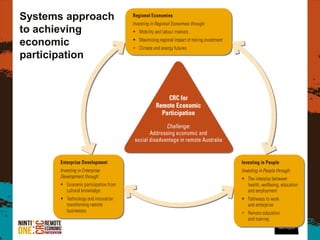
Systems approach
to achieving
economic
participation


                   6
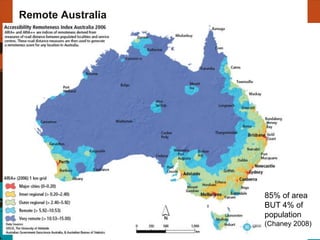
Remote Australia


                   85% of area
                   BUT 4% of
                   population
                   (Chaney 2008)
                                   7
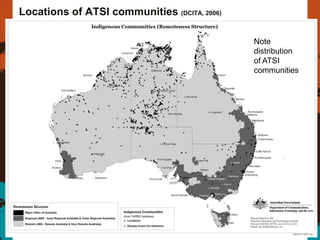
Locations of ATSI communities (DCITA, 2006)

                                              Note
                                              distribution
                                              of ATSI
                                              communities


                                                             8
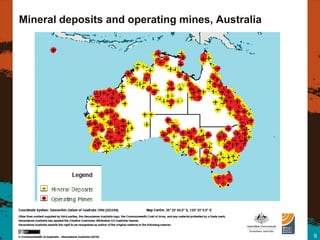
Mineral deposits and operating mines, Australia


                                                  9
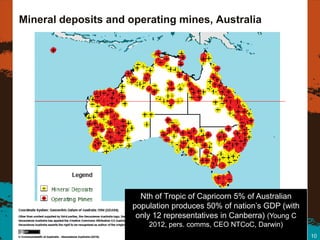
Mineral deposits and operating mines, Australia


                       Nth of Tropic of Capricorn 5% of Australian
                     population produces 50% of nation’s GDP (with
                      only 12 representatives in Canberra) (Young C
                         2012, pers. comms, CEO NTCoC, Darwin)
                                                                      10
Problems associated with remoteness (See Blackwell, Dollery and
Grant (In preparation) for references)


   • Factors:
      • Institutional
      • Environmental or geographical factors:
      • Health and wellbeing
      • Cultural
      • Economic


                                                                  11
Problems associated with remoteness (See Blackwell, Dollery and
Grant (In preparation) for references)

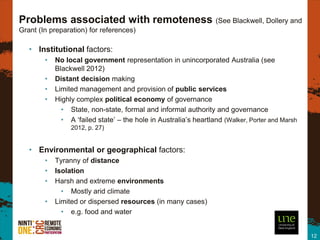
   • Institutional factors:
        •   No local government representation in unincorporated Australia (see
            Blackwell 2012)
        •   Distant decision making
        •   Limited management and provision of public services
        •   Highly complex political economy of governance
              • State, non-state, formal and informal authority and governance
              • A ‘failed state’ – the hole in Australia’s heartland (Walker, Porter and Marsh
                 2012, p. 27)


   • Environmental or geographical factors:
        •   Tyranny of distance
        •   Isolation
        •   Harsh and extreme environments
              • Mostly arid climate
        •   Limited or dispersed resources (in many cases)
              • e.g. food and water


                                                                                                 12
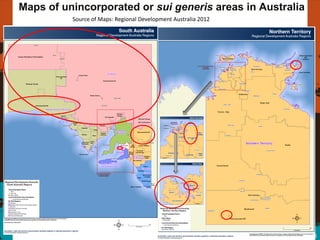
Maps of unincorporated or sui generis areas in Australia
          Source of Maps: Regional Development Australia 2012


                                                                13
Problems associated with remoteness (See Blackwell, Dollery and
Grant (In preparation) for references)

   • Health and wellbeing factors:
        •   High levels of disease and limited access to medical care
              • Distance, communication and cultural inappropriateness
        •   Funding and coordination of health care
              • Does not recognize responsible hospitals and primary care sector
        •   Education, housing and water
              • Limited
              • High cost
        •   ATSI participation in workforce and education low
        •   High proportion of disadvantaged people
        •   Chronic drug and alcohol abuse, in parts
        •   Higher rates of arrest and imprisonment, in parts


                                                                                   14
Problems associated with remoteness (See Blackwell, Dollery and
Grant (forthcoming) for references)

   • Cultural factors:
        •   Social variability
              • Unpredictability in, lack of control over markets, labour and policy
        •   Social interaction
              • Very restricted or very little access
        •   Human populations
              • Sparse, mobile, patchy
        •   Research knowledge is limited
        •   Persistent traditional and local knowledge
        •   Incongruence of western and traditional laws (more details in Blackwell and
            Dollery, 2012a presentation)
        •   Social dislocation (compounded over generations in a relatively short period of
            time)
        •   Inability to keep young people and resulting boredom for those who remain


                                                                                              15
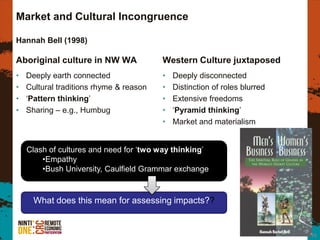
Market and Cultural Incongruence

Hannah Bell (1998)

Aboriginal culture in NW WA              Western Culture juxtaposed
•   Deeply earth connected               •   Deeply disconnected
•   Cultural traditions rhyme & reason   •   Distinction of roles blurred
•   ‘Pattern thinking’                   •   Extensive freedoms
•   Sharing – e.g., Humbug               •   ‘Pyramid thinking’
                                         •   Market and materialism


    Clash of cultures and need for ‘two way thinking’
        •Empathy
        •Bush University, Caulfield Grammar exchange


      What does this mean for assessing impacts??


                                                                            16
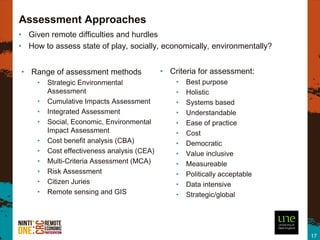
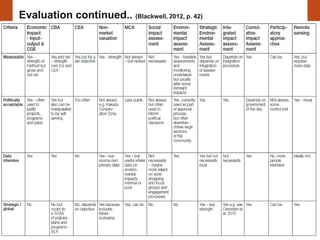
Assessment Approaches
• Given remote difficulties and hurdles
• How to assess state of play, socially, economically, environmentally?


• Range of assessment methods                • Criteria for assessment:
     •   Strategic Environmental                 •   Best purpose
         Assessment                              •   Holistic
     •   Cumulative Impacts Assessment           •   Systems based
     •   Integrated Assessment                   •   Understandable
     •   Social, Economic, Environmental         •   Ease of practice
         Impact Assessment                       •   Cost
     •   Cost benefit analysis (CBA)             •   Democratic
     •   Cost effectiveness analysis (CEA)       •   Value inclusive
     •   Multi-Criteria Assessment (MCA)         •   Measureable
     •   Risk Assessment                         •   Politically acceptable
     •   Citizen Juries                          •   Data intensive
     •   Remote sensing and GIS                  •   Strategic/global


                                                                              17
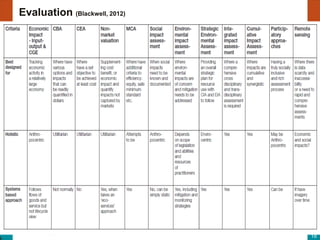
Evaluation (Blackwell, 2012)


                               18
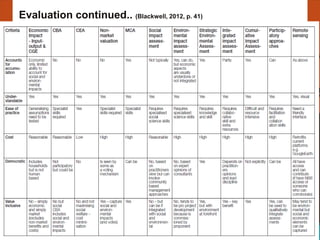
Evaluation continued.. (Blackwell, 2012, p. 41)


                                                  19
Evaluation continued.. (Blackwell, 2012, p. 42)


                                                  20
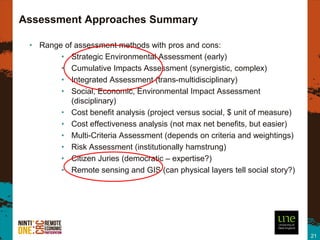
Assessment Approaches Summary

 • Range of assessment methods with pros and cons:
        • Strategic Environmental Assessment (early)
        • Cumulative Impacts Assessment (synergistic, complex)
        • Integrated Assessment (trans-multidisciplinary)
        • Social, Economic, Environmental Impact Assessment
           (disciplinary)
        • Cost benefit analysis (project versus social, $ unit of measure)
        • Cost effectiveness analysis (not max net benefits, but easier)
        • Multi-Criteria Assessment (depends on criteria and weightings)
        • Risk Assessment (institutionally hamstrung)
        • Citizen Juries (democratic – expertise?)
        • Remote sensing and GIS (can physical layers tell social story?)


                                                                             21
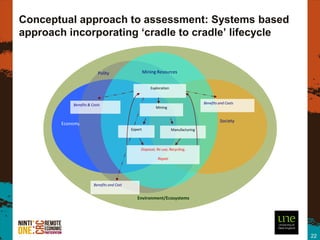
Conceptual approach to assessment: Systems based
approach incorporating ‘cradle to cradle’ lifecycle


                          Polity                     Mining Resources


                                                        Exploration


            Benefits & Costs                                                          Benefits and Costs
                                                           Mining


                                                                                               Society
        Economy
                                            Export                    Manufacturing


                                                 Disposal, Re-use, -
                                                                   Recycling,

                                                            Repair


                        Benefits and Cost


                                               Environment/Ecosystems


                                                                                                           22
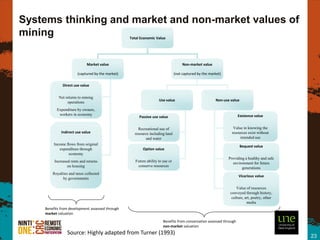
Systems thinking and market and non-market values of
mining                                            Total Economic Value


                             Market value                                            Non-market value

                       (captured by the market)                                 (not captured by the market)

              Direct use value


           Net returns to mining
                                                                    Use value                           Non-use value
                operations
          Expenditure by owners,
           workers in economy                                                                                        Existence value
                                                       Passive use value


                                                      Recreational use of                                         Value in knowing the
             Indirect use value                     resource including land                                      resources exist without
                                                           and water                                                  intended use
         Income flows from original
                                                                                                                        Bequest value
            expenditure through                          Option value
                 economy
                                                                                                               Providing a healthy and safe
         Increased rents and returns                 Future ability to use or
                                                                                                                 environment for future
                 on housing                           conserve resources
                                                                                                                       generations
        Royalties and taxes collected
                                                                                                                     Vicarious value
              by governments

                                                                                                                    Value of resources
                                                                                                                conveyed through history,
                                                                                                                 culture, art, poetry, other
                                                                                                                           media
    Benefits from development assessed through
    market valuation
                                                                       Benefits from conservation assessed through
                                                                       non-market valuation
                 Source: Highly adapted from Turner (1993)
                                                                                                                                               23
Conclusion
  • Impact assessment not simple and needs to account for:
      • Informal market economy in community
      • Significant ‘leakages’
      • Incongruence between aboriginal culture and market based
        philosophy
      • Sui Generis of remote Australia
  • Remote locations (like the NT) are unique culturally, socially,
    economically, environmentally, institutionally and politically
      • and this needs to be accounted for the approach


                                                                      24

ANZSEE 2012 Boyd Blackwell & Brian Dollery: Socio-economic Framework

  • 1.
    A Social-Economic Framework for Assessing Enduring Value From Mining for Remote Communities Dr Boyd D Blackwell* & Prof. Brian Dollery** *Post-doctorial Research Fellow, UNE Business School and CRC REP ** UNE Business School and Director, Centre for Local Government boydb@une.edu.au Presentation made to the 2012 ANZSEE Conference, Green growth or de-growth? 12 – 15 November, 2012, Bond University, Gold Coast
  • 2.
    Acknowledgements • Traditional owners • CRC REP and the Partners in this project • Views are those of the authors • Errors or omissions remain with the authors 2
  • 3.
    Outline • Introduction • Remoteness problems • Methods for impact assessment • Evaluation of methods • Conceptual approach • Conclusion 3
  • 4.
    Introduction Jabiru Community and Ranger Mine • This project one of six in the Enduring Community Value from Mining project • Objective - to track and map mining expenditure in and out of remote communities • Methodology - input output Tanami analysis Newmont Mine • Two case study locations: • Yuendumu and Tanami Gold Mine, NT and • Jabiru and Ranger Uranium Mine, NT Yuendumu Community Source: Manipulation of NT Government 2012, p. 118
  • 5.
    What do wedo? Who are we? The CRC-REP is a collaborative research platform that works with communities, businesses and people in remote regions of Australia to systemically investigate and provide practical responses to the complex issues that drive economic participation. 5
  • 6.
  • 7.
    Remote Australia 85% of area BUT 4% of population (Chaney 2008) 7
  • 8.
    Locations of ATSIcommunities (DCITA, 2006) Note distribution of ATSI communities 8
  • 9.
    Mineral deposits andoperating mines, Australia 9
  • 10.
    Mineral deposits andoperating mines, Australia Nth of Tropic of Capricorn 5% of Australian population produces 50% of nation’s GDP (with only 12 representatives in Canberra) (Young C 2012, pers. comms, CEO NTCoC, Darwin) 10
  • 11.
    Problems associated withremoteness (See Blackwell, Dollery and Grant (In preparation) for references) • Factors: • Institutional • Environmental or geographical factors: • Health and wellbeing • Cultural • Economic 11
  • 12.
    Problems associated withremoteness (See Blackwell, Dollery and Grant (In preparation) for references) • Institutional factors: • No local government representation in unincorporated Australia (see Blackwell 2012) • Distant decision making • Limited management and provision of public services • Highly complex political economy of governance • State, non-state, formal and informal authority and governance • A ‘failed state’ – the hole in Australia’s heartland (Walker, Porter and Marsh 2012, p. 27) • Environmental or geographical factors: • Tyranny of distance • Isolation • Harsh and extreme environments • Mostly arid climate • Limited or dispersed resources (in many cases) • e.g. food and water 12
  • 13.
    Maps of unincorporatedor sui generis areas in Australia Source of Maps: Regional Development Australia 2012 13
  • 14.
    Problems associated withremoteness (See Blackwell, Dollery and Grant (In preparation) for references) • Health and wellbeing factors: • High levels of disease and limited access to medical care • Distance, communication and cultural inappropriateness • Funding and coordination of health care • Does not recognize responsible hospitals and primary care sector • Education, housing and water • Limited • High cost • ATSI participation in workforce and education low • High proportion of disadvantaged people • Chronic drug and alcohol abuse, in parts • Higher rates of arrest and imprisonment, in parts 14
  • 15.
    Problems associated withremoteness (See Blackwell, Dollery and Grant (forthcoming) for references) • Cultural factors: • Social variability • Unpredictability in, lack of control over markets, labour and policy • Social interaction • Very restricted or very little access • Human populations • Sparse, mobile, patchy • Research knowledge is limited • Persistent traditional and local knowledge • Incongruence of western and traditional laws (more details in Blackwell and Dollery, 2012a presentation) • Social dislocation (compounded over generations in a relatively short period of time) • Inability to keep young people and resulting boredom for those who remain 15
  • 16.
    Market and CulturalIncongruence Hannah Bell (1998) Aboriginal culture in NW WA Western Culture juxtaposed • Deeply earth connected • Deeply disconnected • Cultural traditions rhyme & reason • Distinction of roles blurred • ‘Pattern thinking’ • Extensive freedoms • Sharing – e.g., Humbug • ‘Pyramid thinking’ • Market and materialism Clash of cultures and need for ‘two way thinking’ •Empathy •Bush University, Caulfield Grammar exchange What does this mean for assessing impacts?? 16
  • 17.
    Assessment Approaches • Givenremote difficulties and hurdles • How to assess state of play, socially, economically, environmentally? • Range of assessment methods • Criteria for assessment: • Strategic Environmental • Best purpose Assessment • Holistic • Cumulative Impacts Assessment • Systems based • Integrated Assessment • Understandable • Social, Economic, Environmental • Ease of practice Impact Assessment • Cost • Cost benefit analysis (CBA) • Democratic • Cost effectiveness analysis (CEA) • Value inclusive • Multi-Criteria Assessment (MCA) • Measureable • Risk Assessment • Politically acceptable • Citizen Juries • Data intensive • Remote sensing and GIS • Strategic/global 17
  • 18.
  • 19.
  • 20.
  • 21.
    Assessment Approaches Summary • Range of assessment methods with pros and cons: • Strategic Environmental Assessment (early) • Cumulative Impacts Assessment (synergistic, complex) • Integrated Assessment (trans-multidisciplinary) • Social, Economic, Environmental Impact Assessment (disciplinary) • Cost benefit analysis (project versus social, $ unit of measure) • Cost effectiveness analysis (not max net benefits, but easier) • Multi-Criteria Assessment (depends on criteria and weightings) • Risk Assessment (institutionally hamstrung) • Citizen Juries (democratic – expertise?) • Remote sensing and GIS (can physical layers tell social story?) 21
  • 22.
    Conceptual approach toassessment: Systems based approach incorporating ‘cradle to cradle’ lifecycle Polity Mining Resources Exploration Benefits & Costs Benefits and Costs Mining Society Economy Export Manufacturing Disposal, Re-use, - Recycling, Repair Benefits and Cost Environment/Ecosystems 22
  • 23.
    Systems thinking andmarket and non-market values of mining Total Economic Value Market value Non-market value (captured by the market) (not captured by the market) Direct use value Net returns to mining Use value Non-use value operations Expenditure by owners, workers in economy Existence value Passive use value Recreational use of Value in knowing the Indirect use value resource including land resources exist without and water intended use Income flows from original Bequest value expenditure through Option value economy Providing a healthy and safe Increased rents and returns Future ability to use or environment for future on housing conserve resources generations Royalties and taxes collected Vicarious value by governments Value of resources conveyed through history, culture, art, poetry, other media Benefits from development assessed through market valuation Benefits from conservation assessed through non-market valuation Source: Highly adapted from Turner (1993) 23
  • 24.
    Conclusion •Impact assessment not simple and needs to account for: • Informal market economy in community • Significant ‘leakages’ • Incongruence between aboriginal culture and market based philosophy • Sui Generis of remote Australia • Remote locations (like the NT) are unique culturally, socially, economically, environmentally, institutionally and politically • and this needs to be accounted for the approach 24