PARTHENOS-project.eu
WP3: Common policies and
implementation strategies
Parthenos Prato– 14/12/2016
Hella Hollander
KNAW-DANS
PARTHENOS-project.eu
WP3
1. Vision and Approach on Common Policies
2. Fair Principles
3. Parthenos Wizard
4. Questions
2
PARTHENOS-project.eu
1. Commom Policies
Parthenos WP3– Rome– 14/11/2016
Hella Hollander
KNAW-DANS
PARTHENOS-project.eu
Challenge
Goal is to agree on and define the concepts of Policy, Guidelines, Best practice, their objectives
and target audience
 How are humanities repositories assessed? How to create assessment ‘profile’ for
humanities? How to comply with it? How to coordinate reviews?
 What quality of (meta)data is desired? How can it be measured?
The PARTHENOS VISION – Common Policies
4
Task objectives
PARTHENOS-project.eu 5
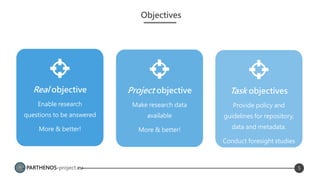
Objectives
Task objectives
Provide policy and
guidelines for repository,
data and metadata.
Conduct foresight studies
Project objective
Make research data
available
More & better!
Real objective
Enable research
questions to be answered
More & better!
PARTHENOS-project.eu
PARTHENOS FLAGSHIP EXPECTED RESULTS
• Guidelines on data management
Produce a coherent, authoritative, well accepted set of policies/guidelines/tools
concerning the management of data lifecycle and related issues such as IPR, quality
and so on
• Standardization and semantics
Produce a wide set of standards and semantics, originated from community needs and
tailored to the methodology and intended use by researchers
• Services and tools
Produce a coherent set of tools for carrying out research using and re-using data
PARTHENOS-project.eu
The PARTHENOS VISION – Common Policies
Focus Approach WP3
The results of the effort of Work Package 3 should have a long-term impact on common
policies and guidelines on research data management, IPR, Open Access and Open data and
how to implement them within the Humanities.
WP2 and WP3 work on an inventory of existing policies from the different infrastructures, and
will define and test requirements for shared policies.
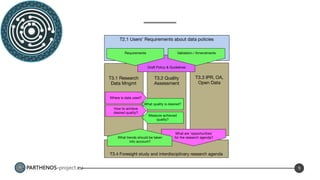
D3.1 represents the result of desk research and theoretical background giving guidelines and
case studies to the researchers. The outcomes of this deliverable could be made more useful
and reusable by creating an interactive guide (web page) to present the results.
7
PARTHENOS-project.eu
Common Vision WP3
• Help researchers to make their data of better quality, interoperable, sharable, findable and
reusable (FAIR principles)
• Agree on and define what policies, guidelines and best practice are.
• Overview of existing policies in the Parthenos disciplines, for different data lifecycle phases
• Find the commonalities between disciplines in the humanities in terms of policies, RDM and
IPR, open access
• Find the gaps: what disciplines are advanced in terms of policies and what are not
• Give recommendation and guidance to researchers
• Give recommendation and guidance to data archives
• Give guidance and recommendations to cultural heritage institutions
8
PARTHENOS-project.eu 9
PARTHENOS-project.eu
Approach
Deliverable as a shared product of WP3
Deliverable: Text and Wizard
Matrixes and Chapters: New content on policies and best practices: Receive input via
working groups
Wizard: What does it bring for Parthenos? A clear picture
FAIR principles into Deliverable: connecting backbone
10
PARTHENOS-project.eu
2. FAIR principles
PARTHENOS-project.eu
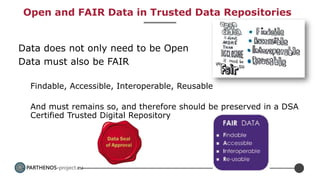
Open and FAIR Data in Trusted Data Repositories
Data does not only need to be Open
Data must also be FAIR
Findable, Accessible, Interoperable, Reusable
And must remains so, and therefore should be preserved in a DSA
Certified Trusted Digital Repository
PARTHENOS-project.eu
OAIS
(ISO 14721)
Trusted Digital
Repositories:
Attributes and
Responsibilities
TRAC
Audit and
Certification of
Trustworthy Digital
Repositories
(ISO 16363 )
Requirements For
Bodies Providing
Audit And
Certification
(ISO 16919 )
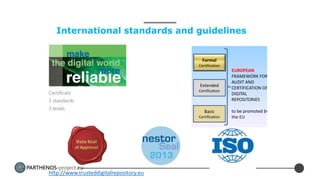
Formal
Certification
See http://wiki.digitalrepositoryauditandcertification.org and
http://www.alliancepermanentaccess.org/membership/member-resources/audit-and-certification
Standards will be available free from http://www.ccsds.org
be applied to the evaluation of the
trustworthiness of digital repositories using ISO
16363.
It covers principles needed to inspire
confidence that third party certification of the
management of the digital repository has been
performed with impartiality, competence,
responsibility, openness, confidentiality, and
responsiveness to complaints
Metrics concerning:
• Organizational Infrastructure
• e.g. The repository shall have a documented history of the
changes to its operations, procedures, software, and
hardware.
• Digital Object Management
• e.g. The repository shall have access to necessary tools
and resources to provide authoritative Representation
Information for all of the digital objects it contains.
• Infrastructure and Security Risk Management
• eg. The repository shall have procedures in place to
evaluate when changes are needed to current
software.
Basic
Certification
Data Seal of
Approval
Extended
Certification
EUROPEAN
FRAMEWORK FOR
AUDIT AND
CERTIFICATION OF
DIGITAL
REPOSITORIES
to be promoted by
the EU
Monitored self-
audit using DSA
metrics
Monitored self-audit using ISO 16363 (or
DIN31644 in Germany)
Audit by
external
auditors
http://www.trusteddigitalrepository.eu
International standards and guidelines
Certificats
3 standards
3 levels
PARTHENOS-project.eu
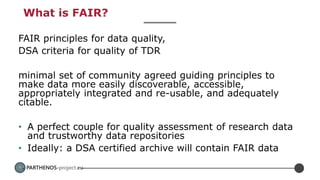
What is FAIR?
FAIR principles for data quality,
DSA criteria for quality of TDR
minimal set of community agreed guiding principles to
make data more easily discoverable, accessible,
appropriately integrated and re-usable, and adequately
citable.
• A perfect couple for quality assessment of research data
and trustworthy data repositories
• Ideally: a DSA certified archive will contain FAIR data
PARTHENOS-project.eu
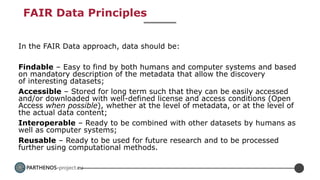
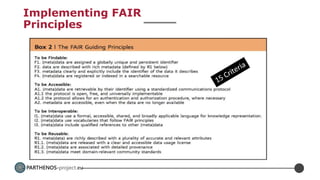
FAIR Data Principles
In the FAIR Data approach, data should be:
Findable – Easy to find by both humans and computer systems and based
on mandatory description of the metadata that allow the discovery
of interesting datasets;
Accessible – Stored for long term such that they can be easily accessed
and/or downloaded with well-defined license and access conditions (Open
Access when possible), whether at the level of metadata, or at the level of
the actual data content;
Interoperable – Ready to be combined with other datasets by humans as
well as computer systems;
Reusable – Ready to be used for future research and to be processed
further using computational methods.
PARTHENOS-project.eu
Implementing FAIR
Principles
PARTHENOS-project.eu
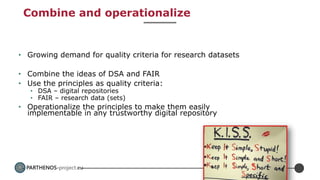
Combine and operationalize
• Growing demand for quality criteria for research datasets
• Combine the ideas of DSA and FAIR
• Use the principles as quality criteria:
• DSA – digital repositories
• FAIR – research data (sets)
• Operationalize the principles to make them easily
implementable in any trustworthy digital repository
PARTHENOS-project.eu
Findable - defined by metadata,
documentation (and identifier for
citation):
1. No URI or PID and no
documentation
2. PID without or with insufficient
metadata
3. Metadata without PID
4. PID with limited metadata, just
enough to understand the data
5. Extensive metadata and rich
additional documentation available
Accessible - defined by presence of a user
license; [metadata retrievable by identifier:
already included under F]
1. No user license / unclear conditions of reuse /
metadata nor data are accessible
2. Metadata are accessible (even when the data
are not or no longer available)
3. User restrictions apply (of any kind, including
privacy, commercial interests, embargo period,
etc.)
4. Public access (after registration)
5. Open Access (unrestricted)
PARTHENOS-project.eu
Interoperable - defined by the data
format; modified version of Tim Berners-
Lee’s 5-star open data plan:
1. Proprietary, non-open format data
2. Proprietary format, accepted by
Certified Trusted Data Repository
3. Non-proprietary, open format (=
“archival format”)
4. Data is additionally
harmonized/standardized, using
standard vocabulary
5. Data is additionally linked to other
data to provide context
Reusable - the most difficult
dimension (partly subjective);
aspects:
1. Clear provenance of data (to
facilitate both replication and
reuse)
2. Data is in a TDR – unsustained
data will not remain usable
3. Explication on how data was or
can be used is available
4. Data automatically usable by
machines
5. Data is reliable (replicable)
PARTHENOS-project.eu
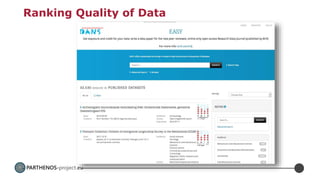
Ranking Quality of Data
PARTHENOS-project.eu
FAIR as the backbone principles
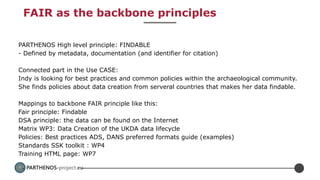
PARTHENOS High level principle: FINDABLE
- Defined by metadata, documentation (and identifier for citation)
Connected part in the Use CASE:
Indy is looking for best practices and common policies within the archaeological community.
She finds policies about data creation from serveral countries that makes her data findable.
Mappings to backbone FAIR principle like this:
Fair principle: Findable
DSA principle: the data can be found on the Internet
Matrix WP3: Data Creation of the UKDA data lifecycle
Policies: Best practices ADS, DANS preferred formats guide (examples)
Standards SSK toolkit : WP4
Training HTML page: WP7
PARTHENOS-project.eu
3. Parthenos Wizard
PARTHENOS-project.eu 23
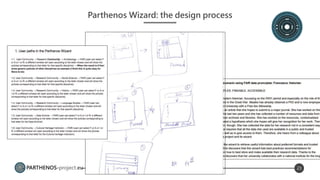
Parthenos Wizard: the design process
PARTHENOS-project.eu
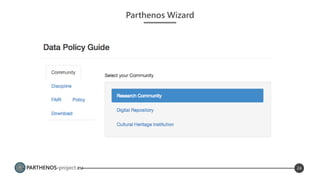
Parthenos Wizard
24
PARTHENOS-project.eu 25
Parthenos Wizard
• Not just a deliverable, we want something that our
stakeholders can use, an instrument that can guide them
trough the jungle of research policies! Idea discussed and
approved in Krakow, first results discussed in Rome.
• We could create an interactive guideline where our users can
find information about the policies that best adapt to their use
case
• We can include not only the research outputs of WP3 but also
WP4 and WP7 and integrate this with the datamodel and
infrastructure of Parthenos via WP5/6.
PARTHENOS-project.eu 26
Parthenos Wizard: latest developments
• Technically, it is developing as a widget in the Parthenos
website: something very simple and sustainable
• Intra-WPs task including WP2, WP3, WP4, WP5/6, WP7
(regular meetings)
• Connect these policies through the FAIR principles of data
quality
• We want to start with a proof of concept that will serve the
others to see how the wizard can be developed
PARTHENOS-project.eu 27
Parthenos Wizard: the technical solution
• The wizard (widget) will be integrated in the Parthenos
website
• Take the information of the T.3.2. Matrix via API
• Displays the information on the selected policies in the wizard
PARTHENOS-project.eu
4. Questions
Hella Hollander
DANS-KNAW
Hella.Hollander@dans.knaw.nl
PARTHENOS is a Horizon 2020 project funded by the European
Commission. The views and opinions expressed in this publication are
the sole responsibility of the author and do not necessarily reflect the
views of the European Commission.

PARTHENOS Common Policies and Implementation Strategies

  • 1.
    PARTHENOS-project.eu WP3: Common policiesand implementation strategies Parthenos Prato– 14/12/2016 Hella Hollander KNAW-DANS
  • 2.
    PARTHENOS-project.eu WP3 1. Vision andApproach on Common Policies 2. Fair Principles 3. Parthenos Wizard 4. Questions 2
  • 3.
    PARTHENOS-project.eu 1. Commom Policies ParthenosWP3– Rome– 14/11/2016 Hella Hollander KNAW-DANS
  • 4.
    PARTHENOS-project.eu Challenge Goal is toagree on and define the concepts of Policy, Guidelines, Best practice, their objectives and target audience  How are humanities repositories assessed? How to create assessment ‘profile’ for humanities? How to comply with it? How to coordinate reviews?  What quality of (meta)data is desired? How can it be measured? The PARTHENOS VISION – Common Policies 4 Task objectives
  • 5.
    PARTHENOS-project.eu 5 Objectives Task objectives Providepolicy and guidelines for repository, data and metadata. Conduct foresight studies Project objective Make research data available More & better! Real objective Enable research questions to be answered More & better!
  • 6.
    PARTHENOS-project.eu PARTHENOS FLAGSHIP EXPECTEDRESULTS • Guidelines on data management Produce a coherent, authoritative, well accepted set of policies/guidelines/tools concerning the management of data lifecycle and related issues such as IPR, quality and so on • Standardization and semantics Produce a wide set of standards and semantics, originated from community needs and tailored to the methodology and intended use by researchers • Services and tools Produce a coherent set of tools for carrying out research using and re-using data
  • 7.
    PARTHENOS-project.eu The PARTHENOS VISION– Common Policies Focus Approach WP3 The results of the effort of Work Package 3 should have a long-term impact on common policies and guidelines on research data management, IPR, Open Access and Open data and how to implement them within the Humanities. WP2 and WP3 work on an inventory of existing policies from the different infrastructures, and will define and test requirements for shared policies. D3.1 represents the result of desk research and theoretical background giving guidelines and case studies to the researchers. The outcomes of this deliverable could be made more useful and reusable by creating an interactive guide (web page) to present the results. 7
  • 8.
    PARTHENOS-project.eu Common Vision WP3 •Help researchers to make their data of better quality, interoperable, sharable, findable and reusable (FAIR principles) • Agree on and define what policies, guidelines and best practice are. • Overview of existing policies in the Parthenos disciplines, for different data lifecycle phases • Find the commonalities between disciplines in the humanities in terms of policies, RDM and IPR, open access • Find the gaps: what disciplines are advanced in terms of policies and what are not • Give recommendation and guidance to researchers • Give recommendation and guidance to data archives • Give guidance and recommendations to cultural heritage institutions 8
  • 9.
  • 10.
    PARTHENOS-project.eu Approach Deliverable as ashared product of WP3 Deliverable: Text and Wizard Matrixes and Chapters: New content on policies and best practices: Receive input via working groups Wizard: What does it bring for Parthenos? A clear picture FAIR principles into Deliverable: connecting backbone 10
  • 11.
  • 12.
    PARTHENOS-project.eu Open and FAIRData in Trusted Data Repositories Data does not only need to be Open Data must also be FAIR Findable, Accessible, Interoperable, Reusable And must remains so, and therefore should be preserved in a DSA Certified Trusted Digital Repository
  • 13.
    PARTHENOS-project.eu OAIS (ISO 14721) Trusted Digital Repositories: Attributesand Responsibilities TRAC Audit and Certification of Trustworthy Digital Repositories (ISO 16363 ) Requirements For Bodies Providing Audit And Certification (ISO 16919 ) Formal Certification See http://wiki.digitalrepositoryauditandcertification.org and http://www.alliancepermanentaccess.org/membership/member-resources/audit-and-certification Standards will be available free from http://www.ccsds.org be applied to the evaluation of the trustworthiness of digital repositories using ISO 16363. It covers principles needed to inspire confidence that third party certification of the management of the digital repository has been performed with impartiality, competence, responsibility, openness, confidentiality, and responsiveness to complaints Metrics concerning: • Organizational Infrastructure • e.g. The repository shall have a documented history of the changes to its operations, procedures, software, and hardware. • Digital Object Management • e.g. The repository shall have access to necessary tools and resources to provide authoritative Representation Information for all of the digital objects it contains. • Infrastructure and Security Risk Management • eg. The repository shall have procedures in place to evaluate when changes are needed to current software. Basic Certification Data Seal of Approval Extended Certification EUROPEAN FRAMEWORK FOR AUDIT AND CERTIFICATION OF DIGITAL REPOSITORIES to be promoted by the EU Monitored self- audit using DSA metrics Monitored self-audit using ISO 16363 (or DIN31644 in Germany) Audit by external auditors http://www.trusteddigitalrepository.eu International standards and guidelines Certificats 3 standards 3 levels
  • 14.
    PARTHENOS-project.eu What is FAIR? FAIRprinciples for data quality, DSA criteria for quality of TDR minimal set of community agreed guiding principles to make data more easily discoverable, accessible, appropriately integrated and re-usable, and adequately citable. • A perfect couple for quality assessment of research data and trustworthy data repositories • Ideally: a DSA certified archive will contain FAIR data
  • 15.
    PARTHENOS-project.eu FAIR Data Principles Inthe FAIR Data approach, data should be: Findable – Easy to find by both humans and computer systems and based on mandatory description of the metadata that allow the discovery of interesting datasets; Accessible – Stored for long term such that they can be easily accessed and/or downloaded with well-defined license and access conditions (Open Access when possible), whether at the level of metadata, or at the level of the actual data content; Interoperable – Ready to be combined with other datasets by humans as well as computer systems; Reusable – Ready to be used for future research and to be processed further using computational methods.
  • 16.
  • 17.
    PARTHENOS-project.eu Combine and operationalize •Growing demand for quality criteria for research datasets • Combine the ideas of DSA and FAIR • Use the principles as quality criteria: • DSA – digital repositories • FAIR – research data (sets) • Operationalize the principles to make them easily implementable in any trustworthy digital repository
  • 18.
    PARTHENOS-project.eu Findable - definedby metadata, documentation (and identifier for citation): 1. No URI or PID and no documentation 2. PID without or with insufficient metadata 3. Metadata without PID 4. PID with limited metadata, just enough to understand the data 5. Extensive metadata and rich additional documentation available Accessible - defined by presence of a user license; [metadata retrievable by identifier: already included under F] 1. No user license / unclear conditions of reuse / metadata nor data are accessible 2. Metadata are accessible (even when the data are not or no longer available) 3. User restrictions apply (of any kind, including privacy, commercial interests, embargo period, etc.) 4. Public access (after registration) 5. Open Access (unrestricted)
  • 19.
    PARTHENOS-project.eu Interoperable - definedby the data format; modified version of Tim Berners- Lee’s 5-star open data plan: 1. Proprietary, non-open format data 2. Proprietary format, accepted by Certified Trusted Data Repository 3. Non-proprietary, open format (= “archival format”) 4. Data is additionally harmonized/standardized, using standard vocabulary 5. Data is additionally linked to other data to provide context Reusable - the most difficult dimension (partly subjective); aspects: 1. Clear provenance of data (to facilitate both replication and reuse) 2. Data is in a TDR – unsustained data will not remain usable 3. Explication on how data was or can be used is available 4. Data automatically usable by machines 5. Data is reliable (replicable)
  • 20.
  • 21.
    PARTHENOS-project.eu FAIR as thebackbone principles PARTHENOS High level principle: FINDABLE - Defined by metadata, documentation (and identifier for citation) Connected part in the Use CASE: Indy is looking for best practices and common policies within the archaeological community. She finds policies about data creation from serveral countries that makes her data findable. Mappings to backbone FAIR principle like this: Fair principle: Findable DSA principle: the data can be found on the Internet Matrix WP3: Data Creation of the UKDA data lifecycle Policies: Best practices ADS, DANS preferred formats guide (examples) Standards SSK toolkit : WP4 Training HTML page: WP7
  • 22.
  • 23.
  • 24.
  • 25.
    PARTHENOS-project.eu 25 Parthenos Wizard •Not just a deliverable, we want something that our stakeholders can use, an instrument that can guide them trough the jungle of research policies! Idea discussed and approved in Krakow, first results discussed in Rome. • We could create an interactive guideline where our users can find information about the policies that best adapt to their use case • We can include not only the research outputs of WP3 but also WP4 and WP7 and integrate this with the datamodel and infrastructure of Parthenos via WP5/6.
  • 26.
    PARTHENOS-project.eu 26 Parthenos Wizard:latest developments • Technically, it is developing as a widget in the Parthenos website: something very simple and sustainable • Intra-WPs task including WP2, WP3, WP4, WP5/6, WP7 (regular meetings) • Connect these policies through the FAIR principles of data quality • We want to start with a proof of concept that will serve the others to see how the wizard can be developed
  • 27.
    PARTHENOS-project.eu 27 Parthenos Wizard:the technical solution • The wizard (widget) will be integrated in the Parthenos website • Take the information of the T.3.2. Matrix via API • Displays the information on the selected policies in the wizard
  • 28.
    PARTHENOS-project.eu 4. Questions Hella Hollander DANS-KNAW Hella.Hollander@dans.knaw.nl PARTHENOSis a Horizon 2020 project funded by the European Commission. The views and opinions expressed in this publication are the sole responsibility of the author and do not necessarily reflect the views of the European Commission.