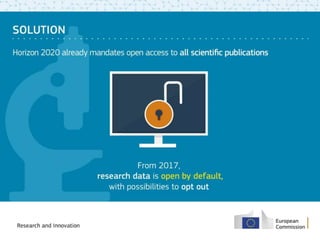
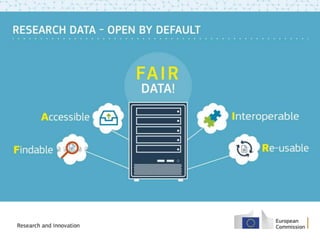
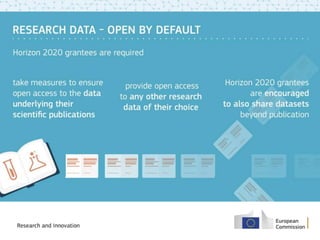
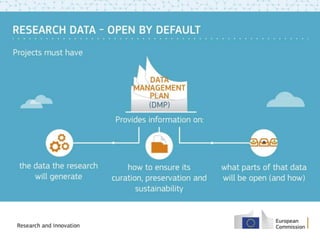
Horizon 2020 and the Open
Research Data pilot
Sarah Jones
Digital Curation Centre, Glasgow
sarah.jones@glasgow.ac.uk
Twitter: @sjDCC
Data Management Plan (DMP) workshop, e-infrastructures Austria, Vienna, 17 November 2016
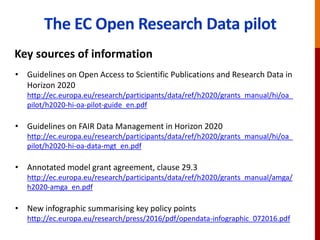
The EC Open Research Data pilot
Key sources of information
• Guidelines on Open Access to Scientific Publications and Research Data in
Horizon 2020
http://ec.europa.eu/research/participants/data/ref/h2020/grants_manual/hi/oa_
pilot/h2020-hi-oa-pilot-guide_en.pdf
• Guidelines on FAIR Data Management in Horizon 2020
http://ec.europa.eu/research/participants/data/ref/h2020/grants_manual/hi/oa_
pilot/h2020-hi-oa-data-mgt_en.pdf
• Annotated model grant agreement, clause 29.3
http://ec.europa.eu/research/participants/data/ref/h2020/grants_manual/amga/
h2020-amga_en.pdf
• New infographic summarising key policy points
http://ec.europa.eu/research/press/2016/pdf/opendata-infographic_072016.pdf
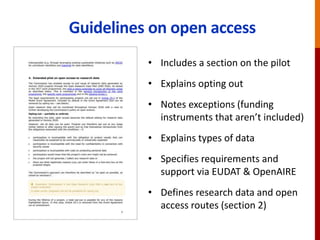
Guidelines on open access
• Includes a section on the pilot
• Explains opting out
• Notes exceptions (funding
instruments that aren’t included)
• Explains types of data
• Specifies requirements and
support via EUDAT & OpenAIRE
• Defines research data and open
access routes (section 2)
FAIR Data Management guidelines
• Notes the extension of the pilot
• Clarifies concept of FAIR data
• Explains what a DMP is and when
they should be updated
• Notes what happens at proposal,
submission and evaluation
• Explains costs are eligible
• Provides a DMP template
Model grant agreement
29.3 Open access to research data
[OPTION for actions participating in the open Research Data Pilot:
Regarding the digital research data generated in the action (‘data’), the
beneficiaries must:
(a) deposit in a research data repository and take measures to make it
possible for third parties to access, mine, exploit, reproduce and
disseminate — free of charge for any user — the following:
(i) the data, including associated metadata, needed to validate the results
presented in scientific publications as soon as possible;
(ii) other data, including associated metadata, as specified and within the
deadlines laid down in the ‘data management plan’ (see Annex 1);
(b) Provide information — via the repository — about tools and
instruments at the disposal of the beneficiaries and necessary for
validating the results (and — where possible — provide the tools
and instruments themselves)
The following European Commission branded slides come from the
EC’s open access team and provide an overview to the key points.
Content from Jean-Francois Dechamp and colleagues.
Mail: RTD-open-access@ec.europa.eu
Web: http://ec.europa.eu/research/openscience/index.cfm
Twitter: @OpenAccessEC
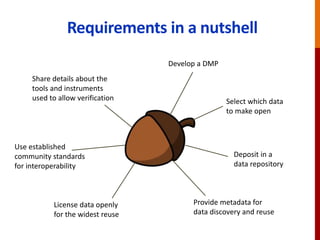
Requirements in a nutshell
Develop a DMP
Select which data
to make open
License data openly
for the widest reuse
Use established
community standards
for interoperability
Provide metadata for
data discovery and reuse
Deposit in a
data repository
Share details about the
tools and instruments
used to allow verification
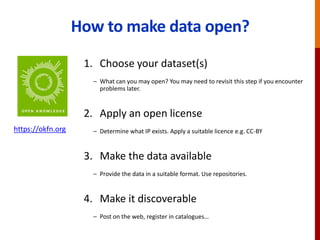
How to make data open?
1. Choose your dataset(s)
– What can you may open? You may need to revisit this step if you encounter
problems later.
2. Apply an open license
– Determine what IP exists. Apply a suitable licence e.g. CC-BY
3. Make the data available
– Provide the data in a suitable format. Use repositories.
4. Make it discoverable
– Post on the web, register in catalogues…
https://okfn.org
www.dcc.ac.uk/resources/how-guides/license-research-data
License research data openly
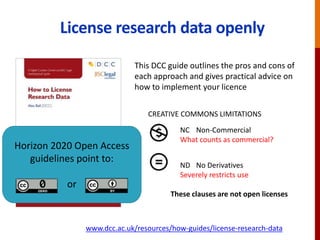
This DCC guide outlines the pros and cons of
each approach and gives practical advice on
how to implement your licence
CREATIVE COMMONS LIMITATIONS
NC Non-Commercial
What counts as commercial?
ND No Derivatives
Severely restricts use
These clauses are not open licenses
Horizon 2020 Open Access
guidelines point to:
or
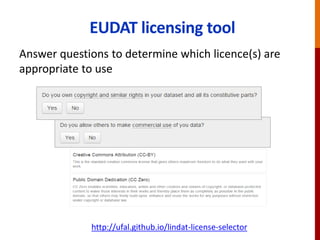
EUDAT licensing tool
Answer questions to determine which licence(s) are
appropriate to use
http://ufal.github.io/lindat-license-selector
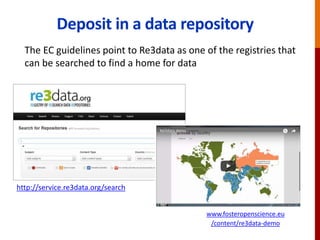
Deposit in a data repository
http://databib.org
http://service.re3data.org/search
The EC guidelines point to Re3data as one of the registries that
can be searched to find a home for data
www.fosteropenscience.eu
/content/re3data-demo
How to select a repository?
• Look for provision from your community, university, publisher, funder etc
• Check they match your particular data needs: e.g. formats accepted;
mixture of Open and Restricted Access.
• See if they provide guidance on how to cite the deposited data.
• Do they assign a persistent & globally unique identifier for sustainable
citations and to links back to particular researchers and grants?
• Look for certification as a ‘Trustworthy Digital Repository’ with an explicit
ambition to keep the data available in long term.
www.openaire.eu/opendatapilot-repository
Zenodo is a multi-disciplinary repository that can be
used for the long-tail of research data
• An OpenAIRE-CERN joint effort
• Multidisciplinary repository accepting
– Multiple data types
– Publications
– Software
• Assigns a Digital Object Identifier (DOI)
• Links funding, publications, data & software
www.zenodo.org
Zenodo
Use metadata standards
Metadata Standards Directory
Broad, disciplinary listing of
standards and tools. Maintained by
RDA group
http://rd-alliance.github.io/
metadata-directory
Biosharing
A portal of data standards,
databases, and policies
Focused on life, environmental
and biomedical sciences
https://biosharing.org
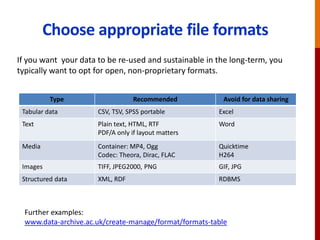
Choose appropriate file formats
If you want your data to be re-used and sustainable in the long-term, you
typically want to opt for open, non-proprietary formats.
Type Recommended Avoid for data sharing
Tabular data CSV, TSV, SPSS portable Excel
Text Plain text, HTML, RTF
PDF/A only if layout matters
Word
Media Container: MP4, Ogg
Codec: Theora, Dirac, FLAC
Quicktime
H264
Images TIFF, JPEG2000, PNG GIF, JPG
Structured data XML, RDF RDBMS
Further examples:
www.data-archive.ac.uk/create-manage/format/formats-table
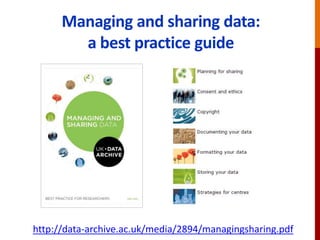
Managing and sharing data:
a best practice guide
http://data-archive.ac.uk/media/2894/managingsharing.pdf
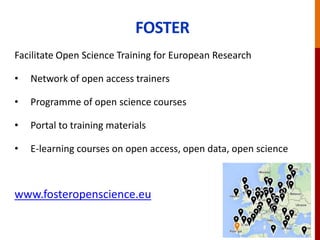
FOSTER
Facilitate Open Science Training for European Research
• Network of open access trainers
• Programme of open science courses
• Portal to training materials
• E-learning courses on open access, open data, open science
www.fosteropenscience.eu
OpenAIRE
http://vimeo.com/108790101
Open Access Infrastructure for Research in Europe
• aggregates data on OA outputs
• mines & enriches it content by linking thing together
• provides services & APIs e.g.
• to generate publication lists
• or support EC reporting
• lots of guidelines on H2020
• Open Data pilot and DMPs
www.openaire.eu
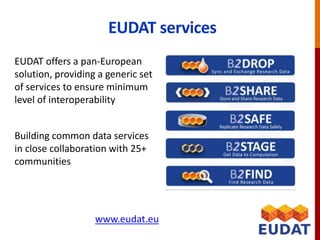
EUDAT services
EUDAT offers a pan-European
solution, providing a generic set
of services to ensure minimum
level of interoperability
Building common data services
in close collaboration with 25+
communities
www.eudat.eu
Discipline-specific infrastructure
• ELIXIR in life sciences
• BBMRI-ERIC (biobank and biomedical resources)
• Euro Argo ERIC (oceanography)
• CLARIN for language resources
• DARIAH-EU for arts and humanities
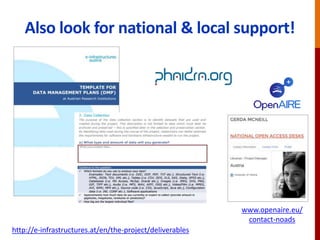
Also look for national & local support!
http://e-infrastructures.at/en/the-project/deliverables
www.openaire.eu/
contact-noads
Thanks for listening
DCC resources on Data Management
www.dcc.ac.uk/resources
Follow us on twitter:
@digitalcuration and #ukdcc

H2020 Open Data Pilot

  • 1.
    Horizon 2020 andthe Open Research Data pilot Sarah Jones Digital Curation Centre, Glasgow sarah.jones@glasgow.ac.uk Twitter: @sjDCC Data Management Plan (DMP) workshop, e-infrastructures Austria, Vienna, 17 November 2016
  • 2.
    The EC OpenResearch Data pilot Key sources of information • Guidelines on Open Access to Scientific Publications and Research Data in Horizon 2020 http://ec.europa.eu/research/participants/data/ref/h2020/grants_manual/hi/oa_ pilot/h2020-hi-oa-pilot-guide_en.pdf • Guidelines on FAIR Data Management in Horizon 2020 http://ec.europa.eu/research/participants/data/ref/h2020/grants_manual/hi/oa_ pilot/h2020-hi-oa-data-mgt_en.pdf • Annotated model grant agreement, clause 29.3 http://ec.europa.eu/research/participants/data/ref/h2020/grants_manual/amga/ h2020-amga_en.pdf • New infographic summarising key policy points http://ec.europa.eu/research/press/2016/pdf/opendata-infographic_072016.pdf
  • 3.
    Guidelines on openaccess • Includes a section on the pilot • Explains opting out • Notes exceptions (funding instruments that aren’t included) • Explains types of data • Specifies requirements and support via EUDAT & OpenAIRE • Defines research data and open access routes (section 2)
  • 4.
    FAIR Data Managementguidelines • Notes the extension of the pilot • Clarifies concept of FAIR data • Explains what a DMP is and when they should be updated • Notes what happens at proposal, submission and evaluation • Explains costs are eligible • Provides a DMP template
  • 5.
    Model grant agreement 29.3Open access to research data [OPTION for actions participating in the open Research Data Pilot: Regarding the digital research data generated in the action (‘data’), the beneficiaries must: (a) deposit in a research data repository and take measures to make it possible for third parties to access, mine, exploit, reproduce and disseminate — free of charge for any user — the following: (i) the data, including associated metadata, needed to validate the results presented in scientific publications as soon as possible; (ii) other data, including associated metadata, as specified and within the deadlines laid down in the ‘data management plan’ (see Annex 1); (b) Provide information — via the repository — about tools and instruments at the disposal of the beneficiaries and necessary for validating the results (and — where possible — provide the tools and instruments themselves)
  • 6.
    The following EuropeanCommission branded slides come from the EC’s open access team and provide an overview to the key points. Content from Jean-Francois Dechamp and colleagues. Mail: RTD-open-access@ec.europa.eu Web: http://ec.europa.eu/research/openscience/index.cfm Twitter: @OpenAccessEC
  • 18.
    Requirements in anutshell Develop a DMP Select which data to make open License data openly for the widest reuse Use established community standards for interoperability Provide metadata for data discovery and reuse Deposit in a data repository Share details about the tools and instruments used to allow verification
  • 19.
    How to makedata open? 1. Choose your dataset(s) – What can you may open? You may need to revisit this step if you encounter problems later. 2. Apply an open license – Determine what IP exists. Apply a suitable licence e.g. CC-BY 3. Make the data available – Provide the data in a suitable format. Use repositories. 4. Make it discoverable – Post on the web, register in catalogues… https://okfn.org
  • 20.
    www.dcc.ac.uk/resources/how-guides/license-research-data License research dataopenly This DCC guide outlines the pros and cons of each approach and gives practical advice on how to implement your licence CREATIVE COMMONS LIMITATIONS NC Non-Commercial What counts as commercial? ND No Derivatives Severely restricts use These clauses are not open licenses Horizon 2020 Open Access guidelines point to: or
  • 21.
    EUDAT licensing tool Answerquestions to determine which licence(s) are appropriate to use http://ufal.github.io/lindat-license-selector
  • 22.
    Deposit in adata repository http://databib.org http://service.re3data.org/search The EC guidelines point to Re3data as one of the registries that can be searched to find a home for data www.fosteropenscience.eu /content/re3data-demo
  • 23.
    How to selecta repository? • Look for provision from your community, university, publisher, funder etc • Check they match your particular data needs: e.g. formats accepted; mixture of Open and Restricted Access. • See if they provide guidance on how to cite the deposited data. • Do they assign a persistent & globally unique identifier for sustainable citations and to links back to particular researchers and grants? • Look for certification as a ‘Trustworthy Digital Repository’ with an explicit ambition to keep the data available in long term. www.openaire.eu/opendatapilot-repository
  • 24.
    Zenodo is amulti-disciplinary repository that can be used for the long-tail of research data • An OpenAIRE-CERN joint effort • Multidisciplinary repository accepting – Multiple data types – Publications – Software • Assigns a Digital Object Identifier (DOI) • Links funding, publications, data & software www.zenodo.org Zenodo
  • 25.
    Use metadata standards MetadataStandards Directory Broad, disciplinary listing of standards and tools. Maintained by RDA group http://rd-alliance.github.io/ metadata-directory Biosharing A portal of data standards, databases, and policies Focused on life, environmental and biomedical sciences https://biosharing.org
  • 26.
    Choose appropriate fileformats If you want your data to be re-used and sustainable in the long-term, you typically want to opt for open, non-proprietary formats. Type Recommended Avoid for data sharing Tabular data CSV, TSV, SPSS portable Excel Text Plain text, HTML, RTF PDF/A only if layout matters Word Media Container: MP4, Ogg Codec: Theora, Dirac, FLAC Quicktime H264 Images TIFF, JPEG2000, PNG GIF, JPG Structured data XML, RDF RDBMS Further examples: www.data-archive.ac.uk/create-manage/format/formats-table
  • 27.
    Managing and sharingdata: a best practice guide http://data-archive.ac.uk/media/2894/managingsharing.pdf
  • 28.
    FOSTER Facilitate Open ScienceTraining for European Research • Network of open access trainers • Programme of open science courses • Portal to training materials • E-learning courses on open access, open data, open science www.fosteropenscience.eu
  • 29.
    OpenAIRE http://vimeo.com/108790101 Open Access Infrastructurefor Research in Europe • aggregates data on OA outputs • mines & enriches it content by linking thing together • provides services & APIs e.g. • to generate publication lists • or support EC reporting • lots of guidelines on H2020 • Open Data pilot and DMPs www.openaire.eu
  • 30.
    EUDAT services EUDAT offersa pan-European solution, providing a generic set of services to ensure minimum level of interoperability Building common data services in close collaboration with 25+ communities www.eudat.eu
  • 31.
    Discipline-specific infrastructure • ELIXIRin life sciences • BBMRI-ERIC (biobank and biomedical resources) • Euro Argo ERIC (oceanography) • CLARIN for language resources • DARIAH-EU for arts and humanities
  • 32.
    Also look fornational & local support! http://e-infrastructures.at/en/the-project/deliverables www.openaire.eu/ contact-noads
  • 33.
    Thanks for listening DCCresources on Data Management www.dcc.ac.uk/resources Follow us on twitter: @digitalcuration and #ukdcc

Editor's Notes

  • #21 Guidance from the DCC can also help researchers to understand data licensing. This guide outlines the pros and cons of each approach e.g. the limitations of some CC options The OA guidelines under Horizon 2020 point to CC-0 or CC-BY as a straightforward and effective way to make it possible for others to mine, exploit and reproduce the data. See p11 at: http://ec.europa.eu/research/participants/data/ref/h2020/grants_manual/hi/oa_pilot/h2020-hi-oa-pilot-guide_en.pdf
  • #30 OpenAIRE is also worth checking out. This is an EC-funded project to provide infrastructure for open access. They’ve recently released a short video that tells you how they can help. Essentially OpenAIRE aggregates metadata from different repositories to compile a complete list of publications and related outputs. They mine and enrich the content, de-duplicating entries and linking together publications with data, details about the project, authors, funders etc. OpenAIRE also provides a number of useful services & APIs, for example you can embed a publication list for your project in your website that is automatically updated whenever someone adds a new paper to a repository (this is harvested into OpenAIRE and pushed out to your list).
  • #31 All share common challenges: – Reference models and architectures – Persistent data identifiers – Metadata management – Distributed data sources – Data interoperability
  • #33 Look at what support is available in Austria too. E-infrastructures Austria have delivered a lot e.g. FAQs, DMP templates, model curricula