PARTHENOS	Teaser	Session	
Slides	DOI:	10.5281/zenodo.1319434		
Ulrike	Wuttke,	University	of	Applied	Sciences	Potsdam	/	PARTHENOS	
@PARTHENOS_EU	@UWuttke	#PARTHENOSWebinar	|	CC-BY	4.0	|	PARTHENOS	
This	project	has	received	funding	from	the	European	Union’s	Horizon	2020	research	and	innovation	programme	under	grant	agreement	No	654119	
19.07.2018	|	Leipzig		
European	Summer	University	in	Digital	Humanities	(ESU)	2018,	
16.-27.07.2018	
http://www.culingtec.uni-leipzig.de/ESU_C_T/node/1061			
	
		
Introducing	the	PARTHENOS	
eHumanities	and	eHeritage	Training	
Suite	and	Webinar	Series
2
PARTHENOS FACTS
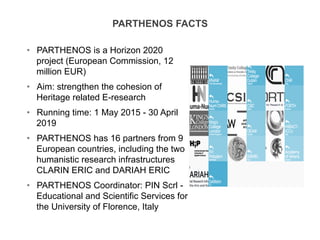
•  PARTHENOS is a Horizon 2020
project (European Commission, 12
million EUR)
•  Aim: strengthen the cohesion of
Heritage related E-research
•  Running time: 1 May 2015 - 30 April
2019
•  PARTHENOS has 16 partners from 9
European countries, including the two
humanistic research infrastructures
CLARIN ERIC and DARIAH ERIC
•  PARTHENOS Coordinator: PIN Scrl -
Educational and Scientific Services for
the University of Florence, Italy
TABLE	OF	CONTENTS	
1)  Welcome	
2)  Warm	Up:	Introduce	yourself	
3)  Playful	Exercise	
4)  Research	Data	and	Research	Data	Management	
in	Humanities	and	Heritage	Science	
5)  PARTHENOS	Training	in	a	Nutshell		
6)  The	PARTHENOS	eHumanities	and	eHeritage	
Webinar	Series:	What’s	next?			
7)  Goodbye	
	
3
WARM	UP	
01	
4
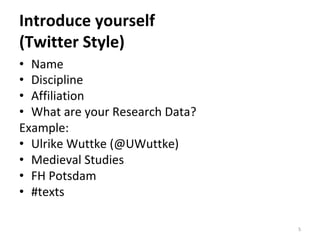
Introduce	yourself		
(Twitter	Style)	
•  Name	
•  Discipline	
•  Affiliation	
•  What	are	your	Research	Data?	
Example:	
•  Ulrike	Wuttke	(@UWuttke)	
•  Medieval	Studies	
•  FH	Potsdam	
•  #texts		
5
PLAYFUL	EXERCISE	
02	
6
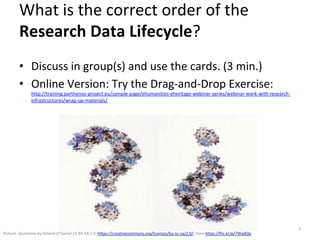
What	is	the	correct	order	of	the	
Research	Data	Lifecycle?		
	
•  Discuss	in	group(s)	and	use	the	cards.	(3	min.)	
•  Online	Version:	Try	the	Drag-and-Drop	Exercise:	
http://training.parthenos-project.eu/sample-page/ehumanities-eheritage-webinar-series/webinar-work-with-research-
infrastructures/wrap-up-materials/	


7	
Picture:	Questions	by	Roland	O'Daniel	CC	BY-SA	2.0	(https://creativecommons.org/licenses/by-nc-sa/2.0/)	from	https://flic.kr/p/7Ww83p
RESEARCH	DATA	IN	HUMANITIES	
AND	HERITAGE	SCIENCE	
03	
8
What	is	Data,	Anyway?	
Do	Humanities	and	Cultural	Heritage	researchers	have	
data?		
•  Yes,	a	lot,	but	they	don’t	tend	to	use	the	word	data		
•  Examples	for	Humanities	data:	primary	sources	
(texts,	pictures),	secondary	sources,	theoretical	
texts,	digital	tools	(software),	annotations,	etc.	
9	
Based	on	the	PARTHENOS	Training	Module	“Manage,	Improve	and	Open	Up	your	Research	and	Data”		
(http://training.parthenos-project.eu/sample-page/manage-improve-and-open-up-your-research-and-data/)	CC-BY-NC	4.0		
(https://creativecommons.org/licenses/by-nc/4.0/)
What	is	Data,	Anyway?	
Are	Humanities	and	Cultural	Heritage	data	special?		
•  Yes	and	No!	
•  Humanities	are	a	very	broad	research	discipline,	many	specific	
research	contexts,	but	also	increasingly	interdisciplinary	research	
•  Humanities	research	lives	from	enrichment	of	data	(layers	of	
interpretation)	
•  Problematic	to	distinguish	between	primary	data	(raw	data)	and	
secondary	data	
•  Issues	with	ownership	of	the	data	(cultural	heritage	institutions,	
publishers)		
•  But:	Many	issues	and	solutions	apply	to	the	broader	field	(and	
beyond	Humanities	and	Heritage	Science!)	
10	
Based	on	the	PARTHENOS	Training	Module	“Manage,	Improve	and	Open	Up	your	Research	and	Data”		
(http://training.parthenos-project.eu/sample-page/manage-improve-and-open-up-your-research-and-data/)	CC-BY-NC	4.0		
(https://creativecommons.org/licenses/by-nc/4.0/)
Why	would	I	want	or	need	to	manage,	
improve	or	open	up	my	data?	
•  Opening	up	the	data	could	lead	to	many	opportunities	
for	using	and	reusing	it,	for	collaborating,	informing	
and	increasing	the	impact	of	the	work	(contemporary	
issues,	interdisciplinary	research,	engaging	broader	
society)	
•  Funder	requirements	on	national	and	international	
level	(e.g.	European	Commission)	=	Research	Data	
Management	and	Open	Science		
•  Luckily:	You	are	not	alone!	=	Ecosystem	of	digital	
research	infrastructures,	cultural	heritage	institutions,	
libraries,	data	centers,	etc.		
11	
Based	on	the	PARTHENOS	Training	Module	“Manage,	Improve	and	Open	Up	your	Research	and	Data”		
(http://training.parthenos-project.eu/sample-page/manage-improve-and-open-up-your-research-and-data/)	CC-BY-NC	4.0		
(https://creativecommons.org/licenses/by-nc/4.0/)
The	FAIR	Principles	
•  Baseline	understanding	for	the	value	sharing	data	
can	deliver	and	the	baseline	requirements	for	
doing	do		
•  Developed	by	FORCE	11	(https://www.force11.org/group/fairgroup/fairprinciples)	
–  Findable	
–  Accessible		
–  Interoperable		
–  Reusable		
•  “as	open	as	possible,	as	closed	as	necessary”	
12	
Based	on	the	PARTHENOS	Training	Module	“Manage,	Improve	and	Open	Up	your	Research	and	Data”		
(http://training.parthenos-project.eu/sample-page/manage-improve-and-open-up-your-research-and-data/)	CC-BY-NC	4.0		
(https://creativecommons.org/licenses/by-nc/4.0/)
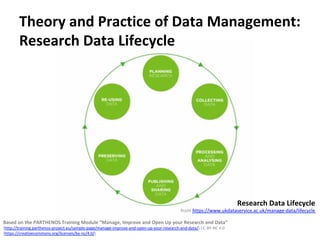
Theory	and	Practice	of	Data	Management:	
Research	Data	Lifecycle	
Research	Data	Lifecycle		
from	https://www.ukdataservice.ac.uk/manage-data/lifecycle		
Based	on	the	PARTHENOS	Training	Module	“Manage,	Improve	and	Open	Up	your	Research	and	Data”		
(http://training.parthenos-project.eu/sample-page/manage-improve-and-open-up-your-research-and-data/)	CC-BY-NC	4.0		
(https://creativecommons.org/licenses/by-nc/4.0/)
Theory	and	Practice	of	Data	Management:	
Research	Data	Management	Planning	
•  Often	you	will	need	a	written	and	agreed	Data	Management	Plan	
(DMP),	esp.	in	case	of	external	funding	
•  To	help	DMP,	many	funding	agencies	provide	a	model	or	template	
for	a	DMP	
•  DMP	may	seem	an	intimidating	(or	even	unwelcome	task),	but	in	
the	end,	it	is	just	a	tool	for	thinking	systematically	through	your	
research	process	from	a	“data	perspective”	
•  DMP	helps	you	to	maximize	research	value	(high	quality	research	
data	and	research	excellence)	and	prevents	unpleasant	surprises	at	
the	close	of	your	project	(and	data	loss!)	
•  Start	early!	
•  Tools	for	DMP	
14	
Based	on	the	PARTHENOS	Training	Module	“Manage,	Improve	and	Open	Up	your	Research	and	Data”		
(http://training.parthenos-project.eu/sample-page/manage-improve-and-open-up-your-research-and-data/)	CC-BY-NC	4.0		
(https://creativecommons.org/licenses/by-nc/4.0/)
PARTHENOS	TRAINING	IN		A	
NUTSHELL	
04	
15
PARTHENOS	Training	rationales	
ü  maximize	the	benefits	of	using	and	cooperating	with	
Research	Infrastructures	on	the	user	side	by	awareness	
raising	concerning	potentials,	building	of	additional	skills	and	
transfer	of	theoretical	knowledge	
ü  infrastructural	meta	topics	
•  Work	Package	7	(Trinity	College	Dublin,	WP	Lead	Jennifer	
Edmond)	
•  Task	7.2	(University	of	Applied	Sciences	Potsdam,	Task	lead	
Ulrike	Wuttke)		
16
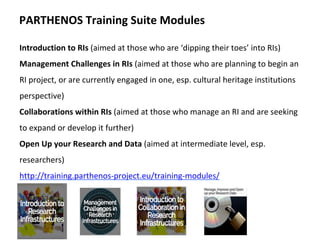
Introduction	to	RIs	(aimed	at	those	who	are	‘dipping	their	toes’	into	RIs)	
Management	Challenges	in	RIs	(aimed	at	those	who	are	planning	to	begin	an	
RI	project,	or	are	currently	engaged	in	one,	esp.	cultural	heritage	institutions	
perspective)	
Collaborations	within	RIs	(aimed	at	those	who	manage	an	RI	and	are	seeking	
to	expand	or	develop	it	further)	
Open	Up	your	Research	and	Data	(aimed	at	intermediate	level,	esp.		
researchers)	
http://training.parthenos-project.eu/training-modules/	
	
	
PARTHENOS	Training	Suite	Modules
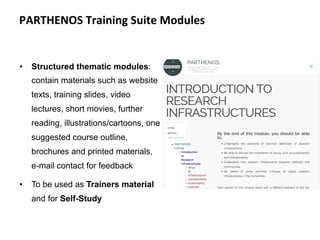
•  Structured thematic modules:
contain materials such as website
texts, training slides, video
lectures, short movies, further
reading, illustrations/cartoons, one
suggested course outline,
brochures and printed materials,
e-mail contact for feedback
•  To be used as Trainers material
and for Self-Study
1
8
PARTHENOS	Training	Suite	Modules
Research	Data	Management	in	the	
PARTHENOS	Training	Suite	
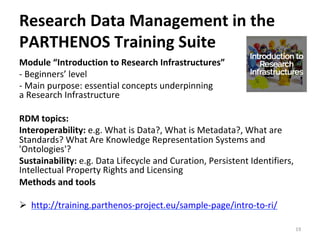
Module	“Introduction	to	Research	Infrastructures”		
-	Beginners’	level	
-	Main	purpose:	essential	concepts	underpinning		
a	Research	Infrastructure	
RDM	topics:		
Interoperability:	e.g.	What	is	Data?,	What	is	Metadata?,	What	are	
Standards?	What	Are	Knowledge	Representation	Systems	and	
'Ontologies'?	
Sustainability:	e.g.	Data	Lifecycle	and	Curation,	Persistent	Identifiers,	
Intellectual	Property	Rights	and	Licensing	
Methods	and	tools		
	
Ø  http://training.parthenos-project.eu/sample-page/intro-to-ri/		
	
19
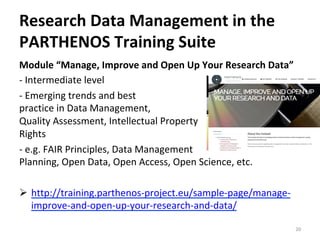
Module	“Manage,	Improve	and	Open	Up	Your	Research	Data”	
-	Intermediate	level		
-	Emerging	trends	and	best		
practice	in	Data	Management,		
Quality	Assessment,	Intellectual	Property		
Rights		
-	e.g.	FAIR	Principles,	Data	Management		
Planning,	Open	Data,	Open	Access,	Open	Science,	etc.			
	
Ø  http://training.parthenos-project.eu/sample-page/manage-
improve-and-open-up-your-research-and-data/		
	 20	
Research	Data	Management	in	the	
PARTHENOS	Training	Suite
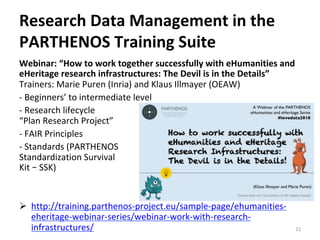
Webinar:	“How	to	work	together	successfully	with	eHumanities	and	
eHeritage	research	infrastructures:	The	Devil	is	in	the	Details”	
Trainers:	Marie	Puren	(Inria)	and	Klaus	Illmayer	(OEAW)		
-	Beginners’	to	intermediate	level	
-	Research	lifecycle		
“Plan	Research	Project”		
-	FAIR	Principles		
-	Standards	(PARTHENOS		
Standardization	Survival		
Kit	–	SSK)	
	
	
Ø  http://training.parthenos-project.eu/sample-page/ehumanities-
eheritage-webinar-series/webinar-work-with-research-
infrastructures/		 21	
Research	Data	Management	in	the	
PARTHENOS	Training	Suite
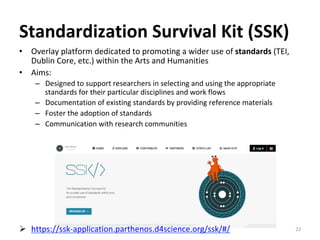
Standardization	Survival	Kit	(SSK)	
•  Overlay	platform	dedicated	to	promoting	a	wider	use	of	standards	(TEI,	
Dublin	Core,	etc.)	within	the	Arts	and	Humanities	
•  Aims:	
–  Designed	to	support	researchers	in	selecting	and	using	the	appropriate	
standards	for	their	particular	disciplines	and	work	flows	
–  Documentation	of	existing	standards	by	providing	reference	materials	
–  Foster	the	adoption	of	standards	
–  Communication	with	research	communities	
Ø  https://ssk-application.parthenos.d4science.org/ssk/#/		 22
THE	PARTHENOS	eHUMANITIES	
AND	eHERITAGE	WEBINAR	SERIES:	
WHAT’S	NEXT?		
05	
23
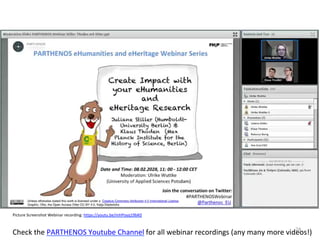
Picture	Screenshot	Webinar	recording:	https://youtu.be/mhPoyq19bK0		
	
Check	the	PARTHENOS	Youtube	Channel	for	all	webinar	recordings	(any	many	more	videos!)			24
Rationale	and	objectives	of	the	
PARTHENOS	webinar	series	
•  Main	message:	Research	Infrastructures	
empower	research(ers)!		
•  Main	target	group	=	Humanities	and	Cultural	
Heritage	researchers	and	practitioners,	
beginner/intermediate	knowledge	of	
research	infrastructures	
•  Each	webinar	can	be	followed	independently	
25
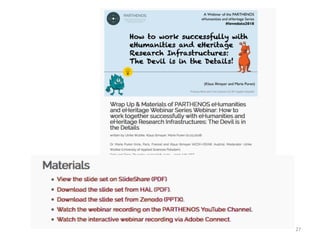
Facilitate	independent	uptake	and	reuse	by:		
•  Providing	a	variety	of	materials	(slides,	recordings,	
optimization	via	additional	materials	such	as	Wrap	
Up,	etc.)	as	OER	(Open	Educational	Resources)	[1]	
•  Publishing	the	materials	in	several	formats	
(Powerpoint,	PDF,	etc.)	
•  Using	several	publication	channels	to	improve	
findability	(e.g.	PARTHENOS	Training	Suite,	Youtube,	
Slideshare,	HAL,	Zenodo)	
•  Promoting	the	available	materials	(via	social	media,	
PARTHENOS	website,	etc.)		
[1]		
http://www.unesco.org/new/en/communication-and-information/access-to-knowledge/open-educational-resources/what-are-open-educational-
resources-oers/	(accessed	01.06.2018)	
26
27
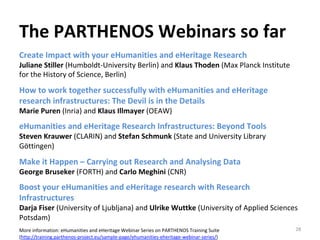
Create	Impact	with	your	eHumanities	and	eHeritage	Research	
Juliane	Stiller	(Humboldt-University	Berlin)	and	Klaus	Thoden	(Max	Planck	Institute	
for	the	History	of	Science,	Berlin)	
	
How	to	work	together	successfully	with	eHumanities	and	eHeritage	
research	infrastructures:	The	Devil	is	in	the	Details	
Marie	Puren	(Inria)	and	Klaus	Illmayer	(OEAW)	
	
eHumanities	and	eHeritage	Research	Infrastructures:	Beyond	Tools	
Steven	Krauwer	(CLARIN)	and	Stefan	Schmunk	(State	and	University	Library	
Göttingen)	
	
Make	it	Happen	–	Carrying	out	Research	and	Analysing	Data		
George	Bruseker	(FORTH)	and	Carlo	Meghini	(CNR)	
	
Boost	your	eHumanities	and	eHeritage	research	with	Research	
Infrastructures		
Darja	Fiser	(University	of	Ljubljana)	and	Ulrike	Wuttke	(University	of	Applied	Sciences	
Potsdam)	
	
More	information:	eHumanities	and	eHeritage	Webinar	Series	on	PARTHENOS	Training	Suite		
(http://training.parthenos-project.eu/sample-page/ehumanities-eheritage-webinar-series/)	
The	PARTHENOS	Webinars	so	far	
28
Which	PARTHENOS	webinar	did	you	
find	the	most	relevant?	
29	
(Picture:	CCO	https://pixabay.com/photo-1889007/)
Which	topic	should	we	choose		
for	the	next	PARTHENOS	webinar?	
30	
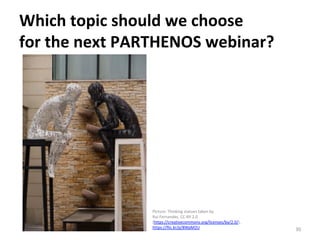
Picture:	Thinking	statues	taken	by		
Rui	Fernandes,	CC-BY	2.0		
(https://creativecommons.org/licenses/by/2.0/),		
https://flic.kr/p/8WpM2U
31
Thank	you!	
CONTACT:		
Dr.	Ulrike	Wuttke		
University	of	Applied	Sciences	Potsdam	(FHP)	
wuttke@fh-potsdam.de	
@UWuttke		
www.parthenos-project.eu	
	
	 32

PARTHENOS Teaser Session at ESU 2018