PARTHENOS-project.eu
Training and Education Activities in
the PARTHENOS Research
Infrastructure (WP 7)
Introducing PARTHENOS-- 14/07/2016
Jennifer Edmond
Trinity College Dublin
PARTHENOS-project.eu 2
Why train in a Research Infrastructure?
•  RIs are becoming more than a
trnsparent support layer, but a way of
thinking about research development in
Europe
•  Impact on the ways we collaborate,
career structures, funding, data sharing,
publications, policy….
•  In spite of this transformational role, still
seen a closed system
•  Tendency in RI projects only to create
training on the use of platforms and
tools: but is this enough?
PARTHENOS-project.eu
Overarching Principles, PARTHENOS Initial Training Plan (Tasks 7.1,7.2)
1.  The PARTHENOS Training Plan is aimed at the PARTHENOS target research community, i.e.
those researchers working in the broad sector of Linguistic Studies, Humanities, Cultural Heritage,
History, Archaeology, availing of ICT methods and tools (not just users of a future PARTHENOS
platform).
2.  The PARTHENOS Training Plan will address two levels of user need: the ‘need to know
about’ (awareness raising) and the ‘need to know how to do’ (skills building).
3.  Although PARTHENOS is a research infrastructure project, we must conceive of our training
interventions as as relevant far more broadly than to researchers only.
4.  Given the resource restrictions within the project, PARTHENOS will focus on asynchronous
delivery, ‘train the trainers’ approaches and partnerships with other projects and initiatives
(DARIAH Teach, RI Train) to attain maximum impact.
3
PARTHENOS-project.eu
Target audiences
Discipline Perspective
Studies of the Past
Language-related Studies
Heritage & Applied Disciplines
Social Sciences (this category was later
queried and largely removed from
consideration)
4
Role Perspective
Researcher Practitioner
Cultural Heritage Practitioner
Developers and Technicians as Practitioner
The Executive Level: Management and Policy
Makers
PARTHENOS-project.eu
Result
5
An initial suite of 3 proposed modules, each with a number of semi-independent
components
“Introduction to Research Infrastructures” (Beginner)
“Management Challenges in Research Infrastructures” (Intermediate)
“Collaboration and the Research Infrastructure” (Advanced)
plus the commitment to a Phase 2 plan
PARTHENOS-project.eu
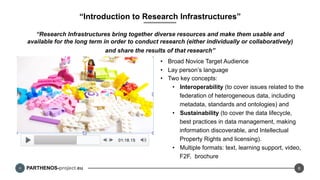
“Introduction to Research Infrastructures”
“Research Infrastructures bring together diverse resources and make them usable and
available for the long term in order to conduct research (either individually or collaboratively)
and share the results of that research”
•  Broad Novice Target Audience
•  Lay person’s language
•  Two key concepts:
•  Interoperability (to cover issues related to the
federation of heterogeneous data, including
metadata, standards and ontologies) and
•  Sustainability (to cover the data lifecycle,
best practices in data management, making
information discoverable, and Intellectual
Property Rights and licensing).
•  Multiple formats: text, learning support, video,
F2F, brochure
6
PARTHENOS-project.eu
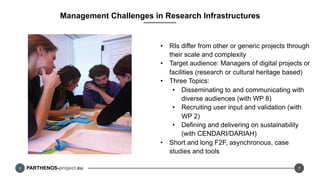
Management Challenges in Research Infrastructures
•  RIs differ from other or generic projects through
their scale and complexity
•  Target audience: Managers of digital projects or
facilities (research or cultural heritage based)
•  Three Topics:
•  Disseminating to and communicating with
diverse audiences (with WP 8)
•  Recruiting user input and validation (with
WP 2)
•  Defining and delivering on sustainability
(with CENDARI/DARIAH)
•  Short and long F2F, asynchronous, case
studies and tools
7
PARTHENOS-project.eu
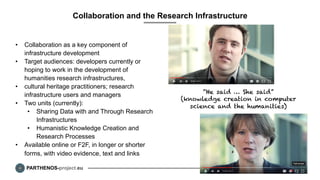
Collaboration and the Research Infrastructure
•  Collaboration as a key component of
infrastructure development
•  Target audiences: developers currently or
hoping to work in the development of
humanities research infrastructures,
•  cultural heritage practitioners; research
infrastructure users and managers
•  Two units (currently):
•  Sharing Data with and Through Research
Infrastructures
•  Humanistic Knowledge Creation and
Research Processes
•  Available online or F2F, in longer or shorter
forms, with video evidence, text and links
8
“He said … She said”
(knowledge creation in computer
science and the humanities)
PARTHENOS-project.eu
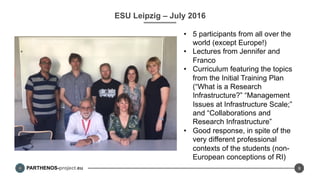
ESU Leipzig – July 2016
•  5 participants from all over the
world (except Europe!)
•  Lectures from Jennifer and
Franco
•  Curriculum featuring the topics
from the Initial Training Plan
(“What is a Research
Infrastructure?” “Management
Issues at Infrastructure Scale;”
and “Collaborations and
Research Infrastructure”
•  Good response, in spite of the
very different professional
contexts of the students (non-
European conceptions of RI)
9
PARTHENOS-project.eu 10
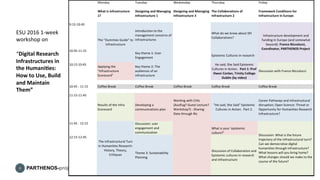
ESU	
  2016	
  1-­‐week	
  
workshop	
  on	


“Digital	
  Research	
  
Infrastructures	
  in	
  
the	
  Humani4es:	
  
How	
  to	
  Use,	
  Build	
  
and	
  Maintain	
  
Them”	


PARTHENOS-project.eu
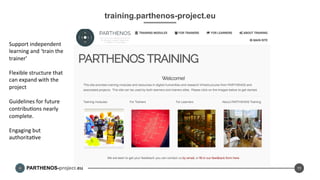
training.parthenos-project.eu
11
Support	
  independent	
  
learning	
  and	
  ‘train	
  the	
  
trainer’	


Flexible	
  structure	
  that	
  
can	
  expand	
  with	
  the	
  
project	


Guidelines	
  for	
  future	
  
contribuDons	
  nearly	
  
complete.	


Engaging	
  but	
  
authoritaDve	


PARTHENOS-project.eu
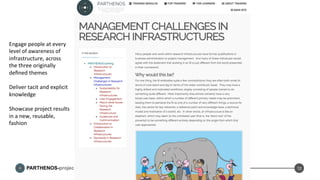
training.parthenos-project.eu
12
Engage	
  people	
  at	
  every	
  
level	
  of	
  awareness	
  of	
  
infrastructure,	
  across	
  
the	
  three	
  originally	
  
defined	
  themes	


Deliver	
  tacit	
  and	
  explicit	
  
knowledge	


Showcase	
  project	
  results	
  
in	
  a	
  new,	
  reusable,	
  
fashion	


PARTHENOS-project.eu
training.parthenos-project.eu
13
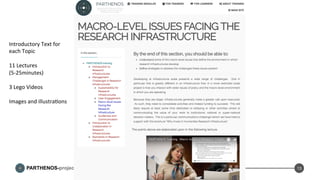
Introductory	
  Text	
  for	
  
each	
  Topic	


11	
  Lectures	
  	
  
(5-­‐25minutes)	


3	
  Lego	
  Videos	


Images	
  and	
  illustraDons	


PARTHENOS-project.eu
training.parthenos-project.eu
14
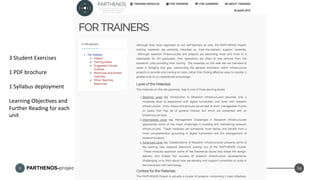
3	
  Student	
  Exercises	


1	
  PDF	
  brochure	


1	
  Syllabus	
  deployment	


Learning	
  ObjecDves	
  and	
  	
  
Further	
  Reading	
  for	
  each	
  
unit	


PARTHENOS-project.eu 15
PARTHENOS-project.eu
Phase 2 Developments: Grow Current State
•  More!
•  Detail
•  Lectures/Lecturers
•  Perspectives (CLARIN, E-RIHS)
•  Topics
•  Partnerships (ESU, LIBER, RITrain,
DARIAH VCC2, DARIAH Teach)
16
PARTHENOS-project.eu
Phase 2 Developments: Add New Modules
•  WP 4 (Standardization) WP7 will build on their
informational comic, ‘Standards Survival Kit’ and the
‘Standards Helpdesk’
•  WP 3 (Common policies and implementation
strategies): WP 7 will build upon the WP3 ‘Wizard’
covering key strategic and policy drivers for RI
development (careers, open science, funding)
•  WP 5 (Interoperability and semantics) and WP 6
(Services and Tools) have identified six categories of
technical training needed to work with the PARTHENOS
results (eg. CIDOC-CRM, Infrastructure Operation,
Resource Registry, 3M and X3ML, D-Net and Resources
Discovery Tools.) WP7 focus on capturing their internal
training and extending its reach/reuse.
17
PARTHENOS-project.eu
Phase 2 Developments: Integrate Knowledge
•  Mobility between and within RIs and its
role in building knowledge and careers
inside and outside of infrastructures
(2017)
•  Integrating infrastructural knowledge
into formal HE curricula (AY
2017-2018 at KCL)
•  Registry of training resources?
18
PARTHENOS-project.eu
THANK YOU!
www.parthenos-project.eu
Jennifer Edmond
Trinity College Dublin
edmondj@tcd.ie www.tcd.ie

PARTHENOS Training and Education

  • 1.
    PARTHENOS-project.eu Training and EducationActivities in the PARTHENOS Research Infrastructure (WP 7) Introducing PARTHENOS-- 14/07/2016 Jennifer Edmond Trinity College Dublin
  • 2.
    PARTHENOS-project.eu 2 Why trainin a Research Infrastructure? •  RIs are becoming more than a trnsparent support layer, but a way of thinking about research development in Europe •  Impact on the ways we collaborate, career structures, funding, data sharing, publications, policy…. •  In spite of this transformational role, still seen a closed system •  Tendency in RI projects only to create training on the use of platforms and tools: but is this enough?
  • 3.
    PARTHENOS-project.eu Overarching Principles, PARTHENOSInitial Training Plan (Tasks 7.1,7.2) 1.  The PARTHENOS Training Plan is aimed at the PARTHENOS target research community, i.e. those researchers working in the broad sector of Linguistic Studies, Humanities, Cultural Heritage, History, Archaeology, availing of ICT methods and tools (not just users of a future PARTHENOS platform). 2.  The PARTHENOS Training Plan will address two levels of user need: the ‘need to know about’ (awareness raising) and the ‘need to know how to do’ (skills building). 3.  Although PARTHENOS is a research infrastructure project, we must conceive of our training interventions as as relevant far more broadly than to researchers only. 4.  Given the resource restrictions within the project, PARTHENOS will focus on asynchronous delivery, ‘train the trainers’ approaches and partnerships with other projects and initiatives (DARIAH Teach, RI Train) to attain maximum impact. 3
  • 4.
    PARTHENOS-project.eu Target audiences Discipline Perspective Studiesof the Past Language-related Studies Heritage & Applied Disciplines Social Sciences (this category was later queried and largely removed from consideration) 4 Role Perspective Researcher Practitioner Cultural Heritage Practitioner Developers and Technicians as Practitioner The Executive Level: Management and Policy Makers
  • 5.
    PARTHENOS-project.eu Result 5 An initial suiteof 3 proposed modules, each with a number of semi-independent components “Introduction to Research Infrastructures” (Beginner) “Management Challenges in Research Infrastructures” (Intermediate) “Collaboration and the Research Infrastructure” (Advanced) plus the commitment to a Phase 2 plan
  • 6.
    PARTHENOS-project.eu “Introduction to ResearchInfrastructures” “Research Infrastructures bring together diverse resources and make them usable and available for the long term in order to conduct research (either individually or collaboratively) and share the results of that research” •  Broad Novice Target Audience •  Lay person’s language •  Two key concepts: •  Interoperability (to cover issues related to the federation of heterogeneous data, including metadata, standards and ontologies) and •  Sustainability (to cover the data lifecycle, best practices in data management, making information discoverable, and Intellectual Property Rights and licensing). •  Multiple formats: text, learning support, video, F2F, brochure 6
  • 7.
    PARTHENOS-project.eu Management Challenges inResearch Infrastructures •  RIs differ from other or generic projects through their scale and complexity •  Target audience: Managers of digital projects or facilities (research or cultural heritage based) •  Three Topics: •  Disseminating to and communicating with diverse audiences (with WP 8) •  Recruiting user input and validation (with WP 2) •  Defining and delivering on sustainability (with CENDARI/DARIAH) •  Short and long F2F, asynchronous, case studies and tools 7
  • 8.
    PARTHENOS-project.eu Collaboration and theResearch Infrastructure •  Collaboration as a key component of infrastructure development •  Target audiences: developers currently or hoping to work in the development of humanities research infrastructures, •  cultural heritage practitioners; research infrastructure users and managers •  Two units (currently): •  Sharing Data with and Through Research Infrastructures •  Humanistic Knowledge Creation and Research Processes •  Available online or F2F, in longer or shorter forms, with video evidence, text and links 8 “He said … She said” (knowledge creation in computer science and the humanities)
  • 9.
    PARTHENOS-project.eu ESU Leipzig –July 2016 •  5 participants from all over the world (except Europe!) •  Lectures from Jennifer and Franco •  Curriculum featuring the topics from the Initial Training Plan (“What is a Research Infrastructure?” “Management Issues at Infrastructure Scale;” and “Collaborations and Research Infrastructure” •  Good response, in spite of the very different professional contexts of the students (non- European conceptions of RI) 9
  • 10.
    PARTHENOS-project.eu 10 ESU  2016  1-­‐week   workshop  on       “Digital  Research   Infrastructures  in   the  Humani4es:   How  to  Use,  Build   and  Maintain   Them”    
  • 11.
    PARTHENOS-project.eu training.parthenos-project.eu 11 Support  independent   learning  and  ‘train  the   trainer’     Flexible  structure  that   can  expand  with  the   project     Guidelines  for  future   contribuDons  nearly   complete.     Engaging  but   authoritaDve            
  • 12.
    PARTHENOS-project.eu training.parthenos-project.eu 12 Engage  people  at  every   level  of  awareness  of   infrastructure,  across   the  three  originally   defined  themes     Deliver  tacit  and  explicit   knowledge     Showcase  project  results   in  a  new,  reusable,   fashion              
  • 13.
    PARTHENOS-project.eu training.parthenos-project.eu 13 Introductory  Text  for   each  Topic     11  Lectures     (5-­‐25minutes)     3  Lego  Videos     Images  and  illustraDons      
  • 14.
    PARTHENOS-project.eu training.parthenos-project.eu 14 3  Student  Exercises     1  PDF  brochure     1  Syllabus  deployment     Learning  ObjecDves  and     Further  Reading  for  each   unit                  
  • 15.
  • 16.
    PARTHENOS-project.eu Phase 2 Developments:Grow Current State •  More! •  Detail •  Lectures/Lecturers •  Perspectives (CLARIN, E-RIHS) •  Topics •  Partnerships (ESU, LIBER, RITrain, DARIAH VCC2, DARIAH Teach) 16
  • 17.
    PARTHENOS-project.eu Phase 2 Developments:Add New Modules •  WP 4 (Standardization) WP7 will build on their informational comic, ‘Standards Survival Kit’ and the ‘Standards Helpdesk’ •  WP 3 (Common policies and implementation strategies): WP 7 will build upon the WP3 ‘Wizard’ covering key strategic and policy drivers for RI development (careers, open science, funding) •  WP 5 (Interoperability and semantics) and WP 6 (Services and Tools) have identified six categories of technical training needed to work with the PARTHENOS results (eg. CIDOC-CRM, Infrastructure Operation, Resource Registry, 3M and X3ML, D-Net and Resources Discovery Tools.) WP7 focus on capturing their internal training and extending its reach/reuse. 17
  • 18.
    PARTHENOS-project.eu Phase 2 Developments:Integrate Knowledge •  Mobility between and within RIs and its role in building knowledge and careers inside and outside of infrastructures (2017) •  Integrating infrastructural knowledge into formal HE curricula (AY 2017-2018 at KCL) •  Registry of training resources? 18
  • 19.