The Horizon 2020 
Open Data Pilot 
Sarah Jones 
Digital Curation Centre 
sarah.jones@glasgow.ac.uk 
Twitter: @sjDCC
Why open access and open data? 
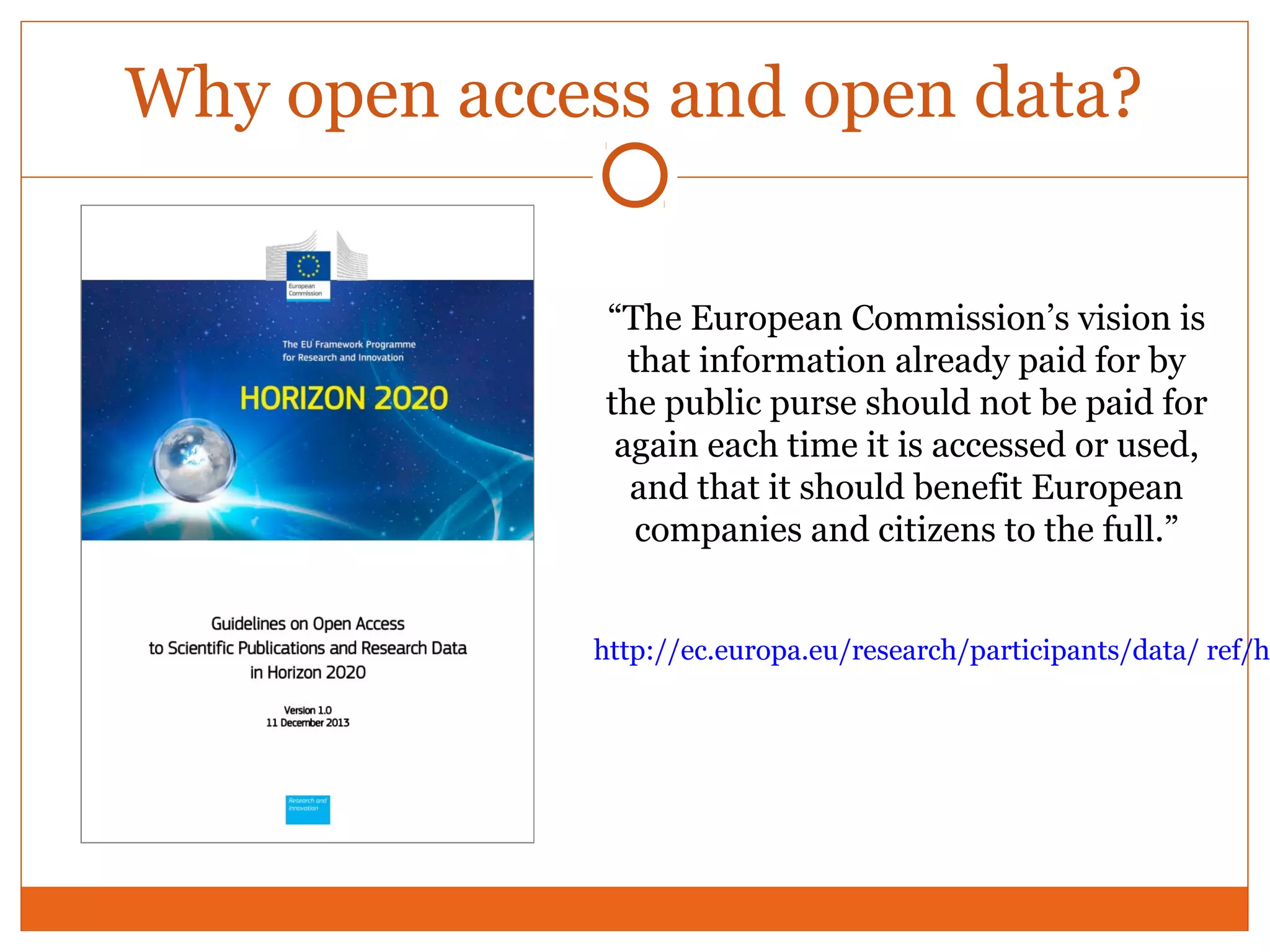
“The European Commission’s vision is 
that information already paid for by 
the public purse should not be paid for 
again each time it is accessed or used, 
and that it should benefit European 
companies and citizens to the full.” 
http://ec.europa.eu/research/participants/data/ ref/h2020/
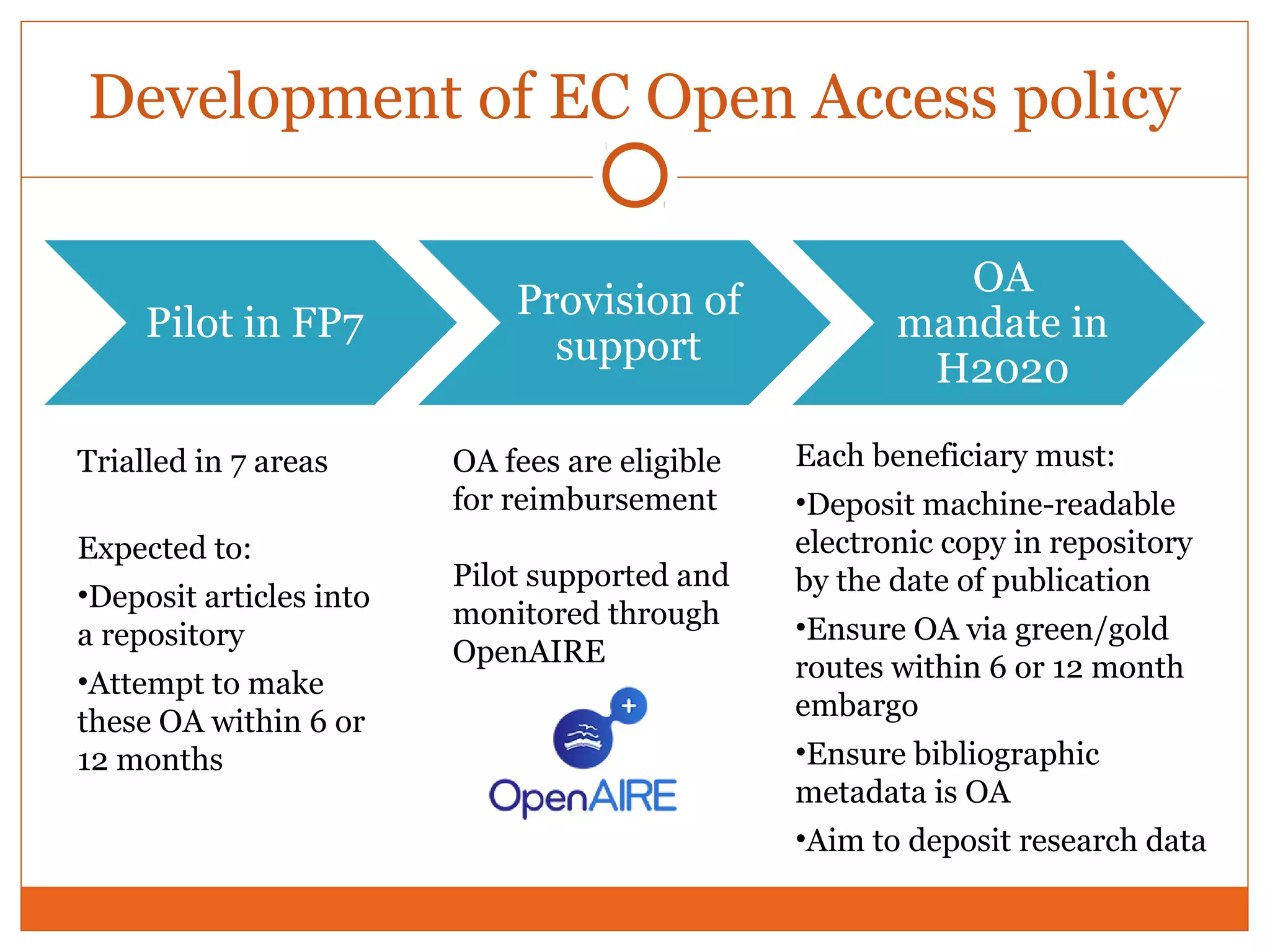
Development of EC Open Access policy 
Pilot in FP7 Provision of 
support 
OA 
mandate in 
H2020 
Trialled in 7 areas 
Expected to: 
•Deposit articles into 
a repository 
•Attempt to make 
these OA within 6 or 
12 months 
OA fees are eligible 
for reimbursement 
Pilot supported and 
monitored through 
OpenAIRE 
Each beneficiary must: 
•Deposit machine-readable 
electronic copy in repository 
by the date of publication 
•Ensure OA via green/gold 
routes within 6 or 12 month 
embargo 
•Ensure bibliographic 
metadata is OA 
•Aim to deposit research data
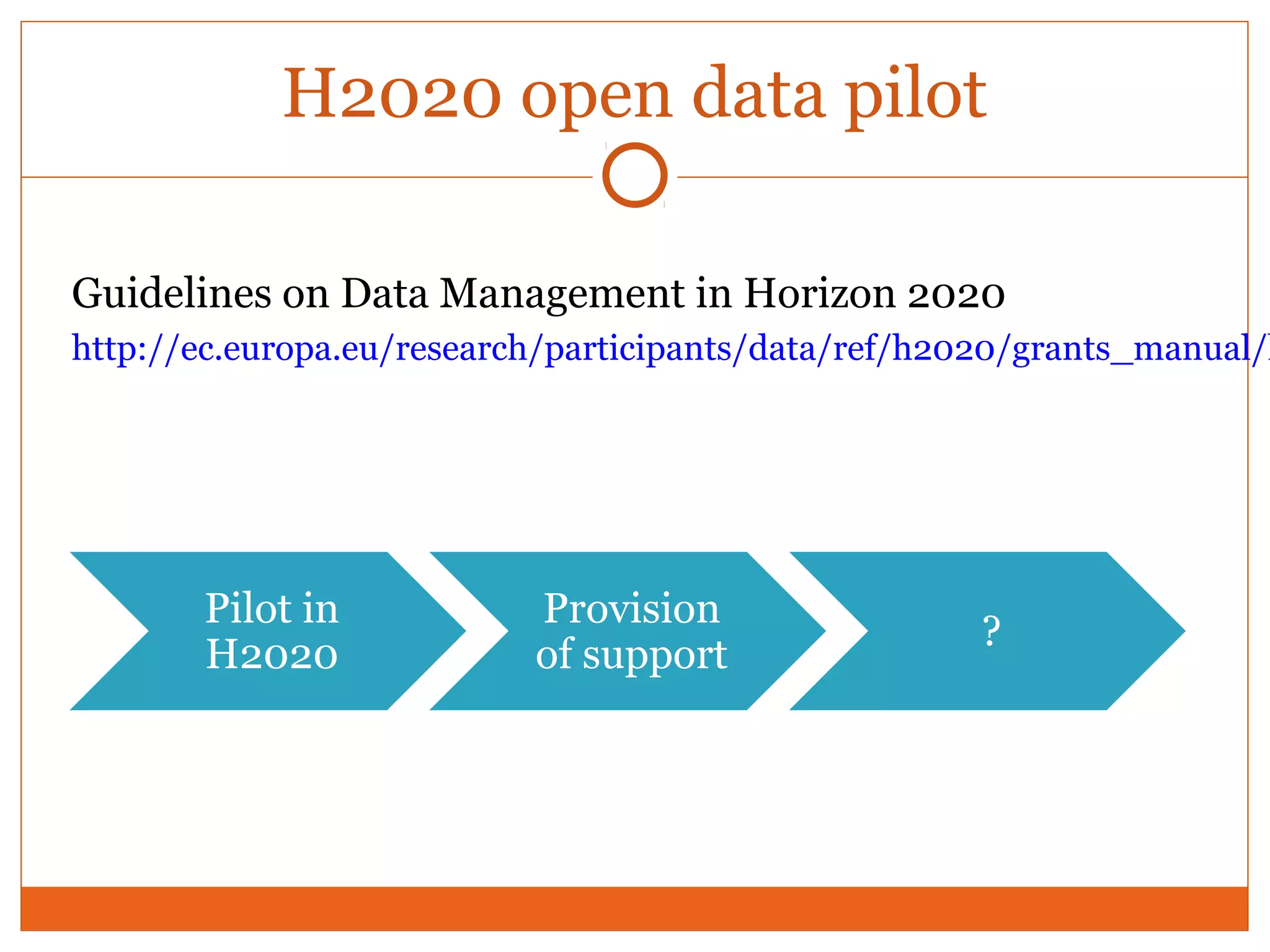
H2020 open data pilot 
Guidelines on Data Management in Horizon 2020 
http://ec.europa.eu/research/participants/data/ref/h2020/grants_manual/hi/Pilot in 
H2020 
Provision 
of support ?
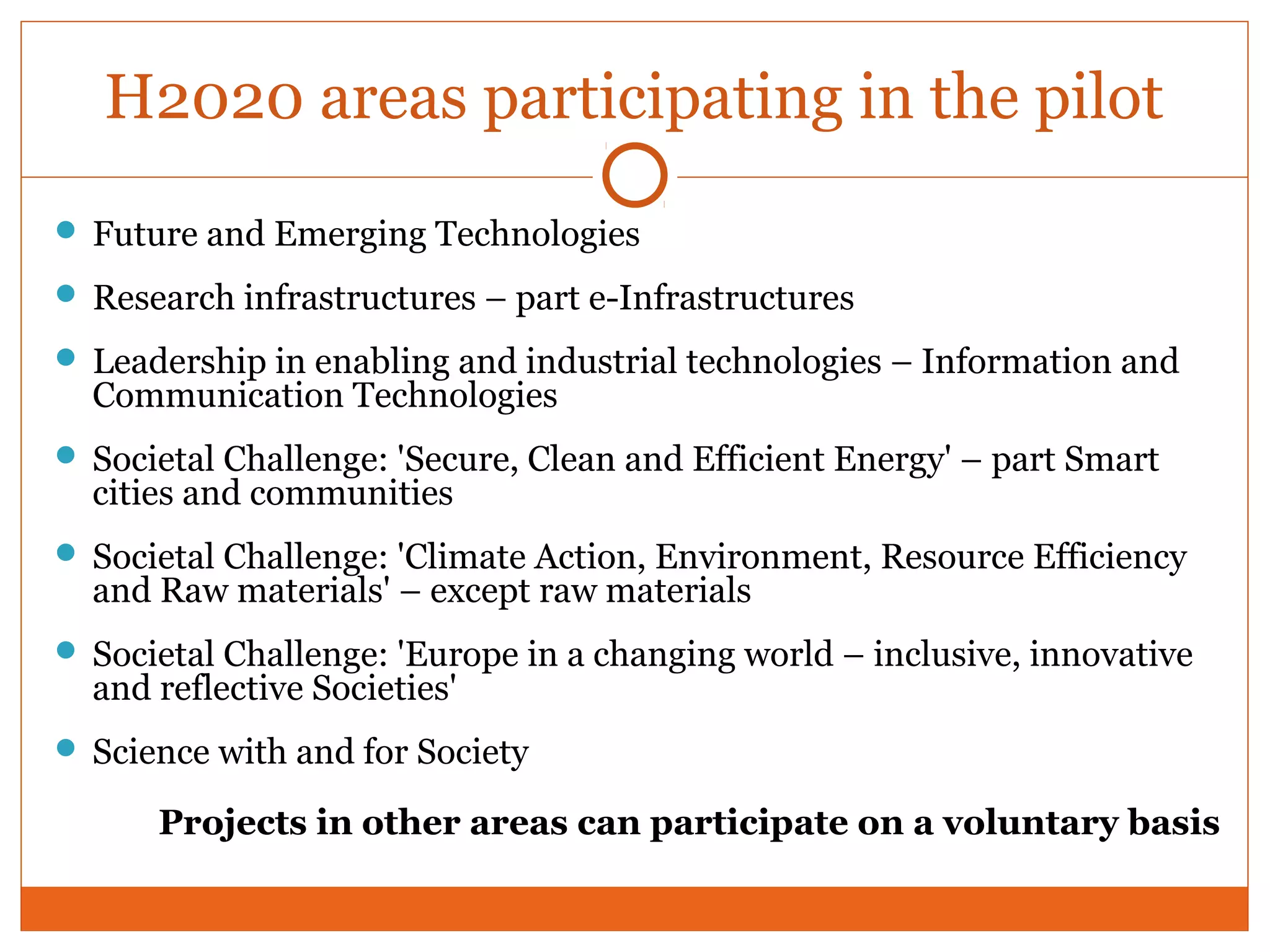
H2020 areas participating in the pilot 
 Future and Emerging Technologies 
 Research infrastructures – part e-Infrastructures 
 Leadership in enabling and industrial technologies – Information and 
Communication Technologies 
 Societal Challenge: 'Secure, Clean and Efficient Energy' – part Smart 
cities and communities 
 Societal Challenge: 'Climate Action, Environment, Resource Efficiency 
and Raw materials' – except raw materials 
 Societal Challenge: 'Europe in a changing world – inclusive, innovative 
and reflective Societies' 
 Science with and for Society 
Projects in other areas can participate on a voluntary basis
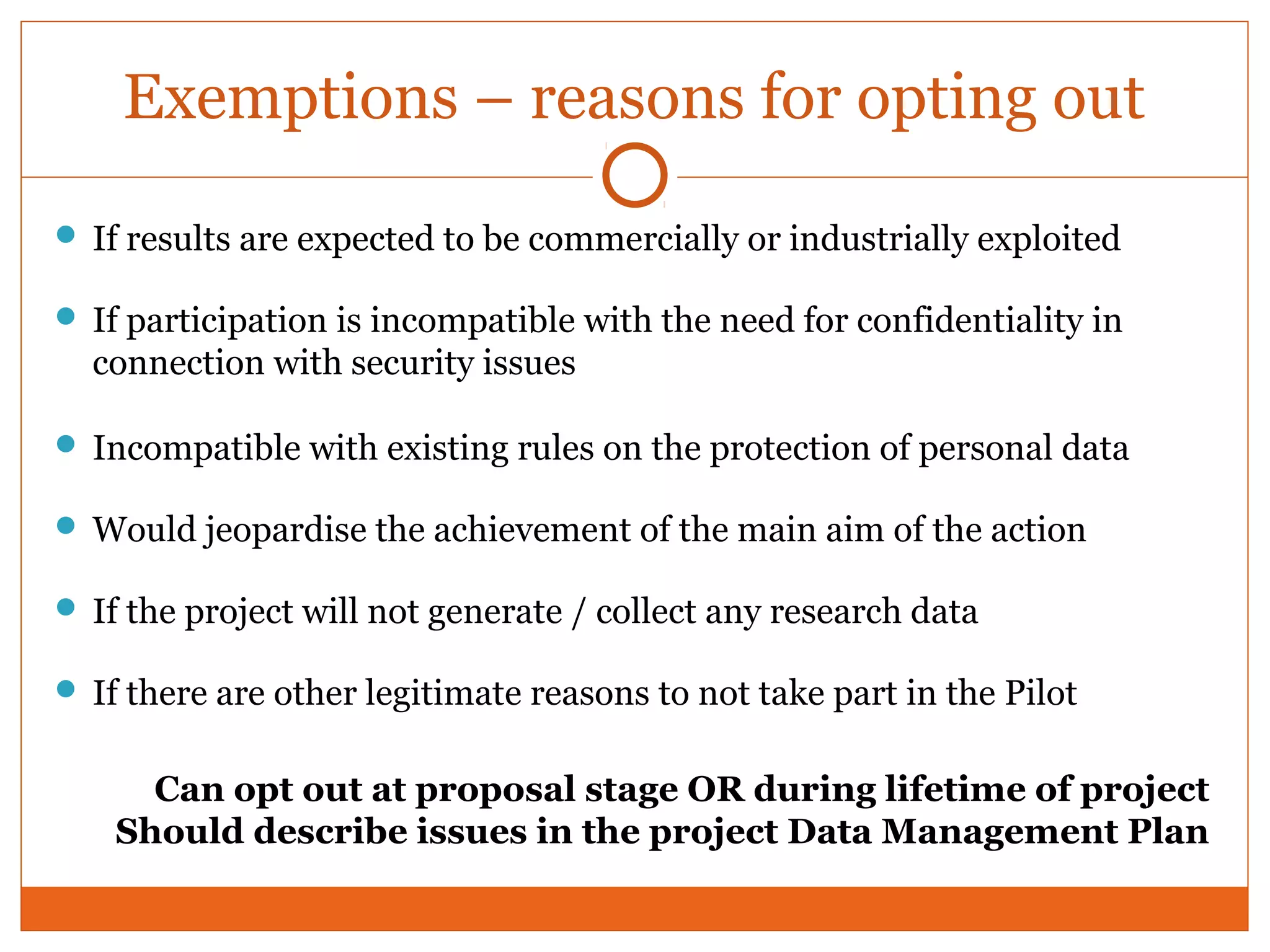
Exemptions – reasons for opting out 
 If results are expected to be commercially or industrially exploited 
 If participation is incompatible with the need for confidentiality in 
connection with security issues 
 Incompatible with existing rules on the protection of personal data 
Would jeopardise the achievement of the main aim of the action 
 If the project will not generate / collect any research data 
 If there are other legitimate reasons to not take part in the Pilot 
Can opt out at proposal stage OR during lifetime of project 
Should describe issues in the project Data Management Plan
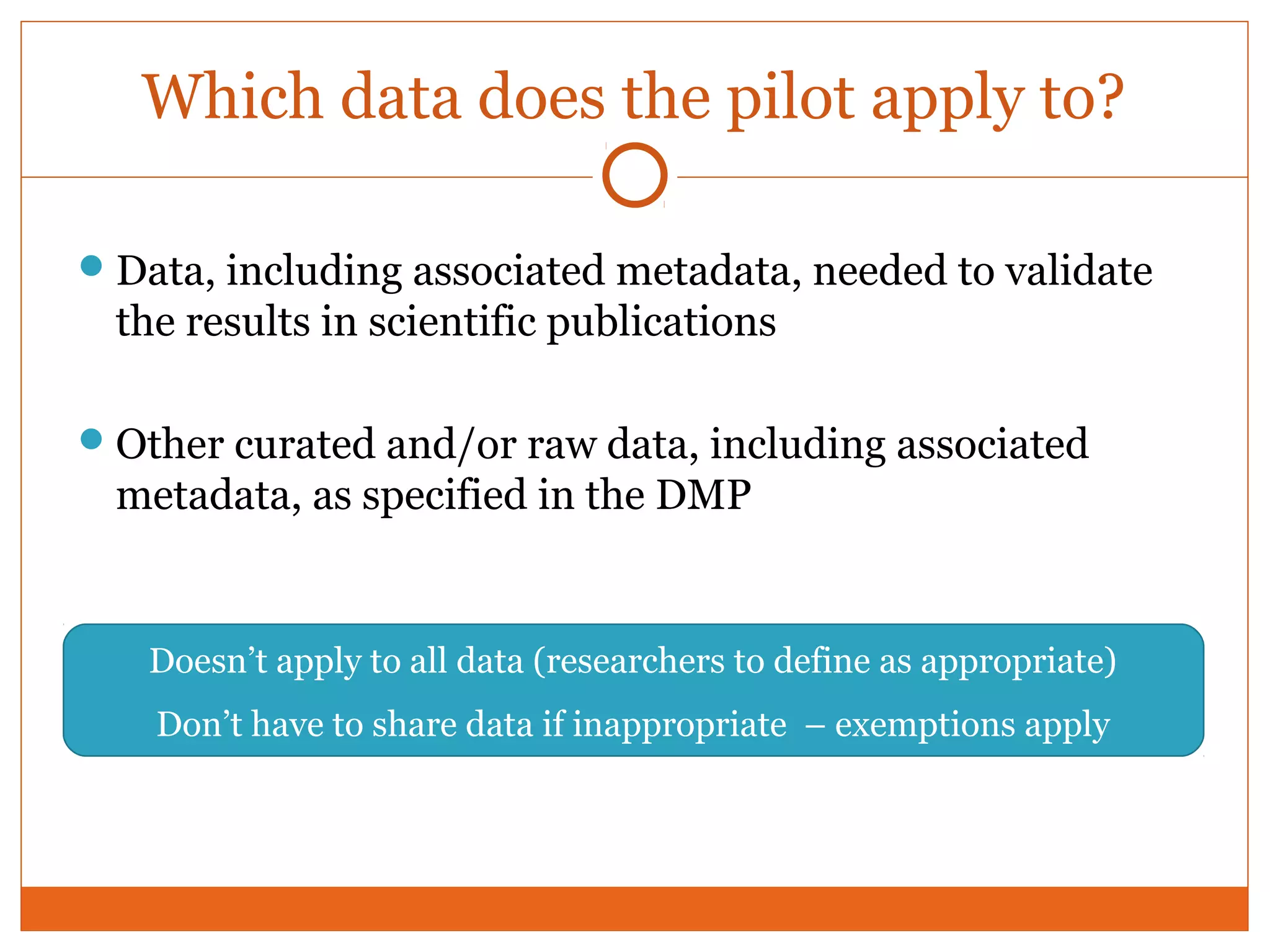
Which data does the pilot apply to? 
Data, including associated metadata, needed to validate 
the results in scientific publications 
Other curated and/or raw data, including associated 
metadata, as specified in the DMP 
Doesn’t apply to all data (researchers to define as appropriate) 
Don’t have to share data if inappropriate – exemptions apply
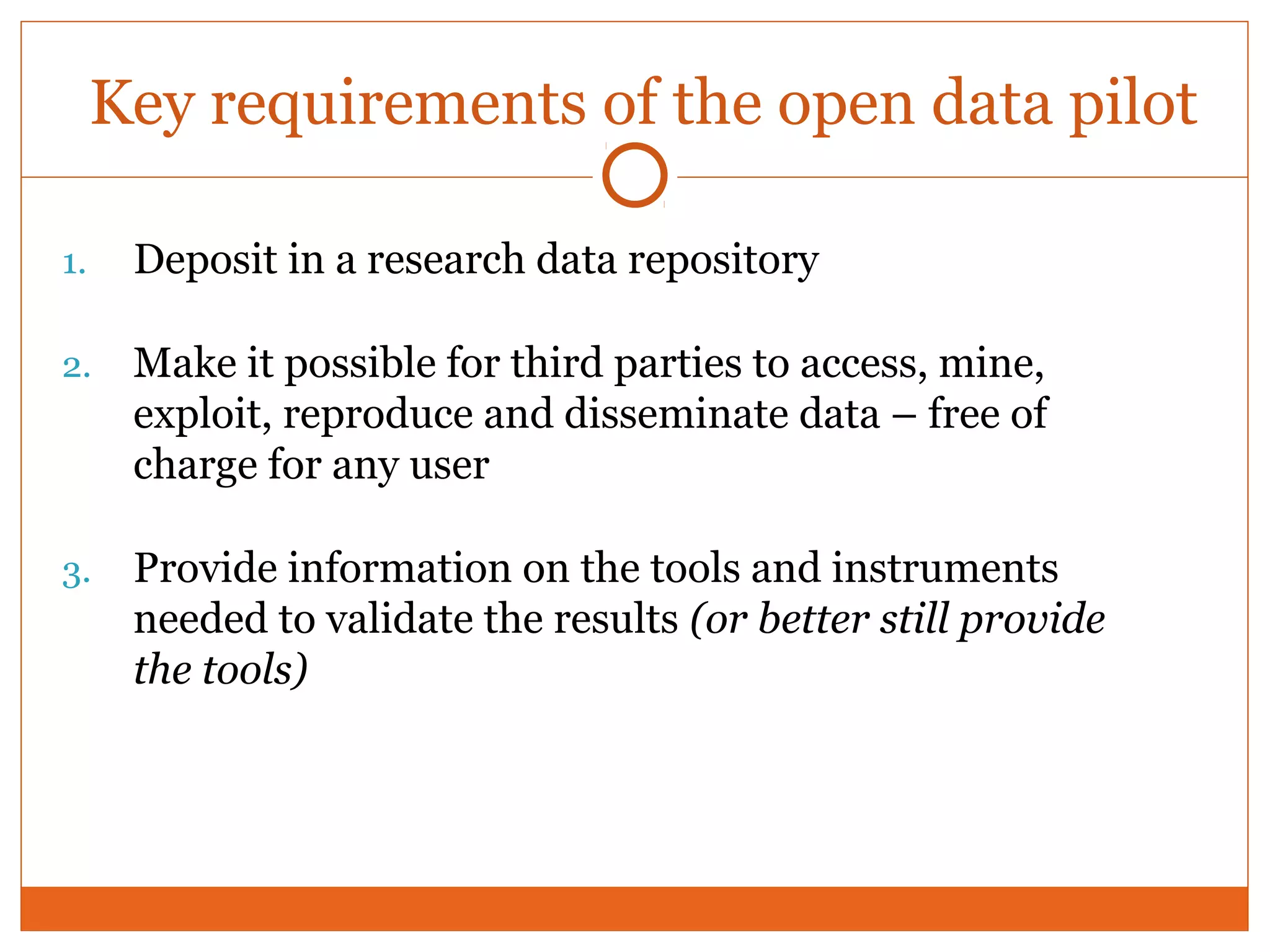
Key requirements of the open data pilot 
1. Deposit in a research data repository 
2. Make it possible for third parties to access, mine, 
exploit, reproduce and disseminate data – free of 
charge for any user 
3. Provide information on the tools and instruments 
needed to validate the results (or better still provide 
the tools)
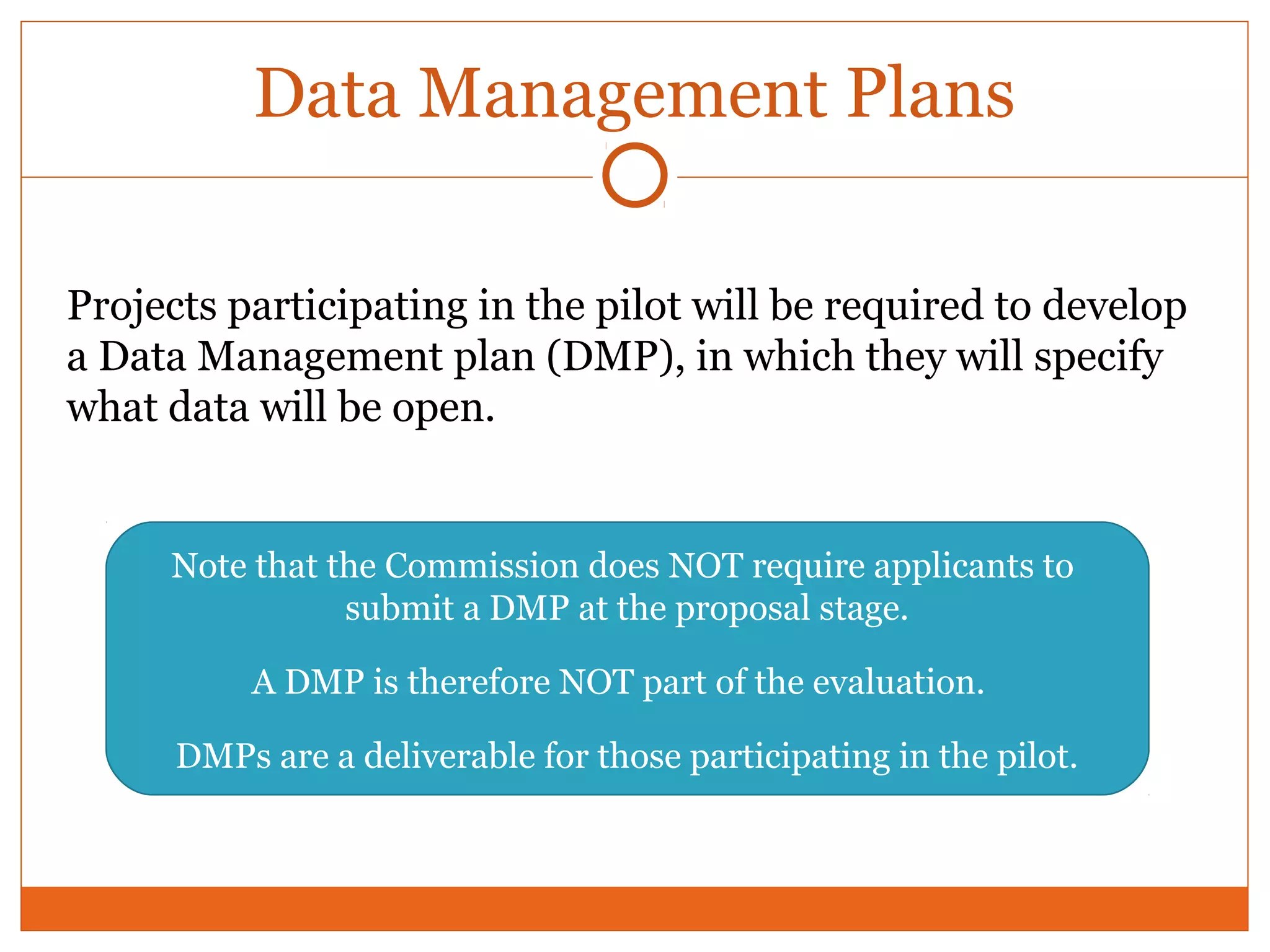
Data Management Plans 
Projects participating in the pilot will be required to develop 
a Data Management plan (DMP), in which they will specify 
what data will be open. 
Note that the Commission does NOT require applicants to 
submit a DMP at the proposal stage. 
A DMP is therefore NOT part of the evaluation. 
DMPs are a deliverable for those participating in the pilot.
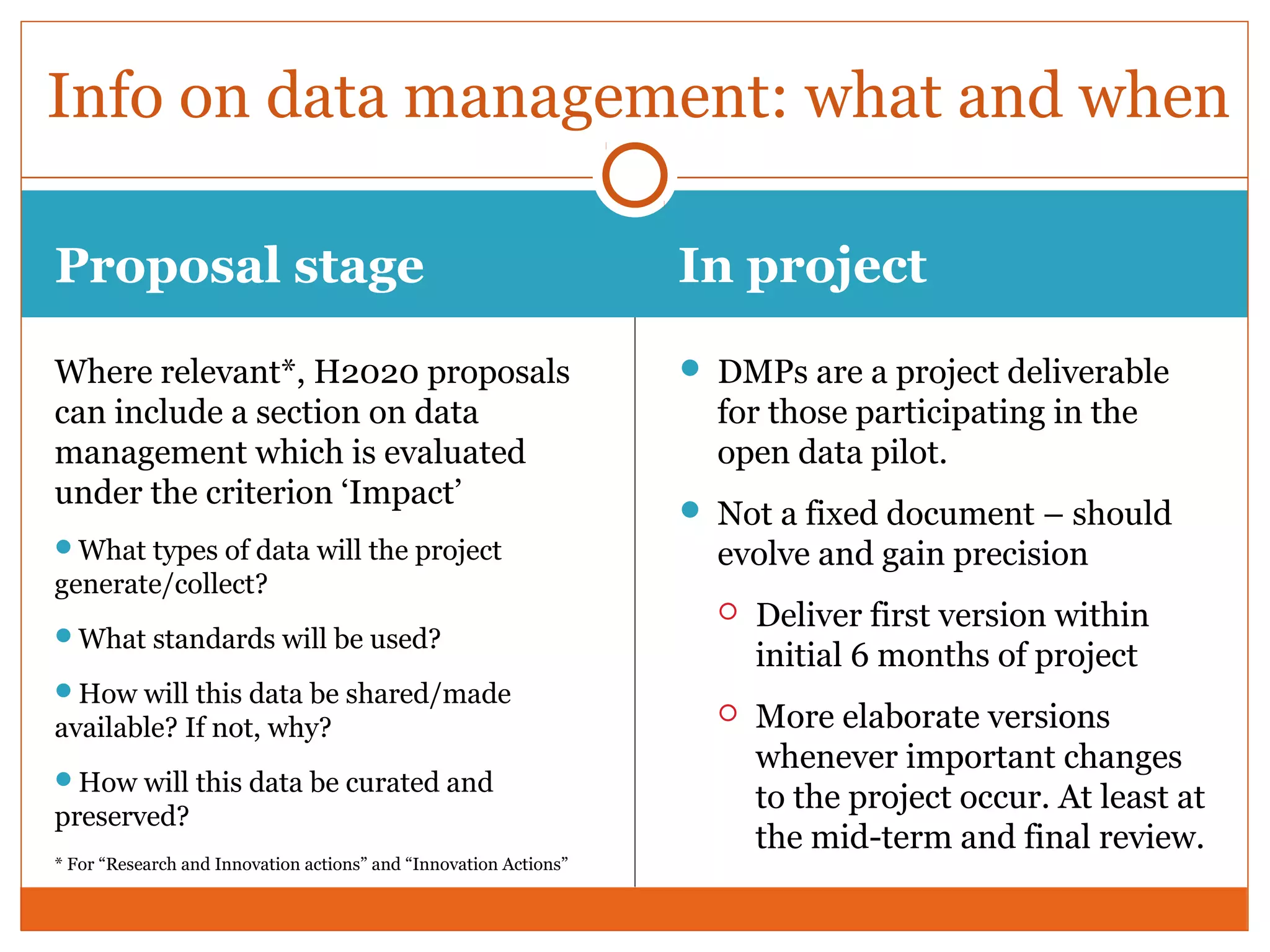
Info on data management: what and when 
Proposal stage In project 
Where relevant*, H2020 proposals 
can include a section on data 
management which is evaluated 
under the criterion ‘Impact’ 
What types of data will the project 
generate/collect? 
What standards will be used? 
How will this data be shared/made 
available? If not, why? 
How will this data be curated and 
preserved? 
* For “Research and Innovation actions” and “Innovation Actions” 
 DMPs are a project deliverable 
for those participating in the 
open data pilot. 
 Not a fixed document – should 
evolve and gain precision 
 Deliver first version within 
initial 6 months of project 
 More elaborate versions 
whenever important changes 
to the project occur. At least at 
the mid-term and final review.
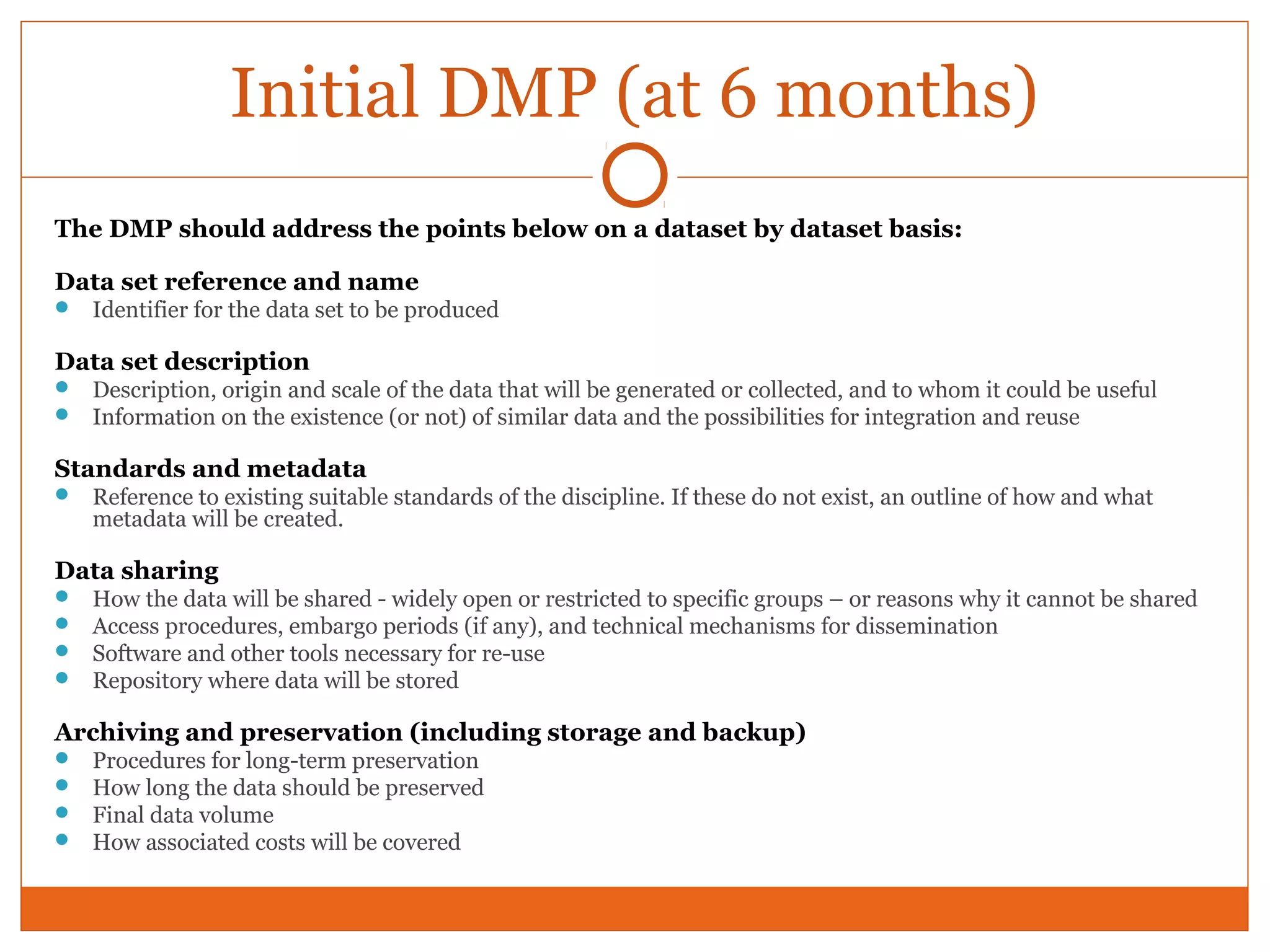
Initial DMP (at 6 months) 
The DMP should address the points below on a dataset by dataset basis: 
Data set reference and name 
 Identifier for the data set to be produced 
Data set description 
 Description, origin and scale of the data that will be generated or collected, and to whom it could be useful 
 Information on the existence (or not) of similar data and the possibilities for integration and reuse 
Standards and metadata 
 Reference to existing suitable standards of the discipline. If these do not exist, an outline of how and what 
metadata will be created. 
Data sharing 
 How the data will be shared - widely open or restricted to specific groups – or reasons why it cannot be shared 
 Access procedures, embargo periods (if any), and technical mechanisms for dissemination 
 Software and other tools necessary for re-use 
 Repository where data will be stored 
Archiving and preservation (including storage and backup) 
 Procedures for long-term preservation 
 How long the data should be preserved 
 Final data volume 
 How associated costs will be covered
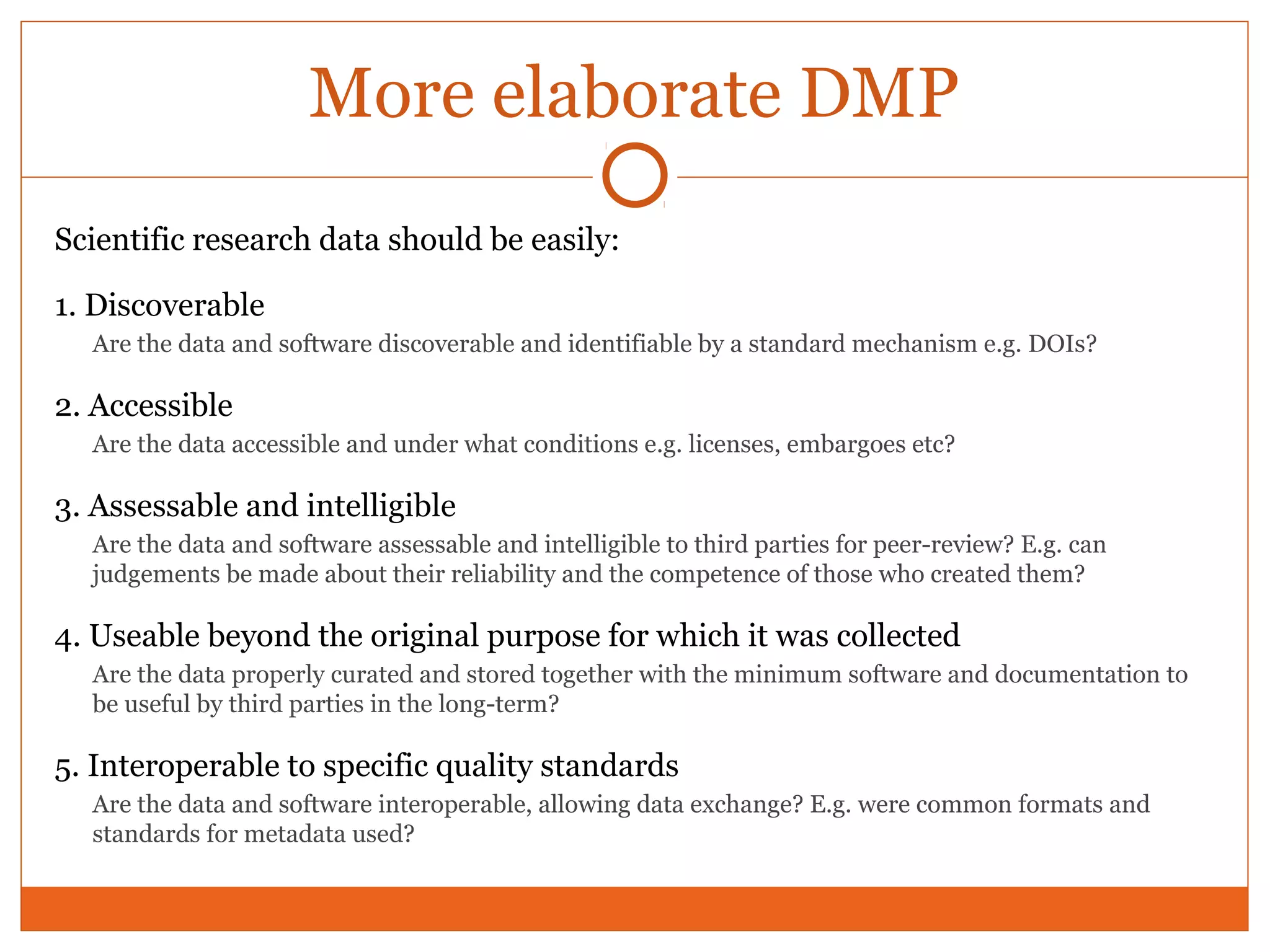
More elaborate DMP 
Scientific research data should be easily: 
1. Discoverable 
Are the data and software discoverable and identifiable by a standard mechanism e.g. DOIs? 
2. Accessible 
Are the data accessible and under what conditions e.g. licenses, embargoes etc? 
3. Assessable and intelligible 
Are the data and software assessable and intelligible to third parties for peer-review? E.g. can 
judgements be made about their reliability and the competence of those who created them? 
4. Useable beyond the original purpose for which it was collected 
Are the data properly curated and stored together with the minimum software and documentation to 
be useful by third parties in the long-term? 
5. Interoperable to specific quality standards 
Are the data and software interoperable, allowing data exchange? E.g. were common formats and 
standards for metadata used?
Uptake and implementation 
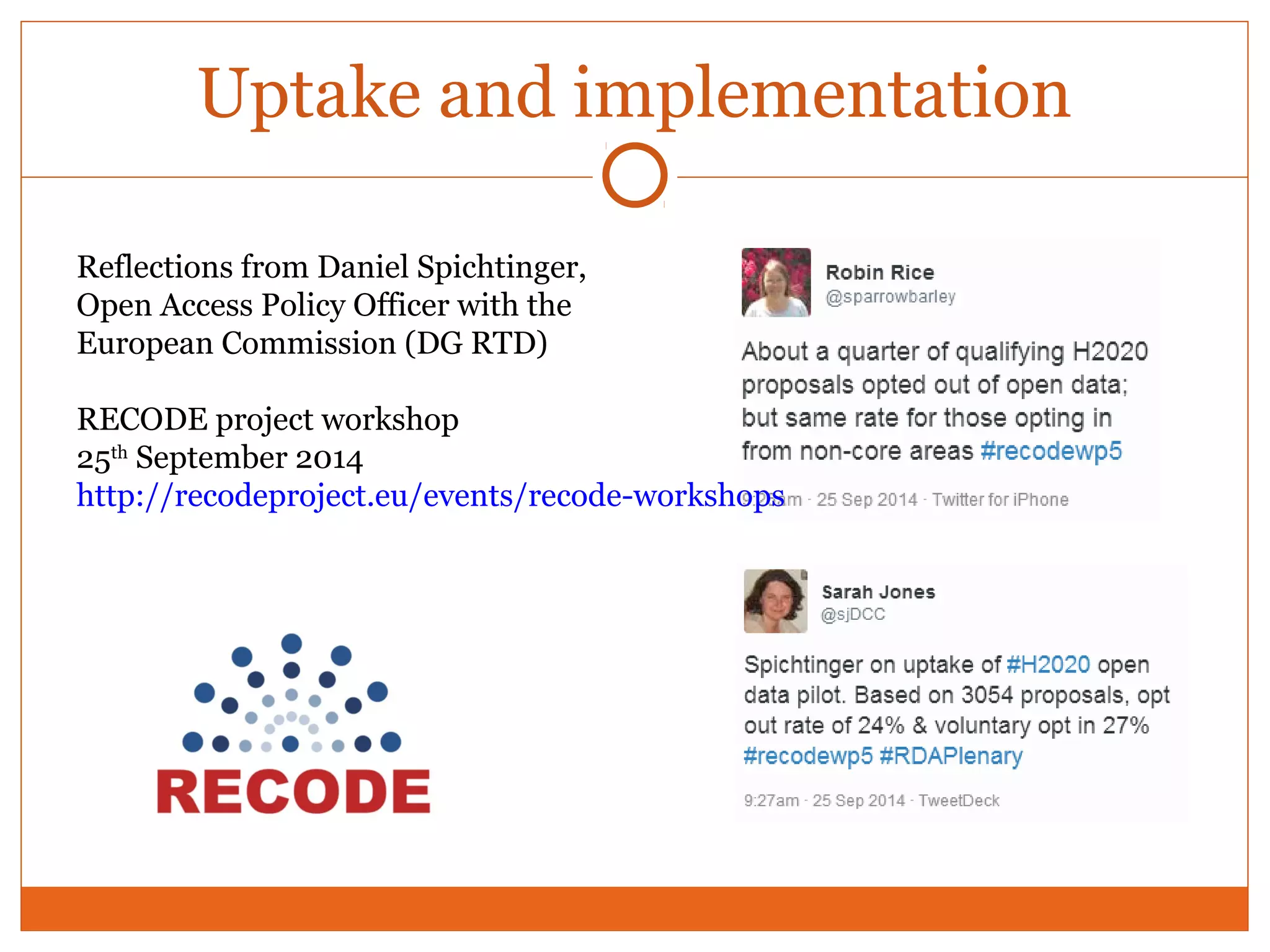
Reflections from Daniel Spichtinger, 
Open Access Policy Officer with the 
European Commission (DG RTD) 
RECODE project workshop 
25th September 2014 
http://recodeproject.eu/events/recode-workshops
Support already provided by the EC 
OpenAIRE+ 
Open Access Infrastructure 
for research in Europe 
aggregates data on OA 
publications 
mines & enriches it content 
by linking thing together 
provides services & APIs 
e.g. to monitor compliance or 
generate publication lists 
www.openaire.eu 
EUDAT 
European Data Infrastructure 
project offering services like: 
B2SHARE: store & share 
B2STAGE: get data to 
computation 
B2SAFE: replicate data 
safely 
B2FIND: find data 
www.eudat.eu
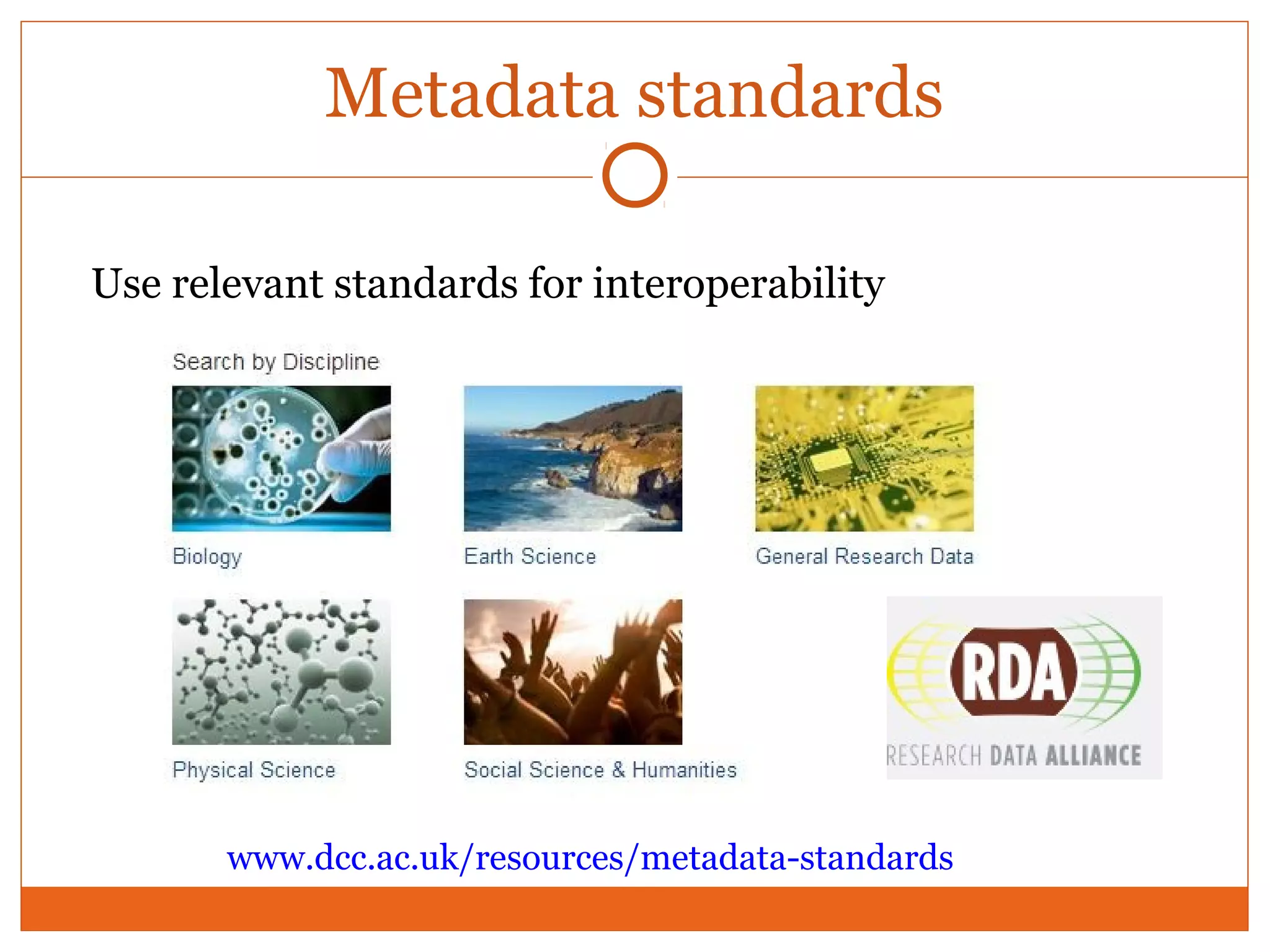
Metadata standards 
Use relevant standards for interoperability 
www.dcc.ac.uk/resources/metadata-standards
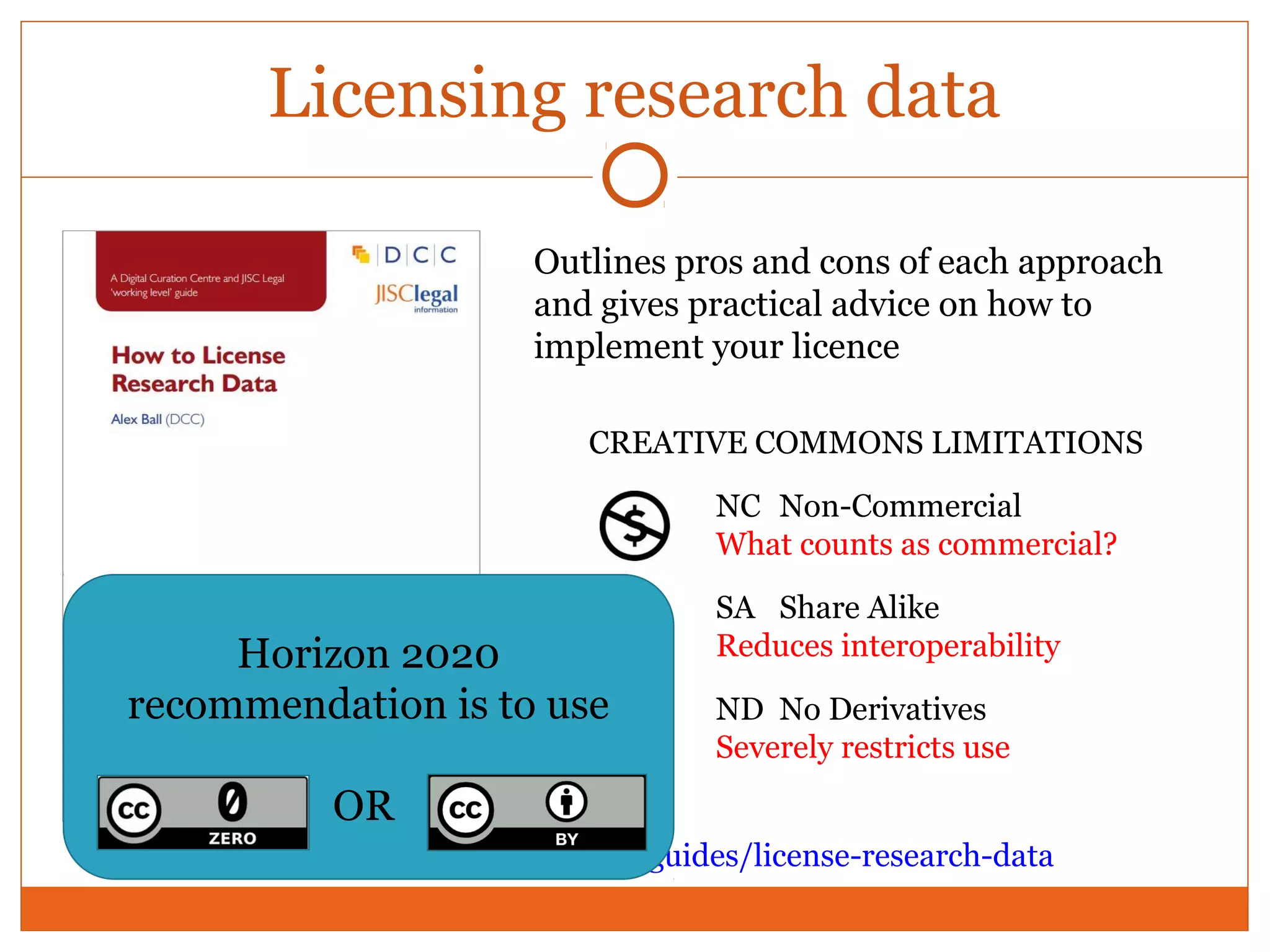
Licensing research data 
Outlines pros and cons of each approach 
and gives practical advice on how to 
implement your licence 
CREATIVE COMMONS LIMITATIONS 
NC Non-Commercial 
What counts as commercial? 
SA Share Alike 
Reduces interoperability 
ND No Derivatives 
Severely restricts use 
Horizon 2020 
recommendation is to use 
OR 
www.dcc.ac.uk/resources/how-guides/license-research-data
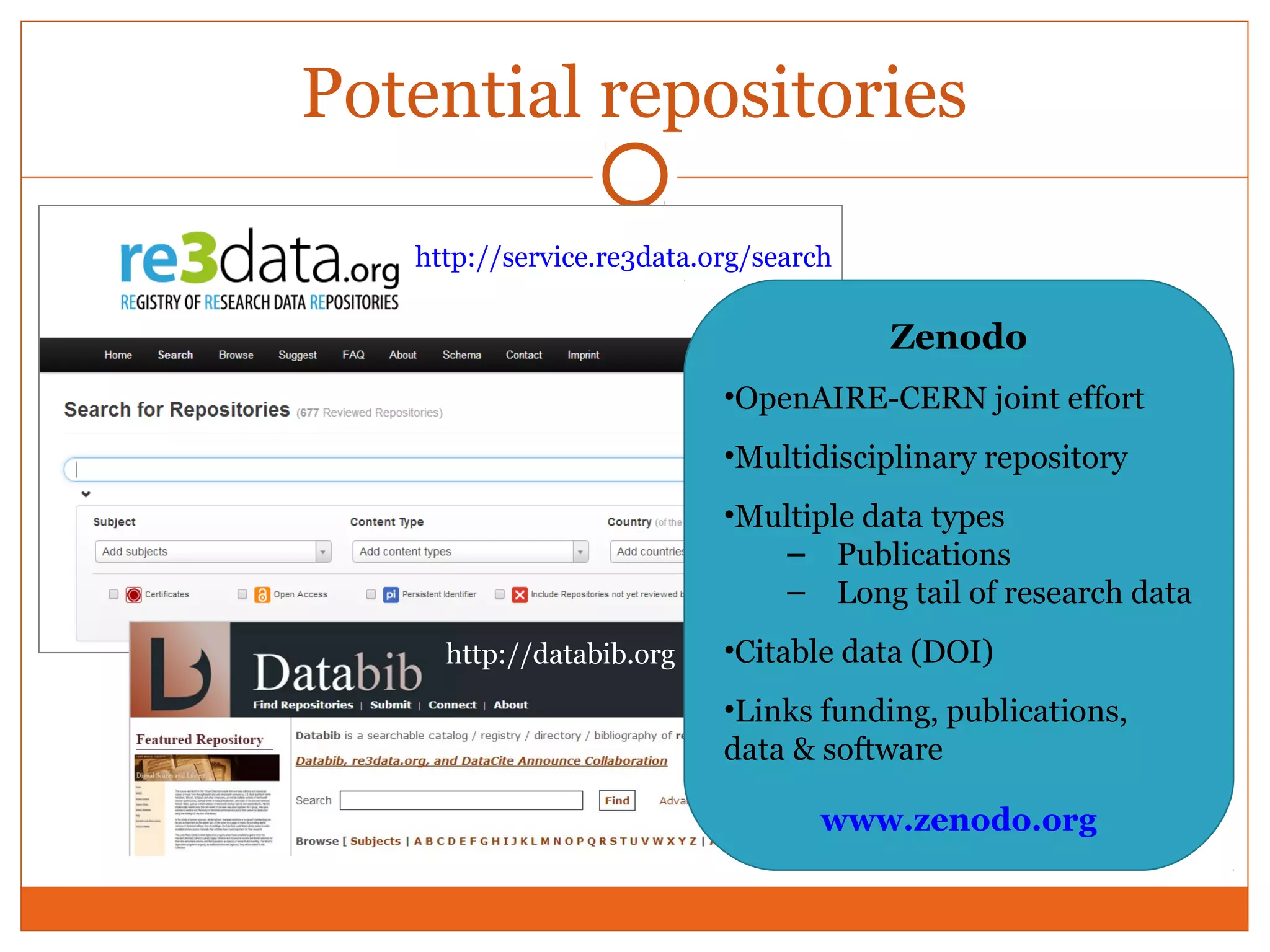
Potential repositories 
http://service.re3data.org/search 
http://databib.org 
Zenodo 
•OpenAIRE-CERN joint effort 
•Multidisciplinary repository 
•Multiple data types 
– Publications 
– Long tail of research data 
•Citable data (DOI) 
•Links funding, publications, 
data & software 
www.zenodo.org
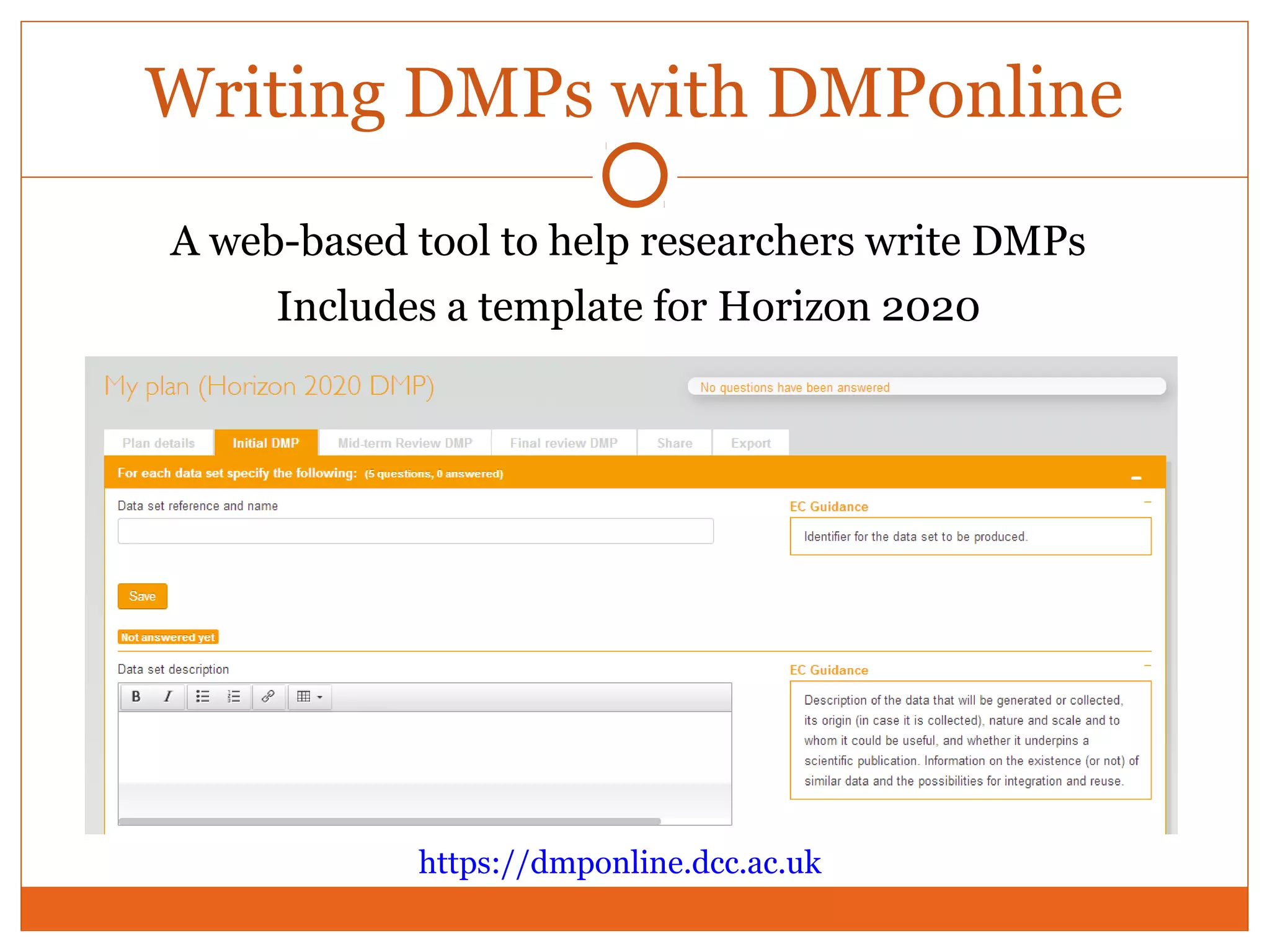
Writing DMPs with DMPonline 
A web-based tool to help researchers write DMPs 
Includes a template for Horizon 2020 
https://dmponline.dcc.ac.uk
Guidelines from the European Commission 
Factsheet on Open Access 
https://ec.europa.eu/programmes/horizon2020/sites/horizon2020/files/FactSheet_Guidelines on Open Access to Scientific Publications and 
Research Data in Horizon 2020 
http://ec.europa.eu/research/participants/data/ ref/h2020/grants_manual/hi/ Guidelines on Data Management in Horizon 2020 
http://ec.europa.eu/research/participants/data/ref/h2020/grants_manua 
l/hi/oa_pilot/h2020-hi-oa-data-mgt_en.pdf
Help on understanding the H2020 pilot 
OpenAIRE guide on the Open Research Data Pilot 
Are you supposed to deposit? > What to deposit > Where to deposit > When to deposit 
https://www.openaire.eu/oa-in-h2020/h2020/h2020-oa-data-pilot 
Joint statement by OpenAIRE, LIBER and COAR 
http://www.slideshare.net/libereurope/horizon-2020-opendatapilot20130703final 
Help from your research office and national agencies 
e.g. http://www.ucl.ac.uk/research/europe/h2020 
e.g. https://www.h2020uk.org/home
Guidance and resources on open data 
Open Knowledge Foundation (training, services, handbook...) 
https://okfn.org 
Open Data Institute (courses, case studies, events...) 
http://theodi.org 
Software Sustainability Institute (software preservation) 
http://www.software.ac.uk 
Open Data Commons (licensing) 
http://opendatacommons.org 
School of Data (training to help people use open data) 
http://schoolofdata.org
Thanks for listening 
DCC guidance, tools and case studies: 
www.dcc.ac.uk/resources 
Follow us on twitter: 
@digitalcuration and #ukdcc

The Horizon 2020 Open Data Pilot - OpenAIRE webinar (Oct. 21 2014) by Sarah Jones (DCC)

  • 1.
    The Horizon 2020 Open Data Pilot Sarah Jones Digital Curation Centre sarah.jones@glasgow.ac.uk Twitter: @sjDCC
  • 2.
    Why open accessand open data? “The European Commission’s vision is that information already paid for by the public purse should not be paid for again each time it is accessed or used, and that it should benefit European companies and citizens to the full.” http://ec.europa.eu/research/participants/data/ ref/h2020/
  • 3.
    Development of ECOpen Access policy Pilot in FP7 Provision of support OA mandate in H2020 Trialled in 7 areas Expected to: •Deposit articles into a repository •Attempt to make these OA within 6 or 12 months OA fees are eligible for reimbursement Pilot supported and monitored through OpenAIRE Each beneficiary must: •Deposit machine-readable electronic copy in repository by the date of publication •Ensure OA via green/gold routes within 6 or 12 month embargo •Ensure bibliographic metadata is OA •Aim to deposit research data
  • 4.
    H2020 open datapilot Guidelines on Data Management in Horizon 2020 http://ec.europa.eu/research/participants/data/ref/h2020/grants_manual/hi/Pilot in H2020 Provision of support ?
  • 5.
    H2020 areas participatingin the pilot  Future and Emerging Technologies  Research infrastructures – part e-Infrastructures  Leadership in enabling and industrial technologies – Information and Communication Technologies  Societal Challenge: 'Secure, Clean and Efficient Energy' – part Smart cities and communities  Societal Challenge: 'Climate Action, Environment, Resource Efficiency and Raw materials' – except raw materials  Societal Challenge: 'Europe in a changing world – inclusive, innovative and reflective Societies'  Science with and for Society Projects in other areas can participate on a voluntary basis
  • 6.
    Exemptions – reasonsfor opting out  If results are expected to be commercially or industrially exploited  If participation is incompatible with the need for confidentiality in connection with security issues  Incompatible with existing rules on the protection of personal data Would jeopardise the achievement of the main aim of the action  If the project will not generate / collect any research data  If there are other legitimate reasons to not take part in the Pilot Can opt out at proposal stage OR during lifetime of project Should describe issues in the project Data Management Plan
  • 7.
    Which data doesthe pilot apply to? Data, including associated metadata, needed to validate the results in scientific publications Other curated and/or raw data, including associated metadata, as specified in the DMP Doesn’t apply to all data (researchers to define as appropriate) Don’t have to share data if inappropriate – exemptions apply
  • 8.
    Key requirements ofthe open data pilot 1. Deposit in a research data repository 2. Make it possible for third parties to access, mine, exploit, reproduce and disseminate data – free of charge for any user 3. Provide information on the tools and instruments needed to validate the results (or better still provide the tools)
  • 9.
    Data Management Plans Projects participating in the pilot will be required to develop a Data Management plan (DMP), in which they will specify what data will be open. Note that the Commission does NOT require applicants to submit a DMP at the proposal stage. A DMP is therefore NOT part of the evaluation. DMPs are a deliverable for those participating in the pilot.
  • 10.
    Info on datamanagement: what and when Proposal stage In project Where relevant*, H2020 proposals can include a section on data management which is evaluated under the criterion ‘Impact’ What types of data will the project generate/collect? What standards will be used? How will this data be shared/made available? If not, why? How will this data be curated and preserved? * For “Research and Innovation actions” and “Innovation Actions”  DMPs are a project deliverable for those participating in the open data pilot.  Not a fixed document – should evolve and gain precision  Deliver first version within initial 6 months of project  More elaborate versions whenever important changes to the project occur. At least at the mid-term and final review.
  • 11.
    Initial DMP (at6 months) The DMP should address the points below on a dataset by dataset basis: Data set reference and name  Identifier for the data set to be produced Data set description  Description, origin and scale of the data that will be generated or collected, and to whom it could be useful  Information on the existence (or not) of similar data and the possibilities for integration and reuse Standards and metadata  Reference to existing suitable standards of the discipline. If these do not exist, an outline of how and what metadata will be created. Data sharing  How the data will be shared - widely open or restricted to specific groups – or reasons why it cannot be shared  Access procedures, embargo periods (if any), and technical mechanisms for dissemination  Software and other tools necessary for re-use  Repository where data will be stored Archiving and preservation (including storage and backup)  Procedures for long-term preservation  How long the data should be preserved  Final data volume  How associated costs will be covered
  • 12.
    More elaborate DMP Scientific research data should be easily: 1. Discoverable Are the data and software discoverable and identifiable by a standard mechanism e.g. DOIs? 2. Accessible Are the data accessible and under what conditions e.g. licenses, embargoes etc? 3. Assessable and intelligible Are the data and software assessable and intelligible to third parties for peer-review? E.g. can judgements be made about their reliability and the competence of those who created them? 4. Useable beyond the original purpose for which it was collected Are the data properly curated and stored together with the minimum software and documentation to be useful by third parties in the long-term? 5. Interoperable to specific quality standards Are the data and software interoperable, allowing data exchange? E.g. were common formats and standards for metadata used?
  • 13.
    Uptake and implementation Reflections from Daniel Spichtinger, Open Access Policy Officer with the European Commission (DG RTD) RECODE project workshop 25th September 2014 http://recodeproject.eu/events/recode-workshops
  • 14.
    Support already providedby the EC OpenAIRE+ Open Access Infrastructure for research in Europe aggregates data on OA publications mines & enriches it content by linking thing together provides services & APIs e.g. to monitor compliance or generate publication lists www.openaire.eu EUDAT European Data Infrastructure project offering services like: B2SHARE: store & share B2STAGE: get data to computation B2SAFE: replicate data safely B2FIND: find data www.eudat.eu
  • 15.
    Metadata standards Userelevant standards for interoperability www.dcc.ac.uk/resources/metadata-standards
  • 16.
    Licensing research data Outlines pros and cons of each approach and gives practical advice on how to implement your licence CREATIVE COMMONS LIMITATIONS NC Non-Commercial What counts as commercial? SA Share Alike Reduces interoperability ND No Derivatives Severely restricts use Horizon 2020 recommendation is to use OR www.dcc.ac.uk/resources/how-guides/license-research-data
  • 17.
    Potential repositories http://service.re3data.org/search http://databib.org Zenodo •OpenAIRE-CERN joint effort •Multidisciplinary repository •Multiple data types – Publications – Long tail of research data •Citable data (DOI) •Links funding, publications, data & software www.zenodo.org
  • 18.
    Writing DMPs withDMPonline A web-based tool to help researchers write DMPs Includes a template for Horizon 2020 https://dmponline.dcc.ac.uk
  • 19.
    Guidelines from theEuropean Commission Factsheet on Open Access https://ec.europa.eu/programmes/horizon2020/sites/horizon2020/files/FactSheet_Guidelines on Open Access to Scientific Publications and Research Data in Horizon 2020 http://ec.europa.eu/research/participants/data/ ref/h2020/grants_manual/hi/ Guidelines on Data Management in Horizon 2020 http://ec.europa.eu/research/participants/data/ref/h2020/grants_manua l/hi/oa_pilot/h2020-hi-oa-data-mgt_en.pdf
  • 20.
    Help on understandingthe H2020 pilot OpenAIRE guide on the Open Research Data Pilot Are you supposed to deposit? > What to deposit > Where to deposit > When to deposit https://www.openaire.eu/oa-in-h2020/h2020/h2020-oa-data-pilot Joint statement by OpenAIRE, LIBER and COAR http://www.slideshare.net/libereurope/horizon-2020-opendatapilot20130703final Help from your research office and national agencies e.g. http://www.ucl.ac.uk/research/europe/h2020 e.g. https://www.h2020uk.org/home
  • 21.
    Guidance and resourceson open data Open Knowledge Foundation (training, services, handbook...) https://okfn.org Open Data Institute (courses, case studies, events...) http://theodi.org Software Sustainability Institute (software preservation) http://www.software.ac.uk Open Data Commons (licensing) http://opendatacommons.org School of Data (training to help people use open data) http://schoolofdata.org
  • 22.
    Thanks for listening DCC guidance, tools and case studies: www.dcc.ac.uk/resources Follow us on twitter: @digitalcuration and #ukdcc

Editor's Notes

  • #3 The background to this is about making the most of the data that has been created through publicly funded research. The guidelines speak of: - Improved quality of results - Greater efficiency - Faster to market = faster growth - Improved transparency of the scientific process
  • #4 Moving from a ‘best-effort’ in FP7 to an ‘obligation’ under Horizon 2020
  • #6 There are seven areas participating in the pilot. This corresponds to about €3 billion or 20% of the overall Horizon 2020 budget in 2014 and 2015. Projects in others can take part on a voluntary basis. It’s an opt in / opt out basis.
  • #7 Projects in these seven areas aren’t forced to participate. There are various reasons to opt out e.g. if results can’t be shared due to confidentiality, legal restrictions or commercial opportunities. Opt out is available at any point. It can also apply to certain parts of the data e.g. they could share some aspects but not others.
  • #8 For those that do take part in the pilot, the starting point is to make all data that underpin publications open. After that, it’s for researchers to define what else should be shared and can be made open. This should be outlined in the DMP. Sometimes sharing is not appropriate (e.g. due to ethical rules of personal data, intellectual property protection, commercial restrictions etc). It’s fine to apply restrictions in such cases. This could be an embargo period prior to publication or while a patent is sought, or controlling access and re-use to protect participants’ identities (e.g. via the use of secure data services / data enclaves or data sharing agreements). Restrictions should be outlined up-front in the DMP.
  • #9 So the specific requirements on projects that participate in the pilot are to: - Deposit data in a repository Enable reuse via open licensing Provide any tools (or at least info on them) needed to validate the data The focus is planning for data sharing and then facilitating that through deposit, licensing and enabling reproducibility
  • #11 Although DMPs are a project deliverable and not required at the application stage, proposals can include a section on data management if desired. The info suggested here is similar to the preliminary DMP, so essentially gets that started.
  • #12 This template should be filled in for each dataset
  • #13 The second template is provided based on the G8 principles and focuses on the qualities/properties needed. These are that scientific research data should be easily discoverable, accessible, assessable and intelligible, usable beyond the original purpose for which it was created, and interoperable to specific quality standards.
  • #16 To make sure their data can be understood by themselves, their community and others, researchers should create metadata and documentation. Metadata is basic descriptive information to help identify and understand the structure of the data e.g. title, author... Documentation provides the wider context. It’s useful to share the methodology / workflow, software and any information needed to understand the data e.g. explanation of abbreviations or acronyms There are lots of standards that can be used. The DCC started a catalogue of disciplinary metadata standards which is now being taken forward as an international initiative via an RDA working group
  • #17 Guidance from the DCC can also help researchers to understand data licensing. This guide outlines the pros and cons of each approach e.g. the limitations of some CC options Under Horizon 2020 it’s recommended that researchers use CC-0 or CC-BY to make data as open as possible.
  • #18 The EC guidelines suggest selecting a suitable repository. The Databib and Re3data lists can be useful for this. They allow you to search and browse by subject. Re3data also allows you to restrict the search by certificates, open access repositories and persistent identifiers.
  • #19 DMPonline is a tool provided by the DCC that is free to use for all. We have included a template for Horizon 2020 based on the templates proposed by the EC. You can see these for the initial, mid-term and final review stages.