PARTHENOS-project.eu
Collaborations within Infrastructures
ESU Leipzig, 2016
Dr Jennifer Edmond
Trinity College Dublin
PARTHENOS-project.eu
Do You Collaborate?
If yes, how?
If no, why not?
PARTHENOS-project.eu
Do Humanists Collaborate?
- Teaching
- Conferences
- Mentoring
- Peer Reviewing
- Research Visits
- Blogs/Social Media
- Discipline on-line communities
- Other on-line interaction
- a “cooperative” rather than “collaborative” model of interaction (Unsworth)
Does DH change this in degree or kind?
Does infrastructure-scale development change this in degree or kind?
PARTHENOS-project.eu
‘Real’ Collaboration
- Multi-disciplinary
- Co-Authorship
- Lab style work
- “coming together of diverse interests and people to achieve a common purpose via
interactions, information sharing and coordination of activities” (Jassawalla and
Sashittal, 1998, 51, my emphasis).
- “DH must be collaborative, so also must DH infrastructure: But the range of interests
encompassed by digital humanities is broad, covering resource development, specific
research questions and methods, evaluation, policy, standards, teaching, and
software development, among others.” (Terras, 2001).
PARTHENOS-project.eu
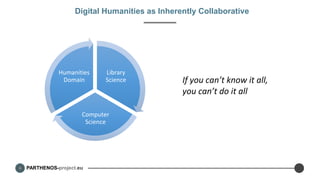
Digital Humanities as Inherently Collaborative
Library
Science
Computer
Science
Humanities
Domain If you can’t know it all,
you can’t do it all
PARTHENOS-project.eu
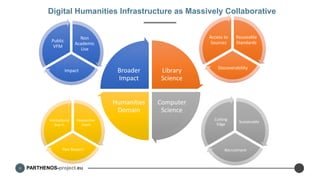
Digital Humanities Infrastructure as Massively Collaborative
Library
Science
Computer
Science
Humanities
Domain
Broader
Impact
Researcher
Users
Peer Respect
Institutional
buy in
Sustainable
Recruitment
Cutting
Edge
Non
Academic
Use
Impact
Public
VFM
Reuseable
Standards
Discoverability
Access to
Sources
PARTHENOS-project.eu
A History of a History of Collaboration
- Phase 1: apply models directly from management science
- relationship-level versus task-level successes and failures (Kraut, 1987)
- potential conflicts between researcher quality goals and organizational efficiency
goals (Fennel and Sandefur, 1983);
- the lack of a common vocabulary to describe work processes and insights between
specialists from different backgrounds (Fennel and Sandefur, 1983
- cultural differences (Amabile et. al., 2001; see also Siemens and Burr, 2011);
- the importance of leadership (Amabile et. al., 2001, see also Siemens, 2009);
- and the cost of insufficient attention in projects being paid to processes, management
structure or role clarity (Amabile et. al., 2001).
- This tradition continues, producing work based in issues arising in digital humanities
projects, but relevant across a number of work contexts, such as problems related to team
members’ physical proximity (or lack thereof) (Siemens and Burr, 2011).
PARTHENOS-project.eu
TRUST
In short, digital humanities teams, like all high-performing teams, require
trust and harmonization between individual and group goals (Siemens,
2009).
- value(s)
- benefit(s)
- mutual respect
- hierarchy
- expectations
- knowledge sharing at stake
“we’re very service oriented, but we don’t want that to be confused with
servitude” (Siemens et. al., 2011, 342, see also Short and Nyman, 2009,
and Speck and Links 2013).
PARTHENOS-project.eu
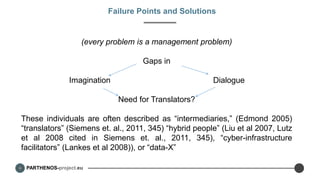
Failure Points and Solutions
(every problem is a management problem)
Gaps in
Imagination Dialogue
Need for Translators?
These individuals are often described as “intermediaries,” (Edmond 2005)
“translators” (Siemens et. al., 2011, 345) “hybrid people” (Liu et al 2007, Lutz
et al 2008 cited in Siemens et. al., 2011, 345), “cyber-infrastructure
facilitators” (Lankes et al 2008)), or “data-X”
PARTHENOS-project.eu
Failure Points and Solutions
BUT…
If we can create a common and agreed
ground for success and progress in
both DH and DH infrastructure, we will
only move forward in stagger steps.
Smiljana Antonijević, Amongst Digital Humanists (2015). Focus on
humanists’ strategies for developing digital competences. Barriers
identified such as lack of time, opportunity, disciplinary incentives. Need
to learn from peers in context, preference for informal channels.

Collaborations within infrastructures

  • 1.
    PARTHENOS-project.eu Collaborations within Infrastructures ESULeipzig, 2016 Dr Jennifer Edmond Trinity College Dublin
  • 2.
  • 3.
    PARTHENOS-project.eu Do Humanists Collaborate? -Teaching - Conferences - Mentoring - Peer Reviewing - Research Visits - Blogs/Social Media - Discipline on-line communities - Other on-line interaction - a “cooperative” rather than “collaborative” model of interaction (Unsworth) Does DH change this in degree or kind? Does infrastructure-scale development change this in degree or kind?
  • 4.
    PARTHENOS-project.eu ‘Real’ Collaboration - Multi-disciplinary -Co-Authorship - Lab style work - “coming together of diverse interests and people to achieve a common purpose via interactions, information sharing and coordination of activities” (Jassawalla and Sashittal, 1998, 51, my emphasis). - “DH must be collaborative, so also must DH infrastructure: But the range of interests encompassed by digital humanities is broad, covering resource development, specific research questions and methods, evaluation, policy, standards, teaching, and software development, among others.” (Terras, 2001).
  • 5.
    PARTHENOS-project.eu Digital Humanities asInherently Collaborative Library Science Computer Science Humanities Domain If you can’t know it all, you can’t do it all
  • 6.
    PARTHENOS-project.eu Digital Humanities Infrastructureas Massively Collaborative Library Science Computer Science Humanities Domain Broader Impact Researcher Users Peer Respect Institutional buy in Sustainable Recruitment Cutting Edge Non Academic Use Impact Public VFM Reuseable Standards Discoverability Access to Sources
  • 7.
    PARTHENOS-project.eu A History ofa History of Collaboration - Phase 1: apply models directly from management science - relationship-level versus task-level successes and failures (Kraut, 1987) - potential conflicts between researcher quality goals and organizational efficiency goals (Fennel and Sandefur, 1983); - the lack of a common vocabulary to describe work processes and insights between specialists from different backgrounds (Fennel and Sandefur, 1983 - cultural differences (Amabile et. al., 2001; see also Siemens and Burr, 2011); - the importance of leadership (Amabile et. al., 2001, see also Siemens, 2009); - and the cost of insufficient attention in projects being paid to processes, management structure or role clarity (Amabile et. al., 2001). - This tradition continues, producing work based in issues arising in digital humanities projects, but relevant across a number of work contexts, such as problems related to team members’ physical proximity (or lack thereof) (Siemens and Burr, 2011).
  • 8.
    PARTHENOS-project.eu TRUST In short, digitalhumanities teams, like all high-performing teams, require trust and harmonization between individual and group goals (Siemens, 2009). - value(s) - benefit(s) - mutual respect - hierarchy - expectations - knowledge sharing at stake “we’re very service oriented, but we don’t want that to be confused with servitude” (Siemens et. al., 2011, 342, see also Short and Nyman, 2009, and Speck and Links 2013).
  • 9.
    PARTHENOS-project.eu Failure Points andSolutions (every problem is a management problem) Gaps in Imagination Dialogue Need for Translators? These individuals are often described as “intermediaries,” (Edmond 2005) “translators” (Siemens et. al., 2011, 345) “hybrid people” (Liu et al 2007, Lutz et al 2008 cited in Siemens et. al., 2011, 345), “cyber-infrastructure facilitators” (Lankes et al 2008)), or “data-X”
  • 10.
    PARTHENOS-project.eu Failure Points andSolutions BUT… If we can create a common and agreed ground for success and progress in both DH and DH infrastructure, we will only move forward in stagger steps. Smiljana Antonijević, Amongst Digital Humanists (2015). Focus on humanists’ strategies for developing digital competences. Barriers identified such as lack of time, opportunity, disciplinary incentives. Need to learn from peers in context, preference for informal channels.

Editor's Notes

  • #3 http://www.esf.org/hosting-experts/scientific-review-groups/humanities-hum/strategic-activities/research-infrastructures-in-the-humanities.html
  • #4 http://www.esf.org/hosting-experts/scientific-review-groups/humanities-hum/strategic-activities/research-infrastructures-in-the-humanities.html
  • #5 http://www.esf.org/hosting-experts/scientific-review-groups/humanities-hum/strategic-activities/research-infrastructures-in-the-humanities.html
  • #6 http://www.esf.org/hosting-experts/scientific-review-groups/humanities-hum/strategic-activities/research-infrastructures-in-the-humanities.html
  • #7 http://www.esf.org/hosting-experts/scientific-review-groups/humanities-hum/strategic-activities/research-infrastructures-in-the-humanities.html
  • #8 Some of the earliest applied work on collaboration in digital humanities (and interdisciplinary research generally) emerged from management science, with some very useful results. Some of the issues identified early on include: relationship-level versus task-level successes and failures (Kraut, 1987); potential conflicts between researcher quality goals and organizational efficiency goals (Fennel and Sandefur, 1983); the lack of a common vocabulary to describe work processes and insights between specialists from different backgrounds (Fennel and Sandefur, 1983; see also Bracken and Oughton, 2006); cultural differences (Amabile et. al., 2001; see also Siemens and Burr, 2011); the importance of leadership (Amabile et. al., 2001, see also Siemens, 2009); and the cost of insufficient attention in projects being paid to processes, management structure or role clarity (Amabile et. al., 2001). This tradition continues, producing work based in issues arising in digital humanities projects, but relevant across a number of work contexts, such as problems related to team members’ physical proximity (or lack thereof) (Siemens and Burr, 2011).
  • #9 http://www.esf.org/hosting-experts/scientific-review-groups/humanities-hum/strategic-activities/research-infrastructures-in-the-humanities.html
  • #10 http://www.esf.org/hosting-experts/scientific-review-groups/humanities-hum/strategic-activities/research-infrastructures-in-the-humanities.html
  • #11 http://www.esf.org/hosting-experts/scientific-review-groups/humanities-hum/strategic-activities/research-infrastructures-in-the-humanities.html REPLACE COVER ART WITH CLIP ART OF BARRIERS