Webinar	start:	24.04.2018,	13:00	CEST		
Moderation:	Ulrike	Wuttke	
(University	of	Applied	Sciences	Potsdam)	
Join	the	conversation	on	Twitter:		
#PARTHENOSWebinar	
@Parthenos_EU
PARTHENOS	eHumanities	and	eHeritage	Webinar	Series	
	
Boost your
eHumanities
and eHeritage
Research with
Research
Infrastructures
Darja Fišer
(University of Ljubljana) &
Ulrike Wuttke (University
of Applied Sciences
Potsdam)
Date	and	Time:	24.04.2028,	13:00	-	14:00	CEST	
Moderation:	Ulrike	Wuttke	
(University	of	Applied	Sciences	Potsdam)	
Join	the	conversation	on	Twitter:		
#PARTHENOSWebinar	
@Parthenos_EU	Unless otherwise stated this work is licensed under a Creative Commons Attribution 4.0 International License.
Graphic: Otto, the Open Access Otter CC-BY 4.0, Katja Diederichs
Some	Housekeeping…	
	•  As	a	participant	you	will	be	muted	and	not	be	seen	
throughout	the	webinar.	
•  For	questions	and	remarks	please	use	the	chat.	For	
questions,	please	use	the	word	question.				
•  Your	questions	are	going	to	be	answered	by	the	
trainers	during	/	after	the	presentation.	
•  If	you	have	sound	problems,	please	test	your	technical	
settings.	You	have	to	click	on	the	speaker	symbol	on	
top	to	to	be	able	to	hear	(it	has	to	be	green).	
•  Help	us	improve:	Follow	up	e-mail	with	a	link	to	a	
short	feedback	survey.	
Unless otherwise stated this work is licensed under a Creative Commons Attribution 4.0 International License.
Some	words	about	PARTHENOS…	
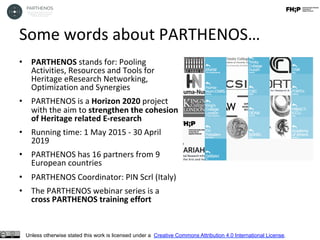
	•  PARTHENOS	stands	for:	Pooling	
Activities,	Resources	and	Tools	for	
Heritage	eResearch	Networking,	
Optimization	and	Synergies		
•  PARTHENOS	is	a	Horizon	2020	project		
with	the	aim	to	strengthen	the	cohesion	
of	Heritage	related	E-research		
•  Running	time:	1	May	2015	-	30	April	
2019	
•  PARTHENOS	has	16	partners	from	9	
European	countries	
•  PARTHENOS	Coordinator:	PIN	Scrl	(Italy)	
•  The	PARTHENOS	webinar	series	is	a	
cross	PARTHENOS	training	effort	
Unless otherwise stated this work is licensed under a Creative Commons Attribution 4.0 International License.
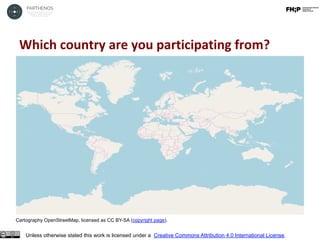
Which	country	are	you	participating	from?	
Unless otherwise stated this work is licensed under a Creative Commons Attribution 4.0 International License.
Cartography OpenStreetMap, licensed as CC BY-SA (copyright page).
Boost	your	eHumanities	and	eHeritage	
research	with	Research	Infrastructures	
Unless otherwise stated this work is licensed under a Creative Commons Attribution 4.0 International License.
Trainers
Darja	Fišer	
(University	of	Ljubljana,	Slovenia)	
	
	
Ulrike	Wuttke	
(University	of		
Applied	Sciences	
Potsdam,	Germany)
Boost your eHumanities and
eHeritage research with
Research Infrastructures
Darja Fišer & Ulrike Wuttke
Unless otherwise stated this presentation is licensed under a Creative Commons Attribution 4.0 International License.
What we will do in this webinar:
●  highlight advantages of developing research questions in
an „infrastructural way“
●  exemplify aspects of finding, working, and contributing
data to Research Infrastructures (RIs) and using Virtual
Research Environments (VREs) and tools
●  present Citizen Science approaches for Humanities and
Heritage research
Poll: What is for you the first step in a research
project? How do you start a project?
What is developing research questions in
humanities?
●  Gesta Danorum
○  written in about 1200 in High Latin by Danish historian Saxo
○  describes in 16 books the period of time from King Dan to Canute VI of
Denmark
○  traditionally divided into 2 parts: B1-9 Norse mythology & B10-16
describing Christianity
Research question: “Is it B9 or B10 that represents the transition
from the heathen to the Christian period in the Gesta
Danorum?”
Source: Clavs Povlsen https://www.clarin.eu/showcase/gesta-danorum
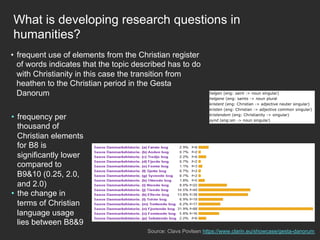
•  frequency per
thousand of
Christian elements
for B8 is
significantly lower
compared to
B9&10 (0.25, 2.0,
and 2.0)
•  the change in
terms of Christian
language usage
lies between B8&9
Source: Clavs Povlsen https://www.clarin.eu/showcase/gesta-danorum
•  frequent use of elements from the Christian register
of words indicates that the topic described has to do
with Christianity in this case the transition from
heathen to the Christian period in the Gesta
Danorum
What is developing research questions in
humanities?
Finding, working, and contributing data to RIs
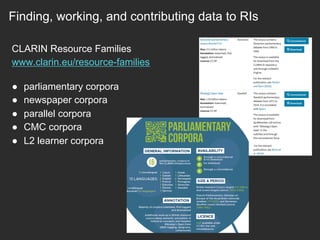
CLARIN Resource Families
www.clarin.eu/resource-families
●  parliamentary corpora
●  newspaper corpora
●  parallel corpora
●  CMC corpora
●  L2 learner corpora
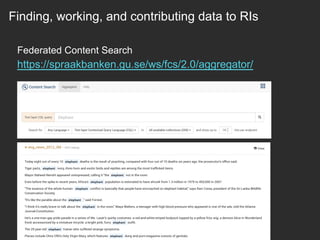
Federated Content Search
https://spraakbanken.gu.se/ws/fcs/2.0/aggregator/
Finding, working, and contributing data to RIs
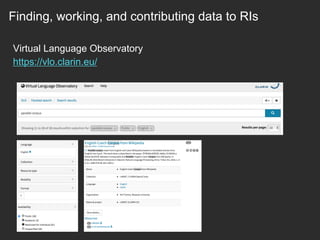
Virtual Language Observatory
https://vlo.clarin.eu/
Finding, working, and contributing data to RIs
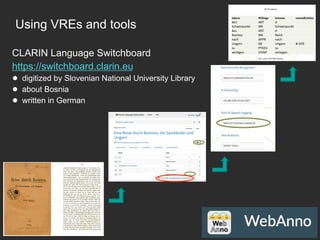
Using VREs and tools
CLARIN Language Switchboard
https://switchboard.clarin.eu
●  digitized by Slovenian National University Library
●  about Bosnia
●  written in German
15
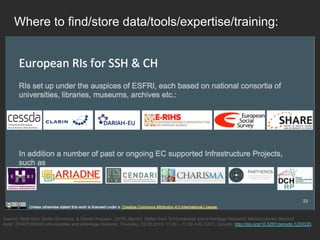
Where to find/store data/tools/expertise/training:
Source: Slide from Stefan Schmunk, & Steven Krauwer. (2018, March). Slides from "e-Humanities and e-Heritage Research Infrastructures: Beyond
tools" (PARTHENOS eHumanities and eHeritage Webinar, Thursday, 22.02.2018, 11:00 – 12:00 A.M. CET). Zenodo. http://doi.org/10.5281/zenodo.1203335,
The Cultural Heritage Data Reuse Charter
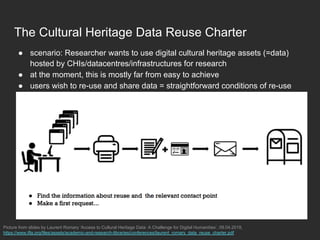
●  scenario: Researcher wants to use digital cultural heritage assets (=data)
hosted by CHIs/datacentres/infrastructures for research
●  at the moment, this is mostly far from easy to achieve
●  users wish to re-use and share data = straightforward conditions of re-use
Picture from slides by Laurent Romary ‘Access to Cultural Heritage Data: A Challenge for Digital Humanities’, 09.04.2018,
https://www.ifla.org/files/assets/academic-and-research-libraries/conferences/laurent_romary_data_reuse_charter.pdf
The Cultural Heritage
Data Reuse Charter
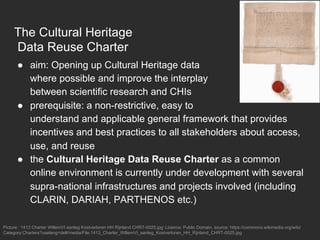
●  aim: Opening up Cultural Heritage data
where possible and improve the interplay
between scientific research and CHIs
●  prerequisite: a non-restrictive, easy to
understand and applicable general framework that provides
incentives and best practices to all stakeholders about access,
use, and reuse
●  the Cultural Heritage Data Reuse Charter as a common
online environment is currently under development with several
supra-national infrastructures and projects involved (including
CLARIN, DARIAH, PARTHENOS etc.)
Picture: ‘1413 Charter WillemVI aanleg Kostverloren HH Rijnland CHRT-0025.jpg’ Licence: Public Domain, source: https://commons.wikimedia.org/wiki/
Category:Charters?uselang=de#/media/File:1413_Charter_WillemVI_aanleg_Kostverloren_HH_Rijnland_CHRT-0025.jpg
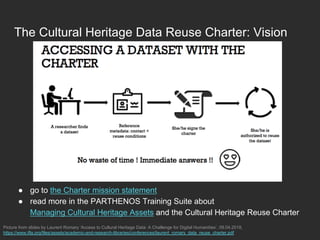
The Cultural Heritage Data Reuse Charter: Vision
●  go to the Charter mission statement
●  read more in the PARTHENOS Training Suite about
Managing Cultural Heritage Assets and the Cultural Heritage Reuse Charter
Picture from slides by Laurent Romary ‘Access to Cultural Heritage Data: A Challenge for Digital Humanities’, 09.04.2018,
https://www.ifla.org/files/assets/academic-and-research-libraries/conferences/laurent_romary_data_reuse_charter.pdf
Talk of Europe (2014-2015)
Source:
http://www.talkofeurope.eu/2014/01/about/
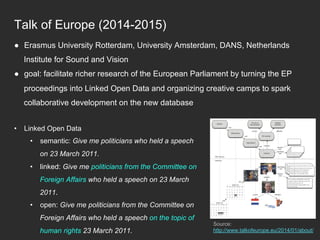
●  Erasmus University Rotterdam, University Amsterdam, DANS, Netherlands
Institute for Sound and Vision
●  goal: facilitate richer research of the European Parliament by turning the EP
proceedings into Linked Open Data and organizing creative camps to spark
collaborative development on the new database
•  Linked Open Data
•  semantic: Give me politicians who held a speech
on 23 March 2011.
•  linked: Give me politicians from the Committee on
Foreign Affairs who held a speech on 23 March
2011.
•  open: Give me politicians from the Committee on
Foreign Affairs who held a speech on the topic of
human rights 23 March 2011.
A Digital Database of Manuscripts and
Intercultural Dialogue in Post-Conquest England
●  this Europeana Research Grant project draws on Europeana
data to take a new approach to the status of French writing
following the Norman Conquest of England in 1066
●  aim: create and analyse an EDM-compliant digital database of all 958
manuscripts containing French literature from medieval England
“Digitisation of medieval manuscripts has been so important to medievalists in
general. There are still many reasons to work with a manuscript in person, but
among other benefits, the digitisation of medieval manuscripts allows us to visually
compare manuscripts from different collections, to see new details on manuscripts
and to access manuscripts remotely. The kind of project I’m working on now,
which involves checking linguistic data of a large number of manuscripts,
wouldn’t be feasible without digitised manuscript collections.”
Krista Murchison (Leiden University)
https://pro.europeana.eu/post/medieval-manuscript-databases-krista-murchison-europeana-research-grants-winner
Sources: https://pro.europeana.eu/post/these-are-the-winners-of-the-europeana-research-grants-programme-2017, https://pro.europeana.eu/
post/medieval-manuscript-databases-krista-murchison-europeana-research-grants-winner
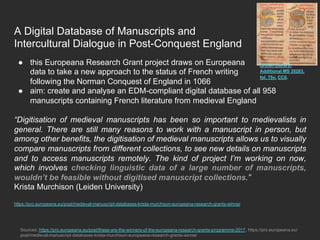
British Library,
Additional MS 35283,
fol. 75v, CC0.
The JANES Project 2014-2017
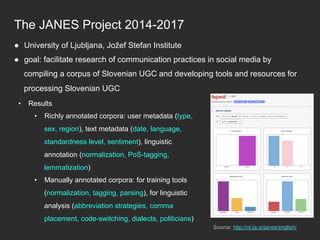
Source: http://nl.ijs.si/janes/english/
●  University of Ljubljana, Jožef Stefan Institute
●  goal: facilitate research of communication practices in social media by
compiling a corpus of Slovenian UGC and developing tools and resources for
processing Slovenian UGC
•  Results
•  Richly annotated corpora: user metadata (type,
sex, region), text metadata (date, language,
standardness level, sentiment), linguistic
annotation (normalization, PoS-tagging,
lemmatization)
•  Manually annotated corpora: for training tools
(normalization, tagging, parsing), for linguistic
analysis (abbreviation strategies, comma
placement, code-switching, dialects, politicians)
Venice Time Machine
●  aim: capture 1,000 years of records of the
Republic of Venice in dynamic digital form
●  machine-learning technologies will enable
the researchers to search and cross-
reference the information
●  for automated text recognition it cooperates with H2020 READ-Transcribus
●  challenge: organize transparent processes linking historical records and
computer-based visualizations
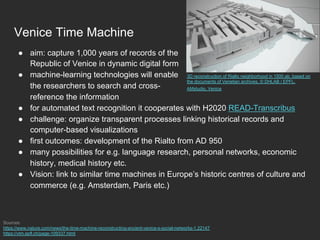
●  first outcomes: development of the Rialto from AD 950
●  many possibilities for e.g. language research, personal networks, economic
history, medical history etc.
●  Vision: link to similar time machines in Europe’s historic centres of culture and
commerce (e.g. Amsterdam, Paris etc.)
Sources:
https://www.nature.com/news/the-time-machine-reconstructing-ancient-venice-s-social-networks-1.22147
https://vtm.epfl.ch/page-109337.html
3D reconstruction of Rialto neighborhood in 1500 ab. based on
the documents of Venetian archives, © DHLAB / EPFL,
AMstudio, Venice
Citizen Science
Bürgerwissenschaft
Sciences Participatives
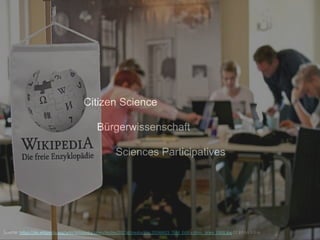
Source: https://de.wikipedia.org/wiki/Wikipedia:Wien/Archiv/2015#/media/File:20140415_TFM_Edit-a-thon_Wien_0301.jpg	CC	BY-SA	3.0	at
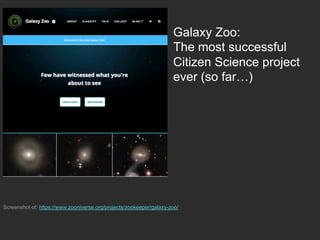
Galaxy Zoo:
The most successful
Citizen Science project
ever (so far…)
Screenshot of: https://www.zooniverse.org/projects/zookeeper/galaxy-zoo/
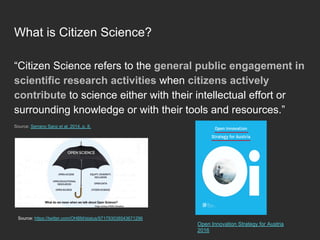
What is Citizen Science?
“Citizen Science refers to the general public engagement in
scientific research activities when citizens actively
contribute to science either with their intellectual effort or
surrounding knowledge or with their tools and resources.”
Source: Serrano Sanz et al. 2014, p. 8.
Source: https://twitter.com/OHBM/status/971793038543671296
Open Innovation Strategy for Austria
2016
●  “Digital Transformation” (Web 2.0, new technologies, new
philosophy of sharing) provides huge potential for Citizen
Science
●  many successful Citizen Science projects take place in
the digital world (VREs)
●  digital solutions mobilize individual and collective
engagement for co-creation
●  new forms of scientific communication play a huge role
Citizen Science and the Digital Transformation
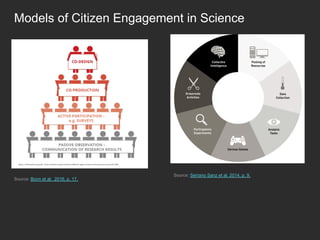
Source: Bonn et al. 2016, p. 17.
Source: Serrano Sanz et al. 2014, p. 9.
Models of Citizen Engagement in Science
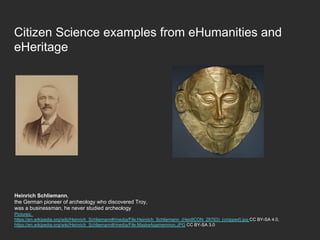
Citizen Science examples from eHumanities and
eHeritage
Heinrich Schliemann,
the German pioneer of archeology who discovered Troy,
was a businessman, he never studied archeology
Pictures:
https://en.wikipedia.org/wiki/Heinrich_Schliemann#/media/File:Heinrich_Schliemann_(HeidICON_28763)_(cropped).jpg CC BY-SA 4.0,
https://en.wikipedia.org/wiki/Heinrich_Schliemann#/media/File:MaskeAgamemnon.JPG CC BY-SA 3.0
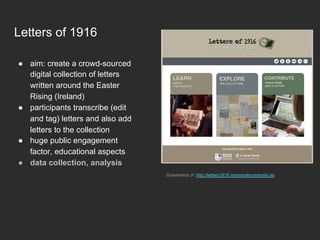
Letters of 1916
●  aim: create a crowd-sourced
digital collection of letters
written around the Easter
Rising (Ireland)
●  participants transcribe (edit
and tag) letters and also add
letters to the collection
●  huge public engagement
factor, educational aspects
●  data collection, analysis
Screenshot of: http://letters1916.maynoothuniversity.ie/
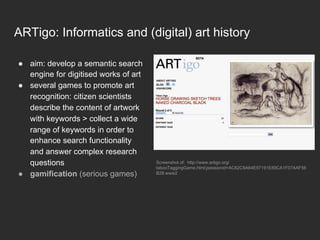
ARTigo: Informatics and (digital) art history
●  aim: develop a semantic search
engine for digitised works of art
●  several games to promote art
recognition: citizen scientists
describe the content of artwork
with keywords > collect a wide
range of keywords in order to
enhance search functionality
and answer complex research
questions
●  gamification (serious games)
Screenshot of: http://www.artigo.org/
tabooTaggingGame.html;jsessionid=AC62C9A64E97191E89CA1F07AAF56
B28.www2
Citizen Science @ Libraries
●  as part of regional studies e.g. contribution to regional
bibliographies, adding to Wikipedia articles, transcription
of digitised materials on Wikisource
●  get general access to tools and general research support
●  georeferencing of maps (Virtuelles Kartenforum 2.0),
SLUB Dresden
●  contributions to collective research of history (German
Example: History of Cycling)
Source examples: https://www.slub-dresden.de/en/open-science/citizen-science/
Potentials and Challenges of Citizen Science
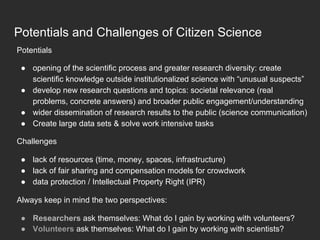
Potentials
●  opening of the scientific process and greater research diversity: create
scientific knowledge outside institutionalized science with “unusual suspects”
●  develop new research questions and topics: societal relevance (real
problems, concrete answers) and broader public engagement/understanding
●  wider dissemination of research results to the public (science communication)
●  Create large data sets & solve work intensive tasks
Challenges
●  lack of resources (time, money, spaces, infrastructure)
●  lack of fair sharing and compensation models for crowdwork
●  data protection / Intellectual Property Right (IPR)
Always keep in mind the two perspectives:
●  Researchers ask themselves: What do I gain by working with volunteers?
●  Volunteers ask themselves: What do I gain by working with scientists?
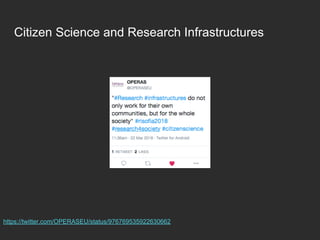
Citizen Science and Research Infrastructures
https://twitter.com/OPERASEU/status/976769535922630662
Poll: What can Research Infrastructures do for
Citizen Science?
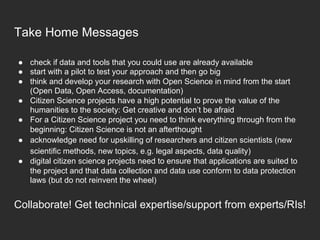
Take Home Messages
●  check if data and tools that you could use are already available
●  start with a pilot to test your approach and then go big
●  think and develop your research with Open Science in mind from the start
(Open Data, Open Access, documentation)
●  Citizen Science projects have a high potential to prove the value of the
humanities to the society: Get creative and don’t be afraid
●  For a Citizen Science project you need to think everything through from the
beginning: Citizen Science is not an afterthought
●  acknowledge need for upskilling of researchers and citizen scientists (new
scientific methods, new topics, e.g. legal aspects, data quality)
●  digital citizen science projects need to ensure that applications are suited to
the project and that data collection and data use conform to data protection
laws (but do not reinvent the wheel)
Collaborate! Get technical expertise/support from experts/RIs!
Bibliography & Reading suggestions #citizenscience:
●  Bonn et al. Green Paper Citizen Science Strategy 2020 for Germany. Berlin, 2016.
●  Ten Principles of Citizen Science from the European Citizen Science Association, 2015
●  Open Innovation, Open Science, Open to the World - A vision for Europe, European Commission
Directorate-General for Research & Innovation, 2016
●  Open Innovation Strategy for Austria, BMWFW, Vienna, 2016
●  Pettibone and Vohland, Citizen Science for all: A Guide for Citizen Science Practitioners, 2016
●  Schreibman 2018, Lecture “From Archives to Activism: Why Public Engagement is Essential for the
Future of the Humanities” (Slides)
●  Heigl, Florian, Dörler, Daniel, Bartar, Pamela, Brodschneider, Robert, Cieslinski, Marika, Ernst,
Marlene, … Ziegler, David. (2018, February 1). Qualitätskriterien für Citizen Science Projekte auf
Österreich forscht (Version 1.0). Zenodo. http://doi.org/10.5281/zenodo.1161922
●  Bowser and Shanley, New Visions in Citizen Science, 2013, chapter Citizen Archivists.
●  Serrano Sanz et al. White Paper on Citizen Science for Europe. Socientize Consortium, 2014
Some Citizen Science Networks & Associations
●  www.buergerschaffenwissen.de (Germany)
●  www.citizen-science.at (Austria)
●  www.science-et-cite.ch/de/citizen-science (Switzerland)
●  www.citizenscienceassociation.org (U.S.)
●  https://ecsa.citizen-science.net (Europe)
●  https://www.citizenscience.org.au/who-we-are/ (Australia)
●  https://www.facebook.com/CitSciAsia (Asia)
●  http://citizenscience.org/ (global)
●  http://citsci.org (Colorado State University)
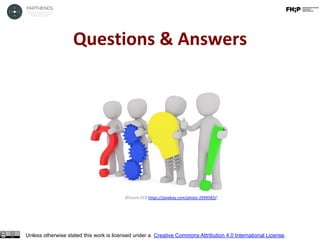
Questions	&	Answers	
Unless otherwise stated this work is licensed under a Creative Commons Attribution 4.0 International License.
(Picture	CC0	https://pixabay.com/photo-2999583/)
Announcements	
Unless otherwise stated this work is licensed under a Creative Commons Attribution 4.0 International License.
•  New	PARTHENOS	Training	Suite	module	around	Developing	research	
Questions	is	being	developed	by	PARTHENOS	(led	by	Darja)	
•  Have	a	look	at	the	PARTHENOS	YouTube	Channel:	all	videos	so	far	produced	
by	PARTHENOS	and	PARTHENOS	Training	
•  PARTHENOS	Webinar	Workshop	at	the	European	Summer	University	in	
Digital	Humanities	2018	(ESU),	Leipzig	(apply	until	1st	of	May	2018,	
scholarships	available):	
How	Research	Infrastructures	empower	eHumanities	and	eHeritage	
Research(ers)
Questions	&	Answers	
Unless otherwise stated this work is licensed under a Creative Commons Attribution 4.0 International License.
(Picture	CC0	https://pixabay.com/photo-2999583/)
Thank	you	for	joining	us!	
Unless otherwise stated this work is licensed under a Creative Commons Attribution 4.0 International License.
(Picture:	CCO	https://pixabay.com/photo-1889007/)	
ü Please	help	us	improving	the	
PARTHENOS	Webinar	Series	
and	fill	out	the	short	Feedback	
Survey	that	we’ll	sent	you	in	a	
follow-up	e-mail.
PARTHENOS	eHumanities	and	eHeritage	Webinar	Series	
	
Join	the	conversation	on	Twitter:		
#PARTHENOSWebinar	
@Parthenos_EU	Unless otherwise stated this work is licensed under a Creative Commons Attribution 4.0 International License.
Graphic: Otto, the Open Access Otter CC-BY 4.0, Katja Diederichs
Moderation and
Contact:
Dr Ulrike Wuttke
(University of Applied
Sciences Potsdam)
wuttke@fh-potsdam.de
Twitter: @UWuttke
www.parthenos-
project.eu
www.fh-potsdam.de

PARTHENOS Webinar: Boost Your eHumanities and eHeritage Research with Research Infrastructures

  • 1.
  • 2.
    PARTHENOS eHumanities and eHeritage Webinar Series Boost your eHumanities and eHeritage Researchwith Research Infrastructures Darja Fišer (University of Ljubljana) & Ulrike Wuttke (University of Applied Sciences Potsdam) Date and Time: 24.04.2028, 13:00 - 14:00 CEST Moderation: Ulrike Wuttke (University of Applied Sciences Potsdam) Join the conversation on Twitter: #PARTHENOSWebinar @Parthenos_EU Unless otherwise stated this work is licensed under a Creative Commons Attribution 4.0 International License. Graphic: Otto, the Open Access Otter CC-BY 4.0, Katja Diederichs
  • 3.
    Some Housekeeping… •  As a participant you will be muted and not be seen throughout the webinar. •  For questions and remarks please use the chat. For questions, please use the word question. • Your questions are going to be answered by the trainers during / after the presentation. •  If you have sound problems, please test your technical settings. You have to click on the speaker symbol on top to to be able to hear (it has to be green). •  Help us improve: Follow up e-mail with a link to a short feedback survey. Unless otherwise stated this work is licensed under a Creative Commons Attribution 4.0 International License.
  • 4.
    Some words about PARTHENOS… •  PARTHENOS stands for: Pooling Activities, Resources and Tools for Heritage eResearch Networking, Optimization and Synergies •  PARTHENOS is a Horizon 2020 project with the aim to strengthen the cohesion of Heritage related E-research • Running time: 1 May 2015 - 30 April 2019 •  PARTHENOS has 16 partners from 9 European countries •  PARTHENOS Coordinator: PIN Scrl (Italy) •  The PARTHENOS webinar series is a cross PARTHENOS training effort Unless otherwise stated this work is licensed under a Creative Commons Attribution 4.0 International License.
  • 5.
    Which country are you participating from? Unless otherwise statedthis work is licensed under a Creative Commons Attribution 4.0 International License. Cartography OpenStreetMap, licensed as CC BY-SA (copyright page).
  • 6.
    Boost your eHumanities and eHeritage research with Research Infrastructures Unless otherwise statedthis work is licensed under a Creative Commons Attribution 4.0 International License. Trainers Darja Fišer (University of Ljubljana, Slovenia) Ulrike Wuttke (University of Applied Sciences Potsdam, Germany)
  • 7.
    Boost your eHumanitiesand eHeritage research with Research Infrastructures Darja Fišer & Ulrike Wuttke Unless otherwise stated this presentation is licensed under a Creative Commons Attribution 4.0 International License.
  • 8.
    What we willdo in this webinar: ●  highlight advantages of developing research questions in an „infrastructural way“ ●  exemplify aspects of finding, working, and contributing data to Research Infrastructures (RIs) and using Virtual Research Environments (VREs) and tools ●  present Citizen Science approaches for Humanities and Heritage research
  • 9.
    Poll: What isfor you the first step in a research project? How do you start a project?
  • 10.
    What is developingresearch questions in humanities? ●  Gesta Danorum ○  written in about 1200 in High Latin by Danish historian Saxo ○  describes in 16 books the period of time from King Dan to Canute VI of Denmark ○  traditionally divided into 2 parts: B1-9 Norse mythology & B10-16 describing Christianity Research question: “Is it B9 or B10 that represents the transition from the heathen to the Christian period in the Gesta Danorum?” Source: Clavs Povlsen https://www.clarin.eu/showcase/gesta-danorum
  • 11.
    •  frequency per thousandof Christian elements for B8 is significantly lower compared to B9&10 (0.25, 2.0, and 2.0) •  the change in terms of Christian language usage lies between B8&9 Source: Clavs Povlsen https://www.clarin.eu/showcase/gesta-danorum •  frequent use of elements from the Christian register of words indicates that the topic described has to do with Christianity in this case the transition from heathen to the Christian period in the Gesta Danorum What is developing research questions in humanities?
  • 12.
    Finding, working, andcontributing data to RIs CLARIN Resource Families www.clarin.eu/resource-families ●  parliamentary corpora ●  newspaper corpora ●  parallel corpora ●  CMC corpora ●  L2 learner corpora
  • 13.
  • 14.
  • 15.
    Using VREs andtools CLARIN Language Switchboard https://switchboard.clarin.eu ●  digitized by Slovenian National University Library ●  about Bosnia ●  written in German 15
  • 16.
    Where to find/storedata/tools/expertise/training: Source: Slide from Stefan Schmunk, & Steven Krauwer. (2018, March). Slides from "e-Humanities and e-Heritage Research Infrastructures: Beyond tools" (PARTHENOS eHumanities and eHeritage Webinar, Thursday, 22.02.2018, 11:00 – 12:00 A.M. CET). Zenodo. http://doi.org/10.5281/zenodo.1203335,
  • 17.
    The Cultural HeritageData Reuse Charter ●  scenario: Researcher wants to use digital cultural heritage assets (=data) hosted by CHIs/datacentres/infrastructures for research ●  at the moment, this is mostly far from easy to achieve ●  users wish to re-use and share data = straightforward conditions of re-use Picture from slides by Laurent Romary ‘Access to Cultural Heritage Data: A Challenge for Digital Humanities’, 09.04.2018, https://www.ifla.org/files/assets/academic-and-research-libraries/conferences/laurent_romary_data_reuse_charter.pdf
  • 18.
    The Cultural Heritage DataReuse Charter ●  aim: Opening up Cultural Heritage data where possible and improve the interplay between scientific research and CHIs ●  prerequisite: a non-restrictive, easy to understand and applicable general framework that provides incentives and best practices to all stakeholders about access, use, and reuse ●  the Cultural Heritage Data Reuse Charter as a common online environment is currently under development with several supra-national infrastructures and projects involved (including CLARIN, DARIAH, PARTHENOS etc.) Picture: ‘1413 Charter WillemVI aanleg Kostverloren HH Rijnland CHRT-0025.jpg’ Licence: Public Domain, source: https://commons.wikimedia.org/wiki/ Category:Charters?uselang=de#/media/File:1413_Charter_WillemVI_aanleg_Kostverloren_HH_Rijnland_CHRT-0025.jpg
  • 19.
    The Cultural HeritageData Reuse Charter: Vision ●  go to the Charter mission statement ●  read more in the PARTHENOS Training Suite about Managing Cultural Heritage Assets and the Cultural Heritage Reuse Charter Picture from slides by Laurent Romary ‘Access to Cultural Heritage Data: A Challenge for Digital Humanities’, 09.04.2018, https://www.ifla.org/files/assets/academic-and-research-libraries/conferences/laurent_romary_data_reuse_charter.pdf
  • 20.
    Talk of Europe(2014-2015) Source: http://www.talkofeurope.eu/2014/01/about/ ●  Erasmus University Rotterdam, University Amsterdam, DANS, Netherlands Institute for Sound and Vision ●  goal: facilitate richer research of the European Parliament by turning the EP proceedings into Linked Open Data and organizing creative camps to spark collaborative development on the new database •  Linked Open Data •  semantic: Give me politicians who held a speech on 23 March 2011. •  linked: Give me politicians from the Committee on Foreign Affairs who held a speech on 23 March 2011. •  open: Give me politicians from the Committee on Foreign Affairs who held a speech on the topic of human rights 23 March 2011.
  • 21.
    A Digital Databaseof Manuscripts and Intercultural Dialogue in Post-Conquest England ●  this Europeana Research Grant project draws on Europeana data to take a new approach to the status of French writing following the Norman Conquest of England in 1066 ●  aim: create and analyse an EDM-compliant digital database of all 958 manuscripts containing French literature from medieval England “Digitisation of medieval manuscripts has been so important to medievalists in general. There are still many reasons to work with a manuscript in person, but among other benefits, the digitisation of medieval manuscripts allows us to visually compare manuscripts from different collections, to see new details on manuscripts and to access manuscripts remotely. The kind of project I’m working on now, which involves checking linguistic data of a large number of manuscripts, wouldn’t be feasible without digitised manuscript collections.” Krista Murchison (Leiden University) https://pro.europeana.eu/post/medieval-manuscript-databases-krista-murchison-europeana-research-grants-winner Sources: https://pro.europeana.eu/post/these-are-the-winners-of-the-europeana-research-grants-programme-2017, https://pro.europeana.eu/ post/medieval-manuscript-databases-krista-murchison-europeana-research-grants-winner British Library, Additional MS 35283, fol. 75v, CC0.
  • 22.
    The JANES Project2014-2017 Source: http://nl.ijs.si/janes/english/ ●  University of Ljubljana, Jožef Stefan Institute ●  goal: facilitate research of communication practices in social media by compiling a corpus of Slovenian UGC and developing tools and resources for processing Slovenian UGC •  Results •  Richly annotated corpora: user metadata (type, sex, region), text metadata (date, language, standardness level, sentiment), linguistic annotation (normalization, PoS-tagging, lemmatization) •  Manually annotated corpora: for training tools (normalization, tagging, parsing), for linguistic analysis (abbreviation strategies, comma placement, code-switching, dialects, politicians)
  • 23.
    Venice Time Machine ● aim: capture 1,000 years of records of the Republic of Venice in dynamic digital form ●  machine-learning technologies will enable the researchers to search and cross- reference the information ●  for automated text recognition it cooperates with H2020 READ-Transcribus ●  challenge: organize transparent processes linking historical records and computer-based visualizations ●  first outcomes: development of the Rialto from AD 950 ●  many possibilities for e.g. language research, personal networks, economic history, medical history etc. ●  Vision: link to similar time machines in Europe’s historic centres of culture and commerce (e.g. Amsterdam, Paris etc.) Sources: https://www.nature.com/news/the-time-machine-reconstructing-ancient-venice-s-social-networks-1.22147 https://vtm.epfl.ch/page-109337.html 3D reconstruction of Rialto neighborhood in 1500 ab. based on the documents of Venetian archives, © DHLAB / EPFL, AMstudio, Venice
  • 24.
    Citizen Science Bürgerwissenschaft Sciences Participatives Source:https://de.wikipedia.org/wiki/Wikipedia:Wien/Archiv/2015#/media/File:20140415_TFM_Edit-a-thon_Wien_0301.jpg CC BY-SA 3.0 at
  • 25.
    Galaxy Zoo: The mostsuccessful Citizen Science project ever (so far…) Screenshot of: https://www.zooniverse.org/projects/zookeeper/galaxy-zoo/
  • 26.
    What is CitizenScience? “Citizen Science refers to the general public engagement in scientific research activities when citizens actively contribute to science either with their intellectual effort or surrounding knowledge or with their tools and resources.” Source: Serrano Sanz et al. 2014, p. 8. Source: https://twitter.com/OHBM/status/971793038543671296 Open Innovation Strategy for Austria 2016
  • 27.
    ●  “Digital Transformation”(Web 2.0, new technologies, new philosophy of sharing) provides huge potential for Citizen Science ●  many successful Citizen Science projects take place in the digital world (VREs) ●  digital solutions mobilize individual and collective engagement for co-creation ●  new forms of scientific communication play a huge role Citizen Science and the Digital Transformation
  • 28.
    Source: Bonn etal. 2016, p. 17. Source: Serrano Sanz et al. 2014, p. 9. Models of Citizen Engagement in Science
  • 29.
    Citizen Science examplesfrom eHumanities and eHeritage Heinrich Schliemann, the German pioneer of archeology who discovered Troy, was a businessman, he never studied archeology Pictures: https://en.wikipedia.org/wiki/Heinrich_Schliemann#/media/File:Heinrich_Schliemann_(HeidICON_28763)_(cropped).jpg CC BY-SA 4.0, https://en.wikipedia.org/wiki/Heinrich_Schliemann#/media/File:MaskeAgamemnon.JPG CC BY-SA 3.0
  • 30.
    Letters of 1916 ● aim: create a crowd-sourced digital collection of letters written around the Easter Rising (Ireland) ●  participants transcribe (edit and tag) letters and also add letters to the collection ●  huge public engagement factor, educational aspects ●  data collection, analysis Screenshot of: http://letters1916.maynoothuniversity.ie/
  • 31.
    ARTigo: Informatics and(digital) art history ●  aim: develop a semantic search engine for digitised works of art ●  several games to promote art recognition: citizen scientists describe the content of artwork with keywords > collect a wide range of keywords in order to enhance search functionality and answer complex research questions ●  gamification (serious games) Screenshot of: http://www.artigo.org/ tabooTaggingGame.html;jsessionid=AC62C9A64E97191E89CA1F07AAF56 B28.www2
  • 32.
    Citizen Science @Libraries ●  as part of regional studies e.g. contribution to regional bibliographies, adding to Wikipedia articles, transcription of digitised materials on Wikisource ●  get general access to tools and general research support ●  georeferencing of maps (Virtuelles Kartenforum 2.0), SLUB Dresden ●  contributions to collective research of history (German Example: History of Cycling) Source examples: https://www.slub-dresden.de/en/open-science/citizen-science/
  • 33.
    Potentials and Challengesof Citizen Science Potentials ●  opening of the scientific process and greater research diversity: create scientific knowledge outside institutionalized science with “unusual suspects” ●  develop new research questions and topics: societal relevance (real problems, concrete answers) and broader public engagement/understanding ●  wider dissemination of research results to the public (science communication) ●  Create large data sets & solve work intensive tasks Challenges ●  lack of resources (time, money, spaces, infrastructure) ●  lack of fair sharing and compensation models for crowdwork ●  data protection / Intellectual Property Right (IPR) Always keep in mind the two perspectives: ●  Researchers ask themselves: What do I gain by working with volunteers? ●  Volunteers ask themselves: What do I gain by working with scientists?
  • 34.
    Citizen Science andResearch Infrastructures https://twitter.com/OPERASEU/status/976769535922630662
  • 35.
    Poll: What canResearch Infrastructures do for Citizen Science?
  • 36.
    Take Home Messages ● check if data and tools that you could use are already available ●  start with a pilot to test your approach and then go big ●  think and develop your research with Open Science in mind from the start (Open Data, Open Access, documentation) ●  Citizen Science projects have a high potential to prove the value of the humanities to the society: Get creative and don’t be afraid ●  For a Citizen Science project you need to think everything through from the beginning: Citizen Science is not an afterthought ●  acknowledge need for upskilling of researchers and citizen scientists (new scientific methods, new topics, e.g. legal aspects, data quality) ●  digital citizen science projects need to ensure that applications are suited to the project and that data collection and data use conform to data protection laws (but do not reinvent the wheel) Collaborate! Get technical expertise/support from experts/RIs!
  • 37.
    Bibliography & Readingsuggestions #citizenscience: ●  Bonn et al. Green Paper Citizen Science Strategy 2020 for Germany. Berlin, 2016. ●  Ten Principles of Citizen Science from the European Citizen Science Association, 2015 ●  Open Innovation, Open Science, Open to the World - A vision for Europe, European Commission Directorate-General for Research & Innovation, 2016 ●  Open Innovation Strategy for Austria, BMWFW, Vienna, 2016 ●  Pettibone and Vohland, Citizen Science for all: A Guide for Citizen Science Practitioners, 2016 ●  Schreibman 2018, Lecture “From Archives to Activism: Why Public Engagement is Essential for the Future of the Humanities” (Slides) ●  Heigl, Florian, Dörler, Daniel, Bartar, Pamela, Brodschneider, Robert, Cieslinski, Marika, Ernst, Marlene, … Ziegler, David. (2018, February 1). Qualitätskriterien für Citizen Science Projekte auf Österreich forscht (Version 1.0). Zenodo. http://doi.org/10.5281/zenodo.1161922 ●  Bowser and Shanley, New Visions in Citizen Science, 2013, chapter Citizen Archivists. ●  Serrano Sanz et al. White Paper on Citizen Science for Europe. Socientize Consortium, 2014
  • 38.
    Some Citizen ScienceNetworks & Associations ●  www.buergerschaffenwissen.de (Germany) ●  www.citizen-science.at (Austria) ●  www.science-et-cite.ch/de/citizen-science (Switzerland) ●  www.citizenscienceassociation.org (U.S.) ●  https://ecsa.citizen-science.net (Europe) ●  https://www.citizenscience.org.au/who-we-are/ (Australia) ●  https://www.facebook.com/CitSciAsia (Asia) ●  http://citizenscience.org/ (global) ●  http://citsci.org (Colorado State University)
  • 39.
    Questions & Answers Unless otherwise statedthis work is licensed under a Creative Commons Attribution 4.0 International License. (Picture CC0 https://pixabay.com/photo-2999583/)
  • 40.
    Announcements Unless otherwise statedthis work is licensed under a Creative Commons Attribution 4.0 International License. •  New PARTHENOS Training Suite module around Developing research Questions is being developed by PARTHENOS (led by Darja) •  Have a look at the PARTHENOS YouTube Channel: all videos so far produced by PARTHENOS and PARTHENOS Training •  PARTHENOS Webinar Workshop at the European Summer University in Digital Humanities 2018 (ESU), Leipzig (apply until 1st of May 2018, scholarships available): How Research Infrastructures empower eHumanities and eHeritage Research(ers)
  • 41.
    Questions & Answers Unless otherwise statedthis work is licensed under a Creative Commons Attribution 4.0 International License. (Picture CC0 https://pixabay.com/photo-2999583/)
  • 42.
    Thank you for joining us! Unless otherwise statedthis work is licensed under a Creative Commons Attribution 4.0 International License. (Picture: CCO https://pixabay.com/photo-1889007/) ü Please help us improving the PARTHENOS Webinar Series and fill out the short Feedback Survey that we’ll sent you in a follow-up e-mail.
  • 43.
    PARTHENOS eHumanities and eHeritage Webinar Series Join the conversation on Twitter: #PARTHENOSWebinar @Parthenos_EU Unless otherwise statedthis work is licensed under a Creative Commons Attribution 4.0 International License. Graphic: Otto, the Open Access Otter CC-BY 4.0, Katja Diederichs Moderation and Contact: Dr Ulrike Wuttke (University of Applied Sciences Potsdam) wuttke@fh-potsdam.de Twitter: @UWuttke www.parthenos- project.eu www.fh-potsdam.de