2
Three Functions ofData Link
Layer Protocols
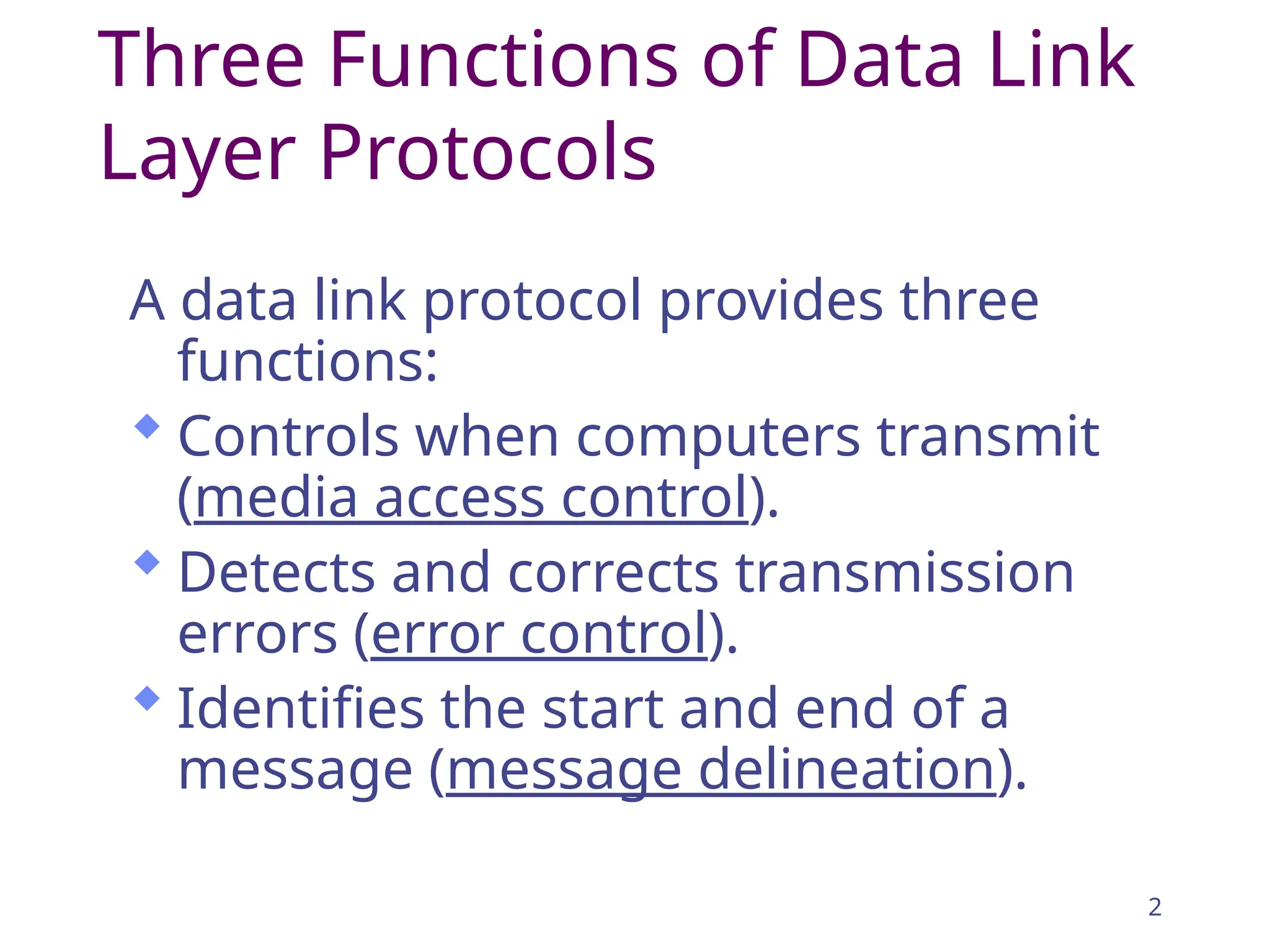
A data link protocol provides three
functions:
Controls when computers transmit
(media access control).
Detects and corrects transmission
errors (error control).
Identifies the start and end of a
message (message delineation).
3.
3
Media Access Control
Mediaaccess control (MAC) refers to
the need to control circuits when
devices transmit.
Two types of MAC:
Polling
Contention
4.
4
Transmission Error Control
All transmission media have potential
for introduction of errors
All data link layer protocols must
provide method for controlling errors
Error control process has two
components
Error detection
Error correction
5.
5
Error Control inNetworks
There are two types of errors associated with
networks.
Human errors, controlled by application
programs
Network errors, controlled by the network
There are two categories of network errors.
Corrupted data (that have been changed)
Lost data
6.
6
What are NetworkErrors?
Network errors are a fact of life in data
communications networks.
Normally errors occur in bursts.
In a burst error, more than one data bit is
changed by the error-causing condition.
Errors are not uniformly distributed, regardless of
error rate statistics.
Dial-up lines are more prone to errors because
they have less stable parameters.
7.
7
Network Error
Onebit error in 1000 bits results in an
error rate of 0.001. However, it also
means that one character made up of
8-bit is not correct. The character
error rate becomes 1/125. It is 8
times of the bit error rate.
8.
8
Network Error
The factthat errors tend to be clustered in
bursts rather than evenly dispersed is
both good and bad:
Good: long period error-free transmission
Bad: it is more difficult to recover the data
from the errors.
I h*ve a p*ncil in my p*cket
I have a *e**il in my pocket
Give me your *oney, or I’ll ki** you.
9.
9
Error Detection
It ispossible to develop data transmission
methodologies that give very high error
detection and correction performance.
The only way to do error detection and
correction is to send extra data with each
message.
In general, the larger the amount of error
detection data sent, the greater the ability
to detect an error.
11
Error Detection: ParityBits
Bit added to each character to make
all bits add up to an even number
(even parity) or odd number (odd
parity)
Good for detecting single-bit errors
only
High overhead (one extra bit per 7-bit
character=12.5%)
12.
12
Parity Checking
One ofthe oldest and simplest method, parity
checking adds 1 additional bit to each byte in
the message. The value of this parity bit is
dependent on the number of 1’s in each byte
transmitted. Even parity causes the sum of all
bits (including the parity bit) to be even. Odd
parity causes the sum to be odd.
Unfortunately if two bits are erroneous, the parity
checking will fail. Parity checking results in
about a 50% reliability rate.
13.
13
Parity Checking
Assume weare using even parity with 7-bit ASCII.
The letter V in 7-bit ASCII is encoded as 0110101.
Because there are four 1s (an even number), parity is set to zero.
This would be transmitted as: 01101010.
Assume we are using odd parity with 7-bit ASCII.
The letter W in 7-bit ASCII is encoded as 1010111 (Oct127).
Because there are five 1s (an odd number), parity is set to zero.
This would be transmitted as: 10101110.
14.
14
Longitudinal Redundancy
Checking (LRC)
LRCwas developed to overcome the problem
with parity’s low probability of detection.
LRC adds one additional character, called the
block check character (BCC) to the end of the
entire message or packet of data.
The value of the BCC is calculated much like the
Parity bit, but for the entire message. Results
in a 98% reliability rate.
16
Polynomial Checking
Like LRC,polynomial checking adds 1 or more
characters to the end of the message based on a
mathematical algorithm.
With checksum, 1 byte is added to the end of the
message. It is obtained by summing the
message values, and dividing by 255. The
remainder is the checksum. (95% effective)
With Cyclical Redundancy Check (CRC), 8, 16, 24 or
32 bits are added, computed by calculating a
remainder to a division problem.
17.
17
Error Detection: Cyclic
RedundancyCheck (CRC)
Data in frame treated as a single binary
number, divided by a unique prime binary,
and remainder is attached to frame
17-bit divisor leaves 16-bit remainder, 33-
bit divisor leaves 32-bit remainder
For a CRC of length N, errors undetected
are 2-N
Overhead is low (1-3%)
18.
18
Flow Control
Necessarywhen data is being sent faster
than it can be processed by receiver
The simplest, most effective, least
expensive, and most commonly used
method for transmission error control.
Using retransmission.
Computer to printer is typical setting
Can also be from computer to computer, when
a processing program is limited in capacity
19.
19
Stop-and-Wait Flow Control
Also called Stop-and-Wait Automatic Repeat
reQuest (ARQ)
It is the simplest form
Source may not send new frame until receiver
acknowledges the frame already sent
Very inefficient, especially when a single
message is broken into separate frames, or
when the data link is long enough for
significant delays to be introduced
20.
20
Error Correction
Areceiver that detects an error simply asks the sender to
retransmit the message until it is received without error.
Lost frame
Damaged frame
With Stop and Wait ARQ the sender stops and waits for a
response from the receiver after each message or data
package.
Responses are:
Error detection
Positive acknowledgment (ACK)
Negative acknowledgment and retransmission (NAK)
Retransmission after time-out
21.
21
Stop-and-Wait ARQ
Oneframe received and handled at a time
If frame is damaged, receiver discards it
and sends no acknowledgment
Sender uses timer to determine whether or not
to retransmit
Sender must keep a copy of transmitted frame
until acknowledgment is received
If acknowledgment is damaged, sender will
know it because of numbering
23
Sliding-Window Flow Control
Also called Continuous ARQ
Allows multiple frames to be in transit
Receiver sends acknowledgement with
sequence number of anticipated frame
Sender maintains list of sequence numbers it
can send, receiver maintains list of sequence
numbers it can receive
ACK (acknowledgement, or RR – Receiver
Ready) supplemented with RNR (receiver not
ready)
24.
24
Go-Back-N ARQ
Usessliding-window flow control
When receiver detects error, it sends
negative acknowledgment (REJ)
Sender must begin transmitting
again from rejected frame
Transmitter must keep a copy of all
transmitted frames
25.
25
Error Correction via
Retransmission
With Continuous ARQ the sender does not wait for
acknowledgement before sending next message.
If it receives an REJ, it retransmits the needed
messages.
The packets that are retransmitted may be only
those containing an error (called Link Access
Protocol for Modems (LAP-M)), or may be the first
packet with an error and all those that followed it
(call Go-Back-N ARQ)
Continuous ARQ is a full-duplex transmission
technique.
26.
26
Packet Loss
Howit could be? Two possibilities:
The receiver did not receive the packet
The sender did not receive the ACK
message
What can we do with packet loss?
Use “Time-out” to detect packet loss
Re-send the packet if there is a “time-ou
t”
28
*Forward Error Correction
Forwarderror correction uses codes containing
sufficient redundancy to prevent errors by
detecting and correcting them at the
receiving end without retransmission of the
original message.
Hamming code is capable of correcting 1 bit error.
More sophisticated techniques, such as Reed-
Solomon, are commonly used.
commonly used in satellite transmission.
Chip implementations of FEC has been used in
modems, e.g. V.34.
32
Six Issues inPacket Design
Error correction
Addressing
Delineation
The transparency problem
Transmission efficiency (packet size
vs. bandwidth utilization ratio)
Media access control
33.
33
Asynchronous File Transfer
Protocols
Ingeneral, microcomputer file transfer
protocols are used on asynchronous point-to-
point circuits, typically across telephone lines
via a modem.
XMODEM (132 bytes)
XMODEM-CRC (CRC-8)
XMODEM-1K (CRC+1K blocks)
YMODEM(CRC-16)
ZMODEM (CRC-32)
KERMIT (CRC-24)
35
Asynchronous FTP
KERMIT
developedby Columbia University
support a variety of different packet
sizes and error detection methods
typically 1000bytes/packet with CRC-24
and adjustable during transmission
uses both stop-and-wait ARQ and
continuous ARQ
36.
36
Synchronous Transmission
With SynchronousTransmission all the
letters or data in one group of data is
transmitted at one time as a block of
data called a frame or packet.
The start and end of each packet
sometimes is marked by adding
synchronization characters (SYN) at
the start/end of each packet.
37.
37
Synchronous Transmission
There aremany protocols for
synchronous transmission that fall
into three broad categories:
Byte-oriented
Bit-oriented
Byte-count
38.
38
High-Level Data LinkControl
(HDLC)
The OSI’s data link protocol
A bit-oriented protocol
On transmitting side, HDLC receives data from an
application, and delivers it to the receiver on the
other side of the link
On the receiving side, HDLC accepts the data and
delivers it to the higher level application layer
Both modules exchange control information,
encoded into a frame
(IBM’s SDLC has similar features and the format of HDLC)
39.
39
HDLC Frame Structure
Flag: 01111110, at
start and end
Address: secondary
station (for multidrop
configurations)
Information: the data
to be transmitted
Frame check
sequence: 16- or 32-bit
CRC
Control: purpose or
function of frame
Information frames:
contain user data
Supervisory frames:
flow/error control
(ACK/ARQ)
Unnumbered frames:
variety of control
functions (see p.131)
40.
40
Transparency Problem
Theproblem of transparency
Because HDLC uses 01111110 to mark
the start and end of a packet, the
character “01111110” will confuse the
receiver.
Solution - Bit Stuffing
Add a 0 after every five 1s at sender side
and delete the 0 at receiver side.
41.
41
HDLC Operation
Initialization:S-frames specify mode
and sequence numbers, U-frames
acknowledge
Data Transfer: I-frames exchange user
data, S-frames acknowledge and
provide flow/error control
Disconnect: U-frames initiate and
acknowledge
42.
42
Ethernet (IEEE 802.3)
Ethernet(IEEE 802.3) was conceived by Bob
Metcalfe in 1973 and developed jointly by
Digital, Intel, and Xerox in the 1970s.
It is a byte-count protocol. Therefore, Ethernet has
no transparency problem because it does not use
number of bytes to delineate the message.
It uses contention media access control.
The address is 6-byte
The maximum length of the message is 1492 bytes.
CRC-32 frame check.
43.
43
Frame Formats
Destination Sourceaddress Length Message CRC-32
address 6 bytes 2 bytes variable 4 bytes
6 bytes
Token Ring (IEEE802.5) format
Access control Frame check sequence
1 byte 4 bytes
Ethernet (IEEE802.3) format
Start Frame Destination Source Message End
delimiter control address address variable delimiter
44.
44
Serial Line InternetProtocol
Serial Line Internet Protocol (SLIP) is a byte-oriented
protocol designed to connect two computers using
Internet protocols over a point-to-point telephone
line. It is developed in 1980s.
SLIP suffers the transparency problem because it uses
“11000000” as END. So, it replaces the character in the
message with “11011001” (ESC) + “11011100”. This trick is
also used for ESC character itself, with a ESC + “11011101”.
Compressed SLIP (CSLIP) uses compression to reduce the
amount of data transmitted.
45.
45
Point-to-Point Protocol
Point-to-PointProtocol (PPP) is a byte-
oriented protocol developed in 1990s as a
replacement for SLIP.
The packet begins and ends with a flag
“01111110”. Therefore, it suffers the transparency
problem.
CRC-16 for error control
Supports network layer protocols other than just
Internet protocol.
Message length is up to 1500 bytes.
46.
46
Packet Formats ofSLIP and
PPP
PPP packet layout
Flag Address Control Message CRC-16 Flag
1 byte 1 byte 1 byte variable 2 bytes 1 byte
SLIP packet layout
End Message End
1 byte variable 1 byte