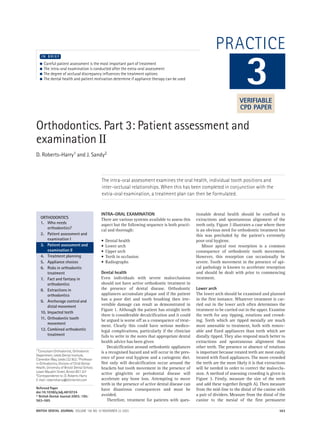
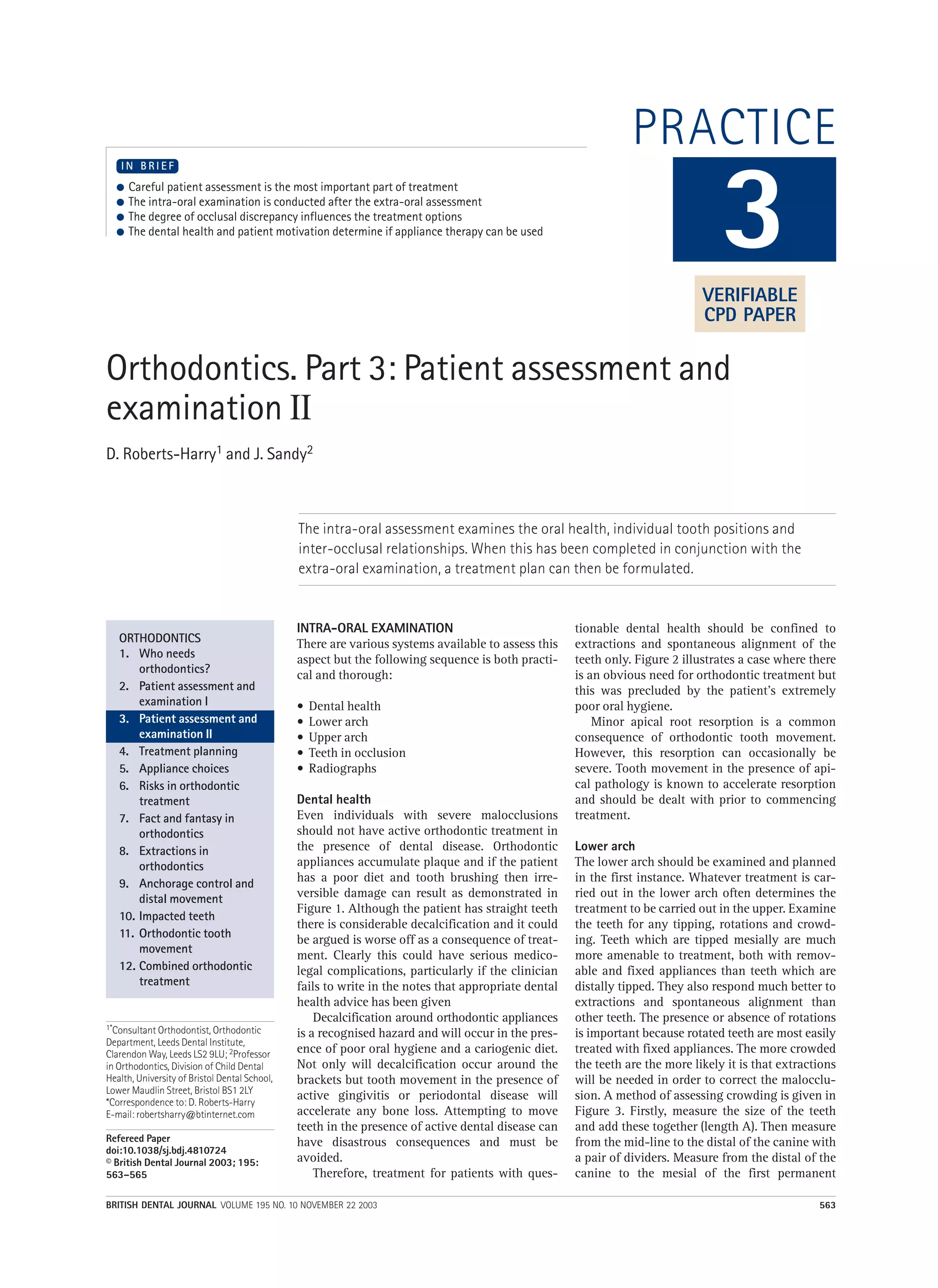
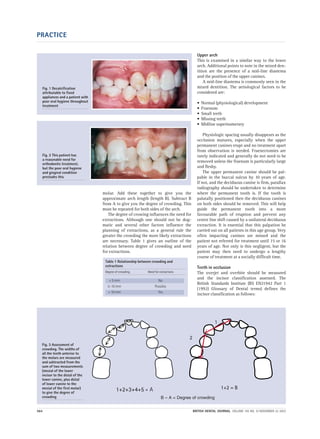
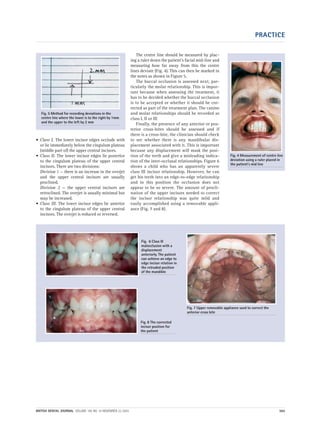
BRITISH DENTAL JOURNAL VOLUME 195 NO. 10 NOVEMBER 22 2003 563
PRACTICE
Orthodontics. Part 3: Patient assessment and
examination II
D. Roberts-Harry1 and J. Sandy2
The intra-oral assessment examines the oral health, individual tooth positions and
inter-occlusal relationships. When this has been completed in conjunction with the
extra-oral examination, a treatment plan can then be formulated.
1*Consultant Orthodontist, Orthodontic
Department, Leeds Dental Institute,
Clarendon Way, Leeds LS2 9LU; 2Professor
in Orthodontics, Division of Child Dental
Health, University of Bristol Dental School,
Lower Maudlin Street, Bristol BS1 2LY
*Correspondence to: D. Roberts-Harry
E-mail: robertsharry@btinternet.com
Refereed Paper
doi:10.1038/sj.bdj.4810724
© British Dental Journal 2003; 195:
563–565
● Careful patient assessment is the most important part of treatment
● The intra-oral examination is conducted after the extra-oral assessment
● The degree of occlusal discrepancy influences the treatment options
● The dental health and patient motivation determine if appliance therapy can be used
I N B R I E F
INTRA-ORAL EXAMINATION
There are various systems available to assess this
aspect but the following sequence is both practi-
cal and thorough:
• Dental health
• Lower arch
• Upper arch
• Teeth in occlusion
• Radiographs
Dental health
Even individuals with severe malocclusions
should not have active orthodontic treatment in
the presence of dental disease. Orthodontic
appliances accumulate plaque and if the patient
has a poor diet and tooth brushing then irre-
versible damage can result as demonstrated in
Figure 1. Although the patient has straight teeth
there is considerable decalcification and it could
be argued is worse off as a consequence of treat-
ment. Clearly this could have serious medico-
legal complications, particularly if the clinician
fails to write in the notes that appropriate dental
health advice has been given
Decalcification around orthodontic appliances
is a recognised hazard and will occur in the pres-
ence of poor oral hygiene and a cariogenic diet.
Not only will decalcification occur around the
brackets but tooth movement in the presence of
active gingivitis or periodontal disease will
accelerate any bone loss. Attempting to move
teeth in the presence of active dental disease can
have disastrous consequences and must be
avoided.
Therefore, treatment for patients with ques-
tionable dental health should be confined to
extractions and spontaneous alignment of the
teeth only. Figure 2 illustrates a case where there
is an obvious need for orthodontic treatment but
this was precluded by the patient's extremely
poor oral hygiene.
Minor apical root resorption is a common
consequence of orthodontic tooth movement.
However, this resorption can occasionally be
severe. Tooth movement in the presence of api-
cal pathology is known to accelerate resorption
and should be dealt with prior to commencing
treatment.
Lower arch
The lower arch should be examined and planned
in the first instance. Whatever treatment is car-
ried out in the lower arch often determines the
treatment to be carried out in the upper. Examine
the teeth for any tipping, rotations and crowd-
ing. Teeth which are tipped mesially are much
more amenable to treatment, both with remov-
able and fixed appliances than teeth which are
distally tipped. They also respond much better to
extractions and spontaneous alignment than
other teeth. The presence or absence of rotations
is important because rotated teeth are most easily
treated with fixed appliances. The more crowded
the teeth are the more likely it is that extractions
will be needed in order to correct the malocclu-
sion. A method of assessing crowding is given in
Figure 3. Firstly, measure the size of the teeth
and add these together (length A). Then measure
from the mid-line to the distal of the canine with
a pair of dividers. Measure from the distal of the
canine to the mesial of the first permanent
3
ORTHODONTICS
1. Who needs
orthodontics?
2. Patient assessment and
examination I
3. Patient assessment and
examination II
4. Treatment planning
5. Appliance choices
6. Risks in orthodontic
treatment
7. Fact and fantasy in
orthodontics
8. Extractions in
orthodontics
9. Anchorage control and
distal movement
10. Impacted teeth
11. Orthodontic tooth
movement
12. Combined orthodontic
treatment
VERIFIABLE
CPD PAPER
PRACTICE
564 BRITISH DENTAL JOURNAL VOLUME 195 NO. 10 NOVEMBER 22 2003
molar. Add these together to give you the
approximate arch length (length B). Subtract B
from A to give you the degree of crowding. This
must be repeated for both sides of the arch.
The degree of crowing influences the need for
extractions. Although one should not be dog-
matic and several other factors influence the
planning of extractions, as a general rule the
greater the crowding the more likely extractions
are necessary. Table 1 gives an outline of the
relation between degree of crowding and need
for extractions.
Upper arch
This is examined in a similar way to the lower
arch. Additional points to note in the mixed den-
tition are the presence of a mid-line diastema
and the position of the upper canines.
A mid-line diastema is commonly seen in the
mixed dentition. The aetiological factors to be
considered are:
• Normal (physiological) development
• Fraenum
• Small teeth
• Missing teeth
• Midline supernumerary
Physiologic spacing usually disappears as the
occlusion matures, especially when the upper
permanent canines erupt and no treatment apart
from observation is needed. Fraenectomies are
rarely indicated and generally do not need to be
removed unless the fraenum is particularly large
and fleshy.
The upper permanent canine should be pal-
pable in the buccal sulcus by 10 years of age.
If not, and the deciduous canine is firm, parallax
radiography should be undertaken to determine
where the permanent tooth is. If the tooth is
palatally positioned then the deciduous canines
on both sides should be removed. This will help
guide the permanent tooth into a more
favourable path of eruption and prevent any
centre line shift caused by a unilateral deciduous
extraction. It is essential that this palpation be
carried out on all patients in this age group. Very
often impacting canines are missed and the
patient not referred for treatment until 15 or 16
years of age. Not only is this negligent, but the
patient may then need to undergo a lengthy
course of treatment at a socially difficult time.
Teeth in occlusion
The overjet and overbite should be measured
and the incisor classification assessed. The
British Standards Institute (BS EN21942 Part 1
(1992) Glossary of Dental terms) defines the
incisor classification as follows:
Fig. 1 Decalcification
attributable to fixed
appliances and a patient with
poor oral hygiene throughout
treatment
Fig. 2 This patient has
a reasonable need for
orthodontic treatment,
but the poor oral hygiene
and gingival condition
precludes this
Table 1 Relationship between crowding and
extractions
Degree of crowding Need for extractions
< 5 mm No
5–10 mm Possibly
> 10 mm Yes
1+2+3+4+5 =A 1+2 = B
1
2
B – A = Degree of crowding
Fig. 3 Assessment of
crowding. The widths of
all the teeth anterior to
the molars are measured
and subtracted from the
sum of two measurements
(mesial of the lower
incisor to the distal of the
lower canine, plus distal
of lower canine to the
mesial of the first molar)
to give the degree of
crowding
PRACTICE
BRITISH DENTAL JOURNAL VOLUME 195 NO. 10 NOVEMBER 22 2003 565
• Class I. The lower incisor edges occlude with
or lie immediately below the cingulum plateau
(middle part of) the upper central incisors.
• Class II. The lower incisor edges lie posterior
to the cingulum plateau of the upper central
incisors. There are two divisions:
Division 1 — there is an increase in the overjet
and the upper central incisors are usually
proclined.
Division 2 — the upper central incisors are
retroclined. The overjet is usually minimal but
may be increased.
• Class III. The lower incisor edges lie anterior
to the cingulum plateau of the upper central
incisors. The overjet is reduced or reversed.
The centre line should be measured by plac-
ing a ruler down the patient's facial mid-line and
measuring how far away from this the centre
lines deviate (Fig. 4). This can then be marked in
the notes as shown in Figure 5.
The buccal occlusion is assessed next, par-
ticularly the molar relationship. This is impor-
tant because when assessing the treatment, it
has to be decided whether the buccal occlusion
is to be accepted or whether it should be cor-
rected as part of the treatment plan. The canine
and molar relationships should be recorded as
class I, II or III
Finally, the presence of any anterior or pos-
terior cross-bites should be assessed and if
there is a cross-bite, the clinician should check
to see whether there is any mandibular dis-
placement associated with it. This is important
because any displacement will mask the posi-
tion of the teeth and give a misleading indica-
tion of the inter-occlusal relationships. Figure 6
shows a child who has an apparently severe
class III incisor relationship. However, he can
get his teeth into an edge-to-edge relationship
and in this position the occlusion does not
appear to be so severe. The amount of procli-
nation of the upper incisors needed to correct
the incisor relationship was quite mild and
easily accomplished using a removable appli-
ance (Fig. 7 and 8).
Fig. 5 Method for recording deviations in the
centre line where the lower is to the right by 1mm
and the upper to the left by 2 mm
Fig. 4 Measurement of centre line
deviation using a ruler placed in
the patient's mid line
Fig. 6 Class III
malocclusion with a
displacement
anteriorly. The patient
can achieve an edge to
edge incisor relation in
the retruded position
of the mandible
Fig. 8 The corrected
incisor position for
the patient
Fig. 7 Upper removable appliance used to correct the
anterior cross bite

Part 3 patient assessment and

  • 1.
    BRITISH DENTAL JOURNALVOLUME 195 NO. 10 NOVEMBER 22 2003 563 PRACTICE Orthodontics. Part 3: Patient assessment and examination II D. Roberts-Harry1 and J. Sandy2 The intra-oral assessment examines the oral health, individual tooth positions and inter-occlusal relationships. When this has been completed in conjunction with the extra-oral examination, a treatment plan can then be formulated. 1*Consultant Orthodontist, Orthodontic Department, Leeds Dental Institute, Clarendon Way, Leeds LS2 9LU; 2Professor in Orthodontics, Division of Child Dental Health, University of Bristol Dental School, Lower Maudlin Street, Bristol BS1 2LY *Correspondence to: D. Roberts-Harry E-mail: robertsharry@btinternet.com Refereed Paper doi:10.1038/sj.bdj.4810724 © British Dental Journal 2003; 195: 563–565 ● Careful patient assessment is the most important part of treatment ● The intra-oral examination is conducted after the extra-oral assessment ● The degree of occlusal discrepancy influences the treatment options ● The dental health and patient motivation determine if appliance therapy can be used I N B R I E F INTRA-ORAL EXAMINATION There are various systems available to assess this aspect but the following sequence is both practi- cal and thorough: • Dental health • Lower arch • Upper arch • Teeth in occlusion • Radiographs Dental health Even individuals with severe malocclusions should not have active orthodontic treatment in the presence of dental disease. Orthodontic appliances accumulate plaque and if the patient has a poor diet and tooth brushing then irre- versible damage can result as demonstrated in Figure 1. Although the patient has straight teeth there is considerable decalcification and it could be argued is worse off as a consequence of treat- ment. Clearly this could have serious medico- legal complications, particularly if the clinician fails to write in the notes that appropriate dental health advice has been given Decalcification around orthodontic appliances is a recognised hazard and will occur in the pres- ence of poor oral hygiene and a cariogenic diet. Not only will decalcification occur around the brackets but tooth movement in the presence of active gingivitis or periodontal disease will accelerate any bone loss. Attempting to move teeth in the presence of active dental disease can have disastrous consequences and must be avoided. Therefore, treatment for patients with ques- tionable dental health should be confined to extractions and spontaneous alignment of the teeth only. Figure 2 illustrates a case where there is an obvious need for orthodontic treatment but this was precluded by the patient's extremely poor oral hygiene. Minor apical root resorption is a common consequence of orthodontic tooth movement. However, this resorption can occasionally be severe. Tooth movement in the presence of api- cal pathology is known to accelerate resorption and should be dealt with prior to commencing treatment. Lower arch The lower arch should be examined and planned in the first instance. Whatever treatment is car- ried out in the lower arch often determines the treatment to be carried out in the upper. Examine the teeth for any tipping, rotations and crowd- ing. Teeth which are tipped mesially are much more amenable to treatment, both with remov- able and fixed appliances than teeth which are distally tipped. They also respond much better to extractions and spontaneous alignment than other teeth. The presence or absence of rotations is important because rotated teeth are most easily treated with fixed appliances. The more crowded the teeth are the more likely it is that extractions will be needed in order to correct the malocclu- sion. A method of assessing crowding is given in Figure 3. Firstly, measure the size of the teeth and add these together (length A). Then measure from the mid-line to the distal of the canine with a pair of dividers. Measure from the distal of the canine to the mesial of the first permanent 3 ORTHODONTICS 1. Who needs orthodontics? 2. Patient assessment and examination I 3. Patient assessment and examination II 4. Treatment planning 5. Appliance choices 6. Risks in orthodontic treatment 7. Fact and fantasy in orthodontics 8. Extractions in orthodontics 9. Anchorage control and distal movement 10. Impacted teeth 11. Orthodontic tooth movement 12. Combined orthodontic treatment VERIFIABLE CPD PAPER
  • 2.
    PRACTICE 564 BRITISH DENTALJOURNAL VOLUME 195 NO. 10 NOVEMBER 22 2003 molar. Add these together to give you the approximate arch length (length B). Subtract B from A to give you the degree of crowding. This must be repeated for both sides of the arch. The degree of crowing influences the need for extractions. Although one should not be dog- matic and several other factors influence the planning of extractions, as a general rule the greater the crowding the more likely extractions are necessary. Table 1 gives an outline of the relation between degree of crowding and need for extractions. Upper arch This is examined in a similar way to the lower arch. Additional points to note in the mixed den- tition are the presence of a mid-line diastema and the position of the upper canines. A mid-line diastema is commonly seen in the mixed dentition. The aetiological factors to be considered are: • Normal (physiological) development • Fraenum • Small teeth • Missing teeth • Midline supernumerary Physiologic spacing usually disappears as the occlusion matures, especially when the upper permanent canines erupt and no treatment apart from observation is needed. Fraenectomies are rarely indicated and generally do not need to be removed unless the fraenum is particularly large and fleshy. The upper permanent canine should be pal- pable in the buccal sulcus by 10 years of age. If not, and the deciduous canine is firm, parallax radiography should be undertaken to determine where the permanent tooth is. If the tooth is palatally positioned then the deciduous canines on both sides should be removed. This will help guide the permanent tooth into a more favourable path of eruption and prevent any centre line shift caused by a unilateral deciduous extraction. It is essential that this palpation be carried out on all patients in this age group. Very often impacting canines are missed and the patient not referred for treatment until 15 or 16 years of age. Not only is this negligent, but the patient may then need to undergo a lengthy course of treatment at a socially difficult time. Teeth in occlusion The overjet and overbite should be measured and the incisor classification assessed. The British Standards Institute (BS EN21942 Part 1 (1992) Glossary of Dental terms) defines the incisor classification as follows: Fig. 1 Decalcification attributable to fixed appliances and a patient with poor oral hygiene throughout treatment Fig. 2 This patient has a reasonable need for orthodontic treatment, but the poor oral hygiene and gingival condition precludes this Table 1 Relationship between crowding and extractions Degree of crowding Need for extractions < 5 mm No 5–10 mm Possibly > 10 mm Yes 1+2+3+4+5 =A 1+2 = B 1 2 B – A = Degree of crowding Fig. 3 Assessment of crowding. The widths of all the teeth anterior to the molars are measured and subtracted from the sum of two measurements (mesial of the lower incisor to the distal of the lower canine, plus distal of lower canine to the mesial of the first molar) to give the degree of crowding
  • 3.
    PRACTICE BRITISH DENTAL JOURNALVOLUME 195 NO. 10 NOVEMBER 22 2003 565 • Class I. The lower incisor edges occlude with or lie immediately below the cingulum plateau (middle part of) the upper central incisors. • Class II. The lower incisor edges lie posterior to the cingulum plateau of the upper central incisors. There are two divisions: Division 1 — there is an increase in the overjet and the upper central incisors are usually proclined. Division 2 — the upper central incisors are retroclined. The overjet is usually minimal but may be increased. • Class III. The lower incisor edges lie anterior to the cingulum plateau of the upper central incisors. The overjet is reduced or reversed. The centre line should be measured by plac- ing a ruler down the patient's facial mid-line and measuring how far away from this the centre lines deviate (Fig. 4). This can then be marked in the notes as shown in Figure 5. The buccal occlusion is assessed next, par- ticularly the molar relationship. This is impor- tant because when assessing the treatment, it has to be decided whether the buccal occlusion is to be accepted or whether it should be cor- rected as part of the treatment plan. The canine and molar relationships should be recorded as class I, II or III Finally, the presence of any anterior or pos- terior cross-bites should be assessed and if there is a cross-bite, the clinician should check to see whether there is any mandibular dis- placement associated with it. This is important because any displacement will mask the posi- tion of the teeth and give a misleading indica- tion of the inter-occlusal relationships. Figure 6 shows a child who has an apparently severe class III incisor relationship. However, he can get his teeth into an edge-to-edge relationship and in this position the occlusion does not appear to be so severe. The amount of procli- nation of the upper incisors needed to correct the incisor relationship was quite mild and easily accomplished using a removable appli- ance (Fig. 7 and 8). Fig. 5 Method for recording deviations in the centre line where the lower is to the right by 1mm and the upper to the left by 2 mm Fig. 4 Measurement of centre line deviation using a ruler placed in the patient's mid line Fig. 6 Class III malocclusion with a displacement anteriorly. The patient can achieve an edge to edge incisor relation in the retruded position of the mandible Fig. 8 The corrected incisor position for the patient Fig. 7 Upper removable appliance used to correct the anterior cross bite