Introduction to
Orthodontics
SOUTHERN CALIFORNIA ORTHODONTIC ASSISTING SCHOOL
What is
Orthodontics?
SOUTHERN CALIFORNIA ORTHODONTIC ASSISTING SCHOOL
The History of Orthodontics
 First practiced by a man named Pierre Fauchard in 1728, attempting to
widen the upper arch with a U-shaped piece of iron
 The first orthodontic wires were fabricated from noble alloys such as gold
or platinum
 Although there are early signs of tooth alignment in the 1700’s and 1800’s,
Orthodontics did not become a practice of its own until the 1900’s
 In the 2000’s, Edward Angle came up with classifications for malocclusion:
Class I, II and III. This system is still used today to describe different types
of bites and angulations
How it Works
 Orthodontics is described as the process of movement of teeth as a result
of force to the crown and root.
 The constant pressure to the tooth allows slow movement through the
aveolar bone, breaking down and rebuilding around the tooth.
 Abrupt force can break down bone quicker than it can rebuild, causing
root resorption and bone loss
 Bodily Movement: Movement of forces where the root and the crown of
the teeth move in parallel and horizontal straightness. The goal for
successful tooth movement
 It is important to practice light continuous force to maintain blood supply,
heavy force reduces it
Types of Treatment
SOUTHERN CALIFORNIA ORTHODONTIC ASSISTING SCHOOL
Phase I & Phase II Treatment
 Phase I treatment, aka interceptive treatment, usually occurs in children as
early as 7 years old
 The patients teeth, jaw are still developing, making certain conditions
easier to address
 Phase I usually has a mixed dentition: Permanent and deciduous teeth
 Only partially bonded, braces are not on all teeth
 More treatment is usually needed later on (Phase II) but less involved or
shorter length
Comprehensive Treatment
 The goal of comprehensive treatment is to establish an ideal bite
 Treatment length can vary from 6-36 months
 May involve coordinated care with other specialist such as oral surgeons to
achieve optimal result aesthetically and mechanically
 Serial extraction: The removal of first or second bicuspids to create space for
alignment of teeth and achieve normal occlusion
 Frenectomy: Surgically cutting the muscle of the frenum (usually with a laser) to
prevent the opening of a gap
 Wisdom teeth extraction: When molars are impacted and may cause crowding
of the teeth in the future (relapse)
 Exposure and bonding chain: When tooth is impacted in gum tissue, surgeon
will expose portion of tooth closest to surface and bond chain for Orthodontist
to control extrusion and bring into alignment
Limited Treatment
 The option of accepting patients abnormal posterior bite and just aligning
the visible teeth so treatment can be completed as soon as possible
 Does not correct all aspects of dentition
 Purely aesthetic option
Types of Brackets
SOUTHERN CALIFORNIA ORTHODONTIC ASSISTING SCHOOL
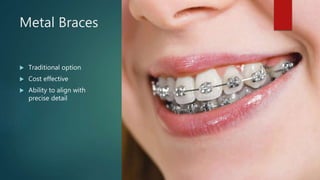
Metal Braces
 Traditional option
 Cost effective
 Ability to align with
precise detail
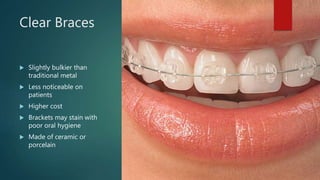
Clear Braces
 Slightly bulkier than
traditional metal
 Less noticeable on
patients
 Higher cost
 Brackets may stain with
poor oral hygiene
 Made of ceramic or
porcelain
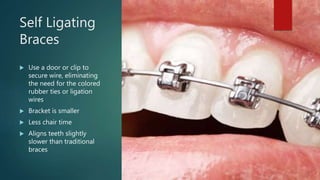
Self Ligating
Braces
 Use a door or clip to
secure wire, eliminating
the need for the colored
rubber ties or ligation
wires
 Bracket is smaller
 Less chair time
 Aligns teeth slightly
slower than traditional
braces
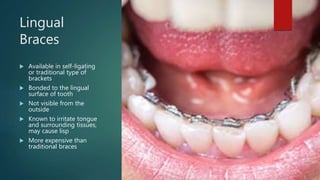
Lingual
Braces
 Available in self-ligating
or traditional type of
brackets
 Bonded to the lingual
surface of tooth
 Not visible from the
outside
 Known to irritate tongue
and surrounding tissues,
may cause lisp
 More expensive than
traditional braces
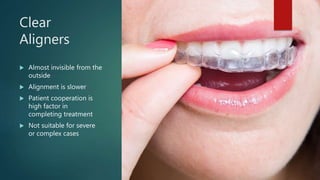
Clear
Aligners
 Almost invisible from the
outside
 Alignment is slower
 Patient cooperation is
high factor in
completing treatment
 Not suitable for severe
or complex cases
Tooth Numbering
System & Charting
SOUTHERN CALIFORNIA ORTHODNTIC ASSISTING SCHOOL
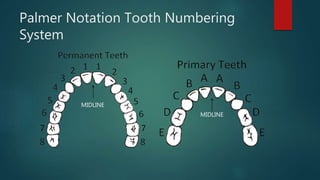
Palmer Notation Tooth Numbering
System
MIDLINE
MIDLINE
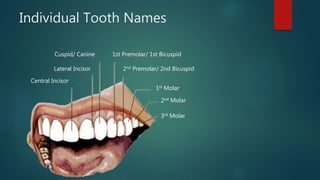
Individual Tooth Names
Central Incisor
Lateral Incisor
Cuspid/ Canine 1st Premolar/ 1st Bicuspid
2nd Premolar/ 2nd Bicuspid
1st Molar
2nd Molar
3rd Molar
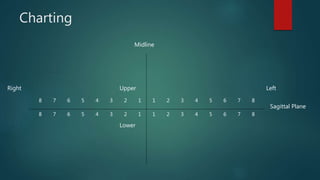
Charting
8 7 6 5 4 3 2 1 1 2 3 4 5 6 7 8
8 7 6 5 4 3 2 1 1 2 3 4 5 6 7 8
Upper
Lower
Right Left
Midline
Sagittal Plane
Orthodontic Records
SOUTHERN CALIFORNIA ORTHODONTIC ASSISTING SCHOOL
Photographs
 The purpose of photos is to allow the doctor to study the patients soft
tissue patterns, facial profile and anatomy without the patient being there
 Used for treatment planning and documenting progress
 Facial photos: Hair must be behind ears and shoulders. Remove any big
earrings, glasses, headbands or bulky hoodies
 Occlusal photos: Tongue must be relaxed and above the mirror. Avoid
mirror fogging by heating mirror. The purpose of these photos is to
observe the lingual and occlusal surfaces of the teeth
 Bite photos: Depending on the patients anatomy, the goal of this photo is
to be able to see at least to the distal of the first molar. Confirm picture is a
straight view of teeth, angle should not be coming from underneath where
chewing surfaces are visible.
Panoramic X-ray
 The purpose of a panoramic x-ray is to show a wide view of the nasal area,
sinuses jaw and teeth. Helpful for assessing TMJ, root length and
resorption, impacted teeth, cysts, ect.
 Remove all piercings on or inside the face
 X-ray bite plane should be perfectly horizontal, slight smile is OK but never
a frown
Cephalometric X-ray
 The purpose of a cephalometric x-ray is to determine if the malocclusion, if
any, is due to the skeletal relationship, dental relationship or both
 Remove all piercing on or inside face
 There should be a straight line from the porion to the bottom of eye
socket
 Crease of neck to chin should be visible in x-ray
 Lips relaxed as if they were asleep
 Neck perfectly straight, there should be no bends in neck bone. If thin is
too high up, neck will curve back. If chin is too far down, they will be in a
leaning position
 Ruler point should be on indent between eyes
Impressions
 The purpose of impressions is to create a negative imprint of teeth and
soft tissues that is poured with stone to make a physical study model
 Alginate: Mixed from water and powder to liquid or semi solid at first, then
solidifies to an imprint of the structures of the mouth
 Do not overfill or under fill impression tray
 If impressions are not poured immediately (recommended) you must keep
in 100% humidity to avoid distortion
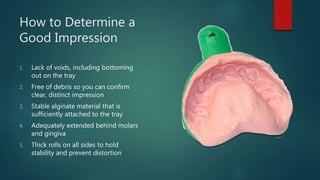
How to Determine a
Good Impression
1. Lack of voids, including bottoming
out on the tray
2. Free of debris so you can confirm
clear, distinct impression
3. Stable alginate material that is
sufficiently attached to the tray
4. Adequately extended behind molars
and gingiva
5. Thick rolls on all sides to hold
stability and prevent distortion
Study Models
 After pouring the impression with stone material, you separate the stone
from the alginate and the outcome is a study model
 Used for diagnosing, treatment planning and documentation
 Models can also be used to fabricate appliances such as hawley retainers
or rapid palatal expanders, ect.
iTero Digital Scanner
 The digital scanner offers comprehensive tools such as measuring width
and canine distance to help the doctor create a more precise treatment
plan
 Has the ability to scan full arches with the palate and bite that can easily be
viewed from the frontal and occlusal angles
 Captures 100,000’s of laser points per second to digitally capture the shape
and surfaces of the teeth
Angles Classifications
& Malocclusions
SOUTHERN CALIFORNIA ORTHODONTIC ASSISTING SCHOOL
Class I Malocclusion
 Class I malocclusion is a normal relationship between the upper and lower
teeth, but may have spacing and/or crowding
 The mesial cusp of the upper first molar rests in the lower first molars
deepest curvature
What is a Malocclusion?
Malocclusion is the misalignment of teeth or irregular relationship between the
upper and lower arches as they come to a physiological rest position (natural bite).
Malocclusion can be hereditary, make the ability to masticate (chew food) more
difficult, effect speech and oral hygiene and lead to shortening the life of the
adjacent tooth structures.
Centric Occlusion: When the molar teeth are closed and touching and teeth & jaw
are in the most unstrained/relaxed position
Class II Malocclusion
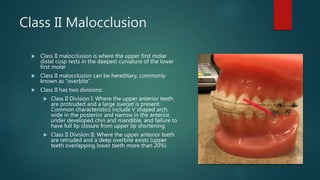
 Class II malocclusion is where the upper first molar
distal cusp rests in the deepest curvature of the lower
first molar
 Class II malocclusion can be hereditary, commonly
known as “overbite”.
 Class II has two divisions:
 Class II Division I: Where the upper anterior teeth
are protruded and a large overjet is present.
Common characteristics include V shaped arch,
wide in the posterior and narrow in the anterior,
under developed chin and mandible, and failure to
have full lip closure from upper lip shortening
 Class II Division II: Where the upper anterior teeth
are retruded and a deep overbite exists (upper
teeth overlapping lower teeth more than 20%)
Class III Malocclusion
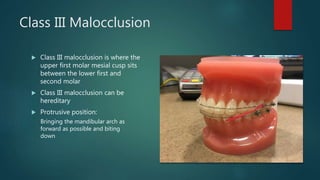
 Class III malocclusion is where the
upper first molar mesial cusp sits
between the lower first and
second molar
 Class III malocclusion can be
hereditary
 Protrusive position:
Bringing the mandibular arch as
forward as possible and biting
down
Headgear
 Used as an outside force, the external parts of the appliance provide additional
support to successfully move teeth into proper position
 Usually recommended worn 12-14 hours a day, prescribed by the doctor
depending on severity of case
 Two components: Facebow (metal piece that attached to band tubes) &
headgear strap
 There are two types of headgear straps
 Cervical: Not as visually apparent, but can cause extrusion of first molars which can
lead to an open bite
 High Pull: Will not extrude the first molars, but there is less control over applying
forces on maxillary and there is more hardware for the patient to wear
 Reverse Pull Headgear: Stimulating the upper maxilla to grow forward using
anteriorly directed force in conjunction with elastics
Cross Bite
 A cross bite is one or more of the upper teeth biting lingual (behind) to the
lower teeth
Open Bite
 Open bite is defined as inadequate vertical overlap of the front teeth
 It can be caused from oral habits such as tongue thrust and thumb sucking, or
hereditary

CA Orthodontic Assisting Permit Course Day 1-2

  • 1.
  • 2.
    What is Orthodontics? SOUTHERN CALIFORNIAORTHODONTIC ASSISTING SCHOOL
  • 3.
    The History ofOrthodontics  First practiced by a man named Pierre Fauchard in 1728, attempting to widen the upper arch with a U-shaped piece of iron  The first orthodontic wires were fabricated from noble alloys such as gold or platinum  Although there are early signs of tooth alignment in the 1700’s and 1800’s, Orthodontics did not become a practice of its own until the 1900’s  In the 2000’s, Edward Angle came up with classifications for malocclusion: Class I, II and III. This system is still used today to describe different types of bites and angulations
  • 4.
    How it Works Orthodontics is described as the process of movement of teeth as a result of force to the crown and root.  The constant pressure to the tooth allows slow movement through the aveolar bone, breaking down and rebuilding around the tooth.  Abrupt force can break down bone quicker than it can rebuild, causing root resorption and bone loss  Bodily Movement: Movement of forces where the root and the crown of the teeth move in parallel and horizontal straightness. The goal for successful tooth movement  It is important to practice light continuous force to maintain blood supply, heavy force reduces it
  • 5.
    Types of Treatment SOUTHERNCALIFORNIA ORTHODONTIC ASSISTING SCHOOL
  • 6.
    Phase I &Phase II Treatment  Phase I treatment, aka interceptive treatment, usually occurs in children as early as 7 years old  The patients teeth, jaw are still developing, making certain conditions easier to address  Phase I usually has a mixed dentition: Permanent and deciduous teeth  Only partially bonded, braces are not on all teeth  More treatment is usually needed later on (Phase II) but less involved or shorter length
  • 7.
    Comprehensive Treatment  Thegoal of comprehensive treatment is to establish an ideal bite  Treatment length can vary from 6-36 months  May involve coordinated care with other specialist such as oral surgeons to achieve optimal result aesthetically and mechanically  Serial extraction: The removal of first or second bicuspids to create space for alignment of teeth and achieve normal occlusion  Frenectomy: Surgically cutting the muscle of the frenum (usually with a laser) to prevent the opening of a gap  Wisdom teeth extraction: When molars are impacted and may cause crowding of the teeth in the future (relapse)  Exposure and bonding chain: When tooth is impacted in gum tissue, surgeon will expose portion of tooth closest to surface and bond chain for Orthodontist to control extrusion and bring into alignment
  • 8.
    Limited Treatment  Theoption of accepting patients abnormal posterior bite and just aligning the visible teeth so treatment can be completed as soon as possible  Does not correct all aspects of dentition  Purely aesthetic option
  • 9.
    Types of Brackets SOUTHERNCALIFORNIA ORTHODONTIC ASSISTING SCHOOL
  • 10.
    Metal Braces  Traditionaloption  Cost effective  Ability to align with precise detail
  • 11.
    Clear Braces  Slightlybulkier than traditional metal  Less noticeable on patients  Higher cost  Brackets may stain with poor oral hygiene  Made of ceramic or porcelain
  • 12.
    Self Ligating Braces  Usea door or clip to secure wire, eliminating the need for the colored rubber ties or ligation wires  Bracket is smaller  Less chair time  Aligns teeth slightly slower than traditional braces
  • 13.
    Lingual Braces  Available inself-ligating or traditional type of brackets  Bonded to the lingual surface of tooth  Not visible from the outside  Known to irritate tongue and surrounding tissues, may cause lisp  More expensive than traditional braces
  • 14.
    Clear Aligners  Almost invisiblefrom the outside  Alignment is slower  Patient cooperation is high factor in completing treatment  Not suitable for severe or complex cases
  • 15.
    Tooth Numbering System &Charting SOUTHERN CALIFORNIA ORTHODNTIC ASSISTING SCHOOL
  • 16.
    Palmer Notation ToothNumbering System MIDLINE MIDLINE
  • 17.
    Individual Tooth Names CentralIncisor Lateral Incisor Cuspid/ Canine 1st Premolar/ 1st Bicuspid 2nd Premolar/ 2nd Bicuspid 1st Molar 2nd Molar 3rd Molar
  • 18.
    Charting 8 7 65 4 3 2 1 1 2 3 4 5 6 7 8 8 7 6 5 4 3 2 1 1 2 3 4 5 6 7 8 Upper Lower Right Left Midline Sagittal Plane
  • 19.
    Orthodontic Records SOUTHERN CALIFORNIAORTHODONTIC ASSISTING SCHOOL
  • 20.
    Photographs  The purposeof photos is to allow the doctor to study the patients soft tissue patterns, facial profile and anatomy without the patient being there  Used for treatment planning and documenting progress  Facial photos: Hair must be behind ears and shoulders. Remove any big earrings, glasses, headbands or bulky hoodies  Occlusal photos: Tongue must be relaxed and above the mirror. Avoid mirror fogging by heating mirror. The purpose of these photos is to observe the lingual and occlusal surfaces of the teeth  Bite photos: Depending on the patients anatomy, the goal of this photo is to be able to see at least to the distal of the first molar. Confirm picture is a straight view of teeth, angle should not be coming from underneath where chewing surfaces are visible.
  • 21.
    Panoramic X-ray  Thepurpose of a panoramic x-ray is to show a wide view of the nasal area, sinuses jaw and teeth. Helpful for assessing TMJ, root length and resorption, impacted teeth, cysts, ect.  Remove all piercings on or inside the face  X-ray bite plane should be perfectly horizontal, slight smile is OK but never a frown
  • 22.
    Cephalometric X-ray  Thepurpose of a cephalometric x-ray is to determine if the malocclusion, if any, is due to the skeletal relationship, dental relationship or both  Remove all piercing on or inside face  There should be a straight line from the porion to the bottom of eye socket  Crease of neck to chin should be visible in x-ray  Lips relaxed as if they were asleep  Neck perfectly straight, there should be no bends in neck bone. If thin is too high up, neck will curve back. If chin is too far down, they will be in a leaning position  Ruler point should be on indent between eyes
  • 23.
    Impressions  The purposeof impressions is to create a negative imprint of teeth and soft tissues that is poured with stone to make a physical study model  Alginate: Mixed from water and powder to liquid or semi solid at first, then solidifies to an imprint of the structures of the mouth  Do not overfill or under fill impression tray  If impressions are not poured immediately (recommended) you must keep in 100% humidity to avoid distortion
  • 24.
    How to Determinea Good Impression 1. Lack of voids, including bottoming out on the tray 2. Free of debris so you can confirm clear, distinct impression 3. Stable alginate material that is sufficiently attached to the tray 4. Adequately extended behind molars and gingiva 5. Thick rolls on all sides to hold stability and prevent distortion
  • 25.
    Study Models  Afterpouring the impression with stone material, you separate the stone from the alginate and the outcome is a study model  Used for diagnosing, treatment planning and documentation  Models can also be used to fabricate appliances such as hawley retainers or rapid palatal expanders, ect.
  • 26.
    iTero Digital Scanner The digital scanner offers comprehensive tools such as measuring width and canine distance to help the doctor create a more precise treatment plan  Has the ability to scan full arches with the palate and bite that can easily be viewed from the frontal and occlusal angles  Captures 100,000’s of laser points per second to digitally capture the shape and surfaces of the teeth
  • 27.
    Angles Classifications & Malocclusions SOUTHERNCALIFORNIA ORTHODONTIC ASSISTING SCHOOL
  • 28.
    Class I Malocclusion Class I malocclusion is a normal relationship between the upper and lower teeth, but may have spacing and/or crowding  The mesial cusp of the upper first molar rests in the lower first molars deepest curvature What is a Malocclusion? Malocclusion is the misalignment of teeth or irregular relationship between the upper and lower arches as they come to a physiological rest position (natural bite). Malocclusion can be hereditary, make the ability to masticate (chew food) more difficult, effect speech and oral hygiene and lead to shortening the life of the adjacent tooth structures. Centric Occlusion: When the molar teeth are closed and touching and teeth & jaw are in the most unstrained/relaxed position
  • 29.
    Class II Malocclusion Class II malocclusion is where the upper first molar distal cusp rests in the deepest curvature of the lower first molar  Class II malocclusion can be hereditary, commonly known as “overbite”.  Class II has two divisions:  Class II Division I: Where the upper anterior teeth are protruded and a large overjet is present. Common characteristics include V shaped arch, wide in the posterior and narrow in the anterior, under developed chin and mandible, and failure to have full lip closure from upper lip shortening  Class II Division II: Where the upper anterior teeth are retruded and a deep overbite exists (upper teeth overlapping lower teeth more than 20%)
  • 30.
    Class III Malocclusion Class III malocclusion is where the upper first molar mesial cusp sits between the lower first and second molar  Class III malocclusion can be hereditary  Protrusive position: Bringing the mandibular arch as forward as possible and biting down
  • 31.
    Headgear  Used asan outside force, the external parts of the appliance provide additional support to successfully move teeth into proper position  Usually recommended worn 12-14 hours a day, prescribed by the doctor depending on severity of case  Two components: Facebow (metal piece that attached to band tubes) & headgear strap  There are two types of headgear straps  Cervical: Not as visually apparent, but can cause extrusion of first molars which can lead to an open bite  High Pull: Will not extrude the first molars, but there is less control over applying forces on maxillary and there is more hardware for the patient to wear  Reverse Pull Headgear: Stimulating the upper maxilla to grow forward using anteriorly directed force in conjunction with elastics
  • 32.
    Cross Bite  Across bite is one or more of the upper teeth biting lingual (behind) to the lower teeth Open Bite  Open bite is defined as inadequate vertical overlap of the front teeth  It can be caused from oral habits such as tongue thrust and thumb sucking, or hereditary

Editor's Notes

  • #19 After slides for day are done (1-18), students practice placing AW’s & placement & removal of elastic ties. Give Vocabulary list & review. Quiz
  • #33 After slides 9-32, students will pair up and take orthodontic photographs on eachother, then sterilize their mirrors and cheek retractors. Students will also take impression on themselves. Save impression for next class instruction. Give students quiz.