

SWITZERLAND – BUSINESS LAWS
PRESENTED BY –
SAVI ARORA
PRESENTED TO –
PROF. RAJPREET CHHATAL AND THE CLASS
VALUE-ADDED TAX (VAT)
Name of the tax Value-added tax (VAT)
Local names Mehrwertsteuer (MWST)
Introduced on 1 January 1995
Administered by Federal Tax Administration
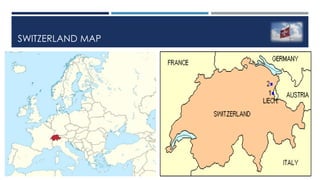
SWITZERLAND MAP
SCOPE OF TAX
VAT applies to the following transactions:
1) Delivery of goods in Switzerland (including Liechtenstein);
2) Supply of services in Switzerland (including Liechtenstein);
3) The receipt of reverse-charge services or purchase of services (and
certain goods deliveries in Switzerland) from enterprises with their
registered office in another country if the value of goods or services
exceeds CHF 10,000 per year; and
4) Import of goods.
WHO IS LIABLE
Any legal entity, establishment, partnership or association
without legal capacity, institution, etc. that operates an
enterprise (obtains revenues through business or professional
activity for a long period of time, regardless of whether there is
an intention to make money) is liable for tax.
There is a registration obligation if the taxable turnover in
Switzerland exceeds CHF 100,000 per year.
GROUP REGISTRATION
Legal persons with their seat in Switzerland or commercial units in
Switzerland can form a VAT group if they are related as a result of “joint
supervision.”
The group may include Swiss branches of foreign entities.
VAT group that includes both Swiss and Liechtenstein entities can not be
formed.
The tax group must appoint a tax representative.
The minimum period for which the tax group can exist is one year.
GROUP REGISTRATION
VAT group members are treated as a single taxable person with a
single VAT number.
The following are the significant aspects of grouping:
 The VAT group submits a single, consolidated VAT return for all of
its members.
 VAT is not chargeable on transactions between group members.
 All VAT group members are jointly and severally liable for the
group’s VAT liabilities.
REVERSE CHARGE
The “reverse charge” is a form of self-assessment for VAT through which the recipient
accounts for the tax.
The reverse-charge mechanism applies to the following situations:
 A Swiss recipient receives services from a supplier domiciled abroad who is not
registered for Swiss VAT, and the place of supply is in Switzerland.
 Data carriers without market value are imported into Switzerland, and certain services
and rights are associated with these data carriers.
 A supply of goods is made in Switzerland by a business that is established abroad and
that is not registered for Swiss VAT, and the supply is not subject to import VAT.
A Swiss recipient is liable for the settlement of VAT under the reverse-charge mechanism
if the recipient is a taxable person or if the value of the supplies received exceeds
CHF10,000 per calendar year
TAXABLE SUPPLIES
The term “taxable supplies” refers to supplies of goods and services
that are liable to VAT at any rate.
The term “tax-exempt without credit” refers to supplies of goods
and services that are not liable to tax and that do not give rise to a
right of input tax deduction.
The term “tax-exempt with credit” (zero-rated), which means that
no VAT is chargeable, but the supplier may recover the related
input tax.
VAT RATES
In Switzerland, the following are the VAT rates:
Standard rate: 8%
Reduced rate: 2.5%
Special rate of 3.8% (for hotel accommodation)
The standard VAT rate applies to all supplies of goods or services, unless a
specific measure provides for a reduced rate or an exemption.
EXAMPLES
Examples of tax-exempt without credit supplies
 Healthcare (in some cases; unless opted for taxation)
 Financial transactions
 Insurance
 Education (unless opted for taxation)
 Real estate (unless opted for taxation)
EXAMPLES
Examples of tax-exempt with credit supplies
 Exports of goods and services
 Supplies of certain goods and services to airlines
 Services with the place of supply abroad
 Supplies of investment gold
EXAMPLES
Examples of goods and services taxable at 2.5%
 Books, newspapers and magazines
 Food and drinks (except provided by hotels and restaurants)
 Drugs
 Water in pipes
Examples of goods and services taxable at 3.8%
 Hotel accommodation, including breakfast
TIME OF SUPPLY
The time when VAT becomes due is called the “time of supply”
or the “tax point”.
In Switzerland, taxable turnover must be declared for the VAT
quarter (or VAT month, if monthly declarations are filed) in
which the sales invoice for a supply is issued or in which
payment is received (if no invoice is issued).
TIME OF SUPPLY
 Prepayments. The tax point for a prepayment is when the supplier
receives the consideration or when the invoice is issued,
whichever is earlier.
 Reverse charge. The tax point for reverse-charge services for a
taxable person is when the invoice is received or when the
service fee is paid. In all other situations, including declarations
made on a cash basis, the effective payment date is decisive.
 Imported goods. The time of supply for imported goods is the
official date of importation.
RECOVERY OF VAT BY TAXABLE PERSON
A taxable person may recover input tax, which is VAT on
purchases, to the extent that the purchases of goods and
services are related to taxable supplies, including tax-exempt
supplies with credit and supplies rendered outside Switzerland
or Liechtenstein that would be taxable if rendered
domestically.
A taxable person generally recovers input tax by deducting it
from output tax, which is VAT charged on supplies made.
RECOVERY OF VAT BY TAXABLE PERSON
Input tax includes:
 VAT charged on goods and services supplied in Switzerland
and Liechtenstein,
 VAT paid on imports of goods and
 VAT self-assessed on reverse-charge supplies.
RECOVERY OF VAT BY TAXABLE PERSON
 Nondeductible input tax: Input tax may not be recovered on
purchases of goods and services that are not used for taxable
business purposes
 Partial exemption: If a Swiss taxable person makes both tax-
exempt supplies without credit and taxable supplies, it may not
recover input tax in full.
 Refunds: If the amount of input VAT recoverable in a period
exceeds the amount of output VAT payable in the same period,
the taxable person is entitled to a refund of the excess amount.
INVOICING
VAT invoices and corrections. A VAT invoice is necessary to support a refund under the
VAT refund scheme.
Proof of exports. Swiss VAT is not chargeable on supplies of exported goods. However, to
qualify as VAT-free, export supplies must be supported by evidence that the goods
have left Switzerland.
Foreign-currency invoices. If a Swiss VAT invoice is issued in a currency other than Swiss
francs (CHF), the amounts must be converted to Swiss francs, using the appropriate
exchange rates.
VAT registration numbers. Every company has received a unique and permanent
company identification number, has replaces Swiss VAT number.
VAT RETURNS AND PAYMENT
VAT returns. Swiss VAT returns are usually submitted for quarterly periods.
If the taxable person has applied to be taxed under the balance tax rate
method, VAT returns must be submitted on a half-yearly basis.
The VAT return is due, together with full payment, 60 days after the end of the
VAT settlement period.
VAT liabilities must be paid in Swiss francs.
Penalties. Interest at a rate of 4.5% a year may be assessed for the late payment
of VAT.
Thank You

Switzerland VAT

  • 1.
    SWITZERLAND – BUSINESSLAWS PRESENTED BY – SAVI ARORA PRESENTED TO – PROF. RAJPREET CHHATAL AND THE CLASS
  • 2.
    VALUE-ADDED TAX (VAT) Nameof the tax Value-added tax (VAT) Local names Mehrwertsteuer (MWST) Introduced on 1 January 1995 Administered by Federal Tax Administration
  • 3.
  • 4.
    SCOPE OF TAX VATapplies to the following transactions: 1) Delivery of goods in Switzerland (including Liechtenstein); 2) Supply of services in Switzerland (including Liechtenstein); 3) The receipt of reverse-charge services or purchase of services (and certain goods deliveries in Switzerland) from enterprises with their registered office in another country if the value of goods or services exceeds CHF 10,000 per year; and 4) Import of goods.
  • 5.
    WHO IS LIABLE Anylegal entity, establishment, partnership or association without legal capacity, institution, etc. that operates an enterprise (obtains revenues through business or professional activity for a long period of time, regardless of whether there is an intention to make money) is liable for tax. There is a registration obligation if the taxable turnover in Switzerland exceeds CHF 100,000 per year.
  • 6.
    GROUP REGISTRATION Legal personswith their seat in Switzerland or commercial units in Switzerland can form a VAT group if they are related as a result of “joint supervision.” The group may include Swiss branches of foreign entities. VAT group that includes both Swiss and Liechtenstein entities can not be formed. The tax group must appoint a tax representative. The minimum period for which the tax group can exist is one year.
  • 7.
    GROUP REGISTRATION VAT groupmembers are treated as a single taxable person with a single VAT number. The following are the significant aspects of grouping:  The VAT group submits a single, consolidated VAT return for all of its members.  VAT is not chargeable on transactions between group members.  All VAT group members are jointly and severally liable for the group’s VAT liabilities.
  • 8.
    REVERSE CHARGE The “reversecharge” is a form of self-assessment for VAT through which the recipient accounts for the tax. The reverse-charge mechanism applies to the following situations:  A Swiss recipient receives services from a supplier domiciled abroad who is not registered for Swiss VAT, and the place of supply is in Switzerland.  Data carriers without market value are imported into Switzerland, and certain services and rights are associated with these data carriers.  A supply of goods is made in Switzerland by a business that is established abroad and that is not registered for Swiss VAT, and the supply is not subject to import VAT. A Swiss recipient is liable for the settlement of VAT under the reverse-charge mechanism if the recipient is a taxable person or if the value of the supplies received exceeds CHF10,000 per calendar year
  • 9.
    TAXABLE SUPPLIES The term“taxable supplies” refers to supplies of goods and services that are liable to VAT at any rate. The term “tax-exempt without credit” refers to supplies of goods and services that are not liable to tax and that do not give rise to a right of input tax deduction. The term “tax-exempt with credit” (zero-rated), which means that no VAT is chargeable, but the supplier may recover the related input tax.
  • 10.
    VAT RATES In Switzerland,the following are the VAT rates: Standard rate: 8% Reduced rate: 2.5% Special rate of 3.8% (for hotel accommodation) The standard VAT rate applies to all supplies of goods or services, unless a specific measure provides for a reduced rate or an exemption.
  • 11.
    EXAMPLES Examples of tax-exemptwithout credit supplies  Healthcare (in some cases; unless opted for taxation)  Financial transactions  Insurance  Education (unless opted for taxation)  Real estate (unless opted for taxation)
  • 12.
    EXAMPLES Examples of tax-exemptwith credit supplies  Exports of goods and services  Supplies of certain goods and services to airlines  Services with the place of supply abroad  Supplies of investment gold
  • 13.
    EXAMPLES Examples of goodsand services taxable at 2.5%  Books, newspapers and magazines  Food and drinks (except provided by hotels and restaurants)  Drugs  Water in pipes Examples of goods and services taxable at 3.8%  Hotel accommodation, including breakfast
  • 14.
    TIME OF SUPPLY Thetime when VAT becomes due is called the “time of supply” or the “tax point”. In Switzerland, taxable turnover must be declared for the VAT quarter (or VAT month, if monthly declarations are filed) in which the sales invoice for a supply is issued or in which payment is received (if no invoice is issued).
  • 15.
    TIME OF SUPPLY Prepayments. The tax point for a prepayment is when the supplier receives the consideration or when the invoice is issued, whichever is earlier.  Reverse charge. The tax point for reverse-charge services for a taxable person is when the invoice is received or when the service fee is paid. In all other situations, including declarations made on a cash basis, the effective payment date is decisive.  Imported goods. The time of supply for imported goods is the official date of importation.
  • 16.
    RECOVERY OF VATBY TAXABLE PERSON A taxable person may recover input tax, which is VAT on purchases, to the extent that the purchases of goods and services are related to taxable supplies, including tax-exempt supplies with credit and supplies rendered outside Switzerland or Liechtenstein that would be taxable if rendered domestically. A taxable person generally recovers input tax by deducting it from output tax, which is VAT charged on supplies made.
  • 17.
    RECOVERY OF VATBY TAXABLE PERSON Input tax includes:  VAT charged on goods and services supplied in Switzerland and Liechtenstein,  VAT paid on imports of goods and  VAT self-assessed on reverse-charge supplies.
  • 18.
    RECOVERY OF VATBY TAXABLE PERSON  Nondeductible input tax: Input tax may not be recovered on purchases of goods and services that are not used for taxable business purposes  Partial exemption: If a Swiss taxable person makes both tax- exempt supplies without credit and taxable supplies, it may not recover input tax in full.  Refunds: If the amount of input VAT recoverable in a period exceeds the amount of output VAT payable in the same period, the taxable person is entitled to a refund of the excess amount.
  • 19.
    INVOICING VAT invoices andcorrections. A VAT invoice is necessary to support a refund under the VAT refund scheme. Proof of exports. Swiss VAT is not chargeable on supplies of exported goods. However, to qualify as VAT-free, export supplies must be supported by evidence that the goods have left Switzerland. Foreign-currency invoices. If a Swiss VAT invoice is issued in a currency other than Swiss francs (CHF), the amounts must be converted to Swiss francs, using the appropriate exchange rates. VAT registration numbers. Every company has received a unique and permanent company identification number, has replaces Swiss VAT number.
  • 20.
    VAT RETURNS ANDPAYMENT VAT returns. Swiss VAT returns are usually submitted for quarterly periods. If the taxable person has applied to be taxed under the balance tax rate method, VAT returns must be submitted on a half-yearly basis. The VAT return is due, together with full payment, 60 days after the end of the VAT settlement period. VAT liabilities must be paid in Swiss francs. Penalties. Interest at a rate of 4.5% a year may be assessed for the late payment of VAT.
  • 21.