PARKINSON’S DISEASE
(PD)
Presented by:
Anila Merlin George
What is Parkinson’s Disease?
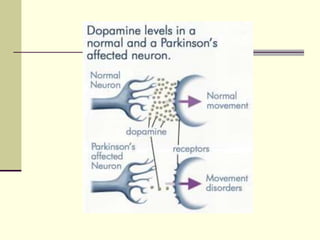
 A progressive neurodegenerative disorder
characterized by the loss of dopaminergic
neurons in the substantia nigra of the brain
 Affects movement
 Although PD isn’t fatal, it is progressive and
incurable
 Even with medications, symptoms vary in
incidence, severity, and timing from person to
person day to day
 Currently, there is no 1 specific test to
diagnose PD
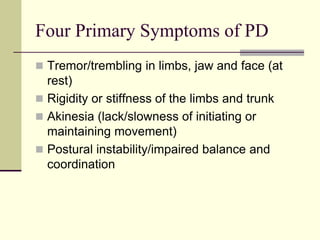
Four Primary Symptoms of PD
 Tremor/trembling in limbs, jaw and face (at
rest)
 Rigidity or stiffness of the limbs and trunk
 Akinesia (lack/slowness of initiating or
maintaining movement)
 Postural instability/impaired balance and
coordination
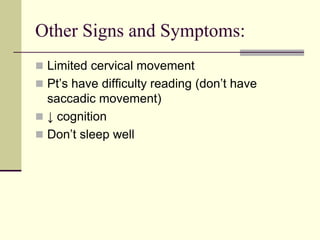
Other Signs and Symptoms:
 Limited cervical movement
 Pt’s have difficulty reading (don’t have
saccadic movement)
 ↓ cognition
 Don’t sleep well
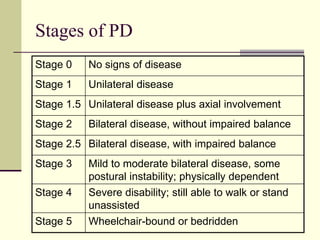
Stages of PD
Stage 0 No signs of disease
Stage 1 Unilateral disease
Stage 1.5 Unilateral disease plus axial involvement
Stage 2 Bilateral disease, without impaired balance
Stage 2.5 Bilateral disease, with impaired balance
Stage 3 Mild to moderate bilateral disease, some
postural instability; physically dependent
Stage 4 Severe disability; still able to walk or stand
unassisted
Stage 5 Wheelchair-bound or bedridden
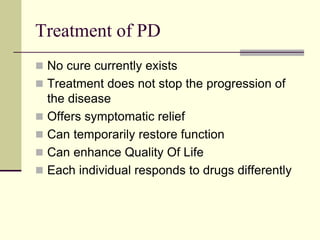
Treatment of PD
 No cure currently exists
 Treatment does not stop the progression of
the disease
 Offers symptomatic relief
 Can temporarily restore function
 Can enhance Quality Of Life
 Each individual responds to drugs differently
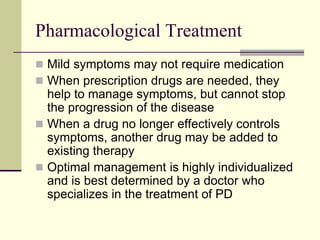
Pharmacological Treatment
 Mild symptoms may not require medication
 When prescription drugs are needed, they
help to manage symptoms, but cannot stop
the progression of the disease
 When a drug no longer effectively controls
symptoms, another drug may be added to
existing therapy
 Optimal management is highly individualized
and is best determined by a doctor who
specializes in the treatment of PD
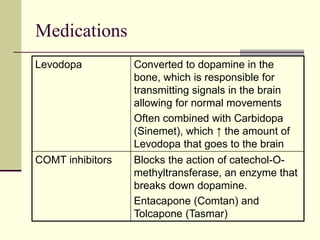
Medications
Levodopa Converted to dopamine in the
bone, which is responsible for
transmitting signals in the brain
allowing for normal movements
Often combined with Carbidopa
(Sinemet), which ↑ the amount of
Levodopa that goes to the brain
COMT inhibitors Blocks the action of catechol-O-
methyltransferase, an enzyme that
breaks down dopamine.
Entacapone (Comtan) and
Tolcapone (Tasmar)
Medications
Dopamine agonists Act like dopamine within the brain
Bromocriptine (Parlodel),
Pramipexole (Mirapex), Ropinirole
(Requip), and Apomorphine
(Apokyn)
Amantadine Unknown mechanism; may ↑
brain’s response to dopamine or
releases stored dopamine
Amantadine (Symmetrel)
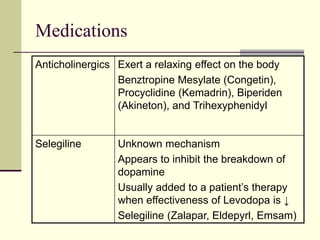
Medications
Anticholinergics Exert a relaxing effect on the body
Benztropine Mesylate (Congetin),
Procyclidine (Kemadrin), Biperiden
(Akineton), and Trihexyphenidyl
Selegiline Unknown mechanism
Appears to inhibit the breakdown of
dopamine
Usually added to a patient’s therapy
when effectiveness of Levodopa is ↓
Selegiline (Zalapar, Eldepyrl, Emsam)
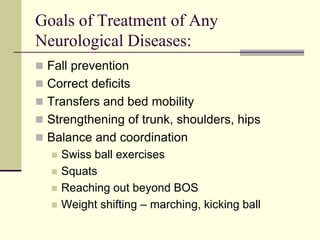
Goals of Treatment of Any
Neurological Diseases:
 Fall prevention
 Correct deficits
 Transfers and bed mobility
 Strengthening of trunk, shoulders, hips
 Balance and coordination
 Swiss ball exercises
 Squats
 Reaching out beyond BOS
 Weight shifting – marching, kicking ball
Evidence Based Practice: PT and PD
 Most PD patients face mobility deficits
 Difficulties with transfers
 Posture
 Balance
 Walking
 Fear of falls
 Loss of independence
 Inactivity
Evidence Based Practice: PT and PD
 PD patients with more than 1 fall in previous year are
likely to fall again within next 3 months
 Most falls occur during transfers and freezing of gait
 Therefore, PT should focus on:
 Promoting active lifestyle
 Active exercises to improve balance, muscle power,
joint mobility, and aerobic capacity
 Cueing strategies
 Postural adjustments in bed or W/C
 Assisted active exercises
 Education to prevent pressure sores and contractures
Abnormal Gait Patterns with PD
 Difficulty weight shifting or initiating
movement
 Hypokinesia, associated with reduced
walking speed and step length
 Episodes of “freezing” motor blocks
 Impaired balance and postural reactions
 ↓ upright stance with narrow BOS
Cueing Strategies
 Used during gait training
 Auditory cues – rhythmic music, metronome,
counting
 Visual cues – stepping over stripes on floor,
focus on an object, colors
 Tactile cues – tapping on hip, leg, etc.
 Cognitive cues – mental image of appropriate
step length
Exercises
 Focus on ROM, gait, balance, antirigidity,
ADLs
 Leg strength – use equipment, resistive
bands
 Balance/sway – foam pads, retropulsion tests
 Strengthen trunk muscles for respiration and
posture
 Weight shifting
 Exercises for transfers
Exercises
 Stretching exercises essential
 Posterior direction: reaching backwards, walking
backwards
 Extension exercised
 Throwing/kicking a ball
 Push-ups; superman
 Respiration exercises
 Relaxation exercises – Yoga, Tai Chi
 Karate exercises – shown to ↓ tremors and ↑
dexterity and coordination
 Energy Conservation
Tai Chi
 The slow, rhythmic pace of functionally based
exercises, internal organ stimulation, flexibility
maintenance, balance training effects, and
general health benefits of Tai Chi
 Relevant to PD management: fall prevention,
tremor reduction, and motor control
Balance Training & High-Intensity
Resistance Training
 PD patients have dyssynchrony of leg
muscles during movement initiation
 Reduced peak torque production in knee
extension, flexion, and ankle dorsiflexion
 LE weakness impairs postural responses to
challenged balance
 High intensity resistance training of knee
extensors, flexors, ankle plantarflexors –
Nautilus
 Cycle ergometer
Treadmill Training
 Many studies conducted and treadmill
training shown to be effective in gait training
 At initial sessions, all patients could walk
without freezing phenomenon at higher
treadmill speeds
 Improvement in gait speed and number of
steps
 Effects lasted 4 months!
Treadmill Training
 Possible that body-weight supported treadmill training
induces implicit motor learning by enhancing
alternative brain networks
 Has potential to enhance gait rhythmicity
 Progressive and intensive treadmill training can
minimize impairments in gait, reduce fall risk and ↑
quality of life
 Positive Aspects of treadmill training:
 Rhythmicity
 Weight-support
 Aerobic training
 External pacemaker
Stretch Reflex
 Trager Approach: imparts a series of very
gently painless, passive rocking motions to
the limbs
 Significant reduction of evoked stretch
response was observed; may induce a
reduction of the muscle rigidity seen in
patients with PD
 More effective in supine than sitting
Surgery
 Ablative Surgery
- This procedure locates, targets, and then destroys (ablates) a
clearly defined area of the brain affected by Parkinson's
- The object is to destroy tissue that produces abnormal chemical
or electrical impulses that produce tremors and dyskinesias
- This type of surgery involves either pallidotomy or thalamotomy
- A related procedure, cryothalamotomy, uses a supercooled
probe that is inserted into the thalamus to freeze and destroy
areas that produce tremors
 Deep Brain Stimulation (DBS)
- DBS targets the subthalamic nucleus, which is located below the
thalamus and is difficult to reach, the globus pallidus, or the
thalamus
- Targeted region is inactivated, not destroyed, by an implanted
electrode
Surgery contd..
 Transplantation or Restorative Surgery
- In transplantation, or restorative, surgery dopamine-producing cells
are implanted into the striatum
- The cells used for transplantation may come from one of several
sources: the patient's body, human embryos, pig embryos
Lastly
 Family & Patient Education
References
 Duval C, Lafontaine D, Hebert J, Leroux A, Panisset M, Boucher JP. The effect
of Trager therapy on the level of evoked stretch responses in patients with
Parkinson’s Disease and rigidity. Journal of Manipulative and Physiological
Therapeutics. 2002;25(7):455-464.
 Hirsch MA, Toole T, Maitland CG, Rider RA. The effects of balance training and
high-intensity resistance training on persons with idiopathic Parkinson’s disease.
Archives of Physical Medicine and Rehabilitation. 2003;84(8):1108-1117.
 Keus S, Bloem B, Hendriks E, et al. Evidence-Based analysis of physical
therapy in Parkinson’s Disease with recommendations for practice and research.
Movement Disorders. 2007;22(4):451-460.
 Miyai I, Fujimoto Y, Yamamoto H, et al. Long-term effect of body weight-
supported treadmill training in Parkinson’s Disease: A randomized controlled
trial. Archives of Physical Medicine and Rehabilitation. 2002;83(10):1370-1373.
 http://www.drugdigest.org/DD/HC/Treament/0,4047,550186,00.html
 Lee MS, Lam P, Ernst E. Effectiveness of Tai Chi for Parkinson’s Disease: A
critical review. Parkinsonism Related Disorders, 2008.
 Konigsberg T. Lecture summer 2008.

Parkinson disease pd

  • 1.
  • 3.
    What is Parkinson’sDisease?  A progressive neurodegenerative disorder characterized by the loss of dopaminergic neurons in the substantia nigra of the brain  Affects movement  Although PD isn’t fatal, it is progressive and incurable  Even with medications, symptoms vary in incidence, severity, and timing from person to person day to day  Currently, there is no 1 specific test to diagnose PD
  • 4.
    Four Primary Symptomsof PD  Tremor/trembling in limbs, jaw and face (at rest)  Rigidity or stiffness of the limbs and trunk  Akinesia (lack/slowness of initiating or maintaining movement)  Postural instability/impaired balance and coordination
  • 5.
    Other Signs andSymptoms:  Limited cervical movement  Pt’s have difficulty reading (don’t have saccadic movement)  ↓ cognition  Don’t sleep well
  • 6.
    Stages of PD Stage0 No signs of disease Stage 1 Unilateral disease Stage 1.5 Unilateral disease plus axial involvement Stage 2 Bilateral disease, without impaired balance Stage 2.5 Bilateral disease, with impaired balance Stage 3 Mild to moderate bilateral disease, some postural instability; physically dependent Stage 4 Severe disability; still able to walk or stand unassisted Stage 5 Wheelchair-bound or bedridden
  • 7.
    Treatment of PD No cure currently exists  Treatment does not stop the progression of the disease  Offers symptomatic relief  Can temporarily restore function  Can enhance Quality Of Life  Each individual responds to drugs differently
  • 8.
    Pharmacological Treatment  Mildsymptoms may not require medication  When prescription drugs are needed, they help to manage symptoms, but cannot stop the progression of the disease  When a drug no longer effectively controls symptoms, another drug may be added to existing therapy  Optimal management is highly individualized and is best determined by a doctor who specializes in the treatment of PD
  • 9.
    Medications Levodopa Converted todopamine in the bone, which is responsible for transmitting signals in the brain allowing for normal movements Often combined with Carbidopa (Sinemet), which ↑ the amount of Levodopa that goes to the brain COMT inhibitors Blocks the action of catechol-O- methyltransferase, an enzyme that breaks down dopamine. Entacapone (Comtan) and Tolcapone (Tasmar)
  • 10.
    Medications Dopamine agonists Actlike dopamine within the brain Bromocriptine (Parlodel), Pramipexole (Mirapex), Ropinirole (Requip), and Apomorphine (Apokyn) Amantadine Unknown mechanism; may ↑ brain’s response to dopamine or releases stored dopamine Amantadine (Symmetrel)
  • 11.
    Medications Anticholinergics Exert arelaxing effect on the body Benztropine Mesylate (Congetin), Procyclidine (Kemadrin), Biperiden (Akineton), and Trihexyphenidyl Selegiline Unknown mechanism Appears to inhibit the breakdown of dopamine Usually added to a patient’s therapy when effectiveness of Levodopa is ↓ Selegiline (Zalapar, Eldepyrl, Emsam)
  • 12.
    Goals of Treatmentof Any Neurological Diseases:  Fall prevention  Correct deficits  Transfers and bed mobility  Strengthening of trunk, shoulders, hips  Balance and coordination  Swiss ball exercises  Squats  Reaching out beyond BOS  Weight shifting – marching, kicking ball
  • 13.
    Evidence Based Practice:PT and PD  Most PD patients face mobility deficits  Difficulties with transfers  Posture  Balance  Walking  Fear of falls  Loss of independence  Inactivity
  • 14.
    Evidence Based Practice:PT and PD  PD patients with more than 1 fall in previous year are likely to fall again within next 3 months  Most falls occur during transfers and freezing of gait  Therefore, PT should focus on:  Promoting active lifestyle  Active exercises to improve balance, muscle power, joint mobility, and aerobic capacity  Cueing strategies  Postural adjustments in bed or W/C  Assisted active exercises  Education to prevent pressure sores and contractures
  • 15.
    Abnormal Gait Patternswith PD  Difficulty weight shifting or initiating movement  Hypokinesia, associated with reduced walking speed and step length  Episodes of “freezing” motor blocks  Impaired balance and postural reactions  ↓ upright stance with narrow BOS
  • 16.
    Cueing Strategies  Usedduring gait training  Auditory cues – rhythmic music, metronome, counting  Visual cues – stepping over stripes on floor, focus on an object, colors  Tactile cues – tapping on hip, leg, etc.  Cognitive cues – mental image of appropriate step length
  • 17.
    Exercises  Focus onROM, gait, balance, antirigidity, ADLs  Leg strength – use equipment, resistive bands  Balance/sway – foam pads, retropulsion tests  Strengthen trunk muscles for respiration and posture  Weight shifting  Exercises for transfers
  • 18.
    Exercises  Stretching exercisesessential  Posterior direction: reaching backwards, walking backwards  Extension exercised  Throwing/kicking a ball  Push-ups; superman  Respiration exercises  Relaxation exercises – Yoga, Tai Chi  Karate exercises – shown to ↓ tremors and ↑ dexterity and coordination  Energy Conservation
  • 19.
    Tai Chi  Theslow, rhythmic pace of functionally based exercises, internal organ stimulation, flexibility maintenance, balance training effects, and general health benefits of Tai Chi  Relevant to PD management: fall prevention, tremor reduction, and motor control
  • 20.
    Balance Training &High-Intensity Resistance Training  PD patients have dyssynchrony of leg muscles during movement initiation  Reduced peak torque production in knee extension, flexion, and ankle dorsiflexion  LE weakness impairs postural responses to challenged balance  High intensity resistance training of knee extensors, flexors, ankle plantarflexors – Nautilus  Cycle ergometer
  • 21.
    Treadmill Training  Manystudies conducted and treadmill training shown to be effective in gait training  At initial sessions, all patients could walk without freezing phenomenon at higher treadmill speeds  Improvement in gait speed and number of steps  Effects lasted 4 months!
  • 22.
    Treadmill Training  Possiblethat body-weight supported treadmill training induces implicit motor learning by enhancing alternative brain networks  Has potential to enhance gait rhythmicity  Progressive and intensive treadmill training can minimize impairments in gait, reduce fall risk and ↑ quality of life  Positive Aspects of treadmill training:  Rhythmicity  Weight-support  Aerobic training  External pacemaker
  • 23.
    Stretch Reflex  TragerApproach: imparts a series of very gently painless, passive rocking motions to the limbs  Significant reduction of evoked stretch response was observed; may induce a reduction of the muscle rigidity seen in patients with PD  More effective in supine than sitting
  • 24.
    Surgery  Ablative Surgery -This procedure locates, targets, and then destroys (ablates) a clearly defined area of the brain affected by Parkinson's - The object is to destroy tissue that produces abnormal chemical or electrical impulses that produce tremors and dyskinesias - This type of surgery involves either pallidotomy or thalamotomy - A related procedure, cryothalamotomy, uses a supercooled probe that is inserted into the thalamus to freeze and destroy areas that produce tremors  Deep Brain Stimulation (DBS) - DBS targets the subthalamic nucleus, which is located below the thalamus and is difficult to reach, the globus pallidus, or the thalamus - Targeted region is inactivated, not destroyed, by an implanted electrode
  • 25.
    Surgery contd..  Transplantationor Restorative Surgery - In transplantation, or restorative, surgery dopamine-producing cells are implanted into the striatum - The cells used for transplantation may come from one of several sources: the patient's body, human embryos, pig embryos
  • 26.
    Lastly  Family &Patient Education
  • 27.
    References  Duval C,Lafontaine D, Hebert J, Leroux A, Panisset M, Boucher JP. The effect of Trager therapy on the level of evoked stretch responses in patients with Parkinson’s Disease and rigidity. Journal of Manipulative and Physiological Therapeutics. 2002;25(7):455-464.  Hirsch MA, Toole T, Maitland CG, Rider RA. The effects of balance training and high-intensity resistance training on persons with idiopathic Parkinson’s disease. Archives of Physical Medicine and Rehabilitation. 2003;84(8):1108-1117.  Keus S, Bloem B, Hendriks E, et al. Evidence-Based analysis of physical therapy in Parkinson’s Disease with recommendations for practice and research. Movement Disorders. 2007;22(4):451-460.  Miyai I, Fujimoto Y, Yamamoto H, et al. Long-term effect of body weight- supported treadmill training in Parkinson’s Disease: A randomized controlled trial. Archives of Physical Medicine and Rehabilitation. 2002;83(10):1370-1373.  http://www.drugdigest.org/DD/HC/Treament/0,4047,550186,00.html  Lee MS, Lam P, Ernst E. Effectiveness of Tai Chi for Parkinson’s Disease: A critical review. Parkinsonism Related Disorders, 2008.  Konigsberg T. Lecture summer 2008.