Accidential falls in MS: Problems, practicalities and possibilities
Thank you for sharing your perspective. It seems that format and structure of home practice is important to consider for adherence. Short, simple exercises that can easily fit into daily life may be most effective.
Plan for session
•Examine the context,
prevalence and incidence of
falls in people with MS
• Identify the risk factors for falls
• Highlight potential
opportunities (and challenges)
for intervention
Awareness of fallsin
neurological conditions
• Do you ask your patient about falls?
• Do you define falls for your patient?
• How do you think your patient(s) defines a
fall?
6.
Definition of aFall
• Many different definitions exist in the
literature
– As many as 8 in the MS literature alone
• Commonly used:
– “Unexpected event in which a participant
comes to rest on ground, floor, or lower level”
7.
Definition of Recurrentfalls
• Experiencing 2 or more falls
– “Multiple”
– Different time frames are used
• 2 to 12 months
– Frequent falls
• Experiencing more than occasional falls
– Three+ or unable to recall
8.
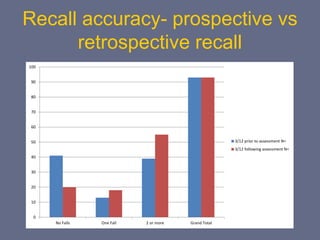
Recall accuracy- prospectivevs
retrospective recall
0
10
20
30
40
50
60
70
80
90
100
No Falls One Fall 2 or more Grand Total
3/12 prior to assessment N=
3/12 following assessment N=
9.
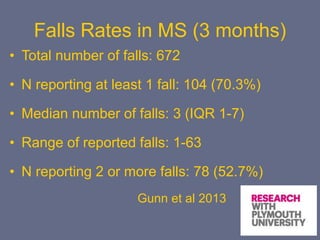
Falls Rates inMS (3 months)
• Total number of falls: 672
• N reporting at least 1 fall: 104 (70.3%)
• Median number of falls: 3 (IQR 1-7)
• Range of reported falls: 1-63
• N reporting 2 or more falls: 78 (52.7%)
Gunn et al 2013
10.
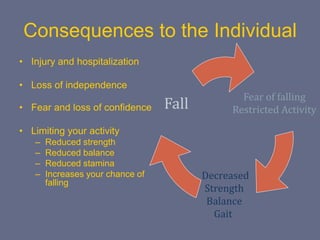
Consequences to theIndividual
• Injury and hospitalization
• Loss of independence
• Fear and loss of confidence
• Limiting your activity
– Reduced strength
– Reduced balance
– Reduced stamina
– Increases your chance of
falling
Fear of falling
Restricted Activity
Decreased
Strength
Balance
Gait
Fall
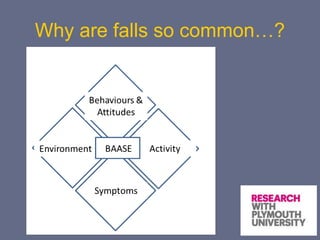
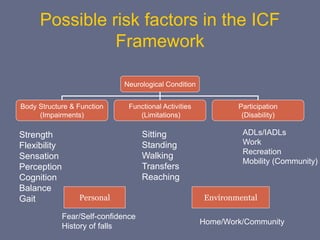
Possible risk factorsin the ICF
Framework
Personal Environmental
Neurological Condition
Body Structure & Function
(Impairments)
Functional Activities
(Limitations)
Participation
(Disability)
Strength
Flexibility
Sensation
Perception
Cognition
Balance
Gait
Sitting
Standing
Walking
Transfers
Reaching
ADLs/IADLs
Work
Recreation
Mobility (Community)
Fear/Self-confidence
History of falls
Home/Work/Community
13.
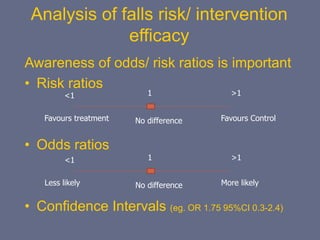
Analysis of fallsrisk/ intervention
efficacy
Awareness of odds/ risk ratios is important
• Risk ratios
• Odds ratios
• Confidence Intervals (eg. OR 1.75 95%CI 0.3-2.4)
1<1 >1
Less likely More likelyNo difference
1<1 >1
Favours treatment Favours ControlNo difference
14.
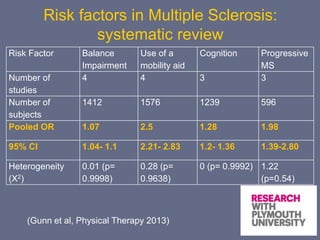
Risk factors inMultiple Sclerosis:
systematic review
Risk Factor Balance
Impairment
Use of a
mobility aid
Cognition Progressive
MS
Number of
studies
4 4 3 3
Number of
subjects
1412 1576 1239 596
Pooled OR 1.07 2.5 1.28 1.98
95% CI 1.04- 1.1 2.21- 2.83 1.2- 1.36 1.39-2.80
Heterogeneity
(X2)
0.01 (p=
0.9998)
0.28 (p=
0.9638)
0 (p= 0.9992) 1.22
(p=0.54)
(Gunn et al, Physical Therapy 2013)
15.
Is that thewhole story?
• Observational study (N=150)
• Prospective falls data collection
• Later combining of data with 3 other
prospective studies
16.
Our work: KeyMS issues
associated with falls
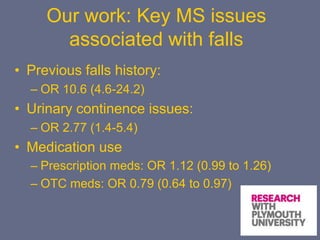
• Previous falls history:
– OR 10.6 (4.6-24.2)
• Urinary continence issues:
– OR 2.77 (1.4-5.4)
• Medication use
– Prescription meds: OR 1.12 (0.99 to 1.26)
– OTC meds: OR 0.79 (0.64 to 0.97)
17.
Our work: KeyMS impairments
associated with falls
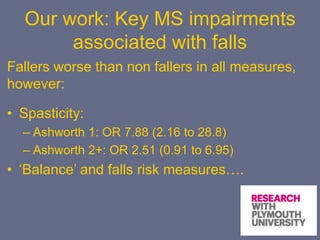
Fallers worse than non fallers in all measures,
however:
• Spasticity:
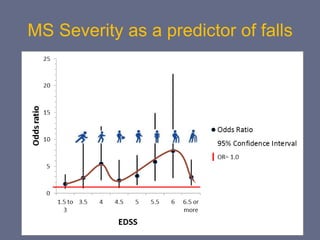
– Ashworth 1: OR 7.88 (2.16 to 28.8)
– Ashworth 2+: OR 2.51 (0.91 to 6.95)
• ‘Balance’ and falls risk measures….
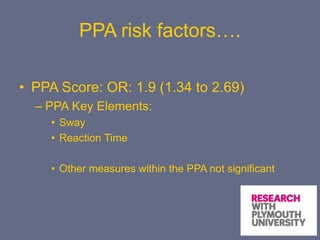
Other potential riskfactors from
prospective cohort studies
• Poor leaning balance, coordinated
stability, choice stepping reaction time and
‘complex’ executive function (Hoang et al
2014)
22.
Other Potential RiskFactors
Qualitative Studies
• Participation
– Divided attention
– Walking in crowds (Community mobility)
– Taking care of the home
– Driving
• Environment
– Unsuitable physical environment
• Carpets, slippery surfaces, doorsteps
– Climate
• Snow, ice, heat
• Personal
– Stress
Nilsagard et al., 2009, Peterson et al., 2010
23.
So… what doesthis mean?
• Unpredictability and change may be key
factors
• ‘Indirect’ issues (e.g. continence/
medication) could be important
• Balance is a key problem
• ….but strength, visual and ‘simple’
sensory problems may be less so
Falls management inMS
– People with MS have very separate needs to
‘average’ users of falls services (e.g. over 65’s)
NG3P17 Verbal comment
– By the nature of it it will tend to be older people who
go [to the falls service], and then if you’re someone
young with say progressive MS, you may be grieving
for your former self anyway without having it thrust in
your face that you are falling around like your Gran.
NG3MS16 Verbal comment
29.
Falls interventions instroke
• Verheyden et al 2015 (systematic review)
– 10 trials n=1004
– Exercise – acute/subacute, chronic – no effect
on fall rate OR number of fallers
• Noted High intensity functional exercises & Agility
programmes warrant further investigation
– Medication – 2 studies, Vit D, Alendronate –
rate and number reduced
– Single lens glasses – no effect
30.
Falls interventions inParkinsons
disease
• Goodwin et al 2011 RCT
– 10 week group exercise programme plus
home exercises
– Significant increase in balance scores.
– No difference in falls rate or number of fallers
• Ashburn et al 2007 RCT
– 6 week home exercise programme
– Improvement in balance outcomes
– No significant difference in falls
31.
Sources of evidencein MS
• Systematic review (n=16)
• Nominal Group study (n=36)
• Research and experience from
international expert group (IMSFPRN)
• Research from related areas
(Gunn et al 2015, 2015a)
32.
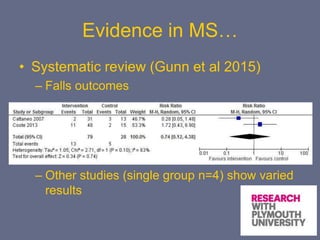
Evidence in MS…
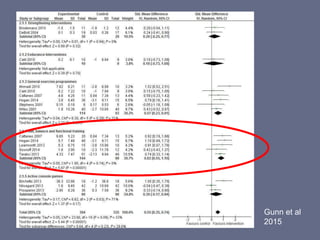
•Systematic review (Gunn et al 2015)
– Falls outcomes
– Other studies (single group n=4) show varied
results
33.
So what dowe know in MS….?
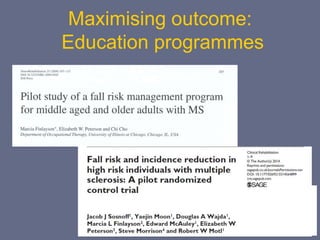
• Falls education programmes can increase
confidence, awareness of (and possibly
use of) management strategies
• Exercise programmes can improve
balance…..
Type of exerciseis likely to be
important
Work in other groups suggests exercise….
• Needs to be challenging to balance
• Needs to include movement in 3
dimensions
• Needs to minimise upper limb support
• Needs to be tailored to individual needs
Sherrington 2008
37.
Undertaking ‘challenging’
balance exercise
Ithink sometimes you have to push yourself
to know what you can and can’t do
physically and mentally. NG3MS20…
……You might try those [difficult] exercises
with a little ‘prodding’... NG3MS16……
……I think I might need a little bit more than
‘prodding’… NG3MS17
Discussion excerpt
38.
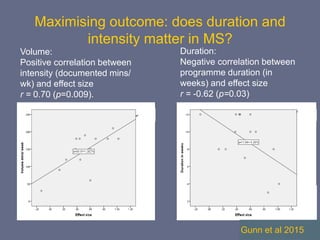
Maximising outcome: doesduration and
intensity matter in MS?
Volume:
Positive correlation between
intensity (documented mins/
wk) and effect size
r = 0.70 (p=0.009).
Duration:
Negative correlation between
programme duration (in
weeks) and effect size
r = -0.62 (p=0.03)
Gunn et al 2015
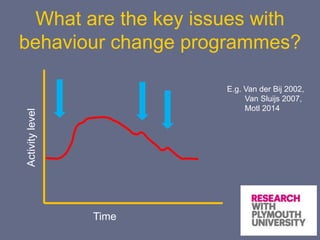
What are thekey issues with
behaviour change programmes?
E.g. Van der Bij 2002,
Van Sluijs 2007,
Motl 2014
Time
Activitylevel
41.
Recruitment, retention and
adherenceto exercise
programmes in MS
• Recruitment: 50-80%
• Adherence:
– Attended programmes- 70-100%
– Home programmes- 60-70%
• Attrition: median rate of 18% (range 0-
33%)
Gunn et al 2015
Key elements weneed
to get right
• Choosing to participate- making it
attractive
• Attending
• Participation during sessions
• Undertaking practice outside ‘formal’
sessions
44.
Programme approach:
Don’t mentionthe ‘F’ word….
– If I was commissioning a group and
everyone in the group had fallen 3 times
before they joined and no times afterwards,
but they had spent 6 weeks being
miserable, or living lesser lives because
they were taking less risks as a result, then
that’s not an outcome I would be
particularly interested in.
(service commissioner)
45.
Programme Approach
– Referralmakes it sound like it’s a patient
being referred, you know I don’t “refer” myself
to the gym, you choose and you just go.
NG3P14 Verbal comment
46.
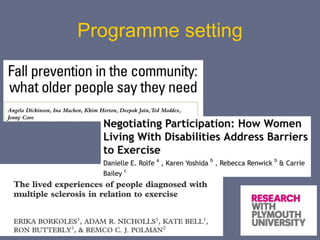
Attending: Programme setting
–I wouldn’t want sessions to be in a hospital… We’re
not ill as in ill, we are finding it difficult to cope but
nevertheless not needing hospitals. NG3MS18 Verbal
comment
– The idea of a hospital setting for me gives it some
validity. I’ve got MS, I don’t want to just turn up to a
random place not knowing…… I’d like to think that
somebody is a professional, and you know, has got a
plan in mind. NG2MS12 Verbal comment
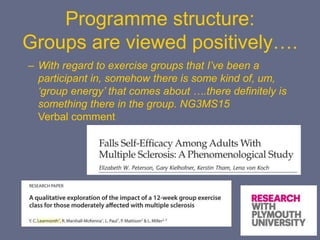
Programme structure:
Groups areviewed positively….
– With regard to exercise groups that I’ve been a
participant in, somehow there is some kind of, um,
‘group energy’ that comes about ….there definitely is
something there in the group. NG3MS15
Verbal comment
49.
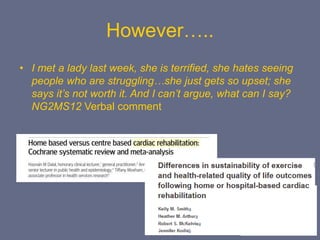
However…..
• I meta lady last week, she is terrified, she hates seeing
people who are struggling…she just gets so upset; she
says it’s not worth it. And I can’t argue, what can I say?
NG2MS12 Verbal comment
50.
Frequency may besignificant
–If you’re an MS person there is no
guarantee you can be there one week
and the next week, it’s a day on day
thing…. You would like to be there for
that time, but there’s no guarantee you
will be. NG2MS10 Verbal comment
51.
Achieving success inhome
practice
…” In our falls and balance group I always say
‘now, who’s done the exercises since last week?
And I’ll get about 2 hands out of 8…..”
(Falls programme lead)
52.
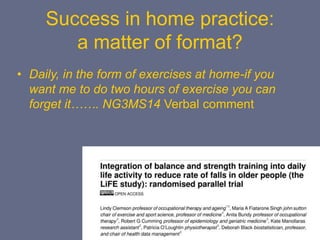
Success in homepractice:
a matter of format?
• Daily, in the form of exercises at home-if you
want me to do two hours of exercise you can
forget it……. NG3MS14 Verbal comment
53.
Supporting engagement
– Theinput needs to be given in such a way
that we enjoy it; we remember it or we have
prompts to remember it, and we go away and
we do it. So that is, whether it’s a group or
individual, those rules must apply because the
only way it’s going to work is with the time,
motivation and energy that we find to put into
it. NG3MS16 Verbal comment
54.
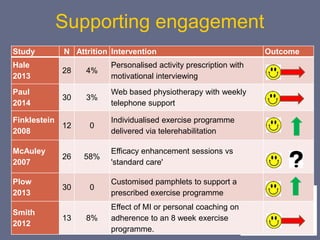
Supporting engagement
Study NAttrition Intervention Outcome
Hale
2013
28 4%
Personalised activity prescription with
motivational interviewing
Paul
2014
30 3%
Web based physiotherapy with weekly
telephone support
Finklestein
2008
12 0
Individualised exercise programme
delivered via telerehabilitation
McAuley
2007
26 58%
Efficacy enhancement sessions vs
'standard care'
Plow
2013
30 0
Customised pamphlets to support a
prescribed exercise programme
Smith
2012
13 8%
Effect of MI or personal coaching on
adherence to an 8 week exercise
programme.
55.
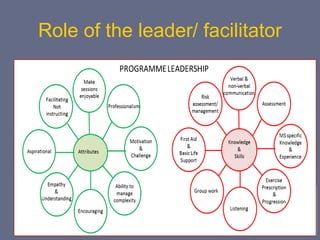
Programme support- facilitation
•The leader is pivotal to the success of the
programme
– I think the relationship between the therapist,
the enabler, whatever we want to call this
wonderful being who is leading this group,
and the people of the programme is utterly
paramount. NG3MS16
Funding and ongoingsupport
• You need to do it properly…
– It needs to have its own resources because you get
fed up trying to run everything on a shoestring and
rushing in and doing a group and then rushing off
again to the next thing. NG2P8 Verbal comment
– There’s just not enough time to do anything properly.
It would just be depressing if we spent a lot of time
developing a really lovely quality service to start off,
and they wouldn’t have the time anyway….
NG2P13 Verbal comment
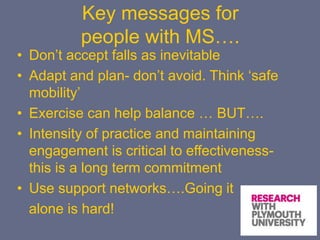
Key messages for
peoplewith MS….
• Don’t accept falls as inevitable
• Adapt and plan- don’t avoid. Think ‘safe
mobility’
• Exercise can help balance … BUT….
• Intensity of practice and maintaining
engagement is critical to effectiveness-
this is a long term commitment
• Use support networks….Going it
alone is hard!
60.
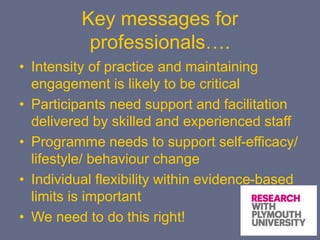
Key messages for
professionals….
•Intensity of practice and maintaining
engagement is likely to be critical
• Participants need support and facilitation
delivered by skilled and experienced staff
• Programme needs to support self-efficacy/
lifestyle/ behaviour change
• Individual flexibility within evidence-based
limits is important
• We need to do this right!
61.
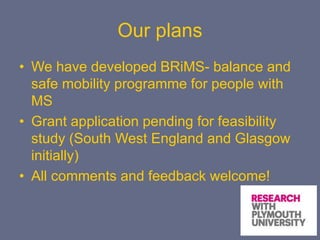
Our plans
• Wehave developed BRiMS- balance and
safe mobility programme for people with
MS
• Grant application pending for feasibility
study (South West England and Glasgow
initially)
• All comments and feedback welcome!
62.
Thank you forlistening
• Acknowledgements:
– Funders
– PhD supervisors:
• Jenny Freeman
• Jon Marsden
• Bernhard Haas
– Participants
Hilary.gunn100@plymouth.ac.uk

![Falls management in MS
– People with MS have very separate needs to
‘average’ users of falls services (e.g. over 65’s)
NG3P17 Verbal comment
– By the nature of it it will tend to be older people who
go [to the falls service], and then if you’re someone
young with say progressive MS, you may be grieving
for your former self anyway without having it thrust in
your face that you are falling around like your Gran.
NG3MS16 Verbal comment](https://image.slidesharecdn.com/hilarygunnaccidentialfallsinms-151117105116-lva1-app6891/85/Accidential-falls-in-MS-Problems-practicalities-and-possibilities-28-320.jpg)
![Undertaking ‘challenging’
balance exercise
I think sometimes you have to push yourself
to know what you can and can’t do
physically and mentally. NG3MS20…
……You might try those [difficult] exercises
with a little ‘prodding’... NG3MS16……
……I think I might need a little bit more than
‘prodding’… NG3MS17
Discussion excerpt](https://image.slidesharecdn.com/hilarygunnaccidentialfallsinms-151117105116-lva1-app6891/85/Accidential-falls-in-MS-Problems-practicalities-and-possibilities-37-320.jpg)