Problem Solving in
PSLE Mathematics

      Yeap Ban Har
  Marshall Cavendish Institute
          Singapore

 banhar.yeap@pathlight.org.sg


 Slides are available at
www.banhar.blogspot.com
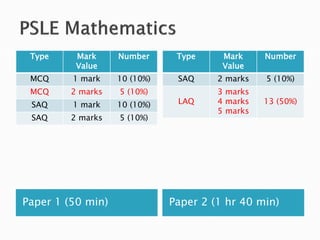
Type     Mark     Number      Type     Mark     Number
          Value                         Value
 MCQ     1 mark    10 (10%)    SAQ     2 marks   5 (10%)
 MCQ     2 marks   5 (10%)             3 marks
 SAQ     1 mark    10 (10%)    LAQ     4 marks   13 (50%)
                                       5 marks
 SAQ     2 marks   5 (10%)


Paper 1 (50 min)              Paper 2 (1 hr 40 min)
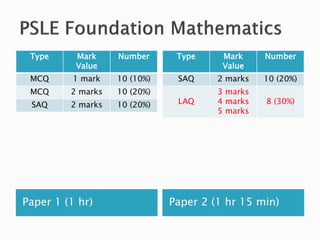
Type     Mark     Number      Type     Mark     Number
          Value                         Value
 MCQ      1 mark   10 (10%)    SAQ     2 marks   10 (20%)
 MCQ     2 marks   10 (20%)            3 marks
 SAQ     2 marks   10 (20%)    LAQ     4 marks   8 (30%)
                                       5 marks


Paper 1 (1 hr)                Paper 2 (1 hr 15 min)
The rationale of teaching mathematics is that it is “a good
       vehicle for the development and improvement of a
                    person’s intellectual competence”.
Ministry of Education 2006
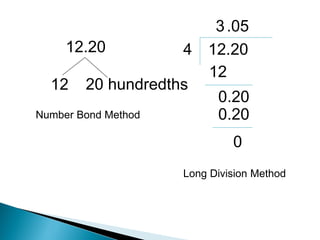
Find the value of 12.2 ÷ 4 .


                           Answer : 3.05 [B1]


                                    Example 1
3 .05
     12.20           4   12.20
                         12
  12    20 hundredths
                           0.20
Number Bond Method         0.20
                              0
                     Long Division Method
A show started at 10.55 a.m. and ended
at 1.30 p.m. How long was the show in
hours and minutes?


                       2 h 30 min


           11 a.m.                  1.30 p.m.


                     Answer : 2 h 35 min [B1]

                                        Example 2
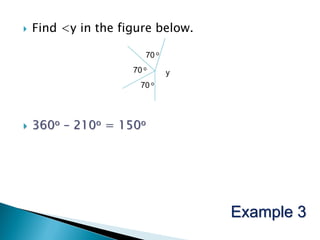
   Find <y in the figure below.

                        70 o
                     70 o      y
                       70 o


   360o – 210o = 150o


                                   Example 3
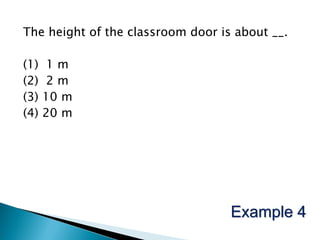
The height of the classroom door is about __.

(1)    1m
(2)    2m
(3)   10 m
(4)   20 m


                                   Example 4
Ministry of Education 2006
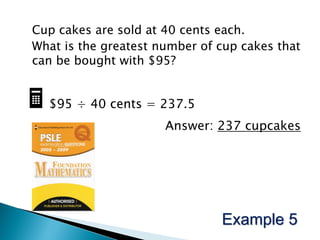
Cup cakes are sold at 40 cents each.
What is the greatest number of cup cakes that
can be bought with $95?


   $95 ÷ 40 cents = 237.5
                      Answer: 237 cupcakes


                               Example 5
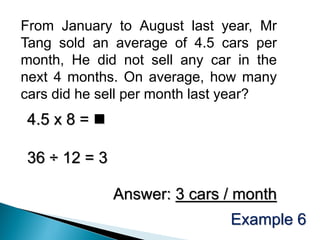
From January to August last year, Mr
Tang sold an average of 4.5 cars per
month, He did not sell any car in the
next 4 months. On average, how many
cars did he sell per month last year?
4.5 x 8 = 

36 ÷ 12 = 3

              Answer: 3 cars / month
                              Example 6
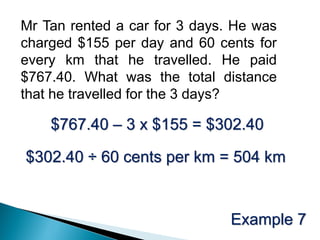
Mr Tan rented a car for 3 days. He was
charged $155 per day and 60 cents for
every km that he travelled. He paid
$767.40. What was the total distance
that he travelled for the 3 days?

    $767.40 – 3 x $155 = $302.40

$302.40 ÷ 60 cents per km = 504 km


                               Example 7
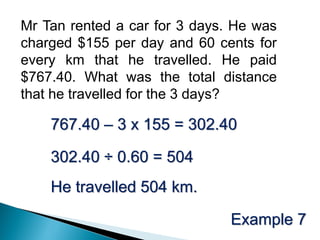
Mr Tan rented a car for 3 days. He was
charged $155 per day and 60 cents for
every km that he travelled. He paid
$767.40. What was the total distance
that he travelled for the 3 days?

    767.40 – 3 x 155 = 302.40

    302.40 ÷ 0.60 = 504
    He travelled 504 km.

                               Example 7
Ministry of Education 2006
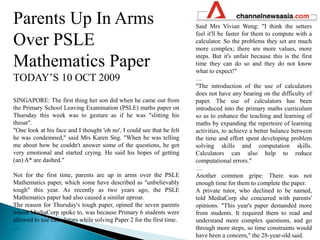
Parents Up In Arms                                                      Said Mrs Vivian Weng: "I think the setters
                                                                        feel it'll be faster for them to compute with a
Over PSLE                                                               calculator. So the problems they set are much
                                                                        more complex; there are more values, more
                                                                        steps. But it's unfair because this is the first
Mathematics Paper                                                       time they can do so and they do not know
                                                                        what to expect!"
TODAY’S 10 OCT 2009                                                     …
                                                                        "The introduction of the use of calculators
                                                                        does not have any bearing on the difficulty of
SINGAPORE: The first thing her son did when he came out from            paper. The use of calculators has been
the Primary School Leaving Examination (PSLE) maths paper on            introduced into the primary maths curriculum
Thursday this week was to gesture as if he was "slitting his            so as to enhance the teaching and learning of
throat".                                                                maths by expanding the repertoire of learning
"One look at his face and I thought 'oh no'. I could see that he felt   activities, to achieve a better balance between
he was condemned," said Mrs Karen Sng. "When he was telling             the time and effort spent developing problem
me about how he couldn't answer some of the questions, he got           solving skills and computation skills.
very emotional and started crying. He said his hopes of getting         Calculators can also help to reduce
(an) A* are dashed."                                                    computational errors."
                                                                        …
Not for the first time, parents are up in arms over the PSLE            Another common gripe: There was not
Mathematics paper, which some have described as "unbelievably           enough time for them to complete the paper.
tough" this year. As recently as two years ago, the PSLE                A private tutor, who declined to be named,
Mathematics paper had also caused a similar uproar.                     told MediaCorp she concurred with parents'
The reason for Thursday's tough paper, opined the seven parents         opinions. "This year's paper demanded more
whom MediaCorp spoke to, was because Primary 6 students were            from students. It required them to read and
allowed to use calculators while solving Paper 2 for the first time.    understand more complex questions, and go
…                                                                       through more steps, so time constraints would
                                                                        have been a concern," the 28-year-old said.
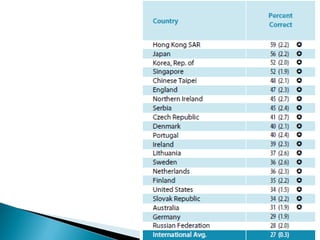
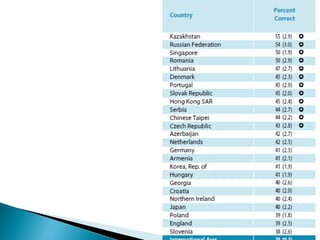
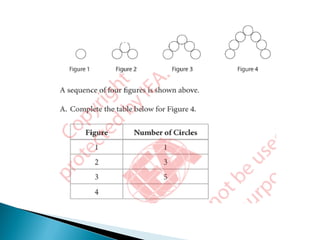
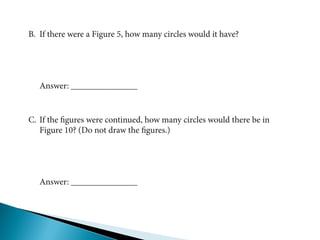
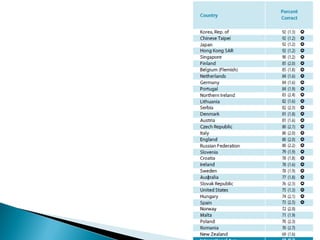
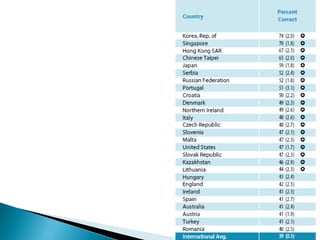
Students in the highest international benchmark are able
   to apply their knowledge in a variety of situations and
                              able to explain themselves.
Ministry of Education 2006
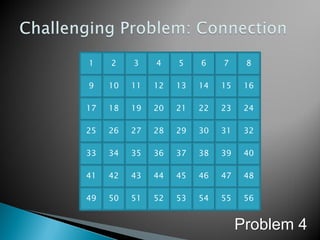
1    2    3    4    5    6    7     8

9    10   11   12   13   14   15    16

17   18   19   20   21   22   23    24

25   26   27   28   29   30   31    32

33   34   35   36   37   38   39    40

41   42   43   44   45   46   47    48

49   50   51   52   53   54   55    56


                                   Problem 4
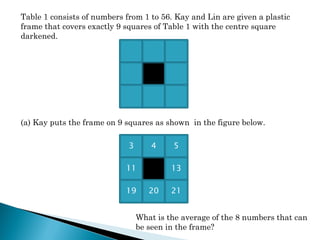
Table 1 consists of numbers from 1 to 56. Kay and Lin are given a plastic
frame that covers exactly 9 squares of Table 1 with the centre square
darkened.


(a) Kay puts the frame on 9 squares as shown in the figure below.

                             3       4    5

                            11            13

                            19      20    21


                                 What is the average of the 8 numbers that can
                                 be seen in the frame?
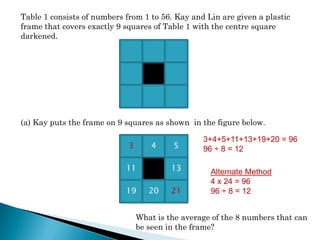
Table 1 consists of numbers from 1 to 56. Kay and Lin are given a plastic
frame that covers exactly 9 squares of Table 1 with the centre square
darkened.


(a) Kay puts the frame on 9 squares as shown in the figure below.

                                                  3+4+5+11+13+19+20 = 96
                             3       4    5       96 ÷ 8 = 12

                            11            13        Alternate Method
                                                    4 x 24 = 96
                            19      20    21        96 ÷ 8 = 12


                                 What is the average of the 8 numbers that can
                                 be seen in the frame?
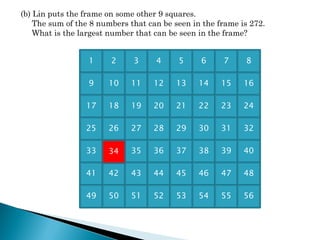
(b) Lin puts the frame on some other 9 squares.
    The sum of the 8 numbers that can be seen in the frame is 272.
    What is the largest number that can be seen in the frame?


                  1     2     3     4     5     6     7     8

                  9    10    11    12     13    14    15    16

                 17    18    19    20     21    22    23    24

                 25    26    27    28     29    30    31    32

                 33    34    35    36     37    38    39    40

                 41    42    43    44     45    46    47    48

                 49    50    51    52     53    54    55    56
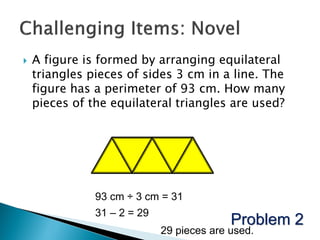
   A figure is formed by arranging equilateral
    triangles pieces of sides 3 cm in a line. The
    figure has a perimeter of 93 cm. How many
    pieces of the equilateral triangles are used?


               93 cm ÷ 3 cm = 31
               31 – 2 = 29
                                           Problem 2
                             29 pieces are used.
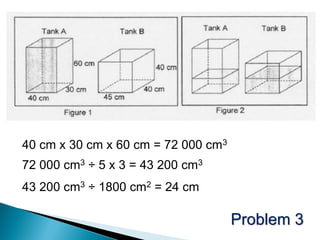
40 cm x 30 cm x 60 cm = 72 000 cm3
72 000 cm3 ÷ 5 x 3 = 43 200 cm3
43 200 cm3 ÷ 1800 cm2 = 24 cm

                                     Problem 3
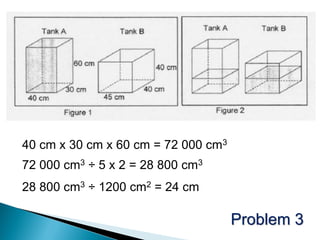
40 cm x 30 cm x 60 cm = 72 000 cm3
72 000 cm3 ÷ 5 x 2 = 28 800 cm3
28 800 cm3 ÷ 1200 cm2 = 24 cm

                                     Problem 3
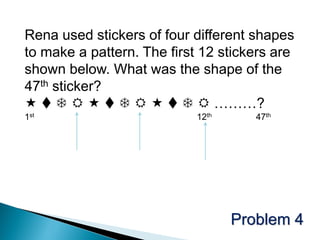
Rena used stickers of four different shapes
to make a pattern. The first 12 stickers are
shown below. What was the shape of the
47th sticker?
            ………?
1st                         12th      47th


                                   Problem 4
Weiyang started a savings plan by putting 2
coins in a money box every day. Each coin was
either a 20-cent or 50-cent coin. His mother
also puts in a $1 coin in the box every 7 days.
The total value of the coins after 182 days was
$133.90.
(a) How many coins were there altogether?
(b) How many of the coins were 50-cent coins?


                                   Problem 5
Weiyang started a savings plan by putting 2
coins in a money box every day. Each coin was
either a 20-cent or 50-cent coin. His mother
also puts in a $1 coin in the box every 7 days.
The total value of the coins after 182 days was
$133.90.
(a) How many coins were there altogether?
(b) How many of the coins were 50-cent coins?

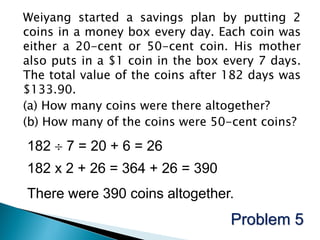
182  7 = 20 + 6 = 26
182 x 2 + 26 = 364 + 26 = 390
There were 390 coins altogether.
                                   Problem 5
Weiyang started a savings plan by putting 2
coins in a money box every day. Each coin was
either a 20-cent or 50-cent coin. His mother
also puts in a $1 coin in the box every 7 days.
The total value of the coins after 182 days was
$133.90.
(a) How many coins were there altogether?
(b) How many of the coins were 50-cent coins?

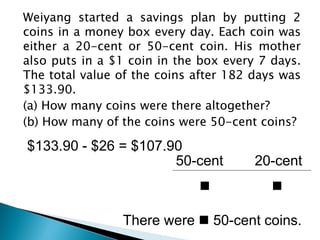
$133.90 - $26 = $107.90
                      50-cent          20-cent
                                         

                There were  50-cent coins.
Suppose each day he put in one 20-cent and
one 50-cent coins, the total is $127.40

But he only put in $107.90 ..

to reduce this by $19.50, exchange 50-cent
for 20-cent coins

$19.50  $0.30 = 65

There were 182 – 65 = 117 fifty-cent coins.
Visualization
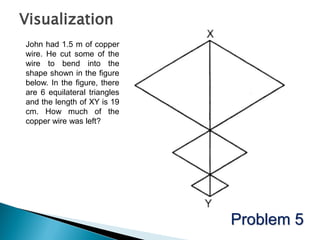
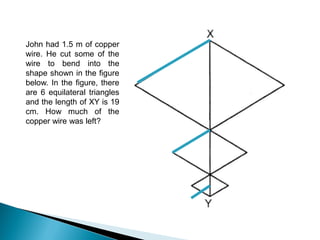
John had 1.5 m of copper
wire. He cut some of the
wire to bend into the
shape shown in the figure
below. In the figure, there
are 6 equilateral triangles
and the length of XY is 19
cm. How much of the
copper wire was left?


                              Problem 5
John had 1.5 m of copper
wire. He cut some of the
wire to bend into the
shape shown in the figure
below. In the figure, there
are 6 equilateral triangles
and the length of XY is 19
cm. How much of the
copper wire was left?
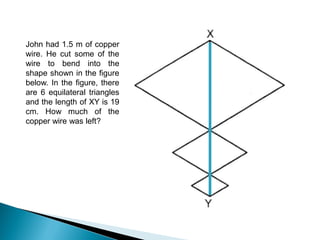
John had 1.5 m of copper
wire. He cut some of the
wire to bend into the
shape shown in the figure
below. In the figure, there
are 6 equilateral triangles
and the length of XY is 19
cm. How much of the
copper wire was left?
John had 1.5 m of copper
wire. He cut some of the
wire to bend into the
shape shown in the figure
below. In the figure, there
are 6 equilateral triangles
and the length of XY is 19
cm. How much of the
copper wire was left?
John had 1.5 m of copper
wire. He cut some of the
wire to bend into the
shape shown in the figure
below. In the figure, there
are 6 equilateral triangles
and the length of XY is 19
cm. How much of the
copper wire was left?


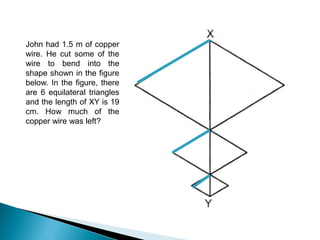
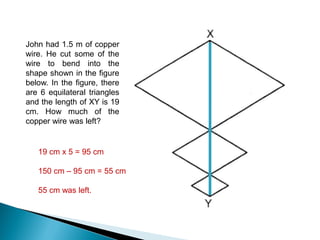
   19 cm x 5 = 95 cm

   150 cm – 95 cm = 55 cm

   55 cm was left.
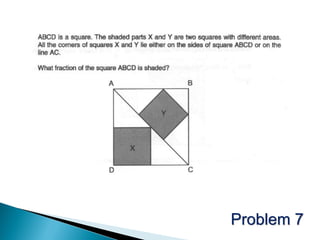
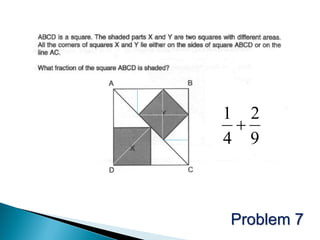
Problem 7
1 2
 
4 9


Problem 7
   Number Sense
   Patterns
   Visualization
   Communication
   Metacognition
   Try to do as you read the problems. Do not
    wait till the end of the question to try to do
    something.
   Try to draw when you do not get what the
    question is getting at. Diagrams such as
    models are very useful.
   Do more mental computation when practising
    Paper 1.

Parents Seminar on PSLE Mathematics

  • 1.
    Problem Solving in PSLEMathematics Yeap Ban Har Marshall Cavendish Institute Singapore banhar.yeap@pathlight.org.sg Slides are available at www.banhar.blogspot.com
  • 4.
    Type Mark Number Type Mark Number Value Value MCQ 1 mark 10 (10%) SAQ 2 marks 5 (10%) MCQ 2 marks 5 (10%) 3 marks SAQ 1 mark 10 (10%) LAQ 4 marks 13 (50%) 5 marks SAQ 2 marks 5 (10%) Paper 1 (50 min) Paper 2 (1 hr 40 min)
  • 5.
    Type Mark Number Type Mark Number Value Value MCQ 1 mark 10 (10%) SAQ 2 marks 10 (20%) MCQ 2 marks 10 (20%) 3 marks SAQ 2 marks 10 (20%) LAQ 4 marks 8 (30%) 5 marks Paper 1 (1 hr) Paper 2 (1 hr 15 min)
  • 10.
    The rationale ofteaching mathematics is that it is “a good vehicle for the development and improvement of a person’s intellectual competence”.
  • 11.
  • 12.
    Find the valueof 12.2 ÷ 4 . Answer : 3.05 [B1] Example 1
  • 13.
    3 .05 12.20 4 12.20 12 12 20 hundredths 0.20 Number Bond Method 0.20 0 Long Division Method
  • 14.
    A show startedat 10.55 a.m. and ended at 1.30 p.m. How long was the show in hours and minutes? 2 h 30 min 11 a.m. 1.30 p.m. Answer : 2 h 35 min [B1] Example 2
  • 15.
    Find <y in the figure below. 70 o 70 o y 70 o  360o – 210o = 150o Example 3
  • 16.
    The height ofthe classroom door is about __. (1) 1m (2) 2m (3) 10 m (4) 20 m Example 4
  • 17.
  • 18.
    Cup cakes aresold at 40 cents each. What is the greatest number of cup cakes that can be bought with $95?  $95 ÷ 40 cents = 237.5 Answer: 237 cupcakes Example 5
  • 19.
    From January toAugust last year, Mr Tang sold an average of 4.5 cars per month, He did not sell any car in the next 4 months. On average, how many cars did he sell per month last year? 4.5 x 8 =  36 ÷ 12 = 3 Answer: 3 cars / month Example 6
  • 20.
    Mr Tan renteda car for 3 days. He was charged $155 per day and 60 cents for every km that he travelled. He paid $767.40. What was the total distance that he travelled for the 3 days? $767.40 – 3 x $155 = $302.40 $302.40 ÷ 60 cents per km = 504 km Example 7
  • 21.
    Mr Tan renteda car for 3 days. He was charged $155 per day and 60 cents for every km that he travelled. He paid $767.40. What was the total distance that he travelled for the 3 days? 767.40 – 3 x 155 = 302.40 302.40 ÷ 0.60 = 504 He travelled 504 km. Example 7
  • 22.
  • 23.
  • 24.
    Parents Up InArms Said Mrs Vivian Weng: "I think the setters feel it'll be faster for them to compute with a Over PSLE calculator. So the problems they set are much more complex; there are more values, more steps. But it's unfair because this is the first Mathematics Paper time they can do so and they do not know what to expect!" TODAY’S 10 OCT 2009 … "The introduction of the use of calculators does not have any bearing on the difficulty of SINGAPORE: The first thing her son did when he came out from paper. The use of calculators has been the Primary School Leaving Examination (PSLE) maths paper on introduced into the primary maths curriculum Thursday this week was to gesture as if he was "slitting his so as to enhance the teaching and learning of throat". maths by expanding the repertoire of learning "One look at his face and I thought 'oh no'. I could see that he felt activities, to achieve a better balance between he was condemned," said Mrs Karen Sng. "When he was telling the time and effort spent developing problem me about how he couldn't answer some of the questions, he got solving skills and computation skills. very emotional and started crying. He said his hopes of getting Calculators can also help to reduce (an) A* are dashed." computational errors." … Not for the first time, parents are up in arms over the PSLE Another common gripe: There was not Mathematics paper, which some have described as "unbelievably enough time for them to complete the paper. tough" this year. As recently as two years ago, the PSLE A private tutor, who declined to be named, Mathematics paper had also caused a similar uproar. told MediaCorp she concurred with parents' The reason for Thursday's tough paper, opined the seven parents opinions. "This year's paper demanded more whom MediaCorp spoke to, was because Primary 6 students were from students. It required them to read and allowed to use calculators while solving Paper 2 for the first time. understand more complex questions, and go … through more steps, so time constraints would have been a concern," the 28-year-old said.
  • 25.
    Students in thehighest international benchmark are able to apply their knowledge in a variety of situations and able to explain themselves.
  • 34.
  • 35.
    1 2 3 4 5 6 7 8 9 10 11 12 13 14 15 16 17 18 19 20 21 22 23 24 25 26 27 28 29 30 31 32 33 34 35 36 37 38 39 40 41 42 43 44 45 46 47 48 49 50 51 52 53 54 55 56 Problem 4
  • 36.
    Table 1 consistsof numbers from 1 to 56. Kay and Lin are given a plastic frame that covers exactly 9 squares of Table 1 with the centre square darkened. (a) Kay puts the frame on 9 squares as shown in the figure below. 3 4 5 11 13 19 20 21 What is the average of the 8 numbers that can be seen in the frame?
  • 37.
    Table 1 consistsof numbers from 1 to 56. Kay and Lin are given a plastic frame that covers exactly 9 squares of Table 1 with the centre square darkened. (a) Kay puts the frame on 9 squares as shown in the figure below. 3+4+5+11+13+19+20 = 96 3 4 5 96 ÷ 8 = 12 11 13 Alternate Method 4 x 24 = 96 19 20 21 96 ÷ 8 = 12 What is the average of the 8 numbers that can be seen in the frame?
  • 38.
    (b) Lin putsthe frame on some other 9 squares. The sum of the 8 numbers that can be seen in the frame is 272. What is the largest number that can be seen in the frame? 1 2 3 4 5 6 7 8 9 10 11 12 13 14 15 16 17 18 19 20 21 22 23 24 25 26 27 28 29 30 31 32 33 34 35 36 37 38 39 40 41 42 43 44 45 46 47 48 49 50 51 52 53 54 55 56
  • 39.
    A figure is formed by arranging equilateral triangles pieces of sides 3 cm in a line. The figure has a perimeter of 93 cm. How many pieces of the equilateral triangles are used? 93 cm ÷ 3 cm = 31 31 – 2 = 29 Problem 2 29 pieces are used.
  • 40.
    40 cm x30 cm x 60 cm = 72 000 cm3 72 000 cm3 ÷ 5 x 3 = 43 200 cm3 43 200 cm3 ÷ 1800 cm2 = 24 cm Problem 3
  • 41.
    40 cm x30 cm x 60 cm = 72 000 cm3 72 000 cm3 ÷ 5 x 2 = 28 800 cm3 28 800 cm3 ÷ 1200 cm2 = 24 cm Problem 3
  • 42.
    Rena used stickersof four different shapes to make a pattern. The first 12 stickers are shown below. What was the shape of the 47th sticker?             ………? 1st 12th 47th Problem 4
  • 43.
    Weiyang started asavings plan by putting 2 coins in a money box every day. Each coin was either a 20-cent or 50-cent coin. His mother also puts in a $1 coin in the box every 7 days. The total value of the coins after 182 days was $133.90. (a) How many coins were there altogether? (b) How many of the coins were 50-cent coins? Problem 5
  • 44.
    Weiyang started asavings plan by putting 2 coins in a money box every day. Each coin was either a 20-cent or 50-cent coin. His mother also puts in a $1 coin in the box every 7 days. The total value of the coins after 182 days was $133.90. (a) How many coins were there altogether? (b) How many of the coins were 50-cent coins? 182  7 = 20 + 6 = 26 182 x 2 + 26 = 364 + 26 = 390 There were 390 coins altogether. Problem 5
  • 45.
    Weiyang started asavings plan by putting 2 coins in a money box every day. Each coin was either a 20-cent or 50-cent coin. His mother also puts in a $1 coin in the box every 7 days. The total value of the coins after 182 days was $133.90. (a) How many coins were there altogether? (b) How many of the coins were 50-cent coins? $133.90 - $26 = $107.90 50-cent 20-cent   There were  50-cent coins.
  • 46.
    Suppose each dayhe put in one 20-cent and one 50-cent coins, the total is $127.40 But he only put in $107.90 .. to reduce this by $19.50, exchange 50-cent for 20-cent coins $19.50  $0.30 = 65 There were 182 – 65 = 117 fifty-cent coins.
  • 47.
    Visualization John had 1.5m of copper wire. He cut some of the wire to bend into the shape shown in the figure below. In the figure, there are 6 equilateral triangles and the length of XY is 19 cm. How much of the copper wire was left? Problem 5
  • 48.
    John had 1.5m of copper wire. He cut some of the wire to bend into the shape shown in the figure below. In the figure, there are 6 equilateral triangles and the length of XY is 19 cm. How much of the copper wire was left?
  • 49.
    John had 1.5m of copper wire. He cut some of the wire to bend into the shape shown in the figure below. In the figure, there are 6 equilateral triangles and the length of XY is 19 cm. How much of the copper wire was left?
  • 50.
    John had 1.5m of copper wire. He cut some of the wire to bend into the shape shown in the figure below. In the figure, there are 6 equilateral triangles and the length of XY is 19 cm. How much of the copper wire was left?
  • 51.
    John had 1.5m of copper wire. He cut some of the wire to bend into the shape shown in the figure below. In the figure, there are 6 equilateral triangles and the length of XY is 19 cm. How much of the copper wire was left? 19 cm x 5 = 95 cm 150 cm – 95 cm = 55 cm 55 cm was left.
  • 52.
  • 53.
    1 2  49 Problem 7
  • 54.
    Number Sense  Patterns  Visualization  Communication  Metacognition
  • 55.
    Try to do as you read the problems. Do not wait till the end of the question to try to do something.  Try to draw when you do not get what the question is getting at. Diagrams such as models are very useful.  Do more mental computation when practising Paper 1.