STPM/S(E)954


                             MAJLIS PEPERIKSAAN MALAYSIA
                            (MALAYSIAN EXAMINATIONS COUNCIL)


             PEPERIKSAAN
SIJIL TINGGI PERSEKOLAHAN MALAYSIA
 (MALAYSIA HIGHER SCHOOL CERTIFICATE EXAMINATION)


                     MATHEMATICS (T)
Syllabus, Specimen Papers and Specimen Experiment


  This syllabus applies for the 2012/2013 session and thereafter until further notice.


                                         1
FALSAFAH PENDIDIKAN KEBANGSAAN

“Pendidikan di Malaysia adalah satu usaha berterusan
ke arah memperkembangkan lagi potensi individu secara
menyeluruh dan bersepadu untuk mewujudkan insan yang
seimbang dan harmonis dari segi intelek, rohani, emosi,
dan jasmani. Usaha ini adalah bagi melahirkan rakyat
Malaysia yang berilmu pengetahuan, berakhlak mulia,
bertanggungjawab, berketerampilan, dan berkeupayaan
mencapai kesejahteraan diri serta memberi sumbangan
terhadap keharmonian dan kemakmuran keluarga,
masyarakat dan negara.”


                          2
FOREWORD

This revised Mathematics (T) syllabus is designed to replace the existing syllabus which has been in
use since the 2002 STPM examination. This new syllabus will be enforced in 2012 and the first
examination will also be held the same year. The revision of the syllabus takes into account the
changes made by the Malaysian Examinations Council (MEC) to the existing STPM examination.
Through the new system, sixth-form study will be divided into three terms, and candidates will sit for
an examination at the end of each term. The new syllabus fulfils the requirements of this new system.
The main objective of introducing the new examination system is to enhance the teaching and
learning orientation in sixth form so as to be in line with the orientation of teaching and learning in
colleges and universities.

The Mathematics (T) syllabus is designed to provide a framework for a pre-university course that
enables candidates to develop the understanding of mathematical concepts and mathematical thinking,
and acquire skills in problem solving and the applications of mathematics related to science and
technology. The assessment tools of this syllabus consist of written papers and coursework.
Coursework offers opportunities for candidates to conduct mathematical investigation and
mathematical modelling that enhance their understanding of mathematical processes and applications
and provide a platform for them to develop soft skills.

The syllabus contains topics, teaching periods, learning outcomes, examination format, grade
description, and sample questions.

The design of this syllabus was undertaken by a committee chaired by Professor Dr. Abu Osman bin
Mad Tap of International Islamic University of Malaysia. Other committee members consist of
university lecturers, representatives from the Curriculum Development Division, Ministry of
Education Malaysia, and experienced teachers teaching Mathematics. On behalf of the Malaysian
Examinations Council, I would like to thank the committee for their commitment and invaluable
contribution. It is hoped that this syllabus will be a guide for teachers and candidates in the teaching
and learning process.


OMAR BIN ABU BAKAR
Chief Executive
Malaysian Examinations Council


                                                   3
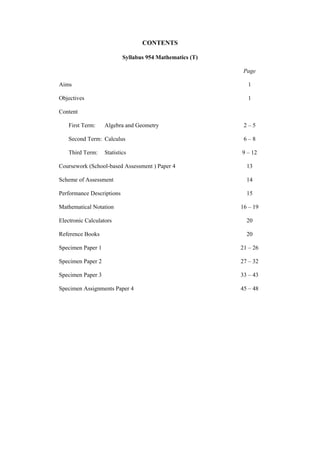
CONTENTS

                           Syllabus 954 Mathematics (T)

                                                           Page

Aims                                                        1

Objectives                                                  1

Content

    First Term:    Algebra and Geometry                    2–5

    Second Term: Calculus                                  6–8

    Third Term:    Statistics                             9 – 12

Coursework (School-based Assessment ) Paper 4               13

Scheme of Assessment                                        14

Performance Descriptions                                    15

Mathematical Notation                                     16 – 19

Electronic Calculators                                      20

Reference Books                                             20

Specimen Paper 1                                          21 – 26

Specimen Paper 2                                          27 – 32

Specimen Paper 3                                          33 – 43

Specimen Assignments Paper 4                              45 – 48


                                        4
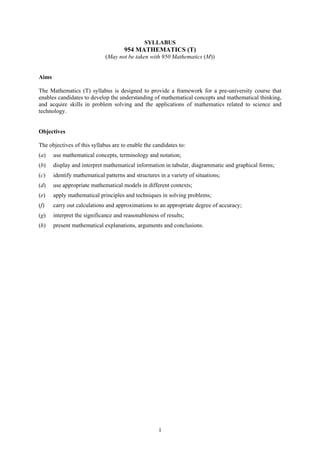
SYLLABUS
                                      954 MATHEMATICS (T)
                             (May not be taken with 950 Mathematics (M))


Aims

The Mathematics (T) syllabus is designed to provide a framework for a pre-university course that
enables candidates to develop the understanding of mathematical concepts and mathematical thinking,
and acquire skills in problem solving and the applications of mathematics related to science and
technology.


Objectives

The objectives of this syllabus are to enable the candidates to:
(a)    use mathematical concepts, terminology and notation;
(b)    display and interpret mathematical information in tabular, diagrammatic and graphical forms;
(c)    identify mathematical patterns and structures in a variety of situations;
(d)    use appropriate mathematical models in different contexts;
(e)    apply mathematical principles and techniques in solving problems;
(f)    carry out calculations and approximations to an appropriate degree of accuracy;
(g)    interpret the significance and reasonableness of results;
(h)    present mathematical explanations, arguments and conclusions.


                                                     1
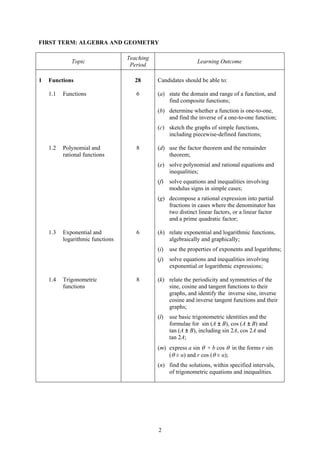
FIRST TERM: ALGEBRA AND GEOMETRY

                                  Teaching
             Topic                                            Learning Outcome
                                   Period

1   Functions                       28       Candidates should be able to:

    1.1   Functions                  6       (a) state the domain and range of a function, and
                                                 find composite functions;
                                             (b) determine whether a function is one-to-one,
                                                 and find the inverse of a one-to-one function;
                                             (c) sketch the graphs of simple functions,
                                                 including piecewise-defined functions;

    1.2   Polynomial and             8       (d) use the factor theorem and the remainder
          rational functions                     theorem;
                                             (e) solve polynomial and rational equations and
                                                 inequalities;
                                             (f)   solve equations and inequalities involving
                                                   modulus signs in simple cases;
                                             (g) decompose a rational expression into partial
                                                 fractions in cases where the denominator has
                                                 two distinct linear factors, or a linear factor
                                                 and a prime quadratic factor;

    1.3   Exponential and            6       (h) relate exponential and logarithmic functions,
          logarithmic functions                  algebraically and graphically;
                                             (i)   use the properties of exponents and logarithms;
                                             (j)   solve equations and inequalities involving
                                                   exponential or logarithmic expressions;

    1.4   Trigonometric              8       (k) relate the periodicity and symmetries of the
          functions                              sine, cosine and tangent functions to their
                                                 graphs, and identify the inverse sine, inverse
                                                 cosine and inverse tangent functions and their
                                                 graphs;
                                             (l)   use basic trigonometric identities and the
                                                   formulae for sin (A ± B), cos (A ± B) and
                                                   tan (A ± B), including sin 2A, cos 2A and
                                                   tan 2A;
                                             (m) express a sin θ + b cos θ in the forms r sin
                                                 (θ ± α) and r cos (θ ± α);
                                             (n) find the solutions, within specified intervals,
                                                 of trigonometric equations and inequalities.


                                             2
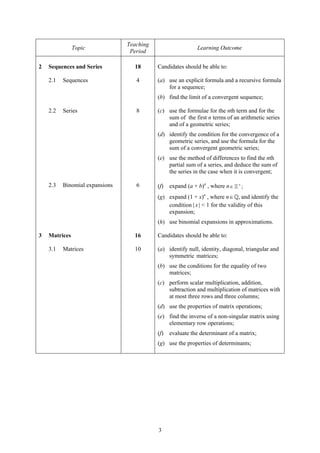
Teaching
               Topic                                        Learning Outcome
                                 Period

2   Sequences and Series          18       Candidates should be able to:

    2.1   Sequences                4       (a) use an explicit formula and a recursive formula
                                               for a sequence;
                                           (b) find the limit of a convergent sequence;

    2.2   Series                   8       (c) use the formulae for the nth term and for the
                                               sum of the first n terms of an arithmetic series
                                               and of a geometric series;
                                           (d) identify the condition for the convergence of a
                                               geometric series, and use the formula for the
                                               sum of a convergent geometric series;
                                           (e) use the method of differences to find the nth
                                               partial sum of a series, and deduce the sum of
                                               the series in the case when it is convergent;

    2.3   Binomial expansions      6       (f)   expand (a + b)n , where n ∈   +
                                                                                   ;

                                           (g) expand (1 + x)n , where n ∈ , and identify the
                                               condition | x | < 1 for the validity of this
                                               expansion;
                                           (h) use binomial expansions in approximations.

3   Matrices                      16       Candidates should be able to:

    3.1   Matrices                10       (a) identify null, identity, diagonal, triangular and
                                               symmetric matrices;
                                           (b) use the conditions for the equality of two
                                               matrices;
                                           (c) perform scalar multiplication, addition,
                                               subtraction and multiplication of matrices with
                                               at most three rows and three columns;
                                           (d) use the properties of matrix operations;
                                           (e) find the inverse of a non-singular matrix using
                                               elementary row operations;
                                           (f)   evaluate the determinant of a matrix;
                                           (g) use the properties of determinants;


                                           3
Teaching
             Topic                                         Learning Outcome
                               Period

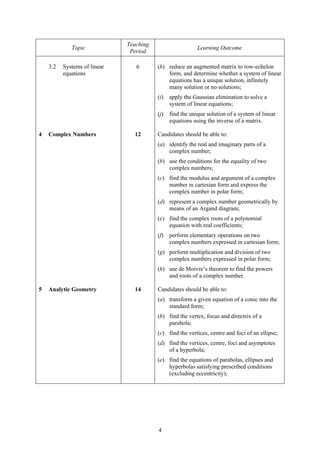
    3.2   Systems of linear      6       (h) reduce an augmented matrix to row-echelon
          equations                          form, and determine whether a system of linear
                                             equations has a unique solution, infinitely
                                             many solution or no solutions;
                                         (i)   apply the Gaussian elimination to solve a
                                               system of linear equations;
                                         (j)   find the unique solution of a system of linear
                                               equations using the inverse of a matrix.

4   Complex Numbers             12       Candidates should be able to:
                                         (a) identify the real and imaginary parts of a
                                             complex number;
                                         (b) use the conditions for the equality of two
                                             complex numbers;
                                         (c) find the modulus and argument of a complex
                                             number in cartesian form and express the
                                             complex number in polar form;
                                         (d) represent a complex number geometrically by
                                             means of an Argand diagram;
                                         (e) find the complex roots of a polynomial
                                             equation with real coefficients;
                                         (f)   perform elementary operations on two
                                               complex numbers expressed in cartesian form;
                                         (g) perform multiplication and division of two
                                             complex numbers expressed in polar form;
                                         (h) use de Moivre’s theorem to find the powers
                                             and roots of a complex number.

5   Analytic Geometry           14       Candidates should be able to:
                                         (a) transform a given equation of a conic into the
                                             standard form;
                                         (b) find the vertex, focus and directrix of a
                                             parabola;
                                         (c) find the vertices, centre and foci of an ellipse;
                                         (d) find the vertices, centre, foci and asymptotes
                                             of a hyperbola;
                                         (e) find the equations of parabolas, ellipses and
                                             hyperbolas satisfying prescribed conditions
                                             (excluding eccentricity);


                                         4
Teaching
              Topic                                          Learning Outcome
                                Period

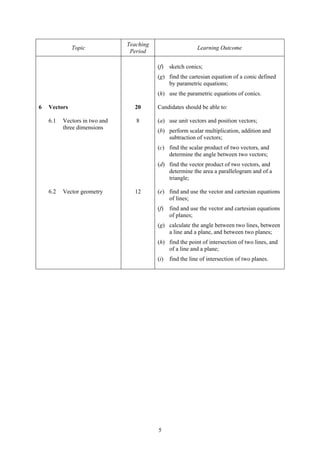
                                          (f )   sketch conics;
                                          (g) find the cartesian equation of a conic defined
                                              by parametric equations;
                                          (h) use the parametric equations of conics.

6   Vectors                      20       Candidates should be able to:

    6.1   Vectors in two and      8       (a) use unit vectors and position vectors;
          three dimensions
                                          (b) perform scalar multiplication, addition and
                                              subtraction of vectors;
                                          (c) find the scalar product of two vectors, and
                                              determine the angle between two vectors;
                                          (d) find the vector product of two vectors, and
                                              determine the area a parallelogram and of a
                                              triangle;

    6.2   Vector geometry        12       (e) find and use the vector and cartesian equations
                                              of lines;
                                          (f)    find and use the vector and cartesian equations
                                                 of planes;
                                          (g) calculate the angle between two lines, between
                                              a line and a plane, and between two planes;
                                          (h) find the point of intersection of two lines, and
                                              of a line and a plane;
                                          (i)    find the line of intersection of two planes.


                                          5
SECOND TERM: CALCULUS

                                 Teaching
             Topic                                            Learning Outcome
                                  Period

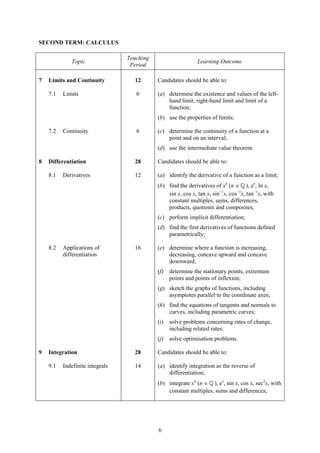
7   Limits and Continuity          12       Candidates should be able to:

    7.1   Limits                    6       (a) determine the existence and values of the left-
                                                hand limit, right-hand limit and limit of a
                                                function;
                                            (b) use the properties of limits;

    7.2   Continuity                6       (c) determine the continuity of a function at a
                                                point and on an interval;
                                            (d) use the intermediate value theorem.

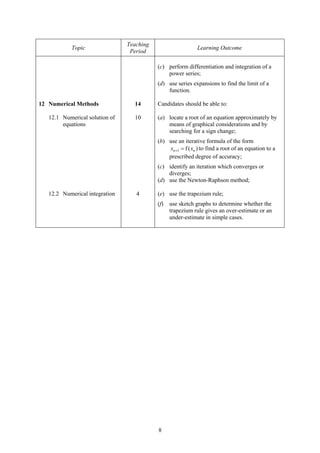
8   Differentiation                28       Candidates should be able to:

    8.1   Derivatives              12       (a) identify the derivative of a function as a limit;
                                            (b) find the derivatives of xn (n ∈ ), ex, ln x,
                                                sin x, cos x, tan x, sin−1x, cos−1x, tan−1x, with
                                                constant multiples, sums, differences,
                                                products, quotients and composites;
                                            (c) perform implicit differentiation;
                                            (d) find the first derivatives of functions defined
                                                parametrically;

    8.2   Applications of          16       (e) determine where a function is increasing,
          differentiation                       decreasing, concave upward and concave
                                                downward;
                                            (f)   determine the stationary points, extremum
                                                  points and points of inflexion;
                                            (g) sketch the graphs of functions, including
                                                asymptotes parallel to the coordinate axes;
                                            (h) find the equations of tangents and normals to
                                                curves, including parametric curves;
                                            (i)   solve problems concerning rates of change,
                                                  including related rates;
                                            (j)   solve optimisation problems.

9   Integration                    28       Candidates should be able to:

    9.1   Indefinite integrals     14       (a) identify integration as the reverse of
                                                differentiation;
                                            (b) integrate xn (n ∈ ), ex, sin x, cos x, sec2x, with
                                                constant multiples, sums and differences;


                                            6
Teaching
            Topic                                            Learning Outcome
                                Period

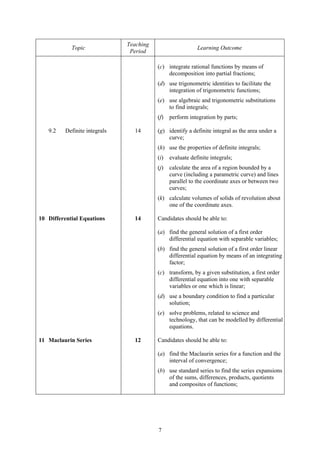
                                          (c) integrate rational functions by means of
                                              decomposition into partial fractions;
                                          (d) use trigonometric identities to facilitate the
                                              integration of trigonometric functions;
                                          (e) use algebraic and trigonometric substitutions
                                              to find integrals;
                                          (f)    perform integration by parts;

   9.2    Definite integrals     14       (g) identify a definite integral as the area under a
                                              curve;
                                          (h) use the properties of definite integrals;
                                          (i )   evaluate definite integrals;
                                          (j )   calculate the area of a region bounded by a
                                                 curve (including a parametric curve) and lines
                                                 parallel to the coordinate axes or between two
                                                 curves;
                                          (k) calculate volumes of solids of revolution about
                                              one of the coordinate axes.

10 Differential Equations        14       Candidates should be able to:

                                          (a) find the general solution of a first order
                                              differential equation with separable variables;
                                          (b) find the general solution of a first order linear
                                              differential equation by means of an integrating
                                              factor;
                                          (c) transform, by a given substitution, a first order
                                              differential equation into one with separable
                                              variables or one which is linear;
                                          (d) use a boundary condition to find a particular
                                              solution;
                                          (e) solve problems, related to science and
                                              technology, that can be modelled by differential
                                              equations.

11 Maclaurin Series              12       Candidates should be able to:

                                          (a) find the Maclaurin series for a function and the
                                              interval of convergence;
                                          (b) use standard series to find the series expansions
                                              of the sums, differences, products, quotients
                                              and composites of functions;


                                          7
Teaching
            Topic                                            Learning Outcome
                                 Period

                                           (c) perform differentiation and integration of a
                                               power series;
                                           (d) use series expansions to find the limit of a
                                               function.

12 Numerical Methods              14       Candidates should be able to:

   12.1 Numerical solution of     10       (a) locate a root of an equation approximately by
        equations                              means of graphical considerations and by
                                               searching for a sign change;
                                           (b) use an iterative formula of the form
                                               xn +1 = f ( xn ) to find a root of an equation to a
                                               prescribed degree of accuracy;
                                           (c) identify an iteration which converges or
                                               diverges;
                                           (d) use the Newton-Raphson method;

   12.2 Numerical integration      4       (e) use the trapezium rule;
                                           (f)   use sketch graphs to determine whether the
                                                 trapezium rule gives an over-estimate or an
                                                 under-estimate in simple cases.


                                           8
THIRD TERM: STATISTICS

                         Teaching
           Topic                                       Learning Outcome
                          Period

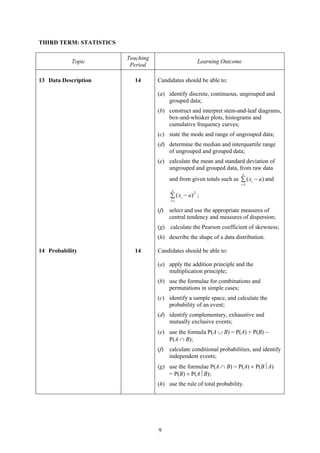
13 Data Description        14       Candidates should be able to:

                                    (a) identify discrete, continuous, ungrouped and
                                        grouped data;
                                    (b) construct and interpret stem-and-leaf diagrams,
                                        box-and-whisker plots, histograms and
                                        cumulative frequency curves;
                                    (c) state the mode and range of ungrouped data;
                                    (d) determine the median and interquartile range
                                        of ungrouped and grouped data;
                                    (e) calculate the mean and standard deviation of
                                        ungrouped and grouped data, from raw data
                                                                          n
                                          and from given totals such as ∑ ( xi − a ) and
                                                                         i =1
                                           n
                                          ∑ ( xi − a ) ;
                                                      2

                                          i =1


                                    (f)   select and use the appropriate measures of
                                          central tendency and measures of dispersion;
                                    (g)   calculate the Pearson coefficient of skewness;
                                    (h) describe the shape of a data distribution.

14 Probability             14       Candidates should be able to:

                                    (a) apply the addition principle and the
                                        multiplication principle;
                                    (b) use the formulae for combinations and
                                        permutations in simple cases;
                                    (c) identify a sample space, and calculate the
                                        probability of an event;
                                    (d) identify complementary, exhaustive and
                                        mutually exclusive events;
                                    (e) use the formula P(A ∪ B) = P(A) + P(B) −
                                        P(A ∩ B);
                                    (f)   calculate conditional probabilities, and identify
                                          independent events;
                                    (g) use the formulae P(A ∩ B) = P(A) × P(B⏐A)
                                        = P(B) × P(A⏐B);
                                    (h) use the rule of total probability.


                                    9
Teaching
            Topic                                            Learning Outcome
                                 Period

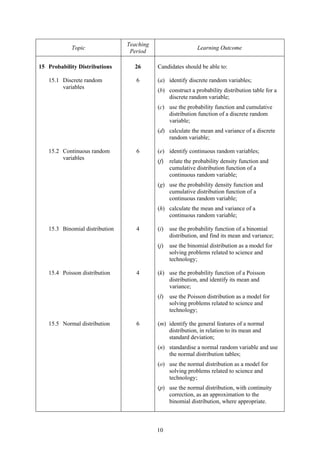
15 Probability Distributions      26       Candidates should be able to:

   15.1 Discrete random            6       (a) identify discrete random variables;
        variables
                                           (b) construct a probability distribution table for a
                                               discrete random variable;
                                           (c) use the probability function and cumulative
                                               distribution function of a discrete random
                                               variable;
                                           (d) calculate the mean and variance of a discrete
                                               random variable;

   15.2 Continuous random          6       (e) identify continuous random variables;
        variables
                                           (f)   relate the probability density function and
                                                 cumulative distribution function of a
                                                 continuous random variable;
                                           (g) use the probability density function and
                                               cumulative distribution function of a
                                               continuous random variable;
                                           (h) calculate the mean and variance of a
                                               continuous random variable;

   15.3 Binomial distribution      4       (i)   use the probability function of a binomial
                                                 distribution, and find its mean and variance;
                                           (j)   use the binomial distribution as a model for
                                                 solving problems related to science and
                                                 technology;

   15.4 Poisson distribution       4       (k) use the probability function of a Poisson
                                               distribution, and identify its mean and
                                               variance;
                                           (l)   use the Poisson distribution as a model for
                                                 solving problems related to science and
                                                 technology;

   15.5 Normal distribution        6       (m) identify the general features of a normal
                                               distribution, in relation to its mean and
                                               standard deviation;
                                           (n) standardise a normal random variable and use
                                               the normal distribution tables;
                                           (o) use the normal distribution as a model for
                                               solving problems related to science and
                                               technology;
                                           (p) use the normal distribution, with continuity
                                               correction, as an approximation to the
                                               binomial distribution, where appropriate.


                                           10
Teaching
           Topic                                          Learning Outcome
                              Period

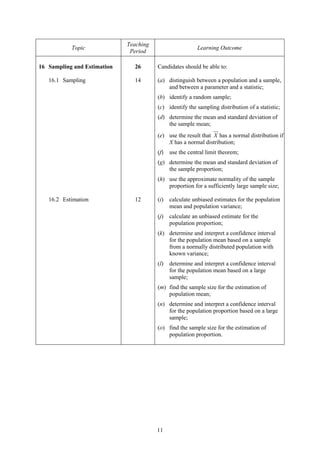
16 Sampling and Estimation     26       Candidates should be able to:

   16.1 Sampling               14       (a) distinguish between a population and a sample,
                                            and between a parameter and a statistic;
                                        (b) identify a random sample;
                                        (c) identify the sampling distribution of a statistic;
                                        (d) determine the mean and standard deviation of
                                            the sample mean;
                                        (e) use the result that X has a normal distribution if
                                            X has a normal distribution;
                                        (f)   use the central limit theorem;
                                        (g) determine the mean and standard deviation of
                                            the sample proportion;
                                        (h) use the approximate normality of the sample
                                            proportion for a sufficiently large sample size;

   16.2 Estimation             12       (i)   calculate unbiased estimates for the population
                                              mean and population variance;
                                        (j)   calculate an unbiased estimate for the
                                              population proportion;
                                        (k) determine and interpret a confidence interval
                                            for the population mean based on a sample
                                            from a normally distributed population with
                                            known variance;
                                        (l)   determine and interpret a confidence interval
                                              for the population mean based on a large
                                              sample;
                                        (m) find the sample size for the estimation of
                                            population mean;
                                        (n) determine and interpret a confidence interval
                                            for the population proportion based on a large
                                            sample;
                                        (o) find the sample size for the estimation of
                                            population proportion.


                                        11
Teaching
           Topic                                    Learning Outcome
                         Period

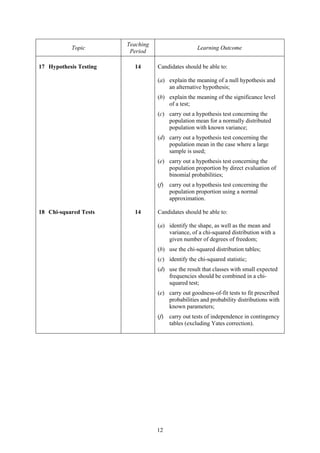
17 Hypothesis Testing     14       Candidates should be able to:

                                   (a) explain the meaning of a null hypothesis and
                                       an alternative hypothesis;
                                   (b) explain the meaning of the significance level
                                       of a test;
                                   (c) carry out a hypothesis test concerning the
                                       population mean for a normally distributed
                                       population with known variance;
                                   (d) carry out a hypothesis test concerning the
                                       population mean in the case where a large
                                       sample is used;
                                   (e) carry out a hypothesis test concerning the
                                       population proportion by direct evaluation of
                                       binomial probabilities;
                                   (f)   carry out a hypothesis test concerning the
                                         population proportion using a normal
                                         approximation.

18 Chi-squared Tests      14       Candidates should be able to:

                                   (a) identify the shape, as well as the mean and
                                       variance, of a chi-squared distribution with a
                                       given number of degrees of freedom;
                                   (b) use the chi-squared distribution tables;
                                   (c) identify the chi-squared statistic;
                                   (d) use the result that classes with small expected
                                       frequencies should be combined in a chi-
                                       squared test;
                                   (e) carry out goodness-of-fit tests to fit prescribed
                                       probabilities and probability distributions with
                                       known parameters;
                                   (f)   carry out tests of independence in contingency
                                         tables (excluding Yates correction).


                                   12
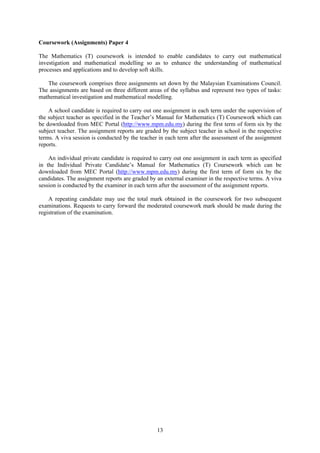
Coursework (Assignments) Paper 4

The Mathematics (T) coursework is intended to enable candidates to carry out mathematical
investigation and mathematical modelling so as to enhance the understanding of mathematical
processes and applications and to develop soft skills.

   The coursework comprises three assignments set down by the Malaysian Examinations Council.
The assignments are based on three different areas of the syllabus and represent two types of tasks:
mathematical investigation and mathematical modelling.

    A school candidate is required to carry out one assignment in each term under the supervision of
the subject teacher as specified in the Teacher’s Manual for Mathematics (T) Coursework which can
be downloaded from MEC Portal (http://www.mpm.edu.my) during the first term of form six by the
subject teacher. The assignment reports are graded by the subject teacher in school in the respective
terms. A viva session is conducted by the teacher in each term after the assessment of the assignment
reports.

    An individual private candidate is required to carry out one assignment in each term as specified
in the Individual Private Candidate’s Manual for Mathematics (T) Coursework which can be
downloaded from MEC Portal (http://www.mpm.edu.my) during the first term of form six by the
candidates. The assignment reports are graded by an external examiner in the respective terms. A viva
session is conducted by the examiner in each term after the assessment of the assignment reports.

    A repeating candidate may use the total mark obtained in the coursework for two subsequent
examinations. Requests to carry forward the moderated coursework mark should be made during the
registration of the examination.


                                                 13
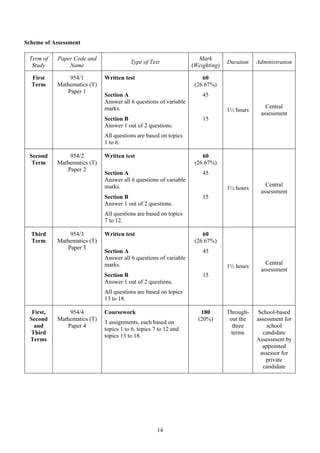
Scheme of Assessment

 Term of   Paper Code and                                           Mark
                                        Type of Test                            Duration   Administration
  Study        Name                                               (Weighting)

  First        954/1         Written test                             60
  Term     Mathematics (T)                                         (26.67%)
              Paper 1
                             Section A                                45
                             Answer all 6 questions of variable
                             marks.                                                           Central
                                                                                1½ hours
                                                                                            assessment
                             Section B                                15
                             Answer 1 out of 2 questions.
                             All questions are based on topics
                             1 to 6.

 Second        954/2         Written test                             60
  Term     Mathematics (T)                                         (26.67%)
              Paper 2
                             Section A                                45
                             Answer all 6 questions of variable
                             marks.                                                           Central
                                                                                1½ hours
                                                                                            assessment
                             Section B                                15
                             Answer 1 out of 2 questions.
                             All questions are based on topics
                             7 to 12.

  Third        954/3         Written test                             60
  Term     Mathematics (T)                                         (26.67%)
              Paper 3
                             Section A                                45
                             Answer all 6 questions of variable
                             marks.                                                           Central
                                                                                1½ hours
                                                                                            assessment
                             Section B                                15
                             Answer 1 out of 2 questions.
                             All questions are based on topics
                             13 to 18.

  First,       954/4         Coursework                              180        Through-    School-based
 Second    Mathematics (T)                                          (20%)        out the   assessment for
                             3 assignments, each based on
   and        Paper 4                                                             three         school
                             topics 1 to 6, topics 7 to 12 and
 Third                                                                            terms       candidate
                             topics 13 to 18.
 Terms                                                                                     Assessment by
                                                                                              appointed
                                                                                             assessor for
                                                                                               private
                                                                                              candidate


                                                    14
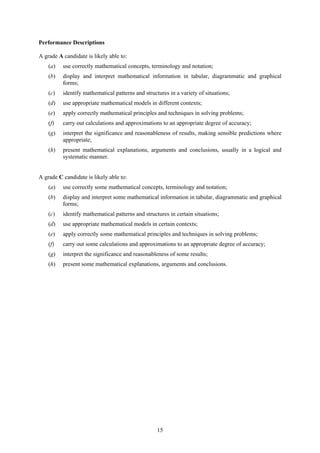
Performance Descriptions

A grade A candidate is likely able to:
    (a)   use correctly mathematical concepts, terminology and notation;
    (b)   display and interpret mathematical information in tabular, diagrammatic and graphical
          forms;
    (c)   identify mathematical patterns and structures in a variety of situations;
    (d)   use appropriate mathematical models in different contexts;
    (e)   apply correctly mathematical principles and techniques in solving problems;
    (f)   carry out calculations and approximations to an appropriate degree of accuracy;
    (g)   interpret the significance and reasonableness of results, making sensible predictions where
          appropriate;
    (h)   present mathematical explanations, arguments and conclusions, usually in a logical and
          systematic manner.


A grade C candidate is likely able to:
    (a)   use correctly some mathematical concepts, terminology and notation;
    (b)   display and interpret some mathematical information in tabular, diagrammatic and graphical
          forms;
    (c)   identify mathematical patterns and structures in certain situations;
    (d)   use appropriate mathematical models in certain contexts;
    (e)   apply correctly some mathematical principles and techniques in solving problems;
    (f)   carry out some calculations and approximations to an appropriate degree of accuracy;
    (g)   interpret the significance and reasonableness of some results;
    (h)   present some mathematical explanations, arguments and conclusions.


                                                   15
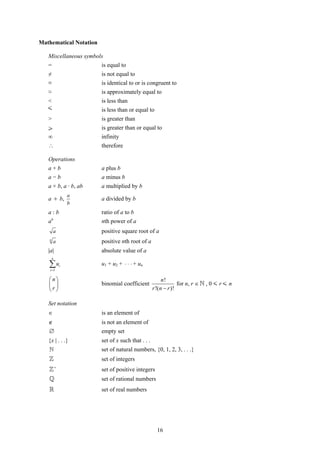
Mathematical Notation

   Miscellaneous symbols
   =                    is equal to
   ≠                    is not equal to
   ≡                    is identical to or is congruent to
   ≈                    is approximately equal to
   <                    is less than
   <                    is less than or equal to
   >                    is greater than
   >                    is greater than or equal to
   ∞                    infinity
   ∴                    therefore

   Operations
   a+b                  a plus b
   a−b                  a minus b
   a × b, a · b, ab     a multiplied by b
                   a
   a ÷ b,               a divided by b
                   b
   a:b                  ratio of a to b
       n
   a                    nth power of a
       a                positive square root of a
   n
       a                positive nth root of a
   |a|                  absolute value of a
       n

   ∑u
    i =1
               i        u1 + u2 + ⋅ ⋅ ⋅ + un

   ⎛n⎞                                                   n!
   ⎜ ⎟                  binomial coefficient                     for n, r ∈   ,0< r< n
   ⎝r⎠                                             r !( n − r )!

   Set notation
   ∈                    is an element of
   ∉                    is not an element of
   ∅                    empty set
   {x | . . .}          set of x such that . . .
                        set of natural numbers, {0, 1, 2, 3, . . .}
                        set of integers
           +
                        set of positive integers
                        set of rational numbers
                        set of real numbers


                                                     16
[a, b]                 closed interval {x | x ∈ , a < x < b}
(a, b)                 open interval {x | x ∈ , a < x < b}
[a, b)                 interval {x | x ∈ , a < x < b}
(a, b]                 interval {x | x ∈ , a < x < b}
∪                      union
∩                      intersection

Functions
f                      a function f
f(x)                   value of a function f at x
f : A→ B               f is a function under which each element of set A has an image in set B
f :x     y             f is a function which maps the element x to the element y
f −1                   inverse function of f
f g                    composite function of f and g which is defined by f g(x) = f [g(x)]
ex                     exponential function of x
loga x                 logarithm to base a of x
ln x                   natural logarithm of x, loge x
sin, cos, tan,
                       trigonometric functions
csc, sec, cot
sin−1, cos−1, tan−1,
                       inverse trigonometric functions
csc−1, sec−1, cot−1

Matrices
A                      a matrix A
0                      null matrix
I                      identity matrix
    T
A                      transpose of a matrix A
    −1
A                      inverse of a non-singular square matrix A
det A                  determinant of a square matrix A

Complex numbers
i                      square root of −1
z                      a complex number z
|z|                    modulus of z
arg z                  argument of z
z*                     complex conjugate of z


                                                17
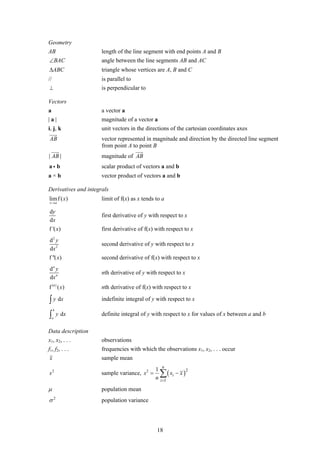
Geometry
AB                    length of the line segment with end points A and B
∠BAC                  angle between the line segments AB and AC
ΔABC                  triangle whose vertices are A, B and C
//                    is parallel to
⊥                     is perpendicular to

Vectors
a                     a vector a
|a|                   magnitude of a vector a
i , j, k              unit vectors in the directions of the cartesian coordinates axes
AB                    vector represented in magnitude and direction by the directed line segment
                      from point A to point B
| AB |                magnitude of AB
ai b                  scalar product of vectors a and b
a×b                   vector product of vectors a and b

Derivatives and integrals
lim f ( x)            limit of f(x) as x tends to a
x →a

dy
                      first derivative of y with respect to x
dx
f '( x)               first derivative of f(x) with respect to x
d2 y
                      second derivative of y with respect to x
dx 2
f ''( x)              second derivative of f(x) with respect to x
dn y
                      nth derivative of y with respect to x
dx n
f (n ) ( x)           nth derivative of f(x) with respect to x

∫ y dx                indefinite integral of y with respect to x
     b
∫    a
         y dx         definite integral of y with respect to x for values of x between a and b

Data description
x1, x2, . . .         observations
f1, f2, . . .         frequencies with which the observations x1, x2, . . . occur
x                     sample mean
                                                    n
                                               1
                                                   ∑ ( xi − x )
                                                                  2
s2                    sample variance, s 2 =
                                               n   i =1

μ                     population mean
σ2                    population variance


                                               18
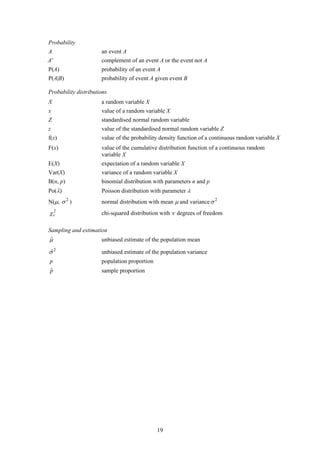
Probability
A                     an event A
A'                    complement of an event A or the event not A
P(A)                  probability of an event A
P(A|B)                probability of event A given event B

Probability distributions
X                     a random variable X
x                     value of a random variable X
Z                     standardised normal random variable
z                     value of the standardised normal random variable Z
f(x)                  value of the probability density function of a continuous random variable X
F(x)                  value of the cumulative distribution function of a continuous random
                      variable X
E(X)                  expectation of a random variable X
Var(X)                variance of a random variable X
B(n, p)               binomial distribution with parameters n and p
Po(λ)                 Poisson distribution with parameter λ
N(μ, σ 2 )            normal distribution with mean μ and variance σ 2
χν2                   chi-squared distribution with ν degrees of freedom

Sampling and estimation
μ
ˆ                     unbiased estimate of the population mean

σ2
ˆ                     unbiased estimate of the population variance
p                     population proportion
ˆ
p                     sample proportion


                                              19
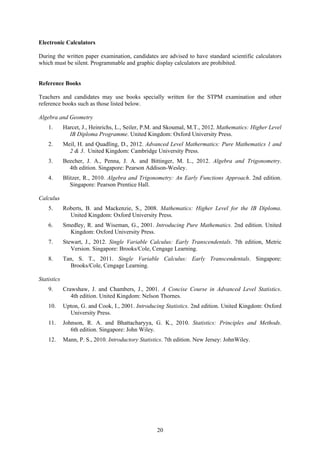
Electronic Calculators

During the written paper examination, candidates are advised to have standard scientific calculators
which must be silent. Programmable and graphic display calculators are prohibited.


Reference Books

Teachers and candidates may use books specially written for the STPM examination and other
reference books such as those listed below.

Algebra and Geometry
    1.       Harcet, J., Heinrichs, L., Seiler, P.M. and Skoumal, M.T., 2012. Mathematics: Higher Level
               IB Diploma Programme. United Kingdom: Oxford University Press.
    2.       Meil, H. and Quadling, D., 2012. Advanced Level Mathermatics: Pure Mathematics 1 and
               2 & 3. United Kingdom: Cambridge University Press.
    3.       Beecher, J. A., Penna, J. A. and Bittinger, M. L., 2012. Algebra and Trigonometry.
               4th edition. Singapore: Pearson Addison-Wesley.
    4.       Blitzer, R., 2010. Algebra and Trigonometry: An Early Functions Approach. 2nd edition.
                Singapore: Pearson Prentice Hall.

Calculus
    5.       Roberts, B. and Mackenzie, S., 2008. Mathematics: Higher Level for the IB Diploma.
               United Kingdom: Oxford University Press.
    6.       Smedley, R. and Wiseman, G., 2001. Introducing Pure Mathematics. 2nd edition. United
               Kingdom: Oxford University Press.
    7.       Stewart, J., 2012. Single Variable Calculus: Early Transcendentals. 7th edition, Metric
                Version. Singapore: Brooks/Cole, Cengage Learning.
    8.       Tan, S. T., 2011. Single Variable Calculus: Early Transcendentals. Singapore:
                Brooks/Cole, Cengage Learning.

Statistics
    9.       Crawshaw, J. and Chambers, J., 2001. A Concise Course in Advanced Level Statistics.
                4th edition. United Kingdom: Nelson Thornes.
    10.      Upton, G. and Cook, I., 2001. Introducing Statistics. 2nd edition. United Kingdom: Oxford
               University Press.
    11.      Johnson, R. A. and Bhattacharyya, G. K., 2010. Statistics: Principles and Methods.
                6th edition. Singapore: John Wiley.
    12.      Mann, P. S., 2010. Introductory Statistics. 7th edition. New Jersey: JohnWiley.


                                                    20
SPECIMEN PAPER

       954/1                                                                     STPM

                     MATHEMATICS (T) (MATEMATIK (T))

                                   PAPER 1 (KERTAS 1)
                              One and a half hours (Satu jam setengah)


                       MAJLIS PEPERIKSAAN MALAYSIA
                              (MALAYSIAN EXAMINATIONS COUNCIL)


                 SIJIL TINGGI PERSEKOLAHAN MALAYSIA
                             (MALAYSIA HIGHER SCHOOL CERTIFICATE)


Instruction to candidates:
   DO NOT OPEN THIS QUESTION PAPER UNTIL YOU ARE TOLD TO DO SO.
    Answer all questions in Section A and any one question in Section B. Answers may be written in
either English or Bahasa Malaysia.
   All necessary working should be shown clearly.
   Scientific calculators may be used. Programmable and graphic display calculators are
prohibited.
   A list of mathematical formulae is provided on page of this question paper.

Arahan kepada calon:
  JANGAN BUKA KERTAS SOALAN INI SEHINGGA DIBERITAHU UNTUK BERBUAT
DEMIKIAN.
   Jawab semua soalan dalam Bahagian A dan mana-mana satu soalan dalam Bahagian B.
Jawapan boleh ditulis dalam bahasa Inggeris atau Bahasa Malaysia.
   Semua kerja yang perlu hendaklah ditunjukkan dengan jelas.
    Kalkulator sainstifik boleh digunakan. Kalkulator boleh atur cara dan kalkulator paparan grafik
tidak dibenarkan.
   Senarai rumus matematik dibekalkan pada halaman dalam kertas soalan ini.

__________________________________________________________________________________
              This question paper consists of printed pages and          blank page.
       (Kertas soalan ini terdiri daripada halaman bercetak dan           halaman kosong.)
                                   © Majlis Peperiksaan Malaysia
STPM 954/1


                                                21
Section A [45 marks]

                                    Answer all questions in this section.

1   The functions f and g are defined by
                                            f :x   e2 x , x ∈ ,
                                            g:x    (ln x)2 , x > 0.
    (a) Find f−1 and state its domain.                                                             [3 marks]

    (b) Show that g   ( 1 ) = g(2), and state, with a reason, whether g has an inverse.
                        2
                                                                                                   [4 marks]

                                                                                   n
2   A sequence is defined by ur = e–(r – 1) – e–r for all integers r > 1. Find    ∑ u , in terms of n, and
                                                                                  r =1
                                                                                          r

                        ∞
deduce the value of   ∑u .
                      r =1
                             r                                                                     [5 marks]


                     ⎛ 2 −2 0 ⎞                ⎛ −1 1 0 ⎞
                     ⎜        ⎟                ⎜         ⎟
3   The matrices P = ⎜ 0 0 2 ⎟ and Q =         ⎜ 0  0 −1 ⎟ are such that PQ = QP.
                     ⎜a b c⎟                   ⎜ 0 −2 2 ⎟
                     ⎝        ⎠                ⎝         ⎠
    (a) Determine the values of a, b and c.                                                        [5 marks]
    (b) Find the real numbers m and n for which P = mQ + nI, where I is the 3 × 3 identity matrix.
                                                                                           [5 marks]

4   Express the complex number z = 1 − 3 i in polar form.                                          [4 marks]

                        1             1
    Hence, find z 5 +     5
                            and z 5 − 5 .                                                          [4 marks]
                        z            z

5   The equation of a hyperbola is 4x2 – 9y2 – 24x –18y – 9 = 0.
    (a) Obtain the standard form for the equation of the hyperbola.                                [3 marks]
    (b) Find the vertices and the equations of the asymptotes of the hyperbola.                    [6 marks]

                                                                                          y − 4 z +1
6   Find the equation of the plane which contains the straight line x − 3 =                    =       and is
                                                                                            3     2
perpendicular to the plane 3x + 2y − z = 3.                                                         [6 marks]


954/1


                                                     22
Bahagian A [45 markah]

                                     Jawab semua soalan dalam bahagian ini.

1   Fungsi f dan g ditakrifkan oleh
                                              f :x    e2 x , x ∈ ;
                                              g:x     (ln x)2 , x > 0.
    (a) Cari f−1 dan nyatakan domainnya.                                                           [3 markah]

    (b) Tunjukkan bahawa g           ( 1 ) = g(2), dan nyatakan, dengan satu sebab, sama ada g mempunyai
                                       2
songsangan.                                                                                        [4 markah]
                                                                                         n
2   Satu jujukan ditakrifkan oleh ur = e–(r – 1) – e–r bagi semua integer r > 1. Cari   ∑ u , dalam sebutan
                                                                                        r =1
                                                                                               r

                          ∞
n, dan deduksikan nilai   ∑u .
                          r =1
                                 r                                                                 [5 markah]


                ⎛ 2 −2 0 ⎞                   ⎛ −1 1 0 ⎞
                ⎜        ⎟                   ⎜         ⎟
3   Matriks P = ⎜ 0 0 2 ⎟ dan Q =            ⎜ 0  0 −1 ⎟ adalah sebegitu rupa sehinggakan PQ = QP.
                ⎜a b c⎟                      ⎜ 0 −2 2 ⎟
                ⎝        ⎠                   ⎝         ⎠
    (a) Tentukan nilai a, b dan c.                                                                 [5 markah]
    (b) Cari nombor nyata m dan n supaya P = mQ + nI, dengan I matriks identiti 3 × 3. [5 markah]

4   Ungkapkan nombor kompleks z = 1 − 3 i dalam bentuk kutub.                                      [4 markah]

                                            1             1
    Dengan yang demikian, cari z 5 +          5
                                                dan z 5 − 5 .                                      [4 markah]
                                            z            z

5   Persamaan satu hiperbola ialah 4x2 – 9y2 – 24x –18y – 9 = 0.
    (a) Dapatkan bentuk piawai bagi persamaan hiperbola itu.                                       [3 markah]
    (b) Cari bucu dan persamaan asimptot hiperbola itu.                                            [6 markah]

                                                                         y − 4 z +1
6   Cari persamaan satah yang mengandung garis lurus x − 3 =                  =     dan serenjang dengan
                                                                           3     2
satah 3x + 2y − z = 3.                                                                        [6 markah]


954/1


                                                        23
Section B [15 marks]

                                  Answer any one question in this section.

7   Express cos x + sin x in the form r cos (x − α), where r > 0 and 0 < α < 1 π . Hence, find the
                                                                             2
minimum and maximum values of cos x + sin x and the corresponding values of x in the interval
0 < x < 2π.                                                                             [7 marks]
    (a) Sketch the graph of y = cos x + sin x for 0 < x < 2π.                                 [3 marks]
    (b) By drawing appropriate lines on your graph, determine the number of roots in the interval
0 < x < 2π of each of the following equations.
          (i) cos x + sin x = − 1
                                2
                                                                                              [1 mark]

         (ii) cos x + sin x = 2                                                               [1 mark]
    (c) Find the set of values of x in the interval 0 < x < 2π for which cos x + sin x > 1.   [3 marks]

8   The position vectors a, b and c of three points A, B and C respectively are given by
                                               a = i + j + k,
                                               b = i + 2j + 3k,
                                               c = i – 3j +2k.
    (a) Find a unit vector parallel to a + b + c.                                             [3 marks]
    (b) Calculate the acute angle between a and a + b + c.                                    [3 marks]
    (c) Find the vector of the form i + λj + μk perpendicular to both a and b.                [2 marks]
    (d) Determine the position vector of the point D which is such that ABCD is a parallelogram
having BD as a diagonal.                                                              [3 marks]
    (e) Calculate the area of the parallelogram ABCD.                                         [4 marks]


954/1


                                                    24
Bahagian B [15 markah]

                         Jawab mana-mana satu soalan dalam bahagian ini.

7   Ungkapkan kos x + sin x dalam bentuk r kos (x − α), dengan r > 0 dan 0 < α < 1 π . Dengan yang
                                                                                 2
demikian, cari nilai minimum dan nilai maksimum kos x + sin x dan nilai x yang sepadan dalam
selang 0 < x < 2π.                                                                [7 markah]
    (a) Lakar graf y = kos x + sin x bagi 0 < x < 2π.                                  [3 markah]
    (b) Dengan melukis garis yang sesuai pada graf anda, tentukan bilangan punca dalam selang
0 < x < 2π setiap persamaan yang berikut.
         (i) kos x + sin x = − 1
                               2
                                                                                       [1 markah]

         (ii) kos x + sin x = 2                                                        [1 markah]
    (c) Cari set nilai x dalam selang 0 < x < 2π supaya kos x + sin x > 1.             [3 markah]

8   Vektor kedudukan a, b, dan c tiga titik A, B, dan C masing-masing diberikan oleh
                                             a = i + j + k,
                                             b = i + 2j + 3k,
                                             c = i – 3j +2k.
    (a) Cari vektor unit yang selari dengan a + b + c.                                 [3 markah]
    (b) Hitung sudut tirus di antara a dengan a + b + c.                               [3 markah]
    (c) Cari vektor dalam bentuk i + λj + μk yang serenjang dengan kedua-dua a dan b. [2 markah]
    (d) Tentukan vektor kedudukan titik D yang sebegitu rupa sehinggakan ABCD ialah satu
segiempat selari dengan BD sebagai satu pepenjuru.                           [3 markah]
    (e) Hitung luas segiempat selari ABCD.                                             [4 markah]


954/1


                                                  25
MATHEMATICAL FORMULAE
                                           (RUMUS MATEMATIK)


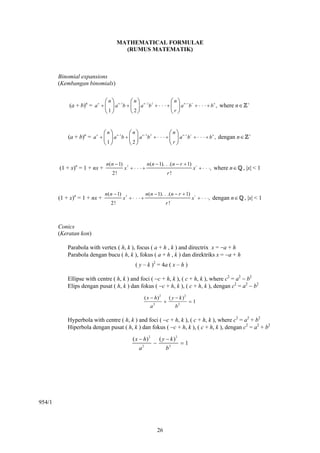
        Binomial expansions
        (Kembangan binomials)


                                ⎛n⎞                ⎛n⎞                           ⎛n⎞
            (a + b)n = a n + ⎜ ⎟ a n −1b + ⎜ ⎟ a n − 2 b 2 + ⋅ ⋅ ⋅ + ⎜ ⎟ a n − r b r + ⋅ ⋅ ⋅ + b n , where n ∈ Z +
                                ⎝1⎠                ⎝2⎠                           ⎝r⎠


                                ⎛n⎞                ⎛n⎞                          ⎛n⎞
            (a + b)n = a n + ⎜ ⎟ a n −1b + ⎜ ⎟ a n − 2 b 2 + ⋅ ⋅ ⋅ + ⎜ ⎟ a n − r b r + ⋅ ⋅ ⋅ + b n , dengan n ∈ Z +
                                ⎝1⎠                ⎝2⎠                          ⎝r⎠


                                 n ( n − 1)                    n ( n − 1). . .( n − r + 1)
        (1 + x)n = 1 + nx +                   x +⋅ ⋅ ⋅+
                                               2
                                                                                                x + ⋅ ⋅ ⋅, where n ∈ Q , |x| < 1
                                                                                                    r

                                    2!                                          r!


                                n ( n − 1)                    n ( n − 1). . .( n − r + 1)
        (1 + x)n = 1 + nx +                   x +⋅ ⋅ ⋅+
                                               2
                                                                                               x + ⋅ ⋅ ⋅, dengan n ∈ Q , |x| < 1
                                                                                                r

                                    2!                                      r!


        Conics
        (Keratan kon)

            Parabola with vertex ( h, k ), focus ( a + h , k ) and directrix x = −a + h
            Parabola dengan bucu ( h, k ), fokus ( a + h , k ) dan direktriks x = −a + h
                                                     ( y – k )2 = 4a ( x – h )

            Ellipse with centre ( h, k ) and foci ( −c + h, k ), ( c + h, k ), where c2 = a2 − b2
            Elips dengan pusat ( h, k ) dan fokus ( −c + h, k ), ( c + h, k ), dengan c2 = a2 − b2
                                                              ( x − h )2        ( y − k )2
                                                                            +                  =1
                                                                 a2                  b2

            Hyperbola with centre ( h, k ) and foci ( −c + h, k ), ( c + h, k ), where c2 = a2 + b2
            Hiperbola dengan pusat ( h, k ) dan fokus ( −c + h, k ), ( c + h, k ), dengan c2 = a2 + b2
                                                    ( x − h) 2         ( y − k )2
                                                                   −                      =1
                                                         a2                 b2


954/1


                                                                       26
SPECIMEN PAPER

       954/2                                                                     STPM

                     MATHEMATICS (T) (MATEMATIK (T))

                                   PAPER 2 (KERTAS 2)
                              One and a half hours (Satu jam setengah)


                       MAJLIS PEPERIKSAAN MALAYSIA
                              (MALAYSIAN EXAMINATIONS COUNCIL)


                 SIJIL TINGGI PERSEKOLAHAN MALAYSIA
                             (MALAYSIA HIGHER SCHOOL CERTIFICATE)


Instruction to candidates:
   DO NOT OPEN THIS QUESTION PAPER UNTIL YOU ARE TOLD TO DO SO.
    Answer all questions in Section A and any one question in Section B. Answers may be written in
either English or Bahasa Malaysia.
   All necessary working should be shown clearly.
   Scientific calculators may be used. Programmable and graphic display calculators are
prohibited.
   A list of mathematical formulae is provided on page of this question paper.

Arahan kepada calon:
  JANGAN BUKA KERTAS SOALAN INI SEHINGGA DIBERITAHU UNTUK BERBUAT
DEMIKIAN.
   Jawab semua soalan dalam Bahagian A dan mana-mana satu soalan dalam Bahagian B.
Jawapan boleh ditulis dalam bahasa Inggeris atau Bahasa Malaysia.
   Semua kerja yang perlu hendaklah ditunjukkan dengan jelas.
    Kalkulator sainstifik boleh digunakan. Kalkulator boleh atur cara dan kalkulator paparan grafik
tidak dibenarkan.
   Senarai rumus matematik dibekalkan pada halaman dalam kertas soalan ini.
__________________________________________________________________________________
              This question paper consists of printed pages and          blank page.
       (Kertas soalan ini terdiri daripada halaman bercetak dan           halaman kosong.)
                                   © Majlis Peperiksaan Malaysia
STPM 954/2


                                                27
Section A [45 marks]

                                           Answer all questions in this section.

1        The function f is defined by
                                                        ⎧ x + 1, x > − 1;
                                                        ⎪
                                               f ( x) = ⎨
                                                        ⎪| x | −1, otherwise.
                                                        ⎩
         (a) Find lim f ( x ).                                                                   [3 marks]
                   x →−1


         (b) Determine whether f is continuous at x = −1.                                        [2 marks]

                                                                                                        2
2        Find the equation of the normal to the curve with parametric equations x = 1 − 2t and y = −2 +
                                                                                                        t
at the point (3, –4).                                                                            [6 marks]

                                                                1

                                                            ∫
                                                                      x
3        Using the substitution x = 4sin 2 u , evaluate                   dx.                    [6 marks]
                                                                0    4− x

                         x −2 d x  x2
4        Show that e ∫ x ( x−1) =      .                                                         [4 marks]
                                  x −1
         Hence, find the particular solution of the differential equation
                                               dy   x−2            1
                                                  +         y=− 2
                                               dx x( x − 1)    x ( x − 1)

                                                       3
which satisfies the boundary condition y =                 when x = 2.                           [4 marks]
                                                       4


                                                   3                       3       5
                                     d2 y    ⎛ dy ⎞  d 3 y ⎛ dy ⎞       ⎛ dy ⎞
5        If y = sin−1 x, show that      2
                                          = x⎜ ⎟ and     3
                                                           = ⎜ ⎟ + 3x 2 ⎜ ⎟ .                    [5 marks]
                                     dx      ⎝ dx ⎠  dx      ⎝ dx ⎠     ⎝ dx ⎠
    Using Maclaurin’s theorem, express sin−1x as a series of ascending powers of x up to the term in
 5
x . State the range of values of x for which the expansion is valid.                      [7 marks]

6        Use the trapezium rule with subdivisions at x = 3 and x = 5 to obtain an approximation to
     7
           x3
∫    1   1 + x4
                dx, giving your answer correct to three places of decimals.              [4 marks]

         By evaluating the integral exactly, show that the error of the approximation is about 4.1%.
                                                                                                  [4 marks]


954/2


                                                                28
Bahagian A [45 markah]

                                Jawab semua soalan dalam bahagian ini.

1   Fungsi f ditakrifkan oleh
                                               ⎧ x + 1, x > − 1;
                                               ⎪
                                      f ( x) = ⎨
                                               ⎪| x | −1, jika tidak.
                                               ⎩
    (a) Cari had f ( x).                                                                 [3 markah]
             x →−1


    (b) Tentukan sama ada f adalah selanjar di x = −1.                                   [2 markah]

2   Cari persamaan normal kepada lengkung dengan persamaan berparameter x = 1 − 2t dan
         2
y = −2 +   di titik (3, –4).                                              [6 markah]
         t

                                                                  1

                                                              ∫
                                                                       x
3   Dengan menggunakan gantian x = 4sin 2 u , nilaikan                     dx.           [6 markah]
                                                                  0   4− x

                           x−2 dx    x2
4   Tunjukkan bahawa e ∫ x ( x−1) =      .                                               [4 markah]
                                    x −1
    Dengan yang demikian, cari selesaian khusus persamaan pembezaan
                                      dy   x−2            1
                                         +         y=− 2
                                      dx x( x − 1)    x ( x − 1)

                                       3
yang memenuhi syarat sempadan y =          apabila x = 2.                                [4 markah]
                                       4

                                                          3                      3   5
                                           d2 y    ⎛ dy ⎞  d 3 y ⎛ dy ⎞       ⎛ dy ⎞
5   Jika y = sin−1 x, tunjukkan bahawa        2
                                                = x⎜ ⎟ dan     3
                                                                 = ⎜ ⎟ + 3x 2 ⎜ ⎟ .      [5 markah]
                                           dx      ⎝ dx ⎠  dx      ⎝ dx ⎠     ⎝ dx ⎠
    Dengan menggunakan teorem Maclaurin, ungkapkan sin−1x sebagai satu siri kuasa x menaik
hingga sebutan dalam x5. Nyatakan julat nilai x supaya kembangan itu sah.       [7 markah]

6  Gunakan petua trapezium dengan subbahagian di x = 3 dan x = 5 untuk memperoleh
              7
                x3
penghampiran
                ∫
             1 1+ x
                    4
                      dx, dengan memberikan jawapan anda betul hingga tiga tempat perpuluhan.

                                                                                    [4 markah]
    Dengan menilai kamiran itu secara tepat, tunjukkan bahawa ralat penghampiran adalah lebih
kurang 4.1%.                                                                      [4 markah]


954/2


                                                     29
Section B [15 marks]

                               Answer any one question in this section.

7 A right circular cone of height a + x, where –a < x < a, is inscribed in a sphere of constant radius
a, such that the vertex and all points on the circumference of the base lie on the surface of the sphere.
    (a) Show that the volume V of the cone is given by V = 1 π (a − x)(a + x) 2 .
                                                           3                                   [3 marks]

    (b) Determine the value of x for which V is maximum and find the maximum value of V.
                                                                                       [6 marks]
    (c) Sketch the graph of V against x.                                                        [2 marks]
    (d) Determine the rate at which V changes when x = 1 a if x is increasing at a rate of
                                                       2
                                                                                                  1 a
                                                                                                 10
                                                                                                        per
minute.                                                                                         [4 marks]

8   Two iterations suggested to estimate a root of the equation                     x3 − 4x2 + 6 = 0    are
           6                   3     1
xn+1 = 4 − 2 and xn +1 = 1 ( xn + 6) 2 .
                         2
          xn

    (a) Show that the equation x 3 − 4 x 2 + 6 = 0 has a root between 3 and 4.                 [3 marks]
    (b) Using sketched graphs of y = x and y = f(x) on the same axes, show that, with initial
approximation x0 = 3, one of the iterations converges to the root whereas the other does not. [6 marks]
    (c) Use the iteration which converges to the root to obtain a sequence of iterations with x0 = 3,
ending the process when the difference of two consecutive iterations is less than 0.05.    [4 marks]
    (d) Determine whether the iteration used still converges to the root if the initial approximation is
x0 = 4.                                                                                       [2 marks]


954/2


                                                   30
Bahagian B [15 markah]

                         Jawab mana-mana satu soalan dalam bahagian ini.

7 Satu kon bulat tegak dengan tinggi a + x, dengan –a < x < a, terterap di dalam satu sfera berjejari
malar a, sebegitu rupa sehinggakan bucu dan semua titik pada lilitan tapak terletak pada permukaan
sfera itu.
    (a) Tunjukkan bahawa isi padu V kon itu diberikan oleh V = 1 π (a − x)(a + x) 2 .
                                                               3                              [3 markah]

    (b) Tentukan nilai x supaya V maksimum dan cari nilai maksimum V.                         [6 markah]
    (c) Lakar graf V lawan x.                                                                 [2 markah]
    (d) Tentukan kadar V berubah apabila x = 1 a jika x menokok pada kadar
                                             2
                                                                                 1 a
                                                                                10
                                                                                       per minit.
                                                                                              [4 markah]

8   Dua lelaran yang dicadangkan untuk menganggar satu punca persamaan x 3 − 4 x 2 + 6 = 0 ialah
           6                   3     1
xn+1 = 4 − 2 dan xn +1 = 1 ( xn + 6) 2 .
                         2
          xn

    (a) Tunjukkan bahawa persamaan x 3 − 4 x 2 + 6 = 0 mempunyai satu punca antara 3 dengan 4.
                                                                                       [3 markah]
   (b) Dengan menggunakan lakaran graf y = x dan y = f(x) pada paksi yang sama, tunjukkan
bahawa, dengan penghampiran awal x0 = 3, salah satu lelaran menumpu kepada punca itu sedangkan
yang lain tidak.                                                                    [6 markah]
    (c) Gunakan lelaran yang menumpu kepada punca itu untuk memperoleh satu jujukan lelaran
dengan x0 = 3, dengan menamatkan proses apabila beza dua lelaran yang berturut-turut kurang
daripada 0.05.                                                                   [4 markah]
   (d) Tentukan sama ada lelaran yang digunakan masih menumpu kepada punca itu jika
penghampiran awal ialah x0 = 4.                                         [2 markah]


954/2


                                                  31
MATHEMATICAL FORMULAE
                                         (RUMUS MATEMATIK)
        Differentiation
        (Pembezaan)
                                                   d                   1
                                                      (sin−1) =
                                                   dx                1 − x2
                                                  d                1
                                                     (cos−1) = −
                                                  dx             1 − x2
                                                  d                1
                                                     (kos−1) = −
                                                  dx             1 − x2
                                                    d              1
                                                       (tan−1) =
                                                    dx           1+x 2

        Integration
        (Pengamiran)
                                                    f ′( x)
                                                  ∫ f ( x) dx = ln |f(x)| + c
                                                       dv                   du
                                                   ∫ u dx dx = uv − ∫ v dx dx
        Maclaurin series
        (Siri Maclaurin)
                                                              x2        xr
                                              ex = 1 + x +       +⋅ ⋅ ⋅+ +⋅ ⋅ ⋅
                                                              2!        r!
                                              x 2 x3                 r +1 x
                                                                            r
                            ln(1 + x) = x −      +   − ⋅ ⋅ ⋅ + ( −1)          + ⋅ ⋅ ⋅ , −1 < x < 1
                                              2    3                      r
                                                                             2 r +1
                                                 x 3 x5                 r x
                                  sin x = x −       +   − ⋅ ⋅ ⋅ + ( −1)             +⋅⋅ ⋅
                                                 3! 5!                   (2 r + 1)!
                                                   x2 x4                 r x
                                                                             2r
                                    cos x = 1 −      +   − ⋅ ⋅ ⋅ + ( −1)          +⋅⋅⋅
                                                   2! 4!                   (2r )!
                                                   x2 x4                 r x
                                                                             2r
                                    kos x = 1 −      +   − ⋅ ⋅ ⋅ + ( −1)          +⋅⋅⋅
                                                   2! 4!                   (2r )!
        Numerical methods
        (Kaedah berangka)
            Newton-Raphson method
            (Kaedah Newton-Raphson)
                                                       f ( xn )
                                        xn +1 = xn –             , n = 0, 1, 2, 3, . . .
                                                       f ′( xn )
            Trapezium rule
            (Petua trapezium)
                      b       1                                                     b−a
                    ∫a y dx ≈ 2h[ y0 + 2( y1 + y2 + ⋅ ⋅ ⋅ + yn−1 ) + yn ], where h = n
                        b         1                                                        b−a
                    ∫   a
                            y dx ≈ h[ y0 + 2( y1 + y2 + ⋅ ⋅ ⋅ + yn −1 ) + yn ], dengan h =
                                  2                                                         n
954/2


                                                               32
SPECIMEN PAPER

        954/3                                                                    STPM

                     MATHEMATICS (T) (MATEMATIK (T))

                                   PAPER 3 (KERTAS 3)
                              One and a half hours (Satu jam setengah)


                        MAJLIS PEPERIKSAAN MALAYSIA
                              (MALAYSIAN EXAMINATIONS COUNCIL)


                  SIJIL TINGGI PERSEKOLAHAN MALAYSIA
                             (MALAYSIA HIGHER SCHOOL CERTIFICATE)


Instruction to candidates:
    DO NOT OPEN THIS QUESTION PAPER UNTIL YOU ARE TOLD TO DO SO.
    Answer all questions in Section A and any one question in Section B. Answers may be written in
either English or Bahasa Malaysia.
    All necessary working should be shown clearly.
   Scientific calculators may be used. Programmable and graphic display calculators are
prohibited.
     A list of mathematical formulae, statistical tables and a graph paper are provided on pages to
of this question paper.

Arahan kepada calon:
  JANGAN BUKA KERTAS SOALAN INI SEHINGGA DIBERITAHU UNTUK BERBUAT
DEMIKIAN.
   Jawab semua soalan dalam Bahagian A dan mana-mana satu soalan dalam Bahagian B.
Jawapan boleh ditulis dalam bahasa Inggeris atau Bahasa Malaysia.
    Semua kerja yang perlu hendaklah ditunjukkan dengan jelas.
    Kalkulator sainstifik boleh digunakan. Kalkulator boleh atur cara dan kalkulator paparan grafik
tidak dibenarkan.
    Senarai rumus matematik, sifir statistik, dan satu kertas graf dibekalkan pada halaman hingga
dalam kertas soalan ini.
__________________________________________________________________________________
              This question paper consists of printed pages and           blank page.
       (Kertas soalan ini terdiri daripada halaman bercetak dan            halaman kosong.)
                                   © Majlis Peperiksaan Malaysia
STPM 954/3


                                                 33
Section A [45 marks]

                                    Answer all questions in this section.

1 The number of ships anchored at a port is recorded every week. The results for 26 particular
weeks are as follows:

             32     28     43     21     35      19   25    45       35   32   18   26    30

             26     27     38     42     18      37   50    46       23   40   20   29    46

    (a) Display the data in a stem-and-leaf diagram.                                           [2 marks]
    (b) Find the median and interquartile range.                                               [4 marks]
    (c) Draw a box-and-whisker plot to represent the data.                                     [3 marks]
    (d) State the shape of the frequency distribution, giving a reason for your answer.        [2 marks]

2   The events A and B are such that P(A) ≠ 0 and P(B) ≠ 0.
    (a) Show that P( A ' | B) = 1 − P( A | B).                                                 [2 marks]
    (b) Show that P( A ' | B ) = P( A ') if A and B are independent.                           [3 marks]

3 The number of defective electrical components per 1000 components manufactured on a machine
may be modelled by a Poisson distribution with a mean of 4.
    (a) Calculate the probability that there are at most 3 defective electrical components in the next
100 components manufactured on the machine.                                                 [3 marks]
     (b) State the assumptions that need to be made about the defective electrical components in order
that the Poisson distribution is a suitable model.                                          [2 marks]

4 The masses of bags of flour produced in a factory have mean 1.004 kg and standard deviation
0.006 kg.
    (a) Find the probability that a randomly selected bag has a mass of at least 1 kg. State any
assumptions made.                                                                      [4 marks]
    (b) Find the probability that the mean mass of 50 randomly selected bags is at least 1 kg.
                                                                                             [4 marks]

5 The proportion of fans of a certain football club who are able to explain the offside rule correctly
is p. A random sample of 9 fans of the football club is selected and 6 fans are able to explain the
offside rule correctly. Test the null hypothesis H0: p = 0.8 against the alternative hypothesis
H1: p < 0.8 at the 10% significance level.                                                  [6 marks]


954/3


                                                      34
Bahagian A [45 markah]

                                Jawab semua soalan dalam bahagian ini.

1 Bilangan kapal yang berlabuh di pelabuhan direkodkan setiap minggu. Keputusan selama
26 minggu adalah seperti yang berikut:

             32     28     43    21     35     19     25   45   35    32    18      26   30

             26     27     38    42     18     37     50   46   23    40    20      29   46

    (a) Paparkan data itu dalam satu gambar rajah tangkai dan daun.                           [2 markah]
    (b) Cari median dan julat antara kuartil.                                                 [4 markah]
    (c) Lukis satu plot kotak dan misai untuk mewakilkan data itu.                            [3 markah]
    (d) Nyatakan bentuk taburan kekerapan, dengan memberikan satu sebab bagi jawapan anda.
                                                                                     [2 markah]

2   Peristiwa A dan B adalah sebegitu rupa sehinggakan P(A) ≠ 0 dan P(B) ≠ 0.
    (a) Tunjukkan bahawa P( A ' | B ) = 1 − P( A | B ).                                       [2 markah]
    (b) Tunjukkan bahawa P( A ' | B) = P( A ') jika A dan B adalah tak bersandar.             [3 markah]

3 Bilangan komponen elektrik yang cacat per 1000 komponen yang dikeluarkan pada satu mesin
boleh dimodelkan oleh satu taburan Poisson dengan min 4.
    (a) Hitung kebarangkalian bahawa terdapat selebih-lebihnya 3 komponen elektik yang cacat
dalam 100 komponen yang berikutnya yang dikeluarkan pada mesin itu.               [3 markah]
    (b) Nyatakan anggapan yang perlu dibuat tentang kompenen elktrik yang cacat itu supaya taburan
Poisson ialah model yang sesuai.                                                       [2 markah]

4 Jisim beg tepung yang dihasilkan di sebuah kilang mempunyai min 1.004 kg dan sisihan piawai
0.006 kg.
    (a) Cari kebarangkalian bahawa sebuah beg yang dipilih secara rawak mempunyai jisim
sekurang-kurangnya 1 kg. Nyatakan sebarang andaian yang dibuat.              [4 markah]
    (b) Cari kebarangkalian bahawa min jisim 50 beg yang dipilih secara rawak sekurang-kurangnya
1 kg.                                                                                 [4 markah]

5 Perkadaran peminat kelab bola sepak tertentu yang mampu menjelaskan peraturan ofsaid dengan
betul ialah p. Satu sampel rawak 9 peminat bola sepak itu dipilih dan 6 peminat mampu menjelaskan
peraturan ofsaid dengan betul. Uji hipotesis nol H0: p = 0.8 terhadap hipotesis alternatif H1: p < 0.8
pada aras keertian 10%.                                                                    [6 markah]


954/3


                                                      35
6 It is thought that there is an association between the colour of a person’s eyes and the reaction of
the person’s skin to ultraviolet light. In order to investigate this, each of a random sample of 120
persons is subjected to a standard dose of ultraviolet light. The degree of the reaction for each person
is noted, “−” indicating no reaction, “+” indicating a slight reaction and “++” indicating a strong
reaction. The results are shown in the table below.

                              Eye colour                     Grey or
                                               Blue                           Brown
               Reaction                                       green

                          −                     7                8              18
                          +                     29              10              16
                          ++                    21               9               2

    Test whether the data provide evidence, at the 5% significance level, that the colour of a person’s
eyes and the reaction of the person’s skin to ultraviolet light are independent.            [10 marks]


954/3


                                                     36
6 Dipercayai bahawa terdapat perkaitan antara warna mata seseorang dengan tindak balas kulit
orang itu terhadap cahaya ultra ungu. Untuk menyiasat perkara ini, setiap orang daripada satu sampel
rawak 120 orang diberi dos piawai cahaya ultra ungu. Darjah tindak balas bagi setiap orang dicatat,
dengan “−” menandakan tiada tindak balas, “+” menandakan sedikit tindak balas dan “++”
menandakan tindak balas yang kuat. Keputusan ditunjukkan di dalam jadual di bawah.

                             Warna mata                  Kelabu atau
                                             Biru                           Coklat
              Tindak balas                                  hijau

                         −                     7               8              18
                         +                    29              10              16
                         ++                   21               9              2

    Uji sama ada data itu memberikan bukti, pada aras keertian 5%, bahawa warna mata seseorang
dan tindak balas kulit orang itu terhadap cahaya ultra ungu adalah tak bersandar. [10 markah]


954/3


                                                   37
Section B [15 marks]

                                Answer any one question in this section.

7 A random variable T, in hours, represents the life-span of a thermal detection system. The
probability that the system fails to work at time t hour is given by
                                                                   21
                                                              −        t
                                          P(T < t ) = 1 − e       5500
                                                                           .
    (a) Find the probability that the system works continuously for at least 250 hours.                              [3 marks]
    (b) Calculate the median life-span of the system.                                                                [3 marks]
    (c) Find the probability density function of the life-span of the system and sketch its graph.
                                                                                               [4 marks]
    (d) Calculate the expected life-span of the system.                                                              [5 marks]

8   A random sample of 48 mushrooms is taken from a farm. The diameter x, in centimetres, of each
                                                              48                         48
mushroom is measured. The results are summarised by       ∑x
                                                           i =1
                                                                      i    = 300.4 and   ∑x
                                                                                         i =1
                                                                                                i
                                                                                                    2
                                                                                                        = 2011.01.

   (a) Calculate unbiased estimates of the population mean and variance of the diameters of the
mushrooms.                                                                           [3 marks]
    (b) Determine a 90% confidence interval for the mean diameter of the mushrooms.                                  [4 marks]
   (c) Test, at the 10% significance level, the null hypothesis that the mean diameter of the
mushrooms is 6.5cm.                                                                 [6 marks]
    (d) Relate the confidence interval obtained in (b) with the result of the test in (c).                           [2 marks]


954/3


                                                    38
Bahagian B [15 markah]

                        Jawab mana-mana satu soalan dalam bahagian ini.

7 Pembolehubah rawak T, dalam jam, mewakilkan jangka hayat satu sistem pengesan haba.
Kebarangkalian bahawa sistem itu gagal berfungsi pada masa t jam diberikan oleh
                                                                    21
                                                               −        t
                                       P(T < t ) = 1 − e           5500
                                                                            .
    (a) Cari kebarangkalian bahawa sistem itu berfungsi secara berterusan sekurang-kurangnya
250 jam.                                                                          [3 markah]
    (b) Hitung median jangka hayat sistem itu.                                                                    [3 markah]
    (c) Cari fungsi ketumpatan kebarangkalian jangka hayat sistem itu dan lakar grafnya. [4 markah]
    (d) Hitung jangkaan jangka hayat sistem itu.                                                                  [5 markah]

8   Satu sampel rawak 48 cendawan diambil dari sebuah ladang. Garis pusat x, dalam sentimeter,
                                                        48                            48
setiap cendawan diukur. Keputusan diiktisarkan oleh     ∑x
                                                        i =1
                                                                    i   = 300.4 dan   ∑x
                                                                                      i =1
                                                                                             i
                                                                                                 2
                                                                                                     = 2011.01.

    (a) Hitung anggaran saksama min dan varians populasi garis pusat cendawan itu.                                [3 markah]
    (b) Tentukan satu selang keyakinan 90% bagi min garis pusat cendawan itu.                                     [4 markah]
    (c) Uji, pada aras keertian 10%, hipotesis nol bahawa min garis pusat cendawan itu ialah 6.5 cm.
                                                                                         [6 markah]
    (d) Hubungkan selang keyakinan yang diperoleh dalam (b) dengan keputusan ujian dalam (c).
                                                                                      [2 markah]


954/3


                                                   39
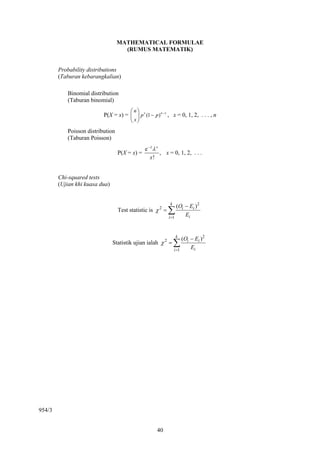
MATHEMATICAL FORMULAE
                                    (RUMUS MATEMATIK)


        Probability distributions
        (Taburan kebarangkalian)

           Binomial distribution
           (Taburan binomial)
                                     ⎛n⎞
                          P(X = x) = ⎜ ⎟ p x (1 − p ) n − x , x = 0, 1, 2, . . . , n
                                     ⎝ x⎠
           Poisson distribution
           (Taburan Poisson)
                                               e−λ λ x
                                  P(X = x) =           , x = 0, 1, 2, . . .
                                                 x!


        Chi-squared tests
        (Ujian khi kuasa dua)


                                                            k
                                                                 (Oi − Ei ) 2
                                  Test statistic is χ 2 =   ∑        Ei
                                                            i =1


                                                                k
                                                                     (Oi − Ei )2
                                Statistik ujian ialah χ 2 =     ∑        Ei
                                                                i =1


954/3


                                                     40
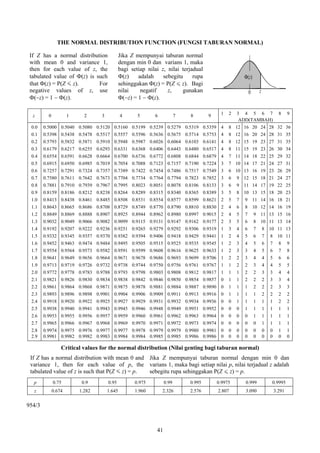
THE NORMAL DISTRIBUTION FUNCTION (FUNGSI TABURAN NORMAL)

 If Z has a normal distribution                   Jika Z mempunyai taburan normal
 with mean 0 and variance 1,                      dengan min 0 dan varians 1, maka
 then for each value of z, the                    bagi setiap nilai z, nilai terjadual
 tabulated value of Φ(z) is such                  Φ(z)    adalah     sebegitu     rupa                                Φ(z)
 that Φ(z) = P(Z < z).       For                  sehinggakan Φ(z) = P(Z < z). Bagi
 negative values of z, use                        nilai    negatif     z,    gunakan                                      0        z
 Φ(−z) = 1 − Φ(z).                                Φ(−z) = 1 − Φ(z).

  z       0           1      2        3           4       5        6             7     8         9       1   2   3 4 5 6 7                       8     9
                                                                                                                  ADD(TAMBAH)
 0.0    0.5000    0.5040   0.5080   0.5120   0.5160    0.5199    0.5239    0.5279    0.5319    0.5359    4   8   12   16      20   24      28   32     36
 0.1    0.5398    0.5438   0.5478   0.5517   0.5557    0.5596    0.5636    0.5675    0.5714    0.5753    4   8   12   16      20   24      28   31     35
 0.2    0.5793    0.5832   0.5871   0.5910   0.5948    0.5987    0.6026    0.6064    0.6103    0.6141    4   8   12   15      19   23      27   31     35
 0.3    0.6179    0.6217   0.6255   0.6293   0.6331    0.6368    0.6406    0.6443    0.6480    0.6517    4   8   11   15      19   23      26   30     34
 0.4    0.6554    0.6591   0.6628   0.6664   0.6700    0.6736    0.6772    0.6808    0.6844    0.6879    4   7   11   14      18   22      25   29     32
 0.5    0.6915    0.6950   0.6985   0.7019   0.7054    0.7088    0.7123    0.7157    0.7190    0.7224    3   7   10   14      17   21      24   27     31
 0.6    0.7257    0.7291   0.7324   0.7357   0.7389    0.7422    0.7454    0.7486    0.7517    0.7549    3   6   10   13      16   19      23   26     29
 0.7    0.7580    0.7611   0.7642   0.7673   0.7704    0.7734    0.7764    0.7794    0.7823    0.7852    3   6    9   12      15   18      21   24     27
 0.8    0.7881    0.7910   0.7939   0.7967   0.7995    0.8023    0.8051    0.8078    0.8106    0.8133    3   6    9   11      14   17      19   22     25
 0.9    0.8159    0.8186   0.8212   0.8238   0.8264    0.8289    0.8315    0.8340    0.8365    0.8389    3   5    8   10      13   15      18   20     23
 1.0    0.8413    0.8438   0.8461   0.8485   0.8508    0.8531    0.8554    0.8577    0.8599    0.8621    2   5    7    9      11   14      16   18     21
 1.1    0.8643    0.8665   0.8686   0.8708   0.8729    0.8749    0.8770    0.8790    0.8810    0.8830    2   4    6    8      10   12      14   16     19
 1.2    0.8849    0.8869   0.8888   0.8907   0.8925    0.8944    0.8962    0.8980    0.8997    0.9015    2   4    5    7       9   11      13   15     16
 1.3    0.9032    0.9049   0.9066   0.9082   0.9099    0.9115    0.9131    0.9147    0.9162    0.9177    2   3    5    6       8   10      11   13     14
 1.4    0.9192    0.9207   0.9222   0.9236   0.9251    0.9265    0.9279    0.9292    0.9306    0.9319    1   3    4    6       7    8      10   11     13
 1.5    0.9332    0.9345   0.9357   0.9370   0.9382    0.9394    0.9406    0.9418    0.9429    0.9441    1   2    4    5       6    7       8   10     11
 1.6    0.9452    0.9463   0.9474   0.9484   0.9495    0.9505    0.9515    0.9525    0.9535    0.9545    1   2    3    4       5    6       7    8      9
 1.7    0.9554    0.9564   0.9573   0.9582   0.9591    0.9599    0.9608    0.9616    0.9625    0.9633    1   2    3    3       4    5       6    7      8
 1.8    0.9641    0.9649   0.9656   0.9664   0.9671    0.9678    0.9686    0.9693    0.9699    0.9706    1   2    2    3       4    4       5    6      6
 1.9    0.9713    0.9719   0.9726   0.9732   0.9738    0.9744    0.9750    0.9756    0.9761    0.9767    1   1    2    2       3    4       4    5      5
 2.0    0.9772    0.9778   0.9783   0.9788   0.9793    0.9798    0.9803    0.9808    0.9812    0.9817    1   1    1    2       2    3       3    4      4
 2.1    0.9821 0.9826 0.9830 0.9834 0.9838 0.9842 0.9846 0.9850 0.9854 0.9857 0                              1   1    2       2        2   3     3     4
 2.2    0.9861 0.9864 0.9868 0.9871 0.9875 0.9878 0.9881 0.9884 0.9887 0.9890 0                              1   1    1       2        2   2     3     3
 2.3    0.9893    0.9896   0.9898   0.9901   0.9904    0.9906    0.9909    0.9911    0.9913    0.9916    0   1   1    1       1        2   2     2     2
 2.4    0.9918    0.9920   0.9922   0.9925   0.9927    0.9929    0.9931    0.9932    0.9934    0.9936    0   0   1    1       1        1   1     2     2
 2.5    0.9938    0.9940   0.9941   0.9943   0.9945    0.9946    0.9948    0.9949    0.9951    0.9952    0   0   0    1       1        1   1     1     1
 2.6    0.9953    0.9955   0.9956   0.9957   0.9959    0.9960    0.9961    0.9962    0.9963    0.9964    0   0   0    0       1        1   1     1     1
 2.7    0.9965    0.9966   0.9967   0.9968   0.9969    0.9970    0.9971    0.9972    0.9973    0.9974    0   0   0    0       0        1   1     1     1
 2.8    0.9974    0.9975   0.9976   0.9977   0.9977    0.9978    0.9979    0.9979    0.9980    0.9981    0   0   0    0       0        0   0     1     1
 2.9    0.9981    0.9982   0.9982   0.9983   0.9984    0.9984    0.9985    0.9985    0.9986    0.9986    0   0   0    0       0        0   0     0     0

                  Critical values for the normal distribution (Nilai genting bagi taburan normal)
 If Z has a normal distribution with mean 0 and Jika Z mempunyai taburan normal dengan min 0 dan
 variance 1, then for each value of p, the varians 1, maka bagi setiap nilai p, nilai terjadual z adalah
 tabulated value of z is such that P(Z < z) = p. sebegitu rupa sehinggakan P(Z < z) = p.
  p           0.75          0.9           0.95           0.975            0.99         0.995            0.9975        0.999                 0.9995
  z           0.674        1.282          1.645          1.960         2.326           2.576            2.807         3.090                    3.291


954/3


                                                                    41
CRITICAL VALUES FOR THE χ2-DISTRIBUTION (NILAI GENTING BAGI TABURAN χ2)

If X has a χ2-distribution with ν          Jika X mempunyai taburan χ2 dengan
degrees of freedom, then for each          ν darjah kebebasan, maka bagi
pair of values of p and ν, the             setiap pasangan nilai p dan ν, nilai              p
tabulated value of x is such               terjadual x adalah sebegitu rupa
that P(X < x) = p.                         sehinggakan P(X < x) = p.
                                                                                         0       x

  p         0.01      0.025       0.05           0.9         0.95    0.975        0.99       0.995   0.999

ν=1       0.0³1571   0.0³9821   0.0²3932        2.706        3.841   5.024    6.635          7.879   10.83
      2   0.02010    0.05064    0.1026          4.605        5.991   7.378    9.210          10.60   13.82
      3   0.1148     0.2158     0.3518          6.251        7.815   9.348    11.34          12.84   16.27
      4   0.2971     0.4844     0.7107          7.779        9.488   11.14    13.28          14.86   18.47
      5   0.5543     0.8312      1.145          9.236        11.07   12.83    15.09          16.75   20.51
      6   0.8721      1.237      1.635          10.64        12.59   14.45    16.81          18.55   22.46
      7    1.239      1.690      2.167          12.02        14.07   16.01    18.48          20.28   24.32
      8    1.647      2.180      2.733          13.36        15.51   17.53    20.09          21.95   26.12
      9    2.088      2.700      3.325          14.68        16.92   19.02    21.67          23.59   27.88
  10       2.558      3.247      3.940          15.99        18.31   20.48    23.21          25.19   29.59
  11       3.053      3.816      4.575          17.28        19.68   21.92    24.73          26.76   31.26
  12       3.571      4.404      5.226          18.55        21.03   23.34    26.22          28.30   32.91
  13       4.107      5.009      5.892          19.81        22.36   24.74    27.69          29.82   34.53
  14       4.660      5.629      6.571          21.06        23.68   26.12    29.14          31.32   36.12
  15       5.229      6.262      7.261          22.31        25.00   27.49    30.58          32.80   37.70
  16       5.812      6.908      7.962          23.54        26.30   28.85    32.00          34.27   39.25
  17       6.408      7.564      8.672          24.77        27.59   30.19    33.41          35.72   40.79
  18       7.015      8.231      9.390          25.99        28.87   31.53    34.81          37.16   42.31
  19       7.633      8.907      10.12          27.20        30.14   32.85    36.19          38.58   43.82
  20       8.260      9.591      10.85          28.41        31.41   34.17    37.57          40.00   45.31
  21       8.897      10.28      11.59          29.62        32.67   35.48    38.93          41.40   46.80
  22       9.542      10.98      12.34          30.81        33.92   36.78    40.29          42.80   48.27
  23       10.20      11.69      13.09          32.01        35.17   38.08    41.64          44.18   49.73
  24       10.86      12.40      13.85          33.20        36.42   39.36    42.98          45.56   51.18
  25       11.52      13.12      14.61          34.38        37.65   40.65    44.31          46.93   52.62
  26       12.20      13.84      15.38          35.56        38.89   41.92    45.64          48.29   54.05
  27       12.88      14.57      16.15          36.74        40.11   43.19    46.96          49.65   55.48
  28       13.56      15.31      16.93          37.92        41.34   44.46    48.28          50.99   56.89
  29       14.26      16.05      17.71          39.09        42.56   45.72    49.59          52.34   58.30
  30       14.95      16.79      18.49          40.26        43.77   46.98    50.89          53.67   59.70

 954/3


                                                        42
Identity card number:......................................................... Centre number /index number:..........................................
(Nombor kad pengenalan)                                                        (Nombor pusat/angka giliran)


       954/3


                                                                       43
44
SPECIMEN ASSIGNMENTS


      954/4                                             STPM


              MATHEMATICS (T) (MATEMATIK (T))

                       PAPER 4 (KERTAS 4)


                MAJLIS PEPERIKSAAN MALAYSIA
                  (MALAYSIAN EXAMINATIONS COUNCIL)


              SIJIL TINGGI PERSEKOLAHAN MALAYSIA
                 (MALAYSIA HIGHER SCHOOL CERTIFICATE)


                       © Majlis Peperiksaan Malaysia

STPM 954/4


                                    45
Assignment A: Mathematical Investigation

When a ray of light hits the surface of a parabolic concave mirror, the angle between the incident ray
and the tangent of the mirror at that point is equal to the angle between the reflected ray and the
tangent of the mirror at that point. It is interesting to find out what happens to the reflected light if the
incident ray of light is parallel to the principal axis of a parabolic concave mirror. This can be done
with the aid of the graph of a quadratic function.

1. (a) Draw the graph of y2 = 9x for 0 < x < 10.
    (b) Draw as accurately as possible a tangent line at x = 1. Draw an incident ray of light parallel to
the x-axis.
    (c) Produce the reflected ray and extend it to cut the x-axis.
    (d) Repeat steps (b) and (c) for few other points on the parabola. Make a conclusion for this
investigation.
    (e) Estimate the coordinates of the focus of the parabola y2 = 9x.

2. (a) Repeat the above procedures for three other parabolas to illustrate how to obtain their
respective foci.
    (b) Deduce the focus of the parabola y2 = kx, where k is a non-zero constant.
    (c) Investigate the focus of the parabola y = kx2, where k is a non-zero constant.

3. The curve of a parabola is given as follows:

             y
                 6

                 4


                 2


                 0       2      4       6       8      10      12      14      16      18
                                                                                            x
             −2

             −4


             −6


    (a) Locate the focal point of the parabola.
    (b) Suggest an equation of the parabola.


954/4


                                                     46
Assignment B: Mathematical Modelling

The population of a type of virus carried by the Aedes mosquitoes can be modelled by a differential
equation which describes the rate of growth of the population by its size. This mathematical
modelling looks at the data obtained from the breeding of mosquitoes in a state during the recent
                                                              dP
outbreak of Chikungunya fever. The population growth rate          is proportional to its size P, with the
                                                               dt
initial population P0. The relative growth rate r is almost constant when the population is small. The
relative growth rate decreases as the population increases, and becomes negative if the population
ever exceeds its carrying capacity k.

                                                         dP       r
1. Show that this population growth rate is given by        = rP − P 2 .
                                                         dt       k

                                      dP
2. (a) By considering the sign of        , discuss the relationship between P and k if P0 is less than k
                                      dt
and if P0 is greater than k.
    (b) Comment on the meaning of the values of P for constant growth, increasing growth and
declining growth.

                                          dP
3. Determine the maximum value of            and interpret the meaning of this maximum value.
                                          dt

4. Express P in terms of r, k and t. Using different initial population sizes P0, r and k, plot, on the
same axes, a few graphs to show the behaviour of P versus t.

5. The population sizes of the virus, in thousands, at different times and in days are given in the table
below.

                Time           Number of virus            Time             Number of virus
                  0                  40                    245                   701
                 35                  77                    252                   712
                 63                 125                    322                   776
                 91                 196                    371                   791
                105                 240                    392                   794
                126                 316                    406                   796
                140                 371                    441                   798
                182                 534                    504                   799
                203                 603                    539                   800
                224                 658                    567                   800

It is interesting to determine the carrying capacity and the growth rate based on the above data to
                                                                                    ΔP
control the population of Aedes mosquitoes. Using different values of P and t, plot    against P and
                                                                                    Δt
hence, obtain the approximate values for r and k.

954/4


                                                    47
Assignment C: Mathematical Modelling

The environmental regulations in a country require that the chlorine level in wastewater discharged be
less than 100 μg per litre. The environmental department wishes to determine whether the chlorine
level in wastewater discharged from factories in the country conforms to the regulations.
   A random sample of wastewater specimens from 100 factories is taken. The data obtained are
shown as follows:
                185    128     157     80     102      90    128    161     114     96
                 46    163      96    118      59     137     62     65     117    143
                 90     66     142     81     105      51    130    167      71     53
                 52    160     119    170      98      91     97    146     118    145
                145     69     131     83     111      92    132    168      80    112
                113     70      97    123      93     111     86     82      96    100
                 56    117     109     85     112     135     93     88     121    154
                 57     73      99    133     168      95    135    181      84     96
                 95    103     146     87     113      77     90     44     124    158
                 62     78     102    171      54      95    138    195     127     68

1. By constructing an appropriate plot, describe the shape of the distribution. Discuss whether the
sample data can be used for a statistical inference.

2. Carry out a goodness-of-fit test, at the 5% significance level, to determine whether the data are
normally distributed with mean 110 μg per litre and standard deviation 35 μg per litre.

3. Calculate the 95% confidence interval for the mean chlorine level in wastewater discharged.
Hence, determine, at the 5% significance level, whether the chlorine level in wastewater discharged
from the factories in the country conforms to the regulations.


954/4


                                                 48

954 Sukatan Pelajaran Matematik (T) STPM (Baharu)

  • 1.
    STPM/S(E)954 MAJLIS PEPERIKSAAN MALAYSIA (MALAYSIAN EXAMINATIONS COUNCIL) PEPERIKSAAN SIJIL TINGGI PERSEKOLAHAN MALAYSIA (MALAYSIA HIGHER SCHOOL CERTIFICATE EXAMINATION) MATHEMATICS (T) Syllabus, Specimen Papers and Specimen Experiment This syllabus applies for the 2012/2013 session and thereafter until further notice. 1
  • 2.
    FALSAFAH PENDIDIKAN KEBANGSAAN “Pendidikandi Malaysia adalah satu usaha berterusan ke arah memperkembangkan lagi potensi individu secara menyeluruh dan bersepadu untuk mewujudkan insan yang seimbang dan harmonis dari segi intelek, rohani, emosi, dan jasmani. Usaha ini adalah bagi melahirkan rakyat Malaysia yang berilmu pengetahuan, berakhlak mulia, bertanggungjawab, berketerampilan, dan berkeupayaan mencapai kesejahteraan diri serta memberi sumbangan terhadap keharmonian dan kemakmuran keluarga, masyarakat dan negara.” 2
  • 3.
    FOREWORD This revised Mathematics(T) syllabus is designed to replace the existing syllabus which has been in use since the 2002 STPM examination. This new syllabus will be enforced in 2012 and the first examination will also be held the same year. The revision of the syllabus takes into account the changes made by the Malaysian Examinations Council (MEC) to the existing STPM examination. Through the new system, sixth-form study will be divided into three terms, and candidates will sit for an examination at the end of each term. The new syllabus fulfils the requirements of this new system. The main objective of introducing the new examination system is to enhance the teaching and learning orientation in sixth form so as to be in line with the orientation of teaching and learning in colleges and universities. The Mathematics (T) syllabus is designed to provide a framework for a pre-university course that enables candidates to develop the understanding of mathematical concepts and mathematical thinking, and acquire skills in problem solving and the applications of mathematics related to science and technology. The assessment tools of this syllabus consist of written papers and coursework. Coursework offers opportunities for candidates to conduct mathematical investigation and mathematical modelling that enhance their understanding of mathematical processes and applications and provide a platform for them to develop soft skills. The syllabus contains topics, teaching periods, learning outcomes, examination format, grade description, and sample questions. The design of this syllabus was undertaken by a committee chaired by Professor Dr. Abu Osman bin Mad Tap of International Islamic University of Malaysia. Other committee members consist of university lecturers, representatives from the Curriculum Development Division, Ministry of Education Malaysia, and experienced teachers teaching Mathematics. On behalf of the Malaysian Examinations Council, I would like to thank the committee for their commitment and invaluable contribution. It is hoped that this syllabus will be a guide for teachers and candidates in the teaching and learning process. OMAR BIN ABU BAKAR Chief Executive Malaysian Examinations Council 3
  • 4.
    CONTENTS Syllabus 954 Mathematics (T) Page Aims 1 Objectives 1 Content First Term: Algebra and Geometry 2–5 Second Term: Calculus 6–8 Third Term: Statistics 9 – 12 Coursework (School-based Assessment ) Paper 4 13 Scheme of Assessment 14 Performance Descriptions 15 Mathematical Notation 16 – 19 Electronic Calculators 20 Reference Books 20 Specimen Paper 1 21 – 26 Specimen Paper 2 27 – 32 Specimen Paper 3 33 – 43 Specimen Assignments Paper 4 45 – 48 4
  • 5.
    SYLLABUS 954 MATHEMATICS (T) (May not be taken with 950 Mathematics (M)) Aims The Mathematics (T) syllabus is designed to provide a framework for a pre-university course that enables candidates to develop the understanding of mathematical concepts and mathematical thinking, and acquire skills in problem solving and the applications of mathematics related to science and technology. Objectives The objectives of this syllabus are to enable the candidates to: (a) use mathematical concepts, terminology and notation; (b) display and interpret mathematical information in tabular, diagrammatic and graphical forms; (c) identify mathematical patterns and structures in a variety of situations; (d) use appropriate mathematical models in different contexts; (e) apply mathematical principles and techniques in solving problems; (f) carry out calculations and approximations to an appropriate degree of accuracy; (g) interpret the significance and reasonableness of results; (h) present mathematical explanations, arguments and conclusions. 1
  • 6.
    FIRST TERM: ALGEBRAAND GEOMETRY Teaching Topic Learning Outcome Period 1 Functions 28 Candidates should be able to: 1.1 Functions 6 (a) state the domain and range of a function, and find composite functions; (b) determine whether a function is one-to-one, and find the inverse of a one-to-one function; (c) sketch the graphs of simple functions, including piecewise-defined functions; 1.2 Polynomial and 8 (d) use the factor theorem and the remainder rational functions theorem; (e) solve polynomial and rational equations and inequalities; (f) solve equations and inequalities involving modulus signs in simple cases; (g) decompose a rational expression into partial fractions in cases where the denominator has two distinct linear factors, or a linear factor and a prime quadratic factor; 1.3 Exponential and 6 (h) relate exponential and logarithmic functions, logarithmic functions algebraically and graphically; (i) use the properties of exponents and logarithms; (j) solve equations and inequalities involving exponential or logarithmic expressions; 1.4 Trigonometric 8 (k) relate the periodicity and symmetries of the functions sine, cosine and tangent functions to their graphs, and identify the inverse sine, inverse cosine and inverse tangent functions and their graphs; (l) use basic trigonometric identities and the formulae for sin (A ± B), cos (A ± B) and tan (A ± B), including sin 2A, cos 2A and tan 2A; (m) express a sin θ + b cos θ in the forms r sin (θ ± α) and r cos (θ ± α); (n) find the solutions, within specified intervals, of trigonometric equations and inequalities. 2
  • 7.
    Teaching Topic Learning Outcome Period 2 Sequences and Series 18 Candidates should be able to: 2.1 Sequences 4 (a) use an explicit formula and a recursive formula for a sequence; (b) find the limit of a convergent sequence; 2.2 Series 8 (c) use the formulae for the nth term and for the sum of the first n terms of an arithmetic series and of a geometric series; (d) identify the condition for the convergence of a geometric series, and use the formula for the sum of a convergent geometric series; (e) use the method of differences to find the nth partial sum of a series, and deduce the sum of the series in the case when it is convergent; 2.3 Binomial expansions 6 (f) expand (a + b)n , where n ∈ + ; (g) expand (1 + x)n , where n ∈ , and identify the condition | x | < 1 for the validity of this expansion; (h) use binomial expansions in approximations. 3 Matrices 16 Candidates should be able to: 3.1 Matrices 10 (a) identify null, identity, diagonal, triangular and symmetric matrices; (b) use the conditions for the equality of two matrices; (c) perform scalar multiplication, addition, subtraction and multiplication of matrices with at most three rows and three columns; (d) use the properties of matrix operations; (e) find the inverse of a non-singular matrix using elementary row operations; (f) evaluate the determinant of a matrix; (g) use the properties of determinants; 3
  • 8.
    Teaching Topic Learning Outcome Period 3.2 Systems of linear 6 (h) reduce an augmented matrix to row-echelon equations form, and determine whether a system of linear equations has a unique solution, infinitely many solution or no solutions; (i) apply the Gaussian elimination to solve a system of linear equations; (j) find the unique solution of a system of linear equations using the inverse of a matrix. 4 Complex Numbers 12 Candidates should be able to: (a) identify the real and imaginary parts of a complex number; (b) use the conditions for the equality of two complex numbers; (c) find the modulus and argument of a complex number in cartesian form and express the complex number in polar form; (d) represent a complex number geometrically by means of an Argand diagram; (e) find the complex roots of a polynomial equation with real coefficients; (f) perform elementary operations on two complex numbers expressed in cartesian form; (g) perform multiplication and division of two complex numbers expressed in polar form; (h) use de Moivre’s theorem to find the powers and roots of a complex number. 5 Analytic Geometry 14 Candidates should be able to: (a) transform a given equation of a conic into the standard form; (b) find the vertex, focus and directrix of a parabola; (c) find the vertices, centre and foci of an ellipse; (d) find the vertices, centre, foci and asymptotes of a hyperbola; (e) find the equations of parabolas, ellipses and hyperbolas satisfying prescribed conditions (excluding eccentricity); 4
  • 9.
    Teaching Topic Learning Outcome Period (f ) sketch conics; (g) find the cartesian equation of a conic defined by parametric equations; (h) use the parametric equations of conics. 6 Vectors 20 Candidates should be able to: 6.1 Vectors in two and 8 (a) use unit vectors and position vectors; three dimensions (b) perform scalar multiplication, addition and subtraction of vectors; (c) find the scalar product of two vectors, and determine the angle between two vectors; (d) find the vector product of two vectors, and determine the area a parallelogram and of a triangle; 6.2 Vector geometry 12 (e) find and use the vector and cartesian equations of lines; (f) find and use the vector and cartesian equations of planes; (g) calculate the angle between two lines, between a line and a plane, and between two planes; (h) find the point of intersection of two lines, and of a line and a plane; (i) find the line of intersection of two planes. 5
  • 10.
    SECOND TERM: CALCULUS Teaching Topic Learning Outcome Period 7 Limits and Continuity 12 Candidates should be able to: 7.1 Limits 6 (a) determine the existence and values of the left- hand limit, right-hand limit and limit of a function; (b) use the properties of limits; 7.2 Continuity 6 (c) determine the continuity of a function at a point and on an interval; (d) use the intermediate value theorem. 8 Differentiation 28 Candidates should be able to: 8.1 Derivatives 12 (a) identify the derivative of a function as a limit; (b) find the derivatives of xn (n ∈ ), ex, ln x, sin x, cos x, tan x, sin−1x, cos−1x, tan−1x, with constant multiples, sums, differences, products, quotients and composites; (c) perform implicit differentiation; (d) find the first derivatives of functions defined parametrically; 8.2 Applications of 16 (e) determine where a function is increasing, differentiation decreasing, concave upward and concave downward; (f) determine the stationary points, extremum points and points of inflexion; (g) sketch the graphs of functions, including asymptotes parallel to the coordinate axes; (h) find the equations of tangents and normals to curves, including parametric curves; (i) solve problems concerning rates of change, including related rates; (j) solve optimisation problems. 9 Integration 28 Candidates should be able to: 9.1 Indefinite integrals 14 (a) identify integration as the reverse of differentiation; (b) integrate xn (n ∈ ), ex, sin x, cos x, sec2x, with constant multiples, sums and differences; 6
  • 11.
    Teaching Topic Learning Outcome Period (c) integrate rational functions by means of decomposition into partial fractions; (d) use trigonometric identities to facilitate the integration of trigonometric functions; (e) use algebraic and trigonometric substitutions to find integrals; (f) perform integration by parts; 9.2 Definite integrals 14 (g) identify a definite integral as the area under a curve; (h) use the properties of definite integrals; (i ) evaluate definite integrals; (j ) calculate the area of a region bounded by a curve (including a parametric curve) and lines parallel to the coordinate axes or between two curves; (k) calculate volumes of solids of revolution about one of the coordinate axes. 10 Differential Equations 14 Candidates should be able to: (a) find the general solution of a first order differential equation with separable variables; (b) find the general solution of a first order linear differential equation by means of an integrating factor; (c) transform, by a given substitution, a first order differential equation into one with separable variables or one which is linear; (d) use a boundary condition to find a particular solution; (e) solve problems, related to science and technology, that can be modelled by differential equations. 11 Maclaurin Series 12 Candidates should be able to: (a) find the Maclaurin series for a function and the interval of convergence; (b) use standard series to find the series expansions of the sums, differences, products, quotients and composites of functions; 7
  • 12.
    Teaching Topic Learning Outcome Period (c) perform differentiation and integration of a power series; (d) use series expansions to find the limit of a function. 12 Numerical Methods 14 Candidates should be able to: 12.1 Numerical solution of 10 (a) locate a root of an equation approximately by equations means of graphical considerations and by searching for a sign change; (b) use an iterative formula of the form xn +1 = f ( xn ) to find a root of an equation to a prescribed degree of accuracy; (c) identify an iteration which converges or diverges; (d) use the Newton-Raphson method; 12.2 Numerical integration 4 (e) use the trapezium rule; (f) use sketch graphs to determine whether the trapezium rule gives an over-estimate or an under-estimate in simple cases. 8
  • 13.
    THIRD TERM: STATISTICS Teaching Topic Learning Outcome Period 13 Data Description 14 Candidates should be able to: (a) identify discrete, continuous, ungrouped and grouped data; (b) construct and interpret stem-and-leaf diagrams, box-and-whisker plots, histograms and cumulative frequency curves; (c) state the mode and range of ungrouped data; (d) determine the median and interquartile range of ungrouped and grouped data; (e) calculate the mean and standard deviation of ungrouped and grouped data, from raw data n and from given totals such as ∑ ( xi − a ) and i =1 n ∑ ( xi − a ) ; 2 i =1 (f) select and use the appropriate measures of central tendency and measures of dispersion; (g) calculate the Pearson coefficient of skewness; (h) describe the shape of a data distribution. 14 Probability 14 Candidates should be able to: (a) apply the addition principle and the multiplication principle; (b) use the formulae for combinations and permutations in simple cases; (c) identify a sample space, and calculate the probability of an event; (d) identify complementary, exhaustive and mutually exclusive events; (e) use the formula P(A ∪ B) = P(A) + P(B) − P(A ∩ B); (f) calculate conditional probabilities, and identify independent events; (g) use the formulae P(A ∩ B) = P(A) × P(B⏐A) = P(B) × P(A⏐B); (h) use the rule of total probability. 9
  • 14.
    Teaching Topic Learning Outcome Period 15 Probability Distributions 26 Candidates should be able to: 15.1 Discrete random 6 (a) identify discrete random variables; variables (b) construct a probability distribution table for a discrete random variable; (c) use the probability function and cumulative distribution function of a discrete random variable; (d) calculate the mean and variance of a discrete random variable; 15.2 Continuous random 6 (e) identify continuous random variables; variables (f) relate the probability density function and cumulative distribution function of a continuous random variable; (g) use the probability density function and cumulative distribution function of a continuous random variable; (h) calculate the mean and variance of a continuous random variable; 15.3 Binomial distribution 4 (i) use the probability function of a binomial distribution, and find its mean and variance; (j) use the binomial distribution as a model for solving problems related to science and technology; 15.4 Poisson distribution 4 (k) use the probability function of a Poisson distribution, and identify its mean and variance; (l) use the Poisson distribution as a model for solving problems related to science and technology; 15.5 Normal distribution 6 (m) identify the general features of a normal distribution, in relation to its mean and standard deviation; (n) standardise a normal random variable and use the normal distribution tables; (o) use the normal distribution as a model for solving problems related to science and technology; (p) use the normal distribution, with continuity correction, as an approximation to the binomial distribution, where appropriate. 10
  • 15.
    Teaching Topic Learning Outcome Period 16 Sampling and Estimation 26 Candidates should be able to: 16.1 Sampling 14 (a) distinguish between a population and a sample, and between a parameter and a statistic; (b) identify a random sample; (c) identify the sampling distribution of a statistic; (d) determine the mean and standard deviation of the sample mean; (e) use the result that X has a normal distribution if X has a normal distribution; (f) use the central limit theorem; (g) determine the mean and standard deviation of the sample proportion; (h) use the approximate normality of the sample proportion for a sufficiently large sample size; 16.2 Estimation 12 (i) calculate unbiased estimates for the population mean and population variance; (j) calculate an unbiased estimate for the population proportion; (k) determine and interpret a confidence interval for the population mean based on a sample from a normally distributed population with known variance; (l) determine and interpret a confidence interval for the population mean based on a large sample; (m) find the sample size for the estimation of population mean; (n) determine and interpret a confidence interval for the population proportion based on a large sample; (o) find the sample size for the estimation of population proportion. 11
  • 16.
    Teaching Topic Learning Outcome Period 17 Hypothesis Testing 14 Candidates should be able to: (a) explain the meaning of a null hypothesis and an alternative hypothesis; (b) explain the meaning of the significance level of a test; (c) carry out a hypothesis test concerning the population mean for a normally distributed population with known variance; (d) carry out a hypothesis test concerning the population mean in the case where a large sample is used; (e) carry out a hypothesis test concerning the population proportion by direct evaluation of binomial probabilities; (f) carry out a hypothesis test concerning the population proportion using a normal approximation. 18 Chi-squared Tests 14 Candidates should be able to: (a) identify the shape, as well as the mean and variance, of a chi-squared distribution with a given number of degrees of freedom; (b) use the chi-squared distribution tables; (c) identify the chi-squared statistic; (d) use the result that classes with small expected frequencies should be combined in a chi- squared test; (e) carry out goodness-of-fit tests to fit prescribed probabilities and probability distributions with known parameters; (f) carry out tests of independence in contingency tables (excluding Yates correction). 12
  • 17.
    Coursework (Assignments) Paper4 The Mathematics (T) coursework is intended to enable candidates to carry out mathematical investigation and mathematical modelling so as to enhance the understanding of mathematical processes and applications and to develop soft skills. The coursework comprises three assignments set down by the Malaysian Examinations Council. The assignments are based on three different areas of the syllabus and represent two types of tasks: mathematical investigation and mathematical modelling. A school candidate is required to carry out one assignment in each term under the supervision of the subject teacher as specified in the Teacher’s Manual for Mathematics (T) Coursework which can be downloaded from MEC Portal (http://www.mpm.edu.my) during the first term of form six by the subject teacher. The assignment reports are graded by the subject teacher in school in the respective terms. A viva session is conducted by the teacher in each term after the assessment of the assignment reports. An individual private candidate is required to carry out one assignment in each term as specified in the Individual Private Candidate’s Manual for Mathematics (T) Coursework which can be downloaded from MEC Portal (http://www.mpm.edu.my) during the first term of form six by the candidates. The assignment reports are graded by an external examiner in the respective terms. A viva session is conducted by the examiner in each term after the assessment of the assignment reports. A repeating candidate may use the total mark obtained in the coursework for two subsequent examinations. Requests to carry forward the moderated coursework mark should be made during the registration of the examination. 13
  • 18.
    Scheme of Assessment Term of Paper Code and Mark Type of Test Duration Administration Study Name (Weighting) First 954/1 Written test 60 Term Mathematics (T) (26.67%) Paper 1 Section A 45 Answer all 6 questions of variable marks. Central 1½ hours assessment Section B 15 Answer 1 out of 2 questions. All questions are based on topics 1 to 6. Second 954/2 Written test 60 Term Mathematics (T) (26.67%) Paper 2 Section A 45 Answer all 6 questions of variable marks. Central 1½ hours assessment Section B 15 Answer 1 out of 2 questions. All questions are based on topics 7 to 12. Third 954/3 Written test 60 Term Mathematics (T) (26.67%) Paper 3 Section A 45 Answer all 6 questions of variable marks. Central 1½ hours assessment Section B 15 Answer 1 out of 2 questions. All questions are based on topics 13 to 18. First, 954/4 Coursework 180 Through- School-based Second Mathematics (T) (20%) out the assessment for 3 assignments, each based on and Paper 4 three school topics 1 to 6, topics 7 to 12 and Third terms candidate topics 13 to 18. Terms Assessment by appointed assessor for private candidate 14
  • 19.
    Performance Descriptions A gradeA candidate is likely able to: (a) use correctly mathematical concepts, terminology and notation; (b) display and interpret mathematical information in tabular, diagrammatic and graphical forms; (c) identify mathematical patterns and structures in a variety of situations; (d) use appropriate mathematical models in different contexts; (e) apply correctly mathematical principles and techniques in solving problems; (f) carry out calculations and approximations to an appropriate degree of accuracy; (g) interpret the significance and reasonableness of results, making sensible predictions where appropriate; (h) present mathematical explanations, arguments and conclusions, usually in a logical and systematic manner. A grade C candidate is likely able to: (a) use correctly some mathematical concepts, terminology and notation; (b) display and interpret some mathematical information in tabular, diagrammatic and graphical forms; (c) identify mathematical patterns and structures in certain situations; (d) use appropriate mathematical models in certain contexts; (e) apply correctly some mathematical principles and techniques in solving problems; (f) carry out some calculations and approximations to an appropriate degree of accuracy; (g) interpret the significance and reasonableness of some results; (h) present some mathematical explanations, arguments and conclusions. 15
  • 20.
    Mathematical Notation Miscellaneous symbols = is equal to ≠ is not equal to ≡ is identical to or is congruent to ≈ is approximately equal to < is less than < is less than or equal to > is greater than > is greater than or equal to ∞ infinity ∴ therefore Operations a+b a plus b a−b a minus b a × b, a · b, ab a multiplied by b a a ÷ b, a divided by b b a:b ratio of a to b n a nth power of a a positive square root of a n a positive nth root of a |a| absolute value of a n ∑u i =1 i u1 + u2 + ⋅ ⋅ ⋅ + un ⎛n⎞ n! ⎜ ⎟ binomial coefficient for n, r ∈ ,0< r< n ⎝r⎠ r !( n − r )! Set notation ∈ is an element of ∉ is not an element of ∅ empty set {x | . . .} set of x such that . . . set of natural numbers, {0, 1, 2, 3, . . .} set of integers + set of positive integers set of rational numbers set of real numbers 16
  • 21.
    [a, b] closed interval {x | x ∈ , a < x < b} (a, b) open interval {x | x ∈ , a < x < b} [a, b) interval {x | x ∈ , a < x < b} (a, b] interval {x | x ∈ , a < x < b} ∪ union ∩ intersection Functions f a function f f(x) value of a function f at x f : A→ B f is a function under which each element of set A has an image in set B f :x y f is a function which maps the element x to the element y f −1 inverse function of f f g composite function of f and g which is defined by f g(x) = f [g(x)] ex exponential function of x loga x logarithm to base a of x ln x natural logarithm of x, loge x sin, cos, tan, trigonometric functions csc, sec, cot sin−1, cos−1, tan−1, inverse trigonometric functions csc−1, sec−1, cot−1 Matrices A a matrix A 0 null matrix I identity matrix T A transpose of a matrix A −1 A inverse of a non-singular square matrix A det A determinant of a square matrix A Complex numbers i square root of −1 z a complex number z |z| modulus of z arg z argument of z z* complex conjugate of z 17
  • 22.
    Geometry AB length of the line segment with end points A and B ∠BAC angle between the line segments AB and AC ΔABC triangle whose vertices are A, B and C // is parallel to ⊥ is perpendicular to Vectors a a vector a |a| magnitude of a vector a i , j, k unit vectors in the directions of the cartesian coordinates axes AB vector represented in magnitude and direction by the directed line segment from point A to point B | AB | magnitude of AB ai b scalar product of vectors a and b a×b vector product of vectors a and b Derivatives and integrals lim f ( x) limit of f(x) as x tends to a x →a dy first derivative of y with respect to x dx f '( x) first derivative of f(x) with respect to x d2 y second derivative of y with respect to x dx 2 f ''( x) second derivative of f(x) with respect to x dn y nth derivative of y with respect to x dx n f (n ) ( x) nth derivative of f(x) with respect to x ∫ y dx indefinite integral of y with respect to x b ∫ a y dx definite integral of y with respect to x for values of x between a and b Data description x1, x2, . . . observations f1, f2, . . . frequencies with which the observations x1, x2, . . . occur x sample mean n 1 ∑ ( xi − x ) 2 s2 sample variance, s 2 = n i =1 μ population mean σ2 population variance 18
  • 23.
    Probability A an event A A' complement of an event A or the event not A P(A) probability of an event A P(A|B) probability of event A given event B Probability distributions X a random variable X x value of a random variable X Z standardised normal random variable z value of the standardised normal random variable Z f(x) value of the probability density function of a continuous random variable X F(x) value of the cumulative distribution function of a continuous random variable X E(X) expectation of a random variable X Var(X) variance of a random variable X B(n, p) binomial distribution with parameters n and p Po(λ) Poisson distribution with parameter λ N(μ, σ 2 ) normal distribution with mean μ and variance σ 2 χν2 chi-squared distribution with ν degrees of freedom Sampling and estimation μ ˆ unbiased estimate of the population mean σ2 ˆ unbiased estimate of the population variance p population proportion ˆ p sample proportion 19
  • 24.
    Electronic Calculators During thewritten paper examination, candidates are advised to have standard scientific calculators which must be silent. Programmable and graphic display calculators are prohibited. Reference Books Teachers and candidates may use books specially written for the STPM examination and other reference books such as those listed below. Algebra and Geometry 1. Harcet, J., Heinrichs, L., Seiler, P.M. and Skoumal, M.T., 2012. Mathematics: Higher Level IB Diploma Programme. United Kingdom: Oxford University Press. 2. Meil, H. and Quadling, D., 2012. Advanced Level Mathermatics: Pure Mathematics 1 and 2 & 3. United Kingdom: Cambridge University Press. 3. Beecher, J. A., Penna, J. A. and Bittinger, M. L., 2012. Algebra and Trigonometry. 4th edition. Singapore: Pearson Addison-Wesley. 4. Blitzer, R., 2010. Algebra and Trigonometry: An Early Functions Approach. 2nd edition. Singapore: Pearson Prentice Hall. Calculus 5. Roberts, B. and Mackenzie, S., 2008. Mathematics: Higher Level for the IB Diploma. United Kingdom: Oxford University Press. 6. Smedley, R. and Wiseman, G., 2001. Introducing Pure Mathematics. 2nd edition. United Kingdom: Oxford University Press. 7. Stewart, J., 2012. Single Variable Calculus: Early Transcendentals. 7th edition, Metric Version. Singapore: Brooks/Cole, Cengage Learning. 8. Tan, S. T., 2011. Single Variable Calculus: Early Transcendentals. Singapore: Brooks/Cole, Cengage Learning. Statistics 9. Crawshaw, J. and Chambers, J., 2001. A Concise Course in Advanced Level Statistics. 4th edition. United Kingdom: Nelson Thornes. 10. Upton, G. and Cook, I., 2001. Introducing Statistics. 2nd edition. United Kingdom: Oxford University Press. 11. Johnson, R. A. and Bhattacharyya, G. K., 2010. Statistics: Principles and Methods. 6th edition. Singapore: John Wiley. 12. Mann, P. S., 2010. Introductory Statistics. 7th edition. New Jersey: JohnWiley. 20
  • 25.
    SPECIMEN PAPER 954/1 STPM MATHEMATICS (T) (MATEMATIK (T)) PAPER 1 (KERTAS 1) One and a half hours (Satu jam setengah) MAJLIS PEPERIKSAAN MALAYSIA (MALAYSIAN EXAMINATIONS COUNCIL) SIJIL TINGGI PERSEKOLAHAN MALAYSIA (MALAYSIA HIGHER SCHOOL CERTIFICATE) Instruction to candidates: DO NOT OPEN THIS QUESTION PAPER UNTIL YOU ARE TOLD TO DO SO. Answer all questions in Section A and any one question in Section B. Answers may be written in either English or Bahasa Malaysia. All necessary working should be shown clearly. Scientific calculators may be used. Programmable and graphic display calculators are prohibited. A list of mathematical formulae is provided on page of this question paper. Arahan kepada calon: JANGAN BUKA KERTAS SOALAN INI SEHINGGA DIBERITAHU UNTUK BERBUAT DEMIKIAN. Jawab semua soalan dalam Bahagian A dan mana-mana satu soalan dalam Bahagian B. Jawapan boleh ditulis dalam bahasa Inggeris atau Bahasa Malaysia. Semua kerja yang perlu hendaklah ditunjukkan dengan jelas. Kalkulator sainstifik boleh digunakan. Kalkulator boleh atur cara dan kalkulator paparan grafik tidak dibenarkan. Senarai rumus matematik dibekalkan pada halaman dalam kertas soalan ini. __________________________________________________________________________________ This question paper consists of printed pages and blank page. (Kertas soalan ini terdiri daripada halaman bercetak dan halaman kosong.) © Majlis Peperiksaan Malaysia STPM 954/1 21
  • 26.
    Section A [45marks] Answer all questions in this section. 1 The functions f and g are defined by f :x e2 x , x ∈ , g:x (ln x)2 , x > 0. (a) Find f−1 and state its domain. [3 marks] (b) Show that g ( 1 ) = g(2), and state, with a reason, whether g has an inverse. 2 [4 marks] n 2 A sequence is defined by ur = e–(r – 1) – e–r for all integers r > 1. Find ∑ u , in terms of n, and r =1 r ∞ deduce the value of ∑u . r =1 r [5 marks] ⎛ 2 −2 0 ⎞ ⎛ −1 1 0 ⎞ ⎜ ⎟ ⎜ ⎟ 3 The matrices P = ⎜ 0 0 2 ⎟ and Q = ⎜ 0 0 −1 ⎟ are such that PQ = QP. ⎜a b c⎟ ⎜ 0 −2 2 ⎟ ⎝ ⎠ ⎝ ⎠ (a) Determine the values of a, b and c. [5 marks] (b) Find the real numbers m and n for which P = mQ + nI, where I is the 3 × 3 identity matrix. [5 marks] 4 Express the complex number z = 1 − 3 i in polar form. [4 marks] 1 1 Hence, find z 5 + 5 and z 5 − 5 . [4 marks] z z 5 The equation of a hyperbola is 4x2 – 9y2 – 24x –18y – 9 = 0. (a) Obtain the standard form for the equation of the hyperbola. [3 marks] (b) Find the vertices and the equations of the asymptotes of the hyperbola. [6 marks] y − 4 z +1 6 Find the equation of the plane which contains the straight line x − 3 = = and is 3 2 perpendicular to the plane 3x + 2y − z = 3. [6 marks] 954/1 22
  • 27.
    Bahagian A [45markah] Jawab semua soalan dalam bahagian ini. 1 Fungsi f dan g ditakrifkan oleh f :x e2 x , x ∈ ; g:x (ln x)2 , x > 0. (a) Cari f−1 dan nyatakan domainnya. [3 markah] (b) Tunjukkan bahawa g ( 1 ) = g(2), dan nyatakan, dengan satu sebab, sama ada g mempunyai 2 songsangan. [4 markah] n 2 Satu jujukan ditakrifkan oleh ur = e–(r – 1) – e–r bagi semua integer r > 1. Cari ∑ u , dalam sebutan r =1 r ∞ n, dan deduksikan nilai ∑u . r =1 r [5 markah] ⎛ 2 −2 0 ⎞ ⎛ −1 1 0 ⎞ ⎜ ⎟ ⎜ ⎟ 3 Matriks P = ⎜ 0 0 2 ⎟ dan Q = ⎜ 0 0 −1 ⎟ adalah sebegitu rupa sehinggakan PQ = QP. ⎜a b c⎟ ⎜ 0 −2 2 ⎟ ⎝ ⎠ ⎝ ⎠ (a) Tentukan nilai a, b dan c. [5 markah] (b) Cari nombor nyata m dan n supaya P = mQ + nI, dengan I matriks identiti 3 × 3. [5 markah] 4 Ungkapkan nombor kompleks z = 1 − 3 i dalam bentuk kutub. [4 markah] 1 1 Dengan yang demikian, cari z 5 + 5 dan z 5 − 5 . [4 markah] z z 5 Persamaan satu hiperbola ialah 4x2 – 9y2 – 24x –18y – 9 = 0. (a) Dapatkan bentuk piawai bagi persamaan hiperbola itu. [3 markah] (b) Cari bucu dan persamaan asimptot hiperbola itu. [6 markah] y − 4 z +1 6 Cari persamaan satah yang mengandung garis lurus x − 3 = = dan serenjang dengan 3 2 satah 3x + 2y − z = 3. [6 markah] 954/1 23
  • 28.
    Section B [15marks] Answer any one question in this section. 7 Express cos x + sin x in the form r cos (x − α), where r > 0 and 0 < α < 1 π . Hence, find the 2 minimum and maximum values of cos x + sin x and the corresponding values of x in the interval 0 < x < 2π. [7 marks] (a) Sketch the graph of y = cos x + sin x for 0 < x < 2π. [3 marks] (b) By drawing appropriate lines on your graph, determine the number of roots in the interval 0 < x < 2π of each of the following equations. (i) cos x + sin x = − 1 2 [1 mark] (ii) cos x + sin x = 2 [1 mark] (c) Find the set of values of x in the interval 0 < x < 2π for which cos x + sin x > 1. [3 marks] 8 The position vectors a, b and c of three points A, B and C respectively are given by a = i + j + k, b = i + 2j + 3k, c = i – 3j +2k. (a) Find a unit vector parallel to a + b + c. [3 marks] (b) Calculate the acute angle between a and a + b + c. [3 marks] (c) Find the vector of the form i + λj + μk perpendicular to both a and b. [2 marks] (d) Determine the position vector of the point D which is such that ABCD is a parallelogram having BD as a diagonal. [3 marks] (e) Calculate the area of the parallelogram ABCD. [4 marks] 954/1 24
  • 29.
    Bahagian B [15markah] Jawab mana-mana satu soalan dalam bahagian ini. 7 Ungkapkan kos x + sin x dalam bentuk r kos (x − α), dengan r > 0 dan 0 < α < 1 π . Dengan yang 2 demikian, cari nilai minimum dan nilai maksimum kos x + sin x dan nilai x yang sepadan dalam selang 0 < x < 2π. [7 markah] (a) Lakar graf y = kos x + sin x bagi 0 < x < 2π. [3 markah] (b) Dengan melukis garis yang sesuai pada graf anda, tentukan bilangan punca dalam selang 0 < x < 2π setiap persamaan yang berikut. (i) kos x + sin x = − 1 2 [1 markah] (ii) kos x + sin x = 2 [1 markah] (c) Cari set nilai x dalam selang 0 < x < 2π supaya kos x + sin x > 1. [3 markah] 8 Vektor kedudukan a, b, dan c tiga titik A, B, dan C masing-masing diberikan oleh a = i + j + k, b = i + 2j + 3k, c = i – 3j +2k. (a) Cari vektor unit yang selari dengan a + b + c. [3 markah] (b) Hitung sudut tirus di antara a dengan a + b + c. [3 markah] (c) Cari vektor dalam bentuk i + λj + μk yang serenjang dengan kedua-dua a dan b. [2 markah] (d) Tentukan vektor kedudukan titik D yang sebegitu rupa sehinggakan ABCD ialah satu segiempat selari dengan BD sebagai satu pepenjuru. [3 markah] (e) Hitung luas segiempat selari ABCD. [4 markah] 954/1 25
  • 30.
    MATHEMATICAL FORMULAE (RUMUS MATEMATIK) Binomial expansions (Kembangan binomials) ⎛n⎞ ⎛n⎞ ⎛n⎞ (a + b)n = a n + ⎜ ⎟ a n −1b + ⎜ ⎟ a n − 2 b 2 + ⋅ ⋅ ⋅ + ⎜ ⎟ a n − r b r + ⋅ ⋅ ⋅ + b n , where n ∈ Z + ⎝1⎠ ⎝2⎠ ⎝r⎠ ⎛n⎞ ⎛n⎞ ⎛n⎞ (a + b)n = a n + ⎜ ⎟ a n −1b + ⎜ ⎟ a n − 2 b 2 + ⋅ ⋅ ⋅ + ⎜ ⎟ a n − r b r + ⋅ ⋅ ⋅ + b n , dengan n ∈ Z + ⎝1⎠ ⎝2⎠ ⎝r⎠ n ( n − 1) n ( n − 1). . .( n − r + 1) (1 + x)n = 1 + nx + x +⋅ ⋅ ⋅+ 2 x + ⋅ ⋅ ⋅, where n ∈ Q , |x| < 1 r 2! r! n ( n − 1) n ( n − 1). . .( n − r + 1) (1 + x)n = 1 + nx + x +⋅ ⋅ ⋅+ 2 x + ⋅ ⋅ ⋅, dengan n ∈ Q , |x| < 1 r 2! r! Conics (Keratan kon) Parabola with vertex ( h, k ), focus ( a + h , k ) and directrix x = −a + h Parabola dengan bucu ( h, k ), fokus ( a + h , k ) dan direktriks x = −a + h ( y – k )2 = 4a ( x – h ) Ellipse with centre ( h, k ) and foci ( −c + h, k ), ( c + h, k ), where c2 = a2 − b2 Elips dengan pusat ( h, k ) dan fokus ( −c + h, k ), ( c + h, k ), dengan c2 = a2 − b2 ( x − h )2 ( y − k )2 + =1 a2 b2 Hyperbola with centre ( h, k ) and foci ( −c + h, k ), ( c + h, k ), where c2 = a2 + b2 Hiperbola dengan pusat ( h, k ) dan fokus ( −c + h, k ), ( c + h, k ), dengan c2 = a2 + b2 ( x − h) 2 ( y − k )2 − =1 a2 b2 954/1 26
  • 31.
    SPECIMEN PAPER 954/2 STPM MATHEMATICS (T) (MATEMATIK (T)) PAPER 2 (KERTAS 2) One and a half hours (Satu jam setengah) MAJLIS PEPERIKSAAN MALAYSIA (MALAYSIAN EXAMINATIONS COUNCIL) SIJIL TINGGI PERSEKOLAHAN MALAYSIA (MALAYSIA HIGHER SCHOOL CERTIFICATE) Instruction to candidates: DO NOT OPEN THIS QUESTION PAPER UNTIL YOU ARE TOLD TO DO SO. Answer all questions in Section A and any one question in Section B. Answers may be written in either English or Bahasa Malaysia. All necessary working should be shown clearly. Scientific calculators may be used. Programmable and graphic display calculators are prohibited. A list of mathematical formulae is provided on page of this question paper. Arahan kepada calon: JANGAN BUKA KERTAS SOALAN INI SEHINGGA DIBERITAHU UNTUK BERBUAT DEMIKIAN. Jawab semua soalan dalam Bahagian A dan mana-mana satu soalan dalam Bahagian B. Jawapan boleh ditulis dalam bahasa Inggeris atau Bahasa Malaysia. Semua kerja yang perlu hendaklah ditunjukkan dengan jelas. Kalkulator sainstifik boleh digunakan. Kalkulator boleh atur cara dan kalkulator paparan grafik tidak dibenarkan. Senarai rumus matematik dibekalkan pada halaman dalam kertas soalan ini. __________________________________________________________________________________ This question paper consists of printed pages and blank page. (Kertas soalan ini terdiri daripada halaman bercetak dan halaman kosong.) © Majlis Peperiksaan Malaysia STPM 954/2 27
  • 32.
    Section A [45marks] Answer all questions in this section. 1 The function f is defined by ⎧ x + 1, x > − 1; ⎪ f ( x) = ⎨ ⎪| x | −1, otherwise. ⎩ (a) Find lim f ( x ). [3 marks] x →−1 (b) Determine whether f is continuous at x = −1. [2 marks] 2 2 Find the equation of the normal to the curve with parametric equations x = 1 − 2t and y = −2 + t at the point (3, –4). [6 marks] 1 ∫ x 3 Using the substitution x = 4sin 2 u , evaluate dx. [6 marks] 0 4− x x −2 d x x2 4 Show that e ∫ x ( x−1) = . [4 marks] x −1 Hence, find the particular solution of the differential equation dy x−2 1 + y=− 2 dx x( x − 1) x ( x − 1) 3 which satisfies the boundary condition y = when x = 2. [4 marks] 4 3 3 5 d2 y ⎛ dy ⎞ d 3 y ⎛ dy ⎞ ⎛ dy ⎞ 5 If y = sin−1 x, show that 2 = x⎜ ⎟ and 3 = ⎜ ⎟ + 3x 2 ⎜ ⎟ . [5 marks] dx ⎝ dx ⎠ dx ⎝ dx ⎠ ⎝ dx ⎠ Using Maclaurin’s theorem, express sin−1x as a series of ascending powers of x up to the term in 5 x . State the range of values of x for which the expansion is valid. [7 marks] 6 Use the trapezium rule with subdivisions at x = 3 and x = 5 to obtain an approximation to 7 x3 ∫ 1 1 + x4 dx, giving your answer correct to three places of decimals. [4 marks] By evaluating the integral exactly, show that the error of the approximation is about 4.1%. [4 marks] 954/2 28
  • 33.
    Bahagian A [45markah] Jawab semua soalan dalam bahagian ini. 1 Fungsi f ditakrifkan oleh ⎧ x + 1, x > − 1; ⎪ f ( x) = ⎨ ⎪| x | −1, jika tidak. ⎩ (a) Cari had f ( x). [3 markah] x →−1 (b) Tentukan sama ada f adalah selanjar di x = −1. [2 markah] 2 Cari persamaan normal kepada lengkung dengan persamaan berparameter x = 1 − 2t dan 2 y = −2 + di titik (3, –4). [6 markah] t 1 ∫ x 3 Dengan menggunakan gantian x = 4sin 2 u , nilaikan dx. [6 markah] 0 4− x x−2 dx x2 4 Tunjukkan bahawa e ∫ x ( x−1) = . [4 markah] x −1 Dengan yang demikian, cari selesaian khusus persamaan pembezaan dy x−2 1 + y=− 2 dx x( x − 1) x ( x − 1) 3 yang memenuhi syarat sempadan y = apabila x = 2. [4 markah] 4 3 3 5 d2 y ⎛ dy ⎞ d 3 y ⎛ dy ⎞ ⎛ dy ⎞ 5 Jika y = sin−1 x, tunjukkan bahawa 2 = x⎜ ⎟ dan 3 = ⎜ ⎟ + 3x 2 ⎜ ⎟ . [5 markah] dx ⎝ dx ⎠ dx ⎝ dx ⎠ ⎝ dx ⎠ Dengan menggunakan teorem Maclaurin, ungkapkan sin−1x sebagai satu siri kuasa x menaik hingga sebutan dalam x5. Nyatakan julat nilai x supaya kembangan itu sah. [7 markah] 6 Gunakan petua trapezium dengan subbahagian di x = 3 dan x = 5 untuk memperoleh 7 x3 penghampiran ∫ 1 1+ x 4 dx, dengan memberikan jawapan anda betul hingga tiga tempat perpuluhan. [4 markah] Dengan menilai kamiran itu secara tepat, tunjukkan bahawa ralat penghampiran adalah lebih kurang 4.1%. [4 markah] 954/2 29
  • 34.
    Section B [15marks] Answer any one question in this section. 7 A right circular cone of height a + x, where –a < x < a, is inscribed in a sphere of constant radius a, such that the vertex and all points on the circumference of the base lie on the surface of the sphere. (a) Show that the volume V of the cone is given by V = 1 π (a − x)(a + x) 2 . 3 [3 marks] (b) Determine the value of x for which V is maximum and find the maximum value of V. [6 marks] (c) Sketch the graph of V against x. [2 marks] (d) Determine the rate at which V changes when x = 1 a if x is increasing at a rate of 2 1 a 10 per minute. [4 marks] 8 Two iterations suggested to estimate a root of the equation x3 − 4x2 + 6 = 0 are 6 3 1 xn+1 = 4 − 2 and xn +1 = 1 ( xn + 6) 2 . 2 xn (a) Show that the equation x 3 − 4 x 2 + 6 = 0 has a root between 3 and 4. [3 marks] (b) Using sketched graphs of y = x and y = f(x) on the same axes, show that, with initial approximation x0 = 3, one of the iterations converges to the root whereas the other does not. [6 marks] (c) Use the iteration which converges to the root to obtain a sequence of iterations with x0 = 3, ending the process when the difference of two consecutive iterations is less than 0.05. [4 marks] (d) Determine whether the iteration used still converges to the root if the initial approximation is x0 = 4. [2 marks] 954/2 30
  • 35.
    Bahagian B [15markah] Jawab mana-mana satu soalan dalam bahagian ini. 7 Satu kon bulat tegak dengan tinggi a + x, dengan –a < x < a, terterap di dalam satu sfera berjejari malar a, sebegitu rupa sehinggakan bucu dan semua titik pada lilitan tapak terletak pada permukaan sfera itu. (a) Tunjukkan bahawa isi padu V kon itu diberikan oleh V = 1 π (a − x)(a + x) 2 . 3 [3 markah] (b) Tentukan nilai x supaya V maksimum dan cari nilai maksimum V. [6 markah] (c) Lakar graf V lawan x. [2 markah] (d) Tentukan kadar V berubah apabila x = 1 a jika x menokok pada kadar 2 1 a 10 per minit. [4 markah] 8 Dua lelaran yang dicadangkan untuk menganggar satu punca persamaan x 3 − 4 x 2 + 6 = 0 ialah 6 3 1 xn+1 = 4 − 2 dan xn +1 = 1 ( xn + 6) 2 . 2 xn (a) Tunjukkan bahawa persamaan x 3 − 4 x 2 + 6 = 0 mempunyai satu punca antara 3 dengan 4. [3 markah] (b) Dengan menggunakan lakaran graf y = x dan y = f(x) pada paksi yang sama, tunjukkan bahawa, dengan penghampiran awal x0 = 3, salah satu lelaran menumpu kepada punca itu sedangkan yang lain tidak. [6 markah] (c) Gunakan lelaran yang menumpu kepada punca itu untuk memperoleh satu jujukan lelaran dengan x0 = 3, dengan menamatkan proses apabila beza dua lelaran yang berturut-turut kurang daripada 0.05. [4 markah] (d) Tentukan sama ada lelaran yang digunakan masih menumpu kepada punca itu jika penghampiran awal ialah x0 = 4. [2 markah] 954/2 31
  • 36.
    MATHEMATICAL FORMULAE (RUMUS MATEMATIK) Differentiation (Pembezaan) d 1 (sin−1) = dx 1 − x2 d 1 (cos−1) = − dx 1 − x2 d 1 (kos−1) = − dx 1 − x2 d 1 (tan−1) = dx 1+x 2 Integration (Pengamiran) f ′( x) ∫ f ( x) dx = ln |f(x)| + c dv du ∫ u dx dx = uv − ∫ v dx dx Maclaurin series (Siri Maclaurin) x2 xr ex = 1 + x + +⋅ ⋅ ⋅+ +⋅ ⋅ ⋅ 2! r! x 2 x3 r +1 x r ln(1 + x) = x − + − ⋅ ⋅ ⋅ + ( −1) + ⋅ ⋅ ⋅ , −1 < x < 1 2 3 r 2 r +1 x 3 x5 r x sin x = x − + − ⋅ ⋅ ⋅ + ( −1) +⋅⋅ ⋅ 3! 5! (2 r + 1)! x2 x4 r x 2r cos x = 1 − + − ⋅ ⋅ ⋅ + ( −1) +⋅⋅⋅ 2! 4! (2r )! x2 x4 r x 2r kos x = 1 − + − ⋅ ⋅ ⋅ + ( −1) +⋅⋅⋅ 2! 4! (2r )! Numerical methods (Kaedah berangka) Newton-Raphson method (Kaedah Newton-Raphson) f ( xn ) xn +1 = xn – , n = 0, 1, 2, 3, . . . f ′( xn ) Trapezium rule (Petua trapezium) b 1 b−a ∫a y dx ≈ 2h[ y0 + 2( y1 + y2 + ⋅ ⋅ ⋅ + yn−1 ) + yn ], where h = n b 1 b−a ∫ a y dx ≈ h[ y0 + 2( y1 + y2 + ⋅ ⋅ ⋅ + yn −1 ) + yn ], dengan h = 2 n 954/2 32
  • 37.
    SPECIMEN PAPER 954/3 STPM MATHEMATICS (T) (MATEMATIK (T)) PAPER 3 (KERTAS 3) One and a half hours (Satu jam setengah) MAJLIS PEPERIKSAAN MALAYSIA (MALAYSIAN EXAMINATIONS COUNCIL) SIJIL TINGGI PERSEKOLAHAN MALAYSIA (MALAYSIA HIGHER SCHOOL CERTIFICATE) Instruction to candidates: DO NOT OPEN THIS QUESTION PAPER UNTIL YOU ARE TOLD TO DO SO. Answer all questions in Section A and any one question in Section B. Answers may be written in either English or Bahasa Malaysia. All necessary working should be shown clearly. Scientific calculators may be used. Programmable and graphic display calculators are prohibited. A list of mathematical formulae, statistical tables and a graph paper are provided on pages to of this question paper. Arahan kepada calon: JANGAN BUKA KERTAS SOALAN INI SEHINGGA DIBERITAHU UNTUK BERBUAT DEMIKIAN. Jawab semua soalan dalam Bahagian A dan mana-mana satu soalan dalam Bahagian B. Jawapan boleh ditulis dalam bahasa Inggeris atau Bahasa Malaysia. Semua kerja yang perlu hendaklah ditunjukkan dengan jelas. Kalkulator sainstifik boleh digunakan. Kalkulator boleh atur cara dan kalkulator paparan grafik tidak dibenarkan. Senarai rumus matematik, sifir statistik, dan satu kertas graf dibekalkan pada halaman hingga dalam kertas soalan ini. __________________________________________________________________________________ This question paper consists of printed pages and blank page. (Kertas soalan ini terdiri daripada halaman bercetak dan halaman kosong.) © Majlis Peperiksaan Malaysia STPM 954/3 33
  • 38.
    Section A [45marks] Answer all questions in this section. 1 The number of ships anchored at a port is recorded every week. The results for 26 particular weeks are as follows: 32 28 43 21 35 19 25 45 35 32 18 26 30 26 27 38 42 18 37 50 46 23 40 20 29 46 (a) Display the data in a stem-and-leaf diagram. [2 marks] (b) Find the median and interquartile range. [4 marks] (c) Draw a box-and-whisker plot to represent the data. [3 marks] (d) State the shape of the frequency distribution, giving a reason for your answer. [2 marks] 2 The events A and B are such that P(A) ≠ 0 and P(B) ≠ 0. (a) Show that P( A ' | B) = 1 − P( A | B). [2 marks] (b) Show that P( A ' | B ) = P( A ') if A and B are independent. [3 marks] 3 The number of defective electrical components per 1000 components manufactured on a machine may be modelled by a Poisson distribution with a mean of 4. (a) Calculate the probability that there are at most 3 defective electrical components in the next 100 components manufactured on the machine. [3 marks] (b) State the assumptions that need to be made about the defective electrical components in order that the Poisson distribution is a suitable model. [2 marks] 4 The masses of bags of flour produced in a factory have mean 1.004 kg and standard deviation 0.006 kg. (a) Find the probability that a randomly selected bag has a mass of at least 1 kg. State any assumptions made. [4 marks] (b) Find the probability that the mean mass of 50 randomly selected bags is at least 1 kg. [4 marks] 5 The proportion of fans of a certain football club who are able to explain the offside rule correctly is p. A random sample of 9 fans of the football club is selected and 6 fans are able to explain the offside rule correctly. Test the null hypothesis H0: p = 0.8 against the alternative hypothesis H1: p < 0.8 at the 10% significance level. [6 marks] 954/3 34
  • 39.
    Bahagian A [45markah] Jawab semua soalan dalam bahagian ini. 1 Bilangan kapal yang berlabuh di pelabuhan direkodkan setiap minggu. Keputusan selama 26 minggu adalah seperti yang berikut: 32 28 43 21 35 19 25 45 35 32 18 26 30 26 27 38 42 18 37 50 46 23 40 20 29 46 (a) Paparkan data itu dalam satu gambar rajah tangkai dan daun. [2 markah] (b) Cari median dan julat antara kuartil. [4 markah] (c) Lukis satu plot kotak dan misai untuk mewakilkan data itu. [3 markah] (d) Nyatakan bentuk taburan kekerapan, dengan memberikan satu sebab bagi jawapan anda. [2 markah] 2 Peristiwa A dan B adalah sebegitu rupa sehinggakan P(A) ≠ 0 dan P(B) ≠ 0. (a) Tunjukkan bahawa P( A ' | B ) = 1 − P( A | B ). [2 markah] (b) Tunjukkan bahawa P( A ' | B) = P( A ') jika A dan B adalah tak bersandar. [3 markah] 3 Bilangan komponen elektrik yang cacat per 1000 komponen yang dikeluarkan pada satu mesin boleh dimodelkan oleh satu taburan Poisson dengan min 4. (a) Hitung kebarangkalian bahawa terdapat selebih-lebihnya 3 komponen elektik yang cacat dalam 100 komponen yang berikutnya yang dikeluarkan pada mesin itu. [3 markah] (b) Nyatakan anggapan yang perlu dibuat tentang kompenen elktrik yang cacat itu supaya taburan Poisson ialah model yang sesuai. [2 markah] 4 Jisim beg tepung yang dihasilkan di sebuah kilang mempunyai min 1.004 kg dan sisihan piawai 0.006 kg. (a) Cari kebarangkalian bahawa sebuah beg yang dipilih secara rawak mempunyai jisim sekurang-kurangnya 1 kg. Nyatakan sebarang andaian yang dibuat. [4 markah] (b) Cari kebarangkalian bahawa min jisim 50 beg yang dipilih secara rawak sekurang-kurangnya 1 kg. [4 markah] 5 Perkadaran peminat kelab bola sepak tertentu yang mampu menjelaskan peraturan ofsaid dengan betul ialah p. Satu sampel rawak 9 peminat bola sepak itu dipilih dan 6 peminat mampu menjelaskan peraturan ofsaid dengan betul. Uji hipotesis nol H0: p = 0.8 terhadap hipotesis alternatif H1: p < 0.8 pada aras keertian 10%. [6 markah] 954/3 35
  • 40.
    6 It isthought that there is an association between the colour of a person’s eyes and the reaction of the person’s skin to ultraviolet light. In order to investigate this, each of a random sample of 120 persons is subjected to a standard dose of ultraviolet light. The degree of the reaction for each person is noted, “−” indicating no reaction, “+” indicating a slight reaction and “++” indicating a strong reaction. The results are shown in the table below. Eye colour Grey or Blue Brown Reaction green − 7 8 18 + 29 10 16 ++ 21 9 2 Test whether the data provide evidence, at the 5% significance level, that the colour of a person’s eyes and the reaction of the person’s skin to ultraviolet light are independent. [10 marks] 954/3 36
  • 41.
    6 Dipercayai bahawaterdapat perkaitan antara warna mata seseorang dengan tindak balas kulit orang itu terhadap cahaya ultra ungu. Untuk menyiasat perkara ini, setiap orang daripada satu sampel rawak 120 orang diberi dos piawai cahaya ultra ungu. Darjah tindak balas bagi setiap orang dicatat, dengan “−” menandakan tiada tindak balas, “+” menandakan sedikit tindak balas dan “++” menandakan tindak balas yang kuat. Keputusan ditunjukkan di dalam jadual di bawah. Warna mata Kelabu atau Biru Coklat Tindak balas hijau − 7 8 18 + 29 10 16 ++ 21 9 2 Uji sama ada data itu memberikan bukti, pada aras keertian 5%, bahawa warna mata seseorang dan tindak balas kulit orang itu terhadap cahaya ultra ungu adalah tak bersandar. [10 markah] 954/3 37
  • 42.
    Section B [15marks] Answer any one question in this section. 7 A random variable T, in hours, represents the life-span of a thermal detection system. The probability that the system fails to work at time t hour is given by 21 − t P(T < t ) = 1 − e 5500 . (a) Find the probability that the system works continuously for at least 250 hours. [3 marks] (b) Calculate the median life-span of the system. [3 marks] (c) Find the probability density function of the life-span of the system and sketch its graph. [4 marks] (d) Calculate the expected life-span of the system. [5 marks] 8 A random sample of 48 mushrooms is taken from a farm. The diameter x, in centimetres, of each 48 48 mushroom is measured. The results are summarised by ∑x i =1 i = 300.4 and ∑x i =1 i 2 = 2011.01. (a) Calculate unbiased estimates of the population mean and variance of the diameters of the mushrooms. [3 marks] (b) Determine a 90% confidence interval for the mean diameter of the mushrooms. [4 marks] (c) Test, at the 10% significance level, the null hypothesis that the mean diameter of the mushrooms is 6.5cm. [6 marks] (d) Relate the confidence interval obtained in (b) with the result of the test in (c). [2 marks] 954/3 38
  • 43.
    Bahagian B [15markah] Jawab mana-mana satu soalan dalam bahagian ini. 7 Pembolehubah rawak T, dalam jam, mewakilkan jangka hayat satu sistem pengesan haba. Kebarangkalian bahawa sistem itu gagal berfungsi pada masa t jam diberikan oleh 21 − t P(T < t ) = 1 − e 5500 . (a) Cari kebarangkalian bahawa sistem itu berfungsi secara berterusan sekurang-kurangnya 250 jam. [3 markah] (b) Hitung median jangka hayat sistem itu. [3 markah] (c) Cari fungsi ketumpatan kebarangkalian jangka hayat sistem itu dan lakar grafnya. [4 markah] (d) Hitung jangkaan jangka hayat sistem itu. [5 markah] 8 Satu sampel rawak 48 cendawan diambil dari sebuah ladang. Garis pusat x, dalam sentimeter, 48 48 setiap cendawan diukur. Keputusan diiktisarkan oleh ∑x i =1 i = 300.4 dan ∑x i =1 i 2 = 2011.01. (a) Hitung anggaran saksama min dan varians populasi garis pusat cendawan itu. [3 markah] (b) Tentukan satu selang keyakinan 90% bagi min garis pusat cendawan itu. [4 markah] (c) Uji, pada aras keertian 10%, hipotesis nol bahawa min garis pusat cendawan itu ialah 6.5 cm. [6 markah] (d) Hubungkan selang keyakinan yang diperoleh dalam (b) dengan keputusan ujian dalam (c). [2 markah] 954/3 39
  • 44.
    MATHEMATICAL FORMULAE (RUMUS MATEMATIK) Probability distributions (Taburan kebarangkalian) Binomial distribution (Taburan binomial) ⎛n⎞ P(X = x) = ⎜ ⎟ p x (1 − p ) n − x , x = 0, 1, 2, . . . , n ⎝ x⎠ Poisson distribution (Taburan Poisson) e−λ λ x P(X = x) = , x = 0, 1, 2, . . . x! Chi-squared tests (Ujian khi kuasa dua) k (Oi − Ei ) 2 Test statistic is χ 2 = ∑ Ei i =1 k (Oi − Ei )2 Statistik ujian ialah χ 2 = ∑ Ei i =1 954/3 40
  • 45.
    THE NORMAL DISTRIBUTIONFUNCTION (FUNGSI TABURAN NORMAL) If Z has a normal distribution Jika Z mempunyai taburan normal with mean 0 and variance 1, dengan min 0 dan varians 1, maka then for each value of z, the bagi setiap nilai z, nilai terjadual tabulated value of Φ(z) is such Φ(z) adalah sebegitu rupa Φ(z) that Φ(z) = P(Z < z). For sehinggakan Φ(z) = P(Z < z). Bagi negative values of z, use nilai negatif z, gunakan 0 z Φ(−z) = 1 − Φ(z). Φ(−z) = 1 − Φ(z). z 0 1 2 3 4 5 6 7 8 9 1 2 3 4 5 6 7 8 9 ADD(TAMBAH) 0.0 0.5000 0.5040 0.5080 0.5120 0.5160 0.5199 0.5239 0.5279 0.5319 0.5359 4 8 12 16 20 24 28 32 36 0.1 0.5398 0.5438 0.5478 0.5517 0.5557 0.5596 0.5636 0.5675 0.5714 0.5753 4 8 12 16 20 24 28 31 35 0.2 0.5793 0.5832 0.5871 0.5910 0.5948 0.5987 0.6026 0.6064 0.6103 0.6141 4 8 12 15 19 23 27 31 35 0.3 0.6179 0.6217 0.6255 0.6293 0.6331 0.6368 0.6406 0.6443 0.6480 0.6517 4 8 11 15 19 23 26 30 34 0.4 0.6554 0.6591 0.6628 0.6664 0.6700 0.6736 0.6772 0.6808 0.6844 0.6879 4 7 11 14 18 22 25 29 32 0.5 0.6915 0.6950 0.6985 0.7019 0.7054 0.7088 0.7123 0.7157 0.7190 0.7224 3 7 10 14 17 21 24 27 31 0.6 0.7257 0.7291 0.7324 0.7357 0.7389 0.7422 0.7454 0.7486 0.7517 0.7549 3 6 10 13 16 19 23 26 29 0.7 0.7580 0.7611 0.7642 0.7673 0.7704 0.7734 0.7764 0.7794 0.7823 0.7852 3 6 9 12 15 18 21 24 27 0.8 0.7881 0.7910 0.7939 0.7967 0.7995 0.8023 0.8051 0.8078 0.8106 0.8133 3 6 9 11 14 17 19 22 25 0.9 0.8159 0.8186 0.8212 0.8238 0.8264 0.8289 0.8315 0.8340 0.8365 0.8389 3 5 8 10 13 15 18 20 23 1.0 0.8413 0.8438 0.8461 0.8485 0.8508 0.8531 0.8554 0.8577 0.8599 0.8621 2 5 7 9 11 14 16 18 21 1.1 0.8643 0.8665 0.8686 0.8708 0.8729 0.8749 0.8770 0.8790 0.8810 0.8830 2 4 6 8 10 12 14 16 19 1.2 0.8849 0.8869 0.8888 0.8907 0.8925 0.8944 0.8962 0.8980 0.8997 0.9015 2 4 5 7 9 11 13 15 16 1.3 0.9032 0.9049 0.9066 0.9082 0.9099 0.9115 0.9131 0.9147 0.9162 0.9177 2 3 5 6 8 10 11 13 14 1.4 0.9192 0.9207 0.9222 0.9236 0.9251 0.9265 0.9279 0.9292 0.9306 0.9319 1 3 4 6 7 8 10 11 13 1.5 0.9332 0.9345 0.9357 0.9370 0.9382 0.9394 0.9406 0.9418 0.9429 0.9441 1 2 4 5 6 7 8 10 11 1.6 0.9452 0.9463 0.9474 0.9484 0.9495 0.9505 0.9515 0.9525 0.9535 0.9545 1 2 3 4 5 6 7 8 9 1.7 0.9554 0.9564 0.9573 0.9582 0.9591 0.9599 0.9608 0.9616 0.9625 0.9633 1 2 3 3 4 5 6 7 8 1.8 0.9641 0.9649 0.9656 0.9664 0.9671 0.9678 0.9686 0.9693 0.9699 0.9706 1 2 2 3 4 4 5 6 6 1.9 0.9713 0.9719 0.9726 0.9732 0.9738 0.9744 0.9750 0.9756 0.9761 0.9767 1 1 2 2 3 4 4 5 5 2.0 0.9772 0.9778 0.9783 0.9788 0.9793 0.9798 0.9803 0.9808 0.9812 0.9817 1 1 1 2 2 3 3 4 4 2.1 0.9821 0.9826 0.9830 0.9834 0.9838 0.9842 0.9846 0.9850 0.9854 0.9857 0 1 1 2 2 2 3 3 4 2.2 0.9861 0.9864 0.9868 0.9871 0.9875 0.9878 0.9881 0.9884 0.9887 0.9890 0 1 1 1 2 2 2 3 3 2.3 0.9893 0.9896 0.9898 0.9901 0.9904 0.9906 0.9909 0.9911 0.9913 0.9916 0 1 1 1 1 2 2 2 2 2.4 0.9918 0.9920 0.9922 0.9925 0.9927 0.9929 0.9931 0.9932 0.9934 0.9936 0 0 1 1 1 1 1 2 2 2.5 0.9938 0.9940 0.9941 0.9943 0.9945 0.9946 0.9948 0.9949 0.9951 0.9952 0 0 0 1 1 1 1 1 1 2.6 0.9953 0.9955 0.9956 0.9957 0.9959 0.9960 0.9961 0.9962 0.9963 0.9964 0 0 0 0 1 1 1 1 1 2.7 0.9965 0.9966 0.9967 0.9968 0.9969 0.9970 0.9971 0.9972 0.9973 0.9974 0 0 0 0 0 1 1 1 1 2.8 0.9974 0.9975 0.9976 0.9977 0.9977 0.9978 0.9979 0.9979 0.9980 0.9981 0 0 0 0 0 0 0 1 1 2.9 0.9981 0.9982 0.9982 0.9983 0.9984 0.9984 0.9985 0.9985 0.9986 0.9986 0 0 0 0 0 0 0 0 0 Critical values for the normal distribution (Nilai genting bagi taburan normal) If Z has a normal distribution with mean 0 and Jika Z mempunyai taburan normal dengan min 0 dan variance 1, then for each value of p, the varians 1, maka bagi setiap nilai p, nilai terjadual z adalah tabulated value of z is such that P(Z < z) = p. sebegitu rupa sehinggakan P(Z < z) = p. p 0.75 0.9 0.95 0.975 0.99 0.995 0.9975 0.999 0.9995 z 0.674 1.282 1.645 1.960 2.326 2.576 2.807 3.090 3.291 954/3 41
  • 46.
    CRITICAL VALUES FORTHE χ2-DISTRIBUTION (NILAI GENTING BAGI TABURAN χ2) If X has a χ2-distribution with ν Jika X mempunyai taburan χ2 dengan degrees of freedom, then for each ν darjah kebebasan, maka bagi pair of values of p and ν, the setiap pasangan nilai p dan ν, nilai p tabulated value of x is such terjadual x adalah sebegitu rupa that P(X < x) = p. sehinggakan P(X < x) = p. 0 x p 0.01 0.025 0.05 0.9 0.95 0.975 0.99 0.995 0.999 ν=1 0.0³1571 0.0³9821 0.0²3932 2.706 3.841 5.024 6.635 7.879 10.83 2 0.02010 0.05064 0.1026 4.605 5.991 7.378 9.210 10.60 13.82 3 0.1148 0.2158 0.3518 6.251 7.815 9.348 11.34 12.84 16.27 4 0.2971 0.4844 0.7107 7.779 9.488 11.14 13.28 14.86 18.47 5 0.5543 0.8312 1.145 9.236 11.07 12.83 15.09 16.75 20.51 6 0.8721 1.237 1.635 10.64 12.59 14.45 16.81 18.55 22.46 7 1.239 1.690 2.167 12.02 14.07 16.01 18.48 20.28 24.32 8 1.647 2.180 2.733 13.36 15.51 17.53 20.09 21.95 26.12 9 2.088 2.700 3.325 14.68 16.92 19.02 21.67 23.59 27.88 10 2.558 3.247 3.940 15.99 18.31 20.48 23.21 25.19 29.59 11 3.053 3.816 4.575 17.28 19.68 21.92 24.73 26.76 31.26 12 3.571 4.404 5.226 18.55 21.03 23.34 26.22 28.30 32.91 13 4.107 5.009 5.892 19.81 22.36 24.74 27.69 29.82 34.53 14 4.660 5.629 6.571 21.06 23.68 26.12 29.14 31.32 36.12 15 5.229 6.262 7.261 22.31 25.00 27.49 30.58 32.80 37.70 16 5.812 6.908 7.962 23.54 26.30 28.85 32.00 34.27 39.25 17 6.408 7.564 8.672 24.77 27.59 30.19 33.41 35.72 40.79 18 7.015 8.231 9.390 25.99 28.87 31.53 34.81 37.16 42.31 19 7.633 8.907 10.12 27.20 30.14 32.85 36.19 38.58 43.82 20 8.260 9.591 10.85 28.41 31.41 34.17 37.57 40.00 45.31 21 8.897 10.28 11.59 29.62 32.67 35.48 38.93 41.40 46.80 22 9.542 10.98 12.34 30.81 33.92 36.78 40.29 42.80 48.27 23 10.20 11.69 13.09 32.01 35.17 38.08 41.64 44.18 49.73 24 10.86 12.40 13.85 33.20 36.42 39.36 42.98 45.56 51.18 25 11.52 13.12 14.61 34.38 37.65 40.65 44.31 46.93 52.62 26 12.20 13.84 15.38 35.56 38.89 41.92 45.64 48.29 54.05 27 12.88 14.57 16.15 36.74 40.11 43.19 46.96 49.65 55.48 28 13.56 15.31 16.93 37.92 41.34 44.46 48.28 50.99 56.89 29 14.26 16.05 17.71 39.09 42.56 45.72 49.59 52.34 58.30 30 14.95 16.79 18.49 40.26 43.77 46.98 50.89 53.67 59.70 954/3 42
  • 47.
    Identity card number:.........................................................Centre number /index number:.......................................... (Nombor kad pengenalan) (Nombor pusat/angka giliran) 954/3 43
  • 48.
  • 49.
    SPECIMEN ASSIGNMENTS 954/4 STPM MATHEMATICS (T) (MATEMATIK (T)) PAPER 4 (KERTAS 4) MAJLIS PEPERIKSAAN MALAYSIA (MALAYSIAN EXAMINATIONS COUNCIL) SIJIL TINGGI PERSEKOLAHAN MALAYSIA (MALAYSIA HIGHER SCHOOL CERTIFICATE) © Majlis Peperiksaan Malaysia STPM 954/4 45
  • 50.
    Assignment A: MathematicalInvestigation When a ray of light hits the surface of a parabolic concave mirror, the angle between the incident ray and the tangent of the mirror at that point is equal to the angle between the reflected ray and the tangent of the mirror at that point. It is interesting to find out what happens to the reflected light if the incident ray of light is parallel to the principal axis of a parabolic concave mirror. This can be done with the aid of the graph of a quadratic function. 1. (a) Draw the graph of y2 = 9x for 0 < x < 10. (b) Draw as accurately as possible a tangent line at x = 1. Draw an incident ray of light parallel to the x-axis. (c) Produce the reflected ray and extend it to cut the x-axis. (d) Repeat steps (b) and (c) for few other points on the parabola. Make a conclusion for this investigation. (e) Estimate the coordinates of the focus of the parabola y2 = 9x. 2. (a) Repeat the above procedures for three other parabolas to illustrate how to obtain their respective foci. (b) Deduce the focus of the parabola y2 = kx, where k is a non-zero constant. (c) Investigate the focus of the parabola y = kx2, where k is a non-zero constant. 3. The curve of a parabola is given as follows: y 6 4 2 0 2 4 6 8 10 12 14 16 18 x −2 −4 −6 (a) Locate the focal point of the parabola. (b) Suggest an equation of the parabola. 954/4 46
  • 51.
    Assignment B: MathematicalModelling The population of a type of virus carried by the Aedes mosquitoes can be modelled by a differential equation which describes the rate of growth of the population by its size. This mathematical modelling looks at the data obtained from the breeding of mosquitoes in a state during the recent dP outbreak of Chikungunya fever. The population growth rate is proportional to its size P, with the dt initial population P0. The relative growth rate r is almost constant when the population is small. The relative growth rate decreases as the population increases, and becomes negative if the population ever exceeds its carrying capacity k. dP r 1. Show that this population growth rate is given by = rP − P 2 . dt k dP 2. (a) By considering the sign of , discuss the relationship between P and k if P0 is less than k dt and if P0 is greater than k. (b) Comment on the meaning of the values of P for constant growth, increasing growth and declining growth. dP 3. Determine the maximum value of and interpret the meaning of this maximum value. dt 4. Express P in terms of r, k and t. Using different initial population sizes P0, r and k, plot, on the same axes, a few graphs to show the behaviour of P versus t. 5. The population sizes of the virus, in thousands, at different times and in days are given in the table below. Time Number of virus Time Number of virus 0 40 245 701 35 77 252 712 63 125 322 776 91 196 371 791 105 240 392 794 126 316 406 796 140 371 441 798 182 534 504 799 203 603 539 800 224 658 567 800 It is interesting to determine the carrying capacity and the growth rate based on the above data to ΔP control the population of Aedes mosquitoes. Using different values of P and t, plot against P and Δt hence, obtain the approximate values for r and k. 954/4 47
  • 52.
    Assignment C: MathematicalModelling The environmental regulations in a country require that the chlorine level in wastewater discharged be less than 100 μg per litre. The environmental department wishes to determine whether the chlorine level in wastewater discharged from factories in the country conforms to the regulations. A random sample of wastewater specimens from 100 factories is taken. The data obtained are shown as follows: 185 128 157 80 102 90 128 161 114 96 46 163 96 118 59 137 62 65 117 143 90 66 142 81 105 51 130 167 71 53 52 160 119 170 98 91 97 146 118 145 145 69 131 83 111 92 132 168 80 112 113 70 97 123 93 111 86 82 96 100 56 117 109 85 112 135 93 88 121 154 57 73 99 133 168 95 135 181 84 96 95 103 146 87 113 77 90 44 124 158 62 78 102 171 54 95 138 195 127 68 1. By constructing an appropriate plot, describe the shape of the distribution. Discuss whether the sample data can be used for a statistical inference. 2. Carry out a goodness-of-fit test, at the 5% significance level, to determine whether the data are normally distributed with mean 110 μg per litre and standard deviation 35 μg per litre. 3. Calculate the 95% confidence interval for the mean chlorine level in wastewater discharged. Hence, determine, at the 5% significance level, whether the chlorine level in wastewater discharged from the factories in the country conforms to the regulations. 954/4 48