The PYP Exhibition
                      at
  Canadian International School of Hong Kong


Parent Information Presentation
What is the Exhibition?

                                   A collaborative inquiry

An inquiry that starts from personal interests and passions but extends into real world issues


        An inquiry that requires students to apply their learning from previous years


                       A “rite of passage” from the PYP to the MYP


               A culmination of the PYP journey that is mandated by the IB


                     A celebration of who our students are as learners
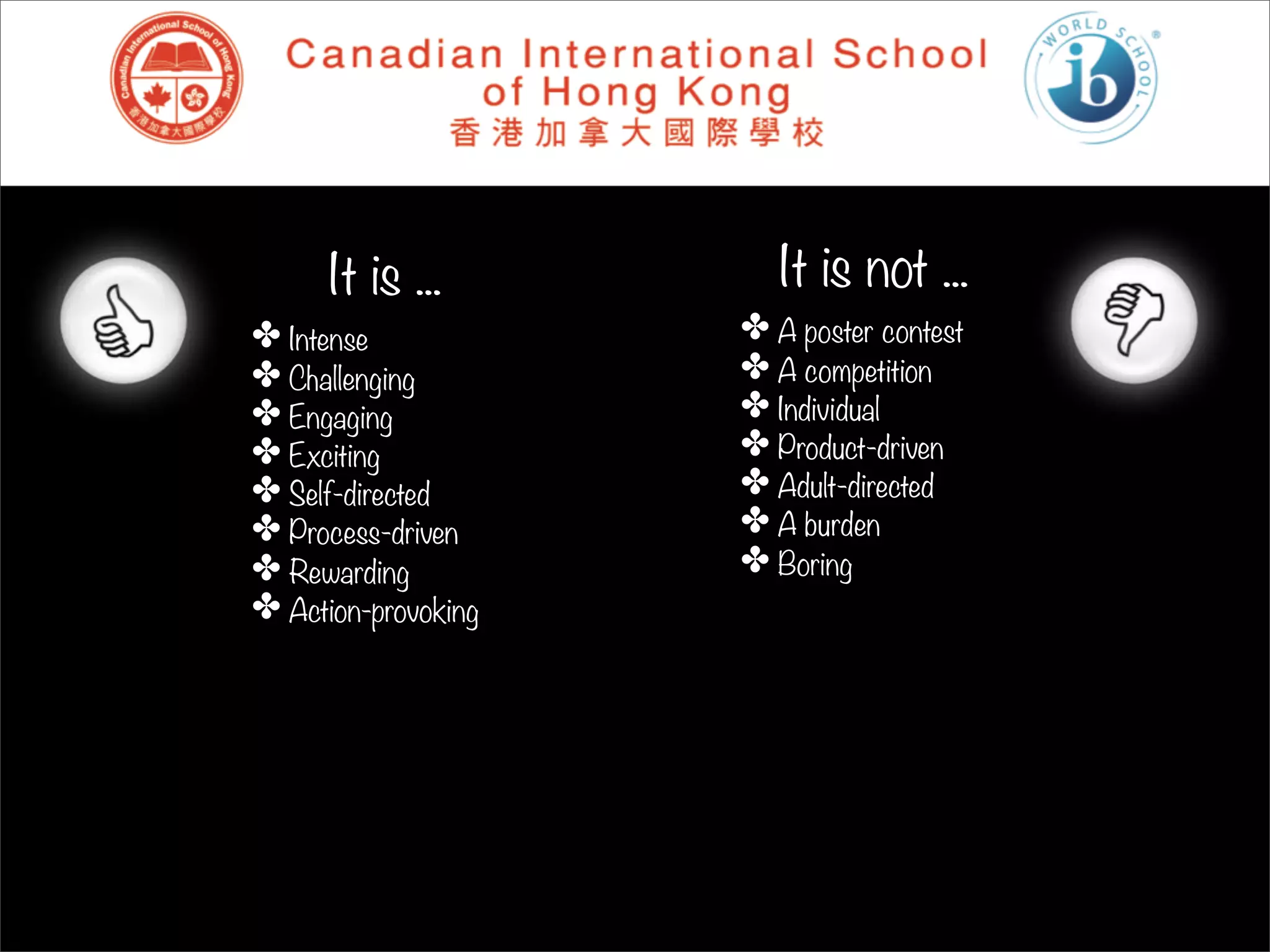
It is ...         It is not ...
✤ Intense            ✤ A poster contest
✤ Challenging        ✤ A competition
✤ Engaging           ✤ Individual
✤ Exciting           ✤ Product-driven
✤ Self-directed      ✤ Adult-directed
✤ Process-driven     ✤ A burden
✤ Rewarding          ✤ Boring
✤ Action-provoking
Students will be required to demonstrate the attitudes and
                attributes of the Learner Profile


         Attitudes                              Attributes
 Appreciation    Respect             Caring             Communicators
 Commitment     Cooperation       Knowledgeable           Thinkers
  Confidence     Curiosity        Open-minded             Reflective
  Creativity    Enthusiasm          Inquirers            Risk-takers
   Empathy       Integrity          Principled            Balanced
 Independence    Tolerance
Students will be required to apply the
    PYP Transdisciplinary Skills


           Communication
               Social
              Research
         Self-management
              Thinking
Students will be conducting their inquiries
       through the PYP Concepts

        Form             Connection
      Function           Perspective
      Causation         Responsibility
       Change             Reflection
Our Transdisciplinary Theme


                 Where We Are in Place and Time
An inquiry into orientation in place and time; personal histories; homes
and journeys; the discoveries, explorations and migrations of
humankind; the relationships between and the interconnectedness of
individuals and civilizations, from local and global perspectives.
Our Central Ideas

              Global interaction has increased over time and impacts people and society.


       The time and the place in which people live affect life and how they connect with others.


                     Circumstances, experiences and actions can lead to change.


Circumstances cause people to journey to different places impacting their lives and the lives of others.


                                    Discoveries can lead to change.
What’s next?


        Students will select areas of personal interest

    These areas need to be connected to a central idea

Collaborative groups will be formed around students’ interests
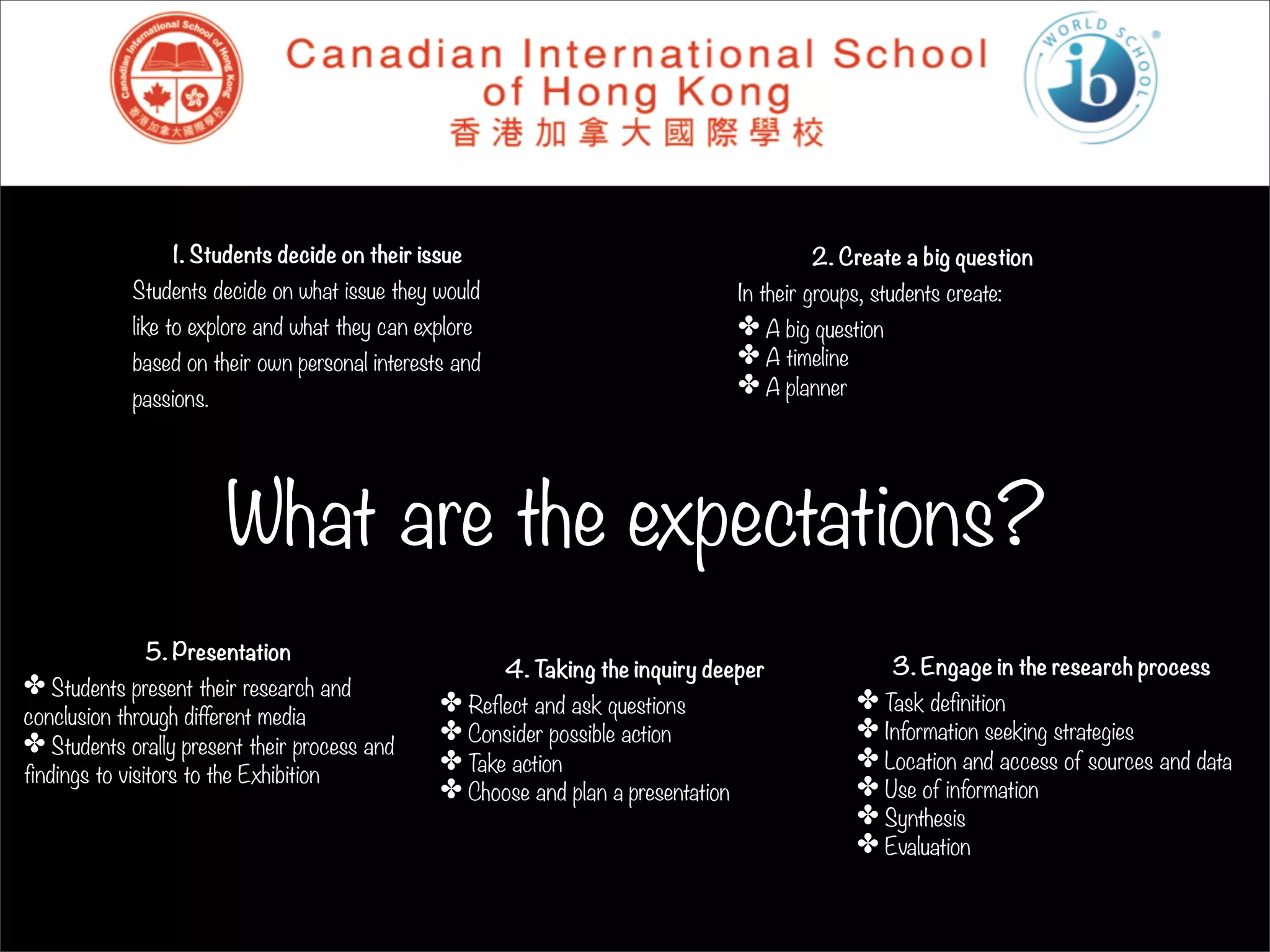
1. Students decide on their issue                                           2. Create a big question
            Students decide on what issue they would                                In their groups, students create:
            like to explore and what they can explore                               ✤ A big question
            based on their own personal interests and                               ✤ A timeline
            passions.
                                                                                    ✤ A planner


                        What are the expectations?
              5. Presentation
                                                        4. Taking the inquiry deeper                   3. Engage in the research process
✤ Students present their research and
                                                 ✤ Reflect and ask questions                      ✤ Task definition
conclusion through different media
                                                 ✤ Consider possible action                       ✤ Information seeking strategies
✤ Students orally present their process and
                                                 ✤ Take action                                    ✤ Location and access of sources and data
findings to visitors to the Exhibition
                                                 ✤ Choose and plan a presentation                 ✤ Use of information
                                                                                                  ✤ Synthesis
                                                                                                  ✤ Evaluation
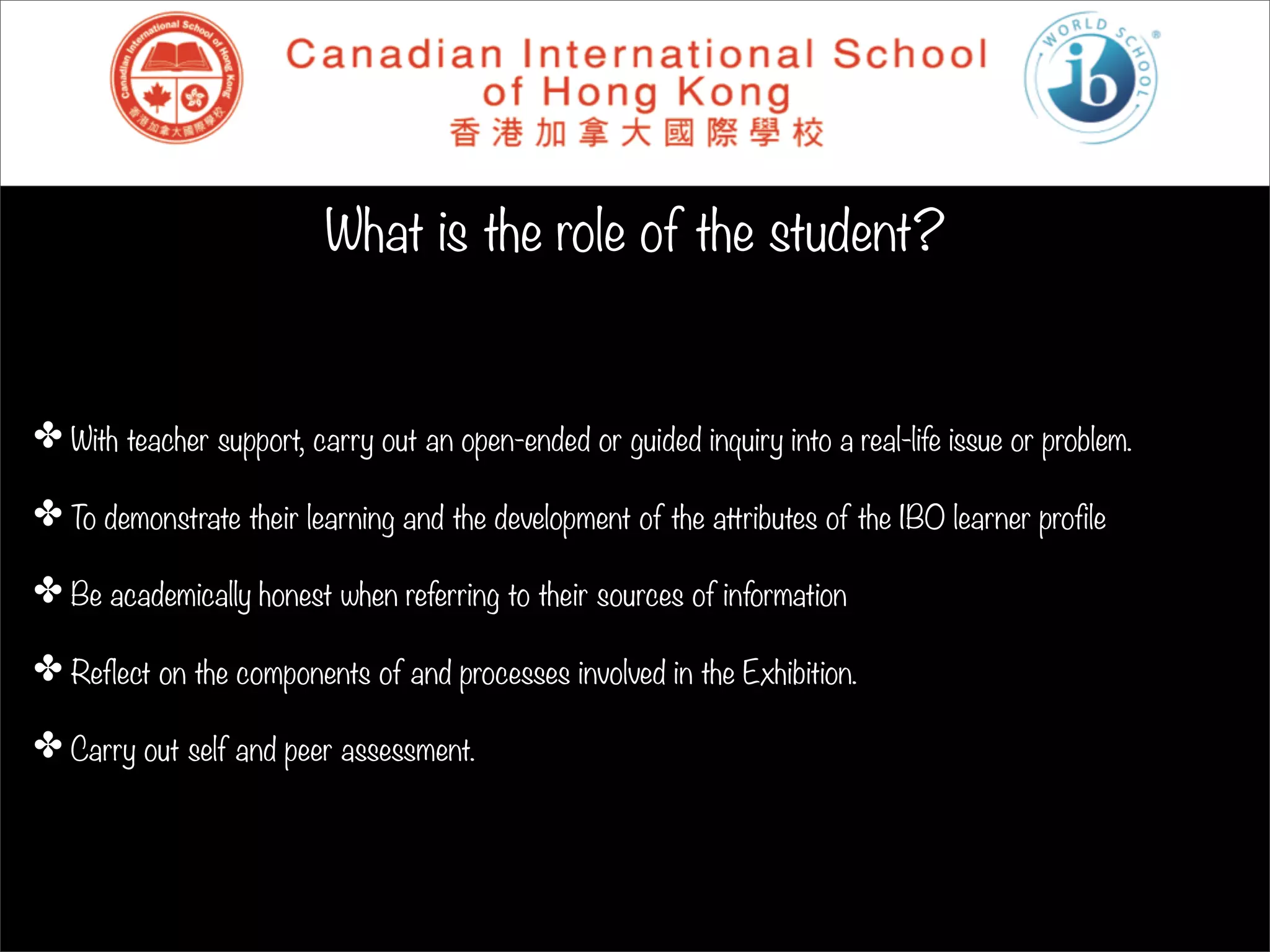
What is the role of the student?


✤ With teacher support, carry out an open-ended or guided inquiry into a real-life issue or problem.

✤ To demonstrate their learning and the development of the attributes of the IBO learner profile

✤ Be academically honest when referring to their sources of information

✤ Reflect on the components of and processes involved in the Exhibition.

✤ Carry out self and peer assessment.
What is the time commitment for students?

✤ Tuning-In: January 7-18

✤ Student Investigations, Exhibit and Reflections: March 11-May 3

✤ Exhibition: April 24 (This is also considered your child’s Student Led Learning Review [SLLR])

✤ Students will engage in Math throughout the Exhibition and the remainder of their time will be
   devoted to working on inquiries, reflecting and taking action


✤ There will be structured workshops to assist the students in developing their inquiries

✤ There will be time for students to meet with mentors, homeroom teachers and teacher supervisors
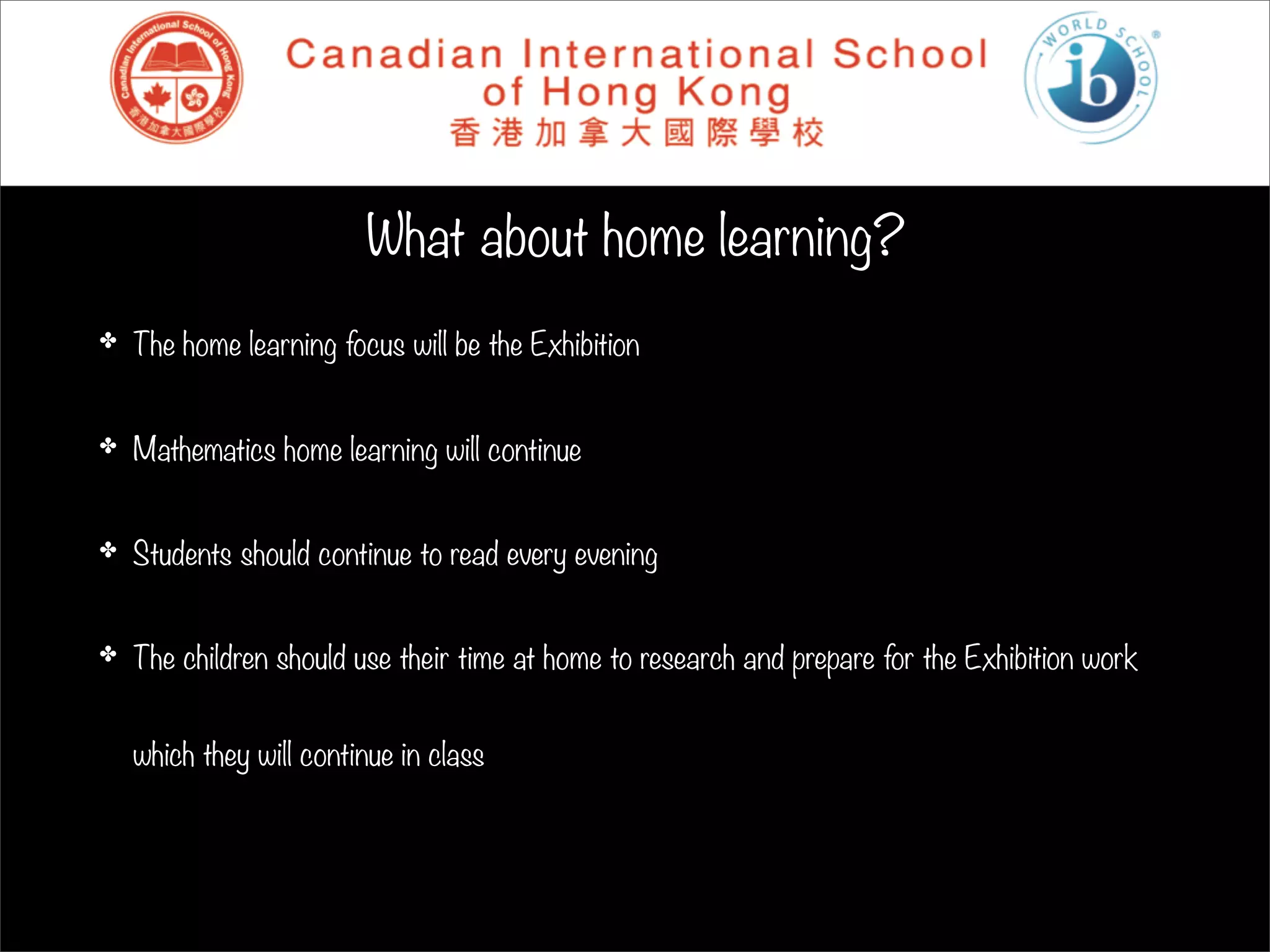
What about home learning?
✤   The home learning focus will be the Exhibition


✤   Mathematics home learning will continue


✤   Students should continue to read every evening


✤   The children should use their time at home to research and prepare for the Exhibition work


    which they will continue in class
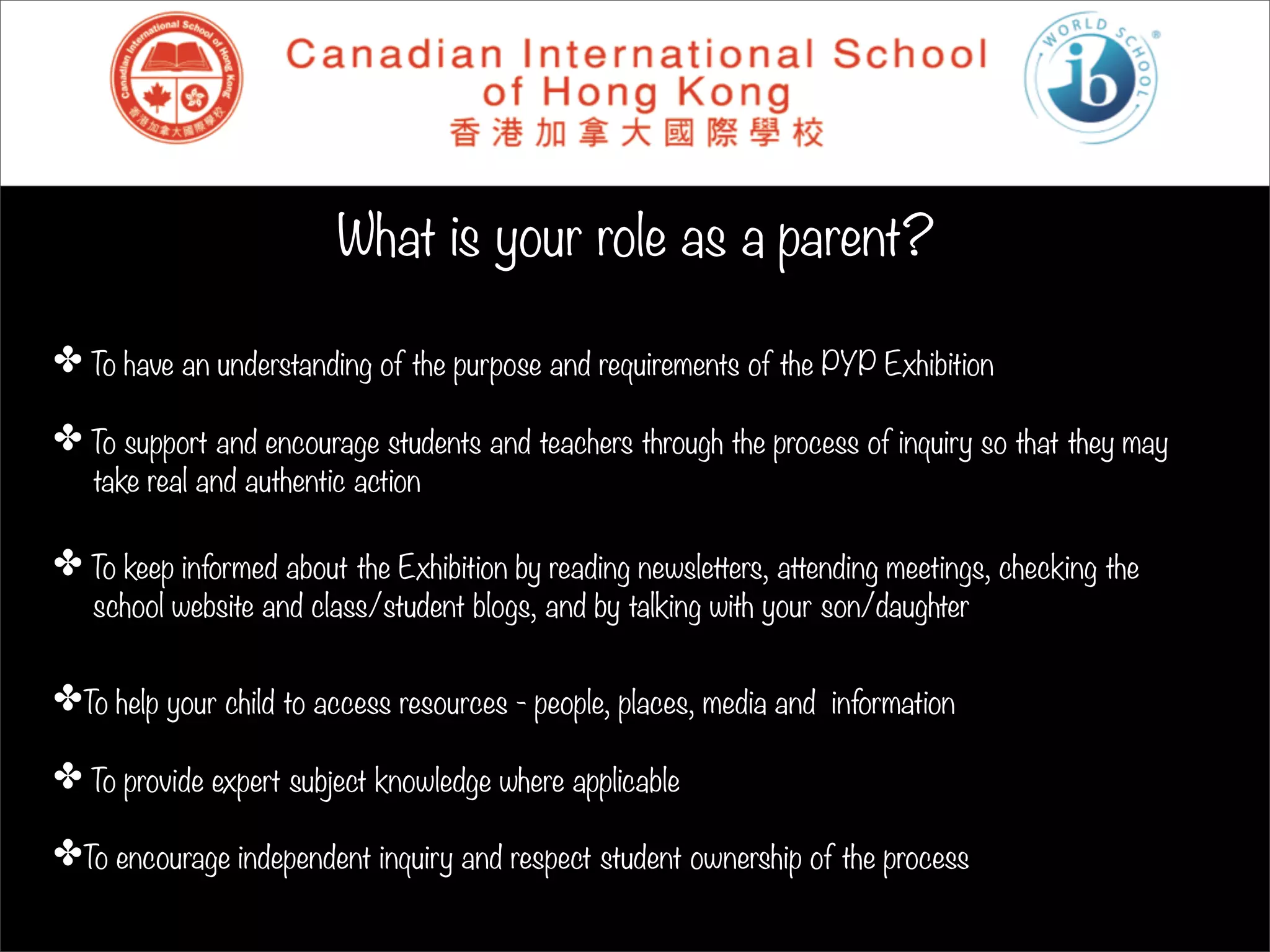
What is your role as a parent?

✤ To have an understanding of the purpose and requirements of the PYP Exhibition

✤ To support and encourage students and teachers through the process of inquiry so that they may
   take real and authentic action

✤ To keep informed about the Exhibition by reading newsletters, attending meetings, checking the
   school website and class/student blogs, and by talking with your son/daughter


✤To help your child to access resources - people, places, media and information

✤ To provide expert subject knowledge where applicable

✤To encourage independent inquiry and respect student ownership of the process
Communication


Any of your questions or concerns should be directed to the
homeroom teacher. He/She will communicate all parental
messages with the Teacher Supervisor and your child’s
mentor (if required).
Some things we should all remember ...

✤ As with any inquiry there will be times when it seems that students are not being
   very productive or learning might appear messy
✤ Sometimes there will be lot of discussion and thought but this will not result in
   anything that can be seen
✤ Students (and adults) need time and space to wonder about things and consider
   their plans
✤ Considerable emphasis is placed on the students’ Process Journals, where they will
   show their understandings of concepts, the process and the application of skills
✤ The Exhibition is not product-driven so the students’ presentation is not considered
   the only evidence of learning
Most important of all ...


... we want students to enjoy their experience and celebrate
themselves as independent and active inquirers. We want our
             children to see the joy in learning!

Parent information presentation

  • 1.
    The PYP Exhibition at Canadian International School of Hong Kong Parent Information Presentation
  • 2.
    What is theExhibition? A collaborative inquiry An inquiry that starts from personal interests and passions but extends into real world issues An inquiry that requires students to apply their learning from previous years A “rite of passage” from the PYP to the MYP A culmination of the PYP journey that is mandated by the IB A celebration of who our students are as learners
  • 3.
    It is ... It is not ... ✤ Intense ✤ A poster contest ✤ Challenging ✤ A competition ✤ Engaging ✤ Individual ✤ Exciting ✤ Product-driven ✤ Self-directed ✤ Adult-directed ✤ Process-driven ✤ A burden ✤ Rewarding ✤ Boring ✤ Action-provoking
  • 4.
    Students will berequired to demonstrate the attitudes and attributes of the Learner Profile Attitudes Attributes Appreciation Respect Caring Communicators Commitment Cooperation Knowledgeable Thinkers Confidence Curiosity Open-minded Reflective Creativity Enthusiasm Inquirers Risk-takers Empathy Integrity Principled Balanced Independence Tolerance
  • 5.
    Students will berequired to apply the PYP Transdisciplinary Skills Communication Social Research Self-management Thinking
  • 6.
    Students will beconducting their inquiries through the PYP Concepts Form Connection Function Perspective Causation Responsibility Change Reflection
  • 7.
    Our Transdisciplinary Theme Where We Are in Place and Time An inquiry into orientation in place and time; personal histories; homes and journeys; the discoveries, explorations and migrations of humankind; the relationships between and the interconnectedness of individuals and civilizations, from local and global perspectives.
  • 8.
    Our Central Ideas Global interaction has increased over time and impacts people and society. The time and the place in which people live affect life and how they connect with others. Circumstances, experiences and actions can lead to change. Circumstances cause people to journey to different places impacting their lives and the lives of others. Discoveries can lead to change.
  • 9.
    What’s next? Students will select areas of personal interest These areas need to be connected to a central idea Collaborative groups will be formed around students’ interests
  • 10.
    1. Students decideon their issue 2. Create a big question Students decide on what issue they would In their groups, students create: like to explore and what they can explore ✤ A big question based on their own personal interests and ✤ A timeline passions. ✤ A planner What are the expectations? 5. Presentation 4. Taking the inquiry deeper 3. Engage in the research process ✤ Students present their research and ✤ Reflect and ask questions ✤ Task definition conclusion through different media ✤ Consider possible action ✤ Information seeking strategies ✤ Students orally present their process and ✤ Take action ✤ Location and access of sources and data findings to visitors to the Exhibition ✤ Choose and plan a presentation ✤ Use of information ✤ Synthesis ✤ Evaluation
  • 11.
    What is therole of the student? ✤ With teacher support, carry out an open-ended or guided inquiry into a real-life issue or problem. ✤ To demonstrate their learning and the development of the attributes of the IBO learner profile ✤ Be academically honest when referring to their sources of information ✤ Reflect on the components of and processes involved in the Exhibition. ✤ Carry out self and peer assessment.
  • 12.
    What is thetime commitment for students? ✤ Tuning-In: January 7-18 ✤ Student Investigations, Exhibit and Reflections: March 11-May 3 ✤ Exhibition: April 24 (This is also considered your child’s Student Led Learning Review [SLLR]) ✤ Students will engage in Math throughout the Exhibition and the remainder of their time will be devoted to working on inquiries, reflecting and taking action ✤ There will be structured workshops to assist the students in developing their inquiries ✤ There will be time for students to meet with mentors, homeroom teachers and teacher supervisors
  • 13.
    What about homelearning? ✤ The home learning focus will be the Exhibition ✤ Mathematics home learning will continue ✤ Students should continue to read every evening ✤ The children should use their time at home to research and prepare for the Exhibition work which they will continue in class
  • 14.
    What is yourrole as a parent? ✤ To have an understanding of the purpose and requirements of the PYP Exhibition ✤ To support and encourage students and teachers through the process of inquiry so that they may take real and authentic action ✤ To keep informed about the Exhibition by reading newsletters, attending meetings, checking the school website and class/student blogs, and by talking with your son/daughter ✤To help your child to access resources - people, places, media and information ✤ To provide expert subject knowledge where applicable ✤To encourage independent inquiry and respect student ownership of the process
  • 15.
    Communication Any of yourquestions or concerns should be directed to the homeroom teacher. He/She will communicate all parental messages with the Teacher Supervisor and your child’s mentor (if required).
  • 16.
    Some things weshould all remember ... ✤ As with any inquiry there will be times when it seems that students are not being very productive or learning might appear messy ✤ Sometimes there will be lot of discussion and thought but this will not result in anything that can be seen ✤ Students (and adults) need time and space to wonder about things and consider their plans ✤ Considerable emphasis is placed on the students’ Process Journals, where they will show their understandings of concepts, the process and the application of skills ✤ The Exhibition is not product-driven so the students’ presentation is not considered the only evidence of learning
  • 17.
    Most important ofall ... ... we want students to enjoy their experience and celebrate themselves as independent and active inquirers. We want our children to see the joy in learning!