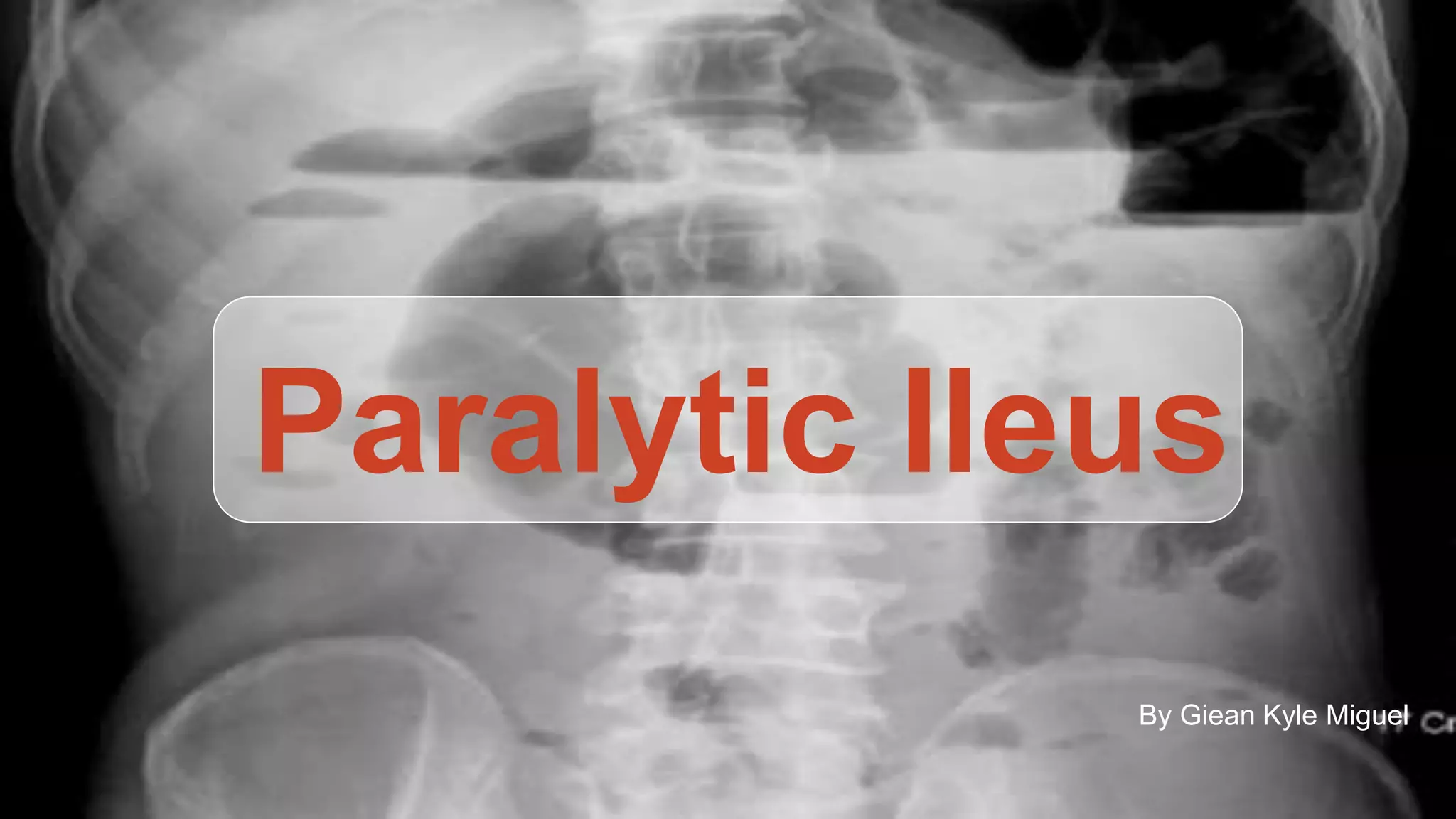
Paralytic Ileus
By Giean Kyle Miguel
PARALYTIC ILEUS
➢ Obstruction of the intestine d/t paralysis of the intestinal muscle.
➢ Second most common reason for hospital re-admission in the first 30 days
after surgery.
➢ Non-mechanical obstruction caused by physiologic, neurogenic, or chemical
imbalances. CAUSES :
➢ Hydromorphone (Dilaudid)
➢ Morphine
➢ Oxycodone
➢ Tricyclic antidepressants
(amitriptyline & imipramine
[Tofranil])
CAUSES :
➢ Intestinal Cancer
➢ Crohn’s disease
➢ diverticulitis
➢ Parkinson’s disease
RISK FACTORS
➢ Electrolyte imbalances
➢ Hx of intestinal injury or trauma
➢ Sepsis
➢ Peripheral artery disease
Aging naturally slows down
how fast the intestines
move. An older adult is at
greater risk for ileus,
especially since they tend
to take more medications
that could potentially slow
movement of material
SIGNS & SYMPTOMS
➢ Abdl. cramping
➢ N/V
➢ Constant, diffuse discomfort
➢ Diarrhea may be present in
partial obstruction
➢ Abdl. distention
➢ Abdl. rigidity
➢ Constipation
➢ Borborygmi
DIAGNOSIS
X-Ray
MANAGEMENT
➢ NPO
➢ NG tube or nasointestinal tube for decompression
➢ Enemas maybe helpful
➢ F&E replacement are important
➢ Ice chips sparingly
➢ Closely monitor I&O
➢ Withheld opioids
➢ Mobilize patient if possible
Source: www.healthline.com/healt

Paralytic ileus

  • 1.
  • 2.
    PARALYTIC ILEUS ➢ Obstructionof the intestine d/t paralysis of the intestinal muscle. ➢ Second most common reason for hospital re-admission in the first 30 days after surgery. ➢ Non-mechanical obstruction caused by physiologic, neurogenic, or chemical imbalances. CAUSES : ➢ Hydromorphone (Dilaudid) ➢ Morphine ➢ Oxycodone ➢ Tricyclic antidepressants (amitriptyline & imipramine [Tofranil]) CAUSES : ➢ Intestinal Cancer ➢ Crohn’s disease ➢ diverticulitis ➢ Parkinson’s disease
  • 3.
    RISK FACTORS ➢ Electrolyteimbalances ➢ Hx of intestinal injury or trauma ➢ Sepsis ➢ Peripheral artery disease Aging naturally slows down how fast the intestines move. An older adult is at greater risk for ileus, especially since they tend to take more medications that could potentially slow movement of material SIGNS & SYMPTOMS ➢ Abdl. cramping ➢ N/V ➢ Constant, diffuse discomfort ➢ Diarrhea may be present in partial obstruction ➢ Abdl. distention ➢ Abdl. rigidity ➢ Constipation ➢ Borborygmi
  • 4.
  • 5.
    MANAGEMENT ➢ NPO ➢ NGtube or nasointestinal tube for decompression ➢ Enemas maybe helpful ➢ F&E replacement are important ➢ Ice chips sparingly ➢ Closely monitor I&O ➢ Withheld opioids ➢ Mobilize patient if possible Source: www.healthline.com/healt

Editor's Notes

  • #3 P.I. is another example of Intestinal obstruction. Usually appears or experienced after some types of surgery, especially abdominal surgery, or spinal injuries, inflammation anywhere within the abdomen that touches the intestines, or dse. Of the intestinal muscles themselves. So P.I. there’s an absence of Peristalsis (wave-like muscle contractions that moves food to different processing stations in the digestive tract.) --- thus preventing the passage of food that leads to functional blockage of the intestines. CAUSES: Crohn’s Diease - causes the intestinal walls to get thicker d/t the autoimmune inflammation (inflammatory bowel disease) Diverticulitis - Fomation of diverticula or pouches that occur along the digestive tract, most often in the colon. Parkinson’s disease - d/t the affectation of the muscles and nerves in the intestines.
  • #4 RISK FACTORS Such as those involving potassium and calcium, because these are the electrolytes that govern the contraction of muscles. Because they cause vascular insufficiency or shock Because this can lead to shock This can lead to vascular insufficiency SIGNS & SYMPTOMS: Gastrointestinal symptoms are the most common signs of an ileus. Your stomach and intestines will start to fill with gas that can’t pass out the rectum. This causes the abdomen to take on a tight and swollen appearance. Abdl. distetion - feeling of fullness BORBORYGMI - a rumbling or gurgling noise made by the movement of fluid and gas in the intestines. From Normal to Quiet
  • #5 X-RAY Supine view of the abdomen in a patient with intestinal obstruction. Dilated loops of small bowel are visible (arrows). Lateral decubitus view of the abdomen, showing air-fluid levels consistent with intestinal obstruction (arrows).
  • #6 NGT Decompression - gastric suction or stomach pumping, to suction out the extra air or material that the patient might otherwise vomit. Cantor, Miller-Abbott