Small Bowel obstruction
Definition and Classifcation
A small bowel obstruction is a blockage of the small
bowel that prevents flow of contents through the
digestive tract.
Small bowel obstructions can be functional or
mechanical, acute or chronic, and partial or complete
Etiologies
Functional Mechanical
 Ileus  Intraluminal or
extraluminal
mechanical
compression
Etiologies
Functional Mechanical
Ilus Intrinsic
Small bowel
Neoplasm
Inflammatory
stricture
Ischemic
strictures
Radiation
stricture
Benign lesions
Gallstones
Congenital
webs
Faeces or
meconium
Bezoar
Extrinsic
Adhesions
Hernia
(congenital or
Acquired)
Pathophysiology
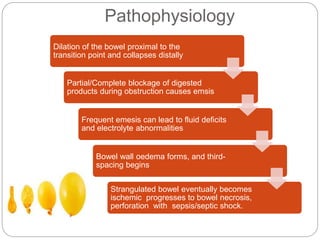
Dilation of the bowel proximal to the
transition point and collapses distally
Partial/Complete blockage of digested
products during obstruction causes emsis
Frequent emesis can lead to fluid deficits
and electrolyte abnormalities
Bowel wall oedema forms, and third-
spacing begins
Strangulated bowel eventually becomes
ischemic progresses to bowel necrosis,
perforation with sepsis/septic shock.
Clinical Presentation
History Examination
Symptoms:
Abdominal pain
Nausea and emesis
Developing constipation-to-obstipation
Risk factors:
 Prior abdominal or pelvic surgery (risk for adhesion
formation)
 ●Abdominal wall or groin hernia
 ●Intestinal inflammation (eg, Crohn disease)
 ●History of or increased risk for neoplasm
 ●Prior abdominopelvic irradiation
 ●History of foreign body ingestion
 Dehydration
 abdominal dissension
 High fever
 Tachycardia
 localized severe
abdominal tenderness
 Rebound tenderness
 Prior surgical scars
Diagnosis/Evaluation
Laboratory studies —
 Complete blood count
 Electrolytes, including blood urea nitrogen and
creatinine
 Serum lactate
 Blood cultures
Imaging —
 Abdominal plain film Radiographs
 Computed tomography (CT)
Abdominal XR
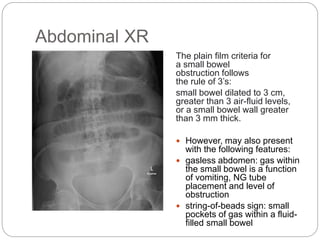
The plain film criteria for
a small bowel
obstruction follows
the rule of 3’s:
small bowel dilated to 3 cm,
greater than 3 air-fluid levels,
or a small bowel wall greater
than 3 mm thick.
 However, may also present
with the following features:
 gasless abdomen: gas within
the small bowel is a function
of vomiting, NG tube
placement and level of
obstruction
 string-of-beads sign: small
pockets of gas within a fluid-
filled small bowel
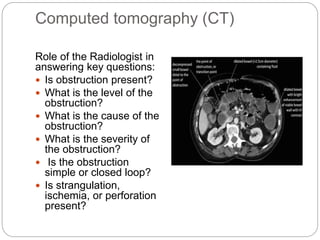
Computed tomography (CT)
Role of the Radiologist in
answering key questions:
 Is obstruction present?
 What is the level of the
obstruction?
 What is the cause of the
obstruction?
 What is the severity of
the obstruction?
 Is the obstruction
simple or closed loop?
 Is strangulation,
ischemia, or perforation
present?
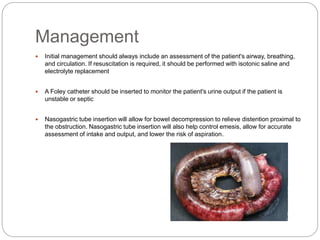
Management
 Initial management should always include an assessment of the patient's airway, breathing,
and circulation. If resuscitation is required, it should be performed with isotonic saline and
electrolyte replacement
 A Foley catheter should be inserted to monitor the patient's urine output if the patient is
unstable or septic
 Nasogastric tube insertion will allow for bowel decompression to relieve distention proximal to
the obstruction. Nasogastric tube insertion will also help control emesis, allow for accurate
assessment of intake and output, and lower the risk of aspiration.
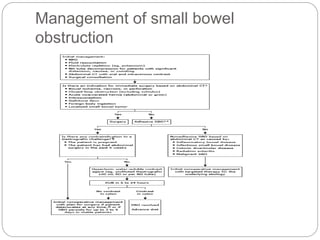
Management of small bowel
obstruction
Gastrograffin for adhesive small
bowel obstuction
Enhancing Outcomes
 The key to preventing the high mortality following a
bowel obstruction is the early diagnosis, resuscitation,
and operative intervention.
 The triage nurse must be fully aware of the signs of
bowel obstruction and expedite the admission. The
emergency physician, nurse practitioner, or physician
assistant must examine the patient and get the
appropriate radiological test
 The surgeon must be consulted even if no
intervention is planned. While awaiting surgery, the
bowel may need to be decompressed with a
nasogastric tube, and the nurse is essential for
monitoring of vital signs and worsening of the
obstruction.
Outcomes
 The morbidity and mortality of bowel obstruction are
dependent on early diagnosis and management.
 If any strangulated bowel is left untreated, there is a
mortality rate of close to 100%.
 However, if surgery is undertaken within 24-48 hours,
the mortality rates are less than 10%.
 Factors that determine the morbidity include the age
of patient, comorbidity, and delay in treatment. Today,
the overall mortality of bowel obstruction is still about
5%-8%.[3][10] [Level 3]
Refrences
1. Water absorption in experimental closed segment obstruction of the ileum in man. Wright HK, O'Brien
JJ,Tilson MD Am JSurg. 1971;121(1):96.
2. Mechanical obstruction of the small bowel and colon. AU Cappell MS, Batke M SO Med Clin North Am.
2008;92(3):575.
3. Bowel Obstruction. AU Gore RM, Silvers RI, Thakrar KH, Wenzke DR, Mehta UK, Newmark GM, Berlin
JW SO Radiol Clin North Am. 2015;53(6):1225.
4. Bowel Obstruction David A. Smith; Sarang Kashyap; Sara M. Nehring
5. Spectrum of causes of intestinal obstruction in adult Nigerian patients.Lawal OO, Olayinka OS, Bankole JO S
Afr J Surg. 2005 May;43(2):34, 36.
Small Bowel obstruction presentation.pptx

Small Bowel obstruction presentation.pptx

  • 1.
  • 2.
    Definition and Classifcation Asmall bowel obstruction is a blockage of the small bowel that prevents flow of contents through the digestive tract. Small bowel obstructions can be functional or mechanical, acute or chronic, and partial or complete
  • 3.
    Etiologies Functional Mechanical  Ileus Intraluminal or extraluminal mechanical compression
  • 4.
    Etiologies Functional Mechanical Ilus Intrinsic Smallbowel Neoplasm Inflammatory stricture Ischemic strictures Radiation stricture Benign lesions Gallstones Congenital webs Faeces or meconium Bezoar Extrinsic Adhesions Hernia (congenital or Acquired)
  • 5.
    Pathophysiology Dilation of thebowel proximal to the transition point and collapses distally Partial/Complete blockage of digested products during obstruction causes emsis Frequent emesis can lead to fluid deficits and electrolyte abnormalities Bowel wall oedema forms, and third- spacing begins Strangulated bowel eventually becomes ischemic progresses to bowel necrosis, perforation with sepsis/septic shock.
  • 6.
    Clinical Presentation History Examination Symptoms: Abdominalpain Nausea and emesis Developing constipation-to-obstipation Risk factors:  Prior abdominal or pelvic surgery (risk for adhesion formation)  ●Abdominal wall or groin hernia  ●Intestinal inflammation (eg, Crohn disease)  ●History of or increased risk for neoplasm  ●Prior abdominopelvic irradiation  ●History of foreign body ingestion  Dehydration  abdominal dissension  High fever  Tachycardia  localized severe abdominal tenderness  Rebound tenderness  Prior surgical scars
  • 7.
    Diagnosis/Evaluation Laboratory studies — Complete blood count  Electrolytes, including blood urea nitrogen and creatinine  Serum lactate  Blood cultures Imaging —  Abdominal plain film Radiographs  Computed tomography (CT)
  • 8.
    Abdominal XR The plainfilm criteria for a small bowel obstruction follows the rule of 3’s: small bowel dilated to 3 cm, greater than 3 air-fluid levels, or a small bowel wall greater than 3 mm thick.  However, may also present with the following features:  gasless abdomen: gas within the small bowel is a function of vomiting, NG tube placement and level of obstruction  string-of-beads sign: small pockets of gas within a fluid- filled small bowel
  • 9.
    Computed tomography (CT) Roleof the Radiologist in answering key questions:  Is obstruction present?  What is the level of the obstruction?  What is the cause of the obstruction?  What is the severity of the obstruction?  Is the obstruction simple or closed loop?  Is strangulation, ischemia, or perforation present?
  • 10.
    Management  Initial managementshould always include an assessment of the patient's airway, breathing, and circulation. If resuscitation is required, it should be performed with isotonic saline and electrolyte replacement  A Foley catheter should be inserted to monitor the patient's urine output if the patient is unstable or septic  Nasogastric tube insertion will allow for bowel decompression to relieve distention proximal to the obstruction. Nasogastric tube insertion will also help control emesis, allow for accurate assessment of intake and output, and lower the risk of aspiration.
  • 11.
    Management of smallbowel obstruction
  • 12.
    Gastrograffin for adhesivesmall bowel obstuction
  • 13.
    Enhancing Outcomes  Thekey to preventing the high mortality following a bowel obstruction is the early diagnosis, resuscitation, and operative intervention.  The triage nurse must be fully aware of the signs of bowel obstruction and expedite the admission. The emergency physician, nurse practitioner, or physician assistant must examine the patient and get the appropriate radiological test  The surgeon must be consulted even if no intervention is planned. While awaiting surgery, the bowel may need to be decompressed with a nasogastric tube, and the nurse is essential for monitoring of vital signs and worsening of the obstruction.
  • 14.
    Outcomes  The morbidityand mortality of bowel obstruction are dependent on early diagnosis and management.  If any strangulated bowel is left untreated, there is a mortality rate of close to 100%.  However, if surgery is undertaken within 24-48 hours, the mortality rates are less than 10%.  Factors that determine the morbidity include the age of patient, comorbidity, and delay in treatment. Today, the overall mortality of bowel obstruction is still about 5%-8%.[3][10] [Level 3]
  • 16.
    Refrences 1. Water absorptionin experimental closed segment obstruction of the ileum in man. Wright HK, O'Brien JJ,Tilson MD Am JSurg. 1971;121(1):96. 2. Mechanical obstruction of the small bowel and colon. AU Cappell MS, Batke M SO Med Clin North Am. 2008;92(3):575. 3. Bowel Obstruction. AU Gore RM, Silvers RI, Thakrar KH, Wenzke DR, Mehta UK, Newmark GM, Berlin JW SO Radiol Clin North Am. 2015;53(6):1225. 4. Bowel Obstruction David A. Smith; Sarang Kashyap; Sara M. Nehring 5. Spectrum of causes of intestinal obstruction in adult Nigerian patients.Lawal OO, Olayinka OS, Bankole JO S Afr J Surg. 2005 May;43(2):34, 36.

Editor's Notes

  • #5 In the United States and Western Europe, the most common cause of mechanical small bowel obstruction is intraperitoneal adhesions, followed by tumors and complicated hernias [1,10]. In 90 percent of cases, small bowel obstruction is caused by adhesions, hernias, or neoplasms [5]. Less frequent causes of obstruction include Crohn disease (3 to 7 percent) [5,13], gallstones (2 percent), volvulus (4 to 15 percent) [14-16], and intussusception (4 to 8 percent) [14,17].
  • #6 A closed-loop obstruction is a form of complete bowel obstruction that occurs when a segment of intestine, usually small bowel, is obstructed in two locations, creating a segment with no proximal or distal outlet. There could be minimal abdominal distention since only a short segment of intestine may be involved. Closed-loop obstruction can rapidly lead to complications (ischemia, necrosis, perforation)
  • #7 Physical examination — The physical examination should include evaluation for systemic signs, abdominal inspection, auscultation, percussion and palpation, as well as a digital rectal examination. Abdominal auscultation – Acute mechanical bowel obstruction is characterized by high-pitched "tinkling" sounds associated with the pain. With significant bowel distention, bowel sounds may become muffled, and as the bowel progressively distends, bowel sounds can become hypoactive. ●Abdominal percussion – Distention of the bowel results in hyperresonance or tympany to percussion throughout the abdomen. However, fluid-filled loops will result in dullness. If percussion over the liver is tympanitic rather than dull, it may be indicative of free intra-abdominal air. Tenderness to light percussion suggests peritonitis. ●Abdominal palpation may identify any abdominal wall or groin hernias, or abnormal masses, which, in the setting of small bowel obstruction, may indicate an abscess, volvulus, or tumor as the source of obstruction. ●Digital rectal examination should be performed to identify fecal impaction or rectal mass as the source of obstruction. Gross or occult blood may be related to intestinal tumor, ischemia, inflammatory mucosal injury, or intussusception.
  • #8 Although mechanical small bowel obstruction may be suspected (or obvious) based upon risk factors, symptoms, and physical exam findings consistent with obstruction, abdominal imaging is usually required to confirm the diagnosis, identify the location of obstruction, judge whether the obstruction is partial or complete, identify complications related to obstruction (ischemia, necrosis, perforation), and determine the potential etiology, all of which will help determine the urgency and nature of further treatment (surgery versus initial nonoperative management)  Laboratory evaluation is essential to evaluate for any leukocytosis, electrolyte derangements that may be present as a result of the emesis. Labs also evaluate for elevated lactic acid that may be suggestive of sepsis or perforation, which at times may not be visible on CT if it is a microperforation and early in the course, blood cultures, or other signs of sepsis/septic shock. Although the lactic acid is often looked to in order to determine if there is a sign of perforation or ischemic gut, it should be noted this can be normal even with a microperforation present, initially. severe leukocytosis, or metabolic acidosis suggest possible complications of bowel necrosis, bowel perforation, or generalized peritonitis
  • #10 Differentiation of total mechanical obstruction from partial mechanical obstruction and pseudo-obstruction is important because total mechanical obstruction is generally treated surgically,whereas the other two entities are usually treated medically
  • #11 Management ultimately depends on the etiology and severity of the obstruction. Stable patients with partial or low-grade obstruction resolve with nasogastric tube decompression and supportive measures. Patients who present with reducible hernias will require non-emergent surgical intervention to prevent future recurrence. Non-reducible or strangulated hernias require emergency surgical intervention. Complete or high-grade obstructions often require urgent or emergent surgical intervention as the risk of ischemia increases. Chronic disease states such as Crohn disease and malignancy require initial supportive measures and longer periods of nonoperative management.