Paragraph Function
Teacher: Manolo l. Giron
Subject: English for academic and professional purposes
School: Zambales National High School
Paragraph
 It is a section of a piece of writing.
 A paragraph always begins on a new line
and contains at least one sentence.
 The length of a paragraph depends on the
information it conveys.
 Paragraphs are used to help your reader follow
the logic of your argument.
 When you begin a new idea, a point that contrasts
one you were just discussing, or when you are
raising a related but separate point, it's probably
time to start a new paragraph.
 In writing reaction paper you are going to be
careful for you to make your writing good.
 Thus, you need to understand what is the function
of your paragraphs.
 Stating: Making an assertion.
 Restating: Putting into different words an
assertion already made for purposes of
clarification and/or adjustment or emphasis.
 Supporting: Providing evidence for an assertion.
 Concurring: Agreeing with another author's
assertion.
 Qualifying: Restricting the meaning of an
assertion already made.
Paragraph Function
 Conceding: Acknowledging the presence of a fact or
perspective that calls into question that author's own
assertions.
 Negating: Offering reasoning or evidence to demonstrate
the falsehoold of an assertion.
 Expanding: Stating at great length or more
comprehensively an idea or assertion already expressed.
 Analyzing: Breaking an assertion down into its constituent
parts in order to clarify or evaluate it.
 Defining: Stating the meaning of a word or words
previously or subsequently used.
 Describing: Naming one or more features of an object or
concept, to help the reader imagine it precisely or understand
it fully.
 Exemplifying: Giving an illustration of what is meant by a
previous statement or giving a concrete instance that will help
make the point credible.
 Comparing and contrasting: Examining objects alongside each
other for the purpose of clarifying their features, evaluating
them or noting differences and similarities.
 Narrating: Telling a story describing an event or series of
events.
 Evaluating: Making judgement about something discussed
previously.
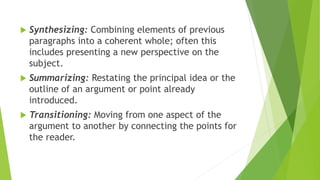
 Synthesizing: Combining elements of previous
paragraphs into a coherent whole; often this
includes presenting a new perspective on the
subject.
 Summarizing: Restating the principal idea or the
outline of an argument or point already
introduced.
 Transitioning: Moving from one aspect of the
argument to another by connecting the points for
the reader.
References
 http//:www.Paragraph Function.htm

Paragraph function

  • 1.
    Paragraph Function Teacher: Manolol. Giron Subject: English for academic and professional purposes School: Zambales National High School
  • 2.
    Paragraph  It isa section of a piece of writing.  A paragraph always begins on a new line and contains at least one sentence.  The length of a paragraph depends on the information it conveys.
  • 3.
     Paragraphs areused to help your reader follow the logic of your argument.  When you begin a new idea, a point that contrasts one you were just discussing, or when you are raising a related but separate point, it's probably time to start a new paragraph.
  • 4.
     In writingreaction paper you are going to be careful for you to make your writing good.  Thus, you need to understand what is the function of your paragraphs.
  • 5.
     Stating: Makingan assertion.  Restating: Putting into different words an assertion already made for purposes of clarification and/or adjustment or emphasis.  Supporting: Providing evidence for an assertion.  Concurring: Agreeing with another author's assertion.  Qualifying: Restricting the meaning of an assertion already made. Paragraph Function
  • 6.
     Conceding: Acknowledgingthe presence of a fact or perspective that calls into question that author's own assertions.  Negating: Offering reasoning or evidence to demonstrate the falsehoold of an assertion.  Expanding: Stating at great length or more comprehensively an idea or assertion already expressed.  Analyzing: Breaking an assertion down into its constituent parts in order to clarify or evaluate it.  Defining: Stating the meaning of a word or words previously or subsequently used.
  • 7.
     Describing: Namingone or more features of an object or concept, to help the reader imagine it precisely or understand it fully.  Exemplifying: Giving an illustration of what is meant by a previous statement or giving a concrete instance that will help make the point credible.  Comparing and contrasting: Examining objects alongside each other for the purpose of clarifying their features, evaluating them or noting differences and similarities.  Narrating: Telling a story describing an event or series of events.  Evaluating: Making judgement about something discussed previously.
  • 8.
     Synthesizing: Combiningelements of previous paragraphs into a coherent whole; often this includes presenting a new perspective on the subject.  Summarizing: Restating the principal idea or the outline of an argument or point already introduced.  Transitioning: Moving from one aspect of the argument to another by connecting the points for the reader.
  • 9.

Editor's Notes

  • #6 You can use a paragraph in declaring something. You can use a paragraph for clarification or for adjustment emphasis of what you already asset. For providing evidence for previous assertion. To support the another author’s assertion. To support the meaning of previous statement.
  • #7 To recognize the fact. To make the statement reverse the meaning. To expand the idea or statement. To break down the idea for clarification. To define the Expression or terminology
  • #8 To describe the object or concept
  • #9 Coherent- to make it easy to understand.