UNIVERSITY OF ZIMBABWE
NAME : SOLOMON KAMBA
REG NUMBER : R142643H
PROGRAMME : HPM (II)
COURSE : PCH201 (Pharmaceutical
Chemistry)
DUE DATE : 11/10/15
LECTURER : Mr. Mutingwendi
PRACTICAL No : THREE, (3)
TITLE: PREPARATION OF PARACETAMOL
(ACETAMINOPHEN OR PARA-ACETYLAMINOPHENOL)
AIMS
 To prepare paracetamol
 To purify paracetamol
 To obtain pure paracetamol void of any impurities
 To weigh the yield
 To calculate the percentage yield
Theory
Acetaminophen (paracetamol) is an analgesic and fever-reducing medicine similar in effect to
aspirin. It is an active ingredient in many over-the-counter medicines, including Tylenol and
Midol. Introduced in the early 1900s, acetaminophen is a coal tar derivative that acts by
interfering with the synthesis of prostaglandins and other substances necessary for the
transmission of pain impulses. Acetaminophen works by inhibiting prostaglandins, which help to
transmit pain signals and induce fever. The body produces prostaglandins in response to injury or
illness. Acetaminophen stops some prostaglandin functions whilst not affecting others.
Prostaglandins are known to promote inflammation and swelling of many body tissues. Unlike
aspirin and ibuprofen, acetaminophen does not have anti-inflammatory action.
Paracetamol consists of a benzene ring core, substituted by one hydroxyl group and the nitrogen
atom of an amide group in the para (1, 4) pattern. The amide group is acetamide (ethanamide). It
is an extensively conjugated system, as the lone pair on the hydroxyl oxygen, the benzene pi
cloud, the nitrogen lone pair, the p orbital on the carbonyl carbon, and the lone pair on the
carbonyl oxygen are all conjugated. The presence of two activating groups also make the
benzene ring highly reactive toward electrophilic aromatic substitution. As the substituents are
ortho, para-directing and para with respect to each other, all positions on the ring are more or less
equally activated. The conjugation also greatly reduces the basicity of the oxygens and the
nitrogen, while making the hydroxyl acidic through delocalisation of charge developed on the
phenoxide anion.
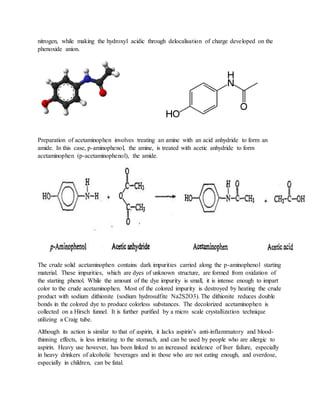
Preparation of acetaminophen involves treating an amine with an acid anhydride to form an
amide. In this case, p-aminophenol, the amine, is treated with acetic anhydride to form
acetaminophen (p-acetaminophenol), the amide.
The crude solid acetaminophen contains dark impurities carried along the p-aminophenol starting
material. These impurities, which are dyes of unknown structure, are formed from oxidation of
the starting phenol. While the amount of the dye impurity is small, it is intense enough to impart
color to the crude acetaminophen. Most of the colored impurity is destroyed by heating the crude
product with sodium dithionite (sodium hydrosulfite Na2S2O3). The dithionite reduces double
bonds in the colored dye to produce colorless substances. The decolorized acetaminophen is
collected on a Hirsch funnel. It is further purified by a micro scale crystallization technique
utilizing a Craig tube.
Although its action is similar to that of aspirin, it lacks aspirin’s anti-inflammatory and blood-
thinning effects, is less irritating to the stomach, and can be used by people who are allergic to
aspirin. Heavy use however, has been linked to an increased incidence of liver failure, especially
in heavy drinkers of alcoholic beverages and in those who are not eating enough, and overdose,
especially in children, can be fatal.
Paracetamol is available in a tablet, capsule, liquid suspension, suppository, intravenous, and
intramuscular form. The common adult dose is 500 mg to 1000 mg. The recommended
maximum daily dose, for adults, is 4000 mg. In recommended doses, paracetamol is generally
safe for children and infants, as well as for adults, although rare cases of acute liver injury have
been linked to amounts lower than 2500 mg per day.
Paracetamol is used for the relief of pains associated with many parts of the body. It has
analgesic properties comparable to those of aspirin, while its anti-inflammatory effects are
weaker. It is better tolerated than aspirin in patients in whom excessive gastric acid secretion or
prolongation of bleeding time may be a concern. Available without a prescription, it has in recent
years increasingly become a common household drug.
Paracetamol has relatively little anti-inflammatory activity, unlike other common analgesics such
as the NSAIDs aspirin and ibuprofen, but ibuprofen and paracetamol have similar effects in the
treatment of headache. Paracetamol can relieve pain in mild arthritis, but has no effect on the
underlying inflammation, redness, and swelling of the joint.
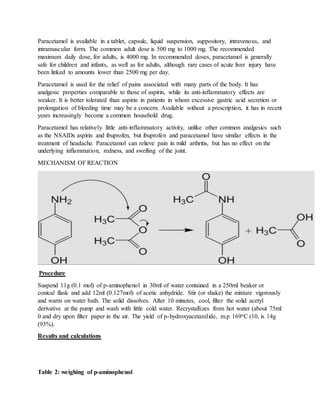
MECHANISM OF REACTION
Procedure
Suspend 11g (0.1 mol) of p-aminophenol in 30ml of water contained in a 250ml beaker or
conical flask and add 12ml (0.127mol) of acetic anhydride. Stir (or shake) the mixture vigorously
and warm on water bath. The solid dissolves. After 10 minutes, cool, filter the solid acetyl
derivative at the pump and wash with little cold water. Recrystallizes from hot water (about 75ml
0 and dry upon filter paper in the air. The yield of p-hydroxyacetanilide, m.p 169oC (10, is 14g
(93%).
Results and calculations
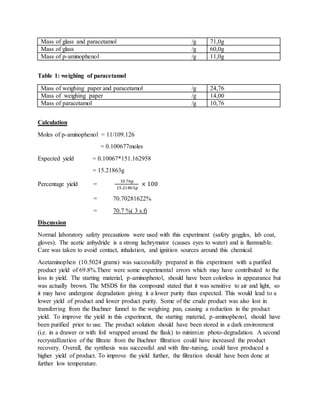
Table 2: weighing of p-aminophenol
Mass of glass and paracetamol /g 71,0g
Mass of glass /g 60,0g
Mass of p-aminophenol /g 11,0g
Table 1: weighing of paracetamol
Mass of weighing paper and paracetamol /g 24,76
Mass of weighing paper /g 14,00
Mass of paracetamol /g 10,76
Calculation
Moles of p-aminophenol = 11/109.126
= 0.100677moles
Expected yield = 0.10067*151.162958
= 15.21863g
Percentage yield =
10.76𝑔
15.21863𝑔
× 100
= 70.70281622%
= 70.7 %( 3 s.f)
Discussion
Normal laboratory safety precautions were used with this experiment (safety goggles, lab coat,
gloves). The acetic anhydride is a strong lachrymator (causes eyes to water) and is flammable.
Care was taken to avoid contact, inhalation, and ignition sources around this chemical.
Acetaminophen (10.5024 grams) was successfully prepared in this experiment with a purified
product yield of 69.8%.There were some experimental errors which may have contributed to the
loss in yield. The starting material, p-aminophenol, should have been colorless in appearance but
was actually brown. The MSDS for this compound stated that it was sensitive to air and light, so
it may have undergone degradation giving it a lower purity than expected. This would lead to a
lower yield of product and lower product purity. Some of the crude product was also lost in
transferring from the Buchner funnel to the weighing pan, causing a reduction in the product
yield. To improve the yield in this experiment, the starting material, p-aminophenol, should have
been purified prior to use. The product solution should have been stored in a dark environment
(i.e. in a drawer or with foil wrapped around the flask) to minimize photo-degradation. A second
recrystallization of the filtrate from the Buchner filtration could have increased the product
recovery. Overall, the synthesis was successful and with fine-tuning, could have produced a
higher yield of product. To improve the yield further, the filtration should have been done at
further low temperature.
Conclusion
The percentage yield was 70.7% and 10.76g of pure paracetamol was obtained.
References
1. Bruice P Y, 1999, Organic Chemistry, 4th edition, McGraw-Hill Co, U.S.A, page 108
2. Hardman J G, et al, 2001, The Pharmacological Basis of Therapeutics, 10th edition, McGraw-
Hill New York, page 260
3. Prescott L F, 2000, Paracetamol; Past Present and Future, AmJ Ther Mart, page 143-147
4. Ronald F, David A and Thompson L, 1995, Principles of Medical Chemistry, 4th edition,
Wilkins Publishers, U.S.A, page 544-545
5. Voldhardt P, and Schore N, 2011, Organic Chemistry Source and Function, 6th edition, W H
Freeman and Company, New York, page 168

Paracetamol.docx solo.docxf

  • 1.
    UNIVERSITY OF ZIMBABWE NAME: SOLOMON KAMBA REG NUMBER : R142643H PROGRAMME : HPM (II) COURSE : PCH201 (Pharmaceutical Chemistry) DUE DATE : 11/10/15 LECTURER : Mr. Mutingwendi PRACTICAL No : THREE, (3)
  • 2.
    TITLE: PREPARATION OFPARACETAMOL (ACETAMINOPHEN OR PARA-ACETYLAMINOPHENOL) AIMS  To prepare paracetamol  To purify paracetamol  To obtain pure paracetamol void of any impurities  To weigh the yield  To calculate the percentage yield Theory Acetaminophen (paracetamol) is an analgesic and fever-reducing medicine similar in effect to aspirin. It is an active ingredient in many over-the-counter medicines, including Tylenol and Midol. Introduced in the early 1900s, acetaminophen is a coal tar derivative that acts by interfering with the synthesis of prostaglandins and other substances necessary for the transmission of pain impulses. Acetaminophen works by inhibiting prostaglandins, which help to transmit pain signals and induce fever. The body produces prostaglandins in response to injury or illness. Acetaminophen stops some prostaglandin functions whilst not affecting others. Prostaglandins are known to promote inflammation and swelling of many body tissues. Unlike aspirin and ibuprofen, acetaminophen does not have anti-inflammatory action. Paracetamol consists of a benzene ring core, substituted by one hydroxyl group and the nitrogen atom of an amide group in the para (1, 4) pattern. The amide group is acetamide (ethanamide). It is an extensively conjugated system, as the lone pair on the hydroxyl oxygen, the benzene pi cloud, the nitrogen lone pair, the p orbital on the carbonyl carbon, and the lone pair on the carbonyl oxygen are all conjugated. The presence of two activating groups also make the benzene ring highly reactive toward electrophilic aromatic substitution. As the substituents are ortho, para-directing and para with respect to each other, all positions on the ring are more or less equally activated. The conjugation also greatly reduces the basicity of the oxygens and the
  • 3.
    nitrogen, while makingthe hydroxyl acidic through delocalisation of charge developed on the phenoxide anion. Preparation of acetaminophen involves treating an amine with an acid anhydride to form an amide. In this case, p-aminophenol, the amine, is treated with acetic anhydride to form acetaminophen (p-acetaminophenol), the amide. The crude solid acetaminophen contains dark impurities carried along the p-aminophenol starting material. These impurities, which are dyes of unknown structure, are formed from oxidation of the starting phenol. While the amount of the dye impurity is small, it is intense enough to impart color to the crude acetaminophen. Most of the colored impurity is destroyed by heating the crude product with sodium dithionite (sodium hydrosulfite Na2S2O3). The dithionite reduces double bonds in the colored dye to produce colorless substances. The decolorized acetaminophen is collected on a Hirsch funnel. It is further purified by a micro scale crystallization technique utilizing a Craig tube. Although its action is similar to that of aspirin, it lacks aspirin’s anti-inflammatory and blood- thinning effects, is less irritating to the stomach, and can be used by people who are allergic to aspirin. Heavy use however, has been linked to an increased incidence of liver failure, especially in heavy drinkers of alcoholic beverages and in those who are not eating enough, and overdose, especially in children, can be fatal.
  • 4.
    Paracetamol is availablein a tablet, capsule, liquid suspension, suppository, intravenous, and intramuscular form. The common adult dose is 500 mg to 1000 mg. The recommended maximum daily dose, for adults, is 4000 mg. In recommended doses, paracetamol is generally safe for children and infants, as well as for adults, although rare cases of acute liver injury have been linked to amounts lower than 2500 mg per day. Paracetamol is used for the relief of pains associated with many parts of the body. It has analgesic properties comparable to those of aspirin, while its anti-inflammatory effects are weaker. It is better tolerated than aspirin in patients in whom excessive gastric acid secretion or prolongation of bleeding time may be a concern. Available without a prescription, it has in recent years increasingly become a common household drug. Paracetamol has relatively little anti-inflammatory activity, unlike other common analgesics such as the NSAIDs aspirin and ibuprofen, but ibuprofen and paracetamol have similar effects in the treatment of headache. Paracetamol can relieve pain in mild arthritis, but has no effect on the underlying inflammation, redness, and swelling of the joint. MECHANISM OF REACTION Procedure Suspend 11g (0.1 mol) of p-aminophenol in 30ml of water contained in a 250ml beaker or conical flask and add 12ml (0.127mol) of acetic anhydride. Stir (or shake) the mixture vigorously and warm on water bath. The solid dissolves. After 10 minutes, cool, filter the solid acetyl derivative at the pump and wash with little cold water. Recrystallizes from hot water (about 75ml 0 and dry upon filter paper in the air. The yield of p-hydroxyacetanilide, m.p 169oC (10, is 14g (93%). Results and calculations Table 2: weighing of p-aminophenol
  • 5.
    Mass of glassand paracetamol /g 71,0g Mass of glass /g 60,0g Mass of p-aminophenol /g 11,0g Table 1: weighing of paracetamol Mass of weighing paper and paracetamol /g 24,76 Mass of weighing paper /g 14,00 Mass of paracetamol /g 10,76 Calculation Moles of p-aminophenol = 11/109.126 = 0.100677moles Expected yield = 0.10067*151.162958 = 15.21863g Percentage yield = 10.76𝑔 15.21863𝑔 × 100 = 70.70281622% = 70.7 %( 3 s.f) Discussion Normal laboratory safety precautions were used with this experiment (safety goggles, lab coat, gloves). The acetic anhydride is a strong lachrymator (causes eyes to water) and is flammable. Care was taken to avoid contact, inhalation, and ignition sources around this chemical. Acetaminophen (10.5024 grams) was successfully prepared in this experiment with a purified product yield of 69.8%.There were some experimental errors which may have contributed to the loss in yield. The starting material, p-aminophenol, should have been colorless in appearance but was actually brown. The MSDS for this compound stated that it was sensitive to air and light, so it may have undergone degradation giving it a lower purity than expected. This would lead to a lower yield of product and lower product purity. Some of the crude product was also lost in transferring from the Buchner funnel to the weighing pan, causing a reduction in the product yield. To improve the yield in this experiment, the starting material, p-aminophenol, should have been purified prior to use. The product solution should have been stored in a dark environment (i.e. in a drawer or with foil wrapped around the flask) to minimize photo-degradation. A second recrystallization of the filtrate from the Buchner filtration could have increased the product recovery. Overall, the synthesis was successful and with fine-tuning, could have produced a higher yield of product. To improve the yield further, the filtration should have been done at further low temperature.
  • 6.
    Conclusion The percentage yieldwas 70.7% and 10.76g of pure paracetamol was obtained. References 1. Bruice P Y, 1999, Organic Chemistry, 4th edition, McGraw-Hill Co, U.S.A, page 108 2. Hardman J G, et al, 2001, The Pharmacological Basis of Therapeutics, 10th edition, McGraw- Hill New York, page 260 3. Prescott L F, 2000, Paracetamol; Past Present and Future, AmJ Ther Mart, page 143-147 4. Ronald F, David A and Thompson L, 1995, Principles of Medical Chemistry, 4th edition, Wilkins Publishers, U.S.A, page 544-545 5. Voldhardt P, and Schore N, 2011, Organic Chemistry Source and Function, 6th edition, W H Freeman and Company, New York, page 168