INTRODUCTION
Name :- Rahul Sharma
Class :- B.Pharma 4th year
Roll no. 1820350075
College :- Rameshvaram institute of technology and management
Submitted to :- Dr. Yasmin khatoon mam
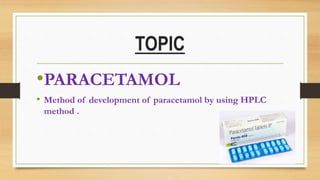
TOPIC
•PARACETAMOL
• Method of development of paracetamol by using HPLC
method .
1. What is paracetamol ?
• Paracetamol is a painkilling (analgesic) medicine available over-the-counter
without a prescription. Paracetamol can be used to: ease mild to moderate pain ‐
for example, headaches, sprains, or toothache. control a fever (high temperature,
also known as pyrexia) ‐ for example, when someone has the flu (influenza)
Dosing
• Dosing
• The recommended dosage is
• Adults: 0.5-1g 4-6hrly (max 4 g.day-1)
• Children older than one month: 20 mg.kg-1 6hrly (max 90 mg.kg-1.d-1)
• Term neonates: 20 mg.kg-1 8hrly up to a maximum of 60 mg.kg-1.d-1).
• At these doses it has an excellent safety profile, notably lacking the
gastrointestinal side effects of aspirin and most non-steroidal anti-
inflammatory agents.
Pharmacokinetics properties
• Pharmacokinetic properties
• Absorption:
• Absolute bioavailability in the fasted fasting state ranges between 62%-89%. Peak
concentrations are reached within 0.17 and 1.2 hours. The presence of food in the
stomach decreases the absorption of paracetamol by increasing tmax and
decreasing Cmax values as it delays gastric emptying.
• Distribution:
• The apparent volume of distribution of paracetamol is 0.69-1.36 L.kg-1. Plasma
protein binding is 20%-25% at therapeutic doses. After overdosage, 20% – 50% of
the drug may be protein bound. Paracetamol crosses the placenta and into breast
milk, where 85% is bound to milk proteins.
Degradation
In vitro:
Paracetamol degradation in vitro occurs through 2 pathways. It is either degraded by
oxidation to quinone-imines or by hydrolysis of the amino group generating p-
aminophenol. P-aminophenol is quickly degraded producing p-benzoquinoneimine.
Deacetylation takes places both under acid and (much faster) basic conditions [xiii] .
In vivo metabolism and elimination:
In vivo, Paracetamol is metabolised primarily in the liver into non-toxic, inactive
products via three metabolic pathways:
Glucuronidation is believed to account for 40% to two-thirds of the metabolism of
paracetamol.
Sulfation (sulfate conjugation) may account for 20-40%.
N-hydroxylation and conjugation to glutathione accounts for less than 15%. The
hepatic cytochrome P450 enzyme system (specifically CYPA2 and CYP2E1, and to a
lesser extent CYP2D6) metabolizes paracetamol. A minor yet significant alkylating
metabolite known as NAPQI (N-acetyl-p-benzo-quinoneimine) is formed. NAPQI is
then irreversibly conjugated with the sulfhydryl groups of glutathione to form
mercapturic acid conjugates and cysteine.
All three pathways yield final products that are inactive, non-toxic, and eventually
excreted by the kidneys.
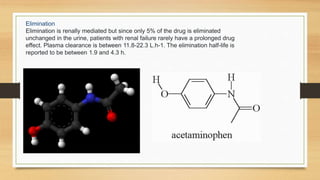
Elimination
Elimination is renally mediated but since only 5% of the drug is eliminated
unchanged in the urine, patients with renal failure rarely have a prolonged drug
effect. Plasma clearance is between 11.8-22.3 L.h-1. The elimination half-life is
reported to be between 1.9 and 4.3 h.
PHYSICAL EVALUATION TEST
• Identification test
• The Paste method of sample preparation for IR was used to identify active
pharmaceutical ingredient. Briefly, the tablets were powdered and weighed,
0.1mg of the powdered drug was taken and placed in a mortar then it was
triturated with two drops of liquid paraffin to give a homogeneous paste.
Then as stated on the USP the paste was spread, to form a thin film, in an
optical plate. The optical plate was then placed in the sample holder. The
spectrum of the sample was then recorded.
Weight variation and friability test
Twenty tablets of each sample were weighed using analytical balance. The
average weight and standard deviation were calculated for weight variation test.
In addition, twenty tablets for each sample were weighed on the analytical
balance and then placed in the friability tester which rotated at 100 rpm. Finally
the tablets were de dusted and reweighed again. The difference in weight was
taken and percent loss in weight was calculated.
Hardness test
Five tablets of each sample were subjected for hardness tester and the crushing
strength of the tablet was measured. Average hardness of the tablets was calculated
and standard deviation was determined
Disintegration test
Six tablets of each sample were placed in disintegration apparatus,
where the volume of disintegration medium was 900 ml of water
maintained at 37±1°C. The time taken to break each tablet into
small particles and pass through the mesh was recorded and
average time was calculated.
Assay:
USP, HPLC method was used for determination of the content of studied samples
Standard preparation: Standard USP Acetaminophen was dissolved in a mobile phase,
water: methanol (3:1 v/v) Assay preparation: For each sample 20 tablets were weighed
and a quantity of powder equivalent to 0.1g was transferred to 200 ml of volumetric
flask. 100 ml of mobile phase was added to the volumetric flask, the solution was then
mechanically shaked for 10 minutes. The resulting solution was diluted to volume by
mobile phase, water: methanol (3:1). Five ml of aliquot was transferred to 250 ml of
volumetric flask and diluted to volume with mobile phase. The solution was then
filtered, and assayed.
REFERENCE
• Karthikeyan M, Glen RC, Bender A (2005). "General Melting Point
Prediction Based on a Diverse Compound Data Set and Artificial
Neural Networks". Journal of Chemical Information and
Modeling. 45 (3): 581–590.
• N. G. Swarooparani, International Journal of Chemical and
Physical Sciences, 2015, 8 (4), 289-294
CONCLUSION
• Various stories are heard about this very helpful at the same time deadly drug. While some
appreciate it for its Relief of muscle and joint pain, cold and flu symptoms, common
headache, antipyretic, anti-inflammatory functions, others curse it for its ability to lead to
renal and hepatic complications in the human body. Paracetamol is one drug known and
recognized by many but its chemistry is known by a select few. This article has brought to
light the chemical properties of Paracetamol which can be used as a pre-cursor in the
production of other chemical substances. One of its chemistry that should be taught to all
is the drug interaction of this very powerful drug. In the presence of other drugs like
warfarin, it causes excessive bleeding; patients should also stay away from Alcohol when
taking this drug. Its adverse effects that results from overdozage should not be taken lightly
as it can lead to range of sicknesses from skin rashes, vomiting to even a damaged liver or
kidney, therefore the right dosage should be given to the patient and the patients should
adhere to it.

PHARMA RELATED PRESENTATION FOR M.PHARMA

  • 1.
    INTRODUCTION Name :- RahulSharma Class :- B.Pharma 4th year Roll no. 1820350075 College :- Rameshvaram institute of technology and management Submitted to :- Dr. Yasmin khatoon mam
  • 2.
    TOPIC •PARACETAMOL • Method ofdevelopment of paracetamol by using HPLC method .
  • 3.
    1. What isparacetamol ? • Paracetamol is a painkilling (analgesic) medicine available over-the-counter without a prescription. Paracetamol can be used to: ease mild to moderate pain ‐ for example, headaches, sprains, or toothache. control a fever (high temperature, also known as pyrexia) ‐ for example, when someone has the flu (influenza)
  • 4.
    Dosing • Dosing • Therecommended dosage is • Adults: 0.5-1g 4-6hrly (max 4 g.day-1) • Children older than one month: 20 mg.kg-1 6hrly (max 90 mg.kg-1.d-1) • Term neonates: 20 mg.kg-1 8hrly up to a maximum of 60 mg.kg-1.d-1). • At these doses it has an excellent safety profile, notably lacking the gastrointestinal side effects of aspirin and most non-steroidal anti- inflammatory agents.
  • 5.
    Pharmacokinetics properties • Pharmacokineticproperties • Absorption: • Absolute bioavailability in the fasted fasting state ranges between 62%-89%. Peak concentrations are reached within 0.17 and 1.2 hours. The presence of food in the stomach decreases the absorption of paracetamol by increasing tmax and decreasing Cmax values as it delays gastric emptying. • Distribution: • The apparent volume of distribution of paracetamol is 0.69-1.36 L.kg-1. Plasma protein binding is 20%-25% at therapeutic doses. After overdosage, 20% – 50% of the drug may be protein bound. Paracetamol crosses the placenta and into breast milk, where 85% is bound to milk proteins.
  • 6.
    Degradation In vitro: Paracetamol degradationin vitro occurs through 2 pathways. It is either degraded by oxidation to quinone-imines or by hydrolysis of the amino group generating p- aminophenol. P-aminophenol is quickly degraded producing p-benzoquinoneimine. Deacetylation takes places both under acid and (much faster) basic conditions [xiii] . In vivo metabolism and elimination: In vivo, Paracetamol is metabolised primarily in the liver into non-toxic, inactive products via three metabolic pathways: Glucuronidation is believed to account for 40% to two-thirds of the metabolism of paracetamol. Sulfation (sulfate conjugation) may account for 20-40%. N-hydroxylation and conjugation to glutathione accounts for less than 15%. The hepatic cytochrome P450 enzyme system (specifically CYPA2 and CYP2E1, and to a lesser extent CYP2D6) metabolizes paracetamol. A minor yet significant alkylating metabolite known as NAPQI (N-acetyl-p-benzo-quinoneimine) is formed. NAPQI is then irreversibly conjugated with the sulfhydryl groups of glutathione to form mercapturic acid conjugates and cysteine. All three pathways yield final products that are inactive, non-toxic, and eventually excreted by the kidneys.
  • 7.
    Elimination Elimination is renallymediated but since only 5% of the drug is eliminated unchanged in the urine, patients with renal failure rarely have a prolonged drug effect. Plasma clearance is between 11.8-22.3 L.h-1. The elimination half-life is reported to be between 1.9 and 4.3 h.
  • 8.
    PHYSICAL EVALUATION TEST •Identification test • The Paste method of sample preparation for IR was used to identify active pharmaceutical ingredient. Briefly, the tablets were powdered and weighed, 0.1mg of the powdered drug was taken and placed in a mortar then it was triturated with two drops of liquid paraffin to give a homogeneous paste. Then as stated on the USP the paste was spread, to form a thin film, in an optical plate. The optical plate was then placed in the sample holder. The spectrum of the sample was then recorded.
  • 9.
    Weight variation andfriability test Twenty tablets of each sample were weighed using analytical balance. The average weight and standard deviation were calculated for weight variation test. In addition, twenty tablets for each sample were weighed on the analytical balance and then placed in the friability tester which rotated at 100 rpm. Finally the tablets were de dusted and reweighed again. The difference in weight was taken and percent loss in weight was calculated. Hardness test Five tablets of each sample were subjected for hardness tester and the crushing strength of the tablet was measured. Average hardness of the tablets was calculated and standard deviation was determined Disintegration test
  • 10.
    Six tablets ofeach sample were placed in disintegration apparatus, where the volume of disintegration medium was 900 ml of water maintained at 37±1°C. The time taken to break each tablet into small particles and pass through the mesh was recorded and average time was calculated. Assay: USP, HPLC method was used for determination of the content of studied samples Standard preparation: Standard USP Acetaminophen was dissolved in a mobile phase, water: methanol (3:1 v/v) Assay preparation: For each sample 20 tablets were weighed and a quantity of powder equivalent to 0.1g was transferred to 200 ml of volumetric flask. 100 ml of mobile phase was added to the volumetric flask, the solution was then mechanically shaked for 10 minutes. The resulting solution was diluted to volume by mobile phase, water: methanol (3:1). Five ml of aliquot was transferred to 250 ml of volumetric flask and diluted to volume with mobile phase. The solution was then filtered, and assayed.
  • 11.
    REFERENCE • Karthikeyan M,Glen RC, Bender A (2005). "General Melting Point Prediction Based on a Diverse Compound Data Set and Artificial Neural Networks". Journal of Chemical Information and Modeling. 45 (3): 581–590. • N. G. Swarooparani, International Journal of Chemical and Physical Sciences, 2015, 8 (4), 289-294
  • 12.
    CONCLUSION • Various storiesare heard about this very helpful at the same time deadly drug. While some appreciate it for its Relief of muscle and joint pain, cold and flu symptoms, common headache, antipyretic, anti-inflammatory functions, others curse it for its ability to lead to renal and hepatic complications in the human body. Paracetamol is one drug known and recognized by many but its chemistry is known by a select few. This article has brought to light the chemical properties of Paracetamol which can be used as a pre-cursor in the production of other chemical substances. One of its chemistry that should be taught to all is the drug interaction of this very powerful drug. In the presence of other drugs like warfarin, it causes excessive bleeding; patients should also stay away from Alcohol when taking this drug. Its adverse effects that results from overdozage should not be taken lightly as it can lead to range of sicknesses from skin rashes, vomiting to even a damaged liver or kidney, therefore the right dosage should be given to the patient and the patients should adhere to it.