


DATA DRIVEN
Smart Manufacturing
MIS Presentation—Instructor: Sir Hussain Mughal
Contributors:
• Zahir Nabi
• Mohammad Ahsan
Abstract
• The advances in the internet technology, internet of
things, cloud computing, big data, and artificial
intelligence have profoundly impacted manufacturing.
• The volume of data collected in manufacturing is growing.
• In this paper, the role of big data in supporting smart
manufacturing is discussed: Historical perspective of data
lifecycle; Conceptual Framework; and Applications.
Introduction
• Smart manufacturing aims to convert data acquired across
the product lifecycle into manufacturing intelligence in
order to yield positive impacts on all aspects of
manufacturing.
• China—The made
• USA—Industrial internet
• Germany—Industry 4.0
• How do we do Data Driven Smart Manufacturing??
• Internet of Things (IoT)
• Cloud computing
• Mobile Internet
• Artificial Intelligence (AI)
Historical Perspective on
Manufacturing Data
• Before the advent of ENIAC, people had handicraft
production. They don’t do much of paperwork. Skills
were inherited by apprenticeship and were easily
forgotten amidst of generation hole.
• Then the data documentation and machine came in.
• All these information technologies were widely used
in manufacturing. Such as: CIM, CAD, MES, CAM, NM,
and ERP.
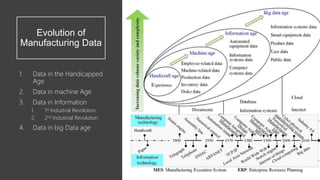
• Evolution of manufacturing data is given below:
Evolution of
Manufacturing Data
1. Data in the Handicapped
Age
2. Data in machine Age
3. Data in Information
1. 1st Industrial Revolution
2. 2nd Industrial Revolution
4. Data in big Data age
Life Cycle of Manufacturing
Data
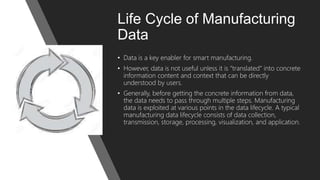
• Data is a key enabler for smart manufacturing.
• However, data is not useful unless it is “translated” into concrete
information content and context that can be directly
understood by users.
• Generally, before getting the concrete information from data,
the data needs to pass through multiple steps. Manufacturing
data is exploited at various points in the data lifecycle. A typical
manufacturing data lifecycle consists of data collection,
transmission, storage, processing, visualization, and application.
1. Data
Sources
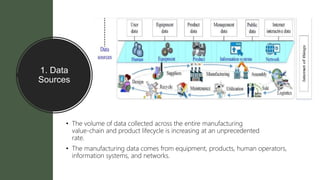
• The volume of data collected across the entire manufacturing
value-chain and product lifecycle is increasing at an unprecedented
rate.
• The manufacturing data comes from equipment, products, human operators,
information systems, and networks.
2. Data Collection
• Data from different sources is collected
in a variety of ways.
Above all, it is collected by means of the
IoT, whereby equipment
and product data can be instantly
collected through smart sensors,
RFID (radio frequency identification),
and other sensing devices,
making it possible to monitor
equipment and product health in
real time.
• Web crawling refers to the technology
of deploying “crawlers” (i.e., computer
programs) to browse public web pages
and collect desirable information. The
web crawling technology enables
manufacturers to acquire public data in
an automatic and efficient manner.
• Management data from manufacturing
information systems can
be acquired and used at any time
through database technologies.
3. Data Storage
• The large volume of collected data from
manufacturing processes must be securely stored
and effectively integrated.
• Generally speaking, the various types of
manufacturing data can be classified into
structured (e.g. digit, symbols, tables, etc.), semi-
structured (e.g., trees, graphs, XML documents,
etc.), and unstructured data (e.g., logs, audios,
videos, images, etc.).
• OBJECT BASED STORAGE—enables the collection
of the data to be stored and managed as an
object. Then there is CLOUD STORAGE—which is
highly cost effective, energy sufficient, and flexible
fashion
4. Data
Processing
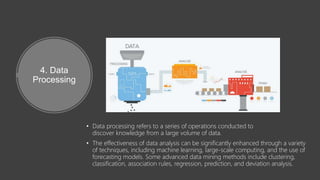
• Data processing refers to a series of operations conducted to
discover knowledge from a large volume of data.
• The effectiveness of data analysis can be significantly enhanced through a variety
of techniques, including machine learning, large-scale computing, and the use of
forecasting models. Some advanced data mining methods include clustering,
classification, association rules, regression, prediction, and deviation analysis.
5. Data Visualization
• Visualization is intended to clearly convey and
communicate information through graphical
means, enabling end users to comprehend data
in a much more explicit fashion.
• The most commonly used visualization
techniques include statement, chart, diagrams,
graphs, and virtual reality.
• Through visualization, the results of data
processing are made more accessible,
straightforward, and user-friendly.
6. Data
Transmission
• Data is continuously flowing among
different information systems, cyber-
physical systems, and human operators.
• The recent advances in IoT, Internet, and
communication networks substantially
consolidated the technological
foundation of real-time, reliable, and
secure transmission of different types of
data. As a result, distributed
manufacturing resources can be
effectively integrated almost anytime and
anywhere.
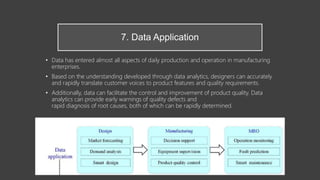
7. Data Application
• Data has entered almost all aspects of daily production and operation in manufacturing
enterprises.
• Based on the understanding developed through data analytics, designers can accurately
and rapidly translate customer voices to product features and quality requirements.
• Additionally, data can facilitate the control and improvement of product quality. Data
analytics can provide early warnings of quality defects and
rapid diagnosis of root causes, both of which can be rapidly determined.
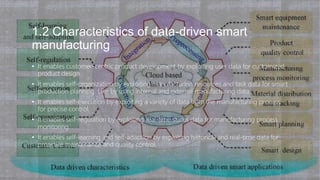
1. Connotation of
Data Driven
Smart
Manufacturing
• Manufacturing enterprises utilize big
data analytics to exploit
the data from manufacturing to refine
manufacturing process,
improving the flexibility and smart
level of manufacturing.
• Moving from primary processes to
Smart processes, in results it improves
production efficiency and
performance of product.
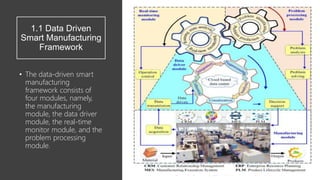
1.1 Data Driven
Smart Manufacturing
Framework
• The data-driven smart
manufacturing
framework consists of
four modules, namely,
the manufacturing
module, the data driver
module, the real-time
monitor module, and the
problem processing
module.
 Manufacturing module:
• It consists of a variety of
information systems and
manufacturing resources,
which can be summarized as
man machine-material-
environment.
• The inputs are raw materials,
whereas the outputs are
finished products. In these
process, various data is
collected from human
operators, production
equipment, information
systems, and industrial
networks.
 Data Driven Module:
• Driving force for smart
manufacturing.
• As inputs, the data from
the manufacturing
module is transmitted to
cloud-based data
centers to be further
analyzed.
• Explicit information and
actionable
recommendations
exploited from different
kinds of raw data are
used to direct the
actions (e.g., product
design, production
planning, and
manufacturing
execution) in
the manufacturing
module.
• The real-time
monitoring module
and problem-processing
module are also both
powered by the
data driver module.
 Real-time monitoring module:
• this module plays a role in
monitoring the
manufacturing process in
real time in order to
ensure product quality.
• Driven by the data driver
module, this module is
enabled to analyze the
real-time running status of
manufacturing facilities.
• As a result, manufacturers
can keep abreast of
changes in the
manufacturing process, so
as to develop the optimal
operational control
strategies.
 Problem processing module:
• this module functions to
identify and predict emerging
problems (e.g., equipment
faults or quality defects),
diagnose root causes,
recommend possible
solutions, estimate solution
effectiveness, and evaluate
potential impacts on other
manufacturing activities.
• Based on real-time
information and analysis of
historical and ongoing data
provided by the data driver
module, either human
operators or artificial
intelligence applications can
make informed decisions, not
only to address current
problems, but also to prevent
similar problems from
happening in the future.
1.2 Characteristics of data-driven smart
manufacturing
• It enables customer-centric product development by exploiting user data for customized
product design.
• It enables self-organization by exploiting manufacturing resources and task data for smart
production planning. Like by using internal and external manufacturing data.
• It enables self-execution by exploiting a variety of data from the manufacturing process
for precise control.
• It enables self-regulation by exploiting real-time status data for manufacturing process
monitoring.
• It enables self-learning and self-adaption by exploiting historical and real-time data for
proactive maintenance and quality control.
2. Data-driven-
smart
manufacturing
application
Manufacturing converts raw material inputs into
finished product outputs and value-added services
through the coordination of relevant manufacturing
facilities, resources, and activities.
Some of the most promising applications that can
be implemented during the manufacturing process
include applications to enable smart design, smart
planning, materials distribution and tracking,
manufacturing process monitoring, quality control,
and smart equipment maintenance.
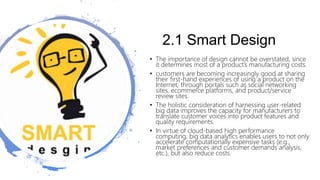
2.1 Smart Design
• The importance of design cannot be overstated, since
it determines most of a product’s manufacturing costs.
• customers are becoming increasingly good at sharing
their first-hand experiences of using a product on the
Internet, through portals such as social networking
sites, ecommerce platforms, and product/service
review sites.
• The holistic consideration of harnessing user-related
big data improves the capacity for manufacturers to
translate customer voices into product features and
quality requirements.
• In virtue of cloud-based high performance
computing, big data analytics enables users to not only
accelerate computationally expensive tasks (e.g.,
market preferences and customer demands analysis,
etc.), but also reduce costs.
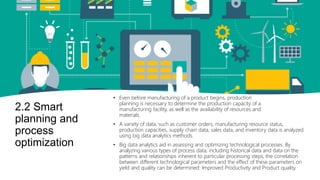
2.2 Smart
planning and
process
optimization
• Even before manufacturing of a product begins, production
planning is necessary to determine the production capacity of a
manufacturing facility, as well as the availability of resources and
materials.
• A variety of data, such as customer orders, manufacturing resource status,
production capacities, supply chain data, sales data, and inventory data is analyzed
using big data analytics methods.
• Big data analytics aid in assessing and optimizing technological processes. By
analyzing various types of process data, including historical data and data on the
patterns and relationships inherent to particular processing steps, the correlation
between different technological parameters and the effect of these parameters on
yield and quality can be determined: Improved Productivity and Product quality.
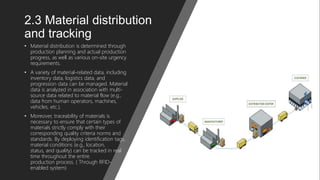
2.3 Material distribution
and tracking
• Material distribution is determined through
production planning and actual production
progress, as well as various on-site urgency
requirements.
• A variety of material-related data, including
inventory data, logistics data, and
progression data can be managed. Material
data is analyzed in association with multi-
source data related to material flow (e.g.,
data from human operators, machines,
vehicles, etc.).
• Moreover, traceability of materials is
necessary to ensure that certain types of
materials strictly comply with their
corresponding quality criteria norms and
standards. By deploying identification tags,
material conditions (e.g., location,
status, and quality) can be tracked in real
time throughout the entire
production process. ( Through RFID-
enabled system)
2.4
Manufacturing
process
monitoring
• The factors (e.g., manufacturing equipment, material,
environment, and technological parameters) can affect the
manufacturing process and influence changes in product
quality. In addition, they can also interact with each other.
• Once a factor falls outside its acceptable range, the
problem will be flagged, and alerts and recommendations
will be sent to operators to make timely adjustments; this
can ensure greater uniformity in the manufacturing
process.
• By synthetizing the factors of time and causality, an early-
warning model of production abnormities in shop-floor
can be established based on relevant big data algorithms,
for instance, decision tree (e.g., ID3 and C4.5) and neural
network.
• With higher flexibility, accuracy and less computing time,
big data analytics can deal with multi-source data and
massive data.
2.5 Product quality control
• A variety of sensors, RFIDs and machine vision
applications can be employed to collect product quality
data, such as geometric parameters (e.g., thickness,
length and surface roughness), location parameters
(e.g., coordinate), tolerance parameters (e.g.,
concentricity), machining parameter (e.g., pressure,
speed, temperature and machining time), etc.
• Bayesian inference method can be used to analyze the
data of process parameters and defective products to
identify the most influential parameters and their
appropriate range.
• In addition, in conjunction with machine learning, big
data analytics will eventually equip manufacturing
enterprises with a particular kind of case-based
reasoning capacity.
2.6 Smart equipment maintenance
• Information from component lifetime & equipment fault can be
used to enable informed maintenance decisions. In combination
with the equipment status data from smart sensors - as well as
domain knowledge, previous experience, and historical records
concerning equipment maintenance - big data analytics can predict
the tendency for equipment capacity to deteriorate, the lifespan of
components, and the cause and extent of certain faults.
• Because of the predictive capacity of big data analytics, the
equipment maintenance paradigm is transformed from passive to
proactive maintenance, thus prolonging equipment life and
minimizing maintenance costs.
• To ensure normal production, the corresponding production
processes, equipment, and energy supplies can be dynamically
adjusted to achieve optimization in real time.
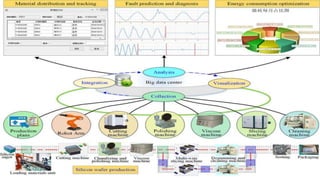
Case Study
• This case study is trying to explain some
practical aspects of the proposed
framework.
• Silicon wafer are one of the most important
components of crystalline silicon
photovoltaic cells.
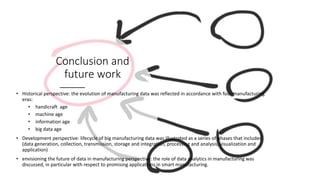
Conclusion and
future work
• Historical perspective: the evolution of manufacturing data was reflected in accordance with four manufacturing
eras:
• handicraft age
• machine age
• information age
• big data age
• Development perspective: lifecycle of big manufacturing data was illustrated as a series of phases that includes
(data generation, collection, transmission, storage and integration, processing and analysis, visualization and
application)
• envisioning the future of data in manufacturing perspective: the role of data analytics in manufacturing was
discussed, in particular with respect to promising applications in smart manufacturing.
Conclusion and
future work
(limitation)
1. the current data collection technologies are not fully ready for smart
data perception.
2. Some unresolved issues (e.g., network unavailability, overfull bandwidth,
and unacceptable latency time, etc.,)
3. previous researches mainly focused on data collected from the physical
world instead of data from virtual models.
Future work
• The key technologies for data
perception and collection from
heterogeneous equipment.
• The new technologies for data storage
and processing.
• The digital twin technologies can be
incorporated into the proposed
framework.
THANK YOU

Data driven smart manufaturing

  • 1.
    DATA DRIVEN Smart Manufacturing MISPresentation—Instructor: Sir Hussain Mughal Contributors: • Zahir Nabi • Mohammad Ahsan
  • 2.
    Abstract • The advancesin the internet technology, internet of things, cloud computing, big data, and artificial intelligence have profoundly impacted manufacturing. • The volume of data collected in manufacturing is growing. • In this paper, the role of big data in supporting smart manufacturing is discussed: Historical perspective of data lifecycle; Conceptual Framework; and Applications.
  • 3.
    Introduction • Smart manufacturingaims to convert data acquired across the product lifecycle into manufacturing intelligence in order to yield positive impacts on all aspects of manufacturing. • China—The made • USA—Industrial internet • Germany—Industry 4.0 • How do we do Data Driven Smart Manufacturing?? • Internet of Things (IoT) • Cloud computing • Mobile Internet • Artificial Intelligence (AI)
  • 4.
    Historical Perspective on ManufacturingData • Before the advent of ENIAC, people had handicraft production. They don’t do much of paperwork. Skills were inherited by apprenticeship and were easily forgotten amidst of generation hole. • Then the data documentation and machine came in. • All these information technologies were widely used in manufacturing. Such as: CIM, CAD, MES, CAM, NM, and ERP. • Evolution of manufacturing data is given below:
  • 5.
    Evolution of Manufacturing Data 1.Data in the Handicapped Age 2. Data in machine Age 3. Data in Information 1. 1st Industrial Revolution 2. 2nd Industrial Revolution 4. Data in big Data age
  • 6.
    Life Cycle ofManufacturing Data • Data is a key enabler for smart manufacturing. • However, data is not useful unless it is “translated” into concrete information content and context that can be directly understood by users. • Generally, before getting the concrete information from data, the data needs to pass through multiple steps. Manufacturing data is exploited at various points in the data lifecycle. A typical manufacturing data lifecycle consists of data collection, transmission, storage, processing, visualization, and application.
  • 7.
    1. Data Sources • Thevolume of data collected across the entire manufacturing value-chain and product lifecycle is increasing at an unprecedented rate. • The manufacturing data comes from equipment, products, human operators, information systems, and networks.
  • 8.
    2. Data Collection •Data from different sources is collected in a variety of ways. Above all, it is collected by means of the IoT, whereby equipment and product data can be instantly collected through smart sensors, RFID (radio frequency identification), and other sensing devices, making it possible to monitor equipment and product health in real time. • Web crawling refers to the technology of deploying “crawlers” (i.e., computer programs) to browse public web pages and collect desirable information. The web crawling technology enables manufacturers to acquire public data in an automatic and efficient manner. • Management data from manufacturing information systems can be acquired and used at any time through database technologies.
  • 9.
    3. Data Storage •The large volume of collected data from manufacturing processes must be securely stored and effectively integrated. • Generally speaking, the various types of manufacturing data can be classified into structured (e.g. digit, symbols, tables, etc.), semi- structured (e.g., trees, graphs, XML documents, etc.), and unstructured data (e.g., logs, audios, videos, images, etc.). • OBJECT BASED STORAGE—enables the collection of the data to be stored and managed as an object. Then there is CLOUD STORAGE—which is highly cost effective, energy sufficient, and flexible fashion
  • 10.
    4. Data Processing • Dataprocessing refers to a series of operations conducted to discover knowledge from a large volume of data. • The effectiveness of data analysis can be significantly enhanced through a variety of techniques, including machine learning, large-scale computing, and the use of forecasting models. Some advanced data mining methods include clustering, classification, association rules, regression, prediction, and deviation analysis.
  • 11.
    5. Data Visualization •Visualization is intended to clearly convey and communicate information through graphical means, enabling end users to comprehend data in a much more explicit fashion. • The most commonly used visualization techniques include statement, chart, diagrams, graphs, and virtual reality. • Through visualization, the results of data processing are made more accessible, straightforward, and user-friendly.
  • 12.
    6. Data Transmission • Datais continuously flowing among different information systems, cyber- physical systems, and human operators. • The recent advances in IoT, Internet, and communication networks substantially consolidated the technological foundation of real-time, reliable, and secure transmission of different types of data. As a result, distributed manufacturing resources can be effectively integrated almost anytime and anywhere.
  • 13.
    7. Data Application •Data has entered almost all aspects of daily production and operation in manufacturing enterprises. • Based on the understanding developed through data analytics, designers can accurately and rapidly translate customer voices to product features and quality requirements. • Additionally, data can facilitate the control and improvement of product quality. Data analytics can provide early warnings of quality defects and rapid diagnosis of root causes, both of which can be rapidly determined.
  • 14.
    1. Connotation of DataDriven Smart Manufacturing • Manufacturing enterprises utilize big data analytics to exploit the data from manufacturing to refine manufacturing process, improving the flexibility and smart level of manufacturing. • Moving from primary processes to Smart processes, in results it improves production efficiency and performance of product.
  • 15.
    1.1 Data Driven SmartManufacturing Framework • The data-driven smart manufacturing framework consists of four modules, namely, the manufacturing module, the data driver module, the real-time monitor module, and the problem processing module.
  • 16.
     Manufacturing module: •It consists of a variety of information systems and manufacturing resources, which can be summarized as man machine-material- environment. • The inputs are raw materials, whereas the outputs are finished products. In these process, various data is collected from human operators, production equipment, information systems, and industrial networks.  Data Driven Module: • Driving force for smart manufacturing. • As inputs, the data from the manufacturing module is transmitted to cloud-based data centers to be further analyzed. • Explicit information and actionable recommendations exploited from different kinds of raw data are used to direct the actions (e.g., product design, production planning, and manufacturing execution) in the manufacturing module. • The real-time monitoring module and problem-processing module are also both powered by the data driver module.
  • 17.
     Real-time monitoringmodule: • this module plays a role in monitoring the manufacturing process in real time in order to ensure product quality. • Driven by the data driver module, this module is enabled to analyze the real-time running status of manufacturing facilities. • As a result, manufacturers can keep abreast of changes in the manufacturing process, so as to develop the optimal operational control strategies.  Problem processing module: • this module functions to identify and predict emerging problems (e.g., equipment faults or quality defects), diagnose root causes, recommend possible solutions, estimate solution effectiveness, and evaluate potential impacts on other manufacturing activities. • Based on real-time information and analysis of historical and ongoing data provided by the data driver module, either human operators or artificial intelligence applications can make informed decisions, not only to address current problems, but also to prevent similar problems from happening in the future.
  • 18.
    1.2 Characteristics ofdata-driven smart manufacturing • It enables customer-centric product development by exploiting user data for customized product design. • It enables self-organization by exploiting manufacturing resources and task data for smart production planning. Like by using internal and external manufacturing data. • It enables self-execution by exploiting a variety of data from the manufacturing process for precise control. • It enables self-regulation by exploiting real-time status data for manufacturing process monitoring. • It enables self-learning and self-adaption by exploiting historical and real-time data for proactive maintenance and quality control.
  • 19.
    2. Data-driven- smart manufacturing application Manufacturing convertsraw material inputs into finished product outputs and value-added services through the coordination of relevant manufacturing facilities, resources, and activities. Some of the most promising applications that can be implemented during the manufacturing process include applications to enable smart design, smart planning, materials distribution and tracking, manufacturing process monitoring, quality control, and smart equipment maintenance.
  • 20.
    2.1 Smart Design •The importance of design cannot be overstated, since it determines most of a product’s manufacturing costs. • customers are becoming increasingly good at sharing their first-hand experiences of using a product on the Internet, through portals such as social networking sites, ecommerce platforms, and product/service review sites. • The holistic consideration of harnessing user-related big data improves the capacity for manufacturers to translate customer voices into product features and quality requirements. • In virtue of cloud-based high performance computing, big data analytics enables users to not only accelerate computationally expensive tasks (e.g., market preferences and customer demands analysis, etc.), but also reduce costs.
  • 21.
    2.2 Smart planning and process optimization •Even before manufacturing of a product begins, production planning is necessary to determine the production capacity of a manufacturing facility, as well as the availability of resources and materials. • A variety of data, such as customer orders, manufacturing resource status, production capacities, supply chain data, sales data, and inventory data is analyzed using big data analytics methods. • Big data analytics aid in assessing and optimizing technological processes. By analyzing various types of process data, including historical data and data on the patterns and relationships inherent to particular processing steps, the correlation between different technological parameters and the effect of these parameters on yield and quality can be determined: Improved Productivity and Product quality.
  • 22.
    2.3 Material distribution andtracking • Material distribution is determined through production planning and actual production progress, as well as various on-site urgency requirements. • A variety of material-related data, including inventory data, logistics data, and progression data can be managed. Material data is analyzed in association with multi- source data related to material flow (e.g., data from human operators, machines, vehicles, etc.). • Moreover, traceability of materials is necessary to ensure that certain types of materials strictly comply with their corresponding quality criteria norms and standards. By deploying identification tags, material conditions (e.g., location, status, and quality) can be tracked in real time throughout the entire production process. ( Through RFID- enabled system)
  • 23.
    2.4 Manufacturing process monitoring • The factors(e.g., manufacturing equipment, material, environment, and technological parameters) can affect the manufacturing process and influence changes in product quality. In addition, they can also interact with each other. • Once a factor falls outside its acceptable range, the problem will be flagged, and alerts and recommendations will be sent to operators to make timely adjustments; this can ensure greater uniformity in the manufacturing process. • By synthetizing the factors of time and causality, an early- warning model of production abnormities in shop-floor can be established based on relevant big data algorithms, for instance, decision tree (e.g., ID3 and C4.5) and neural network. • With higher flexibility, accuracy and less computing time, big data analytics can deal with multi-source data and massive data.
  • 24.
    2.5 Product qualitycontrol • A variety of sensors, RFIDs and machine vision applications can be employed to collect product quality data, such as geometric parameters (e.g., thickness, length and surface roughness), location parameters (e.g., coordinate), tolerance parameters (e.g., concentricity), machining parameter (e.g., pressure, speed, temperature and machining time), etc. • Bayesian inference method can be used to analyze the data of process parameters and defective products to identify the most influential parameters and their appropriate range. • In addition, in conjunction with machine learning, big data analytics will eventually equip manufacturing enterprises with a particular kind of case-based reasoning capacity.
  • 25.
    2.6 Smart equipmentmaintenance • Information from component lifetime & equipment fault can be used to enable informed maintenance decisions. In combination with the equipment status data from smart sensors - as well as domain knowledge, previous experience, and historical records concerning equipment maintenance - big data analytics can predict the tendency for equipment capacity to deteriorate, the lifespan of components, and the cause and extent of certain faults. • Because of the predictive capacity of big data analytics, the equipment maintenance paradigm is transformed from passive to proactive maintenance, thus prolonging equipment life and minimizing maintenance costs. • To ensure normal production, the corresponding production processes, equipment, and energy supplies can be dynamically adjusted to achieve optimization in real time.
  • 26.
    Case Study • Thiscase study is trying to explain some practical aspects of the proposed framework. • Silicon wafer are one of the most important components of crystalline silicon photovoltaic cells.
  • 28.
    Conclusion and future work •Historical perspective: the evolution of manufacturing data was reflected in accordance with four manufacturing eras: • handicraft age • machine age • information age • big data age • Development perspective: lifecycle of big manufacturing data was illustrated as a series of phases that includes (data generation, collection, transmission, storage and integration, processing and analysis, visualization and application) • envisioning the future of data in manufacturing perspective: the role of data analytics in manufacturing was discussed, in particular with respect to promising applications in smart manufacturing.
  • 29.
    Conclusion and future work (limitation) 1.the current data collection technologies are not fully ready for smart data perception. 2. Some unresolved issues (e.g., network unavailability, overfull bandwidth, and unacceptable latency time, etc.,) 3. previous researches mainly focused on data collected from the physical world instead of data from virtual models.
  • 30.
    Future work • Thekey technologies for data perception and collection from heterogeneous equipment. • The new technologies for data storage and processing. • The digital twin technologies can be incorporated into the proposed framework.
  • 31.