 NAME:- SEJAL R PARMAR
 SEM:- 2
 ENROLMENT NO:- 2069108420190033
 YEAR:- 2018-2020
 EMAIL:- sejalparmar095@gmail.com
 TOPIC:- WHAT IS DISCOURSE
 SUBMITTED TO:- DEPARTMENT OF
ENGLISH, MKBU
 Comes from the Latin
“discursus”, denoting
“conversation, speech”
 Written or spoken
communication
 In linguistics, a unit of
language longer than a
single sentence
 Broadly speaking, use of
spoken /written language in
a social context
 ‘conversation or speech’
While it used to be generally held that mere
exposure is language is sufficient to set the
child's language generating machinery in
motion, it is now clear that , in order for
successful first language acquisition to take
place, interaction, rather than exposure is
required; children do not learn language
from overhearing the conversations of
others or from listening to the radio, and
must, acquire it in the context of being
spoken to”.
Discourse … Foucault presents
possibly the best definition of discourse…
in literature, discourse means speech or
writing, normally longer than sentences,
which deals with a certain subject formally.
 Any connected piece of speaking or writing –
Cambridge delta
 “ Novels, as well as short conversation or might
be equally rightfully named discourses”.
 Discourse: a continuous stretch (especially
spoken) language larger than a sentence, often
constituting a coherent unit such as a sermon,
argument, joke, or narrative.
1. Archaic: the
capacity of orderly
thought or procedure:
rationality
2. verbal interchange
of ideas; especially:
conversation
3. formal and orderly
and usually extended
expression of thought
on a subject.
4. connected speech or writing
5. a linguistic unit (as a conversation or a
story) larger than a sentence
6. obsolete: social familiarity
7. a mode of organizing knowledge, ideas, or
experience that is rooted in language.
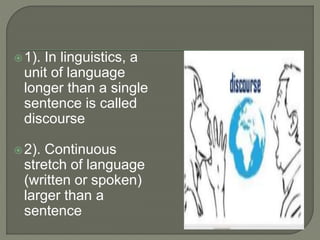
1). In linguistics, a
unit of language
longer than a single
sentence is called
discourse
2). Continuous
stretch of language
(written or spoken)
larger than a
sentence
COHESION:-
Cohesion means links and ties with in the
text
COHERENCE:-
Coherence in linguistics is what makes a
text semantically meaningful.
A discourse is a context-bound act waiting to
be of communication verbalized in a text,
and waiting to be inferred from it.
Such as a communication act is inherently
an interpersonal activity between two
parties. The addresser and the addressee.
They may share a physical context, as in
face to face conversation, or may not, as in
written discourse.
Context is not simple a matter of physical
circumstances but of the ideas, values,
beliefs, and so on inside people heads. In this
sense all communication is a meeting of
minds.
In literature the communication situation is
not so straightforward. Since literature texts
are disconnected from ordinary social
practice.
Paper 8

Paper 8

  • 1.
     NAME:- SEJALR PARMAR  SEM:- 2  ENROLMENT NO:- 2069108420190033  YEAR:- 2018-2020  EMAIL:- sejalparmar095@gmail.com  TOPIC:- WHAT IS DISCOURSE  SUBMITTED TO:- DEPARTMENT OF ENGLISH, MKBU
  • 2.
     Comes fromthe Latin “discursus”, denoting “conversation, speech”  Written or spoken communication  In linguistics, a unit of language longer than a single sentence  Broadly speaking, use of spoken /written language in a social context  ‘conversation or speech’
  • 3.
    While it usedto be generally held that mere exposure is language is sufficient to set the child's language generating machinery in motion, it is now clear that , in order for successful first language acquisition to take place, interaction, rather than exposure is required; children do not learn language from overhearing the conversations of others or from listening to the radio, and must, acquire it in the context of being spoken to”.
  • 4.
    Discourse … Foucaultpresents possibly the best definition of discourse… in literature, discourse means speech or writing, normally longer than sentences, which deals with a certain subject formally.
  • 5.
     Any connectedpiece of speaking or writing – Cambridge delta  “ Novels, as well as short conversation or might be equally rightfully named discourses”.  Discourse: a continuous stretch (especially spoken) language larger than a sentence, often constituting a coherent unit such as a sermon, argument, joke, or narrative.
  • 6.
    1. Archaic: the capacityof orderly thought or procedure: rationality 2. verbal interchange of ideas; especially: conversation 3. formal and orderly and usually extended expression of thought on a subject.
  • 7.
    4. connected speechor writing 5. a linguistic unit (as a conversation or a story) larger than a sentence 6. obsolete: social familiarity 7. a mode of organizing knowledge, ideas, or experience that is rooted in language.
  • 8.
    1). In linguistics,a unit of language longer than a single sentence is called discourse 2). Continuous stretch of language (written or spoken) larger than a sentence
  • 9.
    COHESION:- Cohesion means linksand ties with in the text COHERENCE:- Coherence in linguistics is what makes a text semantically meaningful.
  • 10.
    A discourse isa context-bound act waiting to be of communication verbalized in a text, and waiting to be inferred from it. Such as a communication act is inherently an interpersonal activity between two parties. The addresser and the addressee. They may share a physical context, as in face to face conversation, or may not, as in written discourse.
  • 11.
    Context is notsimple a matter of physical circumstances but of the ideas, values, beliefs, and so on inside people heads. In this sense all communication is a meeting of minds. In literature the communication situation is not so straightforward. Since literature texts are disconnected from ordinary social practice.