Interventions to address deaths from childhood
      Pneumonia and Diarrhoea equitably:

                       what works and at what cost?

Zulfiqar A Bhutta, Jai K Das, Neff Walker, Arjumand Rizvi, Harry Campbell, Igor Rudan, Robert E
           Black, for The Lancet Diarrhoea and Pneumonia Interventions Study Group


                                        April 12, 2013

                                    Lancet Launch London
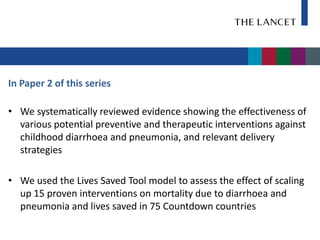
In Paper 2 of this series

• We systematically reviewed evidence showing the effectiveness of
  various potential preventive and therapeutic interventions against
  childhood diarrhoea and pneumonia, and relevant delivery
  strategies

• We used the Lives Saved Tool model to assess the effect of scaling
  up 15 proven interventions on mortality due to diarrhoea and
  pneumonia and lives saved in 75 Countdown countries
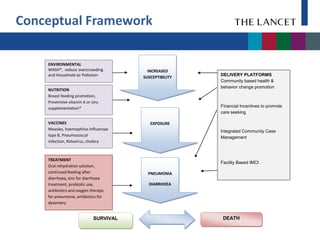
Conceptual Framework

    ENVIRONMENTAL
    WASH*, reduce overcrowding            INCREASED
    and Household air Pollution                          DELIVERY PLATFORMS
                                        SUSCEPTIBILITY
                                                         Community based health &
                                                         behavior change promotion
    NUTRITION
    Breast feeding promotion,
    Preventive vitamin A or zinc
    supplementation*                                     Financial Incentives to promote
                                                         care seeking

    VACCINES                               EXPOSURE
    Measles, haemophilus Influenzae                      Integrated Community Case
    type B, Pneumococcal                                 Management
    infection, Rotavirus, cholera


    TREATMENT
                                                         Facility Based IMCI
    Oral rehydration solution,
    continued feeding after               PNEUMONIA
    diarrhoea, zinc for diarrhoea
    treatment, probiotic use,             DIARRHOEA
    antibiotics and oxygen therapy
    for pneumonia, antibiotics for
    dysentery


                             SURVIVAL                     DEATH
Methods


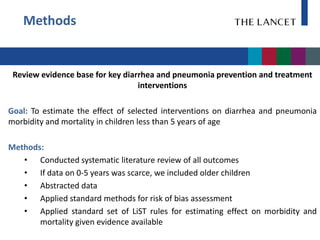
 Review evidence base for key diarrhea and pneumonia prevention and treatment
                                  interventions

Goal: To estimate the effect of selected interventions on diarrhea and pneumonia
morbidity and mortality in children less than 5 years of age

Methods:
   • Conducted systematic literature review of all outcomes
   • If data on 0-5 years was scarce, we included older children
   • Abstracted data
   • Applied standard methods for risk of bias assessment
   • Applied standard set of LiST rules for estimating effect on morbidity and
       mortality given evidence available
Interventions common to Diarrhoea and Pneumonia
BREASTFEEDING AND THE RISK FOR MORBIDITY AND MORTALITY

Not breast feeding was associated with

• 165% (RR 2·65, 95% CI 1·72–4·07) increase in diarrhoea (0–5
  months)
• 32% (1·32, 95% CI 1·06–1·63) increase in diarrhoea (6–11 months)
• 32% (1·32, 95% CI 1·06–1·63) increase in diarrhoea (12-23 months)

• 47% (1·47, 95% CI 0·67–3·25) increase in diarrhoea mortality (6–11
  months)
• 157% (2·57, 95% CI 1·10–6·01) increase in 12–23 months
BREASTFEEDING EDUCATION AND EFFECTS ON BREASTFEEDING RATES


 Increased EBF      Decreased no           • Predominant
 • 43% at 1 day     breastfeeding            and partial
 • 30% at 0–1       • 32% at 1 day,          breastfeeding
    months          • 30% at 0–1 month       were not
 • 90% at 1–6       • 18% for 1–6 months     significant
    months                                 • After 6 months
                                             increase rates of
                                             partial
                                             breastfeeding
                                             by 19%
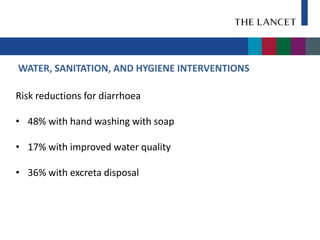
WATER, SANITATION, AND HYGIENE INTERVENTIONS

Risk reductions for diarrhoea

• 48% with hand washing with soap

• 17% with improved water quality

• 36% with excreta disposal
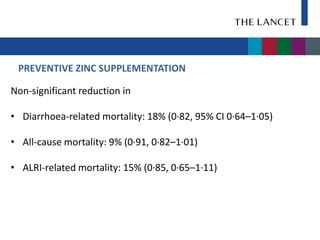
PREVENTIVE ZINC SUPPLEMENTATION

Non-significant reduction in

• Diarrhoea-related mortality: 18% (0·82, 95% CI 0·64–1·05)

• All-cause mortality: 9% (0·91, 0·82–1·01)

• ALRI-related mortality: 15% (0·85, 0·65–1·11)
Diarrhoea specific interventions
Preventive
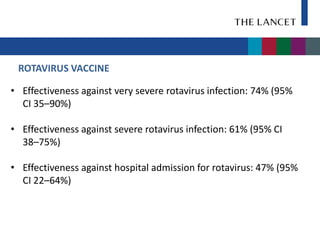
ROTAVIRUS VACCINE

• Effectiveness against very severe rotavirus infection: 74% (95%
  CI 35–90%)

• Effectiveness against severe rotavirus infection: 61% (95% CI
  38–75%)

• Effectiveness against hospital admission for rotavirus: 47% (95%
  CI 22–64%)
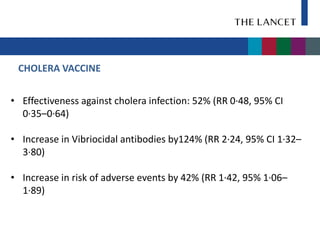
CHOLERA VACCINE


• Effectiveness against cholera infection: 52% (RR 0·48, 95% CI
  0·35–0·64)

• Increase in Vibriocidal antibodies by124% (RR 2·24, 95% CI 1·32–
  3·80)

• Increase in risk of adverse events by 42% (RR 1·42, 95% 1·06–
  1·89)
Diarrhoea specific interventions
Therapeutic
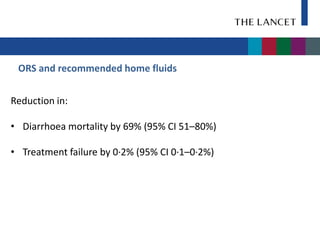
ORS and recommended home fluids


Reduction in:

• Diarrhoea mortality by 69% (95% CI 51–80%)

• Treatment failure by 0·2% (95% CI 0·1–0·2%)
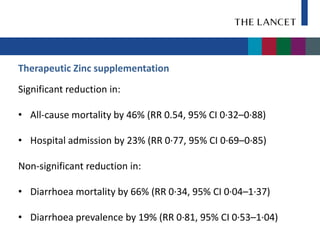
Therapeutic Zinc supplementation
Significant reduction in:

• All-cause mortality by 46% (RR 0.54, 95% CI 0·32–0·88)

• Hospital admission by 23% (RR 0·77, 95% CI 0·69–0·85)

Non-significant reduction in:

• Diarrhoea mortality by 66% (RR 0·34, 95% CI 0·04–1·37)

• Diarrhoea prevalence by 19% (RR 0·81, 95% CI 0·53–1·04)
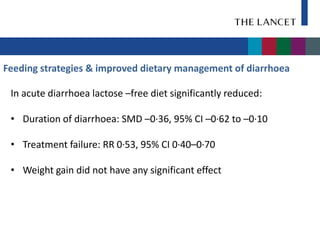
Feeding strategies & improved dietary management of diarrhoea

 In acute diarrhoea lactose –free diet significantly reduced:

 • Duration of diarrhoea: SMD –0·36, 95% CI –0·62 to –0·10

 • Treatment failure: RR 0·53, 95% CI 0·40–0·70

 • Weight gain did not have any significant effect
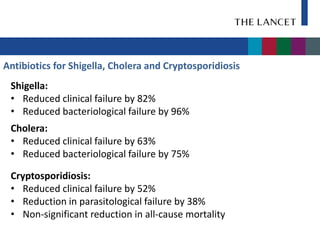
Antibiotics for Shigella, Cholera and Cryptosporidiosis
 Shigella:
 • Reduced clinical failure by 82%
 • Reduced bacteriological failure by 96%
 Cholera:
 • Reduced clinical failure by 63%
 • Reduced bacteriological failure by 75%

 Cryptosporidiosis:
 • Reduced clinical failure by 52%
 • Reduction in parasitological failure by 38%
 • Non-significant reduction in all-cause mortality
Pneumonia specific interventions
Preventive
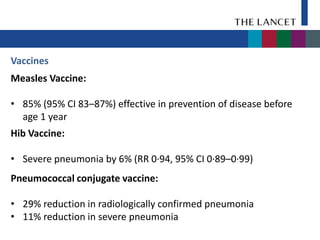
Vaccines
Measles Vaccine:

• 85% (95% CI 83–87%) effective in prevention of disease before
  age 1 year
Hib Vaccine:

• Severe pneumonia by 6% (RR 0·94, 95% CI 0·89–0·99)
Pneumococcal conjugate vaccine:

• 29% reduction in radiologically confirmed pneumonia
• 11% reduction in severe pneumonia
Pneumonia specific interventions
Therapeutic
Antibiotics for the treatment of neonatal pneumonia

Oral or injectable antibiotics reduced:

• All-cause neonatal mortality by 25% (RR 0·75, 95% CI 0·64–0·89)

• Neonatal pneumonia mortality by 42% (0·58, 95% CI 0·41–0·82)
Oxygen systems


• Pulse oximetry together with oxygen therapy reduced severe

• pneumonia mortality by 35% (RR 0·65, 95% CI 0·52–0·78)
Delivery Platforms


Community-based promotion and case management:
• 160% significant increase in use of oral rehydration solution
• 80% increase in use of zinc in diarrhoea
• 13% increase in care-seeking for pneumonia
• 9% increase in care-seeking for diarrhoea.
• 75% significant decline in inappropriate use of antibiotics for
  diarrhoea
• 40% reduction in rates of treatment failure for pneumonia.

Reduction of financial barriers
• Promote increased coverage of child health interventions
• Pronounced effects achieved by those that directly removed user
  fees for access to health services.
LiST modeling effects on mortality outcomes
       for 75 Countdown countries
Historic Trends Scale up- 54% of diarrhoea and 51% of
pneumonia deaths in children younger than 5 years
can be averted

Ambitious Scale up- Eliminate almost all diarrhoea
deaths, but only two-thirds of pneumonia deaths
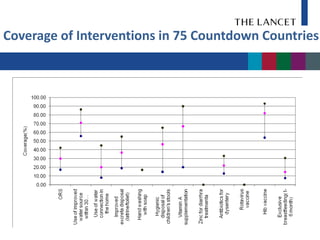
Coverage of Interventions in 75 Countdown Countries
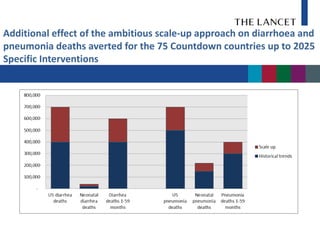
Additional effect of the ambitious scale-up approach on diarrhoea and
pneumonia deaths averted for the 75 Countdown countries up to 2025
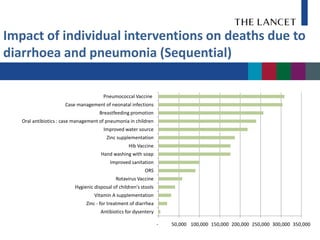
Specific Interventions
Impact of individual interventions on deaths due to
diarrhoea and pneumonia (Sequential)

                                       Pneumococcal Vaccine
                      Case management of neonatal infections
                                     Breastfeeding promotion
   Oral antibiotics : case management of pneumonia in children
                                       Improved water source
                                         Zinc supplementation
                                                   Hib Vaccine
                                      Hand washing with soap
                                          Improved sanitation
                                                           ORS
                                             Rotavirus Vaccine
                          Hygienic disposal of children's stools
                                   Vitamin A supplementation
                               Zinc - for treatment of diarrhea
                                      Antibiotics for dysentery

                                                                   -   50,000 100,000 150,000 200,000 250,000 300,000 350,000
Equity Analysis
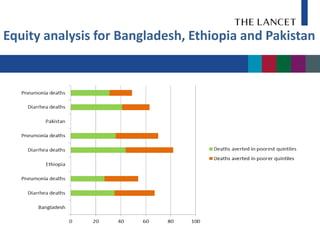
Equity analysis for Bangladesh, Ethiopia and Pakistan
Cost Analysis
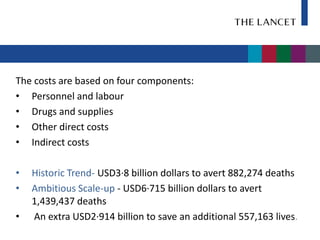
The costs are based on four components:
• Personnel and labour
• Drugs and supplies
• Other direct costs
• Indirect costs

•   Historic Trend- USD3·8 billion dollars to avert 882,274 deaths
•   Ambitious Scale-up - USD6·715 billion dollars to avert
    1,439,437 deaths
•   An extra USD2·914 billion to save an additional 557,163 lives.
Discussion


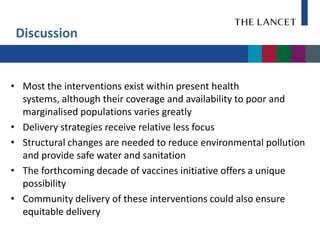
• Most the interventions exist within present health
  systems, although their coverage and availability to poor and
  marginalised populations varies greatly
• Delivery strategies receive relative less focus
• Structural changes are needed to reduce environmental pollution
  and provide safe water and sanitation
• The forthcoming decade of vaccines initiative offers a unique
  possibility
• Community delivery of these interventions could also ensure
  equitable delivery
Key messages

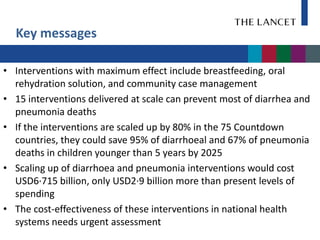
• Interventions with maximum effect include breastfeeding, oral
  rehydration solution, and community case management
• 15 interventions delivered at scale can prevent most of diarrhea and
  pneumonia deaths
• If the interventions are scaled up by 80% in the 75 Countdown
  countries, they could save 95% of diarrhoeal and 67% of pneumonia
  deaths in children younger than 5 years by 2025
• Scaling up of diarrhoea and pneumonia interventions would cost
  USD6·715 billion, only USD2·9 billion more than present levels of
  spending
• The cost-effectiveness of these interventions in national health
  systems needs urgent assessment
THANKS

Interventions to address deaths from childhood Pneumonia and Diarrhoea equitably: What works and at what cost? - Prof. Zulfiqar A Bhutta

  • 1.
    Interventions to addressdeaths from childhood Pneumonia and Diarrhoea equitably: what works and at what cost? Zulfiqar A Bhutta, Jai K Das, Neff Walker, Arjumand Rizvi, Harry Campbell, Igor Rudan, Robert E Black, for The Lancet Diarrhoea and Pneumonia Interventions Study Group April 12, 2013 Lancet Launch London
  • 2.
    In Paper 2of this series • We systematically reviewed evidence showing the effectiveness of various potential preventive and therapeutic interventions against childhood diarrhoea and pneumonia, and relevant delivery strategies • We used the Lives Saved Tool model to assess the effect of scaling up 15 proven interventions on mortality due to diarrhoea and pneumonia and lives saved in 75 Countdown countries
  • 3.
    Conceptual Framework ENVIRONMENTAL WASH*, reduce overcrowding INCREASED and Household air Pollution DELIVERY PLATFORMS SUSCEPTIBILITY Community based health & behavior change promotion NUTRITION Breast feeding promotion, Preventive vitamin A or zinc supplementation* Financial Incentives to promote care seeking VACCINES EXPOSURE Measles, haemophilus Influenzae Integrated Community Case type B, Pneumococcal Management infection, Rotavirus, cholera TREATMENT Facility Based IMCI Oral rehydration solution, continued feeding after PNEUMONIA diarrhoea, zinc for diarrhoea treatment, probiotic use, DIARRHOEA antibiotics and oxygen therapy for pneumonia, antibiotics for dysentery SURVIVAL DEATH
  • 4.
    Methods Review evidencebase for key diarrhea and pneumonia prevention and treatment interventions Goal: To estimate the effect of selected interventions on diarrhea and pneumonia morbidity and mortality in children less than 5 years of age Methods: • Conducted systematic literature review of all outcomes • If data on 0-5 years was scarce, we included older children • Abstracted data • Applied standard methods for risk of bias assessment • Applied standard set of LiST rules for estimating effect on morbidity and mortality given evidence available
  • 5.
    Interventions common toDiarrhoea and Pneumonia
  • 6.
    BREASTFEEDING AND THERISK FOR MORBIDITY AND MORTALITY Not breast feeding was associated with • 165% (RR 2·65, 95% CI 1·72–4·07) increase in diarrhoea (0–5 months) • 32% (1·32, 95% CI 1·06–1·63) increase in diarrhoea (6–11 months) • 32% (1·32, 95% CI 1·06–1·63) increase in diarrhoea (12-23 months) • 47% (1·47, 95% CI 0·67–3·25) increase in diarrhoea mortality (6–11 months) • 157% (2·57, 95% CI 1·10–6·01) increase in 12–23 months
  • 7.
    BREASTFEEDING EDUCATION ANDEFFECTS ON BREASTFEEDING RATES Increased EBF Decreased no • Predominant • 43% at 1 day breastfeeding and partial • 30% at 0–1 • 32% at 1 day, breastfeeding months • 30% at 0–1 month were not • 90% at 1–6 • 18% for 1–6 months significant months • After 6 months increase rates of partial breastfeeding by 19%
  • 8.
    WATER, SANITATION, ANDHYGIENE INTERVENTIONS Risk reductions for diarrhoea • 48% with hand washing with soap • 17% with improved water quality • 36% with excreta disposal
  • 9.
    PREVENTIVE ZINC SUPPLEMENTATION Non-significantreduction in • Diarrhoea-related mortality: 18% (0·82, 95% CI 0·64–1·05) • All-cause mortality: 9% (0·91, 0·82–1·01) • ALRI-related mortality: 15% (0·85, 0·65–1·11)
  • 10.
  • 11.
    ROTAVIRUS VACCINE • Effectivenessagainst very severe rotavirus infection: 74% (95% CI 35–90%) • Effectiveness against severe rotavirus infection: 61% (95% CI 38–75%) • Effectiveness against hospital admission for rotavirus: 47% (95% CI 22–64%)
  • 12.
    CHOLERA VACCINE • Effectivenessagainst cholera infection: 52% (RR 0·48, 95% CI 0·35–0·64) • Increase in Vibriocidal antibodies by124% (RR 2·24, 95% CI 1·32– 3·80) • Increase in risk of adverse events by 42% (RR 1·42, 95% 1·06– 1·89)
  • 13.
  • 14.
    ORS and recommendedhome fluids Reduction in: • Diarrhoea mortality by 69% (95% CI 51–80%) • Treatment failure by 0·2% (95% CI 0·1–0·2%)
  • 15.
    Therapeutic Zinc supplementation Significantreduction in: • All-cause mortality by 46% (RR 0.54, 95% CI 0·32–0·88) • Hospital admission by 23% (RR 0·77, 95% CI 0·69–0·85) Non-significant reduction in: • Diarrhoea mortality by 66% (RR 0·34, 95% CI 0·04–1·37) • Diarrhoea prevalence by 19% (RR 0·81, 95% CI 0·53–1·04)
  • 16.
    Feeding strategies &improved dietary management of diarrhoea In acute diarrhoea lactose –free diet significantly reduced: • Duration of diarrhoea: SMD –0·36, 95% CI –0·62 to –0·10 • Treatment failure: RR 0·53, 95% CI 0·40–0·70 • Weight gain did not have any significant effect
  • 17.
    Antibiotics for Shigella,Cholera and Cryptosporidiosis Shigella: • Reduced clinical failure by 82% • Reduced bacteriological failure by 96% Cholera: • Reduced clinical failure by 63% • Reduced bacteriological failure by 75% Cryptosporidiosis: • Reduced clinical failure by 52% • Reduction in parasitological failure by 38% • Non-significant reduction in all-cause mortality
  • 18.
  • 19.
    Vaccines Measles Vaccine: • 85%(95% CI 83–87%) effective in prevention of disease before age 1 year Hib Vaccine: • Severe pneumonia by 6% (RR 0·94, 95% CI 0·89–0·99) Pneumococcal conjugate vaccine: • 29% reduction in radiologically confirmed pneumonia • 11% reduction in severe pneumonia
  • 20.
  • 21.
    Antibiotics for thetreatment of neonatal pneumonia Oral or injectable antibiotics reduced: • All-cause neonatal mortality by 25% (RR 0·75, 95% CI 0·64–0·89) • Neonatal pneumonia mortality by 42% (0·58, 95% CI 0·41–0·82)
  • 22.
    Oxygen systems • Pulseoximetry together with oxygen therapy reduced severe • pneumonia mortality by 35% (RR 0·65, 95% CI 0·52–0·78)
  • 23.
    Delivery Platforms Community-based promotionand case management: • 160% significant increase in use of oral rehydration solution • 80% increase in use of zinc in diarrhoea • 13% increase in care-seeking for pneumonia • 9% increase in care-seeking for diarrhoea. • 75% significant decline in inappropriate use of antibiotics for diarrhoea • 40% reduction in rates of treatment failure for pneumonia. Reduction of financial barriers • Promote increased coverage of child health interventions • Pronounced effects achieved by those that directly removed user fees for access to health services.
  • 24.
    LiST modeling effectson mortality outcomes for 75 Countdown countries
  • 25.
    Historic Trends Scaleup- 54% of diarrhoea and 51% of pneumonia deaths in children younger than 5 years can be averted Ambitious Scale up- Eliminate almost all diarrhoea deaths, but only two-thirds of pneumonia deaths
  • 26.
    Coverage of Interventionsin 75 Countdown Countries
  • 27.
    Additional effect ofthe ambitious scale-up approach on diarrhoea and pneumonia deaths averted for the 75 Countdown countries up to 2025 Specific Interventions
  • 28.
    Impact of individualinterventions on deaths due to diarrhoea and pneumonia (Sequential) Pneumococcal Vaccine Case management of neonatal infections Breastfeeding promotion Oral antibiotics : case management of pneumonia in children Improved water source Zinc supplementation Hib Vaccine Hand washing with soap Improved sanitation ORS Rotavirus Vaccine Hygienic disposal of children's stools Vitamin A supplementation Zinc - for treatment of diarrhea Antibiotics for dysentery - 50,000 100,000 150,000 200,000 250,000 300,000 350,000
  • 29.
  • 30.
    Equity analysis forBangladesh, Ethiopia and Pakistan
  • 31.
  • 32.
    The costs arebased on four components: • Personnel and labour • Drugs and supplies • Other direct costs • Indirect costs • Historic Trend- USD3·8 billion dollars to avert 882,274 deaths • Ambitious Scale-up - USD6·715 billion dollars to avert 1,439,437 deaths • An extra USD2·914 billion to save an additional 557,163 lives.
  • 33.
    Discussion • Most theinterventions exist within present health systems, although their coverage and availability to poor and marginalised populations varies greatly • Delivery strategies receive relative less focus • Structural changes are needed to reduce environmental pollution and provide safe water and sanitation • The forthcoming decade of vaccines initiative offers a unique possibility • Community delivery of these interventions could also ensure equitable delivery
  • 34.
    Key messages • Interventionswith maximum effect include breastfeeding, oral rehydration solution, and community case management • 15 interventions delivered at scale can prevent most of diarrhea and pneumonia deaths • If the interventions are scaled up by 80% in the 75 Countdown countries, they could save 95% of diarrhoeal and 67% of pneumonia deaths in children younger than 5 years by 2025 • Scaling up of diarrhoea and pneumonia interventions would cost USD6·715 billion, only USD2·9 billion more than present levels of spending • The cost-effectiveness of these interventions in national health systems needs urgent assessment
  • 35.