The End TB Strategy
Global strategy and targets for tuberculosis
prevention, care and control after 2015a
[A67/11 – 14 March 2014](The official text approved by the Sixty seventh World Health Assembly, May 2014)
1
The End TB Strategy
Global strategy and targets for tuberculosis
prevention, care and control after 2015a
[A67/11 – 14 March 2014]
WHO’s declaration of tuberculosis as a global
public health emergency in 1993 ended a
period of prolonged global neglect. Together,
the subsequent launch of the directly observed
treatment, short course (DOTS) strategy;
inclusion of tuberculosis-related indicators
in the Millennium Development Goals;
development and implementation of the
Stop TB Strategy that underpins the Global
Plan to Stop TB 2006–2015; and adoption of
resolution WHA62.15 on the prevention and
control of multidrug-resistant tuberculosis and
extensively drug-resistant tuberculosis by the
Sixty-second World Health Assembly have all
helped to accelerate the global expansion of
tuberculosis care and control.
a	 See resolution WHA67.1.
In May 2012, Member States at the Sixty-
fifth World Health Assembly requested the
DirectorGeneral to submit a comprehensive
review of the global tuberculosis situation
to date, and to present new multisectoral
strategic approaches and new international
targets for the post-2015 period to the Sixty-
seventh World Health Assembly in May 2014,
through the Executive Board.b
The work to
prepare this has involved a wide range of
partners providing substantive input into the
development of the new strategy, including
high-level representatives of Member States,
national tuberculosis programmes, technical
and scientific institutions, financial partners
and development agencies, civil society,
nongovernmental organizations, and the
private sector.
b	 See document WHA65/2012/REC/3, summary record of the
sixth meeting of Committee B, section 3.
2
The process. WHO’s Strategic and Technical
Advisory Group for Tuberculosis approved
the broad, inclusive scope of the consultative
processforthedevelopmentofthedraftstrategy.
It began with a web-based consultation to seek
ways in which to strengthen the current strategy
and introduce any new components. During
2012, as part of the annual meetings of national
tuberculosis programmes, each regional office
organized consultations on the proposed
new strategic framework and targets with
health ministry officials, national tuberculosis
programme managers and partners. Officials of
countries with a high tuberculosis burden then
deliberated on the draft strategic framework at
a special consultation organized just before the
43rd Union World Conference (Kuala Lumpur,
13–17 November 2013). Following this, the
framework was presented and discussed on
the opening day of the Conference at the
global tuberculosis symposium, which was
attended by over 700 stakeholders. In 2013,
three special consultations including senior
officials of Member States, technical experts
and civil society were organized in order
to discuss (i)  formulation of the post-2015
tuberculosis targets; (ii) approaches to building
on the opportunities presented by expansion of
universal health coverage and social protection
to strengthen tuberculosis care and prevention;
and (iii) research and innovation for improved
tuberculosis care, control and elimination. In
June 2013, the Strategic and Technical Advisory
Group for Tuberculosis endorsed the draft,
including the global targets and their rationale.c
The framework of the post-2015 global
tuberculosis strategy is presented in Figure 1.
Figure 1. POST-2015 GLOBAL TUBERCULOSIS STRATEGY FRAMEWORK
VISION A world free of tuberculosis
– zero deaths, disease and suffering due to tuberculosis
GOAL End the global tuberculosis epidemic
MILESTONES FOR 2025 75% reduction in tuberculosis deaths (compared with 2015)
50% reduction in tuberculosis incidence rate
(less than 55 tuberculosis cases per 100 000 population)
– No affected families facing catastrophic costs due to tuberculosis
TARGETS FOR 2035 95% reduction in tuberculosis deaths (compared with 2015)
90% reduction in tuberculosis incidence rate
(less than 10 tuberculosis cases per 100 000 population)
– No affected families facing catastrophic costs due to tuberculosis
PRINCIPLES
1. Government stewardship and accountability, with monitoring and evaluation
2. Strong coalition with civil society organizations and communities
3. Protection and promotion of human rights, ethics and equity
4. Adaptation of the strategy and targets at country level, with global collaboration
PILLARS AND COMPONENTS
1. INTEGRATED, PATIENT-CENTRED CARE AND PREVENTION
A. Early diagnosis of tuberculosis including universal drug-susceptibility testing, and systematic screening of contacts
and high-risk groups
B. Treatment of all people with tuberculosis including drug-resistant tuberculosis, and patient support
C. Collaborative tuberculosis/HIV activities, and management of comorbidities
D. Preventive treatment of persons at high risk, and vaccination against tuberculosis
2. BOLD POLICIES AND SUPPORTIVE SYSTEMS
A. Political commitment with adequate resources for tuberculosis care and prevention
B. Engagement of communities, civil society organizations, and public and private care providers
C. Universal health coverage policy, and regulatory frameworks for case notification, vital registration, quality and
rational use of medicines, and infection control
D. Social protection, poverty alleviation and actions on other determinants of tuberculosis
3. INTENSIFIED RESEARCH AND INNOVATION
A. Discovery, development and rapid uptake of new tools, interventions and strategies
B. Research to optimize implementation and impact, and promote innovations
3
APPROACHES
Expandingc
care, strengthening prevention,
and intensifying research. Addressing the
above challenges will require innovative,
multisectoral, and integrated approaches. The
DOTS strategy strengthened public sector
tuberculosis programmes to help to tackle a
large burden of drugsusceptible disease. The
Stop TB Strategy,d
built on DOTS, helped to
begin addressing drugresistant tuberculosis
and HIV-associated tuberculosis while
promoting research to develop new tools. It
also helped to expand partnerships with all
care providers, civil society organizations and
communities, in the context of strengthening
health systems. Ending the tuberculosis
epidemic will require further expansion of
the scope and reach of interventions for
tuberculosis care and prevention; institution
of systems and policies to create an enabling
environment and share responsibilities; and
aggressive pursuit of research and innovation
to promote development and use of new tools
for tuberculosis care and prevention. It will also
require a provision for revisiting and adjusting
the new strategy based on progress and the
extent to which agreed milestones and targets
are being met.
Eliciting systemic support and engaging
stakeholders. In practical terms, continuing
progress beyond 2015 will require intensified
actions by and beyond tuberculosis
programmes within and outside the health
sector. The new strategy envisages concrete
actions from three levels of governance in
close collaboration with all stakeholders and
with the engagement of communities. At the
core are national tuberculosis programmes or
the equivalent structures that are responsible
for coordination of all activities related to
c	 Strategic and Technical Advisory Group for Tuberculosis:
report of 13th
meeting, 11–12 June 2013 (document WHO/
HTM/TB/2013.9).
d	 The six components of the Stop TB Strategy are: (i) pursue
high-quality DOTS expansion and enhancement;
(ii) address TB/HIV, MDR-TB and other special challenges;
(iii) contribute to health system strengthening; (iv) engage
all care providers; (v) empower people with tuberculosis,
and communities; and (vi) enable and promote research.
delivery of tuberculosis care and prevention.
Above them are the national health ministries
that provide critical systemic support, enforce
regulatory mechanisms, and coordinate
integrated approaches through interministerial
and intersectoral collaboration. Above all,
the national governments have to provide
the overall stewardship to keep tuberculosis
elimination high on the development agenda
through political commitment, investments and
oversight, while making rapid progress towards
universal health coverage and social protection.
Elevating leadership and widening ownership.
Tuberculosis care and control need to be
strengthened further and expanded to include
prevention of tuberculosis. For this purpose,
in-country leadership for tuberculosis control
ought to be elevated to higher levels within
health ministries. This is essential in order to
effect coordinated action on multiple fronts
and to accomplish three clear objectives:
(1) achieving universal access to early detection
and proper treatment of all patients with
tuberculosis; (2) putting supportive health and
social sector policies and systems in place to
enable effective delivery of tuberculosis care
and prevention; and (3) intensifying research to
develop and apply new technologies, tools and
approaches to enable eventual tuberculosis
elimination. The three pillars of the global
tuberculosis strategy are designed to address
these objectives.
4
VISION, GOAL, MILESTONES AND TARGETS
The vision for the post-2015 global tuberculosis
strategy is “a world free of tuberculosis”,
also expressed as “zero deaths, disease and
suffering due to tuberculosis”. The goal is to
end the global tuberculosis epidemic.
The Millennium Development Goal target
“to halt and begin to reverse the incidence
of tuberculosis by 2015” has already been
achieved. The related Stop TB Partnership
targets of reducing tuberculosis prevalence and
death rates by 50% relative to 1990 are on track
to be achieved by 2015. Under this strategy,
new, ambitious yet feasible global targets are
proposed for 2035. These include achieving
a 95% decline in deaths due to tuberculosis
comparedwith2015,andreachinganequivalent
90% reduction in tuberculosis incidence rate
from a projected 110 cases/100 000 in 2015 to
10 cases/100 000 or less by 2035. These targets
are equivalent to the current levels in some low-
incidence countries of North America, western
Europe and the Western Pacific. An additional
target proposed to ascertain progress of
universal health coverage and social protection
is that by 2020, no tuberculosis-affected person
or family should face catastrophic costs due to
tuberculosis care.
Milestones that will need to be reached before
2035 are also proposed for 2020, 2025, and
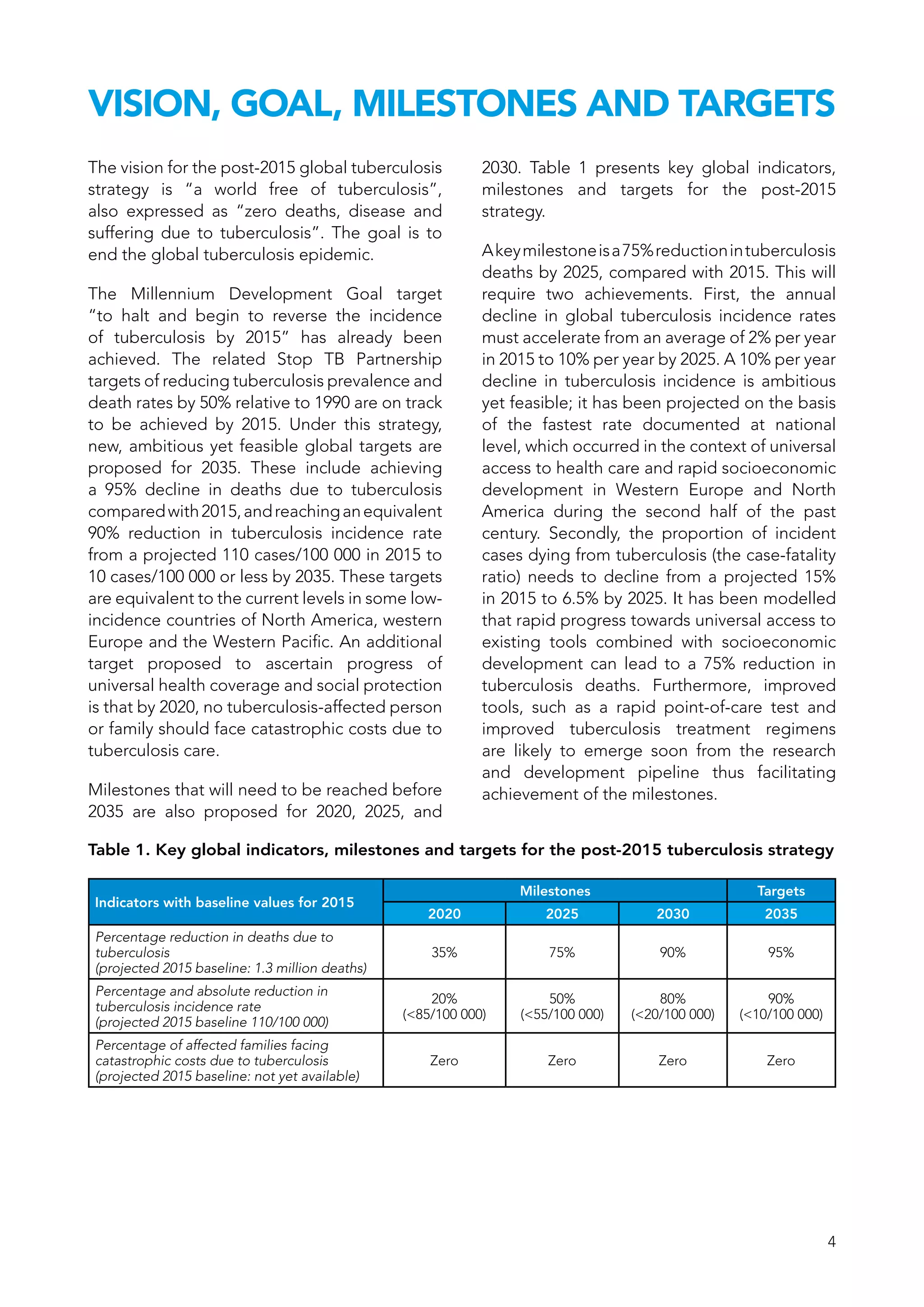
2030. Table 1 presents key global indicators,
milestones and targets for the post-2015
strategy.
Akeymilestoneisa75%reductionintuberculosis
deaths by 2025, compared with 2015. This will
require two achievements. First, the annual
decline in global tuberculosis incidence rates
must accelerate from an average of 2% per year
in 2015 to 10% per year by 2025. A 10% per year
decline in tuberculosis incidence is ambitious
yet feasible; it has been projected on the basis
of the fastest rate documented at national
level, which occurred in the context of universal
access to health care and rapid socioeconomic
development in Western Europe and North
America during the second half of the past
century. Secondly, the proportion of incident
cases dying from tuberculosis (the case-fatality
ratio) needs to decline from a projected 15%
in 2015 to 6.5% by 2025. It has been modelled
that rapid progress towards universal access to
existing tools combined with socioeconomic
development can lead to a 75% reduction in
tuberculosis deaths. Furthermore, improved
tools, such as a rapid point-of-care test and
improved tuberculosis treatment regimens
are likely to emerge soon from the research
and development pipeline thus facilitating
achievement of the milestones.
Table 1. Key global indicators, milestones and targets for the post-2015 tuberculosis strategy
Indicators with baseline values for 2015
Milestones Targets
2020 2025 2030 2035
Percentage reduction in deaths due to
tuberculosis
(projected 2015 baseline: 1.3 million deaths)
35% 75% 90% 95%
Percentage and absolute reduction in
tuberculosis incidence rate
(projected 2015 baseline 110/100 000)
20%
(<85/100 000)
50%
(<55/100 000)
80%
(<20/100 000)
90%
(<10/100 000)
Percentage of affected families facing
catastrophic costs due to tuberculosis
(projected 2015 baseline: not yet available)
Zero Zero Zero Zero
5
In order to sustain progress beyond 2025 and
achieve by 2035 a reduction in tuberculosis
deaths of 95% and a 90% reduction in the
incidence rate from 110 cases/100  000 to
less than 10 cases per 100 000, there must be
additional tools available by 2025. In particular,
a new vaccine that is effective pre- and post-
exposure, and better diagnostics, as well as
saferandeasiertreatmentforlatenttuberculosis
infection, will be needed. Achievements with
existing tools complemented by universal
health coverage and social protection would
be remarkable, but would not be sufficient to
maintaintherateofprogressrequiredtoachieve
the 2035 targets. For new tools to be available
for introduction by 2025, greatly enhanced
and immediate investments in research and
development will be required. Figure 2 shows
the projected acceleration of the decline
in global tuberculosis incidence rates with
optimization of current tools combined with
progress towards universal health coverage and
social protection from 2015, and the additional
impact of new tools by 2025.
Figure 2. Projected acceleration in the decline of global tuberculosis incidence rates to target
levels
The milestone that no families affected by
tuberculosis face catastrophic costs implies
minimizing direct medical costs, such as fees
for consultations, hospitalization, tests and
medicines as well as direct non-medical costs
suchasthosefortransportandanylossofincome
while under care. It requires that tuberculosis
patients and tuberculosis-affected households
have access to appropriate social protection
schemes that cover or compensate for direct
non-medical costs and income losses. With
sufficient political commitment, tuberculosis-
related costs could be rapidly reduced in all
countries, and therefore many countries may be
able to reach the target by 2020.
Rateper100,000/year
100
Optimize use of
current & new tools
emerging from
pipeline, pursue
universal health
coverage and social
protection
Introduce new tools:
a vaccine, new drugs &
treatment regimens, and
a point-of-care test for
treatment of active TB
disease and latent TB
infection
Current global trend: -1.5%/year
-10%/year by 2025
-17%/year
-5%/year
75
50
2015 2020 2025 2030 2035
25
10
6
THE PRINCIPLES OF THE STRATEGY
Government
stewardship and
accountability with
monitoring and
evaluation
Activities under the tuberculosis strategy
span the health and social sectors and
beyond, including finance, labour, trade and
development. Stewardship responsibilities
should be shared by all levels of the government
– local, provincial, and central. The central
government should remain the “steward of
stewards” for tuberculosis care and prevention,
working with all stakeholders.
The success of the post-2015 global tuberculosis
strategy will depend on effective execution of
key stewardship responsibilities by governments
in close collaboration with all stakeholders:
providing the vision and direction through
the national tuberculosis programme and the
health system; collecting and using data for
progressive improvements in tuberculosis care
and prevention; and exerting influence through
regulation and other means to achieve the
stated goals and objectives of the strategy.
To ensure accountability, regular monitoring
and evaluation need to be built into strategy
implementation. Progress will need to be
measured against ambitious national targets
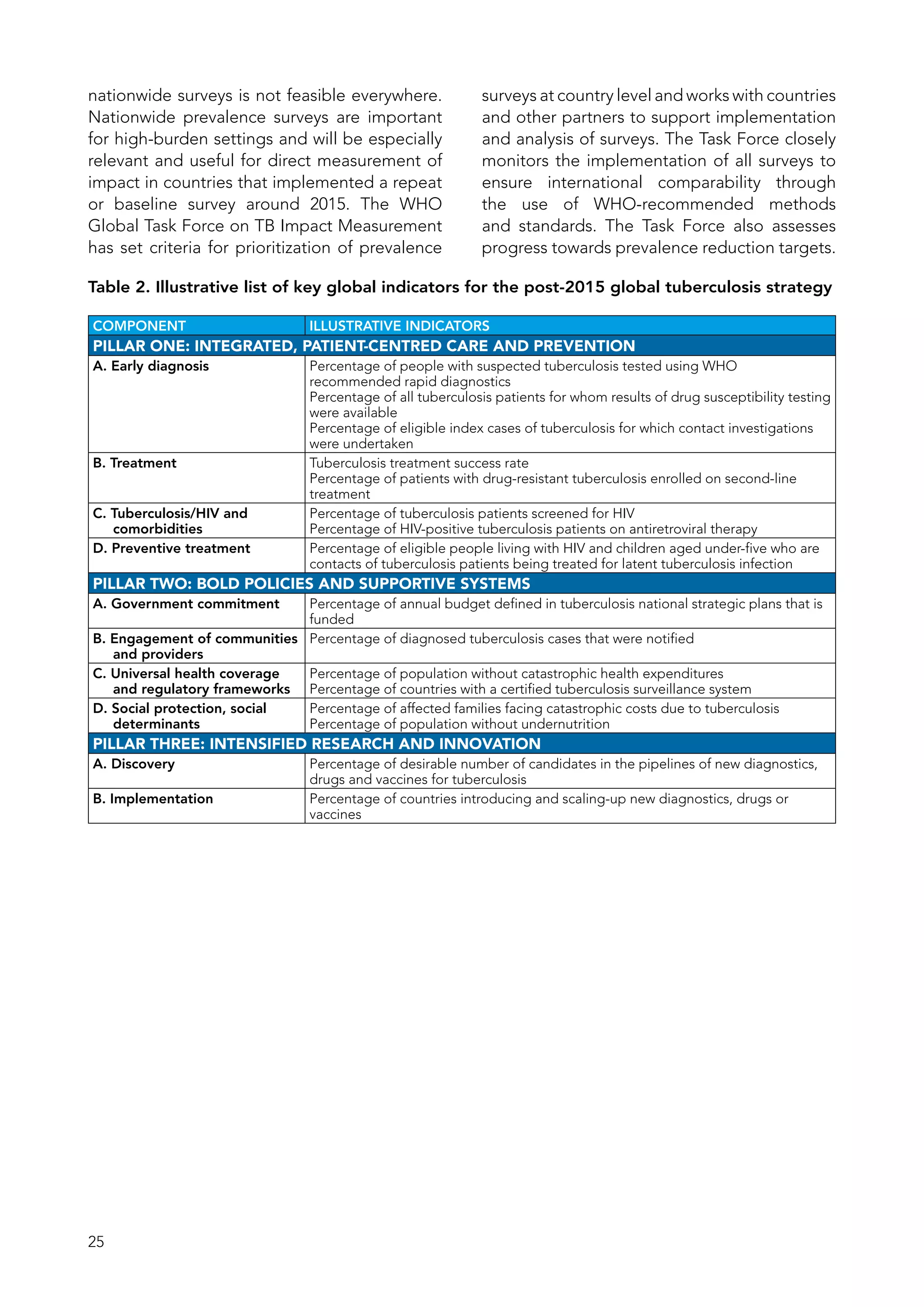
and indicators. Table 2e
presents an illustrative
list of key global indicators that should be
adopted and adapted for national use and for
which country-specific targets should be set.
These indicators should be supplemented by
others considered necessary to capture progress
in the implementation of all essential activities.
Examples of targets that could apply in all
e	 See page 87.
countries include a treatment success rate of at
least 85%, and testing of 100% of tuberculosis
patients for drug susceptibility and HIV.
Strong coalition
with civil society
organizations and
communities
The affected communities must also be
a prominent part of proposed solutions.
Community representatives and civil society
must be enabled to engage more actively
in programme planning and design, service
delivery, and monitoring, as well as in
information, education, support to patients
and their families, research, and advocacy. To
this end, a strong coalition that includes all
stakeholders needs to be built. Such a coalition
of partners can assist people in both accessing
high-quality care and in demanding high-
quality services. A national coalition can also
help drive greater action on the determinants
of the tuberculosis epidemic.
Protection and
promotion of human
rights, ethics and
equity
Policies and strategies for the design of the
overall national tuberculosis response, and the
delivery of tuberculosis care and prevention,
have to explicitly address human rights,
ethics and equity. Access to high-quality
tuberculosis care is an important element of
the right to health. This strategy is built on a
rights-based approach that ensures protection
7
of human rights and promotion of rights-
enhancing policies and interventions. These
include engagement of affected persons and
communities in facilitating implementation of
all pillars and components of the strategy with
special attention to key affected populations.
Tuberculosis care and prevention pose ethical
dilemmas. National tuberculosis programmes
should acknowledge and address these with
due respect to relevant ethical values. These
may include, for example, the conflict between
the public interest in preventing disease
transmission and patients’ rights to demand
a supportive care environment or refuse
treatment; the response to the stigmatization
attached to the disease and the discrimination
against those affected; the lengthy treatment
and the challenges of adherence to treatment;
ensuring patient-centred service provision and
balancing the risk of infection to health care
workers; the care to be offered when there are
not effective treatment options; and setting
of priorities for research and for delivery of
interventions. Ways to address these dilemmas
should be guided by globally recognized
principles and values, should be sensitive to
local values and traditions, and should be
informed by debates among all stakeholders.
The strategy aims to promote equity through
identification of the risks, needs and demands
of those affected, to enable equal opportunities
to prevent disease transmission, equal access
to diagnosis and treatment services, and equal
access to means to prevent associated social
impacts and catastrophic economic costs. The
process through which to meet the targets, and
achieve the goals, of the strategy will be better
served by applying a rights-based approach,
developing and maintaining the highest ethical
standards in every action taken, and ensuring
that inequities are progressively reduced and
eliminated.
Adaptation of the
strategy and targets
at country level, with
global collaboration
Noglobalstrategycanapplysimilarlytoallsettings
across or within countries. The tuberculosis
strategywillhavetobeadaptedtodiversecountry
settings, based on a comprehensive national
strategic plan. Prioritization of interventions
should be undertaken based on local contexts,
needs and capacities. A sound knowledge of
country-specific disease epidemiology will be
essential, including mapping of people at a
greater risk, understanding of socioeconomic
contexts of vulnerable populations, and a grasp
of health system context including underserved
areas. Adoption of the global strategy should be
immediately followed by its national adaptation
and development of clear guidance on how the
different components of the strategy could be
implemented, based on local evidence when
possible.
In a globalized world, diseases like tuberculosis
can spread far and wide via international travel
and trade. Tackling tuberculosis effectively
requires close collaboration among countries.
Effective intercountry collaboration also
requires global coordination and support
to enable adherence to the International
Health Regulations (2005) and ensure health
security. Countries within a region can benefit
from regional collaboration. Migration within
and between countries poses challenges
and addressing them will require in-country
coordination and cross-border collaboration.
Global coordination is also essential for
mobilizing resources for tuberculosis care
and prevention from diverse multilateral,
bilateral and domestic sources. WHO’s global
tuberculosis report, which annually provides
an overview of the status of the tuberculosis
epidemic and implementation of global
strategies, demonstrates and symbolizes the
benefits of close collaboration and global
coordination.
8
Strengthening and expansion of core
functions of tuberculosis programmes. Pillar
one comprises patient-centred interventions
required for tuberculosis care and prevention.
The national tuberculosis programme, or
equivalent, needs to engage and coordinate
closely with other public health programmes,
social support programmes, public and private
health care providers, nongovernmental and
civil society organizations, communities and
patient associations in order to help ensure
provision of high-quality, integrated, patient-
centred tuberculosis care and prevention
across the health system. Pillar one is meant
to help countries to progress from previous
strategies and to embrace new strategies and
technologies for providing universal access to
drug susceptibility testing; to expand services
to manage tuberculosis among children;
to provide additional outreach services to
underserved and vulnerable populations;
and to embark on systematic screening
and preventive treatment of relevant high-
risk groups – all in partnership with relevant
stakeholders. Use of innovative information
and communication technologies for health
(eHealth and mHealth) could particularly help
to improve tuberculosis care provision including
logistics and surveillance.
9
PILLAR
INTEGRATED, PATIENT-CENTRED CARE
AND PREVENTION
1
A. Early diagnosis
of TB including
universal drug-
susceptibility
testing, and
systematic screening
of contacts and
high-risk groups
D. Preventive
treatment of
persons at high risk;
and vaccination
against TB
B. Treatment of
all people with TB
including drug-
resistant TB, and
patient support
C. Collaborative TB/
HIV activities; and
management of co-
morbidities
How pillar 1 works : Key actions
10
Early diagnosis
of tuberculosis
including universal
drug susceptibility
testing, and
systematic screening
of contacts and
high-risk groups
•	 Ensure early detection of tuberculosis.
Currently an estimated two thirds of global
incident tuberculosis cases are notified to
national tuberculosis control programmes
and reported to WHO. Ensuring universal
access to early and accurate diagnosis of
tuberculosis will require the strengthening
and expansion of a network of diagnostic
facilities with easy access to new molecular
tests; information and education to prompt
people with symptoms of tuberculosis to
seek care; engagement of all care providers
in service delivery; the abolition of barriers
that people encounter in seeking care; and
systematic screening in selected high-risk
groups. Although the current most frequently
used test for tuberculosis – sputum-smear
microscopy – is a low-cost option providing
specific diagnosis, it significantly lacks
sensitivity. As a result, health services miss
many tuberculosis patients or identify them
only at advanced stages of the disease.
Screening for symptoms alone may not
suffice; additional screening tools such as
a chest radiograph may facilitate referral
for diagnosis of bacteriologically negative
tuberculosis, extrapulmonary tuberculosis
and tuberculosis in children.
•	 Detect all cases of drug-resistant
tuberculosis. Diagnosis of drug resistance
remains a particular challenge for laboratory
systems in many low- and middle-income
countries. Capacity to diagnose drug-
resistant tuberculosis is limited in most
places where it is sorely needed. Only a
fraction of the estimated cases of multidrug-
resistant tuberculosis receive a laboratory
test to confirm the disease. Adequate
capacity to diagnose all cases of drug-
resistant tuberculosis is essential to make
further progress in global tuberculosis care
and control.
•	 Scale up introduction of new diagnostics.
Wide introduction of new molecular
diagnostic testing platforms will allow early
and accurate diagnosis of tuberculosis and
drug resistance. It could help to diagnose less
advanced forms of tuberculosis and facilitate
early treatment, contributing potentially to
decreased disease transmission, reduced
case fatality, and prevention of adverse
sequelae of the disease. Introduction of
the new molecular diagnostics will require
change of diagnostic policies and training
at all levels. More sensitive and rapid
diagnostics will increase the number of
reliably diagnosed patients. The new realities
of the additional workload will mean lining
up additional human and financial resources.
•	 Implement systematic screening for
tuberculosis among selected high-
risk groups. The burden of undetected
tuberculosis is large in many settings,
especially in high-risk groups. There can be
long delays in diagnosing tuberculosis and
initiating the appropriate treatment among
people with poor access to health services.
Many people with active tuberculosis do not
experience typical symptoms in the early
stages of the disease. These individuals may
not seek care early enough and may not be
identified for testing for tuberculosis if they
do. Mapping of high-risk groups and carefully
planned systematic screening for active
disease among them may improve early case
detection. Early detection helps to reduce
the risks of tuberculosis transmission, poor
treatment outcomes, undesirable health
sequelae, and adverse social and economic
11
consequences of the disease. Contacts of
people with tuberculosis, especially children
aged five years or less, people living with HIV,
and workers exposed to silica dust should
always be screened for active tuberculosis.
Other risk-groups should be identified and
prioritized for possible screening based on
national and local tuberculosis epidemiology,
health system capacity, resource availability,
and the feasibility of reaching the identified
risk-groups. A screening strategy should
be monitored and assessed continuously,
to inform a re-prioritization of risk groups,
re-adaptation of screening approaches,
and discontinuation of screening if
indicated. Screening strategies should
follow established ethical principles for
infectious disease screening, should protect
human rights, and should minimize the
risk of discomfort, pain, stigmatization and
discrimination.
Treatment of
all people with
tuberculosis including
drug-resistant
tuberculosis, and
patient support
•	 Treat all forms of drug-susceptible
tuberculosis. The new tuberculosis strategy
will aim to ensure provision of services for
early diagnosis and proper treatment of
all forms of tuberculosis affecting people
of all ages. New policies incorporating
molecular diagnostics will help to
strengthen management of smear-negative
pulmonary tuberculosis and extrapulmonary
tuberculosis as well as tuberculosis among
children. Key affected populations and risk
groups with suboptimal treatment uptake
or treatment success will need to be given
priority attention in order to accelerate the
decline in case fatality required in order to
reach the ambitious targets for reductions in
tuberculosis mortality.
•	 Treat all cases of drug-resistant tuberculosis.
Resistance to medicines poses a major
threat to global progress in tuberculosis
care and prevention. Globally, about 4%
of new tuberculosis patients and about
20% of patients receiving retreatment have
multidrug-resistant tuberculosis. Providing
universal access to services for drug-resistant
tuberculosis will require a rapid scale up
of laboratory services and programmatic
management. New models of delivering
patient-centred treatment will need to be
devised and customized to diverse settings
and contexts. Ambulatory services should
be given preference over hospitalization,
which should be limited to severe cases.
Expansion of services for management of
drug-resistant tuberculosis will require bold
policies and investments to abolish health
system bottlenecks that impede progress.
•	 Strengthen capacity to manage
drug-resistant cases. The proportion of drug-
resistant tuberculosis patients successfully
completing treatment varies substantially
between countries and averaged 48%
globallyin2012.Currentlyavailabletreatment
regimens for drug-resistant tuberculosis
remain unsatisfactory in terms of duration,
safety, effectiveness and cost. New safer,
affordable and more effective medicines
allowing treatment regimens that are shorter
in duration and easier to administer are key
to improving treatment outcomes. Linkages
with existing pharmacovigilance mechanisms
will contribute to promoting safer use and
management of medicines. Interventions
to improve quality of life for patients while
enabling adherence to treatment include
management of adverse drug reactions and
events; access to comprehensive palliative
and end-of-life care; measures to alleviate
stigmatization and discrimination; and
social support and protection. Importantly,
all care providers managing drug-resistant
tuberculosis should have access to continued
training and education, enabling them
to align their practices with international
standards.
12
•	 Address tuberculosis among children. With
an estimated 500  000 cases and 74  000
deaths occurring annually, tuberculosis
is an important cause of morbidity and
mortality among children. In countries with
a high prevalence of tuberculosis, women of
childbearing age also carry a heavy burden of
the disease. Maternal tuberculosis associated
with HIV is a risk factor for transmission of
tuberculosis to the infant and is associated
with premature delivery, low birth-weight of
neonates, and higher maternal and infant
mortality. National tuberculosis programmes
needtoaddresssystematicallythechallenges
of caring for children with tuberculosis, and
child contacts of adult tuberculosis patients.
These may include, for instance, developing
and using child-friendly formulation of
medicines, and family-centred mechanisms
for enabling adherence to treatment.
•	 Integrate tuberculosis care within
maternal and child health services. Proper
management of tuberculosis among children
will require the development of affordable
and sensitive diagnostic tests that are not
based on sputum specimens. Tuberculosis
care should be integrated within maternal
and child health services to enable provision
of comprehensive care at the community
level. An integrated family-based approach
to tuberculosis care would help to remove
access barriers, reduce delays in diagnosis
and improve management of tuberculosis in
women and children.
•	 Build patient-centred support into the
managementoftuberculosis.Patient-centred
care and support, sensitive and responsive to
patients’educational,emotionalandmaterial
needs, is fundamental to the new global
tuberculosis strategy. Supportive treatment
supervision by treatment partners is essential:
it helps patients to take their medication
regularly and to complete treatment, thus
facilitating their cure and preventing the
development of drug resistance. Supervision
must be carried out in a context-specific and
patient-sensitive manner. Patient-centred
supervision and support must also help to
identify and address factors that may lead
to treatment interruption. It must help to
alleviate stigmatization and discrimination.
Patient support needs to extend beyond
health facilities to patients’ homes, families,
workplaces and communities. Treatment
and support must also extend beyond cure
to address any sequelae associated with
tuberculosis. Examples of patient-centred
support include providing treatment partners
trained by health services and acceptable to
the patient; access to social protection; use of
information and communication technology
for providing information, education and
incentives to patients; and the setting up of
mechanisms for patient and peer groups to
exchange information and experiences.
Collaborative
tuberculosis/
HIV activities, and
management of
comorbidities
•	 Expand collaboration with HIV programmes.
Theoverallgoalofcollaborativetuberculosis/
HIV activities is to decrease the burden of
tuberculosis and HIV infection in people at
risk of or affected by both diseases. HIV-
associated tuberculosis accounts for about
one quarter of all tuberculosis deaths and a
quarter of all deaths due to AIDS. The vast
majority of these cases and deaths are in
the African and South-East Asia regions. All
tuberculosis patients living with HIV should
receive antiretroviral treatment. Integrated
tuberculosis and HIV service delivery has
been shown to increase the likelihood that a
tuberculosis patient will receive antiretroviral
treatment, shorten the time to treatment
initiation, and reduce mortality by almost 40%.
•	 Integrate tuberculosis and HIV services.
Although there has been an encouraging
global scaleup of collaborative tuberculosis/
HIV activities, the overall coverage of services
13
remains low. Further, the level and rate of
progress vary substantially among countries.
There remains a mismatch between the
coverage of HIV testing for tuberculosis
patients and that of antiretroviral treatment,
cotrimoxazole preventive treatment, and HIV
prevention. Reducing delays in diagnosis,
using new diagnostic tools and instituting
prompt treatment can improve health
outcomes among people living with HIV.
Tuberculosis and HIV care should be further
integrated with services for maternal and
child health and prevention of mother-to-child
transmission of HIV in high-burden settings.
•	 Co-manage tuberculosis comorbidities
and noncommunicable diseases. Several
noncommunicable diseases and other
health conditions including diabetes
mellitus, undernutrition, silicosis, as well
as smoking, harmful alcohol and drug use,
and a range of immune-compromising
disorders and treatments are risk factors
for tuberculosis. Presence of comorbidities
may complicate tuberculosis management
and result in poor treatment outcomes.
Conversely, tuberculosis may worsen or
complicate management of other diseases.
Therefore, as a part of basic and coordinated
clinical management, people diagnosed
with tuberculosis should be routinely
assessed for relevant comorbidities. WHO’s
Practical Approach to Lung Healthf
is an
example of promoting tuberculosis care
as an integral part of management of
respiratory illnesses. The local situation
should determine which comorbidities
should be systematically screened for among
people with active tuberculosis. A national
collaborative framework can help integrated
management of noncommunicable diseases
and communicable diseases including
tuberculosis.
f	 Document WHO/HTM/TB/2008.410; document WHO/
NMH/CHP/CPM/08.02.
Preventive treatment
of persons at high
risk, and vaccination
against tuberculosis
•	 Expand preventive treatment of people with
a high risk of tuberculosis. Latent tuberculosis
infection is diagnosed by a tuberculin skin
test or interferon-y release assay. However,
these tests cannot predict which persons will
develop active tuberculosis disease. Isoniazid
preventive therapy is currently recommended
forthetreatmentoflatenttuberculosisinfection
among people living with HIV and children
under five years of age who are contacts of
patients with tuberculosis. It has a proven
preventive effect but severe side effects can
occur, especially among the elderly. Although
regimens with similar efficacy and shorter
duration have been studied, more evidence on
efficacy and safety are needed. More studies
are also required to assess the effectiveness
and feasibility of undertaking preventive
treatment among other high-risk groups
such as, for example, people in congregate
settings like prisons and workplaces, health
care workers, recent converters of a test of
infection, and miners exposed to silica dust.
Management of latent tuberculosis infection
in people with a high risk of developing active
tuberculosis could be an essential component
of tuberculosis elimination, particularly in low
tuberculosis-incidence countries.
•	 ContinueBCGvaccinationinhigh-prevalence
countries. BCG vaccination prevents
disseminated disease including tuberculous
meningitis and miliary tuberculosis, which
are associated with high mortality in infants
and young children. However, its preventive
efficacy against pulmonary tuberculosis,
which varies among populations, is only
about 50%. Until new and more effective
vaccines become available, BCG vaccination
soon after birth should continue for all infants
except for those persons with HIV living in
high tuberculosis prevalence settings.
14
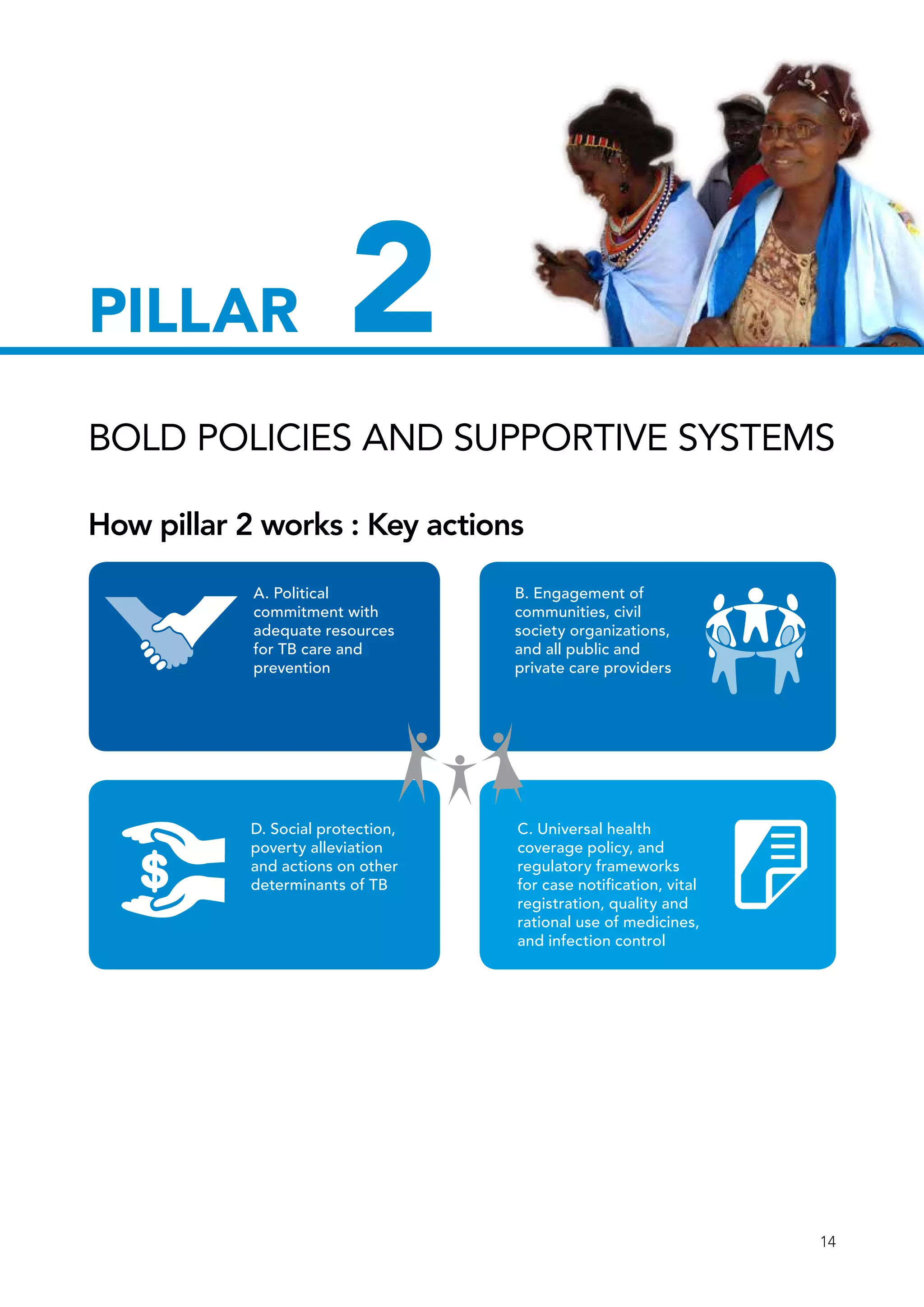
BOLD POLICIES AND SUPPORTIVE SYSTEMS
PILLAR 2
A. Political
commitment with
adequate resources
for TB care and
prevention
D. Social protection,
poverty alleviation
and actions on other
determinants of TB
B. Engagement of
communities, civil
society organizations,
and all public and
private care providers
C. Universal health
coverage policy, and
regulatory frameworks
for case notification, vital
registration, quality and
rational use of medicines,
and infection control
How pillar 2 works : Key actions
15
•	 Sharing of responsibilities. The second
pillar encompasses strategic actions that will
enable implementation of the components
under pillar one through sharing of
responsibilities. These include actions by and
beyond national tuberculosis programmes,
across ministries and departments. Such
actions address medical and non-medical
needs of those ill with tuberculosis and also
help to prevent tuberculosis. This will require
a well-resourced, organized and coordinated
health system with government stewardship
backed up by supportive health policies and
regulations as well as broader social and
development policies. National tuberculosis
programmes, their partners and those
overseeing the programmes need to engage
actively in the setting of a broader social and
economic development agenda. Similarly,
leaders in development must recognize
tuberculosis as being among the social
concerns that deserve priority attention.
•	 Social determinants of tuberculosis. Pillar two
further includes actions beyond the health
sector that can help to prevent tuberculosis
by addressing underlying social determinants.
Proposed interventions include reducing
poverty, ensuring food security, and improving
living and working conditions as well as
interventions to address direct risk factors
such as tobacco control, reduction of harmful
alcohol use, and diabetes care and prevention.
Tuberculosis prevention will also require
actions on the part of governments in order to
help to reduce vulnerabilities and risks among
people most susceptible to the disease.
•	 Multidisciplinary and multisectoral
approach. The implementation of pillar two
components demands a multidisciplinary
and multisectoral approach. Accountability
for pillar two will rest not only with health
ministries, but also other ministries including
finance, labour, social welfare, housing,
mining and agriculture. Eliciting actions
from across diverse ministries will require
commitment and stewardship from the
highest levels of government. This should
translate into ensuring adequate resources
and accountability for optimal and integrated
clinical care; protection from catastrophic
economic burden due to the disease; social
interventions aimed at reducing vulnerability
to the disease; and protection and promotion
of human rights.
Political
commitment with
adequate resources
for tuberculosis care
and prevention
•	 Develop ambitious national strategic plans.
Scaling up and sustaining interventions
for tuberculosis care and prevention will
require high-level political commitment
along with adequate financial and human
resources. Continuous training and
supervision of personnel are fundamental
to sustain significantly expanded activities
for tuberculosis care and prevention. Central
coordination under government stewardship
is essential. This must lead to, as a first
step, development of a national strategic
plan embedded in a national health sector
plan, taking into account tuberculosis
epidemiology, health system structure and
functions including procurement and supply
systems, resource availability, regulatory
policies, links with social services, migrant
populations and crossborder collaboration,
the role of communities, civil society
organizations and the private sector, and
coordination with all stakeholders. A
national strategic plan should be ambitious
and comprehensive, and incorporate five
distinct sub-plans: a core plan, a budget
plan, a monitoring and evaluation plan, an
operational plan and a technical assistance
plan.
•	 Mobilize adequate resources. The expansion
of tuberculosis care and prevention across
and beyond the health sector will be possible
only if adequate funding is secured. The
16
national strategic plan should be properly
budgeted with clear identification of gaps
in finances. A well-budgeted plan should
facilitate resource mobilization from diverse
international and national sources for full
implementation of the plan. In most low-
and middle-income countries, the currently
available resources are inadequate or
sufficient only for modestly ambitious plans.
Coordinated efforts are required to mobilize
additional resources to fund truly ambitious
national strategic plans with a progressive
increase in domestic funding.
Engagement of
communities,
civil society
organizations, and
all public and private
care providers
•	 Engage communities and civil society. A
robust response to end the tuberculosis
epidemic will require the establishment of
lasting partnerships across the health and
social sectors and between the health sector
and communities. Informed community
members can identify people with suspected
tuberculosis, refer them for diagnosis,
provide support during treatment and help
to alleviate stigmatization and discrimination.
Civil society organizations have specific
capacities and tuberculosis programmes
can benefit from harnessing them. Their
competencies include reaching out to
vulnerable groups, mobilizing communities,
channelling information, helping to create
demand for care, framing effective delivery
models and addressing determinants of the
tuberculosis epidemic. National tuberculosis
programmes should reach out to civil
society organizations not currently engaged
in tuberculosis care, encourage them to
integrate community-based tuberculosis
care into their work, and widen the network
of facilities engaged in tuberculosis care
and prevention. Civil society should also
be engaged in policy development and
planning as well as periodic monitoring of
programme implementation.
•	 Scale up public–private mix approaches
and promote International Standards for
Tuberculosis Care. In many countries,
tuberculosis care is delivered by diverse
private care providers. These providers
include pharmacists, formal and informal
practitionersandnongovernmentalandfaith-
based organizations, as well as corporate
healthfacilities.Severalpublicsectorproviders
outside the purview of national tuberculosis
programmes also provide tuberculosis
care. These include, inter alia, large public
hospitals, social security organizations,
prison health services and military health
services. Leaving a large proportion of care
providers out of an organized response
to tuberculosis control has contributed to
stagnating case notification, inappropriate
tuberculosis management, and irrational
use of tuberculosis medicines leading to
the spread of drug-resistant tuberculosis.
National tuberculosis programmes will have
to scale up country-specific public–private
mix approaches already working well in many
countries. To this effect, close collaboration
with health professionals’ associations will
be essential. The International Standards
for Tuberculosis Care, other tools and
guidelines developed by WHO as well as
modern information and communication
technology platforms can be used effectively
for this purpose.
17
Universal health
coverage policy,
and regulatory
frameworks for case
notification, vital
registration, quality
and rational use
of medicines, and
infection control
•	 Move with urgency to universal health
coverage. Universal health coverage,
defined as, “the situation where all people
are able to use the quality health services
that they need and do not suffer financial
hardship paying for them” is fundamental for
effective tuberculosis care and prevention.
Universal health coverage is achieved
through adequate, fair and sustainable
prepayment financing of health care with
full geographical coverage, combined
with effective service quality assurance and
monitoring and evaluation. For tuberculosis
specifically, this implies: (a) expanding access
to the full range of high-quality services
recommended in this strategy, as part of
general health services; (b)  expanding
coverage, including costs of consultations
and testing, medicines, follow-up tests and
all expenditures associated with staying in
complete curative or preventive treatment;
and (c) expanding access to services for all
in need, especially vulnerable groups faced
with the most barriers and worst outcomes.
•	 Strengthen regulatory frameworks. National
policy and regulatory frameworks for health
care financing and access, quality-assured
production and use of medicines and
diagnostics, quality-assured health services,
infectioncontrol,vitalregistrationanddisease
surveillance systems are powerful levers that
are essential for effective tuberculosis care
and prevention. In countries with a high
tuberculosis burden, these frameworks need
to be urgently strengthened and enforced.
The strategy calls for improvements in
several areas outlined below.
•	 Enforce mandatory notification of
tuberculosis cases. Many tuberculosis cases
are not notified, especially those managed
by private care providers that are not linked
to national tuberculosis programmes. Under-
notification of cases hampers disease
surveillance, contact investigation, outbreak
management, and infection control. An
effectively enforced infectious disease law,
or equivalent, that includes compulsory
notification of tuberculosis cases by all health
care providers, is essential.
•	 Ensure recording of tuberculosis deaths
within vital registration. Most countries with
a high burden of tuberculosis do not have
comprehensive vital registration systems
and the quality of information about the
number of deaths due to tuberculosis is often
inadequate. An effective vital registration
system has to be in place to ensure that
each death due to tuberculosis is properly
recorded.
•	 Regulate the production, quality and use of
tuberculosis diagnostics and medicines. Poor
quality tuberculosis medicines put patients at
great risk. Irrational prescription of treatment
regimens leads to poor treatment outcomes
and may cause drug resistance. Use of
inappropriate diagnostics such as serological
tests leads to inaccurate diagnosis.
Regulation and adequate resources for
enforcement are required for the registration,
importation and manufacturing of medical
products. There should be regulation of
how medical products are subsidized and
a determination of which types of health
professional are authorized to prescribe or
dispense tuberculosis medicines.
18
•	 Undertake comprehensive infection control
measures. Appropriate regulation is required
to ensure effective infection control in health
care services and other settings where the risk
of disease transmission is high. Managerial,
administrative, environmental and personal
measures for infection control should be
part of infectious disease legislation, and
regulations related to the construction and
organization of health faculties.
Social protection,
poverty alleviation
and actions on other
determinants of
tuberculosis
•	 Relieve the economic burden related
with tuberculosis. A large proportion of
people with tuberculosis face a catastrophic
economic burden related to the direct
and indirect costs of illness and health
care. Adverse social consequences may
include stigmatization and social isolation,
interruption of studies, loss of employment,
or divorce. The negative consequences
often extend to the family of the persons ill
with tuberculosis. Even when tuberculosis
diagnosis and treatment are offered free
of charge, social protection measures are
needed to alleviate the burden of income
loss and non-medical costs of seeking and
staying in care.
•	 Expand coverage of social protection. Social
protection should cover the needs associated
with tuberculosis such as: (a)  schemes
for compensating the financial burden
associated with illness, such as sickness
insurance, disability pension, social welfare
payments, other cash transfers, vouchers
or food packages; (b) legislation to protect
people with tuberculosis from discrimination
such as expulsion from workplaces,
educational or health institutions, transport
systems or housing; and (c)  instruments to
protect and promote human rights, including
addressing stigma and discrimination, with
special attention to gender, ethnicity, and
protection of vulnerable groups. These
instruments should include capacity-building
to enable affected communities to express
their needs and protect their rights, and to
call to account those who impinge on human
rights, as well as those who are responsible
for protecting those rights.
•	 Address poverty and related risk factors.
Poverty is a powerful determinant of
tuberculosis. Crowded and poorly ventilated
living and working environments often
associated with poverty constitute direct
risk factors for tuberculosis transmission.
Undernutrition is an important risk factor
for developing active disease. Poverty is
also associated with poor general health
knowledge and a lack of empowerment to
act on health knowledge, which leads to
risk of exposure to several tuberculosis risk
factors. Poverty alleviation reduces the risk
of tuberculosis transmission and the risk of
progression from infection to disease. It also
helps to improve access to health services
and adherence to recommended treatment.
•	 Pursue “health-in-all-policies” approaches.
Actions on the determinants of ill health
through “health-in-all-policies” approaches
will immensely benefit tuberculosis care
and prevention. Such actions include, for
example: (a)  pursuing overarching poverty
reduction strategies and expanding
social protection; (b)  improving living and
working conditions and reducing food
insecurity; (c)  addressing the health issues
of migrants and strengthening cross-
border collaboration; (d)  involving diverse
stakeholders, including tuberculosis
affected communities, in mapping the likely
local social determinants of tuberculosis;
and (e)  preventing direct risk factors for
tuberculosis, including smoking and harmful
use of alcohol and drugs, and promoting
healthy diets, as well as proper clinical care
for medical conditions that increase the risk
of tuberculosis, such as diabetes.
19
INTENSIFIED RESEARCH AND INNOVATION
PILLAR 3
A. Discovery, development
and rapid uptake of new tools,
interventions and strategies
B. Research to optimize
implementation and impact;
and promote innovations
How pillar 3 works : Key actions
20
•	 Enhancing investments in research. Progress
in global tuberculosis control is constrained
not only by the lack of new tools to better
detect, treat or prevent tuberculosis but
also by the weaknesses of health systems in
delivering optimal diagnosis and treatment
with existing tools. Ending the tuberculosis
epidemic will require substantial investments
in the development of novel diagnostic,
treatment and prevention tools, and for
ensuring their accessibility and optimal
uptake in countries alongside better and
wider use of existing technologies. This
will be possible only through increased
investments and effective engagement
of partners, the research community and
country tuberculosis programmes.
•	 Embarking on research for tuberculosis
elimination. Revolutionary new technology
and service delivery models are needed to
achieve tuberculosis elimination. This will
require an intensification of research, from
fundamental research to drive innovations
for improved diagnostics, medicines and
vaccines, to operational and health systems
research to improve current programmatic
performance and introduce novel strategies
and interventions based on new tools.
To highlight the need for reinvigorated
tuberculosis research and catalyse further
efforts, an International Roadmap for
Tuberculosis Research has been developed.
The Roadmap outlines priority areas for
future scientific investment across the
research continuum. It provides a framework
for outcome-oriented research. A mapping of
the efforts carried out in the various research
areas will also be necessary, so as to follow up
on progress made. Embarking on research
for tuberculosis elimination will require a
multi-dimensional approach informed by
stakeholders including scientists, public
health experts, tuberculosis programme
managers, financial partners, policy-makers
and civil society representatives. Guided by
clinical and programmatic needs, such an
approach should not only help undertake
public health oriented research for the
development of new tools and strategies
but also facilitate their seamless integration
into ongoing programmes. It is important
that tuberculosis becomes a key domain of
investigation within national health research
agendas.
Discovery,
development and
rapid uptake of new
tools, interventions
and strategies
•	 Develop a point-of-care rapid diagnostic
test for tuberculosis. Since 2007, several
new tests and diagnostic approaches
have been endorsed by WHO, including:
liquid culture with rapid speciation as the
reference standard for bacteriological
confirmation; molecular line probe assays
for rapid diagnosis of multidrug-resistant
tuberculosis; non-commercial culture and
drug-susceptibility testing methods; light-
emitting diode fluorescence microscopes;
and a nucleic acid amplification test for rapid
and simultaneous diagnosis of tuberculosis
and rifampicin-resistant tuberculosis.
However, an accurate and rapid point-of-care
test that is usable in field conditions is still
missing. This requires greater investments
in biomarker research, and the overcoming
of difficulties in transforming sophisticated
laboratory technologies into robust, accurate
and affordable point-of-care platforms.
•	 Develop new drugs and regimens for the
treatment of all forms of tuberculosis.
The pipeline of new drugs has expanded
substantially over the last decade. There
are nearly a dozen new or repurposed
tuberculosisdrugsunderclinicalinvestigation.
Bedaquiline, the first new tuberculosis drug
for decades, was approved in 2013 by WHO
for the treatment of multidrug-resistant
tuberculosis. A second new drug, delamanid,
also for the treatment of multidrug-resistant
21
tuberculosis, is in the process of review by
WHO. Novel regimens, including new or
repurposed medicines and adjuvant and
supportive therapies, are being investigated
and early results appear promising. In order
for further progress to be made, investments
are required in both research and capacity-
building to implement trials in accordance
with international standards, and to identify
means of shortening the duration of
tuberculosis medicines trials.
•	 Enhance research to detect and treat
latent infection. Globally, more than
2000  million people are estimated to be
infected with Mycobacterium tuberculosis,
but only 5% to 15% of those infected
will develop active disease during their
lifetime. Ending the tuberculosis epidemic
will require the elimination of this pool of
infection. Research is needed to develop
new diagnostic tests to identify people with
latent tuberculosis infection who are likely
to develop tuberculosis disease. Further,
treatment strategies that could be safely
used to prevent development of tuberculosis
in latently infected persons will also need
to be identified. These strategies should
include new medicines or combinations as
well as interventions to identify and mitigate
risk factors for progression. Further research
will be required to investigate the impact
and safety of targeted and mass preventive
strategies.
•	 Aim for an effective vaccine against
tuberculosis. The century-old BCG vaccine
is useful to protect against severe forms of
tuberculosis in infants and young children
but has limited efficacy against other forms
of tuberculosis. Much progress has been
made in the development of new vaccines;
currently there are 12 vaccine candidates in
clinical trials. More research and investments
are required to address a series of major
scientific challenges and identify priorities
for future tuberculosis vaccine research. A
post-exposure vaccine that prevents the
disease in latently infected individuals will be
essential to eliminating tuberculosis in the
foreseeable future.
Research to optimize
implementation
and impact, and
promote innovations
•	 Invest in applied research. Investments
in fundamental research need to be
complemented with those for applied
research that supports rapid adoption,
adaptation, and implementation of
evidence-based policies. Research aimed at
improving understanding of the challenges
and developing interventions that result
in improved policies, better design and
implementation of health systems and
more efficient methods of service delivery
is critical to produce evidence for improving
current strategies and introducing new tools.
Research is also needed to identify and
address bottlenecks to implementation of
existing and new policies, and to provide
evidence from the perspective of patients as
well as from health systems.
•	 Use research to inform and improve
implementation. Most innovations cannot
be translated into effective local action
without careful planning and adaptation, and
partnership with stakeholders. In addition to
routine surveillance, well-planned and well-
conducted research is required to assess
national and local epidemiological and
health system situations, socio-behavioural
aspects of health care seeking, adherence to
treatment, stigmatization and discrimination,
and to evaluate different implementation
models.
•	 Create a research-enabling environment.
Fostering better and more relevant
operational, health system and social science
research will help implementation and
contribute to the development of national
and global policies. For this purpose, good
systems for research prioritization, planning
and implementation need to be in place at
country level. Indicators to measure progress
should include investments in outcomes as
well as in the impact of research activities.
A broad-based, concerted effort is needed
to develop research capacity, allocate
appropriate resources, and encourage
stakeholders to work together. An enabling
environment for performing programme-
based research and translating results into
policy and practice is necessary to achieving
thefullpotentialoftuberculosisprogrammes.
23
ADAPTING AND IMPLEMENTING THE
STRATEGY
Initiating and
sustaining strategic
dialogue
Engage all stakeholders in strategy adoption
and adaptation. A first step in adapting and
implementing the strategy would be for Member
States to hold inclusive national consultations
with a wide range of stakeholders, including
communities most affected by tuberculosis,
in order to consider, adopt and prepare for
adaptation of the strategy. Blanket application of
a global strategy could be inappropriate if it does
not adequately respond to an assessment of
local needs that is derived from the nature of the
tuberculosis epidemic, the health system context,
the social and economic development agenda
and the expressed demands of the populations at
risk. Furthermore, it must build on the capacities
of health systems and those of partners.
Use a multidisciplinary approach. A meaningful
implementation of this strategy will demand the
involvement of many actors and their sharing
of responsibilities. The scope of existing
tuberculosis advisory panels will need to be
expanded beyond clinical, epidemiological and
public health expertise. It will need to include a
wider range of capacities from civil society and
from the fields of finance and development
policy, human rights, social protection,
regulation, health technology assessment, the
social sciences, and communications. The work
to adapt the new global tuberculosis strategy
to national contexts may be an adjunct to
overall national health strategic planning, but
will need a significant and specific effort.
Prepare to develop new strategic plans.
Countriesfollowdifferentdevelopmentplanning
cycles. Existing strategic and operational plans
may need to be modified, building on any
new approaches. Detailed national strategic
plans are also essential to mobilize funding
from domestic and international sources.
Development of new national strategic plans or
modifications to existing ones should take into
consideration the recommended framework of
the new strategy.
Epidemiological
and health systems
mapping
Undertake a detailed epidemiological
and health system context assessment. A
prerequisite for adoption of the strategy and
preparation for its adaptation will be a detailed
assessment of the national epidemiological
and health system situation. Proper mapping
should provide important information, such
as population groups most affected by the
disease and most at risk of developing it; age
and sex characteristics and trends; prevalence
of different forms of tuberculosis and dominant
comorbidities, including HIV, undernutrition,
diabetes, tobacco use, and alcohol misuse;
important subnational and urban–rural
variations; distribution and types of care
providers; available social protection schemes
and their current and potential linkages for the
benefit of tuberculosis care and prevention.
Collect and use data to improve systems
mapping. Some of the information for context
assessment can be derived from routine
reporting and, in some countries, from national
or regional tuberculosis prevalence survey
results. Other required information may have to
be obtained from the review of periodic national
programme evaluations, field assessments and
local quantitative and qualitative studies. For
this purpose, countries need to build capacities
in order to establish an information system that
monitors the characteristics of the tuberculosis
epidemic, and make appropriate use of the
data generated from the system at all levels.
24
MEASURING PROGRESS AND IMPACT
Target setting and monitoring of progress in
implementing each component of the global
strategy are essential. Monitoring should be
done routinely using standardized methods
based on data with documented quality. Table
2 below provides examples of the indicators
that can be used to monitor progress in
implementing different components and
subcomponents of this strategy. The main
indicators of disease burden are incidence,
prevalence and mortality. Given the overarching
2035 targets of the strategy, particular attention
to measurement of trends in mortality and
incidence is required.
Mortality data are critical in order to enable
prioritization of public health interventions
and the measurement of progress made in
disease control and the overall health of the
population, including health inequalities. A
robust national vital registration system that
includes recording of data on causes of death
is essential for measurement of trends in
mortality due to tuberculosis. Vital registration
data can also be used to identify subgroups
of the population that have higher mortality
over casenotification ratios, thereby allowing
targeting of interventions. The quality of these
data is documented globally by WHOg
and
statistical methods can be used to account for
incomplete coverage or miscoding. Countries
that already have vital registration systems
need to ensure that data are of sufficient
quality. Those without such systems need to
introduce them. An interim solution being
adopted by an increasing number of countries
is the introduction of a sample vital registration
system.
Globally, incidence is estimated to be declining
slowly, at a rate of about 2% per year. The 2025
and 2035 targets mean that, in the post-2015
period, great attention will need to be given
to measuring how fast incidence is falling. In
g	 Mathers CD, Fat DM, Inoue M, Rao C, Lopez AD.
Counting the dead and what they died from: an assessment
of the global status of cause of death data. Bull World
Health Organ. 2005;83(3):171–7.
high-income countries with high-performance
tuberculosis surveillance and health systems,
case notification systems capture all, or almost
all, incident cases. However, in other countries,
routine case notifications provide biased data
due to under-diagnosis (cases not diagnosed)
and under-reporting (cases diagnosed by
health practitioners but not reported to public
health authorities). In such settings, inventory
studies and capture–recapture modelling may
be used to estimate tuberculosis incidence.
Accurate measurement of trends in tuberculosis
incidence requires the performance of
tuberculosis surveillance systems to be
strengthened so that they cover all providers
of health care and minimize the level of under-
reporting. WHO has developed a tuberculosis
surveillance checklist, the “standards and
benchmarks for tuberculosis surveillance
and vital registration systems”, to assess
a national surveillance system’s ability to
measure tuberculosis cases accurately. The
checklist defines 10 surveillance standards that
must be met in order for notification and vital
registration data to be considered as a direct
measurement of tuberculosis incidence and
tuberculosis mortality, respectively. Countries
that meet all standards can be certified as
having an appropriate surveillance system.
The WHO checklist should be used to improve
tuberculosis surveillance progressively towards
the ultimate goal of measuring trends in
tuberculosis cases directly from notification
data in all countries.
Prevalence is a very useful indicator of
the tuberculosis disease burden. It is
directly measureable through population-
based surveys.h
Prevalence surveys also
provide information that is useful for policy
improvements, in particular those related to
access to health and to tuberculosis diagnosis.
Measurement of tuberculosis prevalence using
h	 World Health Organization. Tuberculosis prevalence
surveys: a handbook. Geneva 2011. http://www.who.int/
tb/advisory_bodies/impact_measurement_taskforce/
resources_documents/thelimebook/en/index.html.
25
nationwide surveys is not feasible everywhere.
Nationwide prevalence surveys are important
for high-burden settings and will be especially
relevant and useful for direct measurement of
impact in countries that implemented a repeat
or baseline survey around 2015. The WHO
Global Task Force on TB Impact Measurement
has set criteria for prioritization of prevalence
surveys at country level and works with countries
and other partners to support implementation
and analysis of surveys. The Task Force closely
monitors the implementation of all surveys to
ensure international comparability through
the use of WHO-recommended methods
and standards. The Task Force also assesses
progress towards prevalence reduction targets.
Table 2. Illustrative list of key global indicators for the post-2015 global tuberculosis strategy
COMPONENT ILLUSTRATIVE INDICATORS
PILLAR ONE: INTEGRATED, PATIENT-CENTRED CARE AND PREVENTION
A. Early diagnosis Percentage of people with suspected tuberculosis tested using WHO
recommended rapid diagnostics
Percentage of all tuberculosis patients for whom results of drug susceptibility testing
were available
Percentage of eligible index cases of tuberculosis for which contact investigations
were undertaken
B. Treatment Tuberculosis treatment success rate
Percentage of patients with drug-resistant tuberculosis enrolled on second-line
treatment
C. Tuberculosis/HIV and
comorbidities
Percentage of tuberculosis patients screened for HIV
Percentage of HIV-positive tuberculosis patients on antiretroviral therapy
D. Preventive treatment Percentage of eligible people living with HIV and children aged under-five who are
contacts of tuberculosis patients being treated for latent tuberculosis infection
PILLAR TWO: BOLD POLICIES AND SUPPORTIVE SYSTEMS
A. Government commitment Percentage of annual budget defined in tuberculosis national strategic plans that is
funded
B. Engagement of communities
and providers
Percentage of diagnosed tuberculosis cases that were notified
C. Universal health coverage
and regulatory frameworks
Percentage of population without catastrophic health expenditures
Percentage of countries with a certified tuberculosis surveillance system
D. Social protection, social
determinants
Percentage of affected families facing catastrophic costs due to tuberculosis
Percentage of population without undernutrition
PILLAR THREE: INTENSIFIED RESEARCH AND INNOVATION
A. Discovery Percentage of desirable number of candidates in the pipelines of new diagnostics,
drugs and vaccines for tuberculosis
B. Implementation Percentage of countries introducing and scaling-up new diagnostics, drugs or
vaccines
26
THE ROLE OF THE SECRETARIAT
The Secretariat, at all levels of the
Organization, will provide support to Member
States in reviewing, adopting, adapting and
implementing their post-2015 tuberculosis
strategies, building on the framework
provided in the strategy. WHO will draw on its
comparative advantages in areas of the core
functions outlined below and use its Strategic
and Technical Advisory Group for Tuberculosis
and regional advisory bodies, as well as the
Organization’s governing bodies, in order to
guide, support and evaluate its work.
WHO will continue its policy and norms-setting
work, building on a range of available and
future guidance documents on tuberculosis.
The Secretariat will provide the strategic
guidance and tools needed for adaptation
and implementation of the strategy in diverse
country settings. These tools will need to
be iterated as further evidence on effective
approaches and best practices becomes
available. Periodic guidance will be needed
on the use of new tuberculosis diagnostics,
medicines susceptibility testing methods
and new treatment regimens as they become
available. WHO will work with partners to
stimulate further evidence generation and
policy recommendations on how national
tuberculosis programmes can engage in
the development agenda to address social
determinants of tuberculosis.
To enable this strategy to have a rapid impact
and to support Member States, the Secretariat
will pursue its core function of technical support
coordination. It will continue to stimulate
contributions from partners, at global, national
and local levels. The tuberculosis technical
assistance mechanism (TBTEAM) managed by
WHO helps to facilitate and mobilize financing
for technical assistance by partnering with major
development agencies. The gaps in technical
expertise among supporting agencies will
need to be filled by collaborating with experts
working in global health disciplines beyond
tuberculosis, and by drawing more young
collaborators into the field.
WHO will continue to strengthen its
stewardship role in generating global demand
for research, prioritizing among tuberculosis
research needs, and supporting with partners
the effective conduct of research to inform
global and national strategy and policy design
and implementation. This will entail further
work with basic scientists, epidemiologists,
social scientists and innovators in the public,
private and academic communities, as well
as affected populations. It will also mean that
national tuberculosis programmes need to
work with academic partners and associated
research institutions, research-focused public
partnerships and public–private partnerships.
WHOwillfostereffectivepartnershipstosupport
the work proposed under the three pillars of the
new strategy. This work in partnership aims to
support Member States in achieving universal
access to tuberculosis care and prevention and
in reaching out to vulnerable populations and
communities most affected by the tuberculosis
epidemic worldwide. WHO will work with
the Stop TB Partnership, and will seek out
new partnerships that can leverage effective
commitment and innovation in the non-health
sector driven elements of the strategy.
The launch of the Stop TB Strategy 2006–
2015 by WHO led to its swift translation into a
comprehensive, costed global plan of action by
the Stop TB Partnership. Similarly for the post-
2015 global tuberculosis strategy, WHO will
actively support the development of a global
investment plan by the Stop TB Partnership,
outlining activities and defining financing
requirements to meet the ambitious targets
while achieving the stated milestones on the
way. WHO will work closely with the Stop TB
Partnership and will contribute to preparing
the global action and investment plan to guide
post-2015 efforts for tuberculosis care and
prevention by providing the required strategic,
scientific and technical input.
27

End tb strategy

  • 3.
    The End TBStrategy Global strategy and targets for tuberculosis prevention, care and control after 2015a [A67/11 – 14 March 2014](The official text approved by the Sixty seventh World Health Assembly, May 2014)
  • 4.
    1 The End TBStrategy Global strategy and targets for tuberculosis prevention, care and control after 2015a [A67/11 – 14 March 2014] WHO’s declaration of tuberculosis as a global public health emergency in 1993 ended a period of prolonged global neglect. Together, the subsequent launch of the directly observed treatment, short course (DOTS) strategy; inclusion of tuberculosis-related indicators in the Millennium Development Goals; development and implementation of the Stop TB Strategy that underpins the Global Plan to Stop TB 2006–2015; and adoption of resolution WHA62.15 on the prevention and control of multidrug-resistant tuberculosis and extensively drug-resistant tuberculosis by the Sixty-second World Health Assembly have all helped to accelerate the global expansion of tuberculosis care and control. a See resolution WHA67.1. In May 2012, Member States at the Sixty- fifth World Health Assembly requested the DirectorGeneral to submit a comprehensive review of the global tuberculosis situation to date, and to present new multisectoral strategic approaches and new international targets for the post-2015 period to the Sixty- seventh World Health Assembly in May 2014, through the Executive Board.b The work to prepare this has involved a wide range of partners providing substantive input into the development of the new strategy, including high-level representatives of Member States, national tuberculosis programmes, technical and scientific institutions, financial partners and development agencies, civil society, nongovernmental organizations, and the private sector. b See document WHA65/2012/REC/3, summary record of the sixth meeting of Committee B, section 3.
  • 5.
    2 The process. WHO’sStrategic and Technical Advisory Group for Tuberculosis approved the broad, inclusive scope of the consultative processforthedevelopmentofthedraftstrategy. It began with a web-based consultation to seek ways in which to strengthen the current strategy and introduce any new components. During 2012, as part of the annual meetings of national tuberculosis programmes, each regional office organized consultations on the proposed new strategic framework and targets with health ministry officials, national tuberculosis programme managers and partners. Officials of countries with a high tuberculosis burden then deliberated on the draft strategic framework at a special consultation organized just before the 43rd Union World Conference (Kuala Lumpur, 13–17 November 2013). Following this, the framework was presented and discussed on the opening day of the Conference at the global tuberculosis symposium, which was attended by over 700 stakeholders. In 2013, three special consultations including senior officials of Member States, technical experts and civil society were organized in order to discuss (i)  formulation of the post-2015 tuberculosis targets; (ii) approaches to building on the opportunities presented by expansion of universal health coverage and social protection to strengthen tuberculosis care and prevention; and (iii) research and innovation for improved tuberculosis care, control and elimination. In June 2013, the Strategic and Technical Advisory Group for Tuberculosis endorsed the draft, including the global targets and their rationale.c The framework of the post-2015 global tuberculosis strategy is presented in Figure 1. Figure 1. POST-2015 GLOBAL TUBERCULOSIS STRATEGY FRAMEWORK VISION A world free of tuberculosis – zero deaths, disease and suffering due to tuberculosis GOAL End the global tuberculosis epidemic MILESTONES FOR 2025 75% reduction in tuberculosis deaths (compared with 2015) 50% reduction in tuberculosis incidence rate (less than 55 tuberculosis cases per 100 000 population) – No affected families facing catastrophic costs due to tuberculosis TARGETS FOR 2035 95% reduction in tuberculosis deaths (compared with 2015) 90% reduction in tuberculosis incidence rate (less than 10 tuberculosis cases per 100 000 population) – No affected families facing catastrophic costs due to tuberculosis PRINCIPLES 1. Government stewardship and accountability, with monitoring and evaluation 2. Strong coalition with civil society organizations and communities 3. Protection and promotion of human rights, ethics and equity 4. Adaptation of the strategy and targets at country level, with global collaboration PILLARS AND COMPONENTS 1. INTEGRATED, PATIENT-CENTRED CARE AND PREVENTION A. Early diagnosis of tuberculosis including universal drug-susceptibility testing, and systematic screening of contacts and high-risk groups B. Treatment of all people with tuberculosis including drug-resistant tuberculosis, and patient support C. Collaborative tuberculosis/HIV activities, and management of comorbidities D. Preventive treatment of persons at high risk, and vaccination against tuberculosis 2. BOLD POLICIES AND SUPPORTIVE SYSTEMS A. Political commitment with adequate resources for tuberculosis care and prevention B. Engagement of communities, civil society organizations, and public and private care providers C. Universal health coverage policy, and regulatory frameworks for case notification, vital registration, quality and rational use of medicines, and infection control D. Social protection, poverty alleviation and actions on other determinants of tuberculosis 3. INTENSIFIED RESEARCH AND INNOVATION A. Discovery, development and rapid uptake of new tools, interventions and strategies B. Research to optimize implementation and impact, and promote innovations
  • 6.
    3 APPROACHES Expandingc care, strengthening prevention, andintensifying research. Addressing the above challenges will require innovative, multisectoral, and integrated approaches. The DOTS strategy strengthened public sector tuberculosis programmes to help to tackle a large burden of drugsusceptible disease. The Stop TB Strategy,d built on DOTS, helped to begin addressing drugresistant tuberculosis and HIV-associated tuberculosis while promoting research to develop new tools. It also helped to expand partnerships with all care providers, civil society organizations and communities, in the context of strengthening health systems. Ending the tuberculosis epidemic will require further expansion of the scope and reach of interventions for tuberculosis care and prevention; institution of systems and policies to create an enabling environment and share responsibilities; and aggressive pursuit of research and innovation to promote development and use of new tools for tuberculosis care and prevention. It will also require a provision for revisiting and adjusting the new strategy based on progress and the extent to which agreed milestones and targets are being met. Eliciting systemic support and engaging stakeholders. In practical terms, continuing progress beyond 2015 will require intensified actions by and beyond tuberculosis programmes within and outside the health sector. The new strategy envisages concrete actions from three levels of governance in close collaboration with all stakeholders and with the engagement of communities. At the core are national tuberculosis programmes or the equivalent structures that are responsible for coordination of all activities related to c Strategic and Technical Advisory Group for Tuberculosis: report of 13th meeting, 11–12 June 2013 (document WHO/ HTM/TB/2013.9). d The six components of the Stop TB Strategy are: (i) pursue high-quality DOTS expansion and enhancement; (ii) address TB/HIV, MDR-TB and other special challenges; (iii) contribute to health system strengthening; (iv) engage all care providers; (v) empower people with tuberculosis, and communities; and (vi) enable and promote research. delivery of tuberculosis care and prevention. Above them are the national health ministries that provide critical systemic support, enforce regulatory mechanisms, and coordinate integrated approaches through interministerial and intersectoral collaboration. Above all, the national governments have to provide the overall stewardship to keep tuberculosis elimination high on the development agenda through political commitment, investments and oversight, while making rapid progress towards universal health coverage and social protection. Elevating leadership and widening ownership. Tuberculosis care and control need to be strengthened further and expanded to include prevention of tuberculosis. For this purpose, in-country leadership for tuberculosis control ought to be elevated to higher levels within health ministries. This is essential in order to effect coordinated action on multiple fronts and to accomplish three clear objectives: (1) achieving universal access to early detection and proper treatment of all patients with tuberculosis; (2) putting supportive health and social sector policies and systems in place to enable effective delivery of tuberculosis care and prevention; and (3) intensifying research to develop and apply new technologies, tools and approaches to enable eventual tuberculosis elimination. The three pillars of the global tuberculosis strategy are designed to address these objectives.
  • 7.
    4 VISION, GOAL, MILESTONESAND TARGETS The vision for the post-2015 global tuberculosis strategy is “a world free of tuberculosis”, also expressed as “zero deaths, disease and suffering due to tuberculosis”. The goal is to end the global tuberculosis epidemic. The Millennium Development Goal target “to halt and begin to reverse the incidence of tuberculosis by 2015” has already been achieved. The related Stop TB Partnership targets of reducing tuberculosis prevalence and death rates by 50% relative to 1990 are on track to be achieved by 2015. Under this strategy, new, ambitious yet feasible global targets are proposed for 2035. These include achieving a 95% decline in deaths due to tuberculosis comparedwith2015,andreachinganequivalent 90% reduction in tuberculosis incidence rate from a projected 110 cases/100 000 in 2015 to 10 cases/100 000 or less by 2035. These targets are equivalent to the current levels in some low- incidence countries of North America, western Europe and the Western Pacific. An additional target proposed to ascertain progress of universal health coverage and social protection is that by 2020, no tuberculosis-affected person or family should face catastrophic costs due to tuberculosis care. Milestones that will need to be reached before 2035 are also proposed for 2020, 2025, and 2030. Table 1 presents key global indicators, milestones and targets for the post-2015 strategy. Akeymilestoneisa75%reductionintuberculosis deaths by 2025, compared with 2015. This will require two achievements. First, the annual decline in global tuberculosis incidence rates must accelerate from an average of 2% per year in 2015 to 10% per year by 2025. A 10% per year decline in tuberculosis incidence is ambitious yet feasible; it has been projected on the basis of the fastest rate documented at national level, which occurred in the context of universal access to health care and rapid socioeconomic development in Western Europe and North America during the second half of the past century. Secondly, the proportion of incident cases dying from tuberculosis (the case-fatality ratio) needs to decline from a projected 15% in 2015 to 6.5% by 2025. It has been modelled that rapid progress towards universal access to existing tools combined with socioeconomic development can lead to a 75% reduction in tuberculosis deaths. Furthermore, improved tools, such as a rapid point-of-care test and improved tuberculosis treatment regimens are likely to emerge soon from the research and development pipeline thus facilitating achievement of the milestones. Table 1. Key global indicators, milestones and targets for the post-2015 tuberculosis strategy Indicators with baseline values for 2015 Milestones Targets 2020 2025 2030 2035 Percentage reduction in deaths due to tuberculosis (projected 2015 baseline: 1.3 million deaths) 35% 75% 90% 95% Percentage and absolute reduction in tuberculosis incidence rate (projected 2015 baseline 110/100 000) 20% (<85/100 000) 50% (<55/100 000) 80% (<20/100 000) 90% (<10/100 000) Percentage of affected families facing catastrophic costs due to tuberculosis (projected 2015 baseline: not yet available) Zero Zero Zero Zero
  • 8.
    5 In order tosustain progress beyond 2025 and achieve by 2035 a reduction in tuberculosis deaths of 95% and a 90% reduction in the incidence rate from 110 cases/100  000 to less than 10 cases per 100 000, there must be additional tools available by 2025. In particular, a new vaccine that is effective pre- and post- exposure, and better diagnostics, as well as saferandeasiertreatmentforlatenttuberculosis infection, will be needed. Achievements with existing tools complemented by universal health coverage and social protection would be remarkable, but would not be sufficient to maintaintherateofprogressrequiredtoachieve the 2035 targets. For new tools to be available for introduction by 2025, greatly enhanced and immediate investments in research and development will be required. Figure 2 shows the projected acceleration of the decline in global tuberculosis incidence rates with optimization of current tools combined with progress towards universal health coverage and social protection from 2015, and the additional impact of new tools by 2025. Figure 2. Projected acceleration in the decline of global tuberculosis incidence rates to target levels The milestone that no families affected by tuberculosis face catastrophic costs implies minimizing direct medical costs, such as fees for consultations, hospitalization, tests and medicines as well as direct non-medical costs suchasthosefortransportandanylossofincome while under care. It requires that tuberculosis patients and tuberculosis-affected households have access to appropriate social protection schemes that cover or compensate for direct non-medical costs and income losses. With sufficient political commitment, tuberculosis- related costs could be rapidly reduced in all countries, and therefore many countries may be able to reach the target by 2020. Rateper100,000/year 100 Optimize use of current & new tools emerging from pipeline, pursue universal health coverage and social protection Introduce new tools: a vaccine, new drugs & treatment regimens, and a point-of-care test for treatment of active TB disease and latent TB infection Current global trend: -1.5%/year -10%/year by 2025 -17%/year -5%/year 75 50 2015 2020 2025 2030 2035 25 10
  • 9.
    6 THE PRINCIPLES OFTHE STRATEGY Government stewardship and accountability with monitoring and evaluation Activities under the tuberculosis strategy span the health and social sectors and beyond, including finance, labour, trade and development. Stewardship responsibilities should be shared by all levels of the government – local, provincial, and central. The central government should remain the “steward of stewards” for tuberculosis care and prevention, working with all stakeholders. The success of the post-2015 global tuberculosis strategy will depend on effective execution of key stewardship responsibilities by governments in close collaboration with all stakeholders: providing the vision and direction through the national tuberculosis programme and the health system; collecting and using data for progressive improvements in tuberculosis care and prevention; and exerting influence through regulation and other means to achieve the stated goals and objectives of the strategy. To ensure accountability, regular monitoring and evaluation need to be built into strategy implementation. Progress will need to be measured against ambitious national targets and indicators. Table 2e presents an illustrative list of key global indicators that should be adopted and adapted for national use and for which country-specific targets should be set. These indicators should be supplemented by others considered necessary to capture progress in the implementation of all essential activities. Examples of targets that could apply in all e See page 87. countries include a treatment success rate of at least 85%, and testing of 100% of tuberculosis patients for drug susceptibility and HIV. Strong coalition with civil society organizations and communities The affected communities must also be a prominent part of proposed solutions. Community representatives and civil society must be enabled to engage more actively in programme planning and design, service delivery, and monitoring, as well as in information, education, support to patients and their families, research, and advocacy. To this end, a strong coalition that includes all stakeholders needs to be built. Such a coalition of partners can assist people in both accessing high-quality care and in demanding high- quality services. A national coalition can also help drive greater action on the determinants of the tuberculosis epidemic. Protection and promotion of human rights, ethics and equity Policies and strategies for the design of the overall national tuberculosis response, and the delivery of tuberculosis care and prevention, have to explicitly address human rights, ethics and equity. Access to high-quality tuberculosis care is an important element of the right to health. This strategy is built on a rights-based approach that ensures protection
  • 10.
    7 of human rightsand promotion of rights- enhancing policies and interventions. These include engagement of affected persons and communities in facilitating implementation of all pillars and components of the strategy with special attention to key affected populations. Tuberculosis care and prevention pose ethical dilemmas. National tuberculosis programmes should acknowledge and address these with due respect to relevant ethical values. These may include, for example, the conflict between the public interest in preventing disease transmission and patients’ rights to demand a supportive care environment or refuse treatment; the response to the stigmatization attached to the disease and the discrimination against those affected; the lengthy treatment and the challenges of adherence to treatment; ensuring patient-centred service provision and balancing the risk of infection to health care workers; the care to be offered when there are not effective treatment options; and setting of priorities for research and for delivery of interventions. Ways to address these dilemmas should be guided by globally recognized principles and values, should be sensitive to local values and traditions, and should be informed by debates among all stakeholders. The strategy aims to promote equity through identification of the risks, needs and demands of those affected, to enable equal opportunities to prevent disease transmission, equal access to diagnosis and treatment services, and equal access to means to prevent associated social impacts and catastrophic economic costs. The process through which to meet the targets, and achieve the goals, of the strategy will be better served by applying a rights-based approach, developing and maintaining the highest ethical standards in every action taken, and ensuring that inequities are progressively reduced and eliminated. Adaptation of the strategy and targets at country level, with global collaboration Noglobalstrategycanapplysimilarlytoallsettings across or within countries. The tuberculosis strategywillhavetobeadaptedtodiversecountry settings, based on a comprehensive national strategic plan. Prioritization of interventions should be undertaken based on local contexts, needs and capacities. A sound knowledge of country-specific disease epidemiology will be essential, including mapping of people at a greater risk, understanding of socioeconomic contexts of vulnerable populations, and a grasp of health system context including underserved areas. Adoption of the global strategy should be immediately followed by its national adaptation and development of clear guidance on how the different components of the strategy could be implemented, based on local evidence when possible. In a globalized world, diseases like tuberculosis can spread far and wide via international travel and trade. Tackling tuberculosis effectively requires close collaboration among countries. Effective intercountry collaboration also requires global coordination and support to enable adherence to the International Health Regulations (2005) and ensure health security. Countries within a region can benefit from regional collaboration. Migration within and between countries poses challenges and addressing them will require in-country coordination and cross-border collaboration. Global coordination is also essential for mobilizing resources for tuberculosis care and prevention from diverse multilateral, bilateral and domestic sources. WHO’s global tuberculosis report, which annually provides an overview of the status of the tuberculosis epidemic and implementation of global strategies, demonstrates and symbolizes the benefits of close collaboration and global coordination.
  • 11.
    8 Strengthening and expansionof core functions of tuberculosis programmes. Pillar one comprises patient-centred interventions required for tuberculosis care and prevention. The national tuberculosis programme, or equivalent, needs to engage and coordinate closely with other public health programmes, social support programmes, public and private health care providers, nongovernmental and civil society organizations, communities and patient associations in order to help ensure provision of high-quality, integrated, patient- centred tuberculosis care and prevention across the health system. Pillar one is meant to help countries to progress from previous strategies and to embrace new strategies and technologies for providing universal access to drug susceptibility testing; to expand services to manage tuberculosis among children; to provide additional outreach services to underserved and vulnerable populations; and to embark on systematic screening and preventive treatment of relevant high- risk groups – all in partnership with relevant stakeholders. Use of innovative information and communication technologies for health (eHealth and mHealth) could particularly help to improve tuberculosis care provision including logistics and surveillance.
  • 12.
    9 PILLAR INTEGRATED, PATIENT-CENTRED CARE ANDPREVENTION 1 A. Early diagnosis of TB including universal drug- susceptibility testing, and systematic screening of contacts and high-risk groups D. Preventive treatment of persons at high risk; and vaccination against TB B. Treatment of all people with TB including drug- resistant TB, and patient support C. Collaborative TB/ HIV activities; and management of co- morbidities How pillar 1 works : Key actions
  • 13.
    10 Early diagnosis of tuberculosis includinguniversal drug susceptibility testing, and systematic screening of contacts and high-risk groups • Ensure early detection of tuberculosis. Currently an estimated two thirds of global incident tuberculosis cases are notified to national tuberculosis control programmes and reported to WHO. Ensuring universal access to early and accurate diagnosis of tuberculosis will require the strengthening and expansion of a network of diagnostic facilities with easy access to new molecular tests; information and education to prompt people with symptoms of tuberculosis to seek care; engagement of all care providers in service delivery; the abolition of barriers that people encounter in seeking care; and systematic screening in selected high-risk groups. Although the current most frequently used test for tuberculosis – sputum-smear microscopy – is a low-cost option providing specific diagnosis, it significantly lacks sensitivity. As a result, health services miss many tuberculosis patients or identify them only at advanced stages of the disease. Screening for symptoms alone may not suffice; additional screening tools such as a chest radiograph may facilitate referral for diagnosis of bacteriologically negative tuberculosis, extrapulmonary tuberculosis and tuberculosis in children. • Detect all cases of drug-resistant tuberculosis. Diagnosis of drug resistance remains a particular challenge for laboratory systems in many low- and middle-income countries. Capacity to diagnose drug- resistant tuberculosis is limited in most places where it is sorely needed. Only a fraction of the estimated cases of multidrug- resistant tuberculosis receive a laboratory test to confirm the disease. Adequate capacity to diagnose all cases of drug- resistant tuberculosis is essential to make further progress in global tuberculosis care and control. • Scale up introduction of new diagnostics. Wide introduction of new molecular diagnostic testing platforms will allow early and accurate diagnosis of tuberculosis and drug resistance. It could help to diagnose less advanced forms of tuberculosis and facilitate early treatment, contributing potentially to decreased disease transmission, reduced case fatality, and prevention of adverse sequelae of the disease. Introduction of the new molecular diagnostics will require change of diagnostic policies and training at all levels. More sensitive and rapid diagnostics will increase the number of reliably diagnosed patients. The new realities of the additional workload will mean lining up additional human and financial resources. • Implement systematic screening for tuberculosis among selected high- risk groups. The burden of undetected tuberculosis is large in many settings, especially in high-risk groups. There can be long delays in diagnosing tuberculosis and initiating the appropriate treatment among people with poor access to health services. Many people with active tuberculosis do not experience typical symptoms in the early stages of the disease. These individuals may not seek care early enough and may not be identified for testing for tuberculosis if they do. Mapping of high-risk groups and carefully planned systematic screening for active disease among them may improve early case detection. Early detection helps to reduce the risks of tuberculosis transmission, poor treatment outcomes, undesirable health sequelae, and adverse social and economic
  • 14.
    11 consequences of thedisease. Contacts of people with tuberculosis, especially children aged five years or less, people living with HIV, and workers exposed to silica dust should always be screened for active tuberculosis. Other risk-groups should be identified and prioritized for possible screening based on national and local tuberculosis epidemiology, health system capacity, resource availability, and the feasibility of reaching the identified risk-groups. A screening strategy should be monitored and assessed continuously, to inform a re-prioritization of risk groups, re-adaptation of screening approaches, and discontinuation of screening if indicated. Screening strategies should follow established ethical principles for infectious disease screening, should protect human rights, and should minimize the risk of discomfort, pain, stigmatization and discrimination. Treatment of all people with tuberculosis including drug-resistant tuberculosis, and patient support • Treat all forms of drug-susceptible tuberculosis. The new tuberculosis strategy will aim to ensure provision of services for early diagnosis and proper treatment of all forms of tuberculosis affecting people of all ages. New policies incorporating molecular diagnostics will help to strengthen management of smear-negative pulmonary tuberculosis and extrapulmonary tuberculosis as well as tuberculosis among children. Key affected populations and risk groups with suboptimal treatment uptake or treatment success will need to be given priority attention in order to accelerate the decline in case fatality required in order to reach the ambitious targets for reductions in tuberculosis mortality. • Treat all cases of drug-resistant tuberculosis. Resistance to medicines poses a major threat to global progress in tuberculosis care and prevention. Globally, about 4% of new tuberculosis patients and about 20% of patients receiving retreatment have multidrug-resistant tuberculosis. Providing universal access to services for drug-resistant tuberculosis will require a rapid scale up of laboratory services and programmatic management. New models of delivering patient-centred treatment will need to be devised and customized to diverse settings and contexts. Ambulatory services should be given preference over hospitalization, which should be limited to severe cases. Expansion of services for management of drug-resistant tuberculosis will require bold policies and investments to abolish health system bottlenecks that impede progress. • Strengthen capacity to manage drug-resistant cases. The proportion of drug- resistant tuberculosis patients successfully completing treatment varies substantially between countries and averaged 48% globallyin2012.Currentlyavailabletreatment regimens for drug-resistant tuberculosis remain unsatisfactory in terms of duration, safety, effectiveness and cost. New safer, affordable and more effective medicines allowing treatment regimens that are shorter in duration and easier to administer are key to improving treatment outcomes. Linkages with existing pharmacovigilance mechanisms will contribute to promoting safer use and management of medicines. Interventions to improve quality of life for patients while enabling adherence to treatment include management of adverse drug reactions and events; access to comprehensive palliative and end-of-life care; measures to alleviate stigmatization and discrimination; and social support and protection. Importantly, all care providers managing drug-resistant tuberculosis should have access to continued training and education, enabling them to align their practices with international standards.
  • 15.
    12 • Address tuberculosisamong children. With an estimated 500  000 cases and 74  000 deaths occurring annually, tuberculosis is an important cause of morbidity and mortality among children. In countries with a high prevalence of tuberculosis, women of childbearing age also carry a heavy burden of the disease. Maternal tuberculosis associated with HIV is a risk factor for transmission of tuberculosis to the infant and is associated with premature delivery, low birth-weight of neonates, and higher maternal and infant mortality. National tuberculosis programmes needtoaddresssystematicallythechallenges of caring for children with tuberculosis, and child contacts of adult tuberculosis patients. These may include, for instance, developing and using child-friendly formulation of medicines, and family-centred mechanisms for enabling adherence to treatment. • Integrate tuberculosis care within maternal and child health services. Proper management of tuberculosis among children will require the development of affordable and sensitive diagnostic tests that are not based on sputum specimens. Tuberculosis care should be integrated within maternal and child health services to enable provision of comprehensive care at the community level. An integrated family-based approach to tuberculosis care would help to remove access barriers, reduce delays in diagnosis and improve management of tuberculosis in women and children. • Build patient-centred support into the managementoftuberculosis.Patient-centred care and support, sensitive and responsive to patients’educational,emotionalandmaterial needs, is fundamental to the new global tuberculosis strategy. Supportive treatment supervision by treatment partners is essential: it helps patients to take their medication regularly and to complete treatment, thus facilitating their cure and preventing the development of drug resistance. Supervision must be carried out in a context-specific and patient-sensitive manner. Patient-centred supervision and support must also help to identify and address factors that may lead to treatment interruption. It must help to alleviate stigmatization and discrimination. Patient support needs to extend beyond health facilities to patients’ homes, families, workplaces and communities. Treatment and support must also extend beyond cure to address any sequelae associated with tuberculosis. Examples of patient-centred support include providing treatment partners trained by health services and acceptable to the patient; access to social protection; use of information and communication technology for providing information, education and incentives to patients; and the setting up of mechanisms for patient and peer groups to exchange information and experiences. Collaborative tuberculosis/ HIV activities, and management of comorbidities • Expand collaboration with HIV programmes. Theoverallgoalofcollaborativetuberculosis/ HIV activities is to decrease the burden of tuberculosis and HIV infection in people at risk of or affected by both diseases. HIV- associated tuberculosis accounts for about one quarter of all tuberculosis deaths and a quarter of all deaths due to AIDS. The vast majority of these cases and deaths are in the African and South-East Asia regions. All tuberculosis patients living with HIV should receive antiretroviral treatment. Integrated tuberculosis and HIV service delivery has been shown to increase the likelihood that a tuberculosis patient will receive antiretroviral treatment, shorten the time to treatment initiation, and reduce mortality by almost 40%. • Integrate tuberculosis and HIV services. Although there has been an encouraging global scaleup of collaborative tuberculosis/ HIV activities, the overall coverage of services
  • 16.
    13 remains low. Further,the level and rate of progress vary substantially among countries. There remains a mismatch between the coverage of HIV testing for tuberculosis patients and that of antiretroviral treatment, cotrimoxazole preventive treatment, and HIV prevention. Reducing delays in diagnosis, using new diagnostic tools and instituting prompt treatment can improve health outcomes among people living with HIV. Tuberculosis and HIV care should be further integrated with services for maternal and child health and prevention of mother-to-child transmission of HIV in high-burden settings. • Co-manage tuberculosis comorbidities and noncommunicable diseases. Several noncommunicable diseases and other health conditions including diabetes mellitus, undernutrition, silicosis, as well as smoking, harmful alcohol and drug use, and a range of immune-compromising disorders and treatments are risk factors for tuberculosis. Presence of comorbidities may complicate tuberculosis management and result in poor treatment outcomes. Conversely, tuberculosis may worsen or complicate management of other diseases. Therefore, as a part of basic and coordinated clinical management, people diagnosed with tuberculosis should be routinely assessed for relevant comorbidities. WHO’s Practical Approach to Lung Healthf is an example of promoting tuberculosis care as an integral part of management of respiratory illnesses. The local situation should determine which comorbidities should be systematically screened for among people with active tuberculosis. A national collaborative framework can help integrated management of noncommunicable diseases and communicable diseases including tuberculosis. f Document WHO/HTM/TB/2008.410; document WHO/ NMH/CHP/CPM/08.02. Preventive treatment of persons at high risk, and vaccination against tuberculosis • Expand preventive treatment of people with a high risk of tuberculosis. Latent tuberculosis infection is diagnosed by a tuberculin skin test or interferon-y release assay. However, these tests cannot predict which persons will develop active tuberculosis disease. Isoniazid preventive therapy is currently recommended forthetreatmentoflatenttuberculosisinfection among people living with HIV and children under five years of age who are contacts of patients with tuberculosis. It has a proven preventive effect but severe side effects can occur, especially among the elderly. Although regimens with similar efficacy and shorter duration have been studied, more evidence on efficacy and safety are needed. More studies are also required to assess the effectiveness and feasibility of undertaking preventive treatment among other high-risk groups such as, for example, people in congregate settings like prisons and workplaces, health care workers, recent converters of a test of infection, and miners exposed to silica dust. Management of latent tuberculosis infection in people with a high risk of developing active tuberculosis could be an essential component of tuberculosis elimination, particularly in low tuberculosis-incidence countries. • ContinueBCGvaccinationinhigh-prevalence countries. BCG vaccination prevents disseminated disease including tuberculous meningitis and miliary tuberculosis, which are associated with high mortality in infants and young children. However, its preventive efficacy against pulmonary tuberculosis, which varies among populations, is only about 50%. Until new and more effective vaccines become available, BCG vaccination soon after birth should continue for all infants except for those persons with HIV living in high tuberculosis prevalence settings.
  • 17.
    14 BOLD POLICIES ANDSUPPORTIVE SYSTEMS PILLAR 2 A. Political commitment with adequate resources for TB care and prevention D. Social protection, poverty alleviation and actions on other determinants of TB B. Engagement of communities, civil society organizations, and all public and private care providers C. Universal health coverage policy, and regulatory frameworks for case notification, vital registration, quality and rational use of medicines, and infection control How pillar 2 works : Key actions
  • 18.
    15 • Sharing ofresponsibilities. The second pillar encompasses strategic actions that will enable implementation of the components under pillar one through sharing of responsibilities. These include actions by and beyond national tuberculosis programmes, across ministries and departments. Such actions address medical and non-medical needs of those ill with tuberculosis and also help to prevent tuberculosis. This will require a well-resourced, organized and coordinated health system with government stewardship backed up by supportive health policies and regulations as well as broader social and development policies. National tuberculosis programmes, their partners and those overseeing the programmes need to engage actively in the setting of a broader social and economic development agenda. Similarly, leaders in development must recognize tuberculosis as being among the social concerns that deserve priority attention. • Social determinants of tuberculosis. Pillar two further includes actions beyond the health sector that can help to prevent tuberculosis by addressing underlying social determinants. Proposed interventions include reducing poverty, ensuring food security, and improving living and working conditions as well as interventions to address direct risk factors such as tobacco control, reduction of harmful alcohol use, and diabetes care and prevention. Tuberculosis prevention will also require actions on the part of governments in order to help to reduce vulnerabilities and risks among people most susceptible to the disease. • Multidisciplinary and multisectoral approach. The implementation of pillar two components demands a multidisciplinary and multisectoral approach. Accountability for pillar two will rest not only with health ministries, but also other ministries including finance, labour, social welfare, housing, mining and agriculture. Eliciting actions from across diverse ministries will require commitment and stewardship from the highest levels of government. This should translate into ensuring adequate resources and accountability for optimal and integrated clinical care; protection from catastrophic economic burden due to the disease; social interventions aimed at reducing vulnerability to the disease; and protection and promotion of human rights. Political commitment with adequate resources for tuberculosis care and prevention • Develop ambitious national strategic plans. Scaling up and sustaining interventions for tuberculosis care and prevention will require high-level political commitment along with adequate financial and human resources. Continuous training and supervision of personnel are fundamental to sustain significantly expanded activities for tuberculosis care and prevention. Central coordination under government stewardship is essential. This must lead to, as a first step, development of a national strategic plan embedded in a national health sector plan, taking into account tuberculosis epidemiology, health system structure and functions including procurement and supply systems, resource availability, regulatory policies, links with social services, migrant populations and crossborder collaboration, the role of communities, civil society organizations and the private sector, and coordination with all stakeholders. A national strategic plan should be ambitious and comprehensive, and incorporate five distinct sub-plans: a core plan, a budget plan, a monitoring and evaluation plan, an operational plan and a technical assistance plan. • Mobilize adequate resources. The expansion of tuberculosis care and prevention across and beyond the health sector will be possible only if adequate funding is secured. The
  • 19.
    16 national strategic planshould be properly budgeted with clear identification of gaps in finances. A well-budgeted plan should facilitate resource mobilization from diverse international and national sources for full implementation of the plan. In most low- and middle-income countries, the currently available resources are inadequate or sufficient only for modestly ambitious plans. Coordinated efforts are required to mobilize additional resources to fund truly ambitious national strategic plans with a progressive increase in domestic funding. Engagement of communities, civil society organizations, and all public and private care providers • Engage communities and civil society. A robust response to end the tuberculosis epidemic will require the establishment of lasting partnerships across the health and social sectors and between the health sector and communities. Informed community members can identify people with suspected tuberculosis, refer them for diagnosis, provide support during treatment and help to alleviate stigmatization and discrimination. Civil society organizations have specific capacities and tuberculosis programmes can benefit from harnessing them. Their competencies include reaching out to vulnerable groups, mobilizing communities, channelling information, helping to create demand for care, framing effective delivery models and addressing determinants of the tuberculosis epidemic. National tuberculosis programmes should reach out to civil society organizations not currently engaged in tuberculosis care, encourage them to integrate community-based tuberculosis care into their work, and widen the network of facilities engaged in tuberculosis care and prevention. Civil society should also be engaged in policy development and planning as well as periodic monitoring of programme implementation. • Scale up public–private mix approaches and promote International Standards for Tuberculosis Care. In many countries, tuberculosis care is delivered by diverse private care providers. These providers include pharmacists, formal and informal practitionersandnongovernmentalandfaith- based organizations, as well as corporate healthfacilities.Severalpublicsectorproviders outside the purview of national tuberculosis programmes also provide tuberculosis care. These include, inter alia, large public hospitals, social security organizations, prison health services and military health services. Leaving a large proportion of care providers out of an organized response to tuberculosis control has contributed to stagnating case notification, inappropriate tuberculosis management, and irrational use of tuberculosis medicines leading to the spread of drug-resistant tuberculosis. National tuberculosis programmes will have to scale up country-specific public–private mix approaches already working well in many countries. To this effect, close collaboration with health professionals’ associations will be essential. The International Standards for Tuberculosis Care, other tools and guidelines developed by WHO as well as modern information and communication technology platforms can be used effectively for this purpose.
  • 20.
    17 Universal health coverage policy, andregulatory frameworks for case notification, vital registration, quality and rational use of medicines, and infection control • Move with urgency to universal health coverage. Universal health coverage, defined as, “the situation where all people are able to use the quality health services that they need and do not suffer financial hardship paying for them” is fundamental for effective tuberculosis care and prevention. Universal health coverage is achieved through adequate, fair and sustainable prepayment financing of health care with full geographical coverage, combined with effective service quality assurance and monitoring and evaluation. For tuberculosis specifically, this implies: (a) expanding access to the full range of high-quality services recommended in this strategy, as part of general health services; (b)  expanding coverage, including costs of consultations and testing, medicines, follow-up tests and all expenditures associated with staying in complete curative or preventive treatment; and (c) expanding access to services for all in need, especially vulnerable groups faced with the most barriers and worst outcomes. • Strengthen regulatory frameworks. National policy and regulatory frameworks for health care financing and access, quality-assured production and use of medicines and diagnostics, quality-assured health services, infectioncontrol,vitalregistrationanddisease surveillance systems are powerful levers that are essential for effective tuberculosis care and prevention. In countries with a high tuberculosis burden, these frameworks need to be urgently strengthened and enforced. The strategy calls for improvements in several areas outlined below. • Enforce mandatory notification of tuberculosis cases. Many tuberculosis cases are not notified, especially those managed by private care providers that are not linked to national tuberculosis programmes. Under- notification of cases hampers disease surveillance, contact investigation, outbreak management, and infection control. An effectively enforced infectious disease law, or equivalent, that includes compulsory notification of tuberculosis cases by all health care providers, is essential. • Ensure recording of tuberculosis deaths within vital registration. Most countries with a high burden of tuberculosis do not have comprehensive vital registration systems and the quality of information about the number of deaths due to tuberculosis is often inadequate. An effective vital registration system has to be in place to ensure that each death due to tuberculosis is properly recorded. • Regulate the production, quality and use of tuberculosis diagnostics and medicines. Poor quality tuberculosis medicines put patients at great risk. Irrational prescription of treatment regimens leads to poor treatment outcomes and may cause drug resistance. Use of inappropriate diagnostics such as serological tests leads to inaccurate diagnosis. Regulation and adequate resources for enforcement are required for the registration, importation and manufacturing of medical products. There should be regulation of how medical products are subsidized and a determination of which types of health professional are authorized to prescribe or dispense tuberculosis medicines.
  • 21.
    18 • Undertake comprehensiveinfection control measures. Appropriate regulation is required to ensure effective infection control in health care services and other settings where the risk of disease transmission is high. Managerial, administrative, environmental and personal measures for infection control should be part of infectious disease legislation, and regulations related to the construction and organization of health faculties. Social protection, poverty alleviation and actions on other determinants of tuberculosis • Relieve the economic burden related with tuberculosis. A large proportion of people with tuberculosis face a catastrophic economic burden related to the direct and indirect costs of illness and health care. Adverse social consequences may include stigmatization and social isolation, interruption of studies, loss of employment, or divorce. The negative consequences often extend to the family of the persons ill with tuberculosis. Even when tuberculosis diagnosis and treatment are offered free of charge, social protection measures are needed to alleviate the burden of income loss and non-medical costs of seeking and staying in care. • Expand coverage of social protection. Social protection should cover the needs associated with tuberculosis such as: (a)  schemes for compensating the financial burden associated with illness, such as sickness insurance, disability pension, social welfare payments, other cash transfers, vouchers or food packages; (b) legislation to protect people with tuberculosis from discrimination such as expulsion from workplaces, educational or health institutions, transport systems or housing; and (c)  instruments to protect and promote human rights, including addressing stigma and discrimination, with special attention to gender, ethnicity, and protection of vulnerable groups. These instruments should include capacity-building to enable affected communities to express their needs and protect their rights, and to call to account those who impinge on human rights, as well as those who are responsible for protecting those rights. • Address poverty and related risk factors. Poverty is a powerful determinant of tuberculosis. Crowded and poorly ventilated living and working environments often associated with poverty constitute direct risk factors for tuberculosis transmission. Undernutrition is an important risk factor for developing active disease. Poverty is also associated with poor general health knowledge and a lack of empowerment to act on health knowledge, which leads to risk of exposure to several tuberculosis risk factors. Poverty alleviation reduces the risk of tuberculosis transmission and the risk of progression from infection to disease. It also helps to improve access to health services and adherence to recommended treatment. • Pursue “health-in-all-policies” approaches. Actions on the determinants of ill health through “health-in-all-policies” approaches will immensely benefit tuberculosis care and prevention. Such actions include, for example: (a)  pursuing overarching poverty reduction strategies and expanding social protection; (b)  improving living and working conditions and reducing food insecurity; (c)  addressing the health issues of migrants and strengthening cross- border collaboration; (d)  involving diverse stakeholders, including tuberculosis affected communities, in mapping the likely local social determinants of tuberculosis; and (e)  preventing direct risk factors for tuberculosis, including smoking and harmful use of alcohol and drugs, and promoting healthy diets, as well as proper clinical care for medical conditions that increase the risk of tuberculosis, such as diabetes.
  • 22.
    19 INTENSIFIED RESEARCH ANDINNOVATION PILLAR 3 A. Discovery, development and rapid uptake of new tools, interventions and strategies B. Research to optimize implementation and impact; and promote innovations How pillar 3 works : Key actions
  • 23.
    20 • Enhancing investmentsin research. Progress in global tuberculosis control is constrained not only by the lack of new tools to better detect, treat or prevent tuberculosis but also by the weaknesses of health systems in delivering optimal diagnosis and treatment with existing tools. Ending the tuberculosis epidemic will require substantial investments in the development of novel diagnostic, treatment and prevention tools, and for ensuring their accessibility and optimal uptake in countries alongside better and wider use of existing technologies. This will be possible only through increased investments and effective engagement of partners, the research community and country tuberculosis programmes. • Embarking on research for tuberculosis elimination. Revolutionary new technology and service delivery models are needed to achieve tuberculosis elimination. This will require an intensification of research, from fundamental research to drive innovations for improved diagnostics, medicines and vaccines, to operational and health systems research to improve current programmatic performance and introduce novel strategies and interventions based on new tools. To highlight the need for reinvigorated tuberculosis research and catalyse further efforts, an International Roadmap for Tuberculosis Research has been developed. The Roadmap outlines priority areas for future scientific investment across the research continuum. It provides a framework for outcome-oriented research. A mapping of the efforts carried out in the various research areas will also be necessary, so as to follow up on progress made. Embarking on research for tuberculosis elimination will require a multi-dimensional approach informed by stakeholders including scientists, public health experts, tuberculosis programme managers, financial partners, policy-makers and civil society representatives. Guided by clinical and programmatic needs, such an approach should not only help undertake public health oriented research for the development of new tools and strategies but also facilitate their seamless integration into ongoing programmes. It is important that tuberculosis becomes a key domain of investigation within national health research agendas. Discovery, development and rapid uptake of new tools, interventions and strategies • Develop a point-of-care rapid diagnostic test for tuberculosis. Since 2007, several new tests and diagnostic approaches have been endorsed by WHO, including: liquid culture with rapid speciation as the reference standard for bacteriological confirmation; molecular line probe assays for rapid diagnosis of multidrug-resistant tuberculosis; non-commercial culture and drug-susceptibility testing methods; light- emitting diode fluorescence microscopes; and a nucleic acid amplification test for rapid and simultaneous diagnosis of tuberculosis and rifampicin-resistant tuberculosis. However, an accurate and rapid point-of-care test that is usable in field conditions is still missing. This requires greater investments in biomarker research, and the overcoming of difficulties in transforming sophisticated laboratory technologies into robust, accurate and affordable point-of-care platforms. • Develop new drugs and regimens for the treatment of all forms of tuberculosis. The pipeline of new drugs has expanded substantially over the last decade. There are nearly a dozen new or repurposed tuberculosisdrugsunderclinicalinvestigation. Bedaquiline, the first new tuberculosis drug for decades, was approved in 2013 by WHO for the treatment of multidrug-resistant tuberculosis. A second new drug, delamanid, also for the treatment of multidrug-resistant
  • 24.
    21 tuberculosis, is inthe process of review by WHO. Novel regimens, including new or repurposed medicines and adjuvant and supportive therapies, are being investigated and early results appear promising. In order for further progress to be made, investments are required in both research and capacity- building to implement trials in accordance with international standards, and to identify means of shortening the duration of tuberculosis medicines trials. • Enhance research to detect and treat latent infection. Globally, more than 2000  million people are estimated to be infected with Mycobacterium tuberculosis, but only 5% to 15% of those infected will develop active disease during their lifetime. Ending the tuberculosis epidemic will require the elimination of this pool of infection. Research is needed to develop new diagnostic tests to identify people with latent tuberculosis infection who are likely to develop tuberculosis disease. Further, treatment strategies that could be safely used to prevent development of tuberculosis in latently infected persons will also need to be identified. These strategies should include new medicines or combinations as well as interventions to identify and mitigate risk factors for progression. Further research will be required to investigate the impact and safety of targeted and mass preventive strategies. • Aim for an effective vaccine against tuberculosis. The century-old BCG vaccine is useful to protect against severe forms of tuberculosis in infants and young children but has limited efficacy against other forms of tuberculosis. Much progress has been made in the development of new vaccines; currently there are 12 vaccine candidates in clinical trials. More research and investments are required to address a series of major scientific challenges and identify priorities for future tuberculosis vaccine research. A post-exposure vaccine that prevents the disease in latently infected individuals will be essential to eliminating tuberculosis in the foreseeable future. Research to optimize implementation and impact, and promote innovations • Invest in applied research. Investments in fundamental research need to be complemented with those for applied research that supports rapid adoption, adaptation, and implementation of evidence-based policies. Research aimed at improving understanding of the challenges and developing interventions that result in improved policies, better design and implementation of health systems and more efficient methods of service delivery is critical to produce evidence for improving current strategies and introducing new tools. Research is also needed to identify and address bottlenecks to implementation of existing and new policies, and to provide evidence from the perspective of patients as well as from health systems. • Use research to inform and improve implementation. Most innovations cannot be translated into effective local action without careful planning and adaptation, and partnership with stakeholders. In addition to routine surveillance, well-planned and well- conducted research is required to assess national and local epidemiological and health system situations, socio-behavioural aspects of health care seeking, adherence to treatment, stigmatization and discrimination, and to evaluate different implementation models. • Create a research-enabling environment. Fostering better and more relevant operational, health system and social science research will help implementation and contribute to the development of national and global policies. For this purpose, good systems for research prioritization, planning and implementation need to be in place at country level. Indicators to measure progress
  • 25.
    should include investmentsin outcomes as well as in the impact of research activities. A broad-based, concerted effort is needed to develop research capacity, allocate appropriate resources, and encourage stakeholders to work together. An enabling environment for performing programme- based research and translating results into policy and practice is necessary to achieving thefullpotentialoftuberculosisprogrammes.
  • 26.
    23 ADAPTING AND IMPLEMENTINGTHE STRATEGY Initiating and sustaining strategic dialogue Engage all stakeholders in strategy adoption and adaptation. A first step in adapting and implementing the strategy would be for Member States to hold inclusive national consultations with a wide range of stakeholders, including communities most affected by tuberculosis, in order to consider, adopt and prepare for adaptation of the strategy. Blanket application of a global strategy could be inappropriate if it does not adequately respond to an assessment of local needs that is derived from the nature of the tuberculosis epidemic, the health system context, the social and economic development agenda and the expressed demands of the populations at risk. Furthermore, it must build on the capacities of health systems and those of partners. Use a multidisciplinary approach. A meaningful implementation of this strategy will demand the involvement of many actors and their sharing of responsibilities. The scope of existing tuberculosis advisory panels will need to be expanded beyond clinical, epidemiological and public health expertise. It will need to include a wider range of capacities from civil society and from the fields of finance and development policy, human rights, social protection, regulation, health technology assessment, the social sciences, and communications. The work to adapt the new global tuberculosis strategy to national contexts may be an adjunct to overall national health strategic planning, but will need a significant and specific effort. Prepare to develop new strategic plans. Countriesfollowdifferentdevelopmentplanning cycles. Existing strategic and operational plans may need to be modified, building on any new approaches. Detailed national strategic plans are also essential to mobilize funding from domestic and international sources. Development of new national strategic plans or modifications to existing ones should take into consideration the recommended framework of the new strategy. Epidemiological and health systems mapping Undertake a detailed epidemiological and health system context assessment. A prerequisite for adoption of the strategy and preparation for its adaptation will be a detailed assessment of the national epidemiological and health system situation. Proper mapping should provide important information, such as population groups most affected by the disease and most at risk of developing it; age and sex characteristics and trends; prevalence of different forms of tuberculosis and dominant comorbidities, including HIV, undernutrition, diabetes, tobacco use, and alcohol misuse; important subnational and urban–rural variations; distribution and types of care providers; available social protection schemes and their current and potential linkages for the benefit of tuberculosis care and prevention. Collect and use data to improve systems mapping. Some of the information for context assessment can be derived from routine reporting and, in some countries, from national or regional tuberculosis prevalence survey results. Other required information may have to be obtained from the review of periodic national programme evaluations, field assessments and local quantitative and qualitative studies. For this purpose, countries need to build capacities in order to establish an information system that monitors the characteristics of the tuberculosis epidemic, and make appropriate use of the data generated from the system at all levels.
  • 27.
    24 MEASURING PROGRESS ANDIMPACT Target setting and monitoring of progress in implementing each component of the global strategy are essential. Monitoring should be done routinely using standardized methods based on data with documented quality. Table 2 below provides examples of the indicators that can be used to monitor progress in implementing different components and subcomponents of this strategy. The main indicators of disease burden are incidence, prevalence and mortality. Given the overarching 2035 targets of the strategy, particular attention to measurement of trends in mortality and incidence is required. Mortality data are critical in order to enable prioritization of public health interventions and the measurement of progress made in disease control and the overall health of the population, including health inequalities. A robust national vital registration system that includes recording of data on causes of death is essential for measurement of trends in mortality due to tuberculosis. Vital registration data can also be used to identify subgroups of the population that have higher mortality over casenotification ratios, thereby allowing targeting of interventions. The quality of these data is documented globally by WHOg and statistical methods can be used to account for incomplete coverage or miscoding. Countries that already have vital registration systems need to ensure that data are of sufficient quality. Those without such systems need to introduce them. An interim solution being adopted by an increasing number of countries is the introduction of a sample vital registration system. Globally, incidence is estimated to be declining slowly, at a rate of about 2% per year. The 2025 and 2035 targets mean that, in the post-2015 period, great attention will need to be given to measuring how fast incidence is falling. In g Mathers CD, Fat DM, Inoue M, Rao C, Lopez AD. Counting the dead and what they died from: an assessment of the global status of cause of death data. Bull World Health Organ. 2005;83(3):171–7. high-income countries with high-performance tuberculosis surveillance and health systems, case notification systems capture all, or almost all, incident cases. However, in other countries, routine case notifications provide biased data due to under-diagnosis (cases not diagnosed) and under-reporting (cases diagnosed by health practitioners but not reported to public health authorities). In such settings, inventory studies and capture–recapture modelling may be used to estimate tuberculosis incidence. Accurate measurement of trends in tuberculosis incidence requires the performance of tuberculosis surveillance systems to be strengthened so that they cover all providers of health care and minimize the level of under- reporting. WHO has developed a tuberculosis surveillance checklist, the “standards and benchmarks for tuberculosis surveillance and vital registration systems”, to assess a national surveillance system’s ability to measure tuberculosis cases accurately. The checklist defines 10 surveillance standards that must be met in order for notification and vital registration data to be considered as a direct measurement of tuberculosis incidence and tuberculosis mortality, respectively. Countries that meet all standards can be certified as having an appropriate surveillance system. The WHO checklist should be used to improve tuberculosis surveillance progressively towards the ultimate goal of measuring trends in tuberculosis cases directly from notification data in all countries. Prevalence is a very useful indicator of the tuberculosis disease burden. It is directly measureable through population- based surveys.h Prevalence surveys also provide information that is useful for policy improvements, in particular those related to access to health and to tuberculosis diagnosis. Measurement of tuberculosis prevalence using h World Health Organization. Tuberculosis prevalence surveys: a handbook. Geneva 2011. http://www.who.int/ tb/advisory_bodies/impact_measurement_taskforce/ resources_documents/thelimebook/en/index.html.
  • 28.
    25 nationwide surveys isnot feasible everywhere. Nationwide prevalence surveys are important for high-burden settings and will be especially relevant and useful for direct measurement of impact in countries that implemented a repeat or baseline survey around 2015. The WHO Global Task Force on TB Impact Measurement has set criteria for prioritization of prevalence surveys at country level and works with countries and other partners to support implementation and analysis of surveys. The Task Force closely monitors the implementation of all surveys to ensure international comparability through the use of WHO-recommended methods and standards. The Task Force also assesses progress towards prevalence reduction targets. Table 2. Illustrative list of key global indicators for the post-2015 global tuberculosis strategy COMPONENT ILLUSTRATIVE INDICATORS PILLAR ONE: INTEGRATED, PATIENT-CENTRED CARE AND PREVENTION A. Early diagnosis Percentage of people with suspected tuberculosis tested using WHO recommended rapid diagnostics Percentage of all tuberculosis patients for whom results of drug susceptibility testing were available Percentage of eligible index cases of tuberculosis for which contact investigations were undertaken B. Treatment Tuberculosis treatment success rate Percentage of patients with drug-resistant tuberculosis enrolled on second-line treatment C. Tuberculosis/HIV and comorbidities Percentage of tuberculosis patients screened for HIV Percentage of HIV-positive tuberculosis patients on antiretroviral therapy D. Preventive treatment Percentage of eligible people living with HIV and children aged under-five who are contacts of tuberculosis patients being treated for latent tuberculosis infection PILLAR TWO: BOLD POLICIES AND SUPPORTIVE SYSTEMS A. Government commitment Percentage of annual budget defined in tuberculosis national strategic plans that is funded B. Engagement of communities and providers Percentage of diagnosed tuberculosis cases that were notified C. Universal health coverage and regulatory frameworks Percentage of population without catastrophic health expenditures Percentage of countries with a certified tuberculosis surveillance system D. Social protection, social determinants Percentage of affected families facing catastrophic costs due to tuberculosis Percentage of population without undernutrition PILLAR THREE: INTENSIFIED RESEARCH AND INNOVATION A. Discovery Percentage of desirable number of candidates in the pipelines of new diagnostics, drugs and vaccines for tuberculosis B. Implementation Percentage of countries introducing and scaling-up new diagnostics, drugs or vaccines
  • 29.
    26 THE ROLE OFTHE SECRETARIAT The Secretariat, at all levels of the Organization, will provide support to Member States in reviewing, adopting, adapting and implementing their post-2015 tuberculosis strategies, building on the framework provided in the strategy. WHO will draw on its comparative advantages in areas of the core functions outlined below and use its Strategic and Technical Advisory Group for Tuberculosis and regional advisory bodies, as well as the Organization’s governing bodies, in order to guide, support and evaluate its work. WHO will continue its policy and norms-setting work, building on a range of available and future guidance documents on tuberculosis. The Secretariat will provide the strategic guidance and tools needed for adaptation and implementation of the strategy in diverse country settings. These tools will need to be iterated as further evidence on effective approaches and best practices becomes available. Periodic guidance will be needed on the use of new tuberculosis diagnostics, medicines susceptibility testing methods and new treatment regimens as they become available. WHO will work with partners to stimulate further evidence generation and policy recommendations on how national tuberculosis programmes can engage in the development agenda to address social determinants of tuberculosis. To enable this strategy to have a rapid impact and to support Member States, the Secretariat will pursue its core function of technical support coordination. It will continue to stimulate contributions from partners, at global, national and local levels. The tuberculosis technical assistance mechanism (TBTEAM) managed by WHO helps to facilitate and mobilize financing for technical assistance by partnering with major development agencies. The gaps in technical expertise among supporting agencies will need to be filled by collaborating with experts working in global health disciplines beyond tuberculosis, and by drawing more young collaborators into the field. WHO will continue to strengthen its stewardship role in generating global demand for research, prioritizing among tuberculosis research needs, and supporting with partners the effective conduct of research to inform global and national strategy and policy design and implementation. This will entail further work with basic scientists, epidemiologists, social scientists and innovators in the public, private and academic communities, as well as affected populations. It will also mean that national tuberculosis programmes need to work with academic partners and associated research institutions, research-focused public partnerships and public–private partnerships. WHOwillfostereffectivepartnershipstosupport the work proposed under the three pillars of the new strategy. This work in partnership aims to support Member States in achieving universal access to tuberculosis care and prevention and in reaching out to vulnerable populations and communities most affected by the tuberculosis epidemic worldwide. WHO will work with the Stop TB Partnership, and will seek out new partnerships that can leverage effective commitment and innovation in the non-health sector driven elements of the strategy. The launch of the Stop TB Strategy 2006– 2015 by WHO led to its swift translation into a comprehensive, costed global plan of action by the Stop TB Partnership. Similarly for the post- 2015 global tuberculosis strategy, WHO will actively support the development of a global investment plan by the Stop TB Partnership, outlining activities and defining financing requirements to meet the ambitious targets while achieving the stated milestones on the way. WHO will work closely with the Stop TB Partnership and will contribute to preparing the global action and investment plan to guide post-2015 efforts for tuberculosis care and prevention by providing the required strategic, scientific and technical input.
  • 30.