“ IITians for ITI” Driving Excellence in Technical Training A PanIIT Program for improving technical training quality in India’s Industrial Training Institutes (ITI’s)  PanIIT Alumni Association Atul Mathur (IIT/K-B.Tech-1984)  PanIIT Pacific Northwest Chapter November 2006
Agenda Executive Summary The Problem: Uneven Quality of Technical Training in India India’s Technical Training Institutes Existing Efforts at Quality Improvement Potential role for IIT Alumni “ IITians for ITI”: Towards Excellence in Technical Training Program Details Project at an ITI Next steps
Executive Summary Industrial Training Institutes (  ITIs ) are mandated to train India’s vast technical workforce needed for her ever growing industry.  There is growing concern about the quality of training imparted in these institutions owing to the problems with the curricula, infrastructure, instruction quality and other issues, including lack of collaborative effort with industry. India urgently needs her ITIs to produce quality technicians for global competitiveness. Towards this objective of improving the ITIs, a number of IITian’s, led by Atul Mathur, have studied the problem at a high level. The outcome is the birth of “ IITians for ITI  ”, a Program envisioned to improve ITIs and drive sustainable excellence in India’s vocational training. The  PanIIT Organization  is uniquely placed to actively help transform India’s ITIs. PanIIT will provide the platform to formulate and implement the Program, which is being designed to afford  opportunities for several IITians to participate, from India and the world over.
Executive Summary-Cont’d This concept paper   sets out the Program vision, its objectives and outlines the next steps. It helps gain a good understanding of the issues at hand and explains how the many diverse strengths of PanIIT can be effectively leveraged for realizing the Program goals. It also paves the way for further studies and engagements to define and finalize various components of the Program, including its implementation strategy.   The Program is predicated on the  active involvement of IIT alumni  around the world in one or more of the hundreds of ITI across the nation.   IIT alumni located locally will reach out to the ITIs. They will work at mentoring an Institute’s principal, its instructors and will liaise with the local industry. IIT alumni located remotely will work on program administration, governance and monitoring. To promote excellence, PanIIT members worldwide will financially contribute for instructor training and student scholarships.  PanIIT organization will work with government agencies and industry associations to clear roadblocks and solicit support. All in all, the Program calls for collective team effort and aims to appeal to every IITians’ core value and identity:  Pursuit of excellence in our relentless strife for success in all our initiatives  Excellence in technical/engineering training and education
Agenda Executive Summary The Problem: Uneven Quality of Technical Training in India India’s Technical Training Institutes Existing Efforts at Quality Improvement Potential role for IIT Alumni “ IITians for ITI ”: Towards Excellence in Technical Training Program Details Project at an ITI Next steps
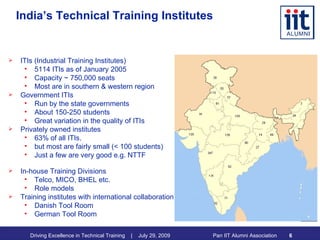
India’s Technical Training Institutes ITIs (Industrial Training Institutes)  5114 ITIs as of January 2005  Capacity ~ 750,000 seats Most are in southern & western region Government ITIs  Run by the state governments About 150-250 students Great variation in the quality of ITIs Privately owned institutes 63% of all ITIs. but most are fairly small (< 100 students) Just a few are very good e.g. NTTF In-house Training Divisions Telco, MICO, BHEL etc. Role models Training institutes with international collaboration Danish Tool Room German Tool Room
India's technical training institutes do not produce highly skilled technicians Employers from the manufacturing sector feel the lack of highly skilled technicians to meet their growing needs Study by CII (Confederation of Indian Industry) & TISS (Tata Institute of Social Sciences) found: Students from ITI’s had “Insufficient Practical Knowledge” Need for “Multi Skilled Workers” is increasing, training has not kept pace with it. Technology changes made by industry outstripped the capacity of most training institutions.
India's technical training institutes   have quality problems rooted in many causes Poor infrastructure  Outdated curriculum Infrequent training of instructors Over-centralization of power with bureaucracy Lack of regular interaction with the industry
What do ITIs need? Management guidance Technical guidance Faculty quality improvement Infrastructure improvement Better utilization of Government funding Suitable curriculum Suitable equipment, Instruments and teaching aids for imparting practical training Close interaction with the industry Introduction of new courses in response to industry needs Periodic update of curriculum and equipment Reputation as premier institutions to attract better quality students and faculty
Current efforts at improving ITI quality U pgradation of ITIs into “the centers of excellence” (CoE) Centrally sponsored scheme for the upgradation of ITIs into “the centers of excellence” (CoE) Select ITIs being ‘upgraded’ currently under a recent scheme of Government of India.  This scheme is to be extended to 500 ITIs. Central Government and World bank funding (Rs. 160 crores) CoE-ITIs have a new framework to facilitate industry participation Managed by Institute Management Committees with industry participation CII and FICCI participation Status of the scheme Implementation varies greatly by the state IMCs already set up in 480 ITIs in 28 States Limited autonomy to IMCs
Current efforts at improving ITI quality Advanced Training Institutes  for Instructors’ training (six institutes around the country) Central Staff Training And Research Institute , Kolkata is the source for teaching aids with German collaboration National Council for Vocational Training  prescribes the curriculum and conducts  All India Trade Tests  to award National Trade Certificates State Council for Vocational Training  conducts trade tests which are not approved by NCVT but are operated by state
Current efforts at improving ITI quality Recommendation by  FICCI  to create a new institutional framework for private participation Create new autonomous organizations at states like universities, with which ITIs should be affiliated Strengthen Private industry linkage with ITIs PanIIT organization  recently made a recommendation to  “Create institutions similar to the IITs but focused on vocational education and highly skilled workers”
Agenda Executive Summary The Problem: Uneven Quality of Technical Training in India India’s Technical Training Institutes Existing Efforts at Quality Improvement Potential role for IIT Alumni “ IITians for ITI ”: Towards Excellence in Technical Training Program Details Project at an ITI Next steps
IITians can give many tangible and intangible inputs to ITIs Global perspective Management advice Mentoring to the Faculty Technical know-how Funding for certain class of expenses Industry and international collaboration Reputation by association
Supporting an ITI will fulfill many needs of an IITian who wants to ‘give back’ to India Fulfillment of personal vision of making a difference to the life of people and institutions in India, and specially to those in their own hometown Opportunity to collaborate with other IIT Alumni towards a long-term shared goal Satisfaction of improving a technical institution of the home-town Satisfaction of mentoring and the resulting growth Recognition for making a contribution
Why should PanIIT Alumni Association get involved? This program fulfills members’ personal vision of making a difference to the life of people and institutions in India. This program will motivate members to contribute passionately as it is aligned with IITians’ core identity and value:  an identity that revolves around excellence in technical/engineering training and education leading to world-class success. pursuit of excellence in our relentless strife for success in all our initiatives This program will channel the energy of IIT Alumni towards preparing ITI students to succeed in today’s global economy. This program will help manufacturing sector of India become globally competitive.
PanIIT Alumni Association is in a position to support the program Influence high level government policy to get the required approvals Ministry of Labour/Directorate of Training Directorate of Training at individual states Collaborate at the highest level with Indian industry CII, FICCI Manufacturing sector, including large manufacturing companies Operationalize the program Develop international collaborations Training institutes (e.g. C&G in UK, ITT in USA) Community colleges in USA Multi-national companies
Agenda Executive Summary The Problem: Uneven Quality of Technical Training in India India’s Technical Training Institutes Existing Efforts at Quality Improvement Potential role for IIT Alumni “ IITians for ITI ” : Towards Excellence in Technical Training Program Details Project at an ITI Next steps
“ IITians for ITI” Program goals The goal of the program is to elevate the quality of ITI by supporting their management and instructors, and by promoting excellence among their students Program envisions a phased approach with initial focus on that subset of ITIs which have the best chances of success being higher up on the quality spectrum. The momentum of this phase will be used for the rest of the ITIs.
“ IITians for ITI”   Scale of the program Long term project spanning over ~15 years Nation wide projects at 100s of ITIs  At its maturity, the program will involve 500 to 3000 Alumni volunteers Scope bigger than what any single IIT Alumni group can accomplish Long term program envisioned to improve ITIs and drive sustainable excellence in India’s vocational training.
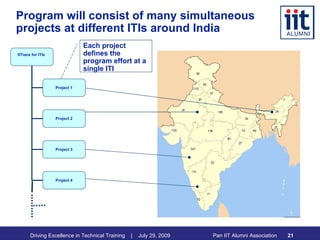
Program will consist of many simultaneous projects at different ITIs around India Each project defines the program effort at a single ITI IITians for ITIs  Project 1 Project 2 Project 3 Project 4
Agenda Executive Summary The Problem: Uneven Quality of Technical Training in India India’s Technical Training Institutes Existing Efforts at Quality Improvement Potential role for IIT Alumni “ IITians for ITI ”: Towards Excellence in Technical Training Program Details Project at an ITI Next steps
What does PanIIT organization need to do to start the program? Form a focus group and seed it with the right group of people Define the program strategy and components Form Coordination Committees Enable the program through high level contact Expand collaboration with Indian industry organizations (CII, FICCI) Enter into MOU with Ministry of Labor Publicize the program Campaign to reach all the Alumni Assoc. chapters and members Provide shared resources for coordination/communications Website/Forums Communication tools such as WebEx/LiveMeeting Conduct pilot projects Invite proposals from Alumni to initiate pilot project at ITIs Start with southern and western region Track pilot projects to completion
What does PanIIT organization need to do to operationalize the program? Support IIT Alumni launch projects at ITIs Interconnect project groups at all the ITIs Facilitate sharing of best practices across all the projects Website/forums/newsletter etc. Coordination among various projects at different ITIs Advisory role to project groups Mentoring in leadership/management Review of proposals/project plans Fundraising for the projects Funding for the operation of groups associated with individual ITIs Sponsorships for the projects (Communication travel, etc.) Involve IIT faculty and workshop instructors as advisors Influence policy at various state governments Influence central government policy
Agenda Executive Summary The Problem: Uneven Quality of Technical Training in India India’s Technical Training Institutes Existing Efforts at Quality Improvement Potential role for IIT Alumni “ IITians for ITI ”: Towards Excellence in Technical Training Program Details Project at an ITI Next steps
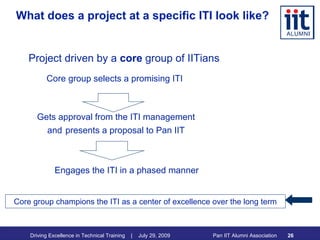
Core group champions the ITI as a center of excellence over the long term What does a project at a specific ITI look like? Project driven by a  core  group of IITians Core group selects a promising ITI Gets approval from the ITI management and   presents a proposal to Pan IIT Engages the ITI in a phased manner
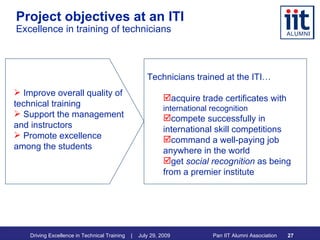
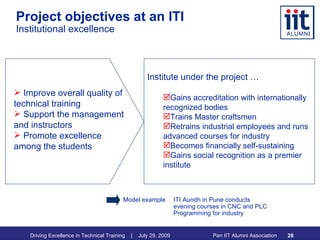
Project objectives at an ITI Excellence in training of technicians Technicians trained at the ITI…  acquire trade certificates with  international recognition compete successfully in international skill competitions command a well-paying job anywhere in the world get  social   recognition  as being from a premier institute Improve overall quality of technical training Support the management and instructors Promote excellence among the students
Project objectives at an ITI Institutional excellence Institute under the project …  Gains accreditation with internationally recognized bodies Trains Master craftsmen Retrains industrial employees and runs advanced courses for industry Becomes financially self-sustaining Gains social recognition as a premier institute Improve overall quality of technical training Support the management and instructors Promote excellence among the students ITI Aundh in Pune conducts  evening courses in CNC and PLC  Programming for industry Model example
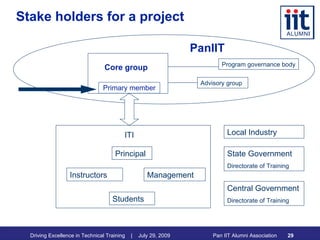
Stake holders for a project ITI Principal Students Instructors Management State Government Directorate of Training Central Government Directorate of Training Local Industry Program governance body Core group PanIIT Advisory group Primary member
Project team Primary member One of the IITians in the core group who is located geographically close to the ITI Working experience in the industry in the sector of excellence Member of the institute’s management committee, especially if the level of support from ITI is limited Direct and regular contact with the ITI Principal of the ITI Main collaborator of the primary member within the ITI Critical role in setting up the project
Project team Core group Consists of 3 or more IITians Supports the primary member in coordination, planning, problem solving, research etc. Periodic teleconference with the primary member Raises and manages funds and sponsorships Manages the excellence promotion and quality improvement components Advisory group Consultants for technical expertise in the domain International group Common resource shared by projects at multiple ITIs
Project Components Quality improvement IIT Alumni to provide guidance and support to the Principal Help align the syllabus with the industry requirements Raise funds for equipment and teaching aids Mentoring IIT Alumni to personally and  remotely  mentor the ITI instructors Scholarships/sponsorships for ITI   instructors Excellence promotion IIT Alumni to sponsor ITI students to participate in the national/international competitions for skill standards and performance benchmarks e.g. WorldSkills Competitions Support for acquiring certificates with international recognition
Project component Quality Improvement Review to identify the needs of the ITI Funds Equipment Teaching aids Part-time instruction Sponsorship of experienced technicians from industry as  instructors
Project component Excellence promotion Sponsor ITI students to participate in the national competitions for skill standards and performance benchmarks Provide ideas for projects Fund student projects Awards for participation and display of excellence Accreditation with international bodies such as C&G Sponsor students to acquire certificates with international recognition WorldSkills Competitions Sponsor the winners of national competitions into international competitions
Project component   Mentoring Primary member as the mentor Selects the instructors to be mentored Direct and regular contact with the instructors Helps sets the instructor’s goals and provides resources Reviews a periodic progress report Incentives for the instructor Scholarships for the instructor Monthly scholarship Scholarship for further training Sponsorship of resources  Personal productivity tools Internet connection CAD systems etc. Tied to continued progress by the instructor
Key success factor:  Level of support from ITI Support from ITIs which are run by state governments depends on many factors Resistance from State government bureaucracy  Management, principal and instructors Support from the local Industry Central government Private ITIs Support from management, principal and instructors Support from local Industry How to increase support? Publicity and education to enhance support Central government support State government approval
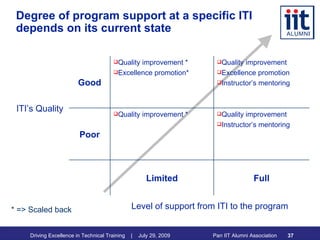
Degree of program support at a specific ITI depends on its current state * => Scaled back Poor Good Level of support from ITI to the program Full Limited Quality improvement Instructor’s mentoring Quality improvement * Quality improvement Excellence promotion Instructor’s mentoring Quality improvement * Excellence promotion* ITI’s Quality
Local PanIIT chapter can play an important role in the success of the project Organize events to support the project team Provide networking opportunities to members of the project teams Personal visits to project ITI by alumni Prepare video reports on visits (&quot;A first hand look at .....&quot;) Organize resources with discipline specific expertise Identify alumni in the industry who can serve on advisory board Identify trainers in the industry who can train the instructors Identify industrial training opportunities for students from the ITIs
Agenda Executive Summary The Problem: Uneven Quality of Technical Training in India India’s Technical Training Institutes Existing Efforts at Quality Improvement Potential role for IIT Alumni “ IITians for ITI ”: Towards Excellence in Technical Training Program Details Next steps
Next steps Seed the Program core team, drawing from members from all IITs to kick start the initial work: Conduct multiple exploratory field and desk research studies , based on a robust study sample, to:  Gain ground level understanding of the ITI quality problem  Seek appropriate input from current stakeholders- ITI principal, instructors, students, administrative and funding agencies, industry etc.  Evolve quality measures and yardsticks to benchmark and rank individual ITIs  (We plan to involve business school students with engineering background and faculty drawn from top-tier Indian business schools in this effort)  Formulate Program strategy : Program vision and mission Program Governance and Administration Program Scope Program Roadmap  Delivery Strategy- phase wise implementation approach with initial focus on ITIs of relatively higher quality
Acknowledgement Primary author:  Atul Mathur (IIT/K B.Tech - Mechanical ’84) . Atul started his career in Telco, Pune, and worked in India for a total of 8 years. Atul is currently working for Autodesk in CAD/CAM software development area and is the primary author of this concept paper. Atul worked on this concept during his sabbatical from Autodesk in 2006. Key contributors Abhijit Bhattacharyya (IIT/K B.Tech - Mechanical ’84) . Abhijit has worked in manufacturing industry in India for  17 years. Abhijit is currently pursuing PhD in manufacturing at University of Florida, Gainsville, FL.  Dr. Seshagiri Rao (IIT/K B.Tech – Chemical ’84), currently a Senior Manager with Accenture. Sesh was earlier Asst. Professor at School of Business, Queen's University. Sources from Indian Industry Yatish Mathur (IIT/K B.Tech – Metallurgical ’84), Delhi, India Sharad Saxena (IIT/K B.Tech - Mechanical ’77), Port Elizabeth, South Africa Rajendra Apashankar (IIT/K B.Tech – Aeronautical ’84), Pune, India Sources from Indian Government (IAS officers) Alok Tandon (IIT/K B.Tech – Electrical ’84) Alok is currently pursuing PhD at UC SD, CA. Alok was earlier Personal Secretary to Minister of Human Resources Development, Government of India. Prakash Kumar (IIT/K B.Tech – Electrical ’84) Prakash is currently Joint Secretary of Ocean Development. Till recently, he was Secretary of Technical Education for Delhi  Ajay Kumar (IIT/K B.Tech – Electrical ’84) Ajay is currently pursuing PhD at University of Minnesota. Advisors Nishith Mathur (IIT/D B.Tech – Mechanical ’84)  Harsh Arora (IIT/D B.Tech – Chemical ’74) Dr. Piyush Kumar (IIT/K B.Tech – Mechanical ’84) Dhiraj Goswami  (IIT/K B.Tech – Electrical ’94) This paper is dedicated to  the Master Craftsmen trained at Training Division, Telco, Pune.

PanIIT_Alumni_Driving_Excellence_in_Technical_Training_v8.3

  • 1.
    “ IITians forITI” Driving Excellence in Technical Training A PanIIT Program for improving technical training quality in India’s Industrial Training Institutes (ITI’s) PanIIT Alumni Association Atul Mathur (IIT/K-B.Tech-1984) PanIIT Pacific Northwest Chapter November 2006
  • 2.
    Agenda Executive SummaryThe Problem: Uneven Quality of Technical Training in India India’s Technical Training Institutes Existing Efforts at Quality Improvement Potential role for IIT Alumni “ IITians for ITI”: Towards Excellence in Technical Training Program Details Project at an ITI Next steps
  • 3.
    Executive Summary IndustrialTraining Institutes ( ITIs ) are mandated to train India’s vast technical workforce needed for her ever growing industry. There is growing concern about the quality of training imparted in these institutions owing to the problems with the curricula, infrastructure, instruction quality and other issues, including lack of collaborative effort with industry. India urgently needs her ITIs to produce quality technicians for global competitiveness. Towards this objective of improving the ITIs, a number of IITian’s, led by Atul Mathur, have studied the problem at a high level. The outcome is the birth of “ IITians for ITI ”, a Program envisioned to improve ITIs and drive sustainable excellence in India’s vocational training. The PanIIT Organization is uniquely placed to actively help transform India’s ITIs. PanIIT will provide the platform to formulate and implement the Program, which is being designed to afford opportunities for several IITians to participate, from India and the world over.
  • 4.
    Executive Summary-Cont’d Thisconcept paper sets out the Program vision, its objectives and outlines the next steps. It helps gain a good understanding of the issues at hand and explains how the many diverse strengths of PanIIT can be effectively leveraged for realizing the Program goals. It also paves the way for further studies and engagements to define and finalize various components of the Program, including its implementation strategy. The Program is predicated on the active involvement of IIT alumni around the world in one or more of the hundreds of ITI across the nation. IIT alumni located locally will reach out to the ITIs. They will work at mentoring an Institute’s principal, its instructors and will liaise with the local industry. IIT alumni located remotely will work on program administration, governance and monitoring. To promote excellence, PanIIT members worldwide will financially contribute for instructor training and student scholarships. PanIIT organization will work with government agencies and industry associations to clear roadblocks and solicit support. All in all, the Program calls for collective team effort and aims to appeal to every IITians’ core value and identity: Pursuit of excellence in our relentless strife for success in all our initiatives Excellence in technical/engineering training and education
  • 5.
    Agenda Executive SummaryThe Problem: Uneven Quality of Technical Training in India India’s Technical Training Institutes Existing Efforts at Quality Improvement Potential role for IIT Alumni “ IITians for ITI ”: Towards Excellence in Technical Training Program Details Project at an ITI Next steps
  • 6.
    India’s Technical TrainingInstitutes ITIs (Industrial Training Institutes) 5114 ITIs as of January 2005 Capacity ~ 750,000 seats Most are in southern & western region Government ITIs Run by the state governments About 150-250 students Great variation in the quality of ITIs Privately owned institutes 63% of all ITIs. but most are fairly small (< 100 students) Just a few are very good e.g. NTTF In-house Training Divisions Telco, MICO, BHEL etc. Role models Training institutes with international collaboration Danish Tool Room German Tool Room
  • 7.
    India's technical traininginstitutes do not produce highly skilled technicians Employers from the manufacturing sector feel the lack of highly skilled technicians to meet their growing needs Study by CII (Confederation of Indian Industry) & TISS (Tata Institute of Social Sciences) found: Students from ITI’s had “Insufficient Practical Knowledge” Need for “Multi Skilled Workers” is increasing, training has not kept pace with it. Technology changes made by industry outstripped the capacity of most training institutions.
  • 8.
    India's technical traininginstitutes have quality problems rooted in many causes Poor infrastructure Outdated curriculum Infrequent training of instructors Over-centralization of power with bureaucracy Lack of regular interaction with the industry
  • 9.
    What do ITIsneed? Management guidance Technical guidance Faculty quality improvement Infrastructure improvement Better utilization of Government funding Suitable curriculum Suitable equipment, Instruments and teaching aids for imparting practical training Close interaction with the industry Introduction of new courses in response to industry needs Periodic update of curriculum and equipment Reputation as premier institutions to attract better quality students and faculty
  • 10.
    Current efforts atimproving ITI quality U pgradation of ITIs into “the centers of excellence” (CoE) Centrally sponsored scheme for the upgradation of ITIs into “the centers of excellence” (CoE) Select ITIs being ‘upgraded’ currently under a recent scheme of Government of India. This scheme is to be extended to 500 ITIs. Central Government and World bank funding (Rs. 160 crores) CoE-ITIs have a new framework to facilitate industry participation Managed by Institute Management Committees with industry participation CII and FICCI participation Status of the scheme Implementation varies greatly by the state IMCs already set up in 480 ITIs in 28 States Limited autonomy to IMCs
  • 11.
    Current efforts atimproving ITI quality Advanced Training Institutes for Instructors’ training (six institutes around the country) Central Staff Training And Research Institute , Kolkata is the source for teaching aids with German collaboration National Council for Vocational Training prescribes the curriculum and conducts All India Trade Tests to award National Trade Certificates State Council for Vocational Training conducts trade tests which are not approved by NCVT but are operated by state
  • 12.
    Current efforts atimproving ITI quality Recommendation by FICCI to create a new institutional framework for private participation Create new autonomous organizations at states like universities, with which ITIs should be affiliated Strengthen Private industry linkage with ITIs PanIIT organization recently made a recommendation to “Create institutions similar to the IITs but focused on vocational education and highly skilled workers”
  • 13.
    Agenda Executive SummaryThe Problem: Uneven Quality of Technical Training in India India’s Technical Training Institutes Existing Efforts at Quality Improvement Potential role for IIT Alumni “ IITians for ITI ”: Towards Excellence in Technical Training Program Details Project at an ITI Next steps
  • 14.
    IITians can givemany tangible and intangible inputs to ITIs Global perspective Management advice Mentoring to the Faculty Technical know-how Funding for certain class of expenses Industry and international collaboration Reputation by association
  • 15.
    Supporting an ITIwill fulfill many needs of an IITian who wants to ‘give back’ to India Fulfillment of personal vision of making a difference to the life of people and institutions in India, and specially to those in their own hometown Opportunity to collaborate with other IIT Alumni towards a long-term shared goal Satisfaction of improving a technical institution of the home-town Satisfaction of mentoring and the resulting growth Recognition for making a contribution
  • 16.
    Why should PanIITAlumni Association get involved? This program fulfills members’ personal vision of making a difference to the life of people and institutions in India. This program will motivate members to contribute passionately as it is aligned with IITians’ core identity and value: an identity that revolves around excellence in technical/engineering training and education leading to world-class success. pursuit of excellence in our relentless strife for success in all our initiatives This program will channel the energy of IIT Alumni towards preparing ITI students to succeed in today’s global economy. This program will help manufacturing sector of India become globally competitive.
  • 17.
    PanIIT Alumni Associationis in a position to support the program Influence high level government policy to get the required approvals Ministry of Labour/Directorate of Training Directorate of Training at individual states Collaborate at the highest level with Indian industry CII, FICCI Manufacturing sector, including large manufacturing companies Operationalize the program Develop international collaborations Training institutes (e.g. C&G in UK, ITT in USA) Community colleges in USA Multi-national companies
  • 18.
    Agenda Executive SummaryThe Problem: Uneven Quality of Technical Training in India India’s Technical Training Institutes Existing Efforts at Quality Improvement Potential role for IIT Alumni “ IITians for ITI ” : Towards Excellence in Technical Training Program Details Project at an ITI Next steps
  • 19.
    “ IITians forITI” Program goals The goal of the program is to elevate the quality of ITI by supporting their management and instructors, and by promoting excellence among their students Program envisions a phased approach with initial focus on that subset of ITIs which have the best chances of success being higher up on the quality spectrum. The momentum of this phase will be used for the rest of the ITIs.
  • 20.
    “ IITians forITI” Scale of the program Long term project spanning over ~15 years Nation wide projects at 100s of ITIs At its maturity, the program will involve 500 to 3000 Alumni volunteers Scope bigger than what any single IIT Alumni group can accomplish Long term program envisioned to improve ITIs and drive sustainable excellence in India’s vocational training.
  • 21.
    Program will consistof many simultaneous projects at different ITIs around India Each project defines the program effort at a single ITI IITians for ITIs Project 1 Project 2 Project 3 Project 4
  • 22.
    Agenda Executive SummaryThe Problem: Uneven Quality of Technical Training in India India’s Technical Training Institutes Existing Efforts at Quality Improvement Potential role for IIT Alumni “ IITians for ITI ”: Towards Excellence in Technical Training Program Details Project at an ITI Next steps
  • 23.
    What does PanIITorganization need to do to start the program? Form a focus group and seed it with the right group of people Define the program strategy and components Form Coordination Committees Enable the program through high level contact Expand collaboration with Indian industry organizations (CII, FICCI) Enter into MOU with Ministry of Labor Publicize the program Campaign to reach all the Alumni Assoc. chapters and members Provide shared resources for coordination/communications Website/Forums Communication tools such as WebEx/LiveMeeting Conduct pilot projects Invite proposals from Alumni to initiate pilot project at ITIs Start with southern and western region Track pilot projects to completion
  • 24.
    What does PanIITorganization need to do to operationalize the program? Support IIT Alumni launch projects at ITIs Interconnect project groups at all the ITIs Facilitate sharing of best practices across all the projects Website/forums/newsletter etc. Coordination among various projects at different ITIs Advisory role to project groups Mentoring in leadership/management Review of proposals/project plans Fundraising for the projects Funding for the operation of groups associated with individual ITIs Sponsorships for the projects (Communication travel, etc.) Involve IIT faculty and workshop instructors as advisors Influence policy at various state governments Influence central government policy
  • 25.
    Agenda Executive SummaryThe Problem: Uneven Quality of Technical Training in India India’s Technical Training Institutes Existing Efforts at Quality Improvement Potential role for IIT Alumni “ IITians for ITI ”: Towards Excellence in Technical Training Program Details Project at an ITI Next steps
  • 26.
    Core group championsthe ITI as a center of excellence over the long term What does a project at a specific ITI look like? Project driven by a core group of IITians Core group selects a promising ITI Gets approval from the ITI management and presents a proposal to Pan IIT Engages the ITI in a phased manner
  • 27.
    Project objectives atan ITI Excellence in training of technicians Technicians trained at the ITI… acquire trade certificates with international recognition compete successfully in international skill competitions command a well-paying job anywhere in the world get social recognition as being from a premier institute Improve overall quality of technical training Support the management and instructors Promote excellence among the students
  • 28.
    Project objectives atan ITI Institutional excellence Institute under the project … Gains accreditation with internationally recognized bodies Trains Master craftsmen Retrains industrial employees and runs advanced courses for industry Becomes financially self-sustaining Gains social recognition as a premier institute Improve overall quality of technical training Support the management and instructors Promote excellence among the students ITI Aundh in Pune conducts evening courses in CNC and PLC Programming for industry Model example
  • 29.
    Stake holders fora project ITI Principal Students Instructors Management State Government Directorate of Training Central Government Directorate of Training Local Industry Program governance body Core group PanIIT Advisory group Primary member
  • 30.
    Project team Primarymember One of the IITians in the core group who is located geographically close to the ITI Working experience in the industry in the sector of excellence Member of the institute’s management committee, especially if the level of support from ITI is limited Direct and regular contact with the ITI Principal of the ITI Main collaborator of the primary member within the ITI Critical role in setting up the project
  • 31.
    Project team Coregroup Consists of 3 or more IITians Supports the primary member in coordination, planning, problem solving, research etc. Periodic teleconference with the primary member Raises and manages funds and sponsorships Manages the excellence promotion and quality improvement components Advisory group Consultants for technical expertise in the domain International group Common resource shared by projects at multiple ITIs
  • 32.
    Project Components Qualityimprovement IIT Alumni to provide guidance and support to the Principal Help align the syllabus with the industry requirements Raise funds for equipment and teaching aids Mentoring IIT Alumni to personally and remotely mentor the ITI instructors Scholarships/sponsorships for ITI instructors Excellence promotion IIT Alumni to sponsor ITI students to participate in the national/international competitions for skill standards and performance benchmarks e.g. WorldSkills Competitions Support for acquiring certificates with international recognition
  • 33.
    Project component QualityImprovement Review to identify the needs of the ITI Funds Equipment Teaching aids Part-time instruction Sponsorship of experienced technicians from industry as instructors
  • 34.
    Project component Excellencepromotion Sponsor ITI students to participate in the national competitions for skill standards and performance benchmarks Provide ideas for projects Fund student projects Awards for participation and display of excellence Accreditation with international bodies such as C&G Sponsor students to acquire certificates with international recognition WorldSkills Competitions Sponsor the winners of national competitions into international competitions
  • 35.
    Project component Mentoring Primary member as the mentor Selects the instructors to be mentored Direct and regular contact with the instructors Helps sets the instructor’s goals and provides resources Reviews a periodic progress report Incentives for the instructor Scholarships for the instructor Monthly scholarship Scholarship for further training Sponsorship of resources Personal productivity tools Internet connection CAD systems etc. Tied to continued progress by the instructor
  • 36.
    Key success factor: Level of support from ITI Support from ITIs which are run by state governments depends on many factors Resistance from State government bureaucracy Management, principal and instructors Support from the local Industry Central government Private ITIs Support from management, principal and instructors Support from local Industry How to increase support? Publicity and education to enhance support Central government support State government approval
  • 37.
    Degree of programsupport at a specific ITI depends on its current state * => Scaled back Poor Good Level of support from ITI to the program Full Limited Quality improvement Instructor’s mentoring Quality improvement * Quality improvement Excellence promotion Instructor’s mentoring Quality improvement * Excellence promotion* ITI’s Quality
  • 38.
    Local PanIIT chaptercan play an important role in the success of the project Organize events to support the project team Provide networking opportunities to members of the project teams Personal visits to project ITI by alumni Prepare video reports on visits (&quot;A first hand look at .....&quot;) Organize resources with discipline specific expertise Identify alumni in the industry who can serve on advisory board Identify trainers in the industry who can train the instructors Identify industrial training opportunities for students from the ITIs
  • 39.
    Agenda Executive SummaryThe Problem: Uneven Quality of Technical Training in India India’s Technical Training Institutes Existing Efforts at Quality Improvement Potential role for IIT Alumni “ IITians for ITI ”: Towards Excellence in Technical Training Program Details Next steps
  • 40.
    Next steps Seedthe Program core team, drawing from members from all IITs to kick start the initial work: Conduct multiple exploratory field and desk research studies , based on a robust study sample, to: Gain ground level understanding of the ITI quality problem Seek appropriate input from current stakeholders- ITI principal, instructors, students, administrative and funding agencies, industry etc. Evolve quality measures and yardsticks to benchmark and rank individual ITIs (We plan to involve business school students with engineering background and faculty drawn from top-tier Indian business schools in this effort) Formulate Program strategy : Program vision and mission Program Governance and Administration Program Scope Program Roadmap Delivery Strategy- phase wise implementation approach with initial focus on ITIs of relatively higher quality
  • 41.
    Acknowledgement Primary author: Atul Mathur (IIT/K B.Tech - Mechanical ’84) . Atul started his career in Telco, Pune, and worked in India for a total of 8 years. Atul is currently working for Autodesk in CAD/CAM software development area and is the primary author of this concept paper. Atul worked on this concept during his sabbatical from Autodesk in 2006. Key contributors Abhijit Bhattacharyya (IIT/K B.Tech - Mechanical ’84) . Abhijit has worked in manufacturing industry in India for 17 years. Abhijit is currently pursuing PhD in manufacturing at University of Florida, Gainsville, FL. Dr. Seshagiri Rao (IIT/K B.Tech – Chemical ’84), currently a Senior Manager with Accenture. Sesh was earlier Asst. Professor at School of Business, Queen's University. Sources from Indian Industry Yatish Mathur (IIT/K B.Tech – Metallurgical ’84), Delhi, India Sharad Saxena (IIT/K B.Tech - Mechanical ’77), Port Elizabeth, South Africa Rajendra Apashankar (IIT/K B.Tech – Aeronautical ’84), Pune, India Sources from Indian Government (IAS officers) Alok Tandon (IIT/K B.Tech – Electrical ’84) Alok is currently pursuing PhD at UC SD, CA. Alok was earlier Personal Secretary to Minister of Human Resources Development, Government of India. Prakash Kumar (IIT/K B.Tech – Electrical ’84) Prakash is currently Joint Secretary of Ocean Development. Till recently, he was Secretary of Technical Education for Delhi Ajay Kumar (IIT/K B.Tech – Electrical ’84) Ajay is currently pursuing PhD at University of Minnesota. Advisors Nishith Mathur (IIT/D B.Tech – Mechanical ’84) Harsh Arora (IIT/D B.Tech – Chemical ’74) Dr. Piyush Kumar (IIT/K B.Tech – Mechanical ’84) Dhiraj Goswami (IIT/K B.Tech – Electrical ’94) This paper is dedicated to the Master Craftsmen trained at Training Division, Telco, Pune.

Editor's Notes

  • #2 About this document: The initial idea of the project came from the letter written by PanIIT board in response to the reservation issue. This concept paper has a great deal input from a number of IIT Alumni. Special thanks are due to Mohan Venkataramana (IIT/M B.Tech Chemical ’74) who created the platform of PNW chapter for presenting the proposal. Revision history: Revision#7: Current revision Revision#6: Oct 14 th Updated after input from Dr. Sesh Rao and review by Dr. Sanjay Kumar and Sharad Saxena. Revision#5: Oct 10 th Restructured after review by Dr. Sesh Rao and Dr. Piyush Kumar Revision#4: Oct 8 th Reformatted after review by Harsh Arora Revision#3: Oct 5th Updated after review by Yatish Mathur, Dhiraj Goswami, Rajendra Apashankar and Prakash Kumar Revision#2: Oct 1st Updated after review by Alok Tandon. Revision#1: Sept 25th Updated after another review by Abhijit Bhattacharayya. Draft#3: Sept 21st Updated after review by Abhijit Bhattacharayya. Draft#2: Sept 13 th Updated after review by Nishith Mathur and Sharad Saxena. Initial draft: Sept 7 th Prepared with inputs from Yatish Mathur and Rajendra Apashankar.