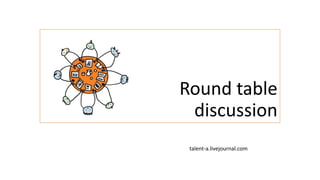
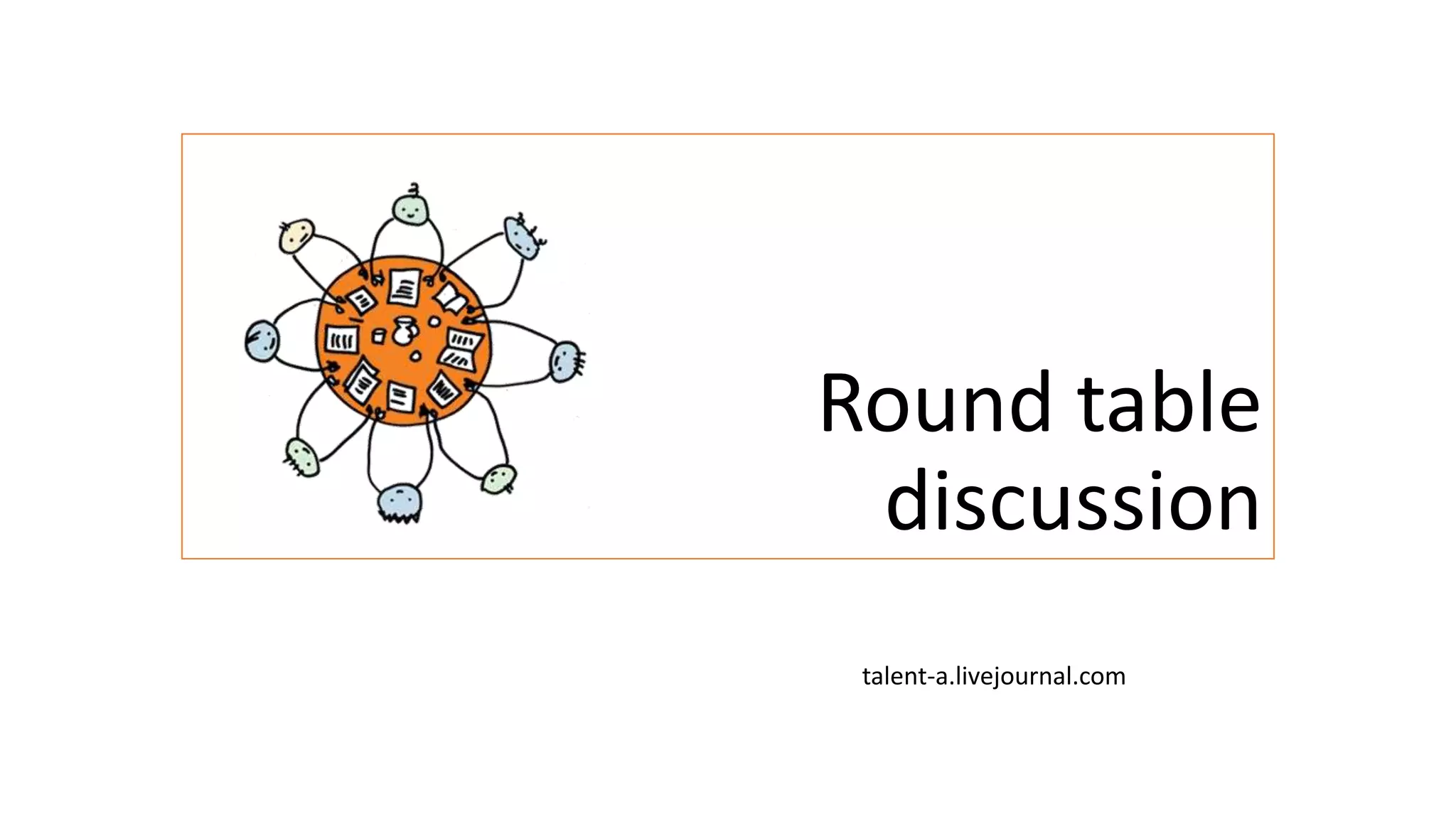
Round table 
discussion 
talent-a.livejournal.com
Why appropriate 
• Unique opportunity for learning and professional exchange 
• Good for networking and in-depth discussion on a particular topic 
• Look at an issue from different points of view 
• Excellent venues for getting targeted feedback, engaging in in-depth 
discussions, and meeting colleagues with similar interests 
• Built upon the idea that every member has something to contribute, 
and that every member has something to learn 
• Personified opinion and polyphonic setting 
• Intended to lead to action and change
Basic requirements 
1. unresolved question; 
2. equal participation of all stakeholders; 
3. to develop appropriate solutions for all participants on the subject 
under discussion.
Preparation: 
• Select a topic 
• Distribute roles (moderator, note-taker, time-keeper, etc). 
• Agree on agenda: set time-limits, prepare a list of up to 15 sub-questions 
• Prepare a list of resources for reading before the round table, to keep 
vocabulary range and to ensure high level of topic awareness 
• Ensure technical equipment and proper setting
Visual aids 
Round tables often do not have traditional audio-visual aids available, 
but roundtable presenters might bring handouts illustrating their work: 
• a) key lessons to be learned, 
• b) a list of resources (web links, books, people) to learn more, 
• c) contacts to encourage follow-up.
Moderator/facilitator role 
• Set expectations 
• Move the group toward consensus on agenda items to be discussed 
• Engage all group members in the discussion 
• Guide discussion: Challenge thinking, share ideas, restate ideas 
• Summarize and conclude discussion
Participants role 
• Be ready to discuss an issue (topic), aiming for solutions. 
• Have certain opinion, knowledge and experience relevant for the 
topic. 
• Participate effectively: 
 Stay focused, be active listener 
Actively engage in discussion, build links between sub-questions 
 Feel free to share an illustration 
 Request an example if a point is not clear 
 Be skeptical – don’t buy everything you hear
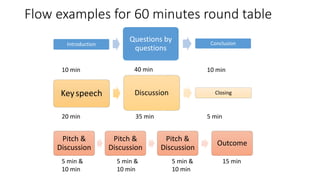
Flow examples for 60 minutes round table 
Introduction 
Questions by 
questions 
Conclusion 
10 min 
40 min 10 min 
Key speech Discussion Closing 
Pitch & 
Discussion 
Pitch & 
Discussion 
Pitch & 
Discussion 
Outcome 
20 min 
5 min & 
10 min 
5 min & 
10 min 
5 min & 
10 min 
15 min 
35 min 5 min
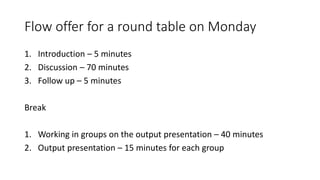
Flow offer for a round table on Monday 
1. Introduction – 5 minutes 
2. Discussion – 70 minutes 
3. Follow up – 5 minutes 
Break 
1. Working in groups on the output presentation – 40 minutes 
2. Output presentation – 15 minutes for each group

Round tables

  • 1.
    Round table discussion talent-a.livejournal.com
  • 2.
    Why appropriate •Unique opportunity for learning and professional exchange • Good for networking and in-depth discussion on a particular topic • Look at an issue from different points of view • Excellent venues for getting targeted feedback, engaging in in-depth discussions, and meeting colleagues with similar interests • Built upon the idea that every member has something to contribute, and that every member has something to learn • Personified opinion and polyphonic setting • Intended to lead to action and change
  • 3.
    Basic requirements 1.unresolved question; 2. equal participation of all stakeholders; 3. to develop appropriate solutions for all participants on the subject under discussion.
  • 4.
    Preparation: • Selecta topic • Distribute roles (moderator, note-taker, time-keeper, etc). • Agree on agenda: set time-limits, prepare a list of up to 15 sub-questions • Prepare a list of resources for reading before the round table, to keep vocabulary range and to ensure high level of topic awareness • Ensure technical equipment and proper setting
  • 5.
    Visual aids Roundtables often do not have traditional audio-visual aids available, but roundtable presenters might bring handouts illustrating their work: • a) key lessons to be learned, • b) a list of resources (web links, books, people) to learn more, • c) contacts to encourage follow-up.
  • 6.
    Moderator/facilitator role •Set expectations • Move the group toward consensus on agenda items to be discussed • Engage all group members in the discussion • Guide discussion: Challenge thinking, share ideas, restate ideas • Summarize and conclude discussion
  • 7.
    Participants role •Be ready to discuss an issue (topic), aiming for solutions. • Have certain opinion, knowledge and experience relevant for the topic. • Participate effectively:  Stay focused, be active listener Actively engage in discussion, build links between sub-questions  Feel free to share an illustration  Request an example if a point is not clear  Be skeptical – don’t buy everything you hear
  • 8.
    Flow examples for60 minutes round table Introduction Questions by questions Conclusion 10 min 40 min 10 min Key speech Discussion Closing Pitch & Discussion Pitch & Discussion Pitch & Discussion Outcome 20 min 5 min & 10 min 5 min & 10 min 5 min & 10 min 15 min 35 min 5 min
  • 9.
    Flow offer fora round table on Monday 1. Introduction – 5 minutes 2. Discussion – 70 minutes 3. Follow up – 5 minutes Break 1. Working in groups on the output presentation – 40 minutes 2. Output presentation – 15 minutes for each group