Download to read offline
![What is a Roundtable Discussion?
A roundtable discussion allows extensive discussion and feedback for the presenter in a more
informal way than a presentation. Presenters are usually referred to as “facilitators” and only
provide brief handouts (usually a one-page printout of key points and possibly some questions)
because the emphasis is on the discussion itself, rather than a formal presentation. The goal is
to get everyone involved and participating in the discussion.
Key qualities of a roundtable discussion:
• Informal
• Emphasis on discussion
• Audience plays an active role
There are many different structures for roundtable discussions. One effective way to begin is
by asking each participant, “If you could have one answer about [roundtable topic] that would
help you understand it better, what would it be?” This method helps narrow the topic in a way
that is most important to your audience. It helps prioritize the roundtable’s discussion.
Sample structure for a roundtable discussion:
• Introduction: who you are, why you’re here.
• Participant introduction: name, school/organization, their interest/expectations for the
roundtable discussion topic
• Topic introduction: what will you be speaking about; tell the participants what you will tell
them during your presentation
• Main points: communicate the main ideas and sub-ideas
• Discussion: this will be the bulk of the time and is discussed in more detail below
• Review: tell the table what you’ve just covered; summarize main points
• Conclusion: thank participants for attending and engaging in the discussion; let them know
ORTESOL will follow-up on each discussion and make notes available for ORTESOL
members.**
ORTESOL Spring Workshop:
April 30, Oregon State University](https://image.slidesharecdn.com/ortesolroundtabletips-160316201413/85/Ortesol-roundtable-tips-1-320.jpg)
![What is a Roundtable Discussion?
A roundtable discussion allows extensive discussion and feedback for the presenter in a more
informal way than a presentation. Presenters are usually referred to as “facilitators” and only
provide brief handouts (usually a one-page printout of key points and possibly some questions)
because the emphasis is on the discussion itself, rather than a formal presentation. The goal is
to get everyone involved and participating in the discussion.
Key qualities of a roundtable discussion:
• Informal
• Emphasis on discussion
• Audience plays an active role
There are many different structures for roundtable discussions. One effective way to begin is
by asking each participant, “If you could have one answer about [roundtable topic] that would
help you understand it better, what would it be?” This method helps narrow the topic in a way
that is most important to your audience. It helps prioritize the roundtable’s discussion.
Sample structure for a roundtable discussion:
• Introduction: who you are, why you’re here.
• Participant introduction: name, school/organization, their interest/expectations for the
roundtable discussion topic
• Topic introduction: what will you be speaking about; tell the participants what you will tell
them during your presentation
• Main points: communicate the main ideas and sub-ideas
• Discussion: this will be the bulk of the time and is discussed in more detail below
• Review: tell the table what you’ve just covered; summarize main points
• Conclusion: thank participants for attending and engaging in the discussion; let them know
ORTESOL will follow-up on each discussion and make notes available for ORTESOL
members.**
ORTESOL Spring Workshop:
April 30, Oregon State University](https://image.slidesharecdn.com/ortesolroundtabletips-160316201413/75/Ortesol-roundtable-tips-1-2048.jpg)
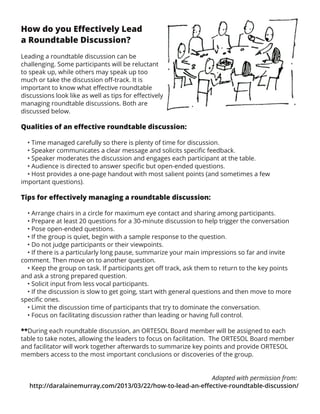

A roundtable discussion is an informal discussion led by a facilitator, with an emphasis on audience participation over presentations. The facilitator provides brief introductions and discussion questions to guide conversation among all participants. An effective roundtable has careful time management, clear messaging from the facilitator, and engagement of all attendees. The facilitator must moderate discussion, direct questions to the group, and ensure all perspectives are heard.


