1
PRESENTATION
SKILLS
2
Presentation Skills
Ideas, concepts or issues talked about or spoken
to a group or audience
Public speaking is one of the most feared things
“I could make such a fool of myself”
Skills required to give a good presentation can
be developed
Preparation is the Key
3
Outline
• General Guidelines
• Slide Do’s and Don’ts
− Handouts
− Powerpoint Navigation
• Delivery Do’s and Don’ts
− How to Handle Questions
• Final Thoughts
4
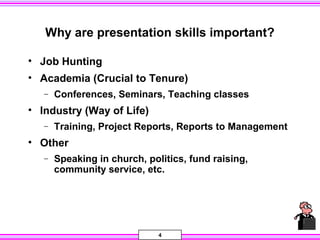
Why are presentation skills important?
• Job Hunting
• Academia (Crucial to Tenure)
− Conferences, Seminars, Teaching classes
• Industry (Way of Life)
− Training, Project Reports, Reports to Management
• Other
− Speaking in church, politics, fund raising,
community service, etc.
5
General Guidelines
A good presentation is a
“POPTA” presentation
What does POPTA stand for?
6
General Guidelines
• Purpose
− You need to define your purpose for giving
the presentation
> Teach, Persuade, Prove, Review, Expository,
Impress, Put to Sleep, Entertain?
− Often your goal is a high level overview,
even for a technical presentation
− Don’t tell them everything you did, you’ll
bore them
7
General Guidelines
• Organization
− Always have an outline
− Tell them what you’re going to tell them,
then tell them, then tell them what you told
them
> Hint: I am doing this for this presentation
− Problem then solution
> Not just “data then solution” or “solution
then problem”
8
General Guidelines
• Preparation
− An unprepared presenter loses the
audience before even starting
− Practice makes perfect and builds
confidence
− Arrive early, make sure everything is set
up
− Dress appropriately
> Better to dress up than down
− Slides should be done well in advance
9
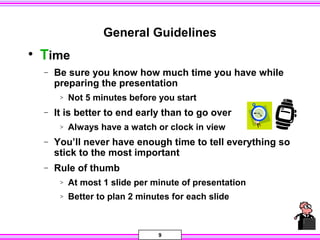
General Guidelines
• Time
− Be sure you know how much time you have while
preparing the presentation
> Not 5 minutes before you start
− It is better to end early than to go over
> Always have a watch or clock in view
− You’ll never have enough time to tell everything so
stick to the most important
− Rule of thumb
> At most 1 slide per minute of presentation
> Better to plan 2 minutes for each slide
10
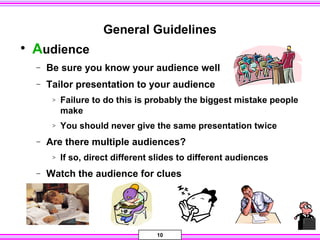
General Guidelines
• Audience
− Be sure you know your audience well
− Tailor presentation to your audience
> Failure to do this is probably the biggest mistake people
make
> You should never give the same presentation twice
− Are there multiple audiences?
> If so, direct different slides to different audiences
− Watch the audience for clues
11
Slide Do’s and Don’ts
• “PowerPoint doesn’t give presentations –
PowerPoint makes slides”
− From microsoft.com website
• Your comments should be more compelling
than the slides
• You shouldn’t put everything on the slide
− K.I.S.S. Principle
12
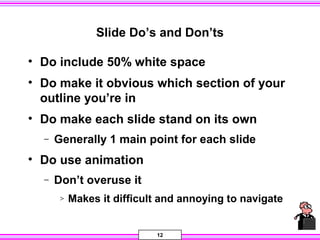
Slide Do’s and Don’ts
• Do include 50% white space
• Do make it obvious which section of your
outline you’re in
• Do make each slide stand on its own
− Generally 1 main point for each slide
• Do use animation
− Don’t overuse it
> Makes it difficult and annoying to navigate
13
Slide Do’s and Don’ts
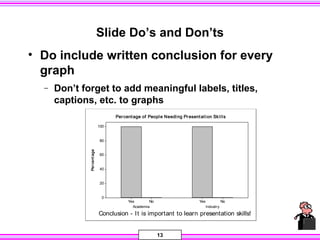
• Do include written conclusion for every
graph
− Don’t forget to add meaningful labels, titles,
captions, etc. to graphs
Percentage
IndustryAcademia
NoYesNoYes
100
80
60
40
20
0
Percentage of People Needing Presentation Skills
Conclusion - It is important to learn presentation skills!
14
Slide Do’s and Don’ts
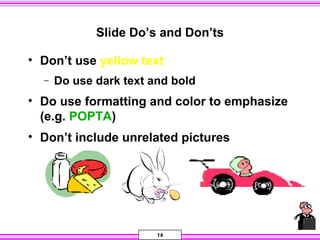
• Don’t use yellow text
− Do use dark text and bold
• Do use formatting and color to emphasize
(e.g. POPTA)
• Don’t include unrelated pictures
15
Slide Do’s and Don’ts
• Don’t include periods at the end of a
bullet.
• Don’t do proofs
• Do include a journal name with a
reference
− Jensen, Jones-Farmer, Champ, and Woodall (2006,
Journal of Quality Technology)
16
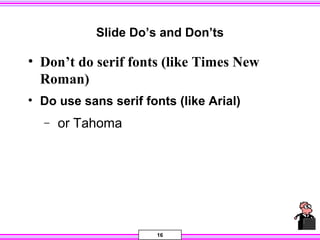
Slide Do’s and Don’ts
• Don’t do serif fonts (like Times New
Roman)
• Do use sans serif fonts (like Arial)
− or Tahoma
17
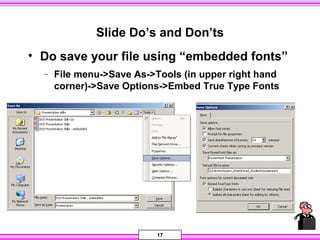
Slide Do’s and Don’ts
• Do save your file using “embedded fonts”
− File menu->Save As->Tools (in upper right hand
corner)->Save Options->Embed True Type Fonts
18
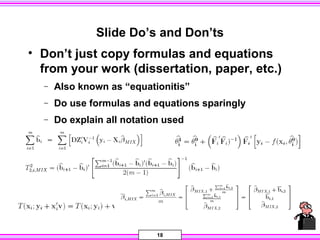
Slide Do’s and Don’ts
• Don’t just copy formulas and equations
from your work (dissertation, paper, etc.)
− Also known as “equationitis”
− Do use formulas and equations sparingly
− Do explain all notation used
19
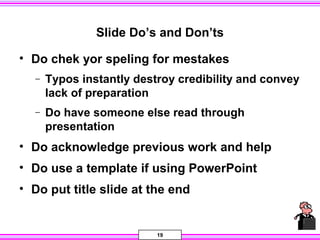
Slide Do’s and Don’ts
• Do chek yor speling for mestakes
− Typos instantly destroy credibility and convey
lack of preparation
− Do have someone else read through
presentation
• Do acknowledge previous work and help
• Do use a template if using PowerPoint
• Do put title slide at the end
20
Slide Do’s and Don’ts
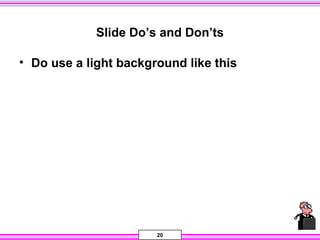
• Do use a light background like this
21
Slide Do’s and Don’ts
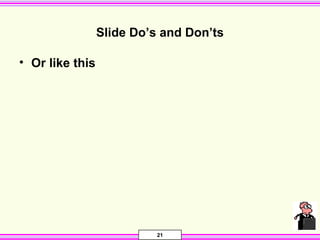
• Or like this
22
Slide Do’s and Don’ts
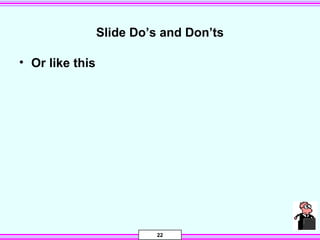
• Or like this
23
Slide Do’s and Don’ts
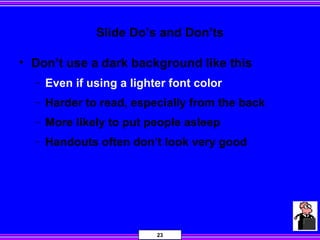
• Don’t use a dark background like this
− Even if using a lighter font color
− Harder to read, especially from the back
− More likely to put people asleep
− Handouts often don’t look very good
24
Slide Do’s and Don’ts
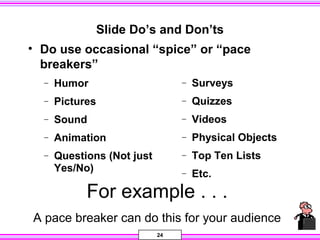
• Do use occasional “spice” or “pace
breakers”
− Humor
− Pictures
− Sound
− Animation
− Questions (Not just
Yes/No)
− Surveys
− Quizzes
− Videos
− Physical Objects
− Top Ten Lists
− Etc.
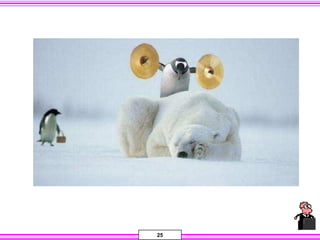
For example . . .
A pace breaker can do this for your audience
25
26
Handouts
• Use them if they help achieve your
objective
− Especially for technical presentations
− Greatly increases retention
• Often best to pass out at the end
− You want to keep the audience engaged
27
Navigation in PowerPoint
• Always go through your presentation in
slide show mode before giving it
− Multiple times
• Use keyboard short cuts, not the mouse
• F1 (in slide show mode)
− To bring up the list of all shortcut keys
(Escape to hide the list)
− Use this while practicing to help you learn
the navigation
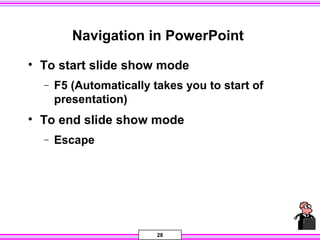
28
Navigation in PowerPoint
• To start slide show mode
− F5 (Automatically takes you to start of
presentation)
• To end slide show mode
− Escape
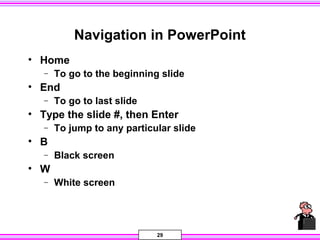
29
Navigation in PowerPoint
• Home
− To go to the beginning slide
• End
− To go to last slide
• Type the slide #, then Enter
− To jump to any particular slide
• B
− Black screen
• W
− White screen
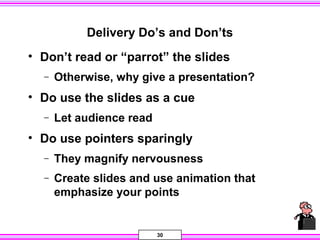
30
Delivery Do’s and Don’ts
• Don’t read or “parrot” the slides
− Otherwise, why give a presentation?
• Do use the slides as a cue
− Let audience read
• Do use pointers sparingly
− They magnify nervousness
− Create slides and use animation that
emphasize your points
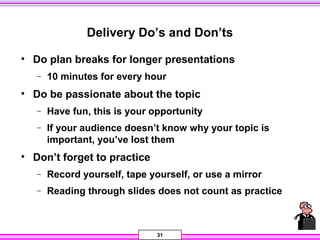
31
Delivery Do’s and Don’ts
• Do plan breaks for longer presentations
− 10 minutes for every hour
• Do be passionate about the topic
− Have fun, this is your opportunity
− If your audience doesn’t know why your topic is
important, you’ve lost them
• Don’t forget to practice
− Record yourself, tape yourself, or use a mirror
− Reading through slides does not count as practice
32
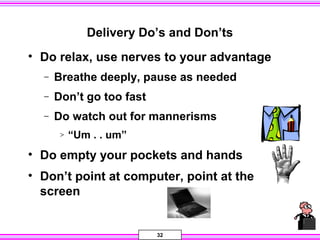
Delivery Do’s and Don’ts
• Do relax, use nerves to your advantage
− Breathe deeply, pause as needed
− Don’t go too fast
− Do watch out for mannerisms
> “Um . . um”
• Do empty your pockets and hands
• Don’t point at computer, point at the
screen
33
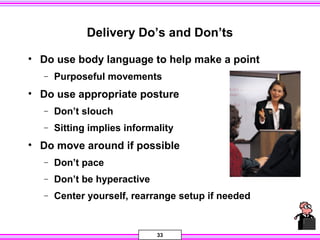
Delivery Do’s and Don’ts
• Do use body language to help make a point
− Purposeful movements
• Do use appropriate posture
− Don’t slouch
− Sitting implies informality
• Do move around if possible
− Don’t pace
− Don’t be hyperactive
− Center yourself, rearrange setup if needed
34
Delivery Do’s and Don’ts
• Do face audience more than slides
− Don’t talk to the screen or wall
• Do vary your voice
− Don’t speak in monotone
− Most people speak too soft, not too loud
• Do memorize slide numbers for key slides
− Or transition points
• Do get honest feedback from someone you trust
35
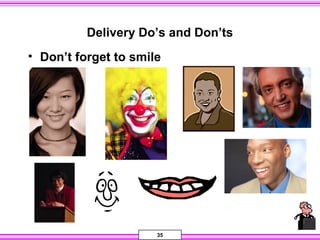
Delivery Do’s and Don’ts
• Don’t forget to smile
36
Handling Questions
• Welcome them
− Lots of questions are either a sign of:
> Interest in what you are talking about
– Audience internalizing
> Failure to communicate an idea
– Meaning that the person still wants to
understand
• Always repeat the question
1. For you to make sure you understood it
2. For audience to make sure they heard it
37
Handling Questions
• Answer the question to the audience
− Then check back to the individual for
confirmation
• Don’t be afraid to say “I don’t know”
− Better than mumbling or fumbling an
answer
38
Final thoughts
• POPTA
• Good slides go a long way
• Practice, practice, practice
• Remember that the audience wants you to
succeed
• Use other resources (Books, web, etc.)
• Anyone can learn to be a better presenter!
39
Thank You
Kukadiya Meet S.
Government Engineering
College,Bhavnagar
Enroll no=130210125060

Presentation skills

  • 1.
  • 2.
    2 Presentation Skills Ideas, conceptsor issues talked about or spoken to a group or audience Public speaking is one of the most feared things “I could make such a fool of myself” Skills required to give a good presentation can be developed Preparation is the Key
  • 3.
    3 Outline • General Guidelines •Slide Do’s and Don’ts − Handouts − Powerpoint Navigation • Delivery Do’s and Don’ts − How to Handle Questions • Final Thoughts
  • 4.
    4 Why are presentationskills important? • Job Hunting • Academia (Crucial to Tenure) − Conferences, Seminars, Teaching classes • Industry (Way of Life) − Training, Project Reports, Reports to Management • Other − Speaking in church, politics, fund raising, community service, etc.
  • 5.
    5 General Guidelines A goodpresentation is a “POPTA” presentation What does POPTA stand for?
  • 6.
    6 General Guidelines • Purpose −You need to define your purpose for giving the presentation > Teach, Persuade, Prove, Review, Expository, Impress, Put to Sleep, Entertain? − Often your goal is a high level overview, even for a technical presentation − Don’t tell them everything you did, you’ll bore them
  • 7.
    7 General Guidelines • Organization −Always have an outline − Tell them what you’re going to tell them, then tell them, then tell them what you told them > Hint: I am doing this for this presentation − Problem then solution > Not just “data then solution” or “solution then problem”
  • 8.
    8 General Guidelines • Preparation −An unprepared presenter loses the audience before even starting − Practice makes perfect and builds confidence − Arrive early, make sure everything is set up − Dress appropriately > Better to dress up than down − Slides should be done well in advance
  • 9.
    9 General Guidelines • Time −Be sure you know how much time you have while preparing the presentation > Not 5 minutes before you start − It is better to end early than to go over > Always have a watch or clock in view − You’ll never have enough time to tell everything so stick to the most important − Rule of thumb > At most 1 slide per minute of presentation > Better to plan 2 minutes for each slide
  • 10.
    10 General Guidelines • Audience −Be sure you know your audience well − Tailor presentation to your audience > Failure to do this is probably the biggest mistake people make > You should never give the same presentation twice − Are there multiple audiences? > If so, direct different slides to different audiences − Watch the audience for clues
  • 11.
    11 Slide Do’s andDon’ts • “PowerPoint doesn’t give presentations – PowerPoint makes slides” − From microsoft.com website • Your comments should be more compelling than the slides • You shouldn’t put everything on the slide − K.I.S.S. Principle
  • 12.
    12 Slide Do’s andDon’ts • Do include 50% white space • Do make it obvious which section of your outline you’re in • Do make each slide stand on its own − Generally 1 main point for each slide • Do use animation − Don’t overuse it > Makes it difficult and annoying to navigate
  • 13.
    13 Slide Do’s andDon’ts • Do include written conclusion for every graph − Don’t forget to add meaningful labels, titles, captions, etc. to graphs Percentage IndustryAcademia NoYesNoYes 100 80 60 40 20 0 Percentage of People Needing Presentation Skills Conclusion - It is important to learn presentation skills!
  • 14.
    14 Slide Do’s andDon’ts • Don’t use yellow text − Do use dark text and bold • Do use formatting and color to emphasize (e.g. POPTA) • Don’t include unrelated pictures
  • 15.
    15 Slide Do’s andDon’ts • Don’t include periods at the end of a bullet. • Don’t do proofs • Do include a journal name with a reference − Jensen, Jones-Farmer, Champ, and Woodall (2006, Journal of Quality Technology)
  • 16.
    16 Slide Do’s andDon’ts • Don’t do serif fonts (like Times New Roman) • Do use sans serif fonts (like Arial) − or Tahoma
  • 17.
    17 Slide Do’s andDon’ts • Do save your file using “embedded fonts” − File menu->Save As->Tools (in upper right hand corner)->Save Options->Embed True Type Fonts
  • 18.
    18 Slide Do’s andDon’ts • Don’t just copy formulas and equations from your work (dissertation, paper, etc.) − Also known as “equationitis” − Do use formulas and equations sparingly − Do explain all notation used
  • 19.
    19 Slide Do’s andDon’ts • Do chek yor speling for mestakes − Typos instantly destroy credibility and convey lack of preparation − Do have someone else read through presentation • Do acknowledge previous work and help • Do use a template if using PowerPoint • Do put title slide at the end
  • 20.
    20 Slide Do’s andDon’ts • Do use a light background like this
  • 21.
    21 Slide Do’s andDon’ts • Or like this
  • 22.
    22 Slide Do’s andDon’ts • Or like this
  • 23.
    23 Slide Do’s andDon’ts • Don’t use a dark background like this − Even if using a lighter font color − Harder to read, especially from the back − More likely to put people asleep − Handouts often don’t look very good
  • 24.
    24 Slide Do’s andDon’ts • Do use occasional “spice” or “pace breakers” − Humor − Pictures − Sound − Animation − Questions (Not just Yes/No) − Surveys − Quizzes − Videos − Physical Objects − Top Ten Lists − Etc. For example . . . A pace breaker can do this for your audience
  • 25.
  • 26.
    26 Handouts • Use themif they help achieve your objective − Especially for technical presentations − Greatly increases retention • Often best to pass out at the end − You want to keep the audience engaged
  • 27.
    27 Navigation in PowerPoint •Always go through your presentation in slide show mode before giving it − Multiple times • Use keyboard short cuts, not the mouse • F1 (in slide show mode) − To bring up the list of all shortcut keys (Escape to hide the list) − Use this while practicing to help you learn the navigation
  • 28.
    28 Navigation in PowerPoint •To start slide show mode − F5 (Automatically takes you to start of presentation) • To end slide show mode − Escape
  • 29.
    29 Navigation in PowerPoint •Home − To go to the beginning slide • End − To go to last slide • Type the slide #, then Enter − To jump to any particular slide • B − Black screen • W − White screen
  • 30.
    30 Delivery Do’s andDon’ts • Don’t read or “parrot” the slides − Otherwise, why give a presentation? • Do use the slides as a cue − Let audience read • Do use pointers sparingly − They magnify nervousness − Create slides and use animation that emphasize your points
  • 31.
    31 Delivery Do’s andDon’ts • Do plan breaks for longer presentations − 10 minutes for every hour • Do be passionate about the topic − Have fun, this is your opportunity − If your audience doesn’t know why your topic is important, you’ve lost them • Don’t forget to practice − Record yourself, tape yourself, or use a mirror − Reading through slides does not count as practice
  • 32.
    32 Delivery Do’s andDon’ts • Do relax, use nerves to your advantage − Breathe deeply, pause as needed − Don’t go too fast − Do watch out for mannerisms > “Um . . um” • Do empty your pockets and hands • Don’t point at computer, point at the screen
  • 33.
    33 Delivery Do’s andDon’ts • Do use body language to help make a point − Purposeful movements • Do use appropriate posture − Don’t slouch − Sitting implies informality • Do move around if possible − Don’t pace − Don’t be hyperactive − Center yourself, rearrange setup if needed
  • 34.
    34 Delivery Do’s andDon’ts • Do face audience more than slides − Don’t talk to the screen or wall • Do vary your voice − Don’t speak in monotone − Most people speak too soft, not too loud • Do memorize slide numbers for key slides − Or transition points • Do get honest feedback from someone you trust
  • 35.
    35 Delivery Do’s andDon’ts • Don’t forget to smile
  • 36.
    36 Handling Questions • Welcomethem − Lots of questions are either a sign of: > Interest in what you are talking about – Audience internalizing > Failure to communicate an idea – Meaning that the person still wants to understand • Always repeat the question 1. For you to make sure you understood it 2. For audience to make sure they heard it
  • 37.
    37 Handling Questions • Answerthe question to the audience − Then check back to the individual for confirmation • Don’t be afraid to say “I don’t know” − Better than mumbling or fumbling an answer
  • 38.
    38 Final thoughts • POPTA •Good slides go a long way • Practice, practice, practice • Remember that the audience wants you to succeed • Use other resources (Books, web, etc.) • Anyone can learn to be a better presenter!
  • 39.
    39 Thank You Kukadiya MeetS. Government Engineering College,Bhavnagar Enroll no=130210125060