P&G 2016
Annual Report
(1) Diluted net earnings per common share are calculated based on net earnings attributable to Procter & Gamble.
(2) These results exclude net sales in Corporate.
VARIOUS STATEMENTS IN THIS ANNUAL REPORT, including estimates, projections, objectives and expected results, are “forward-looking statements” within the meaning of the
Private Securities Litigation Reform Act of 1995, Section 27A of the Securities Act of 1933 and Section 21E of the Securities Exchange Act of 1934 and are generally identified by the
words “believe,” “expect,” “anticipate,” “intend,” “opportunity,” “plan,” “project,” “will,” “should,” “could,” “would,” “likely” and similar expressions. Forward-looking statements are
based on current assumptions that are subject to risks and uncertainties that may cause actual results to differ materially from the forward-looking statements, including the risks and
uncertainties discussed on pages 2–6 of this Annual Report. We undertake no obligation to update or revise publicly any forward-looking statements.
Brand names referenced in this Annual Report are trademarks of The Procter & Gamble Company or one of its subsidiaries. All other brand names are trademarks of their respective owners.
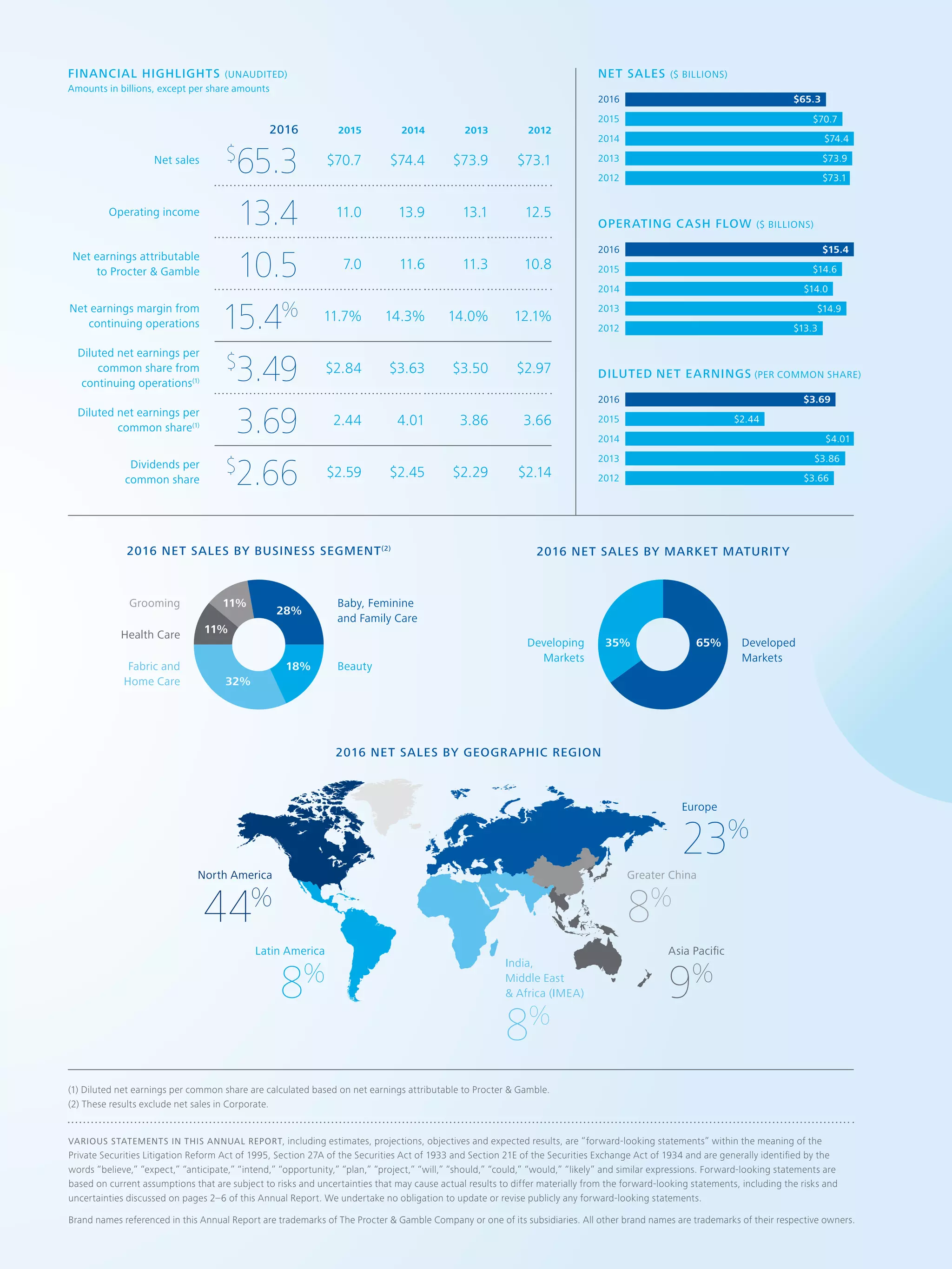
2016 NET SALES BY GEOGRAPHIC REGION
Grooming
Health Care
Fabric and
Home Care
Beauty
Baby, Feminine
and Family Care
Developed
Markets
Developing
Markets
2016 NET SALES BY BUSINESS SEGMENT(2)
FINANCIAL HIGHLIGHTS (UNAUDITED)
Amounts in billions, except per share amounts
2016 NET SALES BY MARKET MATURITY
North America
44%
Europe
23%
Greater China
8%
Asia Pacific
9%
India,
Middle East
& Africa (IMEA)
8%
Latin America
8%
2016 2015 2014 2013 2012
Net sales $
65.3 $70.7 $74.4 $73.9 $73.1
Operating income
13.4 11.0 13.9 13.1 12.5
Net earnings attributable
to Procter & Gamble 10.5 7.0 11.6 11.3 10.8
Net earnings margin from
continuing operations 15.4% 11.7% 14.3% 14.0% 12.1%
Diluted net earnings per
common share from
continuing operations(1)
$
3.49 $2.84 $3.63 $3.50 $2.97
Diluted net earnings per
common share(1)
3.69 2.44 4.01 3.86 3.66
Dividends per
common share
$
2.66 $2.59 $2.45 $2.29 $2.14
65%35%
18%
28%
11%
32%
11%
NET SALES ($ BILLIONS)
2016
2015
2014
2013
2012
$74.4
$70.7
$73.9
$73.1
$65.3
OPERATING CASH FLOW ($ BILLIONS)
2016
2015
2014
2013
2012
$15.4
$14.6
$14.0
$14.9
$13.3
DILUTED NET EARNINGS (PER COMMON SHARE)
$3.692016
2015
2014
2013
2012
$2.44
$4.01
$3.86
$3.66
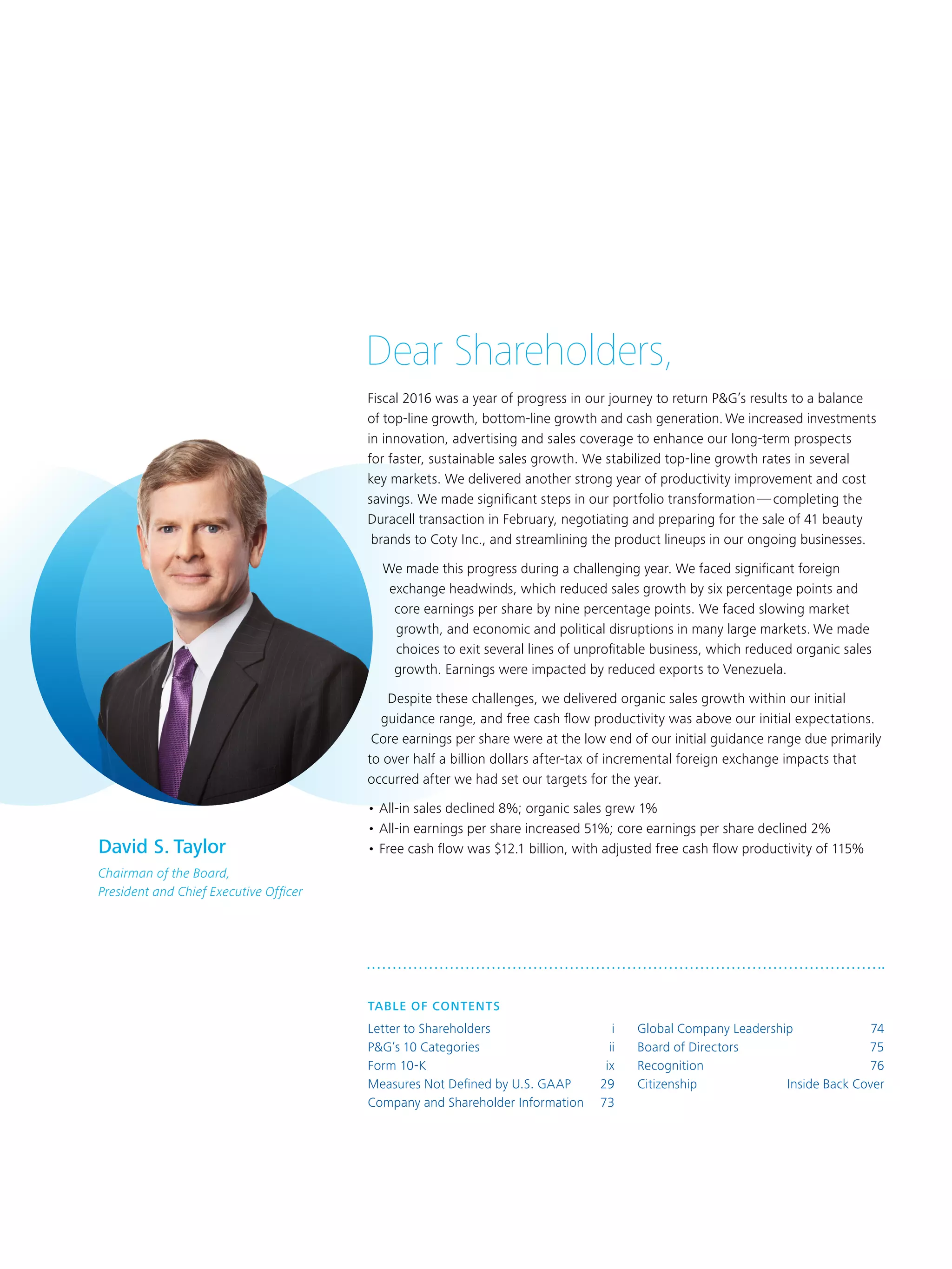
Dear Shareholders,
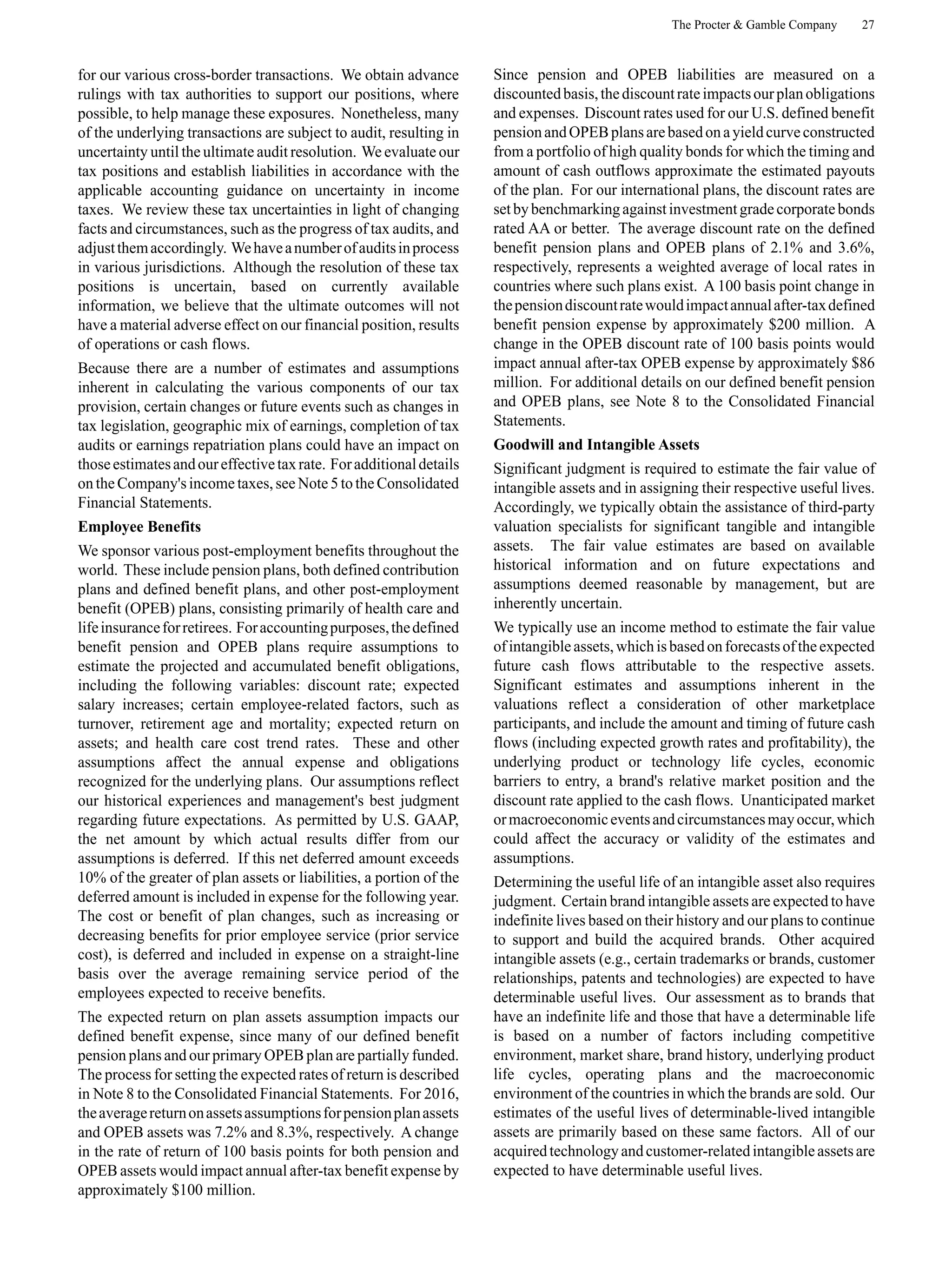
Fiscal 2016 was a year of progress in our journey to return P&G’s results to a balance
of top-line growth, bottom-line growth and cash generation. We increased investments
in innovation, advertising and sales coverage to enhance our long-term prospects
for faster, sustainable sales growth. We stabilized top-line growth rates in several
key markets. We delivered another strong year of productivity improvement and cost
savings. We made significant steps in our portfolio transformation — completing the
Duracell transaction in February, negotiating and preparing for the sale of 41 beauty
brands to Coty Inc., and streamlining the product lineups in our ongoing businesses.
We made this progress during a challenging year. We faced significant foreign
exchange headwinds, which reduced sales growth by six percentage points and
core earnings per share by nine percentage points. We faced slowing market
growth, and economic and political disruptions in many large markets. We made
choices to exit several lines of unprofitable business, which reduced organic sales
growth. Earnings were impacted by reduced exports to Venezuela.
Despite these challenges, we delivered organic sales growth within our initial
guidance range, and free cash flow productivity was above our initial expectations.
Core earnings per share were at the low end of our initial guidance range due primarily
to over half a billion dollars after-tax of incremental foreign exchange impacts that
occurred after we had set our targets for the year.
•	All-in sales declined 8%; organic sales grew 1%
•	All-in earnings per share increased 51%; core earnings per share declined 2%
•	Free cash flow was $12.1 billion, with adjusted free cash flow productivity of 115%David S. Taylor
Chairman of the Board,
President and Chief Executive Officer
TABLE OF CONTENTS	
Letter to Shareholders 	 i
P&G’s 10 Categories	 ii
Form 10-K 	 ix
Measures Not Defined by U.S. GAAP 	 29
Company and Shareholder Information 	 73
Global Company Leadership	 74
Board of Directors 	 75
Recognition 	 76
Citizenship	 Inside Back Cover
We continued to build on our strong track record of returning cash to you, our
shareholders. We paid $7.4 billion in dividends, increasing our dividend for the 60th
consecutive year. We reduced shares outstanding by more than $8 billion through
a combination of share repurchases and shares that were exchanged in the Duracell
transaction. In total, P&G delivered nearly $16 billion of value for shareholders.
We made progress in a challenging environment, but we know we need to do better.
We are focused on streamlining and strengthening our product portfolio, improving
productivity and our cost structure, building the foundation for stronger top-line
growth, and strengthening our organization and culture. These are the choices we’re
focused on to raise the bar on P&G’s performance to consistently deliver balanced
growth and leadership value creation.
Streamlining Our
Product Portfolio
We’re organizing our portfolio around 10 category-based
business units and about 65 brands. These are categories
where P&G has leading market positions and where product
technologies deliver performance differences that matter
to consumers. We’re focusing on categories where product
performance drives purchase decisions — where there
are clear consumer jobs to be done and objective
measures of performance. These are products in
financially attractive categories, which consumers
purchase and use on a daily basis. These 10 category-
based business units have historically grown faster
with higher margins than the balance of the company.
Within these core categories, we are streamlining
our product lines. For example, we are making smart
choices to discontinue undifferentiated, unprofitable
and commoditizing products in favor of more profitable,
consumer-preferred and differentiated products in a number of
markets and businesses around the world, including Mexico, India
and Fabric Care. Combined, these choices caused about a one-point drag
on organic sales growth in fiscal 2016 and are expected to continue to be a
headwind in fiscal 2017.
As we complete this work, our portfolio of brands and products will be better
positioned for stronger and more profitable growth.
10P&G’s
Categories
Explore our brands
and categories
ii • The Procter & Gamble Company
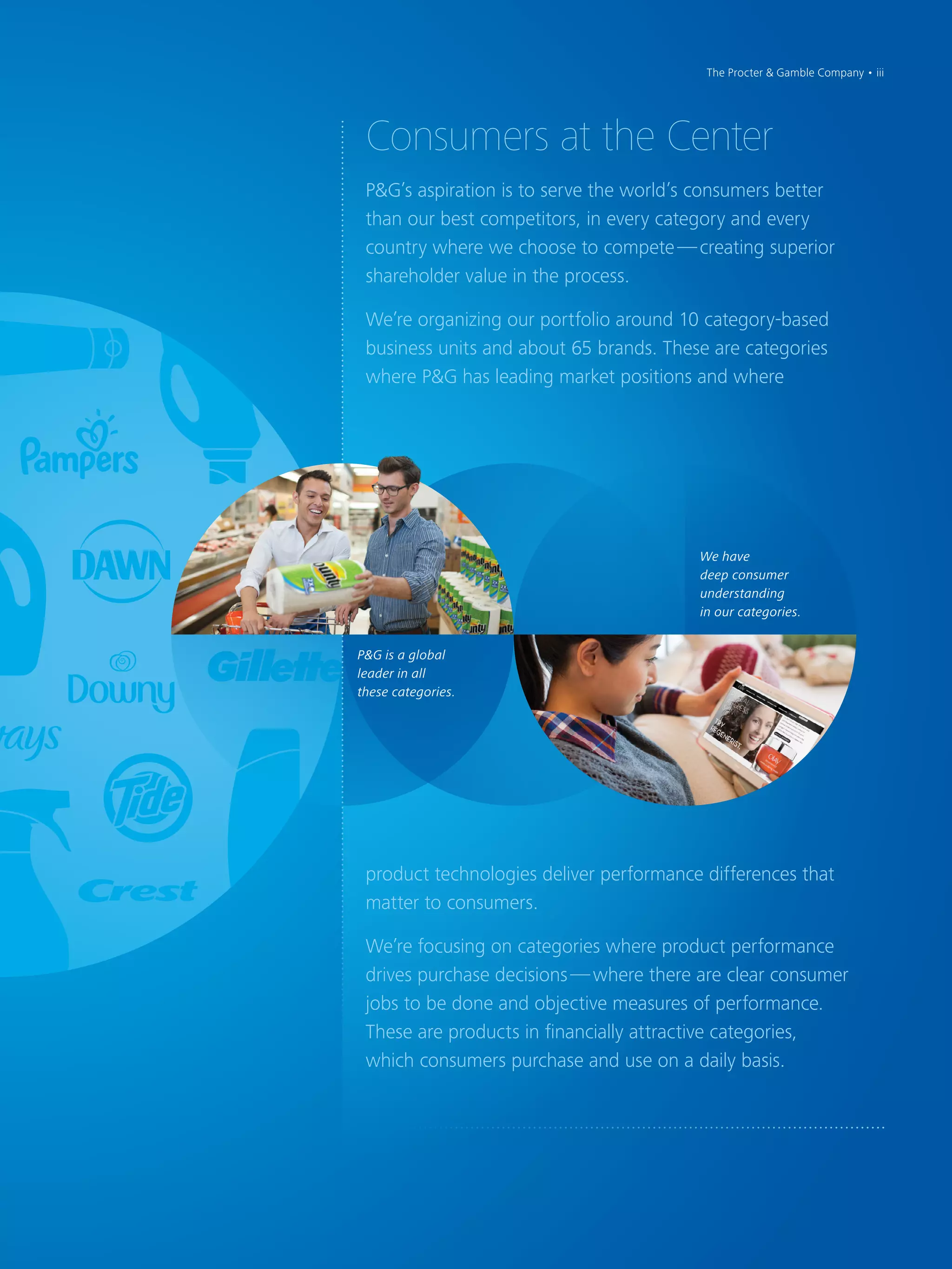
P&G is a global
leader in all
these categories.
We have
deep consumer
understanding
in our categories.
Consumers at the Center
P&G’s aspiration is to serve the world’s consumers better
than our best competitors, in every category and every
country where we choose to compete — creating superior
shareholder value in the process.
We’re organizing our portfolio around 10 category-based
business units and about 65 brands. These are categories
where P&G has leading market positions and where
product technologies deliver performance differences that
matter to consumers.
We’re focusing on categories where product performance
drives purchase decisions — where there are clear consumer
jobs to be done and objective measures of performance.
These are products in financially attractive categories,
which consumers purchase and use on a daily basis.
The Procter & Gamble Company • iii
GROOMING
Male Blades & Razors, Female Blades & Razors,
Pre- and Post-Shave Products,
Appliances, Other Shave Care
FABRIC CARE
Laundry Detergents, Fabric Enhancers,
Laundry Additives
HOME CARE
Dish Care, Air Care, Surface Care,
P&G Professional
ORAL CARE
Toothbrushes, Toothpaste,
Other Oral Care
SKIN AND PERSONAL CARE
Skin Care, Antiperspirant and Deodorant,
Personal Cleansing
HAIR CARE
Shampoo, Conditioner,
Styling Aids, Treatments
PERSONAL HEALTH CARE
Gastrointestinal, Respiratory,
Rapid Diagnostics, Vitamins / Minerals /
Supplements, Other Personal Health Care
FEMININE CARE
Feminine Care,
Adult Incontinence
FAMILY CARE
Paper Towels, Tissues,
Toilet Paper
BABY CARE
Diapers and Pants,
Baby Wipes
Improving Productivity and Cost Structure
We continue to improve cost and cash productivity with significant upside ahead.
Productivity is the fuel for top- and bottom-line growth. We have delivered and
exceeded $10 billion in savings over the past five fiscal years across cost of goods
sold, marketing spending and overhead.
In cost of goods sold, our original target was $6 billion in savings over five years,
from fiscal 2012 to 2016. We delivered over $7 billion, with savings at or above
target each year.
In marketing spending, we have delivered strong savings over the last two years in
non-working agency fees and commercial production costs. We’ve been reinvesting
these savings in marketing programs that improve the reach, frequency or continuity
of our advertising, and in programs such as product sampling that generate trial
of our superior products.
In overhead, the decision to reduce enrollment was difficult, but was made with
careful consideration of what is best for the health of the business. Since 2011,
we have reduced non-manufacturing roles by about 25%, which is two-and-a-half
times the original target. Including divestitures, we’ll reduce non-manufacturing
roles by about 35% by the end of fiscal 2017.
Productivity cost savings have been essential to offset $4 billion of negative
foreign exchange impacts over the last four years. These savings have enabled
us to improve constant currency gross and operating profit margins and deliver
high-single- to double-digit constant currency core earnings per share growth
in each of these years.
We believe we can deliver up to an additional $10 billion in productivity
improvements over the next five years. As with the first $10 billion, we expect
the large majority of our savings will come from cost of goods sold.
Supply chain transformation is in its early stages. We started in North America.
Europe is following, and then we will move on to Latin America and India,
Middle East and Africa. We’re in investment mode now, with savings to ramp
up over the next two to four years.
More opportunity exists for savings in marketing spending, particularly in non-
working fees and production costs. We will also optimize the reach, effectiveness
and efficiency of media spending through the right mix of TV advertising and
digital — across search, social, video and mobile — to reach consumers when
and where they spend their time.
As we fully operationalize the new, focused 10-category company, there will be
additional opportunities to increase organization efficiency, agility and speed
of decision making.
Finally, we are working to improve the effectiveness of our promotional spending
by changing how we use these funds to give our sales teams more flexibility to invest
in what drives the most profitable growth. We see clear opportunities to improve
the effectiveness of promotional spending for us and for our retail partners to grow
categories and brands profitably.
Going forward, we expect to reinvest a significant amount of the productivity
savings back into the business. We’ll invest more in R&D, in product and packaging
improvements, in sales coverage, in brand awareness and in trial-building programs.
P&G wins when we create new categories and grow categories and brands.
These investments are aimed at delivering balanced top- and bottom-line growth.
iv • The Procter & Gamble Company
Supply Chain Efficiency
One way we’re increasing efficiency in our U.S. supply chain
is through our six new mixing centers. They are strategically
located closer to customers in key population centers, putting
80% of our U.S. business within one day of the store shelf
and the shopper. Shipping multiple categories per load
allows more efficient use of every truck and more frequent
customer deliveries. This is driving lower inventory, improving
service to retailers, and increasing product availability for
shoppers — delivering the right mix and the right amount,
right on time.
Accelerating Top-Line Growth
Sales growth is our biggest improvement need, which is enabled by winning with
consumers and fueled by both our productivity and portfolio strengthening efforts that
are underway. Our objective is to consistently deliver organic sales growth ahead of
underlying growth of the markets in which we compete. This level of top-line growth,
balanced with consistent bottom-line growth and cash generation, is what’s needed
to deliver leadership levels of value creation for P&G shareholders.
We’re making progress in accelerating organic sales growth. Organic sales for the
April–June quarter were in line or higher than the previous year in 9 of 10 product
categories. For nearly all of these businesses, the second half of the year was stronger
than the first half. Organic sales for the company were essentially flat in the first half
of the fiscal year and were up 1.5% in the second half — moving in the right direction,
but there’s more work to be done.
80%
of P&G’s U.S. business
within one day of
the store shelf multiple categories
shipped per load
increased product
availability for shoppers
The Procter & Gamble Company • v
Innovating to Delight Consumers
Superior-performing
products lead to a
delightful consumer
experience, driving
repeat purchase
and loyalty.
Everything starts with winning with consumers and shoppers.
We must win with consumers and shoppers at the zero, first and second moments of
truth — when consumers become aware of our categories and brands, purchase them in
a store or online, and use them in their homes. Winning these moments requires insights
that lead to superior-performing product innovations, effective advertising and strong
retail programs. The outcome is growing the number of users — and usage — of our
brands and the categories in which we compete.
Growing users requires product superiority, broad media reach, advertising effectiveness,
distinctive packaging, an easy-to-shop store shelf, sampling programs and consumer
value. We’re raising the bar by asking key questions: Is the product better performing
and most preferred by consumers? Do we have the media reach and effective advertising
to ensure our brands are always top of mind? Is the packaging distinctive, familiar and
appealing? Is the store shelf organized in a way that is easy to shop, enabling consumers
to find the right product for them with the right benefits at the right price? Do we have
sampling programs that allow people to try our best products, particularly at
the point of market entry? Is the relative price and absolute cash outlay
to purchase our brands a good consumer value? Every category and
brand is focused on consistently delivering these drivers of growing
users to grow category and brand sales.
At the same time, we’re strengthening our go-to-market
execution. Execution is what our consumers and shoppers
experience when they are in the store or online. Our
brands need to have the right selection of products,
in the right sizes, at the right value, in the right quantity,
and in the right points of sale to win with consumers
and shoppers in stores and online every day.
PANTENE
Pantene’s new breakthrough conditioner
technology delivers ‘superior conditioning
without weight,’ addressing a significant
consumer trial barrier in the category.
Our Pantene shampoo and conditioner
systems are consumer blind test winners
vs. our best competition in North America,
China and Japan. And they are helping
drive results — Pantene’s U.S. organic
sales were up mid-single digits for the
six months ended in June 2016.
TIDE
Tide is now reaching more consumers and
addressing two growing consumer needs:
natural detergents and odor removal.
Tide purclean is a breakthrough as the
first bio-based detergent with the cleaning
power of Tide. And with the growth of
synthetic fibers and active lifestyles, odors
are an increasing laundry concern. Using
our Febreze technology, the Odor Defense
regimen helps eliminate, neutralize and
block tough odors.
vi • The Procter & Gamble Company
Sampling
is a winning
strategy for growth.
When people try our
products, they are far
more likely to buy them.
Growing Users for
a Stronger Top Line
Growing users is a key driver of balanced growth and value
creation. Two of the ways we grow users of P&G brands are
to offer superior-performing products to consumers and to
increase consumer trial through sampling, particularly at
the point of market entry.
Increasing Consumer Trial
PAMPERS
We’re strengthening brand awareness and
trial at category entry. 70% of U.S. new
moms now receive samples of our best
Pampers products through our prenatal
and hospital programs. Our latest innovation
has our unique three Extra Absorb Channels
that help distribute wetness evenly — unlike
ordinary diapers that have one unstructured
core. It’s driving growth, with Swaddlers
and Cruisers U.S. share up well over one
point in the June 2016 quarter.
GILLETTE
Our U.S.18th birthday sampling program
has put Gillette Fusion ProGlide FlexBall
razors in the hands of nearly 80% of young
men — over two million in 2016, up 33% over
the past two years. We’re now sampling the
FlexBall handle and ProShield cartridge — our
most advanced combination of technologies.
ProShield launched in January and is the
#1 razor in the U.S., the U.K. and Germany,
based on sales. Over 40 million men globally
are now shaving with FlexBall.
Love at
first touch Love the
swaddlers™
*based on sales of the newborn hospital diaper
©2016 P&G
The Procter & Gamble Company • vii
David S. Taylor
Chairman of the Board, President and Chief Executive Officer
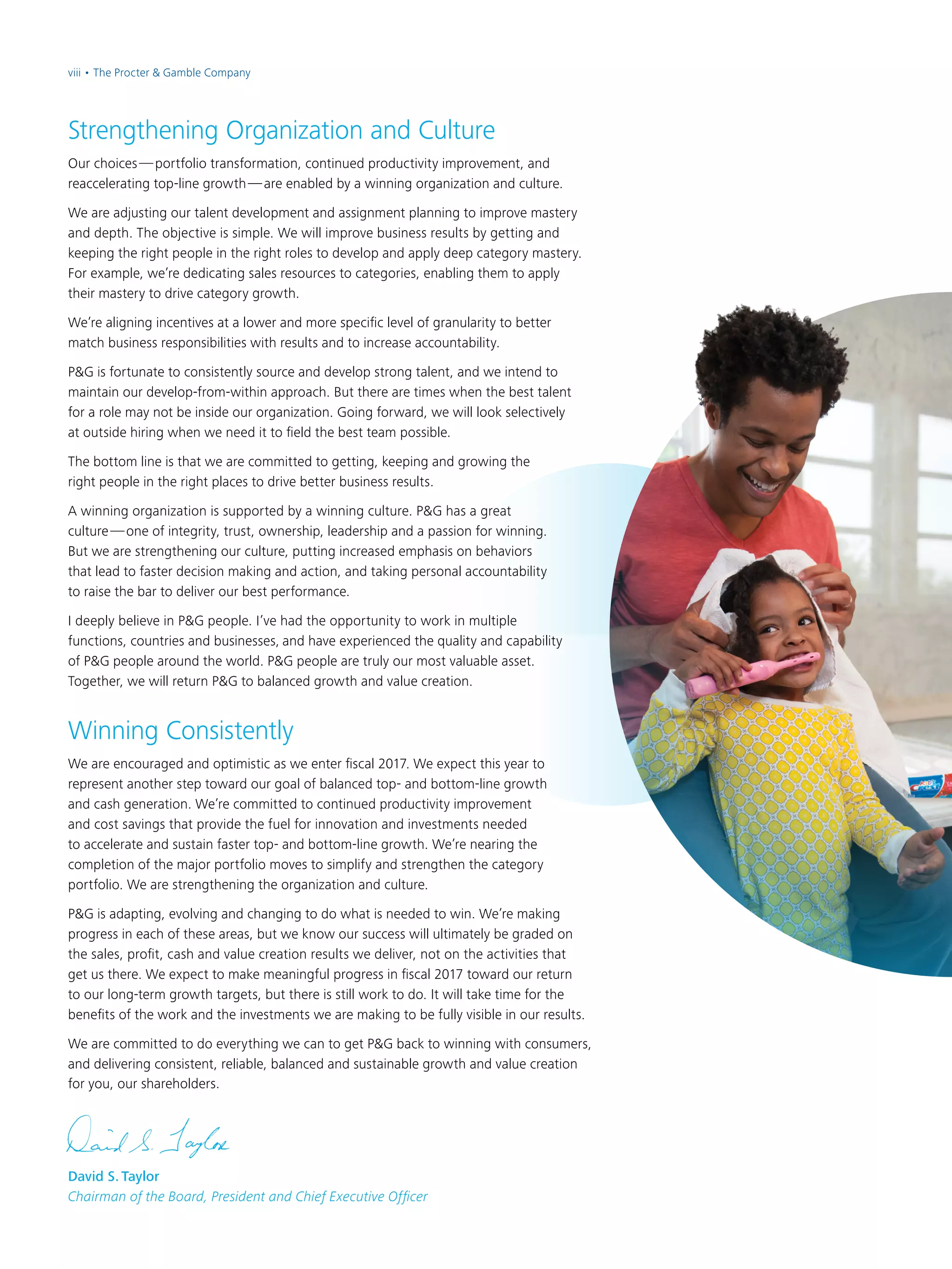
Strengthening Organization and Culture
Our choices — portfolio transformation, continued productivity improvement, and
reaccelerating top-line growth — are enabled by a winning organization and culture.
We are adjusting our talent development and assignment planning to improve mastery
and depth. The objective is simple. We will improve business results by getting and
keeping the right people in the right roles to develop and apply deep category mastery.
For example, we’re dedicating sales resources to categories, enabling them to apply
their mastery to drive category growth.
We’re aligning incentives at a lower and more specific level of granularity to better
match business responsibilities with results and to increase accountability.
P&G is fortunate to consistently source and develop strong talent, and we intend to
maintain our develop-from-within approach. But there are times when the best talent
for a role may not be inside our organization. Going forward, we will look selectively
at outside hiring when we need it to field the best team possible.
The bottom line is that we are committed to getting, keeping and growing the
right people in the right places to drive better business results.
A winning organization is supported by a winning culture. P&G has a great
culture — one of integrity, trust, ownership, leadership and a passion for winning.
But we are strengthening our culture, putting increased emphasis on behaviors
that lead to faster decision making and action, and taking personal accountability
to raise the bar to deliver our best performance.
I deeply believe in P&G people. I’ve had the opportunity to work in multiple
functions, countries and businesses, and have experienced the quality and capability
of P&G people around the world. P&G people are truly our most valuable asset.
Together, we will return P&G to balanced growth and value creation.
Winning Consistently
We are encouraged and optimistic as we enter fiscal 2017. We expect this year to
represent another step toward our goal of balanced top- and bottom-line growth
and cash generation. We’re committed to continued productivity improvement
and cost savings that provide the fuel for innovation and investments needed
to accelerate and sustain faster top- and bottom-line growth. We’re nearing the
completion of the major portfolio moves to simplify and strengthen the category
portfolio. We are strengthening the organization and culture.
P&G is adapting, evolving and changing to do what is needed to win. We’re making
progress in each of these areas, but we know our success will ultimately be graded on
the sales, profit, cash and value creation results we deliver, not on the activities that
get us there. We expect to make meaningful progress in fiscal 2017 toward our return
to our long-term growth targets, but there is still work to do. It will take time for the
benefits of the work and the investments we are making to be fully visible in our results.
We are committed to do everything we can to get P&G back to winning with consumers,
and delivering consistent, reliable, balanced and sustainable growth and value creation
for you, our shareholders.
viii • The Procter & Gamble Company
UNITED STATES SECURITIES AND EXCHANGE COMMISSION
Washington, D.C. 20549
Form 10-K
(Mark one)
[x] ANNUAL REPORT PURSUANT TO SECTION 13 OR 15(d) OF THE SECURITIES EXCHANGE ACT OF 1934
For the Fiscal Year Ended June 30, 2016
OR
[ ] TRANSITION REPORT PURSUANT TO SECTION 13 OR 15(d) OF THE SECURITIES EXCHANGE ACT OF
1934
For the transition period from to
Commission File No. 1-434
THE PROCTER & GAMBLE COMPANY
One Procter & Gamble Plaza, Cincinnati, Ohio 45202
Telephone (513) 983-1100
IRS Employer Identification No. 31-0411980
State of Incorporation: Ohio
Securities registered pursuant to Section 12(b) of the Act:
Title of each class Name of each exchange on which registered
Common Stock, without Par Value New York Stock Exchange, NYSE Euronext-Paris
Indicate by check mark if the registrant is a well-known seasoned issuer, as defined in Rule 405 of the Securities Act. Yes No
Indicate by check mark if the registrant is not required to file reports pursuant to Section 13 or 15(d) of the Act. Yes No
Indicate by check mark whether the registrant (1) has filed all reports required to be filed by Section 13 or 15(d) of the Securities Exchange
Act of 1934 during the preceding 12 months (or for such shorter period that the registrant was required to file such reports), and (2) has
been subject to such filing requirements for the past 90 days. Yes No
Indicate by check mark whether the registrant has submitted electronically and posted on its corporate website, if any, every Interactive
Data File required to be submitted and posted pursuant to Rule 405 of Regulation S-T (§232.405 of this chapter) during the preceding
12 months (or for such shorter period that the registrant was required to submit and post such files). Yes No
Indicate by check mark if disclosure of delinquent filers pursuant to Item 405 of Regulation S-K is not contained herein, and will not be
contained, to the best of registrant's knowledge, in definitive proxy or information statements incorporated by reference in Part III of this
Form 10-K or any amendment to this Form 10-K.
Indicate by check mark whether the registrant is a large accelerated filer, an accelerated filer, a non-accelerated filer or a smaller reporting
company (as defined in Rule 12b-2 of the Exchange Act).
Large accelerated filer Accelerated filer Non-accelerated filer Smaller reporting company
Indicate by check mark whether the registrant is a shell company (as defined in Rule 12b-2 of the Exchange Act). Yes No
The aggregate market value of the voting stock held by non-affiliates amounted to $215 billion on December 31, 2015.
There were 2,668,751,125 shares of Common Stock outstanding as of July 31, 2016.
Documents Incorporated by Reference
Portions of the Proxy Statement for the 2016 Annual Meeting of Shareholders which will be filed within one hundred and twenty days
of the fiscal year ended June 30, 2016 (2016 Proxy Statement) are incorporated by reference into Part III of this report to the extent
described herein.
FORM 10-K TABLE OF CONTENTS Page
PART I Item 1. Business 1
Item 1A. Risk Factors 2
Item 1B. Unresolved Staff Comments 6
Item 2. Properties 6
Item 3. Legal Proceedings 6
Item 4. Mine Safety Disclosure 6
Executive Officers of the Registrant 7
PART II Item 5. Market for Registrant's Common Equity, Related Stockholder Matters and Issuer Purchases
of Equity Securities 8
Item 6. Selected Financial Data 10
Item 7. Management's Discussion and Analysis of Financial Condition and Results of Operations 11
Item 7A. Quantitative and Qualitative Disclosures About Market Risk 30
Item 8. Financial Statements and Supplementary Data 31
Management's Report and Reports of Independent Registered Public Accounting Firm 31
Consolidated Statements of Earnings 34
Consolidated Statements of Comprehensive Income 35
Consolidated Balance Sheets 36
Consolidated Statements of Shareholders' Equity 37
Consolidated Statements of Cash Flows 38
Notes to Consolidated Financial Statements 39
Note 1: Summary of Significant Accounting Policies 39
Note 2: Segment Information 41
Note 3: Supplemental Financial Information 43
Note 4: Goodwill and Intangible Assets 44
Note 5: Income Taxes 46
Note 6: Earnings Per Share 48
Note 7: Stock-based Compensation 48
Note 8: Postretirement Benefits and Employee Stock Ownership Plan 50
Note 9: Risk Management Activities and Fair Value Measurements 54
Note 10: Short-term and Long-term Debt 57
Note 11: Accumulated Other Comprehensive Income/(Loss) 58
Note 12: Commitments and Contingencies 59
Note 13: Discontinued Operations 59
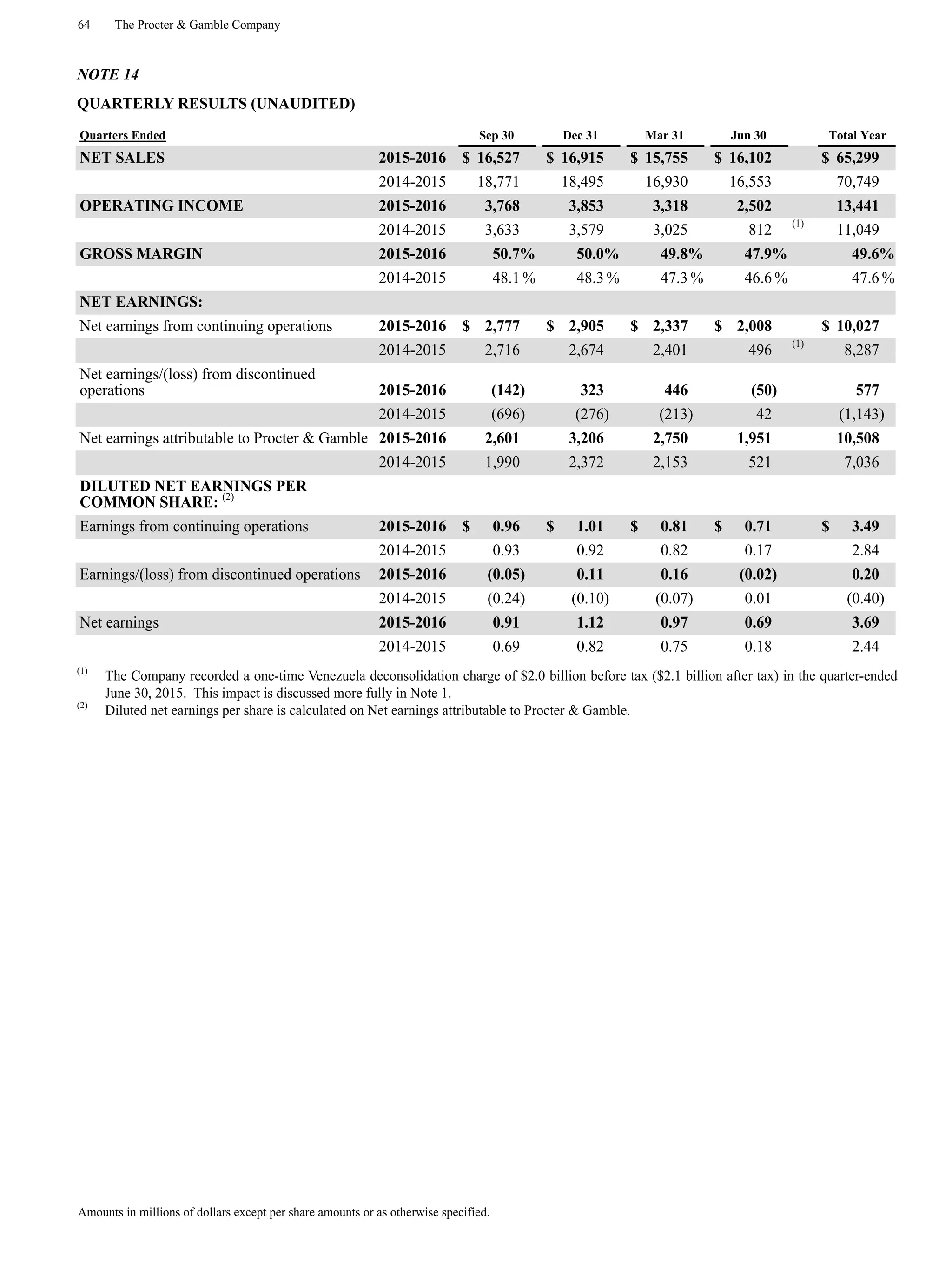
Note 14: Quarterly Results (Unaudited) 64
Item 9. Changes in and Disagreements with Accountants on Accounting and Financial Disclosure 65
Item 9A. Controls and Procedures 65
Item 9B. Other Information 65
PART III Item 10. Directors, Executive Officers and Corporate Governance 65
Item 11. Executive Compensation 65
Item 12. Security Ownership of Certain Beneficial Owners and Management and Related Stockholder
Matters 66
Item 13. Certain Relationships and Related Transactions and Director Independence 67
Item 14. Principal Accountant Fees and Services 67
PART IV Item 15. Exhibits and Financial Statement Schedules 67
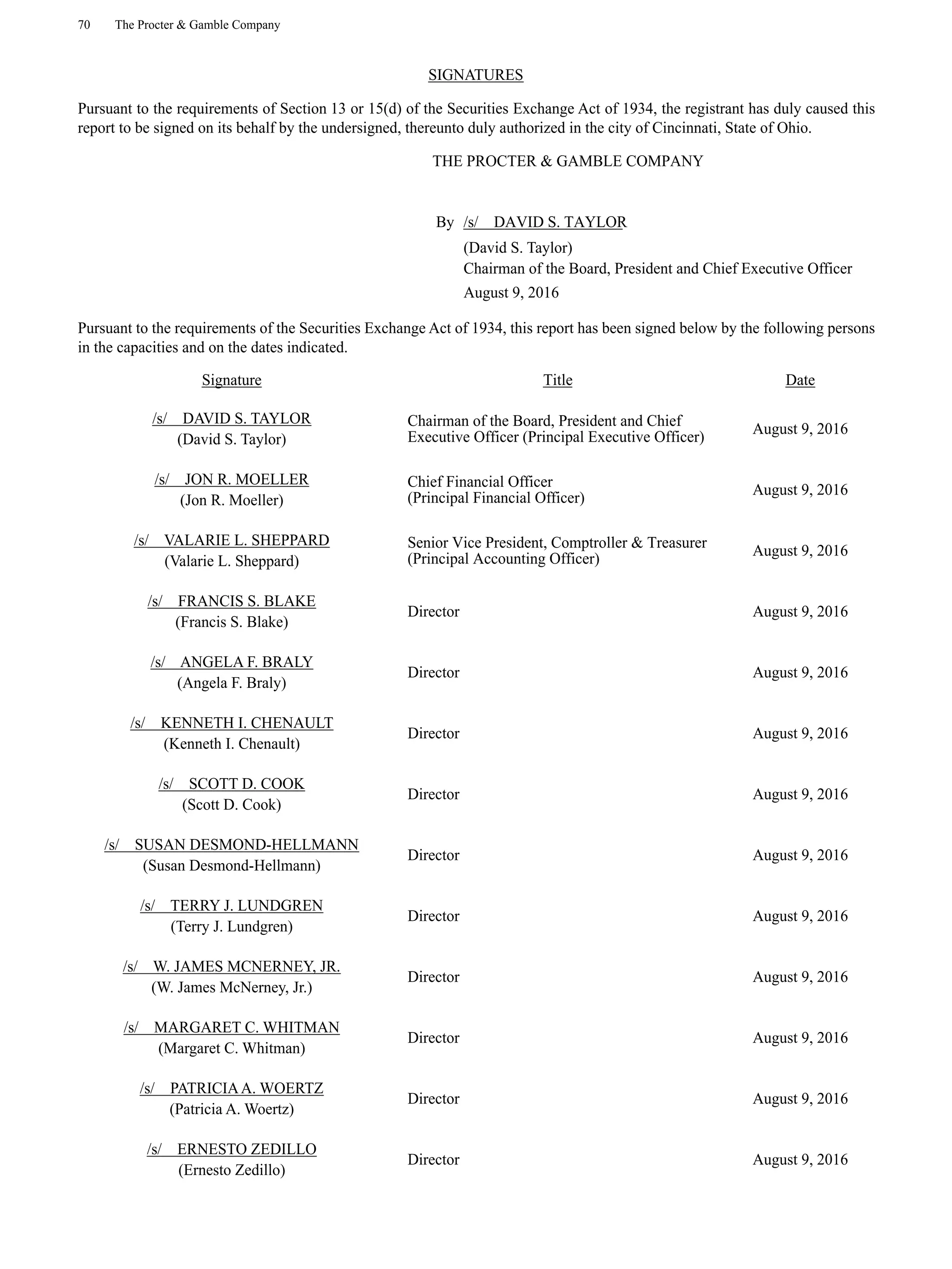
Signatures 70
Exhibit Index 71
The Procter & Gamble Company 1
PART I
Item 1. Business.
Additional information required by this item is incorporated
herein by reference to Management's Discussion and Analysis
(MD&A); and Notes 1 and 2 to our Consolidated Financial
Statements. Unless the context indicates otherwise, the terms
the "Company," "P&G," "we," "our" or "us" as used herein
refer to The Procter & Gamble Company (the registrant) and
its subsidiaries.
The Procter & Gamble Company is focused on providing
branded consumer packaged goods of superior quality and
value to improve the lives of the world's consumers. The
Company was incorporated in Ohio in 1905, having been built
from a business founded in 1837 by William Procter and James
Gamble. Today, our products are sold in more than 180
countries and territories.
Throughout this Form 10-K, we incorporate by reference
information from other documents filed with the Securities and
Exchange Commission (SEC).
TheCompany'sAnnualReportonForm10-K,quarterlyreports
on Form 10-Q and current reports on Form 8-K, and
amendmentsthereto,arefiledelectronicallywiththeSEC. The
SEC maintains an internet site that contains these reports at:
www.sec.gov. You can also access these reports through links
from our website at: www.pginvestor.com.
Copies of these reports are also available, without charge, by
contacting Wells Fargo, 1100 Centre Pointe Curve, Suite 101,
Mendota, MN 55120-4100.
Financial Information about Segments
As of June 30, 2016 the Company has five reportable segments
under U.S. GAAP: Beauty; Grooming; Health Care; Fabric &
Home Care; and Baby, Feminine & Family Care. Many of the
factors necessary for understanding these businesses are
similar. Operating margins of the individual businesses vary
due to the nature of materials and processes used to
manufacturetheproducts,thecapitalintensityofthebusinesses
and differences in selling, general and administrative expenses
as a percentage of net sales. Net sales growth by business is
also expected to vary slightly due to the underlying growth of
the markets and product categories in which they operate.
While none of our reportable segments are highly seasonal,
components within certain reportable segments, such as
Appliances (Grooming), are seasonal.
Additional information about our reportable segments can be
found in the MD&A and Note 2 to our Consolidated Financial
Statements.
Narrative Description of Business
Business Model. Our business model relies on the continued
growth and success of existing brands and products, as well as
the creation of new products. The markets and industry
segments in which we offer our products are highly
competitive. Our products are sold in more than 180 countries
and territories primarily through mass merchandisers, grocery
stores, membership club stores, drug stores, department stores,
distributors, baby stores, specialty beauty stores, e-commerce,
high-frequency stores and pharmacies. We utilize our superior
marketing and online presence to win with consumers at the
"zero moment of truth" - when they are searching for
information about a brand or product. We work collaboratively
with our customers to improve the in-store presence of our
productsandwinthe"first momentoftruth"-whena consumer
is shopping in the store. We must also win the "second moment
of truth" - when a consumer uses the product, evaluates how
well it met his or her expectations and decides whether it was
a good value. We believe we must continue to provide new,
innovative products and branding to the consumer in order to
grow our business. Research and product development
activities, designed to enable sustained organic growth,
continued to carry a high priority during the past fiscal year.
Key Product Categories. Information on key product
categoriescanbefoundinNote2toourConsolidatedFinancial
Statements.
Key Customers. Our customers include mass merchandisers,
grocery stores, membership club stores, drug stores,
department stores, distributors, baby stores, specialty beauty
stores, e-commerce, high-frequency stores and pharmacies.
Sales to Wal-Mart Stores, Inc. and its affiliates represent
approximately 15% of our total revenue in 2016, 2015 and
2014. No other customer represents more than 10% of our net
sales. Our top ten customers account for approximately 35%
of our total sales in 2016, 2015 and 2014. The nature of our
business results in no material backlog orders or contracts with
the government. We believe our practices related to working
capital items for customers and suppliers are consistent with
the industry segments in which we compete.
Sources and Availability of Materials. Almost all of the raw
and packaging materials used by the Company are purchased
from others, some of which are single-source suppliers. We
produce certain raw materials, primarily chemicals, for further
use in the manufacturing process. In addition, fuel, natural gas
and derivative products are important commodities consumed
in our manufacturing process and in the transportation of input
materials and of finished product to customers. The prices we
pay for materials and other commodities are subject to
fluctuation. When prices for these items change, we may or
may not pass the change to our customers. The Company
purchases a substantial variety of other raw and packaging
materials, none of which is material to our business taken as a
whole.
Trademarks and Patents. We own or have licenses under
patentsandregisteredtrademarkswhich areusedinconnection
with our activity in all businesses. Some of these patents or
licenses cover significant product formulation and processes
used to manufacture our products. The trademarks are
important to the overall marketing and branding of our
products. All major trademarks in each business are registered.
2 The Procter & Gamble Company
In part, our success can be attributed to the existence and
continued protection of these trademarks, patents and licenses.
Competitive Condition. The markets in which our products
are sold are highly competitive. Our products compete against
similar products of many large and small companies, including
well-known global competitors. In many of the markets and
industry segments in which we sell our products we compete
againstotherbrandedproductsaswellasretailers'private-label
brands. We are well positioned in the industry segments and
markets in which we operate, often holding a leadership or
significant market share position. We support our products
with advertising, promotions and other marketing vehicles to
build awareness and trial of our brands and products in
conjunction with an extensive sales force. We believe this
combination provides the most efficient method of marketing
forthesetypesofproducts. Productquality,performance,value
and packaging are also important differentiating factors.
Research and Development Expenditures. Research and
development expenditures enable us to develop technologies
and obtain patents across all categories in order to meet the
needs and improve the lives of our consumers. Research and
development expenses were $1.9 billion in 2016, $2.0 billion
in 2015 and $1.9 billion in 2014 (reported in Net earnings from
continuing operations).
ExpendituresforEnvironmentalCompliance.Expenditures
forcompliancewithfederal,stateandlocalenvironmentallaws
and regulations are fairly consistent from year to year and are
not material to the Company. No material change is expected
in fiscal year 2017.
Employees. Total number of employees is an estimate of total
Company employees excluding interns, co-ops and employees
of joint ventures as of the years ended June 30. The number
of employees includes manufacturing and non-manufacturing
employees. A discussion of progress on non-manufacturing
enrollment objectives is included in Note 3 to our Consolidated
Financial Statements. The number of employees includes
employees of discontinued operations.
Total Number of Employees
2016 105,000
2015 110,000
2014 118,000
2013 121,000
2012 126,000
2011 129,000
Financial Information about Foreign and Domestic
Operations. Net sales in the U.S. account for 41% of total net
sales. No other individual country exceeds 10% of total net
sales. Operations outside the U.S. are generally characterized
by the same conditions discussed in the description of the
business above and may be affected by additional factors
includingchangingcurrencyvalues,differentratesofinflation,
economic growth and political and economic uncertainties and
disruptions.
Our sales by geography for the fiscal years ended June 30 were
as follows:
2016 2015 2014
North America (1)
44% 41% 39%
Europe 23% 24% 26%
Asia Pacific 9% 8% 8%
Greater China 8% 9% 9%
IMEA (2)
8% 8% 8%
Latin America 8% 10% 10%
(1)
NorthAmerica includes resultsfor the United States, Canada and
Puerto Rico only.
(2)
IMEA includes India, Middle East and Africa.
Net sales and total assets in the United States and
internationally were as follows (in billions):
Net Sales (years ended June 30) United States International
2016 $27.0 $38.3
2015 $26.8 $43.9
2014 $26.7 $47.7
Total Assets (years ended June 30)
2016 $64.4 $62.7
2015 $65.0 $64.5
2014 $68.8 $75.5
Item 1A. Risk Factors.
We discuss our expectations regarding future performance,
events and outcomes, such as our business outlook and
objectives in this Form 10-K, quarterly reports, press releases
and other written and oral communications. All statements,
except for historical and present factual information, are
“forward-looking statements” and are based on financial data
and business plans available only as of the time the statements
are made, which may become outdated or incomplete. We
assume no obligation to update any forward-looking
statementsasaresultofnewinformation,futureeventsorother
factors. Forward-looking statements are inherently uncertain,
and investors must recognize that events could significantly
differ from our expectations.
Thefollowingdiscussionof“riskfactors”identifiessignificant
factors that may adversely affect our business, operations,
financial position or future financial performance. This
information should be read in conjunction with the MD&Aand
the Consolidated Financial Statements and related Notes
incorporated in this report. The following discussion of risks
is not all inclusive, but is designed to highlight what we believe
are important factors to consider when evaluating our
expectations. These and other factors could cause our future
results to differ from those in the forward-looking statements
and from historical trends.
The Procter & Gamble Company 3
Our business is subject to numerous risks as a result of our
having significant operations and sales in international
markets,includingforeigncurrencyfluctuations,currency
exchange or pricing controls and localized volatility.
We are a global company, with operations in approximately 70
countries and products sold in more than 180 countries and
territories around the world. We hold assets, incur liabilities,
earn revenues and pay expenses in a variety of currencies other
than the U.S. dollar, and our operations outside the U.S.
generate a significant portion of our net revenue. Fluctuations
in exchange rates for foreign currencies, such as the recent
volatilityintheRussianruble,mayreducetheU.S.dollarvalue
of revenues, profits and cash flows we receive from non-U.S.
markets,increaseoursupplycosts(asmeasuredinU.S.dollars)
in those markets, negatively impact our competitiveness in
those markets or otherwise adversely impact our business
results or financial condition. Moreover, discriminatory or
conflictingfiscalpoliciesindifferentcountriescouldadversely
affect our results. See also the Results of Operations and Cash
Flow,FinancialConditionandLiquiditysectionsoftheMD&A
and Note 9 to our Consolidated Financial Statements.
We also have sizable businesses and maintain local currency
cash balances in a number of foreign countries with exchange,
import authorization, pricing or other controls, including
Argentina, Egypt, Nigeria and Ukraine. Our results of
operationsandfinancialconditioncouldbeadverselyimpacted
ifweareunabletosuccessfullymanagesuchcontrols,continue
existing business operations and repatriate earnings from
overseas, or if new or increased tariffs, quotas, exchange or
price controls, trade barriers or similar restrictions are imposed
on our business outside the U.S.
Additionally, our business, operations or employees may be
adversely affected by political volatility, labor market
disruptions or other crises or vulnerabilities in individual
countriesorregions,includingpoliticalinstabilityorupheaval,
broadeconomic instabilityorsovereignriskrelatedtoadefault
by or deterioration in the credit worthiness of local
governments, particularly in emerging markets.
Uncertain global economic conditions may adversely
impact demand for our products or cause our customers
and other business partners to suffer financial hardship,
which could adversely impact our business.
Ourbusinesscouldbenegativelyimpactedbyreduceddemand
for our products related to one or more significant local,
regional or global economic disruptions, such as: a slow-down
in the general economy; reduced market growth rates; tighter
credit markets for our suppliers, vendors or customers; or the
inability to conduct day-to-day transactions through our
financial intermediaries to pay funds to or collect funds from
our customers, vendors and suppliers. Additionally, economic
conditions may cause our suppliers, distributors, contractors
or other third party partners to suffer financial difficulties that
they cannot overcome, resulting in their inability to provide us
with the materials and services we need, in which case our
business and results of operations could be adversely affected.
Customersmayalsosufferfinancialhardshipsduetoeconomic
conditions such that their accounts become uncollectible or are
subject to longer collection cycles. If we are unable to generate
sufficient income and cash flow, it could affect the Company’s
ability to achieve expected share repurchase and dividend
payments.
Disruptions in credit markets or changes to our credit
ratings may reduce our access to credit.
Adisruptioninthecreditmarketsoradowngradeofourcurrent
credit rating could increase our future borrowing costs and
impair our ability to access capital and credit markets on terms
commercially acceptable to us, which could adversely affect
our liquidity and capital resources or significantly increase our
cost of capital.
Disruption in our global supply chain may negatively
impact our business results.
Our ability to meet our customers’ needs and achieve cost
targets depends on our ability to maintain key manufacturing
and supply arrangements, including execution of our
previously-announcedsupplychainsimplificationsandcertain
sole supplier or sole manufacturing plant arrangements. The
loss or disruption of such manufacturing and supply
arrangements, including for issues such as labor disputes, loss
or impairment of key manufacturing sites, inability to procure
sufficient raw or input materials, natural disasters, acts of war
or terrorism or other external factors over which we have no
control, could interrupt product supply and, if not effectively
managed and remedied, have an adverse impact on our
business, financial condition or results of operations.
Our businesses face cost fluctuations and pressures that
could affect our business results.
Our costs are subject to fluctuations, particularly due to
changes in the prices of commodities and raw materials and
the costs of labor, transportation, energy, pension and
healthcare. Therefore, our business results are dependent, in
part, on our continued ability to manage these fluctuations
through pricing actions, cost saving projects and sourcing
decisions, while maintaining and improving margins and
market share. Failure to manage these fluctuations could
adversely impact our financial results.
Our ability to meet our growth targets depends on
successful product, marketing and operations innovation
and successful responses to competitive innovation.
We are a consumer products company that relies on continued
global demand for our brands and products. Achieving our
business results depends, in part, on successfully developing,
introducing and marketing new products and on making
significant improvementstoour equipment andmanufacturing
processes. The success of such innovation depends on our
ability to correctly anticipate customer and consumer
acceptance and trends, to obtain, maintain and enforce
necessary intellectual property protections and to avoid
infringing upon the intellectual property rights of others. We
must also be able to successfully respond to technological
advances made by, and intellectual property rights granted to,
competitors. Failure to continually innovate, improve and
4 The Procter & Gamble Company
respond to competitive moves could compromise our
competitive position and adversely impact our results.
The ability to achieve our business objectives is dependent
on how well we can compete with our local and global
competitors in new and existing markets and channels.
The consumer products industry is highly competitive. Across
all of our categories, we compete against a wide variety of
global and local competitors. As a result, we experience
ongoing competitive pressures in the environments in which
weoperate,aswellaschallengesinmaintainingprofitmargins.
To address these challenges, we must be able to successfully
respond to competitive factors, including pricing, promotional
incentivesandtradeterms. Inaddition,evolvingsaleschannels
and business models may affect customer and consumer
preferences as well as market dynamics, which, for example,
may be seen in the growing consumer preference for shopping
online. Failure to successfully respond to competitive factors
andeffectivelycompeteingrowingsaleschannelsandbusiness
models, particularly e-commerce, could negatively impact our
results.
A significant change in customer relationships or in
customerdemand forourproducts could have a significant
impact on our business.
Wesellmostofourproductsviaretailcustomers,whichinclude
mass merchandisers, grocery stores, membership club stores,
drug stores, department stores, distributors, baby stores,
specialty beauty stores, e-commerce, high-frequency stores
and pharmacies. Our success is dependent on our ability to
successfully manage relationships with our retail trade
customers, which includes our ability to offer trade terms that
are mutually acceptable and are aligned with our pricing and
profitability targets. Continued consolidation among our retail
customers could create significant cost and margin pressure on
our business, and our business performance could suffer if we
cannot reachagreement witha keycustomer based onourtrade
terms and principles. Our business could also be negatively
impacted if a key customer were to significantly reduce the
inventory level of our products or experience a significant
business disruption.
If the reputation of the Company or one or more of our
brands erodes significantly, it could have a material impact
on our financial results.
The Company's reputation, and the reputation of our brands,
form the foundation of our relationships with key stakeholders
and other constituencies, including consumers, customers and
suppliers. The quality and safety of our products are critical
to our business. Many of our brands have worldwide
recognition, and our financial success is directly dependent on
the success of our brands. The success of our brands can suffer
if our marketing plans or product initiatives do not have the
desired impact on a brand's image or its ability to attract
consumers. Our results could also be negatively impacted if
one of our brands suffers substantial harm to its reputation due
to a significant product recall, product-related litigation,
changing consumer perceptions of certain ingredients,
allegations of product tampering or the distribution and sale of
counterfeit products. Additionally, negative or inaccurate
postings or comments on social media or networking websites
about the Company or one of its brands could generate adverse
publicity that could damage the reputation of our brands or the
Company. If we are unable to effectively manage real or
perceived issues, including concerns about safety, quality,
ingredients, efficacy or similar matters, sentiments toward the
Company or our products could be negatively impacted and
our financial results could suffer. Our Company also devotes
significant time and resources to programs that are consistent
with our corporate values and are designed to protect and
preserve our reputation, such as social responsibility and
environmental sustainability. If these programs are not
executed as planned or suffer negative publicity, the
Company's reputation and financial results could be adversely
impacted.
We rely on third parties in many aspects of our business,
which creates additional risk.
Due to the scale and scope of our business, we must rely on
relationships with third parties, including our suppliers,
distributors, contractors, joint venture partners or external
business partners, for certain functions. If we are unable to
effectively manage our third party relationships and the
agreements under which our third party partners operate, our
financial results could suffer. Additionally, while we have
policies and procedures for managing these relationships, they
inherently involve a lesser degree of control over business
operations, governance and compliance, thereby potentially
increasing our financial, legal, reputational and operational
risk.
An information security incident, including a
cybersecurity breach, or the failure of one or more key
information technology systems, networks, hardware,
processes, associated sites or service providers could have
a material adverse impact on our business or reputation.
We rely extensively on information technology (IT) systems,
networks and services, including internet sites, data hosting
and processing facilities and tools, physical security systems
and other hardware, software and technical applications and
platforms, some of which are managed, hosted, provided and/
or used by third-parties or their vendors, to assist in conducting
our business. The various uses of these IT systems, networks
and services include, but are not limited to:
• ordering and managing materials from suppliers;
• converting materials to finished products;
• shipping products to customers;
• marketing and selling products to consumers;
• collecting, transferring, storing, and/or processing
customer, consumer, employee, vendor, investor,
regulatory, and other stakeholder information and
personal data;
• summarizing and reporting results of operations;
• hosting, processing and sharing, as appropriate,
confidential and proprietary research, business plans and
financial information;
The Procter & Gamble Company 5
• collaborating via an online and efficient means of global
business communications;
• complying with regulatory, legal and tax requirements;
• providing data security; and
• handling other processes necessary to manage our
business.
Numerousandevolvinginformationsecuritythreats,including
advanced persistent cybersecurity threats, pose a risk to the
security of our IT systems, networks and services, as well as
to the confidentiality, availability and integrity of our data and
theavailabilityandintegrityofourcriticalbusinessoperations.
As cybersecurity threats rapidly evolve in sophistication and
become more prevalent across the industry globally, the
Company is continually increasing its sensitivity and attention
to these threats. We continue to assess potential threats and
make investments seeking to address these threats, including
monitoring of networks and systems and upgrading skills,
employee training and security policies for the Company and
its third-party providers. However, because the techniques
used in these attacks change frequently and may be difficult to
detect for periods of time, we may face difficulties in
anticipating and implementing adequate preventative
measures. Our IT databases and systems and our third party
providers' databases and systems have been, and will likely
continue to be, subject to computer viruses or other malicious
codes, unauthorized access attempts, denial of service attacks,
phishing and other cyber-attacks. To date, we have seen no
material impact on our business or operations from these
attacks; however, we cannot guarantee that our security efforts
or the security efforts of our third party providers will prevent
breaches or breakdowns to our or our third-party providers’
databases or systems. If the IT systems, networks or service
providers we rely upon fail to function properly or cause
operational outages or aberrations, or if we or one of our third-
party providers suffer a loss, significant unavailability of or
disclosure of our business or stakeholder information, due to
any number of causes, ranging from catastrophic events or
power outages to improper data handling or security breaches,
and our business continuity plans do not effectively address
these failures on a timely basis, we may be exposed to
reputational, competitive and business harm as well as
litigation and regulatory action. The costs and operational
consequences of responding to breaches and implementing
remediation measures could be significant.
We must successfully manage compliance with legislation,
regulation and enforcement, as well as pending legal
matters in the U.S. and abroad.
Ourbusinessissubjecttoawidevarietyoflawsandregulations
across all of the countries in which we do business, including
those laws and regulations involving intellectual property,
product liability, marketing, antitrust, privacy, environmental,
employment, anti-bribery or anti-corruption (such as the U.S.
Foreign Corrupt Practices Act), tax or other matters. Rapidly
changing laws, regulations and related interpretations,
including changes in accounting standards, as well as
increased enforcement actions, create challenges for the
Company, including our compliance and ethics programs and
may alter the environment in which we do business, which
could adversely impact our financial results. If we are unable
to continue to meet these challenges and comply with all laws,
regulations and related interpretations, it could negatively
impact our reputation and our business results. Failure to
successfully manage regulatory and legal matters and resolve
such matters without significant liability or damage to our
reputation may materially adversely impact our results of
operations and financial position. Furthermore, if pending
legal matters result in fines or costs in excess of the amounts
accrued to date, that may also materially impact our results of
operations and financial position.
Changes in applicable tax regulations could negatively
affect our financial results.
The Company is subject to taxation in the U.S. and numerous
foreign jurisdictions. Because the U.S. maintains a worldwide
corporate tax system, the foreign and U.S. tax systems are
somewhat interdependent. For example, certain income that
is earned and taxed in countries outside the U.S. is not taxed
in the U.S., provided those earnings are indefinitely reinvested
outside the U.S. If those same foreign earnings are instead
repatriated to the U.S., additional residual U.S. taxation will
likely occur, due to the U.S.’s worldwide tax system and higher
U.S. corporate tax rate. The U.S. is considering corporate tax
reform that may significantly change the corporate tax rate and
the U.S. international tax rules. Additionally, longstanding
international tax norms that determine each country’s
jurisdiction to tax cross-border international trade are evolving
as a result of the Base Erosion and Profit Shifting project
(“BEPS") undertaken by the G8, G20 and Organization for
EconomicCooperationandDevelopment("OECD"). Asthese
and other tax lawsand related regulations change, our financial
results could be materially impacted. Given the
unpredictability of these possible changes and their potential
interdependency, it is very difficult to assess whether the
overall effect of such potential tax changes would be
cumulatively positive or negative for our earnings and cash
flow, but such changes could adversely impact our financial
results.
If we are unable to successfully execute our portfolio
optimization strategy, as well as successfully manage
ongoing acquisition, joint venture and divestiture
activities, it could adversely impact our business.
InAugust2014,theCompanyannouncedaplantosignificantly
streamline our product portfolio by divesting, discontinuing or
consolidating about 100 non-strategic brands, resulting in a
portfolio of about 65 brands. The Company has announced
theBeautyBrandstransactionwithCotyandcompletedaseries
of other transactions that will substantially complete this plan.
Our ability to successfully execute our portfolio optimization
strategy could impact our results.
Inaddition,asacompanythatmanagesaportfolioofconsumer
brands, our ongoing business model includes a certain level of
acquisition, joint venture and divestiture activities. We must
be able to successfully manage the impacts of these activities,
while at the same time delivering against our business
6 The Procter & Gamble Company
objectives. Specifically, our financial results could be
adversely impacted by the dilutive impacts from the loss of
earnings associated with divested brands. Our financial results
could also be impacted in the event of acquisitions or joint
venture activities if: 1) changes in the cash flows or other
market-based assumptions cause the value of acquired assets
to fall below book value, or 2) we are not able to deliver the
expected cost and growth synergies associated with such
acquisitions and joint ventures, which could also have an
impact on goodwill and intangible assets.
Our business results depend on our ability to successfully
manage productivity improvements and ongoing
organizational change.
Our financial projections assume certain ongoing productivity
improvementsandcostsavings,includingstaffingadjustments
as well as employee departures. Failure to deliver these
planned productivity improvements and cost savings, while
continuingtoinvestinbusinessgrowth,couldadverselyimpact
our financial results. Additionally, successfully executing
management transitions at leadership levels of the Company
and retention of key employees is critical to our business
success. We are generally a build-from-within company and
our success is dependent on identifying, developing and
retaining key employees to provide uninterrupted leadership
and direction for our business. This includes developing and
retaining organizational capabilities in key growth markets
where the depth of skilled or experienced employees may be
limited and competition for these resources is intense, as well
as continuing the development and execution of robust
leadership succession plans.
The United Kingdom’s departure from the European
Union could adversely impact our business and financial
results.
On June 23, 2016, the United Kingdom held a referendum in
which a majority of voters voted for the United Kingdom to
exit the European Union (“Brexit”), the announcement of
which resulted in significant currency exchange rate
fluctuations and volatility in global stock markets. It is
expected that the British government will commence
negotiations to determine the terms of Brexit. Given the lack
of comparable precedent, the implications of Brexit or how
suchimplicationsmightaffecttheCompanyareunclear.Brexit
could,amongotherthings,disrupttradeandthefreemovement
of goods, services and people between the United Kingdom
and the European Union or other countries as well as create
legal and global economic uncertainty. These and other
potential implications of Brexit could adversely affect the
Company’s business and financial results.
Item 1B. Unresolved Staff Comments.
None.
Item 2. Properties.
In the U.S., we own and operate 24 manufacturing sites located
in 18 different states or territories. In addition, we own and
operate 97 manufacturing sites in 38 other countries. Many of
the domestic and international sites manufacture products for
multiple businesses. Beauty products are manufactured at 34
of these locations; Grooming products at 21; Health Care
products at 17; Fabric & Home Care products at 46; and Baby,
Feminine & Family Care at 42. Management believes that the
Company's manufacturing sites are adequate to support the
business and that the properties and equipment have been well
maintained.
Item 3. Legal Proceedings.
The Company is subject, from time to time, to certain legal
proceedings and claims arising out of our business, which
cover a wide range of matters, including antitrust and trade
regulation, product liability, advertising, contracts,
environmental issues, patent and trademark matters, labor and
employment matters and tax. See Note 12 to our Consolidated
Financial Statements for information on certain legal
proceedings for which there are contingencies.
This item should be read in conjunction with the Company's
Risk Factors in Part I, Item 1A for additional information.
Item 4. Mine Safety Disclosure.
Not applicable.
The Procter & Gamble Company 7
EXECUTIVE OFFICERS OF THE REGISTRANT
The names, ages and positions held by the Executive Officers of the Company on August 9, 2016, are:
Name Position Age
First Elected to
Officer Position
David S. Taylor Chairman of the Board, President and Chief Executive
Officer 58 2013
Jon R. Moeller Chief Financial Officer 52 2009
Steven D. Bishop Group President - Global Health Care 52 2016
Giovanni Ciserani Group President - Global Fabric and Home Care and Global
Baby and Feminine Care
54 2013
Mary Lynn Ferguson-McHugh Group President - Global Family Care and Global Brand
Creation and Innovation, P&G Ventures 56 2016
Patrice Louvet Group President - Global Beauty 51 2016
Charles E. Pierce Group President - Global Grooming 59 2016
Carolyn M. Tastad
Group President - North America Selling and Market
Operations
55 2014
Mark F. Biegger Chief Human Resources Officer 54 2012
Gary A. Coombe President - Europe Selling and Market Operations 52 2014
Kathleen B. Fish Chief Technology Officer 59 2014
Deborah P. Majoras Chief Legal Officer and Secretary 52 2010
Juan Fernando Posada President - Latin America Selling and Market Operations 54 2015
Matthew Price President - Greater China Selling and Market Operations 50 2015
Marc S. Pritchard Chief Brand Officer 56 2008
Mohamed Samir President - India, Middle East and Africa (IMEA) Selling
and Market Operations
49 2014
Jeffrey K. Schomburger Global Sales Officer 54 2015
Valarie L. Sheppard Senior Vice President, Comptroller and Treasurer 52 2005
Yannis Skoufalos Global Product Supply Officer 59 2011
Magesvaran Suranjan President - Asia Pacific Selling and Market Operations 46 2015
All the Executive Officers named above have been employed by the Company for more than the past five years.
8 The Procter & Gamble Company
PART II
Item 5. Market for Registrant's Common Equity, Related Stockholder Matters and Issuer Purchases of Equity Securities.
ISSUER PURCHASES OF EQUITY SECURITIES
Period
Total Number of
Shares Purchased (1)
Average Price
Paid per Share(2)
Total Number of
Shares Purchased as
Part of Publicly
Announced Plans or
Programs (3)
Approximate Dollar Value of
Shares that May Yet Be
Purchased Under Our Share
Repurchase Program
4/1/2016 - 4/30/2016 — — —
(3)
5/1/2016 - 5/31/2016 6,152,153 $81.27 6,152,153
(3)
6/1/2016 - 6/30/2016 — — —
(3)
Total 6,152,153 $81.27 6,152,153
(3)
(1)
The total number of shares purchased for the three months ended June 30, 2016 was 6,152,153. All transactions were made in the open
market with large financial institutions. This table excludes shares withheld from employees to satisfy minimum tax withholding
requirements on option exercises and other equity-based transactions. The Company administers cashless exercises through an independent
third party and does not repurchase stock in connection with cashless exercises.
(2)
Average price paid per share is calculated on a settlement basis and excludes commission.
(3)
OnApril26,2016,theCompanystatedthatinfiscalyear2016theCompanyplannedtoreduceCompanysharesoutstandingbyapproximately
$8 to $9 billion, through a combination of direct share repurchases and shares that were exchanged in the Duracell transaction (see Note
13 to our Consolidated Financial Statements), notwithstanding any purchases under the Company's compensation and benefit plans. The
share repurchases were authorized pursuant to a resolution issued by the Company's Board of Directors and were financed through a
combination of operating cash flows and issuance of long-term and short-term debt. The total value of the shares purchased under the share
repurchase plan and exchanged in the Duracell transaction was $8.2 billion. The share repurchase plan ended on June 30, 2016.
Additional information required by this item can be found in Part III, Item 12 of this Form 10-K.
SHAREHOLDER RETURN PERFORMANCE GRAPHS
Market and Dividend Information
P&G has been paying a dividend for 126 consecutive years since its original incorporation in 1890 and has increased its dividend
for 60 consecutive years. Over the past five years, the dividend has increased at an annual compound average rate of 5%.
Nevertheless, as in the past, further dividends will be considered after reviewing dividend yields, profitability expectations and
financing needs and will be declared at the discretion of the Company's Board of Directors.
(in dollars; split-adjusted) 1956 1966 1976 1986 1996 2006 2016
Dividends per share $ 0.01 $ 0.03 $ 0.06 $ 0.16 $ 0.40 $ 1.15 $ 2.66
The Procter & Gamble Company 9
Quarterly Dividends
Quarter Ended 2015 - 2016 2014 - 2015
September 30 $0.6629 $0.6436
December 31 0.6629 0.6436
March 31 0.6629 0.6436
June 30 0.6695 0.6629
Common Stock Price Range
Quarter Ended 2015 - 2016 2014 - 2015
High Low High Low
September 30 $ 82.55 $ 65.02 $ 85.40 $ 77.29
December 31 81.23 71.30 93.89 81.57
March 31 83.87 74.46 91.78 80.82
June 30 84.80 79.10 84.20 77.10
P&G trades on the New York Stock Exchange and NYSE Euronext-Paris under the stock symbol PG. There were approximately
2.9millioncommonstockshareowners,includingshareownersofrecord,participantsintheP&GShareholderInvestmentProgram,
participants in P&G stock ownership plans and beneficial owners with accounts at banks and brokerage firms, as ofJune 30, 2016.
Shareholder Return
The following graph compares the cumulative total return of P&G’s common stock for the five-year period ended June 30, 2016,
against the cumulative total return of the S&P 500 Stock Index (broad market comparison) and the S&P 500 Consumer Staples
Index (line of business comparison). The graph and table assume $100 was invested on June 30, 2011, and that all dividends were
reinvested.
Cumulative Value of $100 Investment, through June 30
Company Name/Index 2011 2012 2013 2014 2015 2016
P&G $ 100 $ 100 $ 129 $ 136 $ 140 $ 156
S&P 500 Index 100 105 127 158 170 177
S&P 500 Consumer Staples Index 100 115 135 155 170 202
10 The Procter & Gamble Company
Item 6. Selected Financial Data.
The information required by this item is incorporated by reference to Note 1 and Note 2 to our Consolidated Financial Statements.
Financial Summary (Unaudited)
Amounts in millions, except per share amounts 2016 2015 2014 2013 2012 2011
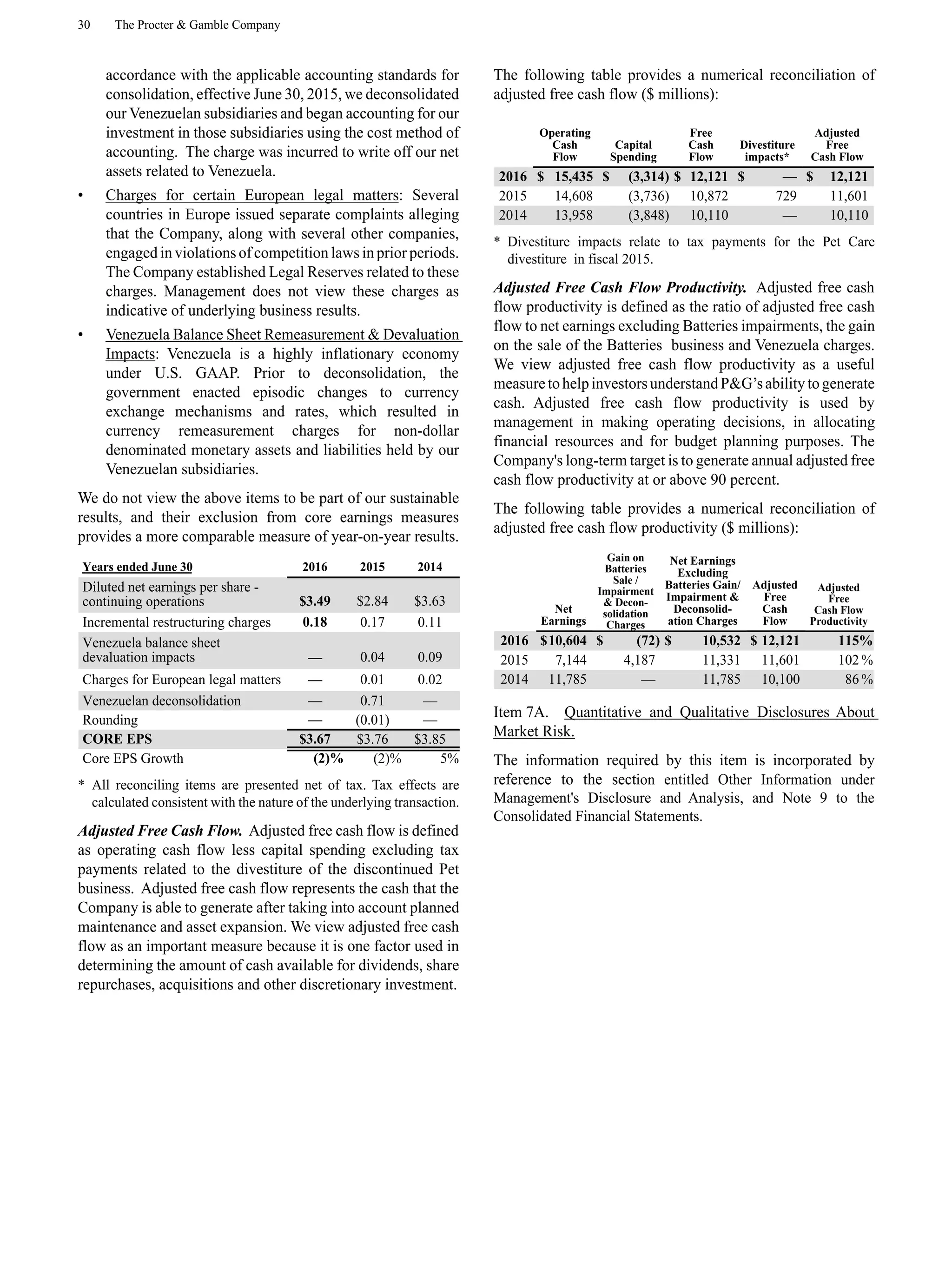
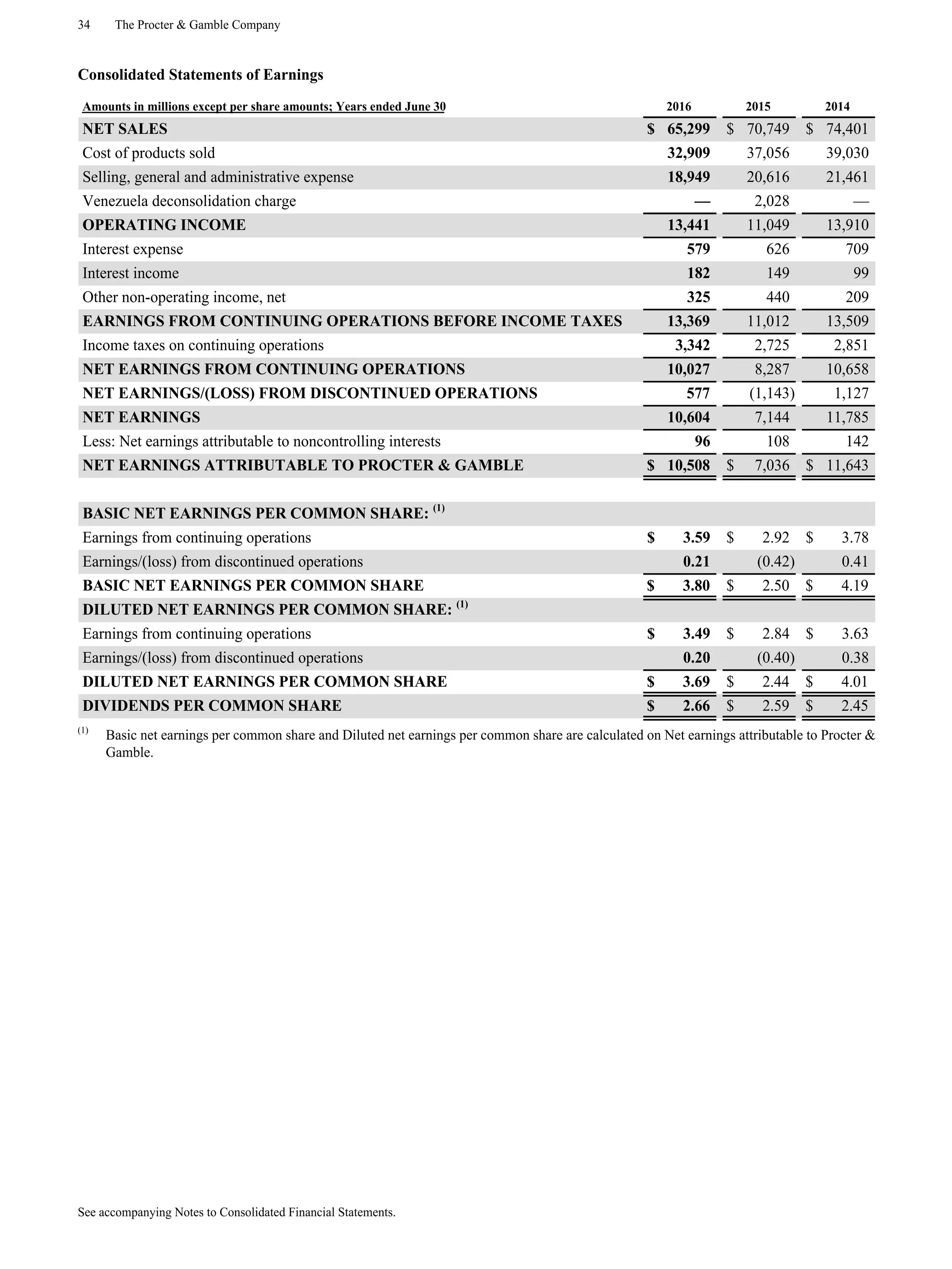
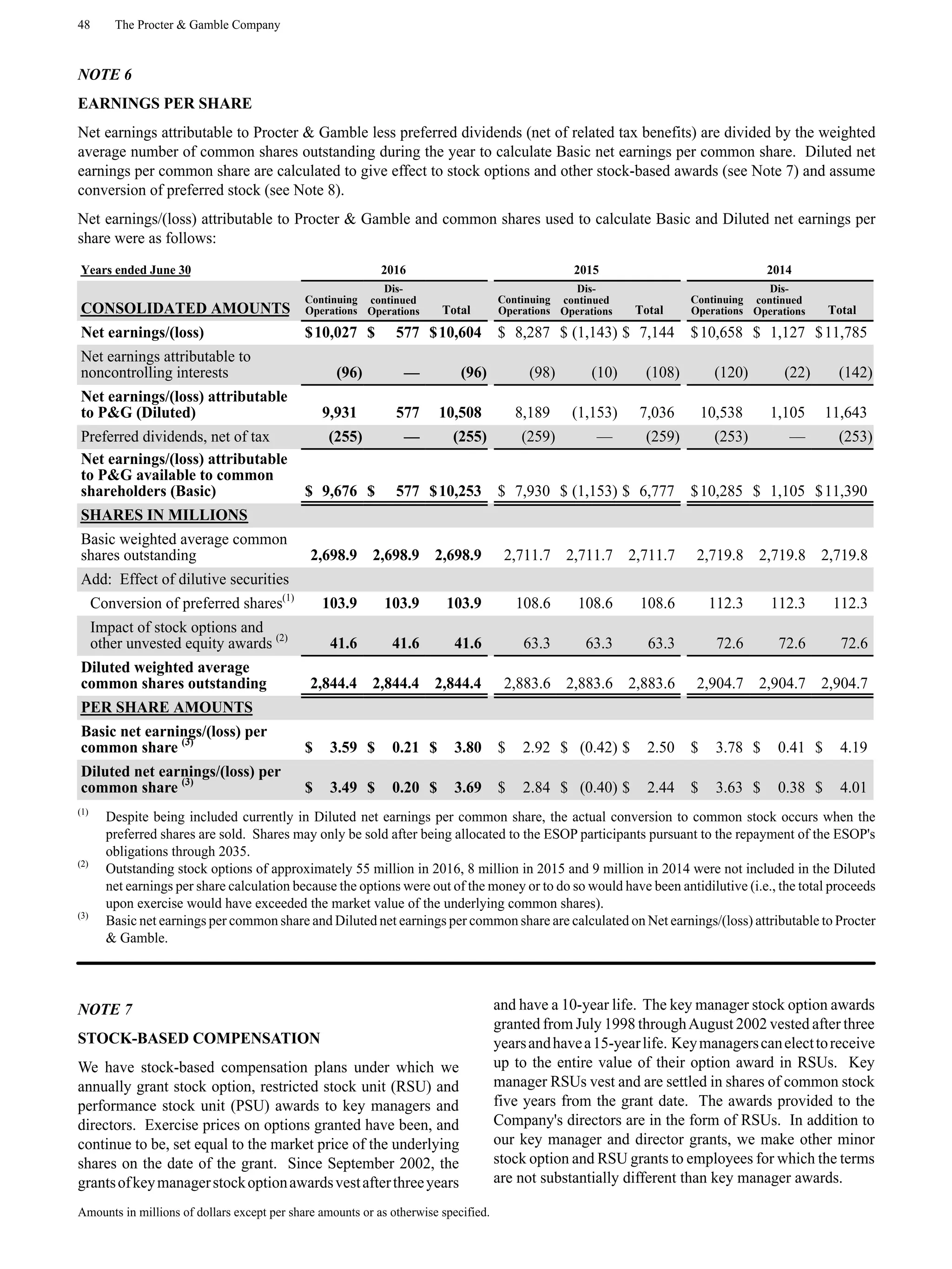
Net sales $ 65,299 $ 70,749 $ 74,401 $ 73,910 $ 73,138 $ 70,464
Gross profit 32,390 33,693 35,371 35,858 35,254 35,110
Operating income 13,441 11,049 13,910 13,051 12,495 13,849
Net earnings from continuing operations 10,027 8,287 10,658 10,346 8,864 10,509
Net earnings/(loss) from discontinued operations 577 (1,143) 1,127 1,056 2,040 1,418
Net earnings attributable to Procter & Gamble 10,508 7,036 11,643 11,312 10,756 11,797
Net earnings margin from continuing operations 15.4% 11.7% 14.3% 14.0% 12.1% 14.9%
Basic net earnings per common share: (1)
Earnings from continuing operations $ 3.59 $ 2.92 $ 3.78 $ 3.65 $ 3.08 $ 3.62
Earnings/(loss) from discontinued operations 0.21 (0.42) 0.41 0.39 0.74 0.50
Basic net earnings per common share $ 3.80 $ 2.50 $ 4.19 $ 4.04 $ 3.82 $ 4.12
Diluted net earnings per common share: (1)
Earnings from continuing operations $ 3.49 $ 2.84 $ 3.63 $ 3.50 $ 2.97 $ 3.46
Earnings/(loss) from discontinued operations 0.20 (0.40) 0.38 0.36 0.69 0.47
Diluted net earnings per common share $ 3.69 $ 2.44 $ 4.01 $ 3.86 $ 3.66 $ 3.93
Dividends per common share $ 2.66 $ 2.59 $ 2.45 $ 2.29 $ 2.14 $ 1.97
Research and development expense $ 1,879 $ 1,991 $ 1,910 $ 1,867 $ 1,874 $ 1,812
Advertising expense 7,243 7,180 7,867 8,188 7,839 7,713
Total assets 127,136 129,495 144,266 139,263 132,244 138,354
Capital expenditures 3,314 3,736 3,848 4,008 3,964 3,306
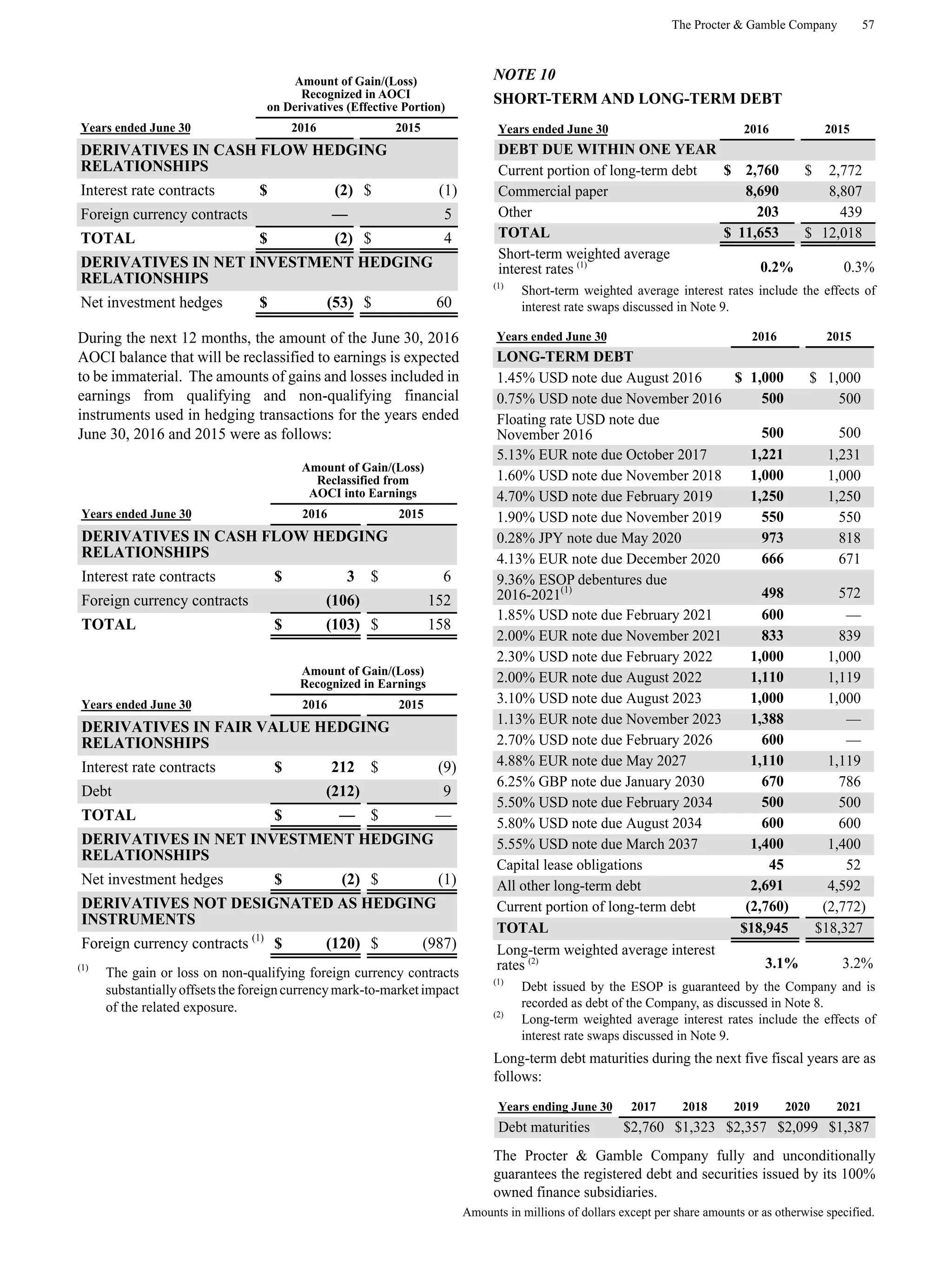
Long-term debt 18,945 18,327 19,807 19,111 21,080 22,033
Shareholders' equity $ 57,983 $ 63,050 $ 69,976 $ 68,709 $ 64,035 $ 68,001
(1)
Basic net earnings per common share and Diluted net earnings per common share are calculated based on Net earnings attributable to
Procter & Gamble.
The Procter & Gamble Company 11
Item 7. Management's Discussion and Analysis of Financial Condition and Results of Operations.
Management's Discussion and Analysis
Forward-Looking Statements
Certain statements in this report, other than purely historical
information, including estimates, projections, statements
relating to our business plans, objectives and expected
operating results and the assumptions upon which those
statements are based, are “forward-looking statements” within
the meaning of the Private Securities Litigation ReformAct of
1995, Section 27A of the Securities Act of 1933 and
Section 21E of the Securities ExchangeAct of 1934. Forward-
looking statements may appear throughout this report,
including, without limitation, in the following sections:
“Management's Discussion andAnalysis” and “Risk Factors.”
These forward-looking statements generally are identified by
the words “believe,” “project,” “expect,” “anticipate,”
“estimate,” “intend,” “strategy,” “future,” “opportunity,”
“plan,” “may,” “should,” “will,” “would,” “will be,” “will
continue,” “will likely result” and similar expressions.
Forward-looking statements are based on current expectations
and assumptions, which are subject to risks and uncertainties
that maycause resultstodiffermaterially from those expressed
or implied in the forward-looking statements. A detailed
discussion of risks and uncertainties that could cause results
and events to differ materially from such forward-looking
statements is included in the section titled "Economic
Conditions and Uncertainties" and the section titled “Risk
Factors” (Item 1A of this Form 10-K). Forward-looking
statements are made as of the date of this report, and we
undertake no obligation to update or revise publicly any
forward-looking statements, whether because of new
information, future events or otherwise.
The purpose of Management's Discussion and Analysis
(MD&A)istoprovideanunderstandingofProcter&Gamble's
financial condition, results of operations and cash flows by
focusing on changes in certain key measures from year to year.
The MD&Ais provided as a supplement to, and should be read
in conjunction with, our Consolidated Financial Statements
and accompanying notes. The MD&A is organized in the
following sections:
• Overview
• Summary of 2016 Results
• Economic Conditions and Uncertainties
• Results of Operations
• Segment Results
• Cash Flow, Financial Condition and Liquidity
• Significant Accounting Policies and Estimates
• Other Information
Throughout the MD&A, we refer to measures used by
management to evaluate performance, including unit volume
growth, net sales and net earnings. We also refer to a number
of financial measures that are not defined under accounting
principles generally accepted in the United States of America
(U.S. GAAP), including organic sales growth, core earnings
per share (Core EPS), adjusted free cash flow and adjusted free
cash flow productivity. Organic sales growth is net sales
growth excluding the impacts of the Venezuela
deconsolidation, acquisitions, divestitures and foreign
exchange from year-over-year comparisons. Core EPS is
diluted net earnings per share from continuing operations
excluding certain items that are not judged to be part of the
Company's sustainable results or trends. Adjusted free cash
flow is operating cash flow less capital spending and certain
divestiture impacts. Adjusted free cash flow productivity is
the ratio of adjusted free cash flow to net earnings excluding
certain one-time items. We believe these measures provide our
investors with additional information about our underlying
results and trends, as well as insight to some of the metrics
used to evaluate management. The explanation at the end of
the MD&Aprovides more details on the use and the derivation
of these measures.
Management also uses certain market share and market
consumption estimates to evaluate performance relative to
competition despite some limitations on the availability and
comparability of share and consumption information.
References to market share and market consumption in the
MD&A are based on a combination of vendor-reported
consumptionandmarketsizedata,aswellasinternalestimates.
All market share references represent the percentage of sales
in dollar terms on a constant currency basis of our products,
relative to all product sales in the category.
OVERVIEW
P&G is a global leader in fast-moving consumer goods,
focused on providing branded consumer packaged goods of
superior quality and value to our consumers around the world.
Ourproductsare sold inmore than180countriesandterritories
primarily through mass merchandisers, grocery stores,
membership club stores, drug stores, department stores,
distributors, baby stores, specialty beauty stores, e-commerce,
high-frequencystoresandpharmacies. Wehaveon-the-ground
operations in approximately 70 countries.
Our market environment is highly competitive with global,
regional and local competitors. In many of the markets and
industry segments in which we sell our products, we compete
againstotherbrandedproductsaswellasretailers'private-label
brands. Additionally, many of the product segments in which
we compete are differentiated by price tiers (referred to as
super-premium, premium, mid-tier and value-tier products).
We are well positioned in the industry segments and markets
in which we operate, often holding a leadership or significant
market share position.
12 The Procter & Gamble Company
ORGANIZATIONAL STRUCTURE
Our organizational structure is comprised of Global Business Units (GBUs), Selling and Market Operations (SMOs), Global
Business Services (GBS) and Corporate Functions (CF).
Global Business Units
Our GBUs are organized into ten product categories. Under U.S. GAAP, the GBUs underlying the ten product categories are
aggregated into five reportable segments: Beauty; Grooming; Health Care; Fabric & Home Care; and Baby, Feminine &
Family Care. The GBUs are responsible for developing overall brand strategy, new product upgrades and innovations and
marketing plans. The following provides additional detail on our reportable segments and the ten product categories and brand
composition within each segment.
Reportable Segments
% of
Net Sales 1
% of Net
Earnings 1
Product Categories (Sub-Categories) Major Brands
Beauty 18% 20%
Hair Care (Conditioner, Shampoo, Styling Aids,
Treatments)
Head & Shoulders,
Pantene, Rejoice
Skin and Personal Care (Antiperspirant and
Deodorant, Personal Cleansing, Skin Care)
Olay, Old Spice,
Safeguard, SK-II
Grooming 11% 15%
Grooming 2
(Shave Care - Female Blades & Razors,
Male Blades & Razors, Pre- and Post-Shave
Products, Other Shave Care; Appliances)
Braun, Fusion, Gillette,
Mach3, Prestobarba,
Venus
Health Care 11% 12%
Oral Care (Toothbrushes, Toothpaste, Other Oral
Care) Crest, Oral-B
Personal Health Care (Gastrointestinal, Rapid
Diagnostics, Respiratory, Vitamins/Minerals/
Supplements, Other Personal Health Care)
Prilosec, Vicks
Fabric & Home Care 32% 27%
Fabric Care (Fabric Enhancers, Laundry Additives,
Laundry Detergents) Ariel, Downy, Gain, Tide
Home Care (Air Care, Dish Care, P&G
Professional, Surface Care)
Cascade, Dawn, Febreze,
Mr. Clean, Swiffer
Baby, Feminine &
Family Care
28% 26%
Baby Care (Baby Wipes, Diapers and Pants) Luvs, Pampers
Feminine Care (Adult Incontinence, Feminine Care) Always, Tampax
Family Care (Paper Towels, Tissues, Toilet Paper) Bounty, Charmin
(1)
Percent of Net sales and Net earnings from continuing operations for the year ended June 30, 2016 (excluding results held in Corporate).
(2)
The Grooming product category is comprised of the Shave Care and Appliances GBUs.
Recent Developments: As of June 30, 2015, the Company
deconsolidated our Venezuelan subsidiaries and began
accounting for our investment in those subsidiaries using the
cost method of accounting. This change resulted in a fiscal
2015one-timeafter-taxchargeof$2.1billion($0.71pershare).
Beginning in fiscal 2016, our financial results only include
sales of finished goods to our Venezuelan subsidiaries to the
extent we receive cash payments from Venezuela (expected to
be largely through the DIPRO and DICOM exchange market).
Accordingly, we no longer include the results of our
Venezuelan subsidiaries' operations in reporting periods
followingfiscal2015(seeNote1totheConsolidatedFinancial
Statements and additional discussion in the MD&A under
"Venezuela Impacts" in Results of Operations).
InAugust2014,theCompanyannouncedaplantosignificantly
streamline our product portfolio by divesting, discontinuing or
consolidating about 100 non-strategic brands. The resulting
portfolio of about 65 key brands are in 10 category-based
businesses where P&G has leading market positions, strong
brands and consumer-meaningful product technologies.
During fiscal 2016, the company completed the divestiture of
its Batteries business. The Batteries business had historically
been part of the Company’s Fabric & Home Care reportable
segment. The results of the Batteries business are presented
asdiscontinuedoperationsand,assuch,areexcludedfromboth
continuing operations and segment results for all periods
presented. Additionally, the Batteries balance sheet positions
as of June 30, 2015 are presented as held for sale in the
Consolidated Balance Sheets.
On July 9, 2015, the Company announced the signing of a
definitive agreement to divest four product categories, to Coty
Inc. ("Coty"). Coty's offer was $12.5 billion. The divestiture
was initially comprised of 43 of the Company's beauty brands
("BeautyBrands"),includingtheglobalsalonprofessionalhair
care and color, retail hair color, cosmetics and fine fragrance
businesses, along with select hair styling brands. Subsequent
to signing, two of the fine fragrance brands, Dolce Gabbana
and Christina Aguilera, were excluded from the divestiture.
While the ultimate form of the transaction has not yet been
decided, the Company’s current preference is for a Reverse
The Procter & Gamble Company 13
Morris Trust split-off transaction in which P&G shareholders
could elect to participate in an exchange offer to exchange their
P&G shares for Coty shares. The Company expects to
complete this transaction in October 2016. The results of the
Beauty Brands are now presented as discontinued operations
and, as such, are excluded from both continuing operations and
segment results for all periods presented. Additionally, the
Beauty Brands' balance sheet positions as of June 30, 2016 and
June 30, 2015 are presented as held for sale in the Consolidated
Balance Sheets.
During fiscal 2015, the Company completed the divestiture of
its Pet Care business. The gain on the transaction was not
material. The results of the Pet Care business are presented as
discontinued operations and, as such, are excluded from both
continuing operations and segment results for all periods
presented.
With these transactions and other recent minor brand
divestitures, the Company will have substantially completed
the strategic portfolio reshaping program.
Beauty: We are a global market leader in the beauty category.
Most of the beauty markets in which we compete are highly
fragmented with a large number of global and local
competitors. We compete in skin and personal care and in hair
care. In skin and personal care, we offer a wide variety of
products,rangingfromdeodorantstopersonalcleansingtoskin
care, such as our Olay brand, which is one of the top facial skin
care brands in the world with over 7% global market share. In
hair care, we compete in the retail channel. We are the global
market leader in the retail hair care market with over 20%
global market share primarily behind our Pantene and Head &
Shoulders brands.
Grooming: We compete in Shave Care and Appliances. In
Shave Care, we are the global market leader in the blades and
razors market. Our global blades and razors market share is
nearly 65%, primarily behind the Gillette franchise including
Fusion, Mach3, Prestobarba and Venus. Our appliances, such
as electric razors and epilators, are sold under the Braun brand
in a number of markets around the world where we compete
against both global and regional competitors. We hold over
20% of the male shavers market and nearly 45% of the female
epilators market.
Health Care: We compete in oral care and personal health
care. In oral care, there are several global competitors in the
market andwe have the numbertwomarket share positionwith
nearly 20% global market share behind our Oral-B and Crest
brands. In personal health care, we are a top ten competitor in
a large, highly fragmented industry, primarily behind
respiratory treatments (Vicks brand), nonprescription
heartburn medications (Prilosec OTC brand) and digestive
wellness products (Metamucil, Pepto Bismol, and Align
brands). Nearly all of our sales outside the U.S. in personal
health care are generated through the PGT Healthcare
partnership with Teva Pharmaceuticals Ltd.
Fabric & Home Care: This segment is comprised of a variety
of fabric care products including laundry detergents, additives
and fabric enhancers; and home care products including
dishwashing liquids and detergents, surface cleaners and air
fresheners. In fabric care, we generally have the number one
or number two market share position in the markets in which
we compete and are the global market leader with nearly 30%
global market share, primarily behind our Tide, Ariel and
Downy brands. Our global home care market share is nearly
25% across the categories in which we compete.
Baby, Feminine & Family Care: In baby care, we compete
mainlyindiapers,pantsandbabywipeswithnearly30%global
market share. We are the number one or number two baby care
competitor in most of the key markets in which we compete,
primarily behind Pampers, the Company's largest brand, with
annual net sales of nearly $9 billion. We are the global market
leader in the feminine care category with over 25% global
market share, primarily behind Always. We also compete in
the adult incontinence category in certain markets, achieving
over 10% market share in the markets where we compete. Our
family care business is predominantly a North American
business comprised largely of the Bounty paper towel and
Charmin toilet paper brands. U.S. market shares are over 40%
for Bounty and over 25% for Charmin.
Selling and Market Operations
Our SMOs are responsible for developing and executing go-
to-marketplansat thelocallevel. The SMOsincludededicated
retail customer, trade channel and country-specific teams. Our
SMOs are organized under six regions comprised of North
America, Europe, Latin America, Asia Pacific, Greater China
and India, Middle East and Africa (IMEA). Throughout the
MD&A, we reference business results in developed markets,
which are comprised of North America, Western Europe and
Japan, and developing markets which are all other markets not
included in developed.
Global Business Services
GBS provides technology, processes and standard data tools
to enable the GBUs and the SMOs to better understand the
business and better serve consumers and customers. The GBS
organization is responsible for providing world-class solutions
at a low cost and with minimal capital investment.
Corporate Functions
CF provides company-level strategy and portfolio analysis,
corporate accounting, treasury, tax, external relations,
governance, human resources and legal, as well as other
centralized functional support.
STRATEGIC FOCUS
P&G aspires to serve the world’s consumers better than our
best competitors in every category and in every country in
which we compete, and, as a result, deliver total shareholder
return in the top one-third of our peer group. Delivering and
sustaining leadership levels of shareholder value creation
requires balanced top-line growth, bottom-line growth and
strong cash generation.
Our strategic choices are focused on winning with consumers.
The consumers who purchase and use our products are at the
center of everything we do. We increase the number of users
- and the usage - of our brands when we win at the zero, first
and second moments of truth: when consumers research our
14 The Procter & Gamble Company
categories and brands, purchase them in a store or online and
use them in their homes.
Winning with consumersaround the world and against our best
competitors requires innovation. Innovation has always been,
and continues to be, P&G’s lifeblood. Innovation requires
consumer insights and technology advancements that lead to
product improvements, improved marketing and
merchandising programs and game-changing inventions that
create new brands and categories.
Productivityimprovementiscriticaltodeliveringourbalanced
top-line growth, bottom-line growth and value creation
objectives. Productivity improvement and sales growth
reinforce and fuel each other. We are driving productivity
improvement across all elements of cost, including cost of
goods sold, marketing and promotional expenses and non-
manufacturingoverhead. Productivityimprovementsandcost
savings are being reinvested in product and packaging
improvements, brand awareness-building advertising and
trial-building sampling programs, increased sales coverage
and R&D programs.
We are improving operational effectiveness and organizational
culture through enhanced clarity of roles and responsibilities,
accountability and incentive compensation programs.
The Company has undertaken an effort to focus and strengthen
its business portfolio to compete in categories and with brands
that are structurally attractive and that play to P&G's strengths.
The ongoing portfolio of businesses consists of 10 product
categories. These are categories where P&G has leading
market positions, strong brands and consumer-meaningful
product technologies.
We believe these strategies are right for the long-term health
of the Company and our objective of delivering total
shareholder return in the top one-third of our peer group.
The Company expects the delivery of the following long-term
annual financial targets will result in total shareholder returns
in the top third of the competitive peer group:
• Organic sales growth above market growth rates in the
categories and geographies in which we compete;
• Core EPS growth of mid-to-high single digits; and
• Adjusted free cash flow productivity of 90% or greater.
In periods with significant macroeconomic pressures, we
intend to maintain a disciplined approach to investing so as not
tosacrificethelong-termhealthofourbusinessestomeetshort-
term objectives in any given year.
SUMMARY OF 2016 RESULTS
Amounts in millions, except per share amounts 2016
Change vs.
Prior Year 2015
Change vs.
Prior Year 2014
Net sales $ 65,299 (8)% $ 70,749 (5)% $ 74,401
Operating income 13,441 22 % 11,049 (21)% 13,910
Net earnings from continuing operations 10,027 21 % 8,287 (22)% 10,658
Net earnings/(loss) from discontinued operations 577 N/A (1,143) N/A 1,127
Net earnings attributable to Procter & Gamble 10,508 49 % 7,036 (40)% 11,643
Diluted net earnings per common share 3.69 51 % 2.44 (39)% 4.01
Diluted net earnings per share from continuing operations 3.49 23 % 2.84 (22)% 3.63
Core EPS 3.67 (2)% 3.76 (2)% 3.85
Cash flow from operating activities 15,435 6 % 14,608 5 % 13,958
• Net sales decreased 8% to $65.3 billion including a
negative 6% impact from foreign exchange.
Organic sales increased 1%, as increased pricing was
partially offset by a reduction in organic volume.
Unit volume decreased 3%. Volume decreased low
single digits in Grooming, Health Care, Fabric &
Home Care and Baby, Feminine & Family Care.
Volume decreased mid-single digits in Beauty.
Organic volume declined 1%.
• Net earnings from continuing operations increased $1.7
billion or 21% in fiscal 2016 due to a $2.1 billion after-
tax charge in the prior year related to the deconsolidation
of our Venezuelan subsidiaries and improved gross
margin, partially offset by the earnings impact of the
decline in net sales. Foreign exchange impacts negatively
affected net earnings from continuing operations by $880
million or approximately 11%.
• Net earnings from discontinued operations increased $1.7
billion due primarily to the net impact of a gain on the sale
of our Batteries business in fiscal 2016 and higher
impairment charges on that business in the prior period.
• Net earnings attributable to Procter & Gamble were $10.5
billion, an increase of $3.5 billion or 49% versus the prior
year due to the aforementioned increases in net earnings
from both continuing and discontinued operations.
• Diluted net earnings per share increased 51% to $3.69.
Diluted net earnings per share from continuing
operations increased 23% to $3.49.
Core EPS decreased 2% to $3.67.
• Cash flow from operating activities was $15.4 billion.
Adjusted free cash flow was $12.1 billion.
Adjusted free cash flow productivity was 115%.
The Procter & Gamble Company 15
ECONOMIC CONDITIONS AND UNCERTAINTIES
We discuss expectations regarding future performance, events
and outcomes, such as our business outlook and objectives, in
annual and quarterly reports, press releases and other written
and oral communications. All such statements, except for
historical and present factual information, are "forward-
looking statements" and are based on financial data and our
business plans available only as of the time the statements are
made, which may become out-of-date or incomplete. We
assume no obligation to update any forward-looking
statementsasaresultofnewinformation,futureeventsorother
factors. Forward-looking statements are inherently uncertain
and investors must recognize that events could be significantly
different from our expectations. For more information on risks
that could impact our results, refer to Item 1A Risk Factors in
this Form 10-K.
Global Economic Conditions. Current macroeconomic
factors remain dynamic, and any causes of market size
contraction, such as reduced GDP in commodity-producing
economies as commodity prices decline, greater political
unrestintheMiddleEastandEasternEurope,furthereconomic
instabilityintheEuropeanUnion,politicalinstabilityincertain
Latin American markets and economic slowdowns in Japan
and China, could reduce our sales or erode our operating
margin, in either case reducing our earnings.
Changes in Costs. Our costs are subject to fluctuations,
particularly due to changes in commodity prices and our own
productivity efforts. We have significant exposures to certain
commodities, in particular certain oil-derived materials like
resins, and volatility in the market price of these commodity
input materials has a direct impact on our costs. If we are
unable to manage commodity fluctuations through pricing
actions, cost savings projects and sourcing decisions as well
as through consistent productivity improvements, it may
adversely impact our gross margin, operating margin and net
earnings. Sales could also be adversely impacted following
pricing actions if there is a negative impact on consumption of
our products. We strive to implement, achieve and sustain cost
improvement plans, including outsourcing projects, supply
chain optimization and general overhead and workforce
optimization. As discussed later in the MD&A, we initiated
certain non-manufacturing overhead reduction projects along
with manufacturing and other supply chain cost improvements
projects in 2012. If we are not successful in executing these
changes, there could be a negative impact on our operating
margin and net earnings.
Foreign Exchange. We have both translation and transaction
exposure to the fluctuation of exchange rates. Translation
exposuresrelatetoexchangerateimpactsofmeasuringincome
statementsofforeignsubsidiariesthatdonotusetheU.S.dollar
as their functional currency. Transaction exposures relate to
1) the impact from input costs that are denominated in a
currency other than the local reporting currency and 2) the
revaluation of transaction-related working capital balances
denominated in currencies other than the functional currency.
In2016,2015and2014,theU.S.dollarhasstrengthenedversus
a number of foreign currencies leading to lower sales and
earnings from these foreign exchange impacts. Certain
countries experiencing significant exchange rate fluctuations,
likeArgentina,Brazil,Canada,Egypt,Mexico,Nigeria,Russia
and Turkey have had, and could have, a significant impact on
our sales, costs and earnings. Increased pricing in response to
these fluctuations in foreign currency exchange rates may
offset portions of the currency impacts, but could also have a
negative impact on consumption of our products, which would
affect our sales.
Government Policies. Our net earnings could be affected by
changes in U.S. or foreign government tax policies. For
example,theU.S.mayconsidercorporatetaxreformthatcould
significantly impact the corporate tax rate and change the U.S.
tax treatment of international earnings. Additionally, we
attempt to carefully manage our debt and currency exposure
in certain countries with currency exchange, import
authorization and pricing controls, such as Argentina, Egypt,
Nigeria and Ukraine. Changes in government policies in these
areasmightcauseanincreaseordecreaseinoursales,operating
margin and net earnings.
RESULTS OF OPERATIONS
The key metrics included in our discussion of our consolidated
results of operations include net sales, gross margin, selling,
general and administrative costs (SG&A), other non-operating
items and income taxes. The primary factors driving year-
over-year changes in net sales include overall market growth
in the categories in which we compete, product initiatives, the
level of initiatives and other activities by competitors,
geographic expansion and acquisition and divestiture activity,
all of which drive changes in our underlying unit volume, as
well as pricing actions (which can also indirectly impact
volume), changes in product and geographic mix and foreign
currency impacts on sales outside the U.S.
Most of our cost of products sold and SG&Aare to some extent
variable in nature. Accordingly, our discussion of these
operating costs focuses primarily on relative margins rather
than the absolute year-over-year changes in total costs. The
primary drivers of changes in gross margin are input costs
(energy and other commodities), pricing impacts, geographic
mix (for example, gross margins in developed markets are
generally higher than in developing markets for similar
products), product mix (for example, the Beauty segment has
higher gross margins than the Company average), foreign
exchange rate fluctuations (in situations where certain input
costs may be tied to a different functional currency than the
underlying sales), the impacts of manufacturing savings
projects and to a lesser extent scale impacts (for costs that are
fixed or less variable in nature). The primary drivers of SG&A
are marketing-related costs and non-manufacturing overhead
costs. Marketing-related costs are primarily variable in nature,
although we may achieve some level of scale benefit over time
due to overall growth and other marketing efficiencies.
Overhead costs are also variable in nature, but on a relative
basis, less so than marketing costs due to our ability to leverage
our organization and systems infrastructures to support
business growth. Accordingly, we generally experience more
scale-related impacts for these costs.
16 The Procter & Gamble Company
The Company is in the midst of a productivity and cost savings
plan to reduce costs in the areas of supply chain, marketing
and overhead expenses. The plan is designed to accelerate cost
reductions by streamlining management decision making,
manufacturing and other work processes to fund the
Company's growth strategy.
Net Sales
Fiscal year 2016 compared with fiscal year 2015
Net sales decreased 8% to $65.3 billion in 2016 on a 3%
decrease in unit volume versus the prior year period. Volume
decreased low single digits in Grooming, Health Care, Fabric
& Home Care and Baby, Feminine & Family Care and
decreased mid-single digits in Beauty. Volume increased low
single digits in developed regions and declined high single
digits in developing regions, in part due to increased pricing
to address foreign exchange devaluations and due to the
Venezuela deconsolidation and minor brand divestitures.
Organic volume declined mid-single digits in developing
markets. Unfavorable foreign exchange reduced net sales by
6%, while higher pricing drove a 1% favorable impact on net
sales. Organic volume decreased 1% and organic sales grew
1% driven by higher pricing.
Fiscal year 2015 compared with fiscal year 2014
Net sales decreased 5% to $70.7 billion in 2015 on a 1%
decrease in unit volume versus the prior year period. Volume
grew low single digits in Fabric & Home Care. Volume
decreased low single digits in Baby, Feminine & Family Care,
Grooming, Health Care and Beauty. Volume increased low
single digits in developed regions and declined low single
digits in developing regions due, in part, to increased pricing
to address foreign exchange devaluations. Unfavorable
foreignexchangereducednetsalesby6%,whilehigherpricing
drove a 2% favorable impact on net sales. Favorable product
mix impact of 1% was offset by acquisition and divestiture
activity. Organic volume decreased 1% and organic sales grew
2% driven by higher pricing.
Operating Costs
Comparisons as a percentage of net sales; Years ended June 30 2016
Basis Point
Change 2015
Basis Point
Change 2014
Gross margin 49.6% 200 47.6% 10 47.5%
Selling, general and administrative expense 29.0% (10) 29.1% 30 28.8%
Operating margin 20.6% 500 15.6% (310) 18.7%
Earnings from continuing operations before income taxes 20.5% 490 15.6% (260) 18.2%
Net earnings from continuing operations 15.4% 370 11.7% (260) 14.3%
Net earnings attributable to Procter & Gamble 16.1% 620 9.9% (570) 15.6%
Fiscal year 2016 compared with fiscal year 2015
Gross margin increased 200 basis points to 49.6% of net sales
in 2016. Gross margin increased primarily due to:
• a 210 basis point positive impact from manufacturing cost
savings,
• a 110 basis point benefit from lower commodity costs and
• a 70 basis point benefit of higher pricing.
These impacts were partially offset by:
• a 70 basis point negative impact from unfavorable foreign
exchange,
• a 70 basis point decrease due to unfavorable product mix
caused by the disproportionate decline of higher margin
segments like Beauty and by product form mix within the
segments,
• a 20 basis point decrease from negative scale impacts due
to lower volume and
• a 20 basis point decline due to incremental restructuring
activity.
Total SG&A decreased 8% to $18.9 billion primarily due to
reduced overhead spending and a decrease in foreign exchange
transaction charges. SG&A as a percentage of net sales
declined 10 basis points to 29.0%, as the negative scale
impacts of lower net sales and inflationary impacts were more
than offset by cost savings efforts, mainly in overhead
spending, and lower foreign exchange transactional charges.
• Marketing spending as a percentage of net sales increased
90 basis points due to the negative scale impacts from
reduced sales.
• Overhead costs as a percentage of net sales decreased 20
basis points, as 90 basis points of productivity savings
were partially offset by wage inflation, increased sales
personnel in certain businesses, investments in research
and development and the negative scale impacts from
reduced sales.
• Lower foreign exchange transactional charges reduced
SG&A as a percentage of net sales by approximately 70
basis points. A pre-deconsolidation balance sheet
remeasurement charge in Venezuela in the base period
drove 20 basis points of this decline. The balance of the
reduction relates to lower transactional charges from
revaluing receivables and payables from transactions
denominated in a currency other than a local entity’s
functional currency.
The Procter & Gamble Company 17
Fiscal year 2015 compared with fiscal year 2014
Gross margin increased 10 basis points to 47.6% of net sales
in 2015. Gross margin benefited from:
• a 200 basis point impact from manufacturing cost savings
and
• a 90 basis point benefit from higher pricing.
These impacts were partially offset by:
• a 110 basis point impact from unfavorable geographic and
product mix, primarily from declines in the higher than
average margin Beauty and Grooming segments as well
as within the Fabric & Home Care and Grooming
segments,
• a 50 basis point impact from unfavorable foreign
exchange,
• a 40 basis point impact from costs related to initiatives and
capacity investments,
• a 30 basis point impact from higher restructuring costs and
• smaller impacts from lower volume scale and higher
commodity costs.
Total SG&A decreased 4% to $20.6 billion, as reduced
overhead and marketing spending was partially offset by
increased foreign exchange transaction charges. SG&A as a
percentage of net sales increased 30 basis points to 29.1%, as
the negative scale impacts of lower net sales and inflationary
impacts were partially offset by cost savings efforts.
• Marketing spending as a percentage of net sales decreased
60 basis points behind lower spending due to efficiency
efforts.
• Overhead spending as a percentage of net sales increased
50 basis points as productivity savings of 60 basis points
from reduced overhead spending were more than offset
by wage inflation, investments in research and
development, the negative scale impacts of lower net sales
and higher restructuring costs.
• Increased foreign exchange transaction charges added
approximately 40 basis points to SG&A as a percentage
of net sales, as current year foreign currency transaction
charges (from revaluing receivables and payables
denominated in a currency other than a local entity’s
functional currency) were partially offset by lower year-
on-year charges for Venezuela remeasurement and
devaluation.
During fiscal 2015, the Company incurred a $2.0 billion ($2.1
billion after tax) charge related to the deconsolidation of its
Venezuelan subsidiaries. See the “Venezuela Impacts” later in
the Results of Operations section.
Non-Operating Items
Fiscal year 2016 compared with fiscal year 2015
• Interest expense was $579 million in 2016, a decrease of
$47millionversustheprioryeardue toloweraveragedebt
balances.
• Interest income was $182 million in 2016, an increase of
$33 million versus the prior year primarily due to
increasing cash, cash equivalents and investment
securities balances.
• Other non-operating income, which primarily includes
divestiture gains and investment income, decreased $115
million to $325 million, due primarily to lower gains on
minor brand divestitures. In 2016, we had approximately
$300 million in minor brand divestiture gains, including
Escudo and certain hair care brands in Europe and IMEA.
The prior year acquisition and divestiture activities
included approximately $450 million in divestiture gains,
including Zest, Camay, Fekkai and Wash & Go hair care
brands and Vaposteam.
Fiscal year 2015 compared with fiscal year 2014
• Interest expense was $626 million in 2015 a decrease of
$83millionversustheprioryeardue toloweraveragedebt
balances and a decrease in weighted average interest rates.
• Interest income was $149 million in 2015, an increase of
$50millionversustheprioryearduetoanincreaseincash,
cash equivalents and investment securities.
• Other non-operating income increased $231 million to
$440 million, primarily due to minor brand divestiture
gains. In 2015, we had approximately $450 million in
minor brand divestiture gains, including Zest, Camay,
Fekkai and Wash & Go hair care brands and Vaposteam.
The prior year acquisition and divestiture activities
included approximately $150 million in divestiture gains,
primarily related to the sale of our bleach businesses in
Europe, IMEA and Latin America, our Pert hair care
business in Latin America and MDVIP.
Income Taxes
Fiscal year 2016 compared with fiscal year 2015
The effective tax rate on continuing operations increased 30
basis points to 25.0% in 2016 mainly due to a 260 basis point
negative impact from the unfavorable geographic mix of
earnings, a 130 basis point impact in the current year from the
establishment of valuation allowances on deferred tax assets
related to net operating loss carryforwards and the impact of
favorable discrete adjustments related to uncertain income tax
positions (which netted to 55 basis points in the current year
versus 85 basis points in the prior year), partially offset by a
400 basis point decrease related to the prior year non-
deductibility of the Venezuelan deconsolidation charge.
Fiscal year 2015 compared with fiscal year 2014
The effective tax rate on continuing operations increased 360
basis points to 24.7% in 2015 mainly due to the non-
deductibility of the $2.0 billion Venezuelan deconsolidation
charge. The rate increase caused by lower favorable discrete
adjustments related to uncertain income tax positions (the net
benefit was 80 basis points in fiscal 2015 versus 170 basis
points in fiscal 2014) was largely offset by a decrease related
to favorable geographic earnings mix.
Net Earnings
Fiscal year 2016 compared with fiscal year 2015
Net earnings from continuing operations increased $1.7 billion
or 21% to $10.0 billion primarily due to the base period charge
of $2.1 billion after-tax related to the deconsolidation of
18 The Procter & Gamble Company
Venezuelan subsidiaries. Earnings also declined due to the
impact of the decline in net sales in fiscal 2016, partially offset
byimprovedgrossmarginandthereductioninSG&A. Foreign
exchange impacts reduced net earnings by about $880 million
in 2016 due to weakening of certain key currencies against the
U.S. dollar, primarily in Argentina, Brazil, Canada, Mexico
and Russia. This impact includes both transactional charges
as discussed above in Operating Costs and translational
impacts from converting earnings from foreign subsidiaries to
U.S. dollars.
Net earnings from discontinued operations improved $1.7
billion in 2016 to $577 million. Batteries drove a $2.1 billion
improvement due primarily to a $1.8 billion reduction in after-
tax impairment charges in the Batteries business ($350 million
in the current year compared to $2.1 billion in the base period)
and a $422 million after-tax gain in the current period from the
sale of the Batteries business. This was partially offset by a
decrease in the earnings of the Beauty Brands (see Note 4 to
the Consolidated Financial Statements).
Net earnings attributable to Procter & Gamble increased $3.5
billion, or 49% to $10.5 billion.
Diluted net earnings per share from continuing operations
increased $0.65, or 23%, to $3.49 due to the increase in net
earnings and a decline in the average number of shares
outstanding. Diluted net earnings per share from discontinued
operations were $0.20 primarily resulting from the gain on the
sale of the Batteries business. This was an improvement of
$0.60 per share versus the prior year. Diluted net earnings per
share increased $1.25, or 51%, to $3.69.
Core EPS decreased 2% to $3.67. Core EPS in fiscal year 2016
represents diluted net earnings per share from continuing
operations excluding charges for certain European legal
matters and incremental restructuring related to our
productivity and cost savings plan. The decline was driven by
reducednetsalesandforeignexchangeimpacts,partiallyoffset
by gross margin expansion.
Fiscal year 2015 compared with fiscal year 2014
Netearningsfromcontinuingoperationsdecreased$2.4billion
or 22% to $8.3 billion due to the $2.1 billion after-tax charge
related to the deconsolidation of Venezuelan subsidiaries and
the decline in net sales, partially offset by reduced SG&A.
Foreign exchange impacts negatively affected net earnings by
approximately $1.3 billion in 2015 due to the weakening of
certain key currencies against the U.S. dollar, primarily in
Russia, Ukraine, Venezuela and Argentina, partially offset by
lower after-taxchargesrelated tobalance sheet remeasurement
charges in Venezuela.
Net earnings from discontinued operations decreased $2.3
billion in 2015 due primarily to $2.1 billion of after-tax
impairment charges in our Batteries business (see Note 4 to
the Consolidated Financial Statements) and the absence of
fiscal 2015 earnings from our divested Pet Care business. Net
earnings attributable to Procter & Gamble decreased $4.6
billion, or 40% to $7.0 billion.
Diluted net earnings per share from continuing operations
decreased $0.79, or 22%, to $2.84 due to the decrease in net
earnings. Wehadadilutednetlosspersharefromdiscontinued
operations of $0.40 due primarily to the impairment charges
on the Batteries business. This was a reduction of $0.78 per
share versus the prior year. Diluted net earnings per share
decreased $1.57, or 39%, to $2.44.
Core EPS decreased 2% to $3.76. Core EPS represents diluted
net earnings per share from continuing operations excluding
charges for Venezuelan deconsolidation, balance sheet
remeasurement charges from foreign exchange policy changes
and devaluation in Venezuela, charges for certain European
legal matters and incremental restructuring related to our
productivity and cost savings plan. The decline was driven by
reduced net sales, partially offset by minor brand divestiture
gains.
Venezuela Impacts
There are a number of currency and other operating controls
and restrictions in Venezuela, which have evolved over time
and may continue to evolve in the future. These evolving
conditions resulted in an other-than-temporary lack of
exchangeability between the Venezuelan bolivar and U.S.
dollar and restricted our Venezuelan operations’ability to pay
dividends or pay for certain raw and package materials,
finished goods and services denominated in U.S. dollars. For
accounting purposes, this resulted in a lack of control over our
Venezuelan subsidiaries. Therefore, in accordance with the
applicable accounting standards for consolidation, effective
June 30, 2015, we deconsolidated our Venezuelan subsidiaries
and began accounting for our investment in those subsidiaries
using the cost method of accounting. This resulted in a write-
off of all of the net assets of our Venezuelan subsidiaries, along
with Venezuela related assets held by other subsidiaries.
Beginning with the first quarter of fiscal 2016, our financial
results only include sales of finished goods to our Venezuelan
subsidiariestotheextentwereceivepaymentsfromVenezuela.
Accordingly, we no longer include the results of our
Venezuelan subsidiaries’ operations in our financial results.
The Procter & Gamble Company 19
SEGMENT RESULTS
Segment results reflect information on the same basis we use for internal management reporting and performance evaluation. The
results of these reportable segments do not include certain non-business unit specific costs such as interest expense, investing
activities and certain restructuring and asset impairment costs. These costs are reported in our Corporate segment and are included
as part of our Corporate segment discussion. Additionally, as described in Note 2 to the Consolidated Financial Statements, we
apply blended statutory tax rates in the segments. Eliminations to adjust segment results to arrive at our effective tax rate are
included in Corporate. All references to net earnings throughout the discussion of segment results refer to net earnings from
continuing operations.
Net Sales Change Drivers 2016 vs. 2015*
Volume with
Acquisitions &
Divestitures
Volume
Excluding
Acquisitions &
Divestitures
Foreign
Exchange Price Mix Other**
Net Sales
Growth
Beauty (5 )% (2 )% (6 )% 2 % — % — % (9 )%
Grooming (2 )% (2 )% (9 )% 5 % (2)% — % (8 )%
Health Care (2 )% (2 )% (6 )% 2 % 1 % — % (5 )%
Fabric & Home Care (1 )% 1 % (6 )% — % — % — % (7 )%
Baby, Feminine & Family Care (3 )% (2 )% (6 )% — % — % — % (9 )%
TOTAL COMPANY (3)% (1)% (6)% 1% — % —% (8)%
Net Sales Change Drivers 2015 vs. 2014*
Volume with
Acquisitions &
Divestitures
Volume
Excluding
Acquisitions &
Divestitures
Foreign
Exchange Price Mix Other**
Net Sales
Growth
Beauty (3 )% (2 )% (5 )% 2 % — % — % (6 )%
Grooming (3 )% (3 )% (8 )% 4 % — % — % (7 )%
Health Care (1 )% (1 )% (5 )% 2 % 3 % — % (1 )%
Fabric & Home Care 1 % 1 % (6 )% 1 % — % (1 )% (5 )%
Baby, Feminine & Family Care (1 )% (1 )% (6 )% 2 % 2 % — % (3 )%
TOTAL COMPANY (1)% (1)% (6)% 2% 1% (1)% (5)%
* Net sales percentage changes are approximations based on quantitative formulas that are consistently applied.
** Other includes the sales mix impact from acquisitions and divestitures and rounding impacts necessary to reconcile volume to net sales.
BEAUTY
($ millions) 2016
Change
vs. 2015 2015
Change
vs. 2014
Volume N/A (5)% N/A (3)%
Net sales $11,477 (9)% $12,608 (6)%
Net earnings $1,975 (9)% $2,181 (5)%
% of net sales 17.2% (10) bps 17.3% 10 bps
Fiscal year 2016 compared with fiscal year 2015
Beauty net sales decreased 9% to $11.5 billion during the fiscal
year on a 5% decrease in unit volume. Unfavorable foreign
exchange reduced net sales by 6%. Price increases had a 2%
positive impact on net sales. Organic sales were unchanged
on organic volume that decreased 2%. Global market share of
the Beauty segment decreased 1.0 points. Volume decreased
low single digits in developed markets and decreased high
single digits in developing markets.
• Volume in Hair Care was down mid-single digits.
Developed markets declined mid-single digits due to
competitive activity while developing markets declined
mid-single digits driven by increased pricing, the
Venezuela deconsolidation and minor brand divestitures.
Global market share of the hair care category decreased
more than a point.
• Volume in Skin and Personal Care decreased high single
digits, while organic volume decreased low single digits,
with the difference attributable to the Camay and Zest
brand divestitures and the Venezuela deconsolidation.
Organic volume was unchanged in developed regions as
commercialinnovationwasoffsetbyongoingcompetitive
activity. Organic volume declined mid-single digits in
developing regions primarily due to increased pricing and
competitive activity. Global market share of the skin and
personal care category decreased nearly a point.
20 The Procter & Gamble Company
Net earnings decreased 9% to $2.0 billion primarily due to the
reduction in net sales, along with a 10 basis-point decrease in
net earnings margin. Net earnings margin decreased due to an
increase in SG&A as a percentage of net sales, largely offset
by gross margin expansion. Gross margin improved due to
productivity savings, increased pricing and lower commodity
costs, partially offset by negative mix. SG&Aas a percentage
of net sales increased as lower marketing and overhead
spending from the Company's focus on efficiencies was more
than offset by the negative scale impacts from the reduction in
sales.
Fiscal year 2015 compared with fiscal year 2014
Beauty net sales decreased 6% to $12.6 billion in 2015 on a
3% decrease in unit volume. Organic sales were unchanged
on a 2% decline in organic volume. Unfavorable foreign
exchange reduced net sales by 5%. Increased pricing was a
benefit of 2%. Global market share of the Beauty segment
decreased 0.6 points. Volume decreased low single digits in
developed markets and was down mid-single digits in
developing markets.
• Volume in Hair Care decreased low single digits in both
developed and developing markets following minor
divestitures and competitive activity. Global market share
of the hair care category was down more than half a point.
• Volume in Skin and Personal Care was down mid-single
digits, driven by a high single-digits decline in developing
markets, primarily due to decreases in skin care and
personal cleansing due to ongoing competitive activity.
Volume was unchanged in developed markets. Global
market share of the skin and personal care category was
down half a point.
Net earnings decreased 5% to $2.2 billion primarily due to
lower volume and the currency-driven reduction in net sales.
Net earnings margin increased 10 basis points primarily due
to a reduction in SG&A as a percent of sales, behind lower
spending from the Company's focus on marketing efficiencies.
GROOMING
($ millions) 2016
Change vs.
2015 2015
Change
vs. 2014
Volume N/A (2)% N/A (3)%
Net sales $6,815 (8)% $7,441 (7)%
Net earnings $1,548 (13)% $1,787 (9)%
% of net sales 22.7% (130) bps 24.0% (40) bps
Fiscal year 2016 compared with fiscal year 2015
Grooming net sales decreased 8% to $6.8 billion during the
fiscal year on a 2% decrease in unit volume. Unfavorable
foreign exchange reduced net sales by 9%. Price increases in
Shave Care contributed 5% to net sales. Unfavorable product
mix decreased net sales by 2% due to a higher relative mix of
disposable razors, which have lower than segment average
selling prices compared to system razor cartridges. Organic
sales increased 2%. Global market share of the Grooming
segment decreased 1.1 points. Volume decreased low single
digits in developed and developing regions.
• Shave Care volume decreased low single digits in both
developed and developing regions due to competitive
activity and increased pricing. Global market share of the
shave care category decreased more than half a point.
• Volume in Appliances was up mid-single digits due to a
mid-single-digit increase in developed regions from
product innovation. Volume in developing regions
increased low single digits due to growth from product
innovation, partially offset by reductions due to increased
pricing. Global market share of the Appliances category
decreased more than half a point.
Netearningsdecreased13%to$1.5billionduetothereduction
in net sales and a 130 basis-point decrease in net earnings
margin. Net earnings margin decreased due to increased
SG&A as a percentage of net sales partially offset by a lower
tax rate. Gross margin was unchanged as the benefits of
increased pricing and productivity efforts were largely offset
byunfavorableforeignexchangeimpactsandnegativeproduct
mix caused by an increase in the proportion of disposable razor
sales compared to system razor cartridges. SG&A as a
percentage of net sales increased due to increased marketing
spending and the negative scale impact of lower net sales. The
tax rate declined due to the geographic mix of earnings.
Fiscal year 2015 compared with fiscal year 2014
Grooming net sales decreased 7% to $7.4 billion in 2015 on a
3%decreaseinunitvolume. Organicsalesincreased1%. Price
increases in blades and razors and appliances contributed 4%
to net sales while unfavorable foreign exchange reduced net
sales by 8%. Global market share of the Grooming segment
decreased 0.1 points versus year ago. Volume decreased low
single digits in both developed and developing regions.
• Shave Care volume decreased low single digits due to a
mid-single-digit decline in developed regions from lower
trade inventory levels and a low-single digit decrease in
developing regions following increased pricing. Global
market share of the shave care category was up slightly.
• Volume in Appliances increased mid-single digits due to
mid-single-digit growth in developed markets and low
single-digit growth in developing markets behind product
innovation and market growth. Global market share of
the Appliances category was flat.
Net earnings decreased 9% to $1.8 billion due to the decline
in net sales and a 40 basis-point decrease in net earnings
margin. Net earnings margin decreased due to higher SG&A
spending as a percent of sales. Decreased spending due to
marketing efficiencies and overhead reductions did not keep
pace with the currency-driven reduction in net sales. Gross
margin was unchanged as negative geographic mix from a
disproportionate decline in developed regions was offset by
manufacturing cost savings.
The Procter & Gamble Company 21
HEALTH CARE
($ millions) 2016
Change
vs. 2015 2015
Change
vs. 2014
Volume N/A (2)% N/A (1)%
Net sales $7,350 (5)% $7,713 (1)%
Net earnings $1,250 7% $1,167 8%
% of net sales 17.0% 190 bps 15.1% 120 bps
Fiscal year 2016 compared with fiscal year 2015
Health Care net sales were down 5% to $7.4 billion during the
fiscal year on a 2% decrease in unit volume. Unfavorable
foreign exchange reduced net sales by 6%. Price increases
contributed 2% to net sales, mainly in developing markets.
Favorable geographic mix increased net sales 1%, primarily
driven by a decline in Oral Care volume in developing regions,
whichhavelowerthansegmentaveragesellingprices. Organic
sales increased 2%. Global market share of the Health Care
segmentdecreased0.7points. Volumewasuplowsingledigits
in developed regions and declined high single digits in
developing regions.
• Oral Care volume declined low single digits due to a high
single-digit decrease in developing regions caused by
increased pricing, competitive activity and reduced
customer inventory. Volume in developed regions
increased low single digits driven by product innovation.
Global market share of the oral care category was down
less than a point.
• Volume in Personal Health Care decreased mid-single
digits primarily due to a mid-single-digit decrease in
developed regions driven by competitive activity and a
weak cough/cold season. Volume in developing markets
decreased low single digits due to increased pricing.
Global market share of the personal health care category
decreased half a point.
Net earnings increased 7% to $1.3 billion as the reduction in
net sales was more than offset by a 190 basis-point increase in
net earnings margin. Gross margin increased primarily due to
manufacturing cost savings and increased pricing. SG&A as
a percentage of net sales decreased primarily due to reduced
marketing spending from the focus on productivity and cost
savings efforts.
Fiscal year 2015 compared with fiscal year 2014
Health Care net sales declined 1% to $7.7 billion in 2015 on a
1% decline in unit volume. Organic sales increased 4%.
Favorable geographic and product mix increased net sales 3%,
primarily driven by Oral Care growth in developed markets,
which hashigher average salesprices. Increased pricing added
2% to net sales. Unfavorable foreign exchange reduced net
sales by 5%. Global market share of the Health Care segment
decreased 0.3 points. Volume increased low single digits in
developed regions but decreased mid-single digits in
developing regions.
• Oral Care volume decreased low single digits as a mid-
single-digit decline in developing regions due to
competitive activity and following increased pricing was
partially offset by a low single-digit increase in developed
regions from product innovation. Global market share of
the oral care category was flat.
• Volume in Personal Health Care decreased low single
digits due to a low single-digit decrease in developed
regions from competitive activity. Volume in developing
markets was unchanged. Global market share of the
personal health care category was down about a point.
Net earnings increased 8% to $1.2 billion as the reduction in
net sales was more than offset by a 120 basis-point increase in
net earnings margin. Net earnings margin increased due to
gross margin expansion and reduced SG&A spending as a
percentage of net sales. Gross margin increased primarily due
to the impact of higher pricing and manufacturing cost savings.
SG&A declined as a percentage of net sales due to a focus on
marketing spending efficiencies.
FABRIC & HOME CARE
($ millions) 2016
Change
vs. 2015 2015
Change
vs. 2014
Volume N/A (1)% N/A 1%
Net sales $20,730 (7)% $22,274 (5)%
Net earnings $2,778 5% $2,634 (5)%
% of net sales 13.4% 160 bps 11.8% —
Fiscal year 2016 compared with fiscal year 2015
Fabric & Home Care net sales for the fiscal year were down
7% to $20.7 billion on unit volume that declined 1%.
Unfavorable foreign exchange reduced net sales by 6%.
Organic sales increased 1% on a 1% increase in organic
volume, which excludes minor brand divestitures and the
Venezuela deconsolidation. Global market share of the Fabric
&HomeCaresegmentdecreased0.2points. Volumeincreased
mid-single digits in developed regions and was down high
single digits in developing regions.
• Fabric Care volume declined low single digits due to a
double-digit decrease in developing regions driven by
increased pricing, reduced distribution of less profitable
brands, minor brand divestitures and the Venezuela
deconsolidation. Organic volume in developing regions
decreased high single digits. Volume in developed
markets increased mid-single digits due to innovation and
increased marketing. Global market share of the fabric
care category was flat.
• Home Care volume increased low single digits.
Developed market volume increased low single digits as
benefits from product innovation more than offset impacts
from competitive activity. This was partially offset by a
low single-digit decrease in developing regions following
increased pricing. Global market share of the home care
category was down slightly.
Net earnings increased 5% to $2.8 billion behind a 160 basis-
point increase in net earnings margin, which more than offset
the reduction in net sales. Net earnings margin increased due
to gross margin expansion, partially offset by increased SG&A
as a percentage of net sales. Increased gross margin was driven
by manufacturing cost savings and lower commodity costs.
22 The Procter & Gamble Company
SG&Aas a percentage of net sales increased due to an increase
in marketing spending and the negative scale impacts from the
reduction in net sales.
Fiscal year 2015 compared with fiscal year 2014
Fabric & Home Care net sales decreased 5% to $22.3 billion
in 2015 on a 1% increase in unit volume. Organic sales
increased2%. Unfavorableforeignexchangereducednetsales
by 6%, while pricing added 1% to net sales, mix was neutral,
and minor brand divestitures had a negative impact of about
1%. Global market share of the Fabric & Home Care segment
decreased 0.1 points. Volume increased low single digits in
developed regions and was unchanged in developing regions.
• Fabric Care volume increased low single digits due to low
single-digit growth in developed regions behind market
growth and product innovation. Volume was unchanged
in developing regions. Global market share of the fabric
care category was flat.
• Home Care volume was unchanged as decreases due to
competitive activity, mainly in developed markets, were
offset by increases from product innovation and expanded
distribution. Global market share of the home care
category was down nearly half a point.
Net earnings decreased 5% to $2.6 billion due to the net sales
reduction. Gross margin was unchanged as negative product
mix impacts from investments to expand new innovations
globally were offset by manufacturing cost savings. SG&Aas
a percent of net sales was unchanged as lower spending due to
marketing and overhead efficiencies kept pace with reduced
sales.
BABY, FEMININE & FAMILY CARE
($ millions) 2016
Change
vs. 2015 2015
Change
vs. 2014
Volume N/A (3)% N/A (1)%
Net sales $18,505 (9)% $20,247 (3)%
Net earnings $2,650 (10)% $2,938 —%
% of net sales 14.3% (20) bps 14.5% 50 bps
Fiscal year 2016 compared with fiscal year 2015
Baby,Feminine&FamilyCarenetsalesdecreased9%to$18.5
billion during the fiscal year on a 3% decline in unit volume.
Unfavorable foreign exchange reduced net sales by 6%.
Organic sales declined 1% on a 2% decline in organic volume.
Global market share of the Baby, Feminine & Family Care
segment decreased 1.1 points. Volume increased low single
digits in developed regions and decreased double digits in
developing regions.
• Volume in Baby Care was down mid-single digits due to
a high single-digit decrease in developing regions caused
bypriceincreasesinthepreviousfiscalyear,theVenezuela
deconsolidationandcompetitiveactivity. Organicvolume
in developing markets was down mid-single digits.
Volume was up low single digits in developed regions as
product innovation and market growth more than offset
competitive activity. Global market share of the baby care
category decreased less than two points, primarily
attributable to developing markets.
• Volume in Feminine Care declined low single digits due
to a mid-single-digit decrease in developing regions
caused by competitive activity and price increases in the
previous fiscal year, partially offset by market growth. In
developed regions, volume was unchanged. Global
marketshareofthefemininecarecategorydecreasedmore
than half a point.
• Volume in Family Care decreased low single digits due to
a double-digit decline in developing regions driven by the
discontinuation of non-strategic products. Volume in
developed regions increased low single digits due to
product innovation and increased merchandising. In the
U.S.,all-outletshareofthefamilycarecategorydecreased
nearly half a point.
Net earnings decreased 10% to $2.7 billion primarily due to
the reduction in net sales. Net earnings margin decreased 20
basis points as higher gross margin was more than offset by an
increase in SG&Aas a percentage of net sales and a higher tax
rate. Gross margin increased driven by manufacturing cost
savings and lower commodity costs, partially offset by
negative product mix. SG&A as a percentage of net sales
increased due to the negative scale impact from the reduction
in net sales. The higher tax rate versus the prior year was due
to the geographic mix of earnings.
Fiscal year 2015 compared with fiscal year 2014
Baby, Feminine & Family Care net sales were down 3% to
$20.2 billion in 2015 on a 1% decline in unit volume. Organic
sales were up 3%. Price increases, primarily in Baby Care,
increased net sales by 2%. Favorable geographic mix from
higher developed market volume in both Feminine Care and
Baby Care and from product mix in Feminine Care increased
net sales by 2%. Unfavorable foreign exchange reduced net
sales by 6%. Global market share of the Baby, Feminine &
Family Care segment decreased 0.6 points. Volume increased
low single digits in developed regions and decreased high
single digits in developing regions.
• Volume in Baby Care decreased low single digits due to
a mid-single-digit decrease in developing regions
following increased pricing, partially offset by a low
single-digit increase in developed regions from product
innovation. Global market share of the baby care category
decreased less than a point.
• Volume in Feminine Care decreased low single digits as
high single-digit decline in developing regions due to
competition and increased pricing was partially offset by
a mid-single-digit increase in developed regions from
product innovation, including the entry into the female
adult incontinence category. Global market share of the
feminine care category was flat.
• Volume in Family Care was unchanged as low single-digit
growth in developed regions was offset by a double-digit
decline in developing regions due to discontinuation of
lowerpricedproductofferings. IntheU.S.,all-outletshare
of the family care category decreased less than a point.
The Procter & Gamble Company 23
Net earnings were unchanged at $2.9 billion as the reduction
in net sales was offset by a 50 basis-point increase in net
earnings margin. Net earnings margin increased due to higher
gross margin, partially offset by an increase in SG&A as a
percent of net sales. The increase in gross margin was driven
by higher pricing and manufacturing cost savings, partially
offset by foreign exchange. SG&A as a percent of net sales
increased as spending reductions did not keep pace with the
currency-driven decline in sales.
CORPORATE
($ millions) 2016
Change
vs. 2015 2015
Change
vs. 2014
Net sales $422 (9)% $466 (37)%
Net loss $(174) N/A $(2,420) N/A
Corporate includes certain operating and non-operating
activities not allocated to specific business segments. These
include: the incidental businesses managed at the corporate
level; financing and investing activities; other general
corporate items; the gains and losses related to certain divested
brands and categories; certain restructuring-type activities to
maintainacompetitivecoststructure,includingmanufacturing
and workforce optimization; certain significant asset
impairment and deconsolidation charges; and certain balance
sheet impacts from significant foreign exchange devaluations.
Corporate also includes reconciling items to adjust the
accounting policies used in the segments to U.S. GAAP. The
most significant reconciling item includes income taxes to
adjust from blended statutory rates that are reflected in the
segments to the overall Company effective tax rate.
Fiscal year 2016 compared with fiscal year 2015
Corporate net sales decreased $44 million during the fiscal
year. Corporate net earnings from continuing operations
improved by approximately $2.2 billion during the fiscal year,
primarily due to the $2.1 billion Venezuela deconsolidation
charge in the prior fiscal year and lower foreign currency
transactional charges. Additional discussion of these items
impacting net earnings in Corporate are included in the Results
of Operations section.
Fiscal year 2015 compared with fiscal year 2014
Net sales in Corporate decreased by $271 million in 2015
primarily due to the prior year divestiture of the MDVIP
business. Corporate net expenses from continuing operations
increased $2.0 billion in 2015, primarily due to the charge
related to the deconsolidation of the Venezuelan subsidiaries,
increased foreign exchange transactional charges and
incremental restructuring charges, which were partially offset
by gains on minor brand divestitures.
Productivity and Cost Savings Plan
In 2012, the Company initiated a productivity and cost savings
plan to reduce costs and better leverage scale in the areas of
supply chain, research and development, marketing and
overheads. Theplanwasdesignedtoacceleratecostreductions
by streamlining management decision making, manufacturing
and other work processes to fund the Company's growth
strategy.
As part of this plan, the Company expects to incur
approximately $5.5 billion in before-tax restructuring costs
over a six-year period (from fiscal 2012 through fiscal 2017).
Through the end of fiscal 2016, 89% of the expected costs have
been incurred. Savings generated from the restructuring costs
are difficult to estimate, given the nature of the activities, the
timing of the execution and the degree of reinvestment.
Overall, these costs and other non-manufacturing enrollment
reductions are expected to deliver approximately $3.0 billion
in annual before-tax gross savings. The cumulative before-tax
savings realized through 2016 were approximately $2.4
billion.
Restructuring accruals of $315 million as of June 30, 2016 are
classified as current liabilities. During fiscal 2016, 51% of the
restructuring charges incurred either have been or will be
settled with cash. Consistent with our historical policies for
ongoing restructuring-type activities, the resulting charges are
funded by and included within Corporate for segment
reporting.
In addition to our restructuring programs, we have additional
ongoing savings efforts in our supply chain, marketing and
overhead areas that yield additional benefits to our operating
margins.
Refer to Note 3 to our Consolidated Financial Statements for
more details on the restructuring program and to the Operating
Costs section of the MD&A for more information about the
totalbenefittooperatingmarginsfromourtotalsavingsefforts.
CASH FLOW, FINANCIAL CONDITION AND
LIQUIDITY
We believe our financial condition continues to be of high
quality, as evidenced by our ability to generate substantial cash
from operations and to readily access capital markets at
competitive rates.
Operating cash flow provides the primary source of cash to
fund operating needs and capital expenditures. Excess
operating cash is used first to fund shareholder dividends.
Other discretionary uses include share repurchases and
acquisitions to complement our portfolio of businesses, brands
and geographies. As necessary, we may supplement operating
cash flow with debt to fund these activities. The overall cash
position of the Company reflects our strong business results
and a global cash management strategy that takes into account
liquidity management, economic factors and tax
considerations.
Operating Cash Flow
Fiscal year 2016 compared with fiscal year 2015
Operating cash flow was $15.4 billion in 2016, a 6% increase
from the prior year. Net earnings, adjusted for non-cash items
(depreciation and amortization, share-based compensation,
deferred income taxes, loss/(gain) on sale of businesses and
impairment charges) generated $13.6 billion of operating cash
24 The Procter & Gamble Company
flow. Working capital and other impacts generated $1.8 billion
of operating cash flow.
• Reduced accounts receivable generated $35 million of
cash due to improved collection results partially offset by
sales mix.The number of days sales outstanding increased
1 day due to foreign exchange impacts.
• Lower inventory generated $116 million of cash mainly
due to supply chain optimizations and lower commodity
costs. Inventory days on hand increased 4 days primarily
due to foreign exchange impacts.
• Accounts payable, accrued and other liabilities increased,
generating $1.3 billion in operating cash flow, of which
approximately $0.8 billion was driven by extended
payment terms with our suppliers. The balance was
primarilydrivenbyanincreaseinfourthquartermarketing
activity versus the prior year. These items, along with the
impact of foreign exchange, drove a 24 day increase in
days payable outstanding. Although difficult to project
due to market and other dynamics, we anticipate similar
cash flow benefits from the extended payment terms with
suppliers over the next fiscal year.
• Other operating assets and liabilities generated $204
million of cash.
Fiscal year 2015 compared with fiscal year 2014
Operating cash flow was $14.6 billion in 2015, a 5% increase
from the prior year. Operating cash flows resulted primarily
from net earnings, adjusted for non-cash items (depreciation
and amortization, share-based compensation, deferred income
taxes, impairment charges, gains on sale of businesses and the
Venezuela deconsolidation charge) and a decrease in working
capital, partially offset by the impact of other operating assets
and liabilities.
• Reduced accounts receivable generated $349 million of
cash due to changes in customer terms and improved
collection results. The number of days sales outstanding
decreased 5 days due to foreign exchange impacts and
improvements in collection results and customer terms.
• Lower inventory generated $313 million of cash mainly
due to supply chain optimizations and lower commodity
costs. Inventory days on hand decreased 7 days due to
foreign exchange impacts,supply chainoptimizationsand
lower commodity costs.
• Accounts payable, accrued and other liabilities increased,
generating $928 million in operating cash flow primarily
driven by extended payment terms.
• Other operating assets and liabilities utilized $976 million
of cash primarily due to the elimination of the deferred tax
impacts associated with the Pet Care divestiture.
Adjusted Free Cash Flow. We view adjusted free cash flow
as an important measure because it is a factor impacting the
amount of cash available for dividends, share repurchases,
acquisitions and other discretionary investment. It is defined
as operating cash flow less capital expenditures and excluding
certain divestiture impacts (tax payments in the prior year for
the Pet Care divestiture) and is one of the measures used to
evaluate senior management and determine their at-risk
compensation.
Fiscal year 2016 compared with fiscal year 2015
Adjusted free cash flow was $12.1 billion in 2016, an increase
of 4% versus the prior year. The increase was driven by the
increase in operating cash flows and decrease in capital
spending. Adjusted free cash flow productivity, defined as the
ratio of adjusted free cash flow to net earnings excluding the
impairment charges and gain on the sale of the Batteries
business, was 115% in 2016.
Fiscal year 2015 compared with fiscal year 2014
Adjusted free cash flow was $11.6 billion in 2015, an increase
of 15% versus the prior year. The increase was driven by the
increase in operating cash flows. Adjusted free cash flow
productivity, defined as the ratio of adjusted free cash flow to
net earnings excluding impairment charges on the Batteries
business and the Venezuelan deconsolidation charge, was
102% in 2015.
Investing Cash Flow
Fiscal year 2016 compared with fiscal year 2015
Net investing activities consumed $5.6 billion in cash in 2016
mainly due to capital spending, divestiture transactions and net
purchases of short-term investments, partially offset by sales
or maturities of short-term investments.
Fiscal year 2015 compared with fiscal year 2014
Net investing activities consumed $2.9 billion in cash in 2015
mainly due to capital spending, net purchases of available-for-
sale securities and a reduction in cash due to Venezuela
deconsolidation, partially offset by asset sales.
Capital Spending. Capital expenditures, primarily to support
capacityexpansion,innovationandcostefficiencies,were$3.3
billion in 2016 and $3.7 billion in 2015. Capital spending as
a percentage of net sales decreased 20 basis points to 5.1% in
2016. Capital spending as a percentage of net sales was 5.3%
in 2015.
Acquisitions. Acquisition activity was not material in 2016 or
2015.
Proceeds from Divestitures and Other Asset Sales. Proceeds
from asset sales in 2016 contributed $432 million in cash,
primarily from plant asset sales and other minor brand
divestitures. Proceeds from asset sales contributed $4.5 billion
incashin2015primarilyfromthesaleofourPetCarebusiness,
the sale of our Chinese battery venture, and other minor brand
divestitures.
Financing Cash Flow
Dividend Payments. Our first discretionary use of cash is
dividend payments. Dividends per common share increased
3% to $2.66 per share in 2016. Total dividend payments to
common and preferred shareholders were $7.4 billion in 2016
and $7.3 billion in 2015. InApril 2016, the Board of Directors
declared an increase in our quarterly dividend from $0.6629
to $0.6695 per share on Common Stock and Series A and B
ESOP Convertible Class A Preferred Stock. This represents a
1% increase compared to the prior quarterly dividend and is
the 60th consecutive year that our dividend has increased. We
The Procter & Gamble Company 25
have paid a dividend for 126 years, every year since our
incorporation in 1890.
Long-Term and Short-Term Debt. We maintain debt levels
we consider appropriate after evaluating a number of factors,
including cash flow expectations, cash requirements for
ongoing operations, investment and financing plans (including
acquisitions and share repurchase activities) and the overall
cost of capital. Total debt was $30.6 billion as of June 30, 2016
and $30.3 billion as of June 30, 2015.
TreasuryPurchases. Totalsharerepurchaseswere$4.0billion
in 2016 and $4.6 billion in 2015. In addition, the cash infusion
of $1.7 billion in the Batteries divestiture was reflected as a
purchase of treasury stock.
Liquidity
AtJune 30,2016,ourcurrentassetsexceededcurrentliabilities
by $3.0 billion largely due to current assets and current
liabilities of the Beauty Brands business held for sale.
Excluding current assets and current liabilities of the Beauty
Brands business held for sale, our current liabilities exceeded
current assets by $1.8 billion, largely due to short-term
borrowings under our commercial paper program. We
anticipate being able to support our short-term liquidity and
operating needs largely through cash generated from
operations. The Company regularly assesses its cash needs
and the available sources to fund these needs. As of June 30,
2016, $11.0 billion of the Company’s cash, cash equivalents
and marketable securities is held off-shore by foreign
subsidiaries. Amounts held by foreign subsidiaries are
generally subject to U.S. income taxation on repatriation to the
U.S. We do not expect restrictions or taxes on repatriation of
cash held outside of the U.S. to have a material effect on our
overallliquidity,financialconditionortheresultsofoperations
for the foreseeable future. Of the June 30, 2016 balance of off-
shore cash, cash equivalents and marketable securities, the
majority relates to various Western European countries. As of
June 30, 2016, we did not have material cash, cash equivalents
and marketable securities balances in any country subject to
exchange controls that significantly restrict our ability to
access or repatriate the funds.
We utilize short- and long-term debt to fund discretionary
items, such as acquisitions and share repurchases. We have
strong short- and long-term debt ratings, which have enabled,
and should continue to enable, us to refinance our debt as it
becomes due at favorable rates in commercial paper and bond
markets. In addition, we have agreements with a diverse group
of financial institutions that, if needed, should provide
sufficient credit funding to meet short-term financing
requirements.
On June 30, 2016, our short-term credit ratings were P-1
(Moody's) andA-1+ (Standard & Poor's), while our long-term
credit ratings were Aa3 (Moody's) and AA- (Standard &
Poor's), all with a stable outlook.
We maintain bank credit facilities to support our ongoing
commercial paper program. The current facility is an $8.0
billion facility split between a $3.2 billion five-year facility
and a $4.8 billion 364-day facility, which expire in November
2020 and November 2016, respectively. The 364-day facility
can be extended for certain periods of time as specified in the
terms of the credit agreement. These facilities are currently
undrawn and we anticipate that they will remain undrawn.
These credit facilities do not have cross-default or ratings
triggers, nor do they have material adverse events clauses,
except at the time of signing. In addition to these credit
facilities, we have an automatically effective registration
statement on Form S-3 filed with the SEC that is available for
registered offerings of short- or long-term debt securities. For
additional details on debt see Note 10 to the Consolidated
Financial Statements.
Guarantees and Other Off-Balance Sheet Arrangements
We do not have guarantees or other off-balance sheet financing
arrangements, including variable interest entities, which we
believe could have a material impact on financial condition or
liquidity.
26 The Procter & Gamble Company
Contractual Commitments
The following table provides information on the amount and payable date of our contractual commitments as of June 30, 2016.
Amounts in millions Total Less Than 1 Year 1-3 Years 3-5 Years After 5 Years
RECORDED LIABILITIES
Total debt $ 30,221 $ 11,635 $ 3,660 $ 3,467 $ 11,459
Capital leases 45 16 21 5 3
Uncertain tax positions (1)
247 247 — — —
OTHER
Interest payments relating to long-term debt 6,439 684 1,249 979 3,527
Operating leases (2)
1,563 237 464 360 502
Minimum pension funding (3)
640 215 425 — —
Purchase obligations (4)
1,794 881 391 234 288
TOTAL CONTRACTUAL COMMITMENTS $ 40,949 $ 13,915 $ 6,210 $ 5,045 $ 15,779
(1)
As of June 30, 2016, the Company's Consolidated Balance Sheet reflects a liability for uncertain tax positions of $1.2 billion, including
$343 million of interest and penalties. Due to the high degree of uncertainty regarding the timing of future cash outflows of liabilities for
uncertain tax positions beyond one year, a reasonable estimate of the period of cash settlement beyond twelve months from the balance
sheet date of June 30, 2016, cannot be made.
(2)
Operating lease obligations are shown net of guaranteed sublease income.
(3)
Represents future pension payments to comply with local funding requirements. These future pension payments assume the Company
continues to meet its future statutory funding requirements. Considering the current economic environment in which the Company operates,
the Company believes its cash flows are adequate to meet the future statutory funding requirements. The projected payments beyond fiscal
year 2019 are not currently determinable.
(4)
Primarily reflects future contractual payments under various take-or-pay arrangements entered into as part of the normal course of business.
Commitments made under take-or-pay obligations represent future purchases in line with expected usage to obtain favorable pricing. This
includes service contracts for information technology, human resources management and facilities management activities that have been
outsourced. While the amounts listed represent contractual obligations, we do not believe it is likely that the full contractual amount would
be paid if the underlying contracts were canceled prior to maturity. In such cases, we generally are able to negotiate new contracts or
cancellation penalties, resulting in a reduced payment. The amounts do not include other contractual purchase obligations that are not take-
or-pay arrangements. Such contractual purchase obligations are primarily purchase orders at fair value that are part of normal operations
and are reflected in historical operating cash flow trends. We do not believe such purchase obligations will adversely affect our liquidity
position.
SIGNIFICANT ACCOUNTING POLICIES AND
ESTIMATES
In preparing our financial statements in accordance with U.S.
GAAP, there are certain accounting policies that may require
a choice between acceptable accounting methods or may
require substantial judgment or estimation in their application.
These include income taxes, certain employee benefits and
goodwill and intangible assets. We believe these accounting
policies, and others set forth in Note 1 to the Consolidated
Financial Statements, should be reviewed as they are integral
to understanding the results of operations and financial
condition of the Company.
The Company has discussed the selection of significant
accounting policies and the effect of estimates with the Audit
Committee of the Company's Board of Directors.
Income Taxes
Our annual tax rate is determined based on our income,
statutory tax rates and the tax impacts of items treated
differently for tax purposes than for financial reporting
purposes. Also inherent in determining our annual tax rate are
judgments and assumptions regarding the recoverability of
certain deferred tax balances, primarily net operating loss and
other carryforwards, and our ability to uphold certain tax
positions.
Realization of net operating losses and other carryforwards is
dependent upon generating sufficient taxable income in the
appropriate jurisdiction prior to the expiration of the
carryforward periods, which involves business plans, planning
opportunities and expectations about future outcomes.
Although realization is not assured, management believes it is
morelikelythannotthatourdeferredtaxassets,netofvaluation
allowances, will be realized.
We operate in multiple jurisdictions with complex tax policy
and regulatory environments. In certain of these jurisdictions,
we may take tax positions that management believes are
supportable, but are potentially subject to successful challenge
by the applicable taxing authority. These interpretational
differenceswiththerespectivegovernmentaltaxingauthorities
can be impacted by the local economic and fiscal environment.
Our operating principles are that our tax structure is based on
our business operating model, such that profits are earned in
line with the business substance and functions of the various
legal entities. However, we may have income tax exposure
related to the determination of the appropriate transfer prices
The Procter & Gamble Company 27
for our various cross-border transactions. We obtain advance
rulings with tax authorities to support our positions, where
possible, to help manage these exposures. Nonetheless, many
of the underlying transactions are subject to audit, resulting in
uncertainty until the ultimate audit resolution. We evaluate our
tax positions and establish liabilities in accordance with the
applicable accounting guidance on uncertainty in income
taxes. We review these tax uncertainties in light of changing
facts and circumstances, such as the progress of tax audits, and
adjustthemaccordingly. Wehaveanumberofauditsinprocess
in various jurisdictions. Although the resolution of these tax
positions is uncertain, based on currently available
information, we believe that the ultimate outcomes will not
have a material adverse effect on our financial position, results
of operations or cash flows.
Because there are a number of estimates and assumptions
inherent in calculating the various components of our tax
provision, certain changes or future events such as changes in
tax legislation, geographic mix of earnings, completion of tax
audits or earnings repatriation plans could have an impact on
thoseestimatesandoureffectivetaxrate. Foradditionaldetails
on the Company'sincome taxes, see Note 5 to the Consolidated
Financial Statements.
Employee Benefits
We sponsor various post-employment benefits throughout the
world. These include pension plans, both defined contribution
plans and defined benefit plans, and other post-employment
benefit (OPEB) plans, consisting primarily of health care and
lifeinsuranceforretirees. Foraccountingpurposes,thedefined
benefit pension and OPEB plans require assumptions to
estimate the projected and accumulated benefit obligations,
including the following variables: discount rate; expected
salary increases; certain employee-related factors, such as
turnover, retirement age and mortality; expected return on
assets; and health care cost trend rates. These and other
assumptions affect the annual expense and obligations
recognized for the underlying plans. Our assumptions reflect
our historical experiences and management's best judgment
regarding future expectations. As permitted by U.S. GAAP,
the net amount by which actual results differ from our
assumptions is deferred. If this net deferred amount exceeds
10% of the greater of plan assets or liabilities, a portion of the
deferred amount is included in expense for the following year.
The cost or benefit of plan changes, such as increasing or
decreasing benefits for prior employee service (prior service
cost), is deferred and included in expense on a straight-line
basis over the average remaining service period of the
employees expected to receive benefits.
The expected return on plan assets assumption impacts our
defined benefit expense, since many of our defined benefit
pension plans and our primary OPEB plan are partially funded.
The process for setting the expected rates of return is described
in Note 8 to the Consolidated Financial Statements. For 2016,
theaveragereturnonassetsassumptionsforpensionplanassets
and OPEB assets was 7.2% and 8.3%, respectively. A change
in the rate of return of 100 basis points for both pension and
OPEB assets would impact annual after-tax benefit expense by
approximately $100 million.
Since pension and OPEB liabilities are measured on a
discountedbasis,thediscountrateimpactsourplanobligations
and expenses. Discount rates used for our U.S. defined benefit
pensionandOPEBplansarebasedonayieldcurveconstructed
from a portfolio of high quality bonds for which the timing and
amount of cash outflows approximate the estimated payouts
of the plan. For our international plans, the discount rates are
setbybenchmarkingagainstinvestmentgradecorporatebonds
rated AA or better. The average discount rate on the defined
benefit pension plans and OPEB plans of 2.1% and 3.6%,
respectively, represents a weighted average of local rates in
countries where such plans exist. A 100 basis point change in
thepensiondiscountratewouldimpactannualafter-taxdefined
benefit pension expense by approximately $200 million. A
change in the OPEB discount rate of 100 basis points would
impact annual after-tax OPEB expense by approximately $86
million. For additional details on our defined benefit pension
and OPEB plans, see Note 8 to the Consolidated Financial
Statements.
Goodwill and Intangible Assets
Significant judgment is required to estimate the fair value of
intangible assets and in assigning their respective useful lives.
Accordingly, we typically obtain the assistance of third-party
valuation specialists for significant tangible and intangible
assets. The fair value estimates are based on available
historical information and on future expectations and
assumptions deemed reasonable by management, but are
inherently uncertain.
We typically use an income method to estimate the fair value
ofintangibleassets,whichisbasedonforecastsoftheexpected
future cash flows attributable to the respective assets.
Significant estimates and assumptions inherent in the
valuations reflect a consideration of other marketplace
participants, and include the amount and timing of future cash
flows (including expected growth rates and profitability), the
underlying product or technology life cycles, economic
barriers to entry, a brand's relative market position and the
discount rate applied to the cash flows. Unanticipated market
ormacroeconomiceventsandcircumstancesmayoccur,which
could affect the accuracy or validity of the estimates and
assumptions.
Determining the useful life of an intangible asset also requires
judgment. Certain brand intangible assets are expected to have
indefinite lives based on their history and our plans to continue
to support and build the acquired brands. Other acquired
intangible assets (e.g., certain trademarks or brands, customer
relationships, patents and technologies) are expected to have
determinable useful lives. Our assessment as to brands that
have an indefinite life and those that have a determinable life
is based on a number of factors including competitive
environment, market share, brand history, underlying product
life cycles, operating plans and the macroeconomic
environment of the countries in which the brands are sold. Our
estimates of the useful lives of determinable-lived intangible
assets are primarily based on these same factors. All of our
acquiredtechnologyandcustomer-relatedintangibleassetsare
expected to have determinable useful lives.
28 The Procter & Gamble Company
Thecostsofdeterminable-livedintangibleassetsareamortized
to expense over their estimated lives. The value of indefinite-
lived intangible assets and residual goodwill is not amortized,
but is tested at least annually for impairment. Our impairment
testing for goodwill is performed separately from our
impairment testing of indefinite-lived intangible assets. We
test goodwill for impairment by reviewing the book value
compared to the fair value at the reporting unit level. We test
individual indefinite-lived intangible assets by comparing the
book values of each asset to the estimated fair value. We
determine the fair value of our reporting units and indefinite-
lived intangible assets based on the income approach. Under
the income approach, we calculate the fair value of our
reporting units and indefinite-lived intangible assets based on
the present value of estimated future cash flows. Considerable
management judgment is necessary to evaluate the impact of
operating and macroeconomic changes and to estimate future
cash flows to measure fair value. Assumptions used in our
impairment evaluations, such as forecasted growth rates and
cost of capital, are consistent with internal projections and
operating plans. We believe such assumptions and estimates
are also comparable to those that would be used by other
marketplace participants.
Most of our goodwill reporting units are comprised of a
combination of legacy and acquired businesses and as a result
have fair value cushions that, at a minimum, exceed two times
their underlying carrying values. Certain of our continuing
goodwill reporting units, in particular Shave Care and
Appliances, are comprised entirely of acquired businesses and
as a result have fair value cushions that are not as high. While
both of these wholly-acquired reporting units have fair value
cushions that currently exceed the underlying carrying values,
the Shave Care cushion, as well as certain of the related
indefinite-lived intangible assets, have been reduced to below
20% due in large part to significant currency devaluations in
a number of countries relative to the U.S. dollar that began in
recent years and continued during fiscal 2016. As a result, this
unit is more susceptible to impairment risk from adverse
changes in business operating plans and macroeconomic
environment conditions, including any further significant
devaluation ofmajorcurrenciesrelative tothe U.S. dollar. Any
such adverse changes in the future could reduce the underlying
cash flows used to estimate fair values and could result in a
decline in fair value that could trigger future impairment
charges of the business unit's goodwill and indefinite-lived
intangibles.
The business unit valuations used to test goodwill and
intangible assets for impairment are dependent on a number of
significant estimates and assumptions, including
macroeconomic conditions, overall category growth rates,
competitive activities, cost containment and margin expansion
and Company business plans. We believe these estimates and
assumptionsarereasonable. Changesto,orafailureto,achieve
these business plans or a further deterioration of the
macroeconomic conditions could result in a valuation that
would trigger an impairment of the goodwill and intangible
assets of these businesses.
See Note 4 to the Consolidated Financial Statements for
additional discussion on goodwill and intangible asset
impairment testing results.
New Accounting Pronouncements
Refer to Note 1 to the Consolidated Financial Statements for
recently adopted accounting pronouncements and recently
issued accounting pronouncements not yet adopted as of
June 30, 2016.
OTHER INFORMATION
Hedging and Derivative Financial Instruments
As a multinational company with diverse product offerings,
we are exposed to market risks, such as changes in interest
rates, currency exchange rates and commodity prices. We
evaluate exposures on a centralized basis to take advantage of
natural exposure correlation and netting. Except within
financing operations, we leverage the Company's diversified
portfolio of exposures as a natural hedge and prioritize
operational hedging activities over financial market
instruments. To the extent we choose to further manage
volatility associated with the net exposures, we enter into
various financial transactions which we account for using the
applicable accounting guidance for derivative instruments and
hedging activities. These financial transactions are governed
by our policies covering acceptable counterparty exposure,
instrument types and other hedging practices. See Note 9 to
the Consolidated Financial Statements for a discussion of our
accounting policies for derivative instruments.
Derivative positions are monitored using techniques including
market valuation, sensitivity analysis and value-at-risk
modeling. The tests for interest rate, currency rate and
commodity derivative positions discussed below are based on
the CorporateManager™ value-at-risk model using a one-year
horizon and a 95% confidence level. The model incorporates
the impact of correlation (the degree to which exposures move
together over time) and diversification (from holding multiple
currency, commodity and interest rate instruments) and
assumes that financial returns are normally distributed.
Estimates of volatility and correlations of market factors are
drawn from the RiskMetrics™ dataset as of June 30, 2016. In
cases where data is unavailable in RiskMetrics™, a reasonable
proxy is included.
Our market risk exposures relative to interest rates, currency
rates and commodity prices, as discussed below, have not
changed materially versus the previous reporting period. In
addition, we are not aware of any facts or circumstances that
would significantly impact such exposures in the near term.
Interest Rate Exposure on Financial Instruments. Interest
rate swaps are used to hedge exposures to interest rate
movementonunderlyingdebtobligations. Certaininterestrate
swaps denominated in foreign currencies are designated to
hedge exposures to currency exchange rate movements on our
investments in foreign operations. These currency interest rate
swaps are designated as hedges of the Company's foreign net
investments.
The Procter & Gamble Company 29
Based on our interest rate exposure as of and during the year
ended June 30, 2016, including derivative and other
instruments sensitive to interest rates, we believe a near-term
change in interest rates, at a 95% confidence level based on
historical interest rate movements, would not materially affect
our financial statements.
Currency RateExposureonFinancialInstruments. Because
we manufacture and sell products and finance operations in a
number of countries throughout the world, we are exposed to
the impact on revenue and expenses of movements in currency
exchange rates. Corporate policy prescribes the range of
allowable hedging activity. To manage the exchange rate risk
associated with the financing of our operations, we primarily
use forward contracts with maturities of less than 18 months.
In addition, we enter into certain currency swaps with
maturitiesofuptofiveyearstohedgeourexposuretoexchange
rate movements on intercompany financing transactions.
Based on our currency rate exposure on derivative and other
instruments as of and during the year ended June 30, 2016, we
believe, at a 95% confidence level based on historical currency
rate movements, the impact on such instruments of a near-term
change in currency rates would not materially affect our
financial statements.
Commodity Price Exposure on Financial Instruments. We
use raw materials that are subject to price volatility caused by
weather, supply conditions, political and economic variables
and other unpredictable factors. We may use futures, options
andswap contracts tomanage the volatility related tothe above
exposures.
As of and during the years ended June 30, 2016 and June 30,
2015, we did not have any commodity hedging activity.
Measures Not Defined By U.S. GAAP
Our discussion of financial results includes several "non-
GAAP" financial measures. We believe that these measures
provide useful perspective of underlying business trends (i.e.
trends excluding non-recurring or unusual items) and results
and provide a supplemental measure of year-on-year results.
The non-GAAP measures described below are used by
management in making operating decisions, allocating
financial resources and for business strategy purposes. These
measures may be useful to investors as they provide
supplemental information about business performance and
provide investors a view of our business results through the
eyes of management. These measures are also used to evaluate
senior management and are a factor in determining their at-
risk compensation. These non-GAAP measures are not
intended to be considered by the user in place of the related
GAAP measure, but rather as supplemental information to our
business results. These non-GAAP measures may not be the
same as similar measures used by other companies due to
possible differences in method and in the items or events being
adjusted. These measures include:
Organic Sales Growth. Organic sales growth is a non-GAAP
measure of sales growth excluding the impacts of the
Venezuela deconsolidation, acquisitions, divestitures and
foreign exchange from year-over-year comparisons. We
believe this measure provides investors with a supplemental
understanding of underlying sales trends by providing sales
growth on a consistent basis, and this measure is used in
assessing achievement of management goals for at-risk
compensation.
The following tables provide a numerical reconciliation of
organic sales growth to reported net sales growth:
Year ended
June 30, 2016
Net Sales
Growth
Foreign
Exchange
Impact
Acquisition/
Divestiture
Impact*
Organic
Sales
Growth
Beauty (9 )% 6 % 3 % — %
Grooming (8 )% 9 % 1 % 2 %
Health Care (5 )% 6 % 1 % 2 %
Fabric & Home
Care (7 )% 6 % 2 % 1 %
Baby, Feminine
& Family Care (9 )% 6 % 2 % (1)%
TOTAL
COMPANY (8)% 6% 3% 1 %
Year ended
June 30, 2015
Net Sales
Growth
Foreign
Exchange
Impact
Acquisition/
Divestiture
Impact*
Organic
Sales
Growth
Beauty (6 )% 5 % 1 % — %
Grooming (7 )% 8 % — % 1 %
Health Care (1 )% 5 % — % 4 %
Fabric & Home
Care (5 )% 6 % 1 % 2 %
Baby, Feminine
& Family Care (3 )% 6 % — % 3 %
TOTAL
COMPANY (5)% 6% 1% 2 %
* Acquisition/Divestiture Impact also includes the impact of the
Venezuela deconsolidation and the rounding impacts necessary to
reconcile net sales to organic sales.
Core EPS. Core EPS is a measure of the Company's diluted
net earnings per share from continuing operations adjusted as
indicated. Management views these non-GAAP measures as a
useful supplemental measure of Company performance over
time. The table below provides a reconciliation of revised
diluted net earnings per share to Core EPS, including the
following reconciling items:
• Incremental restructuring: While the Company has and
continues to have an ongoing level of restructuring
activities, beginning in 2012 we began a $10 billion
strategic productivity and cost savings initiative that
includes incremental restructuring activities. This results
in incremental restructuring charges to accelerate
productivity efforts and cost savings. The charges include
only the incremental portion of the restructuring costs.
• Venezuela deconsolidation charge: For accounting
purposes, evolving conditions resulted in a lack of control
over our Venezuelan subsidiaries. Therefore, in
30 The Procter & Gamble Company
accordance with the applicable accounting standards for
consolidation, effective June 30, 2015, we deconsolidated
our Venezuelan subsidiaries and began accounting for our
investment in those subsidiaries using the cost method of
accounting. The charge was incurred to write off our net
assets related to Venezuela.
• Charges for certain European legal matters: Several
countries in Europe issued separate complaints alleging
that the Company, along with several other companies,
engaged in violations of competition laws in prior periods.
The Company established Legal Reserves related to these
charges. Management does not view these charges as
indicative of underlying business results.
• Venezuela Balance Sheet Remeasurement & Devaluation
Impacts: Venezuela is a highly inflationary economy
under U.S. GAAP. Prior to deconsolidation, the
government enacted episodic changes to currency
exchange mechanisms and rates, which resulted in
currency remeasurement charges for non-dollar
denominated monetary assets and liabilities held by our
Venezuelan subsidiaries.
We do not view the above items to be part of our sustainable
results, and their exclusion from core earnings measures
provides a more comparable measure of year-on-year results.
Years ended June 30 2016 2015 2014
Diluted net earnings per share -
continuing operations $3.49 $2.84 $3.63
Incremental restructuring charges 0.18 0.17 0.11
Venezuela balance sheet
devaluation impacts — 0.04 0.09
Charges for European legal matters — 0.01 0.02
Venezuelan deconsolidation — 0.71 —
Rounding — (0.01) —
CORE EPS $3.67 $3.76 $3.85
Core EPS Growth (2)% (2)% 5%
* All reconciling items are presented net of tax. Tax effects are
calculated consistent with the nature of the underlying transaction.
Adjusted Free Cash Flow. Adjusted free cash flow is defined
as operating cash flow less capital spending excluding tax
payments related to the divestiture of the discontinued Pet
business. Adjusted free cash flow represents the cash that the
Company is able to generate after taking into account planned
maintenance and asset expansion. We view adjusted free cash
flow as an important measure because it is one factor used in
determining the amount of cash available for dividends, share
repurchases, acquisitions and other discretionary investment.
The following table provides a numerical reconciliation of
adjusted free cash flow ($ millions):
Operating
Cash
Flow
Capital
Spending
Free
Cash
Flow
Divestiture
impacts*
Adjusted
Free
Cash Flow
2016 $ 15,435 $ (3,314) $ 12,121 $ — $ 12,121
2015 14,608 (3,736) 10,872 729 11,601
2014 13,958 (3,848) 10,110 — 10,110
* Divestiture impacts relate to tax payments for the Pet Care
divestiture in fiscal 2015.
Adjusted Free Cash Flow Productivity. Adjusted free cash
flow productivity is defined as the ratio of adjusted free cash
flow to net earnings excluding Batteries impairments, the gain
on the sale of the Batteries business and Venezuela charges.
We view adjusted free cash flow productivity as a useful
measuretohelpinvestorsunderstandP&G’sabilitytogenerate
cash. Adjusted free cash flow productivity is used by
management in making operating decisions, in allocating
financial resources and for budget planning purposes. The
Company's long-term target is to generate annual adjusted free
cash flow productivity at or above 90 percent.
The following table provides a numerical reconciliation of
adjusted free cash flow productivity ($ millions):
Net
Earnings
Gain on
Batteries
Sale /
Impairment
& Decon-
solidation
Charges
Net Earnings
Excluding
Batteries Gain/
Impairment &
Deconsolid-
ation Charges
Adjusted
Free
Cash
Flow
Adjusted
Free
Cash Flow
Productivity
2016 $10,604 $ (72) $ 10,532 $ 12,121 115%
2015 7,144 4,187 11,331 11,601 102 %
2014 11,785 — 11,785 10,100 86 %
Item 7A. Quantitative and Qualitative Disclosures About
Market Risk.
The information required by this item is incorporated by
reference to the section entitled Other Information under
Management's Disclosure and Analysis, and Note 9 to the
Consolidated Financial Statements.
The Procter & Gamble Company 31
Item 8. Financial Statements and Supplementary Data.
MANAGEMENT'S REPORT ON INTERNAL CONTROL OVER FINANCIAL REPORTING
Management is responsible for establishing and maintaining adequate internal control over financial reporting of The Procter &
Gamble Company (as defined in Rule 13a-15(f) under the Securities Exchange Act of 1934, as amended). Our internal control
over financial reporting is designed to provide reasonable assurance regarding the reliability of financial reporting and the
preparation of financial statements for external purposes in accordance with generally accepted accounting principles in the United
States of America.
Strong internal controls is an objective that is reinforced through our Worldwide Business Conduct Manual, which sets forth our
commitment to conduct business with integrity, and within both the letter and the spirit of the law. Our people are deeply committed
to our Purpose, Values, and Principles, which unite us in doing what’s right. Our system of internal controls includes written
policies and procedures, segregation of duties, and the careful selection and development of employees. Additional key elements
of our internal control structure include our Global Leadership Council, which is actively involved in oversight of the business
strategies, initiatives, results and controls, our Disclosure Committee, which is responsible for evaluating disclosure implications
of significant business activities and events, our Board of Directors, which provides strong and effective corporate governance,
and our Audit Committee, which reviews significant accounting policies, financial reporting and internal control matters.
The Company's internal control over financial reporting includes a Control Self-Assessment Program that is conducted annually
for critical financial reporting areas of the Company and is audited by our Global Internal Audit organization. Management takes
the appropriate action to correct any identified control deficiencies. Global Internal Audit also performs financial and compliance
audits around the world, provides training, and continuously improves our internal control processes.
Because of its inherent limitations, any system of internal control over financial reporting, no matter how well designed, may not
prevent or detect misstatements due to the possibility that a control can be circumvented or overridden or that misstatements due
to error or fraud may occur that are not detected. Also, because of changes in conditions, internal control effectiveness may vary
over time.
Management assessed the effectiveness of the Company's internal control over financial reporting as of June 30, 2016, using
criteria established in Internal Control - Integrated Framework (2013) issued by the Committee of Sponsoring Organizations of
the Treadway Commission (COSO) and concluded that the Company maintained effective internal control over financial reporting
as of June 30, 2016, based on these criteria.
Deloitte & Touche LLP, an independent registered public accounting firm, has audited the effectiveness of the Company's internal
control over financial reporting as of June 30, 2016, as stated in their report which is included herein.
/s/ David S. Taylor
David S. Taylor
Chairman of the Board, President and Chief Executive Officer
/s/ Jon R. Moeller
Jon R. Moeller
Chief Financial Officer
August 9, 2016
32 The Procter & Gamble Company
REPORT OF INDEPENDENT REGISTERED PUBLIC ACCOUNTING FIRM
To the Board of Directors and Stockholders of The Procter & Gamble Company
Cincinnati, Ohio
We have audited the accompanying Consolidated Balance Sheets of The Procter & Gamble Company and subsidiaries (the
"Company") as of June 30, 2016 and 2015, and the related Consolidated Statements of Earnings, Comprehensive Income,
Shareholders' Equity, and Cash Flows for each of the three years in the period ended June 30, 2016. These financial statements
are the responsibility of the Company's management. Our responsibility is to express an opinion on these financial statements
based on our audits.
We conducted our audits in accordance with the standards of the Public Company Accounting Oversight Board (United States).
Those standards require that we plan and perform the audit to obtain reasonable assurance about whether the financial statements
are free of material misstatement. An audit includes examining, on a test basis, evidence supporting the amounts and disclosures
in the financial statements. An audit also includes assessing the accounting principles used and significant estimates made by
management, as well as evaluating the overall financial statement presentation. We believe that our audits provide a reasonable
basis for our opinion.
In our opinion, such Consolidated Financial Statements present fairly, in all material respects, the financial position of The Procter
& Gamble Company and subsidiaries at June 30, 2016 and 2015, and the results of their operations and their cash flows for each
of the three years in the period ended June 30, 2016, in conformity with accounting principles generally accepted in the United
States of America.
As discussed in Note 1 and Note 13 to the Consolidated Financial Statements, on July 1, 2015, the Company adopted the new
accounting guidance in ASU 2014-08, Presentation of Financial Statements (Topic 205) and Property, Plant, and Equipment
(Topic 360): Reporting Discontinued Operations and Disclosures of Disposals of Components of an Entity.
We have also audited, in accordance with the standards of the Public Company Accounting Oversight Board (United States), the
Company's internal control over financial reporting as of June 30, 2016, based on the criteria established in Internal Control -
Integrated Framework (2013) issued by the Committee of Sponsoring Organizations of the Treadway Commission and our report
dated August 9, 2016 expressed an unqualified opinion on the Company's internal control over financial reporting.
/s/ Deloitte & Touche LLP
Cincinnati, Ohio
August 9, 2016
The Procter & Gamble Company 33
REPORT OF INDEPENDENT REGISTERED PUBLIC ACCOUNTING FIRM
To the Board of Directors and Stockholders of The Procter & Gamble Company
Cincinnati, Ohio
We have audited the internal control over financial reporting of The Procter & Gamble Company and subsidiaries (the "Company")
as of June 30, 2016, based on criteria established in Internal Control - Integrated Framework (2013) issued by the Committee of
Sponsoring Organizations of the Treadway Commission. The Company's management is responsible for maintaining effective
internal control over financial reporting and for its assessment of the effectiveness of internal control over financial reporting,
included in the accompanying Management's Report on Internal Control over Financial Reporting. Our responsibility is to express
an opinion on the Company's internal control over financial reporting based on our audit.
We conducted our audit in accordance with the standards of the Public Company Accounting Oversight Board (United States).
Those standards require that we plan and perform the audit to obtain reasonable assurance about whether effective internal control
over financial reporting was maintained in all material respects. Our audit included obtaining an understanding of internal control
over financial reporting, assessing the risk that a material weakness exists, testing and evaluating the design and operating
effectiveness of internal control based on the assessed risk, and performing such other procedures as we considered necessary in
the circumstances. We believe that our audit provides a reasonable basis for our opinion.
Acompany's internal control over financial reporting is a process designed by, or under the supervision of, the company's principal
executiveandprincipalfinancialofficers,orpersonsperformingsimilarfunctions,andeffectedbythecompany'sboardofdirectors,
management,andotherpersonneltoprovidereasonableassuranceregardingthereliabilityoffinancialreportingandthepreparation
of financial statements for external purposes in accordance with generally accepted accounting principles. A company's internal
control over financial reporting includes those policies and procedures that (1) pertain to the maintenance of records that, in
reasonable detail, accurately and fairly reflect the transactions and dispositions of the assets of the company; (2) provide reasonable
assurance that transactions are recorded as necessary to permit preparation of financial statements in accordance with generally
accepted accounting principles, and that receipts and expenditures of the company are being made only in accordance with
authorizations of management and directors of the company; and (3) provide reasonable assurance regarding prevention or timely
detection of unauthorized acquisition, use, or disposition of the company's assets that could have a material effect on the financial
statements.
Because of the inherent limitations of internal control over financial reporting, including the possibility of collusion or improper
management override of controls, material misstatements due to error or fraud may not be prevented or detected on a timely basis.
Also, projections of any evaluation of the effectiveness of the internal control over financial reporting to future periods are subject
to the risk that the controls may become inadequate because of changes in conditions, or that the degree of compliance with the
policies or procedures may deteriorate.
In our opinion, the Company maintained, in all material respects, effective internal control over financial reporting as of June 30,
2016, based on the criteria established in Internal Control - Integrated Framework (2013) issued by the Committee of Sponsoring
Organizations of the Treadway Commission.
We have also audited, in accordance with the standards of the Public Company Accounting Oversight Board (United States), the
Consolidated Financial Statements as of and for the year ended June 30, 2016 of the Company and our report dated August 9,
2016 expressed an unqualified opinion on those financial statements and included an explanatory paragraph regarding the
Company’s adoption on July 1, 2015 of the new accounting guidance inASU 2014-08,Presentation of Financial Statements (Topic
205) and Property, Plant, and Equipment (Topic 360): Reporting Discontinued Operations and Disclosures of Disposals of
Components of an Entity.
/s/ Deloitte & Touche LLP
Cincinnati, Ohio
August 9, 2016
34 The Procter & Gamble Company
See accompanying Notes to Consolidated Financial Statements.
Consolidated Statements of Earnings
Amounts in millions except per share amounts; Years ended June 30 2016 2015 2014
NET SALES $ 65,299 $ 70,749 $ 74,401
Cost of products sold 32,909 37,056 39,030
Selling, general and administrative expense 18,949 20,616 21,461
Venezuela deconsolidation charge — 2,028 —
OPERATING INCOME 13,441 11,049 13,910
Interest expense 579 626 709
Interest income 182 149 99
Other non-operating income, net 325 440 209
EARNINGS FROM CONTINUING OPERATIONS BEFORE INCOME TAXES 13,369 11,012 13,509
Income taxes on continuing operations 3,342 2,725 2,851
NET EARNINGS FROM CONTINUING OPERATIONS 10,027 8,287 10,658
NET EARNINGS/(LOSS) FROM DISCONTINUED OPERATIONS 577 (1,143) 1,127
NET EARNINGS 10,604 7,144 11,785
Less: Net earnings attributable to noncontrolling interests 96 108 142
NET EARNINGS ATTRIBUTABLE TO PROCTER & GAMBLE $ 10,508 $ 7,036 $ 11,643
BASIC NET EARNINGS PER COMMON SHARE: (1)
Earnings from continuing operations $ 3.59 $ 2.92 $ 3.78
Earnings/(loss) from discontinued operations 0.21 (0.42) 0.41
BASIC NET EARNINGS PER COMMON SHARE $ 3.80 $ 2.50 $ 4.19
DILUTED NET EARNINGS PER COMMON SHARE: (1)
Earnings from continuing operations $ 3.49 $ 2.84 $ 3.63
Earnings/(loss) from discontinued operations 0.20 (0.40) 0.38
DILUTED NET EARNINGS PER COMMON SHARE $ 3.69 $ 2.44 $ 4.01
DIVIDENDS PER COMMON SHARE $ 2.66 $ 2.59 $ 2.45
(1)
Basic net earnings per common share and Diluted net earnings per common share are calculated on Net earnings attributable to Procter &
Gamble.
The Procter & Gamble Company 35
See accompanying Notes to Consolidated Financial Statements.
Consolidated Statements of Comprehensive Income
Amounts in millions; Years ended June 30 2016 2015 2014
NET EARNINGS $ 10,604 $ 7,144 $ 11,785
OTHER COMPREHENSIVE INCOME/(LOSS), NET OF TAX
Financial statement translation (1,679) (7,220) 1,044
Unrealized gains/(losses) on hedges (net of $5, $739 and $(209) tax, respectively) 1 1,234 (347)
Unrealized gains/(losses) on investment securities (net of $7, $0 and $(4) tax,
respectively) 28 24 9
Unrealized gains/(losses) on defined benefit retirement plans (net of $(621), $328
and $(356) tax, respectively) (1,477) 844 (869)
TOTAL OTHER COMPREHENSIVE INCOME/(LOSS), NET OF TAX (3,127) (5,118) (163)
TOTAL COMPREHENSIVE INCOME 7,477 2,026 11,622
Less: Total comprehensive income attributable to noncontrolling interests 96 108 150
TOTAL COMPREHENSIVE INCOME ATTRIBUTABLE TO
PROCTER & GAMBLE $ 7,381 $ 1,918 $ 11,472
36 The Procter & Gamble Company
See accompanying Notes to Consolidated Financial Statements.
Consolidated Balance Sheets
Amounts in millions; Years ended June 30 2016 2015
Assets
CURRENT ASSETS
Cash and cash equivalents $ 7,102 $ 6,836
Available-for-sale investment securities 6,246 4,767
Accounts receivable 4,373 4,568
INVENTORIES
Materials and supplies 1,188 1,266
Work in process 563 525
Finished goods 2,965 3,188
Total inventories 4,716 4,979
Deferred income taxes 1,507 1,356
Prepaid expenses and other current assets 2,653 2,708
Current assets held for sale 7,185 4,432
TOTAL CURRENT ASSETS 33,782 29,646
PROPERTY, PLANT AND EQUIPMENT, NET 19,385 19,655
GOODWILL 44,350 44,622
TRADEMARKS AND OTHER INTANGIBLE ASSETS, NET 24,527 25,010
NONCURRENT ASSETS HELD FOR SALE — 5,204
OTHER NONCURRENT ASSETS 5,092 5,358
TOTAL ASSETS $ 127,136 $ 129,495
Liabilities and Shareholders' Equity
CURRENT LIABILITIES
Accounts payable $ 9,325 $ 8,138
Accrued and other liabilities 7,449 8,091
Current liabilities held for sale 2,343 1,543
Debt due within one year 11,653 12,018
TOTAL CURRENT LIABILITIES 30,770 29,790
LONG-TERM DEBT 18,945 18,327
DEFERRED INCOME TAXES 9,113 9,179
NONCURRENT LIABILITIES HELD FOR SALE — 717
OTHER NONCURRENT LIABILITIES 10,325 8,432
TOTAL LIABILITIES 69,153 66,445
SHAREHOLDERS' EQUITY
Convertible Class A preferred stock, stated value $1 per share (600 shares authorized) 1,038 1,077
Non-Voting Class B preferred stock, stated value $1 per share (200 shares authorized) — —
Common stock, stated value $1 per share (10,000 shares authorized; shares issued:
2016 - 4,009.2, 2015 - 4,009.2 ) 4,009 4,009
Additional paid-in capital 63,714 63,852
Reserve for ESOP debt retirement (1,290) (1,320)
Accumulated other comprehensive income/(loss) (15,907) (12,780)
Treasury stock, at cost (shares held: 2016 - 1,341.2, 2015 - 1,294.7) (82,176) (77,226)
Retained earnings 87,953 84,807
Noncontrolling interest 642 631
TOTAL SHAREHOLDERS' EQUITY 57,983 63,050
TOTAL LIABILITIES AND SHAREHOLDERS' EQUITY $ 127,136 $ 129,495
The Procter & Gamble Company 37
See accompanying Notes to Consolidated Financial Statements.
Consolidated Statements of Shareholders' Equity
Dollars in millions;
Shares in thousands
Common
Shares
Outstanding
Common
Stock
Preferred
Stock
Add-
itional
Paid-In
Capital
Reserve for
ESOP Debt
Retirement
Accumu-
lated
Other
Comp-
rehensive
Income/
(Loss)
Treasury
Stock
Retained
Earnings
Non-
controlling
Interest Total
BALANCE JUNE 30, 2013 2,742,327 $4,009 $1,137 $63,538 ($1,352) ($7,499) ($71,966) $80,197 $645 $68,709
Net earnings 11,643 142 11,785
Other comprehensive income (163) (163)
Dividends to shareholders:
Common (6,658) (6,658)
Preferred, net of tax benefits (253) (253)
Treasury purchases (74,987) (6,005) (6,005)
Employee plan issuances 40,288 364 2,144 2,508
Preferred stock conversions 3,178 (26) 4 22 —
ESOP debt impacts 12 61 73
Noncontrolling interest, net 5 (25) (20)
BALANCE JUNE 30, 2014 2,710,806 $4,009 $1,111 $63,911 ($1,340) ($7,662) ($75,805) $84,990 $762 $69,976
Net earnings 7,036 108 7,144
Other comprehensive loss (5,118) (5,118)
Dividends to shareholders:
Common (7,028) (7,028)
Preferred, net of tax benefits (259) (259)
Treasury purchases (54,670) (4,604) (4,604)
Employee plan issuances 54,100 156 3,153 3,309
Preferred stock conversions 4,335 (34) 4 30 —
ESOP debt impacts 20 68 88
Noncontrolling interest, net (219) (239) (458)
BALANCE JUNE 30, 2015 2,714,571 $4,009 $1,077 $63,852 ($1,320) ($12,780) ($77,226) $84,807 $631 $63,050
Net earnings 10,508 96 10,604
Other comprehensive loss (3,127) (3,127)
Dividends to shareholders:
Common (7,181) (7,181)
Preferred, net of tax benefits (255) (255)
Treasury purchases (1)
(103,449) (8,217) (8,217)
Employee plan issuances 52,089 (144) 3,234 3,090
Preferred stock conversions 4,863 (39) 6 33 —
ESOP debt impacts 30 74 104
Noncontrolling interest, net (85) (85)
BALANCE JUNE 30, 2016 2,668,074 $4,009 $1,038 $63,714 ($1,290) ($15,907) ($82,176) $87,953 $642 $57,983
(1)
Includes $4,213 of treasury shares acquired in the divestiture of the Batteries business (see Note 13).
38 The Procter & Gamble Company
See accompanying Notes to Consolidated Financial Statements.
Consolidated Statements of Cash Flows
Amounts in millions; Years ended June 30 2016 2015 2014
CASH AND CASH EQUIVALENTS, BEGINNING OF YEAR $ 6,836 $ 8,548 $ 5,930
OPERATING ACTIVITIES
Net earnings 10,604 7,144 11,785
Depreciation and amortization 3,078 3,134 3,141
Share-based compensation expense 335 337 360
Deferred income taxes (815) (803) (44)
Gain on sale of businesses (41) (766) (154)
Venezuela deconsolidation charge — 2,028 —
Goodwill and intangible asset impairment charges 450 2,174 —
Change in accounts receivable 35 349 87
Change in inventories 116 313 8
Change in accounts payable, accrued and other liabilities 1,285 928 1
Change in other operating assets and liabilities 204 (976) (1,557)
Other 184 746 331
TOTAL OPERATING ACTIVITIES 15,435 14,608 13,958
INVESTING ACTIVITIES
Capital expenditures (3,314) (3,736) (3,848)
Proceeds from asset sales 432 4,498 577
Cash related to deconsolidated Venezuela operations — (908) —
Acquisitions, net of cash acquired (186) (137) (24)
Purchases of short-term investments (2,815) (3,647) (568)
Proceeds from sales of short-term investments 1,354 1,203 24
Cash transferred in Batteries divestiture (143) — —
Restricted cash related to Beauty Brands divestiture (996) — —
Change in other investments 93 (163) (261)
TOTAL INVESTING ACTIVITIES (5,575) (2,890) (4,100)
FINANCING ACTIVITIES
Dividends to shareholders (7,436) (7,287) (6,911)
Change in short-term debt (418) (2,580) 3,304
Additions to long-term debt 3,916 2,138 4,334
Reductions of long-term debt (2,213) (3,512) (4,095)
Treasury stock purchases (4,004) (4,604) (6,005)
Treasury stock from cash infused in Batteries divestiture (1,730) — —
Impact of stock options and other 2,672 2,826 2,094
TOTAL FINANCING ACTIVITIES (9,213) (13,019) (7,279)
EFFECT OF EXCHANGE RATE CHANGES ON CASH AND CASH EQUIVALENTS (381) (411) 39
CHANGE IN CASH AND CASH EQUIVALENTS 266 (1,712) 2,618
CASH AND CASH EQUIVALENTS, END OF YEAR $ 7,102 $ 6,836 $ 8,548
SUPPLEMENTAL DISCLOSURE
Cash payments for:
Interest $ 569 $ 678 $ 686
Income taxes 3,730 4,558 3,320
Divestiture of Batteries business in exchange for shares of P&G stock (1)
4,213 — —
Assets acquired through non-cash capital leases are immaterial for all periods.
(1)
Includes $1,730 from cash infused into the Batteries business pursuant to the divestiture agreement (see Note 13).
The Procter & Gamble Company 39
Amounts in millions of dollars except per share amounts or as otherwise specified.
Notes to Consolidated Financial Statements
NOTE 1
SUMMARY OF SIGNIFICANT ACCOUNTING
POLICIES
Nature of Operations
The Procter & Gamble Company's (the "Company," "Procter
& Gamble," "we" or "us") business is focused on providing
branded consumer packaged goods of superior quality and
value. Our products are sold in more than 180 countries and
territories primarily through mass merchandisers, grocery
stores, membership club stores, drug stores, department stores,
distributors, baby stores, specialty beauty stores, e-commerce,
high-frequencystoresandpharmacies. Wehaveon-the-ground
operations in approximately 70 countries.
Basis of Presentation
The Consolidated Financial Statements include the Company
and its controlled subsidiaries. Intercompany transactions are
eliminated. Prior year amounts have been reclassified to
conform with current year presentation for amounts related to
segment reporting (see Note 2) and discontinued operations
(see Note 13).
There are a number of currency and other operating controls
and restrictions in Venezuela, which have evolved over time
and may continue to evolve in the future. These evolving
conditions resulted in an other-than-temporary lack of
exchangeability between the Venezuelan bolivar and U.S.
dollar and restricted our Venezuelan operations’ability to pay
dividends and satisfy certain other obligations denominated in
U.S. dollars. For accounting purposes, this resulted in a lack
of control over our Venezuelan subsidiaries. Therefore, in
accordance with the applicable accounting standards for
consolidation, effective June 30, 2015, we deconsolidated our
Venezuelan subsidiaries and began accounting for our
investment in those subsidiaries using the cost method of
accounting. This resulted in a write-off of all of the net assets
of our Venezuelan subsidiaries, along with Venezuela related
assets held by other subsidiaries. Beginning with the first
quarter of fiscal 2016, our financial results only include sales
of finished goods to our Venezuelan subsidiaries to the extent
we receive payments from Venezuela. Accordingly, we no
longer include the results of our Venezuelan subsidiaries’
operations in our financial results.
Use of Estimates
Preparation of financial statements in conformity with
accounting principles generally accepted in the United States
of America (U.S. GAAP) requires management to make
estimates and assumptions that affect the amounts reported in
the Consolidated Financial Statements and accompanying
disclosures. These estimates are based on management's best
knowledge of current events and actions the Company may
undertake in the future. Estimates are used in accounting for,
among other items, consumer and trade promotion accruals,
restructuring reserves, pensions, post-employment benefits,
stock options, valuation of acquired intangible assets, useful
lives for depreciation and amortization of long-lived assets,
future cash flows associated with impairment testing for
goodwill, indefinite-lived intangible assets and other long-
lived assets, deferred tax assets, uncertain income tax positions
and contingencies. Actual results may ultimately differ from
estimates, although management does not generally believe
such differences would materially affect the financial
statements in any individual year. However, in regard to
ongoing impairment testing of goodwill and indefinite-lived
intangible assets, significant deterioration in future cash flow
projections or other assumptions used in estimating fair values
versus those anticipated at the time of the initial valuations,
could result in impairment charges that materially affect the
financial statements in a given year.
Revenue Recognition
Sales are recognized when revenue is realized or realizable and
has been earned. Revenue transactions represent sales of
inventory. The revenue recorded is presented net of sales and
other taxes we collect on behalf of governmental authorities.
The revenue includes shipping and handling costs, which
generally are included in the list price to the customer. Our
policy is to recognize revenue when title to the product,
ownership and risk of loss transfer to the customer, which can
beonthedateofshipmentorthedateofreceiptbythecustomer.
A provision for payment discounts and product return
allowancesisrecordedasareductionofsalesinthesameperiod
the revenue is recognized.
Trade promotions, consisting primarily of customer pricing
allowances, merchandising funds and consumer coupons, are
offeredthroughvariousprogramstocustomersandconsumers.
Sales are recorded net of trade promotion spending, which is
recognized as incurred, generally at the time of the sale. Most
of these arrangements have terms of approximately one year.
Accruals for expected payouts under these programs are
included as accrued marketing and promotion in the Accrued
and other liabilities line item in the Consolidated Balance
Sheets.
Cost of Products Sold
Costofproductssoldisprimarilycomprisedofdirectmaterials
and supplies consumed in the manufacturing of product, as
well as manufacturing labor, depreciation expense and direct
overhead expense necessary to acquire and convert the
purchased materials and supplies into finished product. Cost
of products sold also includes the cost to distribute products to
customers, inbound freight costs, internal transfer costs,
warehousing costs and other shipping and handling activity.
Selling, General and Administrative Expense
Selling, general and administrative expense (SG&A) is
primarily comprised of marketing expenses, selling expenses,
research and development costs, administrative and other
indirectoverheadcosts,depreciationandamortizationexpense
on non-manufacturing assets and other miscellaneous
operating items. Research and development costs are charged
to expense as incurred and were $1.9 billion in 2016, $2.0
billion in 2015 and $1.9 billion in 2014 (reported in Net
earnings from continuing operations). Advertising costs,
charged to expense as incurred, include worldwide television,
40 The Procter & Gamble Company
Amounts in millions of dollars except per share amounts or as otherwise specified.
print,radio,internetandin-storeadvertisingexpensesandwere
$7.2 billion in 2016, $7.2 billion in 2015 and $7.9 billion in
2014 (reported in Net earnings from continuing operations).
Non-advertising related components of the Company's total
marketing spending include costs associated with consumer
promotions, product sampling and sales aids, which are
included in SG&A, as well as coupons and customer trade
funds, which are recorded as reductions to Net sales.
Other Non-Operating Income, Net
Other non-operating income, net, primarily includes net
acquisition and divestiture gains and investment income.
Currency Translation
Financial statements of operating subsidiaries outside the U.S.
generally are measured using the local currency as the
functional currency. Adjustments to translate those statements
into U.S. dollars are recorded in Other comprehensive income
(OCI). For subsidiaries operating in highly inflationary
economies, the U.S. dollar is the functional currency. Re-
measurement adjustments for financial statements in highly
inflationary economies and other transactional exchange gains
and losses are reflected in earnings.
Cash Flow Presentation
TheConsolidatedStatementsofCashFlowsarepreparedusing
the indirect method, which reconciles net earnings to cash flow
from operating activities. Cash flows from foreign currency
transactions and operations are translated at an average
exchange rate for the period. Cash flows from hedging
activities are included in the same category as the items being
hedged. Cash flows from derivative instruments designated
as net investment hedges are classified as financing activities.
Realized gains and losses from non-qualifying derivative
instruments used to hedge currency exposures resulting from
intercompany financing transactions are also classified as
financing activities. Cash flows from other derivative
instruments used to manage interest, commodity or other
currency exposures are classified as operating activities. Cash
payments related to income taxes are classified as operating
activities. Cash flows from the Company's discontinued
operationsareincludedintheConsolidatedStatementsofCash
Flows.
Investments
Investment securities consist of readily marketable debt and
equity securities. Unrealized gains or losses from investments
classifiedastrading,ifany,arechargedtoearnings. Unrealized
gains or losses on securities classified as available-for-sale are
generally recorded in OCI. If an available-for-sale security is
other than temporarily impaired, the loss is charged to either
earnings or OCI depending on our intent and ability to retain
the security until we recover the full cost basis and the extent
of the loss attributable to the creditworthiness of the issuer.
Investment securities are included as Available-for-sale
investment securities and Other noncurrent assets in the
Consolidated Balance Sheets.
Investments in certain companies over which we exert
significant influence, but do not control the financial and
operating decisions, are accounted for as equity method
investments. Other investments that are not controlled, and
over which we do not have the ability to exercise significant
influence,areaccountedforunderthecostmethod. Bothequity
and cost method investments are included as Other noncurrent
assets in the Consolidated Balance Sheets.
Inventory Valuation
Inventories are valued at the lower of cost or market value.
Product-relatedinventoriesare maintainedonthe first-in,first-
out method. The cost of spare part inventories is maintained
using the average-cost method.
Property, Plant and Equipment
Property, plant and equipment is recorded at cost reduced by
accumulateddepreciation. Depreciationexpenseisrecognized
over the assets' estimated useful lives using the straight-line
method. Machinery and equipment includes office furniture
andfixtures(15-yearlife),computerequipmentandcapitalized
software (3- to 5-year lives) and manufacturing equipment (3-
to 20-year lives). Buildings are depreciated over an estimated
useful life of 40 years. Estimated useful lives are periodically
reviewed and, when appropriate, changes are made
prospectively. When certain events or changes in operating
conditions occur, asset lives may be adjusted and an
impairment assessment may be performed on the
recoverability of the carrying amounts.
Goodwill and Other Intangible Assets
Goodwill and indefinite-lived intangible assets are not
amortized, but are evaluated for impairment annually or more
often if indicators of a potential impairment are present. Our
annual impairment testing of goodwill is performed separately
from our impairment testing of indefinite-lived intangible
assets.
We have acquired brands that have been determined to have
indefinite lives. Those assets are evaluated annually for
impairment. We evaluate a number of factors to determine
whether an indefinite life is appropriate, including the
competitive environment, market share, brand history, product
life cycles, operating plans and the macroeconomic
environment of the countries in which the brands are sold. In
addition, when certain events or changes in operating
conditions occur, an additional impairment assessment is
performed and indefinite-lived assets may be adjusted to a
determinable life.
The cost of intangible assets with determinable useful lives is
amortized to reflect the pattern of economic benefits
consumed, either on a straight-line or accelerated basis over
the estimated periods benefited. Patents, technology and other
intangible assets with contractual terms are generally
amortized over their respective legal or contractual lives.
Customer relationships, brands and other non-contractual
intangible assets with determinable lives are amortized over
periods generally ranging from 5 to 30 years. When certain
eventsorchangesinoperatingconditionsoccur,animpairment
assessment is performed and remaining lives of intangible
assets with determinable lives may be adjusted.
For additional details on goodwill and intangible assets see
Note 4.
The Procter & Gamble Company 41
Amounts in millions of dollars except per share amounts or as otherwise specified.
Fair Values of Financial Instruments
Certain financial instruments are required to be recorded at fair
value. Changes in assumptions or estimation methods could
affect the fair value estimates; however, we do not believe any
such changes would have a material impact on our financial
condition, results of operations or cash flows. Other financial
instruments, including cash equivalents, certain investments
and short-term debt, are recorded at cost, which approximates
fair value. The fair values of long-term debt and financial
instruments are disclosed in Note 9.
New Accounting Pronouncements and Policies
In May 2014, the FASB issued ASU 2014-09, “Revenue from
Contracts with Customers (Topic 606)”. This guidance
outlines a single, comprehensive model for accounting for
revenue from contracts with customers. We will adopt the
standard no later than July 1, 2018. While we are currently
assessing the impact of the new standard, we do not expect this
new guidance to have a material impact on our Consolidated
Financial Statements.
On July 1, 2015, the Company adopted ASU 2014-08,
"Presentation of Financial Statements (Topic 205) and
Property, Plant, and Equipment (Topic 360): Reporting
Discontinued Operations and Disclosures of Disposals of
Components of an Entity". The guidance included new
reporting and disclosure requirements for discontinued
operations. For additional details on discontinued operations,
see Note 13.
In February 2016, the FASB issued ASU 2016-02, “Leases
(Topic 842)”. The standard requires lessees to recognize lease
assets and lease liabilities on the balance sheet and requires
expanded disclosures about leasing arrangements. We will
adopt the standard no later than July 1, 2019. We are currently
assessing the impact that the new standard will have on our
Consolidated Financial Statements. For additional details on
our operating leases, see Note 12.
In March 2016, the FASB issued ASU 2016-09, “Stock
Compensation(Topic718):ImprovementstoEmployeeShare-
Based Payment Accounting”. The standard amends several
aspects of the accounting for employee share-based payment
transactions including the accounting for income taxes,
forfeitures and statutory tax withholding requirements, as well
as classification in the statement of cash flows. We will adopt
the standard no later than July 1, 2017. While we are currently
assessing the impact of the new standard, we do not expect the
new guidance to have a material impact on our Consolidated
Financial Statements.
No other new accounting pronouncement issued or effective
during the fiscal year had or is expected to have a material
impact on our Consolidated Financial Statements.
NOTE 2
SEGMENT INFORMATION
On July 9, 2015, the Company announced the signing of a
definitive agreement to divest four product categories, initially
comprised of 43 of its beauty brands (“Beauty Brands”), which
will be merged with Coty Inc. ("Coty"). The transaction
includes the global salon professional hair care and color, retail
hair color, cosmetics and fine fragrance businesses, along with
select hair styling brands and is expected to close in October
2016. In February 2016, the Company completed the
divestiture of its Batteries business to Berkshire Hathaway.
The Company completed the divestiture of its Pet Care
business in the previous fiscal year. Each of these businesses
are reported as discontinued operations for all periods
presented (see Note 13).
Under U.S. GAAP, our remaining Global Business Units
(GBUs) are aggregated into five reportable segments: 1)
Beauty, 2) Grooming, 3) Health Care, 4) Fabric & Home Care
and 5) Baby, Feminine & Family Care. Our five reportable
segments are comprised of:
• Beauty: Hair Care (Conditioner, Shampoo, Styling Aids,
Treatments); Skin and Personal Care (Antiperspirant and
Deodorant, Personal Cleansing, Skin Care);
• Grooming: Shave Care (Female Blades & Razors, Male
Blades & Razors, Pre- and Post-Shave Products, Other
Shave Care); Appliances;
• Health Care: Oral Care (Toothbrushes, Toothpaste, Other
Oral Care); Personal Health Care (Gastrointestinal,
Rapid Diagnostics, Respiratory, Vitamins/Minerals/
Supplements, Other Personal Health Care);
• Fabric & Home Care: Fabric Care (Fabric Enhancers,
LaundryAdditives,LaundryDetergents);HomeCare(Air
Care, Dish Care, P&G Professional, Surface Care ); and
• Baby, Feminine & Family Care: Baby Care (Baby Wipes,
Diapers and Pants); Feminine Care (Adult Incontinence,
Feminine Care); Family Care (Paper Towels, Tissues,
Toilet Paper).
The accounting policies of the segments are generally the same
as those described in Note 1. Differences between these
policies and U.S. GAAPprimarily reflect income taxes, which
arereflectedinthesegmentsusingapplicableblendedstatutory
rates. Adjustments to arrive at our effective tax rate are
included in Corporate.
Corporate includes certain operating and non-operating
activities that are not reflected in the operating results used
internally to measure and evaluate the businesses, as well as
itemstoadjustmanagementreportingprinciplestoU.S.GAAP.
Operating activities in Corporate include the results of
incidental businesses managed at the corporate level.
Operating elements also include certain employee benefit
costs, the costs of certain restructuring-type activities to
maintainacompetitivecoststructure,includingmanufacturing
andworkforceoptimizationandothergeneralCorporateitems.
The non-operating elements in Corporate primarily include
interest expense, certain acquisition and divestiture gains and
interest and investing income.
Total assets for the reportable segments include those assets
managed by the reportable segment, primarily inventory, fixed
assets and intangible assets. Other assets, primarily cash,
accounts receivable, investment securities and goodwill, are
included in Corporate.
42 The Procter & Gamble Company
Amounts in millions of dollars except per share amounts or as otherwise specified.
Ourbusinessunitsare comprisedofsimilarproduct categories.
Nine business units individually accounted for 5% or more of
consolidated net sales as follows:
% of Sales by Business Unit*
Years ended June 30 2016 2015 2014
Fabric Care 22% 22% 22%
Baby Care 14% 15% 15%
Hair Care 10% 11% 11%
Home Care 10% 9% 9%
Shave Care 9% 9% 10%
Family Care 8% 8% 7%
Oral Care 8% 8% 7%
Skin and Personal Care 8% 7% 7%
Feminine Care 6% 6% 6%
All Other 5% 5% 6%
TOTAL 100% 100% 100%
* % of sales by business unit excludes sales held in Corporate.
The Company had net sales in the U.S. of $27.0 billion, $26.8
billion and $26.7 billion for the years ended June 30, 2016,
2015 and 2014, respectively. Long-lived assets in the U.S.
totaled $8.5 billion and $8.3 billion as of June 30, 2016 and
2015, respectively. Long-lived assets consists of property,
plant and equipment. No othercountry's net salesor long-lived
assets exceed 10% of the Company totals.
Our largest customer, Wal-Mart Stores, Inc. and its affiliates,
accounted for approximately 15% of consolidated net sales in
2016, 2015 and 2014. No other customer represents more than
10% of our consolidated net sales.
Global Segment Results Net Sales
Earnings/(Loss)
from
Continuing
Operations
Before
Income Taxes
Net Earnings
/(Loss) from
Continuing
Operations
Depreciation
and
Amortization
Total
Assets
Capital
Expenditures
BEAUTY (1)
2016 $ 11,477 $ 2,636 $ 1,975 $ 218 $ 3,888 $ 435
2015 12,608 2,895 2,181 247 4,004 411
2014 13,401 3,020 2,300 256 4,564 376
GROOMING 2016 6,815 2,009 1,548 451 22,819 383
2015 7,441 2,374 1,787 540 23,090 372
2014 8,009 2,589 1,954 576 23,767 369
HEALTH CARE 2016 7,350 1,812 1,250 204 5,139 240
2015 7,713 1,700 1,167 202 5,212 218
2014 7,798 1,597 1,083 199 5,879 253
FABRIC & HOME CARE 2016 20,730 4,249 2,778 531 6,919 672
2015 22,274 4,059 2,634 547 7,155 986
2014 23,506 4,264 2,770 539 7,938 1,057
BABY, FEMININE & FAMILY
CARE 2016 18,505 4,042 2,650 886 9,863 1,261
2015 20,247 4,317 2,938 924 10,109 1,337
2014 20,950 4,310 2,940 908 10,946 1,317
CORPORATE (1) (2)
2016 422 (1,379) (174) 788 78,508 323
2015 466 (4,333) (2,420) 674 79,925 412
2014 737 (2,271) (389) 663 91,172 476
TOTAL COMPANY 2016 $ 65,299 $ 13,369 $ 10,027 $ 3,078 $ 127,136 $ 3,314
2015 70,749 11,012 8,287 3,134 129,495 3,736
2014 74,401 13,509 10,658 3,141 144,266 3,848
(1)
PrioryearadjustmentsweremadetototalassetsfortheBeautyandCorporatereportablesegmentsrelatedtocertainBeautyBrandstrademarks
included in the scope of the Beauty Brands transaction.
(2)
The Corporate reportable segment includes depreciation and amortization, total assets and capital expenditures of the Pet Care and Batteries
businesses prior to their divestiture and of the Beauty Brands businesses.
The Procter & Gamble Company 43
Amounts in millions of dollars except per share amounts or as otherwise specified.
NOTE 3
SUPPLEMENTAL FINANCIAL INFORMATION
The components of property, plant and equipment were as
follows:
Years ended June 30 2016 2015
PROPERTY, PLANT AND EQUIPMENT
Buildings $ 6,885 $ 6,949
Machinery and equipment 29,506 29,420
Land 769 763
Construction in progress 2,706 2,931
TOTAL PROPERTY, PLANT
AND EQUIPMENT 39,866 40,063
Accumulated depreciation (20,481) (20,408)
PROPERTY, PLANT AND
EQUIPMENT, NET $ 19,385 $ 19,655
Selected components of current and noncurrent liabilities were
as follows:
Years ended June 30 2016 2015
ACCRUED AND OTHER LIABILITIES - CURRENT
Marketing and promotion $ 2,820 $ 2,798
Compensation expenses 1,457 1,390
Restructuring reserves 315 389
Taxes payable 397 845
Legal and environmental 158 205
Other 2,302 2,464
TOTAL $ 7,449 $ 8,091
OTHER NONCURRENT LIABILITIES
Pension benefits $ 6,761 $ 5,247
Other postretirement benefits 1,808 1,414
Uncertain tax positions 952 1,016
Other 804 755
TOTAL $ 10,325 $ 8,432
RESTRUCTURING PROGRAM
TheCompanyhashistoricallyincurredanongoingannuallevel
of restructuring-type activities to maintain a competitive cost
structure, including manufacturing and workforce
optimization. Before-tax costs incurred under the ongoing
program have generally ranged from $250 to $500 annually.
In fiscal 2012, the Company initiated an incremental
restructuring program as part of a productivity and cost savings
plan to reduce costs in the areas of supply chain, research and
development, marketing and overheads. The productivity and
cost savings plan was designed to accelerate cost reductions
by streamlining management decision making, manufacturing
and other work processes in order to help fund the Company's
growth strategy.
The Company expects to incur approximately $5.5 billion in
before-taxrestructuringcostsoverasixyearperiod(fromfiscal
2012 through fiscal 2017), including costs incurred as part of
the ongoing and incremental restructuring program. The
program includes a non-manufacturing overhead enrollment
reduction target of approximately 25% - 30% by the end of
fiscal 2017.
Through fiscal 2016, the Company reduced non-
manufacturing enrollment by approximately 14,200, or
approximately 24%. The reductions are enabled by the
elimination of duplicate work, simplification through the use
of technology and optimization of various functional and
business organizations. In addition, the plan includes
integration of newly acquired companies and the optimization
of the supply chain and other manufacturing processes.
Restructuring costs incurred consist primarily of costs to
separate employees, asset-related costs to exit facilities and
other costs. The Company incurred total restructuring charges
of approximately $977 and $1,068 for the years ended June 30,
2016 and 2015, respectively. Approximately $202 and $338
of these charges were recorded in SG&A for the years ended
June 30, 2016 and 2015, respectively and approximately $718
and $614 of these charges were recorded in Cost of products
sold for the years ended June 30, 2016 and 2015, respectively.
The remainder of the charges were included in Net earnings
from discontinued operations. Since the inception of this
restructuring program, the Company has incurred
approximately $4.9 billion of the total expected restructuring
costs. Approximately$2.3billionofthesechargeswererelated
to separations, $1.4 billion were asset-related and $1.2 billion
were related to other restructuring-type costs. The following
table presents restructuring activity for the years ended
June 30, 2016 and 2015:
Amounts in millions Separations
Asset-
Related
Costs Other Total
RESERVE
JUNE 30, 2014 $ 353 $ — $ 28 $ 381
Charges 516 289 263 1,068
Cash spent (507) — (264) (771)
Charges against
assets — (289) — (289)
RESERVE
JUNE 30, 2015 362 — 27 389
Charges 262 432 283 977
Cash spent (381) — (238) (619)
Charges against
assets — (432) — (432)
RESERVE
JUNE 30, 2016 $ 243 $ — $ 72 $ 315
Separation Costs
EmployeeseparationchargesfortheyearsendedJune 30,2016
and 2015, related to severance packages for approximately
2,770 and 4,820 employees, respectively. For the years ended
June 30, 2016 and 2015, these severance packages included
approximately 920 and 2,340 non-manufacturing employees,
respectively. The packages were predominantly voluntary and
the amounts were calculated based on salary levels and past
44 The Procter & Gamble Company
Amounts in millions of dollars except per share amounts or as otherwise specified.
service periods. Severance costs related to voluntary
separations are generally charged to earnings when the
employee accepts the offer. Since its inception, the
restructuring program has incurred separation charges related
to approximately 17,070 employees, of which approximately
9,540 are non-manufacturing overhead personnel.
Asset-Related Costs
Asset-related costs consist of both asset write-downs and
accelerated depreciation. Asset write-downs relate to the
establishment of a new fair value basis for assets held-for-sale
or disposal. These assets were written down to the lower of
their current carrying basis or amounts expected to be realized
upon disposal, less minor disposal costs. Charges for
accelerated depreciation relate to long-lived assets that will be
taken out of service prior to the end of their normal service
period. These assets relate primarily to manufacturing
consolidations and technology standardizations. The asset-
related charges will not have a significant impact on future
depreciation charges.
Other Costs
Other restructuring-type charges are incurred as a direct result
of the restructuring program. Such charges primarily include
employee relocation related to separations and office
consolidations, termination of contracts related to supply chain
redesign and the cost to change internal systems and processes
to support the underlying organizational changes.
Consistent with our historical policies for ongoing
restructuring-typeactivities,therestructuringprogramcharges
are funded by and included within Corporate for both
management and segment reporting. Accordingly, all of the
charges under the program are included within the Corporate
reportable segment. However, for informative purposes, the
following table summarizesthe total restructuring costsrelated
to our reportable segments:
Years ended June 30 2016 2015
Beauty $ 72 $ 63
Grooming 42 57
Health Care 26 32
Fabric & Home Care 250 197
Baby, Feminine & Family Care 225 192
Corporate (1)
362 527
Total Company $ 977 $ 1,068
(1)
Corporate includes costs related to allocated overheads,
including charges related to our Sales and Market Operations,
Global Business Services and Corporate Functions activities and
costs related to discontinued operations from our Batteries and
Beauty Brands businesses.
NOTE 4
GOODWILLAND INTANGIBLE ASSETS
The change in the net carrying amount of goodwill by reportable segment was as follows:
Beauty Grooming
Health
Care
Fabric &
Home
Care
Baby,
Feminine
& Family
Care Corporate
Total
Company
GOODWILL at JUNE 30, 2014 - Gross $ 14,065 $ 22,097 $ 6,280 $ 1,981 $ 4,910 $ 2,554 $ 51,887
Accumulated impairment losses at June 30, 2014 — (1,158) — — — — (1,158)
GOODWILL at JUNE 30, 2014 - Net 14,065 20,939 6,280 1,981 4,910 2,554 50,729
Acquisitions and divestitures (136) — (6) (3) — (449) (594)
Goodwill impairment charges — — — — — (2,064) (2,064)
Translation and other (1,225) (1,320) (398) (104) (361) (41) (3,449)
GOODWILL at JUNE 30, 2015 - Gross (1)
12,704 20,777 5,876 1,874 4,549 2,064 47,844
Accumulated impairment losses at June 30, 2015 (1)
— (1,158) — — — (2,064) (3,222)
GOODWILL at JUNE 30, 2015 - Net 12,704 19,619 5,876 1,874 4,549 — 44,622
Acquisitions and divestitures (2) — (2) — — — (4)
Translation and other (57) (142) (34) (18) (17) — (268)
GOODWILL at JUNE 30, 2016 - Gross 12,645 20,635 5,840 1,856 4,532 — 45,508
Accumulated impairment losses at June 30, 2016 — (1,158) — — — — (1,158)
GOODWILL at JUNE 30, 2016 - Net $ 12,645 $ 19,477 $ 5,840 $ 1,856 $ 4,532 $ — $ 44,350
(1)
Balances in Corporate segment reflect the gross value of the Batteries goodwill and the corresponding impairment charges recorded against
the business to reflect the value of BH's shares in P&G stock as of June 30, 2015. The Batteries business was divested in February 2016.
The Procter & Gamble Company 45
Amounts in millions of dollars except per share amounts or as otherwise specified.
On July 9, 2015, the Company announced the signing of a
definitive agreement to divest four product categories, initially
comprised of 43 of its beauty brands ("Beauty Brands"), which
will be merged with Coty. The transaction includes the global
salon professional hair care and color, retail hair color and
cosmetics businesses and a majority of the fine fragrances
business, along with select hair styling brands (see Note 13).
The Beauty Brands have historically been part of the
Company's Beauty reportable segment. In accordance with
applicable accounting guidance for the disposal of long-lived
assets, the results of the Beauty Brands are presented as
discontinued operations. As a result, the goodwill attributable
to the Beauty Brands as of June 30, 2016, 2015 and 2014 is
excluded from the preceding table and is reported as Current
assets held for sale in the Consolidated Balance Sheets.
During early fiscal 2015, we determined that the estimated fair
value of our Batteries reporting unit was less than its carrying
amount, resulting in a series of impairment charges. The
underlying fair value assessment was initially triggered by an
agreement in September 2014 to sell the China-based battery
joint venture and a related decision to pursue options to exit
the remainder of the Batteries business. The agreement to sell
theChina-basedbatteryjointventure wasat atransactionvalue
that was below the earnings multiple implied from the prior
valuation of our Batteries business, which effectively
eliminated our fair value cushion. As a result, the remaining
business unit cash flows no longer supported the remaining
carrying amount of the Batteries business. Due largely to these
factors, we recorded an initial non-cash, before and after-tax
impairment charge of $863 to reduce the carrying amount of
goodwill for the Batteries business unit to its estimated fair
value. These same factors resulted in a decline in the fair value
of our Duracell trade name intangible asset below its carrying
value. This resulted in a non-cash, before-tax impairment
charge of $110 ($69 after tax) to reduce the carrying amount
of this asset to its estimated fair value.
Later in fiscal 2015, the Company reached an agreement to
divest the Batteries business via a split transaction in which
the Company agreed to exchange a recapitalized Duracell
CompanyforBerkshireHathaway's(BH)sharesofP&Gstock.
Based on the terms of the agreement and the value of BH's
shares of P&G stock as of the transaction date and changes
thereto through June 30, 2015, the Company recorded
additional non-cash, before and after-tax impairment charges
totaling $1.2 billion.
In February 2016, the Company completed the divestiture of
its Batteries business to BH. Pursuant to the recapitalization
provisions of the agreement, the Company infused additional
cash into the Duracell Company to enable it to repurchase all
52.5 million shares of P&G stock owned by BH. Prior to the
transaction, the Company recorded a non-cash, before-tax
impairment charge of $402 ($350 after tax) during fiscal 2016,
which reflected the value of BH's shares in P&G stock as of
the date of the impairment charges (see Note 13).
All of the fiscal 2016 and 2015 impairment charges in the
Batteries business are included as part of discontinued
operations. The Batteries goodwill is included in Corporate in
the preceding table as of June 30, 2014. The remaining
BatteriesgoodwillatJune 30,2015isreportedinCurrentassets
held for sale in the Consolidated Balance Sheet.
The remaining change in goodwill during fiscal 2016 and 2015
was primarily due to currency translation across all reportable
segments.
All of the goodwill and indefinite-lived intangible asset
impairment charges that are not reflected in discontinued
operations are included in Corporate for segment reporting.
The goodwill and intangible asset valuations are dependent on
a number of significant estimates and assumptions, including
macroeconomic conditions, overall category growth rates,
competitive activities, cost containment and margin expansion
and Company business plans. We believe these estimates and
assumptions are reasonable and are comparable to those that
would be used by other marketplace participants. However,
actual events and results could differ substantially from those
used in our valuations. To the extent such factors result in a
failure to achieve the level of projected cash flows used to
estimate fair value, we may need to record additional non-cash
impairment charges in the future.
Identifiable intangible assets were comprised of:
2016 2015
Years ended
June 30
Gross
Carrying
Amount
Accumulated
Amortization
Gross
Carrying
Amount
Accumulated
Amortization
INTANGIBLE ASSETS WITH DETERMINABLE LIVES
Brands $ 3,409 $ (2,032) $ 3,039 $ (1,721)
Patents and
technology 2,624 (2,164) 2,619 (2,028)
Customer
relationships 1,382 (514) 1,395 (464)
Other 246 (130) 252 (123)
TOTAL $ 7,661 $ (4,840) $ 7,305 $ (4,336)
INTANGIBLE ASSETS WITH INDEFINITE LIVES
Brands 21,706 — 22,041 —
TOTAL $ 29,367 $ (4,840) $ 29,346 $ (4,336)
Due to the divestiture of the Beauty Brands and Batteries
businesses, intangible assets specific to these businesses are
reported in Current assets held for sale in accordance with the
accounting principles for assets held for sale as of June 30,
2016 and 2015.
Amortization expense of intangible assets was as follows:
Years ended June 30 2016 2015 2014
Intangible asset amortization $ 388 $ 457 $ 514
Estimated amortization expense over the next five fiscal years
is as follows:
Years ending June 30 2017 2018 2019 2020 2021
Estimated
amortization expense $ 326 $ 298 $ 281 $ 255 $ 206
46 The Procter & Gamble Company
Amounts in millions of dollars except per share amounts or as otherwise specified.
NOTE 5
INCOME TAXES
Income taxes are recognized for the amount of taxes payable
for the current year and for the impact of deferred tax assets
and liabilities, which represent future tax consequences of
events that have been recognized differently in the financial
statements than for tax purposes. Deferred tax assets and
liabilities are established using the enacted statutory tax rates
and are adjusted for any changes in such rates in the period of
change.
Earnings from continuing operations before income taxes
consisted of the following:
Years ended June 30 2016 2015 2014
United States $ 8,788 $ 8,496 $ 8,513
International 4,581 2,516 4,996
TOTAL $13,369 $11,012 $13,509
Income taxes on continuing operations consisted of the
following:
Years ended June 30 2016 2015 2014
CURRENT TAX EXPENSE
U.S. federal $ 1,673 $ 2,127 $ 1,399
International 1,483 1,142 1,252
U.S. state and local 224 252 237
3,380 3,521 2,888
DEFERRED TAX EXPENSE
U.S. federal 33 (607) 145
International and other (71) (189) (182)
(38) (796) (37)
TOTAL TAX EXPENSE $ 3,342 $ 2,725 $ 2,851
A reconciliation of the U.S. federal statutory income tax rate
to our actual income tax rate on continuing operations is
provided below:
Years ended June 30 2016 2015 2014
U.S. federal statutory
income tax rate 35.0 % 35.0 % 35.0 %
Country mix impacts of
foreign operations (9.1)% (14.0)% (10.8)%
Changes in uncertain tax
positions (0.5)% (0.9)% (1.7)%
Venezuela deconsolidation
charge — % 6.6 % — %
Other (0.4)% (2.0)% (1.4)%
EFFECTIVE INCOME
TAX RATE 25.0 % 24.7 % 21.1 %
Changes in uncertain tax positions represent changes in our net
liability related to prior year tax positions. Country mix
impacts of foreign operations includes the effects of foreign
subsidiaries'earningstaxedatratesotherthantheU.S.statutory
rate, the U.S. tax impacts of non-U.S. earnings repatriation and
any net impacts of intercompany transactions.
Tax benefits credited to shareholders' equity totaled $899 for
the year ended June 30, 2016. This primarily relates to the
impact of certain adjustments to pension obligations recorded
in stockholders' equity and the impact of excess tax benefits
from the exercise of stock options. Tax costs charged to
shareholders' equity totaled $634 for the year ended June 30,
2015. This primarily relates to the tax effects of net investment
hedges and the impact of certain adjustments to pension
obligations recorded in stockholders' equity, partially offset by
excess tax benefits from the exercise of stock options.
We have undistributed earnings of foreign subsidiaries of
approximately $49.0 billion at June 30, 2016, for which
deferred taxes have not been provided. Such earnings are
considered indefinitely invested in the foreign subsidiaries. If
such earnings were repatriated, additional tax expense may
result. However,thecalculationofthe amount ofdeferredU.S.
income tax on these earnings is not practicable because of the
large number of assumptions necessary to compute the tax.
A reconciliation of the beginning and ending liability for
uncertain tax positions is as follows:
Years ended June 30 2016 2015 2014
BEGINNING OF YEAR $ 1,096 $ 1,437 $ 1,600
Increases in tax positions
for prior years 124 87 146
Decreases in tax positions
for prior years (97) (146) (296)
Increases in tax positions
for current year 97 118 142
Settlements with taxing
authorities (301) (250) (135)
Lapse in statute of
limitations (39) (27) (33)
Currency translation (23) (123) 13
END OF YEAR $ 857 $ 1,096 $ 1,437
Included in the total liability for uncertain tax positions at
June 30, 2016, is $589 that, depending on the ultimate
resolution, could impact the effective tax rate in future periods.
The Company is present in approximately 140 taxable
jurisdictions and, at any point in time, has 50-60 jurisdictional
audits underway at various stages of completion. We evaluate
our tax positions and establish liabilities for uncertain tax
positions that may be challenged by local authorities and may
not be fully sustained, despite our belief that the underlying
tax positions are fully supportable. Uncertain tax positions are
reviewed on an ongoing basis and are adjusted in light of
changing facts and circumstances, including progress of tax
audits, developments in case law and closing of statute of
limitations. Such adjustments are reflected in the tax provision
The Procter & Gamble Company 47
Amounts in millions of dollars except per share amounts or as otherwise specified.
as appropriate. We have tax years open ranging from 2008 and
forward. We are generally not able to reliably estimate the
ultimate settlement amounts until the close of the audit. Based
on information currently available, we anticipate that over the
next12monthperiod,auditactivitycouldbecompletedrelated
to uncertain tax positions in multiple jurisdictions for which
we have accrued existing liabilities of approximately $250,
including interest and penalties.
Accounting pronouncements require that, without discretion,
we recognize the additional accrual of any possible related
interest and penalties relating to the underlying uncertain tax
position in income tax expense, unless the Company qualifies
for a specific exception. As of June 30, 2016, 2015 and 2014,
we had accrued interest of $323, $347 and $411 and accrued
penalties of $20, $19 and $32, respectively, which are not
included in the above table. During the fiscal years ended
June 30, 2016, 2015 and 2014, we recognized $2, $15 and $(6)
in interest benefit/(expense) and $(2), $13 and $2 in penalties
benefit/(expense), respectively. The net benefits recognized
resulted primarily from the favorable resolution of tax
positions for prior years.
Deferred income tax assets and liabilities were comprised of
the following:
Years ended June 30 2016 2015
DEFERRED TAX ASSETS
Pension and postretirement benefits $ 2,226 $ 1,739
Loss and other carryforwards 1,077 1,014
Stock-based compensation 845 949
Advance payments 515 281
Accrued marketing and promotion 240 266
Unrealized loss on financial and
foreign exchange transactions 122 183
Fixed assets 216 139
Inventory 61 49
Accrued interest and taxes 55 48
Other 764 839
Valuation allowances (467) (324)
TOTAL $ 5,654 $ 5,183
DEFERRED TAX LIABILITIES
Goodwill and other intangible
assets $ 9,461 $ 9,530
Fixed assets 1,533 1,590
Unrealized gain on financial and
foreign exchange transactions 387 353
Other 105 149
TOTAL $ 11,486 $ 11,622
Net operating loss carryforwards were $3.2 billion and $3.1
billion at June 30, 2016 and 2015, respectively. If unused, $1.0
billion will expire between 2016 and 2035. The remainder,
totaling $2.2 billion at June 30, 2016, may be carried forward
indefinitely.
48 The Procter & Gamble Company
Amounts in millions of dollars except per share amounts or as otherwise specified.
NOTE 6
EARNINGS PER SHARE
Net earnings attributable to Procter & Gamble less preferred dividends (net of related tax benefits) are divided by the weighted
average number of common shares outstanding during the year to calculate Basic net earnings per common share. Diluted net
earnings per common share are calculated to give effect to stock options and other stock-based awards (see Note 7) and assume
conversion of preferred stock (see Note 8).
Net earnings/(loss) attributable to Procter & Gamble and common shares used to calculate Basic and Diluted net earnings per
share were as follows:
Years ended June 30 2016 2015 2014
CONSOLIDATED AMOUNTS
Continuing
Operations
Dis-
continued
Operations Total
Continuing
Operations
Dis-
continued
Operations Total
Continuing
Operations
Dis-
continued
Operations Total
Net earnings/(loss) $10,027 $ 577 $10,604 $ 8,287 $ (1,143) $ 7,144 $10,658 $ 1,127 $11,785
Net earnings attributable to
noncontrolling interests (96) — (96) (98) (10) (108) (120) (22) (142)
Net earnings/(loss) attributable
to P&G (Diluted) 9,931 577 10,508 8,189 (1,153) 7,036 10,538 1,105 11,643
Preferred dividends, net of tax (255) — (255) (259) — (259) (253) — (253)
Net earnings/(loss) attributable
to P&G available to common
shareholders (Basic) $ 9,676 $ 577 $10,253 $ 7,930 $ (1,153) $ 6,777 $10,285 $ 1,105 $11,390
SHARES IN MILLIONS
Basic weighted average common
shares outstanding 2,698.9 2,698.9 2,698.9 2,711.7 2,711.7 2,711.7 2,719.8 2,719.8 2,719.8
Add: Effect of dilutive securities
Conversion of preferred shares(1)
103.9 103.9 103.9 108.6 108.6 108.6 112.3 112.3 112.3
Impact of stock options and
other unvested equity awards (2)
41.6 41.6 41.6 63.3 63.3 63.3 72.6 72.6 72.6
Diluted weighted average
common shares outstanding 2,844.4 2,844.4 2,844.4 2,883.6 2,883.6 2,883.6 2,904.7 2,904.7 2,904.7
PER SHARE AMOUNTS
Basic net earnings/(loss) per
common share (3)
$ 3.59 $ 0.21 $ 3.80 $ 2.92 $ (0.42) $ 2.50 $ 3.78 $ 0.41 $ 4.19
Diluted net earnings/(loss) per
common share (3)
$ 3.49 $ 0.20 $ 3.69 $ 2.84 $ (0.40) $ 2.44 $ 3.63 $ 0.38 $ 4.01
(1)
Despite being included currently in Diluted net earnings per common share, the actual conversion to common stock occurs when the
preferred shares are sold. Shares may only be sold after being allocated to the ESOP participants pursuant to the repayment of the ESOP's
obligations through 2035.
(2)
Outstanding stock options of approximately 55 million in 2016, 8 million in 2015 and 9 million in 2014 were not included in the Diluted
net earnings per share calculation because the options were out of the money or to do so would have been antidilutive (i.e., the total proceeds
upon exercise would have exceeded the market value of the underlying common shares).
(3)
Basic net earnings per common share and Diluted net earnings per common share are calculated on Net earnings/(loss) attributable to Procter
& Gamble.
NOTE 7
STOCK-BASED COMPENSATION
We have stock-based compensation plans under which we
annually grant stock option, restricted stock unit (RSU) and
performance stock unit (PSU) awards to key managers and
directors. Exercise prices on options granted have been, and
continue to be, set equal to the market price of the underlying
shares on the date of the grant. Since September 2002, the
grantsofkeymanagerstockoptionawardsvestafterthreeyears
and have a 10-year life. The key manager stock option awards
granted from July 1998 throughAugust 2002 vested after three
yearsandhavea15-yearlife. Keymanagerscanelecttoreceive
up to the entire value of their option award in RSUs. Key
manager RSUs vest and are settled in shares of common stock
five years from the grant date. The awards provided to the
Company's directors are in the form of RSUs. In addition to
our key manager and director grants, we make other minor
stock option and RSU grants to employees for which the terms
are not substantially different than key manager awards.
The Procter & Gamble Company 49
Amounts in millions of dollars except per share amounts or as otherwise specified.
Senior-level executives receive PSU awards. Under this
program, the number of PSUs that will vest three years after
the respective grant date is based on the Company's
performance relative to pre-established performance goals
during that three year period.
Atotal of 185 million shares of common stock were authorized
for issuance under the stock-based compensation plan
approvedbyshareholdersin2014. Atotalof125millionshares
remainavailableforgrantunderthe2014plan. Thedisclosures
below include stock-based compensation related to
discontinued operations, which is not material in any period
presented.
Years ended June 30 2016 2015 2014
STOCK-BASED COMPENSATION EXPENSE
Stock options $ 199 $ 223 $ 246
RSUs and PSUs 143 114 114
Income tax benefit $ 85 $ 109 $ 127
In calculating the compensation expense for stock options
granted, we utilize a binomial lattice-based valuation model.
Assumptions utilized in the model, which are evaluated and
revised to reflect market conditions and experience, were as
follows:
Years ended June 30 2016 2015 2014
Interest rate 0.7 - 1.9% 0.1 - 2.1% 0.1 - 2.8%
Weighted
average interest
rate 1.8% 2.0% 2.5%
Dividend yield 3.2% 3.1% 3.1%
Expected
volatility 15 - 17% 11 - 15% 15 - 17%
Weighted
average
volatility 16% 15% 16%
Expected life in
years 8.3 8.3 8.2
Lattice-based option valuation models incorporate ranges of
assumptions for inputs and those ranges are disclosed in the
preceding table. Expected volatilities are based on a
combination of historical volatility of our stock and implied
volatilities of call options on our stock. We use historical data
to estimate option exercise and employee termination patterns
within the valuation model. The expected life of options
grantedisderivedfromtheoutputoftheoptionvaluationmodel
and represents the average period of time that options granted
are expected to be outstanding. The interest rate for periods
within the contractual life of the options is based on the U.S.
Treasury yield curve in effect at the time of grant.
Asummary of options, RSUs and PSUs outstanding under the
plans as of June 30, 2016 and activity during the year then
ended is presented below:
Options
Options
(in
thousands)
Weighted
Average
Exercise
Price
Weighted
Average
Contract-
ual Life in
Years
Aggregate
Intrinsic
Value
Outstanding,
beginning of
year 260,292 $ 63.74
Granted 21,848 79.01
Exercised (50,175) 49.40
Canceled (1,568) 73.70
OUTSTANDING,
END OF YEAR 230,397 $ 68.02 5.1 $ 3,440
EXERCISABLE 164,578 $ 62.63 3.6 $ 3,263
The weighted average grant-date fair value of options granted
was $8.48, $9.38 and $10.01 per share in 2016, 2015 and 2014,
respectively. The total intrinsic value of options exercised was
$1,388, $1,814 and $1,152 in 2016, 2015 and 2014,
respectively. The total grant-date fair value of options that
vested during 2016, 2015 and 2014 was $200, $241 and $319,
respectively. At June 30, 2016, there was $186 of
compensation cost that has not yet been recognized related to
stock option grants. That cost is expected to be recognized
over a remaining weighted average period of 1.9 years. Cash
received from options exercised was $2,332, $2,631 and
$1,938 in 2016, 2015 and 2014, respectively. The actual tax
benefit realized for the tax deductions from option exercises
totaled $433, $519 and $338 in 2016, 2015 and 2014,
respectively.
RSUs PSUs
Other stock-
based awards
Units (in
thousands)
Weighted
Average
Grant Date
Fair Value
Units (in
thousands)
Weighted
Average
Grant Date
Fair Value
Non-vested
at July 1,
2015 5,008 $ 64.78 1,188 $ 74.48
Granted 1,855 66.32 571 73.02
Vested (1,453) 61.64 (613) 71.68
Forfeited (136) 67.17 — —
Non-vested
at June 30,
2016 5,274 $ 65.53 1,146 $ 75.25
At June 30, 2016, there was $202 of compensation cost that
has not yet been recognized related to restricted stock, RSUs
and PSUs. That cost is expected to be recognized over a
remaining weighted average period of 3.0 years. The total fair
value of shares vested was $97, $79 and $95 in 2016, 2015 and
2014, respectively.
We have no specific policy to repurchase common shares to
mitigate the dilutive impact of options, RSUs and PSUs.
However, we have historically made adequate discretionary
purchases, based on cash availability, market trends and other
factors, to offset the impacts of such activity.
50 The Procter & Gamble Company
Amounts in millions of dollars except per share amounts or as otherwise specified.
NOTE 8
POSTRETIREMENT BENEFITS AND EMPLOYEE
STOCK OWNERSHIP PLAN
We offer various postretirement benefits to our employees.
Defined Contribution Retirement Plans
We have defined contribution plans which cover the majority
of our U.S. employees, as well as employees in certain other
countries. These plans are fully funded. We generally make
contributionstoparticipants'accountsbasedonindividualbase
salaries and years of service. Total global defined contribution
expense was $292, $305 and $311 in 2016, 2015 and 2014,
respectively.
The primary U.S. defined contribution plan (the U.S. DC plan)
comprises the majority of the expense for the Company's
defined contribution plans. For the U.S. DC plan, the
contribution rate is set annually. Total contributions for this
plan approximated 14% of total participants' annual wages and
salaries in 2016 and 2015 and 15% in 2014.
We maintain The Procter & Gamble Profit Sharing Trust
(Trust) and Employee Stock Ownership Plan (ESOP) to
provide a portion of the funding for the U.S. DC plan and other
retiree benefits (described below). Operating details of the
ESOP are provided at the end of this Note. The fair value of
the ESOP Series Ashares allocated to participants reduces our
cash contribution required to fund the U.S. DC plan.
Defined Benefit Retirement Plans and Other Retiree
Benefits
We offer defined benefit retirement pension plans to certain
employees. These benefits relate primarily to local plans
outside the U.S. and, to a lesser extent, plans assumed in
previous acquisitions covering U.S. employees.
We also provide certain other retiree benefits, primarily health
care and life insurance, for the majority of our U.S. employees
who become eligible for these benefits when they meet
minimum age and service requirements. Generally, the health
care plans require cost sharing with retirees and pay a stated
percentage of expenses, reduced by deductibles and other
coverages. These benefits are primarily funded by ESOP
Series B shares and certain other assets contributed by the
Company.
Obligation and Funded Status. The following provides a reconciliation of benefit obligations, plan assets and funded status of
these defined benefit plans:
Pension Benefits (1)
Other Retiree Benefits (2)
Years ended June 30 2016 2015 2016 2015
CHANGE IN BENEFIT OBLIGATION
Benefit obligation at beginning of year (3)
$ 15,951 $ 17,053 $ 4,904 $ 5,505
Service cost 314 317 124 156
Interest cost 466 545 219 240
Participants' contributions 17 19 74 71
Amendments 8 17 (40) (325)
Actuarial loss/(gain) 1,927 524 589 (399)
Acquisitions/(divestitures) (21) 7 (7) —
Special termination benefits 6 11 12 23
Currency translation and other (826) (1,908) (14) (134)
Benefit payments (557) (634) (229) (233)
BENEFIT OBLIGATION AT END OF YEAR (3)
$ 17,285 $ 15,951 $ 5,632 $ 4,904
CHANGE IN PLAN ASSETS
Fair value of plan assets at beginning of year $ 10,605 $ 11,098 $ 3,470 $ 3,574
Actual return on plan assets 630 1,016 408 10
Acquisitions/(divestitures) (13) — — —
Employer contributions 306 262 32 18
Participants' contributions 17 19 74 71
Currency translation and other (719) (1,156) (8) (6)
ESOP debt impacts (4)
— — 40 36
Benefit payments (557) (634) (229) (233)
FAIR VALUE OF PLAN ASSETS AT END OF YEAR $ 10,269 $ 10,605 $ 3,787 $ 3,470
Reclassification of net obligation to held for sale liabilities 402 336 16 —
FUNDED STATUS $ (6,614) $ (5,010) $ (1,829) $ (1,434)
(1)
Primarily non-U.S.-based defined benefit retirement plans.
(2)
Primarily U.S.-based other postretirement benefit plans.
(3)
For the pension benefit plans, the benefit obligation is the projected benefit obligation. For other retiree benefit plans, the benefit obligation
is the accumulated postretirement benefit obligation.
(4)
Represents the net impact of ESOP debt service requirements, which is netted against plan assets for other retiree benefits.
The Procter & Gamble Company 51
Amounts in millions of dollars except per share amounts or as otherwise specified.
The underfunding of pension benefits is primarily a function of the different funding incentives that exist outside of the U.S. In
certain countries, there are no legal requirements or financial incentives provided to companies to pre-fund pension obligations
prior to their due date. In these instances, benefit payments are typically paid directly from the Company's cash as they become
due.
Pension Benefits Other Retiree Benefits
Years ended June 30 2016 2015 2016 2015
CLASSIFICATION OF NET AMOUNT RECOGNIZED
Noncurrent assets $ 180 $ 276 $ — $ —
Current liabilities (33) (39) (21) (20)
Noncurrent liabilities (6,761) (5,247) (1,808) (1,414)
NET AMOUNT RECOGNIZED $ (6,614) $ (5,010) $ (1,829) $ (1,434)
AMOUNTS RECOGNIZED IN ACCUMULATED OTHER COMPREHENSIVE INCOME (AOCI)
Net actuarial loss $ 6,088 $ 4,488 $ 2,247 $ 1,731
Prior service cost/(credit) 270 300 (334) (346)
NET AMOUNTS RECOGNIZED IN AOCI $ 6,358 $ 4,788 $ 1,913 $ 1,385
The accumulated benefit obligation for all defined benefit pension plans was $15,546 and $14,239 as of June 30, 2016 and 2015,
respectively. Pensionplanswithaccumulatedbenefitobligationsinexcessofplanassetsandplanswithprojectedbenefitobligations
in excess of plan assets consisted of the following:
Accumulated Benefit Obligation
Exceeds the Fair Value of Plan Assets
Projected Benefit Obligation
Exceeds the Fair Value of Plan Assets
Years ended June 30 2016 2015 2016 2015
Projected benefit obligation $ 15,233 $ 13,411 $ 15,853 $ 14,057
Accumulated benefit obligation 13,587 11,918 14,149 12,419
Fair value of plan assets 8,082 7,931 8,657 8,435
Net Periodic Benefit Cost. Components of the net periodic benefit cost were as follows:
Pension Benefits Other Retiree Benefits
Years ended June 30 2016 2015 2014 2016 2015 2014
AMOUNTS RECOGNIZED IN NET PERIODIC BENEFIT COST
Service cost $ 314 $ 317 $ 298 $ 124 $ 156 $ 149
Interest cost 466 545 590 219 240 256
Expected return on plan assets (731) (732) (701) (416) (406) (385)
Prior service cost/(credit) amortization 29 30 26 (52) (20) (20)
Net actuarial loss amortization 265 275 214 78 105 118
Special termination benefits 6 11 5 12 23 9
GROSS BENEFIT COST/(CREDIT) 349 446 432 (35) 98 127
Dividends on ESOP preferred stock — — — (52) (58) (64)
NET PERIODIC BENEFIT COST/(CREDIT) $ 349 $ 446 $ 432 $ (87) $ 40 $ 63
CHANGE IN PLAN ASSETS AND BENEFIT OBLIGATIONS RECOGNIZED IN AOCI
Net actuarial loss/(gain) - current year $ 2,028 $ 240 $ 597 $ (3)
Prior service cost/(credit) - current year 8 17 (40) (325)
Amortization of net actuarial loss (265) (275) (78) (105)
Amortization of prior service (cost)/credit (29) (30) 52 20
Currency translation and other (172) (677) (3) (34)
TOTAL CHANGE IN AOCI 1,570 (725) 528 (447)
NET AMOUNTS RECOGNIZED IN PERIODIC
BENEFIT COST AND AOCI $ 1,919 $ (279) $ 441 $ (407)
Net periodic benefit costs include amounts related to discontinued operations, which are not material for any period.
52 The Procter & Gamble Company
Amounts in millions of dollars except per share amounts or as otherwise specified.
Amounts expected to be amortized from AOCI into net periodic benefit cost during the year ending June 30, 2017, are as follows:
Pension Benefits Other Retiree Benefits
Net actuarial loss $ 400 $ 126
Prior service cost/(credit) 28 (45)
Assumptions. We determine our actuarial assumptions on an annual basis. These assumptions are weighted to reflect each country
that may have an impact on the cost of providing retirement benefits. The weighted average assumptions used to determine benefit
obligations recorded on the Consolidated Balance Sheets as of June 30, were as follows: (1)
Pension Benefits Other Retiree Benefits
2016 2015 2016 2015
Discount rate 2.1% 3.1% 3.6% 4.5%
Rate of compensation increase 2.9% 3.1% N/A N/A
Health care cost trend rates assumed for next year N/A N/A 7.2% 6.8%
Rate to which the health care cost trend rate is assumed to decline (ultimate
trend rate) N/A N/A 4.9% 5.0%
Year that the rate reaches the ultimate trend rate N/A N/A 2021 2021
(1)
Determined as of end of year.
The weighted average assumptions used to determine net benefit cost recorded on the Consolidated Statement of Earnings for the
years ended June 30, were as follows: (1)
Pension Benefits Other Retiree Benefits
Years ended June 30 2016 2015 2014 2016 2015 2014
Discount rate 3.1% 3.5% 4.0% 4.5% 4.4% 4.8%
Expected return on plan assets 7.2% 7.2% 7.2% 8.3% 8.3% 8.3%
Rate of compensation increase 3.1% 3.2% 3.2% N/A N/A N/A
(1)
Determined as of beginning of year and adjusted for acquisitions.
Several factors are considered in developing the estimate for the long-term expected rate of return on plan assets. For the defined
benefit retirement plans, these factors include historical rates of return of broad equity and bond indices and projected long-term
rates of return obtained from pension investment consultants. The expected long-term rates of return for plan assets are 8 - 9%
for equities and 5 - 6% for bonds. For other retiree benefit plans, the expected long-term rate of return reflects that the assets are
comprised primarily of Company stock. The expected rate of return on Company stock is based on the long-term projected return
of 8.5% and reflects the historical pattern of returns.
Assumed health care cost trend rates could have a significant effect on the amounts reported for the other retiree benefit plans. A
one percentage point change in assumed health care cost trend rates would have the following effects:
One-Percentage
Point Increase
One-Percentage
Point Decrease
Effect on the total service and interest cost components $ 80 $ (59)
Effect on the accumulated postretirement benefit obligation 1,057 (809)
Plan Assets. Our investment objective for defined benefit retirement plan assets is to meet the plans' benefit obligations, while
minimizing the potential for future required Company plan contributions. The investment strategies focus on asset class
diversification, liquidity to meet benefit payments and an appropriate balance of long-term investment return and risk. Target
ranges for asset allocations are determined by matching the actuarial projections of the plans' future liabilities and benefit payments
with expected long-term rates of return on the assets, taking into account investment return volatility and correlations across asset
classes. Plan assets are diversified across several investment managers and are generally invested in liquid funds that are selected
to track broad market equity and bond indices. Investment risk is carefully controlled with plan assets rebalanced to target
allocations on a periodic basis and with continual monitoring of investment managers' performance relative to the investment
guidelines established with each investment manager.
The Procter & Gamble Company 53
Amounts in millions of dollars except per share amounts or as otherwise specified.
Our target asset allocation for the year ended June 30, 2016, and actual asset allocation by asset category as of June 30, 2016 and
2015, were as follows:
Target Asset Allocation Actual Asset Allocation at June 30
Pension Benefits
Other Retiree
Benefits
Pension Benefits Other Retiree Benefits
Asset Category 2016 2015 2016 2015
Cash 2% 2% 2% 2% 2% 1%
Debt securities 55% 3% 55% 50% 4% 5%
Equity securities 43% 95% 43% 48% 94% 94%
TOTAL 100% 100% 100% 100% 100% 100%
The following tables set forth the fair value of the Company's plan assets as of June 30, 2016 and 2015 segregated by level within
the fair value hierarchy (refer to Note 9 for further discussion on the fair value hierarchy and fair value principles). Collective
funds are valued using the net asset value reported by the managers of the funds and as supported by the unit prices of actual
purchase and sale transactions. Company stock listed as Level 2 in the hierarchy represents preferred shares which are valued
based on the value of Company common stock. The majority of our Level 3 pension assets are insurance contracts. Their fair
values are based on their cash equivalent or models that project future cash flows and discount the future amounts to a present
value using market-based observable inputs, including credit risk and interest rate curves. There was no significant activity within
the Level 3 pension and other retiree benefits plan assets during the years presented.
Pension Benefits Other Retiree Benefits
Years ended June 30
Fair Value
Hierarchy Level 2016 2015
Fair Value
Hierarchy Level 2016 2015
ASSETS AT FAIR VALUE
Cash and cash equivalents 1 & 2 $ 262 $ 266 1 $ 70 $ 36
Company stock (1)
— — 2 3,545 3,239
Collective fund - equity 2 4,381 5,054 2 14 17
Collective fund - fixed income 2 5,498 5,162 2 158 178
Other (2)
1 & 3 128 123 — —
TOTAL ASSETS AT FAIR VALUE $ 10,269 $ 10,605 $ 3,787 $ 3,470
(1)
Company stock is net of ESOP debt discussed below.
(2)
The Company's other pension and other retiree benefit plan assets measured at fair value are generally classified as Level 3 within the fair
value hierarchy. There are no material other pension and other retiree benefit plan asset balances classified as Level 1 within the fair value
hierarchy.
CashFlows. Management'sbestestimateofcashrequirements
and discretionary contributions for the defined benefit
retirement plans and other retiree benefit plans for the year
ending June 30, 2017, is $217 and $37, respectively. For the
defined benefit retirement plans, this is comprised of $93 in
expected benefit payments from the Company directly to
participants of unfunded plans and $124 of expected
contributions to funded plans. For other retiree benefit plans,
this is comprised of $22 in expected benefit payments from the
Company directly to participants of unfunded plans and $15
of expected contributions to funded plans. Expected
contributions are dependent on many variables, including the
variability of the market value of the plan assets as compared
to the benefit obligation and other market or regulatory
conditions. Inaddition,wetakeintoconsiderationourbusiness
investment opportunities and resulting cash requirements.
Accordingly, actual funding may differ significantly from
current estimates.
Total benefit payments expected to be paid to participants,
which include payments funded from the Company's assets
and payments from the plans are as follows:
Years ending June 30
Pension
Benefits
Other Retiree
Benefits
EXPECTED BENEFIT PAYMENTS
2017 $ 516 $ 190
2018 527 207
2019 537 221
2020 550 233
2021 588 244
2022 - 2026 3,232 1,365
54 The Procter & Gamble Company
Amounts in millions of dollars except per share amounts or as otherwise specified.
Employee Stock Ownership Plan
Wemaintain theESOPtoprovidefundingforcertainemployee
benefits discussed in the preceding paragraphs.
TheESOPborrowed$1.0billionin1989andtheproceedswere
used to purchase SeriesAESOPConvertible Class APreferred
Stock to fund a portion of the U.S. DC plan. Principal and
interest requirements of the borrowing were paid by the Trust
from dividends on the preferred shares and from advances
provided by the Company. The original borrowing of $1.0
billion has been repaid in full, and advances from the Company
of $74 remain outstanding at June 30, 2016. Each share is
convertible at the option of the holder into one share of the
Company's common stock. The dividend for the current year
was equal to the common stock dividend of $2.66 per share.
The liquidation value is $6.82 per share.
In 1991, the ESOP borrowed an additional $1.0 billion. The
proceeds were used to purchase Series B ESOP Convertible
Class APreferred Stock to fund a portion of retiree health care
benefits. These shares, net of the ESOP's debt, are considered
plan assets of the other retiree benefits plan discussed above.
Debt service requirements are funded by preferred stock
dividends, cash contributions and advances provided by the
Company,ofwhich$718isoutstandingatJune 30,2016. Each
share is convertible at the option of the holder into one share
of the Company's common stock. The dividend for the current
year was equal to the common stock dividend of $2.66 per
share. The liquidation value is $12.96 per share.
Our ESOP accounting practices are consistent with current
ESOP accounting guidance, including the permissible
continuation of certain provisions from prior accounting
guidance. ESOP debt, which is guaranteed by the Company,
is recorded as debt (see Note 10) with an offset to the reserve
for ESOP debt retirement, which is presented within
Shareholders' equity. Advances to the ESOP by the Company
are recorded as an increase in the Reserve for ESOP debt
retirement. Interest incurred on the ESOP debt is recorded as
Interest expense. Dividends on all preferred shares, net of
related tax benefits, are charged to Retained earnings.
The series A and B preferred shares of the ESOP are allocated
to employees based on debt service requirements. The number
of preferred shares outstanding at June 30 was as follows:
Shares in thousands 2016 2015 2014
Allocated 39,241 42,044 44,465
Unallocated 6,095 7,228 8,474
TOTAL SERIES A 45,336 49,272 52,939
Allocated 23,925 23,074 22,085
Unallocated 32,319 34,096 35,753
TOTAL SERIES B 56,244 57,170 57,838
For purposes of calculating diluted net earnings per common
share, the preferred shares held by the ESOP are considered
converted from inception.
NOTE 9
RISK MANAGEMENTACTIVITIESANDFAIRVALUE
MEASUREMENTS
As a multinational company with diverse product offerings,
we are exposed to market risks, such as changes in interest
rates, currency exchange rates and commodity prices. We
evaluate exposures on a centralized basis to take advantage of
natural exposure correlation and netting. To the extent we
choose to manage volatility associated with the net exposures,
we enter into various financial transactions that we account for
using the applicable accounting guidance for derivative
instruments and hedging activities. These financial
transactions are governed by our policies covering acceptable
counterparty exposure, instrument types and other hedging
practices.
At inception, we formally designate and document qualifying
instruments as hedges of underlying exposures. We formally
assess, at inception and at least quarterly thereafter, whether
the financial instruments used in hedging transactions are
effective at offsetting changes in either the fair value or cash
flows of the related underlying exposures. Fluctuations in the
value of these instruments generally are offset by changes in
the fair value or cash flows of the underlying exposures being
hedged. This is driven by the high degree of effectiveness
between the exposure being hedged and the hedging
instrument. Theineffectiveportionofachangeinthefairvalue
of a qualifying instrument is immediately recognized in
earnings. The amount of ineffectiveness recognized was
immaterial for all years presented.
Credit Risk Management
We have counterparty credit guidelinesandnormally enter into
transactions with investment grade financial institutions, to the
extent commercially viable. Counterparty exposures are
monitored daily and downgrades in counterparty credit ratings
are reviewed on a timely basis. We have not incurred, and do
not expect to incur, material credit losses on our risk
management or other financial instruments.
Substantially all of the Company's financial instruments used
in hedging transactions are governed by industry standard
netting and collateral agreements with counterparties. If the
Company's credit rating were to fall below the levels stipulated
in the agreements, the counterparties could demand either
collateralization or termination of the arrangements. The
aggregate fair value of the instruments covered by these
contractual features that are in a net liability position as of
June 30, 2016, was not material. The Company has not been
required to post collateral as a result of these contractual
features.
Interest Rate Risk Management
Our policy is to manage interest cost using a mixture of fixed-
rate and variable-rate debt. To manage this risk in a cost-
efficient manner, we enter into interest rate swaps whereby we
agree to exchange with the counterparty, at specified intervals,
the difference between fixed and variable interest amounts
calculated by reference to a notional amount.
The Procter & Gamble Company 55
Amounts in millions of dollars except per share amounts or as otherwise specified.
Interest rate swaps that meet specific accounting criteria are
accounted for as fair value or cash flow hedges. For fair value
hedges, the changes in the fair value of both the hedging
instruments and the underlying debt obligations are
immediately recognized in Interest expense. For cash flow
hedges, the effective portion of the changes in fair value of the
hedging instrument is reported in OCI and reclassified into
Interest expense over the life of the underlying debt obligation.
The ineffective portion for both cash flow and fair value
hedges, which was not material for any year presented, was
immediately recognized in Interest expense.
Foreign Currency Risk Management
We manufacture and sell our products and finance our
operations in a number of countries throughout the world. As
a result, we are exposed to movements in foreign currency
exchange rates.
To manage the exchange rate risk primarily associated with the
financing of our operations, we have historically used a
combinationofforwardcontracts,optionsandcurrencyswaps.
As of June 30, 2016, we had currency swaps with original
maturities up to five years, which are intended to offset the
effect of exchange rate fluctuations on intercompany loans
denominatedinforeigncurrencies. Theseswapsareaccounted
for as cash flow hedges. The effective portion of the changes
in fair value of these instruments is reported in OCI and
reclassifiedintoSG&AandInterestexpenseinthe sameperiod
or periods during which the related hedged transactions affect
earnings. The ineffective portion, which was not material for
any year presented, was immediately recognized in SG&A.
Thechangeinfairvaluesofcertainnon-qualifyinginstruments
used to manage foreign exchange exposure of intercompany
financing transactions and certain balance sheet items subject
to revaluation are immediately recognized in earnings,
substantially offsetting the foreign currency mark-to-market
impact of the related exposures.
Net Investment Hedging
We hedge certain net investment positions in foreign
subsidiaries. To accomplish this, we either borrow directly in
foreign currencies and designate all or a portion of the foreign
currency debt as a hedge of the applicable net investment
position or we enter into foreign currency swaps that are
designated as hedges of net investments. Changes in the fair
value of these instruments are recognized in OCI to offset the
change in the value of the net investment being hedged. The
ineffective portion of these hedges, which was not material in
any year presented, was immediately recognized in Interest
expense.
Commodity Risk Management
Certain raw materials used in our products or production
processes are subject to price volatility caused by weather,
supply conditions, political and economic variables and other
unpredictable factors. To manage the volatility related to
anticipated purchases of certain of these materials, we have
historically, on a limited basis, used futures and options with
maturities generally less than one year and swap contracts with
maturities up to five years. As of and during the years ended
June 30, 2016 and 2015, we did not have any commodity
hedging activity.
Insurance
We self-insure for most insurable risks. However, we purchase
insurance for Directors and Officers Liability and certain other
coverage where it is required by law or by contract.
Fair Value Hierarchy
Accounting guidance on fair value measurements for certain
financial assets and liabilities requires that financial assets and
liabilities carried at fair value be classified and disclosed in
one of the following categories:
• Level 1: Quoted market prices in active markets for
identical assets or liabilities.
• Level 2: Observable market-based inputs or unobservable
inputs that are corroborated by market data.
• Level 3: Unobservable inputs reflecting the reporting
entity's own assumptions or external inputs from inactive
markets.
When applying fair value principles in the valuation of assets
and liabilities, we are required to maximize the use of quoted
market prices and minimize the use of unobservable inputs.
The Company has not changed its valuation techniques used
in measuring the fair value of any financial assets or liabilities
duringtheyear. Ourfairvalueestimatestakeintoconsideration
the credit risk of both the Company and our counterparties.
Whenactivemarketquotesarenotavailableforfinancialassets
and liabilities, we use industry standard valuation models.
Where applicable, these models project future cash flows and
discount the future amounts to a present value using market-
based observable inputs including credit risk, interest rate
curves, foreign currency rates and forward and spot prices for
currencies. In circumstances where market-based observable
inputs are not available, management judgment is used to
develop assumptions to estimate fair value. Generally, the fair
value of our Level 3 instruments is estimated as the net present
value of expected future cash flows based on external inputs.
56 The Procter & Gamble Company
Amounts in millions of dollars except per share amounts or as otherwise specified.
The following table sets forth the Company's financial assets as of June 30, 2016 and 2015 that were measured at fair value on a
recurring basis during the period:
Fair Value Asset
Years ended June 30 2016 2015
Investments:
U.S. government securities $ 4,839 $ 3,495
Corporate bond securities 1,407 1,272
Other investments 28 30
TOTAL $ 6,274 $ 4,797
Investment securities are presented in Available-for-sale investment securities and Other noncurrent assets. The amortized cost
of the U.S. government securities with maturities less than one year was $292 and $700 as of June 30, 2016 and 2015, respectively.
The amortized cost of the U.S. government securities with maturities between one and five years was $4,513 and $2,789 as of
June 30, 2016 and 2015, respectively. The amortized cost of corporate bond securities with maturities of less than a year was
$382 and $221 as of June 30, 2016 and 2015, respectively. The amortized cost of corporate bond securities with maturities between
one and five years was $1,018 and $1,052 as of June 30, 2016 and 2015, respectively. The Company's investments measured at
fair value are generally classified as Level 2 within the fair value hierarchy. There are no material investment balances classified
as either Level 1 or Level 3 within the fair value hierarchy. Fair values are generally estimated based upon quoted market prices
for similar instruments.
The fair value of long-term debt was $24,362 and $23,127 as of June 30, 2016 and 2015, respectively. This includes the current
portion ($2,761 and $2,776 as of June 30, 2016 and 2015, respectively) of debt instruments. Certain long-term debt is recorded
at fair value. Certain long-term debt is not recorded at fair value on a recurring basis, but is measured at fair value for disclosure
purposes. Long-term debt with fair value of $2,331 and $2,180 as of June 30, 2016 and 2015, respectively, is classified as Level
2 within the fair value hierarchy. All remaining long-term debt is classified as Level 1 within the fair value hierarchy. Fair values
are generally estimated based on quoted market prices for identical or similar instruments.
Disclosures about Derivative Instruments
The notional amounts and fair values of qualifying and non-qualifying financial instruments used in hedging transactions as of
June 30, 2016 and 2015 are as follows:
Years ended June 30
Notional Amount Fair Value Asset Fair Value (Liability)
2016 2015 2016 2015 2016 2015
DERIVATIVES IN CASH FLOW HEDGING RELATIONSHIPS
Foreign currency contracts $ 798 $ 951 $ 94 $ 312 $ (63) $ —
DERIVATIVES IN FAIR VALUE HEDGING RELATIONSHIPS
Interest rate contracts $ 4,993 $ 7,208 $ 371 $ 172 $ — $ (13)
DERIVATIVES IN NET INVESTMENT HEDGING RELATIONSHIPS
Net investment hedges $ 3,013 $ 537 $ 28 $ 96 $ (115) $ (1)
DERIVATIVES NOT DESIGNATED AS HEDGING INSTRUMENTS
Foreign currency contracts $ 6,482 $ 6,610 $ 28 $ 13 $ (38) $ (68)
All derivative assets are presented in Prepaid expenses and other current assets or Other noncurrent assets. All derivative liabilities
are presented in Accrued and other liabilities or Other noncurrent liabilities. The total notional amount of contracts outstanding
at the end of the period is indicative of the level of the Company's derivative activity during the period. The decrease in the
notional balance of interest rate fair value hedges is due to the maturity of fixed rate debt and underlying swaps in the current
period. The increase in the notional balance of net investment hedges primarily reflects a movement into Euro cross currency
swaps due to lower interest rates in the current period. All of the Company's derivative assets and liabilities measured at fair value
are classified as Level 2 within the fair value hierarchy.
The Company recognizes transfers between levels within the fair value hierarchy, if any, at the end of each quarter. There were
no transfers between levels during the periods presented. In addition, there was no significant activity within the Level 3 assets
and liabilities during the periods presented. Except for the impairment charges related to our Batteries business (see Note 4), there
were no significant assets or liabilities that were re-measured at fair value on a non-recurring basis during the years ended June 30,
2016 and 2015.
The Procter & Gamble Company 57
Amounts in millions of dollars except per share amounts or as otherwise specified.
Amount of Gain/(Loss)
Recognized in AOCI
on Derivatives (Effective Portion)
Years ended June 30 2016 2015
DERIVATIVES IN CASH FLOW HEDGING
RELATIONSHIPS
Interest rate contracts $ (2) $ (1)
Foreign currency contracts — 5
TOTAL $ (2) $ 4
DERIVATIVES IN NET INVESTMENT HEDGING
RELATIONSHIPS
Net investment hedges $ (53) $ 60
During the next 12 months, the amount of the June 30, 2016
AOCI balance that will be reclassified to earnings is expected
to be immaterial. The amounts of gains and losses included in
earnings from qualifying and non-qualifying financial
instruments used in hedging transactions for the years ended
June 30, 2016 and 2015 were as follows:
Amount of Gain/(Loss)
Reclassified from
AOCI into Earnings
Years ended June 30 2016 2015
DERIVATIVES IN CASH FLOW HEDGING
RELATIONSHIPS
Interest rate contracts $ 3 $ 6
Foreign currency contracts (106) 152
TOTAL $ (103) $ 158
Amount of Gain/(Loss)
Recognized in Earnings
Years ended June 30 2016 2015
DERIVATIVES IN FAIR VALUE HEDGING
RELATIONSHIPS
Interest rate contracts $ 212 $ (9)
Debt (212) 9
TOTAL $ — $ —
DERIVATIVES IN NET INVESTMENT HEDGING
RELATIONSHIPS
Net investment hedges $ (2) $ (1)
DERIVATIVES NOT DESIGNATED AS HEDGING
INSTRUMENTS
Foreign currency contracts (1)
$ (120) $ (987)
(1)
The gain or loss on non-qualifying foreign currency contracts
substantiallyoffsetstheforeigncurrencymark-to-marketimpact
of the related exposure.
NOTE 10
SHORT-TERM AND LONG-TERM DEBT
Years ended June 30 2016 2015
DEBT DUE WITHIN ONE YEAR
Current portion of long-term debt $ 2,760 $ 2,772
Commercial paper 8,690 8,807
Other 203 439
TOTAL $ 11,653 $ 12,018
Short-term weighted average
interest rates (1) 0.2% 0.3%
(1)
Short-term weighted average interest rates include the effects of
interest rate swaps discussed in Note 9.
Years ended June 30 2016 2015
LONG-TERM DEBT
1.45% USD note due August 2016 $ 1,000 $ 1,000
0.75% USD note due November 2016 500 500
Floating rate USD note due
November 2016 500 500
5.13% EUR note due October 2017 1,221 1,231
1.60% USD note due November 2018 1,000 1,000
4.70% USD note due February 2019 1,250 1,250
1.90% USD note due November 2019 550 550
0.28% JPY note due May 2020 973 818
4.13% EUR note due December 2020 666 671
9.36% ESOP debentures due
2016-2021(1)
498 572
1.85% USD note due February 2021 600 —
2.00% EUR note due November 2021 833 839
2.30% USD note due February 2022 1,000 1,000
2.00% EUR note due August 2022 1,110 1,119
3.10% USD note due August 2023 1,000 1,000
1.13% EUR note due November 2023 1,388 —
2.70% USD note due February 2026 600 —
4.88% EUR note due May 2027 1,110 1,119
6.25% GBP note due January 2030 670 786
5.50% USD note due February 2034 500 500
5.80% USD note due August 2034 600 600
5.55% USD note due March 2037 1,400 1,400
Capital lease obligations 45 52
All other long-term debt 2,691 4,592
Current portion of long-term debt (2,760) (2,772)
TOTAL $18,945 $18,327
Long-term weighted average interest
rates (2) 3.1% 3.2%
(1)
Debt issued by the ESOP is guaranteed by the Company and is
recorded as debt of the Company, as discussed in Note 8.
(2)
Long-term weighted average interest rates include the effects of
interest rate swaps discussed in Note 9.
Long-term debt maturities during the next five fiscal years are as
follows:
Years ending June 30 2017 2018 2019 2020 2021
Debt maturities $2,760 $1,323 $2,357 $2,099 $1,387
The Procter & Gamble Company fully and unconditionally
guarantees the registered debt and securities issued by its 100%
owned finance subsidiaries.
58 The Procter & Gamble Company
Amounts in millions of dollars except per share amounts or as otherwise specified.
NOTE 11
ACCUMULATED OTHER COMPREHENSIVE INCOME/(LOSS)
The table below presents the changes in Accumulated other comprehensive income/(loss) (AOCI), including the reclassifications
out of Accumulated other comprehensive income/(loss) by component:
Changes in Accumulated Other Comprehensive Income/(Loss) by Component
Hedges
Investment
Securities
Pension and Other
Retiree Benefits
Financial Statement
Translation Total
BALANCE at JUNE 30, 2014 $ (3,876) $ (18) $ (5,165) $ 1,397 $ (7,662)
OCI before reclassifications (1)
1,390 26 563 (7,475) (5,496)
Amounts reclassified from AOCI (2) (5) (6)
(156) (2) 281 255 378
Net current period OCI 1,234 24 844 (7,220) (5,118)
BALANCE at JUNE 30, 2015 (2,642) 6 (4,321) (5,823) (12,780)
OCI before reclassifications (3)
(103) 29 (1,710) (1,679) (3,463)
Amounts reclassified from AOCI (4) (5)
104 (1) 233 — 336
Net current period OCI 1 28 (1,477) (1,679) (3,127)
BALANCE at JUNE 30, 2016 $ (2,641) $ 34 $ (5,798) $ (7,502) $ (15,907)
(1)
Net of tax (benefit) / expense of $741, $1 and $219 for gains/losses on hedges, investment securities and pension and other retiree benefit
items, respectively, for the period ended June 30, 2015.
(2)
Net of tax (benefit) / expense of $(2), $(1), and $109 for gains/losses on hedges, investment securities and pension and other retiree benefit
items, respectively, for the period ended June 30, 2015.
(3)
Net of tax (benefit) / expense of $6, $7, and $(708) for gains/losses on hedges, investment securities and pension and other retiree benefit
items, respectively, for the period ended June 30, 2016.
(4)
Net of tax (benefit) / expense of $(1), $0, and $87 for gains/losses on hedges, investment securities and pension and other retiree benefit
items, respectively, for the period ended June 30, 2016.
(5)
See Note 9 for classification of gains and losses from hedges in the Consolidated Statements of Earnings. Gains and losses on investment
securities are reclassified from AOCI into Other non-operating income, net. Gains and losses on pension and other retiree benefits are
reclassified from AOCI into Cost of products sold and SG&A, and are included in the computation of net periodic pension cost (see Note
8 for additional details).
(6)
Amounts reclassified from AOCI for financial statement translation relate to the foreign currency losses written off as part of the
deconsolidation of our Venezuelan subsidiaries in fiscal 2015. These losses were reclassified into the Venezuela deconsolidation charge in
the Consolidated Statements of Earnings.
The Procter & Gamble Company 59
Amounts in millions of dollars except per share amounts or as otherwise specified.
NOTE 12
COMMITMENTS AND CONTINGENCIES
Guarantees
Inconjunctionwithcertaintransactions,primarilydivestitures,
we may provide routine indemnifications (e.g.,
indemnification for representations and warranties and
retention of previously existing environmental, tax and
employee liabilities) for which terms range in duration and, in
some circumstances, are not explicitly defined. The maximum
obligation under some indemnifications is also not explicitly
stated and, as a result, the overall amount of these obligations
cannot be reasonably estimated. Other than obligations
recorded as liabilities at the time of divestiture, we have not
made significant payments for these indemnifications. We
believe that if we were to incur a loss on any of these matters,
the loss would not have a material effect on our financial
position, results of operations or cash flows.
In certain situations, we guarantee loans for suppliers and
customers. The total amount of guarantees issued under such
arrangements is not material.
Off-Balance Sheet Arrangements
We do not have off-balance sheet financing arrangements,
including variable interest entities, that have a material impact
on our financial statements.
Purchase Commitments and Operating Leases
We have purchase commitments for materials, supplies,
servicesandproperty,plantandequipmentaspartofthenormal
course of business. Commitments made under take-or-pay
obligations are as follows:
Years ending
June 30 2017 2018 2019 2020 2021
There
after
Purchase
obligations $ 881 $ 221 $ 170 $ 129 $ 105 $ 288
Such amounts represent future purchases in line with expected
usage to obtain favorable pricing. This includes purchase
commitments related to service contracts for information
technology, human resources management and facilities
managementactivitiesthathavebeenoutsourcedtothird-party
suppliers. Due to the proprietary nature of many of our
materials and processes, certain supply contracts contain
penalty provisions for early termination. We do not expect to
incur penalty payments under these provisions that would
materially affect our financial position, results of operations
or cash flows.
We also lease certain property and equipment for varying
periods. Future minimum rental commitments under non-
cancelable operating leases, net of guaranteed sublease
income, are as follows:
Years ending
June 30 2017 2018 2019 2020 2021
There
after
Operating
leases $ 237 $ 240 $ 224 $ 206 $ 154 $ 502
Litigation
We are subject to various legal proceedings and claims arising
out of our business which cover a wide range of matters such
as antitrust, trade and other governmental regulations, product
liability, patent and trademark, advertising, contracts,
environmental, labor and employment and tax.
While considerable uncertainty exists, in the opinion of
management and our counsel, the ultimate resolution of the
various lawsuits and claims will not materially affect our
financial position, results of operations or cash flows.
Weare alsosubject tocontingenciespursuant toenvironmental
laws and regulations that in the future may require us to take
action to correct the effects on the environment of prior
manufacturing and waste disposal practices. Based on
currently available information, we do not believe the ultimate
resolution of environmental remediation will materially affect
our financial position, results of operations or cash flows.
NOTE 13
DISCONTINUED OPERATIONS
On July 9, 2015, the Company announced the signing of a
definitive agreement to divest four product categories which
will be merged with Coty. The divestiture was initially
comprised of 43 of the Company's beauty brands (“Beauty
Brands”), including the global salon professional hair care and
color,retailhaircolor,cosmeticsandfinefragrancebusinesses,
along with select hair styling brands. Subsequent to signing,
the fine fragrance brands of Dolce & Gabbana and Christina
Aguilera were excluded from the divestiture. In connection
with the decision to exclude these brands, the Company
recorded a non-cash, before-tax impairment charge in
discontinued operations of approximately $48 ($42 after tax)
in fiscal 2016 in order to record the Dolce & Gabbana license
intangible asset at its revised estimated net realizable value.
On May 11, 2016, the Company entered into a separate
transaction to sell the Christina Aguilera brand prior to or
concurrentwiththeexpectedclosedateoftheCotytransaction.
On June 30, 2016, Dolce & Gabbana and the Shiseido Group
announced the signing of the worldwide license agreement for
the Dolce & Gabbana beauty business. The Company will
transition out of the Dolce & Gabbana license upon the
effectiveness of the new license, which is expected to occur
prior to or concurrent with the expected close of the Coty
transaction. In connection with this transition, the Company
agreed to pay a termination payment of $83 ($76 after tax).
This termination payment charge is included in discontinued
operations for the year ended June 30, 2016.
While the ultimate form of the Beauty Brands transaction has
not yet been decided, the Company’s current preference is for
a Reverse Morris Trust split-off transaction in which P&G
shareholders could elect to participate in an exchange offer to
exchange their P&G shares for shares of a new corporation that
would hold the Beauty Brands (excluding Dolce & Gabbana
and Christina Aguilera) and then immediately exchange those
shares for Coty shares. The Company expects to close the
transaction in October 2016.
60 The Procter & Gamble Company
Amounts in millions of dollars except per share amounts or as otherwise specified.
Coty’s offer for the Beauty Brands, which was accepted by the
Company, was $12.5 billion. The final value of the transaction
will be determined at closing. Based on Coty’s stock price and
outstanding shares and equity grants as of June 30, 2016, the
value of the transaction was approximately $13.1 billion. The
value is comprised of approximately 411 million shares, or
54% of the diluted equity of the newly combined company,
valued at approximately $10.7 billion and the assumption of
debt of $2.4 billion by the entity holding the Beauty Brands
(excluding Dolce & Gabbana and Christina Aguilera)
immediately prior to close of the transaction. The assumed
debt is expected to vary between $3.9 billion and $1.9 billion,
depending on a $22.06 to $27.06 per share collar of Coty’s
stock based on the trading price prior to the close of the
transaction, but will be subject to other contractual valuation
adjustments.
In February 2016, the Company completed the divestiture of
its Batteries business to Berkshire Hathaway (BH) via a split
transaction, in which the Company exchanged the Duracell
Company, which the Company had infused with additional
cash,torepurchaseall 52.5millionsharesofP&Gstockowned
by BH. During the fiscal year ended June 30, 2016, the
Company recorded non-cash, before-tax goodwill and
indefinite-lived asset impairment charges of $402 ($350 after
tax),toreducetheBatteriescarryingvaluetothetotalestimated
proceeds based on the value of BH’s shares in P&G stock at
the time of the impairment charges(see Note 4). The Company
recorded an after-tax gain on the final transaction of $422 to
reflect a subsequent increase in the final value of the BH’s
shares in P&G stock. The total value of the transaction was
$4.2 billion representing the value of the Duracell business and
the cash infusion. The cash infusion of $1.7 billion was
reflected as a purchase of treasury stock.
On July 31, 2014, the Company completed the divestiture of
its Pet Care operations in North America, Latin America, and
other selected countries to Mars, Incorporated (Mars) for $2.9
billion in an all-cash transaction. Under the terms of the
agreement, Mars acquired our branded pet care products, our
manufacturing sites in the United States and the majority of
the employees working in the Pet Care business. The
agreement included an option for Mars to acquire the Pet Care
business in several additional countries, which was also
completed in fiscal 2015. The European Union countries were
not included in the agreement with Mars.
In December 2014, the Company completed the divestiture of
its Pet Care operations in Western Europe to Spectrum Brands
in an all-cash transaction. Under the terms of the agreement,
Spectrum Brands acquired our branded pet care products, our
manufacturing site in the Netherlands and the majority of the
employees working in the Western Europe Pet Care business.
The one-time after-tax impact of these transactions is not
material.
In accordance with applicable accounting guidance for the
disposal of long-lived assets, the results of the Beauty Brands,
BatteriesandPetCarebusinessesarepresentedasdiscontinued
operations and, as such, have been excluded from both
continuing operations and segment results for all periods
presented. Additionally, the Beauty Brands, Batteries and Pet
Care businesses'balance sheet positionsare presented asassets
and liabilities held for sale in the Consolidated Balance Sheets.
The Beauty Brands were historically part of the Company's
Beauty reportable segment. The Batteries business was
historically part of the Company's Fabric & Home Care
reportablesegment.ThePetCarebusinesswashistoricallypart
of the Company's Health Care reportable segment.
On July 1, 2015, the Company adoptedASU 2014-08, which included new reporting and disclosure requirements for discontinued
operations. The new requirements are effective for discontinued operations occurring on or after the adoption date, which includes
the Beauty Brands divestiture. All other discontinued operations prior to July 1, 2015 are reported based on the previous disclosure
requirements for discontinued operations, including the Batteries and Pet Care divestitures.
The following table summarizes Net earnings/(loss) from discontinued operations and reconciles to the Consolidated Statements
of Earnings:
Years ended June 30 2016 2015 2014
Beauty Brands $ 336 $ 643 $ 660
Batteries 241 (1,835) 389
Pet Care — 49 78
Net earnings/(loss) from discontinued operations $ 577 $ (1,143) $ 1,127
The Procter & Gamble Company 61
Amounts in millions of dollars except per share amounts or as otherwise specified.
The following table summarizes total assets and liabilities held for sale and reconciles to the Consolidated Balance Sheets:
Years ended June 30 2016 2015
Beauty Brands Beauty Brands Batteries Total
Current assets held for sale $ 7,185 $ 922 $ 3,510 $ 4,432
Noncurrent assets held for sale — 5,204 — 5,204
Total assets held for sale $ 7,185 $ 6,126 $ 3,510 $ 9,636
Current liabilities held for sale $ 2,343 $ 356 $ 1,187 $ 1,543
Noncurrent liabilities held for sale — 717 — 717
Total liabilities held for sale $ 2,343 $ 1,073 $ 1,187 $ 2,260
The following is selected financial information included in Net earnings/(loss) from discontinued operations for the Beauty Brands:
Beauty Brands
Years ended June 30 2016 2015 2014
Net sales $ 4,910 $ 5,530 $ 6,109
Cost of products sold 1,621 1,820 1,980
Selling, general and administrative expense 2,763 2,969 3,299
Intangible asset impairment charges 48 — —
Interest expense 32 — 1
Interest income 2 2 2
Other non-operating income/(loss), net 9 91 (3)
Earnings from discontinued operations before income taxes $ 457 $ 834 $ 828
Income taxes on discontinued operations 121 191 168
Net earnings/(loss) from discontinued operations $ 336 $ 643 $ 660
Included in Net earnings/(loss) from discontinued operations is $112 of transition costs that were incurred for the fiscal year ended
June 30, 2016.
The following is selected financial information included in cash flows from discontinued operations for the Beauty Brands:
Beauty Brands
Years ended June 30 2016 2015 2014
NON-CASH OPERATING ITEMS
Depreciation and amortization $ 106 $ 125 $ 127
Gain on sale of businesses 8 86 —
Goodwill and intangible asset impairment charges 48 — —
CASH FLOWS FROM INVESTING ACTIVITIES
Capital expenditures $ 114 $ 106 $ 108
62 The Procter & Gamble Company
Amounts in millions of dollars except per share amounts or as otherwise specified.
The major components of assets and liabilities of the Beauty Brands held for sale are provided below. The assets and liabilities
held for sale will evolve up to the closing date for normal operational changes as well as contractual adjustments including the
assumption of debt, pension plan funding and other provisions.
Beauty Brands
Years ended June 30 2016 (1)
2015
Cash $ 40 $ 9
Restricted cash 996
(2)
—
Accounts receivable 384 293
Inventories 494 476
Prepaid expenses and other current assets 126 144
Property, plant and equipment, net 629 613
(3)
Goodwill and intangible assets, net 4,411 4,513
(3)
Other noncurrent assets 105 78
(3)
Total current assets held for sale $ 7,185 $ 922
Total noncurrent assets held for sale — 5,204
Total assets held for sale $ 7,185 $ 6,126
Accounts payable $ 148 $ 118
Accrued and other liabilities 384 238
Noncurrent deferred tax liabilities 370 352
(3)
Long-term debt 996
(2)
—
Other noncurrent liabilities 445 365
(3)
Total current liabilities held for sale $ 2,343 $ 356
Total noncurrent liabilities held for sale — 717
Total liabilities held for sale $ 2,343 $ 1,073
(1)
The Company expects the Beauty Brands transaction to close in October 2016. Therefore, for the period ended June 30, 2016, all assets
and liabilities held for sale are reported as current assets and liabilities held for sale on the Consolidated Balance Sheets.
(2)
On January 26, 2016, Beauty Brands drew on its Term B loan of $1.0 billion. The proceeds will be held in restricted cash in escrow until
the anticipated legal integration activities prior to close. Beauty Brands has received additional debt funding commitments with a consortium
of lenders of $3.5 billion.
(3)
Amounts as of June 30, 2015, are reflected as part of the noncurrent assets and liabilities held for sale.
The Procter & Gamble Company 63
Amounts in millions of dollars except per share amounts or as otherwise specified.
Following is selected financial information included in Net earnings/(loss) from discontinued operations for the Batteries and Pet
Care businesses:
Net Sales
Earnings
Before
Impairment
Charges and
Income Taxes
Impairment
Charges
Income Tax
(Expense)/
Benefit
Gain/(Loss) on
Sale Before
Income Taxes
Income Tax
(Expense)/
Benefit on
Sale
Net Earnings/
(Loss) from
Discontinued
Operations
Batteries 2016 $ 1,517 $ 266 $ (402) $ (45) $ (288) $ 710
(1)
$ 241
2015 2,226 479 (2,174) (140) — — (1,835)
2014 2,552 548 — (159) — — 389
Pet Care 2016 — — — — — — —
2015 251 — — (4) 195 (142) 49
2014 1,475 130 — (52) — — 78
Total 2016 $ 1,517 $ 266 $ (402) $ (45) $ (288) $ 710
(1)
$ 241
2015 2,477 479 (2,174) (144) 195 (142) (1,786)
2014 4,027 678 — (211) — — 467
(1)
The income tax benefit of the Batteries divestiture primarily represents the reversal of underlying deferred tax balances.
The major components of assets and liabilities of the Batteries business held for sale were as follows:
Batteries
Year ended June 30 2015
Cash $ 25
Accounts receivable 245
Inventories 304
Prepaid expenses and other current assets 28
Property, plant and equipment, net 496
Goodwill and intangible assets, net 2,389
Other noncurrent assets 23
Total assets held for sale $ 3,510
Accounts payable $ 195
Accrued and other liabilities 194
Long-term debt 18
Noncurrent deferred tax liabilities 780
Total liabilities held for sale $ 1,187
64 The Procter & Gamble Company
Amounts in millions of dollars except per share amounts or as otherwise specified.
NOTE 14
QUARTERLY RESULTS (UNAUDITED)
Quarters Ended Sep 30 Dec 31 Mar 31 Jun 30 Total Year
NET SALES 2015-2016 $ 16,527 $ 16,915 $ 15,755 $ 16,102 $ 65,299
2014-2015 18,771 18,495 16,930 16,553 70,749
OPERATING INCOME 2015-2016 3,768 3,853 3,318 2,502 13,441
2014-2015 3,633 3,579 3,025 812
(1)
11,049
GROSS MARGIN 2015-2016 50.7% 50.0% 49.8% 47.9% 49.6%
2014-2015 48.1 % 48.3 % 47.3 % 46.6 % 47.6 %
NET EARNINGS:
Net earnings from continuing operations 2015-2016 $ 2,777 $ 2,905 $ 2,337 $ 2,008 $ 10,027
2014-2015 2,716 2,674 2,401 496
(1)
8,287
Net earnings/(loss) from discontinued
operations 2015-2016 (142) 323 446 (50) 577
2014-2015 (696) (276) (213) 42 (1,143)
Net earnings attributable to Procter & Gamble 2015-2016 2,601 3,206 2,750 1,951 10,508
2014-2015 1,990 2,372 2,153 521 7,036
DILUTED NET EARNINGS PER
COMMON SHARE: (2)
Earnings from continuing operations 2015-2016 $ 0.96 $ 1.01 $ 0.81 $ 0.71 $ 3.49
2014-2015 0.93 0.92 0.82 0.17 2.84
Earnings/(loss) from discontinued operations 2015-2016 (0.05) 0.11 0.16 (0.02) 0.20
2014-2015 (0.24) (0.10) (0.07) 0.01 (0.40)
Net earnings 2015-2016 0.91 1.12 0.97 0.69 3.69
2014-2015 0.69 0.82 0.75 0.18 2.44
(1)
The Company recorded a one-time Venezuela deconsolidation charge of $2.0 billion before tax ($2.1 billion after tax) in the quarter-ended
June 30, 2015. This impact is discussed more fully in Note 1.
(2)
Diluted net earnings per share is calculated on Net earnings attributable to Procter & Gamble.
The Procter & Gamble Company 65
Item 9. Changes in and Disagreements with Accountants on
Accounting and Financial Disclosure.
Not applicable.
Item 9A. Controls and Procedures.
Evaluation of Disclosure Controls and Procedures.
The Company's President and Chief Executive Officer, David
S. Taylor, and the Company's Chief Financial Officer, Jon R.
Moeller, performed an evaluation of the Company's disclosure
controls and procedures (as defined in Rules 13a-15(e) and
15d-15(e) of the Securities Exchange Act of 1934 (Exchange
Act)) as of the end of the period covered by thisAnnual Report
on Form 10-K.
Messrs.TaylorandMoellerhaveconcludedthattheCompany's
disclosure controls and procedures were effective to ensure
that information required to be disclosed in reports we file or
submit under the Exchange Act is (1) recorded, processed,
summarized and reported within the time periods specified in
Securities and Exchange Commission rules and forms, and
(2) accumulated and communicated to our management,
including Messrs. Taylor and Moeller, to allow their timely
decisions regarding required disclosure.
Changes in Internal Control over Financial Reporting.
There were no changes in our internal control over financial
reporting that occurred during the Company's fourth fiscal
quarter that have materially affected, or are reasonably likely
to materially affect, the Company's internal control over
financial reporting.
Item 9B. Other Information.
Not applicable.
PART III
Item 10. Directors, Executive Officers and Corporate
Governance.
The Board of Directors has determined that the following
members of the Audit Committee are independent and are
Audit Committee financial experts as defined by SEC rules:
Ms. Patricia A. Woertz (Chair) and Mr. Kenneth I. Chenault.
The information required by this item is incorporated by
referencetothefollowingsectionsofthe2016ProxyStatement
filed pursuant to Regulation 14A: the section entitled Election
of Directors; the section entitled Corporate Governance, up to
but not including the subsection entitled Board Engagement
and Attendance; the subsections of the Corporate Governance
section entitled Code of Ethics, entitled Director Nominations
for Inclusion in the 2017 Proxy Statement and entitled
Shareholder Recommendations of Board Nominees and
Committee Process for Recommending Board Nominees; and
the section entitled Section 16(a) Beneficial Ownership
Reporting Compliance. Pursuant to Instruction 3 of Item 401
(b) of Regulation S-K, Executive Officers of the Registrant are
reported in Part I of this report.
Item 11. Executive Compensation.
The information required by this item is incorporated by
referencetothefollowingsectionsofthe2016ProxyStatement
filed pursuant to Regulation 14A: the subsections of the
Corporate Governance section entitled Committees of the
Board and entitled Compensation Committee Interlocks and
Insider Participation; and the portion beginning with the
section entitled Director Compensation up to but not including
the section entitled Security Ownership of Management and
Certain Beneficial Owners.
66 The Procter & Gamble Company
Item 12. Security Ownership of Certain Beneficial Owners and Management and Related Stockholder Matters.
The following table gives information about the Company's common stock that may be issued upon the exercise of options,
warrants and rights under all of the Company's equity compensation plans as of June 30, 2016. The table includes the following
plans: The Procter & Gamble 1992 Stock Plan; The Procter & Gamble 1993 Non-Employee Directors' Stock Plan; The Procter &
Gamble Future Shares Plan; The Procter & Gamble 2001 Stock and Incentive Compensation Plan; The Procter & Gamble 2003
Non-Employee Directors' Stock Plan; The Gillette Company 2004 Long-Term Incentive Plan; The Procter & Gamble 2009 Stock
and Incentive Compensation Plan; The Procter & Gamble 2013 Non-Employee Directors' Stock Plan; and The Procter & Gamble
2014 Stock and Incentive Compensation Plan.
Plan Category
(a)
Number of securities to
be issued upon exercise
of outstanding options,
warrants and rights
(b)
Weighted-
average exercise
price of outstanding
options, warrants and
rights
(c)
Number of securities
remaining available for
future issuance under
equity compensation plans
(excluding securities
reflected in column (a))
Equity compensation plans approved by
security holders (1)
Options 226,562,300 $68.1722
(2)
Restricted Stock Units (RSUs)/Performance
Stock Units (PSUs) 11,125,863 N/A
(2)
Equity compensation plans not approved by
security holders (3)
Options 4,030,317 59.2781
(4)
GRAND TOTAL 241,718,480 $68.0167
(5)
125,037,146
(1)
Includes The Procter & Gamble 1992 Stock Plan; The Procter & Gamble 1993 Non-Employee Directors' Stock Plan; The Procter & Gamble
2001 Stock and Incentive Compensation Plan; The Procter & Gamble 2003 Non-Employee Directors' Stock Plan; The Procter & Gamble
2009 Stock and Incentive Compensation Plan;The Procter & Gamble 2013 Non-Employee Directors' Stock Plan; andThe Procter & Gamble
2014 Stock and Incentive Compensation Plan.
(2)
Of the plans listed in (1), only The Procter & Gamble 2014 Stock and Incentive Compensation Plan allow for future grants of securities.
The maximum number of shares that may be granted under this plan is 185 million shares. Stock options and stock appreciation rights are
counted on a one for one basis while full value awards (such as RSUs and PSUs) will be counted as 5 shares for each share awarded. Total
shares available for future issuance under this plan is 125 million.
(3)
Includes The Procter & Gamble Future Shares Plan and The Gillette Company 2004 Long-Term Incentive Plan.
(4)
None of the plans listed in (3) allow for future grants of securities.
(5)
Weighted average exercise price of outstanding options only.
The Procter & Gamble Future Shares Plan
On October 14, 1997, the Company's Board of Directors
approved The Procter & Gamble Future Shares Plan pursuant
to which options to purchase shares of the Company's common
stock may be granted to employees worldwide. The purpose
ofthisplanistoadvancetheinterestsoftheCompanybygiving
substantially all employees a stake in the Company's future
growth and success and to strengthen the alignment of interests
between employees and the Company's shareholders through
increased ownership of shares of the Company's stock. The
plan has not been submitted to shareholders for approval.
Subject to adjustment for changes in the Company's
capitalization, the number of shares to be granted under the
plan is not to exceed 17 million shares. Under the plan's
regulations,recipientsaregrantedoptionstoacquire100shares
of the Company's common stock at an exercise price equal to
the average price of the Company's common stock on the date
of the grant. These options vest five years after the date of
grant and expire ten years following the date of grant. If a
recipientleavestheemployoftheCompanypriortothevesting
date for a reason other than disability, retirement or special
separation (as defined in the plan), then the award is forfeited.
At the time of the first grant following Board approval of the
plan, each employee of the Company not eligible for an award
under the 1992 Stock Plan was granted options for 100 shares.
From the date of this first grant through June 30, 2003, each
new employee of the Company has also received options for
100 shares. Following the grant of options on June 30, 2003,
the Company suspended this part of the plan. The plan
terminated on October 13, 2007.
The Gillette Company 2004 Long-Term Incentive Plan
Shareholders of The Gillette Company approved The Gillette
Company 2004 Long-Term Incentive Plan on May 20, 2004,
and the plan was assumed by the Company upon the merger
between The Procter & Gamble Company and The Gillette
Company. All options became immediately vested and
exercisable on October 1, 2005 as a result of the merger. After
the merger, all outstanding options became options to purchase
The Procter & Gamble Company 67
shares of The Procter & Gamble Company subject to an
exchangeratioof.975sharesofP&GstockpershareofGillette
stock. Only employees previously employed by The Gillette
CompanypriortoOctober 1,2005areeligibletoreceivegrants
under this plan.
The plan was designed to attract, retain and motivate
employees of The Gillette Company and, until the effective
date of the merger between The Gillette Company and The
Procter & Gamble Company, non-employee members of the
Gillette Board of Directors. Under the plan, eligible
participants are: (i) granted or offered the right to purchase
stock options, (ii) granted stock appreciation rights and/or
(iii) granted shares of the Company's common stock or
restricted stock units (and dividend equivalents). Subject to
adjustment for changes in the Company's capitalization and
the addition of any shares authorized but not issued or
redeemed under The Gillette Company 1971 Stock Option
Plan, the number of shares to be granted under the plan is not
to exceed 19,000,000 shares.
Except in the case of death of the recipient, all stock options
andstockappreciationrightsmustexpirenolaterthantenyears
from the date of grant. The exercise price for all stock options
granted under the plan must be equal to or greater than the fair
market value of the Company's stock on the date of grant. Any
common stock awarded under the plan may be subject to
restrictions on sale or transfer while the recipient is employed,
as the committee administering the plan may determine.
If a recipient of a grant leaves the Company while holding an
unexercised option or right: (1) any unexercisable portions
immediately become void, except in the case of death,
retirement, special separation (as those terms are defined in the
plan) or any grants as to which the Compensation Committee
of the Board of Directors has waived the termination
provisions; and (2) any exercisable portions immediately
become void, except in the case of death, retirement, special
separation, voluntary resignation that is not for Good Reason
(asthosetermsaredefinedintheplan)oranygrantsastowhich
the Compensation Committee of the Board of Directors has
waived the termination provisions.
Additional information required by this item is incorporated
by reference to the 2016 Proxy Statement filed pursuant to
Regulation 14A, beginning with the section entitled Security
OwnershipofManagementandCertainBeneficialOwnersand
up to but not including the section entitled Section 16(a)
Beneficial Ownership Reporting Compliance.
Item 13. Certain Relationships and Related Transactions and
Director Independence.
The information required by this item is incorporated by
referencetothefollowingsectionsofthe2016ProxyStatement
filed pursuant to Regulation 14A: the subsections of the
Corporate Governance section entitled Director Independence
and Review and Approval of Transactions with Related
Persons.
Item 14. Principal Accountant Fees and Services.
The information required by this item is incorporated by
reference to the following section of the 2016 Proxy Statement
filed pursuant to Regulation 14A: Report of the Audit
Committee, which ends with the subsection entitled Services
Provided by Deloitte.
PART IV
Item 15. Exhibits and Financial Statement Schedules.
1. Financial Statements:
The following Consolidated Financial Statements of The
Procter & Gamble Company and subsidiaries, management's
report and the reports of the independent registered public
accounting firm are incorporated by reference in Part II, Item 8
of this Form 10-K.
• Management's Report on Internal Control over Financial
Reporting
• ReportofIndependentRegisteredPublicAccountingFirm
on Internal Control over Financial Reporting
• ReportofIndependentRegisteredPublicAccountingFirm
on Consolidated Financial Statements
• Consolidated Statements of Earnings - for years ended
June 30, 2016, 2015 and 2014
• Consolidated Statements of Other Comprehensive
Income - for years ended June 30, 2016, 2015 and 2014
• Consolidated Balance Sheets - as of June 30, 2016 and
2015
• Consolidated Statements of Shareholders' Equity - for
years ended June 30, 2016, 2015 and 2014
• Consolidated Statements of Cash Flows - for years ended
June 30, 2016, 2015 and 2014
• Notes to Consolidated Financial Statements
2. Financial Statement Schedules:
These schedules are omitted because of the absence of the
conditions under which they are required or because the
information is set forth in the Consolidated Financial
Statements or Notes thereto.
68 The Procter & Gamble Company
EXHIBITS
Exhibit (2-1) - First, Second and Third Amendments to the Transaction Agreement dated as of July 8, 2015 among The Procter & Gamble
Company, Coty Inc., Galleria Co. and Green Acquisition Sub Inc. + **
Exhibit (3-1) - Amended Articles of Incorporation (as amended by shareholders at the annual meeting on October 11, 2011 and
consolidated by the Board of Directors on April 8, 2016). +
(3-2) - Regulations (as approved by the Board of Directors on April 8, 2016, pursuant to authority granted by shareholders at the
annual meeting on October 13, 2009). +
Exhibit (4-1) - Indenture, dated as of September 3, 2009, between the Company and Deutsche Bank Trust Company Americas, as Trustee
(Incorporated by reference to Exhibit (4-1) of the Company's Annual Report on Form 10-K for the year ended June 30,
2015).
Exhibit (10-1) - The Procter & Gamble 2001 Stock and Incentive Compensation Plan (as amended on August 17, 2007), which was
originally adopted by shareholders at the annual meeting on October 9, 2001 (Incorporated by reference to Exhibit (10-1)
of the Company's Form 10-Q for the quarter ended March 31, 2013), and related correspondence and terms and conditions
(Incorporated by reference to Exhibit (10-1) of the Company's Form 10-Q for the quarter ended December 31, 2013).*
(10-2) - TheProcter&Gamble1992StockPlan(asamendedDecember 11,2001),whichwasoriginallyadoptedbytheshareholders
at the annual meeting on October 12, 1992 (Incorporated by reference to Exhibit (10-2) of the Company's Annual Report
on Form 10-K for the year ended June 30, 2013).*
(10-3) - The Procter & Gamble Executive Group Life Insurance Policy (Incorporated by reference to Exhibit (10-3) of the
Company's Annual Report on Form 10-K for the year ended June 30, 2013).*
(10-4) - The Procter & Gamble Deferred Compensation Plan for Directors (as amended December 12, 2006), which was originally
adopted by the Board of Directors on September 9, 1980 (Incorporated by reference to Exhibit (10-4) of the Company's
Annual Report on Form 10-K for the year ended June 30, 2012).*
(10-5) - The Procter & Gamble 1993 Non-Employee Directors' Stock Plan (as amended September 10, 2002), which was originally
adopted by the shareholders at the annual meeting on October 11, 1994 (Incorporated by reference to Exhibit (10-5) of
the Company's Annual Report on Form 10-K for the year ended June 30, 2013).*
(10-6) - Summary of the Company’s Key Manager Long-Term Incentive Program +; related correspondence and terms and
conditions (Incorporated by reference to Exhibit (10-6) of the Company's Form 10-Q for the quarter ended September 30,
2015).*
(10-7) - The Procter & Gamble Future Shares Plan (as adjusted for the stock split effective May 21, 2004), which was originally
adopted by the Board of Directors on October 14, 1997 (Incorporated by reference to Exhibit (10-7) of the Company's
Annual Report on Form 10-K for the year ended June 30, 2015).*
(10-8) - The Procter & Gamble 2003 Non-Employee Directors' Stock Plan (as amended in August 2007), which was originally
adoptedbytheshareholdersattheannualmeetingonOctober14,2003,andrelatedcorrespondenceandtermsandconditions
(Incorporated by reference to Exhibit (10-1) of the Company's Form 10-Q for the quarter ended September 30, 2012).*
(10-9) - The Procter & Gamble Company Executive Deferred Compensation Plan (Incorporated by reference to Exhibit (10-4) of
the Company's Form 10-Q for the quarter ended December 31, 2013).*
(10-10) - Summary of the Company's Short TermAchievementReward Program +; related correspondence and terms and conditions
(Incorporated by reference to Exhibit (10-2) of the Company's Form 10-Q for the quarter ended September 30, 2015).*
(10-11) - Company's Forms of Separation Agreement & Release (Incorporated by reference to Exhibit (10-1) of the Company's
Form 10-Q for the quarter ended March 31, 2015).*
(10-12) - Summary of personal benefits available to certain officers and non-employee directors (Incorporated by reference to
Exhibit (10-1) of the Company's Form 10-Q for the quarter ended September 30, 2013).*
(10-13) - The Gillette Company 2004 Long-Term Incentive Plan (as amended on August 14, 2007) (Incorporated by reference to
Exhibit (10-4) of the Company's Form 10-Q for the quarter ended September 30, 2012).*
(10-14) - The Gillette Company Executive Life Insurance Program (Incorporated by reference to Exhibit (10-15) of the Company's
Annual Report on Form 10-K for the year ended June 30, 2012).*
(10-15) - The Gillette Company Personal Financial Planning Reimbursement Program (Incorporated by reference to Exhibit (10-16)
of the Company's Annual Report on Form 10-K for the year ended June 30, 2012).*
(10-16) - The Gillette Company Senior Executive Financial Planning Program (Incorporated by reference to Exhibit (10-17) of the
Company's Annual Report on Form 10-K for the year ended June 30, 2012).*
(10-17) - The Gillette Company Estate Preservation (Incorporated by reference to Exhibit (10-18) of the Company's Annual Report
on Form 10-K for the year ended June 30, 2012).*
(10-18) - TheGilletteCompanyDeferredCompensationPlan(IncorporatedbyreferencetoExhibit(10-19)oftheCompany'sAnnual
Report on Form 10-K for the year ended June 30, 2012).*
The Procter & Gamble Company 69
(10-19) - Senior Executive Recoupment Policy (Incorporated by reference to Exhibit (10-20) of the Company's Annual Report on
Form 10-K for the year ended June 30, 2012).*
(10-20) - The Gillette Company Deferred Compensation Plan (for salary deferrals prior to January 1, 2005) as amended through
August 21, 2006 (Incorporated by reference to Exhibit (10-21) of the Company's Annual Report on Form 10-K for the
year ended June 30, 2012).*
(10-21) - The Procter & Gamble 2009 Stock and Incentive Compensation Plan, which was originally adopted by shareholders at
the annual meeting on October 13, 2009 (Incorporated by reference to Exhibit (10-3) of the Company's Form 10-Q for
the quarter ended December 31, 2011), and the Regulations of the Compensation and Leadership Development Committee
for The Procter & Gamble 2009 Stock and Incentive Compensation Plan, The Procter & Gamble 2001 Stock and Incentive
Compensation Plan, The Procter & Gamble 1992 Stock Plan, The Procter & Gamble 1992 Stock Plan (Belgium Version),
The Gillette Company 2004 Long-Term Incentive Plan and the Gillette Company 1971 Stock Option Plan (Incorporated
by reference to Exhibit (10-1) of the Company's Form 10-Q for the quarter ended December 31, 2012).*
(10-22) - The Procter & Gamble 2009 Stock and Incentive Compensation Plan - Additional terms and conditions and related
correspondence (Incorporated by reference to Exhibit (10-2) of the Company Form 10-Q for the quarter ended December
31, 2013).*
(10-23) - The Procter & Gamble Performance Stock Program Summary +; related correspondence and terms and conditions
(Incorporated by reference to Exhibit (10-4) of the Company's Form 10-Q for the quarter ended September 30, 2015).*
(10-24) - The Procter & Gamble 2013 Non-Employee Directors' Stock Plan (Incorporated by reference to Exhibit 10-3 of the
Company's Form 10-Q for the quarter ended December 31, 2013).*
(10-25) - The Procter & Gamble 2014 Stock and Incentive Compensation Plan, which was originally adopted by shareholders at
the annual meeting on October 14, 2014 +; and the Regulations of the Compensation and Leadership Development
Committee for The Procter & Gamble 2014 Stock and Incentive Compensation Plan (Incorporated by reference to Exhibit
(10-2) of the Company's Form 10-Q for the quarter ended March 31, 2015).*
(10-26) - The Procter & Gamble 2014 Stock and Incentive Compensation Plan - Additional terms and conditions (Incorporated by
reference to Exhibit (10-9) of the Company's Form 10-Q for the quarter ended September 30, 2015), and The Procter &
Gamble 2014 Stock and Incentive Compensation Plan - Related correspondence (Incorporated by reference to Exhibit
(10-1) of the Company's Form 10-Q for the quarter ended December 31, 2015).*
(10-27) - Summary of the Company’sRetirement Plan Restoration Program +; and related correspondence and terms and conditions
(Incorporated by reference to Exhibit (10-8) of the Company's Form 10-Q for the quarter ended September 30, 2015).*
Exhibit (12) - Computation of Ratio of Earnings to Fixed Charges. +
Exhibit (21) - Subsidiaries of the Registrant. +
Exhibit (23) - Consent of Independent Registered Public Accounting Firm. +
Exhibit (31) - Rule 13a-14(a)/15d-14(a) Certifications. +
Exhibit (32) - Section 1350 Certifications. +
Exhibit (99-1) - Summary of Directors and Officers Insurance Program. +
101.INS (1) XBRL Instance Document
101.SCH (1) XBRL Taxonomy Extension Schema Document
101.CAL (1) XBRL Taxonomy Extension Calculation Linkbase Document
101.DEF (1) XBRL Taxonomy Definition Linkbase Document
101.LAB (1) XBRL Taxonomy Extension Label Linkbase Document
101.PRE (1) XBRL Taxonomy Extension Presentation Linkbase Document
(1) Pursuant to Rule 406T of Regulation S-T,these interactive data files are deemed not filed or part of a registration statement
or prospectus for purposes of Sections 11 or 12 of the Securities Act of 1933 or Section 18 of the Securities Exchange Act
of 1934 and otherwise are not subject to liability.
* Compensatory plan or arrangement.
+ Filed herewith.
** Schedules and similar attachments of the Third Amendment have been omitted pursuant to Item 601(b)(2) of Regulation
S-K. These exhibits and attachments consist of (I) Attachment to Schedule 1.05(b)(ii) Excluded Trademarks, (II)
Attachment 3-C to Schedule 1.05(a)(vii) Additional Caldera Domain Names, (III) Parent Shared Technology License
Agreement, (IV) Section 1.05(a)(xx) Acquired Codes, (V) Section 5.21(k) Shared Codes and (VI) Exhibit R Galleria
Business Acquired Plans. The Company agrees to furnish supplementally to the SEC, upon request, a copy of all omitted
schedules and attachments.
70 The Procter & Gamble Company
SIGNATURES
Pursuant to the requirements of Section 13 or 15(d) of the Securities Exchange Act of 1934, the registrant has duly caused this
report to be signed on its behalf by the undersigned, thereunto duly authorized in the city of Cincinnati, State of Ohio.
THE PROCTER & GAMBLE COMPANY
By /s/ DAVID S. TAYLOR
(David S. Taylor)
Chairman of the Board, President and Chief Executive Officer
August 9, 2016
Pursuant to the requirements of the Securities Exchange Act of 1934, this report has been signed below by the following persons
in the capacities and on the dates indicated.
Signature Title Date
/s/ DAVID S. TAYLOR
(David S. Taylor)
Chairman of the Board, President and Chief
Executive Officer (Principal Executive Officer)
August 9, 2016
/s/ JON R. MOELLER
(Jon R. Moeller)
Chief Financial Officer
(Principal Financial Officer)
August 9, 2016
/s/ VALARIE L. SHEPPARD
(Valarie L. Sheppard)
Senior Vice President, Comptroller & Treasurer
(Principal Accounting Officer)
August 9, 2016
/s/ FRANCIS S. BLAKE
(Francis S. Blake)
Director August 9, 2016
/s/ ANGELA F. BRALY
(Angela F. Braly)
Director August 9, 2016
/s/ KENNETH I. CHENAULT
(Kenneth I. Chenault)
Director August 9, 2016
/s/ SCOTT D. COOK
(Scott D. Cook)
Director August 9, 2016
/s/ SUSAN DESMOND-HELLMANN
(Susan Desmond-Hellmann)
Director August 9, 2016
/s/ TERRY J. LUNDGREN
(Terry J. Lundgren)
Director August 9, 2016
/s/ W. JAMES MCNERNEY, JR.
(W. James McNerney, Jr.)
Director August 9, 2016
/s/ MARGARET C. WHITMAN
(Margaret C. Whitman)
Director August 9, 2016
/s/ PATRICIAA. WOERTZ
(Patricia A. Woertz)
Director August 9, 2016
/s/ ERNESTO ZEDILLO
(Ernesto Zedillo)
Director August 9, 2016
The Procter & Gamble Company 71
EXHIBIT INDEX
Exhibit (2-1) - First, Second and Third Amendments to the Transaction Agreement dated as of July 8, 2015 among The Procter & Gamble
Company, Coty Inc., Galleria Co. and Green Acquisition Sub Inc. + **
Exhibit (3-1) - Amended Articles of Incorporation (as amended by shareholders at the annual meeting on October 11, 2011 and
consolidated by the Board of Directors on April 8, 2016). +
(3-2) - Regulations (as approved by the Board of Directors on April 8, 2016, pursuant to authority granted by shareholders at the
annual meeting on October 13, 2009). +
Exhibit (4-1) - Indenture, dated as of September 3, 2009, between the Company and Deutsche Bank Trust Company Americas, as Trustee
(Incorporated by reference to Exhibit (4-1) of the Company's Annual Report on Form 10-K for the year ended June 30,
2015).
Exhibit (10-1) - The Procter & Gamble 2001 Stock and Incentive Compensation Plan (as amended on August 17, 2007), which was
originally adopted by shareholders at the annual meeting on October 9, 2001 (Incorporated by reference to Exhibit (10-1)
of the Company's Form 10-Q for the quarter ended March 31, 2013), and related correspondence and terms and conditions
(Incorporated by reference to Exhibit (10-1) of the Company's Form 10-Q for the quarter ended December 31, 2013).
(10-2) - TheProcter&Gamble1992StockPlan(asamendedDecember 11,2001),whichwasoriginallyadoptedbytheshareholders
at the annual meeting on October 12, 1992 (Incorporated by reference to Exhibit (10-2) of the Company's Annual Report
on Form 10-K for the year ended June 30, 2013).
(10-3) - The Procter & Gamble Executive Group Life Insurance Policy (Incorporated by reference to Exhibit (10-3) of the
Company's Annual Report on Form 10-K for the year ended June 30, 2013).
(10-4) - The Procter & Gamble Deferred Compensation Plan for Directors (as amended December 12, 2006), which was originally
adopted by the Board of Directors on September 9, 1980 (Incorporated by reference to Exhibit (10-4) of the Company's
Annual Report on Form 10-K for the year ended June 30, 2012).
(10-5) - The Procter & Gamble 1993 Non-Employee Directors' Stock Plan (as amended September 10, 2002), which was originally
adopted by the shareholders at the annual meeting on October 11, 1994 (Incorporated by reference to Exhibit (10-5) of
the Company's Annual Report on Form 10-K for the year ended June 30, 2013).
(10-6) - Summary of the Company’s Key Manager Long-Term Incentive Program +; related correspondence and terms and
conditions (Incorporated by reference to Exhibit (10-6) of the Company's Form 10-Q for the quarter ended September 30,
2015).
(10-7) - The Procter & Gamble Future Shares Plan (as adjusted for the stock split effective May 21, 2004), which was originally
adopted by the Board of Directors on October 14, 1997 (Incorporated by reference to Exhibit (10-7) of the Company's
Annual Report on Form 10-K for the year ended June 30, 2015).
(10-8) - The Procter & Gamble 2003 Non-Employee Directors' Stock Plan (as amended in August 2007), which was originally
adoptedbytheshareholdersattheannualmeetingonOctober14,2003,andrelatedcorrespondenceandtermsandconditions
(Incorporated by reference to Exhibit (10-1) of the Company's Form 10-Q for the quarter ended September 30, 2012).
(10-9) - The Procter & Gamble Company Executive Deferred Compensation Plan (Incorporated by reference to Exhibit (10-4) of
the Company's Form 10-Q for the quarter ended December 31, 2013).
(10-10) - Summary of the Company's Short TermAchievementReward Program +; related correspondence and terms and conditions
(Incorporated by reference to Exhibit (10-2) of the Company's Form 10-Q for the quarter ended September 30, 2015).
(10-11) - Company's Forms of Separation Agreement & Release (Incorporated by reference to Exhibit (10-1) of the Company's
Form 10-Q for the quarter ended March 31, 2015).
(10-12) - Summary of personal benefits available to certain officers and non-employee directors (Incorporated by reference to
Exhibit (10-1) of the Company's Form 10-Q for the quarter ended September 30, 2013).
(10-13) - The Gillette Company 2004 Long-Term Incentive Plan (as amended on August 14, 2007) (Incorporated by reference to
Exhibit (10-4) of the Company's Form 10-Q for the quarter ended September 30, 2012).
(10-14) - The Gillette Company Executive Life Insurance Program (Incorporated by reference to Exhibit (10-15) of the Company's
Annual Report on Form 10-K for the year ended June 30, 2012).
(10-15) - The Gillette Company Personal Financial Planning Reimbursement Program (Incorporated by reference to Exhibit (10-16)
of the Company's Annual Report on Form 10-K for the year ended June 30, 2012).
(10-16) - The Gillette Company Senior Executive Financial Planning Program (Incorporated by reference to Exhibit (10-17) of the
Company's Annual Report on Form 10-K for the year ended June 30, 2012).
(10-17) - The Gillette Company Estate Preservation (Incorporated by reference to Exhibit (10-18) of the Company's Annual Report
on Form 10-K for the year ended June 30, 2012).
(10-18) - TheGilletteCompanyDeferredCompensationPlan(IncorporatedbyreferencetoExhibit(10-19)oftheCompany'sAnnual
Report on Form 10-K for the year ended June 30, 2012).
72 The Procter & Gamble Company
(10-19) - Senior Executive Recoupment Policy (Incorporated by reference to Exhibit (10-20) of the Company's Annual Report on
Form 10-K for the year ended June 30, 2012).
(10-20) - The Gillette Company Deferred Compensation Plan (for salary deferrals prior to January 1, 2005) as amended through
August 21, 2006 (Incorporated by reference to Exhibit (10-21) of the Company's Annual Report on Form 10-K for the
year ended June 30, 2012).
(10-21) - The Procter & Gamble 2009 Stock and Incentive Compensation Plan, which was originally adopted by shareholders at
the annual meeting on October 13, 2009 (Incorporated by reference to Exhibit (10-3) of the Company's Form 10-Q for
the quarter ended December 31, 2011), and the Regulations of the Compensation and Leadership Development Committee
for The Procter & Gamble 2009 Stock and Incentive Compensation Plan, The Procter & Gamble 2001 Stock and Incentive
Compensation Plan, The Procter & Gamble 1992 Stock Plan, The Procter & Gamble 1992 Stock Plan (Belgium Version),
The Gillette Company 2004 Long-Term Incentive Plan and the Gillette Company 1971 Stock Option Plan (Incorporated
by reference to Exhibit (10-1) of the Company's Form 10-Q for the quarter ended December 31, 2012).
(10-22) - The Procter & Gamble 2009 Stock and Incentive Compensation Plan - Additional terms and conditions and related
correspondence (Incorporated by reference to Exhibit (10-2) of the Company Form 10-Q for the quarter ended December
31, 2013).
(10-23) - The Procter & Gamble Performance Stock Program Summary +; related correspondence and terms and conditions
(Incorporated by reference to Exhibit (10-4) of the Company's Form 10-Q for the quarter ended September 30, 2015).
(10-24) - The Procter & Gamble 2013 Non-Employee Directors' Stock Plan (Incorporated by reference to Exhibit 10-3 of the
Company's Form 10-Q for the quarter ended December 31, 2013).
(10-25) - The Procter & Gamble 2014 Stock and Incentive Compensation Plan, which was originally adopted by shareholders at
the annual meeting on October 14, 2014 +; and the Regulations of the Compensation and Leadership Development
Committee for The Procter & Gamble 2014 Stock and Incentive Compensation Plan (Incorporated by reference to Exhibit
(10-2) of the Company's Form 10-Q for the quarter ended March 31, 2015).
(10-26) - The Procter & Gamble 2014 Stock and Incentive Compensation Plan - Additional terms and conditions (Incorporated by
reference to Exhibit (10-9) of the Company's Form 10-Q for the quarter ended September 30, 2015), and The Procter &
Gamble 2014 Stock and Incentive Compensation Plan - Related correspondence (Incorporated by reference to Exhibit
(10-1) of the Company's Form 10-Q for the quarter ended December 31, 2015).
(10-27) - Summary of the Company’s Retirement Plan Restoration Program +; related correspondence and terms and conditions
(Incorporated by reference to Exhibit (10-8) of the Company's Form 10-Q for the quarter ended September 30, 2015).
Exhibit (12) - Computation of Ratio of Earnings to Fixed Charges. +
Exhibit (21) - Subsidiaries of the Registrant. +
Exhibit (23) - Consent of Independent Registered Public Accounting Firm. +
Exhibit (31) - Rule 13a-14(a)/15d-14(a) Certifications. +
Exhibit (32) - Section 1350 Certifications. +
Exhibit (99-1) - Summary of Directors and Officers Insurance Program. +
101.INS (1) XBRL Instance Document
101.SCH (1) XBRL Taxonomy Extension Schema Document
101.CAL (1) XBRL Taxonomy Extension Calculation Linkbase Document
101.DEF (1) XBRL Taxonomy Definition Linkbase Document
101.LAB (1) XBRL Taxonomy Extension Label Linkbase Document
101.PRE (1) XBRL Taxonomy Extension Presentation Linkbase Document
(1) Pursuant to Rule 406T of Regulation S-T,these interactive data files are deemed not filed or part of a registration statement
or prospectus for purposes of Sections 11 or 12 of the Securities Act of 1933 or Section 18 of the Securities Exchange Act
of 1934 and otherwise are not subject to liability.
+ Filed herewith.
** Schedules and similar attachments of the Third Amendment have been omitted pursuant to Item 601(b)(2) of Regulation
S-K. These exhibits and attachments consist of (I) Attachment to Schedule 1.05(b)(ii) Excluded Trademarks, (II)
Attachment 3-C to Schedule 1.05(a)(vii) Additional Caldera Domain Names, (III) Parent Shared Technology License
Agreement, (IV) Section 1.05(a)(xx) Acquired Codes, (V) Section 5.21(k) Shared Codes and (VI) Exhibit R Galleria
Business Acquired Plans. The Company agrees to furnish supplementally to the SEC, upon request, a copy of all omitted
schedules and attachments.
BRANDS
For information on our portfolio of
brands and our latest innovations,
please visit www.pg.com/brands
and www.pginnovation.com.
CITIZENSHIP
P&G is committed to being a good
corporate citizen and always doing the
right thing. We focus our citizenship
efforts in five areas: governance,
community impact, diversity and
inclusion, environmental sustainability
and gender equality. To learn more,
please visit www.pg.com.
CORPORATE HEADQUARTERS
The Procter & Gamble Company
P.O. Box 599
Cincinnati, OH 45201-0599
P&G DIRECT STOCK PURCHASE PLAN
The Procter & Gamble Direct Stock
Purchase Plan (DSPP) is a direct stock
purchase and dividend reinvestment plan.
The DSPP is open to current P&G
shareholders as well as new investors
and is designed to encourage long-term
investment in P&G by providing a
convenient and economical way to
purchase P&G stock and reinvest
dividends. Highlights of the plan include:
• Minimum initial investment—$250
• Weekly purchases
• 24/7 online account access
• Optional cash investment—minimum $50
• Administered by Wells Fargo
Shareowner Services
For complete information on the DSPP,
please read the Plan Prospectus. The
Prospectus and online Plan Application
are available at www.pgshareholder.com
or by contacting Wells Fargo
Shareowner Services.
GIVING THE GIFT OF P&G STOCK
Did you know that you can give P&G
stock to your children, grandchildren,
nieces, nephews and friends? Many of
our long-time shareholders know what a
great gift P&G stock makes for a special
person on a special occasion. You can
make the gift by transferring shares from
your account or by purchasing shares for
the recipient through the DSPP. Please visit
www.pgshareholder.com or contact Wells
Fargo Shareowner Services for details.
SHAREOWNER SERVICES
Wells Fargo Shareowner Services serves
as transfer and dividend paying agent
for P&G Common Stock and Administrator
of the Procter & Gamble Direct Stock
Purchase Plan. Registered shareholders
and Plan participants needing account
assistance with share transfers, plan
purchases/sales, lost stock certificates,
etc., should contact Wells Fargo
Shareowner Services at:
Website: www.pgshareholder.com
E-mail: www.pgshareholder.com
Click Contact Us under the Email section.
Phone (M–F, 7am–7pm CST):
1-800-742-6253 or 1-651-450-4064
TRANSFER AGENT
Wells Fargo Shareowner Services
1110 Centre Pointe Curve, Suite 101
Mendota Heights, MN 55120-4100
REGISTRAR
Wells Fargo Shareowner Services
P.O. Box 64874
St. Paul, MN 55164-0874
EXCHANGE LISTINGS
New York Stock Exchange
NYSE Euronext-Paris
STOCK SYMBOL
PG
ANNUAL MEETING
The next annual meeting of shareholders
will be held on Tuesday, October 11, 2016.
A full transcript of the meeting will be
available from Susan Felder, Assistant
Secretary. Ms. Felder can be reached at
1 P&G Plaza, Cincinnati, OH 45202-3315.
FORM 10-K
Shareholders may obtain a copy of P&G’s
2016 report to the Securities and Exchange
Commission on Form 10-K at no charge
by going to www.pginvestor.com or by
sending a written request to Wells Fargo
Shareowner Services, P.O. Box 64874,
St. Paul, MN 55164-0874.
The most recent certifications by our
Chief Executive and Chief Financial
Officers pursuant to Section 302 of the
Sarbanes-Oxley Act of 2002 are filed
as exhibits to our Form 10-K for the fiscal
year ended June 30, 2016. We have also
filed with the New York Stock Exchange
the most recent Annual CEO certification
as required by Section 303A.12(a) of
the New York Stock Exchange Listed
Company Manual.
Company and Shareholder Information
P&G’S PURPOSE
We will provide branded products and services of superior quality and value that improve the lives of
the world’s consumers, now and for generations to come. As a result, consumers will reward us with
leadership sales, profit and value creation, allowing our people, our shareholders and the communities
in which we live and work to prosper. To learn more, please visit www.pg.com.
The Procter & Gamble Company • 73
Global Company Leadership
David S. Taylor
Chairman of the Board, President and Chief Executive Officer*
*On June 1, 2016, P&G announced the retirement of Executive Chairman A.G. Lafley effective June 30, 2016, and the appointment of David S. Taylor as Chairman of the Board
effective July 1, 2016. Taylor assumed the position of Chairman of the Board in addition to his role as President and CEO.
BUSINESS UNITS
Steven D. Bishop
Group President – Global Health Care
Giovanni Ciserani
Group President – Global Fabric
& Home Care and Global Baby
and Feminine Care
Mary Lynn Ferguson-McHugh
Group President – Global Family Care and
Global Brand Creation and Innovation,
P&G Ventures
Thomas M. Finn
President – Global Personal Health Care
Fama Francisco
President – Global Feminine Care
Colleen E. Jay
President – Beauty Specialty Business
Shailesh Jejurikar
President – Global Fabric Care
and Brand Building Organization,
Global Fabric & Home Care
R. Alexandra Keith
President – Global Skin & Personal Care
Patrice Louvet
Group President – Global Beauty
Charles E. Pierce
Group President – Global Grooming
George Tsourapas
President – Global Home Care
and P&G Professional
SELLING AND MARKET OPERATIONS
Gary A. Coombe
President – Europe
Henry Karamanoukian
Senior Vice President –
Go-to-Market, China
Juan Fernando Posada
President – Latin America
Matthew Price
President – Greater China
Mohamed Samir
President – India, Middle East and Africa
Magesvaran Suranjan
President – Asia Pacific
Carolyn M. Tastad
Group President – North America
THE FOLLOWING COMPANY OFFICERS RETIRED DURING THE 2015–16 FISCAL YEAR:
A.G. Lafley, Tarek N. Farahat, Hatsunori Kiriyama, Martin Riant
COMPANY OPERATIONS
Mark Biegger
Chief Human Resources Officer
Linda Clement-Holmes
Chief Information Officer
Philip J. Duncan
Global Design Officer
Kathleen B. Fish
Chief Technology Officer
William P. Gipson
Senior Vice President – Global Diversity
and Research & Development,
Asia Innovation Centers
Deborah P. Majoras
Chief Legal Officer and Secretary
Jon R. Moeller
Chief Financial Officer
Julio N. Nemeth
President – Global Business Services
Marc S. Pritchard
Chief Brand Officer
Jeffrey K. Schomburger
Global Sales Officer
Valarie L. Sheppard
Senior Vice President,
Comptroller and Treasurer
Kirti V. Singh
Vice President – Global Consumer
& Market Knowledge
Yannis Skoufalos
Global Product Supply Officer
74 • The Procter & Gamble Company
Board of Directors
Francis S. Blake
Former Chairman of the Board and Chief Executive Officer of
The Home Depot, Inc. (national retailer). Director since 2015.
Also a Director of Delta Airlines and Macy’s, Inc. Age 67. Member
of the Audit and Governance & Public Responsibility Committees.
Angela F. Braly
Former Chair of the Board, President and Chief Executive Officer
of WellPoint, Inc. (healthcare insurance), now known as Anthem.
Director since 2009. Also a Director of Lowe’s Companies, Inc.,
Brookfield Asset Management, and Exxon Mobil Corporation.
Age 55. Chair of the Governance & Public Responsibility
Committee and member of the Audit Committee.
Kenneth I. Chenault
Chairman and Chief Executive Officer of the American
Express Company (global services, payments and travel).
Director since 2008. Also a Director of International Business
Machines Corporation. Age 65. Member of the Audit and
Compensation & Leadership Development Committees.
Scott D. Cook
Chairman of the Executive Committee of the Board of Intuit Inc.
(software and web services). Director since 2000. Age 64.
Chair of the Innovation & Technology Committee and member
of the Compensation & Leadership Development Committee.
Susan Desmond-Hellmann
Chief Executive Officer of the Bill & Melinda Gates Foundation
(private foundation supporting U.S. education, global health
and development, and community giving in the Pacific
Northwest). Former Chancellor and Arthur and Toni Rembe Rock
Distinguished Professor, University of California, San Francisco.
Director since 2010. Also a Director of Facebook, Inc. Age 59.
Member of the Audit and Innovation & Technology Committees.
Terry J. Lundgren
Chairman and Chief Executive Officer of Macy’s, Inc.
(national retailer). Director since 2013. Age 64. Member of
the Compensation & Leadership Development and Innovation
& Technology Committees.
W. James McNerney, Jr.
Senior Advisor at Clayton, Dubilier & Rice (private equity
investment firm). Former Chairman of the Board, President
and Chief Executive Officer of The Boeing Company (aerospace,
commercial jetliners and military defense systems). Director
since 2003. Also a Director of International Business Machines
Corporation. Age 67. Lead Director, Chair of the Compensation
& Leadership Development Committee and member of the
Governance & Public Responsibility Committee.
David S. Taylor
Chairman of the Board, President and Chief Executive Officer
of the Company. Director since 2015. Age 58.
Margaret C. Whitman
President and Chief Executive Officer of Hewlett Packard
Enterprise (multinational information technology enterprise).
Former Chairman of the Board, President and Chief Executive
Officer of the Hewlett-Packard Company. Director since 2011.
Also Chairman of the Board of HP, Inc. Age 60. Member of
the Compensation & Leadership Development and Innovation
& Technology Committees.
Patricia A. Woertz
Retired Chairman of the Board and former Chief Executive Officer
of Archer Daniels Midland Company (agricultural processors
of oilseeds, corn, wheat and cocoa, etc.). Director since 2008.
Also a Director of Royal Dutch Shell plc and 3M Company. Age 63.
Chair of the Audit Committee and member of the Governance
& Public Responsibility Committee.
Ernesto Zedillo
Former President of Mexico. Director of the Center for the Study
of Globalization and Professor of International Economics and
Politics at Yale University. Director since 2001. Also a Director of
Alcoa Inc., Citigroup, Inc. and Promotora de Informaciones S.A.
Age 64. Member of the Governance & Public Responsibility
and Innovation & Technology Committees.
The Board of Directors has four committees: Audit, Compensation & Leadership Development,
Governance & Public Responsibility, Innovation & Technology
The Procter & Gamble Company • 75
LEADERSHIP
P&G is widely recognized as one of the world’s leading
companies and as a great company for leaders.
• #21, Fortune’s World’s Most Admired Companies
• #32, Forbes’ America’s Most Reputable Companies
• #35, Barron’s World’s Most Respected Companies
• #9, Chief Executive Magazine’s 40 Best Companies for Leaders
• #23, LinkedIn’s Global Top Attractors
INNOVATION
P&G brands consistently deliver meaningful, relevant innovations
to consumers. This commitment earned P&G eight of the top
25 spots on the IRI New Product Pacesetters™
Report for the most
successful non-food product launches of 2015. P&G innovations
making the list were Tide Simply Clean and Fresh (#3), Always
Discreet (#4), Gillette Fusion ProGlide with FlexBall Technology
(#8), Gillette Venus Swirl (#9), Febreze Unstopables (#12),
Tide Ultra Stain Release (#13), Gillette Venus Embrace Sensitive
(#21), and Crest/Oral-B 3D White Brilliance (#25). Since the
first IRI New Product Pacesetters™
Report in 1995, P&G has
had more than 170 products make the top 25 list in non-food
categories—more than our six largest competitors combined.
At the 63rd Cannes Lions International Festival of Creativity,
one of the world’s premier events to inspire and recognize
creativity in branded communications, P&G and our agencies
were awarded 21 Lions across nine brands, including Ariel,
Pantene, SK-II, Old Spice and Gillette. Campaigns like Ariel’s
Dads #ShareTheLoad, Gillette’s Go Ask Dad and SK-II’s
Marriage Market Takeover reflect our choice to raise the
bar on creativity, because it is key to unlocking growth for
our brands, and because the consumers we serve around
the world deserve our very best.
CITIZENSHIP
P&G is committed to being a good corporate citizen and
always doing the right thing.
Governance
The foundation for all our citizenship efforts is good
governance, which we define as doing the right thing,
improving transparency, building collaborative partnerships,
respecting human and labor rights, and sourcing responsibly.
• Scored a perfect 100 on the Human Rights Campaign
Foundation 2016 Corporate Equality Index
• Named a Supply Chain Master by the Gartner
Supply Chain Top 25
Community Impact
We believe deeply in supporting communities around the
world through our people, products and community impact
programs, with our efforts recognized in many parts of the
world. A few highlights:
• P&G Thailand received the American Chamber of Commerce
Corporate Social Responsibility (CSR) Excellence Recognition
for the fifth consecutive year.
• P&G’s Russia partnership with SOS Children’s Villages,
supporting children left without parental care, was named
in a national contest as the Best Social Project of Russia.
• In the U.S., Tide Loads of Hope—a mobile laundromat
providing the basic comfort of clean clothing for those affected
by disaster—was named to PR News’ CSR Hall of Fame.
Diversity and Inclusion
P&G is a very diverse company, with nearly 150 nationalities
in our global workforce. The more we mirror the diversity of
our consumers, the better equipped we are to understand
and serve them.
• #5, DiversityInc’s Top Companies for Global Diversity
• #13, DiversityInc’s Top 50 Companies for Diversity
• For the ninth year in a row, P&G spent more than $2 billion
with minority- and women-owned businesses. Since 2005,
P&G has been a member of the Billion Dollar Roundtable,
a forum of companies spending more than $1 billion annually
with diverse suppliers.
Environmental Sustainability
P&G is focused on driving positive change in the areas of
climate, water and waste. Our work in this area has been
recognized with inclusion on Corporate Responsibility
Magazine’s 100 Best Corporate Citizens List, the MSCI
Sustainability Index, and the FTSE4Good Index, on which
P&G has been named since the index’s inception.
Gender Equality
We want to help build a better world free of gender bias, with
equal representation and an equal voice for women and men.
• Working Mother Best Companies for Multicultural
Women, Top 5
• Working Mother 100 Best Companies
• National Association for Female Executives,
Top 60 Companies for Executive Women
Design:MadisonDesign
Recognition
P&G’s unwavering commitments to leadership, innovation and citizenship resulted in a variety
of awards and recognitions this year.
76 • The Procter & Gamble Company
Citizenship at P&G
P&G is committed to being a good corporate citizen and always doing the right thing.
We are and want to be known as a company that is governed responsibly and behaves ethically,
that is open and transparent in its business dealings, that supports good causes and protects
the environment, and that provides an appealing place to work where our employees are
treated well and are given the opportunity to be all they can be. By growing our company
responsibly, we earn the trust on which our business is based and we build the relationships
on which our future depends.
We focus our citizenship efforts in five areas: governance, community impact, diversity
and inclusion, environmental sustainability and gender equality.
GOVERNANCE
The foundation for all our citizenship efforts is good governance,
which we define as doing the right thing, improving transparency,
building collaborative partnerships, respecting human and labor
rights and sourcing responsibly.
COMMUNITY IMPACT
We believe deeply in supporting communities around the world
through our people, products and community impact programs.
For example, the P&G Children’s Safe Drinking Water (CSDW)
Program has delivered more than 10 billion liters of clean drinking
water, working with more than 150 partners to help people in
more than 85 countries. We also have a robust global disaster
relief program that brings health and hygiene products and the
comforts of home to those who need them most.
DIVERSITY AND INCLUSION
P&G is a very diverse company. There are nearly 150 nationalities
represented in our workforce around the world. We have
operations in about 70 countries and we sell our products in
more than 180 countries and territories. The more we mirror
the diversity of our consumers, the better equipped we are to
understand and serve them. We get the full value of our diversity
with a highly inclusive culture. We view diversity and inclusion
as a business strategy — and an undeniable way to win.
ENVIRONMENTAL SUSTAINABILITY
P&G is focused on driving positive change in the areas of
climate, water and waste. We’ve established our long-term
vision in these areas with short-term goals to ensure we stay
on track. We work hard to offer consumers superior branded
products that require no trade-offs in performance, value
or environmental impact.
GENDER EQUALITY
We want to help build a better world free of gender bias, with
equal representation and an equal voice for women and men.
We are leveraging our insights to uncover gender bias where
it exists, and then we’re taking action to eliminate that bias as
fully as we can. We’re doing this through our brands, with our
corporate voice and with our people.
GOVERNANCE
ENVIRONMENTAL
SUSTAINABILITY
COMMUNITY
IMPACT
DIVERSITY AND
INCLUSION
GENDER
EQUALITY
The paper utilized in the printing of this annual report
is certified to the FSC®
Standards, which promotes
environmentally appropriate, socially beneficial and
economically viable management of the world’s forests.
© 2016 Procter & Gamble
00387131

P&g

  • 1.
  • 2.
    (1) Diluted netearnings per common share are calculated based on net earnings attributable to Procter & Gamble. (2) These results exclude net sales in Corporate. VARIOUS STATEMENTS IN THIS ANNUAL REPORT, including estimates, projections, objectives and expected results, are “forward-looking statements” within the meaning of the Private Securities Litigation Reform Act of 1995, Section 27A of the Securities Act of 1933 and Section 21E of the Securities Exchange Act of 1934 and are generally identified by the words “believe,” “expect,” “anticipate,” “intend,” “opportunity,” “plan,” “project,” “will,” “should,” “could,” “would,” “likely” and similar expressions. Forward-looking statements are based on current assumptions that are subject to risks and uncertainties that may cause actual results to differ materially from the forward-looking statements, including the risks and uncertainties discussed on pages 2–6 of this Annual Report. We undertake no obligation to update or revise publicly any forward-looking statements. Brand names referenced in this Annual Report are trademarks of The Procter & Gamble Company or one of its subsidiaries. All other brand names are trademarks of their respective owners. 2016 NET SALES BY GEOGRAPHIC REGION Grooming Health Care Fabric and Home Care Beauty Baby, Feminine and Family Care Developed Markets Developing Markets 2016 NET SALES BY BUSINESS SEGMENT(2) FINANCIAL HIGHLIGHTS (UNAUDITED) Amounts in billions, except per share amounts 2016 NET SALES BY MARKET MATURITY North America 44% Europe 23% Greater China 8% Asia Pacific 9% India, Middle East & Africa (IMEA) 8% Latin America 8% 2016 2015 2014 2013 2012 Net sales $ 65.3 $70.7 $74.4 $73.9 $73.1 Operating income 13.4 11.0 13.9 13.1 12.5 Net earnings attributable to Procter & Gamble 10.5 7.0 11.6 11.3 10.8 Net earnings margin from continuing operations 15.4% 11.7% 14.3% 14.0% 12.1% Diluted net earnings per common share from continuing operations(1) $ 3.49 $2.84 $3.63 $3.50 $2.97 Diluted net earnings per common share(1) 3.69 2.44 4.01 3.86 3.66 Dividends per common share $ 2.66 $2.59 $2.45 $2.29 $2.14 65%35% 18% 28% 11% 32% 11% NET SALES ($ BILLIONS) 2016 2015 2014 2013 2012 $74.4 $70.7 $73.9 $73.1 $65.3 OPERATING CASH FLOW ($ BILLIONS) 2016 2015 2014 2013 2012 $15.4 $14.6 $14.0 $14.9 $13.3 DILUTED NET EARNINGS (PER COMMON SHARE) $3.692016 2015 2014 2013 2012 $2.44 $4.01 $3.86 $3.66
  • 3.
    Dear Shareholders, Fiscal 2016was a year of progress in our journey to return P&G’s results to a balance of top-line growth, bottom-line growth and cash generation. We increased investments in innovation, advertising and sales coverage to enhance our long-term prospects for faster, sustainable sales growth. We stabilized top-line growth rates in several key markets. We delivered another strong year of productivity improvement and cost savings. We made significant steps in our portfolio transformation — completing the Duracell transaction in February, negotiating and preparing for the sale of 41 beauty brands to Coty Inc., and streamlining the product lineups in our ongoing businesses. We made this progress during a challenging year. We faced significant foreign exchange headwinds, which reduced sales growth by six percentage points and core earnings per share by nine percentage points. We faced slowing market growth, and economic and political disruptions in many large markets. We made choices to exit several lines of unprofitable business, which reduced organic sales growth. Earnings were impacted by reduced exports to Venezuela. Despite these challenges, we delivered organic sales growth within our initial guidance range, and free cash flow productivity was above our initial expectations. Core earnings per share were at the low end of our initial guidance range due primarily to over half a billion dollars after-tax of incremental foreign exchange impacts that occurred after we had set our targets for the year. • All-in sales declined 8%; organic sales grew 1% • All-in earnings per share increased 51%; core earnings per share declined 2% • Free cash flow was $12.1 billion, with adjusted free cash flow productivity of 115%David S. Taylor Chairman of the Board, President and Chief Executive Officer TABLE OF CONTENTS Letter to Shareholders i P&G’s 10 Categories ii Form 10-K ix Measures Not Defined by U.S. GAAP 29 Company and Shareholder Information 73 Global Company Leadership 74 Board of Directors 75 Recognition 76 Citizenship Inside Back Cover
  • 4.
    We continued tobuild on our strong track record of returning cash to you, our shareholders. We paid $7.4 billion in dividends, increasing our dividend for the 60th consecutive year. We reduced shares outstanding by more than $8 billion through a combination of share repurchases and shares that were exchanged in the Duracell transaction. In total, P&G delivered nearly $16 billion of value for shareholders. We made progress in a challenging environment, but we know we need to do better. We are focused on streamlining and strengthening our product portfolio, improving productivity and our cost structure, building the foundation for stronger top-line growth, and strengthening our organization and culture. These are the choices we’re focused on to raise the bar on P&G’s performance to consistently deliver balanced growth and leadership value creation. Streamlining Our Product Portfolio We’re organizing our portfolio around 10 category-based business units and about 65 brands. These are categories where P&G has leading market positions and where product technologies deliver performance differences that matter to consumers. We’re focusing on categories where product performance drives purchase decisions — where there are clear consumer jobs to be done and objective measures of performance. These are products in financially attractive categories, which consumers purchase and use on a daily basis. These 10 category- based business units have historically grown faster with higher margins than the balance of the company. Within these core categories, we are streamlining our product lines. For example, we are making smart choices to discontinue undifferentiated, unprofitable and commoditizing products in favor of more profitable, consumer-preferred and differentiated products in a number of markets and businesses around the world, including Mexico, India and Fabric Care. Combined, these choices caused about a one-point drag on organic sales growth in fiscal 2016 and are expected to continue to be a headwind in fiscal 2017. As we complete this work, our portfolio of brands and products will be better positioned for stronger and more profitable growth. 10P&G’s Categories Explore our brands and categories ii • The Procter & Gamble Company
  • 5.
    P&G is aglobal leader in all these categories. We have deep consumer understanding in our categories. Consumers at the Center P&G’s aspiration is to serve the world’s consumers better than our best competitors, in every category and every country where we choose to compete — creating superior shareholder value in the process. We’re organizing our portfolio around 10 category-based business units and about 65 brands. These are categories where P&G has leading market positions and where product technologies deliver performance differences that matter to consumers. We’re focusing on categories where product performance drives purchase decisions — where there are clear consumer jobs to be done and objective measures of performance. These are products in financially attractive categories, which consumers purchase and use on a daily basis. The Procter & Gamble Company • iii
  • 6.
    GROOMING Male Blades &Razors, Female Blades & Razors, Pre- and Post-Shave Products, Appliances, Other Shave Care FABRIC CARE Laundry Detergents, Fabric Enhancers, Laundry Additives HOME CARE Dish Care, Air Care, Surface Care, P&G Professional ORAL CARE Toothbrushes, Toothpaste, Other Oral Care
  • 7.
    SKIN AND PERSONALCARE Skin Care, Antiperspirant and Deodorant, Personal Cleansing HAIR CARE Shampoo, Conditioner, Styling Aids, Treatments PERSONAL HEALTH CARE Gastrointestinal, Respiratory, Rapid Diagnostics, Vitamins / Minerals / Supplements, Other Personal Health Care FEMININE CARE Feminine Care, Adult Incontinence FAMILY CARE Paper Towels, Tissues, Toilet Paper BABY CARE Diapers and Pants, Baby Wipes
  • 8.
    Improving Productivity andCost Structure We continue to improve cost and cash productivity with significant upside ahead. Productivity is the fuel for top- and bottom-line growth. We have delivered and exceeded $10 billion in savings over the past five fiscal years across cost of goods sold, marketing spending and overhead. In cost of goods sold, our original target was $6 billion in savings over five years, from fiscal 2012 to 2016. We delivered over $7 billion, with savings at or above target each year. In marketing spending, we have delivered strong savings over the last two years in non-working agency fees and commercial production costs. We’ve been reinvesting these savings in marketing programs that improve the reach, frequency or continuity of our advertising, and in programs such as product sampling that generate trial of our superior products. In overhead, the decision to reduce enrollment was difficult, but was made with careful consideration of what is best for the health of the business. Since 2011, we have reduced non-manufacturing roles by about 25%, which is two-and-a-half times the original target. Including divestitures, we’ll reduce non-manufacturing roles by about 35% by the end of fiscal 2017. Productivity cost savings have been essential to offset $4 billion of negative foreign exchange impacts over the last four years. These savings have enabled us to improve constant currency gross and operating profit margins and deliver high-single- to double-digit constant currency core earnings per share growth in each of these years. We believe we can deliver up to an additional $10 billion in productivity improvements over the next five years. As with the first $10 billion, we expect the large majority of our savings will come from cost of goods sold. Supply chain transformation is in its early stages. We started in North America. Europe is following, and then we will move on to Latin America and India, Middle East and Africa. We’re in investment mode now, with savings to ramp up over the next two to four years. More opportunity exists for savings in marketing spending, particularly in non- working fees and production costs. We will also optimize the reach, effectiveness and efficiency of media spending through the right mix of TV advertising and digital — across search, social, video and mobile — to reach consumers when and where they spend their time. As we fully operationalize the new, focused 10-category company, there will be additional opportunities to increase organization efficiency, agility and speed of decision making. Finally, we are working to improve the effectiveness of our promotional spending by changing how we use these funds to give our sales teams more flexibility to invest in what drives the most profitable growth. We see clear opportunities to improve the effectiveness of promotional spending for us and for our retail partners to grow categories and brands profitably. Going forward, we expect to reinvest a significant amount of the productivity savings back into the business. We’ll invest more in R&D, in product and packaging improvements, in sales coverage, in brand awareness and in trial-building programs. P&G wins when we create new categories and grow categories and brands. These investments are aimed at delivering balanced top- and bottom-line growth. iv • The Procter & Gamble Company
  • 9.
    Supply Chain Efficiency Oneway we’re increasing efficiency in our U.S. supply chain is through our six new mixing centers. They are strategically located closer to customers in key population centers, putting 80% of our U.S. business within one day of the store shelf and the shopper. Shipping multiple categories per load allows more efficient use of every truck and more frequent customer deliveries. This is driving lower inventory, improving service to retailers, and increasing product availability for shoppers — delivering the right mix and the right amount, right on time. Accelerating Top-Line Growth Sales growth is our biggest improvement need, which is enabled by winning with consumers and fueled by both our productivity and portfolio strengthening efforts that are underway. Our objective is to consistently deliver organic sales growth ahead of underlying growth of the markets in which we compete. This level of top-line growth, balanced with consistent bottom-line growth and cash generation, is what’s needed to deliver leadership levels of value creation for P&G shareholders. We’re making progress in accelerating organic sales growth. Organic sales for the April–June quarter were in line or higher than the previous year in 9 of 10 product categories. For nearly all of these businesses, the second half of the year was stronger than the first half. Organic sales for the company were essentially flat in the first half of the fiscal year and were up 1.5% in the second half — moving in the right direction, but there’s more work to be done. 80% of P&G’s U.S. business within one day of the store shelf multiple categories shipped per load increased product availability for shoppers The Procter & Gamble Company • v
  • 10.
    Innovating to DelightConsumers Superior-performing products lead to a delightful consumer experience, driving repeat purchase and loyalty. Everything starts with winning with consumers and shoppers. We must win with consumers and shoppers at the zero, first and second moments of truth — when consumers become aware of our categories and brands, purchase them in a store or online, and use them in their homes. Winning these moments requires insights that lead to superior-performing product innovations, effective advertising and strong retail programs. The outcome is growing the number of users — and usage — of our brands and the categories in which we compete. Growing users requires product superiority, broad media reach, advertising effectiveness, distinctive packaging, an easy-to-shop store shelf, sampling programs and consumer value. We’re raising the bar by asking key questions: Is the product better performing and most preferred by consumers? Do we have the media reach and effective advertising to ensure our brands are always top of mind? Is the packaging distinctive, familiar and appealing? Is the store shelf organized in a way that is easy to shop, enabling consumers to find the right product for them with the right benefits at the right price? Do we have sampling programs that allow people to try our best products, particularly at the point of market entry? Is the relative price and absolute cash outlay to purchase our brands a good consumer value? Every category and brand is focused on consistently delivering these drivers of growing users to grow category and brand sales. At the same time, we’re strengthening our go-to-market execution. Execution is what our consumers and shoppers experience when they are in the store or online. Our brands need to have the right selection of products, in the right sizes, at the right value, in the right quantity, and in the right points of sale to win with consumers and shoppers in stores and online every day. PANTENE Pantene’s new breakthrough conditioner technology delivers ‘superior conditioning without weight,’ addressing a significant consumer trial barrier in the category. Our Pantene shampoo and conditioner systems are consumer blind test winners vs. our best competition in North America, China and Japan. And they are helping drive results — Pantene’s U.S. organic sales were up mid-single digits for the six months ended in June 2016. TIDE Tide is now reaching more consumers and addressing two growing consumer needs: natural detergents and odor removal. Tide purclean is a breakthrough as the first bio-based detergent with the cleaning power of Tide. And with the growth of synthetic fibers and active lifestyles, odors are an increasing laundry concern. Using our Febreze technology, the Odor Defense regimen helps eliminate, neutralize and block tough odors. vi • The Procter & Gamble Company
  • 11.
    Sampling is a winning strategyfor growth. When people try our products, they are far more likely to buy them. Growing Users for a Stronger Top Line Growing users is a key driver of balanced growth and value creation. Two of the ways we grow users of P&G brands are to offer superior-performing products to consumers and to increase consumer trial through sampling, particularly at the point of market entry. Increasing Consumer Trial PAMPERS We’re strengthening brand awareness and trial at category entry. 70% of U.S. new moms now receive samples of our best Pampers products through our prenatal and hospital programs. Our latest innovation has our unique three Extra Absorb Channels that help distribute wetness evenly — unlike ordinary diapers that have one unstructured core. It’s driving growth, with Swaddlers and Cruisers U.S. share up well over one point in the June 2016 quarter. GILLETTE Our U.S.18th birthday sampling program has put Gillette Fusion ProGlide FlexBall razors in the hands of nearly 80% of young men — over two million in 2016, up 33% over the past two years. We’re now sampling the FlexBall handle and ProShield cartridge — our most advanced combination of technologies. ProShield launched in January and is the #1 razor in the U.S., the U.K. and Germany, based on sales. Over 40 million men globally are now shaving with FlexBall. Love at first touch Love the swaddlers™ *based on sales of the newborn hospital diaper ©2016 P&G The Procter & Gamble Company • vii
  • 12.
    David S. Taylor Chairmanof the Board, President and Chief Executive Officer Strengthening Organization and Culture Our choices — portfolio transformation, continued productivity improvement, and reaccelerating top-line growth — are enabled by a winning organization and culture. We are adjusting our talent development and assignment planning to improve mastery and depth. The objective is simple. We will improve business results by getting and keeping the right people in the right roles to develop and apply deep category mastery. For example, we’re dedicating sales resources to categories, enabling them to apply their mastery to drive category growth. We’re aligning incentives at a lower and more specific level of granularity to better match business responsibilities with results and to increase accountability. P&G is fortunate to consistently source and develop strong talent, and we intend to maintain our develop-from-within approach. But there are times when the best talent for a role may not be inside our organization. Going forward, we will look selectively at outside hiring when we need it to field the best team possible. The bottom line is that we are committed to getting, keeping and growing the right people in the right places to drive better business results. A winning organization is supported by a winning culture. P&G has a great culture — one of integrity, trust, ownership, leadership and a passion for winning. But we are strengthening our culture, putting increased emphasis on behaviors that lead to faster decision making and action, and taking personal accountability to raise the bar to deliver our best performance. I deeply believe in P&G people. I’ve had the opportunity to work in multiple functions, countries and businesses, and have experienced the quality and capability of P&G people around the world. P&G people are truly our most valuable asset. Together, we will return P&G to balanced growth and value creation. Winning Consistently We are encouraged and optimistic as we enter fiscal 2017. We expect this year to represent another step toward our goal of balanced top- and bottom-line growth and cash generation. We’re committed to continued productivity improvement and cost savings that provide the fuel for innovation and investments needed to accelerate and sustain faster top- and bottom-line growth. We’re nearing the completion of the major portfolio moves to simplify and strengthen the category portfolio. We are strengthening the organization and culture. P&G is adapting, evolving and changing to do what is needed to win. We’re making progress in each of these areas, but we know our success will ultimately be graded on the sales, profit, cash and value creation results we deliver, not on the activities that get us there. We expect to make meaningful progress in fiscal 2017 toward our return to our long-term growth targets, but there is still work to do. It will take time for the benefits of the work and the investments we are making to be fully visible in our results. We are committed to do everything we can to get P&G back to winning with consumers, and delivering consistent, reliable, balanced and sustainable growth and value creation for you, our shareholders. viii • The Procter & Gamble Company
  • 13.
    UNITED STATES SECURITIESAND EXCHANGE COMMISSION Washington, D.C. 20549 Form 10-K (Mark one) [x] ANNUAL REPORT PURSUANT TO SECTION 13 OR 15(d) OF THE SECURITIES EXCHANGE ACT OF 1934 For the Fiscal Year Ended June 30, 2016 OR [ ] TRANSITION REPORT PURSUANT TO SECTION 13 OR 15(d) OF THE SECURITIES EXCHANGE ACT OF 1934 For the transition period from to Commission File No. 1-434 THE PROCTER & GAMBLE COMPANY One Procter & Gamble Plaza, Cincinnati, Ohio 45202 Telephone (513) 983-1100 IRS Employer Identification No. 31-0411980 State of Incorporation: Ohio Securities registered pursuant to Section 12(b) of the Act: Title of each class Name of each exchange on which registered Common Stock, without Par Value New York Stock Exchange, NYSE Euronext-Paris Indicate by check mark if the registrant is a well-known seasoned issuer, as defined in Rule 405 of the Securities Act. Yes No Indicate by check mark if the registrant is not required to file reports pursuant to Section 13 or 15(d) of the Act. Yes No Indicate by check mark whether the registrant (1) has filed all reports required to be filed by Section 13 or 15(d) of the Securities Exchange Act of 1934 during the preceding 12 months (or for such shorter period that the registrant was required to file such reports), and (2) has been subject to such filing requirements for the past 90 days. Yes No Indicate by check mark whether the registrant has submitted electronically and posted on its corporate website, if any, every Interactive Data File required to be submitted and posted pursuant to Rule 405 of Regulation S-T (§232.405 of this chapter) during the preceding 12 months (or for such shorter period that the registrant was required to submit and post such files). Yes No Indicate by check mark if disclosure of delinquent filers pursuant to Item 405 of Regulation S-K is not contained herein, and will not be contained, to the best of registrant's knowledge, in definitive proxy or information statements incorporated by reference in Part III of this Form 10-K or any amendment to this Form 10-K. Indicate by check mark whether the registrant is a large accelerated filer, an accelerated filer, a non-accelerated filer or a smaller reporting company (as defined in Rule 12b-2 of the Exchange Act). Large accelerated filer Accelerated filer Non-accelerated filer Smaller reporting company Indicate by check mark whether the registrant is a shell company (as defined in Rule 12b-2 of the Exchange Act). Yes No The aggregate market value of the voting stock held by non-affiliates amounted to $215 billion on December 31, 2015. There were 2,668,751,125 shares of Common Stock outstanding as of July 31, 2016. Documents Incorporated by Reference Portions of the Proxy Statement for the 2016 Annual Meeting of Shareholders which will be filed within one hundred and twenty days of the fiscal year ended June 30, 2016 (2016 Proxy Statement) are incorporated by reference into Part III of this report to the extent described herein.
  • 14.
    FORM 10-K TABLEOF CONTENTS Page PART I Item 1. Business 1 Item 1A. Risk Factors 2 Item 1B. Unresolved Staff Comments 6 Item 2. Properties 6 Item 3. Legal Proceedings 6 Item 4. Mine Safety Disclosure 6 Executive Officers of the Registrant 7 PART II Item 5. Market for Registrant's Common Equity, Related Stockholder Matters and Issuer Purchases of Equity Securities 8 Item 6. Selected Financial Data 10 Item 7. Management's Discussion and Analysis of Financial Condition and Results of Operations 11 Item 7A. Quantitative and Qualitative Disclosures About Market Risk 30 Item 8. Financial Statements and Supplementary Data 31 Management's Report and Reports of Independent Registered Public Accounting Firm 31 Consolidated Statements of Earnings 34 Consolidated Statements of Comprehensive Income 35 Consolidated Balance Sheets 36 Consolidated Statements of Shareholders' Equity 37 Consolidated Statements of Cash Flows 38 Notes to Consolidated Financial Statements 39 Note 1: Summary of Significant Accounting Policies 39 Note 2: Segment Information 41 Note 3: Supplemental Financial Information 43 Note 4: Goodwill and Intangible Assets 44 Note 5: Income Taxes 46 Note 6: Earnings Per Share 48 Note 7: Stock-based Compensation 48 Note 8: Postretirement Benefits and Employee Stock Ownership Plan 50 Note 9: Risk Management Activities and Fair Value Measurements 54 Note 10: Short-term and Long-term Debt 57 Note 11: Accumulated Other Comprehensive Income/(Loss) 58 Note 12: Commitments and Contingencies 59 Note 13: Discontinued Operations 59 Note 14: Quarterly Results (Unaudited) 64 Item 9. Changes in and Disagreements with Accountants on Accounting and Financial Disclosure 65 Item 9A. Controls and Procedures 65 Item 9B. Other Information 65 PART III Item 10. Directors, Executive Officers and Corporate Governance 65 Item 11. Executive Compensation 65 Item 12. Security Ownership of Certain Beneficial Owners and Management and Related Stockholder Matters 66 Item 13. Certain Relationships and Related Transactions and Director Independence 67 Item 14. Principal Accountant Fees and Services 67 PART IV Item 15. Exhibits and Financial Statement Schedules 67 Signatures 70 Exhibit Index 71
  • 15.
    The Procter &Gamble Company 1 PART I Item 1. Business. Additional information required by this item is incorporated herein by reference to Management's Discussion and Analysis (MD&A); and Notes 1 and 2 to our Consolidated Financial Statements. Unless the context indicates otherwise, the terms the "Company," "P&G," "we," "our" or "us" as used herein refer to The Procter & Gamble Company (the registrant) and its subsidiaries. The Procter & Gamble Company is focused on providing branded consumer packaged goods of superior quality and value to improve the lives of the world's consumers. The Company was incorporated in Ohio in 1905, having been built from a business founded in 1837 by William Procter and James Gamble. Today, our products are sold in more than 180 countries and territories. Throughout this Form 10-K, we incorporate by reference information from other documents filed with the Securities and Exchange Commission (SEC). TheCompany'sAnnualReportonForm10-K,quarterlyreports on Form 10-Q and current reports on Form 8-K, and amendmentsthereto,arefiledelectronicallywiththeSEC. The SEC maintains an internet site that contains these reports at: www.sec.gov. You can also access these reports through links from our website at: www.pginvestor.com. Copies of these reports are also available, without charge, by contacting Wells Fargo, 1100 Centre Pointe Curve, Suite 101, Mendota, MN 55120-4100. Financial Information about Segments As of June 30, 2016 the Company has five reportable segments under U.S. GAAP: Beauty; Grooming; Health Care; Fabric & Home Care; and Baby, Feminine & Family Care. Many of the factors necessary for understanding these businesses are similar. Operating margins of the individual businesses vary due to the nature of materials and processes used to manufacturetheproducts,thecapitalintensityofthebusinesses and differences in selling, general and administrative expenses as a percentage of net sales. Net sales growth by business is also expected to vary slightly due to the underlying growth of the markets and product categories in which they operate. While none of our reportable segments are highly seasonal, components within certain reportable segments, such as Appliances (Grooming), are seasonal. Additional information about our reportable segments can be found in the MD&A and Note 2 to our Consolidated Financial Statements. Narrative Description of Business Business Model. Our business model relies on the continued growth and success of existing brands and products, as well as the creation of new products. The markets and industry segments in which we offer our products are highly competitive. Our products are sold in more than 180 countries and territories primarily through mass merchandisers, grocery stores, membership club stores, drug stores, department stores, distributors, baby stores, specialty beauty stores, e-commerce, high-frequency stores and pharmacies. We utilize our superior marketing and online presence to win with consumers at the "zero moment of truth" - when they are searching for information about a brand or product. We work collaboratively with our customers to improve the in-store presence of our productsandwinthe"first momentoftruth"-whena consumer is shopping in the store. We must also win the "second moment of truth" - when a consumer uses the product, evaluates how well it met his or her expectations and decides whether it was a good value. We believe we must continue to provide new, innovative products and branding to the consumer in order to grow our business. Research and product development activities, designed to enable sustained organic growth, continued to carry a high priority during the past fiscal year. Key Product Categories. Information on key product categoriescanbefoundinNote2toourConsolidatedFinancial Statements. Key Customers. Our customers include mass merchandisers, grocery stores, membership club stores, drug stores, department stores, distributors, baby stores, specialty beauty stores, e-commerce, high-frequency stores and pharmacies. Sales to Wal-Mart Stores, Inc. and its affiliates represent approximately 15% of our total revenue in 2016, 2015 and 2014. No other customer represents more than 10% of our net sales. Our top ten customers account for approximately 35% of our total sales in 2016, 2015 and 2014. The nature of our business results in no material backlog orders or contracts with the government. We believe our practices related to working capital items for customers and suppliers are consistent with the industry segments in which we compete. Sources and Availability of Materials. Almost all of the raw and packaging materials used by the Company are purchased from others, some of which are single-source suppliers. We produce certain raw materials, primarily chemicals, for further use in the manufacturing process. In addition, fuel, natural gas and derivative products are important commodities consumed in our manufacturing process and in the transportation of input materials and of finished product to customers. The prices we pay for materials and other commodities are subject to fluctuation. When prices for these items change, we may or may not pass the change to our customers. The Company purchases a substantial variety of other raw and packaging materials, none of which is material to our business taken as a whole. Trademarks and Patents. We own or have licenses under patentsandregisteredtrademarkswhich areusedinconnection with our activity in all businesses. Some of these patents or licenses cover significant product formulation and processes used to manufacture our products. The trademarks are important to the overall marketing and branding of our products. All major trademarks in each business are registered.
  • 16.
    2 The Procter& Gamble Company In part, our success can be attributed to the existence and continued protection of these trademarks, patents and licenses. Competitive Condition. The markets in which our products are sold are highly competitive. Our products compete against similar products of many large and small companies, including well-known global competitors. In many of the markets and industry segments in which we sell our products we compete againstotherbrandedproductsaswellasretailers'private-label brands. We are well positioned in the industry segments and markets in which we operate, often holding a leadership or significant market share position. We support our products with advertising, promotions and other marketing vehicles to build awareness and trial of our brands and products in conjunction with an extensive sales force. We believe this combination provides the most efficient method of marketing forthesetypesofproducts. Productquality,performance,value and packaging are also important differentiating factors. Research and Development Expenditures. Research and development expenditures enable us to develop technologies and obtain patents across all categories in order to meet the needs and improve the lives of our consumers. Research and development expenses were $1.9 billion in 2016, $2.0 billion in 2015 and $1.9 billion in 2014 (reported in Net earnings from continuing operations). ExpendituresforEnvironmentalCompliance.Expenditures forcompliancewithfederal,stateandlocalenvironmentallaws and regulations are fairly consistent from year to year and are not material to the Company. No material change is expected in fiscal year 2017. Employees. Total number of employees is an estimate of total Company employees excluding interns, co-ops and employees of joint ventures as of the years ended June 30. The number of employees includes manufacturing and non-manufacturing employees. A discussion of progress on non-manufacturing enrollment objectives is included in Note 3 to our Consolidated Financial Statements. The number of employees includes employees of discontinued operations. Total Number of Employees 2016 105,000 2015 110,000 2014 118,000 2013 121,000 2012 126,000 2011 129,000 Financial Information about Foreign and Domestic Operations. Net sales in the U.S. account for 41% of total net sales. No other individual country exceeds 10% of total net sales. Operations outside the U.S. are generally characterized by the same conditions discussed in the description of the business above and may be affected by additional factors includingchangingcurrencyvalues,differentratesofinflation, economic growth and political and economic uncertainties and disruptions. Our sales by geography for the fiscal years ended June 30 were as follows: 2016 2015 2014 North America (1) 44% 41% 39% Europe 23% 24% 26% Asia Pacific 9% 8% 8% Greater China 8% 9% 9% IMEA (2) 8% 8% 8% Latin America 8% 10% 10% (1) NorthAmerica includes resultsfor the United States, Canada and Puerto Rico only. (2) IMEA includes India, Middle East and Africa. Net sales and total assets in the United States and internationally were as follows (in billions): Net Sales (years ended June 30) United States International 2016 $27.0 $38.3 2015 $26.8 $43.9 2014 $26.7 $47.7 Total Assets (years ended June 30) 2016 $64.4 $62.7 2015 $65.0 $64.5 2014 $68.8 $75.5 Item 1A. Risk Factors. We discuss our expectations regarding future performance, events and outcomes, such as our business outlook and objectives in this Form 10-K, quarterly reports, press releases and other written and oral communications. All statements, except for historical and present factual information, are “forward-looking statements” and are based on financial data and business plans available only as of the time the statements are made, which may become outdated or incomplete. We assume no obligation to update any forward-looking statementsasaresultofnewinformation,futureeventsorother factors. Forward-looking statements are inherently uncertain, and investors must recognize that events could significantly differ from our expectations. Thefollowingdiscussionof“riskfactors”identifiessignificant factors that may adversely affect our business, operations, financial position or future financial performance. This information should be read in conjunction with the MD&Aand the Consolidated Financial Statements and related Notes incorporated in this report. The following discussion of risks is not all inclusive, but is designed to highlight what we believe are important factors to consider when evaluating our expectations. These and other factors could cause our future results to differ from those in the forward-looking statements and from historical trends.
  • 17.
    The Procter &Gamble Company 3 Our business is subject to numerous risks as a result of our having significant operations and sales in international markets,includingforeigncurrencyfluctuations,currency exchange or pricing controls and localized volatility. We are a global company, with operations in approximately 70 countries and products sold in more than 180 countries and territories around the world. We hold assets, incur liabilities, earn revenues and pay expenses in a variety of currencies other than the U.S. dollar, and our operations outside the U.S. generate a significant portion of our net revenue. Fluctuations in exchange rates for foreign currencies, such as the recent volatilityintheRussianruble,mayreducetheU.S.dollarvalue of revenues, profits and cash flows we receive from non-U.S. markets,increaseoursupplycosts(asmeasuredinU.S.dollars) in those markets, negatively impact our competitiveness in those markets or otherwise adversely impact our business results or financial condition. Moreover, discriminatory or conflictingfiscalpoliciesindifferentcountriescouldadversely affect our results. See also the Results of Operations and Cash Flow,FinancialConditionandLiquiditysectionsoftheMD&A and Note 9 to our Consolidated Financial Statements. We also have sizable businesses and maintain local currency cash balances in a number of foreign countries with exchange, import authorization, pricing or other controls, including Argentina, Egypt, Nigeria and Ukraine. Our results of operationsandfinancialconditioncouldbeadverselyimpacted ifweareunabletosuccessfullymanagesuchcontrols,continue existing business operations and repatriate earnings from overseas, or if new or increased tariffs, quotas, exchange or price controls, trade barriers or similar restrictions are imposed on our business outside the U.S. Additionally, our business, operations or employees may be adversely affected by political volatility, labor market disruptions or other crises or vulnerabilities in individual countriesorregions,includingpoliticalinstabilityorupheaval, broadeconomic instabilityorsovereignriskrelatedtoadefault by or deterioration in the credit worthiness of local governments, particularly in emerging markets. Uncertain global economic conditions may adversely impact demand for our products or cause our customers and other business partners to suffer financial hardship, which could adversely impact our business. Ourbusinesscouldbenegativelyimpactedbyreduceddemand for our products related to one or more significant local, regional or global economic disruptions, such as: a slow-down in the general economy; reduced market growth rates; tighter credit markets for our suppliers, vendors or customers; or the inability to conduct day-to-day transactions through our financial intermediaries to pay funds to or collect funds from our customers, vendors and suppliers. Additionally, economic conditions may cause our suppliers, distributors, contractors or other third party partners to suffer financial difficulties that they cannot overcome, resulting in their inability to provide us with the materials and services we need, in which case our business and results of operations could be adversely affected. Customersmayalsosufferfinancialhardshipsduetoeconomic conditions such that their accounts become uncollectible or are subject to longer collection cycles. If we are unable to generate sufficient income and cash flow, it could affect the Company’s ability to achieve expected share repurchase and dividend payments. Disruptions in credit markets or changes to our credit ratings may reduce our access to credit. Adisruptioninthecreditmarketsoradowngradeofourcurrent credit rating could increase our future borrowing costs and impair our ability to access capital and credit markets on terms commercially acceptable to us, which could adversely affect our liquidity and capital resources or significantly increase our cost of capital. Disruption in our global supply chain may negatively impact our business results. Our ability to meet our customers’ needs and achieve cost targets depends on our ability to maintain key manufacturing and supply arrangements, including execution of our previously-announcedsupplychainsimplificationsandcertain sole supplier or sole manufacturing plant arrangements. The loss or disruption of such manufacturing and supply arrangements, including for issues such as labor disputes, loss or impairment of key manufacturing sites, inability to procure sufficient raw or input materials, natural disasters, acts of war or terrorism or other external factors over which we have no control, could interrupt product supply and, if not effectively managed and remedied, have an adverse impact on our business, financial condition or results of operations. Our businesses face cost fluctuations and pressures that could affect our business results. Our costs are subject to fluctuations, particularly due to changes in the prices of commodities and raw materials and the costs of labor, transportation, energy, pension and healthcare. Therefore, our business results are dependent, in part, on our continued ability to manage these fluctuations through pricing actions, cost saving projects and sourcing decisions, while maintaining and improving margins and market share. Failure to manage these fluctuations could adversely impact our financial results. Our ability to meet our growth targets depends on successful product, marketing and operations innovation and successful responses to competitive innovation. We are a consumer products company that relies on continued global demand for our brands and products. Achieving our business results depends, in part, on successfully developing, introducing and marketing new products and on making significant improvementstoour equipment andmanufacturing processes. The success of such innovation depends on our ability to correctly anticipate customer and consumer acceptance and trends, to obtain, maintain and enforce necessary intellectual property protections and to avoid infringing upon the intellectual property rights of others. We must also be able to successfully respond to technological advances made by, and intellectual property rights granted to, competitors. Failure to continually innovate, improve and
  • 18.
    4 The Procter& Gamble Company respond to competitive moves could compromise our competitive position and adversely impact our results. The ability to achieve our business objectives is dependent on how well we can compete with our local and global competitors in new and existing markets and channels. The consumer products industry is highly competitive. Across all of our categories, we compete against a wide variety of global and local competitors. As a result, we experience ongoing competitive pressures in the environments in which weoperate,aswellaschallengesinmaintainingprofitmargins. To address these challenges, we must be able to successfully respond to competitive factors, including pricing, promotional incentivesandtradeterms. Inaddition,evolvingsaleschannels and business models may affect customer and consumer preferences as well as market dynamics, which, for example, may be seen in the growing consumer preference for shopping online. Failure to successfully respond to competitive factors andeffectivelycompeteingrowingsaleschannelsandbusiness models, particularly e-commerce, could negatively impact our results. A significant change in customer relationships or in customerdemand forourproducts could have a significant impact on our business. Wesellmostofourproductsviaretailcustomers,whichinclude mass merchandisers, grocery stores, membership club stores, drug stores, department stores, distributors, baby stores, specialty beauty stores, e-commerce, high-frequency stores and pharmacies. Our success is dependent on our ability to successfully manage relationships with our retail trade customers, which includes our ability to offer trade terms that are mutually acceptable and are aligned with our pricing and profitability targets. Continued consolidation among our retail customers could create significant cost and margin pressure on our business, and our business performance could suffer if we cannot reachagreement witha keycustomer based onourtrade terms and principles. Our business could also be negatively impacted if a key customer were to significantly reduce the inventory level of our products or experience a significant business disruption. If the reputation of the Company or one or more of our brands erodes significantly, it could have a material impact on our financial results. The Company's reputation, and the reputation of our brands, form the foundation of our relationships with key stakeholders and other constituencies, including consumers, customers and suppliers. The quality and safety of our products are critical to our business. Many of our brands have worldwide recognition, and our financial success is directly dependent on the success of our brands. The success of our brands can suffer if our marketing plans or product initiatives do not have the desired impact on a brand's image or its ability to attract consumers. Our results could also be negatively impacted if one of our brands suffers substantial harm to its reputation due to a significant product recall, product-related litigation, changing consumer perceptions of certain ingredients, allegations of product tampering or the distribution and sale of counterfeit products. Additionally, negative or inaccurate postings or comments on social media or networking websites about the Company or one of its brands could generate adverse publicity that could damage the reputation of our brands or the Company. If we are unable to effectively manage real or perceived issues, including concerns about safety, quality, ingredients, efficacy or similar matters, sentiments toward the Company or our products could be negatively impacted and our financial results could suffer. Our Company also devotes significant time and resources to programs that are consistent with our corporate values and are designed to protect and preserve our reputation, such as social responsibility and environmental sustainability. If these programs are not executed as planned or suffer negative publicity, the Company's reputation and financial results could be adversely impacted. We rely on third parties in many aspects of our business, which creates additional risk. Due to the scale and scope of our business, we must rely on relationships with third parties, including our suppliers, distributors, contractors, joint venture partners or external business partners, for certain functions. If we are unable to effectively manage our third party relationships and the agreements under which our third party partners operate, our financial results could suffer. Additionally, while we have policies and procedures for managing these relationships, they inherently involve a lesser degree of control over business operations, governance and compliance, thereby potentially increasing our financial, legal, reputational and operational risk. An information security incident, including a cybersecurity breach, or the failure of one or more key information technology systems, networks, hardware, processes, associated sites or service providers could have a material adverse impact on our business or reputation. We rely extensively on information technology (IT) systems, networks and services, including internet sites, data hosting and processing facilities and tools, physical security systems and other hardware, software and technical applications and platforms, some of which are managed, hosted, provided and/ or used by third-parties or their vendors, to assist in conducting our business. The various uses of these IT systems, networks and services include, but are not limited to: • ordering and managing materials from suppliers; • converting materials to finished products; • shipping products to customers; • marketing and selling products to consumers; • collecting, transferring, storing, and/or processing customer, consumer, employee, vendor, investor, regulatory, and other stakeholder information and personal data; • summarizing and reporting results of operations; • hosting, processing and sharing, as appropriate, confidential and proprietary research, business plans and financial information;
  • 19.
    The Procter &Gamble Company 5 • collaborating via an online and efficient means of global business communications; • complying with regulatory, legal and tax requirements; • providing data security; and • handling other processes necessary to manage our business. Numerousandevolvinginformationsecuritythreats,including advanced persistent cybersecurity threats, pose a risk to the security of our IT systems, networks and services, as well as to the confidentiality, availability and integrity of our data and theavailabilityandintegrityofourcriticalbusinessoperations. As cybersecurity threats rapidly evolve in sophistication and become more prevalent across the industry globally, the Company is continually increasing its sensitivity and attention to these threats. We continue to assess potential threats and make investments seeking to address these threats, including monitoring of networks and systems and upgrading skills, employee training and security policies for the Company and its third-party providers. However, because the techniques used in these attacks change frequently and may be difficult to detect for periods of time, we may face difficulties in anticipating and implementing adequate preventative measures. Our IT databases and systems and our third party providers' databases and systems have been, and will likely continue to be, subject to computer viruses or other malicious codes, unauthorized access attempts, denial of service attacks, phishing and other cyber-attacks. To date, we have seen no material impact on our business or operations from these attacks; however, we cannot guarantee that our security efforts or the security efforts of our third party providers will prevent breaches or breakdowns to our or our third-party providers’ databases or systems. If the IT systems, networks or service providers we rely upon fail to function properly or cause operational outages or aberrations, or if we or one of our third- party providers suffer a loss, significant unavailability of or disclosure of our business or stakeholder information, due to any number of causes, ranging from catastrophic events or power outages to improper data handling or security breaches, and our business continuity plans do not effectively address these failures on a timely basis, we may be exposed to reputational, competitive and business harm as well as litigation and regulatory action. The costs and operational consequences of responding to breaches and implementing remediation measures could be significant. We must successfully manage compliance with legislation, regulation and enforcement, as well as pending legal matters in the U.S. and abroad. Ourbusinessissubjecttoawidevarietyoflawsandregulations across all of the countries in which we do business, including those laws and regulations involving intellectual property, product liability, marketing, antitrust, privacy, environmental, employment, anti-bribery or anti-corruption (such as the U.S. Foreign Corrupt Practices Act), tax or other matters. Rapidly changing laws, regulations and related interpretations, including changes in accounting standards, as well as increased enforcement actions, create challenges for the Company, including our compliance and ethics programs and may alter the environment in which we do business, which could adversely impact our financial results. If we are unable to continue to meet these challenges and comply with all laws, regulations and related interpretations, it could negatively impact our reputation and our business results. Failure to successfully manage regulatory and legal matters and resolve such matters without significant liability or damage to our reputation may materially adversely impact our results of operations and financial position. Furthermore, if pending legal matters result in fines or costs in excess of the amounts accrued to date, that may also materially impact our results of operations and financial position. Changes in applicable tax regulations could negatively affect our financial results. The Company is subject to taxation in the U.S. and numerous foreign jurisdictions. Because the U.S. maintains a worldwide corporate tax system, the foreign and U.S. tax systems are somewhat interdependent. For example, certain income that is earned and taxed in countries outside the U.S. is not taxed in the U.S., provided those earnings are indefinitely reinvested outside the U.S. If those same foreign earnings are instead repatriated to the U.S., additional residual U.S. taxation will likely occur, due to the U.S.’s worldwide tax system and higher U.S. corporate tax rate. The U.S. is considering corporate tax reform that may significantly change the corporate tax rate and the U.S. international tax rules. Additionally, longstanding international tax norms that determine each country’s jurisdiction to tax cross-border international trade are evolving as a result of the Base Erosion and Profit Shifting project (“BEPS") undertaken by the G8, G20 and Organization for EconomicCooperationandDevelopment("OECD"). Asthese and other tax lawsand related regulations change, our financial results could be materially impacted. Given the unpredictability of these possible changes and their potential interdependency, it is very difficult to assess whether the overall effect of such potential tax changes would be cumulatively positive or negative for our earnings and cash flow, but such changes could adversely impact our financial results. If we are unable to successfully execute our portfolio optimization strategy, as well as successfully manage ongoing acquisition, joint venture and divestiture activities, it could adversely impact our business. InAugust2014,theCompanyannouncedaplantosignificantly streamline our product portfolio by divesting, discontinuing or consolidating about 100 non-strategic brands, resulting in a portfolio of about 65 brands. The Company has announced theBeautyBrandstransactionwithCotyandcompletedaseries of other transactions that will substantially complete this plan. Our ability to successfully execute our portfolio optimization strategy could impact our results. Inaddition,asacompanythatmanagesaportfolioofconsumer brands, our ongoing business model includes a certain level of acquisition, joint venture and divestiture activities. We must be able to successfully manage the impacts of these activities, while at the same time delivering against our business
  • 20.
    6 The Procter& Gamble Company objectives. Specifically, our financial results could be adversely impacted by the dilutive impacts from the loss of earnings associated with divested brands. Our financial results could also be impacted in the event of acquisitions or joint venture activities if: 1) changes in the cash flows or other market-based assumptions cause the value of acquired assets to fall below book value, or 2) we are not able to deliver the expected cost and growth synergies associated with such acquisitions and joint ventures, which could also have an impact on goodwill and intangible assets. Our business results depend on our ability to successfully manage productivity improvements and ongoing organizational change. Our financial projections assume certain ongoing productivity improvementsandcostsavings,includingstaffingadjustments as well as employee departures. Failure to deliver these planned productivity improvements and cost savings, while continuingtoinvestinbusinessgrowth,couldadverselyimpact our financial results. Additionally, successfully executing management transitions at leadership levels of the Company and retention of key employees is critical to our business success. We are generally a build-from-within company and our success is dependent on identifying, developing and retaining key employees to provide uninterrupted leadership and direction for our business. This includes developing and retaining organizational capabilities in key growth markets where the depth of skilled or experienced employees may be limited and competition for these resources is intense, as well as continuing the development and execution of robust leadership succession plans. The United Kingdom’s departure from the European Union could adversely impact our business and financial results. On June 23, 2016, the United Kingdom held a referendum in which a majority of voters voted for the United Kingdom to exit the European Union (“Brexit”), the announcement of which resulted in significant currency exchange rate fluctuations and volatility in global stock markets. It is expected that the British government will commence negotiations to determine the terms of Brexit. Given the lack of comparable precedent, the implications of Brexit or how suchimplicationsmightaffecttheCompanyareunclear.Brexit could,amongotherthings,disrupttradeandthefreemovement of goods, services and people between the United Kingdom and the European Union or other countries as well as create legal and global economic uncertainty. These and other potential implications of Brexit could adversely affect the Company’s business and financial results. Item 1B. Unresolved Staff Comments. None. Item 2. Properties. In the U.S., we own and operate 24 manufacturing sites located in 18 different states or territories. In addition, we own and operate 97 manufacturing sites in 38 other countries. Many of the domestic and international sites manufacture products for multiple businesses. Beauty products are manufactured at 34 of these locations; Grooming products at 21; Health Care products at 17; Fabric & Home Care products at 46; and Baby, Feminine & Family Care at 42. Management believes that the Company's manufacturing sites are adequate to support the business and that the properties and equipment have been well maintained. Item 3. Legal Proceedings. The Company is subject, from time to time, to certain legal proceedings and claims arising out of our business, which cover a wide range of matters, including antitrust and trade regulation, product liability, advertising, contracts, environmental issues, patent and trademark matters, labor and employment matters and tax. See Note 12 to our Consolidated Financial Statements for information on certain legal proceedings for which there are contingencies. This item should be read in conjunction with the Company's Risk Factors in Part I, Item 1A for additional information. Item 4. Mine Safety Disclosure. Not applicable.
  • 21.
    The Procter &Gamble Company 7 EXECUTIVE OFFICERS OF THE REGISTRANT The names, ages and positions held by the Executive Officers of the Company on August 9, 2016, are: Name Position Age First Elected to Officer Position David S. Taylor Chairman of the Board, President and Chief Executive Officer 58 2013 Jon R. Moeller Chief Financial Officer 52 2009 Steven D. Bishop Group President - Global Health Care 52 2016 Giovanni Ciserani Group President - Global Fabric and Home Care and Global Baby and Feminine Care 54 2013 Mary Lynn Ferguson-McHugh Group President - Global Family Care and Global Brand Creation and Innovation, P&G Ventures 56 2016 Patrice Louvet Group President - Global Beauty 51 2016 Charles E. Pierce Group President - Global Grooming 59 2016 Carolyn M. Tastad Group President - North America Selling and Market Operations 55 2014 Mark F. Biegger Chief Human Resources Officer 54 2012 Gary A. Coombe President - Europe Selling and Market Operations 52 2014 Kathleen B. Fish Chief Technology Officer 59 2014 Deborah P. Majoras Chief Legal Officer and Secretary 52 2010 Juan Fernando Posada President - Latin America Selling and Market Operations 54 2015 Matthew Price President - Greater China Selling and Market Operations 50 2015 Marc S. Pritchard Chief Brand Officer 56 2008 Mohamed Samir President - India, Middle East and Africa (IMEA) Selling and Market Operations 49 2014 Jeffrey K. Schomburger Global Sales Officer 54 2015 Valarie L. Sheppard Senior Vice President, Comptroller and Treasurer 52 2005 Yannis Skoufalos Global Product Supply Officer 59 2011 Magesvaran Suranjan President - Asia Pacific Selling and Market Operations 46 2015 All the Executive Officers named above have been employed by the Company for more than the past five years.
  • 22.
    8 The Procter& Gamble Company PART II Item 5. Market for Registrant's Common Equity, Related Stockholder Matters and Issuer Purchases of Equity Securities. ISSUER PURCHASES OF EQUITY SECURITIES Period Total Number of Shares Purchased (1) Average Price Paid per Share(2) Total Number of Shares Purchased as Part of Publicly Announced Plans or Programs (3) Approximate Dollar Value of Shares that May Yet Be Purchased Under Our Share Repurchase Program 4/1/2016 - 4/30/2016 — — — (3) 5/1/2016 - 5/31/2016 6,152,153 $81.27 6,152,153 (3) 6/1/2016 - 6/30/2016 — — — (3) Total 6,152,153 $81.27 6,152,153 (3) (1) The total number of shares purchased for the three months ended June 30, 2016 was 6,152,153. All transactions were made in the open market with large financial institutions. This table excludes shares withheld from employees to satisfy minimum tax withholding requirements on option exercises and other equity-based transactions. The Company administers cashless exercises through an independent third party and does not repurchase stock in connection with cashless exercises. (2) Average price paid per share is calculated on a settlement basis and excludes commission. (3) OnApril26,2016,theCompanystatedthatinfiscalyear2016theCompanyplannedtoreduceCompanysharesoutstandingbyapproximately $8 to $9 billion, through a combination of direct share repurchases and shares that were exchanged in the Duracell transaction (see Note 13 to our Consolidated Financial Statements), notwithstanding any purchases under the Company's compensation and benefit plans. The share repurchases were authorized pursuant to a resolution issued by the Company's Board of Directors and were financed through a combination of operating cash flows and issuance of long-term and short-term debt. The total value of the shares purchased under the share repurchase plan and exchanged in the Duracell transaction was $8.2 billion. The share repurchase plan ended on June 30, 2016. Additional information required by this item can be found in Part III, Item 12 of this Form 10-K. SHAREHOLDER RETURN PERFORMANCE GRAPHS Market and Dividend Information P&G has been paying a dividend for 126 consecutive years since its original incorporation in 1890 and has increased its dividend for 60 consecutive years. Over the past five years, the dividend has increased at an annual compound average rate of 5%. Nevertheless, as in the past, further dividends will be considered after reviewing dividend yields, profitability expectations and financing needs and will be declared at the discretion of the Company's Board of Directors. (in dollars; split-adjusted) 1956 1966 1976 1986 1996 2006 2016 Dividends per share $ 0.01 $ 0.03 $ 0.06 $ 0.16 $ 0.40 $ 1.15 $ 2.66
  • 23.
    The Procter &Gamble Company 9 Quarterly Dividends Quarter Ended 2015 - 2016 2014 - 2015 September 30 $0.6629 $0.6436 December 31 0.6629 0.6436 March 31 0.6629 0.6436 June 30 0.6695 0.6629 Common Stock Price Range Quarter Ended 2015 - 2016 2014 - 2015 High Low High Low September 30 $ 82.55 $ 65.02 $ 85.40 $ 77.29 December 31 81.23 71.30 93.89 81.57 March 31 83.87 74.46 91.78 80.82 June 30 84.80 79.10 84.20 77.10 P&G trades on the New York Stock Exchange and NYSE Euronext-Paris under the stock symbol PG. There were approximately 2.9millioncommonstockshareowners,includingshareownersofrecord,participantsintheP&GShareholderInvestmentProgram, participants in P&G stock ownership plans and beneficial owners with accounts at banks and brokerage firms, as ofJune 30, 2016. Shareholder Return The following graph compares the cumulative total return of P&G’s common stock for the five-year period ended June 30, 2016, against the cumulative total return of the S&P 500 Stock Index (broad market comparison) and the S&P 500 Consumer Staples Index (line of business comparison). The graph and table assume $100 was invested on June 30, 2011, and that all dividends were reinvested. Cumulative Value of $100 Investment, through June 30 Company Name/Index 2011 2012 2013 2014 2015 2016 P&G $ 100 $ 100 $ 129 $ 136 $ 140 $ 156 S&P 500 Index 100 105 127 158 170 177 S&P 500 Consumer Staples Index 100 115 135 155 170 202
  • 24.
    10 The Procter& Gamble Company Item 6. Selected Financial Data. The information required by this item is incorporated by reference to Note 1 and Note 2 to our Consolidated Financial Statements. Financial Summary (Unaudited) Amounts in millions, except per share amounts 2016 2015 2014 2013 2012 2011 Net sales $ 65,299 $ 70,749 $ 74,401 $ 73,910 $ 73,138 $ 70,464 Gross profit 32,390 33,693 35,371 35,858 35,254 35,110 Operating income 13,441 11,049 13,910 13,051 12,495 13,849 Net earnings from continuing operations 10,027 8,287 10,658 10,346 8,864 10,509 Net earnings/(loss) from discontinued operations 577 (1,143) 1,127 1,056 2,040 1,418 Net earnings attributable to Procter & Gamble 10,508 7,036 11,643 11,312 10,756 11,797 Net earnings margin from continuing operations 15.4% 11.7% 14.3% 14.0% 12.1% 14.9% Basic net earnings per common share: (1) Earnings from continuing operations $ 3.59 $ 2.92 $ 3.78 $ 3.65 $ 3.08 $ 3.62 Earnings/(loss) from discontinued operations 0.21 (0.42) 0.41 0.39 0.74 0.50 Basic net earnings per common share $ 3.80 $ 2.50 $ 4.19 $ 4.04 $ 3.82 $ 4.12 Diluted net earnings per common share: (1) Earnings from continuing operations $ 3.49 $ 2.84 $ 3.63 $ 3.50 $ 2.97 $ 3.46 Earnings/(loss) from discontinued operations 0.20 (0.40) 0.38 0.36 0.69 0.47 Diluted net earnings per common share $ 3.69 $ 2.44 $ 4.01 $ 3.86 $ 3.66 $ 3.93 Dividends per common share $ 2.66 $ 2.59 $ 2.45 $ 2.29 $ 2.14 $ 1.97 Research and development expense $ 1,879 $ 1,991 $ 1,910 $ 1,867 $ 1,874 $ 1,812 Advertising expense 7,243 7,180 7,867 8,188 7,839 7,713 Total assets 127,136 129,495 144,266 139,263 132,244 138,354 Capital expenditures 3,314 3,736 3,848 4,008 3,964 3,306 Long-term debt 18,945 18,327 19,807 19,111 21,080 22,033 Shareholders' equity $ 57,983 $ 63,050 $ 69,976 $ 68,709 $ 64,035 $ 68,001 (1) Basic net earnings per common share and Diluted net earnings per common share are calculated based on Net earnings attributable to Procter & Gamble.
  • 25.
    The Procter &Gamble Company 11 Item 7. Management's Discussion and Analysis of Financial Condition and Results of Operations. Management's Discussion and Analysis Forward-Looking Statements Certain statements in this report, other than purely historical information, including estimates, projections, statements relating to our business plans, objectives and expected operating results and the assumptions upon which those statements are based, are “forward-looking statements” within the meaning of the Private Securities Litigation ReformAct of 1995, Section 27A of the Securities Act of 1933 and Section 21E of the Securities ExchangeAct of 1934. Forward- looking statements may appear throughout this report, including, without limitation, in the following sections: “Management's Discussion andAnalysis” and “Risk Factors.” These forward-looking statements generally are identified by the words “believe,” “project,” “expect,” “anticipate,” “estimate,” “intend,” “strategy,” “future,” “opportunity,” “plan,” “may,” “should,” “will,” “would,” “will be,” “will continue,” “will likely result” and similar expressions. Forward-looking statements are based on current expectations and assumptions, which are subject to risks and uncertainties that maycause resultstodiffermaterially from those expressed or implied in the forward-looking statements. A detailed discussion of risks and uncertainties that could cause results and events to differ materially from such forward-looking statements is included in the section titled "Economic Conditions and Uncertainties" and the section titled “Risk Factors” (Item 1A of this Form 10-K). Forward-looking statements are made as of the date of this report, and we undertake no obligation to update or revise publicly any forward-looking statements, whether because of new information, future events or otherwise. The purpose of Management's Discussion and Analysis (MD&A)istoprovideanunderstandingofProcter&Gamble's financial condition, results of operations and cash flows by focusing on changes in certain key measures from year to year. The MD&Ais provided as a supplement to, and should be read in conjunction with, our Consolidated Financial Statements and accompanying notes. The MD&A is organized in the following sections: • Overview • Summary of 2016 Results • Economic Conditions and Uncertainties • Results of Operations • Segment Results • Cash Flow, Financial Condition and Liquidity • Significant Accounting Policies and Estimates • Other Information Throughout the MD&A, we refer to measures used by management to evaluate performance, including unit volume growth, net sales and net earnings. We also refer to a number of financial measures that are not defined under accounting principles generally accepted in the United States of America (U.S. GAAP), including organic sales growth, core earnings per share (Core EPS), adjusted free cash flow and adjusted free cash flow productivity. Organic sales growth is net sales growth excluding the impacts of the Venezuela deconsolidation, acquisitions, divestitures and foreign exchange from year-over-year comparisons. Core EPS is diluted net earnings per share from continuing operations excluding certain items that are not judged to be part of the Company's sustainable results or trends. Adjusted free cash flow is operating cash flow less capital spending and certain divestiture impacts. Adjusted free cash flow productivity is the ratio of adjusted free cash flow to net earnings excluding certain one-time items. We believe these measures provide our investors with additional information about our underlying results and trends, as well as insight to some of the metrics used to evaluate management. The explanation at the end of the MD&Aprovides more details on the use and the derivation of these measures. Management also uses certain market share and market consumption estimates to evaluate performance relative to competition despite some limitations on the availability and comparability of share and consumption information. References to market share and market consumption in the MD&A are based on a combination of vendor-reported consumptionandmarketsizedata,aswellasinternalestimates. All market share references represent the percentage of sales in dollar terms on a constant currency basis of our products, relative to all product sales in the category. OVERVIEW P&G is a global leader in fast-moving consumer goods, focused on providing branded consumer packaged goods of superior quality and value to our consumers around the world. Ourproductsare sold inmore than180countriesandterritories primarily through mass merchandisers, grocery stores, membership club stores, drug stores, department stores, distributors, baby stores, specialty beauty stores, e-commerce, high-frequencystoresandpharmacies. Wehaveon-the-ground operations in approximately 70 countries. Our market environment is highly competitive with global, regional and local competitors. In many of the markets and industry segments in which we sell our products, we compete againstotherbrandedproductsaswellasretailers'private-label brands. Additionally, many of the product segments in which we compete are differentiated by price tiers (referred to as super-premium, premium, mid-tier and value-tier products). We are well positioned in the industry segments and markets in which we operate, often holding a leadership or significant market share position.
  • 26.
    12 The Procter& Gamble Company ORGANIZATIONAL STRUCTURE Our organizational structure is comprised of Global Business Units (GBUs), Selling and Market Operations (SMOs), Global Business Services (GBS) and Corporate Functions (CF). Global Business Units Our GBUs are organized into ten product categories. Under U.S. GAAP, the GBUs underlying the ten product categories are aggregated into five reportable segments: Beauty; Grooming; Health Care; Fabric & Home Care; and Baby, Feminine & Family Care. The GBUs are responsible for developing overall brand strategy, new product upgrades and innovations and marketing plans. The following provides additional detail on our reportable segments and the ten product categories and brand composition within each segment. Reportable Segments % of Net Sales 1 % of Net Earnings 1 Product Categories (Sub-Categories) Major Brands Beauty 18% 20% Hair Care (Conditioner, Shampoo, Styling Aids, Treatments) Head & Shoulders, Pantene, Rejoice Skin and Personal Care (Antiperspirant and Deodorant, Personal Cleansing, Skin Care) Olay, Old Spice, Safeguard, SK-II Grooming 11% 15% Grooming 2 (Shave Care - Female Blades & Razors, Male Blades & Razors, Pre- and Post-Shave Products, Other Shave Care; Appliances) Braun, Fusion, Gillette, Mach3, Prestobarba, Venus Health Care 11% 12% Oral Care (Toothbrushes, Toothpaste, Other Oral Care) Crest, Oral-B Personal Health Care (Gastrointestinal, Rapid Diagnostics, Respiratory, Vitamins/Minerals/ Supplements, Other Personal Health Care) Prilosec, Vicks Fabric & Home Care 32% 27% Fabric Care (Fabric Enhancers, Laundry Additives, Laundry Detergents) Ariel, Downy, Gain, Tide Home Care (Air Care, Dish Care, P&G Professional, Surface Care) Cascade, Dawn, Febreze, Mr. Clean, Swiffer Baby, Feminine & Family Care 28% 26% Baby Care (Baby Wipes, Diapers and Pants) Luvs, Pampers Feminine Care (Adult Incontinence, Feminine Care) Always, Tampax Family Care (Paper Towels, Tissues, Toilet Paper) Bounty, Charmin (1) Percent of Net sales and Net earnings from continuing operations for the year ended June 30, 2016 (excluding results held in Corporate). (2) The Grooming product category is comprised of the Shave Care and Appliances GBUs. Recent Developments: As of June 30, 2015, the Company deconsolidated our Venezuelan subsidiaries and began accounting for our investment in those subsidiaries using the cost method of accounting. This change resulted in a fiscal 2015one-timeafter-taxchargeof$2.1billion($0.71pershare). Beginning in fiscal 2016, our financial results only include sales of finished goods to our Venezuelan subsidiaries to the extent we receive cash payments from Venezuela (expected to be largely through the DIPRO and DICOM exchange market). Accordingly, we no longer include the results of our Venezuelan subsidiaries' operations in reporting periods followingfiscal2015(seeNote1totheConsolidatedFinancial Statements and additional discussion in the MD&A under "Venezuela Impacts" in Results of Operations). InAugust2014,theCompanyannouncedaplantosignificantly streamline our product portfolio by divesting, discontinuing or consolidating about 100 non-strategic brands. The resulting portfolio of about 65 key brands are in 10 category-based businesses where P&G has leading market positions, strong brands and consumer-meaningful product technologies. During fiscal 2016, the company completed the divestiture of its Batteries business. The Batteries business had historically been part of the Company’s Fabric & Home Care reportable segment. The results of the Batteries business are presented asdiscontinuedoperationsand,assuch,areexcludedfromboth continuing operations and segment results for all periods presented. Additionally, the Batteries balance sheet positions as of June 30, 2015 are presented as held for sale in the Consolidated Balance Sheets. On July 9, 2015, the Company announced the signing of a definitive agreement to divest four product categories, to Coty Inc. ("Coty"). Coty's offer was $12.5 billion. The divestiture was initially comprised of 43 of the Company's beauty brands ("BeautyBrands"),includingtheglobalsalonprofessionalhair care and color, retail hair color, cosmetics and fine fragrance businesses, along with select hair styling brands. Subsequent to signing, two of the fine fragrance brands, Dolce Gabbana and Christina Aguilera, were excluded from the divestiture. While the ultimate form of the transaction has not yet been decided, the Company’s current preference is for a Reverse
  • 27.
    The Procter &Gamble Company 13 Morris Trust split-off transaction in which P&G shareholders could elect to participate in an exchange offer to exchange their P&G shares for Coty shares. The Company expects to complete this transaction in October 2016. The results of the Beauty Brands are now presented as discontinued operations and, as such, are excluded from both continuing operations and segment results for all periods presented. Additionally, the Beauty Brands' balance sheet positions as of June 30, 2016 and June 30, 2015 are presented as held for sale in the Consolidated Balance Sheets. During fiscal 2015, the Company completed the divestiture of its Pet Care business. The gain on the transaction was not material. The results of the Pet Care business are presented as discontinued operations and, as such, are excluded from both continuing operations and segment results for all periods presented. With these transactions and other recent minor brand divestitures, the Company will have substantially completed the strategic portfolio reshaping program. Beauty: We are a global market leader in the beauty category. Most of the beauty markets in which we compete are highly fragmented with a large number of global and local competitors. We compete in skin and personal care and in hair care. In skin and personal care, we offer a wide variety of products,rangingfromdeodorantstopersonalcleansingtoskin care, such as our Olay brand, which is one of the top facial skin care brands in the world with over 7% global market share. In hair care, we compete in the retail channel. We are the global market leader in the retail hair care market with over 20% global market share primarily behind our Pantene and Head & Shoulders brands. Grooming: We compete in Shave Care and Appliances. In Shave Care, we are the global market leader in the blades and razors market. Our global blades and razors market share is nearly 65%, primarily behind the Gillette franchise including Fusion, Mach3, Prestobarba and Venus. Our appliances, such as electric razors and epilators, are sold under the Braun brand in a number of markets around the world where we compete against both global and regional competitors. We hold over 20% of the male shavers market and nearly 45% of the female epilators market. Health Care: We compete in oral care and personal health care. In oral care, there are several global competitors in the market andwe have the numbertwomarket share positionwith nearly 20% global market share behind our Oral-B and Crest brands. In personal health care, we are a top ten competitor in a large, highly fragmented industry, primarily behind respiratory treatments (Vicks brand), nonprescription heartburn medications (Prilosec OTC brand) and digestive wellness products (Metamucil, Pepto Bismol, and Align brands). Nearly all of our sales outside the U.S. in personal health care are generated through the PGT Healthcare partnership with Teva Pharmaceuticals Ltd. Fabric & Home Care: This segment is comprised of a variety of fabric care products including laundry detergents, additives and fabric enhancers; and home care products including dishwashing liquids and detergents, surface cleaners and air fresheners. In fabric care, we generally have the number one or number two market share position in the markets in which we compete and are the global market leader with nearly 30% global market share, primarily behind our Tide, Ariel and Downy brands. Our global home care market share is nearly 25% across the categories in which we compete. Baby, Feminine & Family Care: In baby care, we compete mainlyindiapers,pantsandbabywipeswithnearly30%global market share. We are the number one or number two baby care competitor in most of the key markets in which we compete, primarily behind Pampers, the Company's largest brand, with annual net sales of nearly $9 billion. We are the global market leader in the feminine care category with over 25% global market share, primarily behind Always. We also compete in the adult incontinence category in certain markets, achieving over 10% market share in the markets where we compete. Our family care business is predominantly a North American business comprised largely of the Bounty paper towel and Charmin toilet paper brands. U.S. market shares are over 40% for Bounty and over 25% for Charmin. Selling and Market Operations Our SMOs are responsible for developing and executing go- to-marketplansat thelocallevel. The SMOsincludededicated retail customer, trade channel and country-specific teams. Our SMOs are organized under six regions comprised of North America, Europe, Latin America, Asia Pacific, Greater China and India, Middle East and Africa (IMEA). Throughout the MD&A, we reference business results in developed markets, which are comprised of North America, Western Europe and Japan, and developing markets which are all other markets not included in developed. Global Business Services GBS provides technology, processes and standard data tools to enable the GBUs and the SMOs to better understand the business and better serve consumers and customers. The GBS organization is responsible for providing world-class solutions at a low cost and with minimal capital investment. Corporate Functions CF provides company-level strategy and portfolio analysis, corporate accounting, treasury, tax, external relations, governance, human resources and legal, as well as other centralized functional support. STRATEGIC FOCUS P&G aspires to serve the world’s consumers better than our best competitors in every category and in every country in which we compete, and, as a result, deliver total shareholder return in the top one-third of our peer group. Delivering and sustaining leadership levels of shareholder value creation requires balanced top-line growth, bottom-line growth and strong cash generation. Our strategic choices are focused on winning with consumers. The consumers who purchase and use our products are at the center of everything we do. We increase the number of users - and the usage - of our brands when we win at the zero, first and second moments of truth: when consumers research our
  • 28.
    14 The Procter& Gamble Company categories and brands, purchase them in a store or online and use them in their homes. Winning with consumersaround the world and against our best competitors requires innovation. Innovation has always been, and continues to be, P&G’s lifeblood. Innovation requires consumer insights and technology advancements that lead to product improvements, improved marketing and merchandising programs and game-changing inventions that create new brands and categories. Productivityimprovementiscriticaltodeliveringourbalanced top-line growth, bottom-line growth and value creation objectives. Productivity improvement and sales growth reinforce and fuel each other. We are driving productivity improvement across all elements of cost, including cost of goods sold, marketing and promotional expenses and non- manufacturingoverhead. Productivityimprovementsandcost savings are being reinvested in product and packaging improvements, brand awareness-building advertising and trial-building sampling programs, increased sales coverage and R&D programs. We are improving operational effectiveness and organizational culture through enhanced clarity of roles and responsibilities, accountability and incentive compensation programs. The Company has undertaken an effort to focus and strengthen its business portfolio to compete in categories and with brands that are structurally attractive and that play to P&G's strengths. The ongoing portfolio of businesses consists of 10 product categories. These are categories where P&G has leading market positions, strong brands and consumer-meaningful product technologies. We believe these strategies are right for the long-term health of the Company and our objective of delivering total shareholder return in the top one-third of our peer group. The Company expects the delivery of the following long-term annual financial targets will result in total shareholder returns in the top third of the competitive peer group: • Organic sales growth above market growth rates in the categories and geographies in which we compete; • Core EPS growth of mid-to-high single digits; and • Adjusted free cash flow productivity of 90% or greater. In periods with significant macroeconomic pressures, we intend to maintain a disciplined approach to investing so as not tosacrificethelong-termhealthofourbusinessestomeetshort- term objectives in any given year. SUMMARY OF 2016 RESULTS Amounts in millions, except per share amounts 2016 Change vs. Prior Year 2015 Change vs. Prior Year 2014 Net sales $ 65,299 (8)% $ 70,749 (5)% $ 74,401 Operating income 13,441 22 % 11,049 (21)% 13,910 Net earnings from continuing operations 10,027 21 % 8,287 (22)% 10,658 Net earnings/(loss) from discontinued operations 577 N/A (1,143) N/A 1,127 Net earnings attributable to Procter & Gamble 10,508 49 % 7,036 (40)% 11,643 Diluted net earnings per common share 3.69 51 % 2.44 (39)% 4.01 Diluted net earnings per share from continuing operations 3.49 23 % 2.84 (22)% 3.63 Core EPS 3.67 (2)% 3.76 (2)% 3.85 Cash flow from operating activities 15,435 6 % 14,608 5 % 13,958 • Net sales decreased 8% to $65.3 billion including a negative 6% impact from foreign exchange. Organic sales increased 1%, as increased pricing was partially offset by a reduction in organic volume. Unit volume decreased 3%. Volume decreased low single digits in Grooming, Health Care, Fabric & Home Care and Baby, Feminine & Family Care. Volume decreased mid-single digits in Beauty. Organic volume declined 1%. • Net earnings from continuing operations increased $1.7 billion or 21% in fiscal 2016 due to a $2.1 billion after- tax charge in the prior year related to the deconsolidation of our Venezuelan subsidiaries and improved gross margin, partially offset by the earnings impact of the decline in net sales. Foreign exchange impacts negatively affected net earnings from continuing operations by $880 million or approximately 11%. • Net earnings from discontinued operations increased $1.7 billion due primarily to the net impact of a gain on the sale of our Batteries business in fiscal 2016 and higher impairment charges on that business in the prior period. • Net earnings attributable to Procter & Gamble were $10.5 billion, an increase of $3.5 billion or 49% versus the prior year due to the aforementioned increases in net earnings from both continuing and discontinued operations. • Diluted net earnings per share increased 51% to $3.69. Diluted net earnings per share from continuing operations increased 23% to $3.49. Core EPS decreased 2% to $3.67. • Cash flow from operating activities was $15.4 billion. Adjusted free cash flow was $12.1 billion. Adjusted free cash flow productivity was 115%.
  • 29.
    The Procter &Gamble Company 15 ECONOMIC CONDITIONS AND UNCERTAINTIES We discuss expectations regarding future performance, events and outcomes, such as our business outlook and objectives, in annual and quarterly reports, press releases and other written and oral communications. All such statements, except for historical and present factual information, are "forward- looking statements" and are based on financial data and our business plans available only as of the time the statements are made, which may become out-of-date or incomplete. We assume no obligation to update any forward-looking statementsasaresultofnewinformation,futureeventsorother factors. Forward-looking statements are inherently uncertain and investors must recognize that events could be significantly different from our expectations. For more information on risks that could impact our results, refer to Item 1A Risk Factors in this Form 10-K. Global Economic Conditions. Current macroeconomic factors remain dynamic, and any causes of market size contraction, such as reduced GDP in commodity-producing economies as commodity prices decline, greater political unrestintheMiddleEastandEasternEurope,furthereconomic instabilityintheEuropeanUnion,politicalinstabilityincertain Latin American markets and economic slowdowns in Japan and China, could reduce our sales or erode our operating margin, in either case reducing our earnings. Changes in Costs. Our costs are subject to fluctuations, particularly due to changes in commodity prices and our own productivity efforts. We have significant exposures to certain commodities, in particular certain oil-derived materials like resins, and volatility in the market price of these commodity input materials has a direct impact on our costs. If we are unable to manage commodity fluctuations through pricing actions, cost savings projects and sourcing decisions as well as through consistent productivity improvements, it may adversely impact our gross margin, operating margin and net earnings. Sales could also be adversely impacted following pricing actions if there is a negative impact on consumption of our products. We strive to implement, achieve and sustain cost improvement plans, including outsourcing projects, supply chain optimization and general overhead and workforce optimization. As discussed later in the MD&A, we initiated certain non-manufacturing overhead reduction projects along with manufacturing and other supply chain cost improvements projects in 2012. If we are not successful in executing these changes, there could be a negative impact on our operating margin and net earnings. Foreign Exchange. We have both translation and transaction exposure to the fluctuation of exchange rates. Translation exposuresrelatetoexchangerateimpactsofmeasuringincome statementsofforeignsubsidiariesthatdonotusetheU.S.dollar as their functional currency. Transaction exposures relate to 1) the impact from input costs that are denominated in a currency other than the local reporting currency and 2) the revaluation of transaction-related working capital balances denominated in currencies other than the functional currency. In2016,2015and2014,theU.S.dollarhasstrengthenedversus a number of foreign currencies leading to lower sales and earnings from these foreign exchange impacts. Certain countries experiencing significant exchange rate fluctuations, likeArgentina,Brazil,Canada,Egypt,Mexico,Nigeria,Russia and Turkey have had, and could have, a significant impact on our sales, costs and earnings. Increased pricing in response to these fluctuations in foreign currency exchange rates may offset portions of the currency impacts, but could also have a negative impact on consumption of our products, which would affect our sales. Government Policies. Our net earnings could be affected by changes in U.S. or foreign government tax policies. For example,theU.S.mayconsidercorporatetaxreformthatcould significantly impact the corporate tax rate and change the U.S. tax treatment of international earnings. Additionally, we attempt to carefully manage our debt and currency exposure in certain countries with currency exchange, import authorization and pricing controls, such as Argentina, Egypt, Nigeria and Ukraine. Changes in government policies in these areasmightcauseanincreaseordecreaseinoursales,operating margin and net earnings. RESULTS OF OPERATIONS The key metrics included in our discussion of our consolidated results of operations include net sales, gross margin, selling, general and administrative costs (SG&A), other non-operating items and income taxes. The primary factors driving year- over-year changes in net sales include overall market growth in the categories in which we compete, product initiatives, the level of initiatives and other activities by competitors, geographic expansion and acquisition and divestiture activity, all of which drive changes in our underlying unit volume, as well as pricing actions (which can also indirectly impact volume), changes in product and geographic mix and foreign currency impacts on sales outside the U.S. Most of our cost of products sold and SG&Aare to some extent variable in nature. Accordingly, our discussion of these operating costs focuses primarily on relative margins rather than the absolute year-over-year changes in total costs. The primary drivers of changes in gross margin are input costs (energy and other commodities), pricing impacts, geographic mix (for example, gross margins in developed markets are generally higher than in developing markets for similar products), product mix (for example, the Beauty segment has higher gross margins than the Company average), foreign exchange rate fluctuations (in situations where certain input costs may be tied to a different functional currency than the underlying sales), the impacts of manufacturing savings projects and to a lesser extent scale impacts (for costs that are fixed or less variable in nature). The primary drivers of SG&A are marketing-related costs and non-manufacturing overhead costs. Marketing-related costs are primarily variable in nature, although we may achieve some level of scale benefit over time due to overall growth and other marketing efficiencies. Overhead costs are also variable in nature, but on a relative basis, less so than marketing costs due to our ability to leverage our organization and systems infrastructures to support business growth. Accordingly, we generally experience more scale-related impacts for these costs.
  • 30.
    16 The Procter& Gamble Company The Company is in the midst of a productivity and cost savings plan to reduce costs in the areas of supply chain, marketing and overhead expenses. The plan is designed to accelerate cost reductions by streamlining management decision making, manufacturing and other work processes to fund the Company's growth strategy. Net Sales Fiscal year 2016 compared with fiscal year 2015 Net sales decreased 8% to $65.3 billion in 2016 on a 3% decrease in unit volume versus the prior year period. Volume decreased low single digits in Grooming, Health Care, Fabric & Home Care and Baby, Feminine & Family Care and decreased mid-single digits in Beauty. Volume increased low single digits in developed regions and declined high single digits in developing regions, in part due to increased pricing to address foreign exchange devaluations and due to the Venezuela deconsolidation and minor brand divestitures. Organic volume declined mid-single digits in developing markets. Unfavorable foreign exchange reduced net sales by 6%, while higher pricing drove a 1% favorable impact on net sales. Organic volume decreased 1% and organic sales grew 1% driven by higher pricing. Fiscal year 2015 compared with fiscal year 2014 Net sales decreased 5% to $70.7 billion in 2015 on a 1% decrease in unit volume versus the prior year period. Volume grew low single digits in Fabric & Home Care. Volume decreased low single digits in Baby, Feminine & Family Care, Grooming, Health Care and Beauty. Volume increased low single digits in developed regions and declined low single digits in developing regions due, in part, to increased pricing to address foreign exchange devaluations. Unfavorable foreignexchangereducednetsalesby6%,whilehigherpricing drove a 2% favorable impact on net sales. Favorable product mix impact of 1% was offset by acquisition and divestiture activity. Organic volume decreased 1% and organic sales grew 2% driven by higher pricing. Operating Costs Comparisons as a percentage of net sales; Years ended June 30 2016 Basis Point Change 2015 Basis Point Change 2014 Gross margin 49.6% 200 47.6% 10 47.5% Selling, general and administrative expense 29.0% (10) 29.1% 30 28.8% Operating margin 20.6% 500 15.6% (310) 18.7% Earnings from continuing operations before income taxes 20.5% 490 15.6% (260) 18.2% Net earnings from continuing operations 15.4% 370 11.7% (260) 14.3% Net earnings attributable to Procter & Gamble 16.1% 620 9.9% (570) 15.6% Fiscal year 2016 compared with fiscal year 2015 Gross margin increased 200 basis points to 49.6% of net sales in 2016. Gross margin increased primarily due to: • a 210 basis point positive impact from manufacturing cost savings, • a 110 basis point benefit from lower commodity costs and • a 70 basis point benefit of higher pricing. These impacts were partially offset by: • a 70 basis point negative impact from unfavorable foreign exchange, • a 70 basis point decrease due to unfavorable product mix caused by the disproportionate decline of higher margin segments like Beauty and by product form mix within the segments, • a 20 basis point decrease from negative scale impacts due to lower volume and • a 20 basis point decline due to incremental restructuring activity. Total SG&A decreased 8% to $18.9 billion primarily due to reduced overhead spending and a decrease in foreign exchange transaction charges. SG&A as a percentage of net sales declined 10 basis points to 29.0%, as the negative scale impacts of lower net sales and inflationary impacts were more than offset by cost savings efforts, mainly in overhead spending, and lower foreign exchange transactional charges. • Marketing spending as a percentage of net sales increased 90 basis points due to the negative scale impacts from reduced sales. • Overhead costs as a percentage of net sales decreased 20 basis points, as 90 basis points of productivity savings were partially offset by wage inflation, increased sales personnel in certain businesses, investments in research and development and the negative scale impacts from reduced sales. • Lower foreign exchange transactional charges reduced SG&A as a percentage of net sales by approximately 70 basis points. A pre-deconsolidation balance sheet remeasurement charge in Venezuela in the base period drove 20 basis points of this decline. The balance of the reduction relates to lower transactional charges from revaluing receivables and payables from transactions denominated in a currency other than a local entity’s functional currency.
  • 31.
    The Procter &Gamble Company 17 Fiscal year 2015 compared with fiscal year 2014 Gross margin increased 10 basis points to 47.6% of net sales in 2015. Gross margin benefited from: • a 200 basis point impact from manufacturing cost savings and • a 90 basis point benefit from higher pricing. These impacts were partially offset by: • a 110 basis point impact from unfavorable geographic and product mix, primarily from declines in the higher than average margin Beauty and Grooming segments as well as within the Fabric & Home Care and Grooming segments, • a 50 basis point impact from unfavorable foreign exchange, • a 40 basis point impact from costs related to initiatives and capacity investments, • a 30 basis point impact from higher restructuring costs and • smaller impacts from lower volume scale and higher commodity costs. Total SG&A decreased 4% to $20.6 billion, as reduced overhead and marketing spending was partially offset by increased foreign exchange transaction charges. SG&A as a percentage of net sales increased 30 basis points to 29.1%, as the negative scale impacts of lower net sales and inflationary impacts were partially offset by cost savings efforts. • Marketing spending as a percentage of net sales decreased 60 basis points behind lower spending due to efficiency efforts. • Overhead spending as a percentage of net sales increased 50 basis points as productivity savings of 60 basis points from reduced overhead spending were more than offset by wage inflation, investments in research and development, the negative scale impacts of lower net sales and higher restructuring costs. • Increased foreign exchange transaction charges added approximately 40 basis points to SG&A as a percentage of net sales, as current year foreign currency transaction charges (from revaluing receivables and payables denominated in a currency other than a local entity’s functional currency) were partially offset by lower year- on-year charges for Venezuela remeasurement and devaluation. During fiscal 2015, the Company incurred a $2.0 billion ($2.1 billion after tax) charge related to the deconsolidation of its Venezuelan subsidiaries. See the “Venezuela Impacts” later in the Results of Operations section. Non-Operating Items Fiscal year 2016 compared with fiscal year 2015 • Interest expense was $579 million in 2016, a decrease of $47millionversustheprioryeardue toloweraveragedebt balances. • Interest income was $182 million in 2016, an increase of $33 million versus the prior year primarily due to increasing cash, cash equivalents and investment securities balances. • Other non-operating income, which primarily includes divestiture gains and investment income, decreased $115 million to $325 million, due primarily to lower gains on minor brand divestitures. In 2016, we had approximately $300 million in minor brand divestiture gains, including Escudo and certain hair care brands in Europe and IMEA. The prior year acquisition and divestiture activities included approximately $450 million in divestiture gains, including Zest, Camay, Fekkai and Wash & Go hair care brands and Vaposteam. Fiscal year 2015 compared with fiscal year 2014 • Interest expense was $626 million in 2015 a decrease of $83millionversustheprioryeardue toloweraveragedebt balances and a decrease in weighted average interest rates. • Interest income was $149 million in 2015, an increase of $50millionversustheprioryearduetoanincreaseincash, cash equivalents and investment securities. • Other non-operating income increased $231 million to $440 million, primarily due to minor brand divestiture gains. In 2015, we had approximately $450 million in minor brand divestiture gains, including Zest, Camay, Fekkai and Wash & Go hair care brands and Vaposteam. The prior year acquisition and divestiture activities included approximately $150 million in divestiture gains, primarily related to the sale of our bleach businesses in Europe, IMEA and Latin America, our Pert hair care business in Latin America and MDVIP. Income Taxes Fiscal year 2016 compared with fiscal year 2015 The effective tax rate on continuing operations increased 30 basis points to 25.0% in 2016 mainly due to a 260 basis point negative impact from the unfavorable geographic mix of earnings, a 130 basis point impact in the current year from the establishment of valuation allowances on deferred tax assets related to net operating loss carryforwards and the impact of favorable discrete adjustments related to uncertain income tax positions (which netted to 55 basis points in the current year versus 85 basis points in the prior year), partially offset by a 400 basis point decrease related to the prior year non- deductibility of the Venezuelan deconsolidation charge. Fiscal year 2015 compared with fiscal year 2014 The effective tax rate on continuing operations increased 360 basis points to 24.7% in 2015 mainly due to the non- deductibility of the $2.0 billion Venezuelan deconsolidation charge. The rate increase caused by lower favorable discrete adjustments related to uncertain income tax positions (the net benefit was 80 basis points in fiscal 2015 versus 170 basis points in fiscal 2014) was largely offset by a decrease related to favorable geographic earnings mix. Net Earnings Fiscal year 2016 compared with fiscal year 2015 Net earnings from continuing operations increased $1.7 billion or 21% to $10.0 billion primarily due to the base period charge of $2.1 billion after-tax related to the deconsolidation of
  • 32.
    18 The Procter& Gamble Company Venezuelan subsidiaries. Earnings also declined due to the impact of the decline in net sales in fiscal 2016, partially offset byimprovedgrossmarginandthereductioninSG&A. Foreign exchange impacts reduced net earnings by about $880 million in 2016 due to weakening of certain key currencies against the U.S. dollar, primarily in Argentina, Brazil, Canada, Mexico and Russia. This impact includes both transactional charges as discussed above in Operating Costs and translational impacts from converting earnings from foreign subsidiaries to U.S. dollars. Net earnings from discontinued operations improved $1.7 billion in 2016 to $577 million. Batteries drove a $2.1 billion improvement due primarily to a $1.8 billion reduction in after- tax impairment charges in the Batteries business ($350 million in the current year compared to $2.1 billion in the base period) and a $422 million after-tax gain in the current period from the sale of the Batteries business. This was partially offset by a decrease in the earnings of the Beauty Brands (see Note 4 to the Consolidated Financial Statements). Net earnings attributable to Procter & Gamble increased $3.5 billion, or 49% to $10.5 billion. Diluted net earnings per share from continuing operations increased $0.65, or 23%, to $3.49 due to the increase in net earnings and a decline in the average number of shares outstanding. Diluted net earnings per share from discontinued operations were $0.20 primarily resulting from the gain on the sale of the Batteries business. This was an improvement of $0.60 per share versus the prior year. Diluted net earnings per share increased $1.25, or 51%, to $3.69. Core EPS decreased 2% to $3.67. Core EPS in fiscal year 2016 represents diluted net earnings per share from continuing operations excluding charges for certain European legal matters and incremental restructuring related to our productivity and cost savings plan. The decline was driven by reducednetsalesandforeignexchangeimpacts,partiallyoffset by gross margin expansion. Fiscal year 2015 compared with fiscal year 2014 Netearningsfromcontinuingoperationsdecreased$2.4billion or 22% to $8.3 billion due to the $2.1 billion after-tax charge related to the deconsolidation of Venezuelan subsidiaries and the decline in net sales, partially offset by reduced SG&A. Foreign exchange impacts negatively affected net earnings by approximately $1.3 billion in 2015 due to the weakening of certain key currencies against the U.S. dollar, primarily in Russia, Ukraine, Venezuela and Argentina, partially offset by lower after-taxchargesrelated tobalance sheet remeasurement charges in Venezuela. Net earnings from discontinued operations decreased $2.3 billion in 2015 due primarily to $2.1 billion of after-tax impairment charges in our Batteries business (see Note 4 to the Consolidated Financial Statements) and the absence of fiscal 2015 earnings from our divested Pet Care business. Net earnings attributable to Procter & Gamble decreased $4.6 billion, or 40% to $7.0 billion. Diluted net earnings per share from continuing operations decreased $0.79, or 22%, to $2.84 due to the decrease in net earnings. Wehadadilutednetlosspersharefromdiscontinued operations of $0.40 due primarily to the impairment charges on the Batteries business. This was a reduction of $0.78 per share versus the prior year. Diluted net earnings per share decreased $1.57, or 39%, to $2.44. Core EPS decreased 2% to $3.76. Core EPS represents diluted net earnings per share from continuing operations excluding charges for Venezuelan deconsolidation, balance sheet remeasurement charges from foreign exchange policy changes and devaluation in Venezuela, charges for certain European legal matters and incremental restructuring related to our productivity and cost savings plan. The decline was driven by reduced net sales, partially offset by minor brand divestiture gains. Venezuela Impacts There are a number of currency and other operating controls and restrictions in Venezuela, which have evolved over time and may continue to evolve in the future. These evolving conditions resulted in an other-than-temporary lack of exchangeability between the Venezuelan bolivar and U.S. dollar and restricted our Venezuelan operations’ability to pay dividends or pay for certain raw and package materials, finished goods and services denominated in U.S. dollars. For accounting purposes, this resulted in a lack of control over our Venezuelan subsidiaries. Therefore, in accordance with the applicable accounting standards for consolidation, effective June 30, 2015, we deconsolidated our Venezuelan subsidiaries and began accounting for our investment in those subsidiaries using the cost method of accounting. This resulted in a write- off of all of the net assets of our Venezuelan subsidiaries, along with Venezuela related assets held by other subsidiaries. Beginning with the first quarter of fiscal 2016, our financial results only include sales of finished goods to our Venezuelan subsidiariestotheextentwereceivepaymentsfromVenezuela. Accordingly, we no longer include the results of our Venezuelan subsidiaries’ operations in our financial results.
  • 33.
    The Procter &Gamble Company 19 SEGMENT RESULTS Segment results reflect information on the same basis we use for internal management reporting and performance evaluation. The results of these reportable segments do not include certain non-business unit specific costs such as interest expense, investing activities and certain restructuring and asset impairment costs. These costs are reported in our Corporate segment and are included as part of our Corporate segment discussion. Additionally, as described in Note 2 to the Consolidated Financial Statements, we apply blended statutory tax rates in the segments. Eliminations to adjust segment results to arrive at our effective tax rate are included in Corporate. All references to net earnings throughout the discussion of segment results refer to net earnings from continuing operations. Net Sales Change Drivers 2016 vs. 2015* Volume with Acquisitions & Divestitures Volume Excluding Acquisitions & Divestitures Foreign Exchange Price Mix Other** Net Sales Growth Beauty (5 )% (2 )% (6 )% 2 % — % — % (9 )% Grooming (2 )% (2 )% (9 )% 5 % (2)% — % (8 )% Health Care (2 )% (2 )% (6 )% 2 % 1 % — % (5 )% Fabric & Home Care (1 )% 1 % (6 )% — % — % — % (7 )% Baby, Feminine & Family Care (3 )% (2 )% (6 )% — % — % — % (9 )% TOTAL COMPANY (3)% (1)% (6)% 1% — % —% (8)% Net Sales Change Drivers 2015 vs. 2014* Volume with Acquisitions & Divestitures Volume Excluding Acquisitions & Divestitures Foreign Exchange Price Mix Other** Net Sales Growth Beauty (3 )% (2 )% (5 )% 2 % — % — % (6 )% Grooming (3 )% (3 )% (8 )% 4 % — % — % (7 )% Health Care (1 )% (1 )% (5 )% 2 % 3 % — % (1 )% Fabric & Home Care 1 % 1 % (6 )% 1 % — % (1 )% (5 )% Baby, Feminine & Family Care (1 )% (1 )% (6 )% 2 % 2 % — % (3 )% TOTAL COMPANY (1)% (1)% (6)% 2% 1% (1)% (5)% * Net sales percentage changes are approximations based on quantitative formulas that are consistently applied. ** Other includes the sales mix impact from acquisitions and divestitures and rounding impacts necessary to reconcile volume to net sales. BEAUTY ($ millions) 2016 Change vs. 2015 2015 Change vs. 2014 Volume N/A (5)% N/A (3)% Net sales $11,477 (9)% $12,608 (6)% Net earnings $1,975 (9)% $2,181 (5)% % of net sales 17.2% (10) bps 17.3% 10 bps Fiscal year 2016 compared with fiscal year 2015 Beauty net sales decreased 9% to $11.5 billion during the fiscal year on a 5% decrease in unit volume. Unfavorable foreign exchange reduced net sales by 6%. Price increases had a 2% positive impact on net sales. Organic sales were unchanged on organic volume that decreased 2%. Global market share of the Beauty segment decreased 1.0 points. Volume decreased low single digits in developed markets and decreased high single digits in developing markets. • Volume in Hair Care was down mid-single digits. Developed markets declined mid-single digits due to competitive activity while developing markets declined mid-single digits driven by increased pricing, the Venezuela deconsolidation and minor brand divestitures. Global market share of the hair care category decreased more than a point. • Volume in Skin and Personal Care decreased high single digits, while organic volume decreased low single digits, with the difference attributable to the Camay and Zest brand divestitures and the Venezuela deconsolidation. Organic volume was unchanged in developed regions as commercialinnovationwasoffsetbyongoingcompetitive activity. Organic volume declined mid-single digits in developing regions primarily due to increased pricing and competitive activity. Global market share of the skin and personal care category decreased nearly a point.
  • 34.
    20 The Procter& Gamble Company Net earnings decreased 9% to $2.0 billion primarily due to the reduction in net sales, along with a 10 basis-point decrease in net earnings margin. Net earnings margin decreased due to an increase in SG&A as a percentage of net sales, largely offset by gross margin expansion. Gross margin improved due to productivity savings, increased pricing and lower commodity costs, partially offset by negative mix. SG&Aas a percentage of net sales increased as lower marketing and overhead spending from the Company's focus on efficiencies was more than offset by the negative scale impacts from the reduction in sales. Fiscal year 2015 compared with fiscal year 2014 Beauty net sales decreased 6% to $12.6 billion in 2015 on a 3% decrease in unit volume. Organic sales were unchanged on a 2% decline in organic volume. Unfavorable foreign exchange reduced net sales by 5%. Increased pricing was a benefit of 2%. Global market share of the Beauty segment decreased 0.6 points. Volume decreased low single digits in developed markets and was down mid-single digits in developing markets. • Volume in Hair Care decreased low single digits in both developed and developing markets following minor divestitures and competitive activity. Global market share of the hair care category was down more than half a point. • Volume in Skin and Personal Care was down mid-single digits, driven by a high single-digits decline in developing markets, primarily due to decreases in skin care and personal cleansing due to ongoing competitive activity. Volume was unchanged in developed markets. Global market share of the skin and personal care category was down half a point. Net earnings decreased 5% to $2.2 billion primarily due to lower volume and the currency-driven reduction in net sales. Net earnings margin increased 10 basis points primarily due to a reduction in SG&A as a percent of sales, behind lower spending from the Company's focus on marketing efficiencies. GROOMING ($ millions) 2016 Change vs. 2015 2015 Change vs. 2014 Volume N/A (2)% N/A (3)% Net sales $6,815 (8)% $7,441 (7)% Net earnings $1,548 (13)% $1,787 (9)% % of net sales 22.7% (130) bps 24.0% (40) bps Fiscal year 2016 compared with fiscal year 2015 Grooming net sales decreased 8% to $6.8 billion during the fiscal year on a 2% decrease in unit volume. Unfavorable foreign exchange reduced net sales by 9%. Price increases in Shave Care contributed 5% to net sales. Unfavorable product mix decreased net sales by 2% due to a higher relative mix of disposable razors, which have lower than segment average selling prices compared to system razor cartridges. Organic sales increased 2%. Global market share of the Grooming segment decreased 1.1 points. Volume decreased low single digits in developed and developing regions. • Shave Care volume decreased low single digits in both developed and developing regions due to competitive activity and increased pricing. Global market share of the shave care category decreased more than half a point. • Volume in Appliances was up mid-single digits due to a mid-single-digit increase in developed regions from product innovation. Volume in developing regions increased low single digits due to growth from product innovation, partially offset by reductions due to increased pricing. Global market share of the Appliances category decreased more than half a point. Netearningsdecreased13%to$1.5billionduetothereduction in net sales and a 130 basis-point decrease in net earnings margin. Net earnings margin decreased due to increased SG&A as a percentage of net sales partially offset by a lower tax rate. Gross margin was unchanged as the benefits of increased pricing and productivity efforts were largely offset byunfavorableforeignexchangeimpactsandnegativeproduct mix caused by an increase in the proportion of disposable razor sales compared to system razor cartridges. SG&A as a percentage of net sales increased due to increased marketing spending and the negative scale impact of lower net sales. The tax rate declined due to the geographic mix of earnings. Fiscal year 2015 compared with fiscal year 2014 Grooming net sales decreased 7% to $7.4 billion in 2015 on a 3%decreaseinunitvolume. Organicsalesincreased1%. Price increases in blades and razors and appliances contributed 4% to net sales while unfavorable foreign exchange reduced net sales by 8%. Global market share of the Grooming segment decreased 0.1 points versus year ago. Volume decreased low single digits in both developed and developing regions. • Shave Care volume decreased low single digits due to a mid-single-digit decline in developed regions from lower trade inventory levels and a low-single digit decrease in developing regions following increased pricing. Global market share of the shave care category was up slightly. • Volume in Appliances increased mid-single digits due to mid-single-digit growth in developed markets and low single-digit growth in developing markets behind product innovation and market growth. Global market share of the Appliances category was flat. Net earnings decreased 9% to $1.8 billion due to the decline in net sales and a 40 basis-point decrease in net earnings margin. Net earnings margin decreased due to higher SG&A spending as a percent of sales. Decreased spending due to marketing efficiencies and overhead reductions did not keep pace with the currency-driven reduction in net sales. Gross margin was unchanged as negative geographic mix from a disproportionate decline in developed regions was offset by manufacturing cost savings.
  • 35.
    The Procter &Gamble Company 21 HEALTH CARE ($ millions) 2016 Change vs. 2015 2015 Change vs. 2014 Volume N/A (2)% N/A (1)% Net sales $7,350 (5)% $7,713 (1)% Net earnings $1,250 7% $1,167 8% % of net sales 17.0% 190 bps 15.1% 120 bps Fiscal year 2016 compared with fiscal year 2015 Health Care net sales were down 5% to $7.4 billion during the fiscal year on a 2% decrease in unit volume. Unfavorable foreign exchange reduced net sales by 6%. Price increases contributed 2% to net sales, mainly in developing markets. Favorable geographic mix increased net sales 1%, primarily driven by a decline in Oral Care volume in developing regions, whichhavelowerthansegmentaveragesellingprices. Organic sales increased 2%. Global market share of the Health Care segmentdecreased0.7points. Volumewasuplowsingledigits in developed regions and declined high single digits in developing regions. • Oral Care volume declined low single digits due to a high single-digit decrease in developing regions caused by increased pricing, competitive activity and reduced customer inventory. Volume in developed regions increased low single digits driven by product innovation. Global market share of the oral care category was down less than a point. • Volume in Personal Health Care decreased mid-single digits primarily due to a mid-single-digit decrease in developed regions driven by competitive activity and a weak cough/cold season. Volume in developing markets decreased low single digits due to increased pricing. Global market share of the personal health care category decreased half a point. Net earnings increased 7% to $1.3 billion as the reduction in net sales was more than offset by a 190 basis-point increase in net earnings margin. Gross margin increased primarily due to manufacturing cost savings and increased pricing. SG&A as a percentage of net sales decreased primarily due to reduced marketing spending from the focus on productivity and cost savings efforts. Fiscal year 2015 compared with fiscal year 2014 Health Care net sales declined 1% to $7.7 billion in 2015 on a 1% decline in unit volume. Organic sales increased 4%. Favorable geographic and product mix increased net sales 3%, primarily driven by Oral Care growth in developed markets, which hashigher average salesprices. Increased pricing added 2% to net sales. Unfavorable foreign exchange reduced net sales by 5%. Global market share of the Health Care segment decreased 0.3 points. Volume increased low single digits in developed regions but decreased mid-single digits in developing regions. • Oral Care volume decreased low single digits as a mid- single-digit decline in developing regions due to competitive activity and following increased pricing was partially offset by a low single-digit increase in developed regions from product innovation. Global market share of the oral care category was flat. • Volume in Personal Health Care decreased low single digits due to a low single-digit decrease in developed regions from competitive activity. Volume in developing markets was unchanged. Global market share of the personal health care category was down about a point. Net earnings increased 8% to $1.2 billion as the reduction in net sales was more than offset by a 120 basis-point increase in net earnings margin. Net earnings margin increased due to gross margin expansion and reduced SG&A spending as a percentage of net sales. Gross margin increased primarily due to the impact of higher pricing and manufacturing cost savings. SG&A declined as a percentage of net sales due to a focus on marketing spending efficiencies. FABRIC & HOME CARE ($ millions) 2016 Change vs. 2015 2015 Change vs. 2014 Volume N/A (1)% N/A 1% Net sales $20,730 (7)% $22,274 (5)% Net earnings $2,778 5% $2,634 (5)% % of net sales 13.4% 160 bps 11.8% — Fiscal year 2016 compared with fiscal year 2015 Fabric & Home Care net sales for the fiscal year were down 7% to $20.7 billion on unit volume that declined 1%. Unfavorable foreign exchange reduced net sales by 6%. Organic sales increased 1% on a 1% increase in organic volume, which excludes minor brand divestitures and the Venezuela deconsolidation. Global market share of the Fabric &HomeCaresegmentdecreased0.2points. Volumeincreased mid-single digits in developed regions and was down high single digits in developing regions. • Fabric Care volume declined low single digits due to a double-digit decrease in developing regions driven by increased pricing, reduced distribution of less profitable brands, minor brand divestitures and the Venezuela deconsolidation. Organic volume in developing regions decreased high single digits. Volume in developed markets increased mid-single digits due to innovation and increased marketing. Global market share of the fabric care category was flat. • Home Care volume increased low single digits. Developed market volume increased low single digits as benefits from product innovation more than offset impacts from competitive activity. This was partially offset by a low single-digit decrease in developing regions following increased pricing. Global market share of the home care category was down slightly. Net earnings increased 5% to $2.8 billion behind a 160 basis- point increase in net earnings margin, which more than offset the reduction in net sales. Net earnings margin increased due to gross margin expansion, partially offset by increased SG&A as a percentage of net sales. Increased gross margin was driven by manufacturing cost savings and lower commodity costs.
  • 36.
    22 The Procter& Gamble Company SG&Aas a percentage of net sales increased due to an increase in marketing spending and the negative scale impacts from the reduction in net sales. Fiscal year 2015 compared with fiscal year 2014 Fabric & Home Care net sales decreased 5% to $22.3 billion in 2015 on a 1% increase in unit volume. Organic sales increased2%. Unfavorableforeignexchangereducednetsales by 6%, while pricing added 1% to net sales, mix was neutral, and minor brand divestitures had a negative impact of about 1%. Global market share of the Fabric & Home Care segment decreased 0.1 points. Volume increased low single digits in developed regions and was unchanged in developing regions. • Fabric Care volume increased low single digits due to low single-digit growth in developed regions behind market growth and product innovation. Volume was unchanged in developing regions. Global market share of the fabric care category was flat. • Home Care volume was unchanged as decreases due to competitive activity, mainly in developed markets, were offset by increases from product innovation and expanded distribution. Global market share of the home care category was down nearly half a point. Net earnings decreased 5% to $2.6 billion due to the net sales reduction. Gross margin was unchanged as negative product mix impacts from investments to expand new innovations globally were offset by manufacturing cost savings. SG&Aas a percent of net sales was unchanged as lower spending due to marketing and overhead efficiencies kept pace with reduced sales. BABY, FEMININE & FAMILY CARE ($ millions) 2016 Change vs. 2015 2015 Change vs. 2014 Volume N/A (3)% N/A (1)% Net sales $18,505 (9)% $20,247 (3)% Net earnings $2,650 (10)% $2,938 —% % of net sales 14.3% (20) bps 14.5% 50 bps Fiscal year 2016 compared with fiscal year 2015 Baby,Feminine&FamilyCarenetsalesdecreased9%to$18.5 billion during the fiscal year on a 3% decline in unit volume. Unfavorable foreign exchange reduced net sales by 6%. Organic sales declined 1% on a 2% decline in organic volume. Global market share of the Baby, Feminine & Family Care segment decreased 1.1 points. Volume increased low single digits in developed regions and decreased double digits in developing regions. • Volume in Baby Care was down mid-single digits due to a high single-digit decrease in developing regions caused bypriceincreasesinthepreviousfiscalyear,theVenezuela deconsolidationandcompetitiveactivity. Organicvolume in developing markets was down mid-single digits. Volume was up low single digits in developed regions as product innovation and market growth more than offset competitive activity. Global market share of the baby care category decreased less than two points, primarily attributable to developing markets. • Volume in Feminine Care declined low single digits due to a mid-single-digit decrease in developing regions caused by competitive activity and price increases in the previous fiscal year, partially offset by market growth. In developed regions, volume was unchanged. Global marketshareofthefemininecarecategorydecreasedmore than half a point. • Volume in Family Care decreased low single digits due to a double-digit decline in developing regions driven by the discontinuation of non-strategic products. Volume in developed regions increased low single digits due to product innovation and increased merchandising. In the U.S.,all-outletshareofthefamilycarecategorydecreased nearly half a point. Net earnings decreased 10% to $2.7 billion primarily due to the reduction in net sales. Net earnings margin decreased 20 basis points as higher gross margin was more than offset by an increase in SG&Aas a percentage of net sales and a higher tax rate. Gross margin increased driven by manufacturing cost savings and lower commodity costs, partially offset by negative product mix. SG&A as a percentage of net sales increased due to the negative scale impact from the reduction in net sales. The higher tax rate versus the prior year was due to the geographic mix of earnings. Fiscal year 2015 compared with fiscal year 2014 Baby, Feminine & Family Care net sales were down 3% to $20.2 billion in 2015 on a 1% decline in unit volume. Organic sales were up 3%. Price increases, primarily in Baby Care, increased net sales by 2%. Favorable geographic mix from higher developed market volume in both Feminine Care and Baby Care and from product mix in Feminine Care increased net sales by 2%. Unfavorable foreign exchange reduced net sales by 6%. Global market share of the Baby, Feminine & Family Care segment decreased 0.6 points. Volume increased low single digits in developed regions and decreased high single digits in developing regions. • Volume in Baby Care decreased low single digits due to a mid-single-digit decrease in developing regions following increased pricing, partially offset by a low single-digit increase in developed regions from product innovation. Global market share of the baby care category decreased less than a point. • Volume in Feminine Care decreased low single digits as high single-digit decline in developing regions due to competition and increased pricing was partially offset by a mid-single-digit increase in developed regions from product innovation, including the entry into the female adult incontinence category. Global market share of the feminine care category was flat. • Volume in Family Care was unchanged as low single-digit growth in developed regions was offset by a double-digit decline in developing regions due to discontinuation of lowerpricedproductofferings. IntheU.S.,all-outletshare of the family care category decreased less than a point.
  • 37.
    The Procter &Gamble Company 23 Net earnings were unchanged at $2.9 billion as the reduction in net sales was offset by a 50 basis-point increase in net earnings margin. Net earnings margin increased due to higher gross margin, partially offset by an increase in SG&A as a percent of net sales. The increase in gross margin was driven by higher pricing and manufacturing cost savings, partially offset by foreign exchange. SG&A as a percent of net sales increased as spending reductions did not keep pace with the currency-driven decline in sales. CORPORATE ($ millions) 2016 Change vs. 2015 2015 Change vs. 2014 Net sales $422 (9)% $466 (37)% Net loss $(174) N/A $(2,420) N/A Corporate includes certain operating and non-operating activities not allocated to specific business segments. These include: the incidental businesses managed at the corporate level; financing and investing activities; other general corporate items; the gains and losses related to certain divested brands and categories; certain restructuring-type activities to maintainacompetitivecoststructure,includingmanufacturing and workforce optimization; certain significant asset impairment and deconsolidation charges; and certain balance sheet impacts from significant foreign exchange devaluations. Corporate also includes reconciling items to adjust the accounting policies used in the segments to U.S. GAAP. The most significant reconciling item includes income taxes to adjust from blended statutory rates that are reflected in the segments to the overall Company effective tax rate. Fiscal year 2016 compared with fiscal year 2015 Corporate net sales decreased $44 million during the fiscal year. Corporate net earnings from continuing operations improved by approximately $2.2 billion during the fiscal year, primarily due to the $2.1 billion Venezuela deconsolidation charge in the prior fiscal year and lower foreign currency transactional charges. Additional discussion of these items impacting net earnings in Corporate are included in the Results of Operations section. Fiscal year 2015 compared with fiscal year 2014 Net sales in Corporate decreased by $271 million in 2015 primarily due to the prior year divestiture of the MDVIP business. Corporate net expenses from continuing operations increased $2.0 billion in 2015, primarily due to the charge related to the deconsolidation of the Venezuelan subsidiaries, increased foreign exchange transactional charges and incremental restructuring charges, which were partially offset by gains on minor brand divestitures. Productivity and Cost Savings Plan In 2012, the Company initiated a productivity and cost savings plan to reduce costs and better leverage scale in the areas of supply chain, research and development, marketing and overheads. Theplanwasdesignedtoacceleratecostreductions by streamlining management decision making, manufacturing and other work processes to fund the Company's growth strategy. As part of this plan, the Company expects to incur approximately $5.5 billion in before-tax restructuring costs over a six-year period (from fiscal 2012 through fiscal 2017). Through the end of fiscal 2016, 89% of the expected costs have been incurred. Savings generated from the restructuring costs are difficult to estimate, given the nature of the activities, the timing of the execution and the degree of reinvestment. Overall, these costs and other non-manufacturing enrollment reductions are expected to deliver approximately $3.0 billion in annual before-tax gross savings. The cumulative before-tax savings realized through 2016 were approximately $2.4 billion. Restructuring accruals of $315 million as of June 30, 2016 are classified as current liabilities. During fiscal 2016, 51% of the restructuring charges incurred either have been or will be settled with cash. Consistent with our historical policies for ongoing restructuring-type activities, the resulting charges are funded by and included within Corporate for segment reporting. In addition to our restructuring programs, we have additional ongoing savings efforts in our supply chain, marketing and overhead areas that yield additional benefits to our operating margins. Refer to Note 3 to our Consolidated Financial Statements for more details on the restructuring program and to the Operating Costs section of the MD&A for more information about the totalbenefittooperatingmarginsfromourtotalsavingsefforts. CASH FLOW, FINANCIAL CONDITION AND LIQUIDITY We believe our financial condition continues to be of high quality, as evidenced by our ability to generate substantial cash from operations and to readily access capital markets at competitive rates. Operating cash flow provides the primary source of cash to fund operating needs and capital expenditures. Excess operating cash is used first to fund shareholder dividends. Other discretionary uses include share repurchases and acquisitions to complement our portfolio of businesses, brands and geographies. As necessary, we may supplement operating cash flow with debt to fund these activities. The overall cash position of the Company reflects our strong business results and a global cash management strategy that takes into account liquidity management, economic factors and tax considerations. Operating Cash Flow Fiscal year 2016 compared with fiscal year 2015 Operating cash flow was $15.4 billion in 2016, a 6% increase from the prior year. Net earnings, adjusted for non-cash items (depreciation and amortization, share-based compensation, deferred income taxes, loss/(gain) on sale of businesses and impairment charges) generated $13.6 billion of operating cash
  • 38.
    24 The Procter& Gamble Company flow. Working capital and other impacts generated $1.8 billion of operating cash flow. • Reduced accounts receivable generated $35 million of cash due to improved collection results partially offset by sales mix.The number of days sales outstanding increased 1 day due to foreign exchange impacts. • Lower inventory generated $116 million of cash mainly due to supply chain optimizations and lower commodity costs. Inventory days on hand increased 4 days primarily due to foreign exchange impacts. • Accounts payable, accrued and other liabilities increased, generating $1.3 billion in operating cash flow, of which approximately $0.8 billion was driven by extended payment terms with our suppliers. The balance was primarilydrivenbyanincreaseinfourthquartermarketing activity versus the prior year. These items, along with the impact of foreign exchange, drove a 24 day increase in days payable outstanding. Although difficult to project due to market and other dynamics, we anticipate similar cash flow benefits from the extended payment terms with suppliers over the next fiscal year. • Other operating assets and liabilities generated $204 million of cash. Fiscal year 2015 compared with fiscal year 2014 Operating cash flow was $14.6 billion in 2015, a 5% increase from the prior year. Operating cash flows resulted primarily from net earnings, adjusted for non-cash items (depreciation and amortization, share-based compensation, deferred income taxes, impairment charges, gains on sale of businesses and the Venezuela deconsolidation charge) and a decrease in working capital, partially offset by the impact of other operating assets and liabilities. • Reduced accounts receivable generated $349 million of cash due to changes in customer terms and improved collection results. The number of days sales outstanding decreased 5 days due to foreign exchange impacts and improvements in collection results and customer terms. • Lower inventory generated $313 million of cash mainly due to supply chain optimizations and lower commodity costs. Inventory days on hand decreased 7 days due to foreign exchange impacts,supply chainoptimizationsand lower commodity costs. • Accounts payable, accrued and other liabilities increased, generating $928 million in operating cash flow primarily driven by extended payment terms. • Other operating assets and liabilities utilized $976 million of cash primarily due to the elimination of the deferred tax impacts associated with the Pet Care divestiture. Adjusted Free Cash Flow. We view adjusted free cash flow as an important measure because it is a factor impacting the amount of cash available for dividends, share repurchases, acquisitions and other discretionary investment. It is defined as operating cash flow less capital expenditures and excluding certain divestiture impacts (tax payments in the prior year for the Pet Care divestiture) and is one of the measures used to evaluate senior management and determine their at-risk compensation. Fiscal year 2016 compared with fiscal year 2015 Adjusted free cash flow was $12.1 billion in 2016, an increase of 4% versus the prior year. The increase was driven by the increase in operating cash flows and decrease in capital spending. Adjusted free cash flow productivity, defined as the ratio of adjusted free cash flow to net earnings excluding the impairment charges and gain on the sale of the Batteries business, was 115% in 2016. Fiscal year 2015 compared with fiscal year 2014 Adjusted free cash flow was $11.6 billion in 2015, an increase of 15% versus the prior year. The increase was driven by the increase in operating cash flows. Adjusted free cash flow productivity, defined as the ratio of adjusted free cash flow to net earnings excluding impairment charges on the Batteries business and the Venezuelan deconsolidation charge, was 102% in 2015. Investing Cash Flow Fiscal year 2016 compared with fiscal year 2015 Net investing activities consumed $5.6 billion in cash in 2016 mainly due to capital spending, divestiture transactions and net purchases of short-term investments, partially offset by sales or maturities of short-term investments. Fiscal year 2015 compared with fiscal year 2014 Net investing activities consumed $2.9 billion in cash in 2015 mainly due to capital spending, net purchases of available-for- sale securities and a reduction in cash due to Venezuela deconsolidation, partially offset by asset sales. Capital Spending. Capital expenditures, primarily to support capacityexpansion,innovationandcostefficiencies,were$3.3 billion in 2016 and $3.7 billion in 2015. Capital spending as a percentage of net sales decreased 20 basis points to 5.1% in 2016. Capital spending as a percentage of net sales was 5.3% in 2015. Acquisitions. Acquisition activity was not material in 2016 or 2015. Proceeds from Divestitures and Other Asset Sales. Proceeds from asset sales in 2016 contributed $432 million in cash, primarily from plant asset sales and other minor brand divestitures. Proceeds from asset sales contributed $4.5 billion incashin2015primarilyfromthesaleofourPetCarebusiness, the sale of our Chinese battery venture, and other minor brand divestitures. Financing Cash Flow Dividend Payments. Our first discretionary use of cash is dividend payments. Dividends per common share increased 3% to $2.66 per share in 2016. Total dividend payments to common and preferred shareholders were $7.4 billion in 2016 and $7.3 billion in 2015. InApril 2016, the Board of Directors declared an increase in our quarterly dividend from $0.6629 to $0.6695 per share on Common Stock and Series A and B ESOP Convertible Class A Preferred Stock. This represents a 1% increase compared to the prior quarterly dividend and is the 60th consecutive year that our dividend has increased. We
  • 39.
    The Procter &Gamble Company 25 have paid a dividend for 126 years, every year since our incorporation in 1890. Long-Term and Short-Term Debt. We maintain debt levels we consider appropriate after evaluating a number of factors, including cash flow expectations, cash requirements for ongoing operations, investment and financing plans (including acquisitions and share repurchase activities) and the overall cost of capital. Total debt was $30.6 billion as of June 30, 2016 and $30.3 billion as of June 30, 2015. TreasuryPurchases. Totalsharerepurchaseswere$4.0billion in 2016 and $4.6 billion in 2015. In addition, the cash infusion of $1.7 billion in the Batteries divestiture was reflected as a purchase of treasury stock. Liquidity AtJune 30,2016,ourcurrentassetsexceededcurrentliabilities by $3.0 billion largely due to current assets and current liabilities of the Beauty Brands business held for sale. Excluding current assets and current liabilities of the Beauty Brands business held for sale, our current liabilities exceeded current assets by $1.8 billion, largely due to short-term borrowings under our commercial paper program. We anticipate being able to support our short-term liquidity and operating needs largely through cash generated from operations. The Company regularly assesses its cash needs and the available sources to fund these needs. As of June 30, 2016, $11.0 billion of the Company’s cash, cash equivalents and marketable securities is held off-shore by foreign subsidiaries. Amounts held by foreign subsidiaries are generally subject to U.S. income taxation on repatriation to the U.S. We do not expect restrictions or taxes on repatriation of cash held outside of the U.S. to have a material effect on our overallliquidity,financialconditionortheresultsofoperations for the foreseeable future. Of the June 30, 2016 balance of off- shore cash, cash equivalents and marketable securities, the majority relates to various Western European countries. As of June 30, 2016, we did not have material cash, cash equivalents and marketable securities balances in any country subject to exchange controls that significantly restrict our ability to access or repatriate the funds. We utilize short- and long-term debt to fund discretionary items, such as acquisitions and share repurchases. We have strong short- and long-term debt ratings, which have enabled, and should continue to enable, us to refinance our debt as it becomes due at favorable rates in commercial paper and bond markets. In addition, we have agreements with a diverse group of financial institutions that, if needed, should provide sufficient credit funding to meet short-term financing requirements. On June 30, 2016, our short-term credit ratings were P-1 (Moody's) andA-1+ (Standard & Poor's), while our long-term credit ratings were Aa3 (Moody's) and AA- (Standard & Poor's), all with a stable outlook. We maintain bank credit facilities to support our ongoing commercial paper program. The current facility is an $8.0 billion facility split between a $3.2 billion five-year facility and a $4.8 billion 364-day facility, which expire in November 2020 and November 2016, respectively. The 364-day facility can be extended for certain periods of time as specified in the terms of the credit agreement. These facilities are currently undrawn and we anticipate that they will remain undrawn. These credit facilities do not have cross-default or ratings triggers, nor do they have material adverse events clauses, except at the time of signing. In addition to these credit facilities, we have an automatically effective registration statement on Form S-3 filed with the SEC that is available for registered offerings of short- or long-term debt securities. For additional details on debt see Note 10 to the Consolidated Financial Statements. Guarantees and Other Off-Balance Sheet Arrangements We do not have guarantees or other off-balance sheet financing arrangements, including variable interest entities, which we believe could have a material impact on financial condition or liquidity.
  • 40.
    26 The Procter& Gamble Company Contractual Commitments The following table provides information on the amount and payable date of our contractual commitments as of June 30, 2016. Amounts in millions Total Less Than 1 Year 1-3 Years 3-5 Years After 5 Years RECORDED LIABILITIES Total debt $ 30,221 $ 11,635 $ 3,660 $ 3,467 $ 11,459 Capital leases 45 16 21 5 3 Uncertain tax positions (1) 247 247 — — — OTHER Interest payments relating to long-term debt 6,439 684 1,249 979 3,527 Operating leases (2) 1,563 237 464 360 502 Minimum pension funding (3) 640 215 425 — — Purchase obligations (4) 1,794 881 391 234 288 TOTAL CONTRACTUAL COMMITMENTS $ 40,949 $ 13,915 $ 6,210 $ 5,045 $ 15,779 (1) As of June 30, 2016, the Company's Consolidated Balance Sheet reflects a liability for uncertain tax positions of $1.2 billion, including $343 million of interest and penalties. Due to the high degree of uncertainty regarding the timing of future cash outflows of liabilities for uncertain tax positions beyond one year, a reasonable estimate of the period of cash settlement beyond twelve months from the balance sheet date of June 30, 2016, cannot be made. (2) Operating lease obligations are shown net of guaranteed sublease income. (3) Represents future pension payments to comply with local funding requirements. These future pension payments assume the Company continues to meet its future statutory funding requirements. Considering the current economic environment in which the Company operates, the Company believes its cash flows are adequate to meet the future statutory funding requirements. The projected payments beyond fiscal year 2019 are not currently determinable. (4) Primarily reflects future contractual payments under various take-or-pay arrangements entered into as part of the normal course of business. Commitments made under take-or-pay obligations represent future purchases in line with expected usage to obtain favorable pricing. This includes service contracts for information technology, human resources management and facilities management activities that have been outsourced. While the amounts listed represent contractual obligations, we do not believe it is likely that the full contractual amount would be paid if the underlying contracts were canceled prior to maturity. In such cases, we generally are able to negotiate new contracts or cancellation penalties, resulting in a reduced payment. The amounts do not include other contractual purchase obligations that are not take- or-pay arrangements. Such contractual purchase obligations are primarily purchase orders at fair value that are part of normal operations and are reflected in historical operating cash flow trends. We do not believe such purchase obligations will adversely affect our liquidity position. SIGNIFICANT ACCOUNTING POLICIES AND ESTIMATES In preparing our financial statements in accordance with U.S. GAAP, there are certain accounting policies that may require a choice between acceptable accounting methods or may require substantial judgment or estimation in their application. These include income taxes, certain employee benefits and goodwill and intangible assets. We believe these accounting policies, and others set forth in Note 1 to the Consolidated Financial Statements, should be reviewed as they are integral to understanding the results of operations and financial condition of the Company. The Company has discussed the selection of significant accounting policies and the effect of estimates with the Audit Committee of the Company's Board of Directors. Income Taxes Our annual tax rate is determined based on our income, statutory tax rates and the tax impacts of items treated differently for tax purposes than for financial reporting purposes. Also inherent in determining our annual tax rate are judgments and assumptions regarding the recoverability of certain deferred tax balances, primarily net operating loss and other carryforwards, and our ability to uphold certain tax positions. Realization of net operating losses and other carryforwards is dependent upon generating sufficient taxable income in the appropriate jurisdiction prior to the expiration of the carryforward periods, which involves business plans, planning opportunities and expectations about future outcomes. Although realization is not assured, management believes it is morelikelythannotthatourdeferredtaxassets,netofvaluation allowances, will be realized. We operate in multiple jurisdictions with complex tax policy and regulatory environments. In certain of these jurisdictions, we may take tax positions that management believes are supportable, but are potentially subject to successful challenge by the applicable taxing authority. These interpretational differenceswiththerespectivegovernmentaltaxingauthorities can be impacted by the local economic and fiscal environment. Our operating principles are that our tax structure is based on our business operating model, such that profits are earned in line with the business substance and functions of the various legal entities. However, we may have income tax exposure related to the determination of the appropriate transfer prices
  • 41.
    The Procter &Gamble Company 27 for our various cross-border transactions. We obtain advance rulings with tax authorities to support our positions, where possible, to help manage these exposures. Nonetheless, many of the underlying transactions are subject to audit, resulting in uncertainty until the ultimate audit resolution. We evaluate our tax positions and establish liabilities in accordance with the applicable accounting guidance on uncertainty in income taxes. We review these tax uncertainties in light of changing facts and circumstances, such as the progress of tax audits, and adjustthemaccordingly. Wehaveanumberofauditsinprocess in various jurisdictions. Although the resolution of these tax positions is uncertain, based on currently available information, we believe that the ultimate outcomes will not have a material adverse effect on our financial position, results of operations or cash flows. Because there are a number of estimates and assumptions inherent in calculating the various components of our tax provision, certain changes or future events such as changes in tax legislation, geographic mix of earnings, completion of tax audits or earnings repatriation plans could have an impact on thoseestimatesandoureffectivetaxrate. Foradditionaldetails on the Company'sincome taxes, see Note 5 to the Consolidated Financial Statements. Employee Benefits We sponsor various post-employment benefits throughout the world. These include pension plans, both defined contribution plans and defined benefit plans, and other post-employment benefit (OPEB) plans, consisting primarily of health care and lifeinsuranceforretirees. Foraccountingpurposes,thedefined benefit pension and OPEB plans require assumptions to estimate the projected and accumulated benefit obligations, including the following variables: discount rate; expected salary increases; certain employee-related factors, such as turnover, retirement age and mortality; expected return on assets; and health care cost trend rates. These and other assumptions affect the annual expense and obligations recognized for the underlying plans. Our assumptions reflect our historical experiences and management's best judgment regarding future expectations. As permitted by U.S. GAAP, the net amount by which actual results differ from our assumptions is deferred. If this net deferred amount exceeds 10% of the greater of plan assets or liabilities, a portion of the deferred amount is included in expense for the following year. The cost or benefit of plan changes, such as increasing or decreasing benefits for prior employee service (prior service cost), is deferred and included in expense on a straight-line basis over the average remaining service period of the employees expected to receive benefits. The expected return on plan assets assumption impacts our defined benefit expense, since many of our defined benefit pension plans and our primary OPEB plan are partially funded. The process for setting the expected rates of return is described in Note 8 to the Consolidated Financial Statements. For 2016, theaveragereturnonassetsassumptionsforpensionplanassets and OPEB assets was 7.2% and 8.3%, respectively. A change in the rate of return of 100 basis points for both pension and OPEB assets would impact annual after-tax benefit expense by approximately $100 million. Since pension and OPEB liabilities are measured on a discountedbasis,thediscountrateimpactsourplanobligations and expenses. Discount rates used for our U.S. defined benefit pensionandOPEBplansarebasedonayieldcurveconstructed from a portfolio of high quality bonds for which the timing and amount of cash outflows approximate the estimated payouts of the plan. For our international plans, the discount rates are setbybenchmarkingagainstinvestmentgradecorporatebonds rated AA or better. The average discount rate on the defined benefit pension plans and OPEB plans of 2.1% and 3.6%, respectively, represents a weighted average of local rates in countries where such plans exist. A 100 basis point change in thepensiondiscountratewouldimpactannualafter-taxdefined benefit pension expense by approximately $200 million. A change in the OPEB discount rate of 100 basis points would impact annual after-tax OPEB expense by approximately $86 million. For additional details on our defined benefit pension and OPEB plans, see Note 8 to the Consolidated Financial Statements. Goodwill and Intangible Assets Significant judgment is required to estimate the fair value of intangible assets and in assigning their respective useful lives. Accordingly, we typically obtain the assistance of third-party valuation specialists for significant tangible and intangible assets. The fair value estimates are based on available historical information and on future expectations and assumptions deemed reasonable by management, but are inherently uncertain. We typically use an income method to estimate the fair value ofintangibleassets,whichisbasedonforecastsoftheexpected future cash flows attributable to the respective assets. Significant estimates and assumptions inherent in the valuations reflect a consideration of other marketplace participants, and include the amount and timing of future cash flows (including expected growth rates and profitability), the underlying product or technology life cycles, economic barriers to entry, a brand's relative market position and the discount rate applied to the cash flows. Unanticipated market ormacroeconomiceventsandcircumstancesmayoccur,which could affect the accuracy or validity of the estimates and assumptions. Determining the useful life of an intangible asset also requires judgment. Certain brand intangible assets are expected to have indefinite lives based on their history and our plans to continue to support and build the acquired brands. Other acquired intangible assets (e.g., certain trademarks or brands, customer relationships, patents and technologies) are expected to have determinable useful lives. Our assessment as to brands that have an indefinite life and those that have a determinable life is based on a number of factors including competitive environment, market share, brand history, underlying product life cycles, operating plans and the macroeconomic environment of the countries in which the brands are sold. Our estimates of the useful lives of determinable-lived intangible assets are primarily based on these same factors. All of our acquiredtechnologyandcustomer-relatedintangibleassetsare expected to have determinable useful lives.
  • 42.
    28 The Procter& Gamble Company Thecostsofdeterminable-livedintangibleassetsareamortized to expense over their estimated lives. The value of indefinite- lived intangible assets and residual goodwill is not amortized, but is tested at least annually for impairment. Our impairment testing for goodwill is performed separately from our impairment testing of indefinite-lived intangible assets. We test goodwill for impairment by reviewing the book value compared to the fair value at the reporting unit level. We test individual indefinite-lived intangible assets by comparing the book values of each asset to the estimated fair value. We determine the fair value of our reporting units and indefinite- lived intangible assets based on the income approach. Under the income approach, we calculate the fair value of our reporting units and indefinite-lived intangible assets based on the present value of estimated future cash flows. Considerable management judgment is necessary to evaluate the impact of operating and macroeconomic changes and to estimate future cash flows to measure fair value. Assumptions used in our impairment evaluations, such as forecasted growth rates and cost of capital, are consistent with internal projections and operating plans. We believe such assumptions and estimates are also comparable to those that would be used by other marketplace participants. Most of our goodwill reporting units are comprised of a combination of legacy and acquired businesses and as a result have fair value cushions that, at a minimum, exceed two times their underlying carrying values. Certain of our continuing goodwill reporting units, in particular Shave Care and Appliances, are comprised entirely of acquired businesses and as a result have fair value cushions that are not as high. While both of these wholly-acquired reporting units have fair value cushions that currently exceed the underlying carrying values, the Shave Care cushion, as well as certain of the related indefinite-lived intangible assets, have been reduced to below 20% due in large part to significant currency devaluations in a number of countries relative to the U.S. dollar that began in recent years and continued during fiscal 2016. As a result, this unit is more susceptible to impairment risk from adverse changes in business operating plans and macroeconomic environment conditions, including any further significant devaluation ofmajorcurrenciesrelative tothe U.S. dollar. Any such adverse changes in the future could reduce the underlying cash flows used to estimate fair values and could result in a decline in fair value that could trigger future impairment charges of the business unit's goodwill and indefinite-lived intangibles. The business unit valuations used to test goodwill and intangible assets for impairment are dependent on a number of significant estimates and assumptions, including macroeconomic conditions, overall category growth rates, competitive activities, cost containment and margin expansion and Company business plans. We believe these estimates and assumptionsarereasonable. Changesto,orafailureto,achieve these business plans or a further deterioration of the macroeconomic conditions could result in a valuation that would trigger an impairment of the goodwill and intangible assets of these businesses. See Note 4 to the Consolidated Financial Statements for additional discussion on goodwill and intangible asset impairment testing results. New Accounting Pronouncements Refer to Note 1 to the Consolidated Financial Statements for recently adopted accounting pronouncements and recently issued accounting pronouncements not yet adopted as of June 30, 2016. OTHER INFORMATION Hedging and Derivative Financial Instruments As a multinational company with diverse product offerings, we are exposed to market risks, such as changes in interest rates, currency exchange rates and commodity prices. We evaluate exposures on a centralized basis to take advantage of natural exposure correlation and netting. Except within financing operations, we leverage the Company's diversified portfolio of exposures as a natural hedge and prioritize operational hedging activities over financial market instruments. To the extent we choose to further manage volatility associated with the net exposures, we enter into various financial transactions which we account for using the applicable accounting guidance for derivative instruments and hedging activities. These financial transactions are governed by our policies covering acceptable counterparty exposure, instrument types and other hedging practices. See Note 9 to the Consolidated Financial Statements for a discussion of our accounting policies for derivative instruments. Derivative positions are monitored using techniques including market valuation, sensitivity analysis and value-at-risk modeling. The tests for interest rate, currency rate and commodity derivative positions discussed below are based on the CorporateManager™ value-at-risk model using a one-year horizon and a 95% confidence level. The model incorporates the impact of correlation (the degree to which exposures move together over time) and diversification (from holding multiple currency, commodity and interest rate instruments) and assumes that financial returns are normally distributed. Estimates of volatility and correlations of market factors are drawn from the RiskMetrics™ dataset as of June 30, 2016. In cases where data is unavailable in RiskMetrics™, a reasonable proxy is included. Our market risk exposures relative to interest rates, currency rates and commodity prices, as discussed below, have not changed materially versus the previous reporting period. In addition, we are not aware of any facts or circumstances that would significantly impact such exposures in the near term. Interest Rate Exposure on Financial Instruments. Interest rate swaps are used to hedge exposures to interest rate movementonunderlyingdebtobligations. Certaininterestrate swaps denominated in foreign currencies are designated to hedge exposures to currency exchange rate movements on our investments in foreign operations. These currency interest rate swaps are designated as hedges of the Company's foreign net investments.
  • 43.
    The Procter &Gamble Company 29 Based on our interest rate exposure as of and during the year ended June 30, 2016, including derivative and other instruments sensitive to interest rates, we believe a near-term change in interest rates, at a 95% confidence level based on historical interest rate movements, would not materially affect our financial statements. Currency RateExposureonFinancialInstruments. Because we manufacture and sell products and finance operations in a number of countries throughout the world, we are exposed to the impact on revenue and expenses of movements in currency exchange rates. Corporate policy prescribes the range of allowable hedging activity. To manage the exchange rate risk associated with the financing of our operations, we primarily use forward contracts with maturities of less than 18 months. In addition, we enter into certain currency swaps with maturitiesofuptofiveyearstohedgeourexposuretoexchange rate movements on intercompany financing transactions. Based on our currency rate exposure on derivative and other instruments as of and during the year ended June 30, 2016, we believe, at a 95% confidence level based on historical currency rate movements, the impact on such instruments of a near-term change in currency rates would not materially affect our financial statements. Commodity Price Exposure on Financial Instruments. We use raw materials that are subject to price volatility caused by weather, supply conditions, political and economic variables and other unpredictable factors. We may use futures, options andswap contracts tomanage the volatility related tothe above exposures. As of and during the years ended June 30, 2016 and June 30, 2015, we did not have any commodity hedging activity. Measures Not Defined By U.S. GAAP Our discussion of financial results includes several "non- GAAP" financial measures. We believe that these measures provide useful perspective of underlying business trends (i.e. trends excluding non-recurring or unusual items) and results and provide a supplemental measure of year-on-year results. The non-GAAP measures described below are used by management in making operating decisions, allocating financial resources and for business strategy purposes. These measures may be useful to investors as they provide supplemental information about business performance and provide investors a view of our business results through the eyes of management. These measures are also used to evaluate senior management and are a factor in determining their at- risk compensation. These non-GAAP measures are not intended to be considered by the user in place of the related GAAP measure, but rather as supplemental information to our business results. These non-GAAP measures may not be the same as similar measures used by other companies due to possible differences in method and in the items or events being adjusted. These measures include: Organic Sales Growth. Organic sales growth is a non-GAAP measure of sales growth excluding the impacts of the Venezuela deconsolidation, acquisitions, divestitures and foreign exchange from year-over-year comparisons. We believe this measure provides investors with a supplemental understanding of underlying sales trends by providing sales growth on a consistent basis, and this measure is used in assessing achievement of management goals for at-risk compensation. The following tables provide a numerical reconciliation of organic sales growth to reported net sales growth: Year ended June 30, 2016 Net Sales Growth Foreign Exchange Impact Acquisition/ Divestiture Impact* Organic Sales Growth Beauty (9 )% 6 % 3 % — % Grooming (8 )% 9 % 1 % 2 % Health Care (5 )% 6 % 1 % 2 % Fabric & Home Care (7 )% 6 % 2 % 1 % Baby, Feminine & Family Care (9 )% 6 % 2 % (1)% TOTAL COMPANY (8)% 6% 3% 1 % Year ended June 30, 2015 Net Sales Growth Foreign Exchange Impact Acquisition/ Divestiture Impact* Organic Sales Growth Beauty (6 )% 5 % 1 % — % Grooming (7 )% 8 % — % 1 % Health Care (1 )% 5 % — % 4 % Fabric & Home Care (5 )% 6 % 1 % 2 % Baby, Feminine & Family Care (3 )% 6 % — % 3 % TOTAL COMPANY (5)% 6% 1% 2 % * Acquisition/Divestiture Impact also includes the impact of the Venezuela deconsolidation and the rounding impacts necessary to reconcile net sales to organic sales. Core EPS. Core EPS is a measure of the Company's diluted net earnings per share from continuing operations adjusted as indicated. Management views these non-GAAP measures as a useful supplemental measure of Company performance over time. The table below provides a reconciliation of revised diluted net earnings per share to Core EPS, including the following reconciling items: • Incremental restructuring: While the Company has and continues to have an ongoing level of restructuring activities, beginning in 2012 we began a $10 billion strategic productivity and cost savings initiative that includes incremental restructuring activities. This results in incremental restructuring charges to accelerate productivity efforts and cost savings. The charges include only the incremental portion of the restructuring costs. • Venezuela deconsolidation charge: For accounting purposes, evolving conditions resulted in a lack of control over our Venezuelan subsidiaries. Therefore, in
  • 44.
    30 The Procter& Gamble Company accordance with the applicable accounting standards for consolidation, effective June 30, 2015, we deconsolidated our Venezuelan subsidiaries and began accounting for our investment in those subsidiaries using the cost method of accounting. The charge was incurred to write off our net assets related to Venezuela. • Charges for certain European legal matters: Several countries in Europe issued separate complaints alleging that the Company, along with several other companies, engaged in violations of competition laws in prior periods. The Company established Legal Reserves related to these charges. Management does not view these charges as indicative of underlying business results. • Venezuela Balance Sheet Remeasurement & Devaluation Impacts: Venezuela is a highly inflationary economy under U.S. GAAP. Prior to deconsolidation, the government enacted episodic changes to currency exchange mechanisms and rates, which resulted in currency remeasurement charges for non-dollar denominated monetary assets and liabilities held by our Venezuelan subsidiaries. We do not view the above items to be part of our sustainable results, and their exclusion from core earnings measures provides a more comparable measure of year-on-year results. Years ended June 30 2016 2015 2014 Diluted net earnings per share - continuing operations $3.49 $2.84 $3.63 Incremental restructuring charges 0.18 0.17 0.11 Venezuela balance sheet devaluation impacts — 0.04 0.09 Charges for European legal matters — 0.01 0.02 Venezuelan deconsolidation — 0.71 — Rounding — (0.01) — CORE EPS $3.67 $3.76 $3.85 Core EPS Growth (2)% (2)% 5% * All reconciling items are presented net of tax. Tax effects are calculated consistent with the nature of the underlying transaction. Adjusted Free Cash Flow. Adjusted free cash flow is defined as operating cash flow less capital spending excluding tax payments related to the divestiture of the discontinued Pet business. Adjusted free cash flow represents the cash that the Company is able to generate after taking into account planned maintenance and asset expansion. We view adjusted free cash flow as an important measure because it is one factor used in determining the amount of cash available for dividends, share repurchases, acquisitions and other discretionary investment. The following table provides a numerical reconciliation of adjusted free cash flow ($ millions): Operating Cash Flow Capital Spending Free Cash Flow Divestiture impacts* Adjusted Free Cash Flow 2016 $ 15,435 $ (3,314) $ 12,121 $ — $ 12,121 2015 14,608 (3,736) 10,872 729 11,601 2014 13,958 (3,848) 10,110 — 10,110 * Divestiture impacts relate to tax payments for the Pet Care divestiture in fiscal 2015. Adjusted Free Cash Flow Productivity. Adjusted free cash flow productivity is defined as the ratio of adjusted free cash flow to net earnings excluding Batteries impairments, the gain on the sale of the Batteries business and Venezuela charges. We view adjusted free cash flow productivity as a useful measuretohelpinvestorsunderstandP&G’sabilitytogenerate cash. Adjusted free cash flow productivity is used by management in making operating decisions, in allocating financial resources and for budget planning purposes. The Company's long-term target is to generate annual adjusted free cash flow productivity at or above 90 percent. The following table provides a numerical reconciliation of adjusted free cash flow productivity ($ millions): Net Earnings Gain on Batteries Sale / Impairment & Decon- solidation Charges Net Earnings Excluding Batteries Gain/ Impairment & Deconsolid- ation Charges Adjusted Free Cash Flow Adjusted Free Cash Flow Productivity 2016 $10,604 $ (72) $ 10,532 $ 12,121 115% 2015 7,144 4,187 11,331 11,601 102 % 2014 11,785 — 11,785 10,100 86 % Item 7A. Quantitative and Qualitative Disclosures About Market Risk. The information required by this item is incorporated by reference to the section entitled Other Information under Management's Disclosure and Analysis, and Note 9 to the Consolidated Financial Statements.
  • 45.
    The Procter &Gamble Company 31 Item 8. Financial Statements and Supplementary Data. MANAGEMENT'S REPORT ON INTERNAL CONTROL OVER FINANCIAL REPORTING Management is responsible for establishing and maintaining adequate internal control over financial reporting of The Procter & Gamble Company (as defined in Rule 13a-15(f) under the Securities Exchange Act of 1934, as amended). Our internal control over financial reporting is designed to provide reasonable assurance regarding the reliability of financial reporting and the preparation of financial statements for external purposes in accordance with generally accepted accounting principles in the United States of America. Strong internal controls is an objective that is reinforced through our Worldwide Business Conduct Manual, which sets forth our commitment to conduct business with integrity, and within both the letter and the spirit of the law. Our people are deeply committed to our Purpose, Values, and Principles, which unite us in doing what’s right. Our system of internal controls includes written policies and procedures, segregation of duties, and the careful selection and development of employees. Additional key elements of our internal control structure include our Global Leadership Council, which is actively involved in oversight of the business strategies, initiatives, results and controls, our Disclosure Committee, which is responsible for evaluating disclosure implications of significant business activities and events, our Board of Directors, which provides strong and effective corporate governance, and our Audit Committee, which reviews significant accounting policies, financial reporting and internal control matters. The Company's internal control over financial reporting includes a Control Self-Assessment Program that is conducted annually for critical financial reporting areas of the Company and is audited by our Global Internal Audit organization. Management takes the appropriate action to correct any identified control deficiencies. Global Internal Audit also performs financial and compliance audits around the world, provides training, and continuously improves our internal control processes. Because of its inherent limitations, any system of internal control over financial reporting, no matter how well designed, may not prevent or detect misstatements due to the possibility that a control can be circumvented or overridden or that misstatements due to error or fraud may occur that are not detected. Also, because of changes in conditions, internal control effectiveness may vary over time. Management assessed the effectiveness of the Company's internal control over financial reporting as of June 30, 2016, using criteria established in Internal Control - Integrated Framework (2013) issued by the Committee of Sponsoring Organizations of the Treadway Commission (COSO) and concluded that the Company maintained effective internal control over financial reporting as of June 30, 2016, based on these criteria. Deloitte & Touche LLP, an independent registered public accounting firm, has audited the effectiveness of the Company's internal control over financial reporting as of June 30, 2016, as stated in their report which is included herein. /s/ David S. Taylor David S. Taylor Chairman of the Board, President and Chief Executive Officer /s/ Jon R. Moeller Jon R. Moeller Chief Financial Officer August 9, 2016
  • 46.
    32 The Procter& Gamble Company REPORT OF INDEPENDENT REGISTERED PUBLIC ACCOUNTING FIRM To the Board of Directors and Stockholders of The Procter & Gamble Company Cincinnati, Ohio We have audited the accompanying Consolidated Balance Sheets of The Procter & Gamble Company and subsidiaries (the "Company") as of June 30, 2016 and 2015, and the related Consolidated Statements of Earnings, Comprehensive Income, Shareholders' Equity, and Cash Flows for each of the three years in the period ended June 30, 2016. These financial statements are the responsibility of the Company's management. Our responsibility is to express an opinion on these financial statements based on our audits. We conducted our audits in accordance with the standards of the Public Company Accounting Oversight Board (United States). Those standards require that we plan and perform the audit to obtain reasonable assurance about whether the financial statements are free of material misstatement. An audit includes examining, on a test basis, evidence supporting the amounts and disclosures in the financial statements. An audit also includes assessing the accounting principles used and significant estimates made by management, as well as evaluating the overall financial statement presentation. We believe that our audits provide a reasonable basis for our opinion. In our opinion, such Consolidated Financial Statements present fairly, in all material respects, the financial position of The Procter & Gamble Company and subsidiaries at June 30, 2016 and 2015, and the results of their operations and their cash flows for each of the three years in the period ended June 30, 2016, in conformity with accounting principles generally accepted in the United States of America. As discussed in Note 1 and Note 13 to the Consolidated Financial Statements, on July 1, 2015, the Company adopted the new accounting guidance in ASU 2014-08, Presentation of Financial Statements (Topic 205) and Property, Plant, and Equipment (Topic 360): Reporting Discontinued Operations and Disclosures of Disposals of Components of an Entity. We have also audited, in accordance with the standards of the Public Company Accounting Oversight Board (United States), the Company's internal control over financial reporting as of June 30, 2016, based on the criteria established in Internal Control - Integrated Framework (2013) issued by the Committee of Sponsoring Organizations of the Treadway Commission and our report dated August 9, 2016 expressed an unqualified opinion on the Company's internal control over financial reporting. /s/ Deloitte & Touche LLP Cincinnati, Ohio August 9, 2016
  • 47.
    The Procter &Gamble Company 33 REPORT OF INDEPENDENT REGISTERED PUBLIC ACCOUNTING FIRM To the Board of Directors and Stockholders of The Procter & Gamble Company Cincinnati, Ohio We have audited the internal control over financial reporting of The Procter & Gamble Company and subsidiaries (the "Company") as of June 30, 2016, based on criteria established in Internal Control - Integrated Framework (2013) issued by the Committee of Sponsoring Organizations of the Treadway Commission. The Company's management is responsible for maintaining effective internal control over financial reporting and for its assessment of the effectiveness of internal control over financial reporting, included in the accompanying Management's Report on Internal Control over Financial Reporting. Our responsibility is to express an opinion on the Company's internal control over financial reporting based on our audit. We conducted our audit in accordance with the standards of the Public Company Accounting Oversight Board (United States). Those standards require that we plan and perform the audit to obtain reasonable assurance about whether effective internal control over financial reporting was maintained in all material respects. Our audit included obtaining an understanding of internal control over financial reporting, assessing the risk that a material weakness exists, testing and evaluating the design and operating effectiveness of internal control based on the assessed risk, and performing such other procedures as we considered necessary in the circumstances. We believe that our audit provides a reasonable basis for our opinion. Acompany's internal control over financial reporting is a process designed by, or under the supervision of, the company's principal executiveandprincipalfinancialofficers,orpersonsperformingsimilarfunctions,andeffectedbythecompany'sboardofdirectors, management,andotherpersonneltoprovidereasonableassuranceregardingthereliabilityoffinancialreportingandthepreparation of financial statements for external purposes in accordance with generally accepted accounting principles. A company's internal control over financial reporting includes those policies and procedures that (1) pertain to the maintenance of records that, in reasonable detail, accurately and fairly reflect the transactions and dispositions of the assets of the company; (2) provide reasonable assurance that transactions are recorded as necessary to permit preparation of financial statements in accordance with generally accepted accounting principles, and that receipts and expenditures of the company are being made only in accordance with authorizations of management and directors of the company; and (3) provide reasonable assurance regarding prevention or timely detection of unauthorized acquisition, use, or disposition of the company's assets that could have a material effect on the financial statements. Because of the inherent limitations of internal control over financial reporting, including the possibility of collusion or improper management override of controls, material misstatements due to error or fraud may not be prevented or detected on a timely basis. Also, projections of any evaluation of the effectiveness of the internal control over financial reporting to future periods are subject to the risk that the controls may become inadequate because of changes in conditions, or that the degree of compliance with the policies or procedures may deteriorate. In our opinion, the Company maintained, in all material respects, effective internal control over financial reporting as of June 30, 2016, based on the criteria established in Internal Control - Integrated Framework (2013) issued by the Committee of Sponsoring Organizations of the Treadway Commission. We have also audited, in accordance with the standards of the Public Company Accounting Oversight Board (United States), the Consolidated Financial Statements as of and for the year ended June 30, 2016 of the Company and our report dated August 9, 2016 expressed an unqualified opinion on those financial statements and included an explanatory paragraph regarding the Company’s adoption on July 1, 2015 of the new accounting guidance inASU 2014-08,Presentation of Financial Statements (Topic 205) and Property, Plant, and Equipment (Topic 360): Reporting Discontinued Operations and Disclosures of Disposals of Components of an Entity. /s/ Deloitte & Touche LLP Cincinnati, Ohio August 9, 2016
  • 48.
    34 The Procter& Gamble Company See accompanying Notes to Consolidated Financial Statements. Consolidated Statements of Earnings Amounts in millions except per share amounts; Years ended June 30 2016 2015 2014 NET SALES $ 65,299 $ 70,749 $ 74,401 Cost of products sold 32,909 37,056 39,030 Selling, general and administrative expense 18,949 20,616 21,461 Venezuela deconsolidation charge — 2,028 — OPERATING INCOME 13,441 11,049 13,910 Interest expense 579 626 709 Interest income 182 149 99 Other non-operating income, net 325 440 209 EARNINGS FROM CONTINUING OPERATIONS BEFORE INCOME TAXES 13,369 11,012 13,509 Income taxes on continuing operations 3,342 2,725 2,851 NET EARNINGS FROM CONTINUING OPERATIONS 10,027 8,287 10,658 NET EARNINGS/(LOSS) FROM DISCONTINUED OPERATIONS 577 (1,143) 1,127 NET EARNINGS 10,604 7,144 11,785 Less: Net earnings attributable to noncontrolling interests 96 108 142 NET EARNINGS ATTRIBUTABLE TO PROCTER & GAMBLE $ 10,508 $ 7,036 $ 11,643 BASIC NET EARNINGS PER COMMON SHARE: (1) Earnings from continuing operations $ 3.59 $ 2.92 $ 3.78 Earnings/(loss) from discontinued operations 0.21 (0.42) 0.41 BASIC NET EARNINGS PER COMMON SHARE $ 3.80 $ 2.50 $ 4.19 DILUTED NET EARNINGS PER COMMON SHARE: (1) Earnings from continuing operations $ 3.49 $ 2.84 $ 3.63 Earnings/(loss) from discontinued operations 0.20 (0.40) 0.38 DILUTED NET EARNINGS PER COMMON SHARE $ 3.69 $ 2.44 $ 4.01 DIVIDENDS PER COMMON SHARE $ 2.66 $ 2.59 $ 2.45 (1) Basic net earnings per common share and Diluted net earnings per common share are calculated on Net earnings attributable to Procter & Gamble.
  • 49.
    The Procter &Gamble Company 35 See accompanying Notes to Consolidated Financial Statements. Consolidated Statements of Comprehensive Income Amounts in millions; Years ended June 30 2016 2015 2014 NET EARNINGS $ 10,604 $ 7,144 $ 11,785 OTHER COMPREHENSIVE INCOME/(LOSS), NET OF TAX Financial statement translation (1,679) (7,220) 1,044 Unrealized gains/(losses) on hedges (net of $5, $739 and $(209) tax, respectively) 1 1,234 (347) Unrealized gains/(losses) on investment securities (net of $7, $0 and $(4) tax, respectively) 28 24 9 Unrealized gains/(losses) on defined benefit retirement plans (net of $(621), $328 and $(356) tax, respectively) (1,477) 844 (869) TOTAL OTHER COMPREHENSIVE INCOME/(LOSS), NET OF TAX (3,127) (5,118) (163) TOTAL COMPREHENSIVE INCOME 7,477 2,026 11,622 Less: Total comprehensive income attributable to noncontrolling interests 96 108 150 TOTAL COMPREHENSIVE INCOME ATTRIBUTABLE TO PROCTER & GAMBLE $ 7,381 $ 1,918 $ 11,472
  • 50.
    36 The Procter& Gamble Company See accompanying Notes to Consolidated Financial Statements. Consolidated Balance Sheets Amounts in millions; Years ended June 30 2016 2015 Assets CURRENT ASSETS Cash and cash equivalents $ 7,102 $ 6,836 Available-for-sale investment securities 6,246 4,767 Accounts receivable 4,373 4,568 INVENTORIES Materials and supplies 1,188 1,266 Work in process 563 525 Finished goods 2,965 3,188 Total inventories 4,716 4,979 Deferred income taxes 1,507 1,356 Prepaid expenses and other current assets 2,653 2,708 Current assets held for sale 7,185 4,432 TOTAL CURRENT ASSETS 33,782 29,646 PROPERTY, PLANT AND EQUIPMENT, NET 19,385 19,655 GOODWILL 44,350 44,622 TRADEMARKS AND OTHER INTANGIBLE ASSETS, NET 24,527 25,010 NONCURRENT ASSETS HELD FOR SALE — 5,204 OTHER NONCURRENT ASSETS 5,092 5,358 TOTAL ASSETS $ 127,136 $ 129,495 Liabilities and Shareholders' Equity CURRENT LIABILITIES Accounts payable $ 9,325 $ 8,138 Accrued and other liabilities 7,449 8,091 Current liabilities held for sale 2,343 1,543 Debt due within one year 11,653 12,018 TOTAL CURRENT LIABILITIES 30,770 29,790 LONG-TERM DEBT 18,945 18,327 DEFERRED INCOME TAXES 9,113 9,179 NONCURRENT LIABILITIES HELD FOR SALE — 717 OTHER NONCURRENT LIABILITIES 10,325 8,432 TOTAL LIABILITIES 69,153 66,445 SHAREHOLDERS' EQUITY Convertible Class A preferred stock, stated value $1 per share (600 shares authorized) 1,038 1,077 Non-Voting Class B preferred stock, stated value $1 per share (200 shares authorized) — — Common stock, stated value $1 per share (10,000 shares authorized; shares issued: 2016 - 4,009.2, 2015 - 4,009.2 ) 4,009 4,009 Additional paid-in capital 63,714 63,852 Reserve for ESOP debt retirement (1,290) (1,320) Accumulated other comprehensive income/(loss) (15,907) (12,780) Treasury stock, at cost (shares held: 2016 - 1,341.2, 2015 - 1,294.7) (82,176) (77,226) Retained earnings 87,953 84,807 Noncontrolling interest 642 631 TOTAL SHAREHOLDERS' EQUITY 57,983 63,050 TOTAL LIABILITIES AND SHAREHOLDERS' EQUITY $ 127,136 $ 129,495
  • 51.
    The Procter &Gamble Company 37 See accompanying Notes to Consolidated Financial Statements. Consolidated Statements of Shareholders' Equity Dollars in millions; Shares in thousands Common Shares Outstanding Common Stock Preferred Stock Add- itional Paid-In Capital Reserve for ESOP Debt Retirement Accumu- lated Other Comp- rehensive Income/ (Loss) Treasury Stock Retained Earnings Non- controlling Interest Total BALANCE JUNE 30, 2013 2,742,327 $4,009 $1,137 $63,538 ($1,352) ($7,499) ($71,966) $80,197 $645 $68,709 Net earnings 11,643 142 11,785 Other comprehensive income (163) (163) Dividends to shareholders: Common (6,658) (6,658) Preferred, net of tax benefits (253) (253) Treasury purchases (74,987) (6,005) (6,005) Employee plan issuances 40,288 364 2,144 2,508 Preferred stock conversions 3,178 (26) 4 22 — ESOP debt impacts 12 61 73 Noncontrolling interest, net 5 (25) (20) BALANCE JUNE 30, 2014 2,710,806 $4,009 $1,111 $63,911 ($1,340) ($7,662) ($75,805) $84,990 $762 $69,976 Net earnings 7,036 108 7,144 Other comprehensive loss (5,118) (5,118) Dividends to shareholders: Common (7,028) (7,028) Preferred, net of tax benefits (259) (259) Treasury purchases (54,670) (4,604) (4,604) Employee plan issuances 54,100 156 3,153 3,309 Preferred stock conversions 4,335 (34) 4 30 — ESOP debt impacts 20 68 88 Noncontrolling interest, net (219) (239) (458) BALANCE JUNE 30, 2015 2,714,571 $4,009 $1,077 $63,852 ($1,320) ($12,780) ($77,226) $84,807 $631 $63,050 Net earnings 10,508 96 10,604 Other comprehensive loss (3,127) (3,127) Dividends to shareholders: Common (7,181) (7,181) Preferred, net of tax benefits (255) (255) Treasury purchases (1) (103,449) (8,217) (8,217) Employee plan issuances 52,089 (144) 3,234 3,090 Preferred stock conversions 4,863 (39) 6 33 — ESOP debt impacts 30 74 104 Noncontrolling interest, net (85) (85) BALANCE JUNE 30, 2016 2,668,074 $4,009 $1,038 $63,714 ($1,290) ($15,907) ($82,176) $87,953 $642 $57,983 (1) Includes $4,213 of treasury shares acquired in the divestiture of the Batteries business (see Note 13).
  • 52.
    38 The Procter& Gamble Company See accompanying Notes to Consolidated Financial Statements. Consolidated Statements of Cash Flows Amounts in millions; Years ended June 30 2016 2015 2014 CASH AND CASH EQUIVALENTS, BEGINNING OF YEAR $ 6,836 $ 8,548 $ 5,930 OPERATING ACTIVITIES Net earnings 10,604 7,144 11,785 Depreciation and amortization 3,078 3,134 3,141 Share-based compensation expense 335 337 360 Deferred income taxes (815) (803) (44) Gain on sale of businesses (41) (766) (154) Venezuela deconsolidation charge — 2,028 — Goodwill and intangible asset impairment charges 450 2,174 — Change in accounts receivable 35 349 87 Change in inventories 116 313 8 Change in accounts payable, accrued and other liabilities 1,285 928 1 Change in other operating assets and liabilities 204 (976) (1,557) Other 184 746 331 TOTAL OPERATING ACTIVITIES 15,435 14,608 13,958 INVESTING ACTIVITIES Capital expenditures (3,314) (3,736) (3,848) Proceeds from asset sales 432 4,498 577 Cash related to deconsolidated Venezuela operations — (908) — Acquisitions, net of cash acquired (186) (137) (24) Purchases of short-term investments (2,815) (3,647) (568) Proceeds from sales of short-term investments 1,354 1,203 24 Cash transferred in Batteries divestiture (143) — — Restricted cash related to Beauty Brands divestiture (996) — — Change in other investments 93 (163) (261) TOTAL INVESTING ACTIVITIES (5,575) (2,890) (4,100) FINANCING ACTIVITIES Dividends to shareholders (7,436) (7,287) (6,911) Change in short-term debt (418) (2,580) 3,304 Additions to long-term debt 3,916 2,138 4,334 Reductions of long-term debt (2,213) (3,512) (4,095) Treasury stock purchases (4,004) (4,604) (6,005) Treasury stock from cash infused in Batteries divestiture (1,730) — — Impact of stock options and other 2,672 2,826 2,094 TOTAL FINANCING ACTIVITIES (9,213) (13,019) (7,279) EFFECT OF EXCHANGE RATE CHANGES ON CASH AND CASH EQUIVALENTS (381) (411) 39 CHANGE IN CASH AND CASH EQUIVALENTS 266 (1,712) 2,618 CASH AND CASH EQUIVALENTS, END OF YEAR $ 7,102 $ 6,836 $ 8,548 SUPPLEMENTAL DISCLOSURE Cash payments for: Interest $ 569 $ 678 $ 686 Income taxes 3,730 4,558 3,320 Divestiture of Batteries business in exchange for shares of P&G stock (1) 4,213 — — Assets acquired through non-cash capital leases are immaterial for all periods. (1) Includes $1,730 from cash infused into the Batteries business pursuant to the divestiture agreement (see Note 13).
  • 53.
    The Procter &Gamble Company 39 Amounts in millions of dollars except per share amounts or as otherwise specified. Notes to Consolidated Financial Statements NOTE 1 SUMMARY OF SIGNIFICANT ACCOUNTING POLICIES Nature of Operations The Procter & Gamble Company's (the "Company," "Procter & Gamble," "we" or "us") business is focused on providing branded consumer packaged goods of superior quality and value. Our products are sold in more than 180 countries and territories primarily through mass merchandisers, grocery stores, membership club stores, drug stores, department stores, distributors, baby stores, specialty beauty stores, e-commerce, high-frequencystoresandpharmacies. Wehaveon-the-ground operations in approximately 70 countries. Basis of Presentation The Consolidated Financial Statements include the Company and its controlled subsidiaries. Intercompany transactions are eliminated. Prior year amounts have been reclassified to conform with current year presentation for amounts related to segment reporting (see Note 2) and discontinued operations (see Note 13). There are a number of currency and other operating controls and restrictions in Venezuela, which have evolved over time and may continue to evolve in the future. These evolving conditions resulted in an other-than-temporary lack of exchangeability between the Venezuelan bolivar and U.S. dollar and restricted our Venezuelan operations’ability to pay dividends and satisfy certain other obligations denominated in U.S. dollars. For accounting purposes, this resulted in a lack of control over our Venezuelan subsidiaries. Therefore, in accordance with the applicable accounting standards for consolidation, effective June 30, 2015, we deconsolidated our Venezuelan subsidiaries and began accounting for our investment in those subsidiaries using the cost method of accounting. This resulted in a write-off of all of the net assets of our Venezuelan subsidiaries, along with Venezuela related assets held by other subsidiaries. Beginning with the first quarter of fiscal 2016, our financial results only include sales of finished goods to our Venezuelan subsidiaries to the extent we receive payments from Venezuela. Accordingly, we no longer include the results of our Venezuelan subsidiaries’ operations in our financial results. Use of Estimates Preparation of financial statements in conformity with accounting principles generally accepted in the United States of America (U.S. GAAP) requires management to make estimates and assumptions that affect the amounts reported in the Consolidated Financial Statements and accompanying disclosures. These estimates are based on management's best knowledge of current events and actions the Company may undertake in the future. Estimates are used in accounting for, among other items, consumer and trade promotion accruals, restructuring reserves, pensions, post-employment benefits, stock options, valuation of acquired intangible assets, useful lives for depreciation and amortization of long-lived assets, future cash flows associated with impairment testing for goodwill, indefinite-lived intangible assets and other long- lived assets, deferred tax assets, uncertain income tax positions and contingencies. Actual results may ultimately differ from estimates, although management does not generally believe such differences would materially affect the financial statements in any individual year. However, in regard to ongoing impairment testing of goodwill and indefinite-lived intangible assets, significant deterioration in future cash flow projections or other assumptions used in estimating fair values versus those anticipated at the time of the initial valuations, could result in impairment charges that materially affect the financial statements in a given year. Revenue Recognition Sales are recognized when revenue is realized or realizable and has been earned. Revenue transactions represent sales of inventory. The revenue recorded is presented net of sales and other taxes we collect on behalf of governmental authorities. The revenue includes shipping and handling costs, which generally are included in the list price to the customer. Our policy is to recognize revenue when title to the product, ownership and risk of loss transfer to the customer, which can beonthedateofshipmentorthedateofreceiptbythecustomer. A provision for payment discounts and product return allowancesisrecordedasareductionofsalesinthesameperiod the revenue is recognized. Trade promotions, consisting primarily of customer pricing allowances, merchandising funds and consumer coupons, are offeredthroughvariousprogramstocustomersandconsumers. Sales are recorded net of trade promotion spending, which is recognized as incurred, generally at the time of the sale. Most of these arrangements have terms of approximately one year. Accruals for expected payouts under these programs are included as accrued marketing and promotion in the Accrued and other liabilities line item in the Consolidated Balance Sheets. Cost of Products Sold Costofproductssoldisprimarilycomprisedofdirectmaterials and supplies consumed in the manufacturing of product, as well as manufacturing labor, depreciation expense and direct overhead expense necessary to acquire and convert the purchased materials and supplies into finished product. Cost of products sold also includes the cost to distribute products to customers, inbound freight costs, internal transfer costs, warehousing costs and other shipping and handling activity. Selling, General and Administrative Expense Selling, general and administrative expense (SG&A) is primarily comprised of marketing expenses, selling expenses, research and development costs, administrative and other indirectoverheadcosts,depreciationandamortizationexpense on non-manufacturing assets and other miscellaneous operating items. Research and development costs are charged to expense as incurred and were $1.9 billion in 2016, $2.0 billion in 2015 and $1.9 billion in 2014 (reported in Net earnings from continuing operations). Advertising costs, charged to expense as incurred, include worldwide television,
  • 54.
    40 The Procter& Gamble Company Amounts in millions of dollars except per share amounts or as otherwise specified. print,radio,internetandin-storeadvertisingexpensesandwere $7.2 billion in 2016, $7.2 billion in 2015 and $7.9 billion in 2014 (reported in Net earnings from continuing operations). Non-advertising related components of the Company's total marketing spending include costs associated with consumer promotions, product sampling and sales aids, which are included in SG&A, as well as coupons and customer trade funds, which are recorded as reductions to Net sales. Other Non-Operating Income, Net Other non-operating income, net, primarily includes net acquisition and divestiture gains and investment income. Currency Translation Financial statements of operating subsidiaries outside the U.S. generally are measured using the local currency as the functional currency. Adjustments to translate those statements into U.S. dollars are recorded in Other comprehensive income (OCI). For subsidiaries operating in highly inflationary economies, the U.S. dollar is the functional currency. Re- measurement adjustments for financial statements in highly inflationary economies and other transactional exchange gains and losses are reflected in earnings. Cash Flow Presentation TheConsolidatedStatementsofCashFlowsarepreparedusing the indirect method, which reconciles net earnings to cash flow from operating activities. Cash flows from foreign currency transactions and operations are translated at an average exchange rate for the period. Cash flows from hedging activities are included in the same category as the items being hedged. Cash flows from derivative instruments designated as net investment hedges are classified as financing activities. Realized gains and losses from non-qualifying derivative instruments used to hedge currency exposures resulting from intercompany financing transactions are also classified as financing activities. Cash flows from other derivative instruments used to manage interest, commodity or other currency exposures are classified as operating activities. Cash payments related to income taxes are classified as operating activities. Cash flows from the Company's discontinued operationsareincludedintheConsolidatedStatementsofCash Flows. Investments Investment securities consist of readily marketable debt and equity securities. Unrealized gains or losses from investments classifiedastrading,ifany,arechargedtoearnings. Unrealized gains or losses on securities classified as available-for-sale are generally recorded in OCI. If an available-for-sale security is other than temporarily impaired, the loss is charged to either earnings or OCI depending on our intent and ability to retain the security until we recover the full cost basis and the extent of the loss attributable to the creditworthiness of the issuer. Investment securities are included as Available-for-sale investment securities and Other noncurrent assets in the Consolidated Balance Sheets. Investments in certain companies over which we exert significant influence, but do not control the financial and operating decisions, are accounted for as equity method investments. Other investments that are not controlled, and over which we do not have the ability to exercise significant influence,areaccountedforunderthecostmethod. Bothequity and cost method investments are included as Other noncurrent assets in the Consolidated Balance Sheets. Inventory Valuation Inventories are valued at the lower of cost or market value. Product-relatedinventoriesare maintainedonthe first-in,first- out method. The cost of spare part inventories is maintained using the average-cost method. Property, Plant and Equipment Property, plant and equipment is recorded at cost reduced by accumulateddepreciation. Depreciationexpenseisrecognized over the assets' estimated useful lives using the straight-line method. Machinery and equipment includes office furniture andfixtures(15-yearlife),computerequipmentandcapitalized software (3- to 5-year lives) and manufacturing equipment (3- to 20-year lives). Buildings are depreciated over an estimated useful life of 40 years. Estimated useful lives are periodically reviewed and, when appropriate, changes are made prospectively. When certain events or changes in operating conditions occur, asset lives may be adjusted and an impairment assessment may be performed on the recoverability of the carrying amounts. Goodwill and Other Intangible Assets Goodwill and indefinite-lived intangible assets are not amortized, but are evaluated for impairment annually or more often if indicators of a potential impairment are present. Our annual impairment testing of goodwill is performed separately from our impairment testing of indefinite-lived intangible assets. We have acquired brands that have been determined to have indefinite lives. Those assets are evaluated annually for impairment. We evaluate a number of factors to determine whether an indefinite life is appropriate, including the competitive environment, market share, brand history, product life cycles, operating plans and the macroeconomic environment of the countries in which the brands are sold. In addition, when certain events or changes in operating conditions occur, an additional impairment assessment is performed and indefinite-lived assets may be adjusted to a determinable life. The cost of intangible assets with determinable useful lives is amortized to reflect the pattern of economic benefits consumed, either on a straight-line or accelerated basis over the estimated periods benefited. Patents, technology and other intangible assets with contractual terms are generally amortized over their respective legal or contractual lives. Customer relationships, brands and other non-contractual intangible assets with determinable lives are amortized over periods generally ranging from 5 to 30 years. When certain eventsorchangesinoperatingconditionsoccur,animpairment assessment is performed and remaining lives of intangible assets with determinable lives may be adjusted. For additional details on goodwill and intangible assets see Note 4.
  • 55.
    The Procter &Gamble Company 41 Amounts in millions of dollars except per share amounts or as otherwise specified. Fair Values of Financial Instruments Certain financial instruments are required to be recorded at fair value. Changes in assumptions or estimation methods could affect the fair value estimates; however, we do not believe any such changes would have a material impact on our financial condition, results of operations or cash flows. Other financial instruments, including cash equivalents, certain investments and short-term debt, are recorded at cost, which approximates fair value. The fair values of long-term debt and financial instruments are disclosed in Note 9. New Accounting Pronouncements and Policies In May 2014, the FASB issued ASU 2014-09, “Revenue from Contracts with Customers (Topic 606)”. This guidance outlines a single, comprehensive model for accounting for revenue from contracts with customers. We will adopt the standard no later than July 1, 2018. While we are currently assessing the impact of the new standard, we do not expect this new guidance to have a material impact on our Consolidated Financial Statements. On July 1, 2015, the Company adopted ASU 2014-08, "Presentation of Financial Statements (Topic 205) and Property, Plant, and Equipment (Topic 360): Reporting Discontinued Operations and Disclosures of Disposals of Components of an Entity". The guidance included new reporting and disclosure requirements for discontinued operations. For additional details on discontinued operations, see Note 13. In February 2016, the FASB issued ASU 2016-02, “Leases (Topic 842)”. The standard requires lessees to recognize lease assets and lease liabilities on the balance sheet and requires expanded disclosures about leasing arrangements. We will adopt the standard no later than July 1, 2019. We are currently assessing the impact that the new standard will have on our Consolidated Financial Statements. For additional details on our operating leases, see Note 12. In March 2016, the FASB issued ASU 2016-09, “Stock Compensation(Topic718):ImprovementstoEmployeeShare- Based Payment Accounting”. The standard amends several aspects of the accounting for employee share-based payment transactions including the accounting for income taxes, forfeitures and statutory tax withholding requirements, as well as classification in the statement of cash flows. We will adopt the standard no later than July 1, 2017. While we are currently assessing the impact of the new standard, we do not expect the new guidance to have a material impact on our Consolidated Financial Statements. No other new accounting pronouncement issued or effective during the fiscal year had or is expected to have a material impact on our Consolidated Financial Statements. NOTE 2 SEGMENT INFORMATION On July 9, 2015, the Company announced the signing of a definitive agreement to divest four product categories, initially comprised of 43 of its beauty brands (“Beauty Brands”), which will be merged with Coty Inc. ("Coty"). The transaction includes the global salon professional hair care and color, retail hair color, cosmetics and fine fragrance businesses, along with select hair styling brands and is expected to close in October 2016. In February 2016, the Company completed the divestiture of its Batteries business to Berkshire Hathaway. The Company completed the divestiture of its Pet Care business in the previous fiscal year. Each of these businesses are reported as discontinued operations for all periods presented (see Note 13). Under U.S. GAAP, our remaining Global Business Units (GBUs) are aggregated into five reportable segments: 1) Beauty, 2) Grooming, 3) Health Care, 4) Fabric & Home Care and 5) Baby, Feminine & Family Care. Our five reportable segments are comprised of: • Beauty: Hair Care (Conditioner, Shampoo, Styling Aids, Treatments); Skin and Personal Care (Antiperspirant and Deodorant, Personal Cleansing, Skin Care); • Grooming: Shave Care (Female Blades & Razors, Male Blades & Razors, Pre- and Post-Shave Products, Other Shave Care); Appliances; • Health Care: Oral Care (Toothbrushes, Toothpaste, Other Oral Care); Personal Health Care (Gastrointestinal, Rapid Diagnostics, Respiratory, Vitamins/Minerals/ Supplements, Other Personal Health Care); • Fabric & Home Care: Fabric Care (Fabric Enhancers, LaundryAdditives,LaundryDetergents);HomeCare(Air Care, Dish Care, P&G Professional, Surface Care ); and • Baby, Feminine & Family Care: Baby Care (Baby Wipes, Diapers and Pants); Feminine Care (Adult Incontinence, Feminine Care); Family Care (Paper Towels, Tissues, Toilet Paper). The accounting policies of the segments are generally the same as those described in Note 1. Differences between these policies and U.S. GAAPprimarily reflect income taxes, which arereflectedinthesegmentsusingapplicableblendedstatutory rates. Adjustments to arrive at our effective tax rate are included in Corporate. Corporate includes certain operating and non-operating activities that are not reflected in the operating results used internally to measure and evaluate the businesses, as well as itemstoadjustmanagementreportingprinciplestoU.S.GAAP. Operating activities in Corporate include the results of incidental businesses managed at the corporate level. Operating elements also include certain employee benefit costs, the costs of certain restructuring-type activities to maintainacompetitivecoststructure,includingmanufacturing andworkforceoptimizationandothergeneralCorporateitems. The non-operating elements in Corporate primarily include interest expense, certain acquisition and divestiture gains and interest and investing income. Total assets for the reportable segments include those assets managed by the reportable segment, primarily inventory, fixed assets and intangible assets. Other assets, primarily cash, accounts receivable, investment securities and goodwill, are included in Corporate.
  • 56.
    42 The Procter& Gamble Company Amounts in millions of dollars except per share amounts or as otherwise specified. Ourbusinessunitsare comprisedofsimilarproduct categories. Nine business units individually accounted for 5% or more of consolidated net sales as follows: % of Sales by Business Unit* Years ended June 30 2016 2015 2014 Fabric Care 22% 22% 22% Baby Care 14% 15% 15% Hair Care 10% 11% 11% Home Care 10% 9% 9% Shave Care 9% 9% 10% Family Care 8% 8% 7% Oral Care 8% 8% 7% Skin and Personal Care 8% 7% 7% Feminine Care 6% 6% 6% All Other 5% 5% 6% TOTAL 100% 100% 100% * % of sales by business unit excludes sales held in Corporate. The Company had net sales in the U.S. of $27.0 billion, $26.8 billion and $26.7 billion for the years ended June 30, 2016, 2015 and 2014, respectively. Long-lived assets in the U.S. totaled $8.5 billion and $8.3 billion as of June 30, 2016 and 2015, respectively. Long-lived assets consists of property, plant and equipment. No othercountry's net salesor long-lived assets exceed 10% of the Company totals. Our largest customer, Wal-Mart Stores, Inc. and its affiliates, accounted for approximately 15% of consolidated net sales in 2016, 2015 and 2014. No other customer represents more than 10% of our consolidated net sales. Global Segment Results Net Sales Earnings/(Loss) from Continuing Operations Before Income Taxes Net Earnings /(Loss) from Continuing Operations Depreciation and Amortization Total Assets Capital Expenditures BEAUTY (1) 2016 $ 11,477 $ 2,636 $ 1,975 $ 218 $ 3,888 $ 435 2015 12,608 2,895 2,181 247 4,004 411 2014 13,401 3,020 2,300 256 4,564 376 GROOMING 2016 6,815 2,009 1,548 451 22,819 383 2015 7,441 2,374 1,787 540 23,090 372 2014 8,009 2,589 1,954 576 23,767 369 HEALTH CARE 2016 7,350 1,812 1,250 204 5,139 240 2015 7,713 1,700 1,167 202 5,212 218 2014 7,798 1,597 1,083 199 5,879 253 FABRIC & HOME CARE 2016 20,730 4,249 2,778 531 6,919 672 2015 22,274 4,059 2,634 547 7,155 986 2014 23,506 4,264 2,770 539 7,938 1,057 BABY, FEMININE & FAMILY CARE 2016 18,505 4,042 2,650 886 9,863 1,261 2015 20,247 4,317 2,938 924 10,109 1,337 2014 20,950 4,310 2,940 908 10,946 1,317 CORPORATE (1) (2) 2016 422 (1,379) (174) 788 78,508 323 2015 466 (4,333) (2,420) 674 79,925 412 2014 737 (2,271) (389) 663 91,172 476 TOTAL COMPANY 2016 $ 65,299 $ 13,369 $ 10,027 $ 3,078 $ 127,136 $ 3,314 2015 70,749 11,012 8,287 3,134 129,495 3,736 2014 74,401 13,509 10,658 3,141 144,266 3,848 (1) PrioryearadjustmentsweremadetototalassetsfortheBeautyandCorporatereportablesegmentsrelatedtocertainBeautyBrandstrademarks included in the scope of the Beauty Brands transaction. (2) The Corporate reportable segment includes depreciation and amortization, total assets and capital expenditures of the Pet Care and Batteries businesses prior to their divestiture and of the Beauty Brands businesses.
  • 57.
    The Procter &Gamble Company 43 Amounts in millions of dollars except per share amounts or as otherwise specified. NOTE 3 SUPPLEMENTAL FINANCIAL INFORMATION The components of property, plant and equipment were as follows: Years ended June 30 2016 2015 PROPERTY, PLANT AND EQUIPMENT Buildings $ 6,885 $ 6,949 Machinery and equipment 29,506 29,420 Land 769 763 Construction in progress 2,706 2,931 TOTAL PROPERTY, PLANT AND EQUIPMENT 39,866 40,063 Accumulated depreciation (20,481) (20,408) PROPERTY, PLANT AND EQUIPMENT, NET $ 19,385 $ 19,655 Selected components of current and noncurrent liabilities were as follows: Years ended June 30 2016 2015 ACCRUED AND OTHER LIABILITIES - CURRENT Marketing and promotion $ 2,820 $ 2,798 Compensation expenses 1,457 1,390 Restructuring reserves 315 389 Taxes payable 397 845 Legal and environmental 158 205 Other 2,302 2,464 TOTAL $ 7,449 $ 8,091 OTHER NONCURRENT LIABILITIES Pension benefits $ 6,761 $ 5,247 Other postretirement benefits 1,808 1,414 Uncertain tax positions 952 1,016 Other 804 755 TOTAL $ 10,325 $ 8,432 RESTRUCTURING PROGRAM TheCompanyhashistoricallyincurredanongoingannuallevel of restructuring-type activities to maintain a competitive cost structure, including manufacturing and workforce optimization. Before-tax costs incurred under the ongoing program have generally ranged from $250 to $500 annually. In fiscal 2012, the Company initiated an incremental restructuring program as part of a productivity and cost savings plan to reduce costs in the areas of supply chain, research and development, marketing and overheads. The productivity and cost savings plan was designed to accelerate cost reductions by streamlining management decision making, manufacturing and other work processes in order to help fund the Company's growth strategy. The Company expects to incur approximately $5.5 billion in before-taxrestructuringcostsoverasixyearperiod(fromfiscal 2012 through fiscal 2017), including costs incurred as part of the ongoing and incremental restructuring program. The program includes a non-manufacturing overhead enrollment reduction target of approximately 25% - 30% by the end of fiscal 2017. Through fiscal 2016, the Company reduced non- manufacturing enrollment by approximately 14,200, or approximately 24%. The reductions are enabled by the elimination of duplicate work, simplification through the use of technology and optimization of various functional and business organizations. In addition, the plan includes integration of newly acquired companies and the optimization of the supply chain and other manufacturing processes. Restructuring costs incurred consist primarily of costs to separate employees, asset-related costs to exit facilities and other costs. The Company incurred total restructuring charges of approximately $977 and $1,068 for the years ended June 30, 2016 and 2015, respectively. Approximately $202 and $338 of these charges were recorded in SG&A for the years ended June 30, 2016 and 2015, respectively and approximately $718 and $614 of these charges were recorded in Cost of products sold for the years ended June 30, 2016 and 2015, respectively. The remainder of the charges were included in Net earnings from discontinued operations. Since the inception of this restructuring program, the Company has incurred approximately $4.9 billion of the total expected restructuring costs. Approximately$2.3billionofthesechargeswererelated to separations, $1.4 billion were asset-related and $1.2 billion were related to other restructuring-type costs. The following table presents restructuring activity for the years ended June 30, 2016 and 2015: Amounts in millions Separations Asset- Related Costs Other Total RESERVE JUNE 30, 2014 $ 353 $ — $ 28 $ 381 Charges 516 289 263 1,068 Cash spent (507) — (264) (771) Charges against assets — (289) — (289) RESERVE JUNE 30, 2015 362 — 27 389 Charges 262 432 283 977 Cash spent (381) — (238) (619) Charges against assets — (432) — (432) RESERVE JUNE 30, 2016 $ 243 $ — $ 72 $ 315 Separation Costs EmployeeseparationchargesfortheyearsendedJune 30,2016 and 2015, related to severance packages for approximately 2,770 and 4,820 employees, respectively. For the years ended June 30, 2016 and 2015, these severance packages included approximately 920 and 2,340 non-manufacturing employees, respectively. The packages were predominantly voluntary and the amounts were calculated based on salary levels and past
  • 58.
    44 The Procter& Gamble Company Amounts in millions of dollars except per share amounts or as otherwise specified. service periods. Severance costs related to voluntary separations are generally charged to earnings when the employee accepts the offer. Since its inception, the restructuring program has incurred separation charges related to approximately 17,070 employees, of which approximately 9,540 are non-manufacturing overhead personnel. Asset-Related Costs Asset-related costs consist of both asset write-downs and accelerated depreciation. Asset write-downs relate to the establishment of a new fair value basis for assets held-for-sale or disposal. These assets were written down to the lower of their current carrying basis or amounts expected to be realized upon disposal, less minor disposal costs. Charges for accelerated depreciation relate to long-lived assets that will be taken out of service prior to the end of their normal service period. These assets relate primarily to manufacturing consolidations and technology standardizations. The asset- related charges will not have a significant impact on future depreciation charges. Other Costs Other restructuring-type charges are incurred as a direct result of the restructuring program. Such charges primarily include employee relocation related to separations and office consolidations, termination of contracts related to supply chain redesign and the cost to change internal systems and processes to support the underlying organizational changes. Consistent with our historical policies for ongoing restructuring-typeactivities,therestructuringprogramcharges are funded by and included within Corporate for both management and segment reporting. Accordingly, all of the charges under the program are included within the Corporate reportable segment. However, for informative purposes, the following table summarizesthe total restructuring costsrelated to our reportable segments: Years ended June 30 2016 2015 Beauty $ 72 $ 63 Grooming 42 57 Health Care 26 32 Fabric & Home Care 250 197 Baby, Feminine & Family Care 225 192 Corporate (1) 362 527 Total Company $ 977 $ 1,068 (1) Corporate includes costs related to allocated overheads, including charges related to our Sales and Market Operations, Global Business Services and Corporate Functions activities and costs related to discontinued operations from our Batteries and Beauty Brands businesses. NOTE 4 GOODWILLAND INTANGIBLE ASSETS The change in the net carrying amount of goodwill by reportable segment was as follows: Beauty Grooming Health Care Fabric & Home Care Baby, Feminine & Family Care Corporate Total Company GOODWILL at JUNE 30, 2014 - Gross $ 14,065 $ 22,097 $ 6,280 $ 1,981 $ 4,910 $ 2,554 $ 51,887 Accumulated impairment losses at June 30, 2014 — (1,158) — — — — (1,158) GOODWILL at JUNE 30, 2014 - Net 14,065 20,939 6,280 1,981 4,910 2,554 50,729 Acquisitions and divestitures (136) — (6) (3) — (449) (594) Goodwill impairment charges — — — — — (2,064) (2,064) Translation and other (1,225) (1,320) (398) (104) (361) (41) (3,449) GOODWILL at JUNE 30, 2015 - Gross (1) 12,704 20,777 5,876 1,874 4,549 2,064 47,844 Accumulated impairment losses at June 30, 2015 (1) — (1,158) — — — (2,064) (3,222) GOODWILL at JUNE 30, 2015 - Net 12,704 19,619 5,876 1,874 4,549 — 44,622 Acquisitions and divestitures (2) — (2) — — — (4) Translation and other (57) (142) (34) (18) (17) — (268) GOODWILL at JUNE 30, 2016 - Gross 12,645 20,635 5,840 1,856 4,532 — 45,508 Accumulated impairment losses at June 30, 2016 — (1,158) — — — — (1,158) GOODWILL at JUNE 30, 2016 - Net $ 12,645 $ 19,477 $ 5,840 $ 1,856 $ 4,532 $ — $ 44,350 (1) Balances in Corporate segment reflect the gross value of the Batteries goodwill and the corresponding impairment charges recorded against the business to reflect the value of BH's shares in P&G stock as of June 30, 2015. The Batteries business was divested in February 2016.
  • 59.
    The Procter &Gamble Company 45 Amounts in millions of dollars except per share amounts or as otherwise specified. On July 9, 2015, the Company announced the signing of a definitive agreement to divest four product categories, initially comprised of 43 of its beauty brands ("Beauty Brands"), which will be merged with Coty. The transaction includes the global salon professional hair care and color, retail hair color and cosmetics businesses and a majority of the fine fragrances business, along with select hair styling brands (see Note 13). The Beauty Brands have historically been part of the Company's Beauty reportable segment. In accordance with applicable accounting guidance for the disposal of long-lived assets, the results of the Beauty Brands are presented as discontinued operations. As a result, the goodwill attributable to the Beauty Brands as of June 30, 2016, 2015 and 2014 is excluded from the preceding table and is reported as Current assets held for sale in the Consolidated Balance Sheets. During early fiscal 2015, we determined that the estimated fair value of our Batteries reporting unit was less than its carrying amount, resulting in a series of impairment charges. The underlying fair value assessment was initially triggered by an agreement in September 2014 to sell the China-based battery joint venture and a related decision to pursue options to exit the remainder of the Batteries business. The agreement to sell theChina-basedbatteryjointventure wasat atransactionvalue that was below the earnings multiple implied from the prior valuation of our Batteries business, which effectively eliminated our fair value cushion. As a result, the remaining business unit cash flows no longer supported the remaining carrying amount of the Batteries business. Due largely to these factors, we recorded an initial non-cash, before and after-tax impairment charge of $863 to reduce the carrying amount of goodwill for the Batteries business unit to its estimated fair value. These same factors resulted in a decline in the fair value of our Duracell trade name intangible asset below its carrying value. This resulted in a non-cash, before-tax impairment charge of $110 ($69 after tax) to reduce the carrying amount of this asset to its estimated fair value. Later in fiscal 2015, the Company reached an agreement to divest the Batteries business via a split transaction in which the Company agreed to exchange a recapitalized Duracell CompanyforBerkshireHathaway's(BH)sharesofP&Gstock. Based on the terms of the agreement and the value of BH's shares of P&G stock as of the transaction date and changes thereto through June 30, 2015, the Company recorded additional non-cash, before and after-tax impairment charges totaling $1.2 billion. In February 2016, the Company completed the divestiture of its Batteries business to BH. Pursuant to the recapitalization provisions of the agreement, the Company infused additional cash into the Duracell Company to enable it to repurchase all 52.5 million shares of P&G stock owned by BH. Prior to the transaction, the Company recorded a non-cash, before-tax impairment charge of $402 ($350 after tax) during fiscal 2016, which reflected the value of BH's shares in P&G stock as of the date of the impairment charges (see Note 13). All of the fiscal 2016 and 2015 impairment charges in the Batteries business are included as part of discontinued operations. The Batteries goodwill is included in Corporate in the preceding table as of June 30, 2014. The remaining BatteriesgoodwillatJune 30,2015isreportedinCurrentassets held for sale in the Consolidated Balance Sheet. The remaining change in goodwill during fiscal 2016 and 2015 was primarily due to currency translation across all reportable segments. All of the goodwill and indefinite-lived intangible asset impairment charges that are not reflected in discontinued operations are included in Corporate for segment reporting. The goodwill and intangible asset valuations are dependent on a number of significant estimates and assumptions, including macroeconomic conditions, overall category growth rates, competitive activities, cost containment and margin expansion and Company business plans. We believe these estimates and assumptions are reasonable and are comparable to those that would be used by other marketplace participants. However, actual events and results could differ substantially from those used in our valuations. To the extent such factors result in a failure to achieve the level of projected cash flows used to estimate fair value, we may need to record additional non-cash impairment charges in the future. Identifiable intangible assets were comprised of: 2016 2015 Years ended June 30 Gross Carrying Amount Accumulated Amortization Gross Carrying Amount Accumulated Amortization INTANGIBLE ASSETS WITH DETERMINABLE LIVES Brands $ 3,409 $ (2,032) $ 3,039 $ (1,721) Patents and technology 2,624 (2,164) 2,619 (2,028) Customer relationships 1,382 (514) 1,395 (464) Other 246 (130) 252 (123) TOTAL $ 7,661 $ (4,840) $ 7,305 $ (4,336) INTANGIBLE ASSETS WITH INDEFINITE LIVES Brands 21,706 — 22,041 — TOTAL $ 29,367 $ (4,840) $ 29,346 $ (4,336) Due to the divestiture of the Beauty Brands and Batteries businesses, intangible assets specific to these businesses are reported in Current assets held for sale in accordance with the accounting principles for assets held for sale as of June 30, 2016 and 2015. Amortization expense of intangible assets was as follows: Years ended June 30 2016 2015 2014 Intangible asset amortization $ 388 $ 457 $ 514 Estimated amortization expense over the next five fiscal years is as follows: Years ending June 30 2017 2018 2019 2020 2021 Estimated amortization expense $ 326 $ 298 $ 281 $ 255 $ 206
  • 60.
    46 The Procter& Gamble Company Amounts in millions of dollars except per share amounts or as otherwise specified. NOTE 5 INCOME TAXES Income taxes are recognized for the amount of taxes payable for the current year and for the impact of deferred tax assets and liabilities, which represent future tax consequences of events that have been recognized differently in the financial statements than for tax purposes. Deferred tax assets and liabilities are established using the enacted statutory tax rates and are adjusted for any changes in such rates in the period of change. Earnings from continuing operations before income taxes consisted of the following: Years ended June 30 2016 2015 2014 United States $ 8,788 $ 8,496 $ 8,513 International 4,581 2,516 4,996 TOTAL $13,369 $11,012 $13,509 Income taxes on continuing operations consisted of the following: Years ended June 30 2016 2015 2014 CURRENT TAX EXPENSE U.S. federal $ 1,673 $ 2,127 $ 1,399 International 1,483 1,142 1,252 U.S. state and local 224 252 237 3,380 3,521 2,888 DEFERRED TAX EXPENSE U.S. federal 33 (607) 145 International and other (71) (189) (182) (38) (796) (37) TOTAL TAX EXPENSE $ 3,342 $ 2,725 $ 2,851 A reconciliation of the U.S. federal statutory income tax rate to our actual income tax rate on continuing operations is provided below: Years ended June 30 2016 2015 2014 U.S. federal statutory income tax rate 35.0 % 35.0 % 35.0 % Country mix impacts of foreign operations (9.1)% (14.0)% (10.8)% Changes in uncertain tax positions (0.5)% (0.9)% (1.7)% Venezuela deconsolidation charge — % 6.6 % — % Other (0.4)% (2.0)% (1.4)% EFFECTIVE INCOME TAX RATE 25.0 % 24.7 % 21.1 % Changes in uncertain tax positions represent changes in our net liability related to prior year tax positions. Country mix impacts of foreign operations includes the effects of foreign subsidiaries'earningstaxedatratesotherthantheU.S.statutory rate, the U.S. tax impacts of non-U.S. earnings repatriation and any net impacts of intercompany transactions. Tax benefits credited to shareholders' equity totaled $899 for the year ended June 30, 2016. This primarily relates to the impact of certain adjustments to pension obligations recorded in stockholders' equity and the impact of excess tax benefits from the exercise of stock options. Tax costs charged to shareholders' equity totaled $634 for the year ended June 30, 2015. This primarily relates to the tax effects of net investment hedges and the impact of certain adjustments to pension obligations recorded in stockholders' equity, partially offset by excess tax benefits from the exercise of stock options. We have undistributed earnings of foreign subsidiaries of approximately $49.0 billion at June 30, 2016, for which deferred taxes have not been provided. Such earnings are considered indefinitely invested in the foreign subsidiaries. If such earnings were repatriated, additional tax expense may result. However,thecalculationofthe amount ofdeferredU.S. income tax on these earnings is not practicable because of the large number of assumptions necessary to compute the tax. A reconciliation of the beginning and ending liability for uncertain tax positions is as follows: Years ended June 30 2016 2015 2014 BEGINNING OF YEAR $ 1,096 $ 1,437 $ 1,600 Increases in tax positions for prior years 124 87 146 Decreases in tax positions for prior years (97) (146) (296) Increases in tax positions for current year 97 118 142 Settlements with taxing authorities (301) (250) (135) Lapse in statute of limitations (39) (27) (33) Currency translation (23) (123) 13 END OF YEAR $ 857 $ 1,096 $ 1,437 Included in the total liability for uncertain tax positions at June 30, 2016, is $589 that, depending on the ultimate resolution, could impact the effective tax rate in future periods. The Company is present in approximately 140 taxable jurisdictions and, at any point in time, has 50-60 jurisdictional audits underway at various stages of completion. We evaluate our tax positions and establish liabilities for uncertain tax positions that may be challenged by local authorities and may not be fully sustained, despite our belief that the underlying tax positions are fully supportable. Uncertain tax positions are reviewed on an ongoing basis and are adjusted in light of changing facts and circumstances, including progress of tax audits, developments in case law and closing of statute of limitations. Such adjustments are reflected in the tax provision
  • 61.
    The Procter &Gamble Company 47 Amounts in millions of dollars except per share amounts or as otherwise specified. as appropriate. We have tax years open ranging from 2008 and forward. We are generally not able to reliably estimate the ultimate settlement amounts until the close of the audit. Based on information currently available, we anticipate that over the next12monthperiod,auditactivitycouldbecompletedrelated to uncertain tax positions in multiple jurisdictions for which we have accrued existing liabilities of approximately $250, including interest and penalties. Accounting pronouncements require that, without discretion, we recognize the additional accrual of any possible related interest and penalties relating to the underlying uncertain tax position in income tax expense, unless the Company qualifies for a specific exception. As of June 30, 2016, 2015 and 2014, we had accrued interest of $323, $347 and $411 and accrued penalties of $20, $19 and $32, respectively, which are not included in the above table. During the fiscal years ended June 30, 2016, 2015 and 2014, we recognized $2, $15 and $(6) in interest benefit/(expense) and $(2), $13 and $2 in penalties benefit/(expense), respectively. The net benefits recognized resulted primarily from the favorable resolution of tax positions for prior years. Deferred income tax assets and liabilities were comprised of the following: Years ended June 30 2016 2015 DEFERRED TAX ASSETS Pension and postretirement benefits $ 2,226 $ 1,739 Loss and other carryforwards 1,077 1,014 Stock-based compensation 845 949 Advance payments 515 281 Accrued marketing and promotion 240 266 Unrealized loss on financial and foreign exchange transactions 122 183 Fixed assets 216 139 Inventory 61 49 Accrued interest and taxes 55 48 Other 764 839 Valuation allowances (467) (324) TOTAL $ 5,654 $ 5,183 DEFERRED TAX LIABILITIES Goodwill and other intangible assets $ 9,461 $ 9,530 Fixed assets 1,533 1,590 Unrealized gain on financial and foreign exchange transactions 387 353 Other 105 149 TOTAL $ 11,486 $ 11,622 Net operating loss carryforwards were $3.2 billion and $3.1 billion at June 30, 2016 and 2015, respectively. If unused, $1.0 billion will expire between 2016 and 2035. The remainder, totaling $2.2 billion at June 30, 2016, may be carried forward indefinitely.
  • 62.
    48 The Procter& Gamble Company Amounts in millions of dollars except per share amounts or as otherwise specified. NOTE 6 EARNINGS PER SHARE Net earnings attributable to Procter & Gamble less preferred dividends (net of related tax benefits) are divided by the weighted average number of common shares outstanding during the year to calculate Basic net earnings per common share. Diluted net earnings per common share are calculated to give effect to stock options and other stock-based awards (see Note 7) and assume conversion of preferred stock (see Note 8). Net earnings/(loss) attributable to Procter & Gamble and common shares used to calculate Basic and Diluted net earnings per share were as follows: Years ended June 30 2016 2015 2014 CONSOLIDATED AMOUNTS Continuing Operations Dis- continued Operations Total Continuing Operations Dis- continued Operations Total Continuing Operations Dis- continued Operations Total Net earnings/(loss) $10,027 $ 577 $10,604 $ 8,287 $ (1,143) $ 7,144 $10,658 $ 1,127 $11,785 Net earnings attributable to noncontrolling interests (96) — (96) (98) (10) (108) (120) (22) (142) Net earnings/(loss) attributable to P&G (Diluted) 9,931 577 10,508 8,189 (1,153) 7,036 10,538 1,105 11,643 Preferred dividends, net of tax (255) — (255) (259) — (259) (253) — (253) Net earnings/(loss) attributable to P&G available to common shareholders (Basic) $ 9,676 $ 577 $10,253 $ 7,930 $ (1,153) $ 6,777 $10,285 $ 1,105 $11,390 SHARES IN MILLIONS Basic weighted average common shares outstanding 2,698.9 2,698.9 2,698.9 2,711.7 2,711.7 2,711.7 2,719.8 2,719.8 2,719.8 Add: Effect of dilutive securities Conversion of preferred shares(1) 103.9 103.9 103.9 108.6 108.6 108.6 112.3 112.3 112.3 Impact of stock options and other unvested equity awards (2) 41.6 41.6 41.6 63.3 63.3 63.3 72.6 72.6 72.6 Diluted weighted average common shares outstanding 2,844.4 2,844.4 2,844.4 2,883.6 2,883.6 2,883.6 2,904.7 2,904.7 2,904.7 PER SHARE AMOUNTS Basic net earnings/(loss) per common share (3) $ 3.59 $ 0.21 $ 3.80 $ 2.92 $ (0.42) $ 2.50 $ 3.78 $ 0.41 $ 4.19 Diluted net earnings/(loss) per common share (3) $ 3.49 $ 0.20 $ 3.69 $ 2.84 $ (0.40) $ 2.44 $ 3.63 $ 0.38 $ 4.01 (1) Despite being included currently in Diluted net earnings per common share, the actual conversion to common stock occurs when the preferred shares are sold. Shares may only be sold after being allocated to the ESOP participants pursuant to the repayment of the ESOP's obligations through 2035. (2) Outstanding stock options of approximately 55 million in 2016, 8 million in 2015 and 9 million in 2014 were not included in the Diluted net earnings per share calculation because the options were out of the money or to do so would have been antidilutive (i.e., the total proceeds upon exercise would have exceeded the market value of the underlying common shares). (3) Basic net earnings per common share and Diluted net earnings per common share are calculated on Net earnings/(loss) attributable to Procter & Gamble. NOTE 7 STOCK-BASED COMPENSATION We have stock-based compensation plans under which we annually grant stock option, restricted stock unit (RSU) and performance stock unit (PSU) awards to key managers and directors. Exercise prices on options granted have been, and continue to be, set equal to the market price of the underlying shares on the date of the grant. Since September 2002, the grantsofkeymanagerstockoptionawardsvestafterthreeyears and have a 10-year life. The key manager stock option awards granted from July 1998 throughAugust 2002 vested after three yearsandhavea15-yearlife. Keymanagerscanelecttoreceive up to the entire value of their option award in RSUs. Key manager RSUs vest and are settled in shares of common stock five years from the grant date. The awards provided to the Company's directors are in the form of RSUs. In addition to our key manager and director grants, we make other minor stock option and RSU grants to employees for which the terms are not substantially different than key manager awards.
  • 63.
    The Procter &Gamble Company 49 Amounts in millions of dollars except per share amounts or as otherwise specified. Senior-level executives receive PSU awards. Under this program, the number of PSUs that will vest three years after the respective grant date is based on the Company's performance relative to pre-established performance goals during that three year period. Atotal of 185 million shares of common stock were authorized for issuance under the stock-based compensation plan approvedbyshareholdersin2014. Atotalof125millionshares remainavailableforgrantunderthe2014plan. Thedisclosures below include stock-based compensation related to discontinued operations, which is not material in any period presented. Years ended June 30 2016 2015 2014 STOCK-BASED COMPENSATION EXPENSE Stock options $ 199 $ 223 $ 246 RSUs and PSUs 143 114 114 Income tax benefit $ 85 $ 109 $ 127 In calculating the compensation expense for stock options granted, we utilize a binomial lattice-based valuation model. Assumptions utilized in the model, which are evaluated and revised to reflect market conditions and experience, were as follows: Years ended June 30 2016 2015 2014 Interest rate 0.7 - 1.9% 0.1 - 2.1% 0.1 - 2.8% Weighted average interest rate 1.8% 2.0% 2.5% Dividend yield 3.2% 3.1% 3.1% Expected volatility 15 - 17% 11 - 15% 15 - 17% Weighted average volatility 16% 15% 16% Expected life in years 8.3 8.3 8.2 Lattice-based option valuation models incorporate ranges of assumptions for inputs and those ranges are disclosed in the preceding table. Expected volatilities are based on a combination of historical volatility of our stock and implied volatilities of call options on our stock. We use historical data to estimate option exercise and employee termination patterns within the valuation model. The expected life of options grantedisderivedfromtheoutputoftheoptionvaluationmodel and represents the average period of time that options granted are expected to be outstanding. The interest rate for periods within the contractual life of the options is based on the U.S. Treasury yield curve in effect at the time of grant. Asummary of options, RSUs and PSUs outstanding under the plans as of June 30, 2016 and activity during the year then ended is presented below: Options Options (in thousands) Weighted Average Exercise Price Weighted Average Contract- ual Life in Years Aggregate Intrinsic Value Outstanding, beginning of year 260,292 $ 63.74 Granted 21,848 79.01 Exercised (50,175) 49.40 Canceled (1,568) 73.70 OUTSTANDING, END OF YEAR 230,397 $ 68.02 5.1 $ 3,440 EXERCISABLE 164,578 $ 62.63 3.6 $ 3,263 The weighted average grant-date fair value of options granted was $8.48, $9.38 and $10.01 per share in 2016, 2015 and 2014, respectively. The total intrinsic value of options exercised was $1,388, $1,814 and $1,152 in 2016, 2015 and 2014, respectively. The total grant-date fair value of options that vested during 2016, 2015 and 2014 was $200, $241 and $319, respectively. At June 30, 2016, there was $186 of compensation cost that has not yet been recognized related to stock option grants. That cost is expected to be recognized over a remaining weighted average period of 1.9 years. Cash received from options exercised was $2,332, $2,631 and $1,938 in 2016, 2015 and 2014, respectively. The actual tax benefit realized for the tax deductions from option exercises totaled $433, $519 and $338 in 2016, 2015 and 2014, respectively. RSUs PSUs Other stock- based awards Units (in thousands) Weighted Average Grant Date Fair Value Units (in thousands) Weighted Average Grant Date Fair Value Non-vested at July 1, 2015 5,008 $ 64.78 1,188 $ 74.48 Granted 1,855 66.32 571 73.02 Vested (1,453) 61.64 (613) 71.68 Forfeited (136) 67.17 — — Non-vested at June 30, 2016 5,274 $ 65.53 1,146 $ 75.25 At June 30, 2016, there was $202 of compensation cost that has not yet been recognized related to restricted stock, RSUs and PSUs. That cost is expected to be recognized over a remaining weighted average period of 3.0 years. The total fair value of shares vested was $97, $79 and $95 in 2016, 2015 and 2014, respectively. We have no specific policy to repurchase common shares to mitigate the dilutive impact of options, RSUs and PSUs. However, we have historically made adequate discretionary purchases, based on cash availability, market trends and other factors, to offset the impacts of such activity.
  • 64.
    50 The Procter& Gamble Company Amounts in millions of dollars except per share amounts or as otherwise specified. NOTE 8 POSTRETIREMENT BENEFITS AND EMPLOYEE STOCK OWNERSHIP PLAN We offer various postretirement benefits to our employees. Defined Contribution Retirement Plans We have defined contribution plans which cover the majority of our U.S. employees, as well as employees in certain other countries. These plans are fully funded. We generally make contributionstoparticipants'accountsbasedonindividualbase salaries and years of service. Total global defined contribution expense was $292, $305 and $311 in 2016, 2015 and 2014, respectively. The primary U.S. defined contribution plan (the U.S. DC plan) comprises the majority of the expense for the Company's defined contribution plans. For the U.S. DC plan, the contribution rate is set annually. Total contributions for this plan approximated 14% of total participants' annual wages and salaries in 2016 and 2015 and 15% in 2014. We maintain The Procter & Gamble Profit Sharing Trust (Trust) and Employee Stock Ownership Plan (ESOP) to provide a portion of the funding for the U.S. DC plan and other retiree benefits (described below). Operating details of the ESOP are provided at the end of this Note. The fair value of the ESOP Series Ashares allocated to participants reduces our cash contribution required to fund the U.S. DC plan. Defined Benefit Retirement Plans and Other Retiree Benefits We offer defined benefit retirement pension plans to certain employees. These benefits relate primarily to local plans outside the U.S. and, to a lesser extent, plans assumed in previous acquisitions covering U.S. employees. We also provide certain other retiree benefits, primarily health care and life insurance, for the majority of our U.S. employees who become eligible for these benefits when they meet minimum age and service requirements. Generally, the health care plans require cost sharing with retirees and pay a stated percentage of expenses, reduced by deductibles and other coverages. These benefits are primarily funded by ESOP Series B shares and certain other assets contributed by the Company. Obligation and Funded Status. The following provides a reconciliation of benefit obligations, plan assets and funded status of these defined benefit plans: Pension Benefits (1) Other Retiree Benefits (2) Years ended June 30 2016 2015 2016 2015 CHANGE IN BENEFIT OBLIGATION Benefit obligation at beginning of year (3) $ 15,951 $ 17,053 $ 4,904 $ 5,505 Service cost 314 317 124 156 Interest cost 466 545 219 240 Participants' contributions 17 19 74 71 Amendments 8 17 (40) (325) Actuarial loss/(gain) 1,927 524 589 (399) Acquisitions/(divestitures) (21) 7 (7) — Special termination benefits 6 11 12 23 Currency translation and other (826) (1,908) (14) (134) Benefit payments (557) (634) (229) (233) BENEFIT OBLIGATION AT END OF YEAR (3) $ 17,285 $ 15,951 $ 5,632 $ 4,904 CHANGE IN PLAN ASSETS Fair value of plan assets at beginning of year $ 10,605 $ 11,098 $ 3,470 $ 3,574 Actual return on plan assets 630 1,016 408 10 Acquisitions/(divestitures) (13) — — — Employer contributions 306 262 32 18 Participants' contributions 17 19 74 71 Currency translation and other (719) (1,156) (8) (6) ESOP debt impacts (4) — — 40 36 Benefit payments (557) (634) (229) (233) FAIR VALUE OF PLAN ASSETS AT END OF YEAR $ 10,269 $ 10,605 $ 3,787 $ 3,470 Reclassification of net obligation to held for sale liabilities 402 336 16 — FUNDED STATUS $ (6,614) $ (5,010) $ (1,829) $ (1,434) (1) Primarily non-U.S.-based defined benefit retirement plans. (2) Primarily U.S.-based other postretirement benefit plans. (3) For the pension benefit plans, the benefit obligation is the projected benefit obligation. For other retiree benefit plans, the benefit obligation is the accumulated postretirement benefit obligation. (4) Represents the net impact of ESOP debt service requirements, which is netted against plan assets for other retiree benefits.
  • 65.
    The Procter &Gamble Company 51 Amounts in millions of dollars except per share amounts or as otherwise specified. The underfunding of pension benefits is primarily a function of the different funding incentives that exist outside of the U.S. In certain countries, there are no legal requirements or financial incentives provided to companies to pre-fund pension obligations prior to their due date. In these instances, benefit payments are typically paid directly from the Company's cash as they become due. Pension Benefits Other Retiree Benefits Years ended June 30 2016 2015 2016 2015 CLASSIFICATION OF NET AMOUNT RECOGNIZED Noncurrent assets $ 180 $ 276 $ — $ — Current liabilities (33) (39) (21) (20) Noncurrent liabilities (6,761) (5,247) (1,808) (1,414) NET AMOUNT RECOGNIZED $ (6,614) $ (5,010) $ (1,829) $ (1,434) AMOUNTS RECOGNIZED IN ACCUMULATED OTHER COMPREHENSIVE INCOME (AOCI) Net actuarial loss $ 6,088 $ 4,488 $ 2,247 $ 1,731 Prior service cost/(credit) 270 300 (334) (346) NET AMOUNTS RECOGNIZED IN AOCI $ 6,358 $ 4,788 $ 1,913 $ 1,385 The accumulated benefit obligation for all defined benefit pension plans was $15,546 and $14,239 as of June 30, 2016 and 2015, respectively. Pensionplanswithaccumulatedbenefitobligationsinexcessofplanassetsandplanswithprojectedbenefitobligations in excess of plan assets consisted of the following: Accumulated Benefit Obligation Exceeds the Fair Value of Plan Assets Projected Benefit Obligation Exceeds the Fair Value of Plan Assets Years ended June 30 2016 2015 2016 2015 Projected benefit obligation $ 15,233 $ 13,411 $ 15,853 $ 14,057 Accumulated benefit obligation 13,587 11,918 14,149 12,419 Fair value of plan assets 8,082 7,931 8,657 8,435 Net Periodic Benefit Cost. Components of the net periodic benefit cost were as follows: Pension Benefits Other Retiree Benefits Years ended June 30 2016 2015 2014 2016 2015 2014 AMOUNTS RECOGNIZED IN NET PERIODIC BENEFIT COST Service cost $ 314 $ 317 $ 298 $ 124 $ 156 $ 149 Interest cost 466 545 590 219 240 256 Expected return on plan assets (731) (732) (701) (416) (406) (385) Prior service cost/(credit) amortization 29 30 26 (52) (20) (20) Net actuarial loss amortization 265 275 214 78 105 118 Special termination benefits 6 11 5 12 23 9 GROSS BENEFIT COST/(CREDIT) 349 446 432 (35) 98 127 Dividends on ESOP preferred stock — — — (52) (58) (64) NET PERIODIC BENEFIT COST/(CREDIT) $ 349 $ 446 $ 432 $ (87) $ 40 $ 63 CHANGE IN PLAN ASSETS AND BENEFIT OBLIGATIONS RECOGNIZED IN AOCI Net actuarial loss/(gain) - current year $ 2,028 $ 240 $ 597 $ (3) Prior service cost/(credit) - current year 8 17 (40) (325) Amortization of net actuarial loss (265) (275) (78) (105) Amortization of prior service (cost)/credit (29) (30) 52 20 Currency translation and other (172) (677) (3) (34) TOTAL CHANGE IN AOCI 1,570 (725) 528 (447) NET AMOUNTS RECOGNIZED IN PERIODIC BENEFIT COST AND AOCI $ 1,919 $ (279) $ 441 $ (407) Net periodic benefit costs include amounts related to discontinued operations, which are not material for any period.
  • 66.
    52 The Procter& Gamble Company Amounts in millions of dollars except per share amounts or as otherwise specified. Amounts expected to be amortized from AOCI into net periodic benefit cost during the year ending June 30, 2017, are as follows: Pension Benefits Other Retiree Benefits Net actuarial loss $ 400 $ 126 Prior service cost/(credit) 28 (45) Assumptions. We determine our actuarial assumptions on an annual basis. These assumptions are weighted to reflect each country that may have an impact on the cost of providing retirement benefits. The weighted average assumptions used to determine benefit obligations recorded on the Consolidated Balance Sheets as of June 30, were as follows: (1) Pension Benefits Other Retiree Benefits 2016 2015 2016 2015 Discount rate 2.1% 3.1% 3.6% 4.5% Rate of compensation increase 2.9% 3.1% N/A N/A Health care cost trend rates assumed for next year N/A N/A 7.2% 6.8% Rate to which the health care cost trend rate is assumed to decline (ultimate trend rate) N/A N/A 4.9% 5.0% Year that the rate reaches the ultimate trend rate N/A N/A 2021 2021 (1) Determined as of end of year. The weighted average assumptions used to determine net benefit cost recorded on the Consolidated Statement of Earnings for the years ended June 30, were as follows: (1) Pension Benefits Other Retiree Benefits Years ended June 30 2016 2015 2014 2016 2015 2014 Discount rate 3.1% 3.5% 4.0% 4.5% 4.4% 4.8% Expected return on plan assets 7.2% 7.2% 7.2% 8.3% 8.3% 8.3% Rate of compensation increase 3.1% 3.2% 3.2% N/A N/A N/A (1) Determined as of beginning of year and adjusted for acquisitions. Several factors are considered in developing the estimate for the long-term expected rate of return on plan assets. For the defined benefit retirement plans, these factors include historical rates of return of broad equity and bond indices and projected long-term rates of return obtained from pension investment consultants. The expected long-term rates of return for plan assets are 8 - 9% for equities and 5 - 6% for bonds. For other retiree benefit plans, the expected long-term rate of return reflects that the assets are comprised primarily of Company stock. The expected rate of return on Company stock is based on the long-term projected return of 8.5% and reflects the historical pattern of returns. Assumed health care cost trend rates could have a significant effect on the amounts reported for the other retiree benefit plans. A one percentage point change in assumed health care cost trend rates would have the following effects: One-Percentage Point Increase One-Percentage Point Decrease Effect on the total service and interest cost components $ 80 $ (59) Effect on the accumulated postretirement benefit obligation 1,057 (809) Plan Assets. Our investment objective for defined benefit retirement plan assets is to meet the plans' benefit obligations, while minimizing the potential for future required Company plan contributions. The investment strategies focus on asset class diversification, liquidity to meet benefit payments and an appropriate balance of long-term investment return and risk. Target ranges for asset allocations are determined by matching the actuarial projections of the plans' future liabilities and benefit payments with expected long-term rates of return on the assets, taking into account investment return volatility and correlations across asset classes. Plan assets are diversified across several investment managers and are generally invested in liquid funds that are selected to track broad market equity and bond indices. Investment risk is carefully controlled with plan assets rebalanced to target allocations on a periodic basis and with continual monitoring of investment managers' performance relative to the investment guidelines established with each investment manager.
  • 67.
    The Procter &Gamble Company 53 Amounts in millions of dollars except per share amounts or as otherwise specified. Our target asset allocation for the year ended June 30, 2016, and actual asset allocation by asset category as of June 30, 2016 and 2015, were as follows: Target Asset Allocation Actual Asset Allocation at June 30 Pension Benefits Other Retiree Benefits Pension Benefits Other Retiree Benefits Asset Category 2016 2015 2016 2015 Cash 2% 2% 2% 2% 2% 1% Debt securities 55% 3% 55% 50% 4% 5% Equity securities 43% 95% 43% 48% 94% 94% TOTAL 100% 100% 100% 100% 100% 100% The following tables set forth the fair value of the Company's plan assets as of June 30, 2016 and 2015 segregated by level within the fair value hierarchy (refer to Note 9 for further discussion on the fair value hierarchy and fair value principles). Collective funds are valued using the net asset value reported by the managers of the funds and as supported by the unit prices of actual purchase and sale transactions. Company stock listed as Level 2 in the hierarchy represents preferred shares which are valued based on the value of Company common stock. The majority of our Level 3 pension assets are insurance contracts. Their fair values are based on their cash equivalent or models that project future cash flows and discount the future amounts to a present value using market-based observable inputs, including credit risk and interest rate curves. There was no significant activity within the Level 3 pension and other retiree benefits plan assets during the years presented. Pension Benefits Other Retiree Benefits Years ended June 30 Fair Value Hierarchy Level 2016 2015 Fair Value Hierarchy Level 2016 2015 ASSETS AT FAIR VALUE Cash and cash equivalents 1 & 2 $ 262 $ 266 1 $ 70 $ 36 Company stock (1) — — 2 3,545 3,239 Collective fund - equity 2 4,381 5,054 2 14 17 Collective fund - fixed income 2 5,498 5,162 2 158 178 Other (2) 1 & 3 128 123 — — TOTAL ASSETS AT FAIR VALUE $ 10,269 $ 10,605 $ 3,787 $ 3,470 (1) Company stock is net of ESOP debt discussed below. (2) The Company's other pension and other retiree benefit plan assets measured at fair value are generally classified as Level 3 within the fair value hierarchy. There are no material other pension and other retiree benefit plan asset balances classified as Level 1 within the fair value hierarchy. CashFlows. Management'sbestestimateofcashrequirements and discretionary contributions for the defined benefit retirement plans and other retiree benefit plans for the year ending June 30, 2017, is $217 and $37, respectively. For the defined benefit retirement plans, this is comprised of $93 in expected benefit payments from the Company directly to participants of unfunded plans and $124 of expected contributions to funded plans. For other retiree benefit plans, this is comprised of $22 in expected benefit payments from the Company directly to participants of unfunded plans and $15 of expected contributions to funded plans. Expected contributions are dependent on many variables, including the variability of the market value of the plan assets as compared to the benefit obligation and other market or regulatory conditions. Inaddition,wetakeintoconsiderationourbusiness investment opportunities and resulting cash requirements. Accordingly, actual funding may differ significantly from current estimates. Total benefit payments expected to be paid to participants, which include payments funded from the Company's assets and payments from the plans are as follows: Years ending June 30 Pension Benefits Other Retiree Benefits EXPECTED BENEFIT PAYMENTS 2017 $ 516 $ 190 2018 527 207 2019 537 221 2020 550 233 2021 588 244 2022 - 2026 3,232 1,365
  • 68.
    54 The Procter& Gamble Company Amounts in millions of dollars except per share amounts or as otherwise specified. Employee Stock Ownership Plan Wemaintain theESOPtoprovidefundingforcertainemployee benefits discussed in the preceding paragraphs. TheESOPborrowed$1.0billionin1989andtheproceedswere used to purchase SeriesAESOPConvertible Class APreferred Stock to fund a portion of the U.S. DC plan. Principal and interest requirements of the borrowing were paid by the Trust from dividends on the preferred shares and from advances provided by the Company. The original borrowing of $1.0 billion has been repaid in full, and advances from the Company of $74 remain outstanding at June 30, 2016. Each share is convertible at the option of the holder into one share of the Company's common stock. The dividend for the current year was equal to the common stock dividend of $2.66 per share. The liquidation value is $6.82 per share. In 1991, the ESOP borrowed an additional $1.0 billion. The proceeds were used to purchase Series B ESOP Convertible Class APreferred Stock to fund a portion of retiree health care benefits. These shares, net of the ESOP's debt, are considered plan assets of the other retiree benefits plan discussed above. Debt service requirements are funded by preferred stock dividends, cash contributions and advances provided by the Company,ofwhich$718isoutstandingatJune 30,2016. Each share is convertible at the option of the holder into one share of the Company's common stock. The dividend for the current year was equal to the common stock dividend of $2.66 per share. The liquidation value is $12.96 per share. Our ESOP accounting practices are consistent with current ESOP accounting guidance, including the permissible continuation of certain provisions from prior accounting guidance. ESOP debt, which is guaranteed by the Company, is recorded as debt (see Note 10) with an offset to the reserve for ESOP debt retirement, which is presented within Shareholders' equity. Advances to the ESOP by the Company are recorded as an increase in the Reserve for ESOP debt retirement. Interest incurred on the ESOP debt is recorded as Interest expense. Dividends on all preferred shares, net of related tax benefits, are charged to Retained earnings. The series A and B preferred shares of the ESOP are allocated to employees based on debt service requirements. The number of preferred shares outstanding at June 30 was as follows: Shares in thousands 2016 2015 2014 Allocated 39,241 42,044 44,465 Unallocated 6,095 7,228 8,474 TOTAL SERIES A 45,336 49,272 52,939 Allocated 23,925 23,074 22,085 Unallocated 32,319 34,096 35,753 TOTAL SERIES B 56,244 57,170 57,838 For purposes of calculating diluted net earnings per common share, the preferred shares held by the ESOP are considered converted from inception. NOTE 9 RISK MANAGEMENTACTIVITIESANDFAIRVALUE MEASUREMENTS As a multinational company with diverse product offerings, we are exposed to market risks, such as changes in interest rates, currency exchange rates and commodity prices. We evaluate exposures on a centralized basis to take advantage of natural exposure correlation and netting. To the extent we choose to manage volatility associated with the net exposures, we enter into various financial transactions that we account for using the applicable accounting guidance for derivative instruments and hedging activities. These financial transactions are governed by our policies covering acceptable counterparty exposure, instrument types and other hedging practices. At inception, we formally designate and document qualifying instruments as hedges of underlying exposures. We formally assess, at inception and at least quarterly thereafter, whether the financial instruments used in hedging transactions are effective at offsetting changes in either the fair value or cash flows of the related underlying exposures. Fluctuations in the value of these instruments generally are offset by changes in the fair value or cash flows of the underlying exposures being hedged. This is driven by the high degree of effectiveness between the exposure being hedged and the hedging instrument. Theineffectiveportionofachangeinthefairvalue of a qualifying instrument is immediately recognized in earnings. The amount of ineffectiveness recognized was immaterial for all years presented. Credit Risk Management We have counterparty credit guidelinesandnormally enter into transactions with investment grade financial institutions, to the extent commercially viable. Counterparty exposures are monitored daily and downgrades in counterparty credit ratings are reviewed on a timely basis. We have not incurred, and do not expect to incur, material credit losses on our risk management or other financial instruments. Substantially all of the Company's financial instruments used in hedging transactions are governed by industry standard netting and collateral agreements with counterparties. If the Company's credit rating were to fall below the levels stipulated in the agreements, the counterparties could demand either collateralization or termination of the arrangements. The aggregate fair value of the instruments covered by these contractual features that are in a net liability position as of June 30, 2016, was not material. The Company has not been required to post collateral as a result of these contractual features. Interest Rate Risk Management Our policy is to manage interest cost using a mixture of fixed- rate and variable-rate debt. To manage this risk in a cost- efficient manner, we enter into interest rate swaps whereby we agree to exchange with the counterparty, at specified intervals, the difference between fixed and variable interest amounts calculated by reference to a notional amount.
  • 69.
    The Procter &Gamble Company 55 Amounts in millions of dollars except per share amounts or as otherwise specified. Interest rate swaps that meet specific accounting criteria are accounted for as fair value or cash flow hedges. For fair value hedges, the changes in the fair value of both the hedging instruments and the underlying debt obligations are immediately recognized in Interest expense. For cash flow hedges, the effective portion of the changes in fair value of the hedging instrument is reported in OCI and reclassified into Interest expense over the life of the underlying debt obligation. The ineffective portion for both cash flow and fair value hedges, which was not material for any year presented, was immediately recognized in Interest expense. Foreign Currency Risk Management We manufacture and sell our products and finance our operations in a number of countries throughout the world. As a result, we are exposed to movements in foreign currency exchange rates. To manage the exchange rate risk primarily associated with the financing of our operations, we have historically used a combinationofforwardcontracts,optionsandcurrencyswaps. As of June 30, 2016, we had currency swaps with original maturities up to five years, which are intended to offset the effect of exchange rate fluctuations on intercompany loans denominatedinforeigncurrencies. Theseswapsareaccounted for as cash flow hedges. The effective portion of the changes in fair value of these instruments is reported in OCI and reclassifiedintoSG&AandInterestexpenseinthe sameperiod or periods during which the related hedged transactions affect earnings. The ineffective portion, which was not material for any year presented, was immediately recognized in SG&A. Thechangeinfairvaluesofcertainnon-qualifyinginstruments used to manage foreign exchange exposure of intercompany financing transactions and certain balance sheet items subject to revaluation are immediately recognized in earnings, substantially offsetting the foreign currency mark-to-market impact of the related exposures. Net Investment Hedging We hedge certain net investment positions in foreign subsidiaries. To accomplish this, we either borrow directly in foreign currencies and designate all or a portion of the foreign currency debt as a hedge of the applicable net investment position or we enter into foreign currency swaps that are designated as hedges of net investments. Changes in the fair value of these instruments are recognized in OCI to offset the change in the value of the net investment being hedged. The ineffective portion of these hedges, which was not material in any year presented, was immediately recognized in Interest expense. Commodity Risk Management Certain raw materials used in our products or production processes are subject to price volatility caused by weather, supply conditions, political and economic variables and other unpredictable factors. To manage the volatility related to anticipated purchases of certain of these materials, we have historically, on a limited basis, used futures and options with maturities generally less than one year and swap contracts with maturities up to five years. As of and during the years ended June 30, 2016 and 2015, we did not have any commodity hedging activity. Insurance We self-insure for most insurable risks. However, we purchase insurance for Directors and Officers Liability and certain other coverage where it is required by law or by contract. Fair Value Hierarchy Accounting guidance on fair value measurements for certain financial assets and liabilities requires that financial assets and liabilities carried at fair value be classified and disclosed in one of the following categories: • Level 1: Quoted market prices in active markets for identical assets or liabilities. • Level 2: Observable market-based inputs or unobservable inputs that are corroborated by market data. • Level 3: Unobservable inputs reflecting the reporting entity's own assumptions or external inputs from inactive markets. When applying fair value principles in the valuation of assets and liabilities, we are required to maximize the use of quoted market prices and minimize the use of unobservable inputs. The Company has not changed its valuation techniques used in measuring the fair value of any financial assets or liabilities duringtheyear. Ourfairvalueestimatestakeintoconsideration the credit risk of both the Company and our counterparties. Whenactivemarketquotesarenotavailableforfinancialassets and liabilities, we use industry standard valuation models. Where applicable, these models project future cash flows and discount the future amounts to a present value using market- based observable inputs including credit risk, interest rate curves, foreign currency rates and forward and spot prices for currencies. In circumstances where market-based observable inputs are not available, management judgment is used to develop assumptions to estimate fair value. Generally, the fair value of our Level 3 instruments is estimated as the net present value of expected future cash flows based on external inputs.
  • 70.
    56 The Procter& Gamble Company Amounts in millions of dollars except per share amounts or as otherwise specified. The following table sets forth the Company's financial assets as of June 30, 2016 and 2015 that were measured at fair value on a recurring basis during the period: Fair Value Asset Years ended June 30 2016 2015 Investments: U.S. government securities $ 4,839 $ 3,495 Corporate bond securities 1,407 1,272 Other investments 28 30 TOTAL $ 6,274 $ 4,797 Investment securities are presented in Available-for-sale investment securities and Other noncurrent assets. The amortized cost of the U.S. government securities with maturities less than one year was $292 and $700 as of June 30, 2016 and 2015, respectively. The amortized cost of the U.S. government securities with maturities between one and five years was $4,513 and $2,789 as of June 30, 2016 and 2015, respectively. The amortized cost of corporate bond securities with maturities of less than a year was $382 and $221 as of June 30, 2016 and 2015, respectively. The amortized cost of corporate bond securities with maturities between one and five years was $1,018 and $1,052 as of June 30, 2016 and 2015, respectively. The Company's investments measured at fair value are generally classified as Level 2 within the fair value hierarchy. There are no material investment balances classified as either Level 1 or Level 3 within the fair value hierarchy. Fair values are generally estimated based upon quoted market prices for similar instruments. The fair value of long-term debt was $24,362 and $23,127 as of June 30, 2016 and 2015, respectively. This includes the current portion ($2,761 and $2,776 as of June 30, 2016 and 2015, respectively) of debt instruments. Certain long-term debt is recorded at fair value. Certain long-term debt is not recorded at fair value on a recurring basis, but is measured at fair value for disclosure purposes. Long-term debt with fair value of $2,331 and $2,180 as of June 30, 2016 and 2015, respectively, is classified as Level 2 within the fair value hierarchy. All remaining long-term debt is classified as Level 1 within the fair value hierarchy. Fair values are generally estimated based on quoted market prices for identical or similar instruments. Disclosures about Derivative Instruments The notional amounts and fair values of qualifying and non-qualifying financial instruments used in hedging transactions as of June 30, 2016 and 2015 are as follows: Years ended June 30 Notional Amount Fair Value Asset Fair Value (Liability) 2016 2015 2016 2015 2016 2015 DERIVATIVES IN CASH FLOW HEDGING RELATIONSHIPS Foreign currency contracts $ 798 $ 951 $ 94 $ 312 $ (63) $ — DERIVATIVES IN FAIR VALUE HEDGING RELATIONSHIPS Interest rate contracts $ 4,993 $ 7,208 $ 371 $ 172 $ — $ (13) DERIVATIVES IN NET INVESTMENT HEDGING RELATIONSHIPS Net investment hedges $ 3,013 $ 537 $ 28 $ 96 $ (115) $ (1) DERIVATIVES NOT DESIGNATED AS HEDGING INSTRUMENTS Foreign currency contracts $ 6,482 $ 6,610 $ 28 $ 13 $ (38) $ (68) All derivative assets are presented in Prepaid expenses and other current assets or Other noncurrent assets. All derivative liabilities are presented in Accrued and other liabilities or Other noncurrent liabilities. The total notional amount of contracts outstanding at the end of the period is indicative of the level of the Company's derivative activity during the period. The decrease in the notional balance of interest rate fair value hedges is due to the maturity of fixed rate debt and underlying swaps in the current period. The increase in the notional balance of net investment hedges primarily reflects a movement into Euro cross currency swaps due to lower interest rates in the current period. All of the Company's derivative assets and liabilities measured at fair value are classified as Level 2 within the fair value hierarchy. The Company recognizes transfers between levels within the fair value hierarchy, if any, at the end of each quarter. There were no transfers between levels during the periods presented. In addition, there was no significant activity within the Level 3 assets and liabilities during the periods presented. Except for the impairment charges related to our Batteries business (see Note 4), there were no significant assets or liabilities that were re-measured at fair value on a non-recurring basis during the years ended June 30, 2016 and 2015.
  • 71.
    The Procter &Gamble Company 57 Amounts in millions of dollars except per share amounts or as otherwise specified. Amount of Gain/(Loss) Recognized in AOCI on Derivatives (Effective Portion) Years ended June 30 2016 2015 DERIVATIVES IN CASH FLOW HEDGING RELATIONSHIPS Interest rate contracts $ (2) $ (1) Foreign currency contracts — 5 TOTAL $ (2) $ 4 DERIVATIVES IN NET INVESTMENT HEDGING RELATIONSHIPS Net investment hedges $ (53) $ 60 During the next 12 months, the amount of the June 30, 2016 AOCI balance that will be reclassified to earnings is expected to be immaterial. The amounts of gains and losses included in earnings from qualifying and non-qualifying financial instruments used in hedging transactions for the years ended June 30, 2016 and 2015 were as follows: Amount of Gain/(Loss) Reclassified from AOCI into Earnings Years ended June 30 2016 2015 DERIVATIVES IN CASH FLOW HEDGING RELATIONSHIPS Interest rate contracts $ 3 $ 6 Foreign currency contracts (106) 152 TOTAL $ (103) $ 158 Amount of Gain/(Loss) Recognized in Earnings Years ended June 30 2016 2015 DERIVATIVES IN FAIR VALUE HEDGING RELATIONSHIPS Interest rate contracts $ 212 $ (9) Debt (212) 9 TOTAL $ — $ — DERIVATIVES IN NET INVESTMENT HEDGING RELATIONSHIPS Net investment hedges $ (2) $ (1) DERIVATIVES NOT DESIGNATED AS HEDGING INSTRUMENTS Foreign currency contracts (1) $ (120) $ (987) (1) The gain or loss on non-qualifying foreign currency contracts substantiallyoffsetstheforeigncurrencymark-to-marketimpact of the related exposure. NOTE 10 SHORT-TERM AND LONG-TERM DEBT Years ended June 30 2016 2015 DEBT DUE WITHIN ONE YEAR Current portion of long-term debt $ 2,760 $ 2,772 Commercial paper 8,690 8,807 Other 203 439 TOTAL $ 11,653 $ 12,018 Short-term weighted average interest rates (1) 0.2% 0.3% (1) Short-term weighted average interest rates include the effects of interest rate swaps discussed in Note 9. Years ended June 30 2016 2015 LONG-TERM DEBT 1.45% USD note due August 2016 $ 1,000 $ 1,000 0.75% USD note due November 2016 500 500 Floating rate USD note due November 2016 500 500 5.13% EUR note due October 2017 1,221 1,231 1.60% USD note due November 2018 1,000 1,000 4.70% USD note due February 2019 1,250 1,250 1.90% USD note due November 2019 550 550 0.28% JPY note due May 2020 973 818 4.13% EUR note due December 2020 666 671 9.36% ESOP debentures due 2016-2021(1) 498 572 1.85% USD note due February 2021 600 — 2.00% EUR note due November 2021 833 839 2.30% USD note due February 2022 1,000 1,000 2.00% EUR note due August 2022 1,110 1,119 3.10% USD note due August 2023 1,000 1,000 1.13% EUR note due November 2023 1,388 — 2.70% USD note due February 2026 600 — 4.88% EUR note due May 2027 1,110 1,119 6.25% GBP note due January 2030 670 786 5.50% USD note due February 2034 500 500 5.80% USD note due August 2034 600 600 5.55% USD note due March 2037 1,400 1,400 Capital lease obligations 45 52 All other long-term debt 2,691 4,592 Current portion of long-term debt (2,760) (2,772) TOTAL $18,945 $18,327 Long-term weighted average interest rates (2) 3.1% 3.2% (1) Debt issued by the ESOP is guaranteed by the Company and is recorded as debt of the Company, as discussed in Note 8. (2) Long-term weighted average interest rates include the effects of interest rate swaps discussed in Note 9. Long-term debt maturities during the next five fiscal years are as follows: Years ending June 30 2017 2018 2019 2020 2021 Debt maturities $2,760 $1,323 $2,357 $2,099 $1,387 The Procter & Gamble Company fully and unconditionally guarantees the registered debt and securities issued by its 100% owned finance subsidiaries.
  • 72.
    58 The Procter& Gamble Company Amounts in millions of dollars except per share amounts or as otherwise specified. NOTE 11 ACCUMULATED OTHER COMPREHENSIVE INCOME/(LOSS) The table below presents the changes in Accumulated other comprehensive income/(loss) (AOCI), including the reclassifications out of Accumulated other comprehensive income/(loss) by component: Changes in Accumulated Other Comprehensive Income/(Loss) by Component Hedges Investment Securities Pension and Other Retiree Benefits Financial Statement Translation Total BALANCE at JUNE 30, 2014 $ (3,876) $ (18) $ (5,165) $ 1,397 $ (7,662) OCI before reclassifications (1) 1,390 26 563 (7,475) (5,496) Amounts reclassified from AOCI (2) (5) (6) (156) (2) 281 255 378 Net current period OCI 1,234 24 844 (7,220) (5,118) BALANCE at JUNE 30, 2015 (2,642) 6 (4,321) (5,823) (12,780) OCI before reclassifications (3) (103) 29 (1,710) (1,679) (3,463) Amounts reclassified from AOCI (4) (5) 104 (1) 233 — 336 Net current period OCI 1 28 (1,477) (1,679) (3,127) BALANCE at JUNE 30, 2016 $ (2,641) $ 34 $ (5,798) $ (7,502) $ (15,907) (1) Net of tax (benefit) / expense of $741, $1 and $219 for gains/losses on hedges, investment securities and pension and other retiree benefit items, respectively, for the period ended June 30, 2015. (2) Net of tax (benefit) / expense of $(2), $(1), and $109 for gains/losses on hedges, investment securities and pension and other retiree benefit items, respectively, for the period ended June 30, 2015. (3) Net of tax (benefit) / expense of $6, $7, and $(708) for gains/losses on hedges, investment securities and pension and other retiree benefit items, respectively, for the period ended June 30, 2016. (4) Net of tax (benefit) / expense of $(1), $0, and $87 for gains/losses on hedges, investment securities and pension and other retiree benefit items, respectively, for the period ended June 30, 2016. (5) See Note 9 for classification of gains and losses from hedges in the Consolidated Statements of Earnings. Gains and losses on investment securities are reclassified from AOCI into Other non-operating income, net. Gains and losses on pension and other retiree benefits are reclassified from AOCI into Cost of products sold and SG&A, and are included in the computation of net periodic pension cost (see Note 8 for additional details). (6) Amounts reclassified from AOCI for financial statement translation relate to the foreign currency losses written off as part of the deconsolidation of our Venezuelan subsidiaries in fiscal 2015. These losses were reclassified into the Venezuela deconsolidation charge in the Consolidated Statements of Earnings.
  • 73.
    The Procter &Gamble Company 59 Amounts in millions of dollars except per share amounts or as otherwise specified. NOTE 12 COMMITMENTS AND CONTINGENCIES Guarantees Inconjunctionwithcertaintransactions,primarilydivestitures, we may provide routine indemnifications (e.g., indemnification for representations and warranties and retention of previously existing environmental, tax and employee liabilities) for which terms range in duration and, in some circumstances, are not explicitly defined. The maximum obligation under some indemnifications is also not explicitly stated and, as a result, the overall amount of these obligations cannot be reasonably estimated. Other than obligations recorded as liabilities at the time of divestiture, we have not made significant payments for these indemnifications. We believe that if we were to incur a loss on any of these matters, the loss would not have a material effect on our financial position, results of operations or cash flows. In certain situations, we guarantee loans for suppliers and customers. The total amount of guarantees issued under such arrangements is not material. Off-Balance Sheet Arrangements We do not have off-balance sheet financing arrangements, including variable interest entities, that have a material impact on our financial statements. Purchase Commitments and Operating Leases We have purchase commitments for materials, supplies, servicesandproperty,plantandequipmentaspartofthenormal course of business. Commitments made under take-or-pay obligations are as follows: Years ending June 30 2017 2018 2019 2020 2021 There after Purchase obligations $ 881 $ 221 $ 170 $ 129 $ 105 $ 288 Such amounts represent future purchases in line with expected usage to obtain favorable pricing. This includes purchase commitments related to service contracts for information technology, human resources management and facilities managementactivitiesthathavebeenoutsourcedtothird-party suppliers. Due to the proprietary nature of many of our materials and processes, certain supply contracts contain penalty provisions for early termination. We do not expect to incur penalty payments under these provisions that would materially affect our financial position, results of operations or cash flows. We also lease certain property and equipment for varying periods. Future minimum rental commitments under non- cancelable operating leases, net of guaranteed sublease income, are as follows: Years ending June 30 2017 2018 2019 2020 2021 There after Operating leases $ 237 $ 240 $ 224 $ 206 $ 154 $ 502 Litigation We are subject to various legal proceedings and claims arising out of our business which cover a wide range of matters such as antitrust, trade and other governmental regulations, product liability, patent and trademark, advertising, contracts, environmental, labor and employment and tax. While considerable uncertainty exists, in the opinion of management and our counsel, the ultimate resolution of the various lawsuits and claims will not materially affect our financial position, results of operations or cash flows. Weare alsosubject tocontingenciespursuant toenvironmental laws and regulations that in the future may require us to take action to correct the effects on the environment of prior manufacturing and waste disposal practices. Based on currently available information, we do not believe the ultimate resolution of environmental remediation will materially affect our financial position, results of operations or cash flows. NOTE 13 DISCONTINUED OPERATIONS On July 9, 2015, the Company announced the signing of a definitive agreement to divest four product categories which will be merged with Coty. The divestiture was initially comprised of 43 of the Company's beauty brands (“Beauty Brands”), including the global salon professional hair care and color,retailhaircolor,cosmeticsandfinefragrancebusinesses, along with select hair styling brands. Subsequent to signing, the fine fragrance brands of Dolce & Gabbana and Christina Aguilera were excluded from the divestiture. In connection with the decision to exclude these brands, the Company recorded a non-cash, before-tax impairment charge in discontinued operations of approximately $48 ($42 after tax) in fiscal 2016 in order to record the Dolce & Gabbana license intangible asset at its revised estimated net realizable value. On May 11, 2016, the Company entered into a separate transaction to sell the Christina Aguilera brand prior to or concurrentwiththeexpectedclosedateoftheCotytransaction. On June 30, 2016, Dolce & Gabbana and the Shiseido Group announced the signing of the worldwide license agreement for the Dolce & Gabbana beauty business. The Company will transition out of the Dolce & Gabbana license upon the effectiveness of the new license, which is expected to occur prior to or concurrent with the expected close of the Coty transaction. In connection with this transition, the Company agreed to pay a termination payment of $83 ($76 after tax). This termination payment charge is included in discontinued operations for the year ended June 30, 2016. While the ultimate form of the Beauty Brands transaction has not yet been decided, the Company’s current preference is for a Reverse Morris Trust split-off transaction in which P&G shareholders could elect to participate in an exchange offer to exchange their P&G shares for shares of a new corporation that would hold the Beauty Brands (excluding Dolce & Gabbana and Christina Aguilera) and then immediately exchange those shares for Coty shares. The Company expects to close the transaction in October 2016.
  • 74.
    60 The Procter& Gamble Company Amounts in millions of dollars except per share amounts or as otherwise specified. Coty’s offer for the Beauty Brands, which was accepted by the Company, was $12.5 billion. The final value of the transaction will be determined at closing. Based on Coty’s stock price and outstanding shares and equity grants as of June 30, 2016, the value of the transaction was approximately $13.1 billion. The value is comprised of approximately 411 million shares, or 54% of the diluted equity of the newly combined company, valued at approximately $10.7 billion and the assumption of debt of $2.4 billion by the entity holding the Beauty Brands (excluding Dolce & Gabbana and Christina Aguilera) immediately prior to close of the transaction. The assumed debt is expected to vary between $3.9 billion and $1.9 billion, depending on a $22.06 to $27.06 per share collar of Coty’s stock based on the trading price prior to the close of the transaction, but will be subject to other contractual valuation adjustments. In February 2016, the Company completed the divestiture of its Batteries business to Berkshire Hathaway (BH) via a split transaction, in which the Company exchanged the Duracell Company, which the Company had infused with additional cash,torepurchaseall 52.5millionsharesofP&Gstockowned by BH. During the fiscal year ended June 30, 2016, the Company recorded non-cash, before-tax goodwill and indefinite-lived asset impairment charges of $402 ($350 after tax),toreducetheBatteriescarryingvaluetothetotalestimated proceeds based on the value of BH’s shares in P&G stock at the time of the impairment charges(see Note 4). The Company recorded an after-tax gain on the final transaction of $422 to reflect a subsequent increase in the final value of the BH’s shares in P&G stock. The total value of the transaction was $4.2 billion representing the value of the Duracell business and the cash infusion. The cash infusion of $1.7 billion was reflected as a purchase of treasury stock. On July 31, 2014, the Company completed the divestiture of its Pet Care operations in North America, Latin America, and other selected countries to Mars, Incorporated (Mars) for $2.9 billion in an all-cash transaction. Under the terms of the agreement, Mars acquired our branded pet care products, our manufacturing sites in the United States and the majority of the employees working in the Pet Care business. The agreement included an option for Mars to acquire the Pet Care business in several additional countries, which was also completed in fiscal 2015. The European Union countries were not included in the agreement with Mars. In December 2014, the Company completed the divestiture of its Pet Care operations in Western Europe to Spectrum Brands in an all-cash transaction. Under the terms of the agreement, Spectrum Brands acquired our branded pet care products, our manufacturing site in the Netherlands and the majority of the employees working in the Western Europe Pet Care business. The one-time after-tax impact of these transactions is not material. In accordance with applicable accounting guidance for the disposal of long-lived assets, the results of the Beauty Brands, BatteriesandPetCarebusinessesarepresentedasdiscontinued operations and, as such, have been excluded from both continuing operations and segment results for all periods presented. Additionally, the Beauty Brands, Batteries and Pet Care businesses'balance sheet positionsare presented asassets and liabilities held for sale in the Consolidated Balance Sheets. The Beauty Brands were historically part of the Company's Beauty reportable segment. The Batteries business was historically part of the Company's Fabric & Home Care reportablesegment.ThePetCarebusinesswashistoricallypart of the Company's Health Care reportable segment. On July 1, 2015, the Company adoptedASU 2014-08, which included new reporting and disclosure requirements for discontinued operations. The new requirements are effective for discontinued operations occurring on or after the adoption date, which includes the Beauty Brands divestiture. All other discontinued operations prior to July 1, 2015 are reported based on the previous disclosure requirements for discontinued operations, including the Batteries and Pet Care divestitures. The following table summarizes Net earnings/(loss) from discontinued operations and reconciles to the Consolidated Statements of Earnings: Years ended June 30 2016 2015 2014 Beauty Brands $ 336 $ 643 $ 660 Batteries 241 (1,835) 389 Pet Care — 49 78 Net earnings/(loss) from discontinued operations $ 577 $ (1,143) $ 1,127
  • 75.
    The Procter &Gamble Company 61 Amounts in millions of dollars except per share amounts or as otherwise specified. The following table summarizes total assets and liabilities held for sale and reconciles to the Consolidated Balance Sheets: Years ended June 30 2016 2015 Beauty Brands Beauty Brands Batteries Total Current assets held for sale $ 7,185 $ 922 $ 3,510 $ 4,432 Noncurrent assets held for sale — 5,204 — 5,204 Total assets held for sale $ 7,185 $ 6,126 $ 3,510 $ 9,636 Current liabilities held for sale $ 2,343 $ 356 $ 1,187 $ 1,543 Noncurrent liabilities held for sale — 717 — 717 Total liabilities held for sale $ 2,343 $ 1,073 $ 1,187 $ 2,260 The following is selected financial information included in Net earnings/(loss) from discontinued operations for the Beauty Brands: Beauty Brands Years ended June 30 2016 2015 2014 Net sales $ 4,910 $ 5,530 $ 6,109 Cost of products sold 1,621 1,820 1,980 Selling, general and administrative expense 2,763 2,969 3,299 Intangible asset impairment charges 48 — — Interest expense 32 — 1 Interest income 2 2 2 Other non-operating income/(loss), net 9 91 (3) Earnings from discontinued operations before income taxes $ 457 $ 834 $ 828 Income taxes on discontinued operations 121 191 168 Net earnings/(loss) from discontinued operations $ 336 $ 643 $ 660 Included in Net earnings/(loss) from discontinued operations is $112 of transition costs that were incurred for the fiscal year ended June 30, 2016. The following is selected financial information included in cash flows from discontinued operations for the Beauty Brands: Beauty Brands Years ended June 30 2016 2015 2014 NON-CASH OPERATING ITEMS Depreciation and amortization $ 106 $ 125 $ 127 Gain on sale of businesses 8 86 — Goodwill and intangible asset impairment charges 48 — — CASH FLOWS FROM INVESTING ACTIVITIES Capital expenditures $ 114 $ 106 $ 108
  • 76.
    62 The Procter& Gamble Company Amounts in millions of dollars except per share amounts or as otherwise specified. The major components of assets and liabilities of the Beauty Brands held for sale are provided below. The assets and liabilities held for sale will evolve up to the closing date for normal operational changes as well as contractual adjustments including the assumption of debt, pension plan funding and other provisions. Beauty Brands Years ended June 30 2016 (1) 2015 Cash $ 40 $ 9 Restricted cash 996 (2) — Accounts receivable 384 293 Inventories 494 476 Prepaid expenses and other current assets 126 144 Property, plant and equipment, net 629 613 (3) Goodwill and intangible assets, net 4,411 4,513 (3) Other noncurrent assets 105 78 (3) Total current assets held for sale $ 7,185 $ 922 Total noncurrent assets held for sale — 5,204 Total assets held for sale $ 7,185 $ 6,126 Accounts payable $ 148 $ 118 Accrued and other liabilities 384 238 Noncurrent deferred tax liabilities 370 352 (3) Long-term debt 996 (2) — Other noncurrent liabilities 445 365 (3) Total current liabilities held for sale $ 2,343 $ 356 Total noncurrent liabilities held for sale — 717 Total liabilities held for sale $ 2,343 $ 1,073 (1) The Company expects the Beauty Brands transaction to close in October 2016. Therefore, for the period ended June 30, 2016, all assets and liabilities held for sale are reported as current assets and liabilities held for sale on the Consolidated Balance Sheets. (2) On January 26, 2016, Beauty Brands drew on its Term B loan of $1.0 billion. The proceeds will be held in restricted cash in escrow until the anticipated legal integration activities prior to close. Beauty Brands has received additional debt funding commitments with a consortium of lenders of $3.5 billion. (3) Amounts as of June 30, 2015, are reflected as part of the noncurrent assets and liabilities held for sale.
  • 77.
    The Procter &Gamble Company 63 Amounts in millions of dollars except per share amounts or as otherwise specified. Following is selected financial information included in Net earnings/(loss) from discontinued operations for the Batteries and Pet Care businesses: Net Sales Earnings Before Impairment Charges and Income Taxes Impairment Charges Income Tax (Expense)/ Benefit Gain/(Loss) on Sale Before Income Taxes Income Tax (Expense)/ Benefit on Sale Net Earnings/ (Loss) from Discontinued Operations Batteries 2016 $ 1,517 $ 266 $ (402) $ (45) $ (288) $ 710 (1) $ 241 2015 2,226 479 (2,174) (140) — — (1,835) 2014 2,552 548 — (159) — — 389 Pet Care 2016 — — — — — — — 2015 251 — — (4) 195 (142) 49 2014 1,475 130 — (52) — — 78 Total 2016 $ 1,517 $ 266 $ (402) $ (45) $ (288) $ 710 (1) $ 241 2015 2,477 479 (2,174) (144) 195 (142) (1,786) 2014 4,027 678 — (211) — — 467 (1) The income tax benefit of the Batteries divestiture primarily represents the reversal of underlying deferred tax balances. The major components of assets and liabilities of the Batteries business held for sale were as follows: Batteries Year ended June 30 2015 Cash $ 25 Accounts receivable 245 Inventories 304 Prepaid expenses and other current assets 28 Property, plant and equipment, net 496 Goodwill and intangible assets, net 2,389 Other noncurrent assets 23 Total assets held for sale $ 3,510 Accounts payable $ 195 Accrued and other liabilities 194 Long-term debt 18 Noncurrent deferred tax liabilities 780 Total liabilities held for sale $ 1,187
  • 78.
    64 The Procter& Gamble Company Amounts in millions of dollars except per share amounts or as otherwise specified. NOTE 14 QUARTERLY RESULTS (UNAUDITED) Quarters Ended Sep 30 Dec 31 Mar 31 Jun 30 Total Year NET SALES 2015-2016 $ 16,527 $ 16,915 $ 15,755 $ 16,102 $ 65,299 2014-2015 18,771 18,495 16,930 16,553 70,749 OPERATING INCOME 2015-2016 3,768 3,853 3,318 2,502 13,441 2014-2015 3,633 3,579 3,025 812 (1) 11,049 GROSS MARGIN 2015-2016 50.7% 50.0% 49.8% 47.9% 49.6% 2014-2015 48.1 % 48.3 % 47.3 % 46.6 % 47.6 % NET EARNINGS: Net earnings from continuing operations 2015-2016 $ 2,777 $ 2,905 $ 2,337 $ 2,008 $ 10,027 2014-2015 2,716 2,674 2,401 496 (1) 8,287 Net earnings/(loss) from discontinued operations 2015-2016 (142) 323 446 (50) 577 2014-2015 (696) (276) (213) 42 (1,143) Net earnings attributable to Procter & Gamble 2015-2016 2,601 3,206 2,750 1,951 10,508 2014-2015 1,990 2,372 2,153 521 7,036 DILUTED NET EARNINGS PER COMMON SHARE: (2) Earnings from continuing operations 2015-2016 $ 0.96 $ 1.01 $ 0.81 $ 0.71 $ 3.49 2014-2015 0.93 0.92 0.82 0.17 2.84 Earnings/(loss) from discontinued operations 2015-2016 (0.05) 0.11 0.16 (0.02) 0.20 2014-2015 (0.24) (0.10) (0.07) 0.01 (0.40) Net earnings 2015-2016 0.91 1.12 0.97 0.69 3.69 2014-2015 0.69 0.82 0.75 0.18 2.44 (1) The Company recorded a one-time Venezuela deconsolidation charge of $2.0 billion before tax ($2.1 billion after tax) in the quarter-ended June 30, 2015. This impact is discussed more fully in Note 1. (2) Diluted net earnings per share is calculated on Net earnings attributable to Procter & Gamble.
  • 79.
    The Procter &Gamble Company 65 Item 9. Changes in and Disagreements with Accountants on Accounting and Financial Disclosure. Not applicable. Item 9A. Controls and Procedures. Evaluation of Disclosure Controls and Procedures. The Company's President and Chief Executive Officer, David S. Taylor, and the Company's Chief Financial Officer, Jon R. Moeller, performed an evaluation of the Company's disclosure controls and procedures (as defined in Rules 13a-15(e) and 15d-15(e) of the Securities Exchange Act of 1934 (Exchange Act)) as of the end of the period covered by thisAnnual Report on Form 10-K. Messrs.TaylorandMoellerhaveconcludedthattheCompany's disclosure controls and procedures were effective to ensure that information required to be disclosed in reports we file or submit under the Exchange Act is (1) recorded, processed, summarized and reported within the time periods specified in Securities and Exchange Commission rules and forms, and (2) accumulated and communicated to our management, including Messrs. Taylor and Moeller, to allow their timely decisions regarding required disclosure. Changes in Internal Control over Financial Reporting. There were no changes in our internal control over financial reporting that occurred during the Company's fourth fiscal quarter that have materially affected, or are reasonably likely to materially affect, the Company's internal control over financial reporting. Item 9B. Other Information. Not applicable. PART III Item 10. Directors, Executive Officers and Corporate Governance. The Board of Directors has determined that the following members of the Audit Committee are independent and are Audit Committee financial experts as defined by SEC rules: Ms. Patricia A. Woertz (Chair) and Mr. Kenneth I. Chenault. The information required by this item is incorporated by referencetothefollowingsectionsofthe2016ProxyStatement filed pursuant to Regulation 14A: the section entitled Election of Directors; the section entitled Corporate Governance, up to but not including the subsection entitled Board Engagement and Attendance; the subsections of the Corporate Governance section entitled Code of Ethics, entitled Director Nominations for Inclusion in the 2017 Proxy Statement and entitled Shareholder Recommendations of Board Nominees and Committee Process for Recommending Board Nominees; and the section entitled Section 16(a) Beneficial Ownership Reporting Compliance. Pursuant to Instruction 3 of Item 401 (b) of Regulation S-K, Executive Officers of the Registrant are reported in Part I of this report. Item 11. Executive Compensation. The information required by this item is incorporated by referencetothefollowingsectionsofthe2016ProxyStatement filed pursuant to Regulation 14A: the subsections of the Corporate Governance section entitled Committees of the Board and entitled Compensation Committee Interlocks and Insider Participation; and the portion beginning with the section entitled Director Compensation up to but not including the section entitled Security Ownership of Management and Certain Beneficial Owners.
  • 80.
    66 The Procter& Gamble Company Item 12. Security Ownership of Certain Beneficial Owners and Management and Related Stockholder Matters. The following table gives information about the Company's common stock that may be issued upon the exercise of options, warrants and rights under all of the Company's equity compensation plans as of June 30, 2016. The table includes the following plans: The Procter & Gamble 1992 Stock Plan; The Procter & Gamble 1993 Non-Employee Directors' Stock Plan; The Procter & Gamble Future Shares Plan; The Procter & Gamble 2001 Stock and Incentive Compensation Plan; The Procter & Gamble 2003 Non-Employee Directors' Stock Plan; The Gillette Company 2004 Long-Term Incentive Plan; The Procter & Gamble 2009 Stock and Incentive Compensation Plan; The Procter & Gamble 2013 Non-Employee Directors' Stock Plan; and The Procter & Gamble 2014 Stock and Incentive Compensation Plan. Plan Category (a) Number of securities to be issued upon exercise of outstanding options, warrants and rights (b) Weighted- average exercise price of outstanding options, warrants and rights (c) Number of securities remaining available for future issuance under equity compensation plans (excluding securities reflected in column (a)) Equity compensation plans approved by security holders (1) Options 226,562,300 $68.1722 (2) Restricted Stock Units (RSUs)/Performance Stock Units (PSUs) 11,125,863 N/A (2) Equity compensation plans not approved by security holders (3) Options 4,030,317 59.2781 (4) GRAND TOTAL 241,718,480 $68.0167 (5) 125,037,146 (1) Includes The Procter & Gamble 1992 Stock Plan; The Procter & Gamble 1993 Non-Employee Directors' Stock Plan; The Procter & Gamble 2001 Stock and Incentive Compensation Plan; The Procter & Gamble 2003 Non-Employee Directors' Stock Plan; The Procter & Gamble 2009 Stock and Incentive Compensation Plan;The Procter & Gamble 2013 Non-Employee Directors' Stock Plan; andThe Procter & Gamble 2014 Stock and Incentive Compensation Plan. (2) Of the plans listed in (1), only The Procter & Gamble 2014 Stock and Incentive Compensation Plan allow for future grants of securities. The maximum number of shares that may be granted under this plan is 185 million shares. Stock options and stock appreciation rights are counted on a one for one basis while full value awards (such as RSUs and PSUs) will be counted as 5 shares for each share awarded. Total shares available for future issuance under this plan is 125 million. (3) Includes The Procter & Gamble Future Shares Plan and The Gillette Company 2004 Long-Term Incentive Plan. (4) None of the plans listed in (3) allow for future grants of securities. (5) Weighted average exercise price of outstanding options only. The Procter & Gamble Future Shares Plan On October 14, 1997, the Company's Board of Directors approved The Procter & Gamble Future Shares Plan pursuant to which options to purchase shares of the Company's common stock may be granted to employees worldwide. The purpose ofthisplanistoadvancetheinterestsoftheCompanybygiving substantially all employees a stake in the Company's future growth and success and to strengthen the alignment of interests between employees and the Company's shareholders through increased ownership of shares of the Company's stock. The plan has not been submitted to shareholders for approval. Subject to adjustment for changes in the Company's capitalization, the number of shares to be granted under the plan is not to exceed 17 million shares. Under the plan's regulations,recipientsaregrantedoptionstoacquire100shares of the Company's common stock at an exercise price equal to the average price of the Company's common stock on the date of the grant. These options vest five years after the date of grant and expire ten years following the date of grant. If a recipientleavestheemployoftheCompanypriortothevesting date for a reason other than disability, retirement or special separation (as defined in the plan), then the award is forfeited. At the time of the first grant following Board approval of the plan, each employee of the Company not eligible for an award under the 1992 Stock Plan was granted options for 100 shares. From the date of this first grant through June 30, 2003, each new employee of the Company has also received options for 100 shares. Following the grant of options on June 30, 2003, the Company suspended this part of the plan. The plan terminated on October 13, 2007. The Gillette Company 2004 Long-Term Incentive Plan Shareholders of The Gillette Company approved The Gillette Company 2004 Long-Term Incentive Plan on May 20, 2004, and the plan was assumed by the Company upon the merger between The Procter & Gamble Company and The Gillette Company. All options became immediately vested and exercisable on October 1, 2005 as a result of the merger. After the merger, all outstanding options became options to purchase
  • 81.
    The Procter &Gamble Company 67 shares of The Procter & Gamble Company subject to an exchangeratioof.975sharesofP&GstockpershareofGillette stock. Only employees previously employed by The Gillette CompanypriortoOctober 1,2005areeligibletoreceivegrants under this plan. The plan was designed to attract, retain and motivate employees of The Gillette Company and, until the effective date of the merger between The Gillette Company and The Procter & Gamble Company, non-employee members of the Gillette Board of Directors. Under the plan, eligible participants are: (i) granted or offered the right to purchase stock options, (ii) granted stock appreciation rights and/or (iii) granted shares of the Company's common stock or restricted stock units (and dividend equivalents). Subject to adjustment for changes in the Company's capitalization and the addition of any shares authorized but not issued or redeemed under The Gillette Company 1971 Stock Option Plan, the number of shares to be granted under the plan is not to exceed 19,000,000 shares. Except in the case of death of the recipient, all stock options andstockappreciationrightsmustexpirenolaterthantenyears from the date of grant. The exercise price for all stock options granted under the plan must be equal to or greater than the fair market value of the Company's stock on the date of grant. Any common stock awarded under the plan may be subject to restrictions on sale or transfer while the recipient is employed, as the committee administering the plan may determine. If a recipient of a grant leaves the Company while holding an unexercised option or right: (1) any unexercisable portions immediately become void, except in the case of death, retirement, special separation (as those terms are defined in the plan) or any grants as to which the Compensation Committee of the Board of Directors has waived the termination provisions; and (2) any exercisable portions immediately become void, except in the case of death, retirement, special separation, voluntary resignation that is not for Good Reason (asthosetermsaredefinedintheplan)oranygrantsastowhich the Compensation Committee of the Board of Directors has waived the termination provisions. Additional information required by this item is incorporated by reference to the 2016 Proxy Statement filed pursuant to Regulation 14A, beginning with the section entitled Security OwnershipofManagementandCertainBeneficialOwnersand up to but not including the section entitled Section 16(a) Beneficial Ownership Reporting Compliance. Item 13. Certain Relationships and Related Transactions and Director Independence. The information required by this item is incorporated by referencetothefollowingsectionsofthe2016ProxyStatement filed pursuant to Regulation 14A: the subsections of the Corporate Governance section entitled Director Independence and Review and Approval of Transactions with Related Persons. Item 14. Principal Accountant Fees and Services. The information required by this item is incorporated by reference to the following section of the 2016 Proxy Statement filed pursuant to Regulation 14A: Report of the Audit Committee, which ends with the subsection entitled Services Provided by Deloitte. PART IV Item 15. Exhibits and Financial Statement Schedules. 1. Financial Statements: The following Consolidated Financial Statements of The Procter & Gamble Company and subsidiaries, management's report and the reports of the independent registered public accounting firm are incorporated by reference in Part II, Item 8 of this Form 10-K. • Management's Report on Internal Control over Financial Reporting • ReportofIndependentRegisteredPublicAccountingFirm on Internal Control over Financial Reporting • ReportofIndependentRegisteredPublicAccountingFirm on Consolidated Financial Statements • Consolidated Statements of Earnings - for years ended June 30, 2016, 2015 and 2014 • Consolidated Statements of Other Comprehensive Income - for years ended June 30, 2016, 2015 and 2014 • Consolidated Balance Sheets - as of June 30, 2016 and 2015 • Consolidated Statements of Shareholders' Equity - for years ended June 30, 2016, 2015 and 2014 • Consolidated Statements of Cash Flows - for years ended June 30, 2016, 2015 and 2014 • Notes to Consolidated Financial Statements 2. Financial Statement Schedules: These schedules are omitted because of the absence of the conditions under which they are required or because the information is set forth in the Consolidated Financial Statements or Notes thereto.
  • 82.
    68 The Procter& Gamble Company EXHIBITS Exhibit (2-1) - First, Second and Third Amendments to the Transaction Agreement dated as of July 8, 2015 among The Procter & Gamble Company, Coty Inc., Galleria Co. and Green Acquisition Sub Inc. + ** Exhibit (3-1) - Amended Articles of Incorporation (as amended by shareholders at the annual meeting on October 11, 2011 and consolidated by the Board of Directors on April 8, 2016). + (3-2) - Regulations (as approved by the Board of Directors on April 8, 2016, pursuant to authority granted by shareholders at the annual meeting on October 13, 2009). + Exhibit (4-1) - Indenture, dated as of September 3, 2009, between the Company and Deutsche Bank Trust Company Americas, as Trustee (Incorporated by reference to Exhibit (4-1) of the Company's Annual Report on Form 10-K for the year ended June 30, 2015). Exhibit (10-1) - The Procter & Gamble 2001 Stock and Incentive Compensation Plan (as amended on August 17, 2007), which was originally adopted by shareholders at the annual meeting on October 9, 2001 (Incorporated by reference to Exhibit (10-1) of the Company's Form 10-Q for the quarter ended March 31, 2013), and related correspondence and terms and conditions (Incorporated by reference to Exhibit (10-1) of the Company's Form 10-Q for the quarter ended December 31, 2013).* (10-2) - TheProcter&Gamble1992StockPlan(asamendedDecember 11,2001),whichwasoriginallyadoptedbytheshareholders at the annual meeting on October 12, 1992 (Incorporated by reference to Exhibit (10-2) of the Company's Annual Report on Form 10-K for the year ended June 30, 2013).* (10-3) - The Procter & Gamble Executive Group Life Insurance Policy (Incorporated by reference to Exhibit (10-3) of the Company's Annual Report on Form 10-K for the year ended June 30, 2013).* (10-4) - The Procter & Gamble Deferred Compensation Plan for Directors (as amended December 12, 2006), which was originally adopted by the Board of Directors on September 9, 1980 (Incorporated by reference to Exhibit (10-4) of the Company's Annual Report on Form 10-K for the year ended June 30, 2012).* (10-5) - The Procter & Gamble 1993 Non-Employee Directors' Stock Plan (as amended September 10, 2002), which was originally adopted by the shareholders at the annual meeting on October 11, 1994 (Incorporated by reference to Exhibit (10-5) of the Company's Annual Report on Form 10-K for the year ended June 30, 2013).* (10-6) - Summary of the Company’s Key Manager Long-Term Incentive Program +; related correspondence and terms and conditions (Incorporated by reference to Exhibit (10-6) of the Company's Form 10-Q for the quarter ended September 30, 2015).* (10-7) - The Procter & Gamble Future Shares Plan (as adjusted for the stock split effective May 21, 2004), which was originally adopted by the Board of Directors on October 14, 1997 (Incorporated by reference to Exhibit (10-7) of the Company's Annual Report on Form 10-K for the year ended June 30, 2015).* (10-8) - The Procter & Gamble 2003 Non-Employee Directors' Stock Plan (as amended in August 2007), which was originally adoptedbytheshareholdersattheannualmeetingonOctober14,2003,andrelatedcorrespondenceandtermsandconditions (Incorporated by reference to Exhibit (10-1) of the Company's Form 10-Q for the quarter ended September 30, 2012).* (10-9) - The Procter & Gamble Company Executive Deferred Compensation Plan (Incorporated by reference to Exhibit (10-4) of the Company's Form 10-Q for the quarter ended December 31, 2013).* (10-10) - Summary of the Company's Short TermAchievementReward Program +; related correspondence and terms and conditions (Incorporated by reference to Exhibit (10-2) of the Company's Form 10-Q for the quarter ended September 30, 2015).* (10-11) - Company's Forms of Separation Agreement & Release (Incorporated by reference to Exhibit (10-1) of the Company's Form 10-Q for the quarter ended March 31, 2015).* (10-12) - Summary of personal benefits available to certain officers and non-employee directors (Incorporated by reference to Exhibit (10-1) of the Company's Form 10-Q for the quarter ended September 30, 2013).* (10-13) - The Gillette Company 2004 Long-Term Incentive Plan (as amended on August 14, 2007) (Incorporated by reference to Exhibit (10-4) of the Company's Form 10-Q for the quarter ended September 30, 2012).* (10-14) - The Gillette Company Executive Life Insurance Program (Incorporated by reference to Exhibit (10-15) of the Company's Annual Report on Form 10-K for the year ended June 30, 2012).* (10-15) - The Gillette Company Personal Financial Planning Reimbursement Program (Incorporated by reference to Exhibit (10-16) of the Company's Annual Report on Form 10-K for the year ended June 30, 2012).* (10-16) - The Gillette Company Senior Executive Financial Planning Program (Incorporated by reference to Exhibit (10-17) of the Company's Annual Report on Form 10-K for the year ended June 30, 2012).* (10-17) - The Gillette Company Estate Preservation (Incorporated by reference to Exhibit (10-18) of the Company's Annual Report on Form 10-K for the year ended June 30, 2012).* (10-18) - TheGilletteCompanyDeferredCompensationPlan(IncorporatedbyreferencetoExhibit(10-19)oftheCompany'sAnnual Report on Form 10-K for the year ended June 30, 2012).*
  • 83.
    The Procter &Gamble Company 69 (10-19) - Senior Executive Recoupment Policy (Incorporated by reference to Exhibit (10-20) of the Company's Annual Report on Form 10-K for the year ended June 30, 2012).* (10-20) - The Gillette Company Deferred Compensation Plan (for salary deferrals prior to January 1, 2005) as amended through August 21, 2006 (Incorporated by reference to Exhibit (10-21) of the Company's Annual Report on Form 10-K for the year ended June 30, 2012).* (10-21) - The Procter & Gamble 2009 Stock and Incentive Compensation Plan, which was originally adopted by shareholders at the annual meeting on October 13, 2009 (Incorporated by reference to Exhibit (10-3) of the Company's Form 10-Q for the quarter ended December 31, 2011), and the Regulations of the Compensation and Leadership Development Committee for The Procter & Gamble 2009 Stock and Incentive Compensation Plan, The Procter & Gamble 2001 Stock and Incentive Compensation Plan, The Procter & Gamble 1992 Stock Plan, The Procter & Gamble 1992 Stock Plan (Belgium Version), The Gillette Company 2004 Long-Term Incentive Plan and the Gillette Company 1971 Stock Option Plan (Incorporated by reference to Exhibit (10-1) of the Company's Form 10-Q for the quarter ended December 31, 2012).* (10-22) - The Procter & Gamble 2009 Stock and Incentive Compensation Plan - Additional terms and conditions and related correspondence (Incorporated by reference to Exhibit (10-2) of the Company Form 10-Q for the quarter ended December 31, 2013).* (10-23) - The Procter & Gamble Performance Stock Program Summary +; related correspondence and terms and conditions (Incorporated by reference to Exhibit (10-4) of the Company's Form 10-Q for the quarter ended September 30, 2015).* (10-24) - The Procter & Gamble 2013 Non-Employee Directors' Stock Plan (Incorporated by reference to Exhibit 10-3 of the Company's Form 10-Q for the quarter ended December 31, 2013).* (10-25) - The Procter & Gamble 2014 Stock and Incentive Compensation Plan, which was originally adopted by shareholders at the annual meeting on October 14, 2014 +; and the Regulations of the Compensation and Leadership Development Committee for The Procter & Gamble 2014 Stock and Incentive Compensation Plan (Incorporated by reference to Exhibit (10-2) of the Company's Form 10-Q for the quarter ended March 31, 2015).* (10-26) - The Procter & Gamble 2014 Stock and Incentive Compensation Plan - Additional terms and conditions (Incorporated by reference to Exhibit (10-9) of the Company's Form 10-Q for the quarter ended September 30, 2015), and The Procter & Gamble 2014 Stock and Incentive Compensation Plan - Related correspondence (Incorporated by reference to Exhibit (10-1) of the Company's Form 10-Q for the quarter ended December 31, 2015).* (10-27) - Summary of the Company’sRetirement Plan Restoration Program +; and related correspondence and terms and conditions (Incorporated by reference to Exhibit (10-8) of the Company's Form 10-Q for the quarter ended September 30, 2015).* Exhibit (12) - Computation of Ratio of Earnings to Fixed Charges. + Exhibit (21) - Subsidiaries of the Registrant. + Exhibit (23) - Consent of Independent Registered Public Accounting Firm. + Exhibit (31) - Rule 13a-14(a)/15d-14(a) Certifications. + Exhibit (32) - Section 1350 Certifications. + Exhibit (99-1) - Summary of Directors and Officers Insurance Program. + 101.INS (1) XBRL Instance Document 101.SCH (1) XBRL Taxonomy Extension Schema Document 101.CAL (1) XBRL Taxonomy Extension Calculation Linkbase Document 101.DEF (1) XBRL Taxonomy Definition Linkbase Document 101.LAB (1) XBRL Taxonomy Extension Label Linkbase Document 101.PRE (1) XBRL Taxonomy Extension Presentation Linkbase Document (1) Pursuant to Rule 406T of Regulation S-T,these interactive data files are deemed not filed or part of a registration statement or prospectus for purposes of Sections 11 or 12 of the Securities Act of 1933 or Section 18 of the Securities Exchange Act of 1934 and otherwise are not subject to liability. * Compensatory plan or arrangement. + Filed herewith. ** Schedules and similar attachments of the Third Amendment have been omitted pursuant to Item 601(b)(2) of Regulation S-K. These exhibits and attachments consist of (I) Attachment to Schedule 1.05(b)(ii) Excluded Trademarks, (II) Attachment 3-C to Schedule 1.05(a)(vii) Additional Caldera Domain Names, (III) Parent Shared Technology License Agreement, (IV) Section 1.05(a)(xx) Acquired Codes, (V) Section 5.21(k) Shared Codes and (VI) Exhibit R Galleria Business Acquired Plans. The Company agrees to furnish supplementally to the SEC, upon request, a copy of all omitted schedules and attachments.
  • 84.
    70 The Procter& Gamble Company SIGNATURES Pursuant to the requirements of Section 13 or 15(d) of the Securities Exchange Act of 1934, the registrant has duly caused this report to be signed on its behalf by the undersigned, thereunto duly authorized in the city of Cincinnati, State of Ohio. THE PROCTER & GAMBLE COMPANY By /s/ DAVID S. TAYLOR (David S. Taylor) Chairman of the Board, President and Chief Executive Officer August 9, 2016 Pursuant to the requirements of the Securities Exchange Act of 1934, this report has been signed below by the following persons in the capacities and on the dates indicated. Signature Title Date /s/ DAVID S. TAYLOR (David S. Taylor) Chairman of the Board, President and Chief Executive Officer (Principal Executive Officer) August 9, 2016 /s/ JON R. MOELLER (Jon R. Moeller) Chief Financial Officer (Principal Financial Officer) August 9, 2016 /s/ VALARIE L. SHEPPARD (Valarie L. Sheppard) Senior Vice President, Comptroller & Treasurer (Principal Accounting Officer) August 9, 2016 /s/ FRANCIS S. BLAKE (Francis S. Blake) Director August 9, 2016 /s/ ANGELA F. BRALY (Angela F. Braly) Director August 9, 2016 /s/ KENNETH I. CHENAULT (Kenneth I. Chenault) Director August 9, 2016 /s/ SCOTT D. COOK (Scott D. Cook) Director August 9, 2016 /s/ SUSAN DESMOND-HELLMANN (Susan Desmond-Hellmann) Director August 9, 2016 /s/ TERRY J. LUNDGREN (Terry J. Lundgren) Director August 9, 2016 /s/ W. JAMES MCNERNEY, JR. (W. James McNerney, Jr.) Director August 9, 2016 /s/ MARGARET C. WHITMAN (Margaret C. Whitman) Director August 9, 2016 /s/ PATRICIAA. WOERTZ (Patricia A. Woertz) Director August 9, 2016 /s/ ERNESTO ZEDILLO (Ernesto Zedillo) Director August 9, 2016
  • 85.
    The Procter &Gamble Company 71 EXHIBIT INDEX Exhibit (2-1) - First, Second and Third Amendments to the Transaction Agreement dated as of July 8, 2015 among The Procter & Gamble Company, Coty Inc., Galleria Co. and Green Acquisition Sub Inc. + ** Exhibit (3-1) - Amended Articles of Incorporation (as amended by shareholders at the annual meeting on October 11, 2011 and consolidated by the Board of Directors on April 8, 2016). + (3-2) - Regulations (as approved by the Board of Directors on April 8, 2016, pursuant to authority granted by shareholders at the annual meeting on October 13, 2009). + Exhibit (4-1) - Indenture, dated as of September 3, 2009, between the Company and Deutsche Bank Trust Company Americas, as Trustee (Incorporated by reference to Exhibit (4-1) of the Company's Annual Report on Form 10-K for the year ended June 30, 2015). Exhibit (10-1) - The Procter & Gamble 2001 Stock and Incentive Compensation Plan (as amended on August 17, 2007), which was originally adopted by shareholders at the annual meeting on October 9, 2001 (Incorporated by reference to Exhibit (10-1) of the Company's Form 10-Q for the quarter ended March 31, 2013), and related correspondence and terms and conditions (Incorporated by reference to Exhibit (10-1) of the Company's Form 10-Q for the quarter ended December 31, 2013). (10-2) - TheProcter&Gamble1992StockPlan(asamendedDecember 11,2001),whichwasoriginallyadoptedbytheshareholders at the annual meeting on October 12, 1992 (Incorporated by reference to Exhibit (10-2) of the Company's Annual Report on Form 10-K for the year ended June 30, 2013). (10-3) - The Procter & Gamble Executive Group Life Insurance Policy (Incorporated by reference to Exhibit (10-3) of the Company's Annual Report on Form 10-K for the year ended June 30, 2013). (10-4) - The Procter & Gamble Deferred Compensation Plan for Directors (as amended December 12, 2006), which was originally adopted by the Board of Directors on September 9, 1980 (Incorporated by reference to Exhibit (10-4) of the Company's Annual Report on Form 10-K for the year ended June 30, 2012). (10-5) - The Procter & Gamble 1993 Non-Employee Directors' Stock Plan (as amended September 10, 2002), which was originally adopted by the shareholders at the annual meeting on October 11, 1994 (Incorporated by reference to Exhibit (10-5) of the Company's Annual Report on Form 10-K for the year ended June 30, 2013). (10-6) - Summary of the Company’s Key Manager Long-Term Incentive Program +; related correspondence and terms and conditions (Incorporated by reference to Exhibit (10-6) of the Company's Form 10-Q for the quarter ended September 30, 2015). (10-7) - The Procter & Gamble Future Shares Plan (as adjusted for the stock split effective May 21, 2004), which was originally adopted by the Board of Directors on October 14, 1997 (Incorporated by reference to Exhibit (10-7) of the Company's Annual Report on Form 10-K for the year ended June 30, 2015). (10-8) - The Procter & Gamble 2003 Non-Employee Directors' Stock Plan (as amended in August 2007), which was originally adoptedbytheshareholdersattheannualmeetingonOctober14,2003,andrelatedcorrespondenceandtermsandconditions (Incorporated by reference to Exhibit (10-1) of the Company's Form 10-Q for the quarter ended September 30, 2012). (10-9) - The Procter & Gamble Company Executive Deferred Compensation Plan (Incorporated by reference to Exhibit (10-4) of the Company's Form 10-Q for the quarter ended December 31, 2013). (10-10) - Summary of the Company's Short TermAchievementReward Program +; related correspondence and terms and conditions (Incorporated by reference to Exhibit (10-2) of the Company's Form 10-Q for the quarter ended September 30, 2015). (10-11) - Company's Forms of Separation Agreement & Release (Incorporated by reference to Exhibit (10-1) of the Company's Form 10-Q for the quarter ended March 31, 2015). (10-12) - Summary of personal benefits available to certain officers and non-employee directors (Incorporated by reference to Exhibit (10-1) of the Company's Form 10-Q for the quarter ended September 30, 2013). (10-13) - The Gillette Company 2004 Long-Term Incentive Plan (as amended on August 14, 2007) (Incorporated by reference to Exhibit (10-4) of the Company's Form 10-Q for the quarter ended September 30, 2012). (10-14) - The Gillette Company Executive Life Insurance Program (Incorporated by reference to Exhibit (10-15) of the Company's Annual Report on Form 10-K for the year ended June 30, 2012). (10-15) - The Gillette Company Personal Financial Planning Reimbursement Program (Incorporated by reference to Exhibit (10-16) of the Company's Annual Report on Form 10-K for the year ended June 30, 2012). (10-16) - The Gillette Company Senior Executive Financial Planning Program (Incorporated by reference to Exhibit (10-17) of the Company's Annual Report on Form 10-K for the year ended June 30, 2012). (10-17) - The Gillette Company Estate Preservation (Incorporated by reference to Exhibit (10-18) of the Company's Annual Report on Form 10-K for the year ended June 30, 2012). (10-18) - TheGilletteCompanyDeferredCompensationPlan(IncorporatedbyreferencetoExhibit(10-19)oftheCompany'sAnnual Report on Form 10-K for the year ended June 30, 2012).
  • 86.
    72 The Procter& Gamble Company (10-19) - Senior Executive Recoupment Policy (Incorporated by reference to Exhibit (10-20) of the Company's Annual Report on Form 10-K for the year ended June 30, 2012). (10-20) - The Gillette Company Deferred Compensation Plan (for salary deferrals prior to January 1, 2005) as amended through August 21, 2006 (Incorporated by reference to Exhibit (10-21) of the Company's Annual Report on Form 10-K for the year ended June 30, 2012). (10-21) - The Procter & Gamble 2009 Stock and Incentive Compensation Plan, which was originally adopted by shareholders at the annual meeting on October 13, 2009 (Incorporated by reference to Exhibit (10-3) of the Company's Form 10-Q for the quarter ended December 31, 2011), and the Regulations of the Compensation and Leadership Development Committee for The Procter & Gamble 2009 Stock and Incentive Compensation Plan, The Procter & Gamble 2001 Stock and Incentive Compensation Plan, The Procter & Gamble 1992 Stock Plan, The Procter & Gamble 1992 Stock Plan (Belgium Version), The Gillette Company 2004 Long-Term Incentive Plan and the Gillette Company 1971 Stock Option Plan (Incorporated by reference to Exhibit (10-1) of the Company's Form 10-Q for the quarter ended December 31, 2012). (10-22) - The Procter & Gamble 2009 Stock and Incentive Compensation Plan - Additional terms and conditions and related correspondence (Incorporated by reference to Exhibit (10-2) of the Company Form 10-Q for the quarter ended December 31, 2013). (10-23) - The Procter & Gamble Performance Stock Program Summary +; related correspondence and terms and conditions (Incorporated by reference to Exhibit (10-4) of the Company's Form 10-Q for the quarter ended September 30, 2015). (10-24) - The Procter & Gamble 2013 Non-Employee Directors' Stock Plan (Incorporated by reference to Exhibit 10-3 of the Company's Form 10-Q for the quarter ended December 31, 2013). (10-25) - The Procter & Gamble 2014 Stock and Incentive Compensation Plan, which was originally adopted by shareholders at the annual meeting on October 14, 2014 +; and the Regulations of the Compensation and Leadership Development Committee for The Procter & Gamble 2014 Stock and Incentive Compensation Plan (Incorporated by reference to Exhibit (10-2) of the Company's Form 10-Q for the quarter ended March 31, 2015). (10-26) - The Procter & Gamble 2014 Stock and Incentive Compensation Plan - Additional terms and conditions (Incorporated by reference to Exhibit (10-9) of the Company's Form 10-Q for the quarter ended September 30, 2015), and The Procter & Gamble 2014 Stock and Incentive Compensation Plan - Related correspondence (Incorporated by reference to Exhibit (10-1) of the Company's Form 10-Q for the quarter ended December 31, 2015). (10-27) - Summary of the Company’s Retirement Plan Restoration Program +; related correspondence and terms and conditions (Incorporated by reference to Exhibit (10-8) of the Company's Form 10-Q for the quarter ended September 30, 2015). Exhibit (12) - Computation of Ratio of Earnings to Fixed Charges. + Exhibit (21) - Subsidiaries of the Registrant. + Exhibit (23) - Consent of Independent Registered Public Accounting Firm. + Exhibit (31) - Rule 13a-14(a)/15d-14(a) Certifications. + Exhibit (32) - Section 1350 Certifications. + Exhibit (99-1) - Summary of Directors and Officers Insurance Program. + 101.INS (1) XBRL Instance Document 101.SCH (1) XBRL Taxonomy Extension Schema Document 101.CAL (1) XBRL Taxonomy Extension Calculation Linkbase Document 101.DEF (1) XBRL Taxonomy Definition Linkbase Document 101.LAB (1) XBRL Taxonomy Extension Label Linkbase Document 101.PRE (1) XBRL Taxonomy Extension Presentation Linkbase Document (1) Pursuant to Rule 406T of Regulation S-T,these interactive data files are deemed not filed or part of a registration statement or prospectus for purposes of Sections 11 or 12 of the Securities Act of 1933 or Section 18 of the Securities Exchange Act of 1934 and otherwise are not subject to liability. + Filed herewith. ** Schedules and similar attachments of the Third Amendment have been omitted pursuant to Item 601(b)(2) of Regulation S-K. These exhibits and attachments consist of (I) Attachment to Schedule 1.05(b)(ii) Excluded Trademarks, (II) Attachment 3-C to Schedule 1.05(a)(vii) Additional Caldera Domain Names, (III) Parent Shared Technology License Agreement, (IV) Section 1.05(a)(xx) Acquired Codes, (V) Section 5.21(k) Shared Codes and (VI) Exhibit R Galleria Business Acquired Plans. The Company agrees to furnish supplementally to the SEC, upon request, a copy of all omitted schedules and attachments.
  • 87.
    BRANDS For information onour portfolio of brands and our latest innovations, please visit www.pg.com/brands and www.pginnovation.com. CITIZENSHIP P&G is committed to being a good corporate citizen and always doing the right thing. We focus our citizenship efforts in five areas: governance, community impact, diversity and inclusion, environmental sustainability and gender equality. To learn more, please visit www.pg.com. CORPORATE HEADQUARTERS The Procter & Gamble Company P.O. Box 599 Cincinnati, OH 45201-0599 P&G DIRECT STOCK PURCHASE PLAN The Procter & Gamble Direct Stock Purchase Plan (DSPP) is a direct stock purchase and dividend reinvestment plan. The DSPP is open to current P&G shareholders as well as new investors and is designed to encourage long-term investment in P&G by providing a convenient and economical way to purchase P&G stock and reinvest dividends. Highlights of the plan include: • Minimum initial investment—$250 • Weekly purchases • 24/7 online account access • Optional cash investment—minimum $50 • Administered by Wells Fargo Shareowner Services For complete information on the DSPP, please read the Plan Prospectus. The Prospectus and online Plan Application are available at www.pgshareholder.com or by contacting Wells Fargo Shareowner Services. GIVING THE GIFT OF P&G STOCK Did you know that you can give P&G stock to your children, grandchildren, nieces, nephews and friends? Many of our long-time shareholders know what a great gift P&G stock makes for a special person on a special occasion. You can make the gift by transferring shares from your account or by purchasing shares for the recipient through the DSPP. Please visit www.pgshareholder.com or contact Wells Fargo Shareowner Services for details. SHAREOWNER SERVICES Wells Fargo Shareowner Services serves as transfer and dividend paying agent for P&G Common Stock and Administrator of the Procter & Gamble Direct Stock Purchase Plan. Registered shareholders and Plan participants needing account assistance with share transfers, plan purchases/sales, lost stock certificates, etc., should contact Wells Fargo Shareowner Services at: Website: www.pgshareholder.com E-mail: www.pgshareholder.com Click Contact Us under the Email section. Phone (M–F, 7am–7pm CST): 1-800-742-6253 or 1-651-450-4064 TRANSFER AGENT Wells Fargo Shareowner Services 1110 Centre Pointe Curve, Suite 101 Mendota Heights, MN 55120-4100 REGISTRAR Wells Fargo Shareowner Services P.O. Box 64874 St. Paul, MN 55164-0874 EXCHANGE LISTINGS New York Stock Exchange NYSE Euronext-Paris STOCK SYMBOL PG ANNUAL MEETING The next annual meeting of shareholders will be held on Tuesday, October 11, 2016. A full transcript of the meeting will be available from Susan Felder, Assistant Secretary. Ms. Felder can be reached at 1 P&G Plaza, Cincinnati, OH 45202-3315. FORM 10-K Shareholders may obtain a copy of P&G’s 2016 report to the Securities and Exchange Commission on Form 10-K at no charge by going to www.pginvestor.com or by sending a written request to Wells Fargo Shareowner Services, P.O. Box 64874, St. Paul, MN 55164-0874. The most recent certifications by our Chief Executive and Chief Financial Officers pursuant to Section 302 of the Sarbanes-Oxley Act of 2002 are filed as exhibits to our Form 10-K for the fiscal year ended June 30, 2016. We have also filed with the New York Stock Exchange the most recent Annual CEO certification as required by Section 303A.12(a) of the New York Stock Exchange Listed Company Manual. Company and Shareholder Information P&G’S PURPOSE We will provide branded products and services of superior quality and value that improve the lives of the world’s consumers, now and for generations to come. As a result, consumers will reward us with leadership sales, profit and value creation, allowing our people, our shareholders and the communities in which we live and work to prosper. To learn more, please visit www.pg.com. The Procter & Gamble Company • 73
  • 88.
    Global Company Leadership DavidS. Taylor Chairman of the Board, President and Chief Executive Officer* *On June 1, 2016, P&G announced the retirement of Executive Chairman A.G. Lafley effective June 30, 2016, and the appointment of David S. Taylor as Chairman of the Board effective July 1, 2016. Taylor assumed the position of Chairman of the Board in addition to his role as President and CEO. BUSINESS UNITS Steven D. Bishop Group President – Global Health Care Giovanni Ciserani Group President – Global Fabric & Home Care and Global Baby and Feminine Care Mary Lynn Ferguson-McHugh Group President – Global Family Care and Global Brand Creation and Innovation, P&G Ventures Thomas M. Finn President – Global Personal Health Care Fama Francisco President – Global Feminine Care Colleen E. Jay President – Beauty Specialty Business Shailesh Jejurikar President – Global Fabric Care and Brand Building Organization, Global Fabric & Home Care R. Alexandra Keith President – Global Skin & Personal Care Patrice Louvet Group President – Global Beauty Charles E. Pierce Group President – Global Grooming George Tsourapas President – Global Home Care and P&G Professional SELLING AND MARKET OPERATIONS Gary A. Coombe President – Europe Henry Karamanoukian Senior Vice President – Go-to-Market, China Juan Fernando Posada President – Latin America Matthew Price President – Greater China Mohamed Samir President – India, Middle East and Africa Magesvaran Suranjan President – Asia Pacific Carolyn M. Tastad Group President – North America THE FOLLOWING COMPANY OFFICERS RETIRED DURING THE 2015–16 FISCAL YEAR: A.G. Lafley, Tarek N. Farahat, Hatsunori Kiriyama, Martin Riant COMPANY OPERATIONS Mark Biegger Chief Human Resources Officer Linda Clement-Holmes Chief Information Officer Philip J. Duncan Global Design Officer Kathleen B. Fish Chief Technology Officer William P. Gipson Senior Vice President – Global Diversity and Research & Development, Asia Innovation Centers Deborah P. Majoras Chief Legal Officer and Secretary Jon R. Moeller Chief Financial Officer Julio N. Nemeth President – Global Business Services Marc S. Pritchard Chief Brand Officer Jeffrey K. Schomburger Global Sales Officer Valarie L. Sheppard Senior Vice President, Comptroller and Treasurer Kirti V. Singh Vice President – Global Consumer & Market Knowledge Yannis Skoufalos Global Product Supply Officer 74 • The Procter & Gamble Company
  • 89.
    Board of Directors FrancisS. Blake Former Chairman of the Board and Chief Executive Officer of The Home Depot, Inc. (national retailer). Director since 2015. Also a Director of Delta Airlines and Macy’s, Inc. Age 67. Member of the Audit and Governance & Public Responsibility Committees. Angela F. Braly Former Chair of the Board, President and Chief Executive Officer of WellPoint, Inc. (healthcare insurance), now known as Anthem. Director since 2009. Also a Director of Lowe’s Companies, Inc., Brookfield Asset Management, and Exxon Mobil Corporation. Age 55. Chair of the Governance & Public Responsibility Committee and member of the Audit Committee. Kenneth I. Chenault Chairman and Chief Executive Officer of the American Express Company (global services, payments and travel). Director since 2008. Also a Director of International Business Machines Corporation. Age 65. Member of the Audit and Compensation & Leadership Development Committees. Scott D. Cook Chairman of the Executive Committee of the Board of Intuit Inc. (software and web services). Director since 2000. Age 64. Chair of the Innovation & Technology Committee and member of the Compensation & Leadership Development Committee. Susan Desmond-Hellmann Chief Executive Officer of the Bill & Melinda Gates Foundation (private foundation supporting U.S. education, global health and development, and community giving in the Pacific Northwest). Former Chancellor and Arthur and Toni Rembe Rock Distinguished Professor, University of California, San Francisco. Director since 2010. Also a Director of Facebook, Inc. Age 59. Member of the Audit and Innovation & Technology Committees. Terry J. Lundgren Chairman and Chief Executive Officer of Macy’s, Inc. (national retailer). Director since 2013. Age 64. Member of the Compensation & Leadership Development and Innovation & Technology Committees. W. James McNerney, Jr. Senior Advisor at Clayton, Dubilier & Rice (private equity investment firm). Former Chairman of the Board, President and Chief Executive Officer of The Boeing Company (aerospace, commercial jetliners and military defense systems). Director since 2003. Also a Director of International Business Machines Corporation. Age 67. Lead Director, Chair of the Compensation & Leadership Development Committee and member of the Governance & Public Responsibility Committee. David S. Taylor Chairman of the Board, President and Chief Executive Officer of the Company. Director since 2015. Age 58. Margaret C. Whitman President and Chief Executive Officer of Hewlett Packard Enterprise (multinational information technology enterprise). Former Chairman of the Board, President and Chief Executive Officer of the Hewlett-Packard Company. Director since 2011. Also Chairman of the Board of HP, Inc. Age 60. Member of the Compensation & Leadership Development and Innovation & Technology Committees. Patricia A. Woertz Retired Chairman of the Board and former Chief Executive Officer of Archer Daniels Midland Company (agricultural processors of oilseeds, corn, wheat and cocoa, etc.). Director since 2008. Also a Director of Royal Dutch Shell plc and 3M Company. Age 63. Chair of the Audit Committee and member of the Governance & Public Responsibility Committee. Ernesto Zedillo Former President of Mexico. Director of the Center for the Study of Globalization and Professor of International Economics and Politics at Yale University. Director since 2001. Also a Director of Alcoa Inc., Citigroup, Inc. and Promotora de Informaciones S.A. Age 64. Member of the Governance & Public Responsibility and Innovation & Technology Committees. The Board of Directors has four committees: Audit, Compensation & Leadership Development, Governance & Public Responsibility, Innovation & Technology The Procter & Gamble Company • 75
  • 90.
    LEADERSHIP P&G is widelyrecognized as one of the world’s leading companies and as a great company for leaders. • #21, Fortune’s World’s Most Admired Companies • #32, Forbes’ America’s Most Reputable Companies • #35, Barron’s World’s Most Respected Companies • #9, Chief Executive Magazine’s 40 Best Companies for Leaders • #23, LinkedIn’s Global Top Attractors INNOVATION P&G brands consistently deliver meaningful, relevant innovations to consumers. This commitment earned P&G eight of the top 25 spots on the IRI New Product Pacesetters™ Report for the most successful non-food product launches of 2015. P&G innovations making the list were Tide Simply Clean and Fresh (#3), Always Discreet (#4), Gillette Fusion ProGlide with FlexBall Technology (#8), Gillette Venus Swirl (#9), Febreze Unstopables (#12), Tide Ultra Stain Release (#13), Gillette Venus Embrace Sensitive (#21), and Crest/Oral-B 3D White Brilliance (#25). Since the first IRI New Product Pacesetters™ Report in 1995, P&G has had more than 170 products make the top 25 list in non-food categories—more than our six largest competitors combined. At the 63rd Cannes Lions International Festival of Creativity, one of the world’s premier events to inspire and recognize creativity in branded communications, P&G and our agencies were awarded 21 Lions across nine brands, including Ariel, Pantene, SK-II, Old Spice and Gillette. Campaigns like Ariel’s Dads #ShareTheLoad, Gillette’s Go Ask Dad and SK-II’s Marriage Market Takeover reflect our choice to raise the bar on creativity, because it is key to unlocking growth for our brands, and because the consumers we serve around the world deserve our very best. CITIZENSHIP P&G is committed to being a good corporate citizen and always doing the right thing. Governance The foundation for all our citizenship efforts is good governance, which we define as doing the right thing, improving transparency, building collaborative partnerships, respecting human and labor rights, and sourcing responsibly. • Scored a perfect 100 on the Human Rights Campaign Foundation 2016 Corporate Equality Index • Named a Supply Chain Master by the Gartner Supply Chain Top 25 Community Impact We believe deeply in supporting communities around the world through our people, products and community impact programs, with our efforts recognized in many parts of the world. A few highlights: • P&G Thailand received the American Chamber of Commerce Corporate Social Responsibility (CSR) Excellence Recognition for the fifth consecutive year. • P&G’s Russia partnership with SOS Children’s Villages, supporting children left without parental care, was named in a national contest as the Best Social Project of Russia. • In the U.S., Tide Loads of Hope—a mobile laundromat providing the basic comfort of clean clothing for those affected by disaster—was named to PR News’ CSR Hall of Fame. Diversity and Inclusion P&G is a very diverse company, with nearly 150 nationalities in our global workforce. The more we mirror the diversity of our consumers, the better equipped we are to understand and serve them. • #5, DiversityInc’s Top Companies for Global Diversity • #13, DiversityInc’s Top 50 Companies for Diversity • For the ninth year in a row, P&G spent more than $2 billion with minority- and women-owned businesses. Since 2005, P&G has been a member of the Billion Dollar Roundtable, a forum of companies spending more than $1 billion annually with diverse suppliers. Environmental Sustainability P&G is focused on driving positive change in the areas of climate, water and waste. Our work in this area has been recognized with inclusion on Corporate Responsibility Magazine’s 100 Best Corporate Citizens List, the MSCI Sustainability Index, and the FTSE4Good Index, on which P&G has been named since the index’s inception. Gender Equality We want to help build a better world free of gender bias, with equal representation and an equal voice for women and men. • Working Mother Best Companies for Multicultural Women, Top 5 • Working Mother 100 Best Companies • National Association for Female Executives, Top 60 Companies for Executive Women Design:MadisonDesign Recognition P&G’s unwavering commitments to leadership, innovation and citizenship resulted in a variety of awards and recognitions this year. 76 • The Procter & Gamble Company
  • 91.
    Citizenship at P&G P&Gis committed to being a good corporate citizen and always doing the right thing. We are and want to be known as a company that is governed responsibly and behaves ethically, that is open and transparent in its business dealings, that supports good causes and protects the environment, and that provides an appealing place to work where our employees are treated well and are given the opportunity to be all they can be. By growing our company responsibly, we earn the trust on which our business is based and we build the relationships on which our future depends. We focus our citizenship efforts in five areas: governance, community impact, diversity and inclusion, environmental sustainability and gender equality. GOVERNANCE The foundation for all our citizenship efforts is good governance, which we define as doing the right thing, improving transparency, building collaborative partnerships, respecting human and labor rights and sourcing responsibly. COMMUNITY IMPACT We believe deeply in supporting communities around the world through our people, products and community impact programs. For example, the P&G Children’s Safe Drinking Water (CSDW) Program has delivered more than 10 billion liters of clean drinking water, working with more than 150 partners to help people in more than 85 countries. We also have a robust global disaster relief program that brings health and hygiene products and the comforts of home to those who need them most. DIVERSITY AND INCLUSION P&G is a very diverse company. There are nearly 150 nationalities represented in our workforce around the world. We have operations in about 70 countries and we sell our products in more than 180 countries and territories. The more we mirror the diversity of our consumers, the better equipped we are to understand and serve them. We get the full value of our diversity with a highly inclusive culture. We view diversity and inclusion as a business strategy — and an undeniable way to win. ENVIRONMENTAL SUSTAINABILITY P&G is focused on driving positive change in the areas of climate, water and waste. We’ve established our long-term vision in these areas with short-term goals to ensure we stay on track. We work hard to offer consumers superior branded products that require no trade-offs in performance, value or environmental impact. GENDER EQUALITY We want to help build a better world free of gender bias, with equal representation and an equal voice for women and men. We are leveraging our insights to uncover gender bias where it exists, and then we’re taking action to eliminate that bias as fully as we can. We’re doing this through our brands, with our corporate voice and with our people. GOVERNANCE ENVIRONMENTAL SUSTAINABILITY COMMUNITY IMPACT DIVERSITY AND INCLUSION GENDER EQUALITY The paper utilized in the printing of this annual report is certified to the FSC® Standards, which promotes environmentally appropriate, socially beneficial and economically viable management of the world’s forests.
  • 92.
    © 2016 Procter &Gamble 00387131