Break down silos and join up to win
at customer experience
Join up to stand apart
2
1. Executive summary		 3
2. About the report		 4
3.	Joining up differentiated customer experiences - what gets in the way? 		 5
4. Co-invention – joining up differentiated customer experiences to drive growth		 6
5. Making it happen in practice – the 3i Drivers		 10
	5.1 Invention in strategy and execution
	5.2 Integration of real working practices
	 5.3 Ingenuity of people
6. Summary – making it happen in practice 		 28
7. About BRAND LEARNING and the author		 29
CONTENTS
3
EXECUTIVE SUMMARY
This report identifies the practices that
are getting in the way and explores how
leaders can join up their organisation
to deliver truly differentiated customer
experiences. It provides fresh insights and
practical solutions based on our work with
over 160 leading organisations, as well
as new research with companies such as
Virgin, PepsiCo, First Direct, M&S, Aviva
and Unilever, and in different fields such
as Williams Martini Racing, United Nations
migration and the Royal Marines. The key
findings and recommendations outlined in
this report are:
What’s getting in the way
Why current practices hinder success,
such as rigid strategies focused only on
today’s pain points, restructures that
fail to overcome silos in practice and
disempowered people.
Why ‘Co-Invention’ breaks
down boundaries
How to break down silos and join up
functions through the co-invention of
differentiated customer experience
solutions that have never existed before.
Joined-up customer experiences that are differentiated and relevant are a proven
driver of business growth,1 and a top priority for leaders across industries. However,
many organisations are struggling to keep pace with the rising expectations of
uncompromising customers, and customer experience scores have actually declined in
markets such as the US over the past year.2
The 3i Drivers - How to join
up differentiated customer
experiences in practice
INVENTION in Strategy and Execution
Inspire a customer experience movement,
bring together teams to invent
differentiated customer experiences and
continuously improve the micro-moments
using data-driven insights.
Enabled by…
INTEGRATION of Real Working Practices
Join up structures, processes and ways
of working around the real needs of your
customers, employees and partners.
INGENUITY of People
In an era of increasing automation
and artificial intelligence, harness the
ingenuity of people to deliver innovative
customer experience solutions and
amplify across the business.
It’s about insatiable curiosity in
everyone, focused on how can
we do things better together
- what makes people tick and
constantly asking ‘what if?’ and
‘why the hell not?'
Mark Gilmour
Global Brand Director, Virgin Group
1
Please note:
'Customer’ is used in this report in its broadest sense – ultimately focused on the end consumer,
but including key intermediaries and influencers in a particular market.
Growth results are provided in case studies relating to recent historic initiatives, but not for case
studies describing newer initiatives which haven't yet had time to fully deliver impact.
4
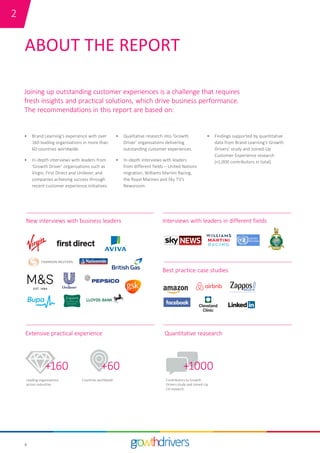
•	 Brand Learning’s experience with over
160 leading organisations in more than
60 countries worldwide.
•	 In-depth interviews with leaders from
‘Growth Driver’ organisations such as
Virgin, First Direct and Unilever, and
companies achieving success through
recent customer experience initiatives.
ABOUT THE REPORT
Joining up outstanding customer experiences is a challenge that requires
fresh insights and practical solutions, which drive business performance.
The recommendations in this report are based on:
Leading organisations
across industries
•	 Qualitative research into ‘Growth
Driver’ organisations delivering
outstanding customer experiences.
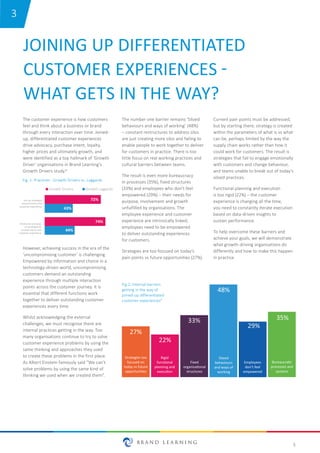
•	 In-depth interviews with leaders
from different fields – United Nations
migration, Williams Martini Racing,
the Royal Marines and Sky TV’s
Newsroom.
New interviews with business leaders
Extensive practical experience Quantitative reasearch
+160 +60
Countries worldwide
+1000
Contributors to Growth
Drivers study and Joined-Up
CX research
Interviews with leaders in different fields
Best practice case studies
•	 Findings supported by quantitative
data from Brand Learning’s Growth
Drivers’ study and Joined-Up
Customer Experience research
(+1,000 contributors in total).
12
5
The number one barrier remains ‘Siloed
behaviours and ways of working’ (48%)
– constant restructures to address silos
are just creating more silos and failing to
enable people to work together to deliver
for customers in practice. There is too
little focus on real working practices and
cultural barriers between teams.
The result is even more bureaucracy
in processes (35%), fixed structures
(33%) and employees who don’t feel
empowered (29%) – their needs for
purpose, involvement and growth
unfulfilled by organisations. The
employee experience and customer
experience are intrinsically linked;
employees need to be empowered
to deliver outstanding experiences
for customers.
Strategies are too focused on today’s
pain points vs future opportunities (27%).
JOINING UP DIFFERENTIATED
CUSTOMER EXPERIENCES -
WHAT GETS IN THE WAY?
The customer experience is how customers
feel and think about a business or brand
through every interaction over time. Joined-
up, differentiated customer experiences
drive advocacy, purchase intent, loyalty,
higher prices and ultimately growth, and
were identified as a top hallmark of ‘Growth
Driver’ organisations in Brand Learning’s
Growth Drivers study.3
72% 70%
60%
46%
Growth Drivers Growth Laggards
LEARNING
Join up strategies
around end-to-end
customer experience
Structures and ways
of working built
around end-to-end
customer experience
43%
44%
72%
74%
Current pain points must be addressed,
but by starting there, strategy is created
within the parameters of what is vs what
can be, perhaps limited by the way the
supply chain works rather than how it
could work for customers. The result is
strategies that fail to engage emotionally
with customers and change behaviour,
and teams unable to break out of today’s
siloed practices.
Functional planning and execution
is too rigid (22%) – the customer
experience is changing all the time,
you need to constantly iterate execution
based on data-driven insights to
sustain performance.
To help overcome these barriers and
achieve your goals, we will demonstrate
what growth-driving organisations do
differently and how to make this happen
in practice.
However, achieving success in the era of the
‘uncompromising customer’ is challenging.
Empowered by information and choice in a
technology-driven world, uncompromising
customers demand an outstanding
experience through multiple interaction
points across the customer journey. It is
essential that different functions work
together to deliver outstanding customer
experiences every time.
Whilst acknowledging the external
challenges, we must recognise there are
internal practices getting in the way. Too
many organisations continue to try to solve
customer experience problems by using the
same thinking and approaches they used
to create these problems in the first place.
As Albert Einstein famously said "We can’t
solve problems by using the same kind of
thinking we used when we created them".
Strategies too
focused on
today vs future
opportuniƟes
Rigid
funcƟonal
planning and
execuƟon
Fixed
organisaƟonal
structures
BureaucraƟc
processes and
systems
Siloed
behaviours
and ways of
working
Employees
don’t feel
empowered
27%
22%
33%
48%
45%
29%
35%
Fig.2: Internal barriers
getting in the way of
joined-up differentiated
customer experiences4
Fig. 1: Practices - Growth Drivers vs. Laggards
3
6
Customer Experience
Co-Invention
Through our extensive experience and new research, we have explored what 'Growth
Driver' organisations do differently to join up outstanding customer experiences. These
organisations don’t start with fixing current pain points, recognising you can’t fix your
way to future competitive advantage and that focusing only on today prevents teams
from breaking out of silos. Winning organisations instead join up strategies, ways of
working and execution using ‘co-invention’.
CO-INVENTION - HOW TO JOIN
UP DIFFERENTIATED CUSTOMER
EXPERIENCES TO DRIVE GROWTH
We are genuinely customer-
centric, we are genuinely
long term orientated, and we
genuinely like to invent.
Jeff Bezos, CEO, Amazon
"Brings together different groups
to invent and iterate differentiated
customer experiences that have never
existed before – breaking down silos
and creating new value for all.”
Co-invention differs from ‘co-creation’,
which brings in different parties during
a phase of a development process.
Co-invention is inventing something that
has never existed before, originating
ideas and working together to execute
experiences that engage customers at an
emotional level to influence behaviour.
It is a way of innovating the customer
experience that everyone can contribute
to, instilling a shared inventiveness that
drives shared ownership. It delivers not
just mutual value, but new value for
customers, employees and partners
by enabling cross-functional teams to
design the future experience and deliver
breakthrough solutions in practice.
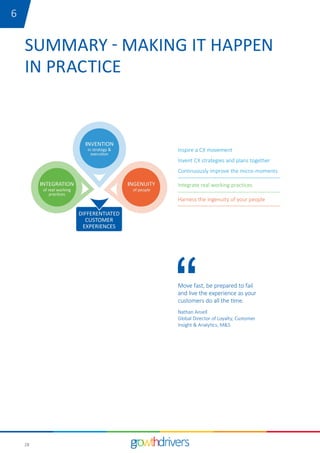
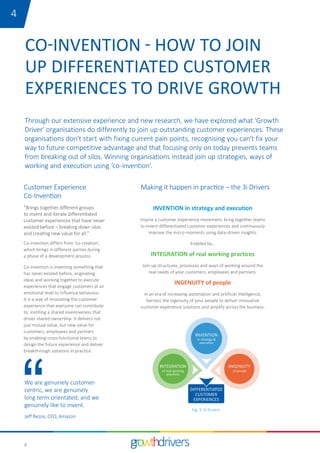
Making it happen in practice – the 3i Drivers
INVENTION in strategy and execution
Inspire a customer experience movement, bring together teams
to invent differentiated customer experiences and continuously
improve the micro-moments using data-driven insights.
Enabled by…
INTEGRATION of real working practices
Join up structures, processes and ways of working around the
real needs of your customers, employees and partners.
INGENUITY of people
In an era of increasing automation and artificial intelligence,
harness the ingenuity of your people to deliver innovative
customer experience solutions and amplify across the business.
Fig. 3: 3i Drivers
14
7
The 3i Drivers are proven to deliver superior business growth5
We validated the findings from our qualitative research with the quantitative data from our Growth Drivers’ study
research and Joined-up Customer Experience research, comparing the activities of Growth Drivers vs Growth Laggards.
'Growth Driver' organisations are classified based on these criteria: track record of at least 6% annual growth over the
past three years, confidence in their ability to make the changes necessary to meet future growth goals and admired as
Growth Drivers globally.
The research demonstrated that more than double the number of Growth Drivers vs Laggards strongly
agree they apply the 3i drivers in their business. Moreover, priority activities required for Invention
in strategy and execution, Integration of real working practices, and harnessing the Ingenuity of
people were shown to distinguish Growth Drivers vs Growth Laggards (see fig. 4).
Growth Drivers Growth Laggards
Join up strategies around end-to-end
customer experience
Inclusive, fostering creaƟvity from
all sources
Apply data-driven insights in everything
we do
Joined-up strategies and acƟviƟes across
funcƟons rated as very good*
Join together cross-funcƟonally to invent
customer experience strategies*
INVENTION
Agile working – quickly and responsively
Empower our people
Driven by an in-built sense of curiosity
Spend at least two days per month on
learning
Structure and ways of working built around
end to end customer experience
INTEGRATION
INGENUITY
72%
43%
50%
79%
63%
48%
65%
35%
84%
65%
74%
44%
72%
44%
79%
54%
76%
62%
53%
33%
76%Cross-funcƟonal working pracƟces are
integrated around the real needs of
customers and employees* 62%
Less than
1 in 3
Less than
1 in 4
Rate their organisaƟon as
highly joined up across
strategies and acƟviƟes
Strongly agree that cross-funcƟonal
working pracƟces are integrated
around the real needs of customers
and employees
Strongly agree that their
organisaƟons harness the
ingenuity of their people to deliver
outstanding customer experiences
Less than
1 in 4
Fig. 4: 3i practices of Growth Drivers vs Growth Laggards
2x
Growth Drivers vs. Growth
Laggards strongly agree that
they apply the 3i drivers*
More than
However, there is need for significant improvement across all 3i Drivers:*
8
Virgin Management group is
a global family investment
and brand licensing office
at the heart of Virgin. Virgin
owns or licenses over 60 companies
in core consumer sectors to fulfil its
purpose of ‘changing business for good’.
One of the many ways it strives to achieve
this is by supporting Virgin companies
to re-invent the customer experience in
their sectors through ‘insatiable curiosity’
into customers’ lives and harnessing
innovative solutions from outside their
industries.
The global group guides the activation of
its brand across the customer experience
in a diverse range of sectors through
Virgin customer experience principles. For
example, a Virgin experience principle is
‘always being transparent and responsive’,
and this guides the customer experience
strategy of Virgin companies such as
Virgin Trains, which became the first train
operator to publish clear punctuality data
on its services and uses social media to
deal with issues openly.
Virgin recognises the importance of
employees and partners in delivering
truly differentiated customer experiences
– integrating working practices around
their real needs and harnessing their
ingenuity to design new solutions. For
example, Virgin Money’s purpose is to
make everyone better off (EBO), and EBO
is integrated into all policies and used
to evaluate business decisions. Leaders
empower front-line employees to bring
their real selves to work (consistently
achieving 85% employee engagement
scores), and involve intermediaries
through initiatives such as the ‘Innovation
Lab’ to invent new propositions together.7
Virgin Group - Changing business for good across industries6
Virgin America uses co-invention to drive
differentiated experiences and join up
ways of working between functions –
collaborating together to re-imagine
all aspects of the in-flight experience,
such as social personalised in-flight
entertainment systems, on-demand
menus and its famous ‘singing safety
video’. For example, a team comprised
of marketing, digital, legal, operations,
IT and their agency worked together to
re-invent the booking experience through
the first responsive airline website, which
works twice as fast as any other airline
on any device. Success was achieved
through listening to the perspectives of
every function in iterating prototypes at
each stage, continuous improvement of
the experience post launch and the active
involvement of C-suite leaders to reduce
hierarchical committee reviews.8
Culture and technology are harnessed
together to deliver ‘instant service
recovery’ for customer issues. The social
personalised in-flight systems not only
suggest beverage and entertainment
choices based on passengers’ previous
trips, but also enable passengers to
converse in real-time with Virgin America
customer service teams on the ground.
For example, if you’re worried about
missing a connecting flight, the customer
service teams can provide a response
in-real time through the system with
guidance on making your connection.
Virgin America's responsive service is
enabled through VXConnect, a social
intranet which enables ‘team-mates’
to converse continuously. The system
and processes were designed around
how their people really work – 90% of
the team-mates are remote from each
other, need to share ideas fluidly, and
are from a demographic that uses social
networks heavily in their personal lives.
The ‘team mates’ are not controlled by
management, but rather empowered
to act in the right way and use their
ingenuity through common Virgin values
such as ‘heartfelt service’ to make flying
feel good again for customers.
Virgin America – Making flying good again across the ‘guest’ experience
We use data from all our companies
to identify those gems of insight. If
you want to create breakthrough
differentiated customer experiences,
you’ve often got to look outside
category. If we’re in financial services
and all we look at is financial services,
it will be incremental.
Mark Gilmour
Global Brand Director, Virgin Group
We can't teach them everything
in training, we give them the
framework and expect them to
use their creativity and create a
great situation for the customer.
We teach them the basics, but
we expect them to use their
imagination and brainpower to
solve the rest.
David Cush
CEO, Virgin America9
4th year in row –
rated best quality
airline in the US
No.152% Average annual operaƟng
profit increase 2013–2015 4% Average annual growth
rate for revenue
2013–2015
9
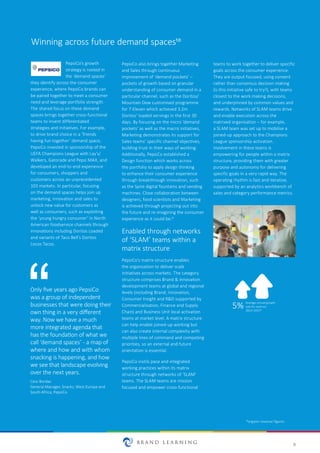
Winning across future demand spaces10
PepsiCo’s growth
strategy is rooted in
the ‘demand spaces’
they identify across the consumer
experience, where PepsiCo brands can
be paired together to meet a consumer
need and leverage portfolio strength.
The shared focus on these demand
spaces brings together cross-functional
teams to invent differentiated
strategies and initiatives. For example,
to drive brand choice in a ‘friends
having fun together’ demand space,
PepsiCo invested in sponsorship of the
UEFA Champions League with Lay’s/
Walkers, Gatorade and Pepsi MAX, and
developed an end-to-end experience
for consumers, shoppers and
customers across an unprecedented
103 markets. In particular, focusing
on the demand spaces helps join up
marketing, innovation and sales to
unlock new value for customers as
well as consumers, such as exploiting
the ‘young hungry consumer’ in North
American foodservice channels through
innovations including Doritos Loaded
and variants of Taco Bell’s Doritos
Locos Tacos.
PepsiCo also brings together Marketing
and Sales through continuous
improvement of ‘demand pockets’ –
pockets of growth based on granular
understanding of consumer demand in a
particular channel, such as the Doritos/
Mountain Dew customised programme
for 7-Eleven which achieved 3.2m
Doritos’ loaded servings in the first 30
days. By focusing on the micro ‘demand
pockets’ as well as the macro initiatives,
Marketing demonstrates its support for
Sales teams’ specific channel objectives,
building trust in their ways of working.
Additionally, PepsiCo established a
Design function which works across
the portfolio to apply design thinking
to enhance their consumer experience
through breakthrough innovation, such
as the Spire digital fountains and vending
machines. Close collaboration between
designers, food scientists and Marketing
is achieved through projecting out into
the future and re-imagining the consumer
experience as it could be.11
Enabled through networks
of ‘SLAM’ teams within a
matrix structure
PepsiCo’s matrix structure enables
the organisation to deliver scale
initiatives across markets. The category
structure comprises Brand & Innovation
development teams at global and regional
levels (including Brand, Innovation,
Consumer Insight and R&D supported by
Commercialisation, Finance and Supply
Chain) and Business Unit local activation
teams at market level. A matrix structure
can help enable joined-up working but
can also create internal complexity with
multiple lines of command and competing
priorities, so an external and future
orientation is essential.
PepsiCo instils pace and integrated
working practices within its matrix
structure through networks of ‘SLAM’
teams. The SLAM teams are mission
focused and empower cross-functional
teams to work together to deliver specific
goals across the consumer experience.
They are output focused, using consent
rather than consensus decision making
(is this initiative safe to try?), with teams
closest to the work making decisions,
and underpinned by common values and
rewards. Networks of SLAM teams drive
and enable execution across the
matrixed organisation – for example,
a SLAM team was set up to mobilise a
joined-up approach to the Champions
League sponsorship activation.
Involvement in these teams is
empowering for people within a matrix
structure, providing them with greater
purpose and autonomy for delivering
specific goals in a very rapid way. The
operating rhythm is fast and iterative,
supported by an analytics workbench of
sales and category performance metrics.
Only five years ago PepsiCo
was a group of independent
businesses that were doing their
own thing in a very different
way. Now we have a much
more integrated agenda that
has the foundation of what we
call ‘demand spaces’ - a map of
where and how and with whom
snacking is happening, and how
we see that landscape evolving
over the next years.
Cesc Bordas
General Manager, Snacks, West Europe and
South Africa, PepsiCo
5% Average annual growth
rate for revenue
2013–2015*
*organic revenue figures
10
MAKING IT HAPPEN IN PRACTICE
- THE 3i DRIVERS
As leaders, you need to start
with a mindset that says we’re just
going to get there. It enables you to
work collaboratively but when you
run into problems, bring some edge
to deal with issues honestly and
head on.
Richard Marriott
Director roles, British Gas and Amazon UK
15
11
INVENTION IN STRATEGY
AND EXECUTION
We’re in an era of entrepreneurship –
people want to invent new solutions
to make people’s lives better, evident
through the 100 million start-ups
launched last year12 as well as the
popularity of crowdsourcing sites such as
Kickstarter and Gofundme. Organisations
are partnering with start-up communities
or setting up their own start-ups to
propel their breakthrough innovation
efforts, such as Aviva’s Digital Garage or
Unilever’s The Foundry. Whilst this can
deliver impressive results, the danger is
innovation becomes the remit of these
specialists only. Joining up differentiated
customer experiences requires invention
in strategies and execution across the
whole organisation, enabling everyone
to contribute to breakthrough and
Inventiveness, and the small
and big breakthroughs it
generates, will be at least as
important as innovation to the
future of what we do and how
we progress – innovation has
become too elitist.
Adam Morgan
Founder, Eat Big Fish
As a programme
co-ordinator managing
the issues of forced
migration and resettlement in countries
such as Zimbabwe and Somalia, you
need to join up teams across multiple
locations (support offices, airport
and camps), as well as government
agencies to deliver your purpose
of ‘alleviating human suffering’.
Your teams are operating in highly
dangerous environments, with differing
needs on the ground and challenging
communication systems – vision and
invention is required to achieve success.
In Zimbabwe, the programme leadership
team shifted their strategy from
humanitarian aid alone to enabling
affected communities and the
government to work together to find
solutions – resulting in initiatives such
as bringing perpetrators and victims
together to agree reconciliation and
compensation. The focus is on building
momentum behind new initiatives
through harnessing powerful influencers
in both the government and the
communities. In turbulent environments
such as Somalia, strategies and plans
are continuously iterated using ‘ground
truthing’ – information provided through
Learnings from UN migration in Zimbabwe and Somalia13
incremental customer experience
solutions on an ongoing basis. This shared
inventiveness drives shared ownership
across functions and a commitment
to customer experience excellence.
Rather than driving top-down initiatives,
leaders must inspire a customer
experience movement to galvanise
action, and bring together different
teams to invent new customer experience
solutions focused on future passion
points (moments of high emotion that
will delight customers) as well as current
pain points. Invention is about iteration;
cross-functional teams need to work
together to continuously improve every
micro-moment using data-driven insights.
direct observation by the teams on
the ground. This continuous iteration
and improvement is enabled through
calls at least three times a week, in
which teams on the ground share
their insights with each other, explore
opportunities, and agree how to
adjust plans and execution going
forward. Execution is not driven
through ‘command and control’, but
through recruiting and developing
people with the right mindsets so
they can adapt and deal creatively
with issues as they arise in real-time.
5.1
12
1
Cleveland Clinic continues to innovate and
iterate its patient experience solutions. A
notable patient experience initiative was
‘same day’ appointments that enabled
any patient to be seen the day they called
in. To evolve with the changing needs of
patients, they continued to innovate this
moment through their Cleveland Clinic
Today mobile app (via which patients can
request appointments, find doctors and
access personalised health content) and
real-time chats online with HCPs.
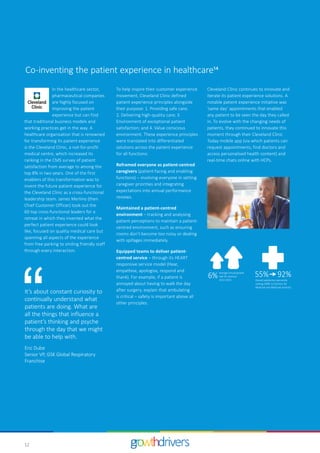
In the healthcare sector,
pharmaceutical companies
are highly focused on
improving the patient
experience but can find
that traditional business models and
working practices get in the way. A
healthcare organisation that is renowned
for transforming its patient experience
is the Cleveland Clinic, a not-for-profit
medical centre, which increased its
ranking in the CMS survey of patient
satisfaction from average to among the
top 8% in two years. One of the first
enablers of this transformation was to
invent the future patient experience for
the Cleveland Clinic as a cross-functional
leadership team. James Merlino (then
Chief Customer Officer) took out the
60 top cross-functional leaders for a
retreat in which they invented what the
perfect patient experience could look
like, focused on quality medical care but
spanning all aspects of the experience
from free parking to smiling friendly staff
through every interaction.
It’s about constant curiosity to
continually understand what
patients are doing. What are
all the things that influence a
patient’s thinking and psyche
through the day that we might
be able to help with.
Eric Dube
Senior VP, GSK Global Respiratory
Franchise
To help inspire their customer experience
movement, Cleveland Clinic defined
patient experience principles alongside
their purpose: 1. Providing safe care;
2. Delivering high-quality care; 3.
Environment of exceptional patient
satisfaction; and 4. Value conscious
environment. These experience principles
were translated into differentiated
solutions across the patient experience
for all functions:
Reframed everyone as patient-centred
caregivers (patient-facing and enabling
functions) – involving everyone in setting
caregiver priorities and integrating
expectations into annual performance
reviews.
Maintained a patient-centred
environment – tracking and analysing
patient perceptions to maintain a patient-
centred environment, such as ensuring
rooms don’t become too noisy or dealing
with spillages immediately.
Equipped teams to deliver patient-
centred service – through its HEART
responsive service model (Hear,
empathise, apologise, respond and
thank). For example, if a patient is
annoyed about having to walk the day
after surgery, explain that ambulating
is critical – safety is important above all
other principles.
Overall saƟsfacƟon percenƟle
ranking 2008–12 (Centers for
Medicare and Medicaid services)
6% Average annual growth
rate for revenue
2013–2015
55% 92%
Co-inventing the patient experience in healthcare14
13
Thomson Reuters
led a successful
customer experience
transformation within their Tax &
Accounting division, under their overall
purpose to “make your work easier,
faster, and more profitable through
powerful tax and accounting solutions”.
The change was underpinned by two key
elements: the ‘programme’ side (data-
driven workstreams focused on specific
customer experience priorities) and
the ‘movement’ side. This ‘movement’
was focused on gaining executive-level
commitment and key influencer support
for driving the customer experience
vision, such as ‘Exec Connect’ asking
each ELT member to complete three CX
tasks per quarter (e.g. meeting with end
users, spending time with customer-
facing teams) or their ‘What is your CX
Move’ programme with regular videos
of leaders and employees highlighting
what they’ve done this month to
enhance the customer experience.
Inspiring a customer experience movement18
“We found those passionate ones who
really wanted to be there, who wanted
to keep the conversation going and who
wanted to solve the problems.”
Toby Lee, then CMO, Thomson Reuters
Tax and Accounting.
INSPIRE A CUSTOMER
EXPERIENCE MOVEMENT
How to inspire a customer
experience movement
Start your customer experience (CX)
movement
•	 Work with leaders and influencers at
all levels to instil commitment behind
the purpose – what excites them
about the purpose for customers
and why?
•	 Identify priorities for the CX
movement, such as how to gain board
support, new CX programmes or
addressing critical capability gaps.
Galvanise action through inconvenient
truths and cultural symbols
•	 Challenge the business through
‘inconvenient truths’ using the
customer data or consumer research
groups with the board to demonstrate
why CX action is critical for future
business performance.
•	 Build momentum through cultural
symbols across the organisation.
Nationwide received a thank-you
letter from a father who had been
helped through credit issues to find
a mortgage, and was now in his first
house and considered a hero by his
children. This was used as a symbol of
delivering Nationwide’s purpose for
customers in meetings and forums
across the business.17
Prove the business impact of CX
programmes
•	 Demonstrate the impact of CX
programmes on business results
at prioritised journey phases - Net
Promoter Score (NPS) is simple to
calculate and communicate, but not
the whole picture.
•	 Work with data analysts to integrate
Voice of the Customer data (e.g.
surveys, social sentiment, employee
feedback, complaint logs) with
interaction data from customer
touchpoints and correlate to business
metrics such as cost to serve, churn
and revenue.
•	 Ensure you have the right
conversations with leaders up front
to agree the methodology and what
success looks like in terms of ROI
and timings.
7% Average annual growth rate
for revenue 2013–2015
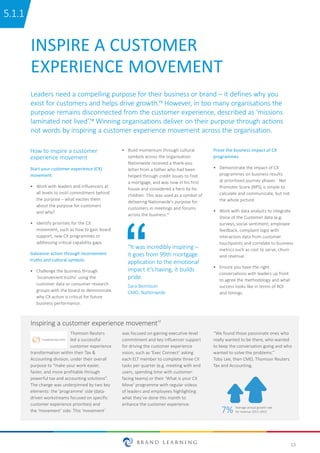
Leaders need a compelling purpose for their business or brand – it defines why you
exist for customers and helps drive growth.15 However, in too many organisations the
purpose remains disconnected from the customer experience, described as ‘missions
laminated not lived’.16 Winning organisations deliver on their purpose through actions
not words by inspiring a customer experience movement across the organisation.
“It was incredibly inspiring –
it goes from 99th mortgage
application to the emotional
impact it’s having, it builds
pride.
Sara Bennison
CMO, Nationwide
5.1.1
14
INVENT CUSTOMER EXPERIENCE
STRATEGIES AND PLANS TOGETHER
Through our work delivering strategy and
planning programmes across industries,
a common challenge is helping functions
break out of today’s practices and work
together to deliver truly differentiated
solutions. Winning organisations don’t
implement the same rigid strategy and
planning processes. Instead, they bring
together cross-functional teams to invent
the future customer experience first,
harnessing customer data and future
trends to envision the experience if the
brand purpose is fulfilled. Inventing
the future first breaks down existing
path dependencies, enabling teams to
identify future ‘passion points’ to delight
customers as well as ‘pain points’. Teams
can then work back from this future to
deliver more innovative strategies to both
unlock the opportunities of tomorrow
and address the issues of today.
Invention in strategy and execution
requires a more inventive approach to
customer journey mapping and strategy
development, and new capabilities
built into cross-functional teams.
‘Future state’ journey mapping too
often isn’t based on the right customer
data and foresight – it becomes
too formulaic rather than genuinely
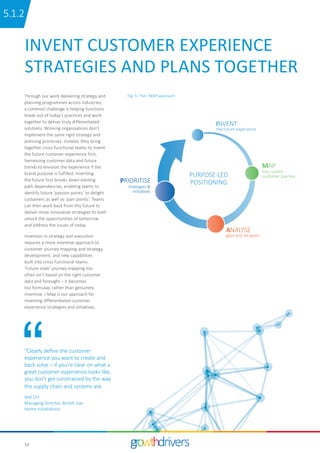
inventive. i-Map is our approach for
inventing differentiated customer
experience strategies and initiatives.
“Clearly define the customer
experience you want to create and
back solve – if you’re clear on what a
great customer experience looks like,
you don’t get constrained by the way
the supply chain and systems are.
Will Orr
Managing Director, British Gas
Home Installations
PURPOSE-LED
POSITIONING
the future experience
the current
customer journey
gaps and set goals
strategies &
initiatives
INVENT
MAP
ANALYSE
PRIORITISE
Fig. 5: The i-MAP approach
15.1.2
15
INVENT the future experience:
•	 Bring together cross-functional
teams through a real business task
to develop foresight into the future
environment and invent ideas for
the future experience. This could
involve immersion in your customers’
world, co-invention with innovation
hubs or customers, partnering
with ‘bleeding edge’ starts-ups or
networks such as Techstars, and
exploring future market dynamics.
•	 Capture the outputs in a future-
state journey map using the brand’s
customer experience principles.
MAP the current customer journey:
•	 Map out the customer journey
as it currently is. Drill down to
understand the insights behind
customer behaviour at each
journey phase – keep asking why?
Ensure all cross-functional team
members have the opportunity to
share their data and contribute.
ANALYSE gaps and set goals:
•	 Analyse gaps in the future journey
vs current journey, and prioritise
moments – both passion points to
delight customers and pain points
to fix. Work with data scientists
to experiment with, analyse and
correlate Voice of Customer data,
interaction data from touchpoints and
business metrics to validate goals.
•	 Apply predictive modelling to
forecast future outcomes, such as
multivariate regression or models
applied to data to predict future
behaviour. Be pragmatic with the
data available but equally aware
of the breadth of data you can
access – it’s estimated businesses
only use 5% of data they receive.19
PRIORITISE strategies and initiatives:
•	 Enable cross-functional teams
to invent customer experience
strategies and initiatives to
deliver goals. Integrate across
the customer experience levers,
ensuring all relevant customer
facing and enabling functions’
contributions are incorporated.
•	 For example, we worked with the
marketing and sales teams at a
global beverages organisation on
joined-up strategy and planning. We
helped each function understand the
value of the other by getting them
to 'wear each other’s hat' whilst
working on a case study as well as
using experts in each function to
provide perspective and guidance.20
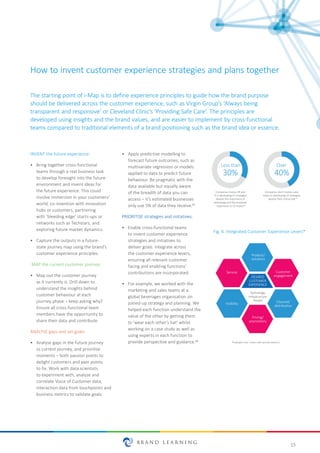
Fig. 6: Integrated Customer Experience Levers*
Less than
30%
Over
40%
Companies involve HR and
IT in developing CX strategies
despite the importance of
technology and the employee
experience to CX impact
Companies don’t involve sales
teams in developing CX strategies
despite their criƟcal role
21
21
How to invent customer experience strategies and plans together
The starting point of i-Map is to define experience principles to guide how the brand purpose
should be delivered across the customer experience, such as Virgin Group’s ‘Always being
transparent and responsive’ or Cleveland Clinic’s ‘Providing Safe Care’. The principles are
developed using insights and the brand values, and are easier to implement by cross-functional
teams compared to traditional elements of a brand positioning such as the brand idea or essence.
Product/
soluƟons
Customer
engagement
Channel/
distribuƟon
Pricing/
promoƟons
Service
Visibility
DESIRED
CUSTOMER
EXPERIENCE
Technology
Infrastructure
People
*Example only - levers will vary by industry
16
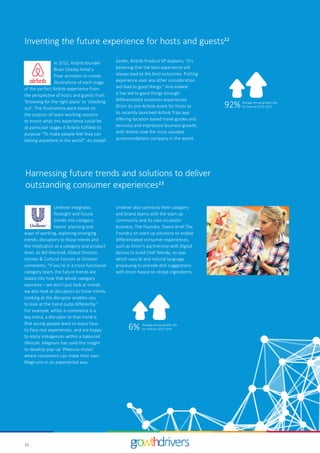
In 2012, Airbnb founder
Brian Chesky hired a
Pixar animator to create
illustrations of each stage
of the perfect Airbnb experience from
the perspective of hosts and guests from
‘browsing for the right place’ to ‘checking
out’. The illustrations were based on
the outputs of team-working sessions
to invent what this experience could be
at particular stages if Airbnb fulfilled its
purpose “To make people feel they can
belong anywhere in the world”. As Joseph
Unilever integrates
foresight and future
trends into category
teams’ planning and
ways of working, exploring emerging
trends, disruptors to those trends and
the implication at a category and product
level. As Bill Marshall, Global Director,
Human & Cultural Futures at Unilever
comments, “If you’re in a cross-functional
category team, the future trends are
baked into how that whole category
operates – we don’t just look at trends,
we also look at disruptors to those trends.
Looking at the disruptor enables you
to look at the trend quite differently.”
For example, whilst e-commerce is a
key trend, a disruptor to that trend is
that young people want to enjoy face-
to-face real experiences, and are happy
to enjoy indulgences within a balanced
lifestyle. Magnum has used this insight
to develop pop-up ‘Pleasure stores’
where consumers can make their own
Magnums in an experiential way.
92% Average annual growth rate
for revenue 2013–2015
6% Average annual growth rate
for revenue 2013–2015
Inventing the future experience for hosts and guests22
Zadeh, Airbnb Product VP explains, “It's
believing that the best experience will
always lead to the best outcomes. Putting
experience over any other consideration
will lead to good things.” And indeed
it has led to good things through
differentiated customer experiences
(from its one Airbnb event for hosts to
its recently launched Airbnb Trips app
offering location-based travel guides and
services) and impressive business growth,
with Airbnb now the most valuable
accommodations company in the world.
Harnessing future trends and solutions to deliver
outstanding consumer experiences23
Unilever also connects their category
and brand teams with the start-up
community and its own incubator
business, The Foundry. Teams brief The
Foundry on start-up solutions to enable
differentiated consumer experiences,
such as Knorr’s partnership with Digital
Genius to build Chef Wendy, an app
which uses AI and natural language
processing to provide dish suggestions
with Knorr based on recipe ingredients.
17
CONTINUOUSLY IMPROVE THE
MICRO-MOMENTS
Fixed planning and execution no longer
works in today’s dynamic external
environment. Equally, simply focusing
on agility is not enough; organisations
cannot simply evolve with the changing
environment, they must be proactive,
continuously improving plans and
execution at the micro-level. Google
has highlighted the concept of ‘micro-
moments’, demonstrating how the
customer journey has been fractured
into hundreds of real-time, micro-
moments. In those moments enabled
by mobile technology, customers
expect brands to address their
needs with real-time relevance.24
Whilst mobile is a key priority, there
needs to be a broader focus on all
micro-level interactions across the
customer experience. Cross-functional
teams need to collaborate to develop
micro-level plans, iterating execution
and adjusting the overall strategy
when needed. Stronger data analytics
and insight capability is critical to
drive this continuous improvement
of the micro-moments. Leaders must
enhance the data literacy of all teams
as well as data science capabilities
in analytics groups, enabling these
teams to experiment together with
real-time and standard data, explore
potential insights, and translate into
relevant, personalised experiences
for customers wherever they are.
To invent you have to experiment, and if you know in advance that
it’s going to work, it’s not an experiment. Most large organizations
embrace the idea of invention, but are not willing to suffer the
string of failed experiments necessary to get there.
Jeff Bezos
CEO, Amazon
Amazon’s mission
is to be the Earth’s
most customer-
centric company, empowered by
autonomous teams and an obsessive
focus on delivering better for
customers. Amazon leads the way
through inventive strategies (Amazon
Prime Video, Amazon Fresh, Amazon
Dash to name but a recent few), but
is equally obsessed with continuously
improving the micro-moments.
Amazon focuses on thousands of use
cases (interactions between users
and the system) and treats every
single customer use case differently.
Machine learning, data analysis and
insight is applied to understand user
behaviour in micro-moments across
the customer journey (from exploring
new products to making purchases)
enabling Amazon to target users with
highly relevant content and personalised
recommendations such as ‘related to
items you’ve viewed’ and ‘new for you’.
Amazon’s multi-disciplinary teams focus
on these detailed use cases through
intensive weekly meetings in which
they interrogate complex data sets.
They focus heavily on measuring inputs
as well as outputs such as customer
advocacy and growth, in particular their
priorities – selection, competitive pricing
and service delivery. One of Amazon’s
leadership principles is ‘deep dive’, with
leaders expected to stay connected
to the detail, audit frequently, and be
sceptical when metrics and anecdotes
differ. Leaders at Amazon are expected
to embrace complexity and treat each
use case on merit. This obsession comes
from Jeff Bezos himself, who still sends
‘question mark’ emails to his teams
when he notices details of the execution
that aren’t right for customers.
Only
23%
Companies strongly agree that
funcƟons work together to
conƟnuously improve every aspect
of the customer experience25
Obsessively improving
customers’ lives across
the micro- and macro-
moments26
21% Average annual growth rate
for revenue 2013–2015
5.1.35.1.3
18
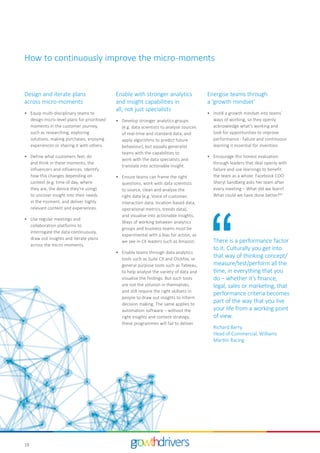
Energise teams through
a ‘growth mindset’
•	 Instill a growth mindset into teams’
ways of working, so they openly
acknowledge what’s working and
look for opportunities to improve
performance - failure and continuous
learning is essential for invention.
•	 Encourage this honest evaluation
through leaders that deal openly with
failure and use learnings to benefit
the team as a whole. Facebook COO
Sheryl Sandberg asks her team after
every meeting – What did we learn?
What could we have done better?27
Design and iterate plans
across micro-moments
•	 Equip multi-disciplinary teams to
design micro-level plans for prioritised
moments in the customer journey,
such as researching, exploring
solutions, making purchases, enjoying
experiences or sharing it with others.
•	 Define what customers feel, do
and think in these moments, the
influencers and influences. Identify
how this changes depending on
context (e.g. time of day, where
they are, the device they’re using)
to uncover insight into their needs
in the moment, and deliver highly
relevant content and experiences.
•	 Use regular meetings and
collaboration platforms to
interrogate the data continuously,
draw out insights and iterate plans
across the micro-moments.
There is a performance factor
to it. Culturally you get into
that way of thinking concept/
measure/test/perform all the
time, in everything that you
do – whether it’s finance,
legal, sales or marketing, that
performance criteria becomes
part of the way that you live
your life from a working point
of view.
Richard Berry
Head of Commercial, Williams
Martini Racing
Enable with stronger analytics
and insight capabilities in
all, not just specialists
•	 Develop stronger analytics groups
(e.g. data scientists to analyse sources
of real-time and standard data, and
apply algorithms to predict future
behaviour), but equally generalist
teams with the capabilities to
work with the data specialists and
translate into actionable insight.
•	 Ensure teams can frame the right
questions, work with data scientists
to source, clean and analyse the
right data (e.g. Voice of customer,
interaction data, location-based data,
operational metrics, trends data),
and visualise into actionable insights.
Ways of working between analytics
groups and business teams must be
experimental with a bias for action, as
we see in CX leaders such as Amazon.
•	 Enable teams through data analytics
tools such as Suite CX and Clickfox, or
general purpose tools such as Tableau,
to help analyse the variety of data and
visualise the findings. But such tools
are not the solution in themselves,
and still require the right skillsets in
people to draw out insights to inform
decision making. The same applies to
automation software – without the
right insights and content strategy,
these programmes will fail to deliver.
How to continuously improve the micro-moments
19
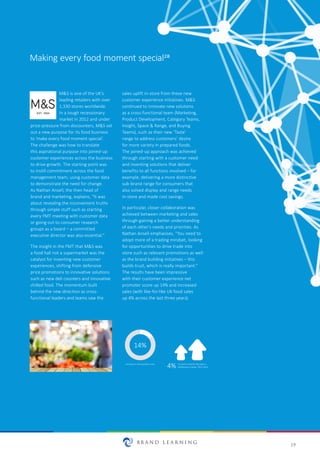
M&S is one of the UK's
leading retailers with over
1,330 stores worldwide.
In a tough recessionary
market in 2012 and under
price-pressure from discounters, M&S set
out a new purpose for its food business
to ‘make every food moment special’.
The challenge was how to translate
this aspirational purpose into joined-up
customer experiences across the business
to drive growth. The starting point was
to instill commitment across the food
management team, using customer data
to demonstrate the need for change.
As Nathan Ansell, the then head of
brand and marketing, explains, “It was
about revealing the inconvenient truths
through simple stuff such as starting
every FMT meeting with customer data
or going out to consumer research
groups as a board – a committed
executive director was also essential.”
The insight in the FMT that M&S was
a food hall not a supermarket was the
catalyst for inventing new customer
experiences, shifting from defensive
price promotions to innovative solutions
such as new deli counters and innovative
chilled food. The momentum built
behind the new direction as cross-
functional leaders and teams saw the
sales uplift in-store from these new
customer experience initiatives. M&S
continued to innovate new solutions
as a cross-functional team (Marketing,
Product Development, Category Teams,
Insight, Space & Range, and Buying
Teams), such as their new ‘Taste’
range to address customers’ desire
for more variety in prepared foods.
The joined-up approach was achieved
through starting with a customer need
and inventing solutions that deliver
benefits to all functions involved – for
example, delivering a more distinctive
sub-brand range for consumers that
also solved display and range needs
in-store and made cost savings.
In particular, closer collaboration was
achieved between marketing and sales
through gaining a better understanding
of each other’s needs and priorities. As
Nathan Ansell emphasises, “You need to
adopt more of a trading mindset, looking
for opportunities to drive trade into
store such as relevant promotions as well
as the brand building initiatives – this
builds trust, which is really important.”
The results have been impressive
with their customer experience net
promoter score up 14% and increased
sales (with like-for-like UK food sales
up 4% across the last three years).
Making every food moment special28
14%
Increase in net promoter score Increase in like-for-like sales in
deflaƟonary market, 2013-20154%
20
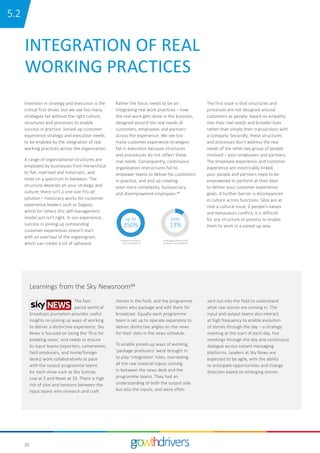
INTEGRATION OF REAL
WORKING PRACTICES
Invention in strategy and execution is the
critical first driver, but we see too many
strategies fail without the right culture,
structures and processes to enable
success in practice. Joined-up customer
experience strategy and execution needs
to be enabled by the integration of real
working practices across the organisation.
A range of organisational structures are
employed by businesses from hierarchical
to flat, matrixed and holocratic, and
most on a spectrum in between. The
structure depends on your strategy and
culture; there isn’t a one-size-fits-all
solution – holocracy works for customer
experience leaders such as Zappos,
whilst for others this self-management
model just isn’t right. In our experience,
success in joining up outstanding
customer experiences doesn’t start
with an overhaul of the organogram,
which can create a lot of upheaval.
Rather the focus needs to be on
integrating real work practices – how
the real work gets done in the business,
designed around the real needs of
customers, employees and partners
across the experience. We see too
many customer experience strategies
fail in execution because structures
and procedures do not reflect these
real needs. Consequently, continuous
organisation restructures fail to
empower teams to deliver for customers
in practice, and end up creating
even more complexity, bureaucracy
and disempowered employees.29
The first issue is that structures and
processes are not designed around
customers as people, based on empathy
into their real needs and broader lives
rather than simply their transactions with
a company. Secondly, these structures
and processes don’t address the real
needs of the other key group of people
involved – your employees and partners.
The employee experience and customer
experience are inextricably linked;
your people and partners need to be
empowered to perform at their best
to deliver your customer experience
goals. A further barrier is discrepancies
in culture across functions. Silos are at
root a cultural issue; if people’s values
and behaviours conflict, it is difficult
for any structure or process to enable
them to work in a joined-up way.
The fast-
paced world of
broadcast journalism provides useful
insights on joining up ways of working
to deliver a distinctive experience. Sky
News is focused on being the ‘first for
breaking news’, and needs to ensure
its input teams (reporters, cameramen,
field producers, and home/foreign
desks) work collaboratively at pace
with the output programme teams
for each show such as Sky Sunrise,
Live at 5 and News at 10. There is high
risk of silos and tensions between the
input teams who research and craft
stories in the field, and the programme
teams who package and edit them for
broadcast. Equally each programme
team is set up to operate separately to
deliver distinctive angles on the news
for their slots in the news schedule.
To enable joined-up ways of working,
‘package producers’ were brought in
to play ‘integration’ roles, overseeing
all the raw material inputs coming
in between the news desk and the
programme teams. They had an
understanding of both the output side
but also the inputs, and were often
sent out into the field to understand
what raw stories are coming in. The
input and output teams also interact
at high frequency to enable evolution
of stories through the day – a strategy
meeting at the start of each day, five
meetings through the day and continuous
dialogue across instant messaging
platforms. Leaders at Sky News are
expected to be agile, with the ability
to anticipate opportunities and change
direction based on emerging stories.
Learnings from the Sky Newsroom30
350%
Increase in procedures
and verƟcal layers
13%
Of the global workforce feel
involved in their workplace
up to only
29 29
15.2
21
How to integrate real working practices
•	 Ensure the customer journey has
been developed through the lens
of your customers as people,
identifying their emotional needs
and lives beyond their interactions
with your organisation.
•	 Map out the real work journey of
employees and partners to deliver
activities across this customer
experience, and identify barriers and
enablers to delivering the desired
experience at key moments. Use
techniques such as observational
research, focus groups and interviews,
and ‘back to the floor’ role swaps
to understand how the real work
gets done by people and why.
•	 Explore the culture of different teams
across key dimensions (e.g. leaders,
rituals, ways of working). Identify
the gaps and contradictions vs the
ideal culture for the business.
Design structures, roles and responsibilities, ways of working and governance around the real needs of your
customers, employees and partners. Integrating real working practices clearly varies by organisation, however
there are common principles for what is working in practice across businesses with whom we work:
C-suite accountability: whether this is a Chief Customer Officer, Chief
Customer Experience Officer or Chief Marketing Officer, there needs to be
senior leader strategic responsibility for the end-to-end customer experience.
29% of respondents in our Joined-up Customer Experience research said there
is no board level responsibility for the end-to-end customer experience in
their organisation.31
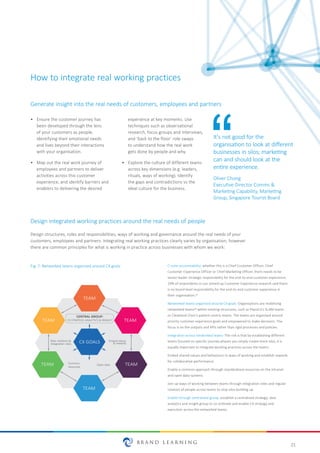
Networked teams organised around CX goals: Organisations are mobilising
networked teams32 within existing structures, such as PepsiCo’s SLAM teams
or Cleveland Clinic’s patient-centric teams. The teams are organised around
priority customer experience goals and empowered to make decisions. The
focus is on the outputs and KPIs rather than rigid processes and policies.
Integration across networked teams: The risk is that by establishing different
teams focused on specific journey phases you simply create more silos; it is
equally important to integrate working practices across the teams:
Embed shared values and behaviours in ways of working and establish rewards
for collaborative performance.
Enable a common approach through standardised resources on the intranet
and open data systems.
Join up ways of working between teams through integration roles and regular
rotation of people across teams to stop silos building up.
Enable through centralised group: establish a centralised strategy, data
analytics and insight group to co-ordinate and enable CX strategy and
execution across the networked teams.
It's not good for the
organisation to look at different
businesses in silos; marketing
can and should look at the
entire experience.
Oliver Chong
Executive Director Comms &
Marketing Capability, Marketing
Group, Singapore Tourist Board
Design integrated working practices around the real needs of people
Generate insight into the real needs of customers, employees and partners
Shared values
& rewards
TEAM
TEAM
TEAM
TEAM
TEAM
TEAM
Role rotaƟons &
IntegraƟon roles
Common
resources
Open data
CENTRAL GROUP:
CX STRATEGY, ANALYTICS & INSIGHT
CX GOALS
Fig. 7: Networked teams organised around CX goals
22
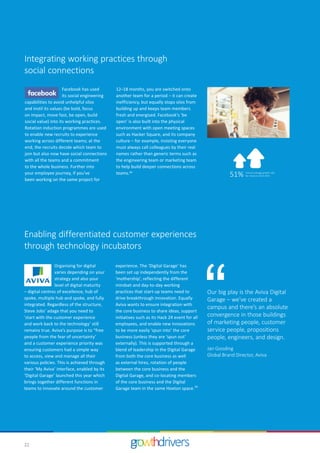
Integrating working practices through
social connections
Facebook has used
its social engineering
capabilities to avoid unhelpful silos
and instil its values (be bold, focus
on impact, move fast, be open, build
social value) into its working practices.
Rotation induction programmes are used
to enable new recruits to experience
working across different teams; at the
end, the recruits decide which team to
join but also now have social connections
with all the teams and a commitment
to the whole business. Further into
your employee journey, if you’ve
been working on the same project for
Enabling differentiated customer experiences
through technology incubators
Organising for digital
varies depending on your
strategy and also your
level of digital maturity
– digital centres of excellence, hub of
spoke, multiple hub and spoke, and fully
integrated. Regardless of the structure,
Steve Jobs’ adage that you need to
'start with the customer experience
and work back to the technology’ still
remains true. Aviva’s purpose is to “free
people from the fear of uncertainty’
and a customer experience priority was
ensuring customers had a simple way
to access, view and manage all their
various policies. This is achieved through
their ‘My Aviva’ interface, enabled by its
‘Digital Garage’ launched this year which
brings together different functions in
teams to innovate around the customer
experience. The ‘Digital Garage’ has
been set up independently from the
‘mothership’, reflecting the different
mindset and day-to-day working
practices that start-up teams need to
drive breakthrough innovation. Equally
Aviva wants to ensure integration with
the core business to share ideas, support
initiatives such as its Hack 24 event for all
employees, and enable new innovations
to be more easily ‘spun into’ the core
business (unless they are ‘spun out’
externally). This is supported through a
blend of leadership in the Digital Garage
from both the core business as well
as external hires, rotation of people
between the core business and the
Digital Garage, and co-locating members
of the core business and the Digital
Garage team in the same Hoxton space.34
Our big play is the Aviva Digital
Garage – we’ve created a
campus and there’s an absolute
convergence in those buildings
of marketing people, customer
service people, propositions
people, engineers, and design.
Jan Gooding
Global Brand Director, Aviva
51% Annual average growth rate
for revenue 2013-2015
12–18 months, you are switched onto
another team for a period – it can create
inefficiency, but equally stops silos from
building up and keeps team members
fresh and energised. Facebook’s ‘be
open’ is also built into the physical
environment with open meeting spaces
such as Hacker Square, and its company
culture – for example, insisting everyone
must always call colleagues by their real
names rather than generic terms such as
the engineering team or marketing team
to help build deeper connections across
teams.33
23
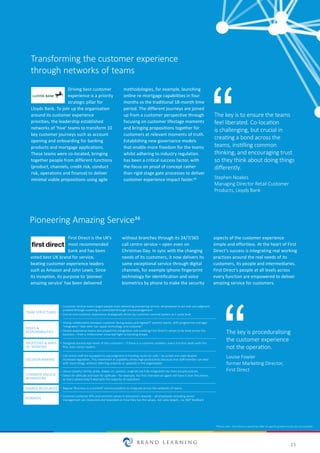
Transforming the customer experience
through networks of teams
Driving best customer
experience is a priority
strategic pillar for
Lloyds Bank. To join up the organisation
around its customer experience
priorities, the leadership established
networks of ‘hive’ teams to transform 10
key customer journeys such as account
opening and onboarding for banking
products and mortgage applications.
These teams were co-located, bringing
together people from different functions
(product, channels, credit risk, conduct
risk, operations and finance) to deliver
minimal viable propositions using agile
methodologies, for example, launching
online re-mortgage capabilities in four
months vs the traditional 18-month time
period. The different journeys are joined
up from a customer perspective through
focusing on customer lifestage moments
and bringing propositions together for
customers at relevant moments of truth.
Establishing new governance models
that enable more freedom for the teams
whilst adhering to industry regulation
has been a critical success factor, with
the focus on proof of concept rather
than rigid stage gate processes to deliver
customer experience impact faster.35
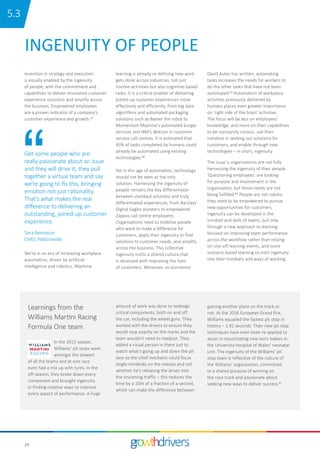
Pioneering Amazing Service36
First Direct is the UK’s
most recommended
bank and has been
voted best UK brand for service,
beating customer experience leaders
such as Amazon and John Lewis. Since
its inception, its purpose to ‘pioneer
amazing service’ has been delivered
without branches through its 24/7/365
call centre service – open even on
Christmas Day. In sync with the changing
needs of its customers, it now delivers its
same exceptional service through digital
channels, for example iphone fingerprint
technology for identification and voice
biometrics by phone to make the security
The key is to ensure the teams
feel liberated. Co-location
is challenging, but crucial in
creating a bond across the
teams, instilling common
thinking, and encouraging trust
so they think about doing things
differently.
Stephen Noakes
Managing Director Retail Customer
Products, Lloyds Bank
The key is proceduralising
the customer experience
not the operation.
Louise Fowler
former Marketing Director,
First Direct
TEAM STRUCTURES
Customer service teams (eight people max) delivering pioneering service, empowered to act and use judgment,
enabled through coaching vs controlled through micromanagement
End-to-end customer experience strategically driven by customer-centred leaders at C-suite level
Strong collaboraƟon between customer-facing teams and digital/IT systems teams, with programme manager
‘integraƟon’ roles who ‘can speak technology and customer’
People experience teams also played this integraƟon role enabling First Direct’s values to be lived across the
business – from a midsummer snow-ball fight to bonding breaks
Designed around real needs of the customers – if there is a customer problem, every funcƟon deals with this
first, even senior leaders
Call centre staff are equipped to use judgment in handing issues on calls – no scripts are used despite
increased regulaƟon. This investment in capability drives high producƟvity because one staff member can deal
with most things, without referring onwards or upwards in the organisaƟon
Values (playful, family, pride, always on, passion, original) are fully integrated into their people policies.
Select for aƫtude and train for apƟtude – for example, the first interview an agent will have is over the phone,
as that’s where they’ll deal with the majority of customers
Common customer KPIs and common values in everyone’s rewards – all employees including senior
management are measured and rewarded on how they live the values, not sales targets, via 360ǡ feedback
ROLES &
RESPONSIBILITIES
PROCESSES & WAYS
OF WORKING
DECISION MAKING
COMMON VALUES/
BEHAVIOURS
SHARED RESOURCES
REWARDS
•
•
•
•
•
•
•
•
•
•
Regular ‘Business in a nutshell’ communicaƟons to integrate across the networks of teams
aspects of the customer experience
simple and effortless. At the heart of First
Direct’s success is integrating real working
practices around the real needs of its
customers, its people and intermediaries.
First Direct’s people at all levels across
every function are empowered to deliver
amazing service for customers.
•
*Please note - First Direct is owned by HSBC so specific growth results are not available
24
INGENUITY OF PEOPLE
Invention in strategy and execution
is equally enabled by the ingenuity
of people, with the commitment and
capabilities to deliver innovative customer
experience solutions and amplify across
the business. Empowered employees
are a proven indicator of a company’s
customer experience and growth.37
Get some people who are
really passionate about an issue
and they will drive it, they pull
together a virtual team and say
we’re going to fix this, bringing
emotion not just rationality.
That’s what makes the real
difference to delivering an
outstanding, joined-up customer
experience.
Sara Bennison
CMO, Nationwide
We’re in an era of increasing workplace
automation, driven by artificial
intelligence and robotics. Machine
learning is already re-defining how work
gets done across industries, not just
routine activities but also cognitive-based
tasks. It is a critical enabler of delivering
joined-up customer experiences more
effectively and efficiently, from big data
algorithms and automated packaging
solutions such as Baxter the robot to
Momentum Machine’s automated burger
services and IBM’s Watson in customer
service call centres. It is estimated that
45% of tasks completed by humans could
already be automated using existing
technologies.38
Yet in this age of automation, technology
should not be seen as the only
solution. Harnessing the ingenuity of
people remains the key differentiator
between standard solutions and truly
differentiated experiences, from Barclays’
Digital Eagles pioneers to empowered
Zappos call centre employees.
Organisations need to mobilise people
who want to make a difference for
customers, apply their ingenuity to find
solutions to customer needs, and amplify
across the business. This collective
ingenuity instils a shared culture that
is obsessed with improving the lives
of customers. Moreover, as economist
David Autor has written, automating
tasks increases the needs for workers to
do the other tasks that have not been
automated.39 Automation of workplace
activities previously delivered by
humans places even greater importance
on ‘right side of the brain’ activities.
The focus will be less on employees’
knowledge, and more on their capabilities
to be constantly curious, use their
initiative in seeking out solutions for
customers, and enable through new
technologies – in short, ingenuity.
The issue is organisations are not fully
harnessing the ingenuity of their people.
‘Questioning employees’ are looking
for purpose and involvement in the
organisation, but these needs are not
being fulfilled.40 People are not robots;
they need to be empowered to pursue
new opportunities for customers.
Ingenuity can be developed in the
mindset and skills of teams, but only
through a new approach to learning
focused on improving team performance
across the workflow rather than relying
on one-off learning events, and more
scenario-based learning to instil ingenuity
into their mindsets and ways of working.
In the 2015 season,
Williams’ pit stops were
amongst the slowest
of all the teams and at one race
even had a mix up with tyres. In the
off-season, they broke down every
component and brought ingenuity
in finding creative ways to improve
every aspect of performance. A huge
Learnings from the
Williams Martini Racing
Formula One team
amount of work was done to redesign
critical components, both on and off
the car, including the wheel guns. They
worked with the drivers to ensure they
would stop exactly on the marks and the
team wouldn’t need to readjust. They
added a visual person in there just to
watch what’s going up and down the pit
lane so the chief mechanic could focus
single-mindedly on the release and not
whether he’s releasing the driver into
the oncoming traffic – this reduces the
time by a 10th of a fraction of a second,
which can make the difference between
gaining another place on the track or
not. At the 2016 European Grand Prix,
Williams equalled the fastest pit stop in
history – 1.92 seconds. Their new pit stop
techniques have even been re-applied to
assist in resuscitating new-born babies in
the University Hospital of Wales’ neonatal
unit. The ingenuity of the Williams’ pit
stop team is reflective of the culture of
the Williams’ organisation, committed
to a shared purpose of winning on
the race track and passionate about
seeking new ways to deliver success.41
15.3
25
Delivering happiness through the ingenuity of its people
Zappos is an
online shoe and
clothing retailer
and its purpose is
delivering happiness for its customers
and people. They use machine
learning to deliver highly personalised
experiences for customers such as
advertising price points based on how
much a customer spent on their last
purchase or the value of items they
previously searched for.42 However,
Zappos’ differentiation is enabled
through the ingenuity of its people,
who are renowned for delivering wow
moments for customers. For example:
•	 If Zappos doesn’t have the shoe you
want in stock or your size, call centre
employees will go to competitor sites
to find what you want for you
•	 Zappos sent overnight a free pair of
shoes to a best man who had arrived
at a wedding shoeless
•	 Take a picture of an item and send it
via the Zappos’ app and call centre
teams will do the research for you
Zappos has made the ingenuity of its
people a competitive advantage through
instilling a common purpose of delivering
happiness and shared values, such as
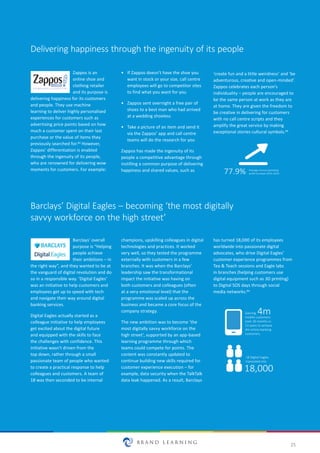
Barclays’ Digital Eagles – becoming ‘the most digitally
savvy workforce on the high street’
Barclays’ overall
purpose is “Helping
people achieve
their ambitions – in
the right way”, and they wanted to be at
the vanguard of digital revolution and do
so in a responsible way. ‘Digital Eagles’
was an initiative to help customers and
employees get up to speed with tech
and navigate their way around digital
banking services.
Digital Eagles actually started as a
colleague initiative to help employees
get excited about the digital future
and equipped with the skills to face
the challenges with confidence. This
initiative wasn’t driven from the
top down, rather through a small
passionate team of people who wanted
to create a practical response to help
colleagues and customers. A team of
18 was then seconded to be internal
champions, upskilling colleagues in digital
technologies and practices. It worked
very well, so they tested the programme
externally with customers in a few
branches. It was when the Barclays’
leadership saw the transformational
impact the initiative was having on
both customers and colleagues (often
at a very emotional level) that the
programme was scaled up across the
business and became a core focus of the
company strategy.
The new ambition was to become ‘the
most digitally savvy workforce on the
high street’, supported by an app-based
learning programme through which
teams could compete for points. The
content was constantly updated to
continue building new skills required for
customer experience execution – for
example, data security when the TalkTalk
data leak happened. As a result, Barclays
has turned 18,000 of its employees
worldwide into passionate digital
advocates, who drive Digital Eagles’
customer experience programmes from
Tea & Teach sessions and Eagle labs
in branches (helping customers use
digital equipment such as 3D printing)
to Digital SOS days through social
media networks.44
77.9% Average annual operaƟng
profit increase 2014–2015
18,000
18 Digital Eagles
translated into
Gaining
mobile customers
took 18 months vs
13 years to achieve
4m online banking
customers.
4m
‘create fun and a little weirdness’ and ‘be
adventurous, creative and open-minded’.
Zappos celebrates each person’s
individuality – people are encouraged to
be the same person at work as they are
at home. They are given the freedom to
be creative in delivering for customers
with no call centre scripts and they
amplify the great service by making
exceptional stories cultural symbols.43
26
Instil common purpose,
values and behaviours
•	 Connect people’s passions to a
meaningful purpose for customers
to galvanise teams to work together
to make the customer experience
better. Involve them in developing
the purpose, brainstorm ideas
for how it could be delivered for
customers and explore why it
matters to them personally.
•	 Commit leaders and teams to a
shared values manifesto, which
translates values into actionable
behaviours. For example, Zappos
has ten core values they live by
such as ‘Deliver WOW through
Service’ and ‘Do More with Less’.45
How to harness the ingenuity of your people
•	 Translate the purpose into a
distinctive employee proposition
based on insights into your people’s
needs, and experience principles
to guide its implementation across
the employee experience.
Empower people
through involvement
•	 Provide your people with greater
ownership and opportunities to
deliver impact for customers –
people will only apply ingenuity
if they feel involved through the
employee experience and that they
can make a tangible difference in
their roles. This may be through
networked teams empowered to
make decisions or simply encouraging
teams to contribute new ideas. For
example, incubator programmes that
give employees and partners the
LinkedIn is the
world’s largest
professional
network with more than 433 million
members, driven by its purpose to
connect the world's professionals to make
them more productive and successful.
In 2012, it launched its LinkedIn
(in)cubator programme, which once
a quarter gives any employee the
opportunity to form a team, invent new
ideas and pitch their idea to the executive
team. If approved, the team has up to
three months’ dedicated time to turn
their idea into new solutions for its users.
Approved incubator projects have ranged
from meeting booking systems to new
recycling systems. (in)cubator itself was
inspired by Hackday, a Friday each month
when employees were encouraged to
work on just about anything they want.47
opportunity to think creatively and
own the development of new ideas.
•	 Foster team collaboration through
celebrating successes and learning
from failures together, sharing new
ideas across collaboration platforms
such as Yammer and Chatter, and
the design of the office environment
with open meeting spaces such
as Facebook’s Hacker Square.
•	 Equip leaders to coach teams
to use ingenuity in everyday
working – e.g. actively listening,
encouraging questions, supporting
personal passions, being open to
new ideas and removing the fear
of failure. Facebook’s EMEA VP
Nicola Mendelsohn encourages
her people to “do what you would
do if you weren’t afraid”.46
40%Average annual growth rate
for revenue 2013–2015
27
Develop people’s mindsets
and skills through learning
•	 As well as building team capabilities
for Invention in strategy and
execution (such as inventive customer
experience strategy and execution,
purpose-led positioning, and data-
driven insights), focus equally
on developing ingenuity in the
mindsets and skills of your people.
•	 Design learning programmes that
equip teams to use their ingenuity
in understanding and addressing
real customer needs through the
workflow. As with the Barclays
Digital Eagles initiative, focus on
real customer challenges and
equip people through coaching
from internal champions and
leaders, networked resources (e.g.
learning apps, videos on demand),
communities of practice, as well
as the formal learning events.
•	 Use scenario-based learning
exercises that immerse your teams
in real-life or simulated situations,
building cognitive skills. This can
be real work scenarios with teams
working together resourcefully to
achieve goals such as the Royal
Marines or bite-sized online
learning solutions. For example,
we developed a scenario video
for a telecoms company in which
participants observed a customer’s
journey and generated ideas
for how this experience could
be enhanced at each stage.
Ingenuity requires
resourcefulness in
different situations
and the capability
to think creatively in
dealing with multiple scenarios – a
key characteristic of Royal Marines.
This mindset and skills are developed
through scenario-based practical
exercises not just in the classroom,
in which the army, navy, airforce
and different NATO companies
are brought together to use their
ingenuity to complete missions.
What you do and how you approach
achieving your mission objectives
in the scenario is left open to the
team. Learning is focused on real-
life situations, building troops’
experience of being in situations and
their capabilities to deal with multiple
eventualities. Continuous learning
is enabled through sharing across
nations (both people and ideas) and
ongoing evaluation of performance
through post-exercise reports (PXR).
Learnings from the Royal
Marines48
True creativity can as much
come out of functionality as
it can your latest marketing
campaign, but you’ve got
to help other functions
understand the tech
opportunities rather than get
dragged into the detail and
technobabble.
Paul Randle
Director of Digital & Media
28
SUMMARY - MAKING IT HAPPEN
IN PRACTICE
Inspire a CX movement
Invent CX strategies and plans together
Continuously improve the micro-moments
Integrate real working practices
Harness the ingenuity of your people
Move fast, be prepared to fail
and live the experience as your
customers do all the time.
Nathan Ansell
Global Director of Loyalty, Customer
Insight & Analytics, M&S
16
29
ABOUT BRAND LEARNING
BRAND LEARNING is a global consultancy whose mission is to help
create growth-capable organisations. We work in partnership with the
world’s leading organisations to inspire and build their capabilities to
deliver customer-centred growth. We work with Marketing, Sales, HR,
Leadership and Digital teams to lift their performance and ability to
create exceptional customer experiences.
Rich Bryson
Group Client and Propositions Director at Brand Learning
Author
7
30
Sources
1.	 Brand Learning Growth Drivers’ Research 2016
identified ‘Join up strategies around the end-
to-end customer experience’ and ‘Structures
and ways of working built around end-to-
end customer experience’ as top hallmarks
of Growth Driver organisations vs Growth
Laggards.
2.	 2016 Temkin Experience Ratings: average
CX scores for all 20 industries in US declined
between 2015–16.
3.	 Brand Learning Growth Drivers’ Research 2016.
Forrester’s Customer Experience Index has
also shown that firms with higher customer
experience scores have more customers who
purchase again, don’t switch and recommend.
4.	 Brand Learning Joined-Up Customer Experience
Research 2016.
5.	 Brand Learning Growth Drivers’ Research
2015. *Brand Learning Joined-Up Customer
Experience Research 2016.
6.	 Brand Learning interview with Mark Gilmour
(Global Brand Director, Virgin Group), 2016.
7.	 Virgin.com article 2015.
8.	 Brand Learning interview with Mark Gilmour
(Global Brand Director, Virgin Group), 2016 and
Work & Co case study.
9.	 Interview with David Cush by Carmine Gallo,
youtube.com.
10.	 Brand Learning interview with Cesc Bordas
(General Manager, Snacks, West Europe and
South Africa, PepsiCo), 2016.
11.	 HBR article, November 2015.
12.	 GEM Global Report, 2015.
13.	 Brand Learning interview with Programme
Co-ordinator for UN Migration, 2016.
14.	 Service Fanatics – how to build superior
patient experience the Cleveland Clinic Way,
2014. Health Care's Service Fanatics – Harvard
Business Review, 2013.
15.	 GROW: How Ideals Power Growth and Profit at
the World’s Greatest Companies, Jim Stengel,
2012.
16.	 Brand Learning Growth Drivers’ Study 2015.
17.	 Brand Learning interview with Sara Bennison
(CMO, Nationwide), 2016.
18.	 Brand Learning interview with Toby Lee (CMO,
Thomson Reuters Legal and formerly of Tax and
Accounting), 2016.
19.	 Data Analytics: Practical Data Analysis and
Statistical Guide to transform and evolve any
business, Isaac Cody, 2016.
20.	 Brand Learning client case study, 2016.
21.	 Brand Learning Joined-Up Customer Experience
Research 2016.
22.	 Airbnb case study, inc.com article 2014.
Fastcompany.com, article 2012.
23.	 Brand Learning interview with Bill Marshall
(Global Director, Human & Cultural Futures,
Unilever), 2016.
24.	 Google Micro-Moments – Your Guide to
Winning the Shift to Mobile, 2016.
25.	 Brand Learning Joined-Up Customer Experience
Research, 2016.
26.	 Brand Learning Interview. The Everything Store:
Jeff Bezos and the Age of Amazon, 2014.
27.	 WACL event 2016, described in interview with
Nicola Mendelsohn, VP EMEA, Facebook.
28.	 Brand Learning interview with Nathan Ansell
(Global Director of Loyalty, Customer Insights &
Analytics, M&S), 2016.
29.	 BCG research. Gallup Poll Survey, 2013.
30.	 Brand Learning interview with former Sky News
journalist, 2016.
31.	 Brand Learning Joined-Up Customer Experience
Research, 2016.
32.	 The concept of networked teams was
introduced in Team of Teams: New Rules of
Engagement for a Complex World, General
McChrystal, 2015.
33.	 Facebook Engineering Bootcamp, facebook.com
posts. The Silo Effect, Gillian Tett, 2015.
34.	 Brand Learning interview with Jan Gooding
(Group Brand Director, Aviva), 2016. The Lean
Enterprise: How Corporations Can Innovate Like
Start-ups, Trevor Owens, Obie Fernandez, 2014.
35.	 Brand Learning interview with Stephen Noakes
(Managing Director Retail Customer Products,
Lloyds Bank), 2016.
36.	 Brand Learning interview with former
Marketing Director, First Direct, 2016.
37.	 Brand Learning Growth Drivers’ Research 2015.
38.	 McKinsey Four Fundamentals of Workplace
Automation, 2015.
39.	 Automation and Anxiety, will smarter machines
cause mass unemployment?, economist.com,
2016.
40.	 Brand Learning Growth Drivers’ Research 2015.
41.	 Brand Learning interview with Richard Berry
(Head of Commercial, Williams Martini Racing),
2016.
42.	 Porter Novelli.com article.
43.	 Zappos.com; ukbusinesinsider.com; inc.com
article – Uncommon service: the Zappos Case
Study.
44.	 Brand Learning interview with former Barclays’
leader. www.barclays.co.uk/DigitalEagles.
45.	 Zappos.com values manifesto.
46.	 Campaignlive.co.uk interview 2015.
47.	 Fastcompany.com article 2013, ‘The LinkedIn
incubator’ youtube 2013.
48.	 Brand Learning interview with Sergeant James
Plowright of the Royal Marines, 2016.
With sincere thanks and great appreciation to all our interviewees,
respondents, and to the broader team at BRAND LEARNING who helped
shape this study and its recommendations.
Inspiring people. Lifting capabilities. Growing organisations.
© Brand Learning 2016 All rights reserved
New York
Brand Learning Inc.
80 Broad Street
Suite 2101
New York
NY 10004
Tel: (+1) 212 392 4898
London
Brand Learning Partners Ltd.
Burgoine Quay
8 Lower Teddington Road
Hampton Wick
Kingston-upon-Thames
Surrey, KT1 4ER
Tel: (+44) 208 614 8150
Singapore
Brand Learning Pte Ltd.
3 Temasek Avenue
Centennial Tower
Level 21-00
Singapore 039190
Tel: (+65) 6549 7935
contactus@brandlearning.com
www.brandlearning.com

Join up to stand apart - Brand Learning Report

  • 1.
    Break down silosand join up to win at customer experience Join up to stand apart
  • 2.
    2 1. Executive summary 3 2. About the report 4 3. Joining up differentiated customer experiences - what gets in the way? 5 4. Co-invention – joining up differentiated customer experiences to drive growth 6 5. Making it happen in practice – the 3i Drivers 10 5.1 Invention in strategy and execution 5.2 Integration of real working practices 5.3 Ingenuity of people 6. Summary – making it happen in practice 28 7. About BRAND LEARNING and the author 29 CONTENTS
  • 3.
    3 EXECUTIVE SUMMARY This reportidentifies the practices that are getting in the way and explores how leaders can join up their organisation to deliver truly differentiated customer experiences. It provides fresh insights and practical solutions based on our work with over 160 leading organisations, as well as new research with companies such as Virgin, PepsiCo, First Direct, M&S, Aviva and Unilever, and in different fields such as Williams Martini Racing, United Nations migration and the Royal Marines. The key findings and recommendations outlined in this report are: What’s getting in the way Why current practices hinder success, such as rigid strategies focused only on today’s pain points, restructures that fail to overcome silos in practice and disempowered people. Why ‘Co-Invention’ breaks down boundaries How to break down silos and join up functions through the co-invention of differentiated customer experience solutions that have never existed before. Joined-up customer experiences that are differentiated and relevant are a proven driver of business growth,1 and a top priority for leaders across industries. However, many organisations are struggling to keep pace with the rising expectations of uncompromising customers, and customer experience scores have actually declined in markets such as the US over the past year.2 The 3i Drivers - How to join up differentiated customer experiences in practice INVENTION in Strategy and Execution Inspire a customer experience movement, bring together teams to invent differentiated customer experiences and continuously improve the micro-moments using data-driven insights. Enabled by… INTEGRATION of Real Working Practices Join up structures, processes and ways of working around the real needs of your customers, employees and partners. INGENUITY of People In an era of increasing automation and artificial intelligence, harness the ingenuity of people to deliver innovative customer experience solutions and amplify across the business. It’s about insatiable curiosity in everyone, focused on how can we do things better together - what makes people tick and constantly asking ‘what if?’ and ‘why the hell not?' Mark Gilmour Global Brand Director, Virgin Group 1 Please note: 'Customer’ is used in this report in its broadest sense – ultimately focused on the end consumer, but including key intermediaries and influencers in a particular market. Growth results are provided in case studies relating to recent historic initiatives, but not for case studies describing newer initiatives which haven't yet had time to fully deliver impact.
  • 4.
    4 • Brand Learning’sexperience with over 160 leading organisations in more than 60 countries worldwide. • In-depth interviews with leaders from ‘Growth Driver’ organisations such as Virgin, First Direct and Unilever, and companies achieving success through recent customer experience initiatives. ABOUT THE REPORT Joining up outstanding customer experiences is a challenge that requires fresh insights and practical solutions, which drive business performance. The recommendations in this report are based on: Leading organisations across industries • Qualitative research into ‘Growth Driver’ organisations delivering outstanding customer experiences. • In-depth interviews with leaders from different fields – United Nations migration, Williams Martini Racing, the Royal Marines and Sky TV’s Newsroom. New interviews with business leaders Extensive practical experience Quantitative reasearch +160 +60 Countries worldwide +1000 Contributors to Growth Drivers study and Joined-Up CX research Interviews with leaders in different fields Best practice case studies • Findings supported by quantitative data from Brand Learning’s Growth Drivers’ study and Joined-Up Customer Experience research (+1,000 contributors in total). 12
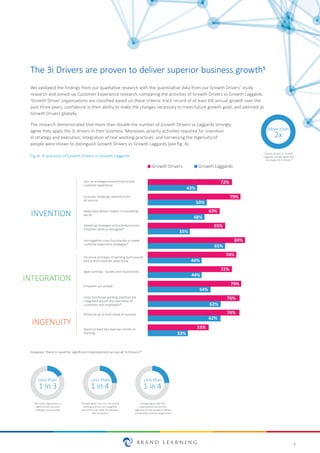
  • 5.
    5 The number onebarrier remains ‘Siloed behaviours and ways of working’ (48%) – constant restructures to address silos are just creating more silos and failing to enable people to work together to deliver for customers in practice. There is too little focus on real working practices and cultural barriers between teams. The result is even more bureaucracy in processes (35%), fixed structures (33%) and employees who don’t feel empowered (29%) – their needs for purpose, involvement and growth unfulfilled by organisations. The employee experience and customer experience are intrinsically linked; employees need to be empowered to deliver outstanding experiences for customers. Strategies are too focused on today’s pain points vs future opportunities (27%). JOINING UP DIFFERENTIATED CUSTOMER EXPERIENCES - WHAT GETS IN THE WAY? The customer experience is how customers feel and think about a business or brand through every interaction over time. Joined- up, differentiated customer experiences drive advocacy, purchase intent, loyalty, higher prices and ultimately growth, and were identified as a top hallmark of ‘Growth Driver’ organisations in Brand Learning’s Growth Drivers study.3 72% 70% 60% 46% Growth Drivers Growth Laggards LEARNING Join up strategies around end-to-end customer experience Structures and ways of working built around end-to-end customer experience 43% 44% 72% 74% Current pain points must be addressed, but by starting there, strategy is created within the parameters of what is vs what can be, perhaps limited by the way the supply chain works rather than how it could work for customers. The result is strategies that fail to engage emotionally with customers and change behaviour, and teams unable to break out of today’s siloed practices. Functional planning and execution is too rigid (22%) – the customer experience is changing all the time, you need to constantly iterate execution based on data-driven insights to sustain performance. To help overcome these barriers and achieve your goals, we will demonstrate what growth-driving organisations do differently and how to make this happen in practice. However, achieving success in the era of the ‘uncompromising customer’ is challenging. Empowered by information and choice in a technology-driven world, uncompromising customers demand an outstanding experience through multiple interaction points across the customer journey. It is essential that different functions work together to deliver outstanding customer experiences every time. Whilst acknowledging the external challenges, we must recognise there are internal practices getting in the way. Too many organisations continue to try to solve customer experience problems by using the same thinking and approaches they used to create these problems in the first place. As Albert Einstein famously said "We can’t solve problems by using the same kind of thinking we used when we created them". Strategies too focused on today vs future opportuniƟes Rigid funcƟonal planning and execuƟon Fixed organisaƟonal structures BureaucraƟc processes and systems Siloed behaviours and ways of working Employees don’t feel empowered 27% 22% 33% 48% 45% 29% 35% Fig.2: Internal barriers getting in the way of joined-up differentiated customer experiences4 Fig. 1: Practices - Growth Drivers vs. Laggards 3
  • 6.
    6 Customer Experience Co-Invention Through ourextensive experience and new research, we have explored what 'Growth Driver' organisations do differently to join up outstanding customer experiences. These organisations don’t start with fixing current pain points, recognising you can’t fix your way to future competitive advantage and that focusing only on today prevents teams from breaking out of silos. Winning organisations instead join up strategies, ways of working and execution using ‘co-invention’. CO-INVENTION - HOW TO JOIN UP DIFFERENTIATED CUSTOMER EXPERIENCES TO DRIVE GROWTH We are genuinely customer- centric, we are genuinely long term orientated, and we genuinely like to invent. Jeff Bezos, CEO, Amazon "Brings together different groups to invent and iterate differentiated customer experiences that have never existed before – breaking down silos and creating new value for all.” Co-invention differs from ‘co-creation’, which brings in different parties during a phase of a development process. Co-invention is inventing something that has never existed before, originating ideas and working together to execute experiences that engage customers at an emotional level to influence behaviour. It is a way of innovating the customer experience that everyone can contribute to, instilling a shared inventiveness that drives shared ownership. It delivers not just mutual value, but new value for customers, employees and partners by enabling cross-functional teams to design the future experience and deliver breakthrough solutions in practice. Making it happen in practice – the 3i Drivers INVENTION in strategy and execution Inspire a customer experience movement, bring together teams to invent differentiated customer experiences and continuously improve the micro-moments using data-driven insights. Enabled by… INTEGRATION of real working practices Join up structures, processes and ways of working around the real needs of your customers, employees and partners. INGENUITY of people In an era of increasing automation and artificial intelligence, harness the ingenuity of your people to deliver innovative customer experience solutions and amplify across the business. Fig. 3: 3i Drivers 14
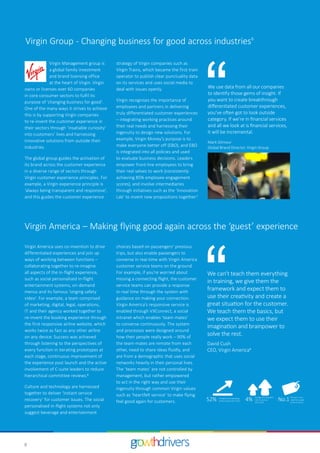
  • 7.
    7 The 3i Driversare proven to deliver superior business growth5 We validated the findings from our qualitative research with the quantitative data from our Growth Drivers’ study research and Joined-up Customer Experience research, comparing the activities of Growth Drivers vs Growth Laggards. 'Growth Driver' organisations are classified based on these criteria: track record of at least 6% annual growth over the past three years, confidence in their ability to make the changes necessary to meet future growth goals and admired as Growth Drivers globally. The research demonstrated that more than double the number of Growth Drivers vs Laggards strongly agree they apply the 3i drivers in their business. Moreover, priority activities required for Invention in strategy and execution, Integration of real working practices, and harnessing the Ingenuity of people were shown to distinguish Growth Drivers vs Growth Laggards (see fig. 4). Growth Drivers Growth Laggards Join up strategies around end-to-end customer experience Inclusive, fostering creaƟvity from all sources Apply data-driven insights in everything we do Joined-up strategies and acƟviƟes across funcƟons rated as very good* Join together cross-funcƟonally to invent customer experience strategies* INVENTION Agile working – quickly and responsively Empower our people Driven by an in-built sense of curiosity Spend at least two days per month on learning Structure and ways of working built around end to end customer experience INTEGRATION INGENUITY 72% 43% 50% 79% 63% 48% 65% 35% 84% 65% 74% 44% 72% 44% 79% 54% 76% 62% 53% 33% 76%Cross-funcƟonal working pracƟces are integrated around the real needs of customers and employees* 62% Less than 1 in 3 Less than 1 in 4 Rate their organisaƟon as highly joined up across strategies and acƟviƟes Strongly agree that cross-funcƟonal working pracƟces are integrated around the real needs of customers and employees Strongly agree that their organisaƟons harness the ingenuity of their people to deliver outstanding customer experiences Less than 1 in 4 Fig. 4: 3i practices of Growth Drivers vs Growth Laggards 2x Growth Drivers vs. Growth Laggards strongly agree that they apply the 3i drivers* More than However, there is need for significant improvement across all 3i Drivers:*
  • 8.
    8 Virgin Management groupis a global family investment and brand licensing office at the heart of Virgin. Virgin owns or licenses over 60 companies in core consumer sectors to fulfil its purpose of ‘changing business for good’. One of the many ways it strives to achieve this is by supporting Virgin companies to re-invent the customer experience in their sectors through ‘insatiable curiosity’ into customers’ lives and harnessing innovative solutions from outside their industries. The global group guides the activation of its brand across the customer experience in a diverse range of sectors through Virgin customer experience principles. For example, a Virgin experience principle is ‘always being transparent and responsive’, and this guides the customer experience strategy of Virgin companies such as Virgin Trains, which became the first train operator to publish clear punctuality data on its services and uses social media to deal with issues openly. Virgin recognises the importance of employees and partners in delivering truly differentiated customer experiences – integrating working practices around their real needs and harnessing their ingenuity to design new solutions. For example, Virgin Money’s purpose is to make everyone better off (EBO), and EBO is integrated into all policies and used to evaluate business decisions. Leaders empower front-line employees to bring their real selves to work (consistently achieving 85% employee engagement scores), and involve intermediaries through initiatives such as the ‘Innovation Lab’ to invent new propositions together.7 Virgin Group - Changing business for good across industries6 Virgin America uses co-invention to drive differentiated experiences and join up ways of working between functions – collaborating together to re-imagine all aspects of the in-flight experience, such as social personalised in-flight entertainment systems, on-demand menus and its famous ‘singing safety video’. For example, a team comprised of marketing, digital, legal, operations, IT and their agency worked together to re-invent the booking experience through the first responsive airline website, which works twice as fast as any other airline on any device. Success was achieved through listening to the perspectives of every function in iterating prototypes at each stage, continuous improvement of the experience post launch and the active involvement of C-suite leaders to reduce hierarchical committee reviews.8 Culture and technology are harnessed together to deliver ‘instant service recovery’ for customer issues. The social personalised in-flight systems not only suggest beverage and entertainment choices based on passengers’ previous trips, but also enable passengers to converse in real-time with Virgin America customer service teams on the ground. For example, if you’re worried about missing a connecting flight, the customer service teams can provide a response in-real time through the system with guidance on making your connection. Virgin America's responsive service is enabled through VXConnect, a social intranet which enables ‘team-mates’ to converse continuously. The system and processes were designed around how their people really work – 90% of the team-mates are remote from each other, need to share ideas fluidly, and are from a demographic that uses social networks heavily in their personal lives. The ‘team mates’ are not controlled by management, but rather empowered to act in the right way and use their ingenuity through common Virgin values such as ‘heartfelt service’ to make flying feel good again for customers. Virgin America – Making flying good again across the ‘guest’ experience We use data from all our companies to identify those gems of insight. If you want to create breakthrough differentiated customer experiences, you’ve often got to look outside category. If we’re in financial services and all we look at is financial services, it will be incremental. Mark Gilmour Global Brand Director, Virgin Group We can't teach them everything in training, we give them the framework and expect them to use their creativity and create a great situation for the customer. We teach them the basics, but we expect them to use their imagination and brainpower to solve the rest. David Cush CEO, Virgin America9 4th year in row – rated best quality airline in the US No.152% Average annual operaƟng profit increase 2013–2015 4% Average annual growth rate for revenue 2013–2015
  • 9.
    9 Winning across futuredemand spaces10 PepsiCo’s growth strategy is rooted in the ‘demand spaces’ they identify across the consumer experience, where PepsiCo brands can be paired together to meet a consumer need and leverage portfolio strength. The shared focus on these demand spaces brings together cross-functional teams to invent differentiated strategies and initiatives. For example, to drive brand choice in a ‘friends having fun together’ demand space, PepsiCo invested in sponsorship of the UEFA Champions League with Lay’s/ Walkers, Gatorade and Pepsi MAX, and developed an end-to-end experience for consumers, shoppers and customers across an unprecedented 103 markets. In particular, focusing on the demand spaces helps join up marketing, innovation and sales to unlock new value for customers as well as consumers, such as exploiting the ‘young hungry consumer’ in North American foodservice channels through innovations including Doritos Loaded and variants of Taco Bell’s Doritos Locos Tacos. PepsiCo also brings together Marketing and Sales through continuous improvement of ‘demand pockets’ – pockets of growth based on granular understanding of consumer demand in a particular channel, such as the Doritos/ Mountain Dew customised programme for 7-Eleven which achieved 3.2m Doritos’ loaded servings in the first 30 days. By focusing on the micro ‘demand pockets’ as well as the macro initiatives, Marketing demonstrates its support for Sales teams’ specific channel objectives, building trust in their ways of working. Additionally, PepsiCo established a Design function which works across the portfolio to apply design thinking to enhance their consumer experience through breakthrough innovation, such as the Spire digital fountains and vending machines. Close collaboration between designers, food scientists and Marketing is achieved through projecting out into the future and re-imagining the consumer experience as it could be.11 Enabled through networks of ‘SLAM’ teams within a matrix structure PepsiCo’s matrix structure enables the organisation to deliver scale initiatives across markets. The category structure comprises Brand & Innovation development teams at global and regional levels (including Brand, Innovation, Consumer Insight and R&D supported by Commercialisation, Finance and Supply Chain) and Business Unit local activation teams at market level. A matrix structure can help enable joined-up working but can also create internal complexity with multiple lines of command and competing priorities, so an external and future orientation is essential. PepsiCo instils pace and integrated working practices within its matrix structure through networks of ‘SLAM’ teams. The SLAM teams are mission focused and empower cross-functional teams to work together to deliver specific goals across the consumer experience. They are output focused, using consent rather than consensus decision making (is this initiative safe to try?), with teams closest to the work making decisions, and underpinned by common values and rewards. Networks of SLAM teams drive and enable execution across the matrixed organisation – for example, a SLAM team was set up to mobilise a joined-up approach to the Champions League sponsorship activation. Involvement in these teams is empowering for people within a matrix structure, providing them with greater purpose and autonomy for delivering specific goals in a very rapid way. The operating rhythm is fast and iterative, supported by an analytics workbench of sales and category performance metrics. Only five years ago PepsiCo was a group of independent businesses that were doing their own thing in a very different way. Now we have a much more integrated agenda that has the foundation of what we call ‘demand spaces’ - a map of where and how and with whom snacking is happening, and how we see that landscape evolving over the next years. Cesc Bordas General Manager, Snacks, West Europe and South Africa, PepsiCo 5% Average annual growth rate for revenue 2013–2015* *organic revenue figures
  • 10.
    10 MAKING IT HAPPENIN PRACTICE - THE 3i DRIVERS As leaders, you need to start with a mindset that says we’re just going to get there. It enables you to work collaboratively but when you run into problems, bring some edge to deal with issues honestly and head on. Richard Marriott Director roles, British Gas and Amazon UK 15
  • 11.
    11 INVENTION IN STRATEGY ANDEXECUTION We’re in an era of entrepreneurship – people want to invent new solutions to make people’s lives better, evident through the 100 million start-ups launched last year12 as well as the popularity of crowdsourcing sites such as Kickstarter and Gofundme. Organisations are partnering with start-up communities or setting up their own start-ups to propel their breakthrough innovation efforts, such as Aviva’s Digital Garage or Unilever’s The Foundry. Whilst this can deliver impressive results, the danger is innovation becomes the remit of these specialists only. Joining up differentiated customer experiences requires invention in strategies and execution across the whole organisation, enabling everyone to contribute to breakthrough and Inventiveness, and the small and big breakthroughs it generates, will be at least as important as innovation to the future of what we do and how we progress – innovation has become too elitist. Adam Morgan Founder, Eat Big Fish As a programme co-ordinator managing the issues of forced migration and resettlement in countries such as Zimbabwe and Somalia, you need to join up teams across multiple locations (support offices, airport and camps), as well as government agencies to deliver your purpose of ‘alleviating human suffering’. Your teams are operating in highly dangerous environments, with differing needs on the ground and challenging communication systems – vision and invention is required to achieve success. In Zimbabwe, the programme leadership team shifted their strategy from humanitarian aid alone to enabling affected communities and the government to work together to find solutions – resulting in initiatives such as bringing perpetrators and victims together to agree reconciliation and compensation. The focus is on building momentum behind new initiatives through harnessing powerful influencers in both the government and the communities. In turbulent environments such as Somalia, strategies and plans are continuously iterated using ‘ground truthing’ – information provided through Learnings from UN migration in Zimbabwe and Somalia13 incremental customer experience solutions on an ongoing basis. This shared inventiveness drives shared ownership across functions and a commitment to customer experience excellence. Rather than driving top-down initiatives, leaders must inspire a customer experience movement to galvanise action, and bring together different teams to invent new customer experience solutions focused on future passion points (moments of high emotion that will delight customers) as well as current pain points. Invention is about iteration; cross-functional teams need to work together to continuously improve every micro-moment using data-driven insights. direct observation by the teams on the ground. This continuous iteration and improvement is enabled through calls at least three times a week, in which teams on the ground share their insights with each other, explore opportunities, and agree how to adjust plans and execution going forward. Execution is not driven through ‘command and control’, but through recruiting and developing people with the right mindsets so they can adapt and deal creatively with issues as they arise in real-time. 5.1
  • 12.
    12 1 Cleveland Clinic continuesto innovate and iterate its patient experience solutions. A notable patient experience initiative was ‘same day’ appointments that enabled any patient to be seen the day they called in. To evolve with the changing needs of patients, they continued to innovate this moment through their Cleveland Clinic Today mobile app (via which patients can request appointments, find doctors and access personalised health content) and real-time chats online with HCPs. In the healthcare sector, pharmaceutical companies are highly focused on improving the patient experience but can find that traditional business models and working practices get in the way. A healthcare organisation that is renowned for transforming its patient experience is the Cleveland Clinic, a not-for-profit medical centre, which increased its ranking in the CMS survey of patient satisfaction from average to among the top 8% in two years. One of the first enablers of this transformation was to invent the future patient experience for the Cleveland Clinic as a cross-functional leadership team. James Merlino (then Chief Customer Officer) took out the 60 top cross-functional leaders for a retreat in which they invented what the perfect patient experience could look like, focused on quality medical care but spanning all aspects of the experience from free parking to smiling friendly staff through every interaction. It’s about constant curiosity to continually understand what patients are doing. What are all the things that influence a patient’s thinking and psyche through the day that we might be able to help with. Eric Dube Senior VP, GSK Global Respiratory Franchise To help inspire their customer experience movement, Cleveland Clinic defined patient experience principles alongside their purpose: 1. Providing safe care; 2. Delivering high-quality care; 3. Environment of exceptional patient satisfaction; and 4. Value conscious environment. These experience principles were translated into differentiated solutions across the patient experience for all functions: Reframed everyone as patient-centred caregivers (patient-facing and enabling functions) – involving everyone in setting caregiver priorities and integrating expectations into annual performance reviews. Maintained a patient-centred environment – tracking and analysing patient perceptions to maintain a patient- centred environment, such as ensuring rooms don’t become too noisy or dealing with spillages immediately. Equipped teams to deliver patient- centred service – through its HEART responsive service model (Hear, empathise, apologise, respond and thank). For example, if a patient is annoyed about having to walk the day after surgery, explain that ambulating is critical – safety is important above all other principles. Overall saƟsfacƟon percenƟle ranking 2008–12 (Centers for Medicare and Medicaid services) 6% Average annual growth rate for revenue 2013–2015 55% 92% Co-inventing the patient experience in healthcare14
  • 13.
    13 Thomson Reuters led asuccessful customer experience transformation within their Tax & Accounting division, under their overall purpose to “make your work easier, faster, and more profitable through powerful tax and accounting solutions”. The change was underpinned by two key elements: the ‘programme’ side (data- driven workstreams focused on specific customer experience priorities) and the ‘movement’ side. This ‘movement’ was focused on gaining executive-level commitment and key influencer support for driving the customer experience vision, such as ‘Exec Connect’ asking each ELT member to complete three CX tasks per quarter (e.g. meeting with end users, spending time with customer- facing teams) or their ‘What is your CX Move’ programme with regular videos of leaders and employees highlighting what they’ve done this month to enhance the customer experience. Inspiring a customer experience movement18 “We found those passionate ones who really wanted to be there, who wanted to keep the conversation going and who wanted to solve the problems.” Toby Lee, then CMO, Thomson Reuters Tax and Accounting. INSPIRE A CUSTOMER EXPERIENCE MOVEMENT How to inspire a customer experience movement Start your customer experience (CX) movement • Work with leaders and influencers at all levels to instil commitment behind the purpose – what excites them about the purpose for customers and why? • Identify priorities for the CX movement, such as how to gain board support, new CX programmes or addressing critical capability gaps. Galvanise action through inconvenient truths and cultural symbols • Challenge the business through ‘inconvenient truths’ using the customer data or consumer research groups with the board to demonstrate why CX action is critical for future business performance. • Build momentum through cultural symbols across the organisation. Nationwide received a thank-you letter from a father who had been helped through credit issues to find a mortgage, and was now in his first house and considered a hero by his children. This was used as a symbol of delivering Nationwide’s purpose for customers in meetings and forums across the business.17 Prove the business impact of CX programmes • Demonstrate the impact of CX programmes on business results at prioritised journey phases - Net Promoter Score (NPS) is simple to calculate and communicate, but not the whole picture. • Work with data analysts to integrate Voice of the Customer data (e.g. surveys, social sentiment, employee feedback, complaint logs) with interaction data from customer touchpoints and correlate to business metrics such as cost to serve, churn and revenue. • Ensure you have the right conversations with leaders up front to agree the methodology and what success looks like in terms of ROI and timings. 7% Average annual growth rate for revenue 2013–2015 Leaders need a compelling purpose for their business or brand – it defines why you exist for customers and helps drive growth.15 However, in too many organisations the purpose remains disconnected from the customer experience, described as ‘missions laminated not lived’.16 Winning organisations deliver on their purpose through actions not words by inspiring a customer experience movement across the organisation. “It was incredibly inspiring – it goes from 99th mortgage application to the emotional impact it’s having, it builds pride. Sara Bennison CMO, Nationwide 5.1.1
  • 14.
    14 INVENT CUSTOMER EXPERIENCE STRATEGIESAND PLANS TOGETHER Through our work delivering strategy and planning programmes across industries, a common challenge is helping functions break out of today’s practices and work together to deliver truly differentiated solutions. Winning organisations don’t implement the same rigid strategy and planning processes. Instead, they bring together cross-functional teams to invent the future customer experience first, harnessing customer data and future trends to envision the experience if the brand purpose is fulfilled. Inventing the future first breaks down existing path dependencies, enabling teams to identify future ‘passion points’ to delight customers as well as ‘pain points’. Teams can then work back from this future to deliver more innovative strategies to both unlock the opportunities of tomorrow and address the issues of today. Invention in strategy and execution requires a more inventive approach to customer journey mapping and strategy development, and new capabilities built into cross-functional teams. ‘Future state’ journey mapping too often isn’t based on the right customer data and foresight – it becomes too formulaic rather than genuinely inventive. i-Map is our approach for inventing differentiated customer experience strategies and initiatives. “Clearly define the customer experience you want to create and back solve – if you’re clear on what a great customer experience looks like, you don’t get constrained by the way the supply chain and systems are. Will Orr Managing Director, British Gas Home Installations PURPOSE-LED POSITIONING the future experience the current customer journey gaps and set goals strategies & initiatives INVENT MAP ANALYSE PRIORITISE Fig. 5: The i-MAP approach 15.1.2
  • 15.
    15 INVENT the futureexperience: • Bring together cross-functional teams through a real business task to develop foresight into the future environment and invent ideas for the future experience. This could involve immersion in your customers’ world, co-invention with innovation hubs or customers, partnering with ‘bleeding edge’ starts-ups or networks such as Techstars, and exploring future market dynamics. • Capture the outputs in a future- state journey map using the brand’s customer experience principles. MAP the current customer journey: • Map out the customer journey as it currently is. Drill down to understand the insights behind customer behaviour at each journey phase – keep asking why? Ensure all cross-functional team members have the opportunity to share their data and contribute. ANALYSE gaps and set goals: • Analyse gaps in the future journey vs current journey, and prioritise moments – both passion points to delight customers and pain points to fix. Work with data scientists to experiment with, analyse and correlate Voice of Customer data, interaction data from touchpoints and business metrics to validate goals. • Apply predictive modelling to forecast future outcomes, such as multivariate regression or models applied to data to predict future behaviour. Be pragmatic with the data available but equally aware of the breadth of data you can access – it’s estimated businesses only use 5% of data they receive.19 PRIORITISE strategies and initiatives: • Enable cross-functional teams to invent customer experience strategies and initiatives to deliver goals. Integrate across the customer experience levers, ensuring all relevant customer facing and enabling functions’ contributions are incorporated. • For example, we worked with the marketing and sales teams at a global beverages organisation on joined-up strategy and planning. We helped each function understand the value of the other by getting them to 'wear each other’s hat' whilst working on a case study as well as using experts in each function to provide perspective and guidance.20 Fig. 6: Integrated Customer Experience Levers* Less than 30% Over 40% Companies involve HR and IT in developing CX strategies despite the importance of technology and the employee experience to CX impact Companies don’t involve sales teams in developing CX strategies despite their criƟcal role 21 21 How to invent customer experience strategies and plans together The starting point of i-Map is to define experience principles to guide how the brand purpose should be delivered across the customer experience, such as Virgin Group’s ‘Always being transparent and responsive’ or Cleveland Clinic’s ‘Providing Safe Care’. The principles are developed using insights and the brand values, and are easier to implement by cross-functional teams compared to traditional elements of a brand positioning such as the brand idea or essence. Product/ soluƟons Customer engagement Channel/ distribuƟon Pricing/ promoƟons Service Visibility DESIRED CUSTOMER EXPERIENCE Technology Infrastructure People *Example only - levers will vary by industry
  • 16.
    16 In 2012, Airbnbfounder Brian Chesky hired a Pixar animator to create illustrations of each stage of the perfect Airbnb experience from the perspective of hosts and guests from ‘browsing for the right place’ to ‘checking out’. The illustrations were based on the outputs of team-working sessions to invent what this experience could be at particular stages if Airbnb fulfilled its purpose “To make people feel they can belong anywhere in the world”. As Joseph Unilever integrates foresight and future trends into category teams’ planning and ways of working, exploring emerging trends, disruptors to those trends and the implication at a category and product level. As Bill Marshall, Global Director, Human & Cultural Futures at Unilever comments, “If you’re in a cross-functional category team, the future trends are baked into how that whole category operates – we don’t just look at trends, we also look at disruptors to those trends. Looking at the disruptor enables you to look at the trend quite differently.” For example, whilst e-commerce is a key trend, a disruptor to that trend is that young people want to enjoy face- to-face real experiences, and are happy to enjoy indulgences within a balanced lifestyle. Magnum has used this insight to develop pop-up ‘Pleasure stores’ where consumers can make their own Magnums in an experiential way. 92% Average annual growth rate for revenue 2013–2015 6% Average annual growth rate for revenue 2013–2015 Inventing the future experience for hosts and guests22 Zadeh, Airbnb Product VP explains, “It's believing that the best experience will always lead to the best outcomes. Putting experience over any other consideration will lead to good things.” And indeed it has led to good things through differentiated customer experiences (from its one Airbnb event for hosts to its recently launched Airbnb Trips app offering location-based travel guides and services) and impressive business growth, with Airbnb now the most valuable accommodations company in the world. Harnessing future trends and solutions to deliver outstanding consumer experiences23 Unilever also connects their category and brand teams with the start-up community and its own incubator business, The Foundry. Teams brief The Foundry on start-up solutions to enable differentiated consumer experiences, such as Knorr’s partnership with Digital Genius to build Chef Wendy, an app which uses AI and natural language processing to provide dish suggestions with Knorr based on recipe ingredients.
  • 17.
    17 CONTINUOUSLY IMPROVE THE MICRO-MOMENTS Fixedplanning and execution no longer works in today’s dynamic external environment. Equally, simply focusing on agility is not enough; organisations cannot simply evolve with the changing environment, they must be proactive, continuously improving plans and execution at the micro-level. Google has highlighted the concept of ‘micro- moments’, demonstrating how the customer journey has been fractured into hundreds of real-time, micro- moments. In those moments enabled by mobile technology, customers expect brands to address their needs with real-time relevance.24 Whilst mobile is a key priority, there needs to be a broader focus on all micro-level interactions across the customer experience. Cross-functional teams need to collaborate to develop micro-level plans, iterating execution and adjusting the overall strategy when needed. Stronger data analytics and insight capability is critical to drive this continuous improvement of the micro-moments. Leaders must enhance the data literacy of all teams as well as data science capabilities in analytics groups, enabling these teams to experiment together with real-time and standard data, explore potential insights, and translate into relevant, personalised experiences for customers wherever they are. To invent you have to experiment, and if you know in advance that it’s going to work, it’s not an experiment. Most large organizations embrace the idea of invention, but are not willing to suffer the string of failed experiments necessary to get there. Jeff Bezos CEO, Amazon Amazon’s mission is to be the Earth’s most customer- centric company, empowered by autonomous teams and an obsessive focus on delivering better for customers. Amazon leads the way through inventive strategies (Amazon Prime Video, Amazon Fresh, Amazon Dash to name but a recent few), but is equally obsessed with continuously improving the micro-moments. Amazon focuses on thousands of use cases (interactions between users and the system) and treats every single customer use case differently. Machine learning, data analysis and insight is applied to understand user behaviour in micro-moments across the customer journey (from exploring new products to making purchases) enabling Amazon to target users with highly relevant content and personalised recommendations such as ‘related to items you’ve viewed’ and ‘new for you’. Amazon’s multi-disciplinary teams focus on these detailed use cases through intensive weekly meetings in which they interrogate complex data sets. They focus heavily on measuring inputs as well as outputs such as customer advocacy and growth, in particular their priorities – selection, competitive pricing and service delivery. One of Amazon’s leadership principles is ‘deep dive’, with leaders expected to stay connected to the detail, audit frequently, and be sceptical when metrics and anecdotes differ. Leaders at Amazon are expected to embrace complexity and treat each use case on merit. This obsession comes from Jeff Bezos himself, who still sends ‘question mark’ emails to his teams when he notices details of the execution that aren’t right for customers. Only 23% Companies strongly agree that funcƟons work together to conƟnuously improve every aspect of the customer experience25 Obsessively improving customers’ lives across the micro- and macro- moments26 21% Average annual growth rate for revenue 2013–2015 5.1.35.1.3
  • 18.
    18 Energise teams through a‘growth mindset’ • Instill a growth mindset into teams’ ways of working, so they openly acknowledge what’s working and look for opportunities to improve performance - failure and continuous learning is essential for invention. • Encourage this honest evaluation through leaders that deal openly with failure and use learnings to benefit the team as a whole. Facebook COO Sheryl Sandberg asks her team after every meeting – What did we learn? What could we have done better?27 Design and iterate plans across micro-moments • Equip multi-disciplinary teams to design micro-level plans for prioritised moments in the customer journey, such as researching, exploring solutions, making purchases, enjoying experiences or sharing it with others. • Define what customers feel, do and think in these moments, the influencers and influences. Identify how this changes depending on context (e.g. time of day, where they are, the device they’re using) to uncover insight into their needs in the moment, and deliver highly relevant content and experiences. • Use regular meetings and collaboration platforms to interrogate the data continuously, draw out insights and iterate plans across the micro-moments. There is a performance factor to it. Culturally you get into that way of thinking concept/ measure/test/perform all the time, in everything that you do – whether it’s finance, legal, sales or marketing, that performance criteria becomes part of the way that you live your life from a working point of view. Richard Berry Head of Commercial, Williams Martini Racing Enable with stronger analytics and insight capabilities in all, not just specialists • Develop stronger analytics groups (e.g. data scientists to analyse sources of real-time and standard data, and apply algorithms to predict future behaviour), but equally generalist teams with the capabilities to work with the data specialists and translate into actionable insight. • Ensure teams can frame the right questions, work with data scientists to source, clean and analyse the right data (e.g. Voice of customer, interaction data, location-based data, operational metrics, trends data), and visualise into actionable insights. Ways of working between analytics groups and business teams must be experimental with a bias for action, as we see in CX leaders such as Amazon. • Enable teams through data analytics tools such as Suite CX and Clickfox, or general purpose tools such as Tableau, to help analyse the variety of data and visualise the findings. But such tools are not the solution in themselves, and still require the right skillsets in people to draw out insights to inform decision making. The same applies to automation software – without the right insights and content strategy, these programmes will fail to deliver. How to continuously improve the micro-moments
  • 19.
    19 M&S is oneof the UK's leading retailers with over 1,330 stores worldwide. In a tough recessionary market in 2012 and under price-pressure from discounters, M&S set out a new purpose for its food business to ‘make every food moment special’. The challenge was how to translate this aspirational purpose into joined-up customer experiences across the business to drive growth. The starting point was to instill commitment across the food management team, using customer data to demonstrate the need for change. As Nathan Ansell, the then head of brand and marketing, explains, “It was about revealing the inconvenient truths through simple stuff such as starting every FMT meeting with customer data or going out to consumer research groups as a board – a committed executive director was also essential.” The insight in the FMT that M&S was a food hall not a supermarket was the catalyst for inventing new customer experiences, shifting from defensive price promotions to innovative solutions such as new deli counters and innovative chilled food. The momentum built behind the new direction as cross- functional leaders and teams saw the sales uplift in-store from these new customer experience initiatives. M&S continued to innovate new solutions as a cross-functional team (Marketing, Product Development, Category Teams, Insight, Space & Range, and Buying Teams), such as their new ‘Taste’ range to address customers’ desire for more variety in prepared foods. The joined-up approach was achieved through starting with a customer need and inventing solutions that deliver benefits to all functions involved – for example, delivering a more distinctive sub-brand range for consumers that also solved display and range needs in-store and made cost savings. In particular, closer collaboration was achieved between marketing and sales through gaining a better understanding of each other’s needs and priorities. As Nathan Ansell emphasises, “You need to adopt more of a trading mindset, looking for opportunities to drive trade into store such as relevant promotions as well as the brand building initiatives – this builds trust, which is really important.” The results have been impressive with their customer experience net promoter score up 14% and increased sales (with like-for-like UK food sales up 4% across the last three years). Making every food moment special28 14% Increase in net promoter score Increase in like-for-like sales in deflaƟonary market, 2013-20154%
  • 20.
    20 INTEGRATION OF REAL WORKINGPRACTICES Invention in strategy and execution is the critical first driver, but we see too many strategies fail without the right culture, structures and processes to enable success in practice. Joined-up customer experience strategy and execution needs to be enabled by the integration of real working practices across the organisation. A range of organisational structures are employed by businesses from hierarchical to flat, matrixed and holocratic, and most on a spectrum in between. The structure depends on your strategy and culture; there isn’t a one-size-fits-all solution – holocracy works for customer experience leaders such as Zappos, whilst for others this self-management model just isn’t right. In our experience, success in joining up outstanding customer experiences doesn’t start with an overhaul of the organogram, which can create a lot of upheaval. Rather the focus needs to be on integrating real work practices – how the real work gets done in the business, designed around the real needs of customers, employees and partners across the experience. We see too many customer experience strategies fail in execution because structures and procedures do not reflect these real needs. Consequently, continuous organisation restructures fail to empower teams to deliver for customers in practice, and end up creating even more complexity, bureaucracy and disempowered employees.29 The first issue is that structures and processes are not designed around customers as people, based on empathy into their real needs and broader lives rather than simply their transactions with a company. Secondly, these structures and processes don’t address the real needs of the other key group of people involved – your employees and partners. The employee experience and customer experience are inextricably linked; your people and partners need to be empowered to perform at their best to deliver your customer experience goals. A further barrier is discrepancies in culture across functions. Silos are at root a cultural issue; if people’s values and behaviours conflict, it is difficult for any structure or process to enable them to work in a joined-up way. The fast- paced world of broadcast journalism provides useful insights on joining up ways of working to deliver a distinctive experience. Sky News is focused on being the ‘first for breaking news’, and needs to ensure its input teams (reporters, cameramen, field producers, and home/foreign desks) work collaboratively at pace with the output programme teams for each show such as Sky Sunrise, Live at 5 and News at 10. There is high risk of silos and tensions between the input teams who research and craft stories in the field, and the programme teams who package and edit them for broadcast. Equally each programme team is set up to operate separately to deliver distinctive angles on the news for their slots in the news schedule. To enable joined-up ways of working, ‘package producers’ were brought in to play ‘integration’ roles, overseeing all the raw material inputs coming in between the news desk and the programme teams. They had an understanding of both the output side but also the inputs, and were often sent out into the field to understand what raw stories are coming in. The input and output teams also interact at high frequency to enable evolution of stories through the day – a strategy meeting at the start of each day, five meetings through the day and continuous dialogue across instant messaging platforms. Leaders at Sky News are expected to be agile, with the ability to anticipate opportunities and change direction based on emerging stories. Learnings from the Sky Newsroom30 350% Increase in procedures and verƟcal layers 13% Of the global workforce feel involved in their workplace up to only 29 29 15.2
  • 21.
    21 How to integratereal working practices • Ensure the customer journey has been developed through the lens of your customers as people, identifying their emotional needs and lives beyond their interactions with your organisation. • Map out the real work journey of employees and partners to deliver activities across this customer experience, and identify barriers and enablers to delivering the desired experience at key moments. Use techniques such as observational research, focus groups and interviews, and ‘back to the floor’ role swaps to understand how the real work gets done by people and why. • Explore the culture of different teams across key dimensions (e.g. leaders, rituals, ways of working). Identify the gaps and contradictions vs the ideal culture for the business. Design structures, roles and responsibilities, ways of working and governance around the real needs of your customers, employees and partners. Integrating real working practices clearly varies by organisation, however there are common principles for what is working in practice across businesses with whom we work: C-suite accountability: whether this is a Chief Customer Officer, Chief Customer Experience Officer or Chief Marketing Officer, there needs to be senior leader strategic responsibility for the end-to-end customer experience. 29% of respondents in our Joined-up Customer Experience research said there is no board level responsibility for the end-to-end customer experience in their organisation.31 Networked teams organised around CX goals: Organisations are mobilising networked teams32 within existing structures, such as PepsiCo’s SLAM teams or Cleveland Clinic’s patient-centric teams. The teams are organised around priority customer experience goals and empowered to make decisions. The focus is on the outputs and KPIs rather than rigid processes and policies. Integration across networked teams: The risk is that by establishing different teams focused on specific journey phases you simply create more silos; it is equally important to integrate working practices across the teams: Embed shared values and behaviours in ways of working and establish rewards for collaborative performance. Enable a common approach through standardised resources on the intranet and open data systems. Join up ways of working between teams through integration roles and regular rotation of people across teams to stop silos building up. Enable through centralised group: establish a centralised strategy, data analytics and insight group to co-ordinate and enable CX strategy and execution across the networked teams. It's not good for the organisation to look at different businesses in silos; marketing can and should look at the entire experience. Oliver Chong Executive Director Comms & Marketing Capability, Marketing Group, Singapore Tourist Board Design integrated working practices around the real needs of people Generate insight into the real needs of customers, employees and partners Shared values & rewards TEAM TEAM TEAM TEAM TEAM TEAM Role rotaƟons & IntegraƟon roles Common resources Open data CENTRAL GROUP: CX STRATEGY, ANALYTICS & INSIGHT CX GOALS Fig. 7: Networked teams organised around CX goals
  • 22.
    22 Integrating working practicesthrough social connections Facebook has used its social engineering capabilities to avoid unhelpful silos and instil its values (be bold, focus on impact, move fast, be open, build social value) into its working practices. Rotation induction programmes are used to enable new recruits to experience working across different teams; at the end, the recruits decide which team to join but also now have social connections with all the teams and a commitment to the whole business. Further into your employee journey, if you’ve been working on the same project for Enabling differentiated customer experiences through technology incubators Organising for digital varies depending on your strategy and also your level of digital maturity – digital centres of excellence, hub of spoke, multiple hub and spoke, and fully integrated. Regardless of the structure, Steve Jobs’ adage that you need to 'start with the customer experience and work back to the technology’ still remains true. Aviva’s purpose is to “free people from the fear of uncertainty’ and a customer experience priority was ensuring customers had a simple way to access, view and manage all their various policies. This is achieved through their ‘My Aviva’ interface, enabled by its ‘Digital Garage’ launched this year which brings together different functions in teams to innovate around the customer experience. The ‘Digital Garage’ has been set up independently from the ‘mothership’, reflecting the different mindset and day-to-day working practices that start-up teams need to drive breakthrough innovation. Equally Aviva wants to ensure integration with the core business to share ideas, support initiatives such as its Hack 24 event for all employees, and enable new innovations to be more easily ‘spun into’ the core business (unless they are ‘spun out’ externally). This is supported through a blend of leadership in the Digital Garage from both the core business as well as external hires, rotation of people between the core business and the Digital Garage, and co-locating members of the core business and the Digital Garage team in the same Hoxton space.34 Our big play is the Aviva Digital Garage – we’ve created a campus and there’s an absolute convergence in those buildings of marketing people, customer service people, propositions people, engineers, and design. Jan Gooding Global Brand Director, Aviva 51% Annual average growth rate for revenue 2013-2015 12–18 months, you are switched onto another team for a period – it can create inefficiency, but equally stops silos from building up and keeps team members fresh and energised. Facebook’s ‘be open’ is also built into the physical environment with open meeting spaces such as Hacker Square, and its company culture – for example, insisting everyone must always call colleagues by their real names rather than generic terms such as the engineering team or marketing team to help build deeper connections across teams.33
  • 23.
    23 Transforming the customerexperience through networks of teams Driving best customer experience is a priority strategic pillar for Lloyds Bank. To join up the organisation around its customer experience priorities, the leadership established networks of ‘hive’ teams to transform 10 key customer journeys such as account opening and onboarding for banking products and mortgage applications. These teams were co-located, bringing together people from different functions (product, channels, credit risk, conduct risk, operations and finance) to deliver minimal viable propositions using agile methodologies, for example, launching online re-mortgage capabilities in four months vs the traditional 18-month time period. The different journeys are joined up from a customer perspective through focusing on customer lifestage moments and bringing propositions together for customers at relevant moments of truth. Establishing new governance models that enable more freedom for the teams whilst adhering to industry regulation has been a critical success factor, with the focus on proof of concept rather than rigid stage gate processes to deliver customer experience impact faster.35 Pioneering Amazing Service36 First Direct is the UK’s most recommended bank and has been voted best UK brand for service, beating customer experience leaders such as Amazon and John Lewis. Since its inception, its purpose to ‘pioneer amazing service’ has been delivered without branches through its 24/7/365 call centre service – open even on Christmas Day. In sync with the changing needs of its customers, it now delivers its same exceptional service through digital channels, for example iphone fingerprint technology for identification and voice biometrics by phone to make the security The key is to ensure the teams feel liberated. Co-location is challenging, but crucial in creating a bond across the teams, instilling common thinking, and encouraging trust so they think about doing things differently. Stephen Noakes Managing Director Retail Customer Products, Lloyds Bank The key is proceduralising the customer experience not the operation. Louise Fowler former Marketing Director, First Direct TEAM STRUCTURES Customer service teams (eight people max) delivering pioneering service, empowered to act and use judgment, enabled through coaching vs controlled through micromanagement End-to-end customer experience strategically driven by customer-centred leaders at C-suite level Strong collaboraƟon between customer-facing teams and digital/IT systems teams, with programme manager ‘integraƟon’ roles who ‘can speak technology and customer’ People experience teams also played this integraƟon role enabling First Direct’s values to be lived across the business – from a midsummer snow-ball fight to bonding breaks Designed around real needs of the customers – if there is a customer problem, every funcƟon deals with this first, even senior leaders Call centre staff are equipped to use judgment in handing issues on calls – no scripts are used despite increased regulaƟon. This investment in capability drives high producƟvity because one staff member can deal with most things, without referring onwards or upwards in the organisaƟon Values (playful, family, pride, always on, passion, original) are fully integrated into their people policies. Select for aƫtude and train for apƟtude – for example, the first interview an agent will have is over the phone, as that’s where they’ll deal with the majority of customers Common customer KPIs and common values in everyone’s rewards – all employees including senior management are measured and rewarded on how they live the values, not sales targets, via 360ǡ feedback ROLES & RESPONSIBILITIES PROCESSES & WAYS OF WORKING DECISION MAKING COMMON VALUES/ BEHAVIOURS SHARED RESOURCES REWARDS • • • • • • • • • • Regular ‘Business in a nutshell’ communicaƟons to integrate across the networks of teams aspects of the customer experience simple and effortless. At the heart of First Direct’s success is integrating real working practices around the real needs of its customers, its people and intermediaries. First Direct’s people at all levels across every function are empowered to deliver amazing service for customers. • *Please note - First Direct is owned by HSBC so specific growth results are not available
  • 24.
    24 INGENUITY OF PEOPLE Inventionin strategy and execution is equally enabled by the ingenuity of people, with the commitment and capabilities to deliver innovative customer experience solutions and amplify across the business. Empowered employees are a proven indicator of a company’s customer experience and growth.37 Get some people who are really passionate about an issue and they will drive it, they pull together a virtual team and say we’re going to fix this, bringing emotion not just rationality. That’s what makes the real difference to delivering an outstanding, joined-up customer experience. Sara Bennison CMO, Nationwide We’re in an era of increasing workplace automation, driven by artificial intelligence and robotics. Machine learning is already re-defining how work gets done across industries, not just routine activities but also cognitive-based tasks. It is a critical enabler of delivering joined-up customer experiences more effectively and efficiently, from big data algorithms and automated packaging solutions such as Baxter the robot to Momentum Machine’s automated burger services and IBM’s Watson in customer service call centres. It is estimated that 45% of tasks completed by humans could already be automated using existing technologies.38 Yet in this age of automation, technology should not be seen as the only solution. Harnessing the ingenuity of people remains the key differentiator between standard solutions and truly differentiated experiences, from Barclays’ Digital Eagles pioneers to empowered Zappos call centre employees. Organisations need to mobilise people who want to make a difference for customers, apply their ingenuity to find solutions to customer needs, and amplify across the business. This collective ingenuity instils a shared culture that is obsessed with improving the lives of customers. Moreover, as economist David Autor has written, automating tasks increases the needs for workers to do the other tasks that have not been automated.39 Automation of workplace activities previously delivered by humans places even greater importance on ‘right side of the brain’ activities. The focus will be less on employees’ knowledge, and more on their capabilities to be constantly curious, use their initiative in seeking out solutions for customers, and enable through new technologies – in short, ingenuity. The issue is organisations are not fully harnessing the ingenuity of their people. ‘Questioning employees’ are looking for purpose and involvement in the organisation, but these needs are not being fulfilled.40 People are not robots; they need to be empowered to pursue new opportunities for customers. Ingenuity can be developed in the mindset and skills of teams, but only through a new approach to learning focused on improving team performance across the workflow rather than relying on one-off learning events, and more scenario-based learning to instil ingenuity into their mindsets and ways of working. In the 2015 season, Williams’ pit stops were amongst the slowest of all the teams and at one race even had a mix up with tyres. In the off-season, they broke down every component and brought ingenuity in finding creative ways to improve every aspect of performance. A huge Learnings from the Williams Martini Racing Formula One team amount of work was done to redesign critical components, both on and off the car, including the wheel guns. They worked with the drivers to ensure they would stop exactly on the marks and the team wouldn’t need to readjust. They added a visual person in there just to watch what’s going up and down the pit lane so the chief mechanic could focus single-mindedly on the release and not whether he’s releasing the driver into the oncoming traffic – this reduces the time by a 10th of a fraction of a second, which can make the difference between gaining another place on the track or not. At the 2016 European Grand Prix, Williams equalled the fastest pit stop in history – 1.92 seconds. Their new pit stop techniques have even been re-applied to assist in resuscitating new-born babies in the University Hospital of Wales’ neonatal unit. The ingenuity of the Williams’ pit stop team is reflective of the culture of the Williams’ organisation, committed to a shared purpose of winning on the race track and passionate about seeking new ways to deliver success.41 15.3
  • 25.
    25 Delivering happiness throughthe ingenuity of its people Zappos is an online shoe and clothing retailer and its purpose is delivering happiness for its customers and people. They use machine learning to deliver highly personalised experiences for customers such as advertising price points based on how much a customer spent on their last purchase or the value of items they previously searched for.42 However, Zappos’ differentiation is enabled through the ingenuity of its people, who are renowned for delivering wow moments for customers. For example: • If Zappos doesn’t have the shoe you want in stock or your size, call centre employees will go to competitor sites to find what you want for you • Zappos sent overnight a free pair of shoes to a best man who had arrived at a wedding shoeless • Take a picture of an item and send it via the Zappos’ app and call centre teams will do the research for you Zappos has made the ingenuity of its people a competitive advantage through instilling a common purpose of delivering happiness and shared values, such as Barclays’ Digital Eagles – becoming ‘the most digitally savvy workforce on the high street’ Barclays’ overall purpose is “Helping people achieve their ambitions – in the right way”, and they wanted to be at the vanguard of digital revolution and do so in a responsible way. ‘Digital Eagles’ was an initiative to help customers and employees get up to speed with tech and navigate their way around digital banking services. Digital Eagles actually started as a colleague initiative to help employees get excited about the digital future and equipped with the skills to face the challenges with confidence. This initiative wasn’t driven from the top down, rather through a small passionate team of people who wanted to create a practical response to help colleagues and customers. A team of 18 was then seconded to be internal champions, upskilling colleagues in digital technologies and practices. It worked very well, so they tested the programme externally with customers in a few branches. It was when the Barclays’ leadership saw the transformational impact the initiative was having on both customers and colleagues (often at a very emotional level) that the programme was scaled up across the business and became a core focus of the company strategy. The new ambition was to become ‘the most digitally savvy workforce on the high street’, supported by an app-based learning programme through which teams could compete for points. The content was constantly updated to continue building new skills required for customer experience execution – for example, data security when the TalkTalk data leak happened. As a result, Barclays has turned 18,000 of its employees worldwide into passionate digital advocates, who drive Digital Eagles’ customer experience programmes from Tea & Teach sessions and Eagle labs in branches (helping customers use digital equipment such as 3D printing) to Digital SOS days through social media networks.44 77.9% Average annual operaƟng profit increase 2014–2015 18,000 18 Digital Eagles translated into Gaining mobile customers took 18 months vs 13 years to achieve 4m online banking customers. 4m ‘create fun and a little weirdness’ and ‘be adventurous, creative and open-minded’. Zappos celebrates each person’s individuality – people are encouraged to be the same person at work as they are at home. They are given the freedom to be creative in delivering for customers with no call centre scripts and they amplify the great service by making exceptional stories cultural symbols.43
  • 26.
    26 Instil common purpose, valuesand behaviours • Connect people’s passions to a meaningful purpose for customers to galvanise teams to work together to make the customer experience better. Involve them in developing the purpose, brainstorm ideas for how it could be delivered for customers and explore why it matters to them personally. • Commit leaders and teams to a shared values manifesto, which translates values into actionable behaviours. For example, Zappos has ten core values they live by such as ‘Deliver WOW through Service’ and ‘Do More with Less’.45 How to harness the ingenuity of your people • Translate the purpose into a distinctive employee proposition based on insights into your people’s needs, and experience principles to guide its implementation across the employee experience. Empower people through involvement • Provide your people with greater ownership and opportunities to deliver impact for customers – people will only apply ingenuity if they feel involved through the employee experience and that they can make a tangible difference in their roles. This may be through networked teams empowered to make decisions or simply encouraging teams to contribute new ideas. For example, incubator programmes that give employees and partners the LinkedIn is the world’s largest professional network with more than 433 million members, driven by its purpose to connect the world's professionals to make them more productive and successful. In 2012, it launched its LinkedIn (in)cubator programme, which once a quarter gives any employee the opportunity to form a team, invent new ideas and pitch their idea to the executive team. If approved, the team has up to three months’ dedicated time to turn their idea into new solutions for its users. Approved incubator projects have ranged from meeting booking systems to new recycling systems. (in)cubator itself was inspired by Hackday, a Friday each month when employees were encouraged to work on just about anything they want.47 opportunity to think creatively and own the development of new ideas. • Foster team collaboration through celebrating successes and learning from failures together, sharing new ideas across collaboration platforms such as Yammer and Chatter, and the design of the office environment with open meeting spaces such as Facebook’s Hacker Square. • Equip leaders to coach teams to use ingenuity in everyday working – e.g. actively listening, encouraging questions, supporting personal passions, being open to new ideas and removing the fear of failure. Facebook’s EMEA VP Nicola Mendelsohn encourages her people to “do what you would do if you weren’t afraid”.46 40%Average annual growth rate for revenue 2013–2015
  • 27.
    27 Develop people’s mindsets andskills through learning • As well as building team capabilities for Invention in strategy and execution (such as inventive customer experience strategy and execution, purpose-led positioning, and data- driven insights), focus equally on developing ingenuity in the mindsets and skills of your people. • Design learning programmes that equip teams to use their ingenuity in understanding and addressing real customer needs through the workflow. As with the Barclays Digital Eagles initiative, focus on real customer challenges and equip people through coaching from internal champions and leaders, networked resources (e.g. learning apps, videos on demand), communities of practice, as well as the formal learning events. • Use scenario-based learning exercises that immerse your teams in real-life or simulated situations, building cognitive skills. This can be real work scenarios with teams working together resourcefully to achieve goals such as the Royal Marines or bite-sized online learning solutions. For example, we developed a scenario video for a telecoms company in which participants observed a customer’s journey and generated ideas for how this experience could be enhanced at each stage. Ingenuity requires resourcefulness in different situations and the capability to think creatively in dealing with multiple scenarios – a key characteristic of Royal Marines. This mindset and skills are developed through scenario-based practical exercises not just in the classroom, in which the army, navy, airforce and different NATO companies are brought together to use their ingenuity to complete missions. What you do and how you approach achieving your mission objectives in the scenario is left open to the team. Learning is focused on real- life situations, building troops’ experience of being in situations and their capabilities to deal with multiple eventualities. Continuous learning is enabled through sharing across nations (both people and ideas) and ongoing evaluation of performance through post-exercise reports (PXR). Learnings from the Royal Marines48 True creativity can as much come out of functionality as it can your latest marketing campaign, but you’ve got to help other functions understand the tech opportunities rather than get dragged into the detail and technobabble. Paul Randle Director of Digital & Media
  • 28.
    28 SUMMARY - MAKINGIT HAPPEN IN PRACTICE Inspire a CX movement Invent CX strategies and plans together Continuously improve the micro-moments Integrate real working practices Harness the ingenuity of your people Move fast, be prepared to fail and live the experience as your customers do all the time. Nathan Ansell Global Director of Loyalty, Customer Insight & Analytics, M&S 16
  • 29.
    29 ABOUT BRAND LEARNING BRANDLEARNING is a global consultancy whose mission is to help create growth-capable organisations. We work in partnership with the world’s leading organisations to inspire and build their capabilities to deliver customer-centred growth. We work with Marketing, Sales, HR, Leadership and Digital teams to lift their performance and ability to create exceptional customer experiences. Rich Bryson Group Client and Propositions Director at Brand Learning Author 7
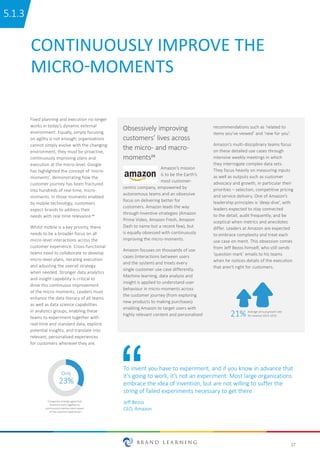
  • 30.
    30 Sources 1. Brand LearningGrowth Drivers’ Research 2016 identified ‘Join up strategies around the end- to-end customer experience’ and ‘Structures and ways of working built around end-to- end customer experience’ as top hallmarks of Growth Driver organisations vs Growth Laggards. 2. 2016 Temkin Experience Ratings: average CX scores for all 20 industries in US declined between 2015–16. 3. Brand Learning Growth Drivers’ Research 2016. Forrester’s Customer Experience Index has also shown that firms with higher customer experience scores have more customers who purchase again, don’t switch and recommend. 4. Brand Learning Joined-Up Customer Experience Research 2016. 5. Brand Learning Growth Drivers’ Research 2015. *Brand Learning Joined-Up Customer Experience Research 2016. 6. Brand Learning interview with Mark Gilmour (Global Brand Director, Virgin Group), 2016. 7. Virgin.com article 2015. 8. Brand Learning interview with Mark Gilmour (Global Brand Director, Virgin Group), 2016 and Work & Co case study. 9. Interview with David Cush by Carmine Gallo, youtube.com. 10. Brand Learning interview with Cesc Bordas (General Manager, Snacks, West Europe and South Africa, PepsiCo), 2016. 11. HBR article, November 2015. 12. GEM Global Report, 2015. 13. Brand Learning interview with Programme Co-ordinator for UN Migration, 2016. 14. Service Fanatics – how to build superior patient experience the Cleveland Clinic Way, 2014. Health Care's Service Fanatics – Harvard Business Review, 2013. 15. GROW: How Ideals Power Growth and Profit at the World’s Greatest Companies, Jim Stengel, 2012. 16. Brand Learning Growth Drivers’ Study 2015. 17. Brand Learning interview with Sara Bennison (CMO, Nationwide), 2016. 18. Brand Learning interview with Toby Lee (CMO, Thomson Reuters Legal and formerly of Tax and Accounting), 2016. 19. Data Analytics: Practical Data Analysis and Statistical Guide to transform and evolve any business, Isaac Cody, 2016. 20. Brand Learning client case study, 2016. 21. Brand Learning Joined-Up Customer Experience Research 2016. 22. Airbnb case study, inc.com article 2014. Fastcompany.com, article 2012. 23. Brand Learning interview with Bill Marshall (Global Director, Human & Cultural Futures, Unilever), 2016. 24. Google Micro-Moments – Your Guide to Winning the Shift to Mobile, 2016. 25. Brand Learning Joined-Up Customer Experience Research, 2016. 26. Brand Learning Interview. The Everything Store: Jeff Bezos and the Age of Amazon, 2014. 27. WACL event 2016, described in interview with Nicola Mendelsohn, VP EMEA, Facebook. 28. Brand Learning interview with Nathan Ansell (Global Director of Loyalty, Customer Insights & Analytics, M&S), 2016. 29. BCG research. Gallup Poll Survey, 2013. 30. Brand Learning interview with former Sky News journalist, 2016. 31. Brand Learning Joined-Up Customer Experience Research, 2016. 32. The concept of networked teams was introduced in Team of Teams: New Rules of Engagement for a Complex World, General McChrystal, 2015. 33. Facebook Engineering Bootcamp, facebook.com posts. The Silo Effect, Gillian Tett, 2015. 34. Brand Learning interview with Jan Gooding (Group Brand Director, Aviva), 2016. The Lean Enterprise: How Corporations Can Innovate Like Start-ups, Trevor Owens, Obie Fernandez, 2014. 35. Brand Learning interview with Stephen Noakes (Managing Director Retail Customer Products, Lloyds Bank), 2016. 36. Brand Learning interview with former Marketing Director, First Direct, 2016. 37. Brand Learning Growth Drivers’ Research 2015. 38. McKinsey Four Fundamentals of Workplace Automation, 2015. 39. Automation and Anxiety, will smarter machines cause mass unemployment?, economist.com, 2016. 40. Brand Learning Growth Drivers’ Research 2015. 41. Brand Learning interview with Richard Berry (Head of Commercial, Williams Martini Racing), 2016. 42. Porter Novelli.com article. 43. Zappos.com; ukbusinesinsider.com; inc.com article – Uncommon service: the Zappos Case Study. 44. Brand Learning interview with former Barclays’ leader. www.barclays.co.uk/DigitalEagles. 45. Zappos.com values manifesto. 46. Campaignlive.co.uk interview 2015. 47. Fastcompany.com article 2013, ‘The LinkedIn incubator’ youtube 2013. 48. Brand Learning interview with Sergeant James Plowright of the Royal Marines, 2016. With sincere thanks and great appreciation to all our interviewees, respondents, and to the broader team at BRAND LEARNING who helped shape this study and its recommendations.
  • 31.
    Inspiring people. Liftingcapabilities. Growing organisations. © Brand Learning 2016 All rights reserved New York Brand Learning Inc. 80 Broad Street Suite 2101 New York NY 10004 Tel: (+1) 212 392 4898 London Brand Learning Partners Ltd. Burgoine Quay 8 Lower Teddington Road Hampton Wick Kingston-upon-Thames Surrey, KT1 4ER Tel: (+44) 208 614 8150 Singapore Brand Learning Pte Ltd. 3 Temasek Avenue Centennial Tower Level 21-00 Singapore 039190 Tel: (+65) 6549 7935 contactus@brandlearning.com www.brandlearning.com