BackgroundBackground
to Demandto Demand
Background to Demand
Marginal Utility Theory
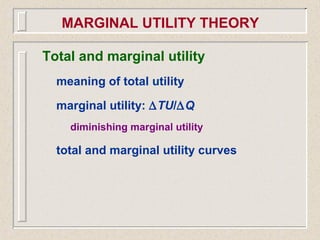
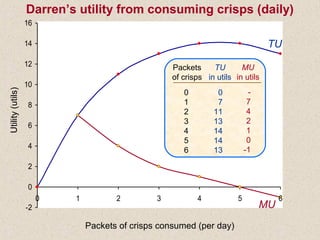
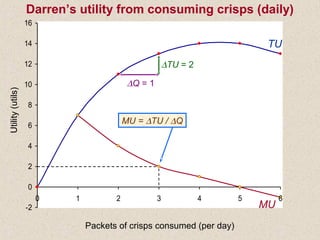
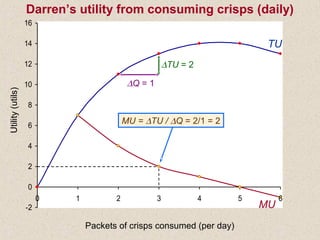
Total and marginal utility
meaning of total utility
marginal utility: ∆TU/∆Q
diminishing marginal utility
total and marginal utility curves
MARGINAL UTILITY THEORY
-2
0
2
4
6
8
10
12
14
16
0 1 2 3 4 5 6
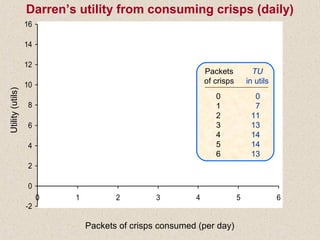
Packets
of crisps
TU
in utils
0
1
2
3
4
5
6
0
7
11
13
14
14
13
Utility(utils)
Packets of crisps consumed (per day)
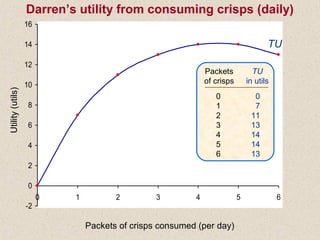
Darren’s utility from consuming crisps (daily)
-2
0
2
4
6
8
10
12
14
16
0 1 2 3 4 5 6
Packets
of crisps
TU
in utils
0
1
2
3
4
5
6
0
7
11
13
14
14
13
Utility(utils)
Packets of crisps consumed (per day)
TU
Darren’s utility from consuming crisps (daily)
-2
0
2
4
6
8
10
12
14
16
0 1 2 3 4 5 6
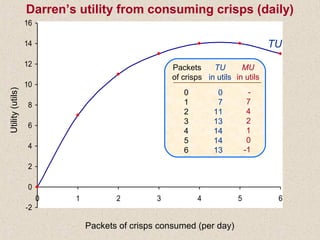
Packets
of crisps
TU
in utils
0
1
2
3
4
5
6
0
7
11
13
14
14
13
MU
in utils
-
7
4
2
1
0
-1
Utility(utils)
Packets of crisps consumed (per day)
TU
Darren’s utility from consuming crisps (daily)
-2
0
2
4
6
8
10
12
14
16
0 1 2 3 4 5 6
Packets
of crisps
TU
in utils
0
1
2
3
4
5
6
0
7
11
13
14
14
13
MU
in utils
-
7
4
2
1
0
-1
Utility(utils)
Packets of crisps consumed (per day)
TU
MU
Darren’s utility from consuming crisps (daily)
-2
0
2
4
6
8
10
12
14
16
0 1 2 3 4 5 6
MU
∆TU = 2
∆Q = 1
MU = ∆TU / ∆Q
Utility(utils)
Packets of crisps consumed (per day)
TU
Darren’s utility from consuming crisps (daily)
-2
0
2
4
6
8
10
12
14
16
0 1 2 3 4 5 6
MU
MU = ∆TU / ∆Q = 2/1 = 2
Utility(utils)
Packets of crisps consumed (per day)
TU
∆TU = 2
∆Q = 1
Darren’s utility from consuming crisps (daily)
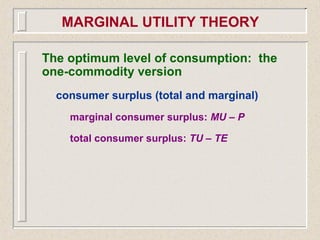
The optimum level of consumption: the
one-commodity version
consumer surplus (total and marginal)
marginal consumer surplus: MU – P
total consumer surplus: TU – TE
MARGINAL UTILITY THEORY
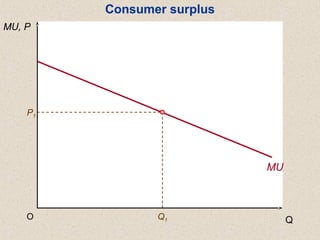
MU
P1
Q1O
MU, P
Q
Consumer surplus
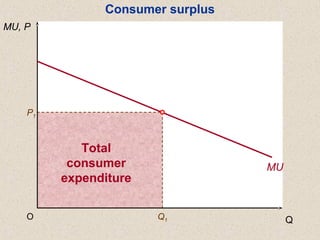
Total
consumer
expenditure
MU
P1
Q1O
MU, P
Q
Consumer surplus
Total
consumer
expenditure
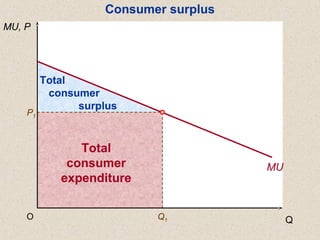
MU
Total
consumer
surplus
P1
Q1
MU, P
QO
Consumer surplus
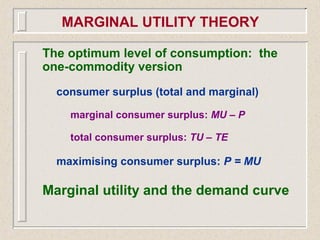
The optimum level of consumption: the
one-commodity version
consumer surplus (total and marginal)
marginal consumer surplus: MU – P
total consumer surplus: TU – TE
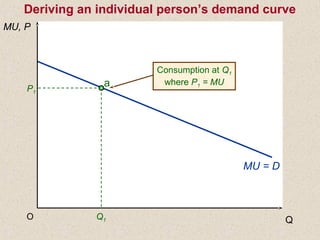
maximising consumer surplus: P = MU
Marginal utility and the demand curve
MARGINAL UTILITY THEORY
MU = D
MU, P
QO Q1
P1
a
Consumption at Q1
where P1 = MU
Deriving an individual person’s demand curve
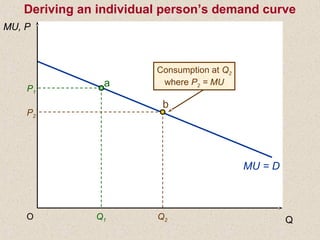
Q2O
P1
Q1
a
P2
b
Consumption at Q2
where P2 = MU
MU, P
Q
MU = D
Deriving an individual person’s demand curve
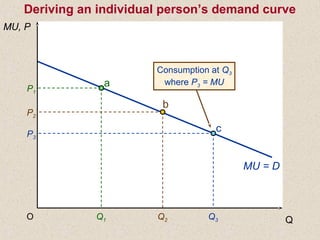
P2
Q2O
P1
Q3Q1
a
P3
c
Consumption at Q3
where P3 = MU
b
MU, P
Q
MU = D
Deriving an individual person’s demand curve
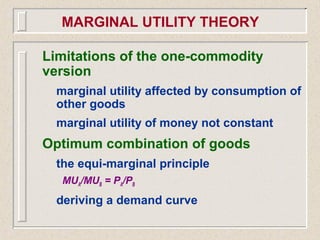
Limitations of the one-commodity
version
marginal utility affected by consumption of
other goods
marginal utility of money not constant
Optimum combination of goods
the equi-marginal principle
MUA/MUB = PA/PB
deriving a demand curve
MARGINAL UTILITY THEORY
Background to Demand
Risk, Uncertainty and
Insurance
Demand under conditions of risk and
uncertainty
defining risk and uncertainty
types of odds
risk attitudes
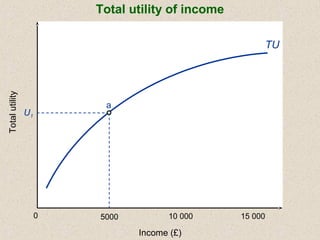
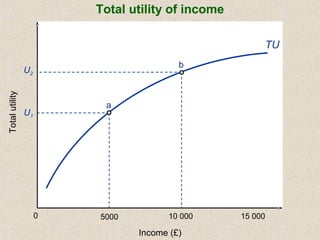
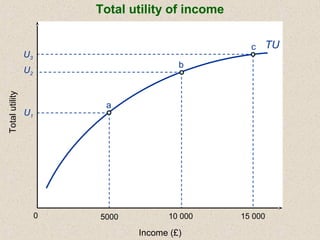
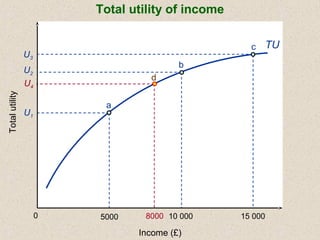
Diminishing marginal utility of income
and attitudes towards risk taking
RISK, UNCERTAINTY AND INSURANCE
TU
5000 10 000 15 0000
Income (£)
Totalutility
U1
Total utility of income
a
TU
5000 10 000 15 0000
U2
U1
a
b
Income (£)
Totalutility Total utility of income
TU
5000 10 000 15 0000
U3
U2
U1
a
b
c
Income (£)
Totalutility Total utility of income
TU
5000 10 000 15 0000 8000
U3
U2
U1
U4
a
b
c
Income (£)
Totalutility
d
Total utility of income
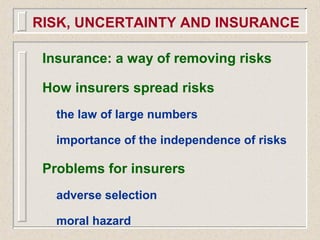
Insurance: a way of removing risks
How insurers spread risks
the law of large numbers
importance of the independence of risks
Problems for insurers
adverse selection
moral hazard
RISK, UNCERTAINTY AND INSURANCE
Background to Demand
Indifference Analysis
Indifference curves
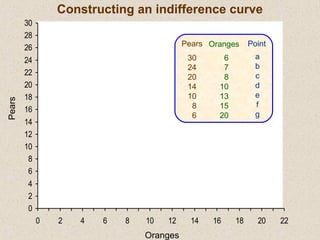
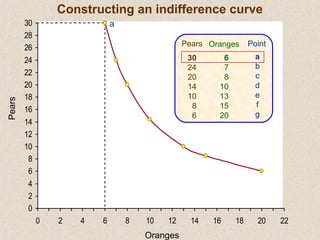
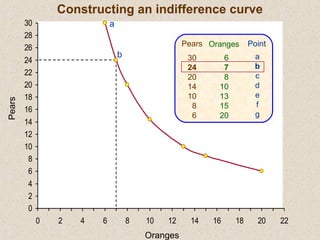
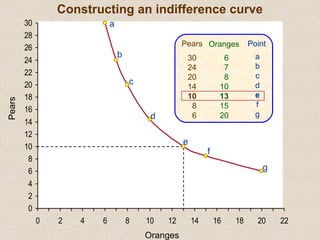
constructing an indifference curve
INDIFFERENCE ANALYSIS
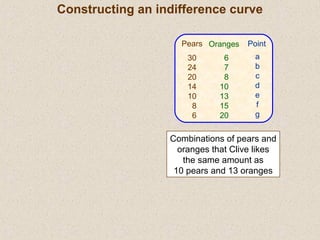
Pears
30
24
20
14
10
8
6
Oranges
6
7
8
10
13
15
20
Point
a
b
c
d
e
f
g
Combinations of pears and
oranges that Clive likes
the same amount as
10 pears and 13 oranges
Constructing an indifference curve
0
2
4
6
8
10
12
14
16
18
20
22
24
26
28
30
0 2 4 6 8 10 12 14 16 18 20 22
Pears
Oranges
Pears
30
24
20
14
10
8
6
Oranges
6
7
8
10
13
15
20
Point
a
b
c
d
e
f
g
Constructing an indifference curve
a
Pears
Oranges
Pears
30
24
20
14
10
8
6
Oranges
6
7
8
10
13
15
20
Point
a
b
c
d
e
f
g
Constructing an indifference curve
0
2
4
6
8
10
12
14
16
18
20
22
24
26
28
30
0 2 4 6 8 10 12 14 16 18 20 22
a
b
Pears
Oranges
Pears
30
24
20
14
10
8
6
Oranges
6
7
8
10
13
15
20
Point
a
b
c
d
e
f
g
Constructing an indifference curve
0
2
4
6
8
10
12
14
16
18
20
22
24
26
28
30
0 2 4 6 8 10 12 14 16 18 20 22
a
b
c
d
e
f
g
Pears
Oranges
Pears
30
24
20
14
10
8
6
Oranges
6
7
8
10
13
15
20
Point
a
b
c
d
e
f
g
Constructing an indifference curve
0
2
4
6
8
10
12
14
16
18
20
22
24
26
28
30
0 2 4 6 8 10 12 14 16 18 20 22
Indifference curves
constructing an indifference curve
the shape of an indifference curve
diminishing marginal rate of substitution
INDIFFERENCE ANALYSIS
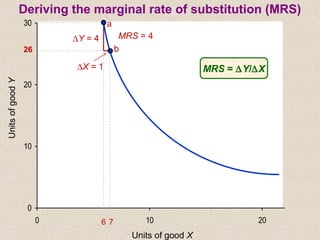
0
10
20
30
0 10 206
26
7
UnitsofgoodY
Units of good X
a
b
∆Y = 4
∆X = 1
MRS = 4
MRS = ∆Y/∆X
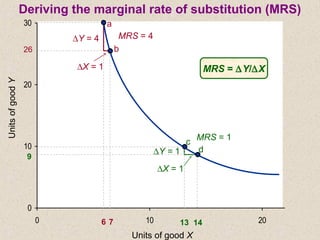
Deriving the marginal rate of substitution (MRS)
0
10
20
30
0 10 20
a
b
UnitsofgoodY
Units of good X
26
6 7
d
∆Y = 4
∆X = 1
∆Y = 1
∆X = 1
MRS = 1
MRS = 4
13 14
9
c
MRS = ∆Y/∆X
Deriving the marginal rate of substitution (MRS)
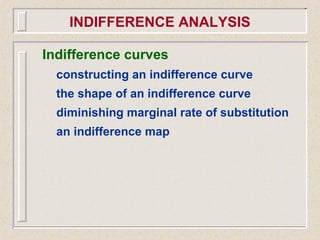
Indifference curves
constructing an indifference curve
the shape of an indifference curve
diminishing marginal rate of substitution
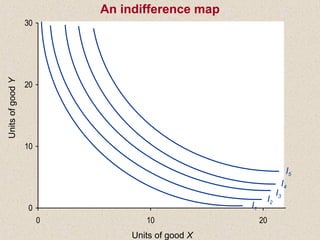
an indifference map
INDIFFERENCE ANALYSIS
0
10
20
30
0 10 20
UnitsofgoodY
Units of good X
I1
I2
I3
I4
I5
An indifference map
Indifference curves
constructing an indifference curve
the shape of an indifference curve
diminishing marginal rate of substitution
an indifference map
The budget line
constructing a budget line
INDIFFERENCE ANALYSIS
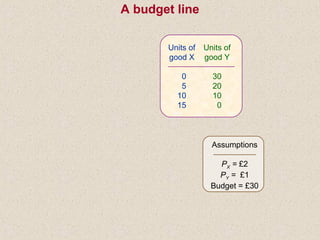
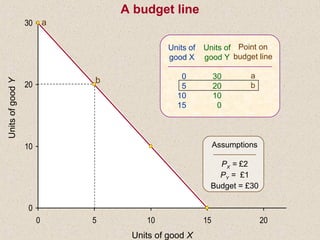
Units of
good X
0
5
10
15
Units of
good Y
30
20
10
0
Assumptions
PX = £2
PY = £1
Budget = £30
A budget line
UnitsofgoodY
Units of good X
a
Units of
good X
0
5
10
15
Units of
good Y
30
20
10
0
Assumptions
PX = £2
PY = £1
Budget = £30
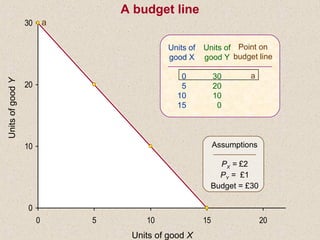
Point on
budget line
a
A budget line
0
10
20
30
0 5 10 15 20
UnitsofgoodY
Units of good X
a
b
Units of
good X
0
5
10
15
Units of
good Y
30
20
10
0
Point on
budget line
a
b
Assumptions
PX = £2
PY = £1
Budget = £30
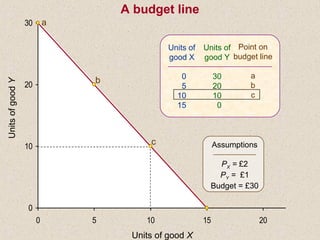
A budget line
0
10
20
30
0 5 10 15 20
UnitsofgoodY
Units of good X
a
b
c
Units of
good X
0
5
10
15
Units of
good Y
30
20
10
0
Point on
budget line
a
b
c
Assumptions
PX = £2
PY = £1
Budget = £30
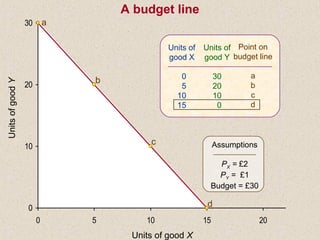
A budget line
0
10
20
30
0 5 10 15 20
UnitsofgoodY
Units of good X
a
b
c
d
Units of
good X
0
5
10
15
Units of
good Y
30
20
10
0
Point on
budget line
a
b
c
d
Assumptions
PX = £2
PY = £1
Budget = £30
A budget line
0
10
20
30
0 5 10 15 20
Indifference curves
constructing an indifference curve
the shape of an indifference curve
diminishing marginal rate of substitution
an indifference map
The budget line
constructing a budget line
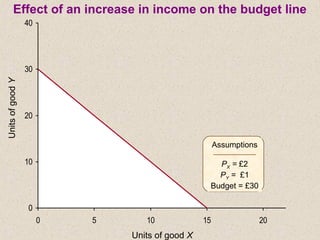
effect of a change in income
INDIFFERENCE ANALYSIS
UnitsofgoodY
Units of good X
Assumptions
PX = £2
PY = £1
Budget = £30
Effect of an increase in income on the budget line
0
10
20
30
40
0 5 10 15 20
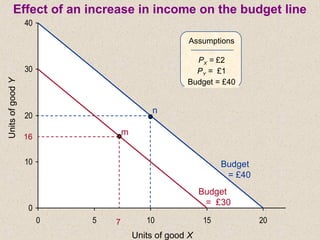
UnitsofgoodY
Units of good X
Assumptions
PX = £2
PY = £1
Budget = £40
Budget
= £40
Budget
= £30
16
7
0
10
20
30
40
0 5 10 15 20
m
n
Effect of an increase in income on the budget line
Indifference curves
constructing an indifference curve
the shape of an indifference curve
diminishing marginal rate of substitution
an indifference map
The budget line
constructing a budget line
effect of a change in income
effect of a change in price
INDIFFERENCE ANALYSIS
0
10
20
30
0 5 10 15 20 25 30
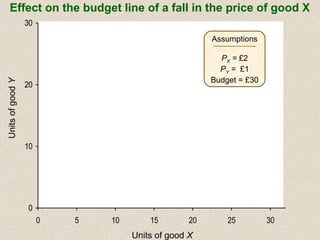
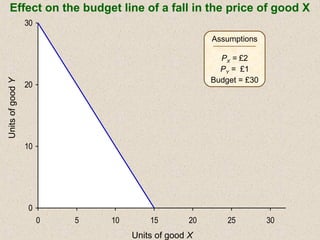
Effect on the budget line of a fall in the price of good XUnitsofgoodY
Units of good X
Assumptions
PX = £2
PY = £1
Budget = £30
0
10
20
30
0 5 10 15 20 25 30
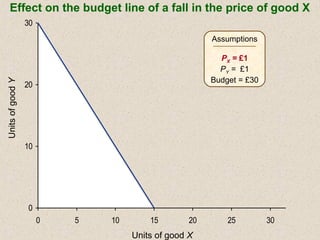
Effect on the budget line of a fall in the price of good XUnitsofgoodY
Units of good X
Assumptions
PX = £2
PY = £1
Budget = £30
0
10
20
30
0 5 10 15 20 25 30
Effect on the budget line of a fall in the price of good XUnitsofgoodY
Units of good X
Assumptions
PX = £1
PY = £1
Budget = £30
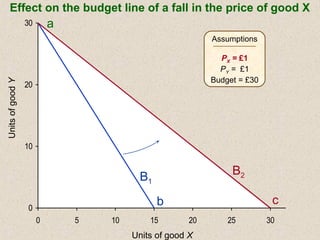
Effect on the budget line of a fall in the price of good XUnitsofgoodY
Units of good X
Assumptions
PX = £1
PY = £1
Budget = £30
B1
B2
a
b0
10
20
30
0 5 10 15 20 25 30
c
The optimum consumption point
INDIFFERENCE ANALYSIS
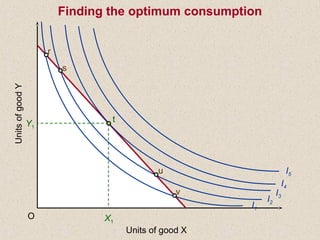
Finding the optimum consumption
UnitsofgoodY
Units of good X
O
I1
I2
I3
I4
I5
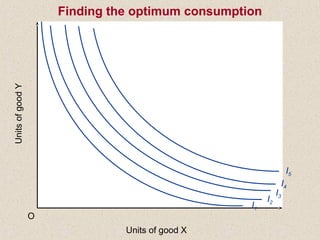
UnitsofgoodY
Units of good X
O
Finding the optimum consumption
I1
I2
I3
I4
I5
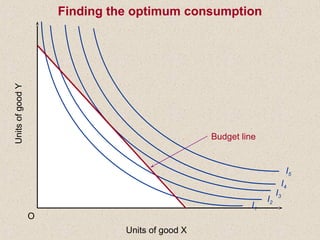
UnitsofgoodY
O
Units of good X
Budget line
Finding the optimum consumption
I1
I2
I3
I4
I5
UnitsofgoodY
O
Units of good X
r
v
s
u
Y1
X1
t
Finding the optimum consumption
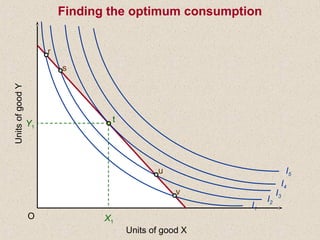
The optimum consumption point
equating the marginal rate of substitution
with the price ratio
MRS = MUA/MUB = PA/PB
INDIFFERENCE ANALYSIS
I1
I2
I3
I4
I5
UnitsofgoodY
O
Units of good X
r
v
s
u
Y1
X1
t
Finding the optimum consumption
The optimum consumption point
equating the marginal rate of substitution
with the price ratio
MRS = MUA/MUB = PA/PB
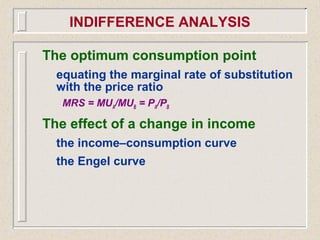
The effect of a change in income
INDIFFERENCE ANALYSIS
The optimum consumption point
equating the marginal rate of substitution
with the price ratio
MRS = MUA/MUB = PA/PB
The effect of a change in income
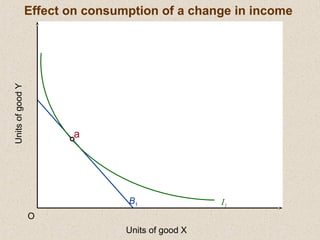
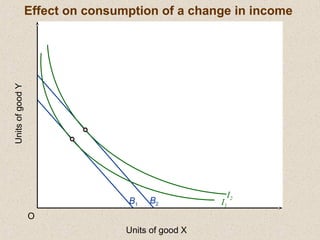
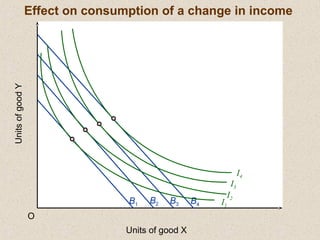
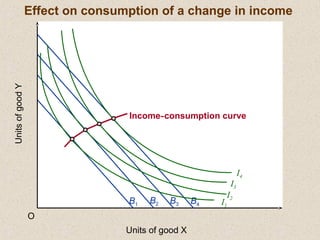
the income–consumption curve
INDIFFERENCE ANALYSIS
UnitsofgoodY
O
Units of good X
B1
Effect on consumption of a change in income
I1
a
I2
UnitsofgoodY
O
Units of good X
B1
B2 I1
Effect on consumption of a change in income
I2
UnitsofgoodY
O
Units of good X
B1
B2 B3 B4 I1
I3
I4
Effect on consumption of a change in income
I2
UnitsofgoodY
O
Units of good X
B1
B2 B3 B4 I1
I3
I4
Income-consumption curve
Effect on consumption of a change in income
The optimum consumption point
equating the marginal rate of substitution
with the price ratio
MRS = MUA/MUB = PA/PB
The effect of a change in income
the income–consumption curve
the Engel curve
INDIFFERENCE ANALYSIS
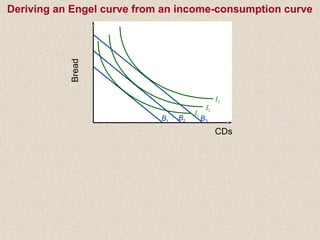
Bread
B1
B2 B3
I3
I2
I1
CDs
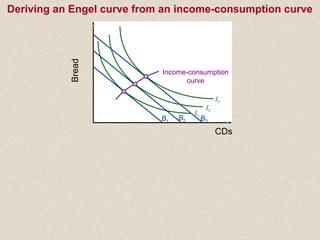
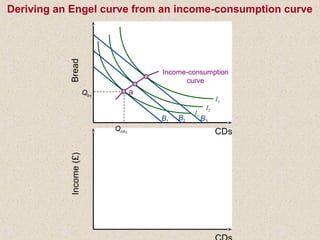
Deriving an Engel curve from an income-consumption curve
B1
B2 B3
I3
I2
I1
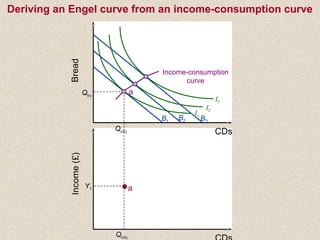
Income-consumption
curve
CDs
Bread
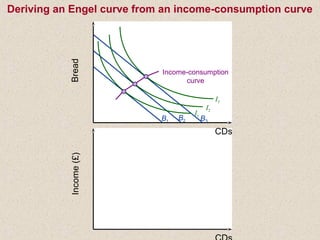
Deriving an Engel curve from an income-consumption curve
B1
B2 B3
I3
I2
I1
Income-consumption
curve
CDs
BreadIncome(£)
Deriving an Engel curve from an income-consumption curve
B1
B2 B3
I3
I2
I1
Income-consumption
curve
BreadIncome(£)
CDs
Qb1
Qcd1
a
Deriving an Engel curve from an income-consumption curve
B1
B2 B3
I3
I2
I1
Income-consumption
curve
BreadIncome(£)
CDs
Qb1
Y1
Qcd1
Qcd1
a
a
Deriving an Engel curve from an income-consumption curve
B1
B2 B3
I3
I2
I1
Income-consumption
curve
BreadIncome(£)
CDs
Qb2
Qb1
Y2
Y1
Qcd2
Qcd1
Qcd2
Qcd1
a
b
a
b
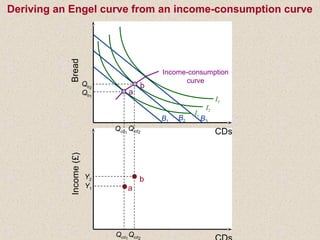
Deriving an Engel curve from an income-consumption curve
B1
B2 B3
I3
I2
I1
Income-consumption
curve
BreadIncome(£)
CDs
Qb3
Qb2
Qb1
Y3
Y2
Y1
Qcd3
Qcd2
Qcd1
Qcd3
Qcd2
Qcd1
a
b
c
a
b
c
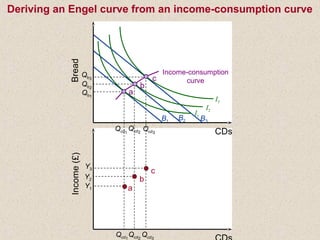
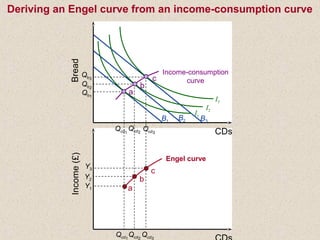
Deriving an Engel curve from an income-consumption curve
B1
B2 B3
I3
I2
I1
Income-consumption
curve
BreadIncome(£)
CDs
Qb3
Qb2
Qb1
Y3
Y2
Y1
Qcd3
Qcd2
Qcd1
Qcd3
Qcd2
Qcd1
Engel curve
a
b
c
a
b
c
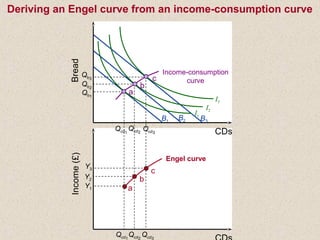
Deriving an Engel curve from an income-consumption curve
The optimum consumption point
equating the marginal rate of substitution
with the price ratio
MRS = MUA/MUB = PA/PB
The effect of a change in income
the income–consumption curve
the Engel curve
income elasticity of demand and the
income–consumption curve
INDIFFERENCE ANALYSIS
B1
B2 B3
I3
I2
I1
Income-consumption
curve
BreadIncome(£)
CDs
Qb3
Qb2
Qb1
Y3
Y2
Y1
Qcd3
Qcd2
Qcd1
Qcd3
Qcd2
Qcd1
Engel curve
a
b
c
a
b
c
Deriving an Engel curve from an income-consumption curve
The optimum consumption point
equating the marginal rate of substitution
with the price ratio
MRS = MUA/MUB = PA/PB
The effect of a change in income
the income–consumption curve
the Engel curve
income elasticity of demand and the
income–consumption curve
the effect of a rise in income on the
demand for an inferior good
INDIFFERENCE ANALYSIS
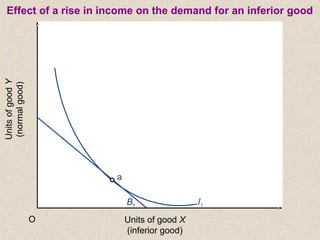
Effect of a rise in income on the demand for an inferior goodUnitsofgoodY
(normalgood)
Units of good X
(inferior good)
O
I1B1
a
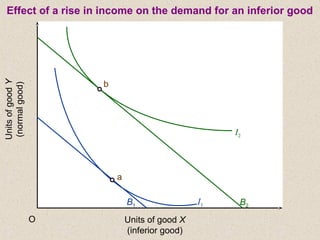
UnitsofgoodY
(normalgood)
O
I2
I1B1 B2
a
b
Units of good X
(inferior good)
Effect of a rise in income on the demand for an inferior good
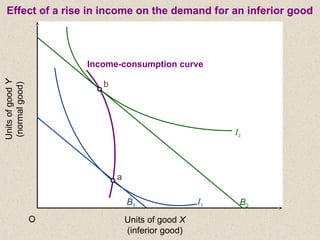
UnitsofgoodY
(normalgood)
O
Income-consumption curve
I2
I1B1 B2
a
b
Units of good X
(inferior good)
Effect of a rise in income on the demand for an inferior good
The effect of changes in price
the price–consumption curve
INDIFFERENCE ANALYSIS
0
10
20
30
0 5 10 15 20 25 30
Assumptions
PX = £2
PY = £1
Budget = £30
Effect of a fall in the price of good XUnitsofgoodY
Units of good X
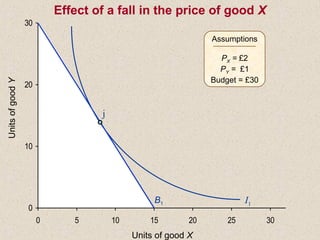
UnitsofgoodY
Units of good X
Assumptions
PX = £2
PY = £1
Budget = £30
B1 I1
0
10
20
30
0 5 10 15 20 25 30
j
Effect of a fall in the price of good X
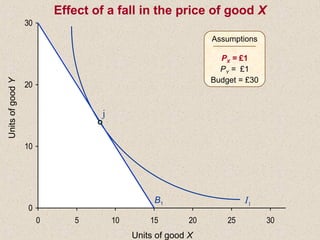
UnitsofgoodY
Units of good X
B1 I1
j
Assumptions
PX = £1
PY = £1
Budget = £30
0
10
20
30
0 5 10 15 20 25 30
Effect of a fall in the price of good X
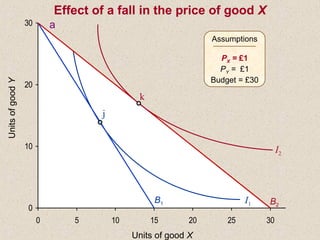
UnitsofgoodY
Units of good X
Assumptions
PX = £1
PY = £1
Budget = £30
B1 I1 B2
a
j
0
10
20
30
0 5 10 15 20 25 30
I2
k
Effect of a fall in the price of good X
0
10
20
30
0 5 10 15 20 25 30
UnitsofgoodY
Units of good X
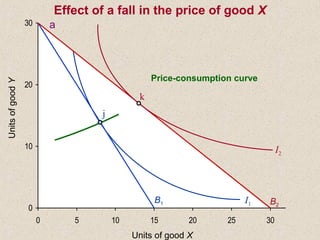
B1 I1 B2
a
j
I2
Price-consumption curve
k
Effect of a fall in the price of good X
The effect of changes in price
the price–consumption curve
deriving the individual's demand curve
INDIFFERENCE ANALYSIS
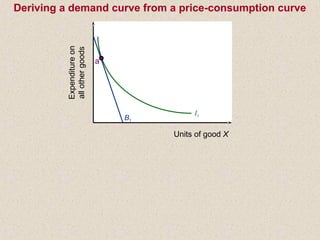
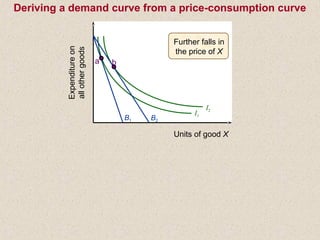
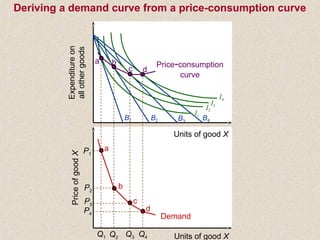
Deriving a demand curve from a price-consumption curve
B1
I1
Expenditureon
allothergoods
Units of good X
a
I2
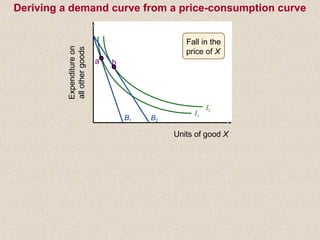
Deriving a demand curve from a price-consumption curve
B1 B2
I1
Expenditureon
allothergoods
Units of good X
a b
Fall in the
price of X
I2
Deriving a demand curve from a price-consumption curve
B1 B2
I1
Expenditureon
allothergoods
Units of good X
a b
Further falls in
the price of X
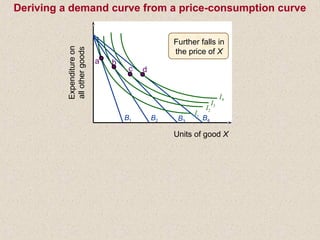
Deriving a demand curve from a price-consumption curve
B1 B2 B3
I3
I2
I1
I4
B4
Expenditureon
allothergoods
Units of good X
a b
c d
Further falls in
the price of X
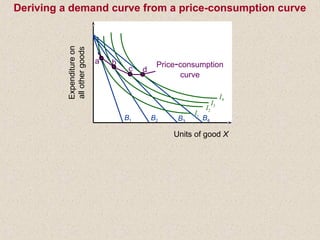
Deriving a demand curve from a price-consumption curve
B1 B2 B3
I3
I2
I1
I4
B4
Expenditureon
allothergoods
Units of good X
Price-consumption
curve
a b
c d
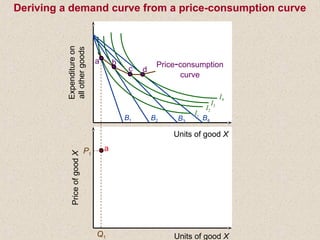
Deriving a demand curve from a price-consumption curve
B1 B2 B3
I3
I2
I1
I4
B4
Expenditureon
allothergoods
Units of good X
a Price-consumption
curve
b
c d
PriceofgoodX
Units of good X
P1
Q1
a
Deriving a demand curve from a price-consumption curve
B1 B2 B3
I3
I2
I1
I4
B4
Expenditureon
allothergoods
Units of good X
a Price-consumption
curve
b
c d
PriceofgoodX
Units of good X
a
Demand
P1
P2
P3
P4
Q1 Q2 Q3 Q4
b
c
d
The effect of changes in price
the price–consumption curve
deriving the individual's demand curve
Income and substitution effects of a
price change
INDIFFERENCE ANALYSIS
The effect of changes in price
the price–consumption curve
deriving the individual's demand curve
Income and substitution effects of a
price change
a normal good
INDIFFERENCE ANALYSIS
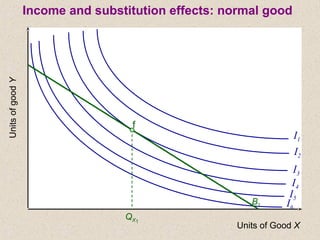
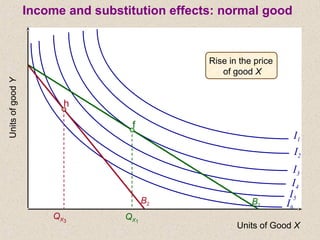
UnitsofgoodY
I1
I2
I3
I4
I5
I6
B1
f
QX1
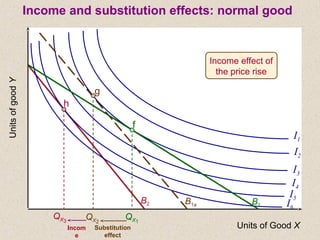
Income and substitution effects: normal good
Units of Good X
UnitsofgoodY
I1
I2
I3
I4
I5
I6
B2
h
B1
QX1
f
Rise in the price
of good X
Income and substitution effects: normal good
Units of Good X
QX3
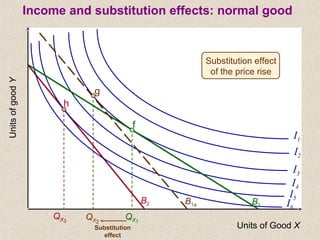
UnitsofgoodY
B2
Substitution
effect
B1
QX1
h
f
I1
I2
I3
I4
I5
I6
QX2
B1a
Substitution effect
of the price rise
g
Income and substitution effects: normal good
Units of Good X
QX3
Units of Good X
UnitsofgoodY
I1
I2
I3
I4
I5
I6
Substitution
effect
Incom
e
QX1
h
f
g
B2 B1
QX2
QX3
B1a
Income effect of
the price rise
Income and substitution effects: normal good
The effect of changes in price
the price–consumption curve
deriving the individual's demand curve
Income and substitution effects of a
price change
a normal good
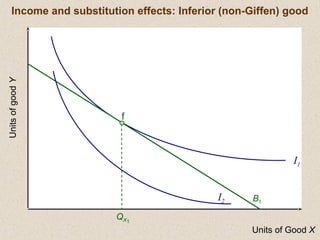
an inferior good
INDIFFERENCE ANALYSIS
Units of Good X
UnitsofgoodY
B1
Income and substitution effects: Inferior (non-Giffen) good
f
QX1
I1
I2
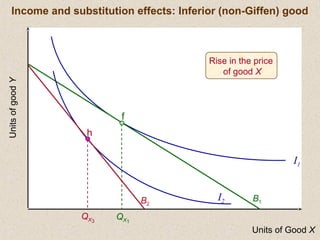
Units of Good X
UnitsofgoodY
f
QX1
B2
QX3
I1
I2
Rise in the price
of good X
h
B1
Income and substitution effects: Inferior (non-Giffen) good
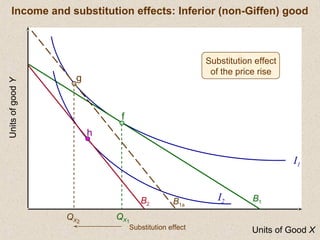
Units of Good X
UnitsofgoodY
f
QX1
B2
h
QX2
I1
I2
Substitution effect
B1a
Substitution effect
of the price rise
B1
Income and substitution effects: Inferior (non-Giffen) good
g
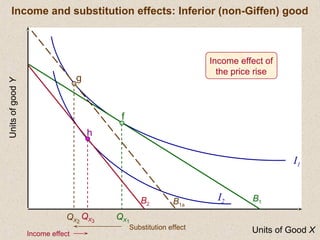
Units of Good X
UnitsofgoodY
f
QX1
B2
g
QX2
QX3
I1
I2
Substitution effect
h
Income effect
B1a
Income effect of
the price rise
B1
Income and substitution effects: Inferior (non-Giffen) good
The effect of changes in price
the price–consumption curve
deriving the individual's demand curve
Income and substitution effects of a
price change
a normal good
an inferior good
a Giffen good (a special type of inferior
good)
INDIFFERENCE ANALYSIS
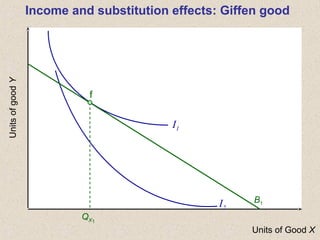
Units of Good X
UnitsofgoodY
B1
Income and substitution effects: Giffen good
f
QX1
I1
I2
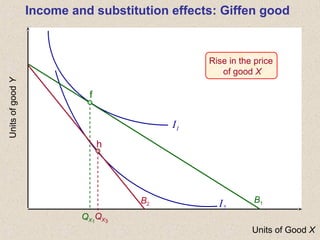
Units of Good X
UnitsofgoodY
f
QX1
B2
QX3
I1
I2
Rise in the price
of good X
h
B1
Income and substitution effects: Giffen good
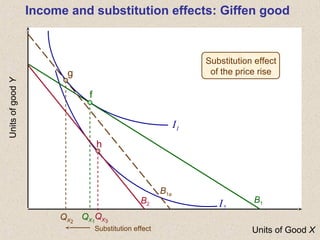
Units of Good X
UnitsofgoodY
f
QX1
B2
h
QX3
I1
I2
QX2
B1a
g
Substitution effect
Substitution effect
of the price rise
B1
Income and substitution effects: Giffen good
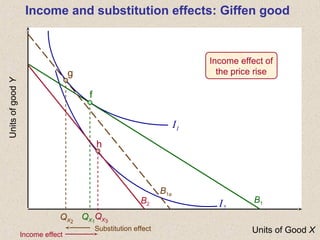
Units of Good X
UnitsofgoodY
f
QX1
B2
h
QX3
I1
I2
g
QX2
Substitution effect
Income effect
Income effect of
the price rise
B1
Income and substitution effects: Giffen good
B1a
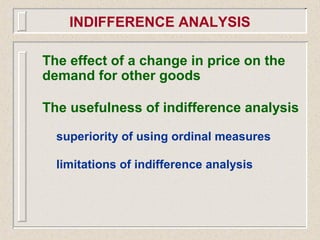
The effect of a change in price on the
demand for other goods
The usefulness of indifference analysis
superiority of using ordinal measures
limitations of indifference analysis
INDIFFERENCE ANALYSIS

03 140911235945-phpapp01

Editor's Notes

  • #2 <number>
  • #4 <number>
  • #5 <number>
  • #6 <number>
  • #7 <number>
  • #8 <number>
  • #9 <number>
  • #10 <number>
  • #11 <number>
  • #12 <number>
  • #13 <number>
  • #14 <number>
  • #15 <number>
  • #16 <number>
  • #17 <number>
  • #18 <number>
  • #19 <number>
  • #21 <number>
  • #22 <number>
  • #23 <number>
  • #24 <number>
  • #25 <number>
  • #26 <number>
  • #28 <number>
  • #29 <number>
  • #30 <number>
  • #31 <number>
  • #32 <number>
  • #33 <number>
  • #34 <number>
  • #35 <number>
  • #36 <number>
  • #37 <number>
  • #38 <number>
  • #39 <number>
  • #40 <number>
  • #41 <number>
  • #42 <number>
  • #43 <number>
  • #44 <number>
  • #45 <number>
  • #46 <number>
  • #47 <number>
  • #48 <number>
  • #49 <number>
  • #50 <number>
  • #51 <number>
  • #52 <number>
  • #53 <number>
  • #54 <number>
  • #55 <number>
  • #56 <number>
  • #57 <number>
  • #58 <number>
  • #59 <number>
  • #60 <number>
  • #61 <number>
  • #62 <number>
  • #63 <number>
  • #64 <number>
  • #65 <number>
  • #66 <number>
  • #67 <number>
  • #68 <number>
  • #69 <number>
  • #70 <number>
  • #71 <number>
  • #72 <number>
  • #73 <number>
  • #74 <number>
  • #75 <number>
  • #76 <number>
  • #77 <number>
  • #78 <number>
  • #79 <number>
  • #80 <number>
  • #81 <number>
  • #82 <number>
  • #83 <number>
  • #84 <number>
  • #85 <number>
  • #86 <number>
  • #87 <number>
  • #88 <number>
  • #89 <number>
  • #90 <number>
  • #91 <number>
  • #92 <number>
  • #93 <number>
  • #94 <number>
  • #95 <number>
  • #96 <number>
  • #97 <number>
  • #98 <number>
  • #99 <number>
  • #100 <number>
  • #101 <number>
  • #102 <number>
  • #103 <number>
  • #104 <number>
  • #105 <number>
  • #106 <number>
  • #107 <number>
  • #108 <number>
  • #109 <number>
  • #110 <number>
  • #111 <number>