Dr.rajesh .k
 Shock is a state of impaired tissue perfusion resulting in an
imbalance between oxygen demand and supply.
 This widespread reduction in effective tissue perfusion
causes insufficient or improper delivery and distribution of
oxygen and nutrients, the end result of which is an altered
cellular and subcellular function leading to anaerobic
metabolism, accumulation of lactic acid and consequently
cellular damage, multiple organ dysfunction and finally
cardiovascular collapse.
 Clinically shock is characterized by signs of
hemodynamic instability, tachycardia,
hypotension and evidence of organ hypoperfusion.
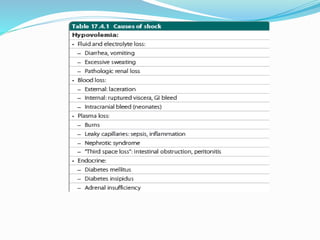
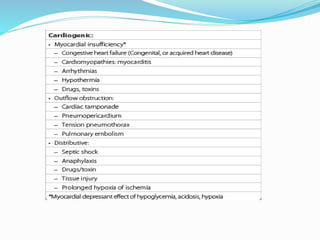
Etiologic Classification of Shock
The patient with shock has abnormalities of either:
• The heart
• The blood volume
• The blood flow distribution.
Accordingly shock can be classified into three groups:
 1. Hypovolemic (decreased circulating blood volume)
 2. Cardiogenic (impaired cardiac function)
 3. Distributive (inappropriate distribution of blood
flow).
 Children with sepsis are more likely to have
cardiac failure than vascular failure as seen in adults.
 When cardiac output is unable to meet the demands
of the tissues, compensatory sympathetic activity
produces selective vasoconstriction of the skin and
splanchnic vessels to divert blood flow to vital organs,
namely brain, heart and kidney.
Three pathophysiological concepts that need understanding
especially in septic shock are as follows:
 Myocardial dysfunction: It develops in nearly all patients
with septic shock. This dysfunction peaks soon after the
onset of sepsis and resolves within 7–10 days in survivors.
Sepsis stimulates the release of inflammatory mediators
that can compromise cardiac function.
 Diminished responsiveness of the myocardium to β1
agonists is secondary to downregulation of β1 receptors,
uncoupling of receptors from adenylate cyclase or
depressed generation of cAMP.
 The myocardium is dysfunctional despite an increase
in cardiac output during the hyperdynamic phase of
sepsis.
 Mean arterial pressure (MAP): It is important to
recognize that oxygen is not distributed uniformly to the
body. Modulation of systemic vascular resistance in
different vascular beds is one of the body’s primary
compensatory mechanisms to shunt blood preferentially to
vital organs such as the heart and brain.
When meanarterial pressure falls below the autoregulatory
range of an organ, blood flow decreases, resulting in tissue
ischemia and organ failure. Because the kidney receives the
second highest blood flow of any organ in the
body,measurement of urine output (with the exception of
patients with hyperosmolar states leading to osmotic
diuresis) and creatinine clearance can be used as an
indicator of adequate perfusion pressure.
 Oxygen delivery versus consumption:
Oxygen delivery is primarily dependent on cardiac
output.Enhancing cardiac output by increasing preload and
contractility or by decreasing afterload will thus increase oxygen
delivery.
 Contrary to adults, oxygen delivery, not oxygen extraction, is the
major determinant of oxygen
consumption in children.
 In patients with septic shock the concept of pathological
oxygen utilization is forwarded to explain dependence of oxygen
consumption on oxygen delivery even at
supernormal oxygen delivery.
 The goal in such patients is therefore to increase oxygen delivery
and consumption until consumption is independent of delivery.
Hypovolemic Shock
 Hypovolemic shock is the leading form of shock in children
worldwide. It is usually caused by hemorrhage or dehydration.
Relative hypovolemia may occur secondary to “third spacing” of
fluids (extravascular fluid shifts) as it may be observed in
children with burns or with sepsis. Depending on the severity
and rate of development of hypovolemia, the shock may appear
abruptly or evolve gradually over several stages.
 Regardless of etiology the final common pathway to circulatory
insufficiency is diminished intravascular volume.
 Children with hypovolemia due to fluid and electrolyte losses
have both intravascular and interstitial depletion. Clinical
findings include sunken eyes, depressed anterior fontanel, dry
mucous membrane,
poor skin turgor, delayed capillary refill, and cool extremities.
 The classical signs of dehydration based on interstitial
fluid depletion are absent. Once again,
hypotension is a late finding and may not occur until
intravascular volume has decreased by about 25%. This
is the time when the compensatory mechanisms fail,
and profound
reduction of cardiac output and fall of blood pressure
occur.
Cardiogenic Shock
 Cardiogenic shock is commonly described as “pump
failure”. The common causes are myocarditis, dysrhythmias,
and drugs with a myocardial depressant action, acidosis,
congenital heart lesions and sepsis. It can also result from
obstruction to the outflow tract, e.g. coarctation of aorta
or aortic stenosis or in states of increased afterload like
hypertension. Cardiogenic shock will have low cardiac
output, hypotension and clinical signs of inadequate tissue
perfusion. Typically intravascular volume is adequate or even
increased, but cardiac dysfunction limits cardiac output.
Distributive shock
 The most common cause of distributive shock is sepsis.
 The common denominator in this shock is leakage of intravascular fluid
through capillary bed into interstitial space known as “third spacing” of fluids
because of
 endothelial damage.
 The majority of cases of septic shock are caused by Gram-negative bacilli
but it may be caused by Gram-positive, rickettsial, fungal and viral infections.
 Early septic shock is known as “warmshock” or hyperdynamic phase as it is
characterized by warm extremities, low SVR, high or normal cardiac output
normal BP and increased pulse pressure.
 Low systemic vascular resistance increases skin blood flow and causes
bounding peripheral pulses.
 Therefore despite high cardiac output, shock and metabolic acidosis develop
because blood flow is inappropriately distributed.
 Adequate and early treatment at this stage may
prevent progression.
 The latter phase of “cold shock” or hypodynamic phase
is characterized by cold extremities,high systemic
vascular resistance, low cardiac output,narrow pulse
pressure and hypotension leading to hypoxia,acidosis
and death.
Clinical Features and Stages of
Shock
 Shock refers to dynamic state ranging from
early,compensated shock to irreversible, terminal
shock.
 Shock can progress over a span of few hours or occur
over minutes, e.g. in hemorrhagic shock. The
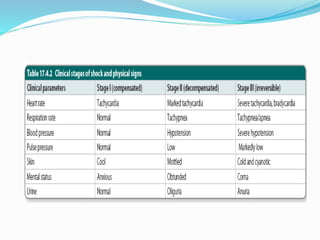
progression can be arbitrarily divided into three stages:
• Early compensated shock
• Decompensated shock
• Irreversible shock.
Early shock
 Early shock refers to preserved vital organ functions secondary to
effective compensatory mechanisms.
 Blood pressure is maintained although signs of inadequate tissue and
organ perfusion are observed. The early physical signs are that of an
exaggerated sympathetic response to stress.
 Tachycardia and signs of decreased peripheral perfusion namely cold-
clammy skin, capillary refill time more than 2 seconds and difference
between core and surface
temperature of ≥ 2°C are the most important clinical pointers to early
shock. Tachypnea may be seen without evidence of an underlying
pulmonary disease. Blood pressure is maintained within normal range
during the early stages.
 Septic shock in the early stages presents with fever,warm well-perfused
extremities, bounding pulses and wide pulse pressure.
 A capillary refill time of 3 seconds or more denotes impaired skin
perfusion. It is a valuable sign during assessment and monitoring
Decompensated Shock
 In this stage, the blood pressure and cardiac output fall as
they cannot be sustained by the intense peripheral
vasoconstriction.
 A cascade of anaerobic tissue metabolism and multiorgan
dysfunction sets in.
 Patient presents with poor pulses, peripheral cyanosis, cold
extremities,hypotension and acidosis.
 Vital organ perfusion gets progressively compromised.
Oliguria or anuria results from diminished renal perfusion.
Diminished cerebral perfusion manifests in the form of
lethargy, confusion and disorientation.
 Rapid aggressive intervention is required to halt the
progression to irreversible stage.
Irreversible Stage
 Irreversible stage of shock is a progressive reduction in
cardiac output, fall in blood pressure and worsening
metabolic acidosis, and multiorgan failure.
 Delayed recognition or inadequate treatment can lead
to terminal shock
Presence of hypotension is not a must for diagnosis of shock in children.
children maintain adequate cardiac output by mounting tachycardic response
 Children maximize systemic vascular resistance to maintain a normal
blood pressure, in the face of significant decrease in the CO.
 This increase due to peripheral vasoconstriction mediated by the
sympathetic nervous system results in diversion or redistribution of
blood flow from less vital organs such as skin, skeletal muscles,
kidneys, and splanchnic organs, to more vital organs like the
brain,heart, lungs, and adrenal glands.
 Therefore, blood pressure will remain maintained till very late stages of
shock and hence is a poor indicator of cardiovascular homeostasis in
children.
The evaluation of other hemodynamic variables like heart rate and
end-organ perfusion, including capillary refill, the quality of the
peripheral pulses, mentation, urine output, and acid-base status, is
more reliable than blood pressure in determining the adequacy of
hemodynamic
status in a child.
Complications of Shock
 Myocardial depression, ARDS, acute renal failure, and
disseminated intravascular coagulation (DIC) are the
most dreaded and life-threatening complications of
shock.
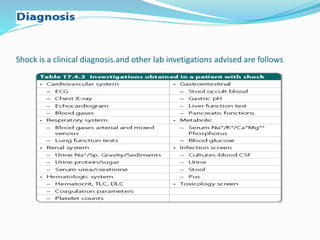
Shock is a clinical diagnosis.and other lab invetigations advised are follows
Management of Shock
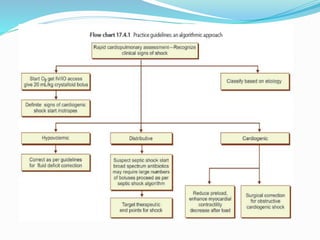
 Two major priorities in treatment of septic shock are
1.rapid assessment of patient’s disease process
2.achievement of cardiopulmonary stability.
 Irrespective of the etiology the initial resuscitation and
stabilization of all forms of shock should be guided by
the ABC’s.
 Stabilization of airway, provision of oxygen and
establishment of vascular access are immediate goals
followed by fluid resuscitation
 An immediate intravenous (IV) access has to be
established.
 In children where IV access is difficult due to collapsed
veins an intraosseous (IO) line must be established instead.
 Obtaining rapid vascular access with at least two wide bore
peripheral venous lines is extremely crucial. Vascular
access may be extremely difficult in children with shock
as they have collapsed veins.
Since time is extremely crucial, Pediatric Advanced Life
Support (PALS) guidelines recommend placement of an
intraosseous needle in infants and children for pushing
fluids.
 Central venous access should be considered for
children in fluid refractory shock as this access helps
in infusion of vasoactive drugs and monitoring of
central venous pressure.
Fluid therapy
 Optimization of circulating volume with help of fluids is
most important cornerstone of therapy in shock.
 Volume replacement should begin as 20 mL/kg IV while
one is trying to assess the etiology.
 Patients in hypovolemic and septic shock may require up to
60 mL/kg in first 1–1.5hours.
 Patients with septic shock may require up to 150–200mL/kg
within the first hour itself. Volume resuscitation beyond
the first hour should be titrated to signs of improved
perfusion, age, appropriate mean arterial pressure (MAP),
a mixed venous oxygen saturation of >70% and cardiac
index > 3.3 L/minute/m2 (ACCM practice guidelines,
2008).
Cardiovascular Support
 Vasoactive drug therapy in the treatment of shock states
aims to increase oxygen delivery or organ perfusion or
both.
 The vasoactive agents used to support circulatory function
may be classified as inotropes, vasopressors,vasodilators,
and inodilators.
 Increasing mean arterial pressure(MAP) to a level that
allows appropriate distribution of cardiac output for
adequate organ perfusion and hence oxygen delivery is one
of the key functions of vasopressors.
 Optimal preload is essential for all patients in shock before
vasoactive therapy is contemplated.
How to Choose the Appropriate
Drug?
 Vasodilators are the only class of agents that can increase
cardiac output and simultaneously reduce myocardial
oxygen demand, e.g. nitroglycerin,nitroprusside.
Inodilators (inotropes + vasodilator) improve cardiac
contractility and reduce afterload, e.g. phosphodiesterase
inhibitors like milrinone and amrinone.
 Children with severe sepsis can present with low cardiac
output and high systemic vascular resistance (SVR) (cold
shock) or low cardiac output and low SVR (warm shock).
 Accordingly in the cold shock, inotropic support should be
started in case of fluid refractory shock while a
combination of inotrope together with a vasopressor is
warranted in warm shock
 Children with catecholamine resistant cold shock
requiring inotropy can be treated with
phosphodiesterase inhibitors like milrinone.
 Children with primary cardiogenic shock can be
treated with inotropes at the first go.
 When an appropriate fluid challenge fails to restore
adequate blood pressure and organ perfusion in
patients with high cardiac output and low systemic
vascular resistance (warm shock), vasopressor agents
should be started.
 Since children with septic shock more often have
associated myocardial dysfunction as opposed to
adults, it is preferable to combine inotropy with a
vasopressor.
 Prostaglandin E1, a potent vasodilator is indicated in
newborns with ductus-dependent lesion presenting in
cardiogenic shock due to ductus closure.
Correction of Metabolic
Derangements
 Metabolic acidosis: Metabolic acidosis, poor tissue
perfusion and resultant anaerobic metabolism leads
to significant metabolic acidosis.
 Acute renal failure: Adequate fluid replacement is
necessary to prevent development of renal failure. Dialysis
will be indicated in case of hyperkalemia, refractory
acidosis and fluid overload. The current trend is towards
early renal replacement therapy especially in septic shock
as this helps in removal of noxious triggers too.
 Hematologic support, Gastrointestinal support,calcium
Nutritional support, Respiratory support should be given.
 Antibiotic therapy: Appropriate empiric antibiotics
should be started in suspected septic shock. It should
provide broad-spectrum coverage depending upon site of
infection and local epidemiologic data regarding sensitivity
pattern. An aminoglycoside (gentamicin or amikacin) and
a third-generation cephalosporin (cefotaxime, ceftriaxone)
should be used for suspected Gram-negative sepsis.
 Combination of cloxacillin and an aminoglycoside should
be used if staphylococcal sepsis is suspected.
Newer and Adjunctive Therapies
Corticosteroids: The 2008 Surviving Sepsis Campaign guidelines recommend
use of stress dose of steroids (hydrocortisone 50 mg/m2 per 24 hours) in
children once they are diagnosed to have catecholamine-resistant septic shock
and in suspected or proven adrenal insufficiency.
Newer inodilators: Levosimendan and enoximone are two new inodilators
being investigated for use in cardiogenic shock. They possess inotropy as well
as coronary and systemic vasodilatory properties. They increase myocyte
sensitivity to calcium and mediate vasodilatation through
activation of adenosine triphosphate (ATP)-dependent potassium channels in
vascular smooth muscles.
Vasopressin: Vasopressors are used in the settingof warm shock having low SVR.
Vasopressin is used as a second-line vasoconstrictor in patients with
catecholamine-resistant warm shock. However its experience in children is
limited.
 ref:
 IAP textbook of pediatrics
 Nelson textbook of pediatrics
 thank you

Shock in children

  • 1.
  • 2.
     Shock isa state of impaired tissue perfusion resulting in an imbalance between oxygen demand and supply.  This widespread reduction in effective tissue perfusion causes insufficient or improper delivery and distribution of oxygen and nutrients, the end result of which is an altered cellular and subcellular function leading to anaerobic metabolism, accumulation of lactic acid and consequently cellular damage, multiple organ dysfunction and finally cardiovascular collapse.
  • 3.
     Clinically shockis characterized by signs of hemodynamic instability, tachycardia, hypotension and evidence of organ hypoperfusion.
  • 4.
    Etiologic Classification ofShock The patient with shock has abnormalities of either: • The heart • The blood volume • The blood flow distribution. Accordingly shock can be classified into three groups:  1. Hypovolemic (decreased circulating blood volume)  2. Cardiogenic (impaired cardiac function)  3. Distributive (inappropriate distribution of blood flow).
  • 7.
     Children withsepsis are more likely to have cardiac failure than vascular failure as seen in adults.  When cardiac output is unable to meet the demands of the tissues, compensatory sympathetic activity produces selective vasoconstriction of the skin and splanchnic vessels to divert blood flow to vital organs, namely brain, heart and kidney.
  • 8.
    Three pathophysiological conceptsthat need understanding especially in septic shock are as follows:  Myocardial dysfunction: It develops in nearly all patients with septic shock. This dysfunction peaks soon after the onset of sepsis and resolves within 7–10 days in survivors. Sepsis stimulates the release of inflammatory mediators that can compromise cardiac function.  Diminished responsiveness of the myocardium to β1 agonists is secondary to downregulation of β1 receptors, uncoupling of receptors from adenylate cyclase or depressed generation of cAMP.  The myocardium is dysfunctional despite an increase in cardiac output during the hyperdynamic phase of sepsis.
  • 9.
     Mean arterialpressure (MAP): It is important to recognize that oxygen is not distributed uniformly to the body. Modulation of systemic vascular resistance in different vascular beds is one of the body’s primary compensatory mechanisms to shunt blood preferentially to vital organs such as the heart and brain. When meanarterial pressure falls below the autoregulatory range of an organ, blood flow decreases, resulting in tissue ischemia and organ failure. Because the kidney receives the second highest blood flow of any organ in the body,measurement of urine output (with the exception of patients with hyperosmolar states leading to osmotic diuresis) and creatinine clearance can be used as an indicator of adequate perfusion pressure.
  • 10.
     Oxygen deliveryversus consumption: Oxygen delivery is primarily dependent on cardiac output.Enhancing cardiac output by increasing preload and contractility or by decreasing afterload will thus increase oxygen delivery.  Contrary to adults, oxygen delivery, not oxygen extraction, is the major determinant of oxygen consumption in children.  In patients with septic shock the concept of pathological oxygen utilization is forwarded to explain dependence of oxygen consumption on oxygen delivery even at supernormal oxygen delivery.  The goal in such patients is therefore to increase oxygen delivery and consumption until consumption is independent of delivery.
  • 11.
    Hypovolemic Shock  Hypovolemicshock is the leading form of shock in children worldwide. It is usually caused by hemorrhage or dehydration. Relative hypovolemia may occur secondary to “third spacing” of fluids (extravascular fluid shifts) as it may be observed in children with burns or with sepsis. Depending on the severity and rate of development of hypovolemia, the shock may appear abruptly or evolve gradually over several stages.  Regardless of etiology the final common pathway to circulatory insufficiency is diminished intravascular volume.  Children with hypovolemia due to fluid and electrolyte losses have both intravascular and interstitial depletion. Clinical findings include sunken eyes, depressed anterior fontanel, dry mucous membrane, poor skin turgor, delayed capillary refill, and cool extremities.
  • 12.
     The classicalsigns of dehydration based on interstitial fluid depletion are absent. Once again, hypotension is a late finding and may not occur until intravascular volume has decreased by about 25%. This is the time when the compensatory mechanisms fail, and profound reduction of cardiac output and fall of blood pressure occur.
  • 13.
    Cardiogenic Shock  Cardiogenicshock is commonly described as “pump failure”. The common causes are myocarditis, dysrhythmias, and drugs with a myocardial depressant action, acidosis, congenital heart lesions and sepsis. It can also result from obstruction to the outflow tract, e.g. coarctation of aorta or aortic stenosis or in states of increased afterload like hypertension. Cardiogenic shock will have low cardiac output, hypotension and clinical signs of inadequate tissue perfusion. Typically intravascular volume is adequate or even increased, but cardiac dysfunction limits cardiac output.
  • 14.
    Distributive shock  Themost common cause of distributive shock is sepsis.  The common denominator in this shock is leakage of intravascular fluid through capillary bed into interstitial space known as “third spacing” of fluids because of  endothelial damage.  The majority of cases of septic shock are caused by Gram-negative bacilli but it may be caused by Gram-positive, rickettsial, fungal and viral infections.  Early septic shock is known as “warmshock” or hyperdynamic phase as it is characterized by warm extremities, low SVR, high or normal cardiac output normal BP and increased pulse pressure.  Low systemic vascular resistance increases skin blood flow and causes bounding peripheral pulses.  Therefore despite high cardiac output, shock and metabolic acidosis develop because blood flow is inappropriately distributed.
  • 15.
     Adequate andearly treatment at this stage may prevent progression.  The latter phase of “cold shock” or hypodynamic phase is characterized by cold extremities,high systemic vascular resistance, low cardiac output,narrow pulse pressure and hypotension leading to hypoxia,acidosis and death.
  • 16.
    Clinical Features andStages of Shock  Shock refers to dynamic state ranging from early,compensated shock to irreversible, terminal shock.  Shock can progress over a span of few hours or occur over minutes, e.g. in hemorrhagic shock. The progression can be arbitrarily divided into three stages: • Early compensated shock • Decompensated shock • Irreversible shock.
  • 17.
    Early shock  Earlyshock refers to preserved vital organ functions secondary to effective compensatory mechanisms.  Blood pressure is maintained although signs of inadequate tissue and organ perfusion are observed. The early physical signs are that of an exaggerated sympathetic response to stress.  Tachycardia and signs of decreased peripheral perfusion namely cold- clammy skin, capillary refill time more than 2 seconds and difference between core and surface temperature of ≥ 2°C are the most important clinical pointers to early shock. Tachypnea may be seen without evidence of an underlying pulmonary disease. Blood pressure is maintained within normal range during the early stages.  Septic shock in the early stages presents with fever,warm well-perfused extremities, bounding pulses and wide pulse pressure.  A capillary refill time of 3 seconds or more denotes impaired skin perfusion. It is a valuable sign during assessment and monitoring
  • 18.
    Decompensated Shock  Inthis stage, the blood pressure and cardiac output fall as they cannot be sustained by the intense peripheral vasoconstriction.  A cascade of anaerobic tissue metabolism and multiorgan dysfunction sets in.  Patient presents with poor pulses, peripheral cyanosis, cold extremities,hypotension and acidosis.  Vital organ perfusion gets progressively compromised. Oliguria or anuria results from diminished renal perfusion. Diminished cerebral perfusion manifests in the form of lethargy, confusion and disorientation.  Rapid aggressive intervention is required to halt the progression to irreversible stage.
  • 19.
    Irreversible Stage  Irreversiblestage of shock is a progressive reduction in cardiac output, fall in blood pressure and worsening metabolic acidosis, and multiorgan failure.  Delayed recognition or inadequate treatment can lead to terminal shock
  • 21.
    Presence of hypotensionis not a must for diagnosis of shock in children. children maintain adequate cardiac output by mounting tachycardic response  Children maximize systemic vascular resistance to maintain a normal blood pressure, in the face of significant decrease in the CO.  This increase due to peripheral vasoconstriction mediated by the sympathetic nervous system results in diversion or redistribution of blood flow from less vital organs such as skin, skeletal muscles, kidneys, and splanchnic organs, to more vital organs like the brain,heart, lungs, and adrenal glands.  Therefore, blood pressure will remain maintained till very late stages of shock and hence is a poor indicator of cardiovascular homeostasis in children. The evaluation of other hemodynamic variables like heart rate and end-organ perfusion, including capillary refill, the quality of the peripheral pulses, mentation, urine output, and acid-base status, is more reliable than blood pressure in determining the adequacy of hemodynamic status in a child.
  • 22.
    Complications of Shock Myocardial depression, ARDS, acute renal failure, and disseminated intravascular coagulation (DIC) are the most dreaded and life-threatening complications of shock.
  • 23.
    Shock is aclinical diagnosis.and other lab invetigations advised are follows
  • 24.
    Management of Shock Two major priorities in treatment of septic shock are 1.rapid assessment of patient’s disease process 2.achievement of cardiopulmonary stability.  Irrespective of the etiology the initial resuscitation and stabilization of all forms of shock should be guided by the ABC’s.  Stabilization of airway, provision of oxygen and establishment of vascular access are immediate goals followed by fluid resuscitation
  • 25.
     An immediateintravenous (IV) access has to be established.  In children where IV access is difficult due to collapsed veins an intraosseous (IO) line must be established instead.  Obtaining rapid vascular access with at least two wide bore peripheral venous lines is extremely crucial. Vascular access may be extremely difficult in children with shock as they have collapsed veins. Since time is extremely crucial, Pediatric Advanced Life Support (PALS) guidelines recommend placement of an intraosseous needle in infants and children for pushing fluids.
  • 26.
     Central venousaccess should be considered for children in fluid refractory shock as this access helps in infusion of vasoactive drugs and monitoring of central venous pressure.
  • 27.
    Fluid therapy  Optimizationof circulating volume with help of fluids is most important cornerstone of therapy in shock.  Volume replacement should begin as 20 mL/kg IV while one is trying to assess the etiology.  Patients in hypovolemic and septic shock may require up to 60 mL/kg in first 1–1.5hours.  Patients with septic shock may require up to 150–200mL/kg within the first hour itself. Volume resuscitation beyond the first hour should be titrated to signs of improved perfusion, age, appropriate mean arterial pressure (MAP), a mixed venous oxygen saturation of >70% and cardiac index > 3.3 L/minute/m2 (ACCM practice guidelines, 2008).
  • 28.
    Cardiovascular Support  Vasoactivedrug therapy in the treatment of shock states aims to increase oxygen delivery or organ perfusion or both.  The vasoactive agents used to support circulatory function may be classified as inotropes, vasopressors,vasodilators, and inodilators.  Increasing mean arterial pressure(MAP) to a level that allows appropriate distribution of cardiac output for adequate organ perfusion and hence oxygen delivery is one of the key functions of vasopressors.  Optimal preload is essential for all patients in shock before vasoactive therapy is contemplated.
  • 29.
    How to Choosethe Appropriate Drug?  Vasodilators are the only class of agents that can increase cardiac output and simultaneously reduce myocardial oxygen demand, e.g. nitroglycerin,nitroprusside. Inodilators (inotropes + vasodilator) improve cardiac contractility and reduce afterload, e.g. phosphodiesterase inhibitors like milrinone and amrinone.  Children with severe sepsis can present with low cardiac output and high systemic vascular resistance (SVR) (cold shock) or low cardiac output and low SVR (warm shock).  Accordingly in the cold shock, inotropic support should be started in case of fluid refractory shock while a combination of inotrope together with a vasopressor is warranted in warm shock
  • 30.
     Children withcatecholamine resistant cold shock requiring inotropy can be treated with phosphodiesterase inhibitors like milrinone.  Children with primary cardiogenic shock can be treated with inotropes at the first go.  When an appropriate fluid challenge fails to restore adequate blood pressure and organ perfusion in patients with high cardiac output and low systemic vascular resistance (warm shock), vasopressor agents should be started.
  • 31.
     Since childrenwith septic shock more often have associated myocardial dysfunction as opposed to adults, it is preferable to combine inotropy with a vasopressor.  Prostaglandin E1, a potent vasodilator is indicated in newborns with ductus-dependent lesion presenting in cardiogenic shock due to ductus closure.
  • 32.
    Correction of Metabolic Derangements Metabolic acidosis: Metabolic acidosis, poor tissue perfusion and resultant anaerobic metabolism leads to significant metabolic acidosis.  Acute renal failure: Adequate fluid replacement is necessary to prevent development of renal failure. Dialysis will be indicated in case of hyperkalemia, refractory acidosis and fluid overload. The current trend is towards early renal replacement therapy especially in septic shock as this helps in removal of noxious triggers too.
  • 33.
     Hematologic support,Gastrointestinal support,calcium Nutritional support, Respiratory support should be given.  Antibiotic therapy: Appropriate empiric antibiotics should be started in suspected septic shock. It should provide broad-spectrum coverage depending upon site of infection and local epidemiologic data regarding sensitivity pattern. An aminoglycoside (gentamicin or amikacin) and a third-generation cephalosporin (cefotaxime, ceftriaxone) should be used for suspected Gram-negative sepsis.  Combination of cloxacillin and an aminoglycoside should be used if staphylococcal sepsis is suspected.
  • 34.
    Newer and AdjunctiveTherapies Corticosteroids: The 2008 Surviving Sepsis Campaign guidelines recommend use of stress dose of steroids (hydrocortisone 50 mg/m2 per 24 hours) in children once they are diagnosed to have catecholamine-resistant septic shock and in suspected or proven adrenal insufficiency. Newer inodilators: Levosimendan and enoximone are two new inodilators being investigated for use in cardiogenic shock. They possess inotropy as well as coronary and systemic vasodilatory properties. They increase myocyte sensitivity to calcium and mediate vasodilatation through activation of adenosine triphosphate (ATP)-dependent potassium channels in vascular smooth muscles. Vasopressin: Vasopressors are used in the settingof warm shock having low SVR. Vasopressin is used as a second-line vasoconstrictor in patients with catecholamine-resistant warm shock. However its experience in children is limited.
  • 36.
     ref:  IAPtextbook of pediatrics  Nelson textbook of pediatrics  thank you