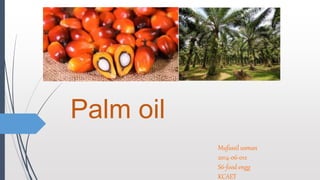
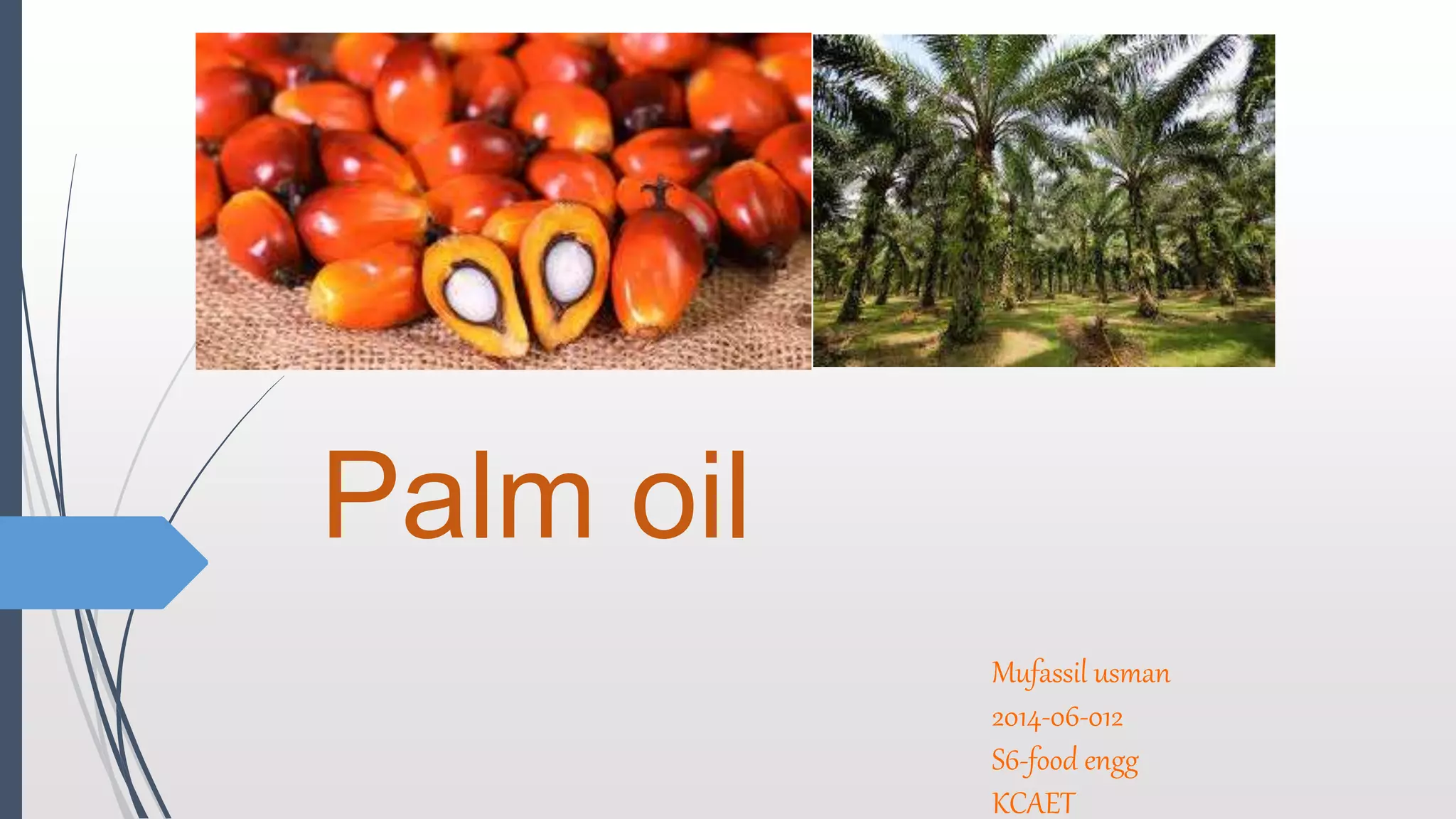
Palm oil
Mufassil usman
2014-06-012
S6-food engg
KCAET
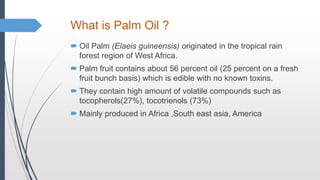
What is Palm Oil ?
 Oil Palm (Elaeis guineensis) originated in the tropical rain
forest region of West Africa.
 Palm fruit contains about 56 percent oil (25 percent on a fresh
fruit bunch basis) which is edible with no known toxins.
 They contain high amount of volatile compounds such as
tocopherols(27%), tocotrienols (73%)
 Mainly produced in Africa ,South east asia, America
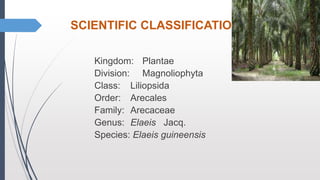
SCIENTIFIC CLASSIFICATION
Kingdom: Plantae
Division: Magnoliophyta
Class: Liliopsida
Order: Arecales
Family: Arecaceae
Genus: Elaeis Jacq.
Species: Elaeis guineensis
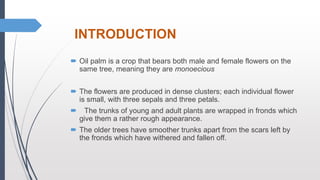
 Oil palm is a crop that bears both male and female flowers on the
same tree, meaning they are monoecious
 The flowers are produced in dense clusters; each individual flower
is small, with three sepals and three petals.
 The trunks of young and adult plants are wrapped in fronds which
give them a rather rough appearance.
 The older trees have smoother trunks apart from the scars left by
the fronds which have withered and fallen off.
INTRODUCTION
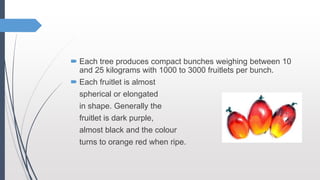
 Each tree produces compact bunches weighing between 10
and 25 kilograms with 1000 to 3000 fruitlets per bunch.
 Each fruitlet is almost
spherical or elongated
in shape. Generally the
fruitlet is dark purple,
almost black and the colour
turns to orange red when ripe.
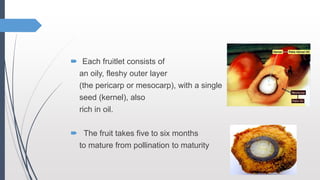
 Each fruitlet consists of
an oily, fleshy outer layer
(the pericarp or mesocarp), with a single
seed (kernel), also
rich in oil.
 The fruit takes five to six months
to mature from pollination to maturity
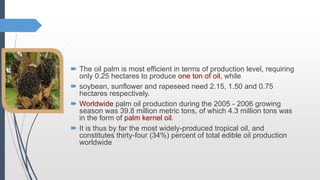
 The oil palm is most efficient in terms of production level, requiring
only 0.25 hectares to produce one ton of oil, while
 soybean, sunflower and rapeseed need 2.15, 1.50 and 0.75
hectares respectively.
 Worldwide palm oil production during the 2005 - 2006 growing
season was 39.8 million metric tons, of which 4.3 million tons was
in the form of palm kernel oil.
 It is thus by far the most widely-produced tropical oil, and
constitutes thirty-four (34%) percent of total edible oil production
worldwide
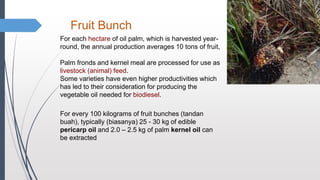
Fruit Bunch
For each hectare of oil palm, which is harvested year-
round, the annual production averages 10 tons of fruit,
Palm fronds and kernel meal are processed for use as
livestock (animal) feed.
Some varieties have even higher productivities which
has led to their consideration for producing the
vegetable oil needed for biodiesel.
For every 100 kilograms of fruit bunches (tandan
buah), typically (biasanya) 25 - 30 kg of edible
pericarp oil and 2.0 – 2.5 kg of palm kernel oil can
be extracted
Why Palm Oil ?
 World Needs of Edible Oils.
 Economic processing on production.
 Each palm oil tree continues producing fruit economically
for up to 25 years
 Other contestant contain too small quantities of edible
oils or contain toxin.
 Palm oil is a rich source of the anti-oxidant vitamin E
containing about 360 – 600 ppm in its refined form
 Palm oil has high concentration of saturated fatty acid
palmitic acid(43.5%),oleic acid(36.6%)
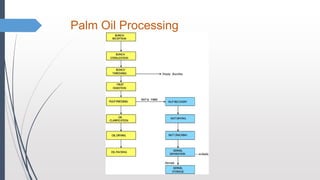
Palm Oil Processing
PALM OIL PRODUCTION
 PROCESS
1. BUNCH RECEPTION
2. STERILIZATION
3. THRESHING
4. DIGESTION
5. OIL EXTRACTION
6. CLARIFICATION
7. REFINING
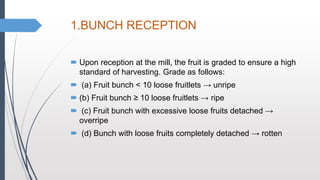
1.BUNCH RECEPTION
 Upon reception at the mill, the fruit is graded to ensure a high
standard of harvesting. Grade as follows:
 (a) Fruit bunch < 10 loose fruitlets → unripe
 (b) Fruit bunch ≥ 10 loose fruitlets → ripe
 (c) Fruit bunch with excessive loose fruits detached →
overripe
 (d) Bunch with loose fruits completely detached → rotten
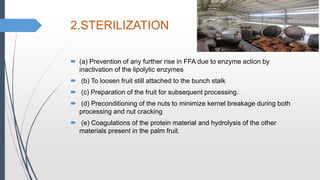
2.STERILIZATION
 (a) Prevention of any further rise in FFA due to enzyme action by
inactivation of the lipolytic enzymes
 (b) To loosen fruit still attached to the bunch stalk
 (c) Preparation of the fruit for subsequent processing.
 (d) Preconditioning of the nuts to minimize kernel breakage during both
processing and nut cracking
 (e) Coagulations of the protein material and hydrolysis of the other
materials present in the palm fruit.
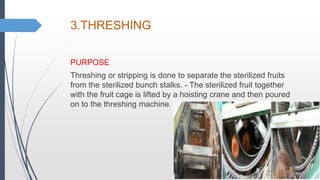
3.THRESHING
PURPOSE
Threshing or stripping is done to separate the sterilized fruits
from the sterilized bunch stalks. - The sterilized fruit together
with the fruit cage is lifted by a hoisting crane and then poured
on to the threshing machine.
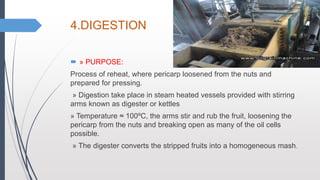
4.DIGESTION
 » PURPOSE:
Process of reheat, where pericarp loosened from the nuts and
prepared for pressing.
» Digestion take place in steam heated vessels provided with stirring
arms known as digester or kettles
» Temperature ≈ 100ºC, the arms stir and rub the fruit, loosening the
pericarp from the nuts and breaking open as many of the oil cells
possible.
» The digester converts the stripped fruits into a homogeneous mash.
5.OIL EXTRACTION
 Palm oil is extracted by pressing in the screws press - consist of
perforated cage in which runs a single or double screw
 Press screw: tough and wear resistant steel; press cage: stainless steel
 The outlet end of perforated cage is restricted by a cone and it is this
restriction of the discharge that creates a pressure in the cage.
 Discharge from screw press: crude palm oil liquor and matte of oily fibre
and nuts
 Fibre and nuts: carried by the steam jacketed conveyor
 Crude oil: passed on to the vibrating screens to be separated from the
accompanying solids.
6.CLARIFICATION AND PURIFICATION
 Purpose: -to give a clear stable product of acceptable
appearance. Water and impurities must be removed.
 1.The crude oil is diluted first with hot water to reduce its viscosity.
 2 • The diluted crude oil is screened to remove any coarse fibrous
material which is returned to digester
 3 • The screened crude oil is heated (90-95°C) and pumped to the
continuous settling tank.
 4 • Retention of the crude liquor in settling tank enables the oil to rise to
the surface and overflow continuously into a reception tank.
 5 • Settled oil purified by centrifuging – reduce the dirt content to 0.01% or
lessrities must be removed.
7.REFINING
 Why refining?
 Water, insoluble impurities, free fatty acids, oxidation product
should be kept a minimum level.
 However, the refining treatment should retain as much as
possible the tocopherols and tocotrienols because of their
antioxidant effect to the product.
 Two methods of refining: physical or chemical refining
THANK YOU

Palm oil

  • 1.
  • 2.
    What is PalmOil ?  Oil Palm (Elaeis guineensis) originated in the tropical rain forest region of West Africa.  Palm fruit contains about 56 percent oil (25 percent on a fresh fruit bunch basis) which is edible with no known toxins.  They contain high amount of volatile compounds such as tocopherols(27%), tocotrienols (73%)  Mainly produced in Africa ,South east asia, America
  • 3.
    SCIENTIFIC CLASSIFICATION Kingdom: Plantae Division:Magnoliophyta Class: Liliopsida Order: Arecales Family: Arecaceae Genus: Elaeis Jacq. Species: Elaeis guineensis
  • 4.
     Oil palmis a crop that bears both male and female flowers on the same tree, meaning they are monoecious  The flowers are produced in dense clusters; each individual flower is small, with three sepals and three petals.  The trunks of young and adult plants are wrapped in fronds which give them a rather rough appearance.  The older trees have smoother trunks apart from the scars left by the fronds which have withered and fallen off. INTRODUCTION
  • 5.
     Each treeproduces compact bunches weighing between 10 and 25 kilograms with 1000 to 3000 fruitlets per bunch.  Each fruitlet is almost spherical or elongated in shape. Generally the fruitlet is dark purple, almost black and the colour turns to orange red when ripe.
  • 6.
     Each fruitletconsists of an oily, fleshy outer layer (the pericarp or mesocarp), with a single seed (kernel), also rich in oil.  The fruit takes five to six months to mature from pollination to maturity
  • 7.
     The oilpalm is most efficient in terms of production level, requiring only 0.25 hectares to produce one ton of oil, while  soybean, sunflower and rapeseed need 2.15, 1.50 and 0.75 hectares respectively.  Worldwide palm oil production during the 2005 - 2006 growing season was 39.8 million metric tons, of which 4.3 million tons was in the form of palm kernel oil.  It is thus by far the most widely-produced tropical oil, and constitutes thirty-four (34%) percent of total edible oil production worldwide
  • 8.
    Fruit Bunch For eachhectare of oil palm, which is harvested year- round, the annual production averages 10 tons of fruit, Palm fronds and kernel meal are processed for use as livestock (animal) feed. Some varieties have even higher productivities which has led to their consideration for producing the vegetable oil needed for biodiesel. For every 100 kilograms of fruit bunches (tandan buah), typically (biasanya) 25 - 30 kg of edible pericarp oil and 2.0 – 2.5 kg of palm kernel oil can be extracted
  • 9.
    Why Palm Oil?  World Needs of Edible Oils.  Economic processing on production.  Each palm oil tree continues producing fruit economically for up to 25 years  Other contestant contain too small quantities of edible oils or contain toxin.  Palm oil is a rich source of the anti-oxidant vitamin E containing about 360 – 600 ppm in its refined form  Palm oil has high concentration of saturated fatty acid palmitic acid(43.5%),oleic acid(36.6%)
  • 10.
  • 11.
    PALM OIL PRODUCTION PROCESS 1. BUNCH RECEPTION 2. STERILIZATION 3. THRESHING 4. DIGESTION 5. OIL EXTRACTION 6. CLARIFICATION 7. REFINING
  • 12.
    1.BUNCH RECEPTION  Uponreception at the mill, the fruit is graded to ensure a high standard of harvesting. Grade as follows:  (a) Fruit bunch < 10 loose fruitlets → unripe  (b) Fruit bunch ≥ 10 loose fruitlets → ripe  (c) Fruit bunch with excessive loose fruits detached → overripe  (d) Bunch with loose fruits completely detached → rotten
  • 13.
    2.STERILIZATION  (a) Preventionof any further rise in FFA due to enzyme action by inactivation of the lipolytic enzymes  (b) To loosen fruit still attached to the bunch stalk  (c) Preparation of the fruit for subsequent processing.  (d) Preconditioning of the nuts to minimize kernel breakage during both processing and nut cracking  (e) Coagulations of the protein material and hydrolysis of the other materials present in the palm fruit.
  • 14.
    3.THRESHING PURPOSE Threshing or strippingis done to separate the sterilized fruits from the sterilized bunch stalks. - The sterilized fruit together with the fruit cage is lifted by a hoisting crane and then poured on to the threshing machine.
  • 15.
    4.DIGESTION  » PURPOSE: Processof reheat, where pericarp loosened from the nuts and prepared for pressing. » Digestion take place in steam heated vessels provided with stirring arms known as digester or kettles » Temperature ≈ 100ºC, the arms stir and rub the fruit, loosening the pericarp from the nuts and breaking open as many of the oil cells possible. » The digester converts the stripped fruits into a homogeneous mash.
  • 16.
    5.OIL EXTRACTION  Palmoil is extracted by pressing in the screws press - consist of perforated cage in which runs a single or double screw  Press screw: tough and wear resistant steel; press cage: stainless steel  The outlet end of perforated cage is restricted by a cone and it is this restriction of the discharge that creates a pressure in the cage.  Discharge from screw press: crude palm oil liquor and matte of oily fibre and nuts  Fibre and nuts: carried by the steam jacketed conveyor  Crude oil: passed on to the vibrating screens to be separated from the accompanying solids.
  • 17.
    6.CLARIFICATION AND PURIFICATION Purpose: -to give a clear stable product of acceptable appearance. Water and impurities must be removed.  1.The crude oil is diluted first with hot water to reduce its viscosity.  2 • The diluted crude oil is screened to remove any coarse fibrous material which is returned to digester  3 • The screened crude oil is heated (90-95°C) and pumped to the continuous settling tank.  4 • Retention of the crude liquor in settling tank enables the oil to rise to the surface and overflow continuously into a reception tank.  5 • Settled oil purified by centrifuging – reduce the dirt content to 0.01% or lessrities must be removed.
  • 18.
    7.REFINING  Why refining? Water, insoluble impurities, free fatty acids, oxidation product should be kept a minimum level.  However, the refining treatment should retain as much as possible the tocopherols and tocotrienols because of their antioxidant effect to the product.  Two methods of refining: physical or chemical refining
  • 19.