Timeline Of PAK-US
Relations
US-PAK Relations
• United States of America remains one of the first
countries to have established diplomatic ties
with Pakistan. Although the relationship dates
back to October 20, 1947, it can be extrapolated
that the relations have been based strictly on
military and economic support.
US PAK Relations:1950-1953
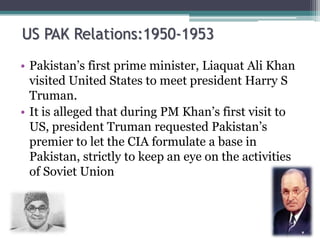
• Pakistan’s first prime minister, Liaquat Ali Khan
visited United States to meet president Harry S
Truman.
• It is alleged that during PM Khan’s first visit to
US, president Truman requested Pakistan’s
premier to let the CIA formulate a base in
Pakistan, strictly to keep an eye on the activities
of Soviet Union
• In 1954, Pakistan signed Mutual Defense
Assistance Agreement with the United States in
May.
• Establishment of a Military Assistance Advisory
Group (MAAG) in Rawalpindi.
• In 1956, President Dwight Eisenhower requested
prime minister Suhrawardy to lease Peshawar Air
Station to the American Army for keeping an eye
on soviet Union and its ballistic missile program.
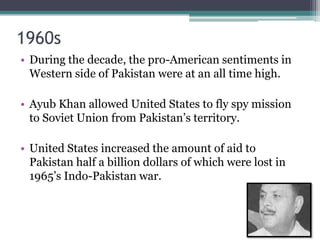
1960s
• During the decade, the pro-American sentiments in
Western side of Pakistan were at an all time high.
• Ayub Khan allowed United States to fly spy mission
to Soviet Union from Pakistan’s territory.
• United States increased the amount of aid to
Pakistan half a billion dollars of which were lost in
1965’s Indo-Pakistan war.
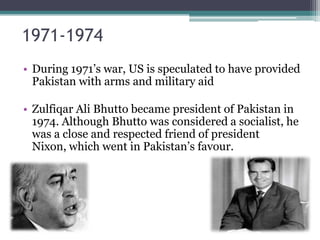
1971-1974
• During 1971’s war, US is speculated to have provided
Pakistan with arms and military aid
• Zulfiqar Ali Bhutto became president of Pakistan in
1974. Although Bhutto was considered a socialist, he
was a close and respected friend of president
Nixon, which went in Pakistan’s favour.
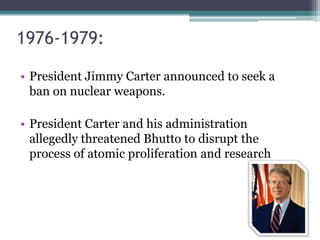
1976-1979:
• President Jimmy Carter announced to seek a
ban on nuclear weapons.
• President Carter and his administration
allegedly threatened Bhutto to disrupt the
process of atomic proliferation and research
1979-1988:
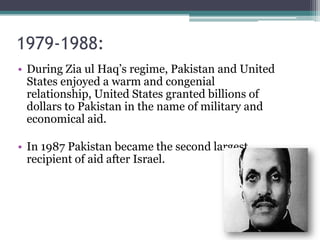
• During Zia ul Haq’s regime, Pakistan and United
States enjoyed a warm and congenial
relationship, United States granted billions of
dollars to Pakistan in the name of military and
economical aid.
• In 1987 Pakistan became the second largest
recipient of aid after Israel.
• In 1990, US under the Pressler amendment, imposed
sanctions on Pakistan, as the country by then had lost its
strategic importance in soviet war
• 1995, Benazir Bhutto visited United States and requested
president Bill Clinton to lift the embargoes on Pakistan and
launch a joint operation to eradicate militancy from the
region.
1990s
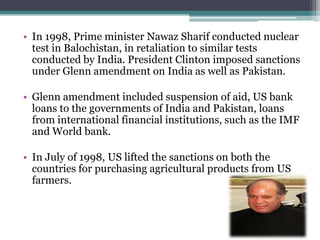
• In 1998, Prime minister Nawaz Sharif conducted nuclear
test in Balochistan, in retaliation to similar tests
conducted by India. President Clinton imposed sanctions
under Glenn amendment on India as well as Pakistan.
• Glenn amendment included suspension of aid, US bank
loans to the governments of India and Pakistan, loans
from international financial institutions, such as the IMF
and World bank.
• In July of 1998, US lifted the sanctions on both the
countries for purchasing agricultural products from US
farmers.
Pak US Relations After 9/11
• In 2001, after the 9/11 attacks and US’s invasion in
various countries to eradicate militancy, Pakistan
became one of the most important strategic allies for
United States.
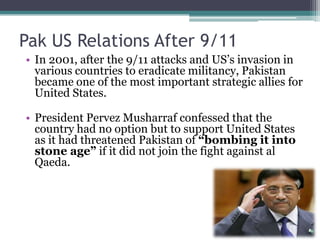
• President Pervez Musharraf confessed that the
country had no option but to support United States
as it had threatened Pakistan of “bombing it into
stone age” if it did not join the fight against al
Qaeda.
• 2003, United States officially forgave $1 billion
loan it had granted to Pakistan in a goodwill
gesture and appreciation for Pakistan’s
cooperation.
• 2004, President George Bush officially declared
Pakistan as a non-Nato ally granting it the
authority to purchase strategic and advanced
military equipments.
• US army launched drone strikes on the north-
western side of the country. Large civilian deaths
and caused much opposition from Pakistanis.
• 2007, A report was issued in which Pakistan was
accused of using aid money provided by US to
Pakistan for its cooperation on war on terror, for
strengthening its defense against India.
• In the June of 2008, an air strike by the US Army
killed 11 paramilitary soldiers of Pakistan Army
Frontier Corps, along with eight Taliban. The
strike and deaths instigated a fierce reaction from
Pakistani command calling the act to have shaken
the foundations of mutual trust and cooperation.
• In the beginning of 2011, Raymond Davis, a CIA
agent in Pakistan killed two Pakistani men in
Lahore, claiming that they came to rob him.
• In the May of 2011, Osama bin Laden was killed in
an operation conducted by US Navy Seals in
Abbottabad
• Pakistani government ordered US army to evacuate
Salala air base which was being used to launch
offensive on Taliban and militants and also halted
NATO supplies for United Sates.
• On May 18, US lawmakers block up to $650 million
in proposed payments to Pakistan unless Islamabad
lets coalition forces resume shipment of war
supplies across its territory.
• President Zardari arrived in Washington on May 19
to attend the NATO summit in Chicago.
However, both the countries were unable to strike a
conclusive deal on the restoration of NATO supplies
as the summit ended.
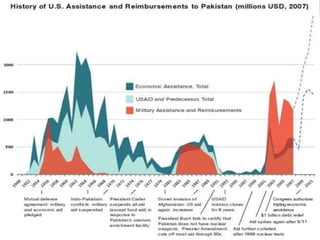
Highlights Of The US Aid To PAK
• US economic assistance to Pakistan peaked in 1962, at over
$2.3bn
• In 2010, military assistance to Pakistan totaled $2.5bn -
including $1.2bn in coalition support funds
• US assistance to Pakistan reached its lowest level in the
1990s, after President George H.W. Bush suspended aid flows
over Pakistan's emerging nuclear program.
• US military assistance dropped dramatically during and
immediately after the Indo-Pakistani wars of 1965 and 1971
• Since 1948, the US has sent more than £30bn in direct aid to
the country.
Comments on Pakistan by U.S.
• “Pakistan is like a black hole for American aid,”
• “We should cut Pakistan off of every cent because
it has been used for evil purposes, including
killing American troops”
Gary Ackerman.
• “The United States has been incredibly patient
with Pakistan. And we have been so despite
certain undeniable and deeply disturbing facts,”
• “The time has come for the United States to fully
review its relations with Pakistan. We must
assess the nature and levels of our support.”
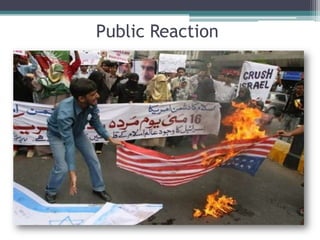
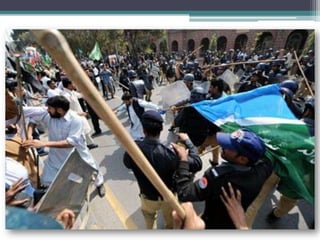
Public Reaction
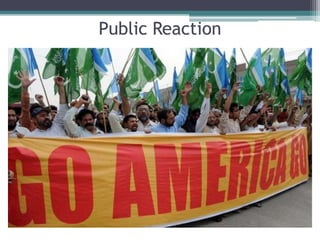
Public Reaction
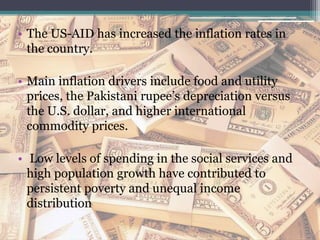
• The US-AID has increased the inflation rates in
the country.
• Main inflation drivers include food and utility
prices, the Pakistani rupee’s depreciation versus
the U.S. dollar, and higher international
commodity prices.
• Low levels of spending in the social services and
high population growth have contributed to
persistent poverty and unequal income
distribution
• Relationship depends on the convergence
of the national interest of both countries.
• The greater the convergence, the stronger
with this relationship be.
• US has been using Pakistan as an exit and
an entry to Afghanistan.
• US has always looked for its national
interest and its about time that Pakistan
does the same.
Conclusion
• The aid relationship between the united states
and Pakistan has been complicated, and even
dangerous, especially since September 11, 2001

Pak US relation 130411005046-phpapp01

  • 1.
  • 2.
    US-PAK Relations • UnitedStates of America remains one of the first countries to have established diplomatic ties with Pakistan. Although the relationship dates back to October 20, 1947, it can be extrapolated that the relations have been based strictly on military and economic support.
  • 3.
    US PAK Relations:1950-1953 •Pakistan’s first prime minister, Liaquat Ali Khan visited United States to meet president Harry S Truman. • It is alleged that during PM Khan’s first visit to US, president Truman requested Pakistan’s premier to let the CIA formulate a base in Pakistan, strictly to keep an eye on the activities of Soviet Union
  • 4.
    • In 1954,Pakistan signed Mutual Defense Assistance Agreement with the United States in May. • Establishment of a Military Assistance Advisory Group (MAAG) in Rawalpindi. • In 1956, President Dwight Eisenhower requested prime minister Suhrawardy to lease Peshawar Air Station to the American Army for keeping an eye on soviet Union and its ballistic missile program.
  • 5.
    1960s • During thedecade, the pro-American sentiments in Western side of Pakistan were at an all time high. • Ayub Khan allowed United States to fly spy mission to Soviet Union from Pakistan’s territory. • United States increased the amount of aid to Pakistan half a billion dollars of which were lost in 1965’s Indo-Pakistan war.
  • 6.
    1971-1974 • During 1971’swar, US is speculated to have provided Pakistan with arms and military aid • Zulfiqar Ali Bhutto became president of Pakistan in 1974. Although Bhutto was considered a socialist, he was a close and respected friend of president Nixon, which went in Pakistan’s favour.
  • 7.
    1976-1979: • President JimmyCarter announced to seek a ban on nuclear weapons. • President Carter and his administration allegedly threatened Bhutto to disrupt the process of atomic proliferation and research
  • 8.
    1979-1988: • During Ziaul Haq’s regime, Pakistan and United States enjoyed a warm and congenial relationship, United States granted billions of dollars to Pakistan in the name of military and economical aid. • In 1987 Pakistan became the second largest recipient of aid after Israel.
  • 9.
    • In 1990,US under the Pressler amendment, imposed sanctions on Pakistan, as the country by then had lost its strategic importance in soviet war • 1995, Benazir Bhutto visited United States and requested president Bill Clinton to lift the embargoes on Pakistan and launch a joint operation to eradicate militancy from the region. 1990s
  • 10.
    • In 1998,Prime minister Nawaz Sharif conducted nuclear test in Balochistan, in retaliation to similar tests conducted by India. President Clinton imposed sanctions under Glenn amendment on India as well as Pakistan. • Glenn amendment included suspension of aid, US bank loans to the governments of India and Pakistan, loans from international financial institutions, such as the IMF and World bank. • In July of 1998, US lifted the sanctions on both the countries for purchasing agricultural products from US farmers.
  • 11.
    Pak US RelationsAfter 9/11 • In 2001, after the 9/11 attacks and US’s invasion in various countries to eradicate militancy, Pakistan became one of the most important strategic allies for United States. • President Pervez Musharraf confessed that the country had no option but to support United States as it had threatened Pakistan of “bombing it into stone age” if it did not join the fight against al Qaeda.
  • 12.
    • 2003, UnitedStates officially forgave $1 billion loan it had granted to Pakistan in a goodwill gesture and appreciation for Pakistan’s cooperation. • 2004, President George Bush officially declared Pakistan as a non-Nato ally granting it the authority to purchase strategic and advanced military equipments. • US army launched drone strikes on the north- western side of the country. Large civilian deaths and caused much opposition from Pakistanis.
  • 13.
    • 2007, Areport was issued in which Pakistan was accused of using aid money provided by US to Pakistan for its cooperation on war on terror, for strengthening its defense against India. • In the June of 2008, an air strike by the US Army killed 11 paramilitary soldiers of Pakistan Army Frontier Corps, along with eight Taliban. The strike and deaths instigated a fierce reaction from Pakistani command calling the act to have shaken the foundations of mutual trust and cooperation.
  • 14.
    • In thebeginning of 2011, Raymond Davis, a CIA agent in Pakistan killed two Pakistani men in Lahore, claiming that they came to rob him. • In the May of 2011, Osama bin Laden was killed in an operation conducted by US Navy Seals in Abbottabad • Pakistani government ordered US army to evacuate Salala air base which was being used to launch offensive on Taliban and militants and also halted NATO supplies for United Sates.
  • 15.
    • On May18, US lawmakers block up to $650 million in proposed payments to Pakistan unless Islamabad lets coalition forces resume shipment of war supplies across its territory. • President Zardari arrived in Washington on May 19 to attend the NATO summit in Chicago. However, both the countries were unable to strike a conclusive deal on the restoration of NATO supplies as the summit ended.
  • 16.
    Highlights Of TheUS Aid To PAK • US economic assistance to Pakistan peaked in 1962, at over $2.3bn • In 2010, military assistance to Pakistan totaled $2.5bn - including $1.2bn in coalition support funds • US assistance to Pakistan reached its lowest level in the 1990s, after President George H.W. Bush suspended aid flows over Pakistan's emerging nuclear program. • US military assistance dropped dramatically during and immediately after the Indo-Pakistani wars of 1965 and 1971 • Since 1948, the US has sent more than £30bn in direct aid to the country.
  • 17.
    Comments on Pakistanby U.S. • “Pakistan is like a black hole for American aid,” • “We should cut Pakistan off of every cent because it has been used for evil purposes, including killing American troops” Gary Ackerman.
  • 18.
    • “The UnitedStates has been incredibly patient with Pakistan. And we have been so despite certain undeniable and deeply disturbing facts,” • “The time has come for the United States to fully review its relations with Pakistan. We must assess the nature and levels of our support.”
  • 19.
  • 20.
  • 22.
    • The US-AIDhas increased the inflation rates in the country. • Main inflation drivers include food and utility prices, the Pakistani rupee’s depreciation versus the U.S. dollar, and higher international commodity prices. • Low levels of spending in the social services and high population growth have contributed to persistent poverty and unequal income distribution
  • 24.
    • Relationship dependson the convergence of the national interest of both countries. • The greater the convergence, the stronger with this relationship be. • US has been using Pakistan as an exit and an entry to Afghanistan. • US has always looked for its national interest and its about time that Pakistan does the same. Conclusion
  • 25.
    • The aidrelationship between the united states and Pakistan has been complicated, and even dangerous, especially since September 11, 2001

Editor's Notes

  • #24 http://blogs.cgdev.org/mca-monitor/2010/08/pakistan-aid-facts.php