

The Color Wheel Presentation from: http://www.district87.org/bhs/art/Misukonis/ArtI/ColorWheel/ColorWheel.htm
History A color circle, based on red, yellow and blue, is traditional in the field of art. Sir Isaac Newton developed the first circular diagram of colors in 1666.
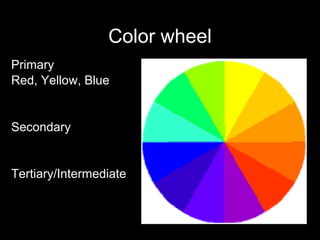
Color wheel Primary Red, Yellow, Blue Secondary Tertiary/Intermediate
Franz Marc The Blue Horse
The meaning of color Franz Marc believed that each color had a specific meaning. - from Franz Marc’s journal Blue - masculine, strength, youth, vitality Red - violence, power  Yellow - feminine, light, favoring green and blue Green - feminine, jealousy, anger Violet - pure, forgiving Orange - earth, sun, warmth
Other types of symbolism refer to nature Blue = sky, calming, water, soothing Green = vegetation, life, fertility Red = fire, blood, violence Etc….
Art and Design In visual experiences, harmony is something that is pleasing to the eye. It engages the viewer and it creates an inner sense of order, a balance in the visual experience.
Color Theory In traditional color theory, these are the 3 pigment colors that can not be mixed or formed by any combination of other colors. All other colors are derived from these 3 hues
Color Theory Studying, analyzing and using color in a specific way is  how we will apply color theory. You goal will be to use color to create interesting and dynamic artwork and compositions.
 
Mark Rothko is known for his  abstract artwork  described as fields of color. His style is somewhat loose and his forms are very similar, his work often creates a color environment for the viewer. Mark Rothko is an immigrated from Russia  in 1913 and studied at Yale university from 1921 – 1923; Rothko died in 1970
 
Color field art This type of artwork gained popularity in the  1960’s  and still continues to develop today.  It is based on using color as a  non-objective form of expression ; pure color.
 
About Rothko Rothko's abstractions were  deeply personal statements  that sought to provide a transcendental experience; he described his work as the  "simple expression of complex thought."  The late 1950s brought increasing recognition of his work along with several commissions for murals.
 
Helen Frankenthaler Color Field Artist
 
About Helen’s Work Working on the floor of her New York studio, Frankenthaler devised a unique technique using oil paint thinned to a watery consistency and alternately  pouring and dripping  the paint onto an unsized, unprimed canvas. As paint and plaster become one in the ancient technique of fresco, Frankenthaler's technique fused paint and canvas into a single entity.  The works evoke  strong feelings of emotion  and are often displayed in reverent, quiet and reflective locations.
 
 
Color Field painting Helen’s work gained popularity in 1952 and color field and abstract art continued to develop through the 1960’s and 70’s.  There are also many contemporary abstract and color field artists practicing today.


Terms and Definitions Take notes on the worksheet given to you. Completing the color worksheet correctly will count as a quiz grade.
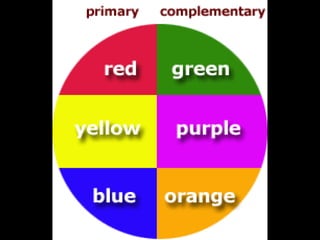
Primary Colors Primary - these are colors that cannot be mixed; Red, Yellow, and Blue These are the most important colors on the color wheel
 
Secondary Secondary - Orange  Green, and Violet  - these colors are mixed by adding two primary colors together.  Ex, yellow and red make orange
 
Tertiary or Intermediate Tertiary - Red-orange, yellow-orange, yellow-green, blue-green, blue-violet, red-violet;  when naming these colors the primary color comes before the secondary color. (the name also tells you how to mix it)
Neutrals Neutrals - these hues are not part of the color wheel but if certain colors are mixed together you can create a neutral. Ex. Red and green make brown Black, White,  Grey ,  Brown , and  Tan
Monochromatic Monochromatic - this means that you add black or white to a color to make a shade or a tint. (lighter or darker)
Analogous Analogous - colors that are adjacent (next to) each other on the color wheel.
Warm Warm - colors like red, orange, or yellow; might symbolize something being hot.
Cool Cool - colors like green, blue, or violet; might symbolize something being cold.
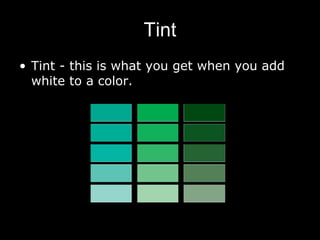
Tint Tint - this is what you get when you add white to a color.
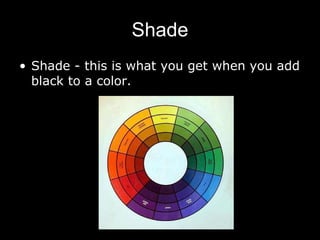
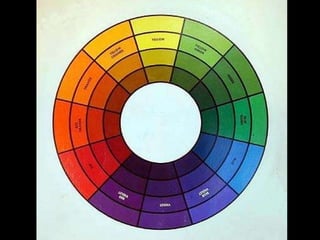
Shade Shade - this is what you get when you add black to a color.
Complement Complements - these colors are opposite each other on the color wheel. Ex. Red and Green, Blue and Orange, Yellow and Violet, etc…
 
 
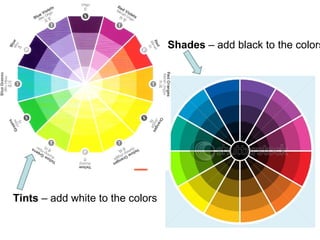
Tints  – add white to the colors Shades  – add black to the colors


Color wheelcompletepresentation

  • 1.
    The Color WheelPresentation from: http://www.district87.org/bhs/art/Misukonis/ArtI/ColorWheel/ColorWheel.htm
  • 2.
    History A colorcircle, based on red, yellow and blue, is traditional in the field of art. Sir Isaac Newton developed the first circular diagram of colors in 1666.
  • 3.
    Color wheel PrimaryRed, Yellow, Blue Secondary Tertiary/Intermediate
  • 4.
    Franz Marc TheBlue Horse
  • 5.
    The meaning ofcolor Franz Marc believed that each color had a specific meaning. - from Franz Marc’s journal Blue - masculine, strength, youth, vitality Red - violence, power Yellow - feminine, light, favoring green and blue Green - feminine, jealousy, anger Violet - pure, forgiving Orange - earth, sun, warmth
  • 6.
    Other types ofsymbolism refer to nature Blue = sky, calming, water, soothing Green = vegetation, life, fertility Red = fire, blood, violence Etc….
  • 7.
    Art and DesignIn visual experiences, harmony is something that is pleasing to the eye. It engages the viewer and it creates an inner sense of order, a balance in the visual experience.
  • 8.
    Color Theory Intraditional color theory, these are the 3 pigment colors that can not be mixed or formed by any combination of other colors. All other colors are derived from these 3 hues
  • 9.
    Color Theory Studying,analyzing and using color in a specific way is how we will apply color theory. You goal will be to use color to create interesting and dynamic artwork and compositions.
  • 10.
  • 11.
    Mark Rothko isknown for his abstract artwork described as fields of color. His style is somewhat loose and his forms are very similar, his work often creates a color environment for the viewer. Mark Rothko is an immigrated from Russia in 1913 and studied at Yale university from 1921 – 1923; Rothko died in 1970
  • 12.
  • 13.
    Color field artThis type of artwork gained popularity in the 1960’s and still continues to develop today. It is based on using color as a non-objective form of expression ; pure color.
  • 14.
  • 15.
    About Rothko Rothko'sabstractions were deeply personal statements that sought to provide a transcendental experience; he described his work as the "simple expression of complex thought." The late 1950s brought increasing recognition of his work along with several commissions for murals.
  • 16.
  • 17.
  • 18.
  • 19.
    About Helen’s WorkWorking on the floor of her New York studio, Frankenthaler devised a unique technique using oil paint thinned to a watery consistency and alternately pouring and dripping the paint onto an unsized, unprimed canvas. As paint and plaster become one in the ancient technique of fresco, Frankenthaler's technique fused paint and canvas into a single entity. The works evoke strong feelings of emotion and are often displayed in reverent, quiet and reflective locations.
  • 20.
  • 21.
  • 22.
    Color Field paintingHelen’s work gained popularity in 1952 and color field and abstract art continued to develop through the 1960’s and 70’s. There are also many contemporary abstract and color field artists practicing today.
  • 23.
  • 24.
  • 25.
  • 26.
  • 27.
  • 28.
  • 29.
    Terms and DefinitionsTake notes on the worksheet given to you. Completing the color worksheet correctly will count as a quiz grade.
  • 30.
    Primary Colors Primary- these are colors that cannot be mixed; Red, Yellow, and Blue These are the most important colors on the color wheel
  • 31.
  • 32.
    Secondary Secondary -Orange Green, and Violet - these colors are mixed by adding two primary colors together. Ex, yellow and red make orange
  • 33.
  • 34.
    Tertiary or IntermediateTertiary - Red-orange, yellow-orange, yellow-green, blue-green, blue-violet, red-violet; when naming these colors the primary color comes before the secondary color. (the name also tells you how to mix it)
  • 35.
    Neutrals Neutrals -these hues are not part of the color wheel but if certain colors are mixed together you can create a neutral. Ex. Red and green make brown Black, White, Grey , Brown , and Tan
  • 36.
    Monochromatic Monochromatic -this means that you add black or white to a color to make a shade or a tint. (lighter or darker)
  • 37.
    Analogous Analogous -colors that are adjacent (next to) each other on the color wheel.
  • 38.
    Warm Warm -colors like red, orange, or yellow; might symbolize something being hot.
  • 39.
    Cool Cool -colors like green, blue, or violet; might symbolize something being cold.
  • 40.
    Tint Tint -this is what you get when you add white to a color.
  • 41.
    Shade Shade -this is what you get when you add black to a color.
  • 42.
    Complement Complements -these colors are opposite each other on the color wheel. Ex. Red and Green, Blue and Orange, Yellow and Violet, etc…
  • 43.
  • 44.
  • 45.
    Tints –add white to the colors Shades – add black to the colors
  • 46.
  • 47.